Waitrose Psychology Audit — The Perfect Gift 2: A Beef Wellington, a Love Triangle and the Longest Christmas Ad in Britain
Waitrose turned a beef Wellington into a proposal in The Perfect Gift 2, a six-minute rom-com sequel starring Keira Knightley and Joe Wilkinson. A psychology audit of food as a love language, scored 85/100.

85 / 100
Overall consumer behavior effectiveness

Brand Overview
- Brand nameWaitrose
- Founded1904
- HeadquartersBracknell, Berkshire, and Victoria, London
- IndustryFood & Beverage
- Websitewww.waitrose.com ↗
Psychology Techniques Identified
- 01Narrative transportation (Green & Brock 2000; six-minute rom-com absorbs viewers)
- 02Parasocial relationships (Horton & Wohl 1956; Knightley as herself, Phil the everyman)
- 03Mere exposure (Zajonc 1968; returning cast, third Christmas of the same story-world)
- 04Nostalgia (Wildschut et al. 2006; rom-com genre, 'The Power of Love', Christmas wedding)
- 05Social comparison (Festinger 1954; Phil vs Hugo love triangle)
- 06Gift-giving as relationship work (Belk 1979; Sherry 1983; handmade Wellington as gift)
- 07Commensality / social eating (Dunbar 2017; cheese counter, shared pie, wedding feast)
- 08Loss aversion (Kahneman & Tversky 1979; three o'clock deadline, fear of losing Keira)
- 09Humour / incongruity (Martin & Ford 2018; A-lister falls for the everyman, played straight)
- 10Peak-end rule (Kahneman et al. 1993; cheeseboard ring ending)
- 11Scarcity & authority (Cialdini 2001; 'longest ad ever' framing, Prague Philharmonic, BAFTA-winning director)
- 12Sequel familiarity / demand-led storytelling (customers asked what happened next; 2025 film's 5.9 System1 stars)
Full Psychology Audit Report
In this audit
A beef Wellington slides down the aisle of a country wedding, followed by a jar of homemade sauce labelled “Marry Me Instead?”. The bride is Keira Knightley, in her own name. The groom is a handsome stranger who loves his own reflection more than his bride. And the man who made the Wellington has just burst through the doors, a year after he first met her over a piece of Sussex Charmer cheddar. This Waitrose psychology audit asks what happens when a supermarket stops advertising groceries and starts making a romantic comedy that Waitrose describes as six minutes long — and whether a sequel can turn last Christmas’s most loved supermarket advert into this Christmas’s most talked-about one.
Waitrose is a British supermarket chain founded in 1904, now part of the John Lewis Partnership, with about 320 shops as of July 2026 and 4.4% of British grocery spending in the twelve weeks to 4 October 2026. Its 2025 Christmas film, “The Perfect Gift”, earned the maximum 5.9 stars from System1 — the top-scoring supermarket Christmas advert of that year — and was named Britain’s favourite Christmas advert by Ipsos for three consecutive weeks. The sequel, “The Perfect Gift 2”, premiered on 10 November 2026, two minutes longer than the original, with the same two leads and a new love rival. It arrives in a crowded Christmas season: M&S’s 2026 “Home of Christmas” campaign, audited on this site on 9 November 2026, is the direct grocer rival, and sibling brand John Lewis’s 2026 Christmas advert, starring Dame Kristin Scott Thomas, drew criticism in press and social-media coverage. This audit asks what the sequel does to the mind of the viewer, how food became the brand’s love language, and whether a six-minute rom-com can carry a grocer that still holds only a small share of the market. One honest limit up front: the sequel premiered one day before this audit, so there is no independent effectiveness score for it yet. This audit scores the psychology of the film and the brand, not its outcome.
I am an Industrial and Organizational Psychologist in Karachi, and I audit brands by testing their claims against psychology research and their own public record. Where a legal matter is only an allegation or a letter, I keep it exactly that. Where a claim is the company’s own description, I will say so in the same sentence, not in a footnote. And where the company’s own record gives a strong welfare record on one page and a competition breach on another, I will show you both rather than pick the flattering one.
“Waitrose is not selling a beef Wellington in this film. It is selling the idea that food can say what words cannot — and that a handmade gift is worth more than a handsome rival.”
— Brand Psychology Analysis, ShahzebSpeaks
📋 Brand Overview
| Field | Detail |
|---|---|
| Brand | Waitrose & Partners (Waitrose Limited) — British supermarket chain |
| Founded | June 1904, at 263 Acton High Street, London, as Waite, Rose & Taylor; renamed Waitrose Ltd in 1908 |
| Headquarters | Bracknell, Berkshire, and Victoria, London |
| Parent | John Lewis Partnership — the UK’s largest employee-owned business; Waitrose joined the Partnership on 1 October 1937 (10 shops, 160 staff) |
| Stores & market share | About 320 shops as of July 2026; 4.4% of British grocery spending (Worldpanel by Numerator, 12 weeks to 4 October 2026; sales up 2.3% year on year) |
| Current campaign | “The Perfect Gift 2” — festive rom-com sequel, premiered 10 November 2026; Waitrose describes it as the longest advert ever produced by a UK supermarket |
| Website | https://www.waitrose.com |
| Psychology score | 85/100 |
Sources: Waitrose company history; John Lewis Partnership results; Worldpanel by Numerator. All figures as of 11 November 2026. The Partnership does not disclose a standalone Waitrose profit before tax, so no such figure is printed in this audit.
📜 Chapter 1: History — from one Acton shop to the home of food lovers
Waitrose began with three men and one shop. In June 1904, Wallace Wyndham Waite, Arthur Rose and David Taylor opened a grocery at 263 Acton High Street in London, trading as Waite, Rose & Taylor. Taylor left in 1906, and in 1908 Waite and Rose formed Waitrose Ltd. The shop grew slowly at first: by the time Waitrose celebrated 100 years of trading in 2004, it had grown from that one shop to 145 branches. The decisive turn came on 1 October 1937, when Waitrose joined the John Lewis Partnership — 10 shops and 160 staff — after Waite met Michael Watkins, the Partnership’s director of trading. Waite stayed with the business until retiring in 1940. The Partnership itself had been founded in 1929 by John Spedan Lewis, who settled the business in trust for its employees, with ownership passing to trustees for the benefit of employees under a second deed of settlement in 1950. Every member of Waitrose staff is still a “Partner” — a co-owner — under that model, and the Partnership has about 69,000 partners in total.
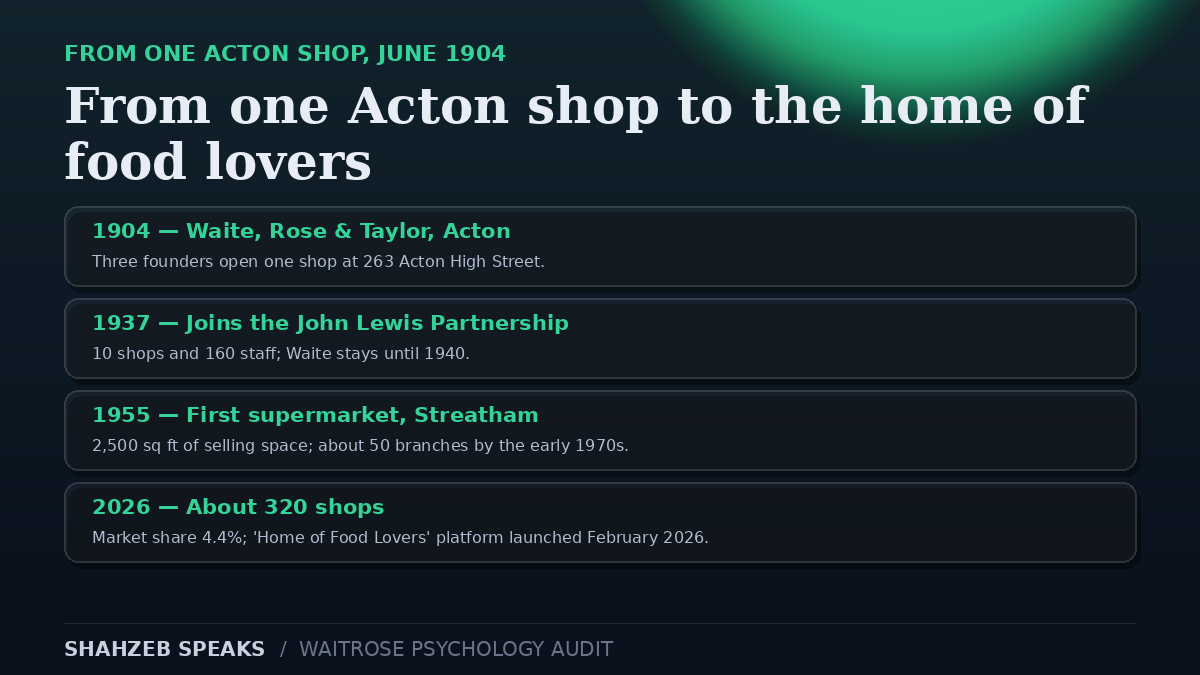
The next seventy years were a steady accumulation of firsts. In 1944 the Partnership bought the South Essex grocer Schofield and Martin, with 12 shops, and its Southend High Street shop converted to self-service in 1951, the first in the business. The first Waitrose supermarket opened in Streatham, south London, in 1955, with 2,500 square feet of selling space, and there were about 50 branches by the early 1970s. Counter service for fresh meat, fish and cheese arrived in 1981, and in 1983 Waitrose became the first major supermarket chain to sell organic food. In September 2009 came the exclusive deal with Duchy Originals, the organic food business founded by the then Prince of Wales in 1990; it relaunched in August 2010 as “Duchy Originals from Waitrose” and was renamed Waitrose Duchy Organic in summer 2015. The range has raised more than £30 million for The Prince of Wales’s Charitable Fund since 2009, a milestone reached by March 2021, when the latest yearly donation stood at £3.6 million. The value range “Essential Waitrose” launched in 2009, the premium “Waitrose 1” range arrived in 2016 and was rebranded as Waitrose & Partners No.1 in 2019, and in September 2018 Waitrose and John Lewis were rebranded together as Waitrose & Partners and John Lewis & Partners, in a joint campaign emphasising the employee-owned model. Waitrose holds a royal warrant to supply groceries, wine and spirits to King Charles III, and it was the first supermarket in the UK to launch a Bag for Life.
The recent chapter is one of deliberate premium positioning. In February 2026 Waitrose launched “The Home of Food Lovers” as its brand platform, with “The Gastronaut” campaign — a science-fiction advert following an astronaut, Michael, frustrated by space rations, returning home for his favourite prawn linguine — and it relaunched its Weekend newspaper as “Your Week In Food” on 4 February 2026. Behind the platform sits a £1 billion multi-year investment programme across shops, online and partnerships: 28 shop refurbishments planned in 2026, with 23 completed in 2025, and new stores including Chelmer Village, which opened on 10 July 2026. The No.1 range, the premium tier at the centre of the Christmas films, saw sales rise nearly 30% in 2025/26. The history matters for this audit because the film is not a new identity. It is a 122-year-old grocer telling the same story it has told since 1983 — that it cares about food more than its rivals do — in the longest form it has ever tried.
🎬 Chapter 2: The Perfect Gift 2 — the film itself
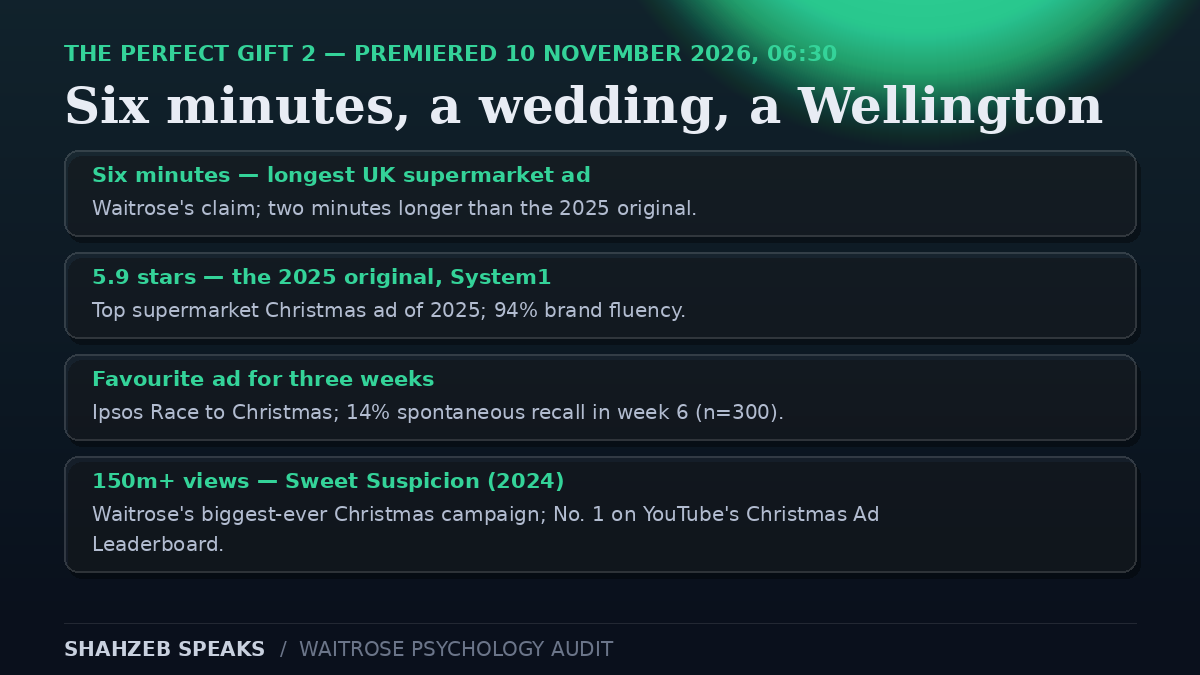
“The Perfect Gift 2” premiered on Waitrose’s YouTube channel and on Waitrose.com at 06:30 on Tuesday 10 November 2026. Waitrose describes it as six minutes long — two minutes longer than the 2025 original — and as the longest advert ever produced by a UK supermarket. Creative Review, which calls it “just under six minutes”, is the more cautious wording, and this audit keeps the claim where it belongs: as Waitrose’s description, not as a measured fact. A teaser had been released on 6 November 2026, showing Knightley in a wedding dress and veil, running barefoot through the supermarket aisles. The film was created by Wonderhood Studios, whose creatives were Jennifer Ashton and Oli Short, directed again by Molly Manners — described by Waitrose and trade press as BAFTA-award winning and the director of Netflix’s “One Day” — through Biscuit Filmworks, with media strategy, planning and buying by MG OMD. The wider campaign runs across television, video on demand, cinema, print, outdoor, audio, social, online, public relations and in-store, with 60- and 30-second movie-style trailers, romcom-inspired movie posters, a press junket, behind-the-scenes footage, bloopers and cooking content. Viewers can watch the film at www.waitrose.com/theperfectgift.
The plot, from the official synopsis as reported by British Comedy Guide, is a full romantic comedy in miniature. Keira is due to marry Hugo at three o’clock — but not Phil. Hugo, played by Alex Hassell, is “more in love with his own reflection than his bride-to-be, treating his own wedding as a photoshoot in which he’s the star”. Across town, Phil is heartbroken, bearded, living in his dressing gown, his only confidants a pack of Waitrose No.1 Handmade Polar Bear Bao Buns. His friends arrive with Waitrose bags and a plan: he bakes the beef Wellington of his life. He races to the wedding — a flat tyre, a dog with a keen sense of smell, a stately home full of stairs — bursts through the doors, and the Wellington slides down the aisle to Keira’s feet, followed by a jar of homemade sauce labelled “Marry Me Instead?”. Hugo is furious, Keira speechless, Phil is ushered out. In the end Keira swaps the wedding aisle for the man she met in the Waitrose aisle and gets down on one knee with a cheeseboard ring, Phil’s “Marry Me Instead” jar as the diamond. “Because a true food match really is the perfect gift. And handmade beats handsome every time.”
Green and Brock (2000), in their work on narrative transportation, showed that when people are absorbed into a story, they stop arguing with it: transportation lowers counter-arguing and transfers the beliefs of the story to the world outside it. That is the mechanism a six-minute advert is buying. A thirty-second spot can show a product; a six-minute film can absorb a viewer. The music is chosen for the same effect: an original score recorded by the Prague Philharmonic Orchestra, with the film closing on Jennifer Rush’s “The Power of Love”, and the 60- and 30-second trailers narrated by Gary Martin, best known as the voice of the Honey Monster. The food is never a prop. No.1 Handmade Polar Bear Bao Buns, the beef Wellington, No.1 Ham & Cheese Croissant Stacks and No.1 Pistachio & Sour Cherry Frangipane Mince Pies are all named products in the story, and each one is a product a viewer can buy. The risk of a six-minute advert is the same as its reward: if the viewer is transported, the brand rides along for six minutes. If they are not, six minutes is a very long time to ask someone to watch an advert.
🎭 Chapter 3: Parasocial casting — Keira, Phil and the man who loves himself
Horton and Wohl (1956), who coined the term parasocial interaction, described the one-sided intimacy audiences form with media figures: viewers respond to a performer as if they knew them, and the relationship feels real even though it is not returned. Waitrose has built its Christmas campaign on exactly that feeling, and it has done so by casting against type in both directions. Keira Knightley plays herself — a Hollywood star, in her own name, shopping at a supermarket cheese counter. Joe Wilkinson plays Phil, the “everyman” he first played in the 2024 whodunnit “Sweet Suspicion”, an ordinary man in a dressing gown who loves a film star. Alex Hassell, new for the sequel, plays Hugo Bunty-Griffin, Keira’s groom-to-be: handsome, polished and, in Hassell’s own words, “a man in love… but really only with himself!”
The casting works because the parasocial bond runs in two directions at once. Knightley invites the viewer into a fantasy — what if a film star shopped where you shop? — while Wilkinson invites the viewer into an identification: Phil is the person the viewer could be, the one who has to win her back with a pie rather than a fortune. Knightley herself said: “I always felt last year’s love story deserved another chapter… I wasn’t expecting to find myself caught between two men and a beef Wellington!” Wilkinson said: “Chuffed to be back for the sequel. If a beef Wellington doesn’t win back the heart of a Hollywood A-lister, nowt will.” The joke lands because the viewer already knows both of them. This is the third Christmas in a row that Wilkinson’s Phil has appeared in a Waitrose campaign, and the second with Knightley. Parasocial relationships deepen with repetition, and Waitrose is spending its third year on the same two people rather than starting over with new faces.
The risk is that the trick depends on the viewer liking Phil more than Hugo, and on Knightley remaining willing to play herself. Hugo is written as the man the viewer is meant to reject — vain, self-absorbed, treating his own wedding as a photoshoot — which makes the choice easy, but also makes it a little too easy. A love triangle only works if both rivals are plausible, and Hugo is designed to lose. That is good for the advert’s message and slightly weak for its drama. The stronger point is the continuity: a supermarket that keeps the same characters for three Christmases is treating its advertising as a story the audience follows, not a message it repeats. That is rare in grocery advertising, and it is the reason the sequel was demanded rather than merely scheduled.
🔁 Chapter 4: Mere exposure and the sequel — why familiarity was the brief
Zajonc (1968), in his mere exposure research, showed that people tend to develop a preference for things simply because they are familiar with them: repeated exposure, on its own, increases liking. The Perfect Gift 2 is a deliberate test of that finding. The audience has now spent three Christmases with Phil. In 2024, the two-part whodunnit “Sweet Suspicion”, created by Saatchi & Saatchi and directed by Lucy Forbes, amassed over 150 million views across social, television and digital channels, making part one Waitrose’s biggest-ever Christmas campaign, and ranked Number One on YouTube’s Christmas Ad Leaderboard. Over 90% of Waitrose customers guessed the wrong culprit — Fig the Cat was the top suspect at 18% — and the missing item was the No.1 Red Velvet Bauble Dessert, stolen by Steve, the devoted cook. In 2025, Wonderhood Studios took over the Christmas account and made the first “Perfect Gift”: a four-minute rom-com short that premiered on YouTube at 00:01 on 12 November 2025, created by Wonderhood, directed by Molly Manners and produced by Biscuit Filmworks, with media by MG OMD.
The 2025 film was the most effective supermarket Christmas advert of its year by independent testing. System1 gave it the maximum 5.9 stars — the top-scoring supermarket Christmas advert of 2025 and joint-second overall in the 2025 Christmas leaderboard — with 94% of viewers realising it was for Waitrose, and the top emotions “amused” and “uplifted”. System1 notes that only about 1% of Christmas adverts it tests earn five stars. Ipsos, in its “Race to Christmas” tracker, named Waitrose the nation’s favourite Christmas advert for three consecutive weeks, weeks four to six, with 14% of respondents naming it spontaneously in week six, in a sample of 300 UK adults fielded on 12 December 2025. Recognition from de-branded stills was 53% in week six, behind Aldi’s 55%. Richard Curtis, of Love Actually and Four Weddings and a Funeral, called the film “sweet as pie”. Waitrose’s own verdict, from Alia Ahmad, Partner and Advertising Senior Manager, was that the campaign “broadened our appeal, presenting our premium food as the ‘love language’ facilitating connection this Christmas” and drove “extremely high engagement across all channels”. Wonderhood’s Nick Exford said the response “has driven Waitrose’s highest talkability in over a decade”.
That record is why the sequel exists, and why it is a demand-led follow-up rather than a fresh gamble. Nathan Ansell, Waitrose Chief Customer Officer, said: “Last year’s The Perfect Gift sparked a huge reaction, and our customers were clear: they wanted to know what happened next. So this Christmas we’ve given them a bigger, bolder sequel, with a love rival, a race against the clock and a beef Wellington as an unlikely hero. Every great romcom needs a moment where all seems lost, and ours just happens to be wrapped in pastry.” He added: “Last year demonstrated that emotional, entertainment-first storytelling effectively cuts through the festive noise, builds strong brand affinity, and creates genuine cultural momentum.” Wonderhood’s executive creative directors have been frank that a sequel can look like the safe choice but is a harder task: audience reactions argued for it, but the new story had to offer enough reasons to return, so the sequel changes the relationship and puts Keira in a more vulnerable position than in the first film. The risk is sequel fatigue, and it is untested: no independent effectiveness score for the sequel existed as of 11 November 2026, and no first-day viewing figure was published. Mere exposure helps only while the audience still wants more. The 2024 whodunnit and the 2025 rom-com both earned their return. The 2026 film has to earn its own.
🍽️ Chapter 5: Food as love language — the gift you can eat
Belk (1979), in his work on gift-giving behaviour, argued that a gift signals effort, care and identity: what you give says who you are and how much the other person matters. Sherry (1983), writing on gift-giving as a social ritual, made the same point from the anthropologist’s side: gifts do relationship work, and the “perfect gift” is a social bond made visible. Waitrose has built its whole Christmas strategy on that idea, and its own managers say so in plain words. Alia Ahmad called the brand’s premium food “the ‘love language’ facilitating connection this Christmas”. Director Molly Manners said: “We played every moment completely straight, giving Phil’s increasingly desperate mission the full cinematic treatment. And beneath all the chaos, there’s a genuine story about how food can say what words sometimes can’t.”
The story proves the point three times over. In the 2025 film, Phil wins Keira back by baking her grandmother’s turkey pie, after meeting her at the cheese counter over Sussex Charmer mature cheddar. In the sequel, the gift is bigger and harder: the beef Wellington of his life, carried through a flat tyre, a dog and a flight of stairs to a wedding at three o’clock. And the ending makes the gift literal — Keira proposes with a cheeseboard ring, Phil’s “Marry Me Instead” jar as the diamond. Dunbar (2017), in his research on commensality, showed that eating together builds social bonds: shared meals are one of the oldest ways humans make and keep relationships. The film stages that finding at every turn — the cheese counter, the shared pie, the wedding feast, the friends who arrive with Waitrose bags and a plan. Food is the plot, not the backdrop, and that is the difference between this campaign and most grocery advertising, where food is shown and then forgotten.
The commercial logic is straightforward. Every food item in the film is a named Waitrose product, led by the No.1 range, whose sales rose nearly 30% in 2025/26. The campaign’s wider 360 activity includes cooking content and product adverts featuring the cast, so the viewer who wants to copy Phil can buy the ingredients to do it. The risk is that the idea is easy to copy and hard to own: every grocer can say food is love. What Waitrose owns is the evidence — two years of a story in which food actually does the loving, and a brand platform, “The Home of Food Lovers”, launched in February 2026, that says the same thing in every other channel. The film and the platform agree with each other, and that agreement is worth more than either one alone.
💭 Chapter 6: Nostalgia — the rom-com you have already seen, and loved
Wildschut, Sedikides, Arndt and Routledge (2006), in their research on nostalgia, showed that nostalgia is typically triggered by negative feelings such as loneliness, and that it serves functions of social connectedness, self-continuity and meaning: it reminds people who they are and who they belong to. “The Perfect Gift 2” is built on that mechanism from its first frame. It is a romantic comedy, the genre Richard Curtis made the default language of British Christmas, and Curtis himself blessed the 2025 original by calling it “sweet as pie”. The sequel’s wedding, the race against the clock, the handsome rival who loses to the ordinary man, the proposal at the end — these are scenes the viewer has seen before, in films they loved, and the familiarity is the point. Nostalgia does not need accuracy. It needs a feeling, and the film supplies one generously.
The music does the same work. The film closes with Jennifer Rush’s “The Power of Love”, a song the audience already knows, over an original score recorded by the Prague Philharmonic Orchestra. The trailers are narrated by Gary Martin, best known as the voice of the Honey Monster — another sound from the viewer’s past, used without explanation. Even the film’s marketing borrows from memory: it was launched like a film release, with 60- and 30-second trailers and romcom-style posters, just as the 2025 original was. The risk in nostalgia is that it can feel borrowed rather than earned. Waitrose earns it, just about, because the nostalgia is attached to something the brand actually does: it sells the food in the film, in shops the viewer can walk into. The film remembers a past the viewer loves, and then gives them a way to buy a piece of it. That is nostalgia with a till at the end of it.
⚖️ Chapter 7: Social comparison and loss aversion — the rival, the clock and the three o’clock deadline
Festinger (1954), in his theory of social comparison, argued that people evaluate themselves by comparing themselves with others, and that the comparison shapes what they want and what they fear. The love triangle is that theory in costume. Phil is the everyman: bearded, heartbroken, living in his dressing gown, his only confidants a pack of No.1 Handmade Polar Bear Bao Buns. Hugo is his opposite: handsome, polished, in love with his own reflection, treating his own wedding as a photoshoot in which he is the star. The viewer is invited to compare the two men and to choose, and the film makes the choice easy by making Hugo vain. That is the film’s weakest piece of psychology, because a comparison only matters if both sides are plausible, and Hugo is designed to lose. But it is also the film’s most effective piece of casting, because the comparison flatters the viewer: most of us are Phil, not Hugo, and the film tells us Phil wins.
Kahneman and Tversky (1979), in prospect theory, showed that losses loom larger than gains: the fear of losing something matters more than the pleasure of gaining it. The film gives that fear a deadline. Keira is due to marry Hugo at three o’clock, and Phil has until then to stop it. The race — the flat tyre, the dog with a keen sense of smell, the stately home full of stairs — is a list of small losses threatening a large one, and the Wellington sliding down the aisle is the moment the loss is either prevented or confirmed. The deadline is what makes a six-minute film feel urgent rather than long. Without three o’clock, the film would be a pleasant story. With it, the viewer is counting the minutes alongside Phil, and the beef Wellington becomes urgent rather than merely appetising. The lesson for any brand is simple: a deadline turns a preference into a decision, and a decision is what a Christmas campaign needs.
😄 Chapter 8: Humour — the joke is that nobody laughs
Martin and Ford (2018), in their work on the psychology of humour, describe incongruity as one of the main sources of laughter: humour comes from the clash between what is expected and what actually happens. “The Perfect Gift 2” is built on a single incongruity, played completely straight. A Hollywood film star falls for a gormless everyman in a dressing gown. A beef Wellington becomes the hero of a wedding. A jar of homemade sauce becomes an engagement ring. None of it is played for laughs in the film itself. As director Molly Manners put it: “We played every moment completely straight, giving Phil’s increasingly desperate mission the full cinematic treatment.” The straight face is the joke, and it works because the viewer supplies the laughter the characters refuse to give.
The humour also does a job that a straight advert could not. A supermarket telling you its beef Wellington is excellent is a claim, and claims invite scepticism. A supermarket showing you a man who believes a beef Wellington can win back a Hollywood star is a story, and stories invite the viewer to go along with them. Wilkinson’s own line carries the same tone: “Chuffed to be back for the sequel. If a beef Wellington doesn’t win back the heart of a Hollywood A-lister, nowt will.” The line is funny because it is modest about something absurd, and the modesty is the brand’s voice: Waitrose is the premium grocer that lets its hero be an ordinary man in a dressing gown rather than a chef in whites. The risk is that incongruity humour has a short shelf life. The first time, the Wellington sliding down the aisle is a surprise. The second time, it is a reference. Waitrose has two more Christmases of goodwill in this story-world at most before the joke needs a new incongruity, and the sequel already spends most of its best one.
🎯 Chapter 9: The peak-end rule — the cheeseboard ring is the memory
Kahneman, Fredrickson, Schreiber and Redelmeier (1993) showed that people judge an experience largely by how it felt at its most intense moment and at its end, rather than by the sum or average of the whole — the peak-end rule. The film is structured around that rule. Its peak is the Wellington sliding down the aisle to Keira’s feet, with the jar of homemade sauce labelled “Marry Me Instead?” following it. Its end is the proposal in reverse: Keira swaps the wedding aisle for the man she met in the Waitrose aisle and gets down on one knee with a cheeseboard ring, Phil’s “Marry Me Instead” jar as the diamond. A viewer who forgets the middle of the film — the flat tyre, the dog, the stairs — will still remember the Wellington and the ring, and those two moments will stand in for the whole six minutes. That is the point of the tagline the film leaves behind: “Because a true food match really is the perfect gift. And handmade beats handsome every time.”
The peak-end rule is also the reason the sequel’s length is a gamble worth taking. A four-minute film in 2025 had one peak and one ending. A six-minute film in 2026 has room for a bigger peak — a wedding, a race, a rival — and a warmer ending, and the extra two minutes exist to earn both. The danger is the middle: a longer film has more minutes that the viewer will not remember, and a peak that arrives late can feel unearned. Waitrose’s answer is to make the middle a series of small peaks — the friends arriving with Waitrose bags, the baking of the Wellington, the race itself — so that the film never goes long without a moment worth remembering. If the audience remembers the ring and the jar, the film has done its job, and the brand will be remembered with them.
👑 Chapter 10: Scarcity and authority — the longest advert, the philharmonic and the limited range
Cialdini (2001), in his work on influence, identified scarcity and authority as two of the most reliable persuaders: people want what is rare, and they trust what an expert endorses. Waitrose uses both, and the sequel uses both. The scarcity is in the framing itself. Waitrose describes the film as the longest advert ever produced by a UK supermarket, and the claim — printed here only as Waitrose’s description — makes the film feel like an event rather than an advert: something made once, at unusual length, that you should watch while it matters. The festive range works the same way. The No.1 Handmade Polar Bear Bao Buns, the Ham & Cheese Croissant Stacks and the Pistachio & Sour Cherry Frangipane Mince Pies are Christmas products, available for a season, and the film’s job is to make the viewer want them before they disappear.
The authority is in the credits. The film is directed by Molly Manners, described by Waitrose and trade press as BAFTA-award winning and the director of Netflix’s “One Day”, through Biscuit Filmworks, with an original score recorded by the Prague Philharmonic Orchestra. The authority is also in the brand’s own record: a royal warrant to supply groceries, wine and spirits to King Charles III; the first UK supermarket to meet the Better Chicken Commitment across all own-brand chicken, by the end of August 2025, ahead of the 2026 industry deadline; and a September 2026 animal welfare policy stating that 100% of livestock supplying its meat, poultry, eggs, milk, fish and seafood are reared to higher welfare standards, with all eggs 100% free-range since 2009. The risk in scarcity is that it has to be real. A “longest ever” claim that turns out to be wrong would damage the authority it was meant to build, which is why this audit prints it only as Waitrose’s claim, with Creative Review’s “just under six minutes” alongside it. The risk in authority is the same: a brand that borrows the Prague Philharmonic and a BAFTA-winning director must make a film worthy of them. On the evidence of the first day’s warm press reaction, it has.
⚠️ Chapter 11: Dark side & regulatory record — exactly what is known
Every legal statement in this chapter is written at its exact status, as of 11 November 2026. A breach of an order is a breach of an order. An upheld complaint is an upheld complaint. A legal letter is a legal letter, not a lawsuit. An allegation that was denied is an allegation, not a finding. I have scoped this chapter to the record types actually checked: regulator enforcement, court judgments and trademark matters, searched under the names Waitrose, Waitrose Limited, Waitrose & Partners, Waite, Rose & Taylor, John Lewis Partnership and John Lewis Partnership plc. What follows is what those searches found — and, at the end, what they did not cover.
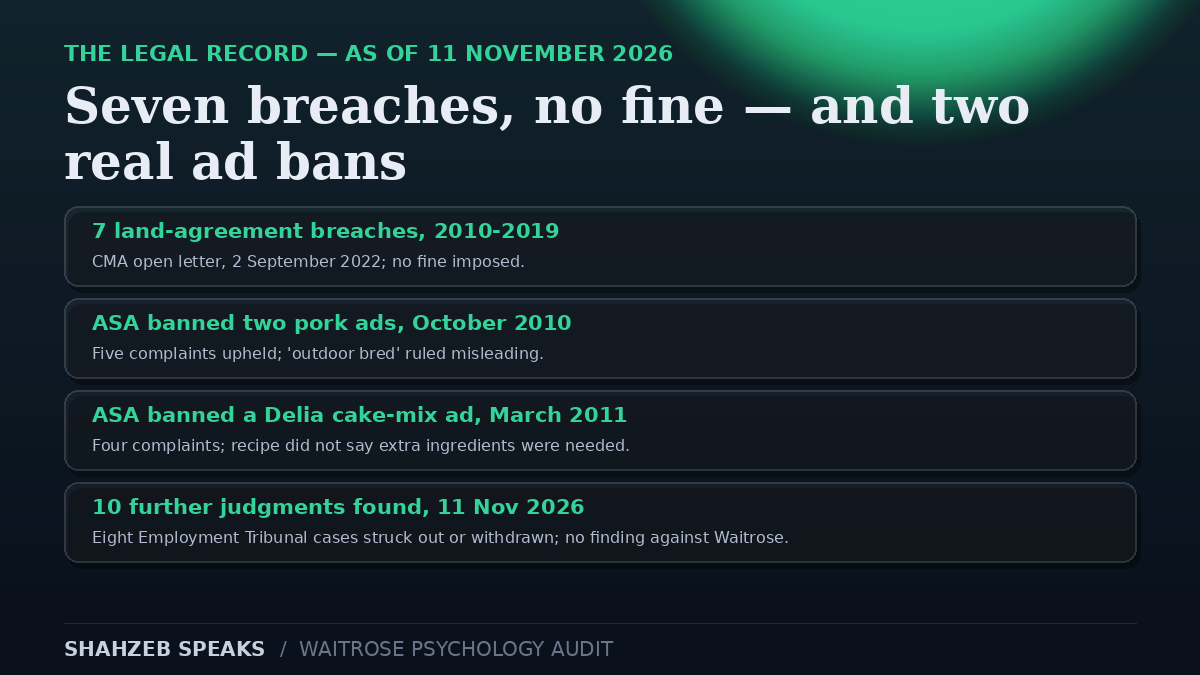
The competition record is the most serious item, and it is also the most often misdescribed. On 2 September 2022, the Competition and Markets Authority published an open letter to Waitrose after Waitrose’s own review of its land agreements — requested by the CMA in February 2020, following Tesco’s 23 breaches — found seven breaches of the Groceries Market Investigation (Controlled Land) Order 2010, between 2010 and 2019. The breaches were restrictive terms in land agreements around seven stores — Bromsgrove, Rustington, Swindon, Daventry, Chester, Notting Hill Gate and Market Harborough — that prevented landlords from letting nearby premises to rival supermarkets. Five breaches were no longer ongoing; two remained ongoing at the time. The outcome was an open letter, not a penalty: no fine was imposed. The CMA wrote expressing concern, Waitrose agreed to remove the restrictive terms and said it had “identified and addressed a small number of historic errors” but did not believe it had enforced them to stop new shops opening. The CMA’s senior remedies director, Adam Land, said: “It’s disappointing that Waitrose has acted against the interests of shoppers, despite these rules having been in place for over 10 years.” This was a breach of an Order, established by the CMA. It was not a fine, not a court ruling and not a criminal offence, and this audit will not call it one.
The advertising record has two real bans. In October 2010, the Advertising Standards Authority upheld five complaints and banned two television adverts and one press advert for Waitrose pork featuring Heston Blumenthal and Delia Smith. The adverts said the pork came from “outdoor bred” pigs; the ASA ruled viewers were likely to understand that to mean the pigs spent their whole lives outdoors, which was not the case — the pigs were reared indoors after weaning. The ASA found a breach of BCAP Code rule 5.1.1 on misleading advertising and CAP Code clause 7.1 on truthfulness. Waitrose said it was “very disappointed”, calling it a dispute about accepted farming-industry terminology. In March 2011, the ASA banned a Waitrose Christmas cake-mix advert featuring Delia Smith after four complaints, ruling it misleading because it did not make clear that additional ingredients were also required to complete the recipe. Two later cases show the other side of the record. In 2014, a television and cinema advert claiming “Everyone who works at Waitrose owns Waitrose” drew 267 complaints, from viewers who said some services, like cleaning, were outsourced; the case was resolved without full investigation after Waitrose agreed to amend the advert, which is not an upheld ruling. In May 2002, the ASA did not uphold a complaint about a Waitrose leaflet headed “Our Price Commitment to You” promising “the best products at the very best prices”, finding the claim would not be understood to mean literally all prices were cheaper than competitors’. In 2005, Waitrose itself complained to the ASA about Sainsbury’s “Fresh to Sainsbury’s” price-comparison adverts; the ASA decided the complaint would not be processed for formal adjudication, but told Sainsbury’s to show its standard price clearly in the body copy rather than small print. No Waitrose ASA ruling from 2012 to 2026 was found in the searches run on 11 November 2026, but that search covered web searches of asa.org.uk and trade-press reporting — the ASA rulings database was not searched directly, so the record cannot be called complete.
The trademark record is a letter and an allegation, and neither became a case. In March and April 2022, Waitrose sent a legal letter to Asda after Asda launched its “Just Essentials” discount range, saying the branding was too similar to Waitrose’s “Essential Waitrose” range, launched in 2009. Waitrose said it was awaiting a response, and that if its concerns were not met, the two “could end up fighting it out in court”. No court filing and no outcome was found in the searches run on 11 November 2026. This is a legal letter, not a lawsuit, and this audit will not call it a court case. In May and June 2018, Hotel Chocolat alleged Waitrose had copied the design of its chocolate slab bars — the same size, the same wavy edges — relying on a registered EU design, registration 001438378-0011. Hotel Chocolat wrote to Waitrose asking it to remove the bars from sale. Waitrose denied any copying or infringement. No court proceedings or outcome was found. This is an allegation and a denied claim, not a finding. In the United States, the WAITROSE word mark is registered on the Principal Register, registration 5220699, filed on 20 May 2015, registered on 13 June 2017 and published for opposition on 23 August 2016, with no opposition outcome stated in the listing.
The court record involves the Partnership rather than Waitrose trading, and each case must be read for what it actually decided. In Juj v John Lewis Partnership plc [2023] EWCA Civ 1507, the claimant sought damages for personal injury after a fall in a car park next to the Waitrose store in Ruislip on 17 May 2015, alleging breach of duty under the Occupiers’ Liability Act 1957. Judgment was entered for the defendant at trial and on first appeal, and the Court of Appeal dismissed the claimant’s second appeal, holding that the trial judge’s finding — that the claimant saw the kerb, tried to step on it and misjudged — was fatal to the claim. The claim was dismissed; no liability was found against the Partnership. In John Lewis Partnership v Charman (Employment Appeal Tribunal, 24 March 2011), the Partnership appealed an Employment Tribunal decision that a summarily dismissed employee’s unfair-dismissal claim, presented outside the three-month limit, could still be heard because it had not been reasonably practicable to present it earlier, as he awaited an internal appeal. The Employment Appeal Tribunal dismissed the Partnership’s appeal and upheld the Tribunal’s jurisdiction ruling. This is a procedural time-limit decision, not a finding on the dismissal itself. In Richards v John Lewis Partnership (Employment Tribunal, judgment 20 June 2019), the unfair-dismissal complaint was struck out because the claimant had under two years’ service under section 108 of the Employment Rights Act 1996; the disability-discrimination claim was expressly unaffected by the judgment. In Secretary of State for Transport v John Lewis Partnership Pensions Trust [2026] UKUT 78 (LC), an HS2 compulsory-purchase case about the basis on which land formerly owned by the Partnership’s Pension Fund — a distribution warehouse near Old Oak Common — should be valued, the dispute concerned pension-fund land, not Waitrose trading, and is a valuation dispute, not a finding against Waitrose.
Live searches of the official databases on 11 November 2026 added ten further judgments in which Waitrose is named as a party. Chiu & Ors v Waitrose Ltd & Ors [2011] EWHC 1356 (TCC), 25 May 2011, was a procedural judgment — relief from sanctions was granted to the second defendant, Wates — and it makes no finding of liability against Waitrose. Juj v John Lewis Partnership PLC [2022] EWHC 2418 (KB), 30 September 2022, is the earlier judgment in the same proceedings as the 2023 Court of Appeal case above: the appeal was dismissed. The other eight are Employment Tribunal judgments, and none of them made a finding against Waitrose: Mr N Thomas v Waitrose [2024] UKET 2303138/2023 (race discrimination, unfair dismissal and holiday pay — claim struck out for non-compliance with tribunal orders and for not being actively pursued); Miss C Stopford v Waitrose Surbiton [2018] UKET 2303727/2017 (unfair-dismissal complaint struck out, under two years’ service; the claimant’s other complaints were not affected); Mrs P Quinlan v Waitrose Ltd [2020] UKET 3320783/2019 (proceedings dismissed after the claimant withdrew the claim); Mr D Grayson v Waitrose Ltd [2021] UKET 2409751/2020 (claim struck out as not actively pursued); Miss J K Scantlebury v Waitrose plc [2025] UKET 2305567/2024 (age discrimination — claim struck out for non-compliance and for not being actively pursued); A v Waitrose & Partners [2020] UKET 1405262/2018 (public interest disclosure — proceedings dismissed after withdrawal); Ms R Bakali v Waitrose Superstores Ltd [2017] UKET 2205998/2017 (unfair dismissal and working time — claims struck out, no jurisdiction and out of time); and Mrs D Hobbis v Waitrose Ltd [2018] UKET 3331723/2018 (disability discrimination — proceedings dismissed after withdrawal). One further case, Truro City Council v Cornwall City Council [2013] EWHC 2525 (Admin), lists Waitrose as a joint applicant for planning permission, but Waitrose took no part in the judicial-review proceedings and no final outcome is visible in the text read.
Two limits must be stated plainly, because they are the difference between an honest chapter and a misleading one. First, the ICO enforcement database was searched directly on 11 November 2026: the keyword “Waitrose” returned no matching results — no enforcement notice, monetary penalty, reprimand or prosecution was found in that listing, although the search covers the enforcement-action listing only, not decision notices, audits, complaints or the data-protection register. The UKIPO trade mark decisions database was also searched directly: zero Hearing Officer decisions were found for “Waitrose Limited”, “Waitrose”, the mark “Waitrose”, or “John Lewis Partnership” — a search that covers Hearing Officer decisions since 1998, not the trade mark register, Appointed Person decisions or court intellectual-property cases. The BAILII and Find Case Law searches were keyword searches, not structured party-name searches, and Find Case Law’s archive is incomplete: a case that names only John Lewis Partnership and never mentions “Waitrose” would not be surfaced — Charman and Richards are proven examples of that gap — and County, Crown and Magistrates’ court judgments are not routinely covered. No Waitrose-specific food-safety prosecution or product-safety case was found in the web searches run on 11 November 2026, but the Food Standards Agency enforcement listings and Companies House filings were not searched directly, so this chapter does not claim that no court case was found. Second, a small piece of Partnership history is worth one sentence as colour, and no more: John Lewis, the founder, was imprisoned for three weeks in Brixton in 1903 for defying a court order obtained by his landlord Lord Howard de Walden, and was found guilty of libel in 1911 with damages of a farthing. That is nineteenth- and early-twentieth-century Partnership history, not a Waitrose matter, and it is not a Waitrose legal finding. The honest reading of the record is that Waitrose’s legal history is real but modest: one competition breach with no fine, two advertising bans more than a decade old, a denied allegation and an unanswered legal letter, and a court record that dismisses claims rather than finding liability. None of that makes the Christmas film worse. It makes the brand behind it a real company, with a real record, rather than a fairy tale set in a wedding.
🇵🇰 Chapter 12: What Pakistani brands should — and shouldn’t — copy
Pakistani brands should copy three things. First, the single story. Waitrose’s Christmas campaign is one film, one idea and one love triangle, expressed across television, cinema, print, outdoor, audio, social, online and in-store. A Pakistani brand with a strong seasonal moment — Eid, Ramadan, a wedding season — should build one idea and run it everywhere, rather than running five ideas that cancel each other out. Second, food as identity. Waitrose does not advertise groceries; it advertises what food means — a gift, a proposal, a way of saying what words cannot. A Pakistani food brand, from a mithai house to a restaurant chain, has richer material than Waitrose does: family recipes, wedding feasts, food as duty and affection. It should tell that story with named dishes and real kitchens, the way Waitrose names its Wellington and its Bao Buns, rather than with generic pictures of smiling families. Third, the long character arc. Waitrose kept Phil for three Christmases and let the audience ask what happened next. A Pakistani brand with a recognisable character — a shopkeeper, a cook, a family — should keep them for years and let the audience follow the story, rather than casting a new celebrity every season.
What they should not copy is the premium-only trap, or the loose claim. Waitrose is a premium grocer with 4.4% of the market: its quality story earns it love, but it has not earned it scale, and its adjusted operating profit of £256m in 2025/26 came on sales of £8.5bn — a margin of 3.2%. A Pakistani brand that copies the premium positioning without the quality record behind it will get the small share without the love. Nor should they copy the “longest ever” style of claim without the proof to back it: Waitrose’s longest-advert claim is printed in this audit only as its own description, with a trade publication’s more cautious wording alongside it. A Pakistani brand that calls itself the biggest, the first or the longest should be able to prove it on the first day, because the regulator and the press will ask on the second. And they should not copy the land-agreement mistake. The CMA’s 2022 open letter is a reminder that restrictive terms written into property deals can surface a decade later as a public rebuke, even without a fine. A growing Pakistani retailer should have its property and supplier terms checked before it signs them, not after a regulator reads them. The film is worth copying. The record behind it is worth learning from.
📊 Psychology Scorecard — the Waitrose psychology audit in numbers
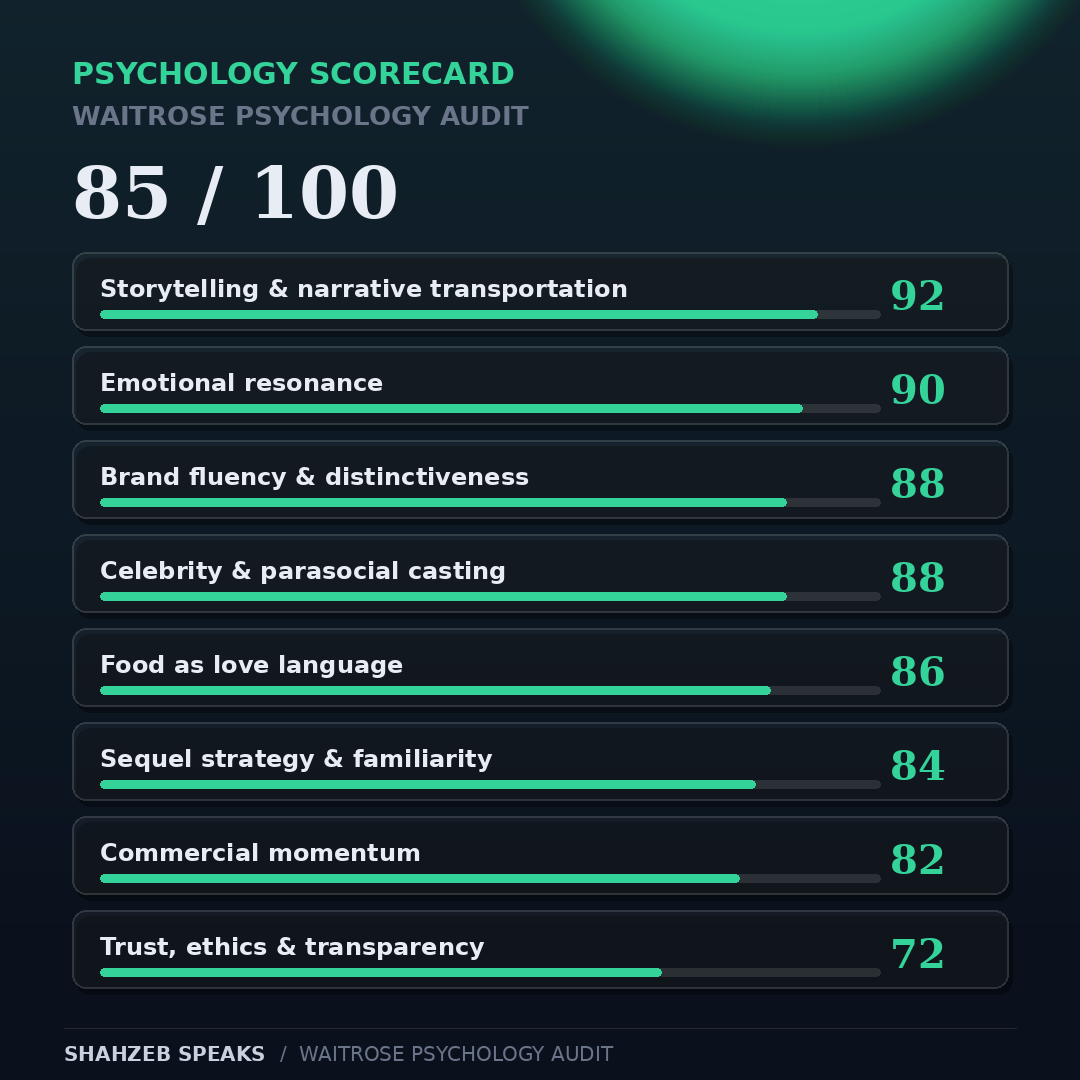
| Dimension | Score | Verdict |
|---|---|---|
| Storytelling & narrative transportation | 92 | A six-minute rom-com that absorbs the viewer; the 2025 original earned the maximum 5.9 System1 stars. |
| Emotional resonance | 90 | “Amused” and “uplifted” were the top viewer emotions; Ipsos named it Britain’s favourite ad for three weeks. |
| Brand fluency & distinctiveness | 88 | 94% of viewers knew the 2025 film was for Waitrose; the cheese counter and No.1 range keep the brand inside the story. |
| Celebrity & parasocial casting | 88 | Knightley playing herself, Wilkinson’s everyman Phil, Hassell’s vain Hugo — a rare three-year character arc in grocery advertising. |
| Food as love language | 86 | Food is the plot, not the backdrop: Sussex Charmer, turkey pie, beef Wellington, Bao Buns — and the brand’s own stated strategy. |
| Sequel strategy & familiarity | 84 | Demand-led sequel — customers asked what happened next — but sequel fatigue is untested as of 11 November 2026. |
| Commercial momentum | 82 | Sales £8.5bn, up 7%, tenth consecutive quarter of customer growth, No.1 range up nearly 30% — but grocery share is still only 4.4%. |
| Trust, ethics & transparency | 72 | A strong welfare record is offset by the CMA’s seven 2010–2019 land-agreement breaches and the upheld ASA rulings of 2010–2011. |
Arithmetic: 92 + 90 + 88 + 88 + 86 + 84 + 82 + 72 = 682. 682 ÷ 8 = 85.25, rounded to 85/100.
✅ Balance sheet & prescription
What Waitrose does best is turn food into a feeling that sells. The storytelling is evidence-based — the 2025 film earned the maximum System1 score and three weeks as Britain’s favourite Christmas advert — the casting builds a parasocial bond over three Christmases, the food is the plot rather than the backdrop, and the brand platform and the film agree with each other. What it does worst is the gap between the story and the scale: a premium grocer with 4.4% of the market, a competition breach that needed a regulator’s open letter to fix, and two advertising bans that show its claims have not always been checked before they were broadcast. The prescription follows that balance. First, let the sequel be measured: publish the independent effectiveness scores when System1 and Ipsos report them, so the next audit can score the outcome rather than the idea. Second, keep the claims checkable — print “longest advert” only with the evidence beside it, and keep the welfare record, which is genuinely strong, at the front of the story. Third, protect the story-world: Phil has two more Christmases of goodwill at most before the joke needs a new incongruity, so plan the next chapter now rather than waiting for the audience to ask. Do those three things and the score rises on its own.
📝 Final Verdict
Waitrose has made a six-minute romantic comedy about the idea that food can say what words cannot, at the exact moment when its last film proved the idea works. The story is generous: a wedding, a race against the clock, a handsome rival who loves himself, an ordinary man who wins with a Wellington, and a proposal made with a cheeseboard ring. The psychology is generous too — narrative transportation, parasocial casting, mere exposure, gift-giving, nostalgia, social comparison, loss aversion, humour and the peak-end rule, all working in the same direction. Its weakness is not creativity but scale and record: a small share of the grocery market, a competition breach that was never fined but never forgotten, and a sequel whose success is still unmeasured a day after its premiere. None of that makes the film worse as a piece of entertainment. It makes the brand behind it a real company, with a real record, telling a very good story. Until the sequel’s scores arrive, the film will be remembered for two things: the Wellington, and the ring.
Psychology Score: 85/100 — A six-minute rom-com sequel that turns food into a love language and a beef Wellington into a proposal, held back by a small market share, a competition record that needed a regulator’s letter, and a sequel whose success is still unmeasured.
If your brand sells food, craft or care, and customers are starting to ask whether the story behind it is real, the psychology of the answer matters more than the polish of the product. I audit that decision journey — get in touch here.
Related audits: Marks & Spencer — The Home of Christmas: Santa Shops at M&S, Dior — The Night in Color: Hand-Drawn Craft, AI Questions and the Price of Belief, and PG Tips — The Tea That Had to Win Britain Back. See also the full list at brand psychology audits and industrial psychology in Pakistan.
📚 References & Sources
- Retail Gazette (2026). Waitrose reunites Keira Knightley and Joe Wilkinson for Christmas ad sequel, 10 November 2026 (read directly 11 November 2026).
- The Grocer (2026). Keira Knightley and Joe Wilkinson return for Waitrose Christmas advert sequel, November 2026.
- British Comedy Guide (2026). Joe Wilkinson in Waitrose 2026 Christmas ad (official synopsis quoted at length; read directly 11 November 2026).
- Creative Review (2026). Waitrose: The Perfect Gift 2 Christmas ad — Keira Knightley, Joe Wilkinson.
- System1 (2026). Waitrose’s cozy Christmas rom-com gets top scores (Ad of the Week; read directly 11 November 2026).
- Agility PR (2026). Ipsos Race to Christmas: Waitrose named Britain’s favourite Christmas ad (three consecutive weeks; week 6, n = 300, fielded 12 December 2025).
- MarComm News (2026). Waitrose reunites Keira Knightley and Joe Wilkinson for another helping of Christmas romance in The Perfect Gift 2.
- Retail Times (2026). Waitrose serves up another festive helping starring Keira Knightley, Joe Wilkinson and a brand-new love rival.
- LBB (2026). Keira Knightley and Joe Wilkinson star in Waitrose Christmas rom-com (2025); Waitrose Christmas teaser (6 November 2026).
- Media Marketing (2026). Festive ads have sequels too: Waitrose reunites Keira Knightley and Joe Wilkinson.
- The Grocer (2025). Keira Knightley and Joe Wilkinson star in romcom Waitrose Christmas advert 2025.
- John Lewis Partnership (2025). Press release: The Perfect Gift (2025).
- KamCity (2026). JLP pays first staff bonus in four years after improved performance at Waitrose and John Lewis (FY2025/26 results; read directly 11 November 2026).
- John Lewis Partnership (2026). Annual Report and Accounts 2025–26.
- John Lewis Partnership (2026). Investing for customers through a challenging market: unaudited interim results (H1 2026/27; read directly 11 November 2026).
- John Lewis Partnership (2025). Full-year results 2024/25.
- Insight DIY (2025). JLP interim sales rose by 5% (H1 2025/26).
- MarComm News (2026). Waitrose launches out-of-this-world new brand campaign cementing itself as the home of food lovers (“The Gastronaut”).
- Retail Times (2026). Waitrose invests in more ways to shop to reflect changing customer habits (£1 billion programme; Chelmer Village).
- The Grocer (2026). Waitrose meets Better Chicken Commitment standard across own-label range; supermarkets reluctant to sign up to Better Chicken Commitment (ChickenTrack 2026).
- Grocery Gazette (2026). Waitrose Leckford living lab (Farming for Nature).
- UK Business Journals (2026). Waitrose new store formats (My Waitrose membership; Net Promoter Score).
- GOV.UK (2022). Open letter to Waitrose about land agreements restricting competition (CMA, 2 September 2022).
- Retail Gazette (2022). Waitrose blocked rivals, CMA.
- Osborne Clarke (2010). Waitrose and Heston penned in over pig claims (ASA, October 2010).
- The Grocer (2011). ASA bans Delia Smith’s Christmas cake ad three months late (March 2011).
- ASA (2015). 2014 most complained-about ads (“Everyone who works at Waitrose owns Waitrose”, 267 complaints, resolved).
- Osborne Clarke (2002). Waitrose very best prices claims scrutinised (ASA, May 2002, not upheld).
- Managing IP (2022). This week in IP: Maersk joins OIN, Waitrose confronts Asda and more (legal letter, March–April 2022).
- Mondaq (Brodies) (2018). Hotel Chocolat stands for no-nonsense on Waitrose alleged lookalike choc bars; Mondaq (Marks & Clerk) (2018). The Waitrose–Hotel Chocolat debate.
- Justia Trademarks. WAITROSE word mark, registration 5220699 (filed 20 May 2015, registered 13 June 2017).
- National Archives case law. Juj v John Lewis Partnership plc [2023] EWCA Civ 1507; Secretary of State for Transport v John Lewis Partnership Pensions Trust [2026] UKUT 78 (LC).
- Employment Cases Update (2011). John Lewis Partnership v Charman UKEAT/0079/11/ZT (24 March 2011).
- GOV.UK (2019). Mr S Richards v John Lewis Partnership — 1402527/2019 — Strike Out (judgment 20 June 2019).
- Green, M. C. & Brock, T. C. (2000). The role of transportation in the persuasiveness of public narratives. Journal of Personality and Social Psychology, 79(5), 701–721.
- Horton, D. & Wohl, R. R. (1956). Mass communication and para-social interaction: Observations on intimacy at a distance. Psychiatry, 19(3), 215–229.
- Zajonc, R. B. (1968). Attitudinal effects of mere exposure. Journal of Personality and Social Psychology, 9(2, Pt. 2), 1–27.
- Wildschut, T., Sedikides, C., Arndt, J. & Routledge, C. (2006). Nostalgia: Content, triggers, functions. Journal of Personality and Social Psychology, 91(5), 975–993.
- Festinger, L. (1954). A theory of social comparison processes. Human Relations, 7(2), 117–140.
- Belk, R. W. (1979). Gift-giving behavior. In J. N. Sheth (Ed.), Research in Marketing (Vol. 2, pp. 95–126). JAI Press.
- Sherry, J. F. (1983). Gift giving in anthropological perspective. Annual Review of Anthropology, 12, 157–182.
- Dunbar, R. I. M. (2017). Breaking bread: The functions of social eating. Adaptive Human Behavior and Physiology, 3, 198–211.
- Kahneman, D. & Tversky, A. (1979). Prospect theory: An analysis of decision under risk. Econometrica, 47(2), 263–291.
- Martin, R. A. & Ford, T. E. (2018). The Psychology of Humor: An Integrative Approach (2nd ed.). Academic Press.
- Cialdini, R. B. (2001). Influence: Science and Practice (4th ed.). Allyn & Bacon.
- Kahneman, D., Fredrickson, B. L., Schreiber, C. A. & Redelmeier, D. A. (1993). When more pain is preferred to less: Adding a better end. Psychological Science, 4(6), 401–405.
- BAILII / National Archives case law (2026). Chiu & Ors v Waitrose Ltd & Ors [2011] EWHC 1356 (TCC); Juj v John Lewis Partnership PLC [2022] EWHC 2418 (KB); Truro City Council v Cornwall City Council [2013] EWHC 2525 (Admin) — live searches, 11 November 2026.
- GOV.UK Employment Tribunal decisions (2017–2025). Thomas v Waitrose [2024] UKET 2303138/2023; Stopford v Waitrose Surbiton [2018] UKET 2303727/2017; Quinlan v Waitrose Ltd [2020] UKET 3320783/2019; Grayson v Waitrose Ltd [2021] UKET 2409751/2020; Scantlebury v Waitrose plc [2025] UKET 2305567/2024; A v Waitrose & Partners [2020] UKET 1405262/2018; Bakali v Waitrose Superstores Ltd [2017] UKET 2205998/2017; Hobbis v Waitrose Ltd [2018] UKET 3331723/2018 — live searches, 11 November 2026.
- ICO (2026). Enforcement action listing, searched 11 November 2026 — keyword “Waitrose” returned no matching results.
- UKIPO (2026). Trade mark decisions database, searched 11 November 2026 — zero Hearing Officer decisions for “Waitrose Limited”, “Waitrose”, the mark “Waitrose”, or “John Lewis Partnership”.
Key Findings
- Founded June 1904 at 263 Acton High Street as Waite, Rose & Taylor; joined the John Lewis Partnership 1 October 1937 (10 shops, 160 staff); about 320 shops as of July 2026; market share 4.4% (Worldpanel, 12 weeks to 4 October 2026).
- "The Perfect Gift 2" — six-minute festive rom-com sequel (Waitrose's description; Creative Review says 'just under six minutes'), premiered 06:30 on 10 November 2026; stars Keira Knightley, Joe Wilkinson as Phil and Alex Hassell as Hugo Bunty-Griffin; directed by Molly Manners, created by Wonderhood Studios.
- The 2025 original earned the maximum 5.9 System1 stars (top supermarket Christmas ad of 2025; 94% brand fluency) and was Ipsos's favourite Christmas ad for three consecutive weeks (14% spontaneous recall, week 6, n=300); no effectiveness score or viewing figure for the 2026 sequel existed as of 11 November 2026.
- Financials (JLP; Waitrose discloses adjusted operating profit only, no standalone profit before tax): FY2025/26 Waitrose sales £8.5bn, up 7%, adjusted operating profit £256m; H1 2026/27 sales £4.3bn, up 4%, adjusted operating profit £103m.
- Legal record: CMA open letter 2 September 2022 after SEVEN breaches of the Groceries Market Investigation (Controlled Land) Order 2010 (2010–2019), NO fine imposed; ASA UPHELD five complaints and BANNED two pork ads in October 2010 and BANNED a Delia cake-mix ad in March 2011; ICO enforcement database searched 11 Nov 2026 with no action found; UKIPO trade mark decisions searched 11 Nov 2026 with zero decisions found; ten further judgments found (Chiu [2011] EWHC 1356 (TCC); Juj [2022] EWHC 2418 (KB); eight Employment Tribunal judgments struck out or withdrawn), none making a finding against Waitrose.
- Score 85/100: 92+90+88+88+86+84+82+72 = 682; 682/8 = 85.25, rounded to 85.
Overall Psychology Score
Waitrose scores 85/100 in our comprehensive psychology audit covering consumer behavior strategies, UX design principles, and psychological marketing effectiveness.
The detailed dimension scores are in the audit's Psychology Scorecard chapter.
High impactMuhammad Shahzeb
MSc Industrial Psychologist, specializing in consumer behavior, UX psychology, and brand strategy analysis. Helping brands understand the psychology behind their success.
About Muhammad Shahzeb →