Dior Psychology Audit — The Night in Color: Hand-Drawn Craft, AI Questions and the Price of Belief
Dior turned a snowy 1949 night at 30 Avenue Montaigne into a hand-drawn holiday film — then online viewers alleged AI use. A psychology audit of craft, belief and the price of handmade luxury, scored 84/100.

84 / 100
Overall consumer behavior effectiveness
Brand Overview
- Brand nameChristian Dior
- Founded1946
- HeadquartersParis, France (30 Avenue Montaigne)
- IndustryFashion & Apparel
- Websitewww.dior.com ↗
Psychology Techniques Identified
- 01Nostalgia marketing (1949 setting; Wildschut et al. 2006; the New Look)
- 02Need to belong / community (Baumeister & Leary 1995; the atelier bees)
- 03Social identity & group markers (Tajfel & Turner 1979; Bar jacket, Cannage, Lucky Star)
- 04Mere exposure (Zajonc 1968; nearly eighty years of Dior codes)
- 05Peak-end rule (Kahneman et al. 1993; the Junon dress reveal)
- 06Loss aversion (Kahneman & Tversky 1979; limited holiday gifting line)
- 07Scarcity & authority (Cialdini 2001; one atelier, one night, couture authority)
- 08Conspicuous consumption (Veblen 1899; visible Dior codes as status signals)
- 09Extended self (Belk 1988; a Dior bag or scent as identity)
- 10IKEA effect (Norton et al. 2012; watching the dress being made)
- 11Character branding (Rihanna as the Lucky Star; the bees as characters)
- 12Accessibility funnel / value anchoring (69% to 87% of leather goods under €4,000)
Full Psychology Audit Report
In this audit
It is a snowy night in Paris in 1949, and Marlene Dietrich telephones Christian Dior in the middle of the night. She needs a colourful dress — her director has decided to shoot in colour instead of black and white. Dior works through the night, helped by a swarm of bees, and delivers a gown the colour of a peacock. That is the story of Dior’s 2026 holiday film, “Christian Dior’s Night in Color” — a hand-drawn animation of about six minutes, released on 4 November 2026 — and within two days of its release, online viewers were alleging that some of it had been made with generative AI. The film is a test of the most valuable question in luxury today: when a house sells you handmade craft, how much is the belief itself worth?
Dior is a French luxury fashion house founded in 1946, now part of LVMH, whose Fashion & Leather Goods division took €8.245 billion in the third quarter of 2026. Its new creative director, Jonathan Anderson, has spent his first year widening the house’s entry level — the share of Dior leather goods priced under €4,000 on the French site rose from 69% in January 2023 to 87% in January 2026. This audit asks what the holiday film does to the mind of the viewer, how the house’s heritage, codes and scarcity work together, and whether the AI allegation — unproven, denied by the film-makers, and still unresolved — damages the one thing a luxury house cannot buy: the belief that the work is real. One honest limit up front: the film was released six days before this audit, so there are no sales results for it yet. This audit scores the psychology of the film and the house, not its outcome.
I am an Industrial and Organizational Psychologist in Karachi, and I audit brands by testing their claims against psychology research and their own public record. Where a legal matter is only an allegation or an investigation, I keep it exactly that. Where a claim is unproven, I will say so in the same sentence, not in a footnote. And where the company’s own record gives a fine in one country and a clearance in another, I will show you both rather than pick the flattering one.
“Dior is not selling a dress in this film. It is selling the belief that a human hand made it — and belief, once questioned, is the hardest luxury to restock.”
— Brand Psychology Analysis, ShahzebSpeaks
📋 Brand Overview
| Field | Detail |
|---|---|
| Brand | Christian Dior (Dior) — French luxury fashion house |
| Founded | 16 December 1946, 30 Avenue Montaigne, Paris; backed by textile magnate Marcel Boussac |
| Headquarters | 30 Avenue Montaigne, Paris 75008 — flagship reopened March 2022 after a renovation of more than two years; nearly 108,000 sq ft |
| Leadership | Delphine Arnault, Chair and CEO of Christian Dior Couture since 1 February 2023; Jonathan Anderson, Creative Director (menswear April 2025, all three lines from June 2025) |
| Parent | LVMH Moët Hennessy Louis Vuitton SE; Fashion & Leather Goods division revenue €8.245bn in Q3 2026 (LVMH group revenue €18.5bn) |
| Current campaign | “Christian Dior’s Night in Color” — hand-drawn holiday film of about six minutes, released 4 November 2026 |
| Website | https://www.dior.com |
| Psychology score | 84/100 |
Sources: LVMH Q3 2026 results; Luxury Tribune and Animation Magazine, November 2026; LVMH appointments release. All figures as of 10 November 2026. LVMH does not disclose Dior brand-level revenue, so no Dior revenue figure is printed in this audit.
📜 Chapter 1: History — the New Look and the house that never left the address
Dior began with a date and an address that have never changed. The house was established on 16 December 1946 at 30 Avenue Montaigne in Paris, with financial backing from the textile magnate Marcel Boussac. Its first collection, Spring–Summer 1947, was unveiled on 12 February 1947 at the same address: two lines, “Corolle” and “En Huit”, with a small, nipped-in waist and a full skirt falling below mid-calf — a deliberate contrast with wartime utility dress and fabric rationing. Harper’s Bazaar editor-in-chief Carmel Snow dubbed it the “New Look”, and the name stuck so firmly that it became the house’s founding myth. The first perfume, Miss Dior, launched in the same year, 1947. Christian Dior led the house for ten years, until his death in 1957.
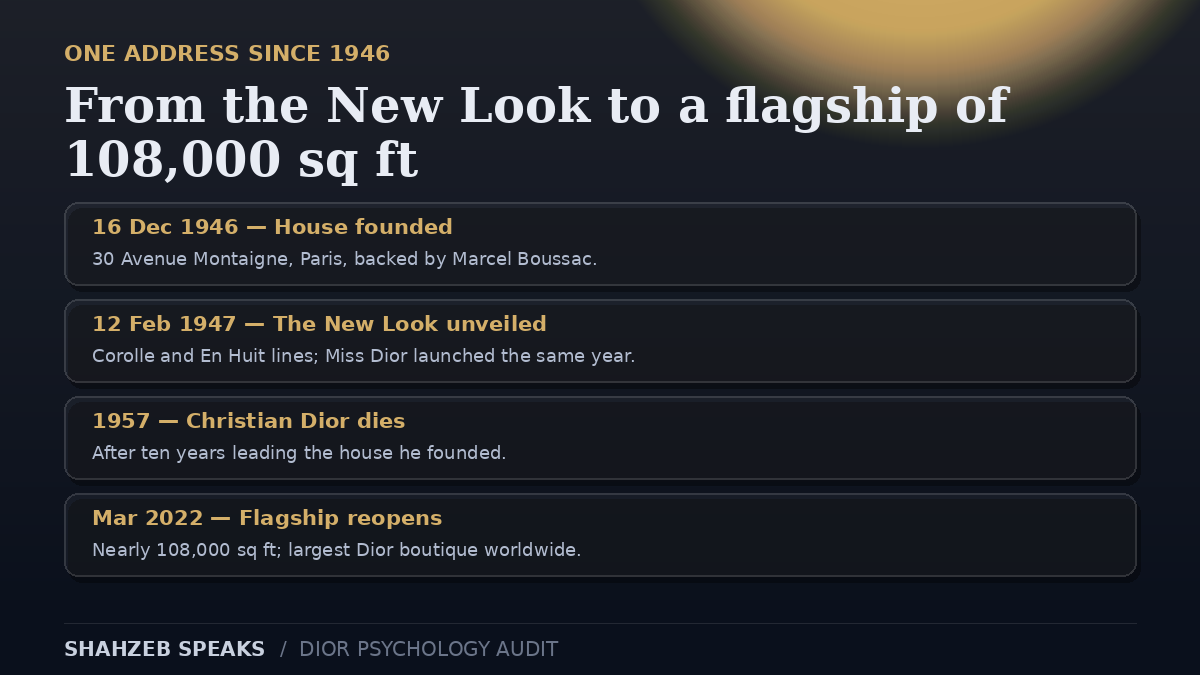
The house after Dior was a relay of famous hands: Yves Saint Laurent, Marc Bohan, Gianfranco Ferré, John Galliano (appointed 14 October 1996), Raf Simons, Maria Grazia Chiuri (womenswear 2016–2025) and Kim Jones (menswear 2018–2025). The current chapter began in 2025. Jonathan Anderson was appointed artistic director of Dior menswear in April 2025, succeeding Kim Jones, and in June 2025 his role expanded to womenswear, menswear and haute couture — the first single creative director to oversee all three lines since Christian Dior himself. Above him, Delphine Arnault has been Chair and CEO of Christian Dior Couture since 1 February 2023, the first woman to lead the house. The building itself tells the same story of continuity: the flagship at 30 Avenue Montaigne reopened in March 2022 after a renovation of more than two years, spanning nearly 108,000 square feet and housing Dior’s largest boutique worldwide, La Galerie Dior, the haute couture ateliers, a restaurant and a café. The house has changed creative directors seven times. It has never changed its address.
🎬 Chapter 2: The Night in Color — the film itself
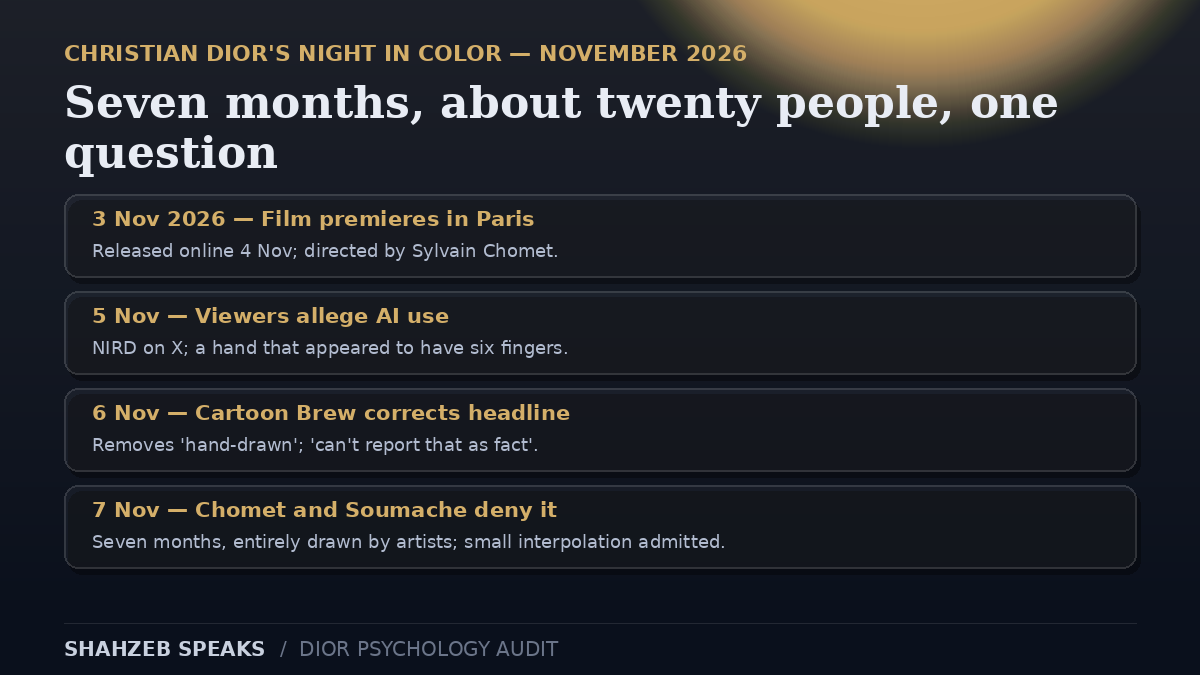
“Christian Dior’s Night in Color” is an animated short film of about six minutes, directed by Sylvain Chomet and produced by Aton Soumache, with creative direction by Jonathan Anderson. It premiered to press in Paris on 3 November 2026 and was released across Dior’s online platforms on 4 November 2026 as the house’s 2026 holiday campaign. It is narrated by Robert Pattinson, a longtime Dior ambassador. The voice cast is a deliberate piece of casting in itself: Rihanna as the Lucky Star, Louis Garrel as Christian Dior, Camille Cottin as Marlene Dietrich, plus Josh O’Connor, LaKeith Stanfield and Greta Lee. A holiday gifting line accompanies the film — ready-to-wear, accessories and homewares — and characters and scenes from the film appear in Dior shop windows worldwide. It is Dior’s second animation project of 2026, after a hand-painted Miss Dior film by Ugo Bienvenu, and the story connects to Anderson’s Cruise 2027 collection, shown in Los Angeles in May 2026.
The plot is a small, deliberate piece of history. On a snowy winter’s night in 1949 at 30 Avenue Montaigne, Marlene Dietrich telephones Christian Dior in the middle of the night: she needs a colourful dress for her first colour film, after her director decides to shoot in colour instead of black and white. Dior works through the night, helped by a swarm of bees — Dior’s affectionate term for his seamstresses — and delivers a gown inspired by the peacock-like 1949 Junon dress. The film is inspired by the real friendship between Christian Dior and Marlene Dietrich, and it takes a deliberate liberty: Dietrich never wore the Junon in real life. The “No Dior, no Dietrich!” anecdote comes from her negotiations to star in Alfred Hitchcock’s Stage Fright. Anderson’s launch statement, as quoted by WWD, set the terms of the debate that followed: “The film we’ve created together for Dior is all hand-drawn using techniques that go back to the 1940s.” Chomet’s stated method matched the claim: characters cut out, animated separately, then assembled onto backgrounds, with techniques associated with the 1940s and inspirations including Walt Disney, notably 101 Dalmatians. The word “hand-drawn” was not decoration. It was the campaign.
🤖 Chapter 3: The AI allegation — what was claimed, what was denied, what is still unknown
Within two days of the film’s release, the claim at the centre of the campaign was being questioned. On 5 November 2026, the day after release, an artist and graphic designer posting as NIRD wrote on X that they had noticed discrepancies in the film that looked like AI red flags, including what they called “the telling rigidity of the 2D animation”, and said Dior’s behind-the-scenes video showed more studio shots than actual animation process, mostly sketches. Other viewers across platforms pointed to alleged glitches: strange warped lettering, a lazy eye, a misplaced phalange — a character who appeared to have six fingers. These are viewer interpretations of frames. They are not proof of AI use, and this audit will not present them as proof.
On 6 November 2026, Cartoon Brew published a correction and apology by its editor, Jamie Lang. The site had first described the film as hand-drawn in its headline, based on Dior’s promotional materials; after reviewing the suspicious images it removed “hand-drawn” from the headline. Lang wrote that it “does seem likely that the claims hold some water” but also: “We can’t report that as fact and don’t want to make any definitive claims based on speculation, but the evidence is compelling.” Cartoon Brew said it had emailed Chomet and Dior PR and had not heard back at that point. One film-studio executive also made claims on LinkedIn, reported by Fast Company on 6 November, about how much of the film was supposedly made with generative AI. Fast Company was explicit that none of this had been confirmed by Dior, and this audit does not print those claims as facts.
On 7 November 2026, in a Variety interview, Chomet and producer Aton Soumache denied that generative AI created the artwork. Soumache said: “Some people are claiming Sylvain was contacted two weeks ago and that the entire film was made with generative AI, without a single drawing, but the reality is that this film took seven months to make and it was entirely drawn by artists.” The film employed roughly twenty people, including six animators, plus storyboard artists, designers, background artists, compositors and editors. In the same interview came the admission that changed the shape of the row: “We used an automated interpolation system for a very small part of the process, but the film itself is traditional 2D animation.” Chomet added: “It’s a way of automating the repetitive, mechanical part of animation, not the creative work.” The tool was not named, and how much of the film it touched was not specified. Chomet’s explanation of the six-finger image was that it showed “a movement where the hand is spread out like a fan. In that kind of drawing, you might see six or seven fingers because you’re trying to convey movement.” As of 9 November 2026, Dior had not immediately responded to Inc.’s request for comment, and Fast Company reported that Dior had not responded to BoF, Cartoon Brew or Fast Company either. No direct corporate denial from Dior itself was found as of 10 November 2026 — the denial on record is from Chomet and Soumache, plus Anderson’s launch statement. So the status, stated plainly, is this: the generative-AI allegation is unproven. It is an allegation by online viewers, answered by a denial from the film-makers and an admission that an unnamed automated tool touched a small, unspecified part of the process. That is the whole of what is known, and the rest is speculation.
🐝 Chapter 4: The need to belong — the bees and the atelier as a tribe
The film’s most effective image is also its oldest psychological idea. Baumeister and Leary (1995), in their classic paper on the need to belong, argued that human beings have a fundamental drive to form and maintain lasting, positive and significant interpersonal relationships — and that much of human behaviour is organised around satisfying it. The bees in the film are that idea made visible. Dior’s seamstresses, called bees by the founder, work through the night together to make one dress for one woman. The viewer is not watching a factory. They are watching a tribe, and the tribe’s work is care.
That matters because luxury, for all its talk of exclusivity, is a belonging business. The customer does not only buy a dress. They buy a way into the room where the dress was made — the atelier at 30 Avenue Montaigne, the hands, the night shift, the shared effort. The film invites the viewer to belong to that room without ever entering it. The risk, and it is the risk the AI allegation touches, is that belonging depends on the tribe being real. If the bees were drawn by hand, the belonging is earned. If a machine drew them, the viewer was invited into a room that does not exist. That is why the allegation stings more than a technical complaint would: it does not accuse Dior of a bad film. It accuses Dior of a false invitation.
👗 Chapter 5: Social identity — the codes that mark the tribe
Tajfel and Turner (1979), in their social identity theory, argued that people derive part of their self-concept from the groups they belong to, and that they mark those groups with visible signs. Dior’s signs are among the most recognisable in fashion: the Bar jacket with its nipped waist, the Cannage quilted pattern, the Lucky Star, the bees, the grey of the Avenue Montaigne boutique, the Junon dress itself. The film is, in effect, a guided tour of those signs. The Lucky Star is a character, voiced by Rihanna. The bees are characters. The Junon dress is the climax. A viewer who knows none of Dior’s history can still read the film as a story; a viewer who knows the codes reads it as a roll call.
That is the mechanism behind the house’s pricing power as well. A Dior bag does not need a logo to be recognised, because the codes do the work of the logo — and codes, unlike logos, flatter the wearer. They signal membership to those who know, and say nothing to those who do not.
👀 Chapter 6: Mere exposure — a century of looking at Dior
Zajonc (1968), in his mere exposure research, showed that people tend to develop a preference for things simply because they are familiar with them — repeated exposure, on its own, increases liking. Dior has been running that experiment for nearly eighty years. The New Look silhouette, the Bar jacket, the Cannage pattern, the grey boutique, the Miss Dior bottle: a viewer in 2026 has seen these shapes hundreds of times before ever buying anything from the house. The film adds to that exposure in a form the viewer will actually watch — a six-minute story rather than a thirty-second advert — and it does so at Christmas, when the house’s imagery is already in every shop window.
The film’s craft claim is also a mere exposure claim in disguise. Hand-drawn animation is itself familiar: it is the style of the films most viewers grew up with, and it carries a warmth that computer-generated imagery, however polished, has to work harder to earn. That is why the allegation matters commercially as well as morally. If the audience believes the film is hand-drawn, every frame adds to eighty years of warm familiarity. If they believe a machine made it, the same frames add to a different familiarity — the look of generated imagery, which viewers are learning to distrust. The exposure is the same. The feeling it produces is not.
💭 Chapter 7: Nostalgia — 1949 as a place, not a date
Wildschut, Sedikides, Arndt and Routledge (2006), in their research on nostalgia, showed that nostalgia is typically triggered by negative feelings such as loneliness, and that it serves functions of social connectedness, self-continuity and meaning — it reminds people who they are and who they belong to. Dior’s film is built on that mechanism. It is set in 1949, in a Paris that is snowy, warm-lit and populated by people who care about each other. It is a past that never quite existed — Dietrich never wore the Junon — but that is the point. Nostalgia does not need accuracy. It needs a feeling, and the film supplies one generously.
The house has been practising this for decades. Sauvage, the men’s fragrance launched in 2015 and created by in-house perfumer François Demachy, has been fronted by Johnny Depp since launch, and has been the best-selling fragrance in the world since 2021. J’adore, created in 1999 by perfumer Calice Becker, had Charlize Theron as its face for twenty years, from 2004 to 2024, before Rihanna was announced as the new face in June 2024. The risk in nostalgia is the same as in Chapter 6: it only works while the past feels real. A 1940s technique that turns out to be a 2026 tool does not just break a claim about a film. It breaks the feeling the film was built to produce.
⏱️ Chapter 8: The peak-end rule — the dress reveal is the memory
Kahneman, Fredrickson, Schreiber and Redelmeier (1993) showed that people judge an experience largely by how it felt at its most intense moment and at its end, rather than by the sum or average of the whole — the peak-end rule. The film is structured around that rule. Its peak is the reveal of the finished gown, inspired by the peacock-like Junon dress, delivered to Dietrich in the small hours. Its end is the warm resolution of a night’s work completed. A viewer who forgets the middle of the film will still remember the dress and the ending, and those two moments will stand in for the whole six minutes.
That is also why the AI row is so damaging in memory terms. The peak of the film is a handmade dress. The allegation, if believed, replaces that peak with a different image: a machine-made frame, a six-fingered hand, a process the viewer did not agree to. The peak-end rule cuts both ways — a strong ending can rescue a weak experience, but a contaminated peak can spoil a strong one. Dior’s response so far has been to defend the peak: seven months, twenty people, six animators, entirely drawn by artists. The admission about automated interpolation, by contrast, was framed as a small, mechanical part of the process. Whether the audience accepts that framing will decide what they remember of this Christmas: the dress, or the doubt.
💎 Chapter 9: Scarcity, authority and loss aversion — and the price of getting in
Cialdini (2001), in his work on influence, identified scarcity and authority as two of the most reliable persuaders: people want what is rare, and they trust what an expert endorses. Dior uses both, and the film uses both. The scarcity is the atelier itself — a small room, a small team, one dress, one night. The authority is the house: seventy-nine years at the same address, a creative director who now oversees all three lines, a founder whose name is the brand. Kahneman and Tversky (1979), in prospect theory, added the other half of the mechanism: losses loom larger than gains, so the fear of missing something matters more than the pleasure of getting it. The holiday gifting line that accompanies the film — ready-to-wear, accessories and homewares, in shops for a season — is built on that fear: the characters and scenes from the film appear in windows worldwide, and then they are gone.
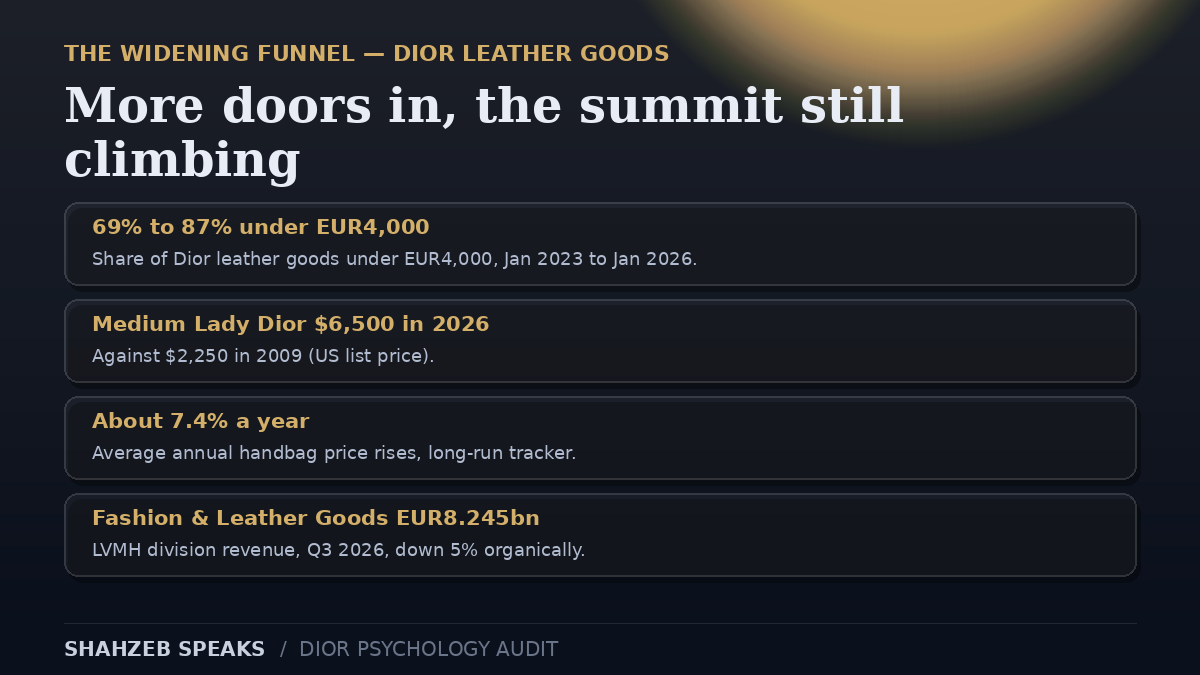
Anderson’s era has changed the arithmetic of getting in. The share of Dior leather goods priced under €4,000 on the French site rose from 69% in January 2023 to 87% in January 2026 — a deliberate accessibility move at the entry level. At the same time, the top of the range has kept climbing: a Medium Lady Dior was listed at $6,500 in the United States in 2026, against $2,250 in 2009, and Dior raises handbag prices most years, at an average of about 7.4% a year on one long-run tracker. The psychology is a widening funnel: more people can enter through a lower-priced bag, a fragrance or a gift, while the summit — haute couture, the Junon dress, the atelier — stays out of reach. The risk is that widening the funnel dilutes the scarcity that makes the summit desirable. The film’s job is to hold the two together: to show a house that is both more accessible and still, in the ways that matter, unreachable.
🪞 Chapter 10: The extended self — why a Dior bag feels like part of you
Belk (1988), in his work on the extended self, argued that possessions become part of a person’s identity — that we are what we have, and that objects we control, create or know intimately become part of the self. Veblen (1899), in The Theory of the Leisure Class, made the older, sharper point: visible consumption signals status, and the signal is the point. A Dior bag does both at once. It extends the self — the owner carries the house’s codes as part of who they are — and it signals status to everyone who recognises the codes. That is why the film’s craft claim matters to the customer as well as to the critic. If the bag was made by hand, the owner’s identity is handmade too. If the film that sold it was made by a machine, the identity feels borrowed rather than earned.
Norton, Mochon and Ariely (2012), in their work on the IKEA effect, showed that people value things more when they have had a hand in making them. Dior’s film is the IKEA effect in reverse: the customer did not make the dress, but they watched it being made — or believed they did — and that watching creates a share of the value. The film’s seven months, twenty people and six animators are not production details. They are the customer’s reason to value the object more. Take the making away, and the value it created goes with it. That is the real price of the AI allegation: not a fine, not a lawsuit, but a discount on the meaning of everything the house sells.
🇵🇰 Chapter 11: What Pakistani brands should — and shouldn’t — copy
Pakistani brands should copy three things. First, the single story: Dior’s Christmas campaign is one film, one idea, one night, expressed across every channel and every shop window. A Pakistani brand with a strong seasonal moment — Eid, Ramadan, a wedding season — should build one idea and run it everywhere, rather than running five ideas that cancel each other out. Second, the codes: Dior’s Bar jacket, Cannage pattern and bees show that a brand can be recognised without a logo, if it repeats the same signs for long enough. A Pakistani brand with a distinctive product — a fabric, a sweet, a craft — should pick its signs and keep them for a decade rather than a season. Third, the widening funnel: Dior’s move to put 87% of its leather goods under €4,000 shows that a premium brand can open more doors without lowering the roof. A Pakistani premium brand should do the same — a lower-priced entry product that carries the same craft story as the flagship.
What they should not copy is the silence, or the ambiguity. When the AI allegation appeared, the denial came from the director and the producer, not from the house itself, and the admission about automated interpolation named no tool and no extent. A Pakistani brand facing the same question should answer it in its own voice, in full, on the first day: what was used, what was not, and how much. Nor should they copy the craft claim without the craft. If a campaign says “handmade”, the making should be visible — in the workshop, in the film, in the store. A claim that cannot be shown is a claim that will be questioned, and in 2026 the questioning arrives within two days.
⚠️ Chapter 12: Dark side & regulatory record — exactly what is known
Every legal statement in this chapter is written at its exact status, as of 10 November 2026. A fine is a fine. An investigation closed without infringement is not a fine. A lawsuit filed is an allegation, not a finding. I have scoped this chapter to the record types actually checked: regulator enforcement, court judgments and trademark filings, searched under the names Christian Dior, Christian Dior Couture, Manufactures Dior, Christian Dior Couture Korea and Dior.
The fine is real, and it is in South Korea. On 12 February 2026, South Korea’s Personal Information Protection Commission fined Christian Dior Couture Korea ₩12.2 billion, about $8.4 million, after a data breach affecting about 1.95 million users. Employees had been tricked, by voice phishing, into granting internal system access to malicious actors, and Dior was unaware of the incident for three months. The fine was part of a combined ₩36 billion penalty across Louis Vuitton Korea (₩21.4 billion, about 3.6 million customers), Dior Korea (₩12.2 billion) and Tiffany Korea (₩2.4 billion). A data breach at a luxury house is a trust breach as well as a legal one: the brand asks customers for their details, their addresses and their money, and then, in this case, did not notice for three months that the door was open.
The Italian position is the opposite, and it must be stated just as plainly. In June 2024, a Milan court appointed a commissioner for one year to oversee Manufactures Dior SRL, an Italian subsidiary responsible for producing Dior handbags, after finding the company had failed to take appropriate steps to verify the working conditions and technical capability of the companies it contracted. Between March and April 2024, Italian police inspected four suppliers, and working conditions were held to be unethical and exploitative. The judicial administration was lifted in late February 2025, after compliance with the conditions on supplier procedures. Then, on 21 May 2025, Italy’s Competition Authority announced that its investigation into Christian Dior Couture S.A., Christian Dior Italia S.r.l. and Manufactures Dior S.r.l. was closed without establishing any infringement. The companies accepted binding commitments including €2 million over five years to fund initiatives identifying victims of labour exploitation and providing tailored protections, training, support and social and workplace integration, and Dior agreed to amend its ethics and social-responsibility statements, implement new supplier vetting and monitoring protocols, and train marketing staff on consumer protection law. That €2 million is a voluntary commitment, not a fine and not a penalty, and this audit will not call it one. Dior itself was not facing a criminal probe; the owners of the contracting and subcontracting companies were under investigation by Milan prosecutors for exploiting workers and employing people off the books.
The court record as claimant is cleaner. In LVMH & Ors v. Rolo Fashion and Georgia Aldridge [2026] EWHC 1703 (IPEC), a default judgment was given on 17 January 2025 for use of the claimants’ marks on counterfeit goods, and a damages inquiry, in a judgment of 9 July 2026 reported on 20 October 2026, awarded £200,000 in damages plus £13,000 under the “user principle”. The claimants were Fendi, Loewe, Christian Dior Couture S.A. and Celine, with LVMH SE as fifth claimant — Dior was a co-claimant, not the sole claimant, and the £213,000 total was awarded to the claimants jointly, not to Dior alone. On 8 October 2026, Christian Dior Couture, S.A. filed a federal trademark-infringement (Schedule A) lawsuit in the US District Court for the Northern District of Illinois, Case No. 1:26-cv-12372, against online sellers allegedly offering counterfeit Dior products. A filing is an allegation, not a finding of liability, and no outcome was verified. Dior filed similar Schedule A suits in the same court on 15 July 2025, 20 August 2025 and 10 November 2025. No product-safety case, and no court ruling against Dior as a defendant, was found in the searches run on 10 November 2026, within the scope stated above. The honest reading is that the legal record is mixed and unfinished in places: a real fine in Korea, a cleared investigation in Italy, a lifted court administration, and an active counterfeit-enforcement programme. None of that makes the Christmas film worse. It makes the house behind it a real company, with a real record, rather than a fairy tale set in 1949.
📊 Psychology Scorecard
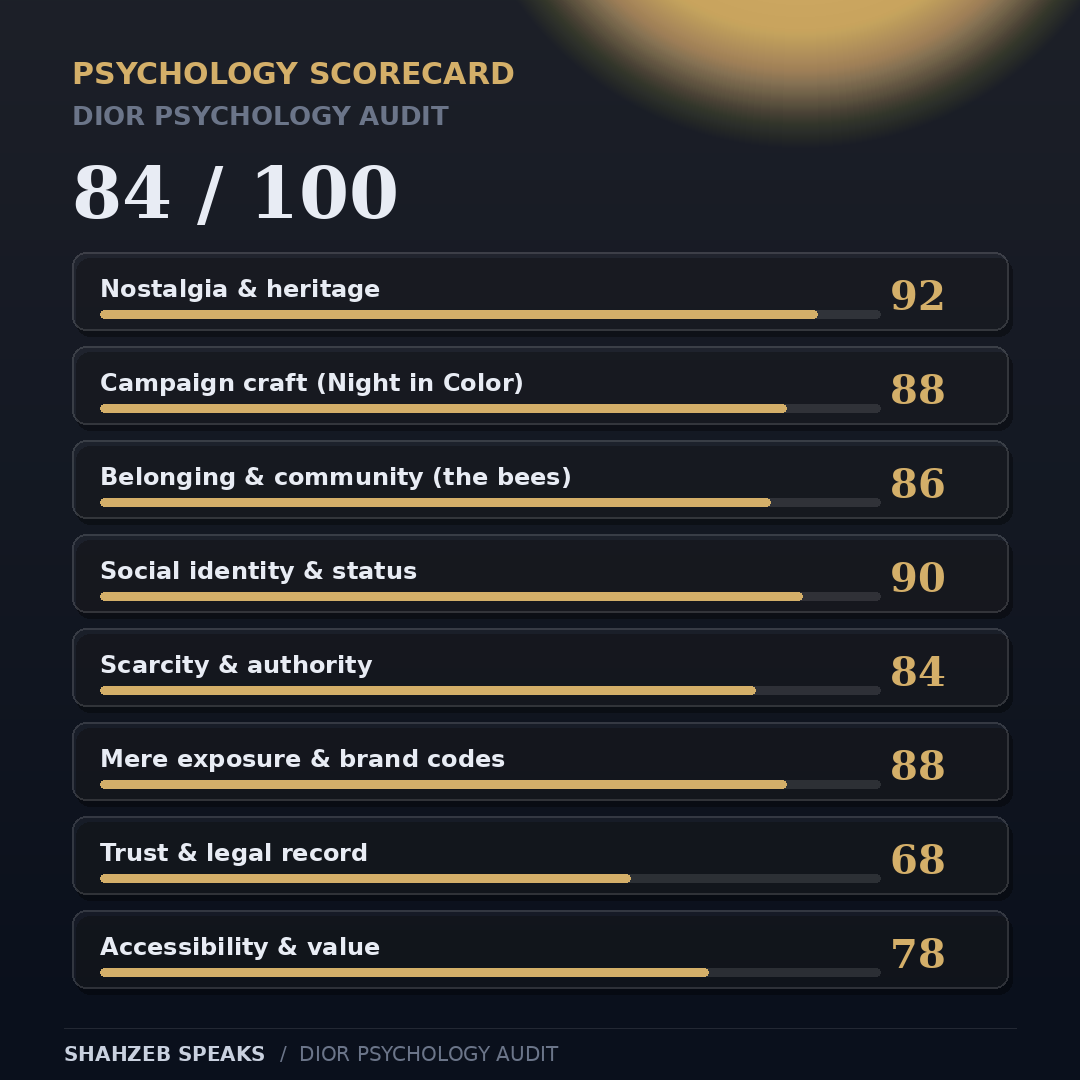
| Dimension | Score | Verdict |
|---|---|---|
| Nostalgia & heritage | 92 | Seventy-nine years at one address, and a 1949 story told as if it happened last night. |
| Campaign craft (Night in Color) | 88 | One film, one idea, a star voice cast — but the craft claim is now questioned. |
| Belonging & community (the bees) | 86 | The atelier as a tribe, and the viewer invited inside it. |
| Social identity & status | 90 | Bar jacket, Cannage, Lucky Star — codes that mark the group without a logo. |
| Scarcity & authority | 84 | One dress, one night, one house — and a seasonal line that will disappear. |
| Mere exposure & brand codes | 88 | Nearly eighty years of familiar shapes, retold in a film people will actually watch. |
| Trust & legal record | 68 | A real fine in Korea, a cleared investigation in Italy — and an unanswered AI question. |
| Accessibility & value | 78 | 87% of leather goods under €4,000 — wider doors, but the summit keeps climbing. |
Arithmetic: 92 + 88 + 86 + 90 + 84 + 88 + 68 + 78 = 674. 674 ÷ 8 = 84.25, rounded to 84/100.
✅ Balance sheet & prescription
What Dior does best is turn heritage into a feeling that sells. The nostalgia is evidence-based, the film is a single idea executed with a star cast, the codes are among the strongest in fashion, and the atelier story gives the customer a tribe to belong to. What it does worst is the unfinished business: a real data-protection fine in Korea, an Italian labour record that was cleared but not forgotten, and an AI allegation that is still unanswered in the house’s own voice. The prescription follows that balance. First, answer the AI question in Dior’s own voice, in full: name the tool, say how much of the film it touched, and show the drawings. The film-makers’ denial and the unnamed admission have left a gap, and in 2026 a gap is filled by speculation within two days. Second, publish a plain-language account of what changed in data protection after the Korean breach, and keep publishing it. Third, let the Christmas campaign be measured: publish what “Night in Color” actually sold, so the next audit can score the outcome rather than the idea. Do those three things and the score rises on its own.
📝 Final Verdict
Dior has made a beautiful film about the value of handmade work, at the exact moment when handmade work is hardest to prove. The story is perfect: a snowy night in 1949, a dress made by bees, a house that has stood at the same address for seventy-nine years. The psychology is perfect too — belonging, identity, nostalgia, scarcity and the peak-end rule, all working in the same direction. Its weakness is not creativity but credibility: an unproven allegation, answered by the film-makers rather than the house, with an admission that named no tool and no extent. None of that makes the film worse as a piece of cinema. It makes the belief behind it a question rather than a certainty — and for a luxury house, belief is the product. Until Dior answers the question in its own voice, the film will be remembered for two things: the dress, and the doubt.
Psychology Score: 84/100 — A hand-drawn holiday film that turns seventy-nine years of heritage into a single night of craft, held back by an unproven AI allegation the house has not yet answered in its own voice and a real data-protection fine in Korea.
If your brand sells craft and customers are starting to ask whether the craft is real, the psychology of the answer matters more than the polish of the product. I audit that decision journey — get in touch here.
Related audits: Louis Vuitton — The Journey Is the Destination, Levi’s — The Yeti, the 501 and the Feeling of Belonging, and Hermès — The Bag You Have to Earn. See also the full list at brand psychology audits and industrial psychology in Pakistan.
📚 References & Sources
- Luxury Tribune (2026). Dior and Prada revive the magic of animation, November 2026.
- Animation Magazine (2026). Acclaimed animator Sylvain Chomet delivers hand-drawn short for Dior’s holiday campaign, November 2026.
- Animation Magazine (2026). Sylvain Chomet defends himself from accusations of using AI in his new animated Dior short, November 2026 (reporting Variety, 7 November 2026).
- Inc. (2026). Dior animated holiday short AI backlash, November 2026 (reporting Business of Fashion, 5 November 2026, and Variety, 7 November 2026).
- Fast Company (2026). Dior holiday ad is triggering yet another AI debate, 6 November 2026.
- Cartoon Brew (2026). Sylvain Chomet Dior ad AI use, 6–7 November 2026 (correction and apology, 6 November 2026).
- Korea JoongAng Daily (2026). Korean units of luxury brands fined ₩36 billion for major customer data leaks, 12 February 2026 (reporting Yonhap; PIPC fine of ₩12.2 billion on Christian Dior Couture Korea).
- Peters & Peters (2025). Dior subsidiary placed under special measures following discovery of exploitation in supply chain; AGCM investigation closed 21 May 2025 without establishing any infringement.
- Fieldfisher (2026). Counterfeit sales vs lost sales: HHJ Hacon applies the user principle to trade mark infringement (LVMH & Ors v Rolo Fashion [2026] EWHC 1703 (IPEC)), 20 October 2026.
- Stockman & Poropat (2026). Dior Schedule A lawsuit 2026 (Case No. 1:26-cv-12372, filed 8 October 2026).
- TheIndustry.fashion (2026). LVMH fashion sales fall 5% as weak Chinese demand hits flagship brand, 13 October 2026 (Q3 2026 results).
- The Impression (2026). LVMH Q3 2026 results.
- LVMH (2023). Appointments at Louis Vuitton and Christian Dior Couture (Delphine Arnault, 1 February 2023).
- Business of Fashion (2025). Jonathan Anderson, Dior creative director.
- Streetstylis (2026). Dior bag prices and price increases (BoF analysis: leather goods under €4,000, 69% to 87%, January 2023 to January 2026).
- Baumeister, R. F. & Leary, M. R. (1995). The need to belong: Desire for interpersonal attachments as a fundamental human motivation. Psychological Bulletin, 117(3), 497–529.
- Tajfel, H. & Turner, J. C. (1979). An integrative theory of intergroup conflict. In W. G. Austin & S. Worchel (Eds.), The Social Psychology of Intergroup Relations. Brooks/Cole.
- Zajonc, R. B. (1968). Attitudinal effects of mere exposure. Journal of Personality and Social Psychology, 9(2), 1–27.
- Kahneman, D. & Tversky, A. (1979). Prospect theory: An analysis of decision under risk. Econometrica, 47(2), 263–291.
- Kahneman, D., Fredrickson, B. L., Schreiber, C. A. & Redelmeier, D. A. (1993). When more pain is preferred to less: Adding a better end. Psychological Science, 4(6), 401–405.
- Wildschut, T., Sedikides, C., Arndt, J. & Routledge, C. (2006). Nostalgia: Content, triggers, functions. Journal of Personality and Social Psychology, 91(5), 975–993.
- Cialdini, R. B. (2001). Influence: Science and Practice (4th ed.). Allyn & Bacon.
- Veblen, T. (1899). The Theory of the Leisure Class. Macmillan.
- Belk, R. W. (1988). Possessions and the extended self. Journal of Consumer Research, 15(2), 139–168.
- Norton, M. I., Mochon, D. & Ariely, D. (2012). The IKEA effect: When labor leads to love. Journal of Consumer Psychology, 22(3), 453–460.
Key Findings
- Founded 16 Dec 1946, 30 Avenue Montaigne, Paris; New Look unveiled 12 Feb 1947; Miss Dior launched 1947; Delphine Arnault Chair/CEO since 1 Feb 2023; Jonathan Anderson creative director (menswear Apr 2025, all three lines June 2025); flagship reopened Mar 2022, nearly 108,000 sq ft.
- "Christian Dior's Night in Color" — hand-drawn holiday film of about six minutes, directed by Sylvain Chomet, creative direction Jonathan Anderson, narrated by Robert Pattinson; premiered 3 Nov 2026, released 4 Nov 2026; Rihanna as the Lucky Star, Louis Garrel as Christian Dior, Camille Cottin as Marlene Dietrich.
- AI allegation UNPROVEN: online viewers alleged generative AI use from 5 Nov 2026; Chomet and Soumache denied generative AI created the artwork (Variety, 7 Nov 2026) and admitted an automated interpolation system was used for a very small part of the process (tool unnamed); no direct corporate denial from Dior itself was found as of 10 Nov 2026.
- Financials (LVMH group/division only; no Dior brand-level revenue is disclosed): Q3 2026 group revenue €18.5bn, up 1% organically; Fashion & Leather Goods €8.245bn, down 5% organically; nine-month group revenue €57.1bn.
- Legal record: South Korea PIPC FINED Christian Dior Couture Korea ₩12.2bn (~$8.4m) on 12 Feb 2026 after a breach affecting ~1.95m users; Italy AGCM investigation CLOSED 21 May 2025 WITHOUT ESTABLISHING ANY INFRINGEMENT (€2m over five years is a voluntary commitment, NOT a fine); Milan judicial administration June 2024, lifted late Feb 2025; LVMH & Ors v Rolo Fashion [2026] EWHC 1703 (IPEC) awarded £200,000 + £13,000 to the claimants JOINTLY; Dior FILED a US Schedule A suit 8 Oct 2026 (Case No. 1:26-cv-12372), no outcome verified.
- Score 84/100: 92+88+86+90+84+88+68+78 = 674; 674/8 = 84.25, rounded to 84.
Overall Psychology Score
Christian Dior scores 84/100 in our comprehensive psychology audit covering consumer behavior strategies, UX design principles, and psychological marketing effectiveness.
The detailed dimension scores are in the audit's Psychology Scorecard chapter.
High impactMuhammad Shahzeb
MSc Industrial Psychologist, specializing in consumer behavior, UX psychology, and brand strategy analysis. Helping brands understand the psychology behind their success.
About Muhammad Shahzeb →