Louis Vuitton Psychology Audit — The Journey Is the Destination
Louis Vuitton's Holiday 2026 railway campaign turns the journey into the destination. A psychology audit of the Monogram at 130, five miniature worlds, and a legal record with two fines in one year, scored 84/100.

84 / 100
Overall consumer behavior effectiveness
Brand Overview
- Brand nameLouis Vuitton
- Founded1854
- HeadquartersParis, France
- IndustryFashion & Apparel
- Websitewww.louisvuitton.com ↗
Psychology Techniques Identified
- 01Need to Belong (Baumeister & Leary 1995; Reunion and Departure)
- 02Peak-End Rule (Kahneman et al. 1993; The Five Minutes Before Departure)
- 03Mere Exposure (Zajonc 1968; The Monogram Everywhere)
- 04Nostalgia (Wildschut et al. 2006; 130 Years of the Monogram)
- 05Scarcity & Limited Editions (Cialdini; Monogram Origine, Emblème, La Beauté)
- 06Status Signalling (Veblen 1899; The Visible Monogram)
- 07Extended Self (Belk 1988; Luggage as Identity)
- 08IKEA Effect (Norton, Mochon & Ariely 2012; Trunk Craft, Personalisation)
- 09Social Identity (Tajfel & Turner 1979; The Monogram as Membership)
- 10Loss Aversion (Kahneman & Tversky 1979; Fear of Missing the Journey)
- 11Immersive Brand Worlds (Windows, Shibuya Pop-Up; Sensory Retail)
- 12Trademark Salience (Damier 1888; Monogram as Anti-Counterfeit Mark)
Full Psychology Audit Report
In this audit
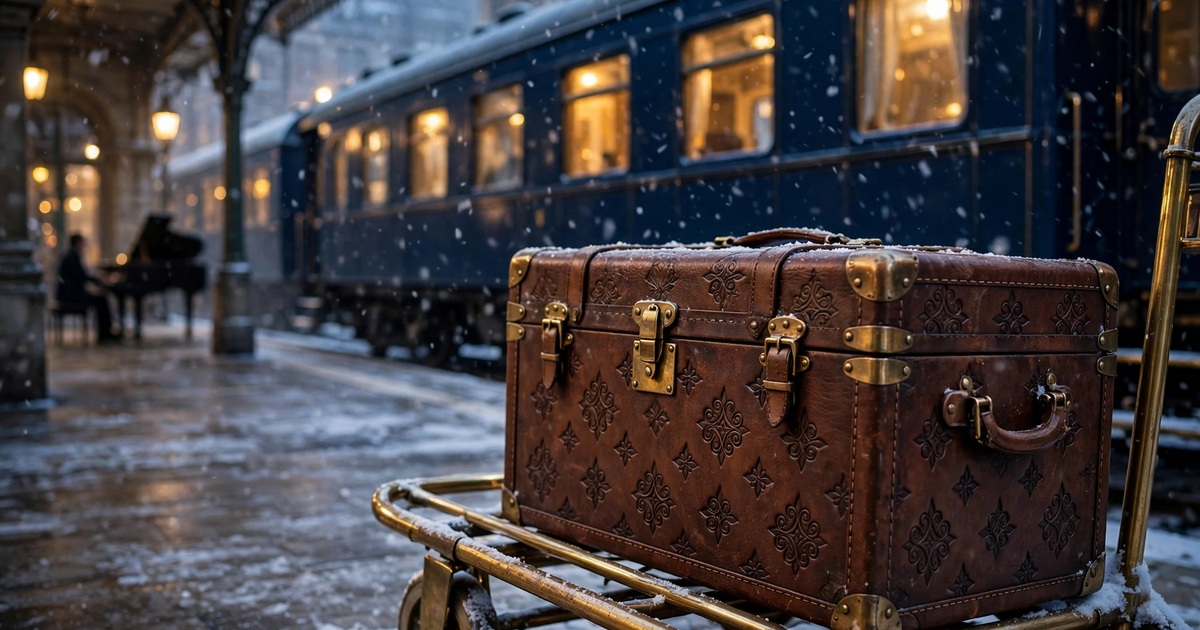
Picture a snowy railway station, five minutes before a grand departure. A pianist plays as each train pulls away. Friends find one another on the platform. Children press their faces to the glass of a miniature train. A traveller writes a postcard she will never send, because the moment is the point. That is Louis Vuitton’s Holiday 2026 campaign, unveiled on 5 November 2026 — and it is also the whole of Louis Vuitton’s psychology in one scene. For 172 years, this brand has sold the same thing: the journey, and the feeling of going somewhere that matters.
Louis Vuitton was founded in Paris in 1854 as a trunk-maker, and it is now the flagship house of LVMH, the group that reported €80.8 billion of revenue in 2025. Its Fashion and Leather Goods division, which Louis Vuitton anchors, reported €37.8 billion in 2025 — though the division was down 5% organically, and down 2% organically in the first nine months of 2026. This audit asks how a trunk workshop became the world’s most recognisable luxury brand, what its Holiday 2026 campaign reveals about the psychology underneath it, and where that psychology starts to cost the brand more than it earns.
I am an Industrial and Organizational Psychologist in Karachi, and I audit brands by testing their claims against psychology research and their own public record. Where a number comes from the company, I say so. Where a legal matter is only a first-instance judgment, an allegation or a reported settlement, I keep it exactly that.
“The journey is the destination.”
— Brand Psychology Analysis, ShahzebSpeaks
📋 Brand Overview
| Field | Detail |
|---|---|
| Brand | Louis Vuitton (Louis Vuitton Malletier) |
| Founded | 1854, Paris, France |
| Headquarters | Paris, France |
| Scale | Flagship house of LVMH (group revenue €80.8 billion in 2025); Fashion and Leather Goods division €37.8 billion in 2025; Louis Vuitton’s own revenue is not disclosed by LVMH |
| Current platform | Holiday 2026 campaign, unveiled 5 November 2026; Monogram 130th anniversary year |
| Website | https://www.louisvuitton.com |
| Psychology score | 84/100 |
Sources: LVMH 2025 financial documents (via secondary summaries); FashionUnited, 30 December 2025; WWD Holiday 2026 exclusive, 5 November 2026; Haute Living, 6 November 2026. All figures as of 7 November 2026.
🏛️ Chapter 1: A trunk that became a language
The story starts with a practical problem: trunks with rounded lids could not be stacked. In 1854, Louis Vuitton opened his own workshop at 4 Rue Neuve-des-Capucines in Paris, and in 1858 he introduced the flat-topped trunk — stackable, airtight, covered in a plain grey canvas he called Trianon. In 1859 he moved his workshops to Asnières, outside Paris. The trunk was not a fashion statement. It was a better box. But better boxes get copied, and the copying shaped everything that followed.
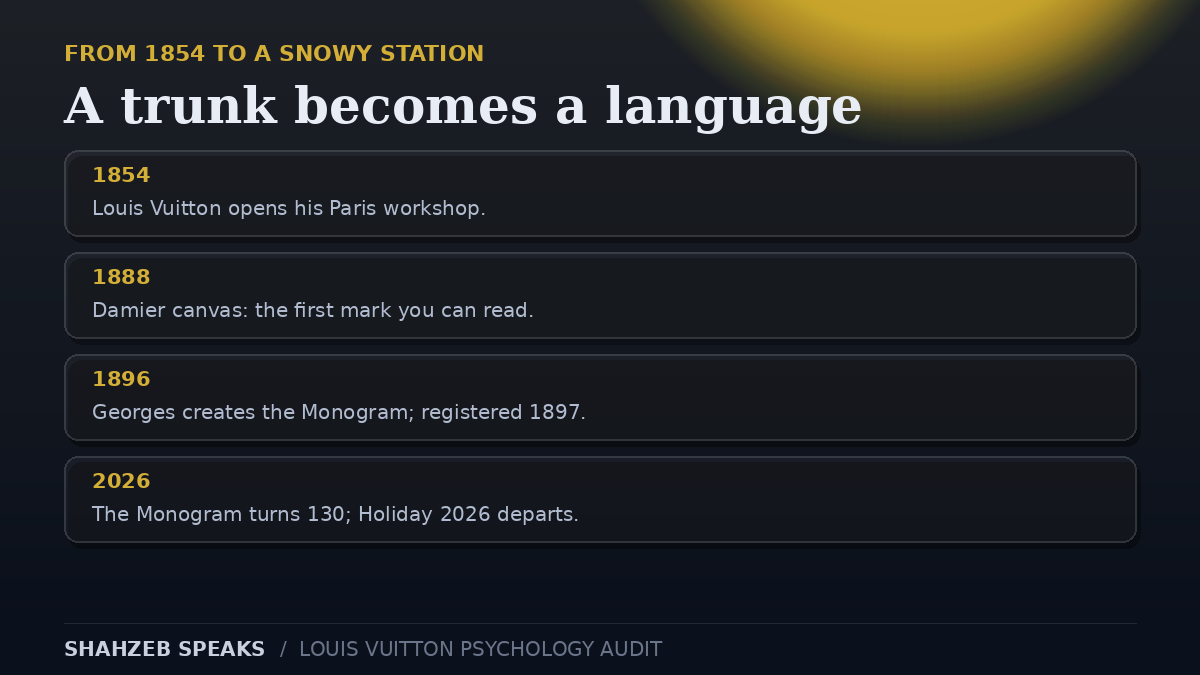
Georges Vuitton, who took over after his father’s death in 1892, answered imitation with design. The Damier canvas arrived in 1888 — a checkerboard of dark and light brown, and the first Vuitton canvas to carry the words “L. VUITTON MARQUE DÉPOSÉE” inside the pattern itself. When that too was copied, Georges created the Monogram in 1896 as a tribute to his father: the LV initials woven with quatrefoil flowers and diamond shapes, registered in 1897. The Monogram was not decoration first. It was a trademark you could see from across a station platform — an anti-counterfeit device that became, over 130 years, the most recognisable pattern in luxury. That is the first lesson of this audit: at Louis Vuitton, the logo was never only a logo. It was a legal instrument that learned to be beautiful.
The house kept building on the same logic. The Speedy arrived in 1930, the Keepall in 1930, the Noé in 1932 — originally designed to carry five bottles of champagne — the Alma in 1992 and the Neverfull in 2007. In 1987, Louis Vuitton merged with Moët Hennessy to form LVMH, and the trunk-maker became the flagship of the world’s largest luxury group. In 2026 the house is celebrating the Monogram’s 130th anniversary with a year-long programme: the Monogram Origine Collection, revisiting the 1896 pattern in a linen-and-cotton jacquard in soft pastel hues, and the Monogram Emblème, a new five-thread weave launched in June 2026. A pattern created to stop thieves is now the subject of a birthday year. That is what 130 years of repetition does to a mark: it turns a defence into a heritage.
💛 Chapter 2: The need to belong — reunion and departure
The Holiday 2026 campaign is built on the most basic human motive in psychology. Baumeister and Leary (1995), in their review in Psychological Bulletin, argued that the need to belong — the desire for frequent, pleasant interaction inside stable relationships marked by mutual concern — is a fundamental human motivation, closer to hunger than to taste. Louis Vuitton’s campaign stages exactly that need, twice over. The departure is the excitement: the train, the countdown, the pianist sending each train off with a melody. The reunion is the ache underneath it: friends finding one another on the platform, children playing, a traveller writing a postcard home.
Notice what the campaign does not show. It does not show a price, a discount or a reason to buy now. It shows the five minutes before a grand departure — a suspended moment, as the brand’s own description puts it — and it trusts the viewer to connect the luggage on the platform with the luggage in the store. The Neverfull Inside Out MM and the Speedy Bandoulière 30 lead the women’s selection; the men’s selection includes the Speedy Bandoulière 30 in Monogram Surplus jacquard, the Track Backpack, the Steamer 30 and the Trio Messenger. None of them is the subject of the film. The subject is the feeling of going somewhere that matters, and of being met when you arrive. A campaign that names a universal feeling and then steps back is more persuasive than one that shouts a price, because the feeling is the product and the product is only the proof.
🚂 Chapter 3: The journey as the product — the peak-end rule
The campaign’s staging is not an accident of taste. It is a precise application of the peak-end rule (Kahneman, Fredrickson, Schreiber & Redelmeier, 1993): people judge an experience mainly by how they felt at its most intense moment and at its end, not by the average of every minute. Louis Vuitton has chosen the most intense moment of travel — the five minutes before departure, when anticipation is highest — and made it the whole campaign. The departure board counts down. The pianist plays. The snow falls. Everything in the frame is arranged to make one moment feel larger than the journey around it.
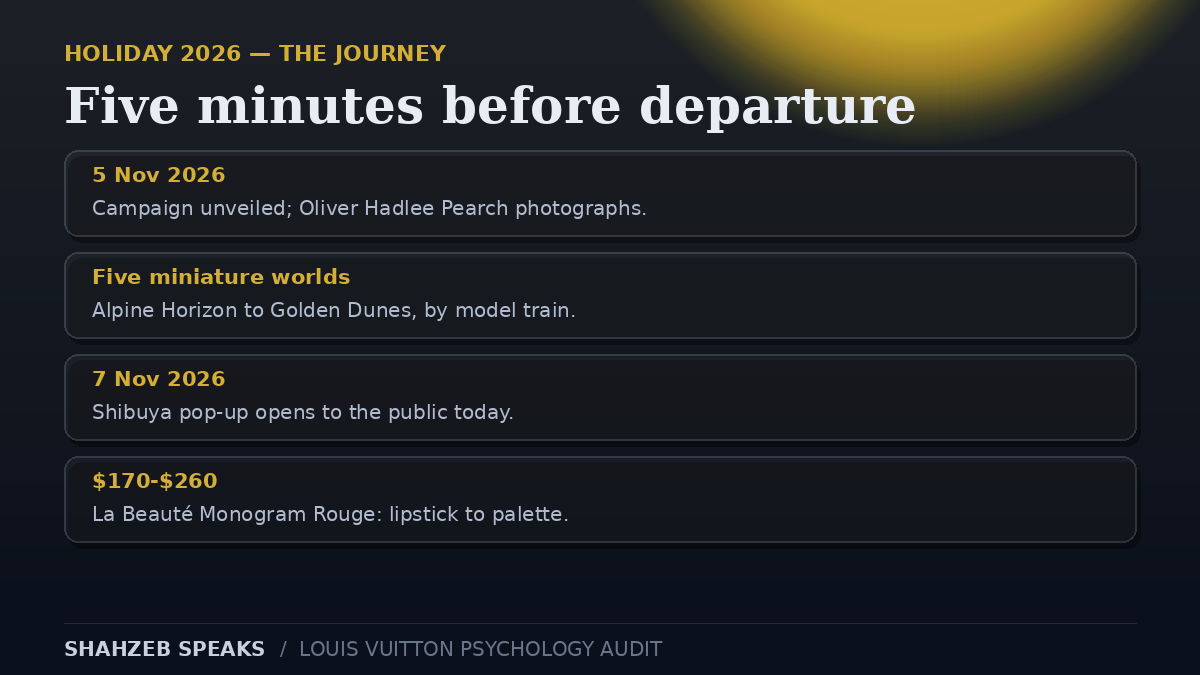
The same logic extends into the stores. The railway theme carries into the holiday windows, which feature five miniature worlds — the Alpine Horizon, the Big Apple, the Blossom Garden, the Moonlight Valley and the Golden Dunes — linked by a model train that travels from one miniature world to the next, as if telling a single journey. The windows have been on view since 1 November, and Christmas trees in most Vuitton stores feature train garlands winding around their branches. In Tokyo, the Louis Vuitton Shibuya Men’s store hosts an immersive installation opening to the public on 7 November 2026: visitors are welcomed by a tree decorated with trains, travel through the miniature worlds, and then enter a second space inspired by the house’s wooden trunks, complete with drawers fitted with natural cowhide handles, where products are presented. The campaign is not a picture of a journey. It is a journey the customer walks through — and the peak moment is staged at every step.
The theme itself is borrowed from the house’s own recent past. The campaign echoes Nicolas Ghesquière’s fall 2025 womenswear collection, for which he polled members of his design team for their favourite films involving trains — among them “Brief Encounter”, “2046”, “Snowpiercer” and “Harry Potter and the Sorcerer’s Stone”. A brand that quotes its own archive, and cinema’s archive, at the same time is doing two things at once: reminding the audience of its heritage, and borrowing the emotional weight of films the audience already loves. That is efficient psychology, and it is also honest craft — the reference is worn openly, not hidden.
⏳ Chapter 4: Scarcity and collectability — the 130th anniversary machine
Scarcity works when the scarce thing is genuinely limited, and Louis Vuitton’s 130th anniversary programme is built to feel that way. Three capsule collections reinterpret the Monogram through the codes of the house’s trunk savoir-faire. The Monogram Origine Collection revisits the 1896 pattern in a new linen-and-cotton jacquard. The Monogram Emblème, launched in June 2026, is a new textured canvas in two colours — poplar beige and ribbon pink — woven with a five-thread technique that creates a raised, embroidered effect. Each is a limited reinterpretation of a pattern that is itself 130 years old, which is the clever part: the scarcity is not of the Monogram, which is everywhere, but of this year’s version of it.
La Beauté Louis Vuitton plays the same game at a lower price. The Monogram Rouge holiday collection, on sale from 5 November 2026, centres on the line’s signature shade — a deep, burnt red — across five hero products: the LV Rouge Matte, giving the shade its first velvety finish, the LV Rouge Satin, where the shade began, the LV Baume in “Monogram Touch”, and the LV Ombres eyeshadow palette, all in burgundy aluminium cases. The prices run from $170 to $260 in the United States: $170 for a lipstick, $260 for the palette. That is a great deal of money for a lipstick, and the price is part of the psychology. Cialdini’s scarcity principle works together with price anchoring here: a $170 lipstick is expensive as make-up and cheap as an entry ticket to Louis Vuitton, and the limited-edition framing makes the decision feel urgent. Pat McGrath, the house’s Creative Director of Cosmetics, said of the shade: “Monogram Rouge has always held a special place for me. The moment I created it, I knew it was something that would endure.” The collection is her way of honouring it, she said — and of saying “this is the one we celebrate.”
There is a risk in the anniversary machine, and it is worth naming. A 130th anniversary is a real milestone, but a year-long programme of capsules, pop-ups and windows can make heritage feel like a product launch calendar. The Monogram is strong enough to survive that. The question is whether the customer still feels the history, or only the schedule.
👁️ Chapter 5: Mere exposure — the pattern you cannot unsee
The Monogram’s power rests on one of the oldest findings in psychology. Zajonc (1968) showed, in his mere exposure experiments, that people come to prefer things simply because they have seen them before — familiarity itself creates liking, even when the person cannot say why. No brand in luxury has exploited this more thoroughly than Louis Vuitton. The Monogram is on bags, trunks, shoes, scarves, phone cases, lipstick cases and store windows, in every airport and high street in the world. A customer does not need to be told what it means. They have seen it a thousand times, and the thousandth sighting feels like recognition.
The 130th anniversary year turns that exposure into a story. From 1 January 2026, stores worldwide displayed replicas of the original 1897 registration alongside historic tools and materials, linking the early history of the canvas to the year’s products. The anniversary campaign celebrates five Monogram bags as heritage masterpieces: the Speedy, the Keepall, the Noé, the Alma and the Neverfull. Each one is presented not as a product but as a chapter. That is mere exposure with a narrative attached: the customer is not just seeing the pattern again, they are being told why it has lasted. The risk is the same as the strength. A pattern seen everywhere can become invisible — wallpaper rather than a signal. The anniversary year is, in effect, Louis Vuitton’s answer to that risk: give people a reason to look at the pattern again, and to see it as history rather than habit.
🕰️ Chapter 6: Nostalgia — 130 years as a selling point
Nostalgia works because it is not really about the past. Wildschut, Sedikides, Arndt and Routledge (2006) showed that nostalgia is a predominantly positive emotion, triggered by sensory cues and social moments, that strengthens feelings of social connectedness and continuity of the self. Louis Vuitton’s campaign is built from exactly those triggers: snow, a station, a pianist, a departure board, a postcard — sensory cues of journeys most people have taken, attached to reunions most people have felt. The campaign does not ask the viewer to remember Louis Vuitton. It asks the viewer to remember their own departures, and to let the brand stand beside the memory.
The heritage framing is doing commercial work at the same time. The Fashion and Leather Goods division was down 5% organically in 2025 at €37.8 billion, and down 2% organically in the first nine months of 2026, with the third quarter down 5%. LVMH does not publish Louis Vuitton’s own revenue, so no brand-level sales figure can be printed here — analyst estimates of €20–25 billion a year are just that, estimates. What is visible is the strategy: when sales soften, the house leans harder on heritage. A 130th anniversary is the strongest version of that lean. It says the brand has survived worse than a soft quarter, and it invites the customer to buy into continuity rather than novelty. That is a sound use of nostalgia — and it is also a test. If the anniversary year lifts the division’s numbers, the heritage strategy is vindicated. If it does not, the house will have to answer a harder question about whether the problem is the story or the price.
💎 Chapter 7: Status signalling — the visible Monogram
Veblen (1899) argued that luxury goods signal status precisely because they are expensive and visible, and Belk (1988) added that possessions become part of the extended self — we are, in part, what we own. The Monogram is the purest version of both ideas in modern luxury. It is not a discreet mark. It is a pattern that covers the whole surface, readable from across a room, and it has been readable in the same way since 1896. A customer carrying a Monogram bag is not signalling wealth in the abstract. They are signalling membership in a group that recognises the pattern — social identity theory (Tajfel & Turner, 1979) applied to a canvas.
That visibility is also the brand’s greatest vulnerability, and the legal record in the next chapter is the evidence. A mark that is worth signalling is worth copying, and Louis Vuitton has spent 130 years defending it. The Damier canvas of 1888 was created because the Trianon canvas was being copied. The Monogram of 1896 was created because the Damier was being copied. The lawsuits of 2026 — Kamad in Paris, Molly Tea in Suzhou — are the same story in a new century. The psychology is circular: the more visible the mark, the more it is copied; the more it is copied, the harder the brand defends it; the harder the brand defends it, the more valuable the mark becomes. That circle has served Louis Vuitton well for 130 years. The question is whether the circle still looks like protection, or whether it is starting to look like bullying — and the Molly Tea backlash suggests the answer is not obvious.
Loss aversion (Kahneman & Tversky, 1979) sharpens the point. The fear of losing something matters more than the pleasure of gaining it, and a limited-edition Monogram collection plays on exactly that asymmetry: the customer is not buying a bag, they are avoiding the regret of missing this year’s version of a 130-year-old pattern. Combined with the visible status signal, the result is a purchase that feels both rational and emotional at once — which is why it is so hard to argue against, and so easy to overspend on.
✂️ Chapter 8: Craft and the IKEA effect — the trunk you can touch
The Shibuya installation’s second room is the most interesting piece of the Holiday 2026 programme, because it is the one place where the customer touches the craft. Products are presented in a setting inspired by the architecture of the house’s trunks, with drawers fitted with natural cowhide handles. That is not decoration. It is the IKEA effect (Norton, Mochon & Ariely, 2012): people value things more when they have laboured over them, or when they can see the labour that went into them. In Norton’s experiments, participants who assembled an IKEA storage box themselves were willing to pay 63% more for it than participants who evaluated an identical pre-assembled box. Labour leads to love, but only when the labour results in successful completion.
Louis Vuitton’s craft story is the same logic at luxury scale. The trunks were built by hand in Asnières, and the house still makes a point of the savoir-faire behind them — the poplar wood, the canvas, the brass fittings, the hand-painted Monogram flowers on the La Beauté cases. The Shibuya room lets the customer handle the drawers and feel the weight of the trunk’s architecture, which turns an abstract claim about craft into a physical experience. A customer who has opened a trunk drawer understands the price better than a customer who has only seen a photograph. That is the IKEA effect working in the brand’s favour: the effort is visible, the completion is satisfying, and the value follows.
The risk is that craft claims invite scrutiny. “Handmade” is a word luxury brands use freely, and the Monogram canvas today is a coated, industrial product, not a hand-painted cloth. Louis Vuitton is wise to stage the craft in the trunk room rather than in a slogan — a claim that can be touched is stronger than a claim that must be believed. But the house should be careful not to let the heritage story outrun the manufacturing reality. A customer who discovers the gap will feel misled, and the Monogram’s power depends on trust.
🇵🇰 Chapter 9: What Pakistani brands should — and shouldn’t — copy
Pakistani brands should copy three things. First, the archive discipline: Louis Vuitton returns to its own history and re-stages it, rather than inventing a new story every season. A Pakistani brand with decades of history has an archive too, and it is usually sitting in a cupboard. Second, the journey frame: Holiday 2026 sells a feeling first and a product second, and the product is the proof of the feeling. A Pakistani travel, textile or food brand that staged a reunion or a departure with the same care would stand out immediately. Third, the immersion: windows, pop-ups and trunk rooms turn a shop into a place worth visiting, not just a place to buy. A Pakistani brand that built one beautiful window a year, and meant it, would be remembered.
What they should not copy is the enforcement reflex described in the next chapter, or the price ladder. A Pakistani brand that sues a small local business over a flower motif will learn the same lesson Louis Vuitton is learning in China: the courtroom can be won and the public argument lost at the same time. And a Pakistani brand that raises prices towards a premium while its core customer is still price-sensitive will learn the same lesson Louis Vuitton is learning in its sales figures: the heritage story and the luxury price cannot both be true for the same customer. Copy the belonging, the craft and the journey. Do not copy the courtroom, and do not copy the price ladder without the income ladder to match it.
⚠️ Chapter 10: Dark side and regulatory record
Louis Vuitton is a frequent claimant in trademark enforcement, and in 2026 it also appears on the other side of the ledger: as a company fined by regulators. Every case below is reported with its procedural status as sourced. A complaint being filed is an allegation, not a finding; a first-instance judgment is not a final ruling where an appeal is pending; and a reported settlement is a settlement, not an admission. All legal statuses are as of 7 November 2026.
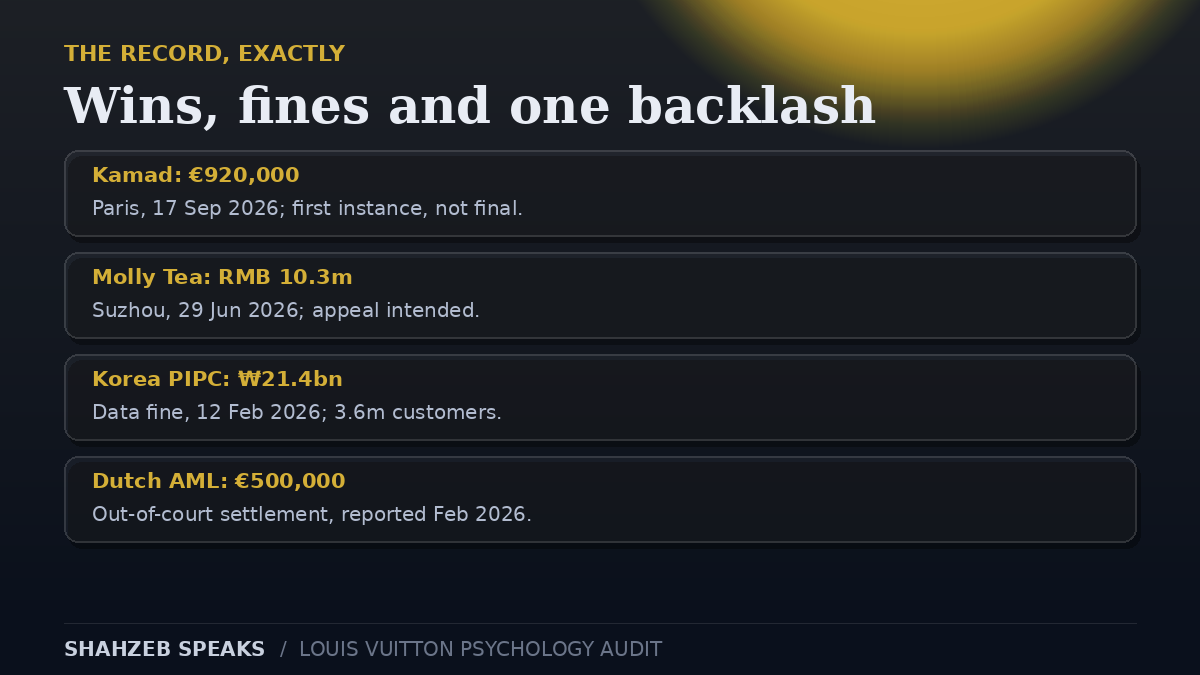
The first case is Louis Vuitton v. Kamad Reworked. On 17 September 2026 the Paris Judicial Court, in a first-instance judgment (Case No. 24/07925), held that Kamad Reworked infringed Louis Vuitton’s trademarks by cutting panels from genuine Louis Vuitton products and incorporating them into new clothing and accessories on which the house’s marks remained visible. The court held that exhaustion of trademark rights did not apply, because the new goods were not the products Louis Vuitton had placed on the market, and it rejected the environmental justification, finding that “the infringement of LVM’s trade mark rights therefore pursues a profit-making purpose, not environmental protection.” The court ordered €920,000 in damages — €750,000 for infringement of trade marks with a reputation, €10,000 for infringement of an additional figurative mark, and €160,000 for unfair competition and parasitism — plus €120,000 in legal expenses, an injunction, destruction of the products, removal of promotional content and publication of the judgment. It also imposed personal liability on the company’s three directors. The judgment was delivered at first instance and is provisionally enforceable; it is not a final ruling.
The second case is Louis Vuitton v. Molly Tea. On 29 June 2026 the Suzhou Intermediate People’s Court delivered a first-instance judgment holding that Molly Tea, a Chinese bubble-tea chain, had infringed seven registered Louis Vuitton four-petal floral trademarks with its four-petal flower logo. The court ordered Molly Tea to stop using the sign and pay RMB 10.3 million — RMB 10 million in economic damages plus RMB 300,000 in enforcement expenses, approximately US$1.5 million. Molly Tea has stated that it intends to appeal, and the complete reasoned judgment has not been officially published. The legal win came with a public cost: critical discussion of the case spread widely on Chinese social media, and research firm JL Warren Capital estimated — these are estimates reported by Bloomberg, not official figures — that Louis Vuitton’s sales in China fell by around 30% in July 2026 and 20–25% in August. The brand won the case. Whether it won the argument is a different question, and the scorecard marks it.
Two further court matters complete the picture. In Louis Vuitton Malletier SA v. Wang, 2026 FC 1244, the Federal Court of Canada found the defendant guilty of contempt for breaching a permanent injunction in a 2019 judgment by continuing to sell counterfeit Louis Vuitton goods; the contempt was proven beyond a reasonable doubt, and the penalty will be determined at a separate sentencing hearing, so no penalty figure is printed here. In the United States, Louis Vuitton Malletier filed a complaint on 28 July 2026 against an unnamed e-commerce operator alleging federal trademark counterfeiting and infringement, and the Southern District of Florida granted a preliminary injunction on 29 September 2026 after the defendant did not respond or appear. A preliminary injunction is not a final ruling on the merits, and the allegations remain allegations.
The regulator record is the part of this chapter that should concern the brand most. On 12 February 2026, South Korea’s Personal Information Protection Commission fined Louis Vuitton Korea ₩21.4 billion — about $14.8 million, the heaviest of three LVMH brands fined a combined ₩36 billion — after an outside actor hacked an employee’s device on three occasions and exposed the personal data of about 3.6 million customers, including names, phone numbers and dates of birth. Separately, in February 2026, the Dutch arm of Louis Vuitton agreed to pay a €500,000 penalty in an out-of-court settlement with the Dutch Public Prosecution Service, after prosecutors concluded it had failed to apply adequate anti-money-laundering controls under the Dutch Money Laundering and Terrorist Financing Prevention Act; a customer had allegedly used illicit funds to buy more than €2 million of luxury goods for resale in China. That settlement is reported in secondary sources — the DutchNews report itself could not be opened in this research, and the prosecution service’s release was not read directly — so it is phrased here as reported, not as a directly verified fact. No product-safety case, labour-standards case or consumer-protection fine against Louis Vuitton was found in this research, and I do not invent one.
The honest reading of the record is that Louis Vuitton defends its marks with unusual force and usually wins in court, that its 2026 wins came with real reputational costs, and that its own compliance failures — a data breach affecting 3.6 million customers and an anti-money-laundering settlement — are now part of the record too. A brand that has spent 130 years building small marks will spend a great deal defending them. That is rational. It is also a cost, in goodwill as well as legal fees, and it is the reason the scorecard marks the legal record below the brand’s creative scores.
📊 Psychology Scorecard
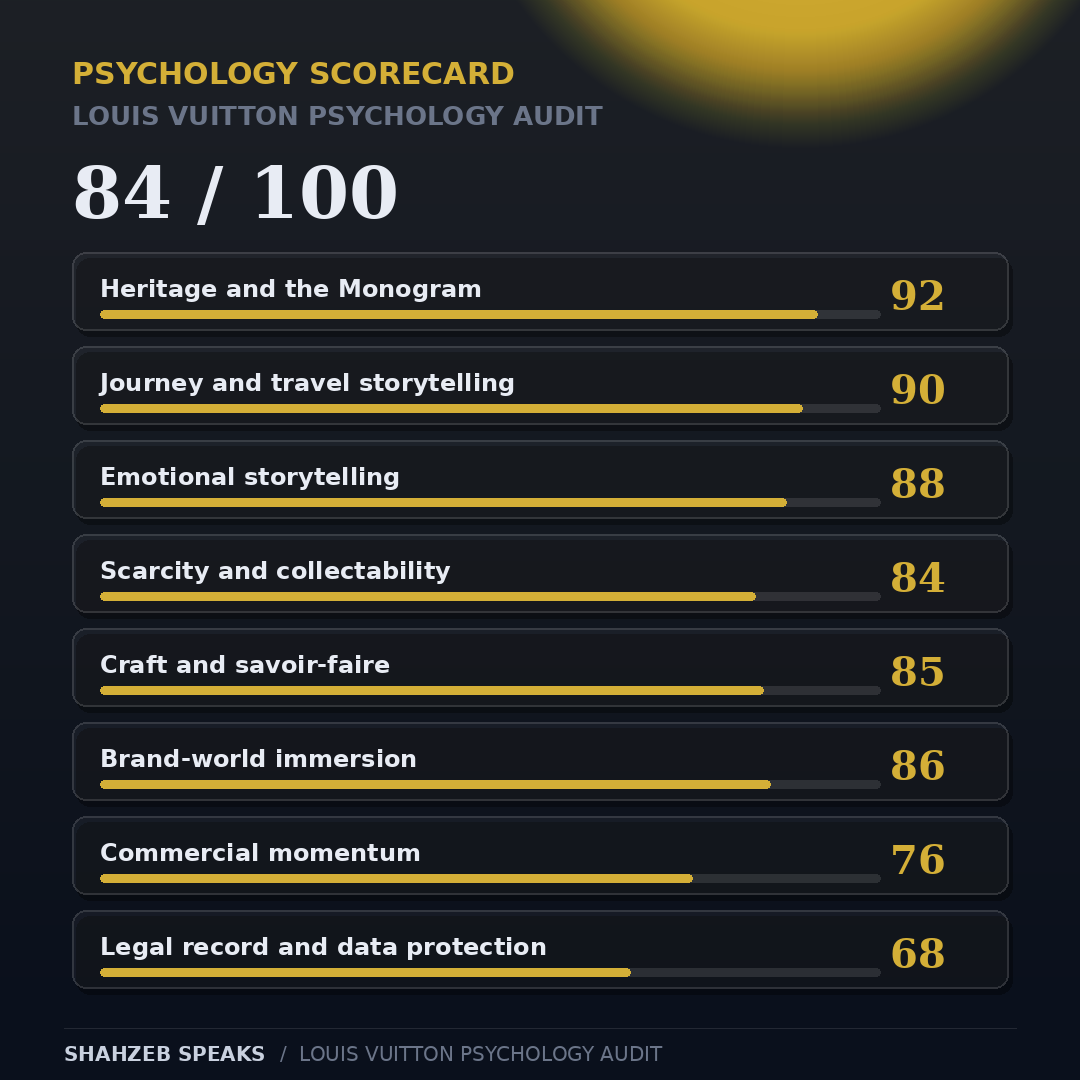
| Dimension | Score | Verdict |
|---|---|---|
| Heritage and the Monogram | 92 | A 130-year-old mark, still the most recognisable in luxury. |
| Journey and travel storytelling | 90 | The station, the countdown, the five miniature worlds. |
| Emotional storytelling | 88 | Reunion and departure, staged without a price in sight. |
| Scarcity and collectability | 84 | Anniversary capsules and a $170 lipstick that feels like a ticket. |
| Craft and savoir-faire | 85 | The Shibuya trunk room lets customers touch the craft. |
| Brand-world immersion | 86 | Windows, pop-up and film tell one continuous journey. |
| Commercial momentum | 76 | Fashion & Leather Goods down 5% in 2025, Q3 2026 down 5%. |
| Legal record and data protection | 68 | Court wins with backlash; a ₩21.4bn data fine and an AML settlement. |
Arithmetic: 92 + 90 + 88 + 84 + 85 + 86 + 76 + 68 = 669. 669 ÷ 8 = 83.625, rounded to 84/100.
✅ Balance sheet & prescription
What Louis Vuitton does best is turn a feeling into a product without ever saying the feeling out loud as a sales pitch. The journey is the platform, the Monogram is the proof, the station is the stage, and the luggage is the uniform that lets a customer wear all three at once. What it does worst is the same thing every heritage brand risks: confusing enforcement with stewardship, and confusing a courtroom win with a public one. The prescription follows that balance. First, publish a real effectiveness measure for Holiday 2026 — reach, recall or sales attribution — rather than letting trade press fill the gap with adjectives. Second, set a public test for trademark enforcement: pursue counterfeiters, but pause before suing a small business over a flower, and say openly how that line is drawn. Third, fix the data protection that the Korean fine exposed, and report the fix the way a luxury brand should — plainly, and before the next breach. Do those three things and the journey earns its destination. Without them, the brand remains a beautiful station with a legal bill it has not fully explained.
📝 Final Verdict
Louis Vuitton has understood something most luxury brands forget: people do not buy luggage, they buy the feeling of going somewhere that matters and being met when they arrive. The Monogram has carried that feeling for 130 years, and Holiday 2026 stages it with rare warmth — a snowy station, five minutes before departure, five miniature worlds and a pop-up that opens today in Shibuya. Its weakness is not creativity but candour: a softening commercial picture, a legal record that pairs courtroom wins with public backlash, and two regulator fines in a single year that say more about the company’s controls than any campaign can. Fix the candour, keep the craft, and this is a brand that will deserve the journey it sells.
Psychology Score: 84/100 — A 172-year-old journey machine, told with rare warmth in a snowy station, held back by softening sales, a legal record that wins in court and loses in public, and two regulator fines in one year.
If your brand sells a journey, the psychology of the decision matters more than the polish of the product. I audit that decision journey — get in touch here.
Related audits: Hermès — The Bag You Have to Earn, Rolex — The Watch You Have to Wait For, and Zara — The Scarcity Machine of Fast Fashion. See also industrial psychology in Pakistan.
📚 References & Sources
- Louis Vuitton (2026). Holiday 2026 campaign, unveiled 5 November 2026; La Beauté Monogram Rouge collection, on sale from 5 November 2026.
- WWD (2026). “Louis Vuitton’s 2026 Holiday Campaign Celebrates Train Travel”, exclusive, 5 November 2026.
- Haute Living (2026). “Louis Vuitton Holiday 2026 Campaign Takes a Train Journey”, 6 November 2026.
- Hypebae (2026). “Louis Vuitton & Pat McGrath Drop Holiday Capsule”, 5 November 2026.
- FashionUnited (2025). “Louis Vuitton marks 130 years of its Monogram with heritage-led collections”, 30 December 2025.
- Harper’s Bazaar Arabia (2026). “130 Years In The Bag: Louis Vuitton Is Celebrating Its Extraordinary Legacy”, 19 February 2026.
- LVMH (2026). Financial documents, fiscal year 2025; first nine months of 2026, as summarised by Alux and FourWeekMBA.
- Canella Camaiora (2026). “Upcycling branded products: is buying the original enough to transform and resell it?”, 2 November 2026.
- MMLC Group (2026). “China Trademark Law: Louis Vuitton v. Molly Tea — The RMB 10.3 Million Four-Petal Logo Dispute”.
- Cassels (2026). “A Court Order Is Not a Suggestion: Federal Court Finds Counterfeiter in Contempt”, 14 October 2026.
- United States District Court, Southern District of Florida (2026). Order Granting Motion for Preliminary Injunction, Case No. 1:26-cv-25085, 29 September 2026.
- Korea JoongAng Daily (2026). “Korean units of luxury brands fined 36 billion won for major customer data leaks”, 12 February 2026.
- FinCrime Central (2026). “Louis Vuitton Fined 500,000 Euros for Dutch AML Compliance Failures”, 13 February 2026.
- Baumeister, R. F. & Leary, M. R. (1995). The need to belong. Psychological Bulletin, 117(3), 497–529.
- Tajfel, H. & Turner, J. C. (1979). An integrative theory of intergroup conflict. In W. G. Austin & S. Worchel (Eds.), The Social Psychology of Intergroup Relations. Brooks/Cole.
- Zajonc, R. B. (1968). Attitudinal effects of mere exposure. Journal of Personality and Social Psychology, 9(2), 1–27.
- Kahneman, D., Fredrickson, B. L., Schreiber, C. A. & Redelmeier, D. A. (1993). When more pain is preferred to less: The peak-end rule. Psychological Science, 4(6), 401–405.
- Kahneman, D. & Tversky, A. (1979). Prospect theory. Econometrica, 47(2), 263–291.
- Norton, M. I., Mochon, D. & Ariely, D. (2012). The IKEA effect: When labor leads to love. Journal of Consumer Psychology, 22(3), 453–460.
- Wildschut, T., Sedikides, C., Arndt, J. & Routledge, C. (2006). Nostalgia: Content, triggers, functions. Journal of Personality and Social Psychology, 91(5), 975–993.
- Belk, R. W. (1988). Possessions and the extended self. Journal of Consumer Research, 15(2), 139–168.
- Veblen, T. (1899). The Theory of the Leisure Class. Macmillan.
- Cialdini, R. B. (2001). Influence: Science and Practice (4th ed.). Allyn & Bacon.
Key Findings
- Founded 1854 in Paris; Damier canvas 1888; Monogram created 1896 by Georges Vuitton, registered 1897; 130th anniversary in 2026; Speedy 1930, Keepall 1930, Noé 1932, Alma 1992, Neverfull 2007.
- LVMH group revenue €80.8 billion in 2025; Fashion & Leather Goods €37.8 billion, down 5% organically; first nine months of 2026 €26.4 billion, down 2% organic. Louis Vuitton's own revenue is not disclosed by LVMH.
- Holiday 2026 unveiled 5 November 2026: snowy railway station, photographed by Oliver Hadlee Pearch, film by Rubberband, Joe Jackson "Steppin' Out"; five miniature worlds (Alpine Horizon, Big Apple, Blossom Garden, Moonlight Valley, Golden Dunes); Shibuya Men's store pop-up opens 7 November 2026.
- La Beauté Monogram Rouge: five hero products, $170–$260 US (LV Rouge $170, LV Ombres $260), on sale from 5 November 2026; Pat McGrath, Creative Director of Cosmetics.
- Legal record: Kamad — Paris Judicial Court ordered €920,000 on 17 September 2026 (first instance, provisionally enforceable). Molly Tea — Suzhou court ordered RMB 10.3 million on 29 June 2026 (first instance; appeal intended). Wang — contempt finding 2026 FC 1244, penalty pending. Korea PIPC fined Louis Vuitton Korea ₡21.4 billion on 12 February 2026. Dutch AML €500,000 out-of-court settlement reported February 2026. No product-safety or labour case was found.
- Score 84/100: 92+90+88+84+85+86+76+68 = 669; 669/8 = 83.625, rounded to 84.
Overall Psychology Score
Louis Vuitton scores 84/100 in our comprehensive psychology audit covering consumer behavior strategies, UX design principles, and psychological marketing effectiveness.
The detailed dimension scores are in the audit's Psychology Scorecard chapter.
High impactMuhammad Shahzeb
MSc Industrial Psychologist, specializing in consumer behavior, UX psychology, and brand strategy analysis. Helping brands understand the psychology behind their success.
About Muhammad Shahzeb →