Zara Psychology Audit — The Scarcity Machine of Fast Fashion
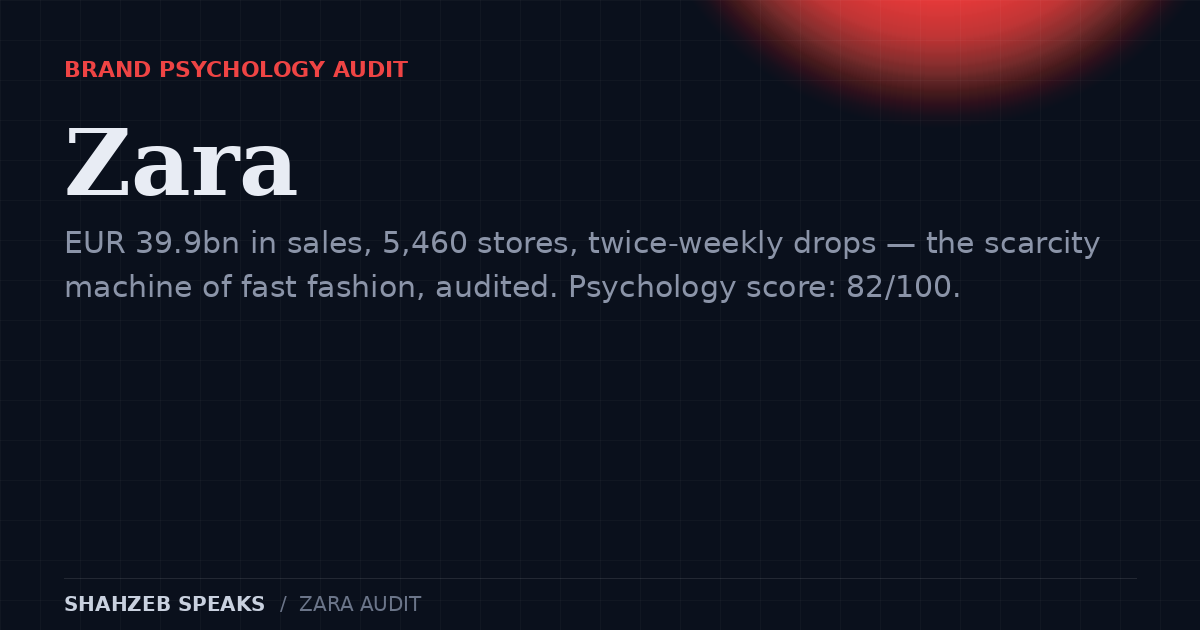
Zara turns runway trends into store stock in weeks, spends almost nothing on advertising, and trains shoppers to buy now or lose it. This psychology audit examines the twice-weekly scarcity engine — and carries the brand's full legal record at its exact status.

82 / 100
Overall consumer behavior effectiveness
Brand Overview
- Brand nameZara
- Founded1975
- HeadquartersArteixo, Spain
- IndustryFashion & Apparel
- Websitewww.zara.com ↗
Psychology Techniques Identified
- 01Scarcity by Design (Limited Runs)
- 02Freshness Urgency (Twice-Weekly Deliveries)
- 03Novelty Reward (the Treasure-Hunt Dopamine)
- 04Loss Aversion (Miss It or Lose It)
- 05Mere Exposure & the Weekly Visit Loop
- 06Anchoring to Runway Prestige
- 07Crowd Social Proof (Busy Stores as Signal)
- 08Curated Choice Architecture (Small Batches, Low Overwhelm)
- 09Affordable-Luxury Price Signalling
- 10Data-Driven Personalisation (Daily Store-Manager Orders, AI Try-On)
- 11Authority Transfer from Fashion Weeks
- 12Sustainability Signalling (Join Life, Pre-Owned)
Full Psychology Audit Report
In this audit
Walk into a Zara store on a Tuesday and return on a Friday, and half of what you saw is gone. Not discounted — gone, replaced by garments that were not there seventy-two hours earlier. No brand in fashion runs its shelves like a countdown clock, and no brand has built a bigger business on the back of that clock: net sales of €39.864 billion and net income of €6.22 billion in the fiscal year that ended 31 January 2026, both records. Zara is not really a clothing company. It is a behavioural laboratory that sells clothes: twice-weekly deliveries, small batches, styles that vanish if they do not sell — a scarcity engine that converts the oldest anxiety in commerce (fear of missing out) into the most disciplined habit in retail (come back this week, buy now).
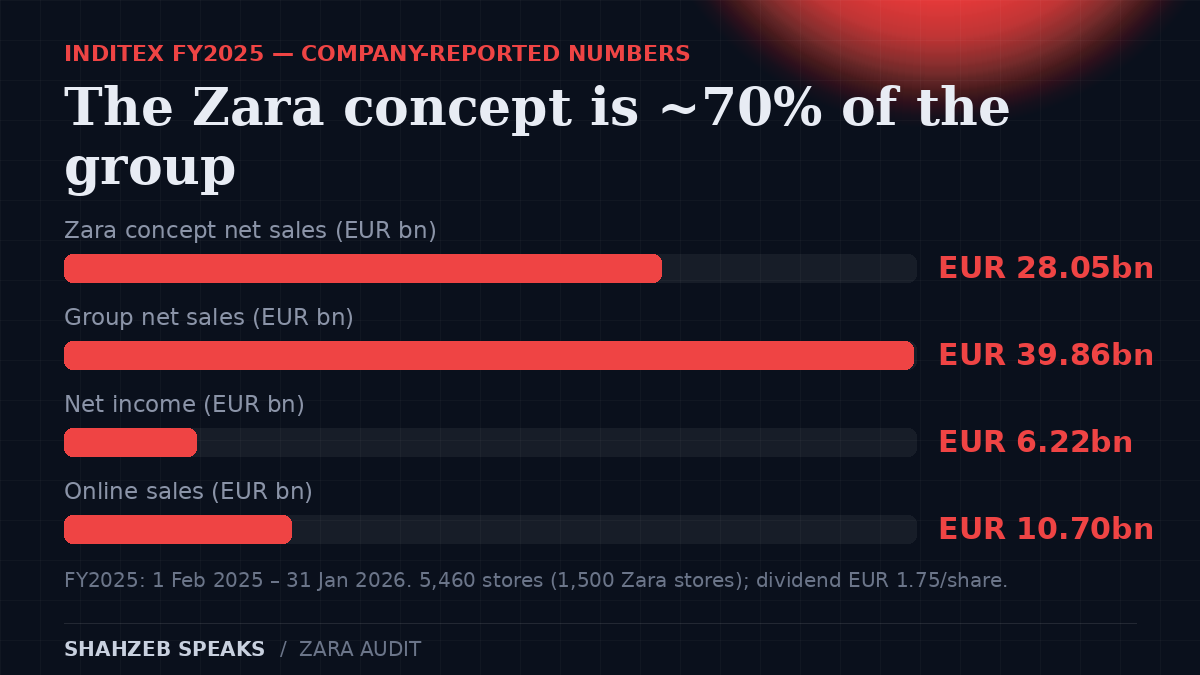
Inditex, Zara’s parent company, operated 5,460 stores at 31 January 2026 (stores opened in 41 markets that year); of those, 1,500 were Zara stores, and the Zara concept (Zara plus Zara Home plus Lefties) generated €28.051 billion in net sales — roughly 70 per cent of the entire group. Online sales reached €10.7 billion. The founder, Amancio Ortega, still controls roughly 59 per cent of the company and was set to receive a record €3.23 billion dividend for the year. And the most striking fact of all: Zara achieved this while — in the words of Encyclopaedia Britannica — having “spent relatively little on advertising.” The stores are the ads. The weekly drop is the campaign.
I am an Industrial and Organizational Psychologist in Karachi. I audit brands the way I audit workplaces: principles first, evidence always, flattery never. Zara scores 82/100 — but the dark-side chapter carries a settled Brazilian labour case, a French inquiry opened and then closed for lack of jurisdiction, a disputed tax-avoidance allegation, and a pattern of creative misfires pulled with apologies. The scarcity engine is genuine. So are the liabilities.
“Zara turned the shop floor into a slot machine with good taste: small batches, twice-weekly drops, and a clock on every garment. The customer is not choosing clothes. The customer is racing a countdown — and the house always wins the race.”
— Brand Psychology Analysis, ShahzebSpeaks
📋 Brand Overview: Zara at a Glance
| Field | Detail |
| Founded | 1975, A Coruña, Spain, by Amancio Ortega (Encyclopaedia Britannica) |
| Owner | Inditex (holding company founded 1985); eight formats: Zara, Pull&Bear, Massimo Dutti, Bershka, Stradivarius, Oysho, Zara Home, Lefties |
| Headquarters | Arteixo, Spain |
| Leadership | Marta Ortega, non-executive chair since 1 April 2022; Óscar García Maceiras, CEO (Reuters, Mar 2023) |
| FY2025 results | Net sales €39.864 billion (+3.2%); net income €6.22 billion (+6.0%) — both records (Inditex FY2025 results presentation) |
| Zara concept | Net sales €28.051 billion (~70% of group); 1,500 Zara stores; 5,460 Inditex stores at 31 Jan 2026 (company results) |
| Ownership | Founder Amancio Ortega controls ~59 per cent; record €3.23 billion dividend for FY2025 (Retail Gazette, Mar 2026) |
| Website | https://www.zara.com |
📜 Chapter 1: The History — From “Zorba” to a €39.864 Billion Empire
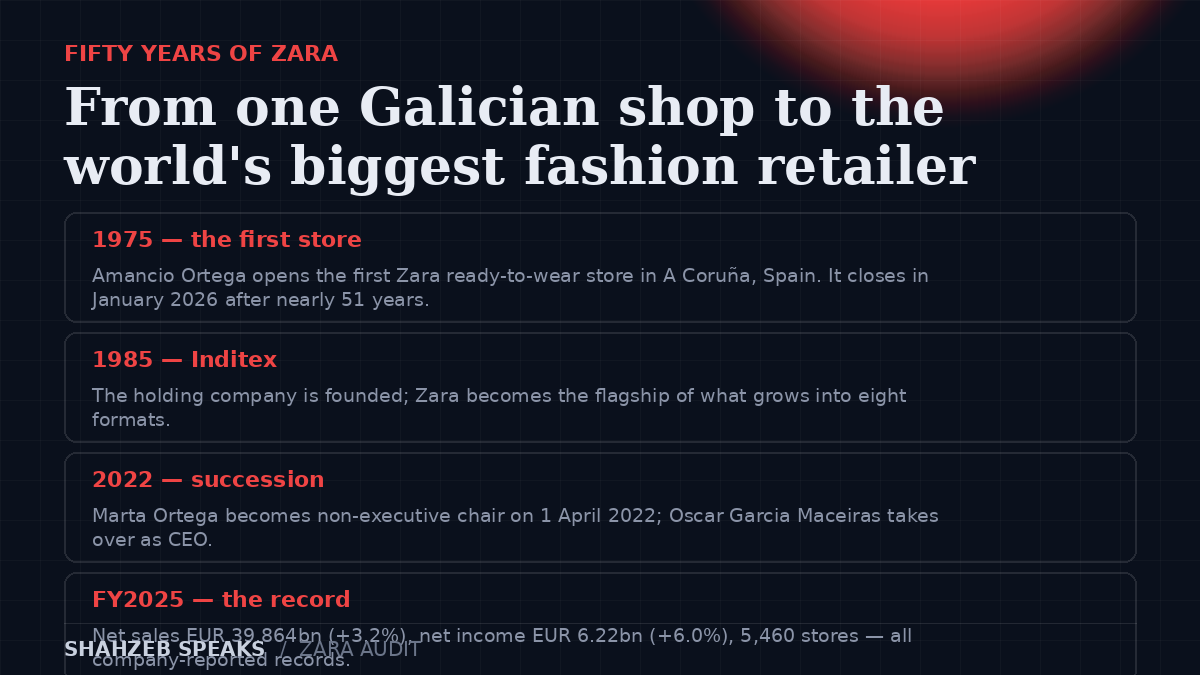
In 1975, Amancio Ortega opened a small ready-to-wear store on Juan Flórez Street in A Coruña, in Spain’s Galicia region. The intended name was “Zorba,” after Zorba the Greek; company communications director Jesús Echevarría told the New York Times the letters were rearranged to “Zara” because a nearby bar already used the name. Ten years later, in 1985, Ortega founded Inditex as the holding company; the group now runs eight commercial formats — Zara, Pull&Bear, Massimo Dutti, Bershka, Stradivarius, Oysho, Zara Home and Lefties — with Zara as the undisputed flagship.
The model’s psychology was baked in from the start. Britannica documents how trend spotters picked up ideas at fashion shows, in-house designers copied the best concepts, and efficient manufacturing — mostly in Spain and surrounding countries — turned runway sightings into store stock “just a few weeks after they had been spotted on fashion runways.” New arrivals reached stores year-round, on a weekly basis, breaking the industry’s seasonal rhythm; styles that did not sell were quickly removed. The rhythm was the message: come often, or miss it.
Leadership is now a family story. Marta Ortega, the founder’s daughter, became non-executive chair on 1 April 2022, with Óscar García Maceiras as CEO (Reuters, March 2023). And in January 2026, Zara closed its very first store on Juan Flórez Street after nearly 51 years — the 300–350 m² shop no longer fitted the large-format flagship model; eleven staff were offered transfers, and the space had briefly served as an exhibition for Zara’s 50th anniversary. The first shop died so the megastore could live: Inditex opened stores in 41 markets that year, and selling space grew 5.3 per cent to 4.72 million m².
🧪 Chapter 2: Technique 1 — Scarcity by Design (Limited Runs)
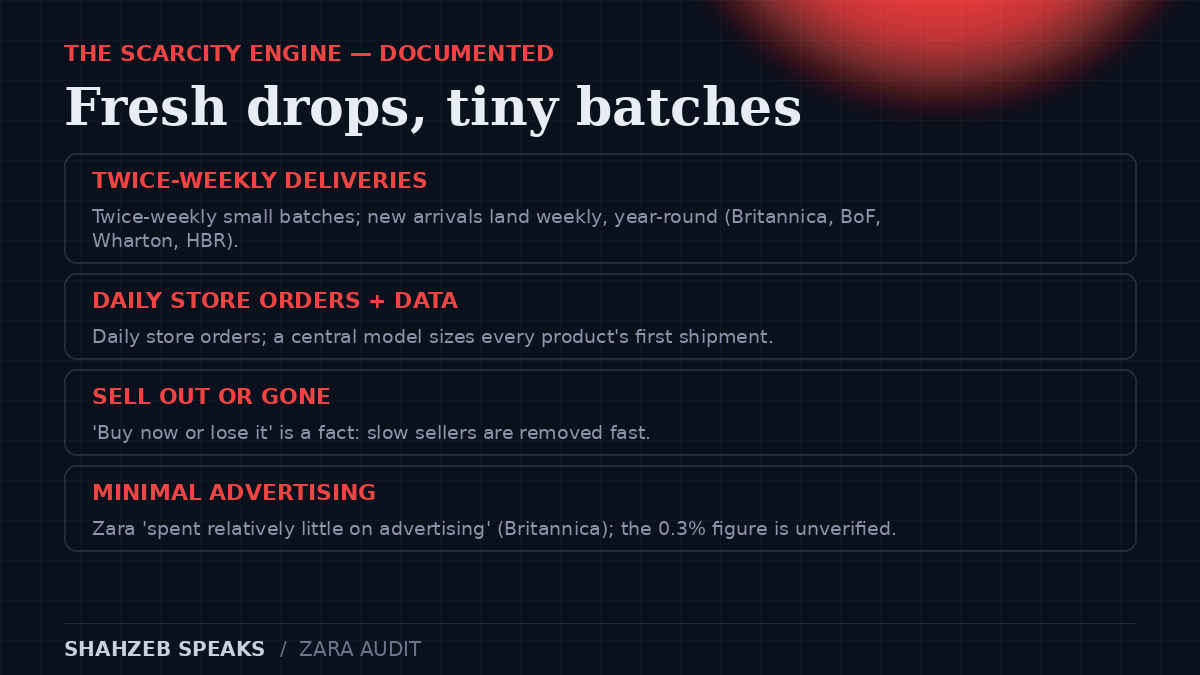
In 1968, Timothy Brock published commodity theory in the Journal of Experimental Social Psychology: “any commodity will be valued to the extent that it is unavailable.” It is one sentence, and Zara built an empire on it. Products are centralised in Spain, then sent in small packages to stores worldwide twice a week — a rhythm that, per the Business of Fashion, lets Zara “replace stocks faster than its rivals.” The scarcity is real, which is precisely why it works.
When a brand genuinely produces in small batches, customers learn the constraint is credible — and credibility turns scarcity from a trick into a habit. Zara’s daily data loop reinforces it: store managers place daily orders, and the company uses current stock availability plus past sales data to calculate the optimal number of units for every initial shipment of a new product (BoF; Inditex annual reporting). The machine allocates scarcity where demand proves it exists. I have charted how scarcity converts attention into action across retail in my guide to scarcity marketing examples; Zara’s version is engineered into logistics rather than painted onto banners.
⏱️ Chapter 3: Technique 2 — Freshness Urgency (Twice-Weekly Deliveries)
In 1987, George Loewenstein’s “Anticipation and the Valuation of Delayed Consumption” (Economic Journal) showed people derive real utility from looking forward to things — savouring shapes choices as much as outcomes. Zara industrialised savouring. Wharton confirms Zara stores worldwide receive new products twice a week, and HBS’s “Rapid-Fire Fulfillment” case (Ferdows, Lewis & Machuca) documents the twice-weekly ordering rhythm down to the warehouse deadlines in La Coruña. (In 2023 Inditex trialled four weekly deliveries at a handful of Madrid stores; a spokesperson declined to comment, and trials did not necessarily mean a permanent rollout — the documented baseline remains twice weekly.)
The cadence also turns anticipation into a reward schedule: the shopper never knows which visit will surface the perfect blazer, so the pleasure of the possible next visit keeps the loop spinning even when the current one disappoints. Britannica adds the year-round dimension — new arrivals reached Zara stores “on a weekly basis,” not in traditional fashion seasons. The industry has four seasons; Zara’s calendar has fifty-two weeks of them.
🎰 Chapter 4: Technique 3 — Novelty Reward (the Treasure-Hunt Dopamine)
In 1957, Ferster and Skinner published Schedules of Reinforcement: variable-ratio schedules — rewards after an unpredictable number of responses — produce the highest, most persistent rates of behaviour. The slot-machine schedule. Zara runs a fashion version: twice-weekly small batches, with styles quickly removed if they do not sell, make the assortment never fully predictable. Today’s gem was absent yesterday and will be gone tomorrow. The “treasure hunt” is not a metaphor the brand invented; it is a reinforcement schedule the supply chain enforces.
What the evidence supports is narrower — novelty captures attention, attention drives approach behaviour, and unpredictable novelty sustains it (Ferster & Skinner, 1957). Zara’s stores, with window displays deliberately built to allow the entire range to be changed overnight (Wharton), are environments designed to make every visit feel like a new game. The brand never has to promise excitement. The calendar does it.
😨 Chapter 5: Technique 4 — Loss Aversion (Miss It or Lose It)
In 1979, Kahneman and Tversky published Prospect Theory in Econometrica: losses loom larger than gains — losing £10 hurts roughly twice as much as gaining £10 pleases. Zara runs this asymmetry as inventory policy. Styles that do not sell are quickly removed (Britannica), so every garment carries a genuine, credible deadline: buy it today, or the rack will not have it on Friday. The loss is quiet and total — the item simply disappears, with no permanent-sale theatre. Prospect theory predicts this hurts more than a missed discount, because the reference point is owning the garment, not a price. Small batches make the threat credible; the twice-weekly rhythm makes it urgent. “Buy now or lose it” is not a slogan here. It is the stock policy.
🔁 Chapter 6: Technique 5 — Mere Exposure & the Weekly Visit Loop
In 1968, Robert Zajonc’s “Attitudinal effects of mere exposure” (JPSP monograph) showed that repeated, unreinforced exposure to a stimulus increases liking for it. Zara’s delivery cadence is a mere-exposure machine: the twice-weekly rhythm trains a weekly visit loop, and each visit re-exposes shoppers to the brand’s aesthetic — same lighting, same minimal styling, same curated mood, with just enough newness to keep attention awake.
This is where the “relatively little” advertising spend (Britannica) stops looking like a gap and starts looking like a strategy. Zara does not need to buy exposure when the store itself is the medium: foot traffic plus a relentless refresh rate means the brand is re-encountered on the customer’s own schedule, at zero media cost. Exposure builds liking; liking builds the visit habit; the habit builds exposure. The loop is self-funding.
👗 Chapter 7: Techniques 6 & 7 — Anchoring to Runway Prestige; Authority Transfer from Fashion Weeks
In 1974, Tversky and Kahneman published their landmark “Judgment under Uncertainty: Heuristics and Biases” in Science, introducing the anchoring effect: an initial reference drags subsequent judgments toward itself, even when it is arbitrary. Zara’s pricing perception is an anchor play. Britannica documents the model: trend spotters pick up ideas at fashion shows, in-house designers copy the best concepts, and the garments reach stores weeks after the runway. The runway piece — photographed on a supermodel, priced at thousands — is the anchor. The Zara version — same silhouette, a fraction of the price — feels like a steal, because judgment was dragged toward the anchor before the shopper ever saw the tag.
The companion mechanism is authority transfer. Robert Cialdini, in Influence (2006), documents how symbols of legitimate authority borrow credibility for whatever stands beside them. Fashion weeks are the authority; the runway reference is the borrowed credential. Zara never claims to be the runway — it claims to translate it, borrowing the original’s prestige while dodging its price. The two techniques stack: the anchor sets the reference price, the authority sets the reference taste, and the high-street price converts both into a purchase that feels clever rather than cheap.
👥 Chapter 8: Technique 8 — Crowd Social Proof (Busy Stores as Signal)
Cialdini’s social proof principle (Influence, 2006) holds that in uncertain situations, people look to the behaviour of others to decide what is correct — and few situations are as uncertain as fashion. A busy Zara store is itself a signal: the crowds, the churned racks, the fitting-room queues tell the entering shopper that this is where taste is currently being decided. With 1,500 Zara stores worldwide and selling space up 5.3 per cent to 4.72 million m² in a single year, ubiquity becomes the advert — the brand is everywhere, therefore the brand must be right. A garment seen on three strangers in one week becomes, by sheer social frequency, the correct choice. The company does not need influencers to certify its taste. The crowd does it for free.
🧭 Chapter 9: Technique 9 — Curated Choice Architecture (Small Batches, Low Overwhelm)
In 2000, Sheena Iyengar and Mark Lepper published their famous jam study in the Journal of Personality and Social Psychology: a display of 24 jams attracted more browsers, but a display of 6 converted ten times as many buyers. Barry Schwartz later named the phenomenon the paradox of choice (The Paradox of Choice, 2004): abundance paralyses. Zara’s small-batch system is choice architecture disguised as logistics. Deliveries arrive in small packages twice a week; the per-visit assortment is finite, curated, and disappearing. The shopper never faces the paralysis of the infinite catalogue, because the catalogue is physically bounded by what fits on this week’s racks.
This is the quiet genius of the model: the same constraint that creates scarcity (Chapter 2) also cures overwhelm. Online, where the assortment is effectively infinite, the effect is harder to hold — one reason the physical store, with its window displays engineered for overnight changeovers (Wharton), remains the psychological heart of the brand even as online sales reached €10.7 billion. Small batches do two jobs at once: they make each item feel rare, and they make the whole store feel shoppable.
💷 Chapter 10: Technique 10 — Affordable-Luxury Price Signalling
In 1989, Rao and Monroe showed in the Journal of Marketing that consumers use price as a signal of quality: the price-perceived-quality heuristic means a higher price, within limits, reads as a better product. Zara plays this heuristic against its own runway anchor (Chapter 7). The garments are priced above disposable fast fashion but far below luxury — a band that signals “this is not cheap” while the runway resemblance signals “this looks expensive.” Affordable-luxury positioning: the price says quality, the silhouette says prestige.
A note of honesty on the advertising story, because the internet repeats a false precision. Britannica documents only that Zara “spent relatively little on advertising” — a qualitative claim. The widely quoted figure of 0.3 per cent of revenue, traced to a 2003 Harvard Business School case study, could not be verified: Inditex does not break out advertising spend in its public accounts (it sits inside “other operating expenses”), so the number is not stated anywhere I can source. What is documented is the mechanism: Zara grows through store traffic and word of mouth, with the twice-weekly drop doing the work that media budgets do elsewhere. The store is the campaign; the window is the billboard. That is verifiable. The 0.3 per cent is not — so I am not printing it.
📊 Chapter 11: Technique 11 — Data-Driven Personalisation (Daily Store-Manager Orders, AI Try-On)
In 2006, Tam and Ho published “Understanding the Impact of Web Personalization on User Information Processing and Decision Outcomes” in MIS Quarterly, showing that personalisation changes how people process information and choose — matched content gets deeper attention and better decisions. Zara’s personalisation is operational rather than digital, and arguably more powerful. Store managers place daily orders, and Inditex’s models calculate the optimal number of units for every initial shipment of each new product using current stock availability and past sales data (BoF). Each store’s assortment is, in effect, customised to its own customers’ revealed preferences — personalisation without a single cookie banner.
The digital layer is catching up. Zara’s AI virtual fitting room — Zara Try-on — is deployed in 43 markets with over 7 million sessions since mid-December (company FY2025 presentation, company-stated), while online sales grew 4.8 per cent to €10.7 billion. The psychology is the same in both channels: reduce the uncertainty of the purchase — will it fit, will my store have my size — and the decision gets easier. Personalisation here is not “recommended for you.” It is “stocked for you,” which is the older, deeper version.
🌱 Chapter 12: Technique 12 — Sustainability Signalling (Join Life, Pre-Owned)
In 2019, White, Habib and Hardisty published “How to SHIFT Consumer Behaviors to Be More Sustainable” in the Journal of Marketing, mapping how brands use signalling — public, visible commitments — to shape sustainable consumption. Zara’s sustainability story is best read through this lens, and with a clear-eyed distinction between company-stated figures and independent verification. The company-stated numbers (FY2025 results presentation): 26 per cent reduction in supply-chain water consumption versus 2020, 88 per cent of textile fibres classified as lower-impact (47 per cent from recycled materials), a goal of 100 per cent lower-impact fibres by 2030, and total emissions (Scopes 1, 2 and 3) cut 11 per cent versus 2018.
The visible signals: the Join Life sustainability label, introduced in 2015 and applied at its peak to 61 per cent of products, was discontinued — the company said it was “no longer necessary to differentiate” collections with the label (The Industry Fashion). Meanwhile Zara Pre-Owned, the resale, repair and donation platform, launched in the UK in late 2022, was running in 16 European countries by September 2024 and reached the US by end of October 2024, with a donation service via the Red Cross (Global Banking & Finance). The signalling psychology works either way: labels and resale platforms tell the customer the brand shares their values, which is exactly what the SHIFT framework predicts. The honest caveat sits in Chapter 13 — Reuters’ November 2024 reporting on air freight is the reason this chapter keeps the trust score lower than the brand would like.
⚠️ Chapter 13: The Dark Side — The Real Legal and Reputational Record
This chapter carries every item at its exact legal status, as of 15 October 2026. Nothing here is upgraded, softened, or presented as worse than the record supports.
Brazil — the 2011 labour case: SETTLED. After São Paulo labour inspections found slave-like conditions at Zara suppliers, Zara/Inditex reached a settlement with prosecutors in December 2011: a $1.8 million settlement plus a Conduct Adjustment Term (TAC) requiring tighter supplier monitoring — and Zara was kept off the labour ministry’s “dirty list” (Manufacturing.net). Scrutiny did not end there: a 2017 report by SOMO and Repórter Brasil said Zara was still failing to meet the TAC’s monitoring and reporting requirements, and reported that Zara had filed a lawsuit arguing the “dirty list” was unconstitutional. Honesty note: the outcome of that legal challenge was not verified, and a reported 2015 claim that Inditex “could be fined up to US$25 million” was only ever reported as a threat, never as an imposed ruling — so neither is printed here as fact.
France — the Xinjiang forced-labour inquiry: OPENED, then CLOSED. In July 2021, French prosecutors opened an inquiry — via the crimes-against-humanity section of the anti-terrorism prosecution — into Inditex, Uniqlo France, SMCP and Skechers over alleged concealment of crimes against humanity and forced labour in Xinjiang, following an NGO complaint. Inditex rejected the claims and pledged cooperation. Outcome: on 4 May 2023, the Paris national anti-terror prosecutor’s office closed the investigation without further action for lack of jurisdiction; the plaintiffs’ lawyer said they would file a new complaint so a judge could be appointed (SpaceDaily). As of 15 October 2026, no later prosecution of Inditex in this matter was found.
The Greens’ tax report: ALLEGED, disputed, never a court finding. In 2016, the European Greens/EFA group alleged that Inditex had avoided around €585 million in taxes between 2011 and 2014 via Ireland, the Netherlands and Switzerland (“Tax Shopping” report). Inditex disputed the figures and said its effective tax rate was 22–24 per cent (Retail Detail EU). This was a political-group allegation, not a court finding — and it must not be presented as one.
Greenwashing: no EU-level sanction as of April 2026. Civil-society watchdogs flagged the Join Life labelling, but per an EcoClaim summary, Inditex/Zara had not been formally sanctioned at EU level for greenwashing in a manner equivalent to H&M, Boohoo or SHEIN as of April 2026. That is a status, not a clean bill of health.
Bravo Tekstil, Turkey (2017): the notes in the clothes. Shoppers in Istanbul found notes sewn into Zara garments — “I made this item you are going to buy, but I didn’t get paid for it.” Workers said the factory had closed in July 2016 owing three months’ wages and severance to 140-plus workers (reported via AP/Reuters, Trust.org). Inditex said it had met its contractual obligations and was working with IndustriALL, Mango and Next on a hardship fund for the workers. A hardship fund is not an admission — but it is an acknowledgment that the supply chain had a human cost.
The creative misfires — a pattern, not a one-off. In August 2014, Zara pulled a children’s striped top with a six-pointed yellow star — marketed with a “sheriff” theme — after comparisons to concentration-camp uniforms; Zara apologised on Twitter, saying the star was inspired by “sheriff’s stars from the classic Western films” (NPR/WCBE; the same reporting noted a 2007 incident when Zara withdrew a handbag featuring swastikas). In December 2023, Zara pulled “The Jacket” Atelier campaign after critics said images — mannequins with missing limbs, figures wrapped in white — resembled the destruction in Gaza; #BoycottZara trended on X. Zara said the campaign had been conceived in July and shot in September, apologised on Instagram on 12 December 2023 and said it “regret[ted] the misunderstanding” (WNCW). In late September/early October 2026, Zara removed a Halloween costume listing likened to a concentration-camp uniform after social-media criticism — no reason given, no public statement (JTA). Three pulls in twelve years, each in the same visual territory, reads as a pattern of weak pre-launch cultural screening.
The air-freight contradiction (Reuters, November 2024). A Reuters exclusive, built on Public Eye customs-data analysis, found Inditex had sharply increased air freight from India: 3,865 consignments by air in the twelve months to end-August 2024 — up 37 per cent year on year — with air’s share of India shipments rising to 70 per cent in the first eight months of 2024. That sits awkwardly beside the company-stated 11 per cent emissions cut versus 2018 and raises direct questions over the Scope 3 target. Inditex responded that it uses sea freight for the “vast majority” of Asian products and air only in exceptional circumstances, citing the Red Sea crisis. Both claims are on the record; the tension between them is real.
📝 Chapter 14: What Brands Should — and Shouldn’t — Copy
Copy the honest scarcity. Zara’s limited runs work because they are real — the supply chain genuinely produces in small batches. Scarcity that is engineered into operations builds trust; scarcity painted onto a banner (“only 3 left!” when the warehouse is full) destroys it. If you cannot deliver scarcity honestly, do not fake it.
Copy the daily data loop. Store managers placing daily orders, with central models optimising the initial shipment of every product — this is the unglamorous engine behind the glamour. Any retailer can shorten the feedback loop between the shop floor and the buying decision. Most simply choose not to.
Copy the refresh rhythm. The twice-weekly delivery cadence is the single most copyable element here: predictable novelty that trains a visit habit. You do not need Zara’s scale to give customers a reason to come back this week rather than next month.
Don’t copy the fake-urgency shortcuts. Countdown timers on products that never sell out, “selling fast” badges on everything, restocks of “limited editions” — brands copying Zara’s surface without its substance will be found out. Customers learn the difference, and the learning is permanent.
Don’t copy the cultural screening gap. Three pulled products in twelve years — 2014, December 2023, October 2026 — each involving imagery adjacent to the Holocaust or a war zone. A brand that optimises stock allocation down to the unit can afford a pre-launch cultural review. The apologies are prompt; the pattern is the problem.
Don’t copy the supply-chain opacity. A settled 2011 labour case, a hardship fund in Turkey, air freight up 37 per cent while emissions targets are celebrated — the scarcity engine runs on a supply chain whose human and carbon costs keep surfacing. Copy the logistics. Audit the chain.
📊 Chapter 15: Zara Psychology Audit Scorecard — Detailed Ratings
| Psychology Dimension | Score | Verdict |
| Scarcity Engine (limited runs, twice-weekly drops) | 95/100 | The tightest engineered scarcity in mainstream retail — real small batches, a twice-weekly clock. |
| Freshness & Novelty Reward | 90/100 | Year-round weekly arrivals turn every visit into a treasure hunt on a variable schedule. |
| Loss Aversion (buy now or lose it) | 88/100 | Slow sellers vanish quietly; hesitation is punished more credibly than any countdown timer. |
| Pricing & Value Signal | 84/100 | Runway aesthetics at high-street prices: the anchor is prestige, the tag is sensible. |
| Store Theatre & Choice Architecture | 86/100 | Windows built for overnight changeovers; small batches keep choice digestible, never paralysing. |
| Social Proof (crowds, ubiquity) | 80/100 | 1,500 stores of busy-shop-floor proof; ubiquity itself is the advertisement. |
| Personalisation & Data Use | 74/100 | Daily store-manager orders and AI try-on in 43 markets — strong operationally, less felt by the shopper. |
| Trust & Ethical Durability | 60/100 | Settled and closed cases plus three creative misfires and the air-freight tension cap this pillar. |
Score arithmetic: 95 + 90 + 88 + 84 + 86 + 80 + 74 + 60 = 657; 657 ÷ 8 = 82.125 → Overall Psychology Score: 82/100.
✅ Chapter 16: Balance Sheet & A Psychologist’s Prescription
Six key findings
- “FY2025 records: €39.864bn net sales (+3.2%), €6.22bn net income (+6.0%); Zara concept €28.051bn (~70% of group); 5,460 stores at 31 Jan 2026, of which 1,500 Zara stores (Inditex FY2025 results presentation).”
- “Twice-weekly small-batch deliveries, daily store-manager orders and data-optimised stock allocation power the scarcity/freshness engine (Reuters, Business of Fashion, Wharton, HBR — twice-weekly rhythm documented).”
- “‘Spent relatively little on advertising’ (Britannica) — the repeated 0.3%-of-revenue figure could not be verified in Inditex’s public accounts and is not stated; Zara grows through store traffic and word of mouth, not a documented zero-ad policy.”
- “Legal record: Brazil 2011 labour case SETTLED ($1.8m + conduct adjustment term, Zara kept off the ‘dirty list’); France Xinjiang forced-labour inquiry OPENED July 2021, CLOSED without further action 4 May 2023 (lack of jurisdiction); EU Greens’ €585m tax-avoidance ALLEGATION (2016) disputed by Inditex, never a court finding; no EU-level greenwashing sanction against Zara as of April 2026.”
- “Repeated creative misfires pulled with apologies: 2014 striped ‘sheriff’ children’s top, December 2023 Atelier/Gaza-resemblance campaign, October 2026 Halloween costume — a pattern of weak pre-launch cultural screening (Reuters/NPR/WNCW/JTA reporting).”
- “Sustainability numbers are company-stated (FY2025 presentation): 26% water cut vs 2020, 88% lower-impact fibres, total emissions down 11% vs 2018 — but Reuters (Nov 2024) found India air-freight consignments up 37% YoY, challenging the Scope 3 story.”
What Zara gets right
- Scarcity is engineered into the supply chain, not painted onto the marketing — which makes it credible, and credibility is what converts scarcity into habit.
- The twice-weekly cadence trains a visit loop that replaces paid advertising with foot traffic — Britannica’s “relatively little on advertising” is a business model, not a gap.
- Data flows daily from the shop floor to the buying decision, so the assortment is personalised by revealed preference, not by algorithm alone.
- The runway-to-rack anchor gives every garment a prestige reference price, so the actual price always feels like a discovery.
Where it is exposed
- Trust is the weakest pillar (60/100): a settled 2011 labour case, the Bravo Tekstil hardship fund, and the air-freight/emissions tension keep the ethical ledger open.
- Three creative misfires in twelve years — 2014, December 2023, October 2026 — point to a structural gap in pre-launch cultural screening, not bad luck.
- The sustainability story is company-stated on the way in and Reuters-reported on the way out; the 37 per cent air-freight rise is the number that will follow the brand.
- The model depends on physical velocity; online’s €10.7 billion is growing, but the treasure-hunt psychology is hardest to reproduce on an infinite digital shelf.
The prescription
- Institutionalise pre-launch cultural screening. The unit-level optimisation is world-class; the cultural review is not. A standing review panel costs a fraction of one pulled campaign’s reputational damage.
- Publish the advertising line honestly. Drop the mythology — the company cannot verify the 0.3 per cent figure, and repeating it invites the scrutiny it is trying to avoid. “Relatively little” is a defensible, documented claim.
- Reconcile the air-freight story. Either the Red Sea crisis genuinely forced the 37 per cent rise — in which case show the data — or the Scope 3 target needs restating. The tension will not age well.
- Make Pre-Owned the second engine. The resale platform is the one asset that converts sustainability signalling into a visit habit of its own. Give it the twice-weekly rhythm treatment.
📝 Final Verdict
Zara is the most disciplined scarcity machine in consumer retail: twice-weekly deliveries, small batches, daily ordering from the shop floor, and styles that vanish if they do not sell — a reinforcement schedule that trains millions of shoppers to treat a clothing run like a countdown. It grew to €39.864 billion in sales with, in Britannica’s careful phrase, “relatively little” advertising, because the store is the campaign and the clock is the copy. The psychology is load-bearing and honest: the scarcity is real, which is why it works. What caps the score at 82 is everything around the machine — a settled Brazilian labour case, a French inquiry opened and closed, a disputed tax allegation, three creative misfires in twelve years, and an air-freight spike that challenges the emissions story. Copy the engine. Audit the chain.
Psychology Score: 82/100 — The Scarcity Machine of Fast Fashion: twice-weekly drops, runway-to-rack speed, and no advertising to speak of — capped by a settled-and-closed legal ledger, creative blind spots, and the air-freight question.
Want your brand audited by a psychologist?
I audit how the world’s biggest brands use psychology — with the receipts. Contact me here.
More audits in this series: my brand psychology audits hub, the SHEIN brand audit on ultra-fast fashion’s algorithm, and my Costco psychology audit (on membership psychology and the $1.50 hot dog). For the urgency mechanics behind the drop model, read my scarcity marketing examples. I write as an industrial psychology in Pakistan practitioner — the psychology travels; the postcode doesn’t matter.
📚 References & Sources
- Inditex. FY2025 results presentation (FY2025: net sales €39.864bn, net income €6.22bn, Zara concept €28.051bn, 5,460 stores, online €10.7bn, dividend €1.75/share; sustainability: 26% water cut, 88% lower-impact fibres, −11% emissions; Zara Try-on: 43 markets, 7m+ sessions) — via Quartr.
- Encyclopaedia Britannica. Amancio Ortega profile (1975 founding; runway-to-rack model; weekly year-round arrivals; styles quickly removed; “spent relatively little on advertising”).
- Reuters via duke.fm (31 Mar 2023). Marta Ortega chair from 1 Apr 2022; Óscar García Maceiras CEO; 1975 first store.
- Retail Gazette (Mar 2026). Amancio Ortega’s record €3.23bn FY2025 dividend; ~59% control; 160,000+ employees.
- Business of Fashion. Inditex’s faster Zara deliveries (twice-weekly small packages; daily store-manager orders; 2023 Madrid trial).
- Wharton Knowledge (UPenn). Zara’s twice-weekly deliveries; window displays built for overnight changeovers.
- Ferdows, K., Lewis, M. A., & Machuca, J. A. D. Rapid-Fire Fulfillment (HBR case on Zara’s twice-weekly ordering rhythm).
- Retail Insight Network. Inditex FY25 profit-growth corroboration.
- The Industry Fashion. Inditex discontinues Join Life sustainability label.
- Global Banking & Finance. Zara Pre-Owned: UK launch, 16 European countries, US launch.
- NPR/WCBE (27 Aug 2014). Zara pulls striped “sheriff” children’s top; 2007 swastika handbag noted.
- WNCW (12 Dec 2023). Zara pulls Atelier campaign; apology 12 Dec 2023; conceived July, shot September.
- Trust.org / AP/Reuters (15 Nov 2017). Bravo Tekstil notes; Inditex hardship fund with IndustriALL, Mango, Next.
- Yahoo/Reuters (Nov 2024). Inditex air freight from India: 3,865 consignments, +37% YoY, 70% air share (Public Eye data); Inditex response.
- JTA / Jewish Telegraphic Agency (Oct 2026). Zara removes Halloween costume listing; no public statement.
- Retail Detail EU. European Greens’ €585m tax-avoidance allegation (2016); Inditex dispute.
- EcoClaim. Greenwashing summary: no EU-level sanction against Zara as of April 2026.
- SOMO/Repórter Brasil (2017). Zara TAC compliance report; “dirty list” challenge.
- Manufacturing.net. Brazil 2011 settlement: $1.8m + Conduct Adjustment Term.
- Stacks921 (1 Jul 2021). France opens Xinjiang forced-labour inquiry.
- SpaceDaily (4 May 2023). France closes inquiry without further action (lack of jurisdiction).
- Hombres con Estilo. First Zara store closes end January 2026 after nearly 51 years; 11 staff transfers.
- The Brand Hopper. Inditex’s eight commercial formats.
- LoveMoney. The Zorba-to-Zara name story (via NYT/communications director).
- Brock, T. C. (1968). Implications of commodity theory for value change. In Greenwald et al. (Eds.), Psychological Foundations of Attitudes.
- Loewenstein, G. (1987). Anticipation and the valuation of delayed consumption. Economic Journal, 97(387), 666–684.
- Ferster, C. B., & Skinner, B. F. (1957). Schedules of Reinforcement. Appleton-Century-Crofts.
- Kahneman, D., & Tversky, A. (1979). Prospect theory. Econometrica, 47(2), 263–291.
- Zajonc, R. B. (1968). Attitudinal effects of mere exposure. Journal of Personality and Social Psychology, 9(2, Pt.2), 1–27.
- Tversky, A., & Kahneman, D. (1974). Judgment under uncertainty: Heuristics and biases. Science, 185(4157), 1124–1131.
- Cialdini, R. B. (2006). Influence: The Psychology of Persuasion (rev. ed.). Harper Business.
- Asch, S. E. (1951). Effects of group pressure upon the modification and distortion of judgments. In Guetzkow (Ed.), Groups, Leadership and Men.
- Iyengar, S. S., & Lepper, M. R. (2000). When choice is demotivating. Journal of Personality and Social Psychology, 79(6), 995–1006.
- Schwartz, B. (2004). The Paradox of Choice. Ecco.
- Rao, A. R., & Monroe, K. B. (1989). The effect of price, brand name, and store name on buyers’ perceptions of product quality. Journal of Marketing Research, 26(3), 351–357.
- Tam, K. Y., & Ho, S. Y. (2006). Understanding the impact of web personalization on user information processing and decision outcomes. MIS Quarterly, 30(4), 865–890.
- White, K., Habib, R., & Hardisty, D. J. (2019). How to SHIFT consumer behaviors to be more sustainable. Journal of Marketing, 83(1), 22–49.
Key Findings
- FY2025 records: €39.864bn net sales (+3.2%), €6.22bn net income (+6.0%); Zara concept €28.051bn (~70% of group); 5,460 stores at 31 Jan 2026, of which 1,500 Zara stores (Inditex FY2025 results presentation)
- Twice-weekly small-batch deliveries, daily store-manager orders and data-optimised stock allocation power the scarcity/freshness engine (Reuters, Business of Fashion, Wharton, HBR — twice-weekly rhythm documented)
- 'Spent relatively little on advertising' (Britannica) — the repeated 0.3%-of-revenue figure could not be verified in Inditex's public accounts and is not stated; Zara grows through store traffic and word of mouth, not a documented zero-ad policy
- Legal record: Brazil 2011 labour case SETTLED ($1.8m + conduct adjustment term, Zara kept off the 'dirty list'); France Xinjiang forced-labour inquiry OPENED July 2021, CLOSED without further action 4 May 2023 (lack of jurisdiction); EU Greens' €585m tax-avoidance ALLEGATION (2016) disputed by Inditex, never a court finding; no EU-level greenwashing sanction against Zara as of April 2026
- Repeated creative misfires pulled with apologies: 2014 striped 'sheriff' children's top, December 2023 Atelier/Gaza-resemblance campaign, October 2026 Halloween costume — a pattern of weak pre-launch cultural screening (Reuters/NPR/WNCW/JTA reporting)
- Sustainability numbers are company-stated (FY2025 presentation): 26% water cut vs 2020, 88% lower-impact fibres, total emissions down 11% vs 2018 — but Reuters (Nov 2024) found India air-freight consignments up 37% YoY, challenging the Scope 3 story
Overall Psychology Score
Zara scores 82/100 in our comprehensive psychology audit covering consumer behavior strategies, UX design principles, and psychological marketing effectiveness.
The detailed dimension scores are in the audit's Psychology Scorecard chapter.
RevolutionaryMuhammad Shahzeb
MSc Industrial Psychologist, specializing in consumer behavior, UX psychology, and brand strategy analysis. Helping brands understand the psychology behind their success.
About Muhammad Shahzeb →