Shein Psychology Audit — How a $3 Top Built the Most Addictive Shopping Machine Ever Made (And Why It’s Now Breaking)
The deepest psychology audit of Shein ever written. How an algorithm that adds up to 10,000 new products a day built the most compulsive shopping loop in retail history — through dopamine-driven novelty, $3 pain-free pricing, TikTok haul culture, and an app gamified like a casino. Plus the 2025-26 reckoning: closed tariff loopholes, an IPO valuation cut in half, and the question of whether the machine survives when the prices stop being unbelievable.

85 / 100
Overall consumer behavior effectiveness

Brand Overview
- Brand nameShein
- Founded2008
- HeadquartersSingapore (founded in Nanjing, China)
- IndustryE-Commerce
- Websitewww.shein.com ↗
Psychology Techniques Identified
- 01Variable Reward Novelty Loop (10,000 New SKUs Daily)
- 02Pain-of-Paying Elimination ($3 Price Points)
- 03Haul Culture Engineering (Quantity as Content)
- 04App Gamification (Points, Spins, Streaks, Timers)
- 05Artificial Urgency (Flash Sales & Countdown Clocks)
- 06Unit Bias & Basket Stuffing Psychology
- 07Social Proof at Scale (Reviews, Photos, Hauls)
- 08Micro-Trend Identity Churn (Aesthetic Cycling)
- 09Vicarious Consumption (Watching Others Unbox)
- 10Moral Licensing & Guilt Management
- 11Algorithmic Demand Sensing (Real-Time Retail)
Full Psychology Audit Report
In this audit
Somewhere right now, a teenager is opening a package the size of a pillow. Inside are perhaps twenty items of clothing that together cost less than one pair of branded jeans. She will film the opening, try on each piece for a few seconds of video, and post the result. Some of these clothes will be worn once. Some never. The video will get more use than the wardrobe. And the company that made this entire ritual possible added several thousand new products to its app today, as it did yesterday, as it will tomorrow.
This is Shein, and I want to be precise about what this audit examines. Shein is routinely analyzed as a supply chain story, and the supply chain is genuinely remarkable. But the supply chain only explains how Shein makes clothes fast and cheap. It does not explain why a hundred million people cannot stop buying them. That part is psychology, and as an Industrial and Organizational Psychologist I would rank Shein’s behavioral architecture with the most effective compulsion machines ever built for consumers, alongside the slot machine and the infinite scroll feed. This audit dissects that machine chapter by chapter, and then examines the most interesting thing that has ever happened to it: the moment in 2025-26 when tariffs began switching the machine off.
“Zara sells fashion quickly. Shein sells the feeling of acquiring, over and over, at a price too small for your brain to object to. The product is not the dress. The product is the next dress, and the one after that. Shein industrialized the moment before wanting becomes thinking.”
— Brand Psychology Analysis, ShahzebSpeaks
📋 Brand Overview: Shein at a Glance
| Brand Name | Shein (originally SheInside) |
| Founder | Chris Xu (Xu Yangtian), 2008, Nanjing, China |
| Headquarters | Singapore (relocated from China) |
| Financials | ~$38bn revenue scale; $1.1bn profit (2024); targeting $2bn profit for 2025 via price rises and cost cuts |
| Valuation Journey | $100bn (2022 peak) → $40-50bn targeted for planned Hong Kong IPO (2026) |
| Core Mechanic | Real-time retail: small test batches (100-200 units), algorithmic reordering, thousands of new SKUs daily |
| Signature Culture | The “Shein haul” — bulk unboxing videos with billions of views on TikTok |
| 2025-26 Shock | US de minimis loophole closed; ~30% tariffs on parcels; 12% US user loss; US sales down 8%; EU version arrives July 2026 |
| Psychology Score | 85 / 100 — ⚡ Extreme Impact |
📜 Chapter 1: The Complete History — Wedding Dresses to World Domination (2008–2026)
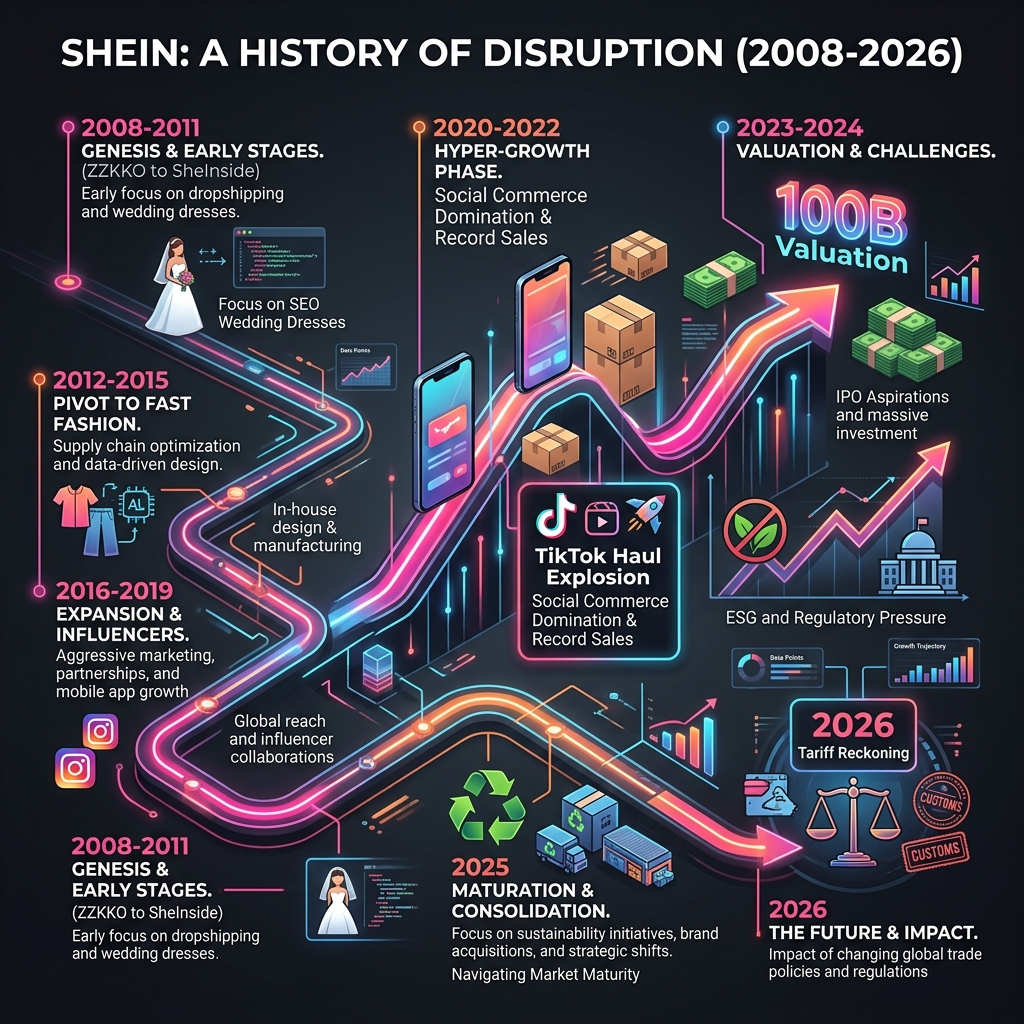
🛒 2008-2014: The SEO Merchant
Shein’s origin story explains more about the company than most people realize. Chris Xu was not a fashion designer. He was a search engine optimization specialist who discovered that Western customers would buy Chinese-made wedding dresses online if you understood what they searched for. The company, then called SheInside, was never a clothing company that learned marketing. It was a demand-detection company that learned clothing, and that DNA runs through everything that follows. Where traditional fashion starts with a designer’s instinct, Shein started with a keyword report.
⚙️ 2015-2019: The Machine Takes Shape
Renamed Shein, the company built the system that would change retail: a network of small Guangzhou factories connected to real-time sales data, producing test batches of 100-200 units, then automatically reordering only what sold. The industry calls it large-scale automated test and reorder. I call it what it is psychologically: a machine for discovering desire faster than the desirer knows she has it. Zara’s famous two-week turnaround suddenly looked slow; Shein could go from trend detection to product page in days.
📱 2020-2022: The Pandemic Explosion
Locked-down teenagers, stimulus money, and TikTok’s rise converged perfectly. Shein became the most downloaded shopping app in dozens of countries, overtook Amazon in US app downloads, and reached a private valuation of $100 billion in 2022, more than H&M and Zara’s parent combined at the time. The #sheinhaul hashtag accumulated billions of views, and a generation learned to measure shopping in kilograms.
⚖️ 2023-2024: The Scrutiny Years
Success brought the auditors. Reports on factory hours, congressional scrutiny over cotton sourcing, a racketeering lawsuit from independent designers alleging systematic design theft, and an infamous influencer factory tour that backfired spectacularly. Shein moved its headquarters to Singapore, attempted a US listing that stalled in Washington, then a London listing that stalled again, while revenue kept climbing toward $38 billion and profit hit $1.1 billion in 2024.
💥 2025-2026: The Loophole Closes
Then the ground moved. The Trump administration ended the de minimis exemption, the rule that had let sub-$800 parcels enter the US duty-free and on which Shein’s entire pricing architecture quietly depended. Tariffs of 30% or more hit US-bound parcels. Shein raised prices, and the psychology I describe in Chapter 4 began working in reverse: by June 2025 the company had lost 12% of its US users, and September US sales fell 8%. France temporarily suspended the platform amid a regulatory scandal. The planned IPO moved to Hong Kong at a targeted $40-50 billion, half the 2022 peak. The EU’s own de minimis reform arrives in July 2026. The most interesting experiment in consumer psychology of this decade is now running live: what happens to a compulsion machine when its prices stop being invisible?
🤖 Chapter 2: The Algorithm Wears the Designer’s Hat
Before the compulsion psychology, you need to understand what Shein actually replaced, because the replacement is the foundation everything else stands on.
Traditional fashion is a prediction business. A designer guesses what you will want in nine months, a buyer commits to huge volumes, and the guess ships to stores. When the guess is wrong, you get markdowns and landfills. Shein inverted the entire sequence. It does not predict demand; it detects it. Thousands of designs go live daily as small test batches. The app watches what gets clicked, carted, and bought, in real time, across a hundred million users. Winners get reordered within days. Losers die quietly at 100 units of sunk cost. The customer believes she is browsing a catalog; she is actually voting in a continuous election that decides what gets manufactured tomorrow.
Psychologically, this produces something traditional retail never achieved: a feed with an almost perfect hit rate for novelty. Every scroll session contains something new because newness is the product line’s only constant, and something appealing because unappealing things are algorithmically culled within days. The catalog is not curated by taste. It is curated by the aggregated impulses of everyone who scrolled before you, which makes it, by construction, nearly impossible to find boring. Keep that in mind for the next chapter, because a feed that cannot bore you is the prerequisite for a loop that cannot end.
🎰 Chapter 3: The Infinite Wardrobe — Novelty as a Drug Delivery System
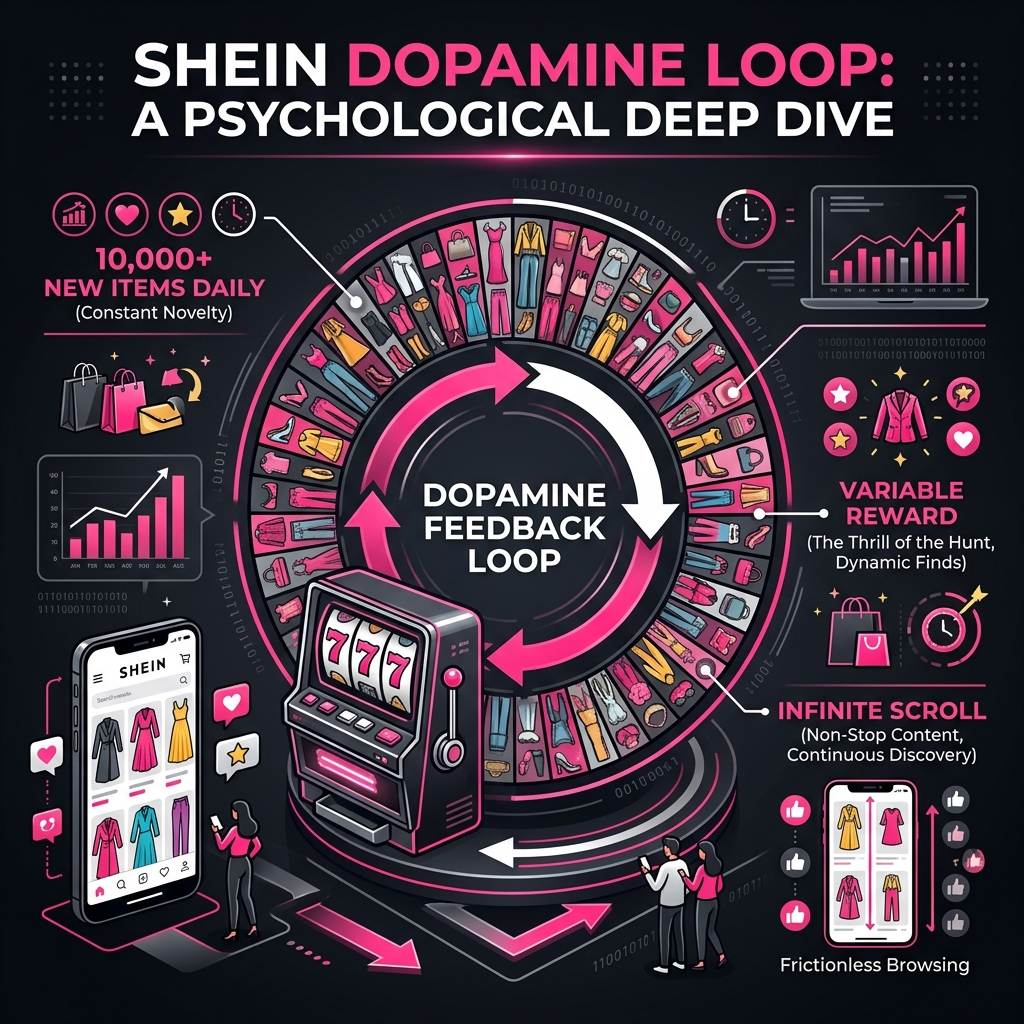
Here is the number that defines Shein’s psychology: estimates of its daily new product additions run from around 2,000 to as high as 10,000 items per day. For comparison, a traditional retailer might introduce a few thousand styles per year. This is not an inventory statistic. It is a neurological strategy.
Dopamine research, particularly Berridge and Robinson’s work separating “wanting” from “liking,” shows that the brain’s reward circuitry fires hardest not at reward delivery but at novel, unpredictable possibility. The slot machine exploits this with uncertain payouts. The social feed exploits it with uncertain content. Shein exploits it with uncertain merchandise: every scroll might reveal the perfect item, and because thousands of items arrived today, that possibility literally never exhausts. You can reach the end of a store. You cannot reach the end of Shein, and a feed without an end is a session without a natural stopping point.
The pricing then removes the brake that would normally interrupt the loop. In ordinary shopping, desire collides with deliberation: do I need this, can I afford it, where will I wear it? Deliberation is the enemy of compulsion. Shein’s genius, covered next, was discovering the price point at which deliberation simply fails to activate.
💸 Chapter 4: The $3 Anesthetic — Killing the Pain of Paying
Neuroeconomists Knutson, Loewenstein and colleagues demonstrated that paying activates brain regions associated with pain, and that this pain of paying is what makes us hesitate at checkouts. The pain scales with the amount and with the salience of the transaction. Their research is why casinos use chips and apps use stored cards: abstract the payment, dull the pain.
Shein attacked the same brake from the other side: it made the amounts themselves too small to hurt. A $3 top, a $6 dress, an $8 pair of shoes. Below roughly the price of a coffee, spending decisions stop being processed as decisions at all. Nobody deliberates over $3; deliberation costs more mental energy than the money is worth. So items go into the cart the way sunflower seeds go into a mouth, individually trivial, collectively substantial. The average Shein order is not one $3 item. It is fifteen of them, and $45 spent as fifteen painless micro-decisions feels completely different from $45 spent as one considered purchase. Same money, opposite psychology.
Unit bias and basket mechanics finish the job. Free-shipping thresholds turn “I’m done” into “I need $9 more to qualify,” reframing additional spending as saving. Percentage discounts stack visibly at checkout, so the receipt reads like a scoreboard of winnings rather than a bill. I have watched pricing psychology for years, and I know of no mainstream retailer that has pushed the pain-free spending architecture further than Shein. Which is exactly why the tariff story in Chapter 9 is so devastating: the entire machine assumes prices below the deliberation threshold, and tariffs are pushing them back above it.
📦 Chapter 5: Haul Culture — When Customers Became the Marketing Department
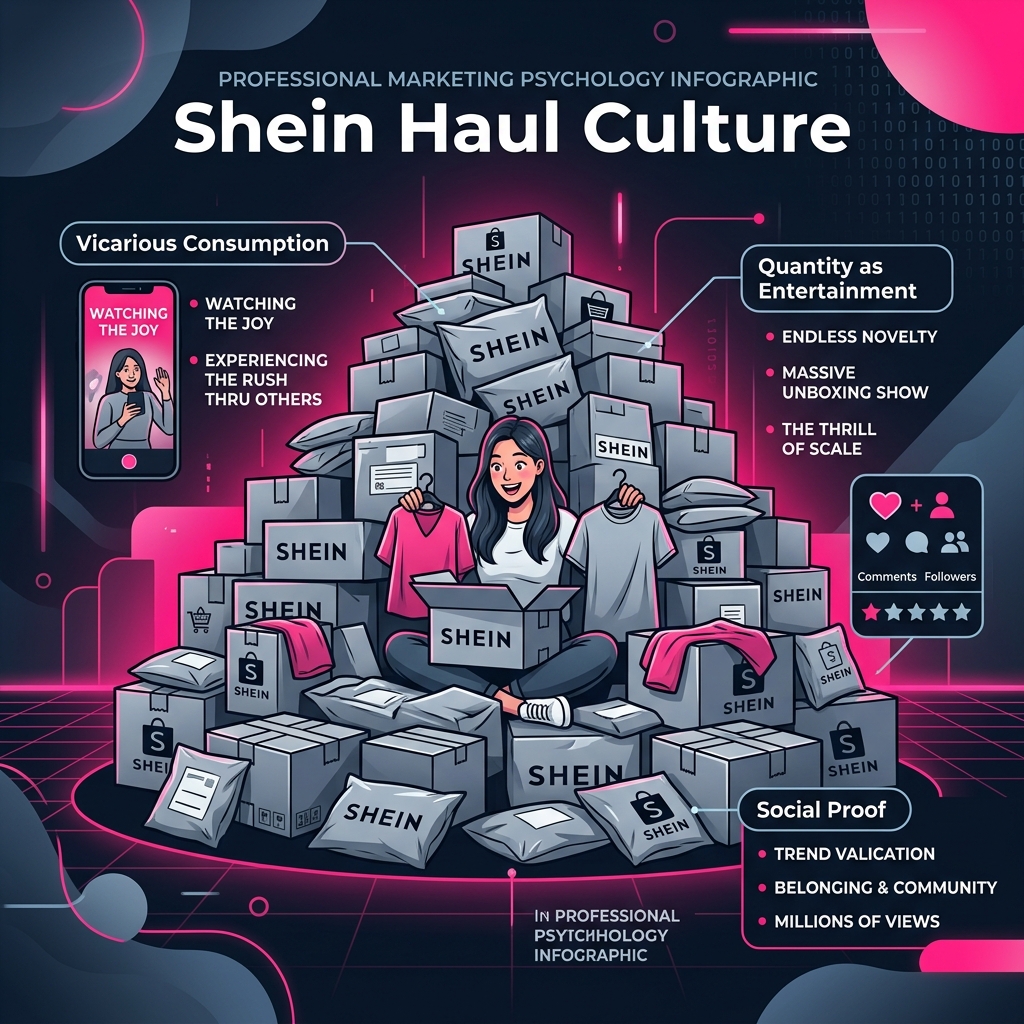
The Shein haul deserves its place in marketing history. The format is standardized: a mountain of grey packages, a per-item try-on, a running total that sounds impossible (“all of this for $70”). The #sheinhaul universe has accumulated billions of views, and Shein did not invent it so much as detect and feed it, with affiliate codes, free product for micro-influencers, and an app that made 30-item orders frictionless.
Three mechanisms make hauls uniquely powerful advertising. First, vicarious consumption: mirror-neuron research suggests viewers partially simulate the unboxing experience they watch, so every haul delivers a diluted hit of acquisition dopamine to thousands of people, priming the appetite it appears to satisfy. Second, social proof at volume: a professional ad is a claim, but an ordinary girl genuinely delighted by twenty cheap items is evidence, repeated across a million bedrooms. Third, and least appreciated, hauls reframe quantity as the achievement. The impressive number in a haul video is not the quality of any item; it is the count and the total. Haul culture quietly taught a generation that the point of shopping is the haul itself, the acquiring, which is precisely the behavior Shein’s machine needs repeated. When I audited Labubu and Rhode, I described products whose use ritual generates their own advertising. Shein’s version is the most extreme: its advertising ritual is overconsumption, performed as entertainment.
An honest note: haul culture also bred the backlash. “Shein haul” became shorthand for disposable fashion guilt, deinfluencing content grew as a counter-genre, and the same virality that built the brand now carries its critics. Chapter 8 takes that seriously.
🎮 Chapter 6: The Casino in Your Pocket — Gamification Architecture
Open the Shein app and count the game mechanics. Daily check-in rewards that build streaks. Points earned for browsing, reviewing, and watching livestreams, redeemable against purchases. Spin-the-wheel discounts. Flash sales with countdown clocks. Limited-time coupons that expire visibly, ticking. In-app livestream shopping events. This is not a shopping app with promotions. It is a variable-reward game whose scoring currency happens to be clothing.
Each mechanic maps to an established compulsion lever. Streaks exploit loss aversion: miss a day and lose your accumulated check-in bonus, so the app earns a daily open regardless of shopping intent. Points exploit the endowed progress effect: partially filled reward meters demand completion. Countdown timers manufacture urgency that forecloses deliberation, the same lever I documented in the Daraz audit, but deployed with more layers. And the spin wheel is simply a slot machine with a coupon payout, variable ratio reinforcement in its nakedest retail form.
The strategic effect is that Shein converted shopping from an occasional errand into a daily habit loop with a daily reason to return. Habit research (Wendy Wood’s work is the standard reference) shows behavior repeated in stable contexts becomes automatic; the check-in streak builds the automatic open, and the infinite novel feed does the rest. Most retailers fight for visits. Shein engineered a reason to visit that has nothing to do with needing clothes, which is the entire point, because need was never the business model.
👗 Chapter 7: Micro-Trend Identity — Selling Belonging by the Week
The deepest layer of Shein’s psychology is not about price or apps. It is about what clothing means to its core customer, and how Shein changed the metabolism of that meaning.
Fashion has always been identity signaling. What changed is the clock speed. Trend cycles that once lasted seasons now last weeks: a TikTok aesthetic emerges, peaks, and dies within a month, and each cycle issues a new membership requirement. Add the documented outfit-repeating stigma of a life lived on camera, where clothes are logged in photos and re-wearing reads as running out of content, and you get a generation under continuous pressure to refresh its visual identity at a pace no normal budget could sustain.
Shein positioned itself as the only affordable answer to that impossible demand. Its feed does not just stock micro-trends; its algorithm detects them at birth and manufactures them within days, which means Shein is simultaneously the supplier of the identity treadmill and its accelerant. Every new aesthetic the machine amplifies creates the belonging-anxiety that the machine then monetizes. As a psychologist I want to be careful here: Shein did not create status anxiety, social media did not create it either, and blaming one retailer for a cultural condition flatters no one’s analysis. But Shein industrialized the response to it more completely than anyone, and it profits in direct proportion to how fast identities churn. That is a business model with a moral texture, and the next chapter stops being polite about it.
⚠️ Chapter 8: The Dark Side — What the $3 Top Actually Costs
🏭 The Labor Ledger
Investigations, including a widely reported 2022 Channel 4 documentary, alleged working weeks up to 75 hours in some supplier factories, with per-garment piece rates that make the $3 retail price arithmetic suddenly legible. Shein has published supplier codes of conduct and remediation programs since, and I will not pretend to audit factories from a desk. But the psychological point stands independent of any single report: prices this low are not produced by efficiency alone, and every consumer at some level knows it, which is why the next section exists.
🧠 Guilt Management and Moral Licensing
The fascinating consumer-psychology question is how buyers reconcile enjoying a product they suspect is ethically compromised. The research answers: motivated reasoning (“reports are probably exaggerated”), diffusion of responsibility (“my one order changes nothing”), and moral licensing, where a single virtuous act, a thrifted item, a reused tote, licenses the guilt away. Shein benefits from all three without having to argue any of them, because the $3 price does the persuading and the brain supplies its own absolution. This is the part of the machine nobody designed and nobody has to maintain.
🎨 The Design Theft Docket
Independent designers have sued Shein repeatedly, including a 2023 US lawsuit invoking racketeering statutes and alleging systematic copying as a business process. Shein disputes the claims and settles or fights case by case. At minimum, an algorithm that scrapes trend signals at scale sits uncomfortably close to the line between inspiration and reproduction, and the volume of near-identical items on the platform makes the docket unsurprising.
🌍 The Disposability Problem
Garments priced below a sandwich are treated like one. Estimates on fast-fashion waste vary widely enough that I will not pin a fake-precise number here, but the behavioral mechanism needs no statistics: items acquired without deliberation are discarded without deliberation. The endowment effect, our attachment to what we own, scales with investment, and a $3 top purchased in a fifteen-item haul carries almost no investment to attach to. Shein did not just lower the price of clothing. It lowered the psychological cost of throwing clothing away.
📉 Chapter 9: The Reckoning — When the Prices Became Visible (2025-2026)
Everything above describes a machine tuned to one condition: prices below the brain’s deliberation threshold, delivered duty-free through the de minimis loophole. In 2025 that condition ended, and the results read like a controlled experiment in the very psychology this audit describes.
The US closed de minimis; parcels absorbed tariffs of 30% or more; Shein raised prices. And the loop began running backward. By June 2025, 12% of US users were gone. September US sales fell 8%. Rival Temu, hit by the same rules, saw monthly active users plunge as much as 46% in a quarter and slashed US ad spend by roughly 95% year over year. Note what did not change: the products, the app, the gamification, the feed. Only the prices moved, modestly in absolute terms, a few dollars per item. But those few dollars carried items back across the deliberation threshold, and deliberation is fatal to compulsion. A $3 top asks nothing of the brain. An $8 top asks a question, and a question is a chance to say no.
The financial architecture felt it immediately. The IPO, once dreamed at $100 billion, now targets $40-50 billion in Hong Kong in late 2026. Shein is guiding to a $2 billion profit for 2025, nearly double 2024, achieved through the price rises and cost discipline, which tells you management chose margin over the growth flywheel. That is a rational choice and also a confession: the era of growth-at-any-price psychology is over, because the psychology only worked at prices that no longer exist in its biggest market. The EU’s de minimis reform lands in July 2026. The machine is not broken. But for the first time since 2008, it is operating above the anesthetic threshold, and this audit’s honest verdict is that nobody, including Shein, yet knows how much of the demand was ever about the clothes.
⚔️ Chapter 10: Competitive Positioning — The Race to the Bottom Has Company
| Competitor | Their Weapon | The Psychological Difference |
| Temu | Even harder gamification, everything-store breadth, subsidized prices | Same compulsion stack, no fashion identity; hit even harder by de minimis (users down up to 46%) |
| Zara (Inditex) | Fast fashion with quality floor and store theater | Sells trend participation with dignity intact; the trade-up destination when Shein guilt bites |
| H&M | Legacy scale, sustainability messaging | Caught in the middle: neither cheapest nor cleanest; squeezed from both sides |
| Thrift / Depop / Vinted | Secondhand as identity and absolution | The psychological counter-culture: scarcity, hunt joy, and moral license, everything Shein cannot offer |
The Temu rivalry deserves one paragraph because it is a genuine psychological arms race: two companies running near-identical compulsion architectures, competing on who can make spending feel more like a game. The post-tariff data suggests a sobering conclusion for both: when the anesthetic prices rose, Temu’s engagement collapsed faster than Shein’s, implying Shein’s fashion identity retains somewhat more real attachment than Temu’s pure bargain rush. Meanwhile the secondhand platforms are quietly building the opposite machine, where the dopamine comes from scarcity and the hunt, and the purchase arrives with moral license included. If I were forecasting the next decade of Gen Z shopping psychology, that is the corner I would watch.
📊 Chapter 11: Psychology Scorecard — Detailed Ratings
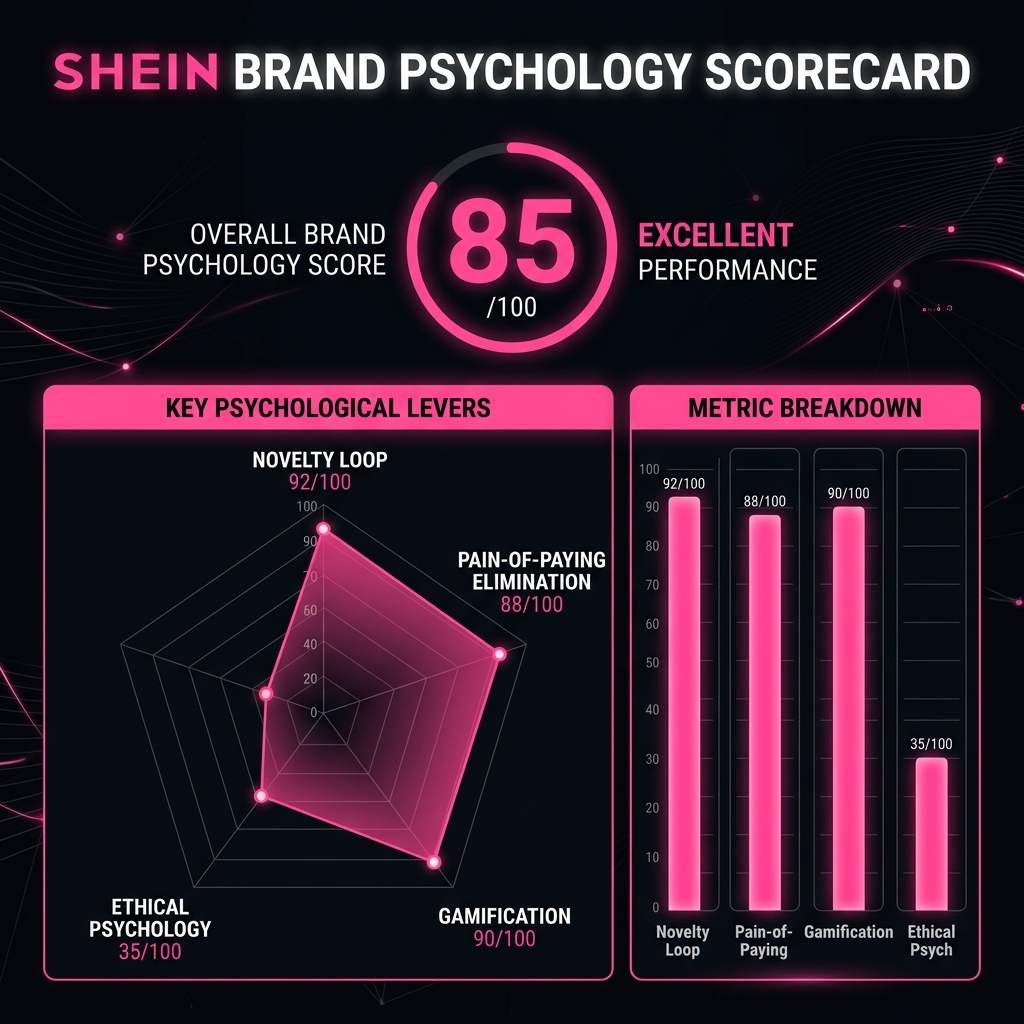
| Psychology Dimension | Score | Verdict |
| Novelty Loop & Feed Design | 97/100 | The most complete novelty-compulsion engine in retail. |
| Pain-of-Paying Elimination | 96/100 | Pricing below the deliberation threshold, executed at scale. |
| Community-Generated Marketing (Hauls) | 94/100 | Customers as broadcasters; overconsumption as entertainment. |
| Gamification Architecture | 93/100 | Streaks, points, spins, timers: a casino with a clothing section. |
| Algorithmic Demand Sensing | 95/100 | Real-time retail that discovers desire before the customer names it. |
| Brand Emotional Depth | 58/100 | Customers love the prices and the rush; almost nobody loves Shein. |
| Durability & Regulatory Resilience | 55/100 | The core mechanic is tariff-dependent, and the tariffs arrived. |
| Ethical Psychology | 40/100 | Labor questions, design theft litigation, engineered disposability. The lowest ethics score this site has awarded. |
| OVERALL PSYCHOLOGY SCORE | 85/100 | ⚡ Extreme Impact — a masterpiece of compulsion on a cracking foundation. |
✅ Chapter 12: Balance Sheet & A Psychologist’s Prescription
💪 Psychological Strengths
- The full compulsion stack: infinite novelty, anesthetic pricing, gamified retention, and self-replicating haul marketing, integrated more completely than any retailer in history
- Demand detection as a moat: the algorithm learns desire from a hundred million users daily; competitors copy features, not data
- Habit infrastructure: streaks and check-ins produce daily opens independent of shopping need
- Fashion identity edge over Temu: post-tariff data suggests Shein’s aesthetic churn holds users better than pure bargain psychology
⚠️ Psychological Weaknesses
- Price-threshold dependence: the machine assumes purchases below the deliberation line; tariffs moved the line, and the 2025-26 US numbers show what happens next
- No emotional reservoir: a brand held together by prices has nothing to draw on when prices rise; there is no Shein loyalty to spend
- Guilt accumulation: the deinfluencing counterculture and secondhand platforms are converting Shein’s own virality into a stigma engine
- Regulatory convergence: US done, EU July 2026, France’s suspension a warning: the loopholes are closing in every major market at once
🔮 The Prescription
- Build a reason beyond price before the EU deadline. Quality tiers, a credible basics line, or genuine design identity: something that survives an $8 average item price, because that price is coming everywhere.
- Convert the haul into a wardrobe. Styling tools, re-wear content, and outfit-building features would shift the ritual from acquiring toward using, extending item lifespan and softening the disposability stigma at its psychological root.
- Buy ethical credibility with verifiable transparency, not codes of conduct. Published factory audits by named third parties, live and boring. A connoisseur press release will not survive the next documentary; data might.
- Settle the design-theft docket structurally. A licensed independent-designer marketplace would turn the loudest plaintiffs into paid partners and produce the one thing the algorithm cannot: stories about creators winning.
- De-escalate the casino for minors. Age-gate the spin wheels and streaks before a regulator does it less politely. The loot-box precedent in gaming is the roadmap, and Shein is walking it backward.
📝 Final Verdict
Shein is the most complete application of compulsion psychology in the history of retail, and I do not write that sentence loosely. It stacked the slot machine’s novelty loop, the casino’s gamification, the price point that switches off deliberation, and a marketing ritual performed for free by its own customers, into one machine that taught a hundred million people to shop the way they scroll. As a piece of behavioral engineering, it deserves the elite scores this audit gives it. As a business built on that engineering, it earned $38 billion in revenue and, for a moment, a $100 billion valuation.
But this audit ends on the finding the machine’s own data just delivered. When tariffs pushed prices a few dollars upward, users left in double-digit percentages, sales fell, and the valuation halved. A few dollars. That is the entire psychological confession in one number: the loyalty was never to the brand, the clothes, or even the trends. It was to a price low enough to make wanting feel free. Shein now faces the hardest conversion in consumer psychology, turning an anesthetic into an attachment, and it must do it while regulators close loopholes on three continents and its own haul culture curdles into stigma. The machine still runs. The question the next two years will answer is whether anyone ever loved it, or only what it cost.
Psychology Score: 85/100 — Shein posts elite scores for its novelty loop (97), pain-free pricing (96), and demand-sensing algorithm (95), dragged down by the weakest ethics score ever awarded on ShahzebSpeaks (40), thin emotional depth (58), and a durability rating (55) that the 2025-26 tariff data has already begun to vindicate. A masterpiece of compulsion engineering, now running its first experiment without anesthesia.
🧠 Want a Psychology Audit for Your Brand?
I’m Muhammad Shahzeb, an MSc Industrial Psychologist and Full-Stack Developer. I apply behavioral science to branding, pricing, and conversion, including telling you honestly when your growth machine is built on something fragile. Let’s audit yours before the market does.
📚 References & Sources
- South China Morning Post. “Shein eyes US$2 billion profit in 2025 despite Trump tariffs and French ban.” scmp.com
- Modaes Global. “The Trials of 2025: Shein’s Pivotal Year in the Fashion Industry.” modaes.com
- Kavout Market Lens. “Shein’s Hong Kong IPO: A $50 Billion Compromise Under Regulatory Cloud.” 2026.
- Marketplace. “Yep, the de minimis tariff exemption is still suspended.” March 2026.
- Digiday. “Tariffs forced Temu to slash its U.S. ad spend on nearly every platform.” 2026.
- Bloomberg Intelligence data on Temu monthly active user decline, April-June 2025 (as reported).
- Berridge, K. C., & Robinson, T. E. (1998). “What is the role of dopamine in reward: hedonic impact, reward learning, or incentive salience?” Brain Research Reviews, 28(3), 309-369.
- Knutson, B., Rick, S., Wimmer, G. E., Prelec, D., & Loewenstein, G. (2007). “Neural predictors of purchases.” Neuron, 53(1), 147-156. (Pain of paying.)
- Ferster, C. B., & Skinner, B. F. (1957). Schedules of Reinforcement. Appleton-Century-Crofts.
- Wood, W. (2019). Good Habits, Bad Habits: The Science of Making Positive Changes That Stick. Farrar, Straus and Giroux.
- Kahneman, D., & Tversky, A. (1979). “Prospect theory: An analysis of decision under risk.” Econometrica, 47(2), 263-291. (Loss aversion.)
- Nunes, J. C., & Drèze, X. (2006). “The endowed progress effect: How artificial advancement increases effort.” Journal of Consumer Research, 32(4), 504-512.
- Merton, R. K. (1968 framework) and Monin, B., & Miller, D. T. (2001). “Moral credentials and the expression of prejudice.” Journal of Personality and Social Psychology, 81(1), 33-43. (Moral licensing.)
- Channel 4 / “Untold: Inside the Shein Machine” documentary reporting on supplier working hours, 2022.
- US federal court filings, independent designers v. Shein (RICO allegations), 2023; Shein’s public responses.
- Eyal, N. (2014). Hooked: How to Build Habit-Forming Products. Portfolio/Penguin.
Audit conducted by Muhammad Shahzeb, MSc Industrial & Organizational Psychology | Brand Psychology Specialist | Full-Stack Web Developer
Learn more about my approach →
Key Findings
- Shein adds up to 10,000 new products daily — turning its app into an infinite slot machine where the reward is novelty itself.
- The $3 price point is not a price, it is an anesthetic: it bypasses the brain's pain-of-paying response, converting shopping into a continuous scroll.
- TikTok haul culture made Shein's customers its marketing department, normalizing 30-item orders as entertainment.
- Shein's app is gamified like a casino with daily check-in points, spin wheels, and flash sales.
- The 2025-26 tariff reckoning (closing the de minimis loophole) broke the core mechanic, causing a 12% loss in US users and slashing the IPO valuation.
- Shein's deepest vulnerability is psychological: the machine runs on prices low enough to bypass deliberation, and tariffs push purchases back above the thinking threshold.
Overall Psychology Score
Shein scores 85/100 in our comprehensive psychology audit covering consumer behavior strategies, UX design principles, and psychological marketing effectiveness.
The detailed dimension scores are in the audit's Psychology Scorecard chapter.
High impactMuhammad Shahzeb
MSc Industrial Psychologist, specializing in consumer behavior, UX psychology, and brand strategy analysis. Helping brands understand the psychology behind their success.
About Muhammad Shahzeb →