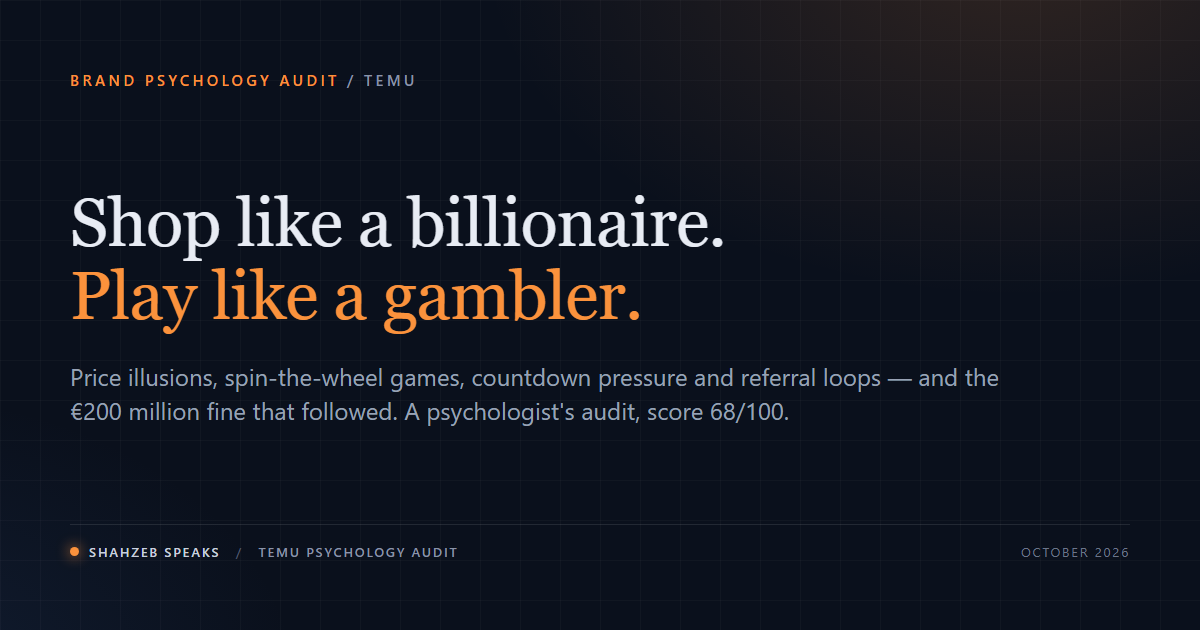
Temu Psychology Audit — Shop Like a Billionaire, Play Like a Gambler
A psychology audit of Temu, the PDD Holdings marketplace that grew from a 2022 US launch into a global giant. How crossed-out prices make spending feel painless, how spin-the-wheel games and referral loops make buying feel like winning, why its app is rated 4.7 while its service scores 1.8, and how a €200 million EU fine, an open EU consumer case and US state lawsuits converge on the same tactics. With lessons for Pakistani e-commerce.

68 / 100
Overall consumer behavior effectiveness
Brand Overview
- Brand nameTemu
- Founded2022
- HeadquartersDublin, Ireland (PDD Holdings); Temu founded in Boston, US
- IndustryE-Commerce
- Websitewww.temu.com ↗
Psychology Techniques Identified
- 01Price Anchoring (Crossed-Out Prices)
- 02Pain of Paying & Mental Accounting
- 03Zero-Price Effect ("Free" Gifts)
- 04Gamification & Variable Reward
- 05Endowed Progress & Goal Gradient
- 06Scarcity & Urgency Cues
- 07Referral Loops & Social Proof
- 08Hook Price & Upsell Variants
- 09Identity Reframing ("Shop Like a Billionaire")
- 10Mere Exposure (Saturation Advertising)
- 11Peak-End Rule
- 12Dark-Pattern Risk & Regulatory Scrutiny
Full Psychology Audit Report
In this audit
You open the app for the first time and, before you can browse anything, a wheel spins and lands on a discount just for you. A phone case costs less than a cup of chai. A pair of earbuds is crossed out from a price you have never seen anyone pay. A banner says the offer ends in nine minutes. Another tells you that if you invite three friends, something will be free. Within a few minutes you have bought things you did not want, at prices that made spending feel like winning.
That is Temu. Launched in the United States in September 2022 by PDD Holdings, it spread to Oceania in March 2023, to Europe a month later, and then around the world, carried by some of the most intensive advertising of the decade — including a Super Bowl campaign that told Americans to “Shop like a billionaire.” It is also, in October 2026, the subject of a €200 million fine from the European Commission, an open EU consumer-protection case, a $2 million US settlement, and lawsuits from at least seven US states.
I am an Industrial and Organizational Psychologist, and this audit looks at Temu the way a psychologist would: not as a bargain bin, but as a carefully engineered set of behavioural levers — price illusions, game mechanics, urgency, referrals and an advertising blitz — and at what happens when those levers are pulled so hard that regulators start pulling back. Every legal action below is described at its exact status, because the difference between an allegation and a finding matters.
“Temu does not sell products so much as it sells the feeling of getting away with something. The price makes spending feel painless, the wheel makes buying feel like winning, and the clock makes waiting feel like losing. That is a brilliant acquisition machine — and a fragile way to build trust.”
— Brand Psychology Analysis, ShahzebSpeaks
📋 Brand Overview: Temu at a Glance
| Parent company | PDD Holdings Inc. (also owns Pinduoduo) — incorporated in the Cayman Islands, principal executive offices in Dublin, Ireland |
| Launched | September 2022, North America (founded in Boston); Oceania March 2023; Europe April 2023 |
| Model | Marketplace connecting mostly China-based manufacturers and merchants with overseas shoppers; shifting to locally based sellers in some markets since 2025 |
| Revenue disclosed | PDD reports one segment and does not break out Temu. Group revenue FY2025: RMB 431.8 billion (≈US$61.8bn) |
| Signature slogan | “Shop like a billionaire” (Super Bowl, 2023) |
| Two reputations (4 Oct 2026) | App Store 4.7 from 2.2 million ratings · Trustpilot 1.8 from 56,250 reviews · BBB rating B, not accredited |
| Biggest regulatory event | €200 million fine under the EU Digital Services Act, 28 May 2026 (Temu contests it) |
📜 Chapter 1: The History — Four Years From Launch to a €200 Million Fine (2022–2026)
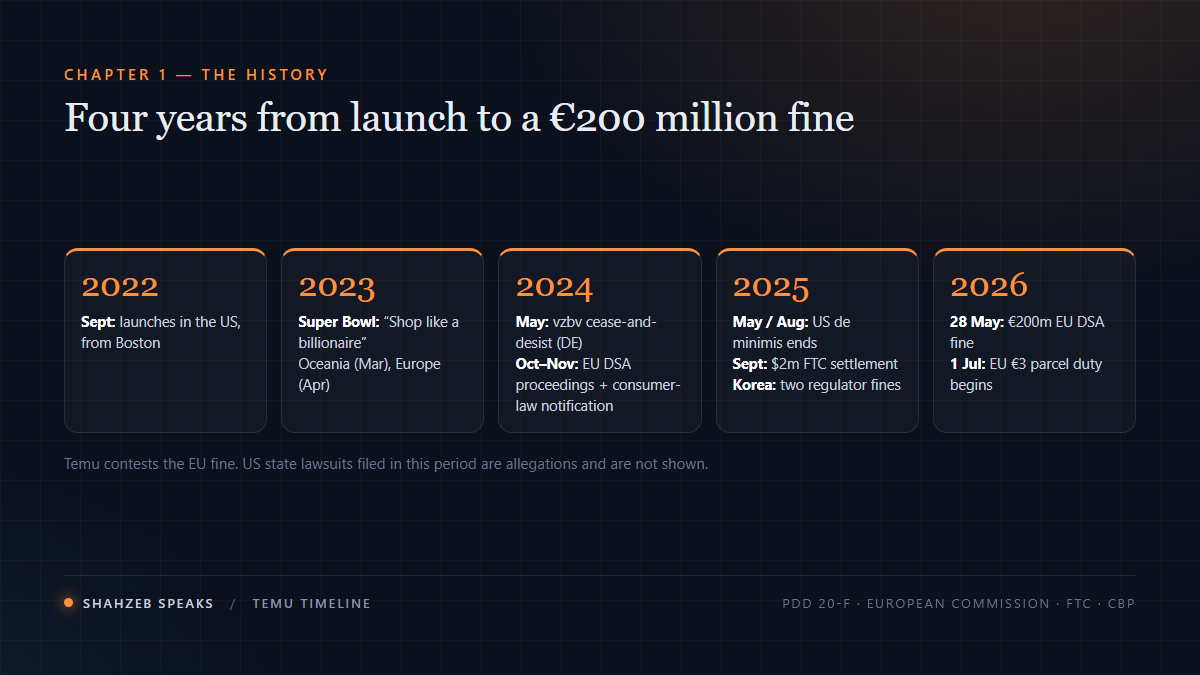
🚀 2022: A launch built to be loud
Temu went live in the US in September 2022. Its parent, PDD Holdings, had built Pinduoduo in China around group buying, games and rock-bottom prices. Temu exported the formula — and added a Western-scale advertising budget.
🏈 2023–2024: The Super Bowl and the billionaire
Temu’s first Super Bowl spot in 2023 introduced “Shop like a billionaire”: a promise that an ordinary shopper could buy without counting. It returned in 2024 with multiple spots and, by Temu’s own announcement reported by CNN, $15 million in coupons and giveaways. Outlets disagree on the exact number of ads and their cost, so I am not printing either.
⚖️ 2024: Europe starts asking questions
On 31 October 2024 the European Commission opened formal proceedings under the Digital Services Act. A week later, on 8 November, the EU’s consumer-protection network notified Temu of practices it considers to infringe EU consumer law. In Germany, Temu had already signed a cease-and-desist declaration in May 2024 after a warning from the federal consumer organisation, vzbv.
📦 2025: The de minimis door closes
Temu’s prices depended partly on the US “de minimis” rule, which let low-value parcels enter duty-free. US Customs ended it for China and Hong Kong on 2 May 2025 and globally on 29 August 2025. Temu briefly added “import charges”, then told CBS News that “all sales in the U.S. are now handled by locally based sellers, with orders fulfilled from within the country.”
💶 2026: The fine, and a second door
On 28 May 2026 the European Commission fined Temu €200 million for failing to properly assess the risk of illegal products on its platform. Its own mystery shopping found chargers that failed basic safety tests and baby toys with chemical and choking hazards. Temu called the fine “disproportionate” and said it contests the decision. Five weeks later, on 1 July 2026, the EU introduced a €3 customs duty on low-value parcels. Europe’s version of the de minimis door had begun to close too.
🏷️ Chapter 2: The Price Illusion — Why Spending on Temu Doesn’t Feel Like Spending
Temu’s first lever is not the price itself. It is how the price feels.
Anchoring: the crossed-out number
Almost every listing shows a low price beside a higher, crossed-out one. Anchoring, the tendency to judge a number relative to the first number we see, is one of the most robust findings in decision research. The crossed-out price sets the reference point, and the real price is experienced as a gain. Whether those reference prices are genuine is exactly what regulators have questioned: the EU’s consumer-protection network listed “fake discounts — giving the false impression that products are offered with a discount where there is none” among the practices it notified Temu about in November 2024. That is a notification, not a final ruling; the case remains open. (More on how anchoring works in marketing.)
The hook price and the upsell
The European consumer organisation BEUC documented a common pattern in its May 2024 complaint: a very low “hook” price — tape at €0.87 — followed by variants that cost more, one flagged as “highest rated”; or pans at €10.11 followed by a €29.91 option marked with a fire emoji and “47% discount.” The low price gets you in. The comparison set does the selling.
The pain of paying, removed
Prelec and Loewenstein’s research on mental accounting showed that paying hurts, and that the hurt depends on how a cost is framed and felt, not only on its size. Temu’s tiny unit prices make each individual purchase feel nearly costless. The pain arrives later, at the total, by which point the basket already feels like yours.
“Free” is a different number
Shampanier, Mazar and Ariely showed that a price of zero is not just a low price — it triggers a disproportionate jump in demand. Temu’s “free gifts”, unlocked through games or referrals, exploit exactly this. The gift is rarely free in effort: it is paid for in invitations, playing time and further purchases.
🎰 Chapter 3: The Slot Machine in Your Pocket — Gamification
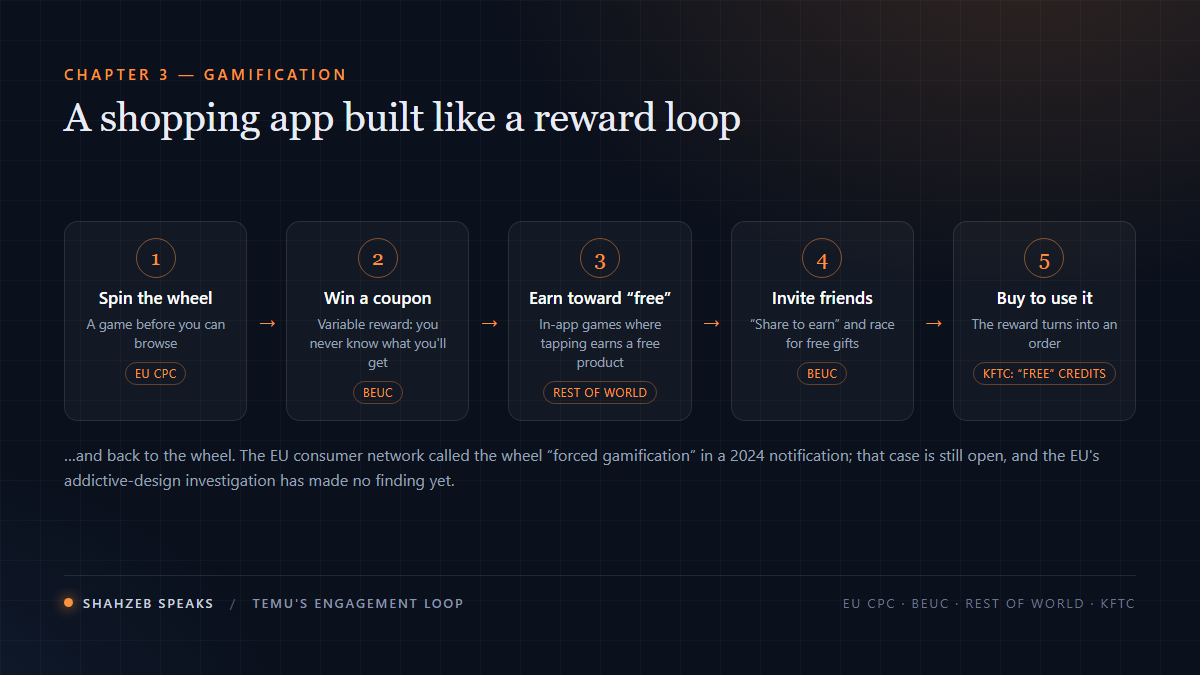
Temu’s most distinctive feature is that shopping is wrapped in games.
- The wheel. The EU consumer-protection network described “forced gamification: forcing consumers to play a ‘spin the fortune wheel’ game to access the online marketplace, while hiding essential information about the conditions of use linked to the rewards of the game.” Again, this is what the network notified Temu it considers a breach — the case has not been decided.
- The farm and the fish. Reporting by Rest of World in 2023 described in-app games such as Fishland and Farmland, where users tap to feed virtual fish or grow trees to earn free products — and where “referrals are the secret ingredient to winning the games.”
- The goal. Games that let you earn toward a free product turn a gift into a target. Nunes and Drèze’s “endowed progress effect” explains why that is so powerful: people given a head start toward a goal — a loyalty card with two stamps already filled — are more likely to complete it, and effort tends to rise as a reward gets closer. Once you are partway to “free”, stopping feels like losing what you have already earned.
Why does this work? Variable rewards — not knowing what the wheel will land on — are one of the most reliable ways to sustain behaviour, and a 2014 review of empirical gamification studies by Hamari, Koivisto and Sarsa found that gamification generally does increase engagement, with effects that depend on context and users. The European Commission’s DSA investigation into the “addictive design of the service, including game-like reward programmes” is still open; it has made no finding on that point.
The psychological cost is subtle. When buying feels like winning, the question “do I need this?” is replaced by “what did I get?” That is great for conversion and corrosive for satisfaction, which shows up in Chapter 7.
⏳ Chapter 4: Urgency and Scarcity — The Clock and the Crowd
Scarcity is one of the oldest findings in social psychology. In Worchel, Lee and Adewole’s 1975 study, identical cookies were rated as more desirable when they came from a jar with only two cookies than from a jar with ten. Scarce things feel more valuable, and disappearing things feel urgent. (See scarcity marketing examples for the ethical line.)
Temu’s use of urgency has drawn some of the clearest regulatory responses:
- Germany. The federal consumer organisation vzbv objected to checkout messages such as “Hurry! Over 126 people have this item in their cart.” In May 2024 Temu signed a cease-and-desist declaration undertaking to stop that design and to explain its crossed-out prices. This was an out-of-court undertaking, not a court ruling.
- South Korea. The Korea Fair Trade Commission fined Temu’s operator KRW 358 million in June 2025. According to a summary of the decision by the law firm Yoon & Yang, the violations included a countdown timer falsely implying users had to install the app within a limited time to get coupons, and a roulette promotion offering a game console for KRW 999 that suggested many customers could win when only one unit was offered.
- The EU. The consumer-protection network’s November 2024 notification listed “pressure selling … false claims about limited supplies or false purchase deadlines.”
A 2019 crawl of 11,000 shopping websites by Mathur and colleagues catalogued urgency and scarcity messages — countdown timers, low-stock warnings, “people are viewing this” notices — among the deceptive design patterns already in use across e-commerce. Temu did not invent them. It scaled them, and became one of the first platforms whose versions were examined by regulators on several continents.
🤝 Chapter 5: Referrals, Credits and Social Proof
The cheapest customer is the one your existing customer brings. Temu’s referral mechanics — “share to earn”, affiliate codes, “races” for free gifts, as BEUC described them — recruit users into recruiting. Social influence research (Cialdini and Goldstein’s review is a good start) shows why a recommendation from a friend lowers our guard: it borrows the friend’s credibility.
The weak point is disclosure. Korea’s competition regulator, per the same law-firm summary, found that Temu presented “credits” and rewards as free without clearly disclosing the eligibility conditions. And the EU network’s notification said national authorities “found reviews which they suspect to be unauthentic.” Social proof only works while it is believed. Once shoppers suspect the crowd is staged, the tactic turns against the brand.
💎 Chapter 6: “Shop Like a Billionaire” — Selling an Identity
The slogan is a small masterpiece of reframing. Discount shopping usually carries a faint stigma — the feeling of settling. “Shop like a billionaire” flips it: buying cheaply becomes a form of abundance, of never having to check the price tag. It sells not the products but the feeling of being able to say yes to everything.
Paired with saturation advertising, it also leans on the mere-exposure effect: repeated exposure to a brand makes it feel familiar, and familiarity feels like trustworthiness. For a brand with no history, buying familiarity at Super Bowl scale was a rational shortcut.
The tension is that the identity it sells — effortless abundance — sits next to products whose quality varies widely. When the parcel arrives, the shopper does not feel like a billionaire. They feel like someone who bought something cheap. That gap is the subject of the next chapter.
🪞 Chapter 7: Two Reputations — 4.7 Stars and 1.8 Stars
On the same day, 4 October 2026, Temu held a 4.7 rating on Apple’s App Store from 2.2 million ratings, a 1.8 TrustScore on Trustpilot from 56,250 reviews (58% of them one-star), and a B rating from the Better Business Bureau, which recorded more than 6,000 complaints in three years.
Neither source is a representative sample; Trustpilot in particular attracts people with a grievance. But the size of the gap is itself diagnostic. Psychologically, the two numbers measure two different moments:
- The app experience — the wheel, the deal, the little win — is designed to be pleasant, and it is rated in the moment.
- The delivery experience — the product, the fit, the wait, the return — happens later, and that is where disappointment lives.
Kahneman’s peak-end rule suggests people judge an experience by its most intense moment and its ending. Temu engineers a delightful peak at checkout. For many customers, the ending is the parcel. A brand that wins the peak and loses the ending builds high downloads and fragile loyalty.
⚠️ Chapter 8: The Dark Side — The Regulatory Ledger
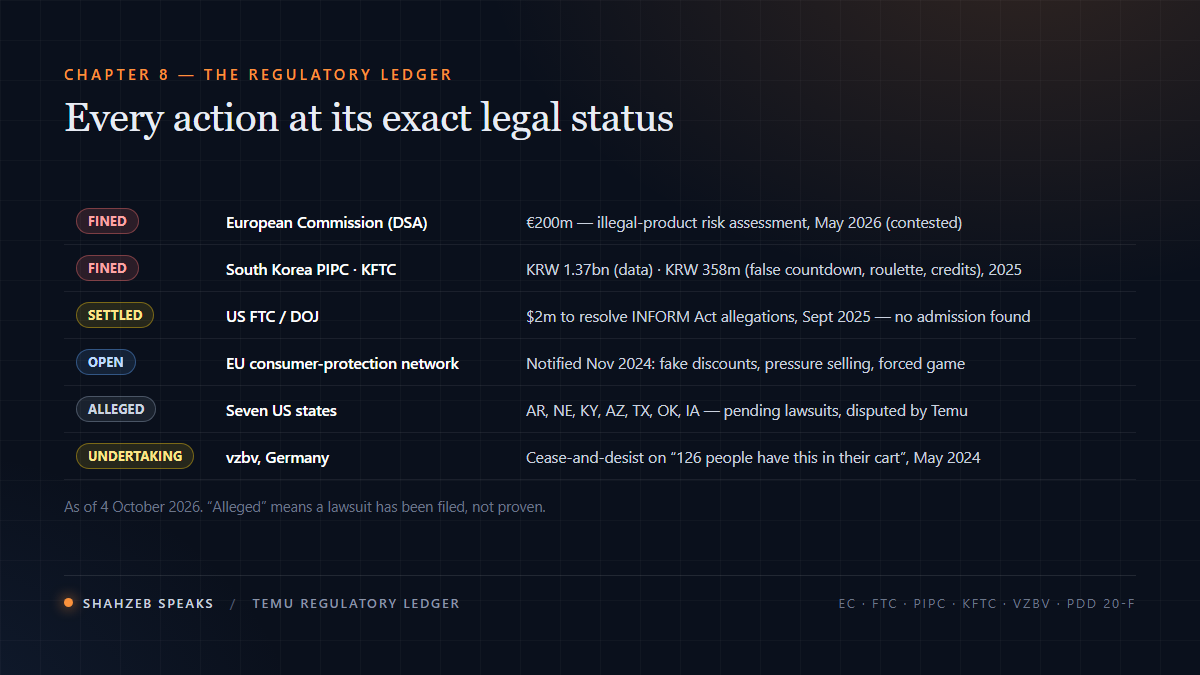
| Who | What | Status |
| European Commission (DSA) | Failure to assess the risk of illegal products | Fined €200m, 28 May 2026. Temu contests it. Addictive-design and recommender strands still under investigation |
| EU consumer-protection network | Fake discounts, pressure selling, forced gamification, hidden minimum order, suspect reviews, hard-to-reach contact | Notified 8 Nov 2024; case ongoing; no decision found |
| US FTC / Department of Justice | INFORM Consumers Act: seller information and reporting on “gamified product listings” | Agreed to pay $2m to resolve allegations, 5 Sep 2025; no admission found |
| US states (Arkansas, Nebraska, Kentucky, Arizona, Texas, Oklahoma, Iowa) | Consumer-protection and data claims | Pending lawsuits — allegations only. Temu disputes them |
| South Korea — PIPC (data) | Data transfers, sellers’ data, seven-step account deletion | Penalised KRW 1.369bn + KRW 17.6m, May 2025 |
| South Korea — KFTC (advertising) | False countdown timer, single-unit roulette offer, “free” credits | Fined KRW 358m, Jun 2025 |
| Germany — vzbv (consumer group) | “Over 126 people have this item in their cart” checkout pressure | Cease-and-desist declaration signed, May 2024 (out of court) |
Two things stand out to a psychologist. First, the actions converge on the same mechanics this audit has described: discounts, urgency, games and referrals. Second, almost every one concerns honesty — whether the discount, the deadline, the crowd or the “free” reward was what it appeared to be. That is the boundary between persuasion and manipulation, and it is drawn on the same line I use in my own work: a technique is legitimate if it still works when the customer can see how it was built.
🧸 Product safety
The Commission’s own mystery shopping, cited in its fine, found unsafe chargers and baby toys. Separately, European consumer groups tested 81 Temu products in 2025 and found 53 (65%) non-compliant — though BEUC itself notes those products were selected because they were expected to be higher risk, so the figure is not a representative rate for everything on the platform.
📉 Chapter 9: The Model Under Pressure
Temu’s psychology was built on a cost structure: cheap goods shipped directly, duty-free, in small parcels. That structure is changing.
- The duty gap is closing — the US ended de minimis in 2025, and the EU began charging €3 per low-value item in July 2026.
- Costs are rising. PDD’s cost of revenues rose from 37.0% of revenue in 2023 to 43.7% in 2025, which the company attributes mainly to fulfilment fees, bandwidth and payment processing. Group net income fell from RMB 112.4 billion in 2024 to RMB 97.8 billion in 2025, and was down 12% year on year in the second quarter of 2026.
- The model is shifting toward locally based sellers and local warehouses in the US, Korea and elsewhere.
Here is the psychological problem. When the price advantage narrows, the levers that depended on it — the painless spend, the “too cheap to say no” moment — weaken. What is left is the brand, and the brand’s trust account is in deficit. A shopper who stayed for the bargain has fewer reasons to stay once the bargain shrinks.
⚔️ Chapter 10: Competitive Positioning
| Brand | Core psychological promise | Main vulnerability |
| Temu | Winning: everything is a deal, and buying is a game | Trust, quality and regulation |
| Shein | Novelty: endless new fashion at low prices | Ethics of ultra-fast fashion |
| Amazon | Certainty: it arrives, and returns are easy | Higher prices on commodity items |
| Daraz (Pakistan) | Events and trust signals: 11.11, flash sales, cash on delivery | Seller quality variance |
Temu’s position is the purest “price plus play” offer in global e-commerce. Amazon’s is the opposite: certainty. The long-run question is whether shoppers who came for the game will stay when they want certainty.
🇵🇰 Chapter 11: What Pakistani E-commerce Should — and Shouldn’t — Copy
Pakistani platforms already use many of these mechanics, from flash sales to countdowns. Temu is the clearest live experiment in how far they can be pushed. The lessons:
- Copy the low-friction start, not the forced game. Making the first purchase easy is good design. Forcing a game before someone can browse is what the EU network singled out.
- Make every discount real and checkable. A genuine reference price is a durable asset. A fake one is the first thing regulators and consumer groups look for — and in a market where cash on delivery means customers can refuse a parcel, distrust costs you directly.
- Use urgency only when it is true. A countdown that resets, or “only 2 left” that never changes, works once. Then it teaches customers to ignore you.
- Disclose referral conditions up front. “Free” with hidden conditions converts in the short run and generates complaints in the long run.
- Design for the ending, not just the peak. Delivery, packaging and returns are where reputations are made. Daraz’s cash-on-delivery trust signal shows how much the ending matters here.
📊 Chapter 12: Psychology Scorecard — Detailed Ratings
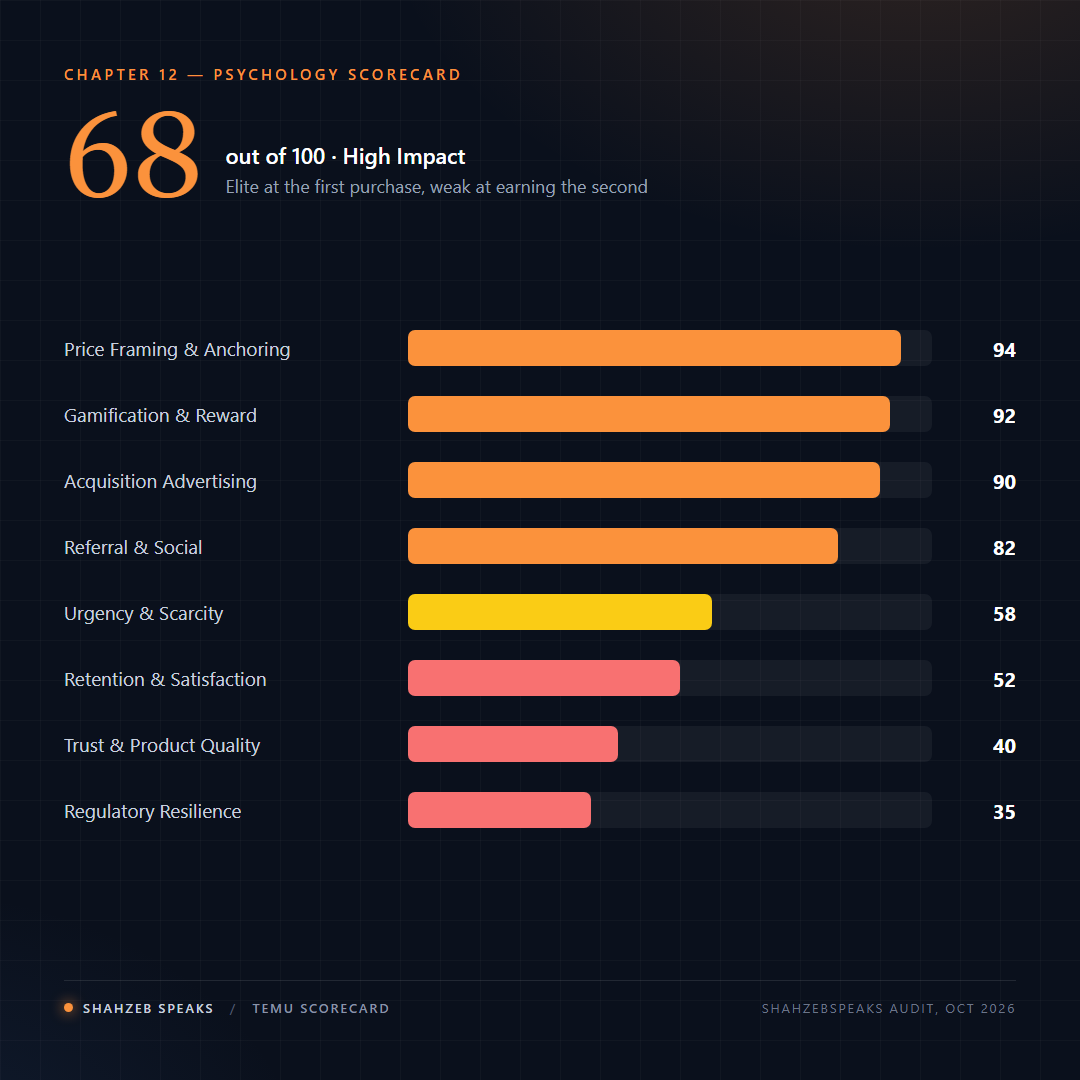
| Psychology Dimension | Score | Verdict |
| Price Framing & Anchoring | 94/100 | Makes spending feel painless; the honesty of its reference prices is under EU scrutiny. |
| Gamification & Variable Reward | 92/100 | The most game-like shopping experience in the West; forced use is what regulators object to. |
| Acquisition Advertising | 90/100 | “Shop like a billionaire” bought familiarity at Super Bowl scale. |
| Referral & Social Mechanics | 82/100 | Turns customers into recruiters; undermined where conditions are hidden. |
| Urgency & Scarcity | 58/100 | Effective, but the false versions drew action in Germany, Korea and the EU. |
| Retention & Satisfaction | 52/100 | A 4.7 app and a 1.8 Trustpilot: wins the peak, loses the ending. |
| Trust & Product Quality | 40/100 | Safety tests and complaint volumes weigh on every promise. |
| Regulatory Resilience | 35/100 | A €200m fine, an open EU consumer case, seven US state suits and Korean sanctions. |
| OVERALL PSYCHOLOGY SCORE | 68/100 | ⚡ High Impact — a brilliant acquisition machine with a trust deficit. |
✅ Chapter 13: Balance Sheet & A Psychologist’s Prescription
💪 Psychological Strengths
- Painless spending: tiny unit prices and crossed-out anchors
- Play: variable rewards and endowed progress that make buying feel like winning
- Reach: saturation advertising that manufactured familiarity fast
- Virality: referral loops that recruit customers into recruiting
- Identity reframe: “Shop like a billionaire” removed the stigma of cheap
⚠️ Psychological Weaknesses
- Honesty questions: discounts, deadlines, crowds and “free” rewards all under scrutiny
- The ending: product quality and delivery decide loyalty, and the reviews show it
- Dependence on price: the levers weaken as duties and costs rise
- Regulatory drag: each enforcement action makes the persuasive features riskier to run
🔮 The Prescription
- Make the game optional and transparent. Let people browse first, and show the conditions of every reward before the wheel spins. The fun survives; the coercion does not.
- Verify every reference price. A discount you can prove is worth more than ten you cannot.
- Retire false urgency. Keep countdowns only for real deadlines and real stock.
- Invest in the ending. Quality control, honest product photos and easy returns are what turn a first order into a second.
- Move the brand from “cheap” to “fair”. As the price gap narrows, fairness — real prices, real reviews, real safety — is the only advantage that compounds.
📝 Final Verdict
Temu is the most complete demonstration of behavioural economics applied to shopping that the Western consumer has seen. It anchors every price, removes the pain of paying, turns browsing into a game, manufactures urgency, and recruits customers to recruit more customers — all wrapped in an identity that makes cheap feel rich. As an acquisition machine, it is close to elite.
Its weaknesses sit in exactly the same place. Nearly every regulatory action against it concerns whether a discount, a deadline, a crowd or a reward was what it appeared to be. Its app is rated 4.7 and its service 1.8. And its cost advantage, the foundation under every lever, is narrowing.
For brands in Pakistan and everywhere else, the lesson is not “don’t use psychology.” It is that persuasion that survives scrutiny compounds, and persuasion that doesn’t eventually sends the bill.
Psychology Score: 68/100 — Temu earns elite marks for price framing (94), gamification (92) and acquisition advertising (90), and strong marks for referral mechanics (82), held back by urgency tactics that drew regulatory action (58), retention and satisfaction (52), trust and product quality (40) and regulatory resilience (35). A brilliant way to win the first purchase, and an unfinished way to earn the second.
🧠 Want to Know Which of Your Tactics Would Survive Scrutiny?
I’m Muhammad Shahzeb, an MSc Industrial Psychologist and web developer. I audit product pages, checkouts and promotions through consumer psychology — what persuades, what manipulates, and what will hold up when customers and regulators look closely.
📚 References & Sources
- PDD Holdings Inc. Form 20-F for the fiscal year 2025 (filed 29 April 2026), U.S. Securities and Exchange Commission.
- PDD Holdings. “PDD Holdings Announces Second Quarter 2026 Unaudited Financial Results.” 24 August 2026.
- European Commission. Press release IP/24/5622 (opening of DSA proceedings against Temu), 31 October 2024.
- European Commission. Press release IP/24/5707 (CPC Network action against Temu), 8 November 2024.
- European Commission. Press release IP/25/1913 (preliminary findings under the DSA), July 2025.
- European Commission. Press release IP/26/1178 (€200 million fine under the DSA), 28 May 2026.
- European Commission. “Ensuring fairness and safety: €3 customs duty on low-value parcels.” 29 June 2026.
- U.S. Federal Trade Commission. “Online Marketplace Temu to Pay $2 Million Penalty for Alleged INFORM Act Violations.” 5 September 2025.
- U.S. Customs and Border Protection. National media release on the end of de minimis, 29 August 2025.
- Verbraucherzentrale Bundesverband (vzbv). “Nach vzbv-Abmahnung: Temu bessert nach.” 14 May 2024.
- BEUC. “Taming Temu: Why the fast-growing online marketplace fails to comply with the DSA.” May 2024; and “Under the Microscope: Tests of Temu Products by Consumer Groups,” updated 30 January 2026; press release, 28 May 2026.
- Korea Personal Information Protection Commission decision on Temu, May 2025 (unofficial English translation); Korea Fair Trade Commission decision, June 2025 (as summarised by Yoon & Yang LLC).
- Rest of World. “Temu’s games” reporting (Viola Zhou), 27 February 2023.
- CBS News. “Temu halts shipments to U.S. from China” (Temu statement on locally based sellers), May 2025.
- Better Business Bureau profile for Temu.com; Trustpilot profile for temu.com; Apple App Store listing — all read 4 October 2026.
- Worchel, S., Lee, J., & Adewole, A. (1975). Effects of supply and demand on ratings of object value. Journal of Personality and Social Psychology, 32(5), 906–914.
- Mathur, A., Acar, G., Friedman, M. J., Lucherini, E., Mayer, J., Chetty, M., & Narayanan, A. (2019). Dark patterns at scale: Findings from a crawl of 11K shopping websites. Proceedings of the ACM on Human-Computer Interaction, 3(CSCW), 1–32.
- Shampanier, K., Mazar, N., & Ariely, D. (2007). Zero as a special price: The true value of free products. Marketing Science, 26(6), 742–757.
- Nunes, J. C., & Drèze, X. (2006). The endowed progress effect: How artificial advancement increases effort. Journal of Consumer Research, 32(4), 504–512.
- Prelec, D., & Loewenstein, G. (1998). The red and the black: Mental accounting of savings and debt. Marketing Science, 17(1), 4–28.
- Hamari, J., Koivisto, J., & Sarsa, H. (2014). Does gamification work? A literature review of empirical studies on gamification. Proceedings of the 47th Hawaii International Conference on System Sciences, 3025–3034.
- Kahneman, D., & Tversky, A. (1979). Prospect theory: An analysis of decision under risk. Econometrica, 47(2), 263–291.
- Tversky, A., & Kahneman, D. (1974). Judgment under uncertainty: Heuristics and biases. Science, 185(4157), 1124–1131.
- Kahneman, D., Fredrickson, B. L., Schreiber, C. A., & Redelmeier, D. A. (1993). When more pain is preferred to less: Adding a better end. Psychological Science, 4(6), 401–405.
- Zajonc, R. B. (1968). Attitudinal effects of mere exposure. Journal of Personality and Social Psychology, 9(2, Pt. 2), 1–27.
- Cialdini, R. B., & Goldstein, N. J. (2004). Social influence: Compliance and conformity. Annual Review of Psychology, 55, 591–621.
Audit conducted by Muhammad Shahzeb, MSc Industrial & Organizational Psychology | Brand Psychology Specialist | Full-Stack Web Developer
Learn more about my approach →
Key Findings
- Temu launched in the US in September 2022 and reached Oceania and Europe by April 2023; PDD Holdings does not report Temu's revenue or users separately
- Its strongest lever is price framing: crossed-out reference prices and tiny unit prices make spending feel painless, though the EU consumer network has questioned whether some discounts are genuine
- Shopping is wrapped in games and referral loops; the EU consumer network notified Temu in 2024 that it considers a forced spin-the-wheel game a breach of consumer law, a case that is still open
- Urgency tactics drew action on three fronts: a cease-and-desist undertaking in Germany, KFTC fines in South Korea, and the EU notification on pressure selling
- On 4 Oct 2026 the app was rated 4.7 on the App Store but 1.8 on Trustpilot, a gap that suggests Temu wins the checkout moment and loses the delivery moment
- The European Commission fined Temu €200 million under the DSA in May 2026 (contested); Temu also agreed to pay $2 million to resolve FTC allegations, and seven US state lawsuits are pending
Overall Psychology Score
Temu scores 68/100 in our comprehensive psychology audit covering consumer behavior strategies, UX design principles, and psychological marketing effectiveness.
The detailed dimension scores are in the audit's Psychology Scorecard chapter.
High impactMuhammad Shahzeb
MSc Industrial Psychologist, specializing in consumer behavior, UX psychology, and brand strategy analysis. Helping brands understand the psychology behind their success.
About Muhammad Shahzeb →