Costco Psychology Audit — How a $1.50 Hot Dog and a $65 Card Built the Most Loyal Customers in Retail
A deep psychology audit of Costco, the retailer that charges people before they can buy anything and still keeps more than nine in ten of them. How the membership fee turns shopping into commitment, why the warehouse is designed to look cheap, how the treasure hunt uses real scarcity, why a hot dog priced at $1.50 since 1985 is the most valuable price in retail, how Kirkland Signature borrows the store's trust, and the uncomfortable question of how much all that psychology makes members buy.

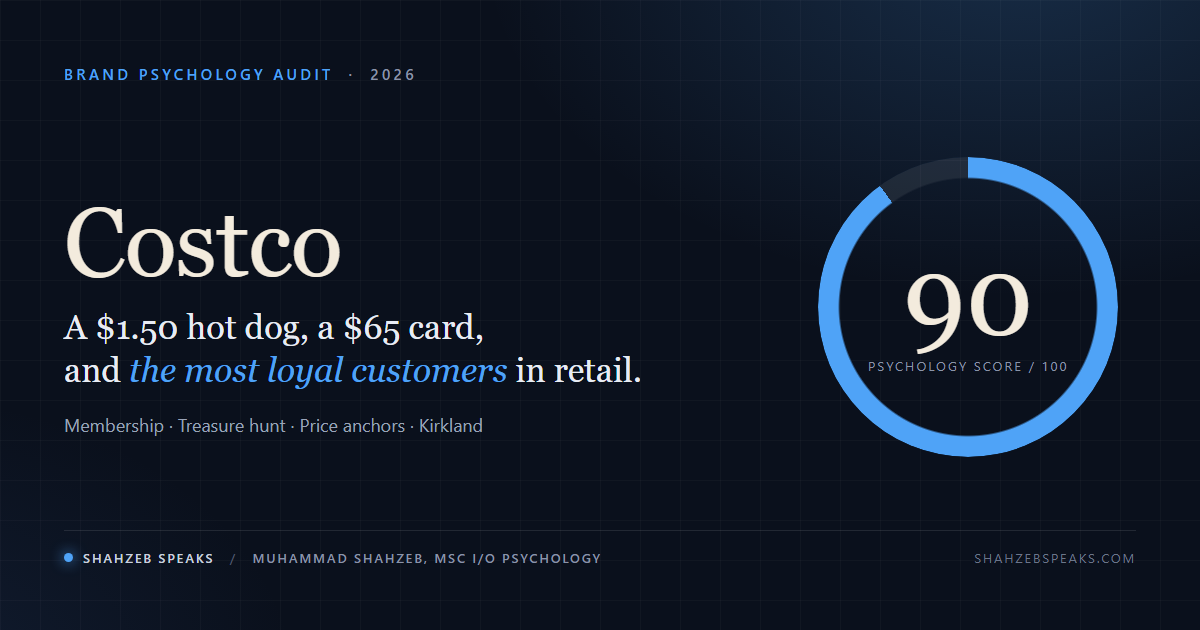
90 / 100
Overall consumer behavior effectiveness
Brand Overview
- Brand nameCostco
- Founded1983
- HeadquartersIssaquah, Washington, USA
- IndustryRetail
- Websitewww.costco.com ↗
Psychology Techniques Identified
- 01Membership Fee as Commitment Device
- 02Sunk Cost Effect
- 03Commitment & Consistency (Cialdini)
- 04Low-Price Cues & Price Image
- 05Treasure Hunt (Real Scarcity)
- 06Variable Ratio Reinforcement
- 07Choice Curation (Reduced Decision Fatigue)
- 08Price Anchoring ($1.50 Hot Dog)
- 09Loss Leaders as Trust Signals
- 10Private Label Halo (Kirkland Signature)
- 11Reciprocity Through Free Samples
- 12Mental Accounting & the Executive Reward
Full Psychology Audit Report
In this audit
On a Saturday morning, a family drives past three supermarkets to reach a warehouse with concrete floors, no decorations, steel shelving to the ceiling and a car park that is already full. At the entrance, an employee checks that they have paid for the right to shop there. They walk in intending to buy milk, paper towels and chicken. They leave with those, plus a kayak, a 48-pack of batteries, a cashmere jumper and a set of patio lights. On the way out, they buy a hot dog and a drink for $1.50 and feel like they won.
That is Costco, and it is one of the most psychologically elegant businesses in the world. For the fiscal year that ended on 30 August 2026, it reported net sales of $297.3 billion, up 10.2%. It has 82.9 million paid members. In the United States and Canada, 92.2% of members renew every year, for a card that costs $65 before they have bought a single thing. Most retailers spend fortunes trying to create loyalty. Costco charges people for it.
I am an Industrial and Organizational Psychologist, and this audit examines how a warehouse that deliberately looks cheap became a place people describe with genuine affection, how the membership fee turns shopping into commitment, why a hot dog priced the same since 1985 does more marketing than an advertising budget, and the less comfortable question of what all that psychology does to how much people buy.
“Every other retailer makes its money on what you buy. Costco makes a large share of its money on the right to buy, and then spends the rest of the relationship proving the fee was worth it. That single inversion explains the warehouse, the markups, the hot dog, and the loyalty.”
— Brand Psychology Analysis, ShahzebSpeaks
📋 Brand Overview: Costco at a Glance
| Company Name | Costco Wholesale Corporation |
| Founded | 1983, first warehouse in Seattle, by Jim Sinegal and Jeffrey Brotman (merged with Price Club, founded 1976, in 1993) |
| Headquarters | Issaquah, Washington, USA |
| CEO | Ron Vachris (since January 2024) |
| Net Sales | $297.3 billion for fiscal 2026 (52 weeks ended 30 August 2026), up 10.2%; total comparable sales +8.4% |
| Warehouses | 931 (Q3 fiscal 2026), including 639 in the United States and Puerto Rico, across 14 countries |
| Members | 82.9 million paid members, 41.2 million of them Executive; 149 million cardholders (Q3 fiscal 2026) |
| Renewal Rate | 92.2% in the U.S. and Canada; 89.7% worldwide (Q3 fiscal 2026) |
| Membership Fee | $65 Gold Star / $130 Executive in the U.S. since 1 September 2024; Executive 2% reward capped at $1,250 |
| Signature Assets | The $1.50 hot dog and drink, the $4.99 rotisserie chicken, Kirkland Signature, the membership card, free samples, the warehouse itself |
| Psychological Code | You paid to be here, so everything here is a good deal |
| Psychology Score | 90 / 100 — 🔥 Revolutionary |
📜 Chapter 1: The History — A Warehouse That Refused to Look Like a Store (1976–2026)
🏗️ 1976–1983: Sol Price and the Idea of Paying to Shop
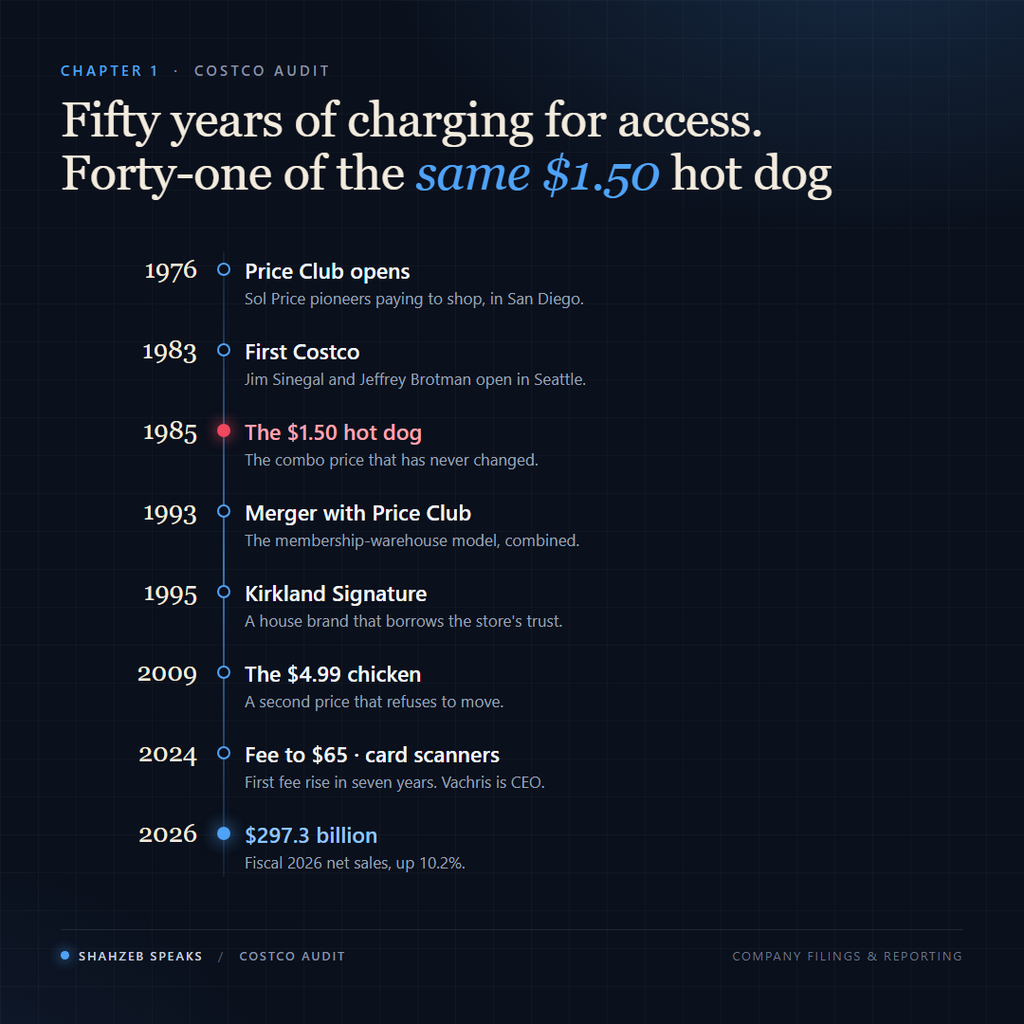
The membership warehouse model was pioneered by Sol Price, who opened Price Club in San Diego in 1976. Jim Sinegal learned the business working for Price. In 1983 he and Jeffrey Brotman opened the first Costco warehouse in Seattle. The model was radical for its time: charge an annual fee, stock a limited range in bulk, keep markups extremely low, and make money on volume and membership rather than on the margin of each item.
🌭 1985: The Hot Dog Price Is Set
The hot dog and soda combination was priced at $1.50. It has not changed since. Chapter 5 explains why this may be the most valuable price point in American retail, and why successive leaders have treated it as untouchable.
🤝 1993–1999: Price Club and Costco Merge
Costco merged with Price Club in 1993, briefly operating as PriceCostco before settling on the Costco name. The combined company inherited the full membership-warehouse philosophy and the discipline behind it.
🏷️ 1995: Kirkland Signature
Costco launched its private label, named after the Washington town where the company was then based. Kirkland Signature grew into one of the largest consumer brands in the United States, which is remarkable for a brand that is only sold in one retailer’s warehouses and online. Chapter 6 covers the trust psychology behind it.
🍗 2009–2024: The Chicken, the Fee and the Card Scanners
The rotisserie chicken settled at $4.99 in 2009 and has stayed there. In January 2024 Ron Vachris became CEO. On 1 September 2024 Costco raised its U.S. membership fee for the first time in seven years, to $65 and $130, and began rolling out membership scanners at warehouse entrances to stop people using cards that were not theirs.
📈 2025–2026: Executive Hours and Record Sales
In June 2025 Costco began opening earlier for Executive members, adding a visible status benefit to the more expensive tier. Fiscal 2026 closed with $297.3 billion in net sales and total comparable sales up 8.4%, while digitally enabled comparable sales grew far faster than the warehouses.
💳 Chapter 2: The Membership Fee — Paying to Commit
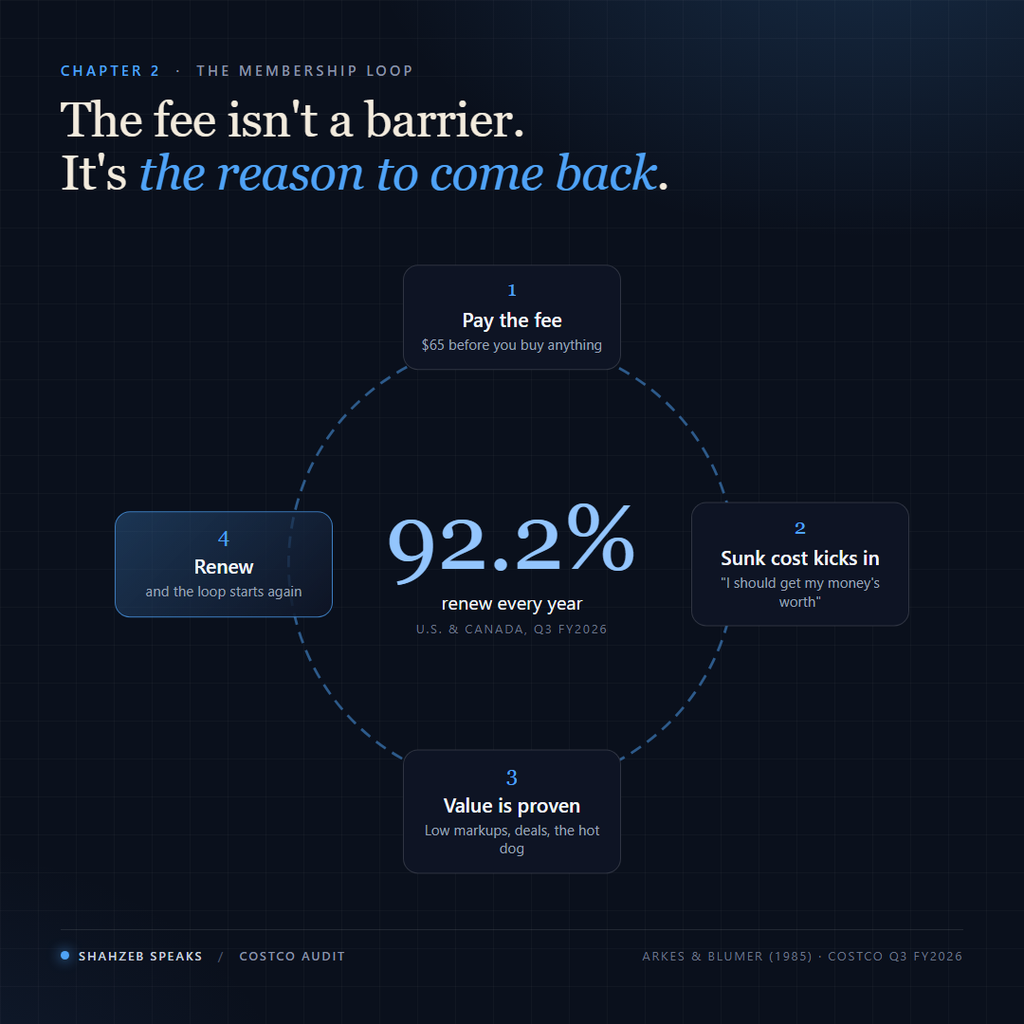
If you understand one thing about Costco, understand this. The membership fee is not mainly a source of revenue. It is a psychological device. The revenue is real, of course: Costco collected $4.06 billion in membership fees in the first three quarters of fiscal 2026 alone, and those fees are widely estimated to account for a large share of its operating profit. But the fee’s more important job is to change how members think about every visit.
Sunk cost turns into a reason to return
Once you have paid $65, the fee is spent whether you visit or not. Rationally, it should not affect future decisions. Psychologically, it does. Research on the sunk cost effect, including Arkes and Blumer’s classic 1985 studies, shows that people who have paid for something use it more, to justify the payment. Every trip to Costco is partly a way of “getting your money’s worth,” which means the fee generates the very visits that make it worthwhile.
Commitment and self-perception
Cialdini’s commitment and consistency principle explains the second layer. Paying for membership is a small, voluntary, public commitment. People who have made such a commitment tend to act, and even think, in ways consistent with it. “I am a Costco member” becomes a small part of identity, often a surprisingly proud one, and members defend the store in the way people defend decisions they chose.
A pre-paid frame for every price
The fee also changes how prices feel. Having paid for access, members enter with an expectation that prices inside will be good, because that is what they paid for. This is a form of expectation-driven perception: a shopper who expects value is inclined to see value, and the warehouse design (Chapter 3) is built to confirm it.
The renewal decision is made at the counter
The genius of the model is when the renewal decision is evaluated. Members do not judge the fee once a year in the abstract. They judge it constantly, in small moments at the register and the gas pump, and the Executive tier makes this explicit by printing the 2% reward on an annual certificate. When the certificate is larger than the $65 difference between tiers, the upgrade feels like free money. That is why Executive membership grew to 41.2 million, half of all paid members, and why those members drive the large majority of sales.
The result is the statistic every subscription business in the world envies: 92.2% renewal in the U.S. and Canada. I explained in my subscription traps article how many companies keep subscribers by making cancellation hard. Costco does the opposite. Membership is easy to cancel and fully refundable. It keeps people by making the value visible.
🏚️ Chapter 3: Designed to Look Cheap
Walk into a Costco and almost everything you see is sending the same message: no money was wasted here, so none is being charged to you.
Concrete floors, steel racking and pallets. These are cheaper than supermarket fittings, but their psychological job is just as important. They are low-price cues: visible signals that costs are low. Consumer research on price image shows that shoppers infer a store’s prices from environmental signals as much as from the prices themselves, and an industrial environment reads as “we pass the savings on.”
Almost no advertising. Costco spends very little on traditional advertising compared with other large retailers. That absence itself becomes a message about efficiency, and word of mouth does the work. Members recommending Costco are far more persuasive than any campaign, because personal recommendations do not trigger advertising scepticism.
Bulk sizes. A 30-roll pack of toilet paper and a giant jar of peanut butter look like good value because the unit price is low, and because large quantities feel like buying wholesale. The size is itself a value signal, independent of whether the household needs that much.
No bags and simple checkout. Members pack their own items into boxes or carry them out. The mild inconvenience is accepted, even valued, because it confirms the story: this is a place that does not waste money on frills.
The deeper principle is consistency of signal. Every cue in the environment points to the same conclusion. A warehouse that looked cheap but had one luxurious section would undermine the whole message. Costco almost never breaks the pattern, which is why its low-price image is so durable even when members spend far more per visit than they would in a supermarket.
🗺️ Chapter 4: The Treasure Hunt
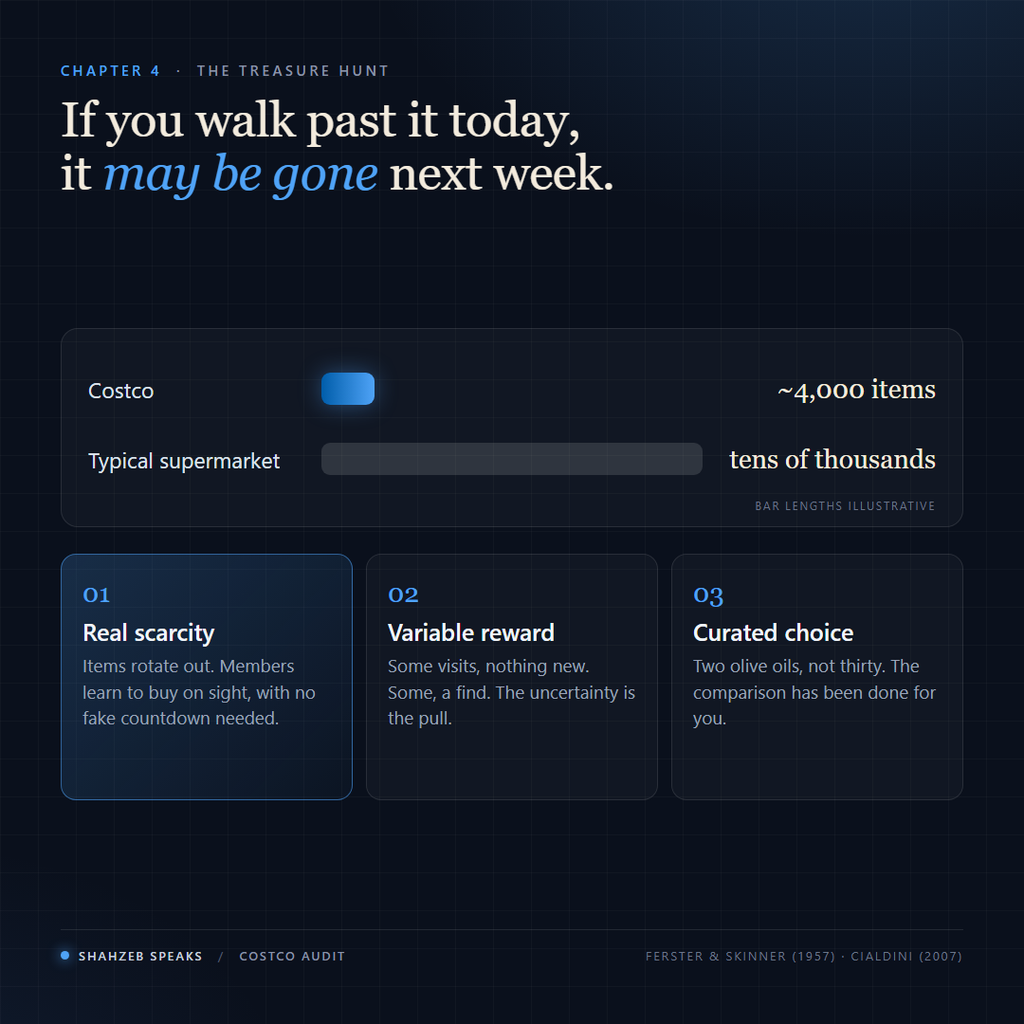
Costco’s own leaders have long used the phrase “treasure hunt” to describe the shopping experience, and it is an accurate description of a carefully engineered set of psychological mechanisms.
A tiny range, and a big surprise
Costco carries roughly 4,000 items, compared with the tens of thousands in a typical supermarket. The core range, the staples people come for, is stable. But a meaningful part of the floor rotates: seasonal goods, one-off buys, premium brands at unusual prices, items that appear for a few weeks and vanish.
Scarcity and “buy it now”
Because members know items may disappear, they buy on sight. This is scarcity at work, the principle I covered in my article on scarcity marketing examples. Costco rarely uses artificial countdown timers or “only 2 left” banners. It does not need them. The scarcity is real, and members have learned it through experience, which makes it far more powerful than a manufactured deadline.
Variable reward
You never know exactly what you will find. Sometimes it is nothing new. Sometimes it is a designer item at half its usual price. That unpredictability is variable ratio reinforcement, the same learning principle behind slot machines, social media feeds and, as I covered in my Labubu audit, blind boxes. The possibility of a find turns a routine shopping trip into something closer to entertainment.
Less choice, easier decisions
A small range also reduces decision fatigue. Instead of choosing between thirty brands of olive oil, members choose between two or three, one of which is often Kirkland Signature. Costco has, in effect, done the comparison for you. That feels like service, and it is also a reason members trust the store’s selection.
Free samples
Product sampling stations add reciprocity, taste-based persuasion and a pleasant, sociable reason to wander further into the building. A sample lowers the risk of trying something new, and being handed something for free creates a small, genuine pull toward buying it.
🌭 Chapter 5: The $1.50 Hot Dog — The Most Valuable Price in Retail
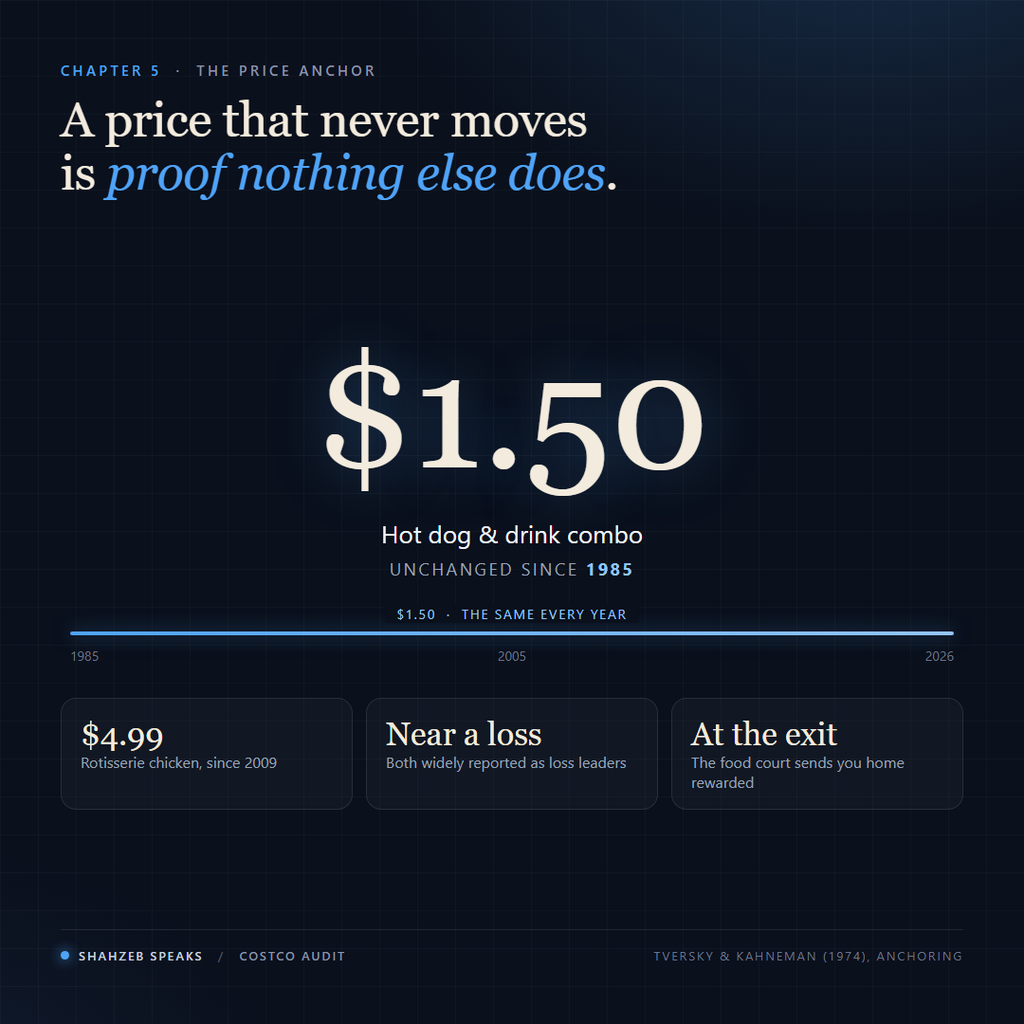
The Costco hot dog and drink has cost $1.50 since 1985. Over those four decades nearly every other price in the economy has risen several times over. The hot dog has not moved.
Former CEO Craig Jelinek has recalled telling co-founder Jim Sinegal that the company was losing money on the hot dog, and Sinegal responding, with a colourful threat, that he must never raise the price. CEO Ron Vachris has publicly promised that the price will not change as long as he is in charge. When Costco made its first change to the combo in forty years, it let members swap the soda for a bottle of Kirkland Signature water, at the same $1.50.
Why protect a single cheap item this fiercely? Because it is not a food item. It is a promise made visible.
A price anchor for the whole store
Anchoring, which I covered in depth in my anchoring bias article, describes how a single reference number shapes judgements that follow. The hot dog is an anchor for Costco’s entire price image. Members encounter it at the end of the trip, and it quietly reinforces the conclusion that everything they just bought was also fairly priced.
A loss leader that earns trust
The hot dog and the $4.99 rotisserie chicken are widely understood to be sold at or near a loss. Traditional loss leaders exist to lure people into a store. These do something more valuable. They prove good faith. A company that absorbs a loss on its most famous item, year after year, looks like a company that is not trying to squeeze its members.
Placement is part of the persuasion
The rotisserie chicken is typically located at the back of the warehouse, so members walk past a great deal of merchandise to reach it. The food court is at the exit. One item pulls you through the store, and the other sends you home feeling rewarded.
Consistency as a brand asset
In a period of inflation and price anxiety, an unchanged price becomes national news. Every time the media writes about the $1.50 hot dog, Costco receives free, trusted coverage of its value promise. No advertising budget could buy the credibility of a price that has not moved in forty years.
🏷️ Chapter 6: Kirkland Signature — Trust That Transfers
Most store brands are bought despite being store brands. Kirkland Signature is bought because it is Costco’s brand, and the difference is entirely psychological.
The markup cap creates a credibility halo. Costco’s widely reported practice of capping markups at around 14% on branded goods and 15% on Kirkland Signature is part of its public story. Whether or not a member knows the exact numbers, most know the general idea: Costco does not take much margin. That belief transfers directly to the house brand. If the store is known for fair pricing, its own brand inherits the assumption of fairness.
Quality signalling through co-branding. Costco has sometimes sold Kirkland products that are widely understood to come from well-known manufacturers, and at times has openly co-branded items. That lets members infer premium quality without Costco having to claim it, which is more persuasive than a direct claim.
The halo effect across categories. A good experience with Kirkland coffee makes members more willing to try Kirkland batteries, wine or clothing. I covered this mechanism in my halo effect article: a positive impression in one domain spreads to judgements in unrelated ones.
Exclusivity creates a switching cost. Kirkland Signature is only available through Costco. Members who come to rely on a Kirkland product must keep their membership to keep buying it. The private label is not just a margin opportunity. It is a loyalty mechanism.
🛒 Chapter 7: Why Members Buy More Than They Meant To
The same design that makes Costco feel like good value also makes it very effective at increasing spending. Several mechanisms combine.
The “value” frame lowers resistance. When a store has earned a reputation for good prices, shoppers relax their usual scrutiny. A purchase that would prompt hesitation in a department store feels safe in Costco, because the environment has already answered the price question.
Bulk sizes raise the spend per trip. Even when unit prices are lower, the absolute amount spent is higher. A family can save on each item and still spend much more per visit than planned.
The “found” item bypasses the list. Treasure hunt items are, by design, things people did not come for. The fear of missing a deal overrides the shopping list, and one unplanned purchase often leads to another, the pattern I described in my article on the Diderot effect.
The Executive reward encourages consolidation. The 2% annual reward makes members want to buy more of their spending at Costco to grow the certificate, which is a form of loyalty through accumulated gains that I also discussed in the context of Starbucks’ tiered rewards in my Starbucks audit.
Mental accounting. Richard Thaler’s work on mental accounting shows that people place money into separate mental categories. A Costco trip is often mentally filed as “saving money,” which makes it easier to justify spending larger amounts under that heading.
⚠️ Chapter 8: The Dark Side — Value, Waste and Friction
🗑️ Buying more than you use
The most honest criticism of the warehouse model is that a low unit price only saves money if you use what you buy. Perishable food bought in bulk and thrown away, or household goods that sit unused, turn a bargain into a loss. Costco’s psychology is excellent at making large purchases feel wise; it does nothing to ensure they are consumed. For small households especially, the “savings” can be largely theoretical.
💸 The fee is a real cost for light shoppers
For someone who visits a few times a year, a $65 or $130 fee can outweigh the savings. The sunk cost effect described in Chapter 2 can make such members visit more often to justify the fee, which increases spending rather than reducing it.
🚗 Friction and crowding
Full car parks, long queues, crowded aisles at weekends and the absence of bags are the price of the model. Committed members accept them as part of the ritual. For newer and younger shoppers used to fast online delivery, they can be a genuine barrier.
🔎 Card checks and control
The entrance scanners introduced in 2024, and the tightening of rules on who may use a membership, protect the model’s economics and are fair to paying members. But they also shift the feeling of the entrance from welcome toward verification. So far, members have largely accepted this, because it is framed as protecting their value.
🌐 The renewal rate is softening at the edges
The worldwide renewal rate slipped slightly, to 89.7% by the third quarter of fiscal 2026. Costco has attributed part of this to members who sign up online renewing at lower rates than those who join in a warehouse. Psychologically, that makes sense: a member who joined in person has walked the warehouse, eaten the hot dog and experienced the treasure hunt. A member who joined through a web page has paid the fee without the experience that justifies it.
👷 Chapter 9: Employees as Part of the Promise
Costco has long had a reputation for paying and treating warehouse employees better than much of retail, and for low staff turnover. From an organisational psychology perspective, this is not separate from the brand. It is part of how the brand is delivered.
Low turnover means experienced staff. Employees who stay know the products, the warehouse and the members. That creates competent, efficient service without the scripted friendliness many retailers require.
Fair treatment supports discretionary effort. The research on organisational citizenship behaviour consistently links perceived fairness and trust to voluntary effort beyond the job description. I explored the reverse, what happens when that trust is missing, in my quiet quitting article.
The story reinforces the value frame. Members who believe Costco treats its employees well feel better about shopping there. The perception of a fair company strengthens trust in its prices. This is the same connection I highlighted in the Starbucks audit, operating in the opposite direction: where the relationship with staff is stable, it supports the customer promise rather than undermining it.
⚔️ Chapter 10: Competitive Positioning
| Competitor | Psychological Position | Where Costco Wins or Loses |
| Sam’s Club | Same model, backed by Walmart’s scale and technology | Loses on app and checkout convenience in places; wins on treasure hunt, Kirkland trust and member affection |
| BJ’s Wholesale | Regional club with more grocery-style convenience | Wins on scale, quality perception and brand identity |
| Amazon (Prime) | Membership plus convenience; value measured in speed | Loses badly on convenience; wins on price trust, discovery and the in-person experience |
| Aldi | Small range, private label, no fee | Loses on small-basket convenience; wins on treasure hunt and non-grocery range |
| Walmart and supermarkets | Low prices, no fee, huge range, close to home | Loses on convenience and choice; wins on commitment, trust and the feeling of a deal |
The common thread is revealing. Almost every competitor beats Costco on at least one practical dimension, whether convenience, range or proximity. None matches the emotional relationship. People do not usually say they love a supermarket. A remarkable number say they love Costco, and that attachment is built almost entirely from the psychology described in this audit, not from a marketing budget.
📊 Chapter 11: The Lesson for Every Business
Few businesses can copy Costco’s scale, but several of its principles apply almost anywhere.
- Make one promise visible and never break it. The hot dog works because it is permanent. A single, dependable signal of fairness is worth more than many temporary discounts.
- Keep every cue consistent. Costco’s environment tells one story. Mixed signals weaken a positioning faster than a weak one.
- Let customers commit, then prove it was worth it. Commitment is powerful only when the value that follows is real. Costco’s renewal rate comes from delivering, not from trapping.
- Curate choice. Doing the selection for customers can feel like service, not restriction, if the selection is trusted.
- Treat employees as part of the product. The customer experience is delivered by people, and people who are treated fairly deliver it better.
📊 Chapter 12: Psychology Scorecard — Detailed Ratings
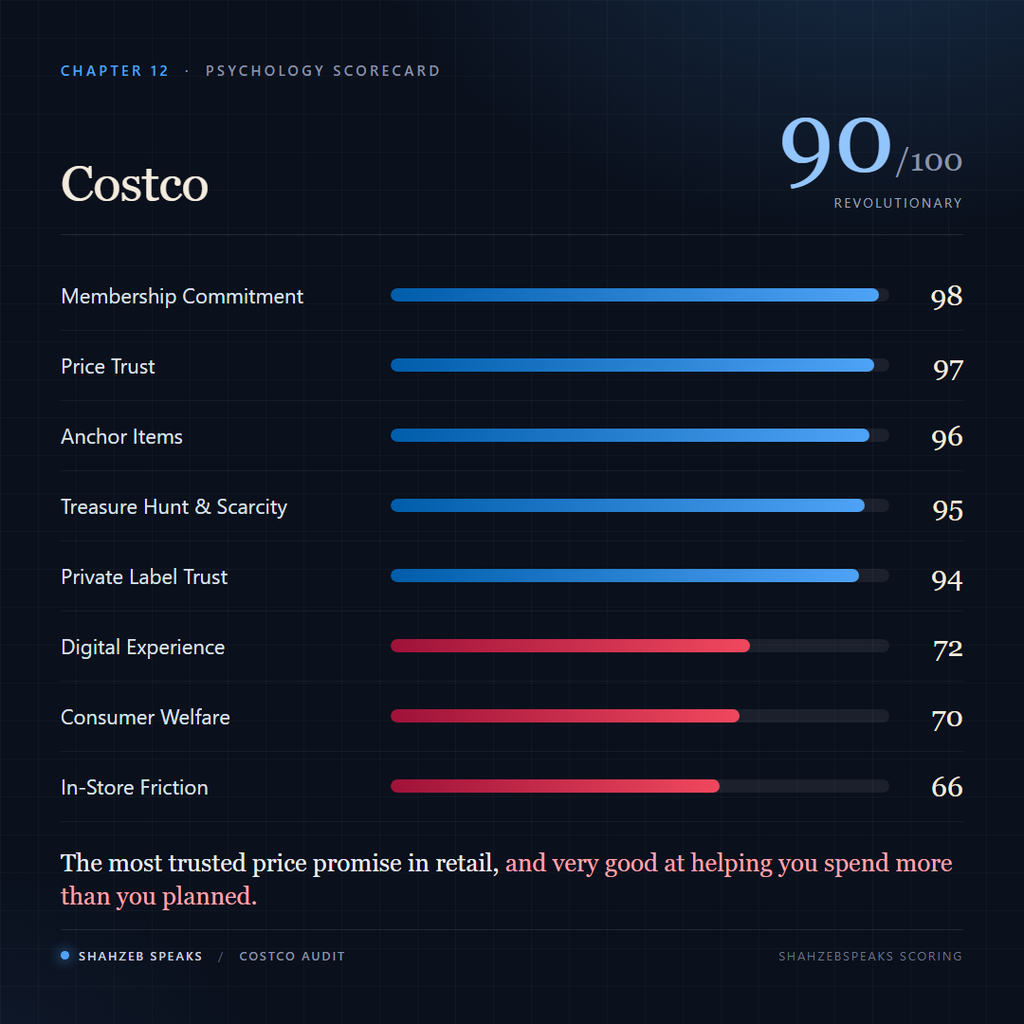
| Psychology Dimension | Score | Verdict |
| Membership Commitment | 98/100 | 92.2% renewal for a fee paid before any purchase. Nothing in retail matches it. |
| Price Trust | 97/100 | Low markups, cheap-looking warehouses and almost no advertising tell one story. |
| Anchor Items | 96/100 | A $1.50 hot dog since 1985 and a $4.99 chicken that do the work of a campaign. |
| Treasure Hunt & Scarcity | 95/100 | Real scarcity and variable reward, without a single fake countdown timer. |
| Private Label Trust | 94/100 | Kirkland inherits the store’s credibility and adds a reason to keep the card. |
| Digital Experience | 72/100 | Growing fast, but online joiners renew less; the magic lives in the building. |
| Consumer Welfare | 70/100 | Bulk “savings” can become waste, and the value frame lowers spending resistance. |
| In-Store Friction | 66/100 | Crowds, queues, parking and card checks that loyal members forgive and new ones may not. |
| OVERALL PSYCHOLOGY SCORE | 90/100 | 🔥 Revolutionary — the business that made customers pay for loyalty and then earned it. |
✅ Chapter 13: Balance Sheet & A Psychologist’s Prescription
💪 Psychological Strengths
- Commitment by design: the fee turns every visit into a reason to return
- Consistent price signal: warehouse, markups, advertising and anchor items all say the same thing
- Genuine scarcity: the treasure hunt is real, so it never feels manipulative
- A permanent promise: the hot dog proves good faith every single day
- Transferable trust: Kirkland Signature turns store credibility into brand loyalty
- Stable workforce: experienced, fairly treated staff deliver the experience without scripts
⚠️ Psychological Weaknesses
- Overbuying: the value frame and bulk sizes can turn savings into waste
- Friction: crowds, queues and the no-frills model test newer shoppers
- Digital dilution: members who join online without the in-store experience renew less
- Verification feel: entrance scanners protect value but cool the welcome
- Light-user economics: the fee can outweigh savings for infrequent members
🔮 The Prescription
- Bring the warehouse into the online sign-up. New digital members should receive a reason to visit in person early, such as a first-visit food court offer. The in-store experience is what justifies renewal, so the first visit matters more than the first click.
- Help members buy the right amount. Clear unit-use guidance on perishables, or smaller pack options in selected categories, would reduce waste and strengthen long-term trust. A retailer whose brand is fairness can afford to help people spend wisely.
- Make the renewal value visible to every tier. Executive members see their reward certificate. Gold Star members have no equivalent reminder of what they saved. A simple annual savings summary would do for the base tier what the certificate does for the top one.
- Keep verification warm. Scanners protect paying members, and they should be framed that way at the door. The entrance is the first moment of every visit, and it should feel like recognition rather than inspection.
- Never touch the hot dog. It is not about food cost. It is the most efficient trust signal in the company, and the day it changes, every other price becomes a question.
📝 Final Verdict
Costco turned one of the most basic assumptions of retail upside down. Instead of trying to remove every barrier between a customer and a purchase, it added one: a fee to walk through the door. Then it used that fee to transform the psychology of every visit that followed. Members arrive committed, expecting good value, and find an environment designed from floor to ceiling to confirm that expectation.
The warehouse looks cheap on purpose. The range is small on purpose. The best items disappear on purpose. The hot dog costs $1.50 on purpose, and has for forty years. Each of these choices is simple. Together they have produced 82.9 million paying members, a 92.2% renewal rate in its home markets and nearly $300 billion in annual sales, with almost no advertising.
The honest caveat is that the same psychology that builds trust also builds spending. A value frame lowers resistance, bulk sizes raise the bill, and a bargain that ends in the bin is not a saving. Costco is not deceiving anyone, and that is exactly why the model is so powerful. It is the rare business whose persuasion is built on keeping its promises, and the only real risk is that members trust it so completely they stop checking whether they needed what they bought.
Psychology Score: 90/100 — Costco earns elite marks for membership commitment (98), price trust (97), anchor items (96), treasure hunt and scarcity (95) and private label trust (94), held back by digital experience (72), consumer welfare (70) and in-store friction (66). The business that charged customers for loyalty, and then earned it.
🧠 Want a Psychology Audit for Your Brand?
I’m Muhammad Shahzeb, an MSc Industrial Psychologist and Full-Stack Developer. I audit pricing signals, loyalty and membership models, and the in-store and online experience using behavioral science, including the part where I show you which of your promises customers actually believe. Let’s look at yours.
📚 References & Sources
- Costco Wholesale Corporation. “Costco Wholesale Corporation Reports August Sales Results.” September 2, 2026. investor.costco.com
- Costco Wholesale Corporation. “Costco Wholesale Corporation Reports Third Quarter and Year-To-Date Operating Results For Fiscal 2026.” May 28, 2026.
- Costco Wholesale Corporation. Q3 Fiscal 2026 earnings call (membership, renewal rate and Executive member figures). May 2026.
- Costco Customer Service. “Membership Fee Increase” (effective September 1, 2024).
- CBS News. “Costco raises its annual membership fees for the first time in 7 years.” July 2024.
- Fox Business. “Costco’s exclusive hours for executive members ‘very well received.'” 2025.
- The Shelby Report. “Costco Caps FY26 With $297.3B In Sales, Up 10.2 Percent.” September 15, 2026.
- The Motley Fool. “How Kirkland Quietly Became Costco’s Most Powerful Moat.” March 17, 2026.
- Arkes, H. R., & Blumer, C. (1985). “The psychology of sunk cost.” Organizational Behavior and Human Decision Processes, 35(1), 124-140.
- Cialdini, R. B. (2007). Influence: The Psychology of Persuasion. Harper Business.
- Thaler, R. H. (1999). “Mental accounting matters.” Journal of Behavioral Decision Making, 12(3), 183-206.
- Tversky, A., & Kahneman, D. (1974). “Judgment under uncertainty: Heuristics and biases.” Science, 185(4157), 1124-1131.
- Ferster, C. B., & Skinner, B. F. (1957). Schedules of Reinforcement. Appleton-Century-Crofts.
- Iyengar, S. S., & Lepper, M. R. (2000). “When choice is demotivating: Can one desire too much of a good thing?” Journal of Personality and Social Psychology, 79(6), 995-1006.
- Hamilton, R., & Chernev, A. (2013). “Low prices are just the beginning: Price image in retail management.” Journal of Marketing, 77(6), 1-20.
- Organ, D. W. (1988). Organizational Citizenship Behavior: The Good Soldier Syndrome. Lexington Books.
Audit conducted by Muhammad Shahzeb, MSc Industrial & Organizational Psychology | Brand Psychology Specialist | Full-Stack Web Developer
Learn more about my approach →
Key Findings
- Costco reported $297.3 billion in net sales for fiscal 2026, up 10.2%, with 82.9 million paid members and a 92.2% renewal rate in the U.S. and Canada, for a card paid for before any purchase
- The membership fee works less as revenue than as a commitment device: the sunk cost of the fee makes every visit a way of getting your money's worth, which generates the visits that justify it
- The warehouse is designed to look cheap, and every cue from concrete floors to almost no advertising tells one consistent story of low prices, which is why the price image survives high spending per trip
- The treasure hunt uses real scarcity and variable reward across roughly 4,000 items, so members buy on sight without Costco needing a single fake countdown timer
- The $1.50 hot dog, unchanged since 1985, is not a food item but a permanent, public proof of good faith that anchors the price perception of the whole store
- The same psychology that builds trust also raises spending: a value frame lowers resistance and bulk sizes raise the bill, and online joiners who never experience the warehouse renew at lower rates
Overall Psychology Score
Costco scores 90/100 in our comprehensive psychology audit covering consumer behavior strategies, UX design principles, and psychological marketing effectiveness.
The detailed dimension scores are in the audit's Psychology Scorecard chapter.
RevolutionaryMuhammad Shahzeb
MSc Industrial Psychologist, specializing in consumer behavior, UX psychology, and brand strategy analysis. Helping brands understand the psychology behind their success.
About Muhammad Shahzeb →