

Pick up an unfamiliar product in a shop. The packaging is beautiful: heavy card, restrained type, a satisfying weight in the hand. Before you have read a single specification, you have already concluded that the contents are probably good quality, the company probably knows what it is doing, and the price is probably justified. You did not decide any of that. It arrived fully formed, in under two seconds, from a piece of cardboard.
That is the halo effect, and the thing that makes it genuinely unsettling is not that it happens. It is that you will confidently deny it happened, and you will produce reasonable-sounding explanations for a judgement that was actually made by the packaging. There is a well-known experiment that demonstrates exactly this, and I will get to it.
I am an Industrial and Organizational Psychologist, and this article covers where the halo effect came from in 1920, fifteen brands running on it today, the reverse version that has destroyed several large companies, the way it quietly corrupts hiring decisions in every organisation I have ever looked at, and an honest section on where the popular version of this idea is overstated.
“A brand does not need to be excellent at everything. It needs to be visibly excellent at one thing people can see, and the mind will generously fill in the rest. This is the cheapest form of brand equity available, and it is also the most fragile, because the same mechanism runs in reverse at the same speed.”
— Consumer Psychology Analysis, ShahzebSpeaks

🎖️ Where it comes from: Thorndike, 1920
The psychologist Edward Thorndike published a paper in 1920 called “A constant error in psychological ratings.” He had asked commanding officers in the military to rate their soldiers on a range of separate qualities: physique, intelligence, leadership, character, loyalty, dependability.
These are unrelated traits. A soldier can be physically impressive and unintelligent, or brilliant and unreliable. Thorndike expected the ratings to vary independently.
They did not. The correlations were extraordinarily high across every dimension. Officers who rated a soldier as physically impressive also rated him as more intelligent, more loyal and more dependable. The ratings were not measuring six qualities. They were measuring one global impression, repeated six times with different labels attached.
Thorndike called it a “halo,” borrowing the image of a saint’s glowing ring: one bright quality lighting up everything around it. A century later it remains one of the most reliably replicated effects in psychology, and one of the most consistently underestimated by the people it operates on.
🎥 The experiment that makes it uncomfortable
Thorndike showed the effect exists. Richard Nisbett and Timothy Wilson showed, in 1977, that we cannot see it working, and this is the study I would ask everyone to remember.
They had students watch a videotaped interview with a lecturer who spoke with a Belgian accent. Half saw a version where he was warm, friendly and enthusiastic. The other half saw the same man, answering the same questions, behaving in a cold and distant manner.
Students then rated his appearance, his mannerisms and his accent. These are fixed physical attributes. They were identical in both videos.
The students who saw the warm version rated his appearance, mannerisms and accent as appealing. The students who saw the cold version rated the same appearance, the same mannerisms and the same accent as irritating. His warmth had bled into their perception of his face.
Then came the part that matters most. When asked whether their liking for him had influenced their ratings of his attributes, students denied it. Several insisted the causation ran the other way: that his irritating accent had made them dislike him. They had no access to what had actually happened in their own heads, and they filled the gap with a plausible story.
That is the practical lesson of the halo effect. You cannot catch yourself doing it by paying closer attention. Introspection returns a confident, wrong answer. The only reliable defences are structural, and I cover those near the end.
🧠 What is actually happening
Four mechanisms are doing the work, and they stack.
Attribute substitution. Kahneman’s framing is the clearest: when faced with a hard question, the mind quietly answers an easier one instead. “Is this product well engineered?” is difficult and requires expertise you may not have. “Does this product look and feel well made?” is instant. The answer to the second gets reported as the answer to the first, and the swap is invisible.
Affective priming. An initial emotional reaction, formed in milliseconds, colours everything processed afterwards. Once you feel positively toward something, ambiguous evidence gets read charitably. The same evidence, encountered after a negative first impression, reads as a warning sign.
Cognitive economy. Evaluating a product on nine independent dimensions is expensive. Forming one global impression and applying it everywhere is cheap and usually good enough. The halo effect is not a malfunction; it is a shortcut that works often enough to have survived, and fails in exactly the situations where accuracy matters most.
Consistency motive. Once you have formed a view, contradicting evidence creates discomfort, which Festinger described as cognitive dissonance. Reinterpreting the evidence is easier than revising the view. This is why halos strengthen over time rather than eroding, and why loyal customers defend brands through failures that would end a newer relationship.
✨ 15 brands running on the halo effect
1. Apple, and the unboxing
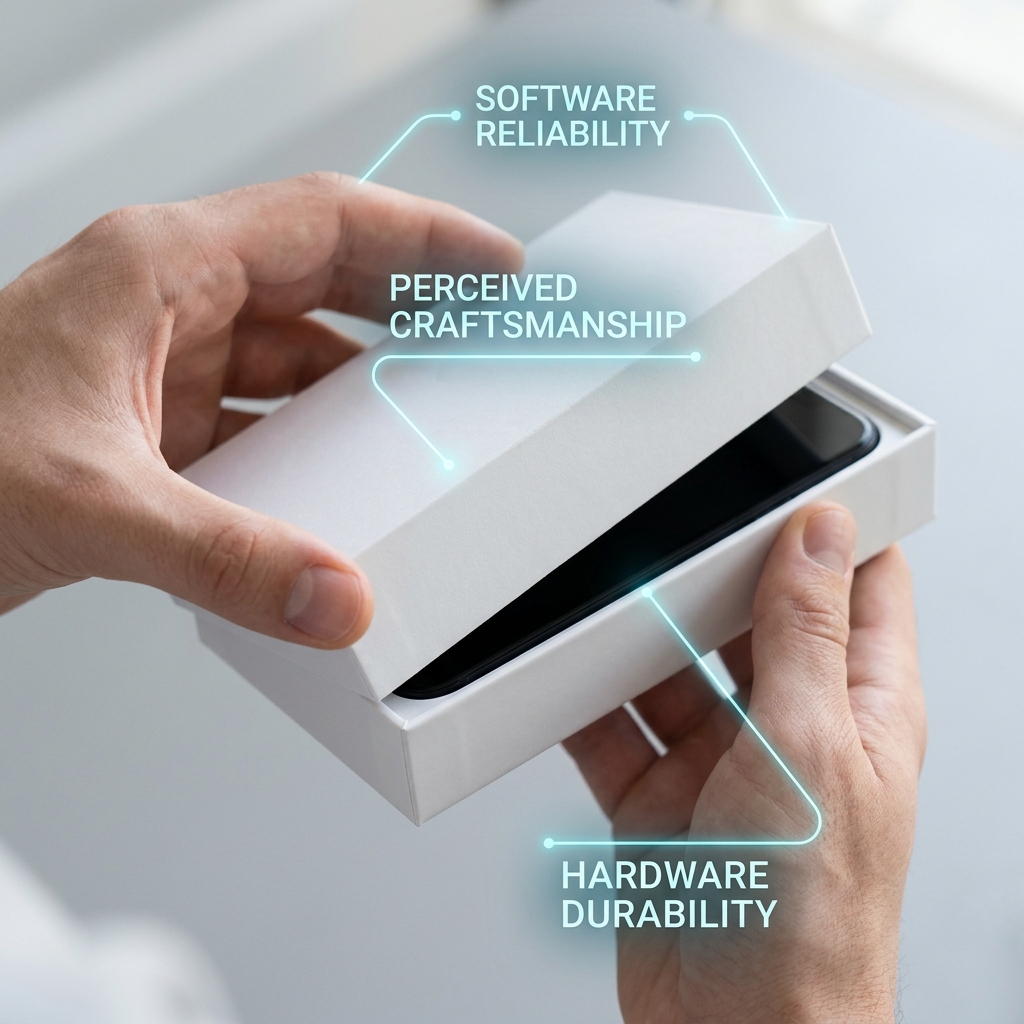
The most studied case in modern branding. The precision of the packaging, the resistance of the lid as it lifts, the placement of every cable, all of it happens before the product is switched on. It communicates one legible quality, care about detail, and that quality is then generously extended to engineering, software, security and durability, none of which the customer has yet evaluated. Apple did not invent this, but it industrialised it.
2. Dyson, and visible engineering
The transparent bin, the exposed cyclone, the deliberately mechanical look. Dyson makes engineering visible in a category where it is normally hidden inside beige plastic, and visible engineering creates an assumption of superior engineering that extends to every product the brand launches, including categories it entered decades later.
3. Tesla, and the founder halo
Tesla is an unusually pure demonstration because the halo runs through a person rather than a product. Belief in the founder’s technical vision transfers to expectations about build quality, software, safety and timelines. The interesting part for a psychologist is what happens when the founder becomes controversial: a halo attached to a person inherits everything that happens to that person, which makes it the highest-variance brand asset available.
4. Patagonia, and the ethics halo
Patagonia’s environmental commitments are real and unusually well documented. What interests me is the spillover: customers who believe the brand is ethical also rate its durability, comfort and design more highly, and rate the price as more reasonable. Moral quality is not supposed to predict stitching quality. It does anyway.
5. Rolex, and price as evidence
Price is one of the strongest halo triggers because it is the easiest signal to read. Expensive implies well-made implies desirable implies a good investment. The chain runs automatically, which is why cutting prices damages luxury brands in a way that seems irrational until you understand that the price was the quality evidence.
6. Toyota, and reliability spillover
Decades of reliability data built a genuine reputational asset, and it now extends to models nobody has tested, categories Toyota recently entered, and resale values. Here the halo is largely earned and reasonably predictive, which is worth saying, because not every halo is a distortion. Sometimes the shortcut is correct.
7. Nike, and borrowed excellence
Endorsement is the halo effect purchased directly. The athlete’s demonstrated excellence transfers to a shoe the customer cannot evaluate. The transfer is real and measurable, and so is the reverse: endorsement contracts get terminated fast when an athlete’s reputation collapses, because the pipeline carries whatever is put into it.
8. “German engineering,” “Swiss made,” “Japanese quality”
The country-of-origin effect is one of the most robust findings in international marketing. A national reputation attaches to individual products regardless of where they were actually assembled. In Pakistan and much of South Asia there is a strong “imported” halo, where the same item is perceived as higher quality purely because it came from abroad, and a matching horn effect where domestic manufacturing is discounted before it is examined.
9. Michelin stars, and the transferred verdict
Once a restaurant holds a star, diners rate the food, service, atmosphere and value more highly. The star is a genuine signal, but it also becomes a lens: an unremarkable dish at a starred restaurant gets interpreted as sophisticated rather than disappointing, because the frame was set before the food arrived.
10. University names on a CV
An elite institution on a résumé raises assessments of intelligence, work ethic, communication skill and leadership potential, most of which the degree does not measure. I return to this in the hiring section because it is where the halo effect does the most damage in organisations.
11. Packaging that changes how food tastes
This one is not a metaphor. Charles Spence’s work on gastrophysics has repeatedly shown that packaging, colour, weight and even the sound of a container measurably change reported taste, sweetness and perceived quality of identical products. The halo does not only affect what people say. It affects what they experience.
12. The clean office and the competent firm
Physical environment operates on business buyers exactly as packaging operates on consumers. A well-designed office, a good website, a tidy presentation deck: none of these measure competence, and all of them get read as competence, which is why professional services firms spend so heavily on them.
13. Founder story as a halo generator
A brand with a visible, costly origin story inherits an assumption of authenticity across everything it sells. I analysed this in detail in my Khaadi audit, where a 1998 handloom origin creates a craft halo the brand does not fully use, and in my Anthropic audit, where a founding act of caution colours how every subsequent claim is read.
14. The first-product halo
Whatever a company does exceptionally well first becomes the lens for everything after. Nvidia’s graphics reputation carried into artificial intelligence hardware long before most buyers could evaluate the difference, which I covered in my Nvidia audit. The risk is symmetrical: a weak first product creates a shadow that outlives the fix.
15. Attractive people and attractive products
The “what is beautiful is good” stereotype, documented by Dion, Berscheid and Walster in 1972, finds that physically attractive people are rated higher on intelligence, kindness and competence. The same pattern applies to product aesthetics, and it is why design investment returns more than its functional contribution justifies. I have an important caveat about the size of this effect in the honest section below.
😈 The horn effect: the same mechanism, pointing down
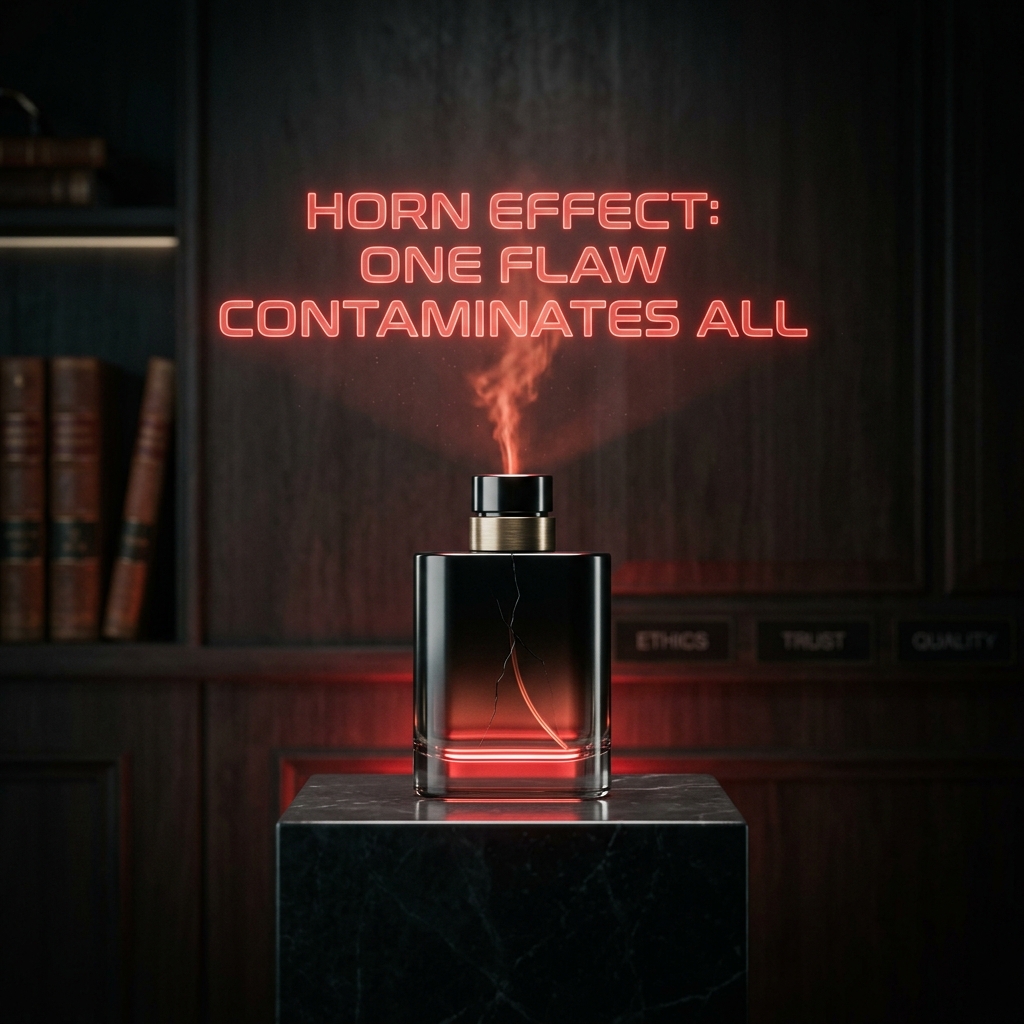
The reverse is called the horn effect, and it is faster, stronger and considerably harder to reverse.
One visible failure contaminates every other judgement about a brand. A safety scandal makes customers rate the company’s design, service, ethics and even unrelated product lines more harshly. Nothing else changed. The lens did.
Three patterns I would highlight from cases I have looked at closely:
The fall is proportional to the height. Brands built on a specific virtue are punished hardest when that exact virtue fails. I documented this at length in my Johnson & Johnson audit: a company whose entire identity was built on caring for families faced a collapse in trust that a less virtuous brand would not have suffered for equivalent conduct. The halo becomes the yardstick critics measure you against.
Negative information is weighted more heavily. The negativity bias documented by Baumeister and Rozin means one bad data point outweighs several good ones. A brand needs sustained excellence to build a halo and a single well-publicised failure to acquire horns.
Recovery requires structural change, not communication. Because the effect operates below awareness, advertising your way out rarely works. What shifts a horn effect is visible, costly, verifiable action, for the same reason the halo formed in the first place: people read what they can see.
💼 Where it does real damage: hiring

This is the part I care about most professionally, because the halo effect in branding costs consumers money, and the halo effect in hiring costs people careers.
Thorndike found the effect in performance ratings, and it has never left them. In an unstructured interview, a candidate who is articulate, confident and personable in the first few minutes gets rated higher on analytical ability, integrity, work ethic and leadership, none of which conversational fluency measures. Interviewers then experience this as insight rather than impression, exactly as Nisbett and Wilson’s students did.
The specific triggers show up repeatedly:
- Institutional prestige. A recognised university or a famous former employer raises ratings on traits the credential does not measure.
- Verbal fluency. Confident speech is read as competence. They correlate weakly, and confidence is easier to perform than competence.
- Similarity to the interviewer. Shared background, accent or interests generate liking, and liking generates favourable ratings on everything else.
- Appearance and grooming. Documented influence on ratings of ability in roles where appearance is irrelevant.
- Performance review carryover. One strong quarter or one memorable failure colours ratings for years, which is a large part of why annual reviews correlate so poorly with actual output.
The remedy is not “be aware of your biases,” because the 1977 study shows awareness does not reach this process. The remedy is structure. Schmidt and Hunter’s landmark analysis of selection methods found structured interviews substantially outperform unstructured ones for predicting job performance, and the mechanism is straightforward: standardised questions, scored independently against defined criteria, before any overall impression is formed. I wrote about the wider selection landscape in my article on how companies use psychometric tests to reject you.
⚠️ The honest part: where this idea is oversold
The halo effect is real, replicated and important. The popular version of it is also stretched well past what the evidence supports, and a psychologist who does not say so is not being useful.
It has become an explanation for everything
“Halo effect” now gets applied to any case where a brand does well, which makes it unfalsifiable and therefore useless. If a company succeeds because its product is genuinely better, that is not a halo, it is a product. The concept only has meaning where an impression transfers to an attribute it should not predict. Toyota reliability predicting Toyota reliability is not a bias; it is evidence.
The attractiveness literature is inflated
The “what is beautiful is good” finding is real, but effect sizes in careful meta-analyses are modest, considerably smaller than the way it circulates in popular writing. It is a nudge on judgement, not a determinant of outcomes, and articles that present it as destiny are overselling.
Halo strength depends heavily on how much the evaluator knows
The effect is strongest when the judge lacks expertise and the attribute is hard to verify. Give someone real diagnostic information and the halo shrinks substantially. This is why expert reviewers, professional buyers and experienced traders are less susceptible, and it points to the practical defence: the halo fills gaps, so reduce the gaps.
Business writing about it is often circular
Phil Rosenzweig made this argument forcefully in The Halo Effect in 2007, and it applies to most management literature. Analysts observe that a company performed well financially, then rate its culture, strategy and leadership as excellent, then present those ratings as the explanation for the performance. The judgements were contaminated by the outcome they claim to explain. A great many business case studies are halo effects written up as research, and I would treat “the secrets of successful companies” books with this in mind.
🛡️ How to work with it
If you are building a brand
- Pick one visible quality and be genuinely excellent at it. Not three. One, and one that customers can actually perceive without expertise. The mind will extend it further than you could ever claim in advertising.
- Invest in what is touched first. Packaging, the website’s first screen, the onboarding, the office, the reply time. These form the lens through which everything after is read, which makes them cheap leverage.
- Understand what you are borrowing. Endorsements, certifications and partnerships import someone else’s halo, and they import their horns on the same wire.
- Protect the quality your halo is built on above all others. If your reputation is safety, a safety failure costs more than a decade of ordinary underperformance, because the failure attacks the mechanism itself.
If you are making decisions
- Score attributes separately and in advance. Define what you are evaluating, in what order, before forming an overall impression. This is the single most effective intervention available.
- Hide identifying information where you can. Blind evaluation of work samples, anonymised CVs for initial screening, and reviewing writing before meeting the writer.
- Ask what you would think if the good thing were absent. “If this had ordinary packaging, would I still believe this?” is the consumer version of the debiasing question.
- Distrust your own confidence most of all. The 1977 finding is that people give sincere, articulate, entirely wrong accounts of why they judged something. Feeling certain is not evidence of accuracy here; it may be the symptom.
🔗 Related biases
| Bias | How it relates |
| Horn effect | The same mechanism running negatively. Faster to form, harder to remove. |
| Confirmation bias | The halo sets the initial belief; confirmation bias then defends it. |
| Processing fluency | Easy-to-process things feel more trustworthy, which feeds the initial impression. |
| Anchoring | Anchoring fixes a number; the halo fixes an overall impression. Both set a reference point. |
| Authority bias | Credentials and titles function as halo triggers on their own. |
📝 The takeaway
The halo effect is the cheapest brand equity in existence and the most dangerous to depend on. One perceivable quality gets extended, without permission and without awareness, across every judgement a customer makes. This is why a well-made box changes what people believe about a device inside it, why a founder’s reputation becomes a product specification, and why a brand’s ethical stance improves how comfortable its shoes feel.
The uncomfortable half is that the mechanism has no loyalty. It amplifies whatever it is given. The same process that lets one visible virtue upgrade an entire company allows one visible failure to downgrade it just as thoroughly, and considerably faster. Every brand that builds a halo is also building the yardstick that will be used against it.
And the defence, for consumers and for managers, is the same and it is unglamorous. You cannot introspect your way out of this. You can only build structure around the decision: separate the attributes, define the criteria before you look, hide what should not matter, and ask what you would conclude if the shiny thing were removed. That is duller than knowing about biases. It is also the only part that works.
❓ Frequently asked questions
What is the halo effect in simple terms?
One positive quality causes everything else about a person, product or brand to be judged more favourably, even qualities the first one has nothing to do with. Good packaging makes people assume better engineering, and a friendly manner makes people rate someone as more competent.
Who discovered the halo effect?
Edward Thorndike, in a 1920 paper titled “A constant error in psychological ratings,” after finding that military officers’ ratings of soldiers on unrelated traits were almost perfectly correlated.
What is the halo effect in branding?
When one visible strength causes customers to assume a brand is strong in areas they have not evaluated. Apple’s packaging quality shaping beliefs about engineering, or a country-of-origin reputation raising assumptions about an individual product, are both examples.
What is the horn effect?
The negative version. One visible failure or flaw causes everything else to be judged more harshly. It forms faster than a halo, hits hardest when it contradicts the brand’s core promise, and is much harder to reverse.
How does the halo effect affect hiring?
Interviewers rate confident, articulate or prestigiously credentialed candidates higher on unrelated traits like integrity and analytical ability, and experience this as judgement rather than bias. Structured interviews with independently scored criteria substantially reduce it.
Can you avoid the halo effect by being aware of it?
Largely no. Nisbett and Wilson showed in 1977 that people deny the influence even as it happens and invent plausible alternative explanations. The effective defences are structural: score attributes separately, define criteria in advance, and blind what should not matter.
🧠 Want to know what your brand’s halo is actually built on?
I’m Muhammad Shahzeb, an MSc Industrial and Organizational Psychologist and Full-Stack Developer. I audit brand perception and hiring processes using behavioral science, including the part where I identify which of your strengths is holding up beliefs you have never actually earned.
📚 References and further reading
- Thorndike, E. L. (1920). “A constant error in psychological ratings.” Journal of Applied Psychology, 4(1), 25-29.
- Nisbett, R. E., & Wilson, T. D. (1977). “The halo effect: Evidence for unconscious alteration of judgments.” Journal of Personality and Social Psychology, 35(4), 250-256.
- Dion, K., Berscheid, E., & Walster, E. (1972). “What is beautiful is good.” Journal of Personality and Social Psychology, 24(3), 285-290.
- Kahneman, D. (2011). Thinking, Fast and Slow. Farrar, Straus and Giroux. (Attribute substitution.)
- Rosenzweig, P. (2007). The Halo Effect: … and the Eight Other Business Delusions That Deceive Managers. Free Press.
- Schmidt, F. L., & Hunter, J. E. (1998). “The validity and utility of selection methods in personnel psychology.” Psychological Bulletin, 124(2), 262-274.
- Baumeister, R. F., Bratslavsky, E., Finkenauer, C., & Vohs, K. D. (2001). “Bad is stronger than good.” Review of General Psychology, 5(4), 323-370.
- Rozin, P., & Royzman, E. B. (2001). “Negativity bias, negativity dominance, and contagion.” Personality and Social Psychology Review, 5(4), 296-320.
- Spence, C. (2017). Gastrophysics: The New Science of Eating. Viking. (Packaging and perceived taste.)
- Reber, R., Schwarz, N., & Winkielman, P. (2004). “Processing fluency and aesthetic pleasure.” Personality and Social Psychology Review, 8(4), 364-382.
- Festinger, L. (1957). A Theory of Cognitive Dissonance. Stanford University Press.
- Eagly, A. H., Ashmore, R. D., Makhijani, M. G., & Longo, L. C. (1991). “What is beautiful is good, but…: A meta-analytic review of research on the physical attractiveness stereotype.” Psychological Bulletin, 110(1), 109-128.
Written by Muhammad Shahzeb, MSc Industrial & Organizational Psychology | Consumer Psychology Specialist | Full-Stack Web Developer
Learn more about my approach →