
Put your old phone up for sale and something strange happens. You know roughly what it is worth. You have seen the listings. And yet every offer that arrives feels insulting, as though the buyers are missing something obvious about this particular phone. They are not looking at the same object you are. They see a used device with a scratch on the corner. You see the phone that survived a fall in 2024, holds every photo from a trip you took, and has been in your pocket every day for two years.
That gap between what you would sell it for and what anyone would pay for it is not stubbornness, and it is not you being bad at pricing. It has a name, a famous experiment behind it, and an entire layer of modern marketing built on top of it. It is called the endowment effect, and once you can see it, you notice that a surprising number of business models exist purely to trigger it.
I am an Industrial and Organizational Psychologist, and this article covers the 1990 experiment that made it famous, twelve places it operates in ordinary life, the argument about what actually causes it, and the part most articles leave out entirely: the serious evidence that the effect is weaker and more fragile than the popular version suggests. That last section matters, because a bias you overestimate is as expensive as one you ignore.
“Ownership does not change the object. It changes which side of the transaction you are standing on, and your brain has completely different accounting for those two positions. The seller is counting a loss. The buyer is counting a purchase. They will never agree, and neither of them is lying.”
— Consumer Psychology Analysis, ShahzebSpeaks

☕ The mug experiment that named it
The term comes from Richard Thaler, who introduced it in a 1980 paper on consumer choice. The demonstration everyone remembers came a decade later.
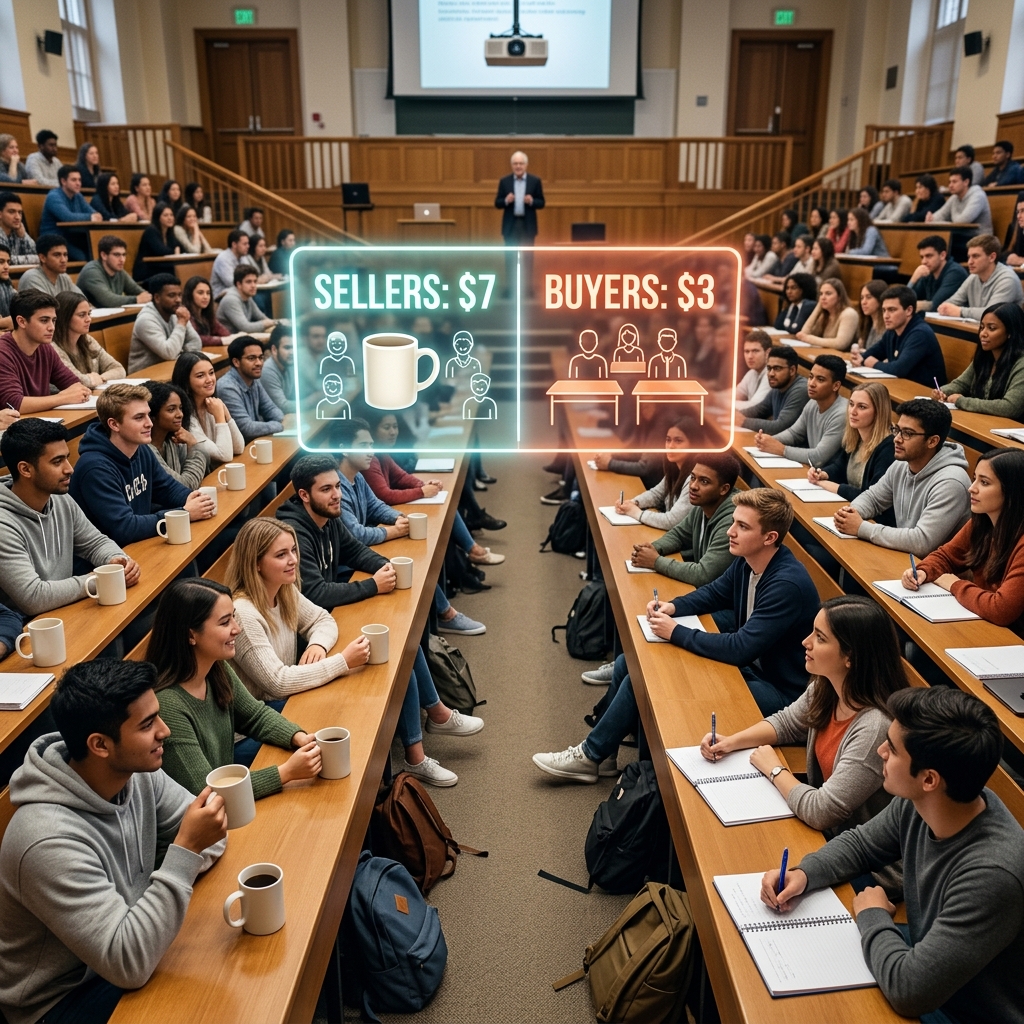
In 1990, Daniel Kahneman, Jack Knetsch and Richard Thaler ran a study that has been repeated in classrooms ever since. They handed out plain coffee mugs to half the participants in a room. The other half got nothing. Then they set up a market: sellers named the lowest price they would accept, buyers named the highest they would pay.
Standard economics predicts something specific here. Who happens to be holding the mug is arbitrary, so roughly half the mugs should change hands as they move toward whoever values them more. Prices should converge.
They did not. Sellers asked for roughly twice what buyers offered. Median asking prices sat around $7 against offers near $3, and far fewer trades happened than theory predicted. Nothing about the mugs had changed in the ten minutes since they were distributed. The only thing that changed was who owned them.
The finding held across variations, objects and countries, and it became one of the foundational results of behavioural economics, cited in the work that eventually took Kahneman to a Nobel Prize in 2002 and Thaler to one in 2017.
🏀 The Duke basketball tickets, and why the numbers get absurd
My favourite illustration is not a laboratory study. It comes from Dan Ariely and Ziv Carmon’s work at Duke University, and it involves something students genuinely care about.
Duke basketball tickets are allocated by lottery after students camp out for days. Everyone in the lottery has demonstrated the same intense desire, and everyone has paid the same cost in time and discomfort. Then chance splits them into winners and losers.
Ariely and Carmon contacted both groups. Students who had not won tickets said they would pay around $170 for one. Students who had won said they would not sell for less than roughly $2,400.
A gap of more than fourteen times, between two groups who were identical a week earlier and were separated by nothing but a random draw. When asked to justify their numbers, the two sides did not just disagree on price, they described different things entirely. Buyers talked about money, other ways to spend the weekend, alternatives. Sellers talked about the game, the memory, the experience they would be giving up. They were not valuing the same item.
🧠 What is actually causing it
This is where the topic gets more interesting than the popular version admits, because researchers have argued about the mechanism for thirty years and have not fully settled it.
1. Loss aversion (the classic explanation)
Kahneman and Tversky’s prospect theory holds that losses feel roughly twice as large as equivalent gains. Once you own the mug, parting with it is coded as a loss, while acquiring it was only ever a gain. Same object, different mental accounting, roughly double the number. For a long time this was treated as the complete answer.
2. Reference point shift
A subtler version of the same idea. Ownership does not just add value, it moves the baseline from which you evaluate everything. Once the phone is yours, “having the phone” becomes normal, and any deal is now measured against that new normal rather than against not having it. This is why the effect appears almost instantly, sometimes within minutes.
3. Mere ownership
James Beggan demonstrated in 1992 that people rate objects more favourably simply because those objects belong to them, even when no trade is involved and nothing can be lost. This suggests something beyond loss aversion: possessions get pulled into the self. Russell Belk’s work on possessions and the extended self argues the same thing more broadly, that what we own becomes part of how we understand who we are.
4. Attention and information asymmetry
A more mundane explanation that I think deserves more credit than it gets. Owners have simply spent more time with the object. You know your car’s good qualities in detail and have stopped noticing its flaws through habituation. The buyer sees only what is visible in twenty minutes, and what is visible in twenty minutes is mostly flaws. Some of the “bias” is just an information gap dressed up as psychology.
The current state of the argument, reflected in Carey Morewedge and Colleen Giblin’s 2015 review, is that ownership itself does more of the work than pure loss aversion does, and that the effect is a family of related mechanisms rather than a single one. That is a less satisfying answer than “loss aversion explains it,” and it is more likely to be true.
🏷️ 12 places the endowment effect runs your life
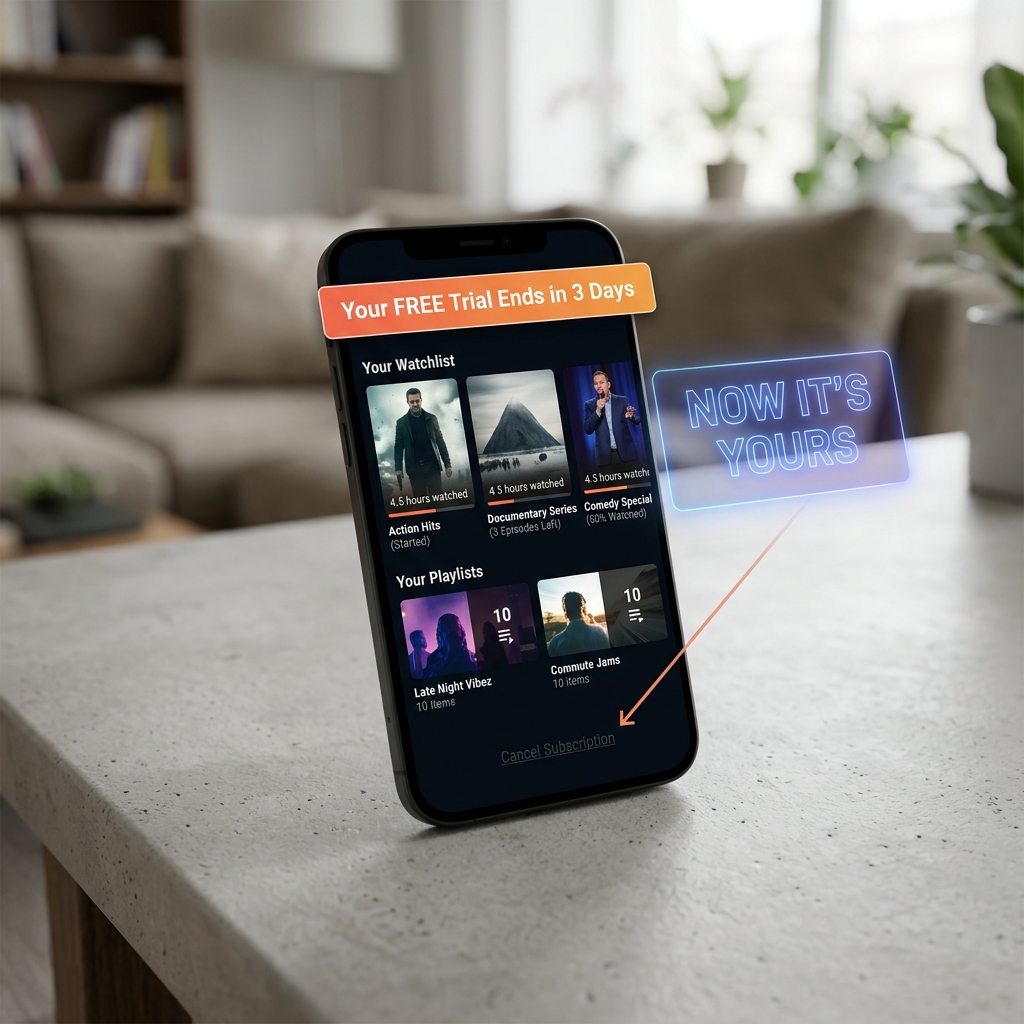
1. Free trials
The whole model. Thirty free days does not exist to prove the product works, it exists to make it yours, so that cancelling registers as a loss rather than a decision not to buy. I broke down how this stacks with cancellation friction in my article on why cancelling a subscription feels impossible.
2. Test drives
You are not evaluating the car. You are being given twenty minutes of ownership so the negotiation afterwards is about keeping it, not acquiring it. The good salesperson knows exactly what those twenty minutes are for.
3. Money-back guarantees
Elegant because they work in both directions. The guarantee reduces the perceived risk of buying, which increases purchases, and then ownership makes returning it feel like a loss. Return rates are consistently far lower than the number of customers who bought because returns were possible.
4. “Your cart is waiting”
The cart is a possession invented by e-commerce. Nothing has been paid for, and yet abandoning it feels like giving something up. That is why the reminder email says “your” items and not “these” items.
5. Selling a used car, phone or laptop
The classic everyday case. Anyone who has listed something on OLX, Facebook Marketplace or eBay has felt personally insulted by an offer that was, objectively, fair. Your valuation includes your history with the object. Nobody is buying your history.

6. Property, and why houses sit unsold
The most expensive version. Sellers routinely overprice their own homes and then hold out for months rather than accept a market price, because a home contains years of life that no valuation captures. In Pakistan and much of South Asia this is amplified further by inherited property, where the asset is also a family relationship, and a fair price can feel like a betrayal.
7. Gold and jewellery
A specifically local case worth naming. Gold jewellery in South Asian households is simultaneously a financial asset and an emotional object with a story attached, usually a wedding. The resale price accounts only for the metal. The owner is pricing the wedding, and no jeweller in the world will pay for that.
8. Auctions and bidding wars
Something odd happens once you are the leading bidder: the item starts to feel like yours before you own it. Losing then feels like a loss rather than a non-purchase, which is why auction prices routinely exceed what anyone would have paid outright.
9. Loyalty points and status tiers
Airline status is the sharpest example. People make genuinely irrational travel decisions to avoid dropping a tier, because losing gold status feels like a demotion rather than the natural end of a promotional benefit. The airline gave you something specifically so that you would fear losing it.
10. Job offers and salary negotiation
Once a candidate mentally accepts a role, small changes to the terms feel like takeaways, and employers who renegotiate late reliably underestimate how badly this lands. On the other side, employees stay in jobs they dislike partly because leaving means giving up known benefits for unknown ones.
11. Ideas and work you produced yourself
The most professionally expensive version. Your own strategy, code, design or plan feels more valuable to you than to anyone else in the room, which makes criticism feel like theft. This is closely related to what I wrote about in the IKEA effect: labour creates ownership, and ownership creates overvaluation.
12. Free samples and giveaways
Ownership starts on contact. Handing someone the product to hold, letting them try the shoe, giving a sample sachet, all convert a stranger into a temporary owner before any money is discussed. Peck and Childers’ work on the need for touch found that simply holding an object increases perceived ownership and willingness to pay.
⚠️ The honest part: the endowment effect is shakier than you have been told
Most articles on this topic stop at the mugs. I think that is a disservice, because the last twenty years have been rough on this finding and the corrections are genuinely interesting.
The procedure critique
In 2005, Charles Plott and Kathryn Zeiler published a paper arguing that much of the observed endowment effect was an artifact of how the experiments were run. Participants often did not fully understand the elicitation procedure, and they may have been reading signals from the experimenter about what the object was worth. When Plott and Zeiler used more careful procedures, with practice rounds, anonymity and better explanation, the gap between buying and selling prices largely disappeared.
This does not prove the effect is fake, and the debate continued vigorously afterwards. But it does establish something important: the size of the effect depends heavily on the conditions, and the dramatic laboratory numbers were probably inflated by the design of the studies that produced them.
The exchange asymmetry critique
A related finding: much of what looks like overvaluation may be a general reluctance to trade rather than a specific belief that your item is worth more. People resist swapping things they own for equivalent things they do not own, which produces the same observed pattern without requiring any inflated valuation at all.
It varies enormously by person and culture
The effect is weaker in people with trading experience, and market professionals show it far less. There is also evidence of cultural variation, with some cross-cultural work finding weaker effects in more collectivist settings, where the self may be construed less around individual possession. I would treat this literature as suggestive rather than settled, because cross-cultural replication in this area is thinner than anyone would like.
It barely applies to money and goods held for trade
You do not become attached to a banknote, and a shopkeeper does not develop feelings about stock. Items acquired specifically to be exchanged appear largely exempt, which is a useful boundary condition and is also the practical reason experienced traders do not fall for it.
What I think the evidence actually supports
The endowment effect is real, robust in ordinary life, and probably smaller and more conditional than the famous two-times figure implies. It is strongest for objects with personal history, weakest for commodities and money, and it can be substantially reduced by experience, clear information and market familiarity. Anyone quoting “people value what they own twice as much” as a universal law is quoting a laboratory number that has not held up cleanly since 2005.
🛡️ How to counter it, on both sides
If you are selling something
- Price against listings, not feelings. Find three comparable items that actually sold, not three that are merely listed. Asking prices are other people’s endowment effects.
- Ask the reversal question. “If I did not own this today, what would I pay for it?” This single question is the most reliable debiasing tool available, because it moves you to the buyer’s reference point.
- Separate the object from the memory. The memory is not being sold and does not leave with the item. Naming that explicitly makes the price easier to accept.
- Set your floor before the first offer. Once negotiation starts, every offer is evaluated against your inflated baseline instead of the market.
If you are buying
- Expect the seller to be wrong, and expect them to be sincere about it. They are not trying to cheat you. They are seeing a different object.
- Be careful with free trials and test drives. They are not evaluation periods, they are ownership periods. Decide your criteria before it becomes yours.
- Watch for “your” language. Your cart, your plan, your points, your seat. Every “your” is doing work.
If you are a business using it
The ethical line here is reasonably clear, and I would draw it in one sentence. Letting people experience a product genuinely before deciding is legitimate. Making the exit harder than the entrance is not. A free trial that ends with an obvious, one-click cancellation is good marketing. A free trial that ends with a phone call, a retention script and a cancellation page buried three levels deep is sludge, and regulators in the US, UK and EU have started treating it as such.
🔗 How it relates to other biases
| Bias | How it differs |
| Loss aversion | The broader mechanism. Endowment is loss aversion applied specifically to things you own. |
| IKEA effect | A stronger version driven by labour. You built it, so you value it beyond mere ownership. |
| Sunk cost fallacy | About past investment justifying future spending. Endowment is about present possession inflating value. |
| Status quo bias | Preferring things to stay as they are. Endowment explains part of why the status quo feels valuable. |
| Mere exposure | Liking things because they are familiar. Ownership creates familiarity, so the two compound. |
📝 The takeaway
The endowment effect is one of the few findings in behavioural economics that you can verify on yourself within a week. Try to sell something you have owned for two years and watch how personally you take the first offer. That reaction is the whole phenomenon, running in real time.
What I would hold onto is the underlying insight rather than the headline number. Ownership is not a neutral state. It rewrites the reference point from which you evaluate everything about an object, and it does so quickly, invisibly and without asking. That is why so much of modern marketing is designed to give you something before it asks you for anything.
And the correction matters as much as the finding. The effect is real and it is smaller than the famous studies implied, it depends on the object, the person and the situation, and it can be reduced by the simple act of asking what you would pay if it were not already yours. A bias you can name is a bias you can partly disarm, which is more than can be said for most of them.
❓ Frequently asked questions
What is the endowment effect in simple terms?
People value something more once they own it. Ask a seller and a buyer to price the identical object and the seller consistently names a higher number, purely because it currently belongs to them.
Who discovered the endowment effect?
Richard Thaler named it in 1980. The best-known demonstration is the 1990 coffee mug experiment by Daniel Kahneman, Jack Knetsch and Richard Thaler, in which sellers asked for roughly twice what buyers offered.
What causes the endowment effect?
The traditional explanation is loss aversion, since losses feel about twice as large as equivalent gains. Later research suggests ownership itself does much of the work, with possessions becoming psychologically attached to the self, alongside reference point shifts and simple information asymmetry between owners and buyers.
Is the endowment effect real, or has it been debunked?
It is real but weaker and more conditional than the popular version suggests. A 2005 study by Plott and Zeiler showed much of the laboratory gap disappeared under more careful procedures, and the effect is far weaker for commodities, money and experienced traders.
What is an example of the endowment effect in marketing?
Free trials, test drives, money-back guarantees, free samples and loyalty status tiers all work by transferring ownership before asking for a decision, so that declining feels like giving something up rather than not buying.
How do I avoid the endowment effect when selling something?
Ask yourself what you would pay for the item today if you did not already own it, price against items that actually sold rather than items merely listed, and set your minimum before the first offer arrives.
🧠 Want your pricing and trial flow reviewed by a psychologist?
I’m Muhammad Shahzeb, an MSc Industrial and Organizational Psychologist and Full-Stack Developer. I audit trials, pricing pages, onboarding and checkout flows using behavioral science, and I will tell you honestly where your funnel crosses from persuasion into sludge.
📚 References and further reading
- Thaler, R. H. (1980). “Toward a positive theory of consumer choice.” Journal of Economic Behavior & Organization, 1(1), 39-60. (Coins the term.)
- Kahneman, D., Knetsch, J. L., & Thaler, R. H. (1990). “Experimental tests of the endowment effect and the Coase theorem.” Journal of Political Economy, 98(6), 1325-1348. (The mug experiment.)
- Kahneman, D., Knetsch, J. L., & Thaler, R. H. (1991). “Anomalies: The endowment effect, loss aversion, and status quo bias.” Journal of Economic Perspectives, 5(1), 193-206.
- Kahneman, D., & Tversky, A. (1979). “Prospect theory: An analysis of decision under risk.” Econometrica, 47(2), 263-291.
- Carmon, Z., & Ariely, D. (2000). “Focusing on the forgone: How value can appear so different to buyers and sellers.” Journal of Consumer Research, 27(3), 360-370. (Duke basketball tickets.)
- Beggan, J. K. (1992). “On the social nature of nonsocial perception: The mere ownership effect.” Journal of Personality and Social Psychology, 62(2), 229-237.
- Plott, C. R., & Zeiler, K. (2005). “The willingness to pay / willingness to accept gap, the ‘endowment effect,’ subject misconceptions, and experimental procedures for eliciting valuations.” American Economic Review, 95(3), 530-545.
- Morewedge, C. K., & Giblin, C. E. (2015). “Explanations of the endowment effect: An integrative review.” Trends in Cognitive Sciences, 19(6), 339-348.
- Belk, R. W. (1988). “Possessions and the extended self.” Journal of Consumer Research, 15(2), 139-168.
- Peck, J., & Childers, T. L. (2003). “Individual differences in haptic information processing: The ‘need for touch’ scale.” Journal of Consumer Research, 30(3), 430-442.
- Samuelson, W., & Zeckhauser, R. (1988). “Status quo bias in decision making.” Journal of Risk and Uncertainty, 1(1), 7-59.
- Norton, M. I., Mochon, D., & Ariely, D. (2012). “The IKEA effect: When labor leads to love.” Journal of Consumer Psychology, 22(3), 453-460.
Written by Muhammad Shahzeb, MSc Industrial & Organizational Psychology | Consumer Psychology Specialist | Full-Stack Web Developer
Learn more about my approach →