
You applied for the job. You wrote a good CV, a tailored cover letter, and then a link arrived asking you to complete a 40-minute online assessment before anyone would speak to you. You did it, half-distracted, on your phone, on a slow connection. A week later came the automated rejection. Here is the part nobody tells you: for many competitive roles, a human being never read your application at all. A test rejected you first, and a recruiter only ever saw the survivors.
Psychometric assessments now sit at the front gate of a huge share of professional hiring, and they filter out the majority of applicants before the human stage begins. As an Industrial and Organizational Psychologist, I have worked on both sides of this: the science that builds these tests and the anxiety of the people sitting them. So this article does two things honestly. It explains what these tests actually measure and why they reject people, and then it gives you the specific, legitimate strategies to pass each type, because the tests are far more beatable than the panic around them suggests.
“A psychometric test is not measuring who you are. It is measuring how you perform on a psychometric test, and those are different skills. The good news is that the second one can be practised.”
— Career Psychology Analysis, ShahzebSpeaks

🎯 Why companies use them at all
Before you can beat the test, you need to understand why it exists, because that tells you what it is looking for. Companies do not use psychometrics to be cruel or lazy. They use them because of a genuinely uncomfortable truth: traditional hiring methods are bad at predicting job performance.
Decades of research in personnel selection, most famously summarised by Schmidt and Hunter, found that the unstructured interview, the thing everyone trusts most, is one of the weakest predictors of who will actually do the job well. Gut feeling, rapport and “culture fit” mostly measure how much the interviewer likes you, which is contaminated by bias. Cognitive ability tests, by contrast, are among the strongest single predictors of performance across almost every role. So a company facing 2,000 applicants for 20 positions has a real problem, and psychometrics are their answer: a cheap, fast, standardised filter that predicts performance better than a human skim of CVs and treats every candidate by the same yardstick.
That last point matters and is worth being fair about. A well-built test is arguably fairer than a human recruiter, because it does not care about your name, your accent, which university’s blazer you wore, or whether you reminded the manager of himself. For candidates from backgrounds that human gatekeepers quietly discount, a test can be the most level part of the whole process. The problem is not usually the existence of the test. It is that most candidates walk into it blind.
🧩 The three families of test (and what each really measures)
Almost everything you will face falls into three families. Knowing which one you are sitting changes how you should approach it completely, and confusing them is the first way people fail.
1. Aptitude and cognitive ability tests
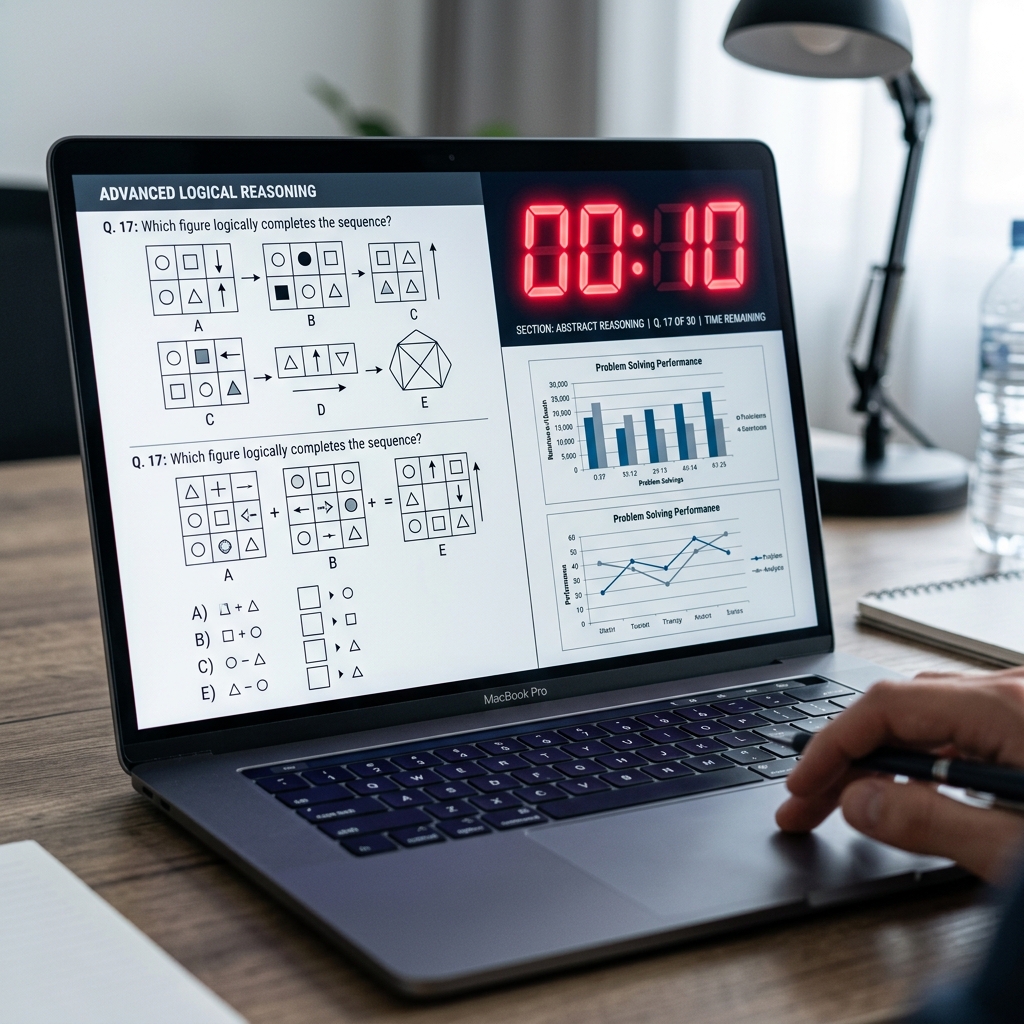
These are the numerical, verbal, logical and abstract-reasoning tests, usually timed and often deliberately impossible to fully complete. Numerical reasoning gives you tables and graphs and asks you to compute under pressure. Verbal reasoning gives you a passage and “true / false / cannot say” statements. Abstract or inductive reasoning shows you shape sequences and asks what comes next. Providers you will meet include SHL, Kenexa, Talent Q and Cut-e among others.
What they actually measure is not knowledge but processing speed and accuracy under time pressure. This is the family that rejects the most people, and, crucially, it is the family most improvable with practice, because the question formats are finite and repetitive.
2. Personality questionnaires
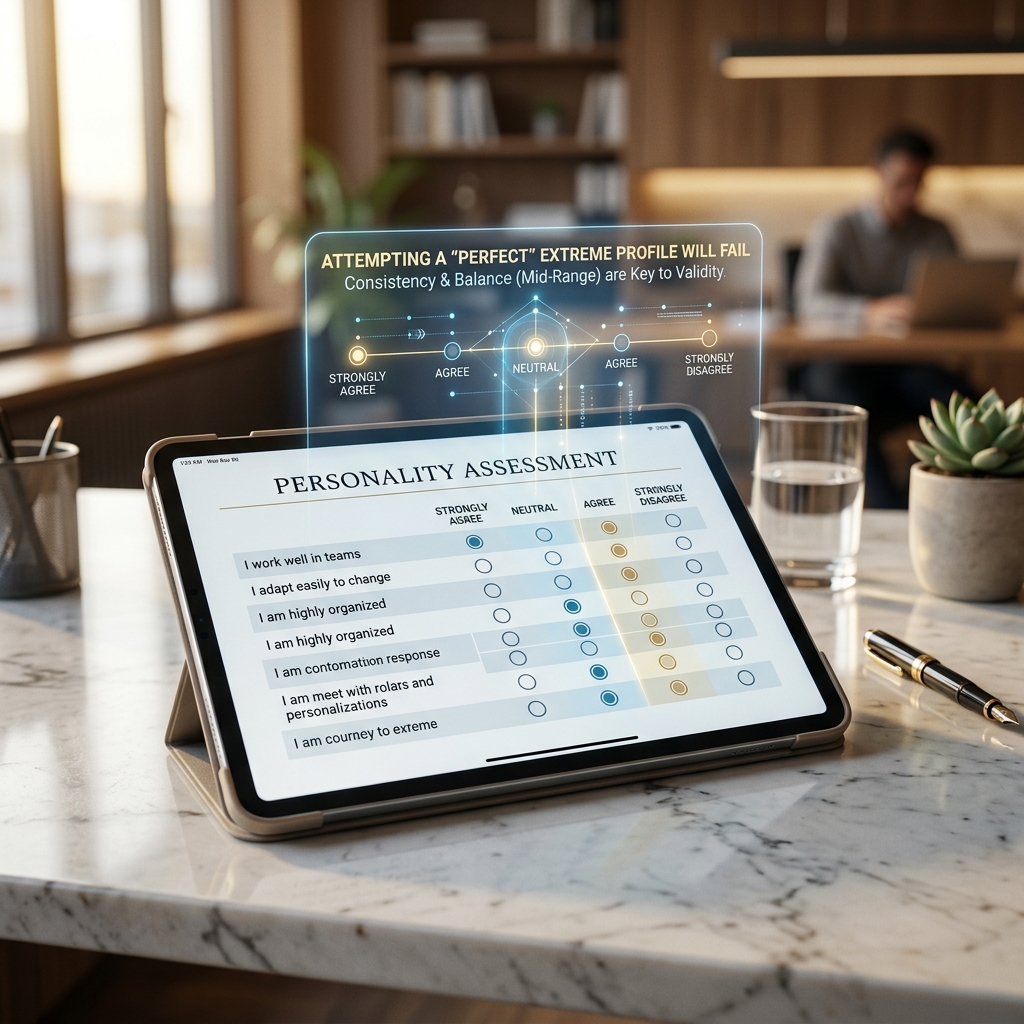
These ask you to rate statements (“I enjoy being the centre of attention,” “I plan tasks carefully”) on agreement scales, or force you to choose which of several statements is “most like me.” They are usually untimed and there are, officially, no right answers. Most are built on the Big Five model (openness, conscientiousness, extraversion, agreeableness, emotional stability), sometimes dressed in a proprietary brand like Hogan or OPQ.
What they really measure is your fit to a profile the employer has decided the role needs, plus, quietly, your consistency and honesty. They are a different beast from aptitude tests and require the opposite strategy, as I will explain.
3. Situational judgement tests (SJTs)
These describe a realistic workplace scenario (“A colleague takes credit for your work in a meeting…”) and ask you to rank or choose responses. They are increasingly common and quietly the most learnable, because they are really testing whether you have absorbed the behavioral values the organisation rewards. There is a correct answer, and it is usually the one that reflects the company’s stated competencies, not the one that feels most natural to a stressed human.

❌ Why the test actually rejects you (the real reasons)
People assume they fail because they are not smart enough. Occasionally true, usually not. Here are the real reasons candidates get rejected, in roughly the order I see them.
You ran out of time and panicked. Aptitude tests are frequently designed so that almost nobody finishes. Candidates who do not know this waste the first ten minutes in shock, rush, make errors, and score below their real ability. The test did not reject your intelligence. It rejected your unfamiliarity with the format.
You had never seen the question type before. A numerical reasoning question is a specific genre with recurring tricks (percentage change, ratios, reading the right cell in a busy table). A first-timer solves each from scratch; a practised candidate recognises the pattern and answers in a third of the time. The gap between them is not IQ. It is reps.
You tried to “look perfect” on the personality test. This is the most common self-inflicted failure. Candidates guess what the employer wants and answer as an impossibly flawless superhuman. Modern questionnaires have built-in consistency and social-desirability checks that flag exactly this, and an inconsistent, too-good-to-be-true profile gets binned faster than an honest imperfect one.
You answered the SJT as yourself instead of as the ideal employee. Your honest reaction to a colleague stealing credit might be confrontation. The “correct” answer is usually the calm, procedure-following, collaborative one, because that reflects the competency framework. Answering authentically instead of strategically is a frequent, avoidable miss.
You sat it in bad conditions. Phone, noisy room, weak connection, no paper, no calculator ready, tired at midnight. These tests reward preparation of the environment as much as the mind, and a shocking number of capable people reject themselves through logistics.
✅ How to pass: aptitude and cognitive tests
This is the most beatable family, and improvement is dramatic with the right approach.
Practise the exact format until it is boring. This is the single highest-return action, and the research on test-retest practice effects backs it: scores rise meaningfully across the first several attempts as the format stops being novel. Find free and paid practice tests for the specific type (numerical, verbal, logical) and ideally the specific provider named in your invitation. Do dozens. You are not cheating; you are removing the unfamiliarity penalty that was silently costing you points.
Learn the recurring maths, cold. Numerical tests recycle a small toolkit: percentage change, ratios, currency conversion, reading tables and charts, simple averages. Drill these until they are automatic so your limited time goes to the question, not to remembering how percentages work.
Master the clock, not just the questions. Know in advance roughly how many seconds you have per question. If one is fighting you, guess and move on, because leaving three easy questions unanswered to perfect one hard one is how good candidates score badly. Most of these tests do not penalise wrong guesses, so never leave a blank when time is ending.
For verbal “true / false / cannot say”, answer only from the passage. The single biggest verbal-reasoning error is using your own outside knowledge. If the passage does not state or directly imply it, the answer is “cannot say,” even when you personally know it is true. The test measures reading discipline, not general knowledge.
Set up the room like an exam. Quiet space, stable internet, calculator, pen, rough paper, water, do-not-disturb on, and your best time of day. Treat the logistics as part of the test, because they are.
✅ How to pass: personality questionnaires
Here the strategy inverts, and most advice online gets it dangerously wrong by telling people to “fake” a perfect profile. Do not. Here is what actually works.
Be honest, but be your professional self. Answer as you are at work on a good day, not as a saint and not as your most private self. The test is looking for a genuine, consistent pattern, and consistency is scored. Wild attempts to game it produce the erratic profiles that consistency checks flag, and flagged profiles are treated as dishonest, which is worse than being imperfect.
Research the role’s real competencies first. Read the job description and the company’s values, and understand which traits genuinely matter for this role. A sales role rewards higher extraversion and resilience; an audit role rewards conscientiousness and detail. You are not faking; you are choosing, within your honest range, to emphasise the true parts of yourself that fit. Everyone has a range, and presenting the work-relevant end of yours is legitimate.
Avoid the extremes and the fence. Answering “strongly agree” or “strongly disagree” to everything reads as inflexible; sitting on “neutral” for everything reads as evasive or disengaged. Genuine people show a spread with occasional strong positions on things they actually feel strongly about. Let your answers have shape.
Do not contradict yourself. These questionnaires ask the same underlying trait in several disguised ways specifically to catch inconsistency. If you claimed to love teamwork on question 8, do not claim to prefer working entirely alone on question 40. Answer from your real, stable self and consistency takes care of itself.
✅ How to pass: situational judgement tests
The most learnable family once you understand the trick: answer as the ideal employee of that specific company, not as yourself.
Read the competency framework and answer to it. Almost every organisation publishes its values or competencies (integrity, collaboration, customer focus, and so on). The “correct” SJT response is nearly always the one that best demonstrates those stated values, even if a real person under stress would react differently. You are being tested on whether you know the professional playbook, so play it.
Follow the calm, escalate-properly, protect-the-team pattern. Across most SJTs, the higher-scoring answers share a shape: stay composed, gather information before acting, follow correct procedure, involve the right people rather than going rogue, and prioritise the customer and the team over your ego. When two answers seem reasonable, pick the more collaborative and less confrontational one.
Beware the two traps. The aggressive option (“confront them immediately in front of everyone”) and the passive option (“do nothing and hope it resolves”) are usually both wrong. The right answer typically lives in the measured middle: address it directly but professionally, through the proper channel.
⚠️ An honest caveat: the ethics and the limits
Two honest points, because I would rather you trust the rest of the advice.
First, on personality tests specifically, do not confuse strategy with lying. Emphasising the true work-relevant side of yourself is fair and expected. Constructing a fictional person is not only detectable through consistency checks, it is self-defeating: if you fake your way into a role that fundamentally does not fit you, you have won a job that will make you miserable and at which you will likely underperform. The tests are imperfect, but on fit they are sometimes protecting you from a bad match as much as protecting the employer.
Second, these tests are not flawless or above criticism. Poorly chosen or badly validated assessments can carry cultural and linguistic bias, and a numerical test sat in your second language measures something other than pure ability. Good employers validate their tests and offer adjustments; if you have a disability or a genuine access issue, you are usually entitled to request accommodations, and asking is a sign of professionalism, not weakness. The system is more beatable and more negotiable than the intimidating interface suggests.
🇵🇰 A note for candidates in Pakistan and South Asia
Psychometric testing is expanding fast in the region’s multinationals, banks, telecoms and larger corporates, and many local candidates meet these tests for the first time with no preparation because the format was never part of their education. That is a disadvantage made entirely of unfamiliarity, which means it is the easiest disadvantage in the world to erase. A candidate here who spends a week on practice tests before applying often leaps past equally capable peers who walked in cold. If the graduate programmes and management-trainee schemes you want use these assessments, and most of the big ones now do, treat practice as part of your job search, not an afterthought once the invitation arrives.
❓ Frequently asked questions
Can you fail a psychometric test?
You cannot fail a personality test in a true/false sense, but you can be screened out for poor role fit or an inconsistent profile. You can absolutely “fail” aptitude and situational judgement tests by scoring below the cut-off the employer sets, which is how most candidates get rejected before the interview.
Can you practise psychometric tests?
Yes, and you should. Aptitude tests improve significantly with practice because the question formats repeat. This is legitimate preparation, not cheating, and it removes the unfamiliarity penalty that costs first-timers points.
Should you be honest on personality tests?
Yes, but strategically honest. Answer as your genuine professional self and emphasise the true, work-relevant traits the role needs. Do not fabricate a perfect profile, because built-in consistency and social-desirability checks flag it, and a flagged profile is rejected faster than an honest imperfect one.
How do I pass a situational judgement test?
Answer as the ideal employee of that specific company, not as yourself. Read the organisation’s values, and choose responses that stay calm, gather information, follow proper procedure, involve the right people, and prioritise the team and customer. Avoid both the aggressive and the do-nothing options.
Are psychometric tests accurate?
Cognitive ability tests are among the strongest available predictors of job performance, more so than unstructured interviews. Personality and situational tests are weaker and more gameable, and all tests can carry bias if poorly validated. They are useful filters, not perfect ones.
🧠 Preparing for assessments or hiring for a role?
I’m Muhammad Shahzeb, an MSc Industrial and Organizational Psychologist. I coach candidates through psychometric and assessment-centre preparation, and I help employers design selection processes that actually predict performance instead of just filtering people out. Whichever side of the test you’re on, I can help.
📚 References and further reading
- Schmidt, F. L., & Hunter, J. E. (1998). “The validity and utility of selection methods in personnel psychology.” Psychological Bulletin, 124(2), 262-274.
- Sackett, P. R., Zhang, C., Berry, C. M., & Lievens, F. (2022). “Revisiting meta-analytic estimates of validity in personnel selection.” Journal of Applied Psychology, 107(11), 2040-2068.
- Costa, P. T., & McCrae, R. R. (1992). NEO PI-R Professional Manual. (The Big Five model.)
- Hogan, R., & Hogan, J. (2007). Hogan Personality Inventory Manual (3rd ed.). Hogan Assessment Systems.
- Lievens, F., & Motowidlo, S. J. (2016). “Situational judgment tests: From measures of situational judgment to measures of general domain knowledge.” Industrial and Organizational Psychology, 9(1), 3-22.
- Hausknecht, J. P., Halpert, J. A., Di Paolo, N. T., & Moriarty Gerrard, M. O. (2007). “Retesting in selection: A meta-analysis of coaching and practice effects.” Journal of Applied Psychology, 92(2), 373-385.
- Ones, D. S., Viswesvaran, C., & Reiss, A. D. (1996). “Role of social desirability in personality testing for personnel selection.” Journal of Applied Psychology, 81(6), 660-679.
- SHL, Talent Q, and Cut-e (Aon) public candidate preparation resources.
Written by Muhammad Shahzeb, MSc Industrial & Organizational Psychology | Selection & Assessment Specialist | Full-Stack Web Developer
Learn more about my approach →