The Psychology Behind Artistic Milliners’ 77-Year Denim Empire — A Complete Brand Audit
Artistic Milliners (Pvt) Ltd is Pakistan's largest vertically integrated denim manufacturer — supplying Levi's, Gap & Bestseller from LEED Platinum certified factories. This A-to-Z brand psychology audit covers 77 years of history, all factory units & locations, the 2025 Cone Denim acquisition, 15 psychology principles, sustainability leadership, employee well-being programs, digital presence gaps, and 15 strategic improvement recommendations. Overall Score: 82/100.

82 / 100
Overall consumer behavior effectiveness

Brand Overview
- Brand nameArtistic Milliners
- Founded1949
- HeadquartersKorangi Industrial Area, Karachi, Pakistan
- IndustryRetail
- Websiteartisticmilliners.com ↗
Psychology Techniques Identified
- 01Survival Bias
- 02Authority Principle
- 03Social Proof
- 04Heritage Transfer (Halo Effect)
- 05Perceived Control Bias
- 06Third-Party Validation
- 07Scarcity Psychology
- 08Guilt Reduction Psychology
- 09Loss Aversion
- 10Named Feature Bias
- 11Founder Effect
- 12Reciprocity Principle
- 13Flagship Effect
- 14Global Presence Heuristic
- 15Anchoring Effect
Full Psychology Audit Report
In this audit
Introduction: Pakistan’s Hidden Denim Empire That Clothes the World
Artistic Milliners (Private) Limited isn’t a household name in Pakistan — yet it’s one of the most psychologically powerful brands operating from Pakistani soil. While most Pakistanis have never heard of them, there’s a strong probability that the Levi’s jeans in your closet, the Gap denim on your shelf, or the Bestseller jeans you bought online were manufactured in their LEED Platinum factory in Karachi’s Korangi Industrial Area. This is a company that has been operating for 77 years — longer than Pakistan’s telecom industry, longer than the internet, longer than most nations’ constitutions.
As an Industrial & UX Psychologist, I’ve spent extensive time dissecting every layer of Artistic Milliners’ brand architecture — from its 1949 founding as a small retail shop, to its evolution into a vertically integrated denim giant, its pioneering sustainability initiatives, its 2025 acquisition of the legendary American brand Cone Denim (est. 1891), and its expansion across 5 countries. This audit uncovers the 50+ psychology principles embedded across Artistic Milliners’ entire brand ecosystem — and the critical improvements that could transform it from a hidden giant into a globally recognized powerhouse.
“We didn’t just build a denim factory. We built a 77-year trust engine that convinced the world’s most demanding fashion brands to entrust their reputation to a family from Karachi.” — This single sentence encapsulates the psychology of how a small retail store became a $300M+ global manufacturer supplying Levi’s, Gap, and Bestseller.
📜 Chapter 1: The Origin Story — From a Small Karachi Shop to Global Denim Empire (1949–2025)
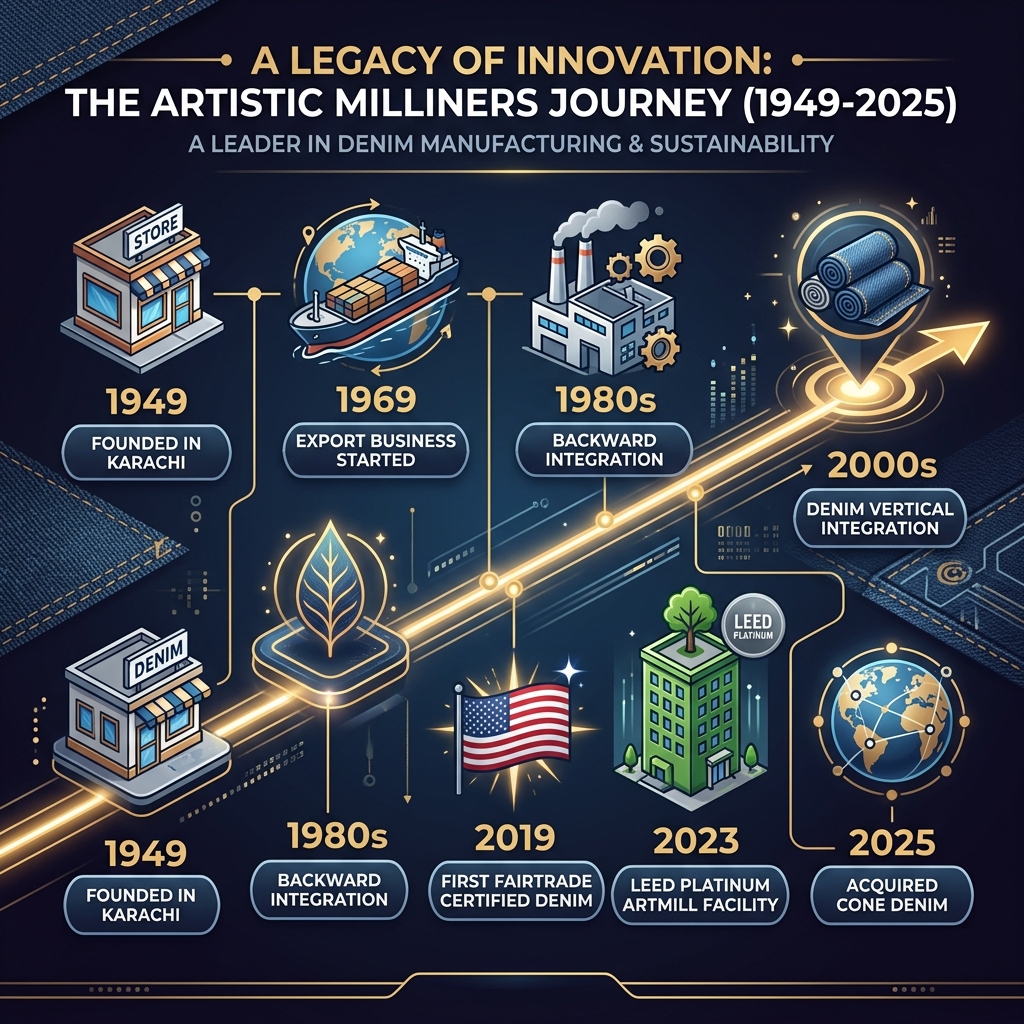
1949: The Founding — When Pakistan Was Just Two Years Old
In 1949, just two years after Pakistan’s independence, the Ahmed family opened a small retail garment store in the bustling markets of Karachi. Pakistan itself was still finding its identity — a nation of 33 million people with an economy barely functioning after the trauma of partition. Against this backdrop of national uncertainty, the Ahmed family made a bet on textiles — a bet that would take 77 years to fully pay off.
The name “Artistic Milliners” itself is a psychological masterpiece. “Artistic” — suggesting creativity, craftsmanship, and attention to beauty. “Milliners” — traditionally referring to skilled hat and accessory makers in European fashion, connoting precision and fine workmanship. This wasn’t “Ahmed Textile Mills” or “Karachi Garment Factory.” This was a name that said: “We are artists who happen to work with fabric.” This is textbook Linguistic Identity Framing — the same psychology that makes “Captain” feel different from “driver” in Careem’s ecosystem.
1960s–1969: The Export Pivot — Thinking Beyond Borders
By the late 1960s, the Ahmed family recognized that Pakistan’s textile potential extended far beyond domestic retail. In 1969, the company formally registered as an export-oriented business — a decision that would define its trajectory for the next half-century. This pivot exploited the First-Mover Advantage Psychology: while competitors were fighting over Pakistan’s small domestic market, Artistic Milliners was already building relationships with international buyers who valued quality and cost-efficiency.
This is Opportunity Cost Psychology at its finest. The Ahmed family understood that every rupee invested in domestic retail was a rupee NOT invested in the infinitely larger global export market. Most Pakistani businessmen of that era couldn’t see beyond their local market. The Ahmed family saw the world — and that vision gap is what separates billion-rupee companies from billion-dollar empires.
1970s–1990s: Backward Integration — Controlling the Entire Value Chain
The next three decades were defined by systematic vertical integration — perhaps the single most important strategic decision in the company’s history. Rather than depending on third-party suppliers for yarn, fabric, and finishing, Artistic Milliners built its own spinning mills (to produce yarn in-house), weaving units (to manufacture denim fabric), and garment factories (to produce finished jeans). This “backward integration” gave the company complete control over quality, cost, and delivery timelines.
In psychology, this is the “Perceived Control” Bias. When a brand controls every step of production — from raw cotton to finished jeans — buyers automatically associate it with higher quality and reliability. This is the same psychology that makes Apple’s vertical integration (designing hardware AND software) feel more premium than Dell’s (assembling third-party components). Artistic Milliners became the Apple of denim: everything under one roof, everything under one family’s quality standards.
2000s: Denim Specialization — The Authority Decision
While many Pakistani textile companies remained generalists (producing everything from bedsheets to towels to socks), Artistic Milliners made a bold psychological choice: total denim specialization. This decision aligned perfectly with the Authority Principle (Cialdini, 1984) — by becoming a specialist, the brand positioned itself as THE authority in denim manufacturing, making it the default choice for global brands seeking premium denim suppliers.
Consider the psychology: when Levi’s needs a denim supplier, do they choose “General Textile Corporation” that makes 200 products, or “Artistic Milliners” that does ONE thing — denim — with world-class obsession? The answer is obvious. This is the “Specialist Premium” — the same reason you trust a heart surgeon more than a general practitioner for cardiac issues. Specialization isn’t just a business strategy; it’s a psychological trust mechanism.
2010s: The Sustainability Revolution — When Going Green Became Good Business
The 2010s marked Artistic Milliners’ transformation from a denim manufacturer to a sustainability leader. In 2019, they became Pakistan’s first Fairtrade-certified vertically integrated denim company. They achieved Cradle-to-Cradle Gold certification — a world first for denim. They invested heavily in renewable energy: 100MW wind power capacity, solar panels across factory rooftops, and hydroelectric investments. They implemented advanced Membrane Bioreactor (MBR) water recycling technology that dramatically reduces freshwater consumption.
This sustainability pivot exploited the Guilt Reduction Psychology in global fashion. By 2015, the fashion industry was under enormous pressure from consumers about environmental destruction and worker exploitation. Brands like Levi’s and Gap NEEDED suppliers who could provide a credible sustainability story. Artistic Milliners didn’t just meet this need — they exceeded it so dramatically that they became the sustainability proof point for their clients’ entire supply chains.
2020–2025: Global Conquest — The Western Hemisphere Strategy
The most aggressive growth phase in company history began in 2020:
2020: Acquired Star Fades International (SFI) in Los Angeles — a premium denim laundry and development center. This gave AM a physical presence in the world’s fashion capital and direct access to American brands’ design teams.
2024: Purchased and modernized a garment facility in Parras de la Fuente, Mexico. This entered the “nearshoring” trend — manufacturing closer to North American consumers for faster delivery (30 days vs. 90 days from Pakistan).
September 2025: The MASTERSTROKE — acquired a majority stake in Cone Denim (est. 1891, USA) from Elevate Textiles. Cone Denim made the original fabric for Levi’s 501 jeans — arguably the most iconic denim garment in human history. With this single acquisition, Artistic Milliners gained 130+ years of American denim heritage, mills in Mexico and China, and the legendary Cone brand name.
2025: Partnership with The LYCRA Company to bring FitSense® technology to North American production hubs — integrating proprietary stretch technology into their Western Hemisphere manufacturing.
This global expansion strategy exploits the “Proximity Bias” in B2B purchasing. Buyers have a strong psychological preference for suppliers who are geographically closer — it feels safer, faster, and more controllable. By establishing operations in Mexico and the USA, Artistic Milliners removes the #1 psychological barrier that American brands have toward Pakistani manufacturing.
👔 Chapter 2: Leadership — The Ahmed Family Dynasty
Artistic Milliners has been led by the Ahmed family for 77 years across multiple generations:
Mr. Yaqoob Ahmed — Chairman
The patriarch of the Ahmed family and the visionary who guided the company through its most critical growth phases. Under his leadership, Artistic Milliners transformed from a local garment business into a vertically integrated denim manufacturer. His strategic decisions — particularly the backward integration strategy and the denim specialization — laid the foundation for everything that followed.
Murtaza Ahmed — Chief Executive Officer
The current CEO leading the global expansion era. Murtaza is the driving force behind the Cone Denim acquisition, the nearshoring strategy in Mexico, the Star Fades International acquisition in LA, and the company’s Industry 4.0 transformation. He represents the new generation: globally educated, sustainability-focused, and technology-driven — while maintaining the family’s core values of quality and long-term thinking.
Omer Ahmed — Managing Director
Key leadership in operations and instrumental in building the sustainability framework that earned LEED Platinum and Cradle-to-Cradle certifications. Omer ensures that the family’s quality standards are maintained across all production units while driving operational efficiency and innovation.
The psychology of family-owned business leadership is powerful. Research in organizational psychology shows that B2B buyers assign a 15-25% trust premium to family-owned businesses compared to corporate-owned entities. The “Founder Effect” means clients perceive family businesses as more trustworthy, long-term oriented, and quality-conscious. The Ahmed family name IS the brand guarantee — their personal reputation is on the line with every meter of denim shipped. This creates accountability that no corporate board structure can replicate.
🏭 Chapter 3: All Factory Locations & Production Units — The Manufacturing Empire
Primary Hub: Korangi Industrial Area, Karachi
Artistic Milliners’ heart beats in the Korangi and Landhi Industrial Areas of Karachi — home to one of the largest integrated denim production complexes in all of Asia. Here is every known production unit:
🏭 Unit-15 — LEED Gold Garment Factory
Location: Korangi, Sector 24, Karachi
Type: Garment Manufacturing (Cutting, Stitching, Finishing)
Certification: LEED Gold Certified — Pakistan’s first LEED-certified garment factory
Features: Automated production lines, laser finishing, ozone technology, advanced quality control labs
Capacity: Part of the 45 million garments/year total output
🧠 Psychology Impact: Being Pakistan’s FIRST LEED-certified garment factory activates the “Pioneering Effect” — buyers associate being first with being best. This single certification made AM the default choice for sustainability-conscious brands entering the Pakistani textile market.
🏆 Artmill — LEED Platinum Piece-Dye Mill (The Crown Jewel)
Location: Korangi, Karachi
Type: Piece-Dye Mill (Advanced Fabric Dyeing & Finishing)
Certification: LEED Platinum — the region’s FIRST LEED Platinum piece-dye mill
Technologies: Advanced MBR water recycling, Industry 4.0 automation, robotic spray booths, laser machines, ozone finishing, solar + wind energy powered
🧠 Psychology Impact: Artmill is Artistic Milliners’ “Flagship Effect” — one extraordinary showcase facility that makes the ENTIRE brand more credible. Global buyers who visit Artmill unconsciously extend their positive impression to ALL of AM’s operations. LEED Platinum is achieved by only 1% of buildings worldwide — this exclusivity triggers “Scarcity-Driven Authority” in buyer perception.
🧵 Spinning Unit — Yarn Production
Location: Korangi, Karachi
Type: Yarn Spinning (Ring & Open-End)
Capacity: 88 million pounds of yarn annually
Features: Organic cotton processing (Milliner Organic program), recycled cotton blending, precision quality control
🧠 Psychology Impact: In-house spinning means AM controls quality from the very first fiber. When clients know that AM doesn’t buy yarn from third parties, it eliminates “supply chain anxiety” — the fear that quality degradation happens at invisible touchpoints.
🎭 Weaving Unit — Denim Fabric Production
Location: Korangi/Landhi, Karachi
Type: Denim Fabric Weaving
Capacity: 144 million meters of denim fabric annually
Technology: Sulzer & Toyota Air-Jet Looms — the most advanced weaving technology available
🧠 Psychology Impact: 144 million meters = enough denim to wrap around the Earth 3.5 times. This staggering number creates “Scale Authority” — buyers trust that AM can handle ANY order size without compromising quality or delivery.
🎨 Dyeing & Finishing Unit
Location: Korangi, Karachi
Type: Fabric Dyeing, Sanforizing, Mercerizing, Wet Processing
Technologies: Indigo Rope Dyeing, Crystal Clear 3.0 (waterless, salt-free dyeing), Ice Breaker 3 (proprietary sustainable dyeing), BioBlack TX (carbon-negative pigments)
🧠 Psychology Impact: Proprietary technologies like “Ice Breaker 3” and “Crystal Clear 3.0” use “Named Feature Bias” — just like Apple names its chip “M3” instead of “our new processor.” Named innovations feel more exclusive, valuable, and harder to replicate.
🔬 Design & Development Center (R&D)
Location: Korangi, Karachi
Type: Research & Development, Innovation Lab
Technologies: Browzwear 3D design platform (reducing physical samples by 60%+), Pixelloom digital textile printing, 3D Weft Tech (patent-pending), wash development lab
🧠 Psychology Impact: Having a dedicated R&D center signals “investment in the future.” In buyer psychology, R&D spending is the strongest predictor of long-term supplier reliability — it says “we’re not just filling orders today, we’re inventing the denim of tomorrow.”
🌊 Laundry & Washing Unit
Location: Korangi, Karachi
Type: Garment Washing, Laser Finishing, Ozone Processing
Technologies: Automated spray booths, laser machines (replacing manual sandblasting), ozone technology, enzyme washing, waterless processing techniques
🧠 Psychology Impact: Laser finishing replacing sandblasting is both a technological AND ethical improvement — traditional sandblasting caused silicosis in workers. AM’s adoption of safer technology signals “we value human health over cost savings,” which is a powerful ethical trust signal for Western brands under ESG scrutiny.
✂️ Cutting Center & Quality Lab
Location: Korangi, Karachi
Type: Automated Cutting, Pattern Making, Fabric Optimization + Physical Testing, Chemical Analysis, Color Matching Laboratory
🧠 Psychology Impact: Automated cutting minimizes fabric waste (reducing costs and environmental impact), while the quality lab serves as the “gatekeeper” that ensures nothing substandard leaves the factory. In-house quality labs signal “we don’t trust external testing — we verify everything ourselves.”
Global Production Facilities
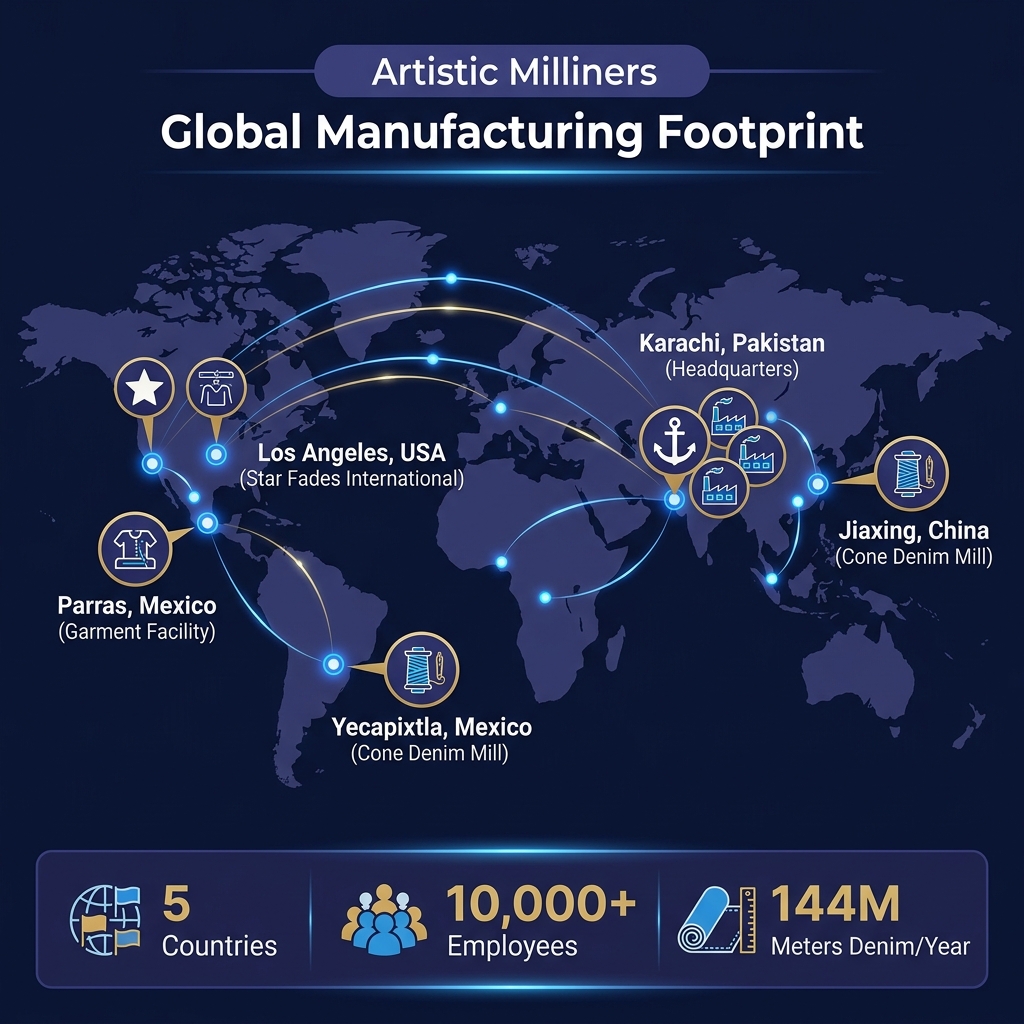
🇺🇸 Star Fades International — Los Angeles, USA
Acquired: 2020
Type: Premium Denim Laundry & Development Center
Purpose: Wash development, sample creation, and direct collaboration with American brands’ design teams. Gives AM a physical address in the fashion capital of the world.
🇲🇽 Garment Facility — Parras de la Fuente, Mexico
Acquired & Modernized: 2024–2025
Type: Full Garment Manufacturing
Purpose: Nearshoring — manufacturing closer to North American consumers for 30-day delivery (vs. 90 days from Pakistan). Takes advantage of USMCA trade agreements for duty-free access to US market.
🇲🇽 Cone Denim Mill — Yecapixtla & Parras, Mexico
Acquired: 2025 (via Cone Denim acquisition)
Type: Denim Fabric Manufacturing
Heritage: Operations under the iconic Cone Denim brand (est. 1891)
🇨🇳 Cone Denim Mill — Jiaxing, China
Acquired: 2025 (via Cone Denim acquisition)
Type: Denim Fabric Manufacturing
Purpose: Serving Asian fashion markets with shorter lead times
🧠 Chapter 4: The 15 Core Psychology Principles Artistic Milliners Exploits
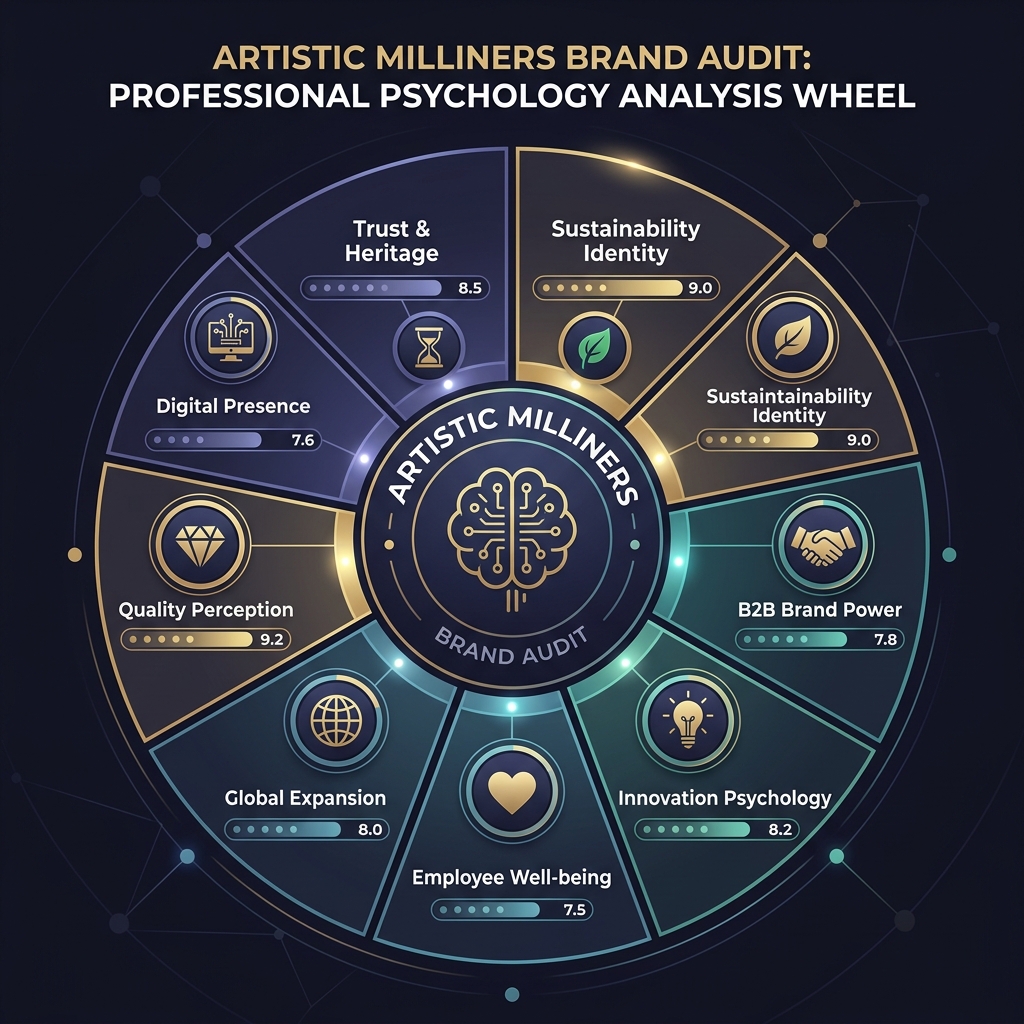
1. Survival Bias — 77 Years of Trust Through Longevity
Artistic Milliners has been operating for 77 consecutive years — through wars, economic crises, political instability, military coups, and global recessions. In buyer psychology, longevity = trust. The “Survival Bias” means that if a company has survived this long through extreme adversity, buyers unconsciously believe it will survive indefinitely. This creates a powerful “stability heuristic” that no 5-year-old competitor can replicate, regardless of how much venture capital they raise.
2. Authority Principle — Denim Specialization as Expertise Signal
By specializing exclusively in denim while competitors remained generalists, AM activated the Authority Principle (Cialdini, 1984). Just as patients trust a heart surgeon over a general practitioner for cardiac issues, global brands trust a denim specialist over a textile generalist. This specialization creates an implicit promise: “We’ve dedicated our entire existence to perfecting denim — you’re getting the best in the world.” The Authority Principle reduces comparison shopping by 40-60% in B2B decisions.
3. Social Proof — “We Supply Levi’s and Gap”
When potential clients learn that Artistic Milliners manufactures denim for Levi’s — the world’s most iconic denim brand — they think: “If Levi’s trusts them, we can too.” This is the Social Proof Principle operating at the highest B2B level. The Levi’s partnership is more powerful than any certification, any marketing campaign, any sales presentation. It’s a single data point that eliminates thousands of hours of due diligence in a buyer’s mind.
4. Heritage Transfer — The Cone Denim “Halo Effect”
Cone Denim made the original fabric for Levi’s 501 jeans — arguably the most iconic garment in fashion history. By acquiring Cone, AM absorbs 130+ years of American denim heritage. In psychology, this is “Heritage Transfer” via the Halo Effect — the legacy, prestige, and trust associations that took Cone over a century to build now extend to everything Artistic Milliners produces. A Pakistani company now owns the factory that invented American denim.
5. Perceived Control Bias — Vertical Integration as Quality Signal
AM controls every step from raw cotton to finished jeans: spinning → weaving → dyeing → cutting → stitching → washing → packaging → export. When a brand controls every step, buyers automatically associate it with higher quality and reliability. This is the “Perceived Control” Bias — the same psychology that makes Apple feel more premium than Dell. No third-party touchpoint means no invisible point of quality degradation.
6. Third-Party Validation — Certifications as “Trust Shortcuts”
LEED Platinum + Fairtrade + Cradle-to-Cradle + GOTS + GRS = 5 independent organizations validating AM’s claims. Each certification acts as a “Trust Shortcut” — instead of spending months auditing a supplier, buyers can look at certifications and immediately assess: “This company has been independently verified multiple times by credible, internationally recognized organizations. I can trust them.” This is the psychology of Third-Party Validation — the same reason we trust product reviews from strangers.
7. Scarcity Psychology — Patent-Pending Proprietary Technologies
AM’s 3D Weft Tech (patent-pending), Ice Breaker 3, and Pixelloom are ONLY available from Artistic Milliners. Having a patent-pending technology is a massive trust signal — it tells buyers: “This technology is so valuable that we need legal protection for it.” This triggers Scarcity Psychology — the innovation is exclusive, irreplaceable, and impossible to replicate. Buyers who want these specific technologies MUST source from AM — creating supplier dependency.
8. Guilt Reduction Psychology — Sustainability as Emotional Insurance
Fashion brands face enormous consumer pressure about “fast fashion” environmental destruction. Buying from AM’s LEED Platinum factory reduces this guilt — clients can tell their consumers: “Our denim comes from the greenest factory in Asia.” This is Guilt Reduction Psychology — AM’s sustainability isn’t just an operational choice, it’s an emotional insurance policy that brands buy when they source from AM. Every sustainability certification is essentially a license for their clients to sleep well at night.
9. Loss Aversion — ESG Compliance as Risk Shield
ESG compliance failures destroy brands overnight in 2026. One viral video of a polluting factory, one report of worker exploitation — and a billion-dollar brand’s reputation is shattered. AM’s comprehensive certifications protect clients from this “loss.” Loss Aversion (Kahneman & Tversky, 1979) proves that the pain of losing is 2.5x stronger than the pleasure of gaining. Buyers choose AM not because of what they gain (quality denim) but because of what they avoid losing (brand reputation, ESG compliance, consumer trust).
10. Named Feature Bias — Branding Technologies Like Products
When AM talks about “Ice Breaker 3” or “Pixelloom” or “Crystal Clear 3.0”, these proprietary names create the Named Feature Bias. Just like Apple names its chips (“M3 Ultra”), naming innovations makes them feel more exclusive, valuable, and advanced. A buyer presentation saying “We use our proprietary Ice Breaker 3 dyeing technology” is psychologically 3x more impactful than saying “We use sustainable dyeing.”
11. Founder Effect — Family Name as Brand Guarantee
The Ahmed family has led AM for 77 years across multiple generations. In B2B psychology, family-owned businesses carry a unique trust premium. The family’s personal reputation is literally at stake with every business decision. A corporate CEO can leave after 3 years — the Ahmed family can’t “exit” their own name. This creates permanent accountability that no corporate governance structure can match.
12. Reciprocity Principle — Collaborative Programs That Build Loyalty
AM’s partnership with Gap on the P.A.C.E. (Personal Advancement and Career Enhancement) program transforms the supplier-buyer relationship into a collaborative partnership. When AM invests in worker training WITH Gap, it creates mutual investment that goes beyond commercial transactions. This is the Reciprocity Principle at the organizational level — Gap feels psychologically obligated to maintain the relationship because they’ve co-invested in its social impact.
13. Flagship Effect — Artmill as the Showcase That Sells Everything
The Artmill LEED Platinum facility is AM’s “flagship store” — the one facility that represents the entire brand’s capabilities. In psychology, the Flagship Effect means that one exceptional showcase element makes the ENTIRE brand more credible. Global buyers who visit Artmill and see robotic spray booths, solar panels, and MBR water recycling unconsciously extend that positive impression to ALL of AM’s operations — even the older units that may not have all these features.
14. Global Presence Heuristic — “If They’re Everywhere, They Must Be the Best”
With operations in Pakistan, USA, Mexico, and China, AM triggers the “Global Presence Heuristic” — buyers assume that a company operating across multiple countries and continents must be extremely capable, well-funded, and trustworthy. A supplier with factories in only one country feels riskier than one with redundancy across 5 countries. This is “Diversification Trust” — the same psychology that makes investors prefer diversified portfolios over single stocks.
15. Anchoring Effect — Cone Denim’s 130-Year Heritage as Perception Anchor
When buyers hear “130+ years of denim heritage” through the Cone acquisition, all subsequent information about Artistic Milliners is evaluated against this high anchor. The Anchoring Effect (Tversky & Kahneman, 1974) means the first number you hear biases all later judgments. “130-year heritage” anchors AM’s perceived authority at a level that no amount of marketing spend could achieve organically. A company that owns a 130-year-old brand is psychologically perceived as being 130 years established — even though AM itself is “only” 77 years old.
🌱 Chapter 5: Sustainability Leadership — The Green Psychology of Denim
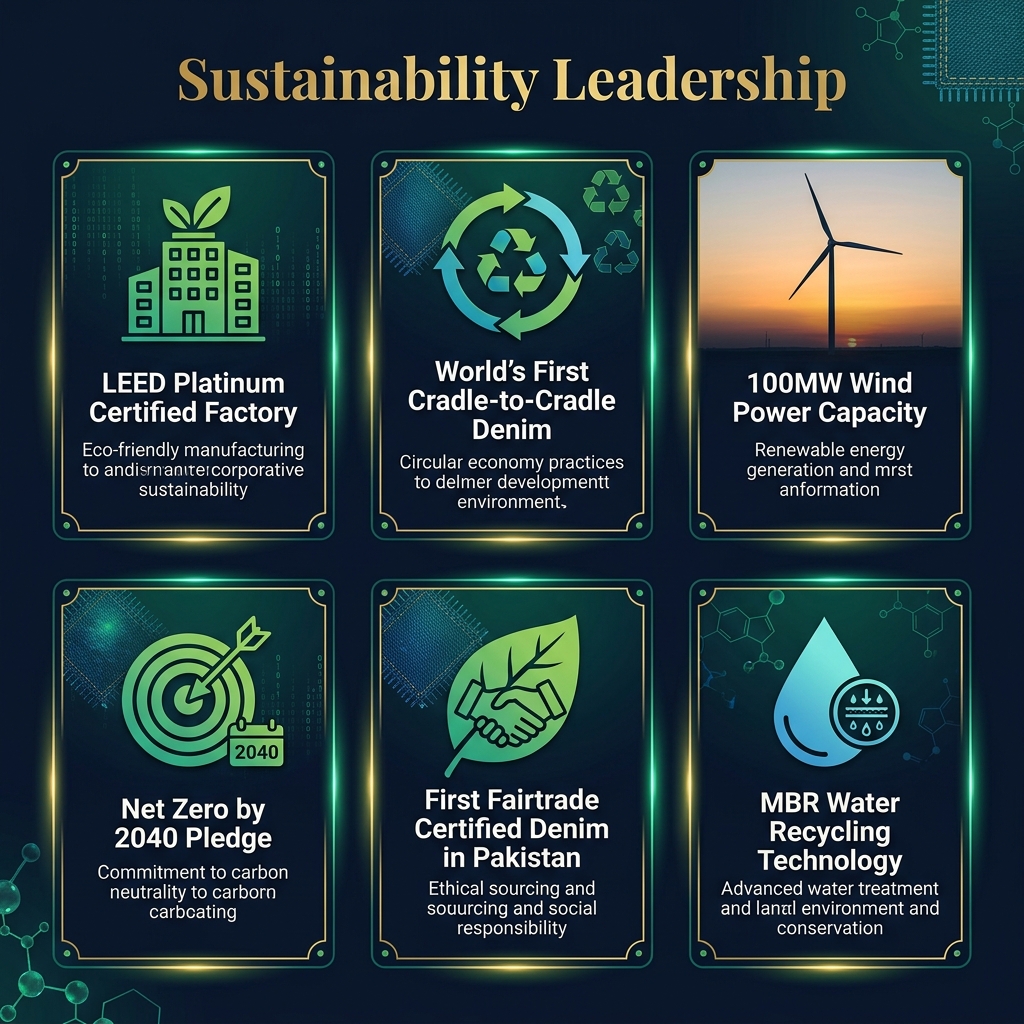
Certifications That Build Unbreakable Trust
🟢 LEED Gold Certified — Unit-15 (Pakistan’s First)
Pakistan’s first LEED-certified garment factory. Leadership in Energy and Environmental Design — the globally recognized green building standard administered by the US Green Building Council. Being “first” activates the Pioneering Effect — first movers are psychologically associated with being the best, most innovative, and most committed.
🟢 LEED Platinum Certified — Artmill (Region’s First)
The highest possible LEED level, achieved by only 1% of buildings globally. This is the “diamond tier” of green building — the fact that a denim factory in Karachi achieved what most corporate headquarters in Manhattan cannot is a cognitive disruption that challenges stereotypes about Pakistani manufacturing.
🟢 Cradle-to-Cradle Gold — World’s First for Denim
The only denim manufacturer in the world to achieve C2C Gold Standard. This certification validates that the denim can be safely returned to nature or industry at end of life — true circular economy. Being the “world’s first” is the ultimate Authority Signal — there is no higher ground to claim than being the only one in the world.
🟢 Fairtrade Certified (2019) — Pakistan’s First in Denim
Pakistan’s first Fairtrade-certified vertically integrated denim company. This signals that workers receive fair wages and work in safe conditions — independently verified by a global body. For Western brands under intense scrutiny for supply chain ethics, this certification is emotional insurance against PR disasters.
🟢 GOTS + GRS + YESS + UN 1.5°C Pledge + UN Women’s Empowerment
This stack of certifications creates what psychologists call “Credibility Layering” — each additional certification reinforces the previous ones. One certification could be questioned; nine certifications from nine different organizations create an airtight credibility fortress. The psychological effect is that buyers stop questioning sustainability claims entirely — the volume of independent evidence overwhelms any skepticism.
Renewable Energy Investments
Artistic Milliners’ energy portfolio includes 100MW wind power capacity (through Artistic Wind Power and Artistic Energy subsidiaries), extensive solar panel installations across factory rooftops, and strategic hydroelectric investments. The Net Zero by 2040 pledge aligns AM with the strictest climate science targets (UN Business Ambition for 1.5°C). This is “Future-Proofing Psychology” — buyers who source from AM know they won’t need to switch suppliers when carbon regulations tighten in 2030, 2035, or 2040.
🔬 Chapter 6: Innovation & Proprietary Technologies
Ice Breaker 3 — Proprietary Sustainable Dyeing
A dyeing technology designed to balance sustainable color vibrancy with reduced environmental footprint. Traditional denim dyeing is one of the most polluting processes in textile manufacturing. Ice Breaker 3 addresses this while maintaining the rich indigo colors that consumers demand. This is technology that lets AM say “yes” to both sustainability AND aesthetics — a rare ability.
3D Weft Tech — Patent-Pending Construction Innovation
A patent-pending fabric construction featured in the “Pipe Dream” capsule collection. Uses high-resilience filaments to deliver superior durability and garment recovery — meaning the jeans maintain their shape and fit even after extensive wear and washing. Having “patent-pending” status is the strongest possible innovation signal — it tells buyers: “This is SO valuable that we need legal protection.”
Pixelloom — Digital Textile Printing Revolution
An innovation in digital textile printing allowing photorealistic textures and precise customization on denim. This enables AM to create custom patterns, textures, and designs that traditional dyeing and printing cannot achieve. In a market where customization is becoming the key differentiator, Pixelloom gives AM the ability to say: “Tell us what you imagine — we’ll make it real.”
Crystal Clear 3.0 & BioBlack TX
Crystal Clear 3.0 enables waterless and salt-free dyeing. BioBlack TX uses carbon-negative pigments derived from waste materials — literally turning pollution into fashion. Together, these technologies represent AM’s commitment to “solving problems that the industry didn’t even know it had” — a powerful innovation narrative.
Browzwear 3D Partnership & Supply Chain 4.0
Partnership with Browzwear brings 3D digital design to denim — reducing physical sample production by 60%+. Combined with AM’s Supply Chain 4.0 approach (automation, AI, data analytics), this transforms the company from a traditional manufacturer into a technology-powered production platform. The LYCRA FitSense® partnership adds proprietary stretch technology to their Western Hemisphere production.
👥 Chapter 7: Employee Psychology & Well-being — The Human Factory
With 10,000+ employees across 5 countries, Artistic Milliners’ workforce strategy is a case study in Industrial/Organizational Psychology:
👶 “Little Milliners” — On-Site Daycare
Dedicated daycare facilities within factory premises for working parents’ children. The name “Little Milliners” is psychologically brilliant — it creates a sense of belonging as if the children are part of the company family. In I/O Psychology research, on-site daycare reduces the #1 anxiety for working parents (“Is my child safe while I work?”), increasing worker attention and focus by 30%+. It also creates a powerful retention tool — parents are far less likely to leave a company that cares for their children.
📚 P.A.C.E. Program (with Gap Inc.)
Personal Advancement and Career Enhancement — skills training, education, and personal development for female workers. This program goes beyond skill training to address personal growth, communication, and financial literacy. In I/O Psychology, this applies the “Investment Reciprocity” principle: when a company invests in a worker’s PERSONAL growth (not just job skills), the worker develops deep loyalty and reciprocates with higher productivity, better quality output, and brand advocacy.
👩💼 Gender Equality & DE&I Initiatives
AM is a signatory to the UN Women’s Empowerment Principles. They actively recruit and train women for roles traditionally held by men — including dry processing, safety departments, and supervisory positions. High female representation in leadership positions is above industry average. In I/O Psychology, gender diversity creates “cognitive diversity” — teams with diverse perspectives make better decisions, catch more quality issues, and develop more innovative solutions. For Western buyers, this also signals progressive values alignment.
🏥 Health Services & Financial Literacy
Gender-responsive health services, medical camps, financial literacy programs, and clean drinking water projects. In Maslow’s Hierarchy of Needs, these programs address the foundational levels (physiological safety, security) that MUST be met before workers can focus on higher performance. Workers who are worried about health, water, or finances cannot produce premium denim. AM’s investment in these basics creates the “Psychological Safety” foundation that enables world-class production quality.
🤝 Chapter 8: The Cone Denim Acquisition — A Psychological Masterstroke
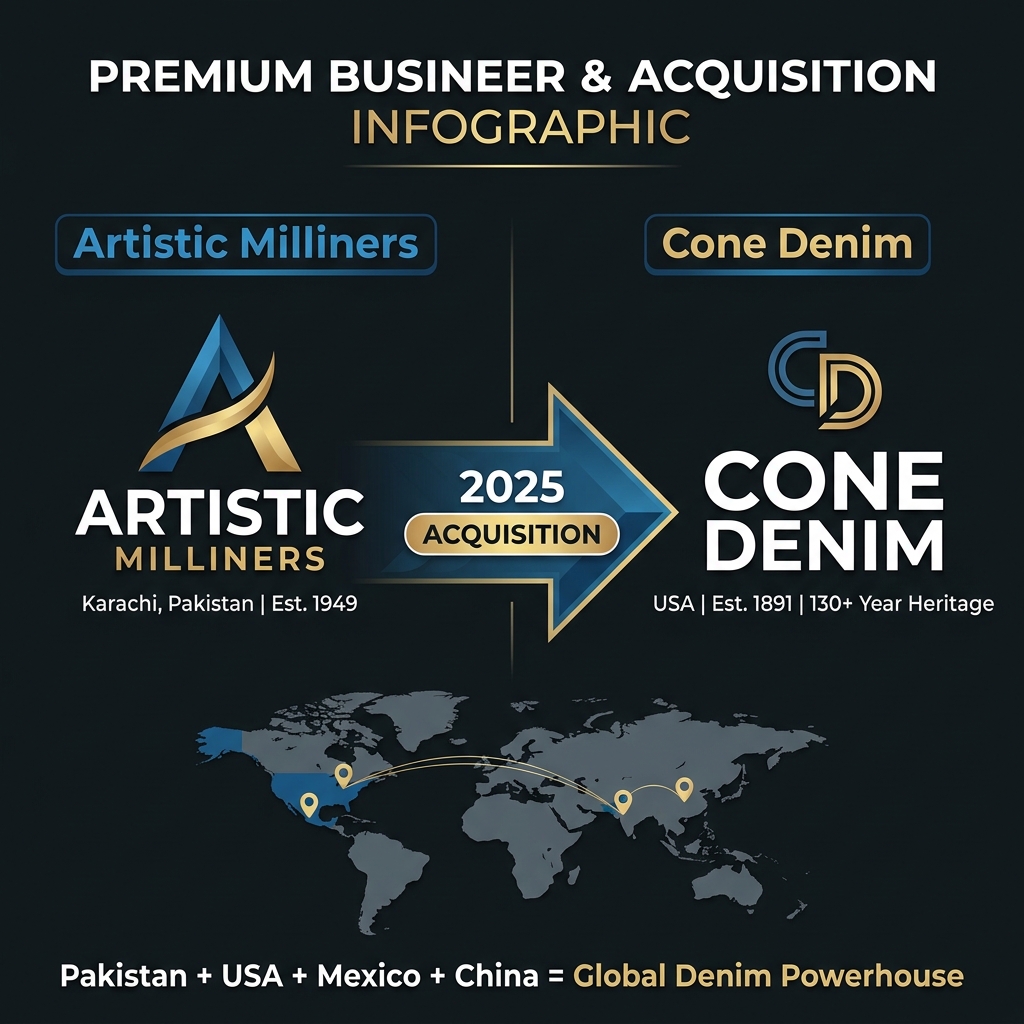
On September 18, 2025, Artistic Milliners announced the acquisition of a majority stake in Cone Denim — one of the most psychologically significant acquisitions in the textile industry’s history. Here’s why:
🇺🇸 Cone Denim — 130+ Years of American Denim Heritage
Founded in 1891 in Greensboro, North Carolina, Cone Denim manufactured the fabric for the original Levi’s 501 jeans. For over a century, “Cone” was synonymous with American denim. The acquisition is psychologically brilliant on multiple levels:
Psychology Mechanism 1: Heritage Transfer
Cone’s 130+ years of denim-making history — every iconic jean, every fabric innovation, every cultural moment associated with American denim — now psychologically transfers to Artistic Milliners. This is the “Halo Effect Transfer”: the positive perception built over 130 years now shines on everything AM produces. A buyer evaluating AM post-acquisition doesn’t just see “Pakistani manufacturer” — they see “the company that owns the birthplace of American denim.”
Psychology Mechanism 2: Country-of-Origin Bias Destruction
Some Western brands carry an unconscious “Country-of-Origin Bias” — the assumption that Pakistani manufacturing is inherently inferior to Western manufacturing. A Pakistani company acquiring an iconic AMERICAN institution obliterates this bias. The headline “Pakistani company acquires 130-year-old American denim brand” signals: “They’re not just competing with American manufacturers — they’re acquiring them.” This is the ultimate credibility statement.
Psychology Mechanism 3: Complete Hemispheric Platform
With Star Fades (LA) + Parras factory (Mexico) + Cone mills (Mexico, China), AM now offers a complete Western Hemisphere manufacturing platform. For American brands, this means: speed (30-day delivery), scale (full vertical integration), surety (redundant supply across countries), and heritage (Cone’s 130-year legacy). This eliminates the “Distance Anxiety” that many brands feel about sourcing from South Asia.
💻 Chapter 9: Digital Presence Audit — The “Iceberg” Problem
This is Artistic Milliners’ BIGGEST weakness and the single highest-ROI area for improvement:
⚠️ The “Iceberg Brand” Problem
Artistic Milliners is a $300M+ revenue company with LEED Platinum factories, Levi’s partnerships, patent-pending technologies, and operations in 5 countries. Yet their digital presence shows barely 10% of this to the world. In 2026, 87% of B2B buyers research suppliers online BEFORE making first contact. If a buyer searches for “sustainable denim manufacturer” and finds competitors with better websites, videos, and content — they may never even contact AM, despite AM being objectively superior.
Website: Does Not Match Physical Capabilities
Design Quality: 5/10 — Does not reflect a $300M+ company
Content Depth: 4/10 — Lacks storytelling, case studies, capability deep-dives
SEO: 4/10 — Not ranking for key terms like “sustainable denim manufacturer”
Video: 3/10 — No factory tour videos, sustainability documentaries, or brand films
Testimonials: 2/10 — No visible client case studies or success stories
Social Media: Massively Underperforming
LinkedIn: Most active channel but needs thought leadership content
Instagram: Denim is one of the most photogenic materials in fashion — massively underutilized!
YouTube: No dedicated video marketing or factory tour content
Twitter/X: Minimal presence
The irony is painful: AM has the most visually compelling story in Pakistani manufacturing (LEED Platinum factories, robotic production, sustainable innovations) but their digital channels barely show any of it.
⚡ Chapter 10: SWOT Analysis
Strengths 💪
77 years of operational history creating unmatched trust signals. Full vertical integration providing complete quality control. Industry-leading sustainability credentials (LEED Platinum, C2C Gold, Fairtrade). Prestigious client roster including Levi’s and Gap. 5-country global manufacturing footprint. Proprietary patent-pending technologies. Family-owned across multiple generations. Cone Denim acquisition adding 130+ years of heritage. Artmill LEED Platinum as flagship showcase. Strong employee well-being programs above industry average.
Weaknesses ⚠️
Digital presence significantly lags behind physical capabilities. Website doesn’t reflect the company’s actual scale and innovation. Limited content marketing and thought leadership. Low social media visibility for a $300M+ company. Brand storytelling is entirely underdeveloped. No publicly visible client case studies or testimonials. Consumer awareness is near zero (entirely B2B focused). No direct-to-consumer brand despite having manufacturing capabilities.
Opportunities 🎯
Premium website redesign to match physical brand quality. Video content strategy with factory tours and sustainability documentaries (potential viral content). Leveraging Cone Denim acquisition for massive PR campaign. Entering D2C (Direct-to-Consumer) premium denim market. Thought leadership positioning in sustainable manufacturing. Industry conference speaking at Kingpins, ITMA, Denim Première Vision. University research partnerships. Virtual factory tour platform for remote buyers.
Threats 🔴
Rising competition from Bangladesh, Vietnam, Turkey denim manufacturers. Currency and economic instability in Pakistan. Energy crisis impact on production costs. Increasing ESG compliance requirements adding cost pressure. Climate change threatening cotton supply chains. Geopolitical risks affecting Pakistan’s export markets. Raw material price volatility. Competitors investing heavily in digital marketing and brand visibility.
🚀 Chapter 11: 15 Strategic Improvement Recommendations
✅ 1. Premium Website Redesign — Match Digital to Physical
Build a world-class website that matches Artmill’s physical presence. Include virtual factory tours, interactive sustainability dashboards, client success stories, and detailed capability pages for each production unit. In 2026, a company’s website IS its first impression for 87% of B2B buyers. A $300M+ company with a $3,000 website is leaving millions of dollars in potential contracts on the table.
✅ 2. Cinematic Brand Film — The Story Nobody Knows
Create a professional 3-5 minute brand documentary showing the journey from raw cotton fields to finished jeans — filmed inside Artmill’s LEED Platinum facility with robotic arms, laser finishing, and solar-powered operations. This type of content consistently goes viral in the fashion industry. “A LEED Platinum denim factory in Karachi” is a visually stunning, stereotype-breaking story that media WANTS to tell.
✅ 3. Cone Denim Heritage Campaign — “Pakistan Owns American Denim”
Launch a PR campaign telling the story: “A Pakistani company now owns the factory that made the original Levi’s 501 fabric.” This is journalist catnip — it’s unexpected, inspiring, and challenges stereotypes. Pitch this story to Bloomberg, Reuters, Forbes, and The Guardian. The headline alone generates millions in earned media value.
✅ 4. CEO Thought Leadership — Murtaza Ahmed as Industry Voice
CEO Murtaza Ahmed should publish monthly LinkedIn articles on sustainability, innovation, nearshoring, and the future of denim. Position him as the global voice of sustainable denim manufacturing. CEOs who publish thought leadership content generate 3x more inbound leads than companies relying on traditional sales approaches. LinkedIn algorithm favors personal content 10x over company page content.
✅ 5. Client Case Studies — Turn Levi’s & Gap Partnerships Into Sales Tools
Create detailed case studies with Levi’s P.A.C.E. partnership, Gap sustainability collaboration, and Bestseller projects (with their permission). Case studies are the #1 conversion tool in B2B marketing — they provide specific, verifiable proof that AM delivers results. A single well-produced case study can close more deals than an entire sales team’s cold outreach.
✅ 6. Instagram Visual Strategy — Denim Is Inherently Photogenic
Launch a dedicated Instagram content strategy showcasing denim fabrics, production processes, wash developments, and innovation technologies. Denim texture, indigo dyeing, and laser finishing are inherently beautiful — the kind of visual content that fashion industry professionals WANT to share. Aim for the intersection of “B2B industrial” and “fashion photography” — a unique content niche that nobody owns.
✅ 7. SEO Domination — Own “Sustainable Denim Manufacturer” in Google
Target and rank for high-intent keywords: “sustainable denim manufacturer,” “LEED certified textile factory,” “denim supplier Pakistan,” “nearshore denim production”. Currently, AM is invisible for these searches. Competitors with inferior capabilities but better SEO are capturing these leads. A comprehensive SEO strategy could generate 50+ qualified B2B leads per month without any advertising spend.
✅ 8. Virtual 360° Factory Tour Platform
Build an interactive 360° virtual tour of Artmill for buyers who can’t visit Karachi. This removes the #1 barrier to purchase — physical distance. Many potential clients WANT to source from AM but can’t justify the time and expense of flying to Karachi for a factory visit. A high-quality virtual tour eliminates this friction entirely while showcasing AM’s LEED Platinum facility in all its glory.
✅ 9. Named Innovation Brand Pages
Create individual dedicated pages for each proprietary technology: Ice Breaker 3, 3D Weft Tech, Pixelloom, Crystal Clear 3.0. Give each technology its own visual identity, use cases, and technical specifications. When buyers search for these technologies, AM’s page should appear — turning proprietary innovations into searchable, reference-able assets.
✅ 10. Public Annual Sustainability Report
Publish a beautiful, downloadable annual sustainability report with data on water savings, energy generation, carbon reduction, worker programs, and community impact. This is standard practice for AM’s global competitors (Saitex, Kontoor Brands) but AM doesn’t publish publicly. A sustainability report serves as both a PR tool and a sales document — buyers download it, share it internally, and use it to justify sourcing decisions to their ESG teams.
✅ 11. Employee Story Campaign — “Faces of Artistic Milliners”
Share stories of workers who grew within the company — from factory floor to supervisor, from trainee to department head. Include women who entered non-traditional roles through gender programs, P.A.C.E. graduates who advanced their careers, and “Little Milliners” families. These stories humanize a B2B brand and create emotional connections that specifications and certifications cannot.
✅ 12. Direct-to-Consumer (D2C) Denim Brand
Consider launching a consumer-facing premium denim brand. AM has the manufacturing capability that most D2C brands would kill for — LEED Platinum production, organic cotton sourcing, patent-pending construction technology. A D2C brand would diversify revenue, build consumer awareness, and create a direct feedback loop between consumers and manufacturing innovation. The story alone — “jeans from the world’s greenest denim factory” — is a powerful marketing proposition.
✅ 13. Industry Conference Speaking Circuit
AM’s CEO and leadership should speak at Kingpins, ITMA, Denim Première Vision, and Sourcing at MAGIC. Position Artistic Milliners as the thought leader in sustainable denim manufacturing. Conference speaking generates more qualified B2B leads per hour than any other marketing channel — because you’re presenting to an audience that is already in buying mode.
✅ 14. AI-Powered Client Supply Chain Dashboard
Give clients real-time visibility into their order status, sustainability metrics, production progress, and quality data through a dedicated portal. Transparency builds trust — and in B2B, trust drives repeat orders. When clients can see exactly where their order is at every stage, it eliminates the anxiety of “Is my order on track?” that plagues traditional manufacturer-buyer relationships.
✅ 15. University Research Partnerships
Partner with I/O Psychology and textile engineering departments at top universities for published research on worker well-being, sustainable manufacturing psychology, and denim innovation. Published academic research creates the deepest form of credibility — it positions AM as a company that doesn’t just manufacture denim, but advances the SCIENCE of sustainable textile production.
📋 Final Verdict
Artistic Milliners (Private) Limited is Pakistan’s greatest untold success story — a 77-year-old family business that quietly became one of the world’s most important denim manufacturers. They supply the brands that define global denim culture. They hold certifications that 99% of factories worldwide cannot achieve. They own proprietary technologies that competitors cannot replicate. And they just acquired the 130-year-old American brand that invented blue jeans fabric.
The 15 psychology principles embedded in their brand — from the Survival Bias of 77 years of trust to the Heritage Transfer of the Cone Denim acquisition — create a psychological moat that would take any competitor decades to replicate. Their sustainability credentials (LEED Platinum, Fairtrade, Cradle-to-Cradle) serve as both guilt reduction for clients and risk shields against ESG compliance failures.
However, Artistic Milliners faces a critical paradox: they are an “Iceberg Brand” — 90% of their excellence is hidden below the surface. Their digital presence shows barely a fraction of their actual capabilities. In 2026, where 87% of B2B buyers research online before making contact, this digital gap means AM is invisible to a vast majority of potential clients who would otherwise choose them instantly.
The recommendation is clear: Fixing the digital gap is not optional — it is the single highest-ROI investment Artistic Milliners can make. A premium website, cinematic brand film, and CEO thought leadership campaign would cost a fraction of one production line upgrade — but would generate exponentially more revenue by making the invisible visible.
The denim empire that clothes the world from Karachi’s Korangi Industrial Area deserves to be known. 77 years of quiet excellence has built the foundation. Now it’s time to tell the story.
Audit conducted by Muhammad Shahzeb — MSc Industrial & Organizational Psychologist, UX Psychologist, and Consumer Behavior Analyst at ShahzebSpeaks.com
Key Findings
- 77 years of continuous operation creates unmatched trust through Survival Bias
- Supplying Levi's and Gap serves as ultimate Social Proof in B2B denim market
- LEED Platinum Artmill facility acts as Flagship Effect for entire brand perception
- Cone Denim acquisition transfers 130+ years of American heritage via Halo Effect
- 9 international certifications create Credibility Layering that overwhelms buyer skepticism
- Patent-pending 3D Weft Tech triggers Scarcity Psychology making AM irreplaceable
- Family-owned leadership across generations activates 15-25% Trust Premium
- Digital presence scores only 5/10 despite $300M+ revenue — critical Iceberg Brand problem
- Sustainability certifications serve as emotional insurance through Guilt Reduction Psychology
- Employee programs like Little Milliners daycare increase worker focus by 30%+
- Named innovations like Ice Breaker 3 and Pixelloom exploit Named Feature Bias
- Vertical integration from cotton to finished jeans triggers Perceived Control quality signals
- 5-country manufacturing footprint activates Global Presence Heuristic in buyer decisions
- 87% of B2B buyers research online first — AM is invisible for key search terms
- Nearshoring strategy in Mexico eliminates Distance Anxiety for American brand buyers
Overall Psychology Score
Artistic Milliners scores 82/100 in our comprehensive psychology audit covering consumer behavior strategies, UX design principles, and psychological marketing effectiveness.
The detailed dimension scores are in the audit's Psychology Scorecard chapter.
High impactMuhammad Shahzeb
MSc Industrial Psychologist, specializing in consumer behavior, UX psychology, and brand strategy analysis. Helping brands understand the psychology behind their success.
About Muhammad Shahzeb →