Stanley Psychology Audit — The Cup That Became a Cult
Stanley sold a $45 cup like a fashion drop — then faced a 2.6 million mug recall. Score: 80/100. See scorecard.

80 / 100
Overall consumer behavior effectiveness
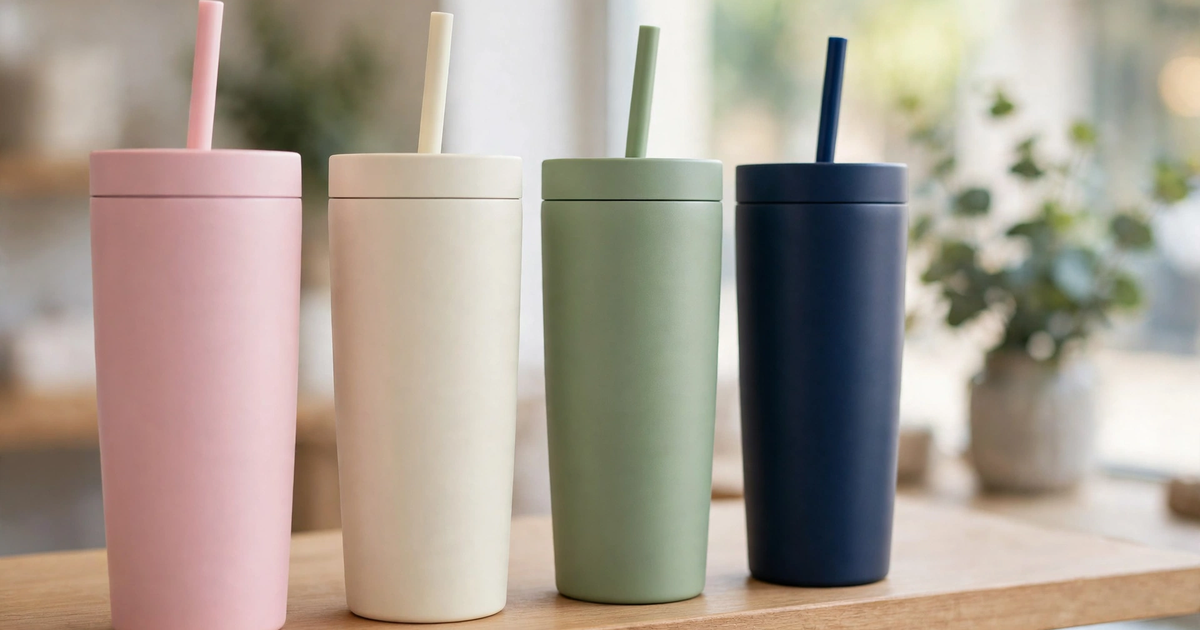
Brand Overview
- Brand nameStanley
- Founded1913
- HeadquartersSeattle, Washington, USA
- IndustryRetail
- Websitewww.stanley1913.com ↗
Psychology Techniques Identified
- 01Scarcity Drops & FOMO (Limited Colours, "Will Not Be Restocked")
- 02Social Proof at Scale (700M #StanleyTumbler Views Claimed, User-Generated)
- 03Community-Led Seeding (The Buy Guide, Women Talking to Women)
- 04Identity & Colour Signalling (Cup as Accessory, Outfit Matching)
- 05Collecting & Set Completion (Goal-Gradient Dynamics, New Drops Re-Open the Set)
- 06Reciprocity Spectacle (Car Replacement After the Car-Fire Video)
- 07Heritage & Nostalgia Anchoring (1913 Founder Story, Built For Life)
- 08Everyday-Ritual Embedding (Daily, All-Day Use Reframing)
- 09Collaboration Halo (Starbucks, Pendleton, Magnolia)
- 10Accessory Ecosystem & Endowment (Boots, Straw Covers, Personalisation)
- 11User-Generated Content Flywheel (Customers Posting Collections)
- 12Premium Pricing as Quality Cue ($45 Quencher, $49.95 Starbucks Edition)
Full Psychology Audit Report
In this audit
In January 2024, people queued outside Target stores from 3 a.m. for a drinking cup. Not a phone, not a sneaker — a $49.95 insulated tumbler, pink, with a straw, gone in minutes at many stores, with Starbucks confirming it would not be restocked. Stanley did not sell a better cup than its rivals. It sold scarcity, identity and belonging — and then, when a 2.6 million mug recall and two lawsuits arrived, it learned what that kind of desire costs when trust is tested.
I am an Industrial and Organizational Psychologist in Karachi, and I audit brands by the psychology they actually use, not the story they tell about themselves. This audit traces Stanley from a 1913 workman’s bottle to a fashion drop, scores the eight dimensions of its psychology, and keeps every legal claim at its exact status — because in this case, the difference between “dismissed” and “dismissed with leave to amend” is the whole story.
“Stanley proved that a utility product becomes a cult when buying it says something about who you are — and that a cult punishes disclosure failures harder than a commodity ever would.” — Brand Psychology Analysis, ShahzebSpeaks
📋 Brand Overview: Stanley at a Glance
| Field | Detail |
|---|---|
| Brand | Stanley (Stanley 1913) |
| Founded | 1913, by inventor William Stanley Jr. (company claim) |
| Maker / parent | Pacific Market International (PMI); PMI WW Brands LLC, dba Stanley 1913, of Seattle, Washington; HAVI Group acquired PMI Worldwide in 2021 |
| Headquarters | Seattle, Washington, USA (importer address in the CPSC recall) |
| Hero product | Quencher tumbler — 40 oz typically $45, 30 oz $35 |
| Revenue | About $70 million in 2019 to about $750 million in 2023, as reported by CNBC |
| Scale | More than 10 million Quenchers sold since the 2016 launch (National Inventors Hall of Fame profile); PMI brands Stanley and Aladdin sold in over 60 countries |
| Website | https://www.stanley1913.com |
One confusion to clear before anything else: this Stanley is not Stanley Black & Decker, the tool company. The toolmaker sued PMI in February 2025, alleging PMI breached a 2012 agreement by using the “Stanley” name broadly, including on apparel and marketing; PMI denied the allegations, saying it owns the Stanley brand for food and beverage containers dating to 1913. The outcome of that suit was not verified in this research, and this audit prints no outcome for it. Never mix the two companies’ revenues or histories.
📜 Chapter 1: The History — 112 years of patience, four years of frenzy
Stanley’s own history, which it states as a company claim, begins in 1913, when inventor William Stanley Jr. fused vacuum insulation and steel in one portable bottle, inventing the all-steel vacuum bottle. For decades the brand targeted workmen and outdoor users — blue-collar workers, campers, outdoors enthusiasts — and as recently as 2012 described its resonance with “a 30-year-career veteran policeman” and “a retired Army soldier”. That is a century of selling durability to people who needed a bottle to survive a shift, not to match an outfit.
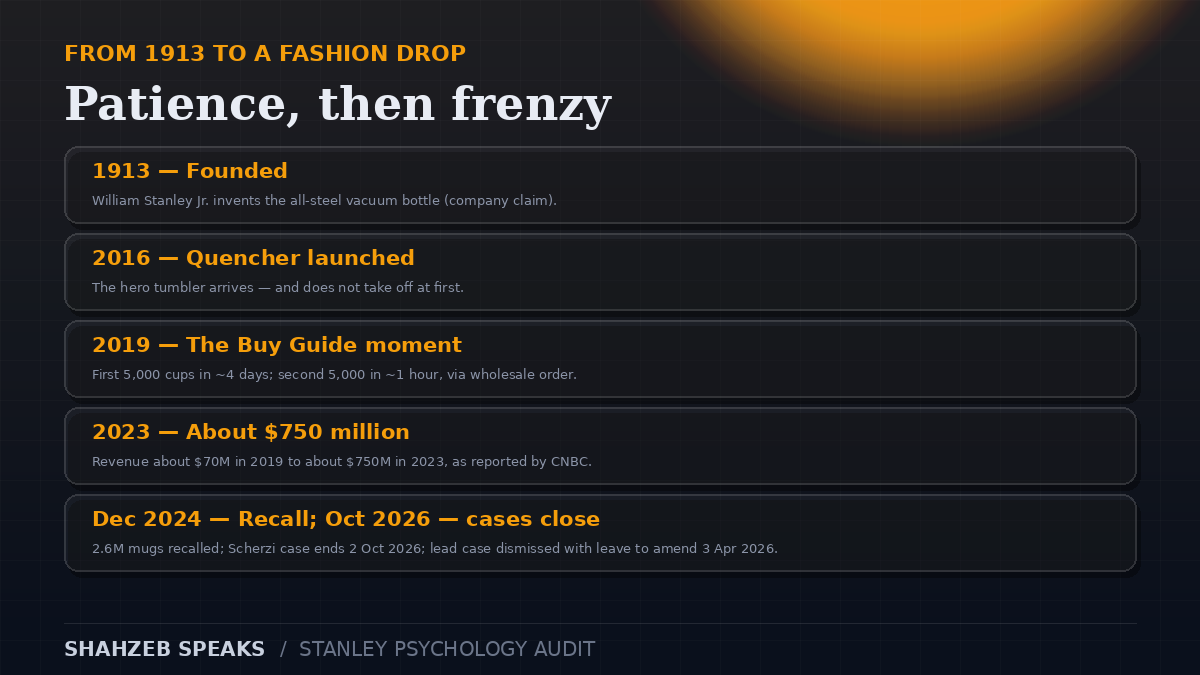
The Quencher was introduced in 2016 and did not take off. The turn came from outside the company. In 2017, three women founded The Buy Guide, an Instagram shopping blog, and its second post, in November 2017, featured a 40 oz Stanley Quencher. In 2019, fearing the tumbler would be discontinued, The Buy Guide urged followers to buy remaining stock and lobby Stanley; Stanley directed them to a wholesale order with a 10,000-cup minimum. The Buy Guide sold its first 5,000 cups in about four days and the second 5,000 in about an hour. A Stanley executive later said there had been no plans to discontinue the tumbler in 2019, but that it “wasn’t prioritized at the time”. The community found the product before the company found the community.
In 2020, Terence Reilly, a former Crocs executive, became Stanley’s president, and under him the brand repositioned the Quencher from what outlets described as a male, green and hot product to a colourful, everyday, female-focused one, with colour drops and collaborations. In 2021, HAVI Group acquired PMI Worldwide. By 2023, Stanley closed the year with about $750 million in annual revenue, as reported by CNBC — roughly ten times the roughly $70 million reported for 2019. One source gives $73 million for 2019 instead of $70 million; this audit prints the CNBC-reported “about $70 million” version and treats both as approximate. Reilly left Stanley in 2024 to return to Crocs as president of its HEYDUDE brand, announced 16 April 2024. The turnaround CEO’s exit is part of the story; this audit does not claim a causal sales effect from it.
👥 Chapter 2: The community-led turnaround — women talking to women
The most important fact in this audit is also the most humbling for marketers: Stanley’s revival was not an advertising campaign. It was a recommendation from a community the company had not built, to an audience the company had not targeted. The Buy Guide’s audience was 97.7% women, with the highest demographic women aged 35–44, and almost 100% aged 25–45, according to data The Buy Guide shared with Retail Dive. The brand’s pitch shifted from occasional use — camping, tailgating — to daily, all-day use that, in the outlet’s words, “needed to look good… with their outfits”.
The psychology here is Cialdini’s social proof: people determine correct behaviour by observing what others do, especially similar others under uncertainty. A recommendation from three women who look like you, use the product daily, and answer comments is a different kind of proof from a celebrity endorsement. Kearney’s Namrata Shah, quoted in Retail Dive coverage, put it as women talking to women creating “a lot more trust”. The Buy Guide did not just sell cups. It gave Stanley a trusted channel into a demographic the brand had never spoken to, and it did so before Stanley spent anything like a campaign budget on the idea. That sequence — community first, strategy second — is the reason this audit’s first finding is that the turnaround was community-led, not ad-led.
The second-order effect matters too. Once the community existed, Stanley adopted it as a strategy rather than merely benefiting from it: colour drops, collaborations and limited editions became the operating system. That is where the next chapter begins — and where admiration for the turnaround has to be separated from admiration for what it became.
🔥 Chapter 3: Scarcity and the drop — selling out on purpose
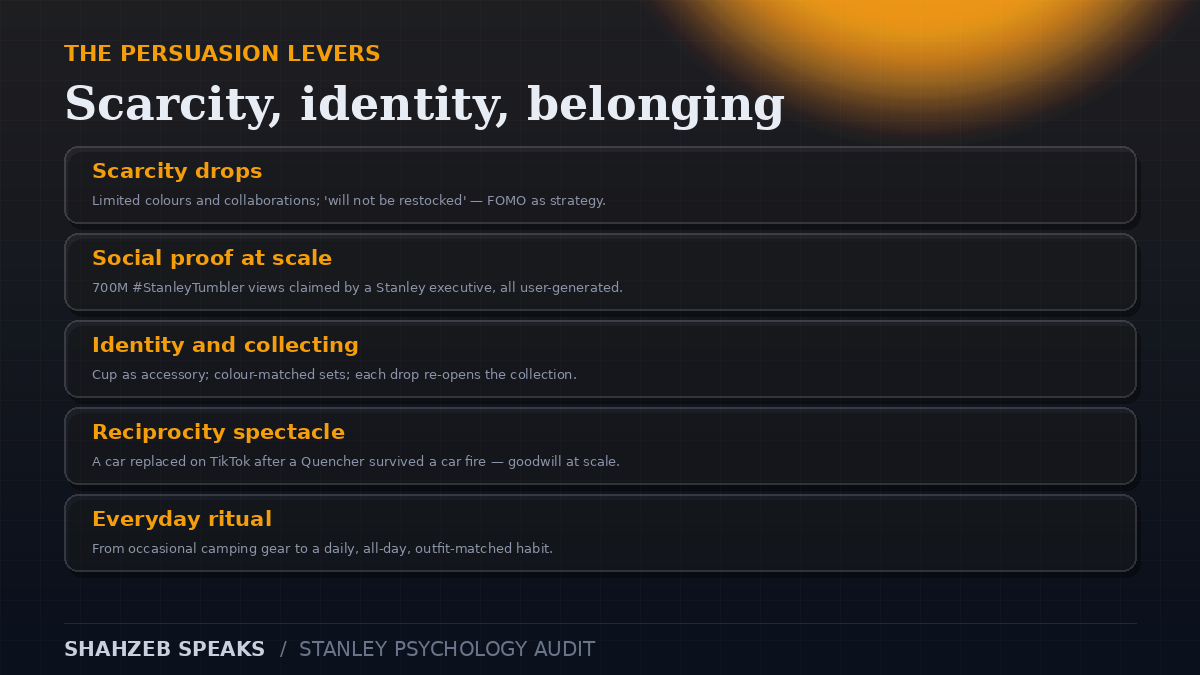
Stanley adopted a “drops” tactic borrowed from sneaker and streetwear culture: limited colours, finishes, patterns and collaborations, including Pendleton, Target’s Hearth & Hand with Magnolia, Starbucks, Joanna Gaines and Mossy Oak camouflage. Stanley executive Matt Navarro is quoted as saying the strategy around “limited, special-edition drops; partnerships… collaborations with celebrities and artists and athletes” helped create “the brand status… we have today”, and that “there is certainly a promotional strategy around FOMO”. That is as close to an admission as a brand gives: the scarcity is not an accident of demand. It is the product.
Cialdini’s scarcity principle holds that things perceived as limited or less available are desired more, working through loss aversion and reactance: the threat of losing access makes the object more attractive than its features alone would. Stanley’s January 2024 Starbucks Valentine’s Day Quenchers are the textbook case: pink and red 40 oz tumblers launched in Starbucks stores inside Target, with queues from 3 a.m. and overnight camping reported, sold out in minutes at many stores, and Starbucks confirming the item would not be restocked. A “will not be restocked” statement is scarcity in its purest form — it removes the consumer’s ability to wait, compare and decide calmly, and replaces it with a deadline.
The resale market completed the loop. The Starbucks × Stanley pink tumblers, sold at $49.95 retail at Target, were reported reselling at about $300 — reported resale listings, not a verified market price, and this audit does not present it as one. But even as a reported figure it does psychological work: a $300 listing tells every later buyer that the $45 cup is “worth” more than its price, which makes the next drop feel like a bargain rather than an expense. Scarcity does not just sell the cup in front of you. It reprices every cup after it.
🎨 Chapter 4: Identity and collecting — the cup as an accessory, the set as a goal
Belk’s 1988 “extended self” thesis holds that possessions are a major contributor to and reflection of our identities. Stanley is that thesis with a handle. Retail Dive coverage quotes Kearney’s Shah describing the cup as “much more as an accessory and not just a water bottle… the one that I want to carry with me today”. Colour-matching cups to outfits, buying different colours for different occasions, and displaying collections — Retail Dive cites TikTok users showing off collections of 18 and “about a dozen” Quenchers — are identity work, not hydration work. The cup stopped being a container and became a signal: of taste, of belonging, of being the kind of person who has the colour.
Collecting adds a second mechanism, and this audit frames it carefully as interpretation, not as a measured effect on Stanley buyers. The goal-gradient hypothesis, from Hull (1932) and Kivetz, Urminsky and Zheng (2006), holds that effort accelerates as people approach a goal — in the original study, café reward members bought more frequently the closer they were to a free coffee. A collection works the same way in reverse: every new colour drop re-opens the set, so the goal is never finished, and each purchase moves the collector closer to a completeness that the next drop immediately moves away again. Researcher and psychotherapist Peter Danzig, quoted in Retail Dive, described collecting as joy, “visualization of completeness”, “the hunt and the find”, and nostalgia. The audit’s claim is modest: Stanley’s drop strategy is consistent with goal-gradient dynamics. It is not proof that the study explains Stanley buyers.
The same logic applies to mere exposure, Zajonc’s 1968 finding that repeated, unreinforced exposure to a stimulus increases liking for it. The cup’s ubiquity — in feeds, gyms, offices and schools, with consumers themselves posting about their experience — meant most buyers had seen a Quencher dozens of times before ever considering one. Again, that is consistency with a principle, not a measured effect on this brand’s buyers, and this audit will not pretend otherwise.
📱 Chapter 5: Social proof at scale — and the car that became a commercial
A Stanley executive claimed 700 million views of #StanleyTumbler on TikTok, all user-generated. Marketing Dive separately cited about 20 million views for “Stanley Cup” TikTok content. Those are different hashtags measured at different dates, and this audit does not merge them into one figure. The 700 million figure is an executive claim reported by the outlet, not an independently audited count — but even discounted heavily, it describes a scale of unpaid exposure that no advertising budget buys, and it explains why Stanley’s marketing spend could stay small while its fame grew large.
The single most valuable piece of that exposure was not planned at all. In November 2023, Danielle Lettering posted a TikTok showing her Stanley Quencher surviving a car fire with ice still inside. Stanley president Terence Reilly responded on TikTok offering to replace her car, and the company did so. CreatorIQ vendor data puts her video at 94 million views and 9 million likes, and Reilly’s response at about 54 million views and 6.7 million likes, with Stanley’s November 2023 earned media at $7.0 million in earned media value. View counts grow over time, so these are dated vendor figures, not current totals.
The psychology is Cialdini’s reciprocity: a large, public, unexpected gift creates goodwill and an obligation to praise and defend the giver. Replacing a car is not a coupon. It is a spectacle of generosity, performed in public, at a scale that makes every viewer feel gifted by proxy. It also did something subtler: it turned a durability claim — “our cup survives a fire” — into a story told by a customer, not by the brand. That is the most persuasive form of proof there is, and Stanley got it for the price of one car. It is also, as Chapter 7 shows, the standard the brand then failed to meet when its own disclosures were tested.
💰 Chapter 6: Price, ecosystem and the everyday ritual
A Quencher at $45 is a premium price for a cup, and that is the point. The price-quality heuristic means consumers use price as a signal of quality where quality is hard to judge directly, and Stanley’s price says “this is not like other cups” before any feature is considered. The accessory ecosystem — boots, straw covers, charms, colour-matched extras — then does endowment-effect work: once a cup is owned and personalised, its owner values it above a stranger’s identical cup, in the same pattern Kahneman, Knetsch and Thaler (1990) demonstrated with university mugs, where sellers demanded roughly double buyers’ offers. The mug-experiment parallel is a rhetorical fit, not evidence about Stanley owners, and this audit says so plainly.
The everyday-ritual reframing is the quietest and most profitable move in the whole story. The Buy Guide’s pitch shifted the Quencher from occasional use to daily, all-day use — a product carried everywhere, matched to outfits, refilled constantly. A product used daily is a product replaced, accessorised and collected; a product used on camping trips is not. That reframing is why “more than 10 million Quenchers sold since 2016” is not just a sales figure. It is evidence that a utility product became a habit, and a habit became an identity.
For the companion question of how another cult brand built desire on a different mechanism, read my audit of Crocs, and for scarcity as a system rather than a tactic, my audit of Zara.
⚠️ Chapter 7: The dark side — a recall, a lead scare, and two cases that closed without vindication
This chapter keeps every legal claim at its exact status, as of 27 October 2026, because this audit’s credibility depends on it. Start with the recall, which is the only formal safety action in the story. On 12 December 2024, the US Consumer Product Safety Commission announced recall 25-063: about 2.6 million Stanley Switchback and Trigger Action stainless steel travel mugs in the United States, because, in the CPSC’s words, “lid threads can shrink when exposed to heat and torque, causing the lid to detach during use, posing a burn hazard”. The remedy was a free replacement lid including shipping, and consumers were told to stop using the mugs immediately. The mugs were sold from June 2016 to December 2024 at Amazon, Walmart, Dick’s Sporting Goods, Target and other stores for $20 to $50. The importer was PMI WW Brands LLC, dba Stanley 1913, of Seattle, Washington, and the mugs were manufactured in China.
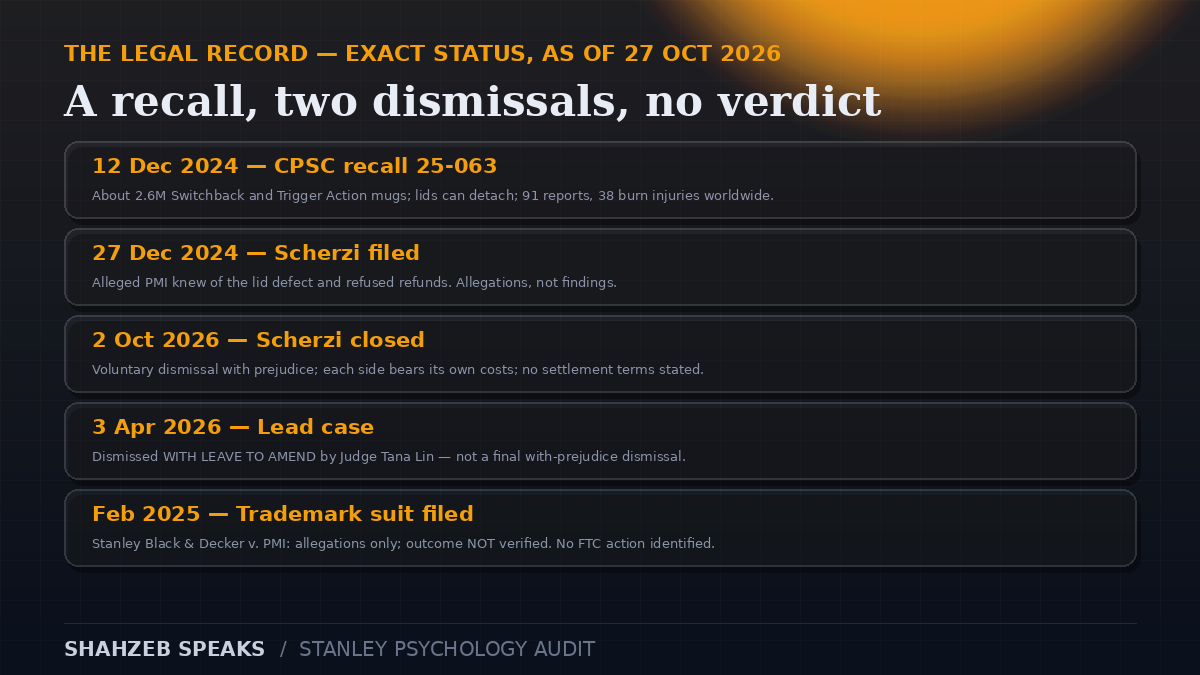
The incident counts, as reported to Stanley and published by the CPSC, were 91 reports worldwide, including 16 in the United States, of lids detaching; 38 burn injuries worldwide, including 2 in the United States; and 11 consumers worldwide requiring medical attention. These are reports, not adjudicated findings that a mug caused every injury. Health Canada joined the recall for about 184,170 units sold in Canada, with 3 incident reports and 1 burn injury in Canada, according to secondary reporting. And one fact must be stated plainly because coverage often blurs it: the Quencher is not in this recall. The recall covers Switchback and Trigger Action mugs only.
The Scherzi case followed the recall. Danielle Scherzi v. Pacific Market International LLC, filed 27 December 2024 in the Western District of Washington, was later consolidated with two other cases, and plaintiffs alleged — allegations, not findings — that PMI knew of the lid defect, refused refunds, and offered “clearly inferior” replacement lids. On 25 March 2026, Judge Richard A. Jones granted in part and denied in part PMI’s motion to dismiss. On 13 April 2026, plaintiffs filed notice that they would not file an amended complaint. On 30 September 2026, plaintiffs filed notice of voluntary dismissal, and on 2 October 2026 the case was terminated — dismissed with prejudice, with each side bearing its own attorneys’ fees and costs, and no settlement terms stated on the docket. The correct sentence is: the case ended in a voluntary dismissal with prejudice, with each side bearing its own costs, and no settlement was announced. Do not write that Stanley settled, and do not write that Stanley won at trial. A voluntary dismissal with prejudice is neither a verdict nor a disclosed settlement.
The lead case is separate from the recall, and confusing the two is the main legal error risk in this story. After lead-test videos went viral on social media in early 2024, consumers alleged PMI concealed lead in tumblers, in violation of consumer-protection statutes in California, Nevada and New York, plus unjust enrichment and fraudulent omission. The lead is in pellets sealing the vacuum insulation at the base. PMI’s position, in a company statement reported by Reuters, was that the pellets contain “some lead” but are covered by a durable stainless-steel layer, making them inaccessible to consumers. On 3 April 2026, Judge Tana Lin of the US District Court for the Western District of Washington dismissed the proposed class action, finding consumers did not demonstrate a “specific and plausible risk of harm” and that the mere presence of lead was not shown to be material to a reasonable consumer. That dismissal was with leave to amend — plaintiffs were given the opportunity to file a corrected complaint, and the judge said the case would be dismissed with prejudice only if they failed to fix the deficiencies. So the exact wording is: dismissed with leave to amend on 3 April 2026 — not a final with-prejudice dismissal at that date. Whether plaintiffs later filed an amended complaint was not verified in this research, and this audit claims nothing about it.
The shadow side is not only legal. The collecting culture that built Stanley is also its sustainability contradiction. Critics quoted in secondary coverage argued that producing many bottles counteracts the environmental benefit of a reusable product, and worried the Quencher could become “the next cotton tote bag” — a reusable product whose overproduction defeats its purpose. No published study of a Stanley cup’s breakeven reuse count was found in this research, and this audit states that gap rather than inventing a number. A durable product is a sustainability claim. A collection of twenty durable products is a consumption pattern, and the two should not be confused.
🌍 Chapter 8: What other brands should — and shouldn’t — copy
Copy the community-first sequence. Stanley’s turnaround began when a community adopted a neglected product, not when a campaign launched one. Brands that want that effect should build products worth recommending to a specific community, and then listen to that community before designing the strategy. The Buy Guide preceded the drop strategy by years. Strategy followed adoption; it did not create it.
Copy the drop discipline, not the drop frenzy. Limited editions work when the limitation is real and the product is good. They curdle when scarcity becomes the only reason to buy, and when customers learn that “limited” means “you will be punished for waiting”. The January 2024 queues were a triumph of demand creation and a warning about it at the same time: a brand that trains customers to panic-buy has trained them to associate it with anxiety, not loyalty.
Do not copy the disclosure timing. Stanley’s biggest trust risk was never product quality. It was the gap between what the company knew and what it said, first about lead in the vacuum seal, then about lids that could detach. Both matters ended in 2026 dismissals — but neither dismissal vindicated the disclosure choices, because neither case reached a verdict on them. A dismissal with leave to amend, and a voluntary dismissal with no settlement terms, close a docket. They do not close a question. Brands that want cult loyalty should learn the asymmetry: a community that loves you will forgive a defect faster than it forgives feeling misled about one.
Do not copy the collection trap. A reusable product that becomes a collectible undermines its own sustainability claim. If your environmental story depends on people owning one durable thing, do not build a business model that rewards them for owning twenty.
📊 Psychology Scorecard
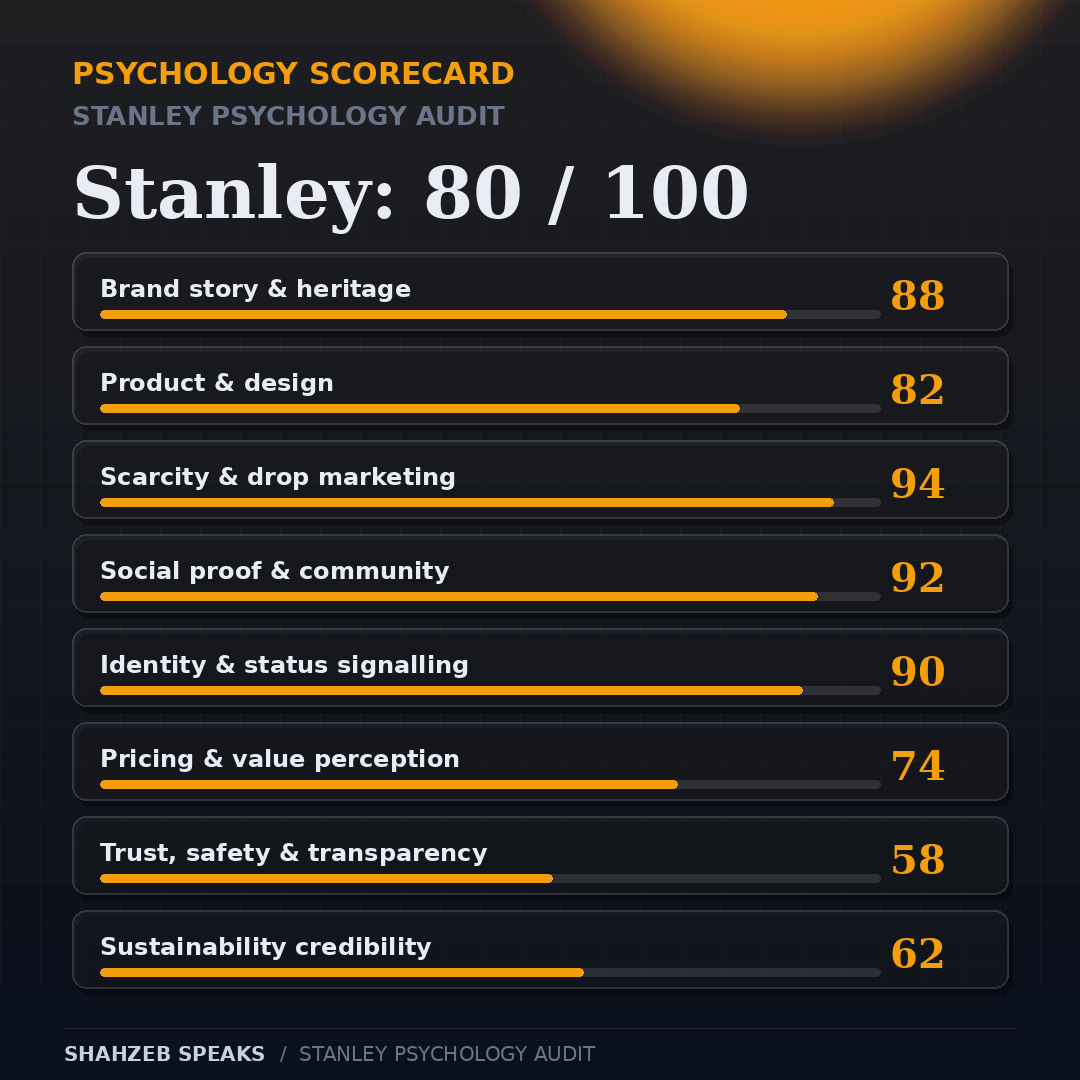
| Dimension | Score | Verdict |
|---|---|---|
| Brand story & heritage | 88 | A 112-year founder story that is real, and that the revival honoured rather than invented. |
| Product & design | 82 | Functional, car-cup-holder fit, daily-use design — dented by a 2.6 million mug recall. |
| Scarcity & drop marketing | 94 | The defining strength: limited colours, collaborations and “will not be restocked” as a system. |
| Social proof & community | 92 | A community-led revival and TikTok ubiquity no advertising budget could buy. |
| Identity & status signalling | 90 | The cup as accessory and collection: identity work, not hydration work. |
| Pricing & value perception | 74 | $45 signals premium, but resale inflation makes the value story fragile. |
| Trust, safety & transparency | 58 | Recall plus lead disclosure history; the 2026 dismissals close cases, not questions. |
| Sustainability credibility | 62 | A durable reusable product, undermined by a collecting culture that multiplies ownership. |
| Overall (rounded average) | 80 | 640 / 8 = 80 / 100. |
✅ Balance Sheet & Prescription
What Stanley does brilliantly: it turned a century-old utility product into an identity object through a community it did not create, then systematised that community’s behaviour into drops, collaborations and an accessory ecosystem. Its scarcity is disciplined, its social proof is genuine, and its price signals premium without apology.
What holds it back: trust and sustainability are the two dimensions where the psychology breaks. The disclosure history around lead and lids, and the collecting culture that contradicts the reusable claim, are not footnotes. They are the reason a brand with 94-point scarcity scores 80 overall rather than 90.
The prescription: three moves. First, disclose early and completely: publish what is inside the product, including the lead-seal construction, before a TikTok creator discovers it. Second, cap the collection trap: limit drops per customer, or publish the environmental arithmetic of owning one cup versus twenty. Third, protect the community that built the brand: the Buy Guide audience trusted women talking to women, and that trust is the asset. A brand that treats its community as a demand machine will eventually be treated by that community as one.
📝 Final Verdict
Stanley is the rare brand whose psychology deserves both admiration and caution in the same paragraph. It proved that a product nobody prioritised could become a cultural object when a community adopted it — and it proved that the same community will scrutinise disclosure failures with the intensity that only love produces. The 2026 dismissals closed two court cases. They did not answer the question the cases asked: when did the company know, and when did it tell its customers? Until a brand answers that question on its own timetable, its score will always carry an asterisk — and Stanley’s does.
Psychology Score: 80/100 — a masterclass in scarcity, identity and community, held back by trust and sustainability scores that its own disclosure history earned.
📬 Want a psychology audit of your brand?
If your product has a community you have not found yet, or a trust question you have not answered yet, the psychology is already at work — with or without you. Contact me and tell me which one you are facing.
Related audits: Crocs, Zara, Dyson. For the field behind this audit, see industrial psychology in Pakistan.
📚 References & Sources
- US Consumer Product Safety Commission (2024). Recall 25-063: Stanley Recalls 2.6 Million Switchback and Trigger Action Travel Mugs Due to Burn Hazard, 12 December 2024.
- Scherzi v. Pacific Market International LLC, No. 2:24-cv-02151 (W.D. Wash.): docket entries including 25 March 2026 order, 13 April 2026 notice, 30 September 2026 voluntary dismissal notice, 2 October 2026 termination.
- Bloomberg Law / Business Insurance (2026). Reporting on the 3 April 2026 dismissal with leave to amend in the Stanley lead litigation, Judge Tana Lin (W.D. Wash.).
- Stanley 1913 (company history page). Company claims: founded 1913 by William Stanley Jr.; Built For Life products.
- Marketing Dive / Retail Dive (2023–2024). Stanley Quencher viral success: Buy Guide history, 2019 sell-through, audience data, drop strategy, executive quotes.
- National Inventors Hall of Fame. Stanley Cups profile: Quencher 2016 launch; more than 10 million Quenchers sold since launch.
- CreatorIQ (2023). Earned podcast episode 111, Terence Reilly: car-fire video and response metrics, November 2023 earned media.
- HAVI Group / Business Wire (2021). HAVI Acquires PMI Worldwide, 1 September 2021.
- Manufacturing Dive (2025). Stanley Black & Decker sues drinkware maker over name (allegations only; outcome not verified).
- Cialdini, R. B. (1984/2021). Influence: The Psychology of Persuasion. Scarcity, social proof, reciprocity, unity.
- Belk, R. W. (1988). Possessions and the extended self. Journal of Consumer Research, 15(2), 139–168.
- Kivetz, R., Urminsky, O., & Zheng, Y. (2006). The goal-gradient hypothesis resurrected. Journal of Marketing Research, 43(1), 39–58.
- Zajonc, R. B. (1968). Attitudinal effects of mere exposure. Journal of Personality and Social Psychology, 9(2), 1–27.
- Kahneman, D., Knetsch, J. L., & Thaler, R. H. (1990). Experimental tests of the endowment effect and the Coase theorem. Journal of Political Economy, 98(6), 1325–1348.
- EWG (2024). News release: Lead use in popular Stanley tumblers sparks consumer concern, February 2024.
Key Findings
- Founded 1913 by William Stanley Jr. (company claim); maker Pacific Market International, acquired by HAVI Group in 2021; headquarters Seattle, Washington; official website stanley1913.com; PMI brands Stanley and Aladdin sold in over 60 countries
- Revenue about $70 million in 2019 to about $750 million in 2023, as reported by CNBC; more than 10 million Quenchers sold since the 2016 launch; Quencher 40 oz typically $45
- CPSC recall 25-063 announced 12 December 2024: about 2.6 million Switchback and Trigger Action mugs recalled in the US; 91 reports worldwide of lids detaching, 38 burn injuries worldwide, 11 requiring medical attention; the Quencher is NOT in this recall
- Scherzi case filed 27 December 2024 ALLEGING PMI knew of the lid defect and refused refunds; 30 September 2026 plaintiffs filed notice of voluntary dismissal; 2 October 2026 case terminated, dismissed with prejudice, each side bearing its own costs, NO settlement terms stated — NOT a settlement and NOT a trial win
- Lead case: consumers ALLEGED PMI concealed lead in tumblers; 3 April 2026 Judge Tana Lin DISMISSED the proposed class action WITH LEAVE TO AMEND, finding no 'specific and plausible risk of harm' shown — NOT a final with-prejudice dismissal at that date; later status NOT verified
- Trademark suit by Stanley Black & Decker filed February 2025 ALLEGING breach and infringement; outcome NOT verified and NOT claimed; no FTC enforcement action against PMI/Stanley was identified in this research
Overall Psychology Score
Stanley scores 80/100 in our comprehensive psychology audit covering consumer behavior strategies, UX design principles, and psychological marketing effectiveness.
The detailed dimension scores are in the audit's Psychology Scorecard chapter.
High impactMuhammad Shahzeb
MSc Industrial Psychologist, specializing in consumer behavior, UX psychology, and brand strategy analysis. Helping brands understand the psychology behind their success.
About Muhammad Shahzeb →