John Lewis Psychology Audit — Gloria and Pickles: The Cash, the Toy Dog and the Gran Cave
John Lewis's 20th Christmas advert follows Gloria, a grandmother who reaches for cash — until her childhood toy dog Pickles talks her out of it. A psychology audit of gift-giving, nostalgia and the Gran Cave, scored 81/100.

81 / 100
Overall consumer behavior effectiveness

Brand Overview
- Brand nameJohn Lewis
- Founded1864
- HeadquartersLondon, United Kingdom
- IndustryRetail
- Websitewww.johnlewis.com ↗
Psychology Techniques Identified
- 01Gift price asymmetry (Flynn & Adams 2009; givers expect expensive gifts to be more appreciated, receivers report no link)
- 02Requested vs thoughtful gifts (Gino & Flynn 2011; receivers prefer what they asked for)
- 03Nostalgia & self-continuity (Sedikides et al. 2015, 2016, 2018; Pickles restores connection across generations)
- 04Experiential advantage (Kumar, Killingsworth & Gilovich 2020; the Gran Cave as an experience, not a thing)
- 05Narrative transportation (Green & Brock 2000; three-minute film absorbs the viewer)
- 06Parasocial relationships (Horton & Wohl 1956; Kristin Scott Thomas, Paul Whitehouse)
- 07Mere exposure (Zajonc 1968; 20th Christmas ad, a familiar format made fresh)
- 08Social proof & norming (Cialdini 2001; 'Don't give up on giving' as a national call)
- 09Loss aversion (Kahneman & Tversky 1979; fear of getting the gift wrong, cash as the safe fallback)
- 10Peak-end rule (Kahneman et al. 1993; the Gran Cave reveal is the memory)
- 11Scarcity & authority (Cialdini 2001; Never Knowingly Undersold price-match against 25 retailers)
- 12Music-evoked emotion (Sam Fender cover, children's choir, Easington Colliery Band)
Full Psychology Audit Report
In this audit
It is Christmas Eve, and Gloria has done what millions of grandmothers do every year: she has put cash inside the Christmas cards, because she no longer trusts herself to choose a gift her grandchildren will love. Then the toy dog from her own childhood springs to life on the attic floor and tells her, in the voice of Paul Whitehouse, “You can do better than cash.” This John Lewis psychology audit asks whether a toy dog, a three-minute film and a room full of disco balls can restore a nation’s gift-giving confidence — and whether the 20th John Lewis Christmas advert deserves its place in the tradition it is trying to honour.
John Lewis is a British department-store chain founded in 1864, now the retail half of the John Lewis Partnership, the employee-owned business that has owned Waitrose since 1937 and employs more than 65,000 Partners. Its Christmas advert is the most watched advertising event in Britain: the 20th edition, “Gloria and Pickles”, premiered at 07:30 on 3 November 2026, stars Dame Kristin Scott Thomas, and is scored by a brand-new Sam Fender cover of a Rolling Stones classic. It arrived in a crowded Christmas season. Sibling brand Waitrose’s six-minute sequel “The Perfect Gift 2”, audited on this site on 11 November 2026, is the direct family rival, and Marks & Spencer’s “Home of Christmas” campaign, audited here on 9 November 2026, is the high-street rival. This audit asks what the film does to the mind of the viewer, why a grandmother reaches for cash, what a childhood toy does to memory, and whether a room called the Gran Cave is a gift at all. One honest limit up front: the film premiered nine days before this audit, so there is no independent sales or long-term effectiveness score for it yet. This audit scores the psychology of the film and the brand, not its outcome.
I am an Industrial and Organizational Psychologist in Karachi, and I audit brands by testing their claims against psychology research and their own public record. Where a legal matter is only an allegation or a filed claim, I keep it exactly that. Where a figure is a survey finding rather than a population fact, I will say so in the same sentence, not in a footnote. And where the company’s own record gives a proud employee-ownership story on one page and an upheld advertising ruling on another, I will show you both rather than pick the flattering one.
“John Lewis is not selling a toy dog in this film. It is selling the idea that the best gift is the one that proves you were paying attention — and that a grandmother who thinks she has run out of ideas still has the best one of all.”
— Brand Psychology Analysis, ShahzebSpeaks
📋 Brand Overview
| Field | Detail |
|---|---|
| Brand | John Lewis (John Lewis & Partners; John Lewis Partnership plc) — British department-store chain |
| Founded | 1864, as a small draper’s shop on Oxford Street, London |
| Headquarters | London, United Kingdom |
| Parent | John Lewis Partnership — employee-owned since 1929; the Partnership bought Waitrose in October 1937 (10 shops, 164 staff) |
| Stores & ownership | More than 65,000 Partners (employee-owners); Oxford Street flagship rebuilt in 1953 and the largest John Lewis store. No single shop count is printed here because the Partnership’s own sources disagree (see Chapter 1). |
| Current campaign | “Gloria and Pickles” — the 20th John Lewis Christmas advert, premiered 3 November 2026; tagline “Don’t give up on giving” |
| Website | https://www.johnlewis.com |
| Psychology score | 81/100 |
Sources: John Lewis Partnership press office; JLP jobs history; John Lewis Partnership full-year and half-year results. All figures as of 12 November 2026.
📜 Chapter 1: History — from a draper’s shop to the employee-owned Partnership
John Lewis began with one man and one small shop. In 1864, John Lewis opened a draper’s shop on Oxford Street in London, and took 16s 4d — 82p in today’s money — on his first day. It was a modest start for a business that would become one of Britain’s best-known retailers. The first great expansion came in 1905, when John Lewis acquired Peter Jones in Sloane Square, the shop where, twenty years later, his son John Spedan Lewis would devise the price promise that still defines the brand. The decisive turn, though, was not a purchase but a gift. On 18 April 1929, Spedan Lewis signed the First Trust Settlement, transferring his shares in John Lewis Ltd, Peter Jones Ltd and the Odney Estate to trustees on behalf of the Partners — the people who worked in the business. A Second Trust Settlement followed on 26 April 1950, giving the Partnership to the people who work in it. John Lewis has been employee-owned since 1929, and every member of staff is still a Partner, a co-owner of the business, rather than an employee of a distant shareholder.
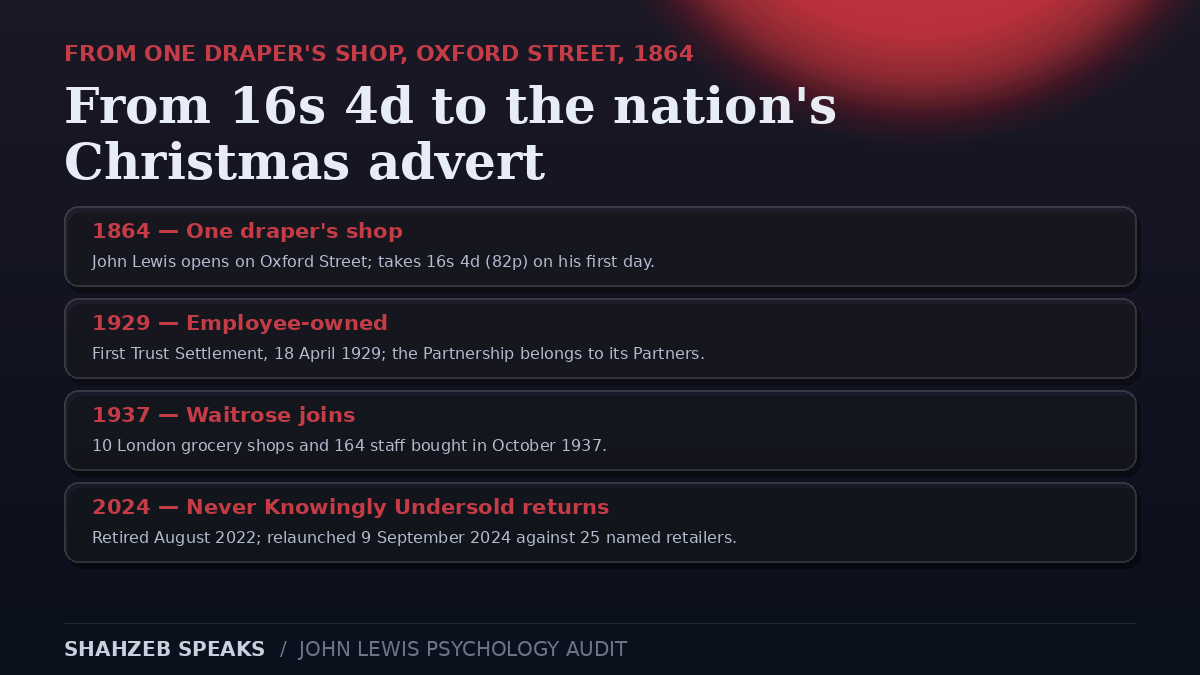
The Partnership grew by buying businesses that shared its character. In October 1937 it bought Waitrose Ltd, then 10 London grocery shops with 164 staff — the purchase that made the Partnership a two-brand business and the reason Waitrose and John Lewis still share a Christmas season, and a Christmas audit, today. The Oxford Street flagship, the largest John Lewis store, was rebuilt in 1953 after wartime bomb damage. The price promise came earlier still: “Never Knowingly Undersold” was devised by Spedan Lewis in 1925 at Peter Jones, honoured for nearly a century until it was retired in August 2022 and replaced by a general commitment to competitive value on own-label merchandise. It returned on 9 September 2024, relaunched to price-match thousands of products against 25 named retailers including Amazon, M&S, Next, Asos, Selfridges and Harvey Nichols, with customers given 7 days to claim a refund of the price difference. The promise is a psychological device as much as a commercial one: it tells the shopper that the brand has already done the comparing for them, and it is the subject of Chapter 8.
The recent chapter has been one of new leadership and heavy spending. Jason Tarry became the seventh Chairman of the John Lewis Partnership in September 2024, after six years as Tesco’s UK & Ireland chief executive and 33 years at Tesco. Dame Sharon White stepped down at the end of her term in September 2024 after a five-year tenure, the shortest chairmanship in the Partnership’s history. Tarry now combines the roles of chairman and chief executive following the departure of Nish Kankiwala, whose chief executive position was scrapped. Peter Ruis is executive director — managing director — of John Lewis, having returned at the start of 2024. Behind them sits a £800m multi-year estate transformation programme, with £50m invested in five stores in 2026 — Glasgow, Cambridge, Leicester, Reading and Liverpool — and the Glasgow redevelopment alone costing more than £20m, with phased work running to spring 2027. One honest limit belongs in this chapter, because it shows how carefully this audit treats numbers: the Partnership’s own sources disagree on how many John Lewis shops there are. The John Lewis plc Annual Report & Accounts 2026 states 36 John Lewis stores; the Partnership’s full-year results announcement of March 2026 states that John Lewis operates 34 shops across the UK. Until that discrepancy is resolved, this audit prints neither figure as a fact. A brand that has survived 162 years does not need a disputed count to prove its scale.
🎬 Chapter 2: Gloria and Pickles — the film itself
“Gloria and Pickles” is the 20th John Lewis Christmas advert, and it knows it. The campaign, titled “Gloria and Pickles” with the tagline “Don’t give up on giving”, was created by Saatchi & Saatchi, directed by Lucy Forbes — the BAFTA-winning director known for This Is Going to Hurt and Eric — through the production company Smuggler. It is a three-minute film, and it premiered at 07:30 on 3 November 2026 on John Lewis channels including johnlewis.com, YouTube and Instagram. Its television debut came the same evening, in Coronation Street on ITV between 8:30 and 9pm and in The Great British Bake Off on Channel 4 between 8 and 9:15pm, followed by ITV, Sky, Channel 4, broadcaster video on demand and subscription video on demand including Netflix, Prime Video and Disney+, with social activity across Meta, TikTok, YouTube, Reddit, Pinterest and Snapchat. A Christmas advert that opens on a Tuesday morning and closes the evening in the two biggest shows on British television is not hoping to be noticed. It is planning to be.
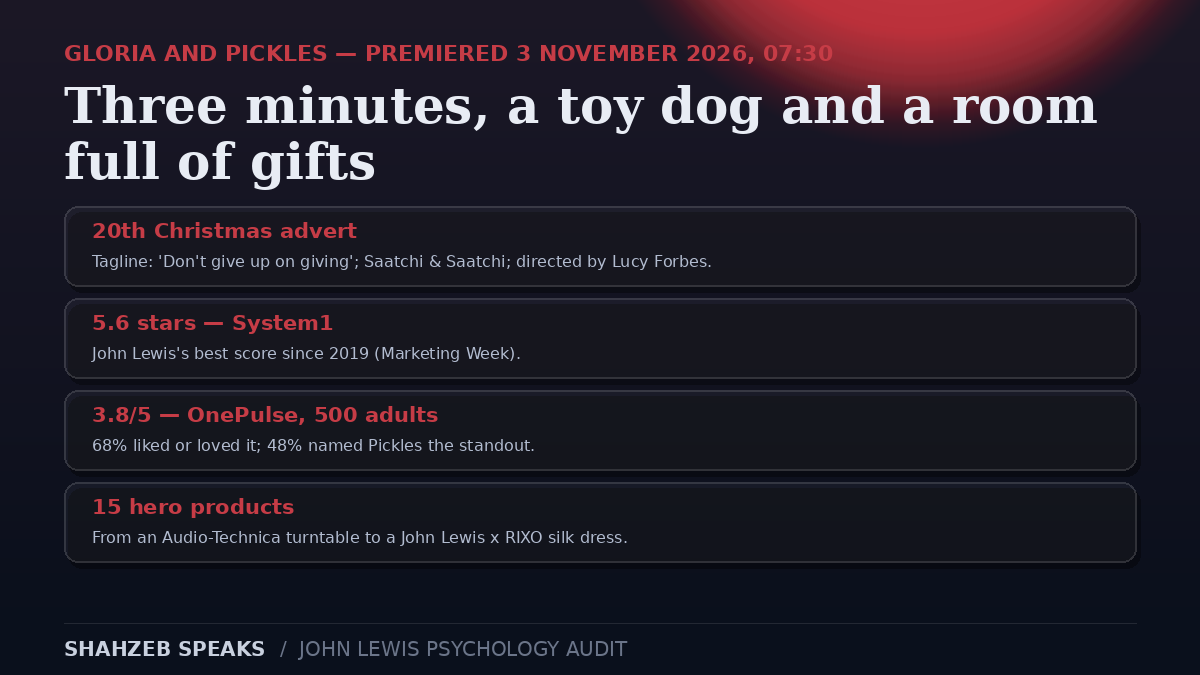
The cast is the campaign’s first argument. Dame Kristin Scott Thomas — Oscar-nominated, BAFTA-winning — plays Gloria, a grandmother who has lost confidence in her gift-giving. Paul Whitehouse voices Pickles, a vintage Little Snoopy pull-along toy who was Gloria’s own childhood gift. Pickles is based on the Fisher-Price Little Snoopy Pull-Along Toy, introduced in 1966, which makes the toy itself older than most of the audience’s parents: a deliberate choice, as Chapter 5 explains. The soundtrack is the campaign’s second argument. Sam Fender recorded a brand-new cover of the Rolling Stones’ “You Can’t Always Get What You Want”, his first new music since “Rein Me In”, re-recording the children’s choir with pupils from his old school, John Spence Community High School, and arranging a brass section with the Easington Colliery Band. The song’s title is the film’s thesis in eight words: you cannot always get what you want, but sometimes you get what you need — and what Gloria’s grandchildren need is not cash.
The plot, from the Partnership’s own account, runs like this. It is Christmas Eve. Gloria welcomes her daughter, son-in-law and grandchildren Freddie and Maggie, then retrieves her old toy collection from the attic. The children are distracted, and alone, she puts cash in their Christmas cards, doubting her ability to choose a gift they will love. Then Pickles springs to life and says, “You can do better than cash.” A tuk-tuk ride through London sparks a gifting epiphany, and on Christmas morning the envelopes are empty and a single key opens the “Gran Cave” — a room of sparkling lights, disco balls and music — bridging the generational gap. The campaign sits inside a wider all-year-round gifting push, including the newly launched Gift List vodcast with Angela Scanlon and the newly opened Box Studio in the Oxford Street flagship store. Fifteen hero products are woven through the film, including an Audio-Technica turntable and a John Lewis x RIXO silk dress — the count is verified, the full list is not, and this audit does not print one. Physical copies of the Sam Fender single are available on 7-inch vinyl and CD from the John Lewis website, with all John Lewis profits donated to Action for Children, expected to be at least £18,000 in total, and Sam Fender’s store sales profits going to Teenage Cancer Trust. Rosie Hanley, Marketing & Loyalty Director, put the message in one sentence: “our message this year is simple: ‘Don’t give up on giving.’ We hope this restores the nation’s gift-giving confidence.” The previous year’s campaign was “Where Love Lives”, a father-and-son story also created by Saatchi & Saatchi. The question this audit must answer is whether the 20th film restores confidence, or simply borrows it from the nineteen that came before.
💸 Chapter 3: The price of a gift — why Gloria reaches for cash
Gloria’s first mistake is the one most of us make. She assumes that a more expensive gift will be more appreciated, and that a cheap gift — or worse, cash — will be read as a lack of care. Flynn and Adams (2009), in “Money can’t buy love: Asymmetric beliefs about gift price and feelings of appreciation”, published in the Journal of Experimental Social Psychology, 45(2), 404–409, showed that this assumption is wrong in a precise and measurable way. Across three studies, including engagement rings and birthday gifts, givers expected more expensive gifts to be more appreciated than less expensive ones. Receivers reported no link at all between price and appreciation. The giver’s logic is that price signals thoughtfulness: spending more must mean caring more. The receiver’s logic is different. Once a gift is in their hands, its price stops mattering, and what matters is whether the gift fits them. Gloria is caught in exactly this asymmetry. She cannot afford — or cannot find — the expensive gift she imagines her grandchildren want, so she retreats to cash, which is the most expensive-looking safe option and the least thoughtful-feeling one. The film’s opening is a small portrait of a well-documented error: the giver overthinks the price, and the receiver never cared about it in the first place.
Cash is the giver’s escape hatch, and it has a psychology of its own. Cash says: I trust you to choose better than I can. It also says: I have given up choosing. Both messages are true at once, which is why cash feels so awkward as a gift. It removes the risk of getting it wrong, and it removes the proof that you tried. Gloria’s envelopes are not lazy; they are frightened. She has watched her grandchildren grow up in a world she does not fully understand, she has seen them distracted by screens and by each other, and she has concluded that her taste no longer matches theirs. Flynn and Adams would tell her that her fear is misplaced in one way and accurate in another. Misplaced, because the price of the gift was never the test. Accurate, because the gift still has to fit — and fit is about attention, not money. Pickles exists to teach her the second half of that lesson.
🎁 Chapter 4: Asked-for beats thoughtful — the awkward truth
Here the advert’s message meets a complication the advert does not mention. “Don’t give up on giving” sounds like a defence of the thoughtful gift over cash. The research says the story is more awkward than that. Gino and Flynn (2011), in “Give them what they want: The benefits of explicitness in gift exchange”, published in the Journal of Experimental Social Psychology, 47, found that receivers appreciate a gift they explicitly requested more than an unrequested “thoughtful” gift — and that givers predict the opposite. Givers overestimate how much thoughtfulness matters, and underestimate how much getting what the person actually wants matters. Gino, Flynn and colleagues (2012), in “Exaggerated, mispredicted, and misplaced: When ‘it’s the thought that counts’ in gift exchanges”, published in the Journal of Experimental Psychology: General, 141(4), 667–681, went further: “it’s the thought that counts” is systematically miscalibrated. Receivers only appreciate a giver’s thoughts when they are triggered to consider them — for example, after receiving a bad gift. Givers mispredict when thoughts count. And thoughtful gifts increase the giver’s sense of social connection, even when they do not increase the receiver’s appreciation by the same amount.
That is an uncomfortable finding for a film built on the idea that cash is the enemy. If Freddie and Maggie had asked for something specific, the research says the best gift Gloria could give them is exactly what they asked for — even if it feels unromantic, even if it looks like a shopping list rather than a gesture. Cash, in that light, is not the opposite of thoughtfulness. It is a clumsy version of explicitness: a gift that says, get what you want. The film’s answer is that cash is still worse than a thoughtful gift, and on the film’s own terms it is right — but only because Gloria never asks. The grandchildren never tell her what they want, and she never asks them. The Gran Cave works as a gift because it is built from attention: Gloria has watched, listened and remembered, and the room is the proof. The research would add a footnote the film leaves out. The fastest route to a gift that lands is not always a grand gesture. Sometimes it is a simple question, asked early and taken seriously. The ad’s anti-cash message is only half the story, and the half it leaves out is the one that would have helped Gloria most.
🧸 Chapter 5: Nostalgia — the toy that remembers for her
Pickles is not a toy. Pickles is a memory with a pull-string. The toy is a vintage Little Snoopy pull-along, based on the Fisher-Price toy introduced in 1966, which means it belonged to Gloria when she was a child, and it carries sixty years of her life inside a small wooden dog. That is the film’s most powerful piece of psychology, and it is the one the research supports most strongly. Sedikides, Wildschut, Routledge, Arndt, Hepper and Zhou (2015), in “To nostalgize: Mixing memory with affect and desire”, published in Advances in Experimental Social Psychology, 51, describe nostalgia as a self-conscious, bittersweet but predominantly positive and fundamentally social emotion. It serves a self-oriented function, raising self-positivity; an existential function, increasing perceptions of life as meaningful; and a sociality function, increasing social connectedness, reinforcing socially oriented action and promoting prosocial behaviour. Nostalgia is not homesickness. It is a resource, and Gloria draws on it at the exact moment she needs it.
Sedikides and Wildschut (2018), in “Finding meaning in nostalgia”, published in the Review of General Psychology, 22(1), 48–61, showed that nostalgia helps people find meaning in life primarily by increasing social connectedness — belongingness and acceptance — and secondarily by augmenting self-continuity, the connection between past and present selves. Sedikides, Wildschut, Cheung, Routledge, Hepper, Arndt and Vail (2016), in “Nostalgia fosters self-continuity”, published in Emotion, 16(4), 524–539, tested the mechanism across six experiments: nostalgia fosters self-continuity through social connectedness, and self-continuity in turn confers eudaimonic well-being. Pickles does all three jobs at once. He reconnects Gloria to her own childhood, which restores her sense of who she is. He reconnects her to her grandchildren, by giving her a shared object to talk about across the generations. And he restores her continuity: the girl who once pulled a wooden dog along the floor is the same person as the grandmother standing in the attic, and the gift she gives now is continuous with the gift she once received. That is why the toy works where a new purchase would not. A new toy would be a thing. Pickles is a bridge, and the film is right to make him the hero rather than the wrapping paper.
🪩 Chapter 6: The Gran Cave — an experience, not a thing
The Gran Cave is the film’s best idea, and it is also its most researched one. On Christmas morning the envelopes are empty and a single key opens a room of sparkling lights, disco balls and music — a room Gloria has built for her grandchildren, rather than a present she has bought for them. Kumar, Killingsworth and Gilovich (2020), in “Spending on doing promotes more moment-to-moment happiness than spending on having”, published in the Journal of Experimental Social Psychology, 88, 103971, found that experiential purchases — travel, entertainment, meals out — produce greater moment-to-moment happiness than material purchases, in prospect and in retrospect, and that happiness was higher for all experiential categories than for all material categories across two large experience-sampling studies. Van Boven and Gilovich (2003), in the seminal finding on the experiential advantage, showed that people derive more happiness from experiences than from possessions, partly because experiences are harder to compare with what others have and are more often shared and talked about. The Gran Cave is an experience in the purest sense: it cannot be wrapped, it cannot be compared with a cousin’s present, and its value is in the hours the family spends inside it together.
That is also why the ending rescues the film from its own commercial logic. Fifteen hero products are woven through the film, and a department store’s Christmas advert must, in the end, sell things. But the gift that matters most in the story is not a thing at all. It is a room, a key and an invitation. The research says that is the gift most likely to be remembered, and the film knows it: the final image is not a product shot but a family in a room full of light. The risk is that the Gran Cave is also a fantasy most grandmothers cannot build. A room of disco balls and sparkling lights takes space, money and time, and the film never shows the work of building it. That is a fair criticism, and it is the film’s one soft spot. But the psychology is sound even if the logistics are not. What Gloria gives is time, attention and a shared experience, and the evidence says those are the gifts that last longest in memory. The envelope was empty. The room is full. That contrast is the whole film.
🎤 Chapter 7: Casting and music — the famous faces do the persuading
John Lewis has always cast its Christmas adverts like films, and this one is cast like a prestige drama. Horton and Wohl (1956), who coined the term parasocial interaction, described the one-sided intimacy audiences form with media figures: viewers respond to a performer as if they knew them, and the relationship feels real even though it is not returned. Dame Kristin Scott Thomas brings that intimacy with her. She is Oscar-nominated and BAFTA-winning, a face the audience has trusted for decades, and she plays Gloria without glamour — a grandmother in her own home, worried about getting Christmas wrong. Paul Whitehouse brings a different kind of familiarity: a beloved comic voice, instantly recognisable, now attached to a toy dog. The pairing works because the parasocial bond runs in two directions. Scott Thomas invites the viewer to care about Gloria as a person. Whitehouse invites the viewer to laugh with Pickles as a friend. Between them, they carry a film that has only three minutes to make the audience feel something.
The music does the same work in a different register. Sam Fender’s cover of the Rolling Stones’ “You Can’t Always Get What You Want” is his first new music since “Rein Me In”, and it arrives with its own story: a children’s choir re-recorded with pupils from his old school, John Spence Community High School, and a brass section arranged with the Easington Colliery Band. The song’s title is the film’s argument, and the choir is its proof — a famous singer going back to his own school to make something new from something old, exactly as Gloria goes back to her attic to do the same. Green and Brock (2000), in their work on narrative transportation, showed that when people are absorbed into a story, they stop arguing with it: transportation lowers counter-arguing and transfers the beliefs of the story to the world outside it. A familiar voice, a familiar song and a familiar face are the fastest route into that absorption. And this is the 20th John Lewis Christmas advert, which brings Zajonc’s (1968) mere exposure effect into play: people tend to develop a preference for things simply because they are familiar with them, and repeated exposure, on its own, increases liking. Twenty years of Christmas adverts have made the John Lewis film itself a familiar object, and familiarity is doing some of the persuading before the first frame plays. The risk is that familiarity can curdle into expectation. An audience that knows the formula — the slow build, the famous face, the emotional turn — can start to watch for the formula instead of the story. This film mostly escapes that trap, because Pickles is genuinely strange, and strangeness is the one thing a formula cannot fake.
🏷️ Chapter 8: The commercial machine behind the magic
Behind the toy dog sits a commercial machine, and this audit would be dishonest if it pretended otherwise. The price promise is the oldest part of it. “Never Knowingly Undersold”, devised in 1925, retired in August 2022 and returned on 9 September 2024, now price-matches thousands of products against 25 named retailers including Amazon, M&S, Next, Asos, Selfridges and Harvey Nichols, with customers given 7 days to claim a refund of the price difference. It is a trust device: it tells the shopper that John Lewis has already checked the price, so the shopper does not have to. The Christmas campaign is the newest part of it. Fifteen hero products are woven through the film, including an Audio-Technica turntable and a John Lewis x RIXO silk dress, and the wider gifting push includes the Gift List vodcast with Angela Scanlon and the Box Studio in the Oxford Street flagship store. A viewer who loves the film can buy the film, piece by piece, which is the point. The charity tie-ins soften the selling: physical copies of the Sam Fender single on 7-inch vinyl and CD, with all John Lewis profits donated to Action for Children and expected to be at least £18,000 in total, and Sam Fender’s store sales profits going to Teenage Cancer Trust.
The financial backdrop is mixed, and the film arrives in a difficult year. For the full year 2025/26, the 53 weeks ended 31 January 2026, Partnership sales were £13.4bn, up 5% year on year, with profit before tax, Partnership Bonus and exceptional items of £134m, up 6% — but a statutory pre-tax loss of £21m after £120m of exceptional charges, largely non-cash write-downs of legacy technology systems. Waitrose sales were £8.5bn, up 7%, while John Lewis sales were £4.9bn, up 3%, with an adjusted operating profit of £58m. The 2% Partnership Bonus — one week’s pay — was the first bonus since 2022. The half year to 1 August 2026 was harder: Partnership sales of £6.3bn, up 2%, with a pre-tax loss of £124m; John Lewis sales of £2.0bn, down 2%, with an adjusted operating loss of £83m. Chair Jason Tarry’s own words frame the second half as the test: “the majority of our profit is earned in the second half, so our focus now is on serving customers brilliantly through our peak trading period.” Christmas, in other words, is not a celebration for this business. It is the season the year’s profit depends on, and this advert is the instrument chosen to win it. That does not make the film cynical. It makes it load-bearing, and the score in Chapter 9 should be read with that weight in mind.
📣 Chapter 9: Reception — loved, and loudly disliked
The reception to “Gloria and Pickles” was warm in the testing and divided in the press, and both halves of that sentence matter. System1 awarded the film 5.6 stars — John Lewis’s best result since 2019, as reported by Marketing Week — which is a strong independent score for a film that had to follow nineteen predecessors. A OnePulse survey of 500 UK adults on launch day, 3 November 2026, rated the advert 3.8 out of 5, with 68% saying they liked or loved it and 48% naming Pickles the dog as the standout. The same survey found that 85% of those surveyed said they had given cash instead of a gift — a survey claim about 500 people on one day, not a population statistic, and this audit prints it only as such. On the commercial question, 58% of respondents said the advert would make no difference to their shopping habits at John Lewis, against 36% who said they were more inclined to visit. That split is the honest headline of the launch: loved by most, decisive for only a minority.
The backlash was loud, and it was aimed at the grandchildren. Columnist Sarah Vine called the children “spoilt, entitled, rude and overindulged”. Piers Morgan said the film was possibly the worst advert he had seen. GB News presenter Alex Armstrong called it “horrendous” and criticised the portrayal of the grandchildren. Kantar’s Lynne Deason said the advert lacks the emotional pull of earlier campaigns. AdRanking, which gave the film its highest score of the 2026 season for the sharpest strategy in years, still called it “busier than it needs to be” and said the ending “swaps one perfect present for a room full of products”. The criticism has a point. The grandchildren are written as distracted and ungrateful for most of the film, and a viewer who dislikes them will struggle to care whether Gloria’s gift lands. The “busier than it needs to be” charge also lands: a tuk-tuk ride, a toy dog, a choir, a brass band, fifteen hero products and a disco room are a great deal to fit into three minutes. But the division itself is revealing. A Christmas advert that nobody dislikes is usually a Christmas advert nobody remembers. This one was loved, disliked and argued about on its first day, which is a better fate than being ignored.
⚠️ Chapter 10: Dark side & regulatory record — exactly what is known
Every legal statement in this chapter is written at its exact status, as of 12 November 2026. An upheld ruling is an upheld ruling. A withdrawn advert is a withdrawn advert, not a ban. A filed claim is a filed claim, not a judgment. A failed opposition is a failed opposition, not a win. I have scoped this chapter to the record types actually checked: the ASA rulings database, FCA action via reputable press, UK High Court cases via reputable press, UKIPO trade mark decisions, the CMA via press only, HMRC and BEIS minimum-wage naming, one Employment Tribunal judgment, and county-court reporting via press. The names searched separately were “John Lewis”, “John Lewis plc”, “John Lewis Partnership” and “John Lewis & Partners”. What follows is what those searches found — and, at the end, what they did not cover.
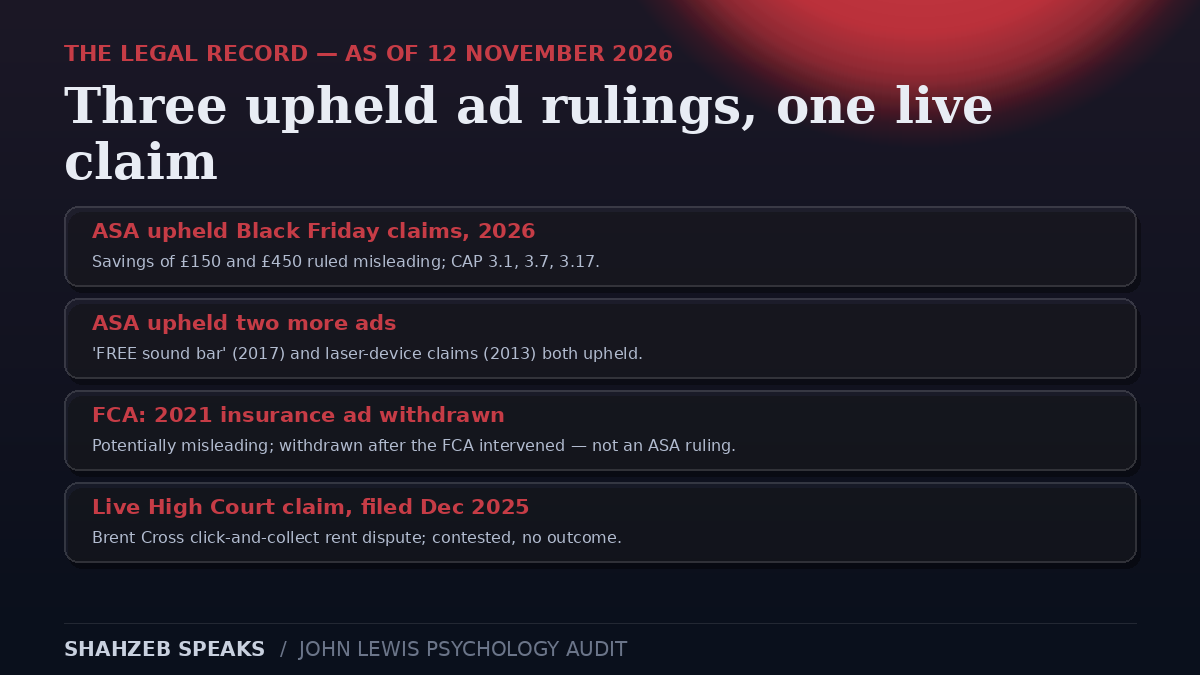
The advertising record is the most serious part, and the most recent item in it is also the clearest. In ASA ruling A26-1326172, published in 2026, the Advertising Standards Authority considered John Lewis plc’s Black Friday price promotions, seen on 12 and 13 November 2025. The claims were “Save £150” on a MacBook Air, in a Facebook advert, and “Save £450” on an ASUS Zenbook, in a display advert. Both issues were upheld. The adverts were misleading, breaching CAP Code rules 3.1 on misleading advertising, 3.7 on substantiation and 3.17 on prices, and the ruling states that “the ads must not appear again in the form complained of”. John Lewis was told to ensure that future savings claims did not mislead and were substantiated against the usual selling price. This is a real upheld ruling, from this year, about the exact kind of claim — a saving against a price — that a Christmas shopper is most likely to trust. It is also the reason the return of “Never Knowingly Undersold” matters: a brand that promises it will not be beaten on price must be able to prove the prices it prints.
Two older ASA rulings complete the advertising record. On 12 July 2017, the ASA upheld a complaint about a John Lewis Partnership plc advert offering a “FREE LG SH7 sound bar” with an LG TV priced at £1,999, seen on 15 February 2017. The television had previously been sold at £1,749 without the sound bar, and its price rose when the sound bar was added. The ruling was upheld, breaching CAP Code rules 3.1 and 3.24.2 on “free” claims, and the ASA ruled that “the ad cannot appear again in this form”. On 18 December 2013, the ASA upheld a ruling against John Lewis Partnership plc over claims about a laser skin device, finding that the evidence for the claims was not sufficiently robust. Three upheld rulings, across thirteen years, all about the same failure: a claim printed before it was properly proved. That is a pattern worth naming, even though the oldest of the three is now more than a decade old.
The 2021 home-insurance advert is the item most often misdescribed, so it needs the most care. The “Let Life Happen” home-insurance advert ran from 11 to 27 October 2021 and was withdrawn on 27 or 28 October 2021 after the Financial Conduct Authority intervened. The FCA considered the advert potentially misleading because it implied that accidental damage cover would pay for deliberate damage by a child, which the policy does not cover. John Lewis said: “This advert has been withdrawn because the Financial Conduct Authority considers the content to be potentially misleading.” No ASA ruling was issued — the FCA acted before the ASA could launch an investigation — so this was not an ASA ban, and this audit will not call it one. About 380 to 400 complaints had been made to the ASA, mostly about the depiction of a boy in a dress rather than the insurance point. John Lewis contacted customers who had bought the cover between 11 and 31 October 2021 to confirm their understanding. The distinction matters: a regulator intervening and a brand withdrawing is a serious matter, but it is a different matter from a formal upheld ruling, and the two should never be confused.
The live court record is a single claim, and it has no outcome. In December 2025, Hammerson and Standard Life Investments, now Aberdeen, filed a High Court claim against the John Lewis Partnership over turnover rent at Brent Cross. The claimants seek a declaration that click-and-collect sales should count as “gross receipts” under a 125-year turnover lease agreed in 1979, with a base rent of £30,000 a year plus 0.75% of gross receipts above £4m and 1% above £10m, plus backdated rent, interest and costs since 2013. John Lewis is contesting the claim, arguing that click-and-collect transactions are completed when goods are dispatched from its distribution centre, not at collection. The claim is ongoing, no trial date had been set as of April or May 2026, and no judgment had been found as of 12 November 2026. There is no winner, no fine and no settlement to report, and this audit will not imply one.
The employment and pay record has one naming and one judgment. On 4 August 2021, HM Revenue & Customs and the Department for Business, Energy & Industrial Strategy named the John Lewis Partnership for failing to pay the National Minimum Wage to 19,392 employees, with £941,355 owed, for breaches between 2011 and 2018 — the largest amount in a list of 191 employers owing £2.1m to more than 34,000 workers. The arrears were repaid. John Lewis said it was a “technical breach” caused by smoothing variable pay so that Partners receive the same amount each month, and that it “has been fixed and which we ourselves made public at the time”. One figure must not be attached to this item: the named employers were fined an additional £3.2m in total across all 191 companies, and that figure must not be attributed to John Lewis alone. In the Employment Tribunal, Wijeyanathan v John Lewis Plc, case number 2300041/2022, heard on 7 October 2022 with a reserved judgment on 23 November 2022, a former Unit Manager at Waitrose Battersea claimed unfair dismissal and wrongful dismissal after being dismissed without notice on 29 August 2021 for alleged gross misconduct. Both claims were dismissed — “not well-founded” — and the Tribunal found the respondent was entitled to terminate without notice for gross misconduct.
The competition and trade mark records pull in opposite directions, and both must be stated plainly. On competition, the CMA matter concerns Waitrose, not John Lewis trading: restrictive covenants in some Waitrose land deals prevented rival supermarkets from opening nearby, in breach of the Groceries Market Investigation (Controlled Land) Order 2010. Waitrose agreed to remove the restrictions. No fine and no punishment followed — the CMA had no power to fine supermarkets for the anti-competitive clauses. On trade marks, the record is a loss, and it must not be dressed up as a win. In UKIPO decision O/0617/25, dated 7 July 2025, John Lewis PLC opposed two applications by Claudio Luiz De Almeida Harris — a “Lewis logo” and “LEWIS MAGAZINE” — under sections 5(2)(b) and 5(3) of the Trade Marks Act 1994, relying on earlier JOHN LEWIS marks. Both oppositions failed. The decision states: “The opposition to the Lewis logo (Application No. 3698627) has failed. Subject to a successful appeal, the application may proceed to registration.” The same applied to the Lewis Magazine mark, and the applicant was entitled to a contribution towards costs. The older trade mark case went the other way. In UKIPO decision O/180/98, dated 9 September 1998, John Lewis Plc opposed Napa Products Ltd’s JUMELLE mark under sections 5(2)(b) and 5(4)(a), based on John Lewis’s JONELLE mark. The opposition was successful under section 5(2)(b) on likelihood of confusion, with no formal finding under section 5(4)(a). Finally, a county-court case reported in 2014, from around 2013 to 2014, saw Roddy Mansfield claim that John Lewis had wrongly added him to email marketing lists without opt-in after he registered on the Waitrose website to check delivery, challenging a pre-ticked box and the “soft opt-in” argument. The court found in the claimant’s favour and John Lewis was ordered to pay damages; the court rejected the soft opt-in argument, holding that prospective customers must positively opt in. The damages amount was not stated in the source found.
Two limits must be stated plainly, because they are the difference between an honest chapter and a misleading one. First, the CMA’s own case register was searched via press only, not directly, and Companies House filings were not searched at all, so this chapter does not claim a clean CMA record and does not print any unqualified statement that no case was found. Second, “John Lewis of Hungerford Limited”, a furniture company, is a different company from John Lewis plc, and its record — including a 2000 trade mark decision — has been excluded from this chapter entirely. The honest reading of the record is that John Lewis’s legal history is real but modest: three upheld advertising rulings, one withdrawn advert after regulator intervention, one live court claim with no outcome, one minimum-wage naming with the arrears repaid, one dismissed tribunal claim, one trade mark loss and one trade mark win, and one county-court loss over email marketing. None of that makes the Christmas film worse. It makes the brand behind it a real company, with a real record, rather than a fairy tale set in a Gran Cave.
🇵🇰 Chapter 11: What Pakistani brands should — and shouldn’t — copy
Pakistani brands should copy three things. First, the single emotional idea. John Lewis’s Christmas campaign is one film, one idea — don’t give up on giving — and one toy dog, expressed across television, video on demand, social media and the shop floor. A Pakistani brand with a strong seasonal moment — Eid, Ramadan, a wedding season — should build one idea and run it everywhere, rather than running five ideas that cancel each other out. Second, nostalgia with a real object at its centre. Pickles works because the toy is real, old and specific: a 1966 Fisher-Price pull-along, not a generic symbol of childhood. A Pakistani brand has richer material than John Lewis does — a grandmother’s recipe book, a father’s old radio, a childhood toy from a bazaar stall — and it should name the object, show its age and let the audience recognise it, rather than filming a generic happy family. Third, the experience over the thing. The Gran Cave is the gift that matters most in this film, and it is not a product. A Pakistani brand selling food, fabric or furniture should ask what experience it can give — a family meal, a room prepared for guests, a moment made for someone — rather than only showing the product on a shelf.
What they should not copy is the cash-versus-thoughtfulness trap, or the loose claim. The research in Chapter 4 says the best gift is often the one the person asked for, and a Pakistani brand that tells its customers that cash is lazy will be telling them something the evidence only half supports. A better message is the one Gloria actually learns: pay attention, ask what they want, and give them the experience of being known. Nor should they copy the price-claim habit. John Lewis has three upheld ASA rulings, all about claims printed before they were properly proved, and the newest one is from this year, about a Black Friday saving. A Pakistani brand that prints a saving, a “free” offer or a “lowest price” claim should be able to prove it on the first day, because the regulator and the press will ask on the second. And they should not copy the premium-only trap. John Lewis is a premium department store whose retail sales grew only 3% in 2025/26 and fell 2% in the first half of 2026/27, with an adjusted operating loss of £83m in that half. A beautiful Christmas film is not a business model. A Pakistani brand should copy the storytelling, and then make sure the business behind the story can carry it.
📊 Psychology Scorecard — the John Lewis psychology audit in numbers
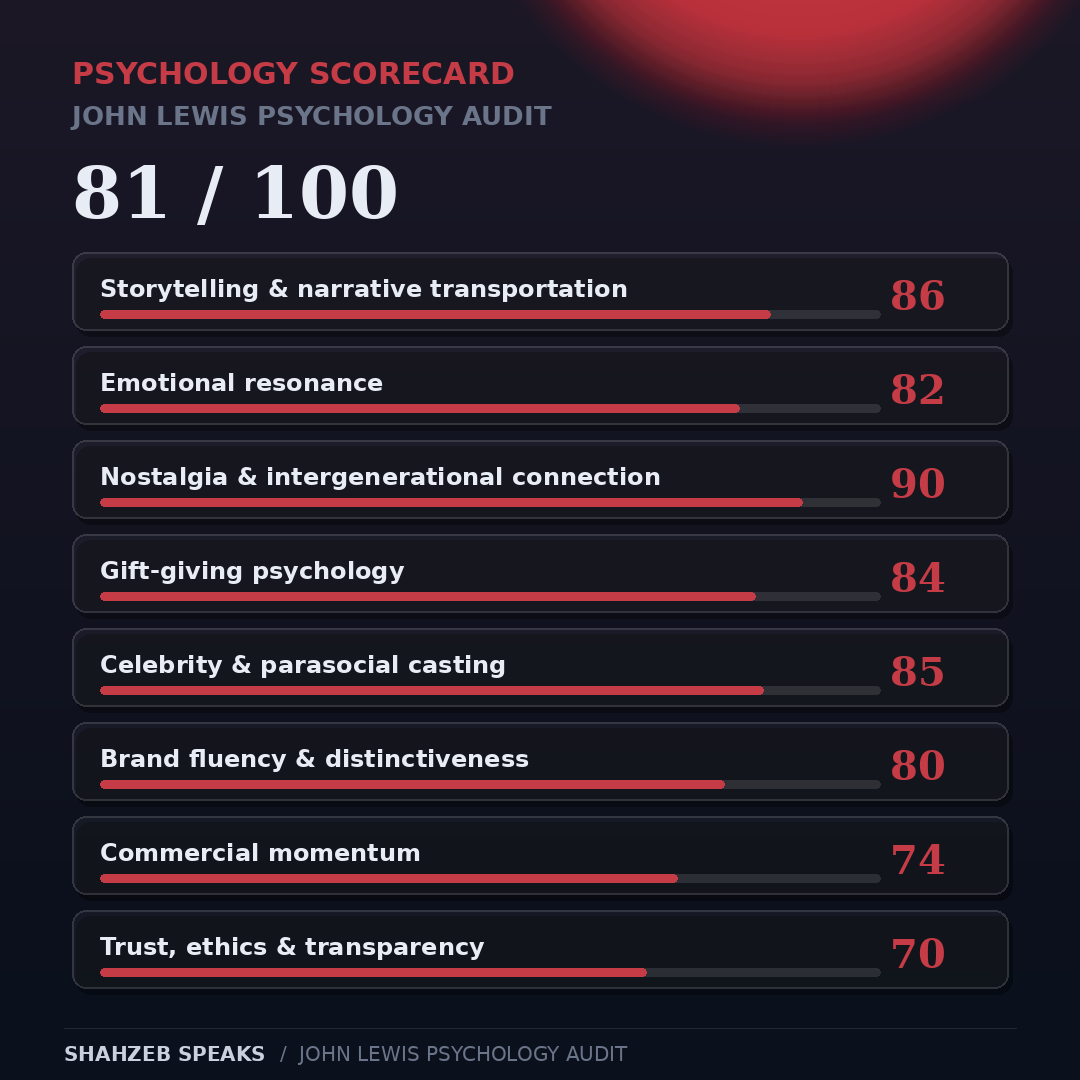
| Dimension | Score | Verdict |
|---|---|---|
| Storytelling & narrative transportation | 86 | A three-minute film with a clear arc — cash, a talking toy, a tuk-tuk ride and a locked room — but busier than it needs to be. |
| Emotional resonance | 82 | System1 gave it 5.6 stars, the best since 2019, yet Kantar’s Lynne Deason said it lacks the emotional pull of earlier campaigns. |
| Nostalgia & intergenerational connection | 90 | Pickles is the film’s best idea: a 1966 toy that restores self-continuity and social connectedness across generations. |
| Gift-giving psychology | 84 | The price-asymmetry insight is exact, but the anti-cash message is only half the story — asked-for gifts beat thoughtful ones. |
| Celebrity & parasocial casting | 85 | Scott Thomas and Whitehouse carry the film, and Fender’s choir-and-brass cover ties the song to the story. |
| Brand fluency & distinctiveness | 80 | The 20th advert in a familiar tradition — distinctive, but the formula is now visible to the audience. |
| Commercial momentum | 74 | Fifteen hero products, a vodcast and a Box Studio, but John Lewis sales fell 2% in the first half of 2026/27 with an £83m adjusted operating loss. |
| Trust, ethics & transparency | 70 | Employee ownership since 1929 is a genuine strength, offset by three upheld ASA rulings and a 2021 minimum-wage naming. |
Arithmetic: 86 + 82 + 90 + 84 + 85 + 80 + 74 + 70 = 651. 651 ÷ 8 = 81.375, rounded to 81/100.
✅ Balance sheet & prescription
What John Lewis does best is turn a memory into a gift. The nostalgia is evidence-based — Pickles restores self-continuity and social connectedness exactly as the research describes — the casting carries the film, the Gran Cave is an experience rather than a thing, and the price-asymmetry insight at the heart of the story is real. What it does worst is the gap between the story and the proof. The anti-cash message is only half the research, the grandchildren are written in a way that invited a loud backlash, the film is crowded with products and ideas, and the trust score is held back by three upheld advertising rulings, the newest from this year. The prescription follows that balance. First, let the film be measured: publish the independent effectiveness and sales results when they arrive, so the next audit can score the outcome rather than the idea. Second, ask the question the film skips — what did they actually want? — and let the next campaign show a giver asking, not only giving. Third, keep the claims checkable: a price promise that was relaunched in 2024 must be proved every time it is printed, because the ASA has already ruled on the savings claims once. Do those three things and the score rises on its own.
📝 Final Verdict
John Lewis has made a three-minute film about the idea that the best gift is the one that proves you were paying attention, at the exact moment when its own business needs Christmas to work harder than ever. The story is generous: a grandmother who has lost confidence, a toy dog who remembers for her, a ride through London, an empty envelope, a key and a room full of light. The psychology is generous too — gift-price asymmetry, the awkward truth about thoughtful gifts, nostalgia, the experiential advantage, parasocial casting, narrative transportation and mere exposure, all working in the same direction. Its weakness is not creativity but proof and record: a message that is only half the research, a cast of grandchildren the audience was invited to dislike, a film crowded with fifteen products, and a legal record with three upheld advertising rulings behind it. None of that makes the film worse as a piece of entertainment. It makes the brand behind it a real company, with a real record, telling a very good story. Until the sales results arrive, the film will be remembered for two things: the toy dog, and the room.
Psychology Score: 81/100 — A warm, well-cast 20th Christmas advert whose toy dog and Gran Cave get the psychology of nostalgia and experience exactly right, held back by a half-told gift-giving message, a crowded three minutes, a difficult trading year and a record of upheld advertising rulings.
If your brand sells gifts, craft or care, and customers are starting to ask whether the story behind it is real, the psychology of the answer matters more than the polish of the product. I audit that decision journey — get in touch here.
Related audits: Waitrose — The Perfect Gift 2: A Beef Wellington, a Love Triangle and the Longest Christmas Ad in Britain, Marks & Spencer — The Home of Christmas: Santa Shops at M&S, and Dior — The Night in Color: Hand-Drawn Craft, AI Questions and the Price of Belief. See also the full list at brand psychology audits and industrial psychology in Pakistan.
📚 References & Sources
- John Lewis Partnership (2026). Press release: Gloria and Pickles — the 20th John Lewis Christmas advert (read directly 12 November 2026).
- LBB (2026). John Lewis Christmas advert 2026: Kristin Scott Thomas, Paul Whitehouse (read directly 12 November 2026).
- The Marketing Blog (2026). Who is the woman in the John Lewis Christmas advert 2026: Kristin Scott Thomas plays Gloria (Fisher-Price Little Snoopy Pull-Along Toy, introduced 1966).
- 365 Retail (2026). John Lewis Christmas advert 2026: Gloria and Pickles (previous campaign “Where Love Lives”).
- Marketing Minute (2026). John Lewis: Gloria and Pickles — Gran Cave Christmas ad 2026 (15 hero products).
- AdRanking (2026). Christmas adverts 2026 rankings (System1 5.6 stars, best since 2019; sharpest strategy in years).
- OnePulse (2026). John Lewis Christmas ad 2026 reactions: Gloria and Pickles (survey of 500 UK adults, launch day 3 November 2026).
- Fashion Times (2026). John Lewis Christmas advert backlash 2026 (Sarah Vine, Piers Morgan, Alex Armstrong, Lynne Deason, OnePulse figures).
- JLP Jobs (2026). The history of the Partnership (1864 shop, 16s 4d first day; Peter Jones 1905; Trust Settlements 1929 and 1950; Waitrose bought October 1937).
- Drapers (2024). John Lewis brings back Never Knowingly Undersold price promise (9 September 2024; 25 named retailers; 7 days to claim).
- The Grocer (2024). John Lewis revives Never Knowingly Undersold price promise.
- Retail Insight Network (2024). John Lewis Partnership: Jason Tarry chairman (seventh chairman, September 2024).
- Retail Gazette (2024). John Lewis chair: Jason Tarry; White on track (Dame Sharon White, five-year tenure).
- Drapers (2026). John Lewis’s Peter Ruis: we can double our fashion business (executive director since start of 2024).
- The Industry.Fashion (2026). John Lewis invests £50m in store transformation (£800m programme; five stores in 2026).
- John Lewis Partnership (2026). Full-year results announcement 2025/26 (53 weeks to 31 January 2026; read directly 12 November 2026).
- John Lewis Partnership (2026). Half-year results 2026/27 (26 weeks to 1 August 2026; read directly 12 November 2026).
- John Lewis plc (2026). Annual Report & Accounts 2025–26 (more than 65,000 Partners; 36 John Lewis stores — conflicts with the results announcement figure of 34 shops).
- ASA (2026). John Lewis plc — ruling A26-1326172 (Black Friday savings claims, both upheld; read directly 12 November 2026).
- ASA (2017). John Lewis Partnership plc — ruling A17-379927 (“FREE LG SH7 sound bar”, upheld 12 July 2017).
- ASA (2013). Advice online: Beauty and cosmetics — using lasers (John Lewis Partnership plc laser skin device claims, upheld 18 December 2013).
- Adweek (2021). John Lewis pulls controversial home insurance ad after backlash (FCA intervention; withdrawn October 2021).
- Decision Marketing (2021). Finance watchdog outruns ASA to ban John Lewis ad (FCA intervention; no ASA ruling issued).
- Retail Gazette (2026). John Lewis sued by Brent Cross owner in click-and-collect rent row (claim filed December 2025; reported 28–29 April 2026).
- CoStar (2026). Hammerson and Aberdeen sue John Lewis over Brent Cross turnover lease (125-year lease, 1979).
- Business Live (2021). Full list of firms named for minimum-wage breaches (John Lewis Partnership, £941,355 owed to 19,392 staff, named 4 August 2021).
- Retail Systems (2021). John Lewis pays 19,000 workers less than minimum wage (technical breach; arrears repaid).
- The Business Desk (2022). Supermarket groups’ land deals blocked rivals from competing (CMA Waitrose land covenants; no fine).
- UKIPO (2025). Trade mark decision O/0617/25, 7 July 2025 (both John Lewis oppositions against “Lewis” marks failed; read directly 12 November 2026).
- UKIPO (1998). Trade mark decision O/180/98, 9 September 1998 (opposition successful under s.5(2)(b)).
- GOV.UK (2022). S. Wijeyanathan v John Lewis Plc, 2300041/2022, reserved judgment 23 November 2022 (both claims dismissed).
- JMG Insurance (2014). Retailer John Lewis falls foul of anti-spam laws (Mansfield county-court email-marketing case; court found for the claimant).
- Flynn, F. J. & Adams, G. S. (2009). Money can’t buy love: Asymmetric beliefs about gift price and feelings of appreciation. Journal of Experimental Social Psychology, 45(2), 404–409.
- Gino, F. & Flynn, F. J. (2011). Give them what they want: The benefits of explicitness in gift exchange. Journal of Experimental Social Psychology, 47.
- Gino, F., Flynn, F. J. et al. (2012). Exaggerated, mispredicted, and misplaced: When “it’s the thought that counts” in gift exchanges. Journal of Experimental Psychology: General, 141(4), 667–681.
- Kumar, A., Killingsworth, M. A. & Gilovich, T. (2020). Spending on doing promotes more moment-to-moment happiness than spending on having. Journal of Experimental Social Psychology, 88, 103971.
- Van Boven, L. & Gilovich, T. (2003). To do or to have? That is the question. Journal of Personality and Social Psychology, 85(6), 1193–1202.
- Sedikides, C., Wildschut, T., Routledge, C., Arndt, J., Hepper, E. G. & Zhou, X. (2015). To nostalgize: Mixing memory with affect and desire. Advances in Experimental Social Psychology, 51.
- Sedikides, C. & Wildschut, T. (2018). Finding meaning in nostalgia. Review of General Psychology, 22(1), 48–61.
- Sedikides, C., Wildschut, T., Cheung, W.-Y., Routledge, C., Hepper, E. G., Arndt, J. & Vail, K. E. (2016). Nostalgia fosters self-continuity. Emotion, 16(4), 524–539.
- Horton, D. & Wohl, R. R. (1956). Mass communication and para-social interaction: Observations on intimacy at a distance. Psychiatry, 19(3), 215–229.
- Green, M. C. & Brock, T. C. (2000). The role of transportation in the persuasiveness of public narratives. Journal of Personality and Social Psychology, 79(5), 701–721.
- Zajonc, R. B. (1968). Attitudinal effects of mere exposure. Journal of Personality and Social Psychology, 9(2, Pt. 2), 1–27.
Key Findings
- Founded 1864 on Oxford Street as a draper's shop (16s 4d on the first day); employee-owned since the First Trust Settlement of 18 April 1929; Waitrose bought October 1937 (10 shops, 164 staff); Jason Tarry seventh chairman since September 2024.
- "Gloria and Pickles" — 20th John Lewis Christmas advert, three-minute film premiered 07:30 on 3 November 2026; stars Dame Kristin Scott Thomas, Paul Whitehouse voices Pickles; Sam Fender cover of "You Can't Always Get What You Want"; tagline "Don't give up on giving".
- Reception: System1 5.6 stars, John Lewis's best since 2019 (Marketing Week); OnePulse launch-day survey of 500 UK adults rated it 3.8/5, 68% liked or loved it; backlash from Sarah Vine, Piers Morgan and Alex Armstrong; 58% said it would not change their shopping habits.
- Financials: FY2025/26 Partnership sales £13.4bn, up 5%, PBTBE £134m, statutory pre-tax loss £21m; John Lewis sales £4.9bn, up 3%, adjusted operating profit £58m; H1 2026/27 John Lewis sales £2.0bn, down 2%, adjusted operating loss £83m.
- Legal record: ASA UPHELD Black Friday savings claims in a 2026 ruling (A26-1326172); ASA UPHELD a "FREE sound bar" claim in 2017 and laser-device claims in 2013; FCA intervention led to WITHDRAWAL of the 2021 home-insurance ad (NOT an ASA ruling); live High Court claim filed December 2025 over Brent Cross click-and-collect rent, contested, NO outcome; HMRC named the Partnership in August 2021 for £941,355 owed to 19,392 staff; UKIPO oppositions against "Lewis" marks FAILED in July 2025.
- Score 81/100: 86+82+90+84+85+80+74+70 = 651; 651/8 = 81.375, rounded to 81.
Overall Psychology Score
John Lewis scores 81/100 in our comprehensive psychology audit covering consumer behavior strategies, UX design principles, and psychological marketing effectiveness.
The detailed dimension scores are in the audit's Psychology Scorecard chapter.
High impactMuhammad Shahzeb
MSc Industrial Psychologist, specializing in consumer behavior, UX psychology, and brand strategy analysis. Helping brands understand the psychology behind their success.
About Muhammad Shahzeb →