Marks & Spencer Psychology Audit — The Home of Christmas: Santa Shops at M&S
M&S turned Father Christmas into a shopper in its first fully integrated Christmas campaign since 2017. A psychology audit of nostalgia, Sparks, food authority and the £300m cyberattack — scored 84/100.

84 / 100
Overall consumer behavior effectiveness
Brand Overview
- Brand nameMarks & Spencer
- Founded1884
- HeadquartersLondon, UK (Waterside House, Paddington)
- IndustryRetail
- Websitewww.marksandspencer.com ↗
Psychology Techniques Identified
- 01Nostalgia marketing (Grappi et al. 2024; This is not just food, Percy Pig, Colin the Caterpillar)
- 02Identity transfer / role reversal (Santa becomes the shopper)
- 03Social proof (81%/68% campaign research; fastest-growing grocer)
- 04Sensory marketing (slow-motion food close-ups; This is not just food)
- 05Scarcity & seasonality (seasonal-only lines; £70 Oakham Turkey Crown)
- 06Habit & loyalty loops (Sparks; new offers every Tuesday)
- 07Value anchoring (Remarksable; price-cut volume stories)
- 08Character branding (Percy Pig and Colin the Caterpillar as mascots)
- 09Peak-end rule (the feast as the peak, the store as the ending)
- 10Omnichannel convenience (Ocado, click-and-collect, store rotation)
- 11Trust repair through transparency (cyberattack disclosure timeline)
- 12Sustainability signalling (Plan A, net zero by 2040, SBTi-validated targets)
Full Psychology Audit Report
In this audit
Father Christmas shaves off his beard. He walks out of the North Pole unrecognised, wanders through a Marks & Spencer food hall, and discovers what Christmas actually feels like when nobody is watching him perform it. He is not delivering presents. He is buying them. That is the whole of M&S’s 2026 Christmas campaign in one image — the world’s most famous giver turned into a shopper — and the starting point for this M&S psychology audit. It is the first time since 2017 that the retailer has brought its food, fashion, home and beauty together in a single festive advert.
M&S is a British retailer founded in 1884, with 1,059 UK stores and a food business that took £9.7 billion in the year to March 2026. It has just come through the worst year in its recent history — a cyberattack that shut its online orders for 46 days and cost it an estimated £300 million in operating profit — and it has just reported a half-year rebound, with adjusted profit more than doubling to £403.2 million. This audit asks what the Christmas campaign does to the mind of the shopper, how the brand’s nostalgia, food authority and loyalty scheme work together, and whether the trust the brand is asking for has actually been earned back. One honest limit up front: the campaign launched on 6 November 2026, three days before this audit, so there are no sales results for it yet. This audit scores the psychology of the campaign, not its outcome.
I am an Industrial and Organizational Psychologist in Karachi, and I audit brands by testing their claims against psychology research and their own public record. Where a number comes from the company, I say so. Where a legal matter is only an investigation or an arrest on suspicion, I keep it exactly that. And where the company’s own reporting gives two different answers, I will show you both rather than pick the flattering one.
“Santa does not deliver Christmas in this advert. He shops for it — and that one reversal is the whole strategy.”
— Brand Psychology Analysis, ShahzebSpeaks
📋 Brand Overview
| Field | Detail |
|---|---|
| Brand | Marks & Spencer (M&S) |
| Founded | 1884, Leeds — Michael Marks opened a Penny Bazaar stall at Kirkgate Market with a £5 loan from wholesaler Isaac Jowitt Dewhirst; Thomas Spencer became partner in 1894, investing £300 |
| Headquarters | Waterside House, Paddington, London, UK; listed on the London Stock Exchange (MKS) |
| Leadership | Chairman Archie Norman; Chief Executive Stuart Machin (since 2022) |
| Scale | 1,059 UK stores at March 2026 (227 Full Line, 333 owned Food, 466 franchise Food); Food sales £9.7bn in FY2025/26; 17 million Sparks loyalty members |
| Current campaign | “The Home of Christmas” — launched 6 November 2026; first fully integrated Christmas campaign since 2017 |
| Website | https://www.marksandspencer.com |
| Psychology score | 84/100 |
Sources: M&S corporate results and presentations; The Grocer, 6 November 2026; The Industry.beauty, November 2026. All figures as of 9 November 2026.
🎄 Chapter 1: The Santa who shopped at M&S
M&S began with a stall and a loan. In 1884, Michael Marks opened a Penny Bazaar stall at Kirkgate Market in Leeds, with £5 borrowed from the wholesaler Isaac Jowitt Dewhirst. Everything on the stall cost a penny. Ten years later, in 1894, Thomas Spencer became his partner, investing £300, and the name Marks & Spencer was born. The St Michael own-label — named after Michael Marks — arrived in 1928, and it stayed on the shelves for more than seventy years. That is the heritage the 2026 Christmas campaign is drawing on: not a brand that invented Christmas, but a brand that has sold Christmas, in one form or another, for 141 years.
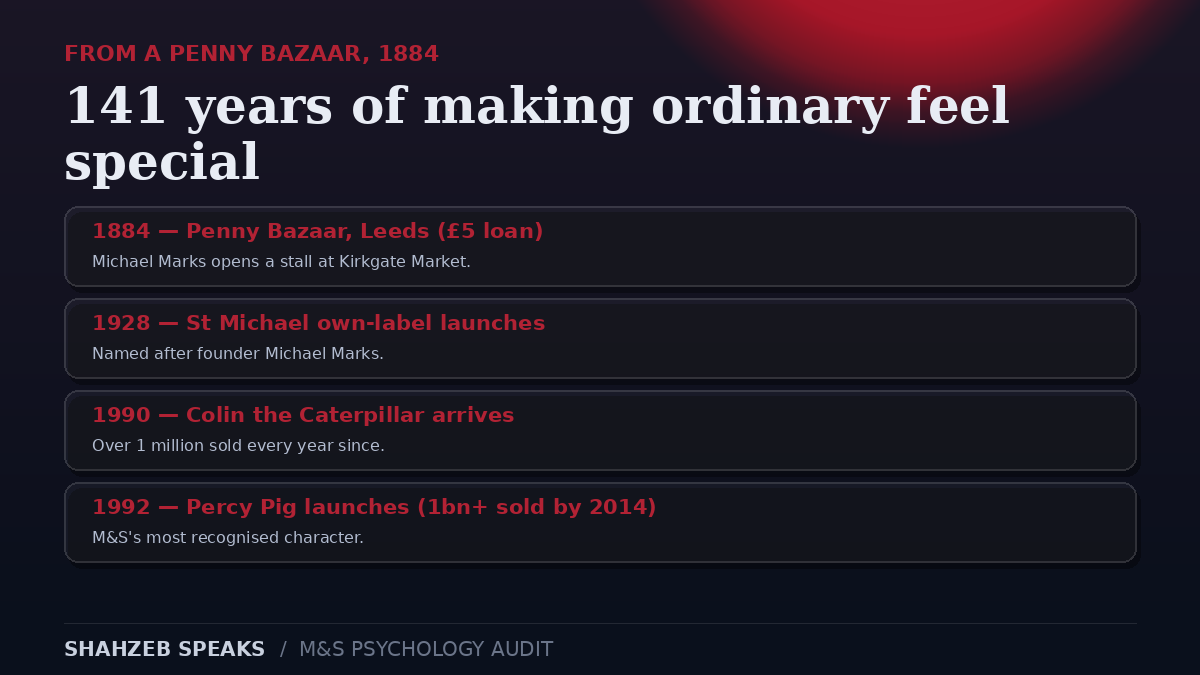
The two characters that carry that heritage into the present are not people but food. Percy Pig, the pink jelly sweet, launched in 1992, and by 2014 more than one billion Percy Pigs had been sold; in 2025 the sweet went on sale at Target in the United States and Coles in Australia. Colin the Caterpillar, the chocolate sponge cake, has been on sale since 1990, with more than one million sold every year — and a gluten-free version launched in February 2026 sold more than 10,000 in its first five days across more than 400 stores. These are not products. They are mascots with birthdays, and they give the brand something most retailers do not have: characters that customers ask for by name, in a shop, out loud.
🎅 Chapter 2: The Home of Christmas — the campaign itself
“The Home of Christmas” launched on 6 November 2026: on M&S social channels at 7 a.m., with its television debut on ITV’s This Morning at 10.15 a.m., then across TV, cinema, streaming, social media and outdoor. The three-minute film was created by the agency Mother, produced by Smuggler and directed by Shannon Murphy. James Norton plays Father Christmas, Lucy Punch plays Mrs Claus, and Katherine Jenkins sings a new recording of Belinda Carlisle’s “Heaven Is a Place on Earth” — and cameos in the film. The story is simple: encouraged by Mrs Claus, Santa shaves off his beard, leaves the North Pole unrecognised, and experiences Christmas as a shopper — ending at an M&S store “emblazoned with lights as ‘The Home of Christmas'”. As Norton put it: “It’s not every day you get asked to play Santa, let alone a Santa who immediately shaves off his beard!”
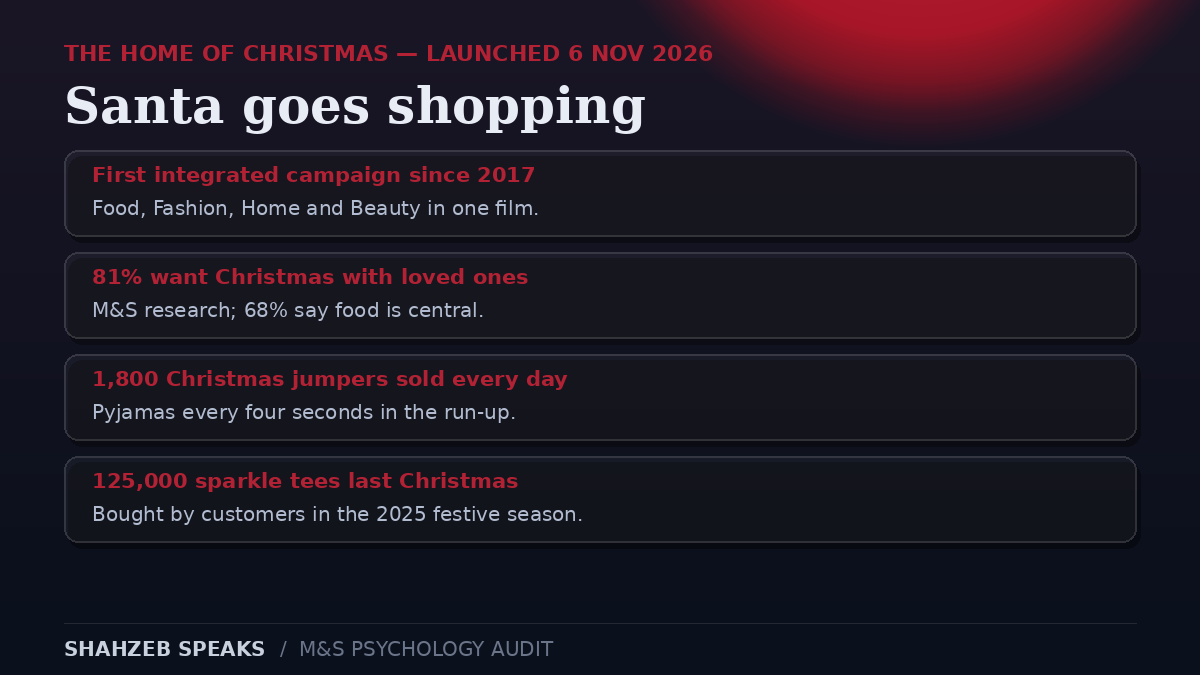
The campaign is built on M&S’s own research: 81% of customers say they want to spend Christmas with the people they love, and 68% say food is central to making the season special. The film shows the products that research points to: a £70 Oakham Turkey Crown with Italian Chestnut, Pancetta & Calabrian Orange Stuffing, a £45 Sequin Dress, a £55 Autograph Pure Cashmere Scarf. The physical centrepiece is the Pantheon store on Oxford Street, transformed into a “Home of Christmas” — almost 100,000 square feet across four floors, where fashion, home and beauty sales are up 27% since the store reopened, against 2024/25. The seasonal numbers around it are the kind that make a campaign feel like a festival: M&S sells 1,800 Christmas jumpers every day during the festive season, a pair of pyjamas every four seconds in the run-up to Christmas, and last Christmas customers bought 125,000 sparkle tees and crew knits. Last year’s Christmas was different: a food advert featuring Dawn French’s returning Fairy character with chef Tom Kerridge, and separate food and clothing campaigns. This year, for the first time since 2017, everything is in one film.
💛 Chapter 3: Nostalgia as strategy — why the past sells Christmas
The campaign’s first psychological move is nostalgia, and it is an evidence-based move rather than a hunch. Grappi, Pauwels-Delassus, Pedeliento and Zarantonello (2024), in the Journal of Product & Brand Management, studied 277 British and 255 Indian consumers and found that nostalgia in advertising increases brand love — and that in the UK, personal nostalgia, the kind tied to a person’s own memories, works better than historical nostalgia, the kind tied to a distant past. M&S’s campaign is built on personal nostalgia: the food on the table, the people around it, the Christmas you remember having. Youn and Dodoo (2021), in two studies of 374 people each, found that nostalgic brands score higher on sincerity, excitement and competence than non-nostalgic brands, and show stronger brand attachment, self-brand connection and relationship quality.
M&S has been practising this for two decades. “This is not just food, this is M&S food” first aired in 2004, with slow-motion close-ups of food and a voiceover by Dervla Kirwan; it was revived in 2019, twelve years after its last use. When the advert for the Melt in the Middle Chocolate Pudding aired, the pudding’s sales rose 3,000%, according to the M&S archive. Percy Pig was brought to life — voiced by Tom Holland — in the 2021 Christmas food campaign alongside Dawn French’s Fairy, and M&S Food has called Percy Pig its “most well known and recognised character”, more so than Colin the Caterpillar. The risk in nostalgia is that it becomes a museum: a brand that only looks backwards. The 2026 campaign avoids that by putting the nostalgic figure — Santa — into a present-tense, unfamiliar role. He is not delivering the past. He is shopping in the present.
🍽️ Chapter 4: Food authority — the growth engine
Food is where M&S’s recovery is real, and the numbers are the strongest in this audit. In the year to 28 March 2026, Food sales reached £9.7 billion, up 7.0%, with market share of 4.1%, up 0.2 percentage points on Worldpanel data — and M&S described itself as the UK’s fastest-growing grocer. In the half year to 26 September 2026, reported on 4 November, Food sales rose 13.9% to £5.16 billion, with adjusted operating profit of £288.6 million and a margin of 5.6%. Food volumes in the UK were up 11.9%. The engine behind those numbers is product: more than 1,400 new lines launched in the year to March 2026, and quality upgraded across 1,000 products.
The value story inside the food numbers is worth reading, because it explains how a premium retailer grows in a cost-of-living market. M&S runs three value programmes — Remarksable, Dropped & Locked, and Bigger Pack, Better Value — and the price cuts behind them move real volume: beef mince cut 23% in price drove volume up 58%, and golden-yolk eggs cut 10% in price drove volume up 102%. The same logic runs through clothing: 1.8 million £10 bras were sold. The psychology here is value anchoring — a premium brand showing, with specific prices and specific volumes, that it can be affordable without becoming cheap. The audit’s caution is that “fastest-growing grocer” is M&S’s own description of itself, and that the Worldpanel grocery measure does not publish an M&S share in its monthly release, because M&S falls outside its grocer definition. The growth is real; the superlative is the company’s.
🎁 Chapter 5: Sparks, the habit machine
Sparks is M&S’s loyalty scheme, and it is the quietest machine in this audit — and possibly the most powerful. It has 17 million members. It was first launched in 2015, relaunched as a digital-first scheme in 2020, and relaunched again in 2026. The M&S app has more than 5 million active users. On 20 October 2026, M&S launched its biggest-ever Christmas giveaway through Sparks: up to £15 per member, via three offers — £5 on £25 of Delacourt Champagne in England and Wales or £20 of soft drinks and mixers in Scotland, £5 on £25 of flowers online, and £5 on £20 in an M&S Café — running to 1 January 2027. The potential cost, if every one of the 17 million members took all three offers, would be £255 million. That figure is a maximum, not a forecast — the actual cost will be far lower — and this audit will not print it without that qualification.
The psychology of Sparks is the habit loop: a small, regular reward that brings the customer back on a schedule. New offers land in the app every Tuesday, which gives the scheme a weekly rhythm — a reason to open the app that has nothing to do with needing anything. M&S’s own research for the giveaway found that 44% of shoppers had already made their first festive purchase, that the expected average spend on Christmas presents is £377.90, that 47% look for discounts, offers or loyalty rewards, and that 27% save their rewards for the Christmas food shop. That last figure is the telling one: the loyalty scheme is not just a discount mechanism, it is a savings mechanism for the feast. The risk is the same as for any loyalty scheme: when the reward becomes the reason to shop, the brand stops being chosen and starts being used. Sparks, at 17 million members, is close enough to that line to be watched.
💷 Chapter 6: Value signalling — premium, but provably cheaper
M&S’s oldest problem is the perception that it is expensive. Its answer, in 2026, is not to say “we are good value” but to show the arithmetic. The price-cut stories in Chapter 4 — mince down 23% in price, volume up 58%; eggs down 10%, volume up 102% — are value signalling in its most concrete form: a specific price, a specific result, printed in the company’s own results presentation. The £10 bra, sold 1.8 million times, does the same work in clothing: a round number, a known product, a volume that proves the price is real rather than a promotion. Remarksable, Dropped & Locked and Bigger Pack, Better Value are the programme names that hold these stories together, and their function is to give the shopper a reason to believe the price before they reach the till.
The psychology here is anchoring with evidence. A premium brand that simply cuts prices looks desperate; a premium brand that cuts a price and shows the volume that followed looks confident. The risk is that the anchor drifts: if every product is “remarkable value”, the word stops meaning anything, and the brand’s premium position — the thing that lets it charge £70 for a turkey crown and £55 for a cashmere scarf — starts to erode. M&S is walking that line deliberately in 2026, and the half-year results suggest the walk is working: Food sales up 13.9%, fashion, home and beauty sales up 17.5–18% to £2.00 billion in the same half. The value story and the premium story are, for now, both true at once.
🏬 Chapter 7: Stores & omnichannel — the estate, and a number that does not agree with itself
At March 2026, M&S had 1,059 UK stores: 227 Full Line stores, 1 fashion, home and beauty-only store, 32 outlets, 333 owned Food stores and 466 franchise Food stores, with 16.5 million square feet of UK selling space. The store programme is the biggest physical bet in the company’s strategy: a £300 million investment announced in July 2025, covering 16 new stores, 9 extensions and 12 renewals in the year to March 2026, and 47 deals signed for new or renewed stores to open by FY2028 — more than the previous three years combined. The Pantheon store on Oxford Street, the centrepiece of the Christmas campaign, is the showpiece of that programme: almost 100,000 square feet across four floors, with fashion, home and beauty sales up 27% since it reopened.
There is a number in the store story that does not agree with itself, and this audit will not hide it. Reporting in July and November 2025 put the store rotation target at 180 Full Line stores and 420 Food stores by FY2028. The company’s own FY2025/26 results presentation, however, states a target of 200 full-line stores by 2027/28. Those two targets cannot both be the plan, and the company has not publicly reconciled them. I flag the conflict rather than printing one figure as settled, because a brand audit that picks the flattering number is not an audit. The omnichannel side of the story is cleaner: M&S sales on Ocado.com surpassed £1 billion in the year to March 2026, up 17.7%, and Ocado Retail was consolidated into M&S from 6 April 2025. The store is still the centre of the brand — but the customer who orders the turkey crown online and collects it in store is now the normal customer, not the exception.
🛡️ Chapter 8: Trust & the cyberattack — the rebound, and what it cost
On 17 April 2025, attackers first got into M&S’s systems, according to evidence the chairman, Archie Norman, gave to MPs on 8 July 2025. The company realised what had happened on Easter Saturday, 19 April, and went public on 22 April. On 25 April it suspended all online orders. They did not resume until 10 June — 46 days later — and click-and-collect was not restored until August 2025. On 13 May, M&S confirmed that personal data of customers had been taken: names, email addresses, postal addresses, dates of birth and order history. No usable card or payment details were taken, and no account passwords. M&S said there was no evidence the data had been shared or published online, and it did not disclose how many customers were affected.
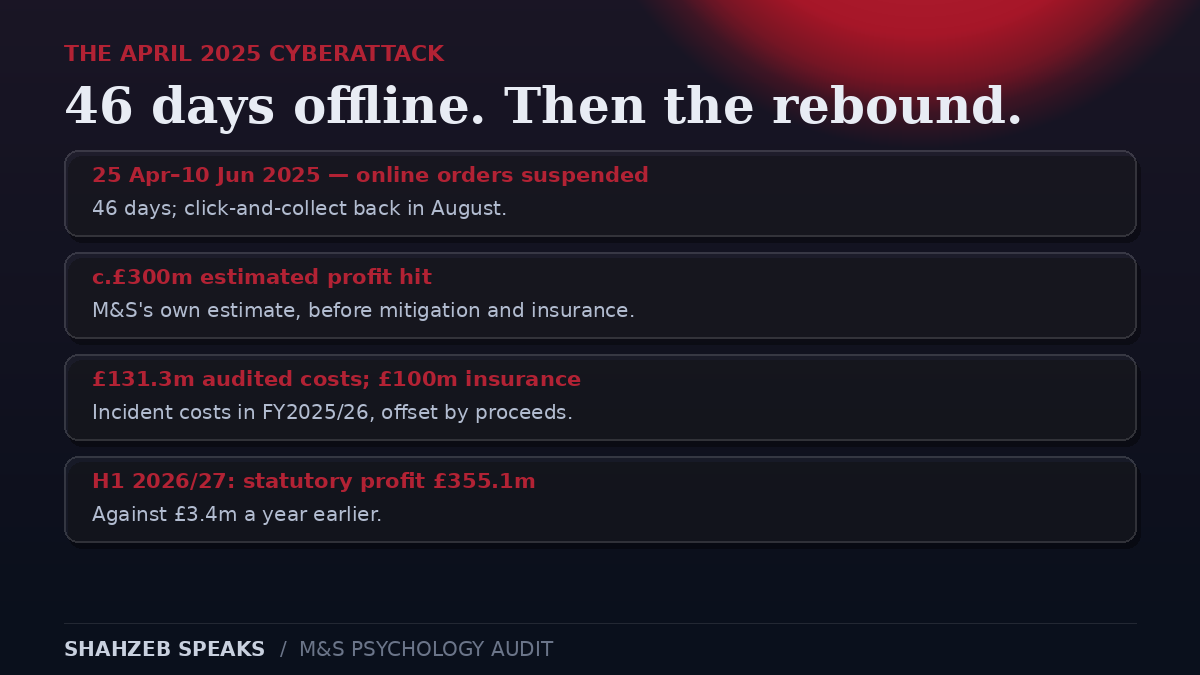
The financial cost, as M&S itself framed it, was an estimated hit of around £300 million to 2025/26 operating profit, stated in May 2025 before cost mitigation, insurance and trading actions. The audited figure is smaller and more precise: £131.3 million of incident-related costs in the year to March 2026 — £109.3 million of immediate systems response and recovery, the rest legal and professional — offset by £100 million of insurance proceeds. The year that followed was the proof of the recovery: in the half year to 26 September 2026, statutory profit before tax was £355.1 million, against £3.4 million a year earlier, and adjusted profit before tax more than doubled to £403.2 million. Group sales were £9.26 billion, up 16.2%. The year before the attack, FY2024/25, adjusted profit before tax had been £875.5 million — the highest in over 15 years — and the cyber-hit year, FY2025/26, came in at £671.4 million, down 23.8%. The rebound is real, but it is a rebound to a level the company had already reached before the attack, not a new height. Trust, in the M&S story, is not a slogan. It is a number that fell, and is now climbing back.
🇵🇰 Chapter 9: What Pakistani brands should — and shouldn’t — copy
Pakistani brands should copy three things. First, the discipline of one idea per season: M&S’s Christmas campaign is a single film, a single idea — Santa goes shopping — expressed across every channel, every product and one flagship store. A Pakistani retailer or food brand with a strong seasonal moment — Eid, Ramadan, a wedding season — should build one idea and run it everywhere, rather than running five ideas that cancel each other out. Second, the character: Percy Pig and Colin the Caterpillar show that a product can become a mascot customers ask for by name, and that a mascot outlives any single campaign. A Pakistani brand with a distinctive product — a biscuit, a sweet, a drink — should give it a name, a face and a story, and keep it for a decade rather than a season. Third, the loyalty rhythm: Sparks works because it gives customers a weekly reason to return — new offers every Tuesday — not because the discount is large. A small, regular reason beats a large, rare one.
What they should not copy is the silence after a crisis, or the confusion in the store plan. M&S went public within five days of realising it had been attacked, and disclosed what data had been taken within a month — that speed is worth copying. But the brand’s own reporting gives two different answers for its store target, and no public reconciliation exists. A Pakistani brand building trust in a market where consumers already suspect brands of hiding things cannot afford that kind of ambiguity. Publish one plan, with one number, and correct it in public when it changes. And do not copy the premium-value tightrope without the evidence: M&S can charge £70 for a turkey crown because it can show the volume its price cuts produce. A brand that charges premium prices without publishing any evidence for them is not premium. It is just expensive.
⚠️ Chapter 10: Dark side & regulatory record — exactly what is known
Every legal statement in this chapter is written at its exact status, as of 9 November 2026. An investigation being opened is not a finding. An arrest on suspicion is not a charge. A media attribution is not an official one. I have scoped this chapter to the record types actually checked: the regulator investigation, the arrests, and the company’s own disclosures.
The regulator position is this. On 2 May 2025, the Information Commissioner’s Office announced that it was investigating the incident, alongside a similar breach at the Co-op. No fine, enforcement notice or charge against M&S over this incident has been reported as of 9 November 2026. That sentence must be read carefully: it means nothing has been reported, not that the regulator has cleared the company — no such clearance has been reported. An investigation being open is itself a case on the record. The National Crime Agency is also investigating.
The criminal position is this. On 10 July 2025, the National Crime Agency arrested four people, aged 17 to 20, on suspicion of Computer Misuse Act offences, blackmail, money laundering and participating in an organised crime group, in connection with the attacks on M&S, the Co-op and Harrods. No charges have been reported. Media and security reporting has attributed the attack to the group known as Scattered Spider, using DragonForce ransomware — reportedly beginning with attackers impersonating employees to IT help desks to get passwords reset. That attribution is by media and security reporting only. The NCA has not named a group, and this audit will not present the attribution as fact. Whether M&S paid any ransom has not been disclosed by the company, and this audit will not state it either way.
The honest reading is that the legal record is unfinished, and that is itself the finding. The breach was real, the data taken was real, the 46-day shutdown was real, and the financial cost was real — an estimated £300 million hit to operating profit, £131.3 million of audited costs, £100 million of insurance. What is not yet known is whether the regulator will act, whether anyone will be charged, or who was responsible. A brand that asks customers to trust it with their data, their addresses and their dates of birth should be judged on the record as it stands, not on the record as it might one day become. On the record as it stands, M&S disclosed quickly, recovered financially, and still has an open investigation and no named attacker. That is a recovery, not a clearance.
📊 Psychology Scorecard
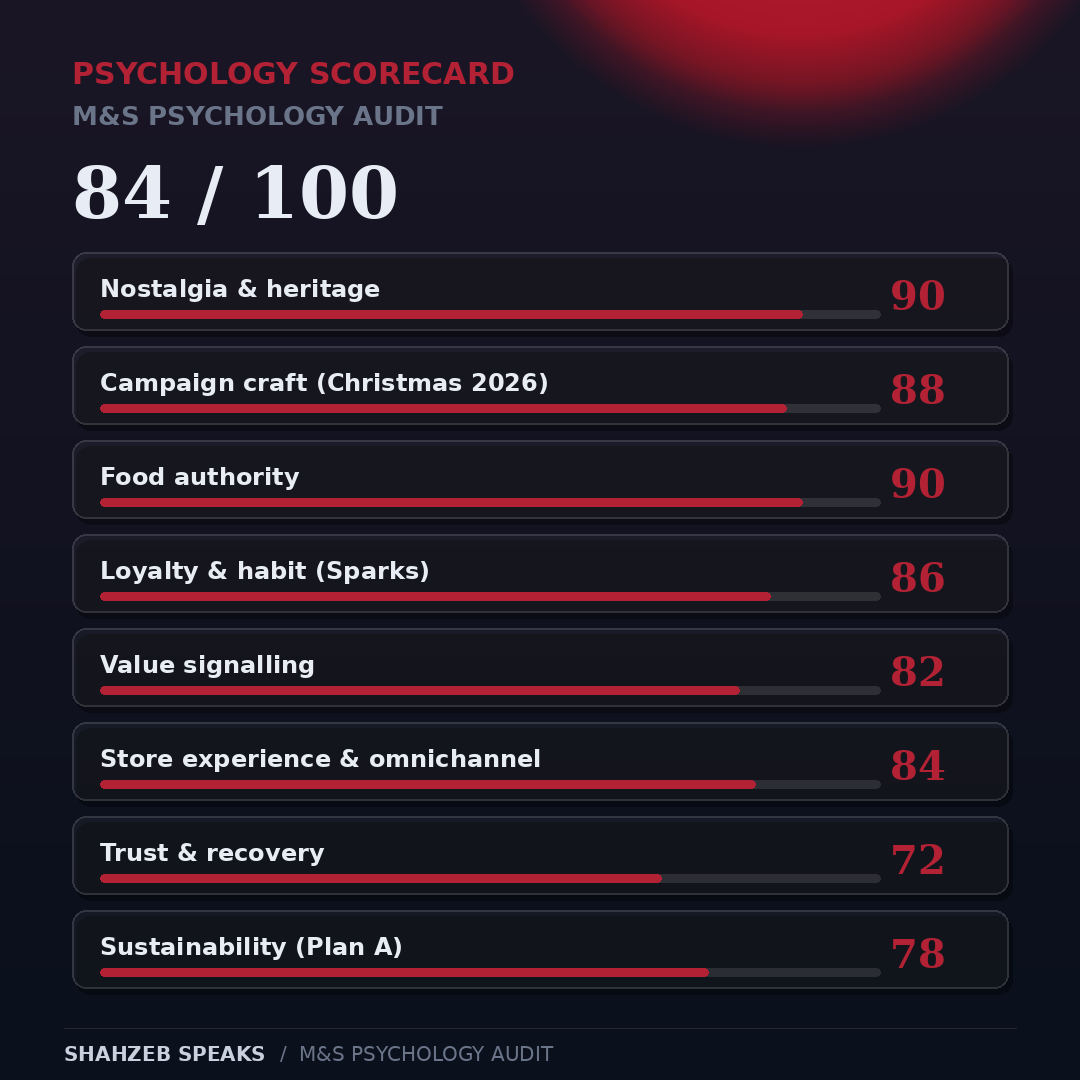
| Dimension | Score | Verdict |
|---|---|---|
| Nostalgia & heritage | 90 | 141 years, two mascots, and a campaign built on personal memory. |
| Campaign craft (Christmas 2026) | 88 | One film, one idea, every channel — the first integrated campaign since 2017. |
| Food authority | 90 | £9.7bn of food, 4.1% share, and volume proof behind the value claims. |
| Loyalty & habit (Sparks) | 86 | 17 million members and a weekly rhythm that brings them back. |
| Value signalling | 82 | Price cuts with volume proof — but the premium line is thin. |
| Store experience & omnichannel | 84 | Pantheon is a showpiece; the store target disagrees with itself. |
| Trust & recovery | 72 | Fast disclosure and a real rebound — but an open investigation. |
| Sustainability (Plan A) | 78 | Net zero by 2040, SBTi-validated — but thin 2026 progress evidence. |
Arithmetic: 90 + 88 + 90 + 86 + 82 + 84 + 72 + 78 = 670. 670 ÷ 8 = 83.75, rounded to 84/100.
✅ Balance sheet & prescription
What M&S does best is turn heritage into a feeling that sells food. The nostalgia is evidence-based, the campaign is a single idea executed across every channel, the food numbers are the strongest in the company’s recent history, and Sparks gives 17 million people a weekly reason to come back. What it does worst is the unfinished business: a cyberattack with an open regulator investigation and no named attacker, a store plan that gives two different answers, and a sustainability story — Plan A, net zero by 2040, SBTi-validated targets — with thin evidence of 2026 progress. The prescription follows that balance. First, close the trust gap in public: publish a plain-language account of what changed in security after April 2025, and keep publishing it until the regulator’s investigation is resolved. Second, reconcile the store target in one public statement — 180 or 200, and by when — because a brand that cannot agree with itself on its own plan cannot ask customers to trust its plans for them. Third, let the Christmas campaign be measured: publish what “The Home of Christmas” actually sold, so the next audit can score the outcome rather than the idea. Do those three things and the score rises on its own.
📝 Final Verdict
M&S has done something rare in 2026: it has turned a crisis into a comeback and a comeback into a Christmas campaign that knows exactly what it is. Santa goes shopping, the food is the star, the loyalty scheme is the engine, and the heritage is the reason to believe any of it. The campaign is the best piece of brand psychology the company has produced in years — a single idea, built on research, executed across every channel, with mascots, a flagship store and a £15 giveaway behind it. Its weakness is not creativity but completion: the trust record is still open, the store plan still disagrees with itself, and the sustainability story still needs its 2026 evidence. None of that makes the Christmas advert worse. It makes the brand behind it a work in progress — and a work in progress that, for the first time since the attack, is visibly moving in the right direction.
Psychology Score: 84/100 — A Christmas campaign that turns the world’s most famous giver into a shopper, built on 141 years of heritage and a food business in genuine recovery, held back by an unfinished cyberattack record and a store plan that still disagrees with itself.
If your brand has one strong idea and a calendar full of noise, the psychology of the decision matters more than the polish of the product. I audit that decision journey — get in touch here.
Related audits: Zara — The Scarcity Machine of Fast Fashion, Levi’s — The Yeti, the 501 and the Feeling of Belonging, and Louis Vuitton — The Journey Is the Destination. See also the full list at brand psychology audits and industrial psychology in Pakistan.
📚 References & Sources
- Marks & Spencer (2026). Christmas advert 2026: “The Home of Christmas”, marksandspencer.com, 6 November 2026.
- The Grocer (2026). M&S launches Christmas advert 2026 starring James Norton as “sexy Santa”, 6 November 2026.
- The Industry.beauty (2026). Marks & Spencer unites fashion, beauty and food in first fully integrated Christmas campaign since 2017.
- Creative Review (2026). Lucy Punch and James Norton star in M&S Christmas ad.
- Marks & Spencer (2026). Full-year results, 52 weeks ended 28 March 2026, 20 May 2026; results presentation.
- Marks & Spencer (2025). Full-year results, 52 weeks ended 29 March 2025 (FY2024/25).
- Marks & Spencer (2026). Half-year results, 26 weeks to 26 September 2026, reported 4 November 2026.
- Marks & Spencer (2025). Full-year results announcement, 21 May 2025 (cyberattack impact estimate).
- London Stock Exchange (2026). M&S rebounds from cyber attack as food offsets clothing profit miss, 4 November 2026.
- Decision Marketing (2026). M&S unleashes £255m Sparks Christmas giveaway, October 2026.
- The Grocer (2025). M&S steps up store renewal programme with £300m investment, July 2025.
- Marks & Spencer (2026). The M&S Story Timeline; Food Timeline (M&S Company Archive).
- Retail Week (2019). Marks and Spencer revives “not just food” marketing campaign.
- Marketing Week (2021). M&S social media Christmas food campaign (Percy Pig, Dawn French’s Fairy).
- Retail Times (2026). M&S sells over 10,000 gluten-free Colin the Caterpillar cakes in first five days of launch.
- Blacknote Intelligence (2025). Marks and Spencer / Co-op cyber attack: timeline and analysis.
- In Your Area (2025). Marks & Spencer customer emails and dates of birth stolen in cyber attack, 13 May 2025.
- Aspenfy (2025). M&S, Co-op and Harrods cyber attacks 2025: arrests and costs.
- Drapers (2025). Sparks loyalty scheme resumes online, July 2025.
- Grappi, S., Pauwels-Delassus, V., Pedeliento, G. & Zarantonello, L. (2024). Nostalgia in advertising and brand love. Journal of Product & Brand Management, 33(7), 869–887.
- Youn, S. & Dodoo, N. A. (2021). The power of brand nostalgia. Journal of Brand Management.
- Marks & Spencer (2026). Our approach to net zero (Plan A).
- Marks & Spencer (2022). M&S Sparks global growth roll-out (loyalty scheme).
Key Findings
- Founded 1884, Leeds Penny Bazaar; Michael Marks opened the stall with a £5 loan from Isaac Jowitt Dewhirst; Thomas Spencer became partner in 1894, investing £300; St Michael own-label introduced 1928.
- "The Home of Christmas" launched 6 Nov 2026 — first fully integrated Food/Fashion/Home/Beauty Christmas campaign since 2017; Mother agency, Shannon Murphy (Smuggler), James Norton as Santa, Lucy Punch as Mrs Claus, Katherine Jenkins singing Belinda Carlisle's "Heaven Is a Place on Earth"; M&S research: 81% want Christmas with loved ones, 68% say food is central.
- Financials: FY2025/26 adjusted PBT £671.4m (down 23.8%, cyber-hit) vs £875.5m in FY2024/25 (highest in over 15 years); H1 FY2026/27 statutory PBT £355.1m (vs £3.4m a year earlier), adjusted PBT £403.2m more than doubled; Food sales £9.7bn in FY2025/26, market share 4.1%.
- Sparks: 17 million members; biggest-ever Christmas giveaway launched 20 Oct 2026, up to £15 per member — a potential £255m maximum cost IF every member took all three offers; Sparks relaunched in 2026; app 5m+ active users.
- Cyberattack legal record: ICO opened an investigation on 2 May 2025; no fine, enforcement notice or charge has been reported as of 9 Nov 2026; four people arrested on suspicion on 10 July 2025, no charges reported; attribution to Scattered Spider/DragonForce is media/security reporting only; M&S has not said whether a ransom was paid; c.£300m estimated profit hit; £131.3m audited costs; £100m insurance proceeds.
- Score 84/100: 90+88+90+86+82+84+72+78 = 670; 670/8 = 83.75, rounded to 84.
Overall Psychology Score
Marks & Spencer scores 84/100 in our comprehensive psychology audit covering consumer behavior strategies, UX design principles, and psychological marketing effectiveness.
The detailed dimension scores are in the audit's Psychology Scorecard chapter.
High impactMuhammad Shahzeb
MSc Industrial Psychologist, specializing in consumer behavior, UX psychology, and brand strategy analysis. Helping brands understand the psychology behind their success.
About Muhammad Shahzeb →