TK Maxx Psychology Audit — Festive Crossing: The Ducks, the Treasure Hunt and the Familiar Farm
TK Maxx brought back its Festive Farm world for Christmas 2026, with a family of ducks in designer gifts crossing the road. Our psychology audit of the nostalgia, the treasure hunt and the joke scores TK Maxx 83/100.

83 / 100
Overall consumer behavior effectiveness

Brand Overview
- Brand nameTK Maxx
- Founded1994
- HeadquartersWatford, England, UK
- IndustryRetail
- Websitewww.tkmaxx.com ↗
Psychology Techniques Identified
- 01Mere exposure (Zajonc 1968; the Festive Farm world returns after three years instead of a new world being invented)
- 02Nostalgia (Wildschut et al. 2006; the returning 2023 world plus Ciara's 2004 hit "Goodies" — two nostalgia channels at once)
- 03Variable-ratio reinforcement / treasure hunt (Skinner; rapidly changing stock, "when it's gone, it's gone" — the next visit might hold the find)
- 04Social proof (Cialdini 2001; the ducks are already wearing the gifts; the farmer's wife has already told the neighbours)
- 05Humour & playfulness (deadpan ducks in knitwear, a shocked goat and alpaca, a duckling pulling a wooden toy duck)
- 06Narrative transportation (Green & Brock 2000; "this little Christmas saga" absorbs the viewer instead of arguing with them)
- 07Scarcity & seasonal urgency (Cialdini 2001; Christmas-only framing and the treasure-hunt stock model — no verified scarcity claim for specific products)
- 08Reciprocity & generosity framing (Gouldner 1960; "Spoil All Your Loved Ones For Less" pairs giving with thrift)
- 09Consistency & commitment (Cialdini 2001; same world and same platform since 2023 — the brand stays consistent with its positioning)
- 10Authority & craft (Wieden+Kennedy London, director Gary Freedman, The Perlin's 11 unique CG characters)
- 11Word-of-mouth seeding (the farmer's wife told the neighbours — the ad's only explicit sales line, delivered as a joke)
- 12Loss aversion (Kahneman & Tversky 1979; the hunt's other side — the find you miss once the stock is gone)
Full Psychology Audit Report
In this audit
It is snowing on a country lane. A red truck loaded with shopping bags waits patiently in the middle of the road, its headlights on, while a family of ducks crosses in front of it — each one wearing a knitted hat, a scarf and sunglasses, each one carrying a wrapped gift. The farmer and his wife sit in the cab, the goat and the alpaca watch from the back, and nobody is in a hurry. TK Maxx did not invent a new Christmas world this year. It brought back a three-year-old one — and the psychology of that choice is the whole audit.
I am an Industrial and Organizational Psychologist in Karachi, and I audit brands on the psychology of what they actually do — not on how much I like their products. This audit is of TK Maxx’s “Festive Crossing”, which launched online on 5 November 2026 and made its television debut on 16 November, the day before this audit was written. It is one day old on television. No effectiveness score exists yet, no viewer or sales figure has been published, and this audit will not invent one. What it scores is the campaign’s psychology and craft: the familiarity it trades on, the nostalgia it doubles up, the treasure hunt it dramatises, and the risk it takes by telling one small joke for a whole minute.
“Did you tell the neighbours about the great gifts at TK Maxx, love?” — “I certainly did! Everyone loves a bargain, dear.”
— The farmer and his wife, TK Maxx, “Festive Crossing”, 2026
📋 Brand Overview
| Field | Detail |
|---|---|
| Brand | TK Maxx — off-price apparel and home fashions retailer, owned by The TJX Companies, Inc. |
| Launched in the UK | 1994, first store in Bristol; TJX introduced off-price retailing to the UK and Ireland |
| Headquarters | Watford, England, UK (TK Maxx); parent TJX Companies headquartered in Framingham, Massachusetts, USA |
| Scale | 673 TK Maxx stores in Europe and 357 in the UK, as of 31 January 2026; TJX group total 5,214 stores across 9 countries |
| Parent (FY26) | TJX group net sales $60,372 million, the first time above $60 billion; TJX International net sales $7,986 million, up 11% |
| Current campaign | “Festive Crossing”, launched 5 November 2026; television debut 16 November 2026; first new TK Maxx Christmas advert in three years |
| Website | https://www.tkmaxx.com |
| Psychology score | 83/100 |
📜 Chapter 1: History — the treasure hunt that crossed the Atlantic
TK Maxx began as an import. TJ Maxx was founded in Framingham, Massachusetts, in 1976 by Bernard Cammarata, as an off-price chain: branded goods bought cheap — overproduction, overbuying, end-of-season stock — and sold cheaper still. The model reached Canada in 1990 through Winners, and in 1994 it crossed the Atlantic. The first UK store opened in Bristol, and TJX says it introduced off-price retailing to the UK and Ireland. The name was changed from TJ Maxx to TK Maxx to avoid confusion with the unrelated British chain TJ Hughes — a small decision that has lasted thirty years.
The expansion since then has been steady rather than spectacular, which suits the model. Germany followed in 2007, Poland in 2009, Austria and the Netherlands in 2015, Australia in 2017 through the acquisition of 35 Trade Secret discount department stores, and Spain in March 2026, with the first store in Barcelona’s Diagonal Mar shopping centre. As of 31 January 2026, the end of TJX’s fiscal year 2026, TJX International had 835 stores: 673 TK Maxx in Europe, 74 Homesense in the UK and Ireland, and 88 TK Maxx in Australia. The group total was 5,214 stores across nine countries. In the UK alone, 357 TK Maxx stores and 72 Homesense stores were trading.
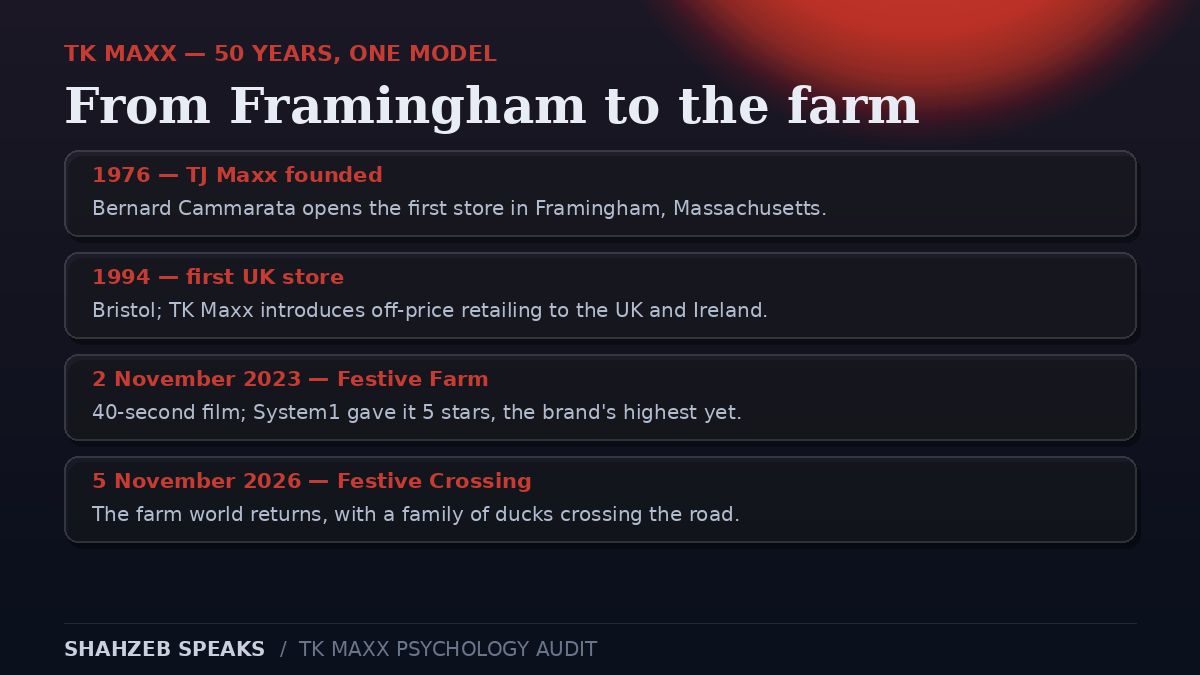
The numbers behind the brand are large, and they are worth recording because they frame the campaign’s timing. In the fiscal year ended 31 January 2026, TJX group net sales were $60,372 million — the first time the group had passed $60 billion. TJX International, the segment that holds TK Maxx in Europe and Australia, recorded net sales of $7,986 million, up 11% from $7,181 million, with segment profit of $558 million, up from $422 million, and a margin of 7.0%, up from 5.9%. TJX UK, the operating company, reported turnover of £4,354.3 million, up 4.7% from £4,159.1 million, and profit of £201.5 million, up from £97.7 million. TJX does not break out TK Maxx revenue in its filings, so no TK Maxx-only revenue figure appears in this audit. The brand’s own line is “BIG LABELS, SMALL PRICES”, and its own site claims prices “up to 60% less than the RRP” — a company claim, not an independently verified saving, and this audit prints it only as such.
The Christmas advertising history is shorter than the retail history, and it is the part that matters for this audit. The goat that appears in “Festive Crossing” first showed up in TK Maxx’s 2020 Christmas advert, the “lil’ goat” film. The 2021 Christmas advert was set to a special version of Aerosmith’s “Walk This Way”. Then, on 2 November 2023, “Festive Farm” launched: a 40-second film, premiering on Channel 4 at 9.45pm during “Don’t Look Down for Stand Up To Cancer”, in which CGI farm animals catwalked out of a barn in designer outfits — a turtleneck-clad alpaca, ducks in Harry Styles-inspired pearls, a hedgehog in a pink cashmere hat — set to Eve and Gwen Stefani’s 2001 hit “Let Me Blow Ya Mind”. The film scored 5 stars with System1, its 20-second edit scoring 5.2 stars, and System1 called it TK Maxx’s highest score yet. TK Maxx then ran that film for three festive seasons rather than making a new one. That decision — to reuse rather than replace — is the foundation of the 2026 campaign, and Chapter 3 explains why it was a psychological decision, not only a budgetary one.
🎬 Chapter 2: “Festive Crossing” — one joke, told beautifully
“Festive Crossing” launched on 5 November 2026 across video-on-demand, online video and integrated digital channels, as a 30-second cut, with a 60-second version on YouTube and TK Maxx’s owned channels. It made its television debut on 16 November 2026, in high-profile prime-time placements. It is TK Maxx’s first new Christmas advert in three years, and it is a return, not a reinvention: the film brings back the “Festive Farm” world first launched in 2023, with the same farmer and his wife, the same goat and the same alpaca, and one new cast of characters.
The film is, by the standards of Christmas advertising, almost absurdly simple. A farmer and his wife drive home from a TK Maxx shopping trip in a battered red truck loaded with gifts. Their journey is stopped by a stylish family of ducks crossing the road, each one showing off designer gifts bought at TK Maxx — hats, sweaters, boots, sunglasses, bathrobes and a yoga mat, according to the trade coverage. The original goat and alpaca from Festive Farm watch, shocked, from the back of the truck. The final beat is a small straggler duckling pulling a wooden toy duck on a string across the snow, and a mouse makes a guest appearance in the duckling line-up. The soundtrack is Ciara’s 2004 hit “Goodies”. The film’s only dialogue is the exchange quoted at the top of this audit: the farmer asks his wife whether she told the neighbours about the great gifts at TK Maxx, and she replies that she certainly did, because everyone loves a bargain.

The craft behind the simplicity is considerable. The campaign was created by Wieden+Kennedy London, with Charlie Lanus as group creative director and Alexandra Sattlecker as creative director, and directed by Gary Freedman through MJZ London, with Lasse Frank as director of photography. Post production and visual effects came from The Perlin, which built 11 unique CG characters for the 60-second film, each with bespoke clothing, fur and feather systems and distinct personalities. No real ducks were used in the making of the advert — TK Maxx’s own YouTube description says so, in capitals. The media was handled by Omnicom Media Group, and the campaign runs across Instagram, Facebook, TikTok and LinkedIn, with influencer partnerships and behind-the-scenes and blooper material on Instagram and TikTok.
The company-stated aim is clear, and it is worth quoting because it states the test the campaign sets itself. Catrina Funk, group brand and marketing director at TK Maxx, said: “Christmas is all about the joy of giving, and we know shoppers are thinking carefully about how they spend, looking for great deals and thoughtful, high-quality gifts. At TK Maxx, we want to show that you can make your Christmas budget go further without compromising on quality.” She added that “Festive Farm has resonated with audiences since it first launched in 2023” and that the team “loved the duck family from the moment we saw them”. The creative directors, Lanus and Sattlecker, said their ambition was “to make a film that felt cinematic, funny, and properly festive, while retaining the charm and personality that makes this farm world so enjoyable”, calling the film “this little Christmas saga”. That is a company claim and a creative claim, not an independent finding — but it states the test. If the film works, it works because the world feels familiar, the joke lands, and the gift-giving feels generous rather than cheap. The next chapters test each of those in turn.
🔁 Chapter 3: Mere exposure — familiarity is the strategy
The strongest psychology in this audit is also the simplest to state: TK Maxx did not invent a new world. It brought back a three-year-old one. The goat, the alpaca, the farmer and his wife are familiar faces. Only the ducks are new. That is a deliberate choice, and it rests on one of the oldest findings in social psychology: the mere-exposure effect.
Robert Zajonc demonstrated it in 1968, in the Journal of Personality and Social Psychology: repeated exposure to a stimulus increases liking for it, even without conscious recognition. People come to prefer the things they have seen before, simply because they have seen them before. The effect is not about quality, and it is not about argument. It is about the comfort of recognition. A brand that returns to a world its audience already knows is borrowing that comfort — and TK Maxx had three years of it in the bank, because it ran the 2023 film for three festive seasons rather than replacing it.
That is why Funk’s line matters: “Festive Farm has resonated with audiences since it first launched in 2023.” The brand is not guessing that the world is familiar. It has spent three Christmases making it familiar, and the 2023 film’s 5-star System1 score — the brand’s highest yet at the time — is evidence that the familiarity was liked, not merely tolerated. The 2026 film cashes that in. The viewer does not need to be introduced to the farmer, the goat or the alpaca. The introduction happened in 2023. The 2026 film can spend its whole minute on the joke.
But familiarity has a failure mode, and the ducks are the answer to it. A world that returns unchanged goes stale. The same film for a fourth Christmas would have been a rerun, and a rerun is not a campaign. The ducks are the novelty dose: new characters, new gifts, a new sight gag, in a world that is otherwise unchanged. The audit’s central claim is that this balance — the familiar world plus one new thing — is the strategy, and it is a sound one. Mere exposure does the heavy lifting, and the ducks stop the familiarity from turning stale. The risk, which Chapter 8 takes up, is that the novelty is thin: one joke, stretched across a minute, with no new information about why TK Maxx is the place to shop.
🎵 Chapter 4: Nostalgia — two channels at once
The second psychology in the film is nostalgia, and it runs on two channels at once. The first is the returning world itself: viewers are being asked to remember a Christmas advert from 2023, and the pleasure of recognition is a small act of remembering. The second is the music. “Goodies” by Ciara is a 2004 hit, and for the millennial shoppers the advert targets, it is a throwback to their own youth — the same trick the 2023 film played with Eve and Gwen Stefani’s 2001 track “Let Me Blow Ya Mind”. The brand has now used Y2K-era pop as its Christmas music twice running. That is not a coincidence. It is a second nostalgia channel, running in parallel with the first.
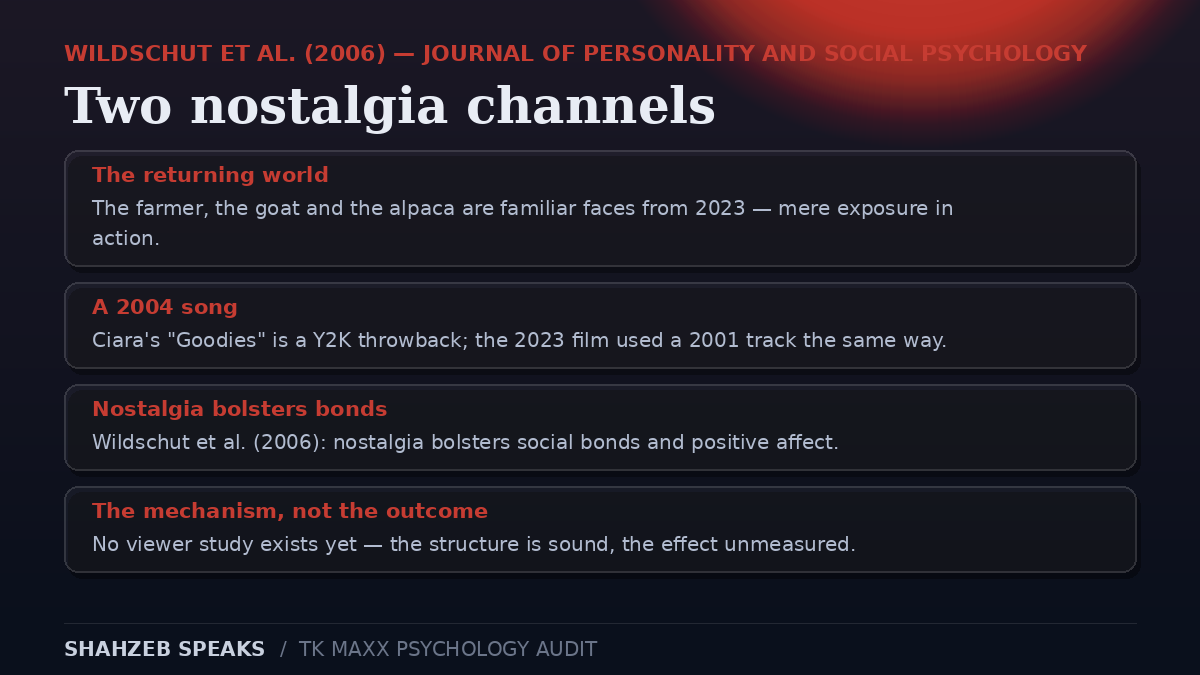
The research behind this is precise. Wildschut, Sedikides, Arndt and Routledge, writing in 2006 in the Journal of Personality and Social Psychology, ran seven studies on nostalgia and found that nostalgic narratives typically feature the self with close others — family and friends — or in momentous events; that nostalgia is triggered by negative mood and loneliness; and that it bolsters social bonds, increases positive self-regard and generates positive affect. Nostalgia, in other words, is not only a warm feeling. It is a social feeling. It makes people feel closer to the people they love, and better about themselves.
That is exactly what the film is selling, and it is worth stating carefully. The farmer and his wife are driving home together, with gifts for the people they love, in a world full of animals that feel like family. The music reaches back to a time when the viewer was younger. The nostalgia is doing its standard work, twice over: the world supplies the social warmth, and the song supplies the personal memory. The audit does not claim the film will make anyone feel nostalgic — no viewer study exists yet. It claims the film is built on a real mechanism, and built on it twice. That is a sound use of the research, and it is the reason the campaign scores highly on this dimension.
There is a limit to claim here, and it matters. The Wildschut studies were run in laboratories and surveys, on personal nostalgia — memories of one’s own life — not on advertising. The audit does not claim that watching a duck in a knitted hat will make a viewer feel closer to their family. It claims the film is structured to trigger the mechanism: a returning world, a familiar song, a family driving home with gifts. Whether it works is a question for the effectiveness data that does not yet exist. The structure is sound. The outcome is unmeasured.
🎰 Chapter 5: The treasure hunt — variable reward, dramatised
The third psychology in the film is the one that explains the brand itself. TK Maxx does not sell a catalogue. It sells a hunt. Its own description of the model is plain: “Our rapidly changing assortments create the treasure hunt experience that our customers love.” Buyers are, in the company’s own words, “opportunistic and entrepreneurial” — buying overproduction, overbuying and end-of-season stock, with several deliveries a week and new products reaching the shop floor every week. The stock is never the same twice, and when it is gone, it is gone. That is the whole business, and the film dramatises it.
The mechanism is variable-ratio reinforcement, the principle Skinner described for rewards delivered on an unpredictable schedule: rewards that arrive unpredictably sustain responding more persistently than rewards that arrive on a fixed schedule. It is the principle behind slot machines and loot boxes, and behind every treasure-hunt retailer. The next visit might hold the find. The next rack might hold the designer label at half the price. The uncertainty is not a flaw in the model. It is the model.
The film tells that story without ever explaining it. The ducks found designer gifts. The farmer’s wife told the neighbours. Word has spread. The farmer is driving home with a truck full of bags, and the ducks are showing off what they found. Nobody in the film is persuaded by an argument about price or quality. They are persuaded by the sight of someone else who has already found something good. The ad sells the hunt, not any single product — and that is both its strength and, as Chapter 8 shows, its weakness. A hunt with no product on screen is a mood, not a reason to visit a specific shop.
There is a second part to the treasure hunt that the film handles well: the price claim. TK Maxx’s own site says its prices are “up to 60% less than the RRP”, with RRPs independently obtained from brand owners and suppliers, who must provide evidence of the RRP. That is the company’s claim, and this audit prints it only as such. But the film never says it. The price is implied by the platform — “Spoil All Your Loved Ones For Less” — and by the wife’s line about everyone loving a bargain. The audit counts that as a strength: the film lets the viewer infer the value, rather than shouting a discount. It also counts it as a limit: a viewer who has never shopped at TK Maxx will not learn from this film how the pricing works, or why the gifts are cheaper. The hunt is dramatised. The economics are not.
👥 Chapter 6: Social proof — the ducks are the review
The fourth psychology in the film is social proof, and it is the one the film executes most elegantly. Cialdini’s principle is simple: people look to what others are doing to decide what to do, especially under uncertainty. The film’s joke is social proof in costume. A whole family of ducks is already wearing the gifts. The farmer’s wife has already told the neighbours. The goat and the alpaca are watching, shocked, because they have seen what the ducks found and they have not found it themselves. Nobody in the film is argued into shopping. Everyone is shown already enjoying the find.
The word-of-mouth line is the ad’s only explicit sales message, and it is delivered as a joke. “Everyone loves a bargain, dear” is not a claim about TK Maxx. It is a claim about everyone — and that is what makes it work. A brand that says “we are cheap” invites scepticism. A character who says “everyone loves a bargain” invites agreement, because it is a statement about human nature that happens to point at the brand. The farmer’s question — “Did you tell the neighbours about the great gifts at TK Maxx, love?” — does the same work in reverse: it tells the viewer that telling the neighbours is what people do, and that the neighbours will want to know. The ad is not selling a product. It is selling the act of telling someone else about it.
That is a sophisticated use of social proof, and it is worth comparing with the cruder version. Many Christmas adverts show a crowd, or a family, or a queue, and expect the viewer to infer popularity. “Festive Crossing” shows something narrower and more persuasive: specific individuals, wearing specific gifts, in a specific place, having a specific good time. The ducks are not a crowd. They are five characters with distinct personalities, distinct outfits and distinct gifts — and the film gives each of them a moment. The viewer is not being told that everyone shops at TK Maxx. The viewer is being shown five someones who already did, and who are visibly pleased about it.
The limit is the same as the treasure hunt’s. Social proof works when the proof is credible, and the proof here is a family of CGI ducks. That is the joke, and the joke is the point — but it is also a ceiling. A viewer who wants to know what TK Maxx actually sells, at what price, and why it is better than the shop next door, will not find the answer in this film. The ducks prove that shopping at TK Maxx is fun. They do not prove that it is good value. The brand’s own site makes the value claim. The film leaves it to the platform line.
🎁 Chapter 7: Generosity — spoil your loved ones for less
The fifth psychology in the film is the one the platform names directly. “Spoil All Your Loved Ones For Less” pairs generosity with thrift: the emotional reward of giving is preserved while the financial cost is cut. That pairing is the brand’s answer to the cost-of-living pressure that Funk named in her statement — shoppers “thinking carefully about how they spend, looking for great deals and thoughtful, high-quality gifts” — and it is the reason the campaign’s timing matters. A Christmas advert that promises generosity without mentioning cost would feel out of touch in 2026. A Christmas advert that promises cheapness without mentioning generosity would feel mean. The platform promises both, in one line.
The film dramatises the generosity side and leaves the thrift side to the platform. The ducks are not buying for themselves. They are carrying gifts — wrapped, beribboned, chosen. The farmer and his wife are driving home with a truck full of bags, and the bags are for other people. The duckling at the end, pulling a wooden toy duck on a string, is the smallest act of giving in the film, and it is the one that lands hardest, because it is the most obviously chosen: a toy, pulled along, for someone who is not in the film. Generosity is the emotion the film is built on, and the brand’s claim is that generosity does not need to be expensive.
That claim should be stated carefully. No survey or sales figure in the sources for this audit shows that TK Maxx shoppers actually spend less, gift more, or feel more generous. The audit discusses the generosity framing as the campaign’s positioning, clearly labelled as interpretation. It does not claim the ad makes people more generous. What it does claim is that the positioning is coherent: a discount retailer that promises generosity is promising something its full-price competitors cannot promise as cheaply, and the film’s job is to make that promise feel warm rather than transactional. The ducks, the snow, the 2004 song and the returning world all serve that job. The price is never mentioned. The generosity is never in doubt.
⚠️ Chapter 8: The criticism — one joke, light on substance
An honest audit carries the criticism, and this campaign has a clear one. Daily Commercials, reviewing the film on 13 November 2026, gave it 3 out of 5, and its verdict is worth quoting in full because it names the film’s real weakness: “a handsome, well-cast and genuinely funny comeback for TK Maxx’s Festive Farm, lifted by Gary Freedman’s deadpan direction, real-feeling winter photography and a cheeky Ciara needle drop. But it is one joke stretched across a minute, with little to say about why TK Maxx is the place to shop. Charming in the moment, light on substance.” The review also says the 30-second television cut “will probably be the stronger film”. That is one critic’s score, not a consumer-effectiveness measure, and this audit attributes it as such. But the criticism is sound, and it deserves a chapter of its own.
The film’s joke is a sight gag: ducks crossing a road, dressed up, carrying gifts. It is a good sight gag, and the craft is genuinely high — the CGI is detailed, the direction is deadpan, the photography feels real. But a sight gag is a single idea, and the 60-second version has to stretch it. The ducks cross. The truck waits. The goat and the alpaca look shocked. The duckling pulls its toy. That is the film. There is no second idea, no twist, no reason to keep watching after the first twenty seconds except the charm of the animals. The 30-second cut, which is the version most viewers will see on television, is probably the stronger film precisely because it does not ask the joke to last a minute.
The second part of the criticism is more important than the first. The film says almost nothing about why TK Maxx is the place to shop. Nothing on screen tells the viewer what the ducks are wearing, or where they found it, or what it cost, or why it is better than the same gift from another shop. The brand’s treasure-hunt model — the thing that actually distinguishes TK Maxx from every other retailer — is implied by the plot and never stated. A viewer who has never shopped at TK Maxx will finish the film knowing that ducks like it there. They will not know why.
Ad Ranking’s round-up of the 2026 Christmas adverts, updated on 10 November, makes the same point more briefly: “one sight gag, familiar characters and a song that does the rest”. Creative Boom, in its rolling round-up, calls the film “a refreshing change from all the mushy stuff” — which is praise, but praise for what the film is not, rather than for what it is. The audit’s verdict on this chapter is that the criticism is fair, and that it caps the score. A film that is charming, well-crafted and thin is a good film. It is not a great one. The scorecard reflects that.
🔍 Chapter 9: What the film leaves out
There are three honest gaps in this campaign, and they belong in the audit before the legal chapter, because they are about the campaign itself rather than the company behind it. The first is that no effectiveness data exists yet. The television debut was yesterday. No System1 star rating, no Test Your Ad score and no other consumer-effectiveness measure for “Festive Crossing” has been published as of 17 November 2026. The 2023 film’s 5-star System1 score belongs to the 2023 film only, and it must never be attributed to the 2026 film. This audit scores the campaign’s psychology and craft, not its outcome, and it says so plainly.
The second gap is the charity product. The 2023 “Festive Farm” campaign included a specially made Christmas bear, priced at £9.99, with £3 from each sale donated to The Prince’s Trust, TK Maxx’s long-term charity partner. No equivalent charity product for 2026 was found in the sources for this audit. That may mean there is none, or it may mean it has not been announced yet. Either way, this audit does not claim one exists. The absence matters, because the bear gave the 2023 campaign a second story — a reason to buy beyond the joke — and the 2026 campaign, as far as the public record shows, does not have one.
The third gap is the product itself. The film shows gifts, but it never shows a price, a label or a brand name on any of them. The ducks are wearing designer gifts, according to the trade coverage, but the viewer is never told which designers, or what the gifts cost, or what the saving is. That is a deliberate choice — the film is selling a feeling, not a catalogue — but it is a choice with a cost. The treasure hunt works when the viewer believes the find is real. A CGI duck in a knitted hat is charming. It is not evidence. The film asks the viewer to trust the brand’s claim that the gifts are designer and discounted, and the only support for that trust is the platform line and the brand’s own site. For a retailer whose entire model is the bargain, that is a surprisingly indirect way to make the case.
⚖️ Chapter 10: The dark side — the parent company’s record
Every audit on this site carries a legal chapter, and this one is about the parent company, because TK Maxx itself has a short legal record and TJX Companies has a long one. The distinction matters: the items below are about TJX, the parent, unless stated otherwise, and they are stated at their exact status, as of 17 November 2026.
The most recent item is also the most serious. On 30 October 2026, the New York State Department of Labor announced that it had secured $674,526 in back wages for 7,577 employees of The TJX Companies, Inc., following a proactive investigation and self-audit of about 185 New York stores for spread-of-hours violations, covering August 2020 to August 2023. Investigators first found the issue in an unannounced visit to a Marshalls store in the Bronx in April 2023. TJX “cooperated fully” and paid out, with individual amounts reaching $4,686. This is a recovery of unpaid wages, not a fine — no penalty figure was announced — and it is a parent-company, United States-only matter, resolved by payment. It is also, by the standards of corporate wage cases, a modest sum spread across many people: about $89 per employee on average. That does not make it trivial. It makes it a compliance failure that was found, admitted in practice, and paid for.
The second item is a clean result. On 11 March 2026, Australia’s Ad Standards Community Panel decided two complaints against a TK Maxx advertisement — case 0054-26 for free-to-air television and case 0051-26 for pay television — and found no breach in either case. The complaints said a low camera angle “upskirted” a female model. The panel found no breach of section 2.4 of the AANA Code of Ethics, on sex, sexuality and nudity, and no breach of any other section. TK Maxx had run two rounds of third-party consumer testing and obtained Clear Ads approval, with a G rating, before launch. The audit records the outcome as it stands: no breach found, in both cases.
The older items are smaller, and they are recorded briefly. In January 2013, the Harris Tweed Authority said TK Maxx was selling two jacket styles containing some Harris Tweed with labelling and promotion that it said breached the Harris Tweed Act 1993 and its rights, and it launched court proceedings. After negotiations, the Authority “secured an appropriate confidential settlement”. No amount was disclosed, and there was no court ruling. In California, two Proposition 65 notices against the parent company’s supplier chain were settled for small amounts: notice 2024-02154, filed 30 May 2024 over an alleged chemical in a pen pouch sold via TJ Maxx, settled on 28 August 2024 for a $500 civil penalty plus $14,500 in fees; and notice 2025-00290, filed 29 January 2025 over an alleged chemical in a ceramic pot sold via Marshalls, settled on 13 June 2025 for $500 plus $7,000 in fees. These are routine small settlements, not findings against TK Maxx’s advertising. A United States OSHA inspection of a single store in Portland, Oregon, opened on 12 November 2024 on a complaint, found six violations — four serious, two willful — with a current penalty of $65,472, and the case is shown as open. It is a single-store, United States-only matter.
The historical item is the 2007 TJX data breach, in which at least 45.7 million credit cards were exposed to possible fraud. TJX and nearly all the banks and bank associations that sued settled for an undisclosed amount, covered by a $107 million reserve TJX had set aside. The exact settlement date was not verified in the sources for this audit, so this audit prints no date. And there is one item that is not a legal action at all, which must be framed exactly as what it is. On 16 November 2026, ProPublica reported that TJX said it had received a $331 million tariff refund and had “accrued incremental expenses of $112 million” for year-end incentive pay and discretionary bonuses. Separately, eight United States Senate Democrats wrote to the Federal Trade Commission on 11 November 2026, asking it to investigate whether large companies receiving tariff refunds violated federal law by not passing them to customers. No finding, charge or ruling against TJX exists. This is a news report plus a request for investigation, not a fine, an investigation or a scandal, and this audit does not call it one.
Finally, the absence that the audit must state honestly: no UK Advertising Standards Authority ruling against TK Maxx was found in searches on 17 November 2026, and no current lawsuit, investigation or fine against TK Maxx itself in the UK was found. That is absence of evidence, not proof that none exists, and this audit writes “no ruling found”, never “never had a ruling”. The parent company’s record is real, and it is the record the scorecard’s trust dimension reflects. The brand’s own record, in the UK, is clean as far as the searches run could find.
🇵🇰 Chapter 11: What Pakistani brands should — and shouldn’t — copy
Pakistani brands should copy the returning world. TK Maxx’s best decision was not the ducks. It was the decision, made in 2023, to build a world — a farm, a farmer, a goat, an alpaca — and then to return to it, year after year, instead of inventing a new one each Christmas. A Pakistani brand with a recognisable world — a shop, a street, a family, a ritual — should do the same. Familiarity is free, and it compounds. The first year, the audience learns the world. The second year, they recognise it. The third year, they look forward to it. Most Pakistani Christmas and Eid campaigns start from zero every year, and they pay for that choice in attention every time.
Pakistani brands should also copy the word-of-mouth line. The only explicit sales message in “Festive Crossing” is a joke about telling the neighbours, and it is the most persuasive line in the film, because it is a statement about human nature that happens to point at the brand. A Pakistani brand that says “tell your neighbour” will be believed more readily than one that says “we are the cheapest”, because the first is a social observation and the second is a claim. Word of mouth is the oldest channel in Pakistan’s retail culture, and it is the one this film uses best.
Pakistani brands should not copy the vagueness. The film’s greatest weakness is that it never says what the ducks are wearing, what it costs, or why TK Maxx is the place to shop. A Pakistani brand with a genuine price advantage should state it — clearly, specifically, and with the evidence behind it. The treasure hunt works when the find is real. A CGI duck in a knitted hat is charming, but it is not evidence, and a Pakistani audience that is spending carefully will notice the difference between a feeling and a fact. State the price. Name the brand. Show the saving. The film’s charm is worth copying. Its silence about the product is not.
And Pakistani brands should not copy the parent company’s labour record. The New York back-wage recovery — $674,526 for 7,577 employees, spread-of-hours violations over three years — is a reminder that a brand’s psychology does not stop at its advertising. A company that promises generosity to its customers while underpaying its staff will eventually be found out, and the finding will be announced by a regulator, not by the brand. The audit’s trust score reflects that. Pay people correctly, on time, and in full — and say so only when it is true.
📊 Psychology Scorecard
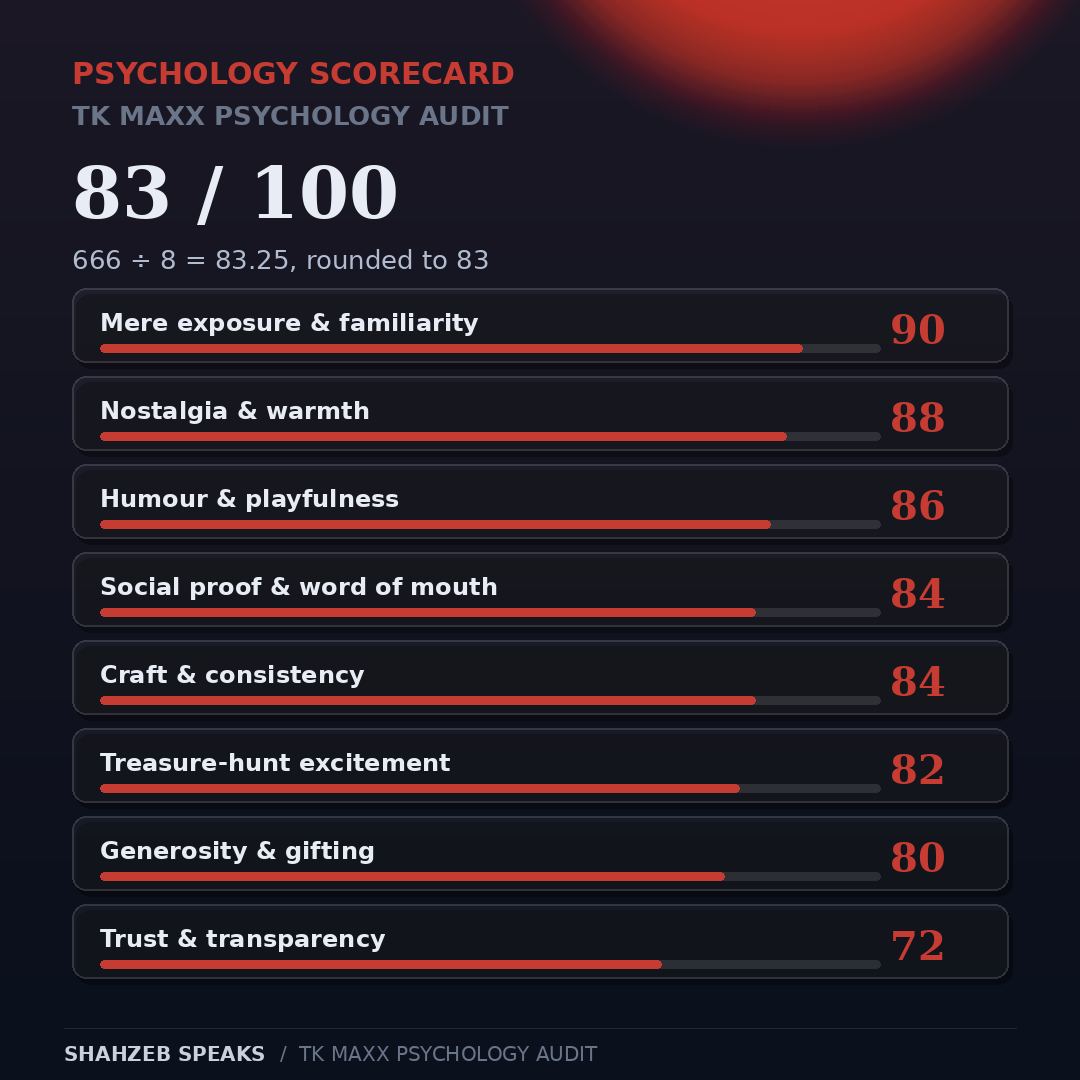
The scorecard below scores the campaign’s psychology and craft, not its outcome. No effectiveness data exists yet, and none is claimed. The eight dimensions are scored out of 100, and the overall score is their rounded average.
| Dimension | Score | Verdict |
|---|---|---|
| Mere exposure & familiarity | 90 | A three-year-old world, returned intact — the strategy is the familiarity |
| Nostalgia & warmth | 88 | Two channels at once: the returning world and a 2004 song |
| Humour & playfulness | 86 | Deadpan ducks, a shocked goat, a duckling with a toy — the joke lands |
| Social proof & word of mouth | 84 | The ducks are already wearing the gifts; the neighbours have been told |
| Craft & consistency | 84 | 11 unique CG characters, a real winter, the same world since 2023 |
| Treasure-hunt excitement | 82 | The hunt is dramatised beautifully; the economics are never stated |
| Generosity & gifting | 80 | “Spoil All Your Loved Ones For Less” is coherent; no charity product found for 2026 |
| Trust & transparency | 72 | No UK ASA ruling found; the parent company’s wage recovery and breach history weigh here |
| Overall | 83/100 | 90 + 88 + 86 + 84 + 84 + 82 + 80 + 72 = 666; 666 ÷ 8 = 83.25, rounded to 83 |
✅ Balance sheet & prescription
What works: the returning world, which turns three years of familiarity into an asset; the double nostalgia of a remembered world and a 2004 song; the word-of-mouth joke, which is the film’s only sales line and its most persuasive one; the craft, from 11 distinct CG characters to a winter that feels real; and the platform, which pairs generosity with thrift in a single line that fits the year.
What does not: the single joke, stretched across a 60-second cut that the 30-second version will probably beat; the absence of any product story — no price, no label, no reason the ducks’ gifts came from TK Maxx rather than anywhere else; the missing charity product that gave the 2023 campaign a second story; and the parent company’s record, which the trust score carries.
The prescription: keep the world, and keep returning to it — it is the brand’s best asset. But give the next film a second idea, not only a new animal. Put one real product on screen, with its price and its saving, so the treasure hunt has evidence behind it. Bring back a charity product, so the generosity has somewhere to go beyond the joke. And keep the 30-second cut as the hero: the joke is a thirty-second joke, and the minute-long version asks it to do work it was not built for.
📝 Final Verdict
“Festive Crossing” is a charming film built on a sound idea. TK Maxx understood that the most valuable thing it owned this Christmas was not a new concept but an old one — a farmyard world its audience already liked — and it spent its budget on returning to that world with new characters rather than inventing a replacement. The mere-exposure effect, the double nostalgia and the social proof are all working, and the craft is genuinely high. The film’s weakness is that it is one joke, told at length, with no product story behind it, and the audit’s score reflects both halves of that judgement. It is a good Christmas advert. It is not a great one — and the difference between the two is a second idea, a real price, and a reason to believe the hunt is worth joining.
Psychology Score: 83/100 — a familiar farm, a new family of ducks, and one joke told beautifully. The strategy is sound; the substance is thin.
— Brand Psychology Analysis, ShahzebSpeaks
If your brand keeps inventing a new world every Christmas instead of returning to the one your customers already love, you are paying for familiarity you already own. I help organisations build evidence-based brand strategy — get in touch here.
If this audit helped, you may also like Marks & Spencer — The Home of Christmas, Waitrose — The Perfect Gift 2, and Oreo — Santa’s Favorite Cookie. For the wider field, the homepage of this site covers industrial psychology in Pakistan and beyond.
📚 References & Sources
- TK Maxx, “Festive Crossing” (2026). Campaign launched 5 November 2026; television debut 16 November 2026. Agency: Wieden+Kennedy London; director: Gary Freedman (MJZ). Covered in LBB, 5 November 2026: https://lbbonline.com/news/tk-maxx-christmas-2026-cute-animals ; Retail Gazette, 5 November 2026: https://www.retailgazette.co.uk/blog/2026/11/watch-tk-maxx-launches-first-new-christmas-advert-in-three-years/
- Daily Commercials, “TK Maxx Festive Crossing Ad Review — Christmas 2026”, 13 November 2026 (3 out of 5): https://dailycommercials.com/tk-maxx-festive-crossing-christmas-2026-ad-review/
- TK Maxx, “Festive Farm” (2023). Launched 2 November 2023; System1 Ad of the Week, 24 November 2023 (5 stars; 5.2 stars for the 20-second edit): https://system1group.com/ad-of-the-week/tk-maxxs-creature-catwalk-is-a-festive-fashion-hit
- The TJX Companies, Inc., company background and fiscal 2026 results (year ended 31 January 2026): group net sales $60,372 million; TJX International net sales $7,986 million; 5,214 stores. https://www.tjx.com/businesses/europe
- Retail Sector, TK Maxx knowledge base: TJX UK turnover £4,354.3 million, profit £201.5 million; 357 TK Maxx stores in the UK. https://www.retailsector.co.uk/knowledge-base/tk-maxx/
- TK Maxx, “How we do it”: treasure-hunt model and “up to 60% less than the RRP” claim. https://www.tkmaxx.com/uk/en/how-we-do-it
- New York State Department of Labor, $674,526 back-wage recovery for 7,577 TJX employees, announced 30 October 2026: https://www.einpresswire.com/article/953448507/the-new-york-state-department-of-labor-announces-recovery-of-near
- Ad Standards Australia, cases 0054-26 and 0051-26, decided 11 March 2026 (no breach): https://adstandards.com.au/case/case-0054-26/
- Harris Tweed Authority / Drapers, Harris Tweed dispute settled confidentially, January 2013: https://www.drapersonline.com/companies/multiples-and-etailers/harris-tweed-wins-dispute-with-tk-maxx
- Zajonc, R. B. (1968). Attitudinal effects of mere exposure. Journal of Personality and Social Psychology, 9(2), 1–27.
- Wildschut, T., Sedikides, C., Arndt, J. & Routledge, C. (2006). Nostalgia: Content, triggers, functions. Journal of Personality and Social Psychology, 91(5), 975–993.
- Skinner, B. F. Variable-ratio reinforcement schedules (canonical principle).
- Cialdini, R. B. (2001). Influence: Science and Practice. Social proof, scarcity, reciprocity and consistency.
- Green, M. C. & Brock, T. C. (2000). Narrative transportation — the persuasiveness of public narratives.
- Kahneman, D. & Tversky, A. (1979). Prospect theory: An analysis of decision under risk. Econometrica, 47(2), 263–291.
- Gouldner, A. W. (1960). The norm of reciprocity: A preliminary statement. American Sociological Review, 25(2), 161–178.
Key Findings
- TJ Maxx founded 1976 in Framingham, Massachusetts, by Bernard Cammarata; first UK store opened in Bristol in 1994; name changed from TJ Maxx to TK Maxx to avoid confusion with TJ Hughes; Germany 2007, Poland 2009, Austria and the Netherlands 2015, Australia 2017, Spain March 2026; 673 TK Maxx stores in Europe and 357 in the UK as of 31 January 2026; TJX group total 5,214 stores across 9 countries.
- "Festive Crossing" launched 5 November 2026 across video-on-demand, online video and integrated digital channels (30-second cut), with a 60-second version on YouTube and TK Maxx's owned channels; television debut 16 November 2026 in prime-time placements; first new TK Maxx Christmas advert in three years; returns to the "Festive Farm" world first launched in 2023; created by Wieden+Kennedy London (Charlie Lanus, Alexandra Sattlecker), directed by Gary Freedman (MJZ), DP Lasse Frank, VFX The Perlin (11 unique CG characters), media Omnicom Media Group; soundtrack Ciara's 2004 hit "Goodies"; platform "Spoil All Your Loved Ones For Less".
- Parent figures (TJX, fiscal year ended 31 January 2026): group net sales $60,372m — the first time above $60bn; TJX International net sales $7,986m, up 11% from $7,181m; segment profit $558m (from $422m); TJX UK turnover £4,354.3m (up 4.7%), profit £201.5m (up from £97.7m); "up to 60% less than the RRP" is the company's own claim; TJX does not break out TK Maxx revenue, so no TK Maxx-only revenue figure is printed.
- Legal record: New York wage recovery — RECOVERED $674,526, announced 30 October 2026, for 7,577 TJX employees (spread-of-hours violations, August 2020 to August 2023; TJX cooperated fully and paid out; recovery of unpaid wages, NOT a fine — no penalty figure announced). Australia Ad Standards — NO BREACH, decided 11 March 2026, two cases (0054-26 and 0051-26). Harris Tweed dispute — SETTLED CONFIDENTIALLY, January 2013; no amount disclosed, no court ruling. California Prop 65 — SETTLED (2024: $500 penalty + $14,500 fees; 2025: $500 + $7,000 fees). US OSHA inspection — OPEN, $65,472 penalty, one Portland, Oregon store, March 2025. TJX 2007 data breach — SETTLED, at least 45.7 million credit cards exposed (exact settlement date not verified). Tariff refunds — REPORTED 16 November 2026 (ProPublica: TJX received $331m, accrued $112m for bonuses); no finding, charge or ruling against TJX. No UK ASA ruling against TK Maxx found in searches on 17 November 2026.
- Psychology: Zajonc (1968) — mere exposure, repeated exposure increases liking; Wildschut et al. (2006) — nostalgia bolsters social bonds and positive affect; Skinner — variable-ratio reinforcement behind the treasure hunt; Cialdini (2001) — social proof in the ducks already wearing the gifts; Daily Commercials review, 13 November 2026, 3 out of 5 — one critic's score, not an effectiveness measure.
- Score 83/100: 90+88+86+84+84+82+80+72 = 666; 666/8 = 83.25, rounded to 83.
Overall Psychology Score
TK Maxx scores 83/100 in our comprehensive psychology audit covering consumer behavior strategies, UX design principles, and psychological marketing effectiveness.
The detailed dimension scores are in the audit's Psychology Scorecard chapter.
High impactMuhammad Shahzeb
MSc Industrial Psychologist, specializing in consumer behavior, UX psychology, and brand strategy analysis. Helping brands understand the psychology behind their success.
About Muhammad Shahzeb →