Oreo Psychology Audit — Santa’s Favorite Cookie: The Ritual, the Revenge and the Milk
Oreo's first new Christmas advert in five years turns a stolen cookie into Santa's revenge. Our psychology audit of the ritual, the joke and the risk behind it scores Oreo 83/100.

83 / 100
Overall consumer behavior effectiveness

Brand Overview
- Brand nameOreo
- Founded1912
- HeadquartersChicago, Illinois, USA
- IndustryFood & Beverage
- Websitewww.oreo.com ↗
Psychology Techniques Identified
- 01Ritual & involvement (Vohs, Wang, Gino & Norton 2013; ritual group enjoyment 5.95 vs 5.15 control, d=0.73; the film dramatises the milk-and-cookies ritual broken and restored, plus Oreo's own "Twist, Lick, Dunk")
- 02Nostalgia (Wildschut et al. 2006; Zhou et al. 2008; the Christmas-morning family setting bolsters social bonds and positive affect)
- 03Reciprocity (Gouldner 1960; Cialdini 2001; dad takes Santa's cookie, Santa repays him bite for bite)
- 04Humour & playfulness (Stay Playful platform; mischievous tone shift from the warm 2021 "Ding Dong" film)
- 05Narrative transportation (Green & Brock 2000; the 30-second theft-and-revenge story absorbs the viewer instead of arguing with them)
- 06Social identity & sharing (Tajfel & Turner 1979; the film invites sharing the joke across social channels)
- 07Scarcity & seasonal urgency (Cialdini 2001; Christmas-only framing creates time-limited pressure — no verified Oreo scarcity claim for this campaign)
- 08Authority & celebrity (Cialdini 2001; Colin Jost's No Notes studio and director Benji Weinstein carry the creative authority)
- 09Consistency & commitment (Cialdini 2001; "Stay Playful" since 2021 — the brand stays consistent with its positioning)
- 10Social proof (Cialdini 2001; the family leaving milk and cookies normalises the ritual — everyone does it)
- 11Goal-gradient effect (Kivetz et al. 2006; the 2027 relaunch gives the brand visible progress toward a bigger goal)
- 12Loss aversion (Kahneman & Tversky 1979; Santa's revenge dramatises the loss of the dad's presents — the bite marks make the loss visible)
Full Psychology Audit Report
In this audit
It is Christmas Eve. A plate of chocolate sandwich cookies and a glass of milk wait by the fireplace, as they have for generations. A father walks past, takes a bite, and keeps walking. On Christmas morning, the family finds the damage: bite marks in the dad’s stocking, his golf clubs, his snowboard, his television and his remote. Santa has taken his revenge, one bite at a time. Oreo’s first new Christmas advert in five years is built on a joke everyone understands instantly — steal Santa’s cookie, and Santa steals back — and the psychology underneath the joke is older and stronger than the gag itself.
I am an Industrial and Organizational Psychologist in Karachi, and I audit brands on the psychology of what they actually do — not on how much I like their products. This audit is of Oreo’s “Santa’s Favorite Cookie”, launched on 12 November 2026. It is four days old. No effectiveness score exists yet, no viewer or sales figure has been published, and this audit will not invent one. What it scores is the campaign’s psychology and craft: the ritual it dramatises, the nostalgia it trades on, the reciprocity joke it tells, and the risk it takes by making Santa vengeful. The parent company, Mondelēz International, was audited on this site on 3 November 2026; this audit stays on the Oreo brand and this campaign, and treats the parent company’s record only as context.
“Get your own Oreo.”
— Closing line, Oreo, “Santa’s Favorite Cookie”, 2026
📋 Brand Overview
| Field | Detail |
|---|---|
| Brand | Oreo — chocolate sandwich cookie, Mondelēz International |
| Introduced | 6 March 1912, by Nabisco in Chelsea, New York City; name trademarked 14 March 1912 |
| Owner | Mondelēz International since the 2012 Kraft spin-off; Nabisco acquired by Kraft in 2000 |
| Headquarters | Chicago, Illinois, USA (Mondelēz International) |
| Scale | Sold in more than 100 countries; the company’s claim is “World’s Best Selling Cookie” |
| Parent (Q3 2026) | Mondelēz net revenues $9.97 billion, up 2.3% year on year; biscuits and baked snacks up 2.2% organic, supported by Oreo |
| Current campaign | “Santa’s Favorite Cookie”, launched 12 November 2026; 30-second film, first new Oreo Christmas creative in five years |
| Website | https://www.oreo.com |
| Psychology score | 83/100 |
📜 Chapter 1: History — the imitation that ate the original
Oreo began as a copy. The chocolate cream-centred cookie it imitated was Hydrox, introduced by Sunshine Biscuits in 1908 — four years before Oreo. Nabisco introduced Oreo on 6 March 1912 at its Chelsea factory in New York City, and the first Oreo was sold that day to a grocer in Hoboken, New Jersey. The name was trademarked on 14 March 1912. Oreo outstripped Hydrox so completely that many people now wrongly believe Hydrox was the imitation. That is the first psychology lesson in the brand’s history, and it is worth stating plainly: the winner was not the inventor. It was the brand that built the better ritual around the same idea.
The ritual is “Twist, Lick, Dunk” — twist the cookie open, lick the creme, dunk it in milk — and it has anchored Oreo marketing for decades. It is not a slogan. It is a set of instructions for how to eat the product, and instructions are more powerful than slogans, because they turn consumption into a small ceremony. Chapter 3 explains why that matters, with the research behind it. For now, the point is that Oreo has always sold a way of eating, not only a cookie.
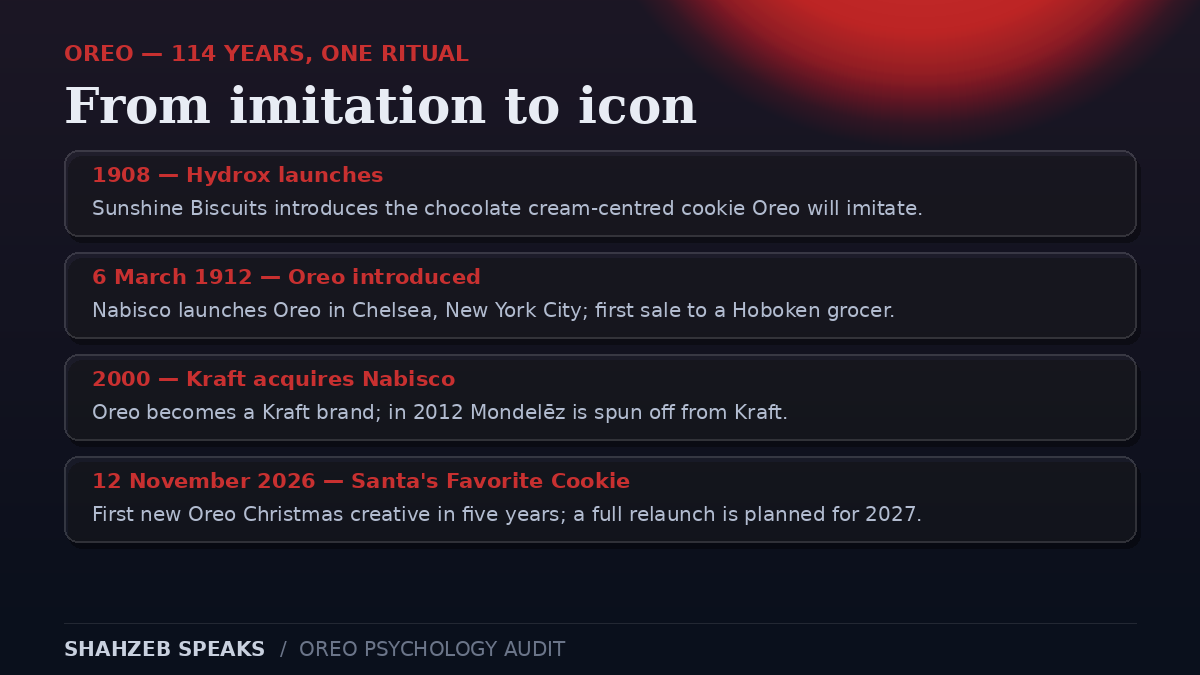
The ownership history is short. Kraft acquired Nabisco in 2000, and Oreo became a Kraft brand. In 2012 Mondelēz International was spun off from Kraft, and Oreo became a Mondelēz brand. The brand is now sold in more than 100 countries, and the company’s claim is that it is the world’s best-selling cookie — a claim this audit attributes to the company, not one it verifies independently. Mondelēz does not break out Oreo’s revenue in its filings, so no Oreo-level revenue figure appears in this audit: published estimates conflict, and printing one would be guessing.
The parent company’s numbers are verified and worth recording, because they frame the campaign’s timing. Mondelēz reported third-quarter 2026 net revenues of $9.97 billion on 29 October 2026, up 2.3% year on year, with full-year 2025 net revenues of approximately $38.5 billion. Biscuits and baked snacks recorded 2.2% organic revenue growth in the quarter, supported by Oreo, Ritz and cakes and pastries. In May 2026 Mondelēz handed global Oreo creative to 72andSunny after a review, and in September 2026 it signalled a full Oreo relaunch in 2027, with new packaging and new formulas. The Christmas film arrives, in other words, as a bridge: a fresh creative for a brand that is about to be relaunched.
🎬 Chapter 2: “Santa’s Favorite Cookie” — a theft, a revenge, a dunk
Oreo launched “Santa’s Favorite Cookie” on 12 November 2026 in the United States, with United Kingdom coverage following on 13 November. It is the brand’s first new Christmas creative in five years, since the 2021 “Ding Dong” film, in which Santa enlisted a snowman and a yeti to deliver Oreos. That film ran every festive season through 2024. Five years is a long time to run the same Christmas film, and the new one is deliberately different in tone.
The centrepiece is a 30-second film, with a 15-second cut. A father sneaks a bite of the Oreos left by the fireplace for Santa. On Christmas morning the family finds that Santa has taken his revenge: bite marks in the dad’s stocking, his golf clubs, his snowboard, his flatscreen television and his remote. The film closes with Santa at the North Pole, soaking his feet and dunking an Oreo into a glass of milk. The closing line is “Get your own Oreo.” The campaign is tagged “Stay Playful”, Oreo’s long-running brand platform.
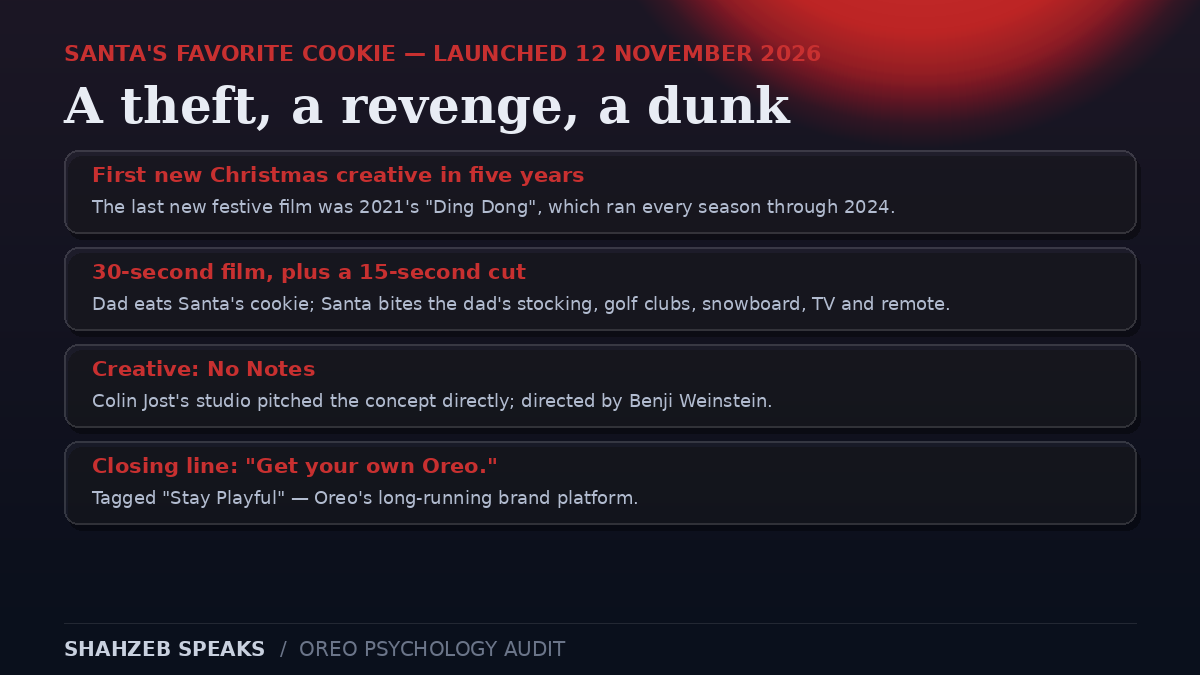
The creative team is part of the story. The concept came from No Notes, the creative content studio founded by comedian and Saturday Night Live star Colin Jost, which pitched the idea directly to Oreo. The film was directed by Benji Weinstein, produced by Good Company and Merchant, with Dentsu handling social activity and Publicis Production providing consultancy. The 15- and 30-second versions run across Amazon, streaming and connected television, and on Meta, TikTok, Pinterest, Snapchat and YouTube, as well as Oreo’s owned channels.
The company-stated aim is to bring the brand into the holiday conversation, encourage consumption and sharing, and reinforce Oreo’s place in seasonal traditions. Matt Foley, Vice President of Oreo at Mondelēz International, said the idea was to align Oreo with the beloved tradition of leaving milk and cookies out for Santa, and to bring the brand’s association with joy and connection into the festive season. That is a company claim, not an independent finding — but it states the test the campaign sets itself. If the film works, it works because the tradition feels real, the joke lands, and the cookie is the thing that restores the ritual. The next chapters test each of those in turn.
🕯️ Chapter 3: Ritual — the product is the ceremony
The strongest psychology in this audit is also the oldest in the brand. The film is built on the Christmas Eve ritual of leaving milk and cookies for Santa — and on Oreo’s own “Twist, Lick, Dunk” ritual. The ad dramatises what happens when the ritual is broken: the father eats Santa’s cookie, and the order of Christmas morning is disturbed until Santa gets his Oreo and his milk. The ritual is not decoration. It is the plot.
The research behind this is precise. Vohs, Wang, Gino and Norton, writing in 2013 in Psychological Science, ran four experiments on whether rituals change how food tastes. In the first, 52 students ate chocolate after either performing a ritual — breaking the chocolate, unwrapping it slowly, taking a moment — or doing nothing in particular. The ritual group rated the chocolate as more flavourful and more deserving of savouring: enjoyment averaged 5.95 on the scale used, against 5.15 for the control group, a difference the authors reported as statistically significant (t(50) = 2.65, p = .01, d = 0.73). Random gestures did not produce the effect. Performing the ritual yourself mattered more than watching someone else perform it. The mechanism, the authors argued, was greater involvement in the experience.
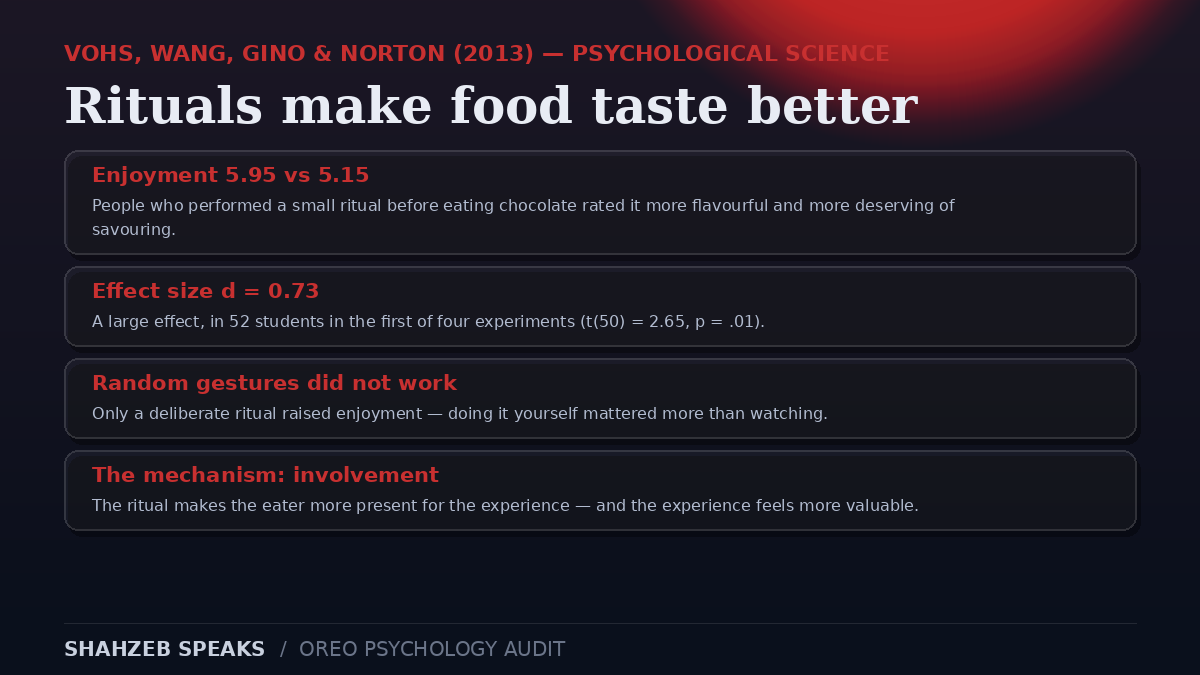
That finding is the audit’s central claim, and it is worth stating carefully. Rituals raise perceived flavour and value through involvement — not because the food changes, but because the eater is more present for it. Oreo has understood this for decades: “Twist, Lick, Dunk” is a ritual printed on the product’s behaviour, not only on its packaging. The Christmas film extends the same logic to the season. Leaving milk and cookies for Santa is itself a ritual, performed by parents on behalf of children, and the film’s joke only works if the audience already treats that ritual as sacred. The father’s bite is funny because it breaks something the audience respects. The restoration — Santa dunking his own Oreo at the North Pole — is satisfying because the ritual is repaired, in the correct order, with the correct product.
There is a limit to claim here, and it matters. The Vohs experiments were run in a laboratory with students, on chocolate, lemonade and carrots — not on Christmas Eve, and not on Oreo. The audit does not claim the film will make anyone’s Oreo taste better. It claims the film is built on a real mechanism: rituals make consumption feel more valuable, and this film puts two rituals — the brand’s and the season’s — inside the same thirty seconds. That is a sound use of the research. It is also the reason the campaign scores highest on this dimension.
🎄 Chapter 4: Nostalgia — Christmas morning, remembered
The second mechanism is nostalgia, and it does the warming-up work that the joke cannot do alone. The film’s setting — a family home, a fireplace, a Christmas morning reveal — is built from the raw material of nostalgic memory. Wildschut, Sedikides, Arndt and Routledge, writing in 2006 in the Journal of Personality and Social Psychology, ran seven studies on what nostalgia contains and what it does. Nostalgic narratives typically feature the self with close others — family and friends — or in momentous events. Nostalgia is often triggered by negative mood and loneliness, and it bolsters social bonds, increases positive self-regard, and generates positive affect. A later study by Zhou, Sedikides, Wildschut and Gao in 2008 found that loneliness reduced perceived social support but increased nostalgia, and nostalgia in turn increased perceived social support — nostalgia acting as a psychological resource.
The milk-and-cookies tradition is a childhood ritual for most of the audience, and the film trades on exactly the content Wildschut and colleagues found dominating nostalgic experience: the self, with close others, in a momentous event. The father is not a stranger. He is a parent, in a family home, on Christmas morning. The bite marks are funny because the setting is warm. If the same joke were set in a supermarket, it would be a different film — and a colder one.
There is a careful distinction to make here. Nostalgia in advertising is often used as a shortcut: show an old thing, borrow the feeling. This film does something more specific. It does not show an old Oreo advert. It shows an old family ritual, and it puts the product inside it as the thing that makes the ritual work. The cookie is not the memory. The cookie is the thing that lets the memory happen again, correctly, this year. That is the honest version of nostalgia marketing, and it is the version this film uses.
⚖️ Chapter 5: Comic reciprocity — Santa enforces the exchange
The joke in the film is a reciprocity violation and its punishment, and it works because the audience reads the exchange logic instantly. Gouldner set out the norm of reciprocity in 1960, in the American Sociological Review: people should help those who have helped them, and should not injure those who have helped them. It is a universal social norm that stabilises relationships, and violations invite retaliation or sanction. Cialdini lists reciprocity among his principles of persuasion: people feel obliged to return favours, and the obligation is felt even when the favour was small.
The father takes Santa’s cookie. That is the violation. Santa repays him in kind, by biting his presents. That is the enforcement. The humour works for two reasons. First, the exchange is exact: a bite for a bite, measured in the same currency. Second, the enforcer is the giver. Santa is the figure who brings the presents, and in this film he is also the figure who takes a bite out of them. The audience laughs because the logic is fair and the enforcer is unexpected — a jolly figure behaving like a strict accountant.
There is a risk inside the joke, and the audit should name it. A vengeful Santa is memorable, but it is also a Santa who punishes a parent in front of his family, and some viewers will read that as mean-spirited rather than playful. No audience reaction data exists yet — the campaign is four days old — so this is an interpretation, not a verified reaction. But the risk is real enough to score honestly. The film’s tone moved from the warm 2021 “Ding Dong” film, in which Santa enlisted a snowman and a yeti to deliver Oreos, to a mischievous film in which Santa takes revenge. Warmth is safe. Mischief is memorable. The film chose memorable, and the choice is a bet.
🎭 Chapter 6: “Stay Playful” — the mischief shift
The campaign sits on Oreo’s “Stay Playful” platform, and the previous Christmas film ran under the same platform through 2024. Play is the brand’s long-term positioning, not a one-off joke. But the tone has shifted, and the shift is the interesting part of this audit.
“Ding Dong” was a warm film: Santa, a snowman, a yeti, a delivery. “Santa’s Favorite Cookie” is a mischievous film: a theft, a revenge, a dunk. The platform is the same. The emotional register is not. The new film trusts the audience to enjoy a Santa who is petty about his cookies, and it trusts the joke to carry the brand without a warm ending. The closing image — Santa soaking his feet and dunking an Oreo — is the only soft moment, and it arrives after the revenge has already been served.
Humour in advertising reliably increases attention and ad liking, but its effect on brand recall and persuasion is mixed and context-dependent. This audit prints no figure for humour’s effectiveness, because no figure for this film was verified. The honest assessment is that the mischief makes the film stand out in a Christmas season crowded with warm, earnest, tearful adverts — the same season in which ASOS, Waitrose, John Lewis, Burberry and Liverpool FC have all launched campaigns in the last few weeks. In a season of warmth, a vengeful Santa is the one you remember. Whether you remember it fondly is a question the audience will answer, not the audit.
⏳ Chapter 7: Seasonality and scarcity — the honest limit
The campaign’s festive framing creates time-limited urgency: Christmas only, once a year, and then it is gone. Scarcity is one of Cialdini’s principles of persuasion — people value what is scarce, and seasonal, time-limited availability is a standard scarcity cue. But this audit must be honest about what was not verified. No specific Oreo scarcity claim for this campaign — no limited edition, no “while stocks last”, no countdown, no deadline for Christmas delivery — was found in any source read. The urgency is seasonal, not specific.
That is a genuine weakness in the campaign’s psychology. The film gives the viewer a reason to smile, and a reason to buy Oreo for Christmas Eve, but it gives no reason to buy now rather than next week. The ritual is annual. The product is available all year. Nothing in the campaign creates a moment of decision. Compare this with the ASOS Hotline campaign audited on this site on 15 November 2026, which had the same weakness — seasonal urgency only, no verified reason to act now — and scored 72 on scarcity and urgency. Oreo scores similarly, for the same reason. The film is a Christmas story. It is not a Christmas deadline.
The one mitigating factor is the calendar. The campaign launched on 12 November, five weeks before Christmas, which is early enough for the film to run through the whole festive season and late enough that the season is already in the shops. The timing is right. The mechanism is not fully built. A simple, honest addition — a genuine delivery deadline, or a limited festive pack, stated plainly — would close the gap without changing the film.
🌉 Chapter 8: The 2027 relaunch — a bridge campaign
The most important context for this film is not in the film at all. In September 2026 Mondelēz said it is preparing a full Oreo relaunch in 2027, with new packaging and new formulas. Luca Zaramella, then the company’s chief financial officer and now its chief operating officer, said at a Barclays conference that the teams around the world were thinking of activating the full relaunch in 2027 “in a way that is going to really make a difference for the brand itself and for Mondelēz”. A relaunch is a large, expensive commitment. A Christmas film four months before it is a bridge.
Bridge campaigns have a specific job: keep the brand warm, remind the audience what it stands for, and do not spend the relaunch’s ideas early. “Santa’s Favorite Cookie” does that job well. It reminds the audience of the ritual, the playfulness and the seasonal role, without previewing new packaging or new formulas. It also explains the creative change: Mondelēz moved global Oreo creative to 72andSunny in May 2026 after a review, and No Notes — a small, comedian-founded studio — pitched this concept directly to Oreo about six months later. The film feels like a direct pitch: one idea, one joke, one line. That is the shape of a concept that was sold on its own merits, not through a long agency process.
The risk of a bridge campaign is that it is judged as a relaunch. It should not be. The honest score for this film is a score for a thirty-second joke that keeps a 114-year-old brand warm for Christmas. On that test, it does its job. The relaunch will be judged in 2027, on its own evidence.
🇵🇰 Chapter 9: What Pakistani brands should — and shouldn’t — copy
The lesson of this campaign travels well, because the mechanism is not American. It is human. A Pakistani biscuit or snack brand does not need Santa, and it does not need Christmas. It needs the structure: a ritual the audience already performs, a small break in that ritual, and the product as the thing that restores it.
Pakistan has rituals of its own that work the same way: chai at dusk, the biscuit with the tea, the sweet served after a meal, the sharing of food at Eid and at weddings. A brand that dramatises the breaking and restoring of one of those rituals — the guest who takes the last biscuit, the host who replaces it, the child who steals from the tin — is using the same psychology Oreo uses, with material its own audience recognises instantly. The Vohs finding does not depend on milk and cookies. It depends on involvement: a small ceremony, performed by the eater, makes the food feel more valuable.
What Pakistani brands should not copy is the revenge. The joke works in Oreo’s film because Santa is a fictional figure with no real authority, and because the audience knows the revenge is a game. A real person punishing a real person is not a joke. It is a complaint. The safe version of the same structure is the repair, not the punishment: the ritual is broken, and the product puts it right. Keep the mischief in the ritual, not in the relationship.
One more thing to copy, and one more to avoid. Copy the restraint: one idea, one joke, one line, in thirty seconds. Many Pakistani television adverts try to carry three ideas and a price, and the audience remembers none of them. Avoid the vagueness: Oreo’s film gives no reason to buy now, and that is its weakest score in this audit. A Pakistani brand that adds an honest, specific reason — a genuine festive pack, a real deadline, a limited flavour — would beat this film on the dimension where it is weakest.
⚠️ Chapter 10: The dark side — a parent’s fine, and three cases that failed
The legal record for Oreo is short, and the most serious item in it belongs to the parent company, not to the cookie. That distinction matters, and this chapter keeps it exact.
On 23 May 2024 the European Commission fined Mondelēz International €337.5 million for hindering the cross-border trade of chocolate, biscuits and coffee products between European Union member states, in breach of EU competition rules. The Commission found 22 anticompetitive agreements or concerted practices between 2006 and 2020, and abuse of a dominant position in certain national chocolate-tablet markets. Mondelēz expressly acknowledged liability and cooperated with the investigation, earning a 15% reduction in the fine. The case number is AT.40632. The Commission’s own release names Oreo biscuits among the products covered. This is a final decision, and it is a parent-company fine, not an Oreo-specific one. The parent company’s audit on this site, published 3 November 2026, covers it in full. This audit records it as context, and does not repeat that chapter.
The Oreo-specific record is three labelling cases, and all three ended in Mondelēz’s favour or were withdrawn. In Harris v. Mondelēz, a putative class action in the Eastern District of New York alleged that Oreo’s front-label claim “Always Made With Real Cocoa” was misleading because the cocoa is alkalised. On 28 July 2020 the court dismissed the case with prejudice, holding that a reasonable consumer would not be misled, since the product does contain cocoa. Leave to amend was denied. In Leonard v. Mondelēz, a putative class action in the Southern District of New York alleged that Fudge Covered Mint Crème Oreo cookies were misleadingly labelled “fudge”. On 8 March 2023 the court dismissed the complaint in its entirety, with prejudice. And in May 2003 an attorney filed suit in Marin County Superior Court in California, seeking to ban Oreo sales to children on the ground that the cookies contained trans fat. He voluntarily dismissed the suit on 15 May 2003, days later, saying its publicity purpose had been achieved. Kraft, then Oreo’s owner, was never served with a copy. There was no ruling on the merits, no fine and no settlement.
No Oreo-specific advertising ruling from the Advertising Standards Authority or the Federal Trade Commission was found in the searches run on 16 November 2026, and no current lawsuit, investigation or fine against Oreo itself was found. That is absence of evidence, not proof of absence, and this audit writes it as “no ruling found”, never as “never had a ruling”. The verified record is therefore: one final parent-company fine, and three Oreo labelling cases that all ended in the company’s favour or were withdrawn. For a brand that has sold cookies for 114 years, that is a clean record — and the trust score below reflects it, with the parent’s fine as the reason it is not higher.
📊 Psychology Scorecard — the Oreo psychology audit in numbers
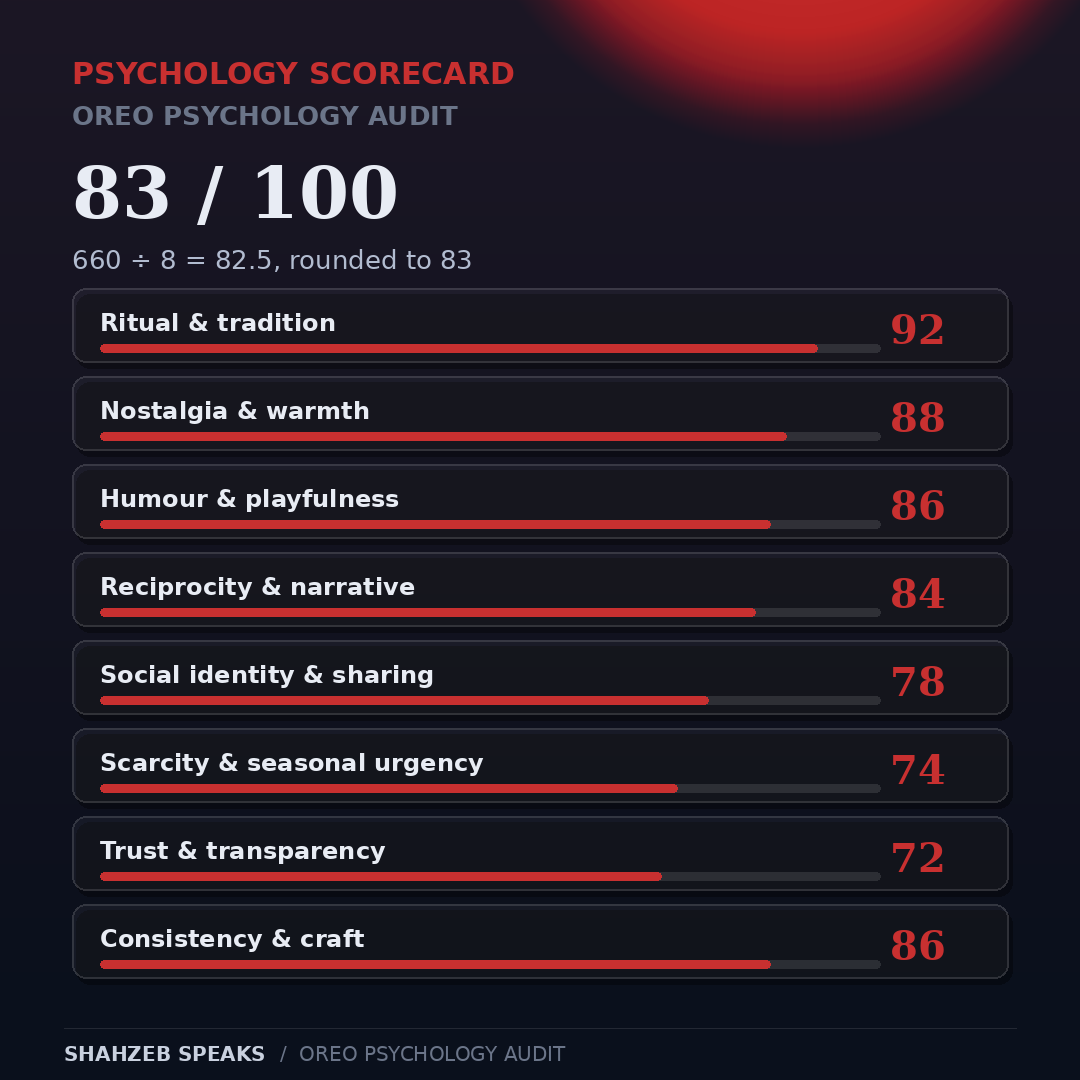
| Dimension | Score | Verdict |
|---|---|---|
| Ritual & tradition | 92 | Two rituals in thirty seconds — the brand’s and the season’s — broken and restored. |
| Nostalgia & warmth | 88 | Christmas morning, family, close others — the standard material of nostalgic memory. |
| Humour & playfulness | 86 | A vengeful Santa is the one Christmas joke you remember; the warmth is thinner than in 2021. |
| Reciprocity & narrative | 84 | A bite for a bite — the exchange logic is exact and instantly readable. |
| Social identity & sharing | 78 | The film invites sharing the joke, but the community around it is thin so far. |
| Scarcity & seasonal urgency | 74 | Seasonal urgency only — no verified reason to act now. |
| Trust & transparency | 72 | Three labelling cases all failed or were withdrawn; the parent’s €337.5m fine caps the score. |
| Consistency & craft | 86 | One idea, one joke, one line — film, platform and ritual tell the same story. |
| Overall | 83/100 | (92 + 88 + 86 + 84 + 78 + 74 + 72 + 86) ÷ 8 = 660 ÷ 8 = 82.5 → 83 |
✅ Balance sheet & prescription
What works. The ritual is the product, and the film knows it. Two rituals — “Twist, Lick, Dunk” and milk and cookies for Santa — are broken and restored inside thirty seconds, on a mechanism the research supports: rituals raise perceived value through involvement. The nostalgia is specific rather than borrowed, the reciprocity joke is exact, and the film is the most memorable Christmas advert of the season precisely because it is the least warm. As a bridge to a 2027 relaunch, it keeps the brand warm without spending the relaunch’s ideas.
What does not work yet. The campaign gives the viewer no concrete reason to act now — no verified scarcity, no deadline, no limited offer. The trust story is unfinished: a parent-company fine of €337.5 million sits in the record, and the film does nothing to address it. And the campaign is four days old, so nothing about its effectiveness is known. An audit that scored outcome would be guessing. This one scores craft, and the craft is strong but incomplete.
Prescription. Three moves. First, give the film a reason to act now that is honest — a genuine deadline for Christmas delivery, or a limited festive pack, stated plainly. Second, extend the ritual beyond the film: a “leave it for Santa” kit, or a short social series in which families film their own milk-and-cookies ritual, turning the audience’s tradition into the campaign’s content. Third, let the 2027 relaunch inherit the joke rather than the warmth: the mischief is the distinctive part of this film, and a relaunch that returns to safe warmth would waste it.
📝 Final Verdict
Oreo waited five years for a new Christmas film, and then made one about a father who steals Santa’s cookie and a Santa who steals back. That is a confident choice for a 114-year-old brand, and the psychology behind it is sound — ritual used as plot, nostalgia used as setting, reciprocity used as the joke, and a mischievous tone that stands out in a season of warm, earnest adverts. The film is well made, well timed, and honestly limited: it is four days old, its urgency is seasonal rather than specific, and it launched under a parent company that paid a €337.5 million competition fine two years ago. For a brand about to relaunch, it is a good bridge — and the relaunch, in 2027, is the moment when the mischief will have to become a strategy rather than a single film.
Psychology Score: 83/100 — Oreo turned a stolen cookie into a ritual restored. The joke is exact, the nostalgia is real, and the mischief is memorable; it now needs a reason to buy now, and a relaunch that keeps the nerve.
Want your brand audited the same way — on the psychology of what it actually does? I help organisations understand why customers choose, stay, or leave — get in touch here.
More brand psychology audits: ASOS — The Hotline, Mondelēz — The Snack Drawer Empire, and Waitrose — The Perfect Gift 2. See all audits at Brand Psychology Audits.
📚 References & Sources
- Adweek (12 November 2026). In Oreo’s First Holiday Ad in 5 Years, Cookie-Stealing Parents Land on Santa’s Naughty List. https://www.adweek.com/brand-marketing/in-oreos-first-holiday-ad-in-5-years-cookie-stealing-parents-land-on-santas-naughty-list/
- Marketing Dive (12 November 2026). Oreo refreshes holiday creative with spin on Santa’s milk and cookies. https://www.marketingdive.com/news/oreo-refreshes-holiday-creative-with-spin-on-santas-milk-and-cookies/874493/
- Grocery Gazette (13 November 2026). Oreo Christmas ad five years. https://www.grocerygazette.co.uk/2026/11/13/oreo-christmas-ad-five-years/
- MediaPost (13 November 2026). When It Comes To Oreos, Santa’s Not Messing Around. https://www.mediapost.com/publications/article/419445/when-it-comes-to-oreos-santas-not-messing-around.html
- DesignRush (13 November 2026). Oreo’s “Santa’s Favorite Cookie”: Colin Jost’s No Notes Holiday Ad 2026. https://news.designrush.com/oreo-santas-favorite-cookie-colin-jost-no-notes-holiday-ad-2026
- Roastbrief (13 November 2026). The Oreo brand releases its first new holiday ad in five years. https://roastbrief.us/the-oreo-brand-releases-its-first-new-holiday-ad-in-five-years/
- European Commission (23 May 2024). Commission fines Mondelēz €337.5 million for obstructing cross-border trade of chocolate, biscuits and coffee products. https://ec.europa.eu/commission/presscorner/api/files/document/print/el/ip_24_2727/IP_24_2727_EN.pdf
- Proskauer (2020). Judge Dunks Plaintiff’s Claims and Dismisses Oreo False Advertising Lawsuit. https://www.proskauer.com/blog/judge-dunks-plaintiffs-claims-and-dismisses-oreo-false-advertising-lawsuit
- Justia (8 March 2023). Leonard v. Mondelēz Global LLC, No. 21-cv-10102 (S.D.N.Y.). https://law.justia.com/cases/federal/district-courts/new-york/nysdce/1:2021cv10102/570840/24/
- Just Food (2003). USA: Lawyer drops Oreo cookie lawsuit. https://www.just-food.com/news/usa-lawyer-drops-oreo-cookie-lawsuit/
- Vohs, K. D., Wang, Y., Gino, F. & Norton, M. I. (2013). Rituals enhance consumption. Psychological Science, 24(9), 1714–1721.
- Wildschut, T., Sedikides, C., Arndt, J. & Routledge, C. (2006). Nostalgia: Content, triggers, functions. Journal of Personality and Social Psychology, 91(5), 975–993.
- Zhou, X., Sedikides, C., Wildschut, T. & Gao, D. (2008). Counteracting loneliness: On the restorative function of nostalgia. Psychological Science, 19(10), 1023–1029.
- Gouldner, A. W. (1960). The norm of reciprocity: A preliminary statement. American Sociological Review, 25(2), 161–178.
- Cialdini, R. B. (2001). Influence: Science and Practice (4th ed.). Boston: Allyn & Bacon.
- Mondelēz International (29 October 2026). Third quarter 2026 results: net revenues $9.97 billion. https://files.quartr.com/reports/8b01c39b747ea3d576bbb9f72ae93d79-2026-10-29-20-19-38.pdf
Key Findings
- Introduced 6 March 1912 by Nabisco in Chelsea, New York City; first sale to a Hoboken, New Jersey grocer; name trademarked 14 March 1912; imitation of 1908 Hydrox; Nabisco acquired by Kraft in 2000; Mondelēz spun off from Kraft in 2012; sold in more than 100 countries; "Twist, Lick, Dunk" is the brand's established ritual.
- "Santa's Favorite Cookie" launched 12 November 2026 (UK coverage 13 November), Oreo's first new Christmas creative in five years since 2021's "Ding Dong"; 30-second film with a 15-second cut; dad eats Santa's cookie, Santa bites the dad's stocking, golf clubs, snowboard, TV and remote; closes with Santa dunking an Oreo in milk; tagline "Get your own Oreo."; creative by No Notes (Colin Jost's studio), directed by Benji Weinstein; media across Amazon, streaming and connected TV, Meta, TikTok, Pinterest, Snapchat, YouTube and owned channels.
- Parent figures (Mondelēz, reported 29 October 2026): Q3 2026 net revenues $9.97bn (+2.3% year on year); FY2025 approximately $38.5bn; biscuits and baked snacks +2.2% organic in Q3, supported by Oreo, Ritz and cakes/pastries; global Oreo creative moved to 72andSunny in May 2026; a full Oreo relaunch with new packaging and formulas is planned for 2027.
- Legal record: EU antitrust fine — FINED €337.5m, 23 May 2024, final decision (case AT.40632); Mondelēz expressly acknowledged liability and cooperated; Oreo named among products covered; this is a parent-company fine, not Oreo-specific. Harris v. Mondelēz (E.D.N.Y., 28 Jul 2020) — DISMISSED WITH PREJUDICE ("Always Made With Real Cocoa"). Leonard v. Mondelēz (S.D.N.Y., 8 Mar 2023) — DISMISSED WITH PREJUDICE ("Fudge Covered" Mint Crème). 2003 trans-fat suit — FILED May 2003, VOLUNTARILY DISMISSED 15 May 2003; Kraft never served; no ruling on the merits. No Oreo-specific ASA or FTC ruling found in searches on 16 November 2026.
- Psychology: Vohs et al. (2013) — ritual group enjoyment of chocolate 5.95 vs 5.15 control, d=0.73; Wildschut et al. (2006) — nostalgia bolsters social bonds and positive affect; Gouldner (1960) — norm of reciprocity; the film's joke is a reciprocity violation and its comic enforcement.
- Score 83/100: 92+88+86+84+78+74+72+86 = 660; 660/8 = 82.5, rounded to 83.
Overall Psychology Score
Oreo scores 83/100 in our comprehensive psychology audit covering consumer behavior strategies, UX design principles, and psychological marketing effectiveness.
The detailed dimension scores are in the audit's Psychology Scorecard chapter.
High impactMuhammad Shahzeb
MSc Industrial Psychologist, specializing in consumer behavior, UX psychology, and brand strategy analysis. Helping brands understand the psychology behind their success.
About Muhammad Shahzeb →