PG Tips Psychology Audit — The Tea That Had to Win Britain Back
PG Tips refreshed its tea in October 2026 with heavier bags at unchanged prices. Monkey, the campaign, habit, heritage and a sales slide. Score: 81/100. See scorecard.

81 / 100
Overall consumer behavior effectiveness

Brand Overview
- Brand namePG Tips
- Founded1930
- HeadquartersAmsterdam, Netherlands
- IndustryFood & Beverage
- Websitewww.pgtips.co.uk ↗
Psychology Techniques Identified
- 01Mere Exposure & Familiarity (Zajonc 1968)
- 02Habit Loop: Cue, Routine, Reward (Morning Tea Ritual)
- 03Reappraisal & the Refresh Effect (October 2026 Blend and Pack)
- 04Loss Aversion Avoidance via Unchanged Prices (Kahneman & Tversky 1979)
- 05Processing Fluency & Shelf Standout (Heritage Pack Design)
- 06Parasocial Relationship & Mascot Bonding (Monkey, Horton & Wohl 1956)
- 07Nostalgia & Autobiographical Memory (Chimps to Monkey)
- 08Social Proof via Consumer Testing Claim (+13 Points, Company Claim)
- 09Trust Shortcut via Certification (Rainforest Alliance, Since April 2012)
- 10Identity & Domestic Self-Congruity (Live Life One Tea at a Time)
- 11Peak-End & the Perfect Cup (Pyramid Bag Ritual)
- 12Scarcity of Attention & the Second Box Test (Repeat Purchase)
Full Psychology Audit Report
In this audit
In October 2026, one of Britain’s most familiar tea brands did something it has done several times before: it asked the country to taste it again. PG Tips announced a new blend, heavier tea bags, refreshed packaging and a £1.5 million campaign — not because it had discovered a new kind of tea, but because its sales were still falling and its last few reinventions had not stuck. PG Tips is a masterclass in a specific psychology: how a brand survives when everybody already knows it, by making the familiar feel new again without breaking the habit that made it familiar in the first place.
I am an Industrial and Organizational Psychologist in Karachi, and I audit brands by testing their psychology against their evidence: what the brand claims, what it actually does, and what the numbers support. PG Tips has almost a century of evidence, from chimpanzees to a knitted monkey to a heavier tea bag. This audit works through that evidence, chapter by chapter, and ends with a score that reflects both the strength of the ritual and the weakness of a brand that keeps having to reintroduce itself.
“PG Tips does not sell tea. It sells the pause between one thing and the next — and every reinvention is an attempt to keep that pause from belonging to someone else.” — Brand Psychology Analysis, ShahzebSpeaks
📋 Brand Overview
| Field | Detail |
|---|---|
| Brand | PG Tips |
| Founded | 1930, by Brooke Bond (as Pre-Gest-Tee; “Tips” refers to leaf tips) |
| Owner | Lipton Teas and Infusions (CVC Capital Partners; Unilever tea business sold for €4.5 billion, completed July 2022) |
| Headquarters | Amsterdam, Netherlands |
| Website | pgtips.co.uk (brand site; owner site liptonteas.com) |
| 2026 refresh | New blend, bag 2.9g to 3.125g, RRPs unchanged, refreshed packs, £1.5m campaign from autumn 2026 |
| Signature assets | Pyramid bag (1996), Monkey mascot (2007–2017, retired 2024, returned 2025), “Live Life One Tea at a Time” |
| Psychology Score | 81/100 |
🏛️ Chapter 1: History — from a digestive aid to a national habit
PG Tips began in 1930 as a Brooke Bond blend whose original name, Pre-Gest-Tee, marketed it as a digestive aid. Grocers shortened the name to PG, and “Tips” was added for the leaf tips in the blend. The digestive claim quietly disappeared from labelling by the 1950s, but the name stayed, and with it a useful lesson: a brand’s first positioning rarely survives, but its first habit often does. Britain was already a tea-drinking nation; PG Tips did not need to teach the habit. It needed to own a version of it — brisk, bright, built for milk and sugar — and then defend that version for decades.
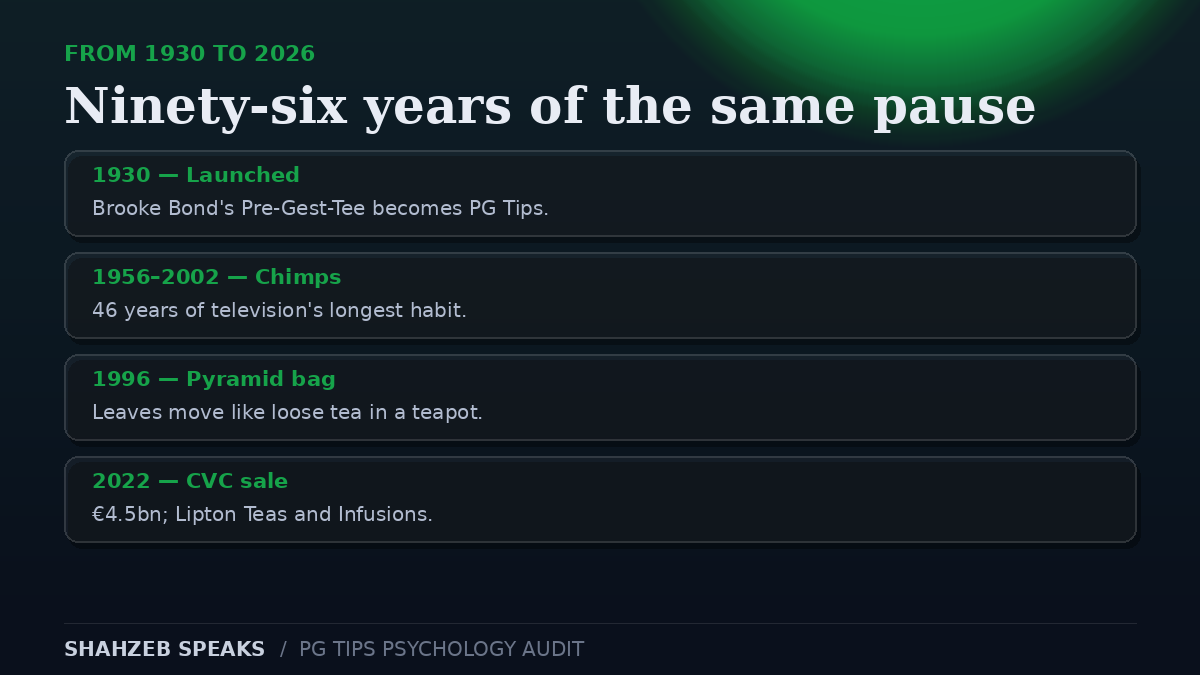
The timeline that matters runs through advertising as much as through tea. In 1956, with the launch of commercial television, PG Tips began its chimpanzee campaign: dressed-up chimps acting out household scenes, voiced by stars including Peter Sellers and Bob Monkhouse. It ran for 46 years, until 2002, when it was retired on welfare grounds reported in brand histories. Unilever acquired Brooke Bond in 1984. The pyramid, or tetrahedron, bag arrived in 1996, designed to let leaves move more freely, like loose tea in a teapot. In 2007, after a plasticine-bird interlude that failed to hold the nation’s affection, the brand brought in Monkey — the knitted puppet previously famous from ITV Digital — alongside Johnny Vegas. Monkey retired on 1 May 2024, returned in May 2025, and is the thread that connects the brand’s past to its October 2026 refresh.
Ownership changed underneath all of this. Unilever sold its global tea business, Ekaterra, to private-equity firm CVC Capital Partners for €4.5 billion, completing in July 2022; the business was renamed Lipton Teas and Infusions. That matters psychologically, not just financially: PG Tips is no longer a small brand inside a giant consumer company. It is a flagship inside a pure tea company whose entire business depends on tea. A refresh that fails inside Unilever is a disappointment. The same refresh inside Lipton Teas and Infusions is an existential test. The October 2026 investment — described by UK and Ireland managing director Jonny Briscoe as the most significant investment in the PG Tips blend in recent years — should be read in that light.
🔁 Chapter 2: Mere exposure and the habit loop — why familiarity is the product
Robert Zajonc’s mere exposure effect (1968) says people tend to prefer things they have encountered before, simply because they have encountered them. PG Tips is a century-long experiment in that effect. Most British adults did not choose PG Tips after comparing blends. They inherited it: it was the tea in their parents’ kitchen, then in their first flat, then in their office. Each encounter lowered the effort of choosing again. The brand’s job, for most of its life, was not persuasion. It was presence: stay on the shelf, stay in the cupboard, stay in the routine, and let exposure do the work.
The habit loop sharpens the point. A cue (the kettle, the break, the end of a task), a routine (boil, bag, milk, sugar, stir), and a reward (warmth, a pause, a small sense of order) repeat until the sequence runs without deliberation. PG Tips’ pyramid bag, its consistent brisk taste, and its pack sizes all serve that loop: they reduce variation, so the reward arrives the same way every time. That is also why a refresh is dangerous. Change the taste too much, and you break the reward. Change nothing, and the loop belongs to whichever competitor offers a cheaper or trendier version of the same pause. The 2026 refresh tries to thread that needle explicitly: a fuller flavour, the company says, while retaining the signature taste profile, with more tea in the bag and no price rise. More of the same, slightly better, at the same price — that is a habit-preserving change, not a habit-breaking one.
🛒 Chapter 3: The October 2026 refresh — reappraisal, priced as value
The refresh, announced in October 2026, has four parts, and each maps to a psychology principle. First, the blend: a new Original blend that, in consumer testing, increased both purchase intent and overall preference by 13 percentage points against the current blend, according to the company via trade press. That figure is a company claim from testing, not an independent sales result, and this audit treats it that way. It is still a meaningful signal, because the claim is specific and falsifiable: if the new blend does not sell, the testing claim will look hollow. Second, the bag: weight up from 2.9g to 3.125g, delivering, the company says, more flavour in every cup. Third, the pack: refreshed artwork across Original, Gold, Decaf and English Breakfast, designed, the company says, to strengthen on-shelf standout and draw on heritage. Fourth, the campaign: £1.5 million of integrated marketing spanning trade and consumer PR, social media, shopper marketing, out-of-home advertising from November, sampling and retail partnerships.
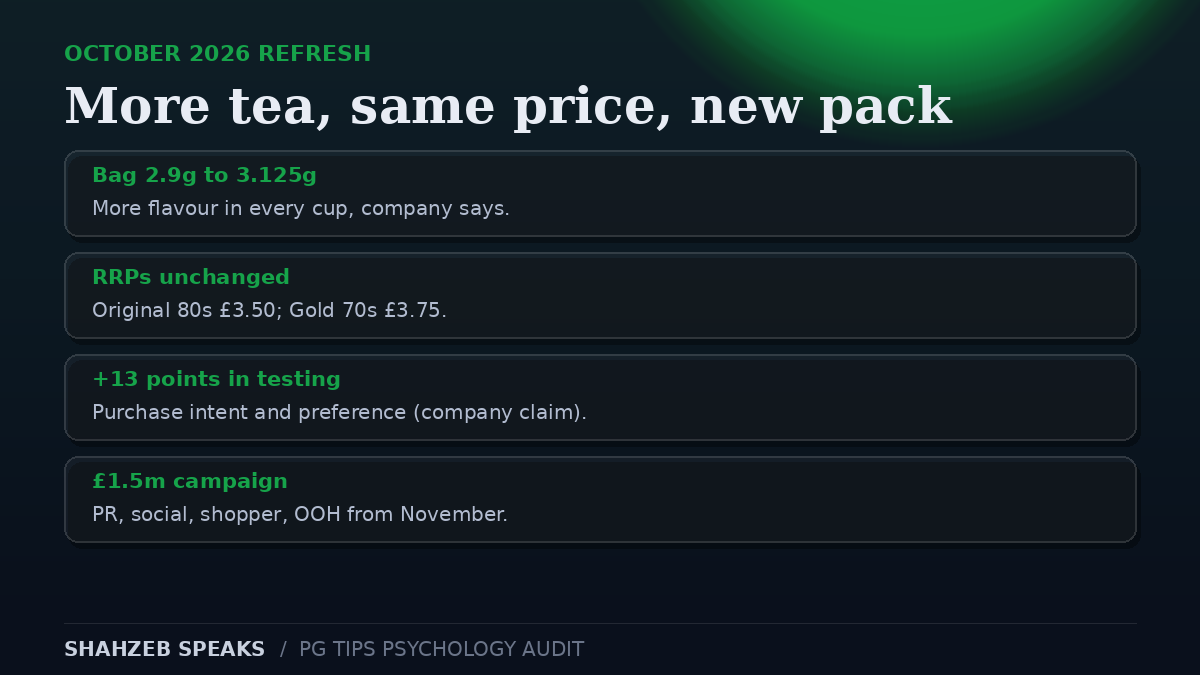
| Refresh element | Figure | Psychology |
|---|---|---|
| Bag weight | 2.9g to 3.125g | More value without a price cue to notice. |
| Prices | Unchanged (e.g. 80s £3.50) | Loss aversion avoided: no loss to weigh. |
| Testing claim | +13 points intent and preference | Social proof, if the claim is believed. |
| Campaign | £1.5 million | Reappraisal: a reason to look again. |
| Category context | Black tea 8 in 10 UK cups (NIQ) | The category is not dying; the brand is losing share in it. |
The pricing decision is the most psychologically astute part of the refresh. Kahneman and Tversky’s loss aversion (1979) says losses weigh more heavily than equivalent gains. A price rise would have been felt as a loss on every pack, while a taste improvement is felt as a gain only if the drinker notices it. By holding recommended prices unchanged — Original 80s at £3.50, 160s at £5.50, 240s at £6.50, Gold 70s at £3.75 — while adding tea to the bag, PG Tips gives the gain without the loss. It is also a processing-fluency play: the shopper does not need to recalculate value. The pack looks familiar, the price looks familiar, and the only new information is “more flavour”. Familiarity plus a small improvement is exactly the combination that drives reappraisal — the company’s own word for what the refresh is meant to achieve — without triggering the resistance that a louder relaunch would cause.
The context, however, is unforgiving. The Grocer reported that PG Tips value sales slipped 7.1% on volumes down 2.2% in the year to 13 June 2026 (NIQ, 52 weeks). A brand in that position is not refreshing from strength. It is refreshing because the previous answers failed: a 2024 reboot under then-chief executive Nathalie Roos, which sought to cut the SKU count and win younger shoppers, was abandoned the following year, and a £15 million “Rock Solid” campaign featuring actor Ashley Walters was retired without reviving sales. The 2026 refresh is therefore best judged as a correction, not a triumph: it returns to taste, the driver that consumer research with over 1,000 people identified as central to purchase and value perception, after two attempts that tried to fix the brand through range and celebrity instead.
🐵 Chapter 4: Monkey — parasocial comfort, retired and revived
No audit of PG Tips can skip Monkey, because Monkey is the brand’s most successful psychological asset and its most revealing failure. Horton and Wohl’s parasocial relationship (1956) describes the one-sided bond audiences form with media figures: you feel you know them, even though they do not know you. Monkey, the knitted puppet voiced first by Ben Miller alongside Johnny Vegas from 2007, built exactly that bond. He was funny, chaotic, and domestic — a character who lived in a kitchen, not in an advertisement. When he retired on 1 May 2024, the reaction proved the bond was real: people noticed, and they missed him, in the words of Lipton’s UK and Ireland chief marketing officer Elle Barker, who said the comeback was long overdue.
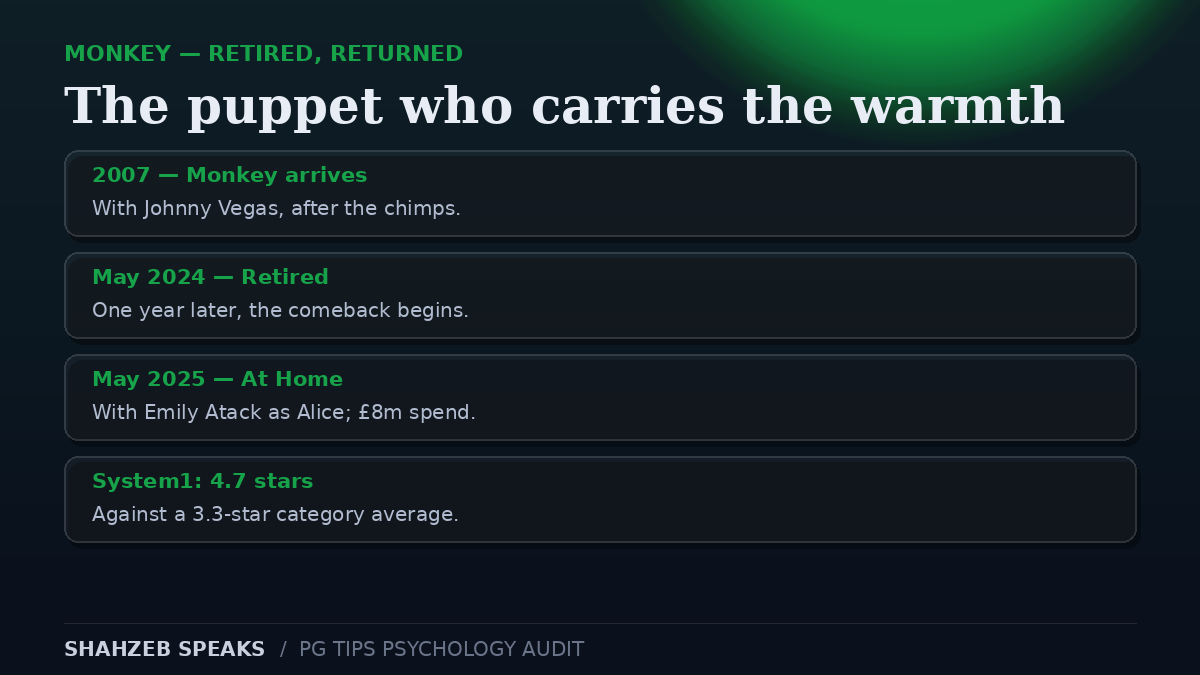
The May 2025 return, “At Home with Monkey”, gave Monkey a new life: married to Alice, known as Mrs M, played by Emily Atack, with two children, Earl and Chai, in a reality-television parody of domestic life, voiced by Ivo Graham, backed by £8 million of spend from agency New Commercial Arts. System1 scored the ad 4.7 stars on its Test Your Ad measure, against a 3.3-star category average, predicting strong potential for long-term share gain with the right investment. That is a strong creative result, and it matters for the 2026 refresh, which explicitly builds on the Monkey return and the “Live Life One Tea at a Time” platform. The psychology is nostalgia plus novelty: the character is familiar, the situation is new, and the tea is the prop that makes the domestic chaos bearable. It is also a warning. A brand whose warmth depends on a puppet has outsourced its emotional equity. When the puppet leaves, the warmth leaves with him. The 2026 refresh’s emphasis on taste, not just character, is an attempt to rebalance that equity back into the product.
🌍 Chapter 5: Sustainability — certification as trust, and its limits
PG Tips’ sustainability story is older and more substantive than its refresh story. Unilever committed in 2007 to sourcing all its tea sustainably, asked the Rainforest Alliance to certify East African estates, and since April 2012 all tea used in PG Tips has been Rainforest Alliance certified, according to brand histories. In 2018 the brand moved to plant-based, biodegradable bags made from corn starch, aiming for all bags to use the new material by the end of that year, and by 2020 it had become the first major tea brand to remove plastic from its teabags across its range. The 2026 refresh repeats the current position: all cartons recyclable, bags plant-based and compostable.
Psychologically, certification works as a trust shortcut. A shopper cannot verify estate conditions from a supermarket aisle, so a recognised seal does the verifying for them. That shortcut only works while the seal is credible and the claim is specific. PG Tips’ claims are specific — a named certifier, a date, a material — which is why they score well here. The limit is also clear: sustainability is a permission to buy, not a reason to buy. Nobody chooses a tea primarily because its bag composts; they choose it because it tastes right, costs fairly, and feels familiar, and sustainability removes an objection rather than creating a desire. Brands that lead with sustainability while taste and value slip discover this quickly. PG Tips’ history suggests it understands the order: taste first, certification as reassurance, never the reverse.
⚠️ Chapter 6: The dark side — decline, failed reboots, and what was not found
An honest audit must separate three kinds of bad news: decline, failed strategy, and legal trouble. PG Tips has the first two in abundance and, on the evidence searched, little of the third. Decline first: value down 7.1% and volumes down 2.2% in the year to June 2026, on NIQ data reported by The Grocer. That is not a collapse, but it is a steady leak in a category where black tea still accounts for eight in ten cups consumed in the UK. The brand is losing ground in a market that has not gone away. Failed strategy second: the Roos reboot abandoned, the £15 million Rock Solid campaign retired, and two reinventions in three years before the 2026 refresh. Each failed attempt costs more than money: it teaches shoppers that the brand is unsure of itself, and it teaches retailers that the next launch may also be reversed.
Legal record, as of 1 November 2026: no court ruling, fine, or regulator enforcement action against PG Tips or Lipton Teas and Infusions was found in the reputable sources searched for this audit. That sentence is a search finding, not a guarantee that none exists, and it is stated that way deliberately after the lesson of the previous audit cycle, where an implied absence turned out to be wrong. The chimps’ retirement in 2002 is reported as on welfare grounds in brand histories; it is not presented here as a court finding, because no court finding was verified. No Advertising Standards Authority ruling is printed, because none was verified for this run. A brand with a long, public history and no verified legal black mark deserves credit for that, but the credit is limited: absence of a headline is not evidence of excellence, and the audit’s score reflects that limit.
🇵🇰 Chapter 7: What brands elsewhere should — and should not — copy
Copy this: lead a refresh with the product attribute customers actually rank first. PG Tips’ research with over 1,000 consumers found taste and overall quality drive purchase and value perception, and the 2026 refresh leads with taste, more tea, and unchanged prices. That order — product, then pack, then campaign — is the right order, and it is the opposite of the Rock Solid approach, which led with celebrity. Copy the pricing discipline too: adding value without adding price removes the loss-aversion barrier that kills many relaunches. And copy the character discipline: Monkey works because he lives in a domestic world the product belongs to, not because he is famous. A mascot that belongs in the customer’s kitchen will outlast a celebrity who merely visits it.
There is one more lesson in the refresh, and it concerns the shopper who never reads a press release. For that shopper, the refresh is not a strategy. It is a pack that looks slightly different, a bag that feels slightly heavier, and a cup that tastes slightly fuller. If those three small signals agree, the shopper buys again without ever knowing a refresh happened, and that quiet repeat purchase is the real measure of reappraisal. Campaigns win attention; only the cup wins the second box. Brands that judge a refresh by launch-week noise will always overrate celebrity and underrate taste, because noise is visible in a week and taste is visible only over months. PG Tips has, at last, chosen the slower measure. The question is whether its owners will give it the time that measure requires, or whether another reinvention will arrive before the second box has had its say.
Do not copy this: the cycle of reinvention without consolidation. PG Tips has now had a reboot, a retirement, a return, and a refresh in roughly three years. Each one was defensible alone. Together, they signal a brand searching for itself in public, and shoppers notice searching. A brand elsewhere — including a tea brand in Pakistan, where chai carries even deeper ritual and identity weight — should learn the timing lesson: give a good refresh time to work before judging it, and judge it on repeat purchase, not on launch-week attention. Do not copy the outsourcing of warmth to a single character either. Monkey is an asset, but a brand that needs its puppet to feel warm has a product problem that no puppet can fix permanently. Build the warmth into the taste, the pack, and the price, and let the character amplify it, not carry it.
📊 Chapter 8: Psychology Scorecard
The score below is the rounded average of eight dimensions, each judged against the evidence in this audit. It is not a sales forecast and not a taste judgement. It is a judgement of how well the brand’s psychology matches its evidence.
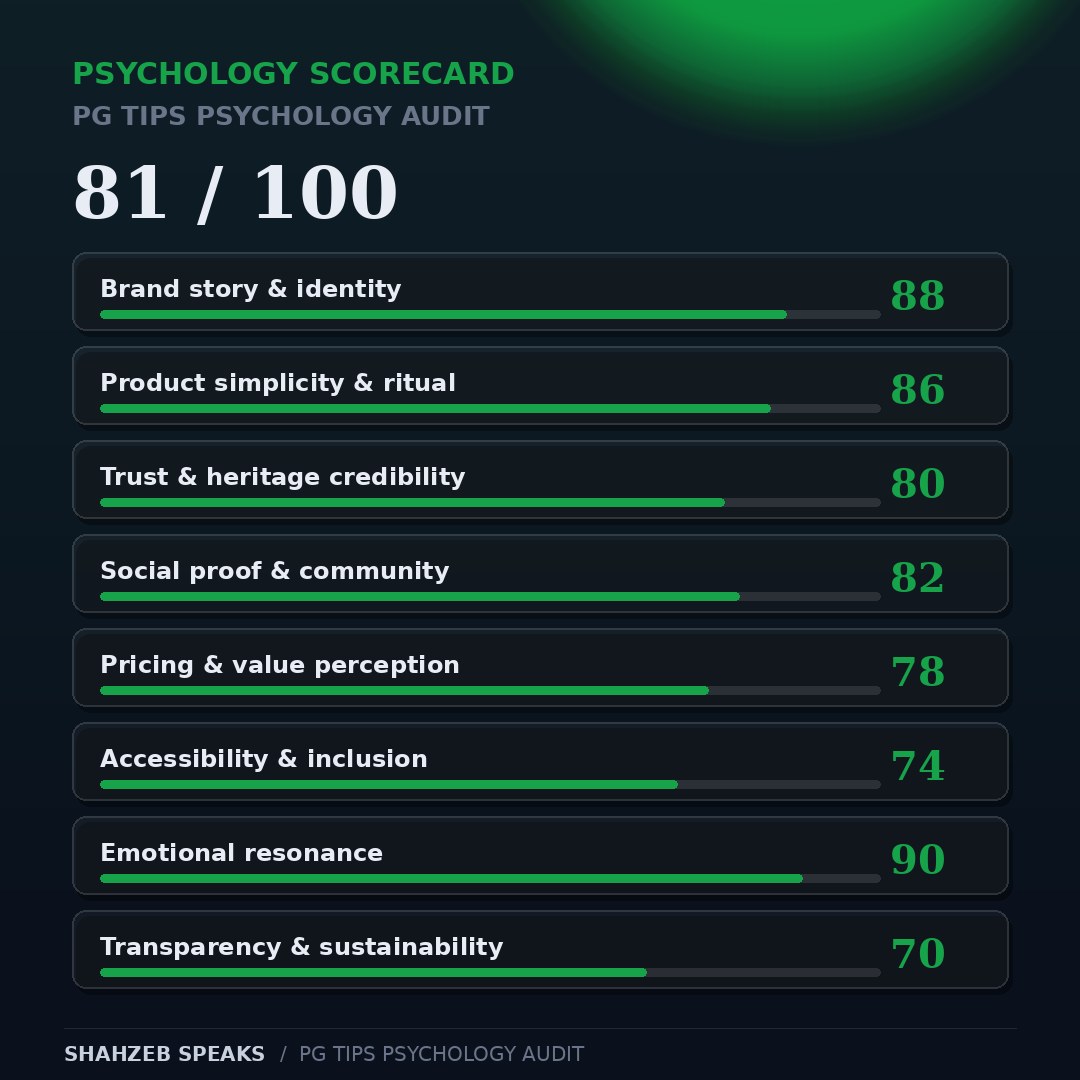
| Dimension | Score | Verdict |
|---|---|---|
| Brand story & identity | 88 | Ninety-six years of habit, still recognisable. |
| Product simplicity & ritual | 86 | The pause, unchanged in form, improved in weight. |
| Trust & heritage credibility | 80 | Long history, no verified legal black mark found. |
| Social proof & community | 82 | Monkey’s return proved the bond; testing claim needs sales proof. |
| Pricing & value perception | 78 | Unchanged prices plus more tea is the right move. |
| Accessibility & inclusion | 74 | Everyday price points, but a UK-centred story. |
| Emotional resonance | 90 | The kitchen pause, carried by Monkey, is genuinely felt. |
| Transparency & sustainability | 70 | Specific certification, but sales decline is not confronted in brand copy. |
Arithmetic: 88 + 86 + 80 + 82 + 78 + 74 + 90 + 70 = 648. 648 divided by 8 = 81. The overall score is therefore 81/100, matching the scorecard image, the Final Verdict, and the importer field.
✅ Chapter 9: Balance sheet & prescription
What works: a habit built over 96 years; a product-led refresh that leads with taste and holds prices; a beloved character whose return scored 4.7 stars; specific sustainability claims with a named certifier. What does not: a sales decline that predates the refresh; a pattern of abandoned reinventions that undermines confidence; a testing claim (+13 points) that has not yet been proven in sales; warmth that depends too heavily on one puppet. Prescription: give this refresh a full year without another reinvention; report repeat purchase, not just trial, as the success measure; move one piece of warmth from Monkey back into the product — a pack, a ritual, a story that belongs to the tea itself — so the next retirement does not take the brand’s feelings with it.
📝 Chapter 10: Final Verdict
PG Tips is not a brand in crisis. It is a brand in a slow leak, and it has finally answered the leak with the right thing: a better cup at the same price, in a familiar pack, carried by a character people actually missed. Whether that answer works will be decided not by the £1.5 million campaign in November, but by the second box a shopper buys in January, when the novelty has worn off and only the taste remains. That is the honest test, and it is the test this audit will be judged against when the sales data arrive.
Psychology Score: 81/100 — A beloved ritual, refreshed the right way at last, still waiting for shoppers to prove it worked.
📬 Does your brand keep reintroducing itself?
If your brand has refreshed twice in three years and still feels unfamiliar, the problem may be the order: product, pack, campaign — not the reverse. Contact me and tell me which reinvention failed, and what customers actually ranked first.
For the broader field behind this audit, see my homepage on industrial psychology in Pakistan, and for related audits, read the Tapal tea audit and the Coca-Cola audit.
Sources
- Grocery Gazette (2026). PG Tips unveils major rebrand and marketing campaign. 12 October 2026.
- The Grocer (2026). PG Tips unveils brand refresh as sales slide continues. 8 October 2026. (NIQ 52 weeks to 13 June 2026: value -7.1%, volumes -2.2%.)
- Talking Retail (2026). PG Tips invests in major brand refresh and marketing campaign. 12 October 2026.
- Talking Retail (2025). PG Tips launches ‘At Home With Monkey’ ad campaign. 7 May 2025.
- System1 (2025). Monkey’s Triumphant Return for PG Tips. 16 July 2025. (4.7 stars vs 3.3 category average.)
- Marketing Week. Has PG Tips’ advertising put its brand characters before its sales? (History: 1930 launch, chimps 1956–2002.)
- Unilever / Renewable Carbon News (2018). First 100% biodegradable PG Tips tea bags in stores. 28 February 2018.
- The Grocer (2021). Unilever sells global tea business to CVC Capital Partners for €4.5bn.
- Zajonc, R. B. (1968). Attitudinal effects of mere exposure. Journal of Personality and Social Psychology.
- Kahneman, D., & Tversky, A. (1979). Prospect theory: An analysis of decision under risk. Econometrica.
- Horton, D., & Wohl, R. R. (1956). Mass communication and para-social interaction. Psychiatry.
Key Findings
- Founded 1930 by Brooke Bond as Pre-Gest-Tee; chimps campaign 1956-2002; Unilever acquired Brooke Bond 1984; pyramid bag 1996; headquarters Amsterdam, Netherlands; owner Lipton Teas and Infusions after CVC Capital Partners €4.5 billion purchase completed July 2022
- October 2026 refresh: new blend, bag weight 2.9g to 3.125g, RRPs unchanged (Original 80s £3.50, Gold 70s £3.75), refreshed packs across Original, Gold, Decaf and English Breakfast, £1.5 million integrated campaign with out-of-home from November 2026
- Company claim via trade press: new blend increased purchase intent and overall preference by 13 percentage points in consumer testing with over 1,000 consumers; taste and quality identified as main purchase drivers; black tea accounts for eight in 10 UK cups (NIQ)
- Sales context: value down 7.1% and volumes down 2.2% in the year to 13 June 2026 (NIQ 52 weeks, via The Grocer); previous 2024 reboot abandoned and £15 million Rock Solid campaign with Ashley Walters retired without reviving sales
- Monkey: debuted with Johnny Vegas 2007, retired 1 May 2024, returned May 2025 as At Home with Monkey with Emily Atack as Alice/Mrs M, children Earl and Chai, voice Ivo Graham, £8 million spend, System1 4.7 stars against 3.3 category average
- Legal record: NO court ruling, fine, or regulator enforcement action against PG Tips or Lipton Teas and Infusions was found in reputable sources searched for this audit as of 1 November 2026 (stated as a search finding); chimps retired 2002 on welfare grounds per history sources, not a court finding; Score 81/100: 88+86+80+82+78+74+90+70 = 648; 648/8 = 81
Overall Psychology Score
PG Tips scores 81/100 in our comprehensive psychology audit covering consumer behavior strategies, UX design principles, and psychological marketing effectiveness.
The detailed dimension scores are in the audit's Psychology Scorecard chapter.
High impactMuhammad Shahzeb
MSc Industrial Psychologist, specializing in consumer behavior, UX psychology, and brand strategy analysis. Helping brands understand the psychology behind their success.
About Muhammad Shahzeb →