ASOS Psychology Audit — The Hotline: Why Asking for Help Is the Smartest Move in Fashion
ASOS's first Christmas campaign, the Hotline, turns "I don't know what to wear" into entertainment. Our psychology audit of the advice, nostalgia and curation behind it scores ASOS 81/100.

81 / 100
Overall consumer behavior effectiveness

Brand Overview
- Brand nameASOS
- Founded2000
- HeadquartersLondon, England
- IndustryFashion & Apparel
- Websitewww.asos.com ↗
Psychology Techniques Identified
- 01Choice overload & curation (Iyengar & Lepper 2000; a 6-jam table converted 30% of tasters against 3% for 24 jams; ASOS's own line: customers want "help navigating" limitless choice)
- 02Advice-seeking & competence (Brooks, Gino & Schweitzer 2015; advice-seekers are perceived as more competent, strongest for difficult tasks and expert advisors)
- 03Nostalgia (Wildschut et al. 2006; Zhou et al. 2008; the retro phone-in format bolsters social bonds and positive affect)
- 04Authority (Cialdini 2001; Law Roach, Stylist in Residence since 19 September 2026, styling the ASOS Magazine winter covers)
- 05Social proof (Cialdini 2001; three relatable callers with dilemmas like the audience's — meeting a date's parents, a big event, a hard-to-buy-for sister)
- 06Parasocial relationships (Horton & Wohl 1956; Ziwe and Farron Clark as familiar hosts welcoming the viewer in)
- 07Personalisation (ASOS FY26, company-reported: personalised search lifted conversion 140bps, c.£31m annualised revenue; 90% of eligible products feature at least one outfit)
- 08Scarcity & festive urgency (Cialdini 2001; Christmas occasions and gifting deadlines create time-limited pressure — no verified ASOS scarcity claim for this campaign)
- 09Narrative transportation (Green & Brock 2000; the 90-second phone-in film absorbs the viewer instead of arguing with them)
- 10Goal-gradient effect (Kivetz et al. 2006; GMV growth returning in Q4 FY26, first time since FY22, as visible progress toward recovery)
- 11Reciprocity & gifting (Cialdini 2001; the Hotline gives free styling advice first, and the winter edit makes the gift easy)
- 12Social identity (Tajfel & Turner 1979; ASOS.WORLD loyalty at 5.6m members, 74% of UK active customers)
Full Psychology Audit Report
In this audit
A customer rings a hotline because she cannot find a gift for her sister. A young actor rings because he needs an outfit to meet his girlfriend’s parents. A comedian and a celebrity stylist pick up, and the answer is not a product — it is advice. That is the whole idea behind ASOS Hotline, ASOS’s first dedicated Christmas campaign, launched on 11 November 2026. ASOS has stopped selling fashion as endless choice and started selling it as help — and the psychology behind that shift is the smartest move the brand has made in years.
I am an Industrial and Organizational Psychologist in Karachi, and I audit brands on the psychology of what they actually do — not on what their press releases claim. This audit is built on ASOS’s own announcements and results, trade-press reporting, and peer-reviewed psychology. One limit up front: the Hotline campaign is four days old. No independent effectiveness score exists yet — no System1 star rating, no consumer-testing result, no sales figure. So this audit scores the campaign’s psychology and craft, not its outcome. Where a figure comes from ASOS itself, I say so, because a company describing its own strategy is a claim, not a fact.
“I’ve always believed in the power of fashion to give you confidence in how you show up. We all have those moments when we’re getting ready and just don’t know what to wear.”
— Law Roach, ASOS Stylist in Residence, on the Hotline campaign
The audit covers ASOS’s history and its return to profit, the Hotline campaign itself, the choice overload it answers, the advice-seeking psychology it turns into entertainment, the nostalgia of its retro format, the authority and social proof of its cast, the personalisation engine behind it, the festive urgency it creates, the honest regulatory record — including a cyber incident five weeks before launch — and what Pakistani brands should and should not copy. The scorecard at the end puts a number on it: 81 out of 100.
📋 Brand Overview
| Field | Detail |
|---|---|
| Brand | ASOS plc — online fashion and beauty retailer |
| Founded | 2000, in London, as AsSeenOnScreen; ASOS name adopted in 2003 |
| Headquarters | Greater London House, Camden Town, London |
| Listed | London Stock Exchange (ASC); sells in over 100 markets |
| Scale (FY26) | 16.4 million active customers; 53.9 million shipped orders; average basket £43.59 |
| Financials (FY26) | GMV £2,349.0 million; revenue £2,245.6 million; profit before tax £24.4 million, after a £281.6 million loss in FY25 |
| Current campaign | “ASOS Hotline”, launched 11 November 2026; 90-second retro-inspired hero film; first dedicated Christmas partywear and gifting campaign |
| Website | https://www.asos.com |
| Psychology score | 81/100 |
📜 Chapter 1: History — from “buy what you see on screen” to a stylist
ASOS began in June 2000 in London as AsSeenOnScreen, with a simple idea: sell clothes inspired by what celebrities wore on film and television. The name ASOS was formally adopted in 2003, and the idea underneath it never really changed — fashion as something you recognise, want, and can buy in one step. The company grew into one of the world’s largest online-only fashion retailers, with no physical shops at all, selling its own labels — ASOS DESIGN, ARRANGE, Topshop and 4505 — alongside partner brands, in womenswear, menswear, face and body, and sportswear.
The last five years have been a test of that model. In February 2021 ASOS bought the Topshop, Topman, Miss Selfridge and HIIT brands from the administrators of Arcadia Group for £330 million — £265 million for the brands and £65 million for stock. The deal excluded the brands’ 70 high-street stores, and around 300 employees transferred to ASOS. Buying Topshop was a bet that a high-street name could live entirely online. It was also a bet that ASOS could keep growing while the fashion market around it shrank.
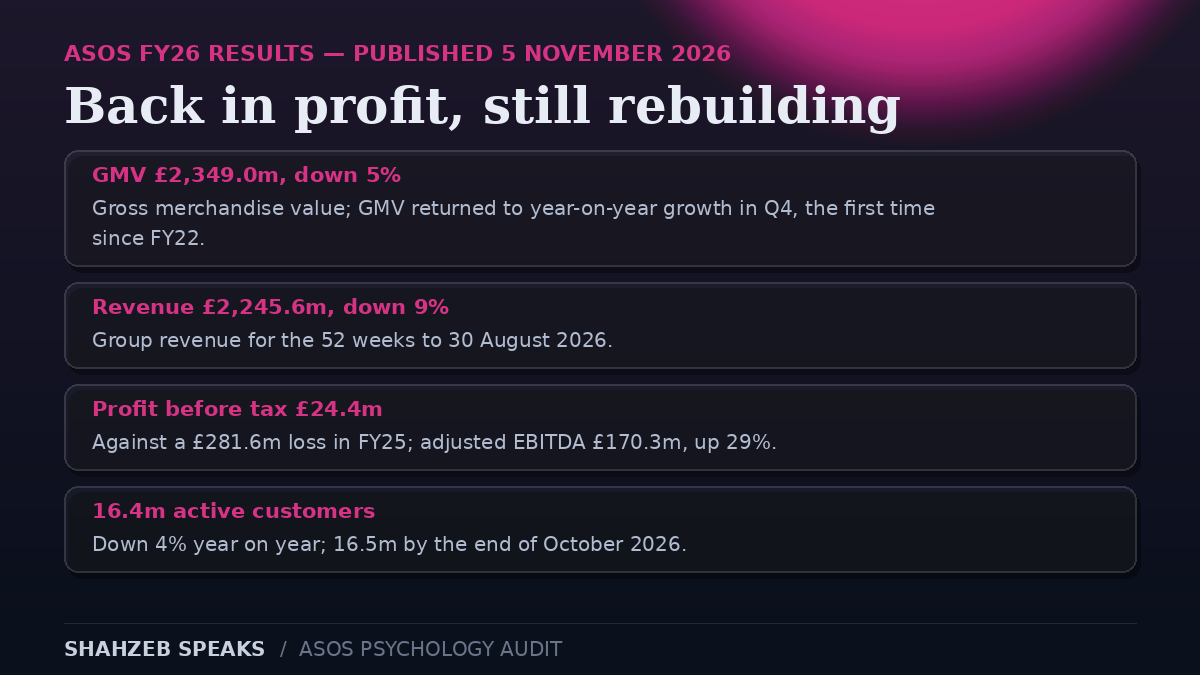
That bet took time to pay off. In the financial year to 30 August 2026 — FY26, reported on 5 November 2026 — ASOS recorded gross merchandise value of £2,349.0 million, down 5% year on year, and group revenue of £2,245.6 million, down 9%. Active customers fell 4% to 16.4 million, and shipped orders fell 6% to 53.9 million. But the direction changed inside the year: GMV returned to year-on-year growth in the fourth quarter for the first time since FY22, the customer database returned to quarter-on-quarter growth for the first time since the second quarter of FY22, and by the end of October 2026 the group had 16.5 million active customers. Adjusted EBITDA rose 29% to £170.3 million, and the statutory result swung from a £281.6 million loss before tax in FY25 to a £24.4 million profit. Net debt fell by more than 40% to £109.3 million.
The Hotline campaign arrives at that exact moment — a brand that has cut costs, returned to profit, and now needs a reason for customers to come back. Its own results give the reason in one sentence, reporting the company’s own research: “in a world of almost limitless choice, customers are no longer looking for access to more fashion, but for help navigating it. Our response is ‘The Stylist’.” That sentence is the strategy behind the Hotline, and the rest of this audit tests whether the campaign delivers on it.
🎬 Chapter 2: ASOS Hotline — a 90-second film that sells advice
ASOS launched the Hotline on 11 November 2026 across digital, social and editorial channels. It is the company’s first dedicated Christmas partywear and gifting campaign, built around its positioning as “The Stylist” — offering inspiration, curation and advice for occasions from office Christmas parties to winter breaks and cold-weather dressing. The centrepiece is a 90-second retro-inspired hero film in which customers phone in with style and gifting dilemmas, and the answers come from a cast that mixes comedy, expertise and influence.
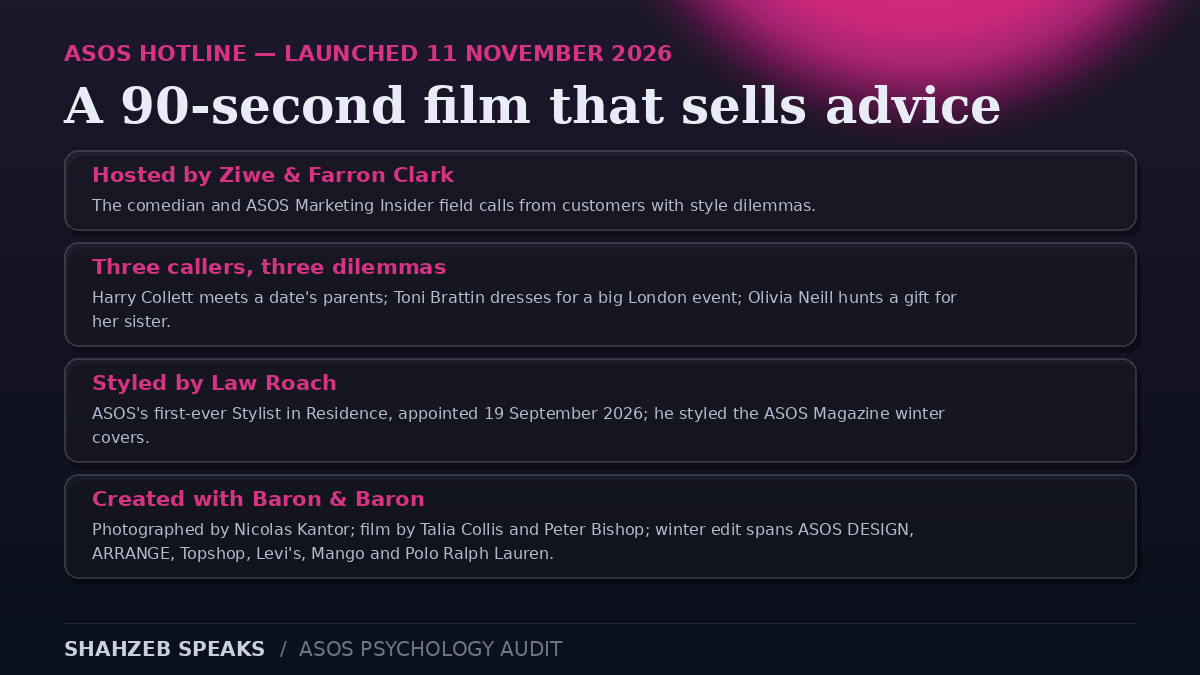
The film is hosted by comedian and writer Ziwe and ASOS Marketing Insider Farron Clark, who field calls from three people, each with a seasonal dilemma. Actor Harry Collett needs an outfit to meet a date’s parents. Beauty entrepreneur Toni Brattin needs a look for a big event in London. Influencer Olivia Neill is searching for a gift for a sister who is difficult to buy for. Ziwe, Collett and Neill also front the digital covers of the ASOS Magazine winter issue, styled by Stylist in Residence Law Roach. The campaign was created with creative agency Baron & Baron, photographed by Nicolas Kantor, and brought to life on film by Talia Collis and Peter Bishop.
The winter edit behind the film spans ASOS’s own brands — ASOS DESIGN, ARRANGE and Topshop — alongside partner brands including Levi’s, Mango and Polo Ralph Lauren, covering party looks, winter dressing and gifts, with trends including 80s power dressing, high-volume silhouettes, plush textures and embellishment. Law Roach was appointed ASOS’s first-ever Stylist in Residence on 19 September 2026, and his first project was styling six covers for the relaunched ASOS Magazine, a quarterly digital publication with a limited-edition print issue. The Hotline is, in that sense, not a one-off advert. It is the public face of a strategy ASOS has been building for months: from selling clothes to selling the help that goes with them.
Vanessa Spence, ASOS’s Executive Vice President for Brand and Creative, described the intent in the company’s own words: “Winter is full of moments when you want to look and feel your best, whether that’s a big night out, finding the perfect gift or simply trying something new. With ASOS Hotline, we’re bringing together fashion, entertainment and expert styling to help our customers navigate those moments with confidence. It’s a really fun expression of our ambition to make ASOS everyone’s personal stylist, helping people find their style and make every moment their own.” That is a company claim, not an independent finding — but it is a useful one, because it states the test the campaign sets itself. If the Hotline works, it works because people believe ASOS can be their stylist. The next chapters test that belief, principle by principle.
🛒 Chapter 3: Choice overload — the problem ASOS finally named
The strongest psychology in this audit is also the simplest: too much choice stops people choosing. The classic study is Iyengar and Lepper’s jam experiment, published in the Journal of Personality and Social Psychology in 2000. At a gourmet grocery in Menlo Park, California, a tasting table with 24 jams attracted more browsers — 60% of passers-by stopped, against 40% at a table with six jams. But the six-jam table converted far better: 30% of tasters bought a jar, against 3% at the 24-jam table. Ten times the choice, one tenth of the buying.
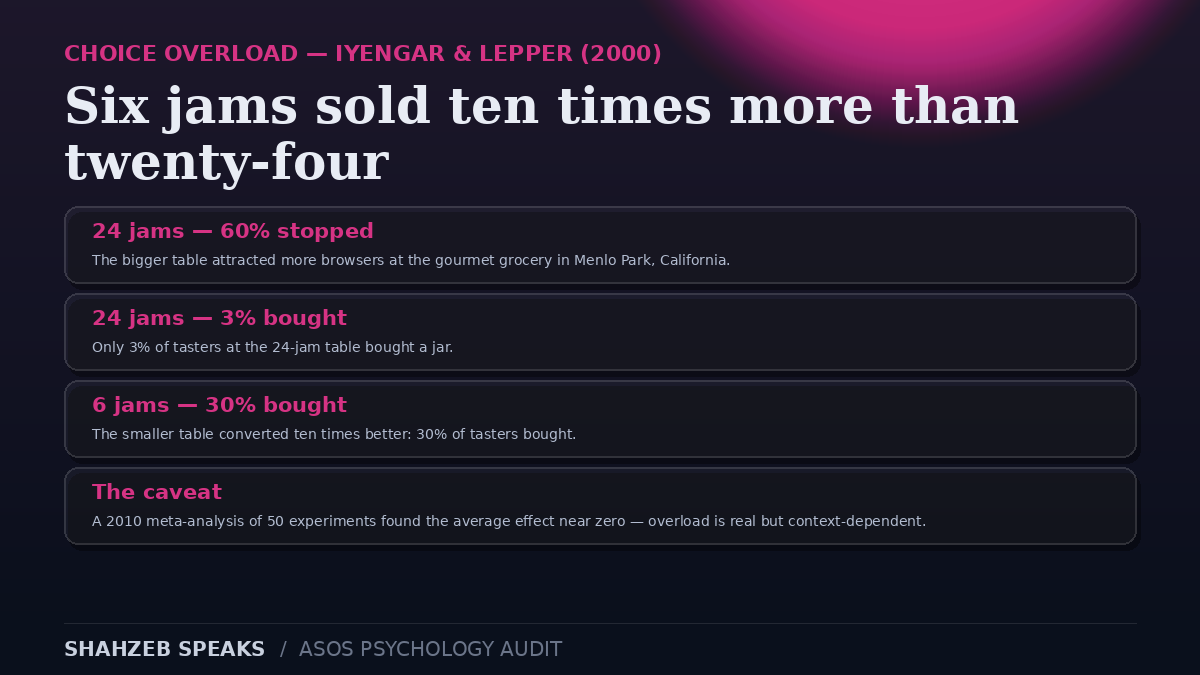
That result needs its caveat, because it is often quoted as a law and it is not one. Scheibehenne, Greifeneder and Todd meta-analysed 50 experiments in 2010 and found the average choice-overload effect near zero: the effect is real but context-dependent, strongest when the options are comparable, the stakes feel high, and the chooser lacks expertise. A later meta-analysis by Chernev, Böckenholt and Goodman, covering 99 studies in 2015, found a robust overall effect. The honest reading is that overload is not automatic — it depends on the situation. And the Hotline’s situation is the one where overload is strongest: a shopper choosing a party outfit or a gift, among options that look similar, for an occasion that matters, without knowing what will suit them.
That is why ASOS’s own framing is so important. The company does not claim to have solved choice by adding more of it. Its results say customers “are no longer looking for access to more fashion, but for help navigating it” — and the Hotline is that help, dramatised. A caller phones with one dilemma. An expert answers with one look. The film shows the opposite of the website: one problem, one answer, one outfit. That is curation as a product, not curation as a filter. The winter edit does the same thing in the shop: a set of party looks, winter dressing and gifts, chosen in advance, so the customer chooses among a few good options instead of drowning in thousands.
There is a risk here, and it is worth naming. Curation only works if the customer trusts the curator. If the edit feels like the same products pushed harder, the Hotline becomes a prettier version of the problem it claims to solve. The campaign’s job is to make the curation feel like a service — a person who listened, not an algorithm that sorted. The retro phone, the named callers, the specific dilemmas: all of that is designed to make the advice feel personal. Whether customers believe it is the test the campaign has not yet faced, because it is four days old.
🙋 Chapter 4: Advice-seeking — the fear the Hotline removes
Most people are afraid to ask for advice, and the fear is specific: they worry that asking will make them look incompetent. The Hotline’s entire format is built on removing that fear. A caller phones a hotline — the most anonymous, low-stakes way to ask for help — and the answer comes back as entertainment. Nobody in the film looks foolish for not knowing what to wear. The dilemma is the joke, the advice is the payoff, and the caller leaves looking better.
The research says that fear is misplaced. Brooks, Gino and Schweitzer, in Management Science in 2015, showed that people are reluctant to seek advice for fear of appearing incompetent, but that the fear is wrong: people perceive those who seek advice as more competent than those who do not. The effect is moderated by task difficulty, advisor egocentrism and advisor expertise — it is strongest when the task is difficult, when advice is sought from the person directly, and when the advisor is an expert rather than a non-expert. In the first experiment, with 199 students working on a challenging brainteaser of seven IQ questions, people trying to appear competent were twice as likely to ask their partner for advice, and advice-seekers were rated as smarter than those who sent generic positive messages — but only when the advisor was a self-identified expert in the topic.
Every element of that finding maps onto the Hotline. The task is difficult: choosing an outfit to meet a date’s parents, or a gift for a sister who is hard to buy for, are exactly the kind of high-stakes, low-expertise decisions where advice-seeking looks competent. The advisor is an expert: Law Roach is a celebrity stylist, Ziwe and Farron Clark are the hosts, and the format puts the advice in the mouth of someone the audience already trusts. And the advice is sought directly, in public, which is the form the research says works best. The film does not just show advice being given. It shows advice being asked for — and the asker looking good for it.
That is a sharp contrast with how fashion usually sells. Most fashion advertising shows people who already know what to wear. The Hotline shows people who do not — and makes that the normal, likeable position. For a brand whose customers are mostly young, and often buying for occasions that matter to them, that is a deliberate choice. It says: not knowing is not a failure, it is the reason we are here. That message is worth more than any single outfit in the edit, because it gives the customer permission to use the service ASOS is trying to sell.
🕰️ Chapter 5: Nostalgia — why the phone is red and rotary
The most visible choice in the Hotline film is also the most psychological: the telephone. Not a smartphone, not a chat window, but a retro phone-in — a format most of the target audience never used, and all of them recognise. Nostalgia is not about the past being better. It is about the past feeling safer, warmer, and more connected — and the Hotline borrows that feeling for a shopping decision.
The evidence for nostalgia as a psychological resource is solid. Wildschut, Sedikides, Arndt and Routledge, in the Journal of Personality and Social Psychology in 2006, ran seven studies on nostalgia’s content, triggers and functions, and found that nostalgic narratives typically feature the self as protagonist with close others or in momentous events; that nostalgia is triggered by negative mood and loneliness; and that it bolsters social bonds, increases positive self-regard and generates positive affect. Zhou, Sedikides, Wildschut and Gao, in Psychological Science in 2008, found in four studies that loneliness reduced perceived social support but increased nostalgia, and nostalgia in turn increased perceived social support. Nostalgia, in their words, is “a psychological resource that protects and fosters mental health”.
The Hotline uses nostalgia in two directions at once. The format is nostalgic — a phone-in, a host, a caller, a problem solved live. The content is nostalgic too: the winter edit leans on 80s power dressing, high-volume silhouettes, plush textures and embellishment, a decade whose fashion is now a comfort reference rather than a trend. And the occasions are nostalgic by nature: Christmas parties, family gatherings, gifts for people you love. The campaign wraps a modern problem — too much choice, too little time — in a format that feels like a time when someone would simply ring up and ask.
There is a limit to nostalgia, and the Hotline stays on the right side of it. The phone is a prop, not the product: nobody is being asked to actually ring a number. The film lives on digital and social channels, and the shopping happens on the app and the website. Nostalgia that asks you to go backwards fails; nostalgia that makes the present feel warmer works. The Hotline’s retro format is a mood, not a mechanism, and that is why it lands. It also carries a quiet risk: if the retro styling reads as a gimmick rather than a genuine warmth, the campaign will feel like a costume. The cast — real people with real dilemmas — is what stops that happening.
👑 Chapter 6: Authority and social proof — one cast, two principles
The Hotline’s cast does two jobs at once, and they correspond to two of Cialdini’s principles of persuasion. Law Roach is authority: a celebrity stylist, appointed as ASOS’s first-ever Stylist in Residence, whose presence tells the audience that the advice is expert. Ziwe, Farron Clark, Harry Collett, Toni Brattin and Olivia Neill are social proof: people like the audience, with dilemmas like the audience’s, asking the questions the audience would ask. Authority says “trust the advice”. Social proof says “people like you do this”. Together, they cover the two reasons a customer might hesitate: “is this good advice?” and “is this for me?”
The authority principle is straightforward: people defer to experts, and typically underestimate their tendency to do so. Cialdini set it out in Influence (2001) and in “Harnessing the Science of Persuasion” in the Harvard Business Review (2001). The Hotline’s use of it is careful. Roach is not shown lecturing. He is shown styling — doing the work, on real people, for real occasions. That matters, because authority that performs is more persuasive than authority that announces itself. His appointment on 19 September 2026, and his styling of six covers for the relaunched ASOS Magazine, give the role a history before the campaign, so the expertise does not appear invented for Christmas.
The social-proof side is equally deliberate. The three callers are not models. They are an actor worried about meeting his date’s parents, a beauty entrepreneur dressing for a big London event, and an influencer trying to buy a gift for a hard-to-buy-for sister. Those are not abstract personas; they are the exact situations the audience recognises from their own December. Social proof works when the other person is similar to you, and the Hotline’s callers are similar in the way that matters — they have the same problem, not the same income. The film also spreads the proof across platforms: the same faces front the ASOS Magazine winter covers, so the campaign feels like a world, not a single advert.
The risk with a star cast is that the stars outshine the brand. ASOS has balanced that risk by making the callers the heroes and the stylist the helper. The customer is the one with the problem, and the problem is solved — which is the position ASOS wants its own customers to occupy. If the audience remembers the film as “the one where Harry Collett needed an outfit for his girlfriend’s parents”, that is not a failure. It is the campaign working: a specific human problem, attached to a specific brand, that the audience can retell.
🤖 Chapter 7: Personalisation — the engine behind the smile
The Hotline is a film, but the strategy behind it is a machine. ASOS describes its ambition as using artificial intelligence to transform how people buy fashion online: “from transactional to inspirational, from generic to deeply personal, from individual to social, from flat to immersive, and from single items to complete outfits.” That is the company’s own framing, from its FY26 results — and the numbers behind it, also company-reported, are worth reading, because they show how far the personalisation has already gone.
Personalised search alone lifted conversion by 140 basis points, equivalent to about £31 million of annualised revenue, according to the company. Ninety per cent of eligible products now feature at least one outfit, up from 57% in FY25, and ASOS grew from showing hundreds of thousands of outfits a year to over a million. Testing of virtual try-on showed higher conversion and revenue per customer, and a directional reduction in returns, strongest among newer customers. ASOS was also one of the first fashion retailers to launch on ChatGPT, in May 2026, where customers can discover products and receive personalised styling advice through conversation; since launch, the company reports traffic up 10% with a 4 percentage-point improvement in bounce rate. All of those figures are company-reported, and should be read as the company’s account of its own performance — but they are consistent with the Hotline’s premise. The advice in the film is the human face of a system that already shows most customers an outfit, not an item.
That connection is the audit’s most important observation. The Hotline is not a creative idea bolted onto a website that still sells by the item. It is the advertising expression of a product change: from single items to complete outfits, from generic to personal. The film’s one-problem-one-answer format mirrors the outfit format — a complete look, chosen for a specific occasion, rather than a list of products. When the advertising and the product tell the same story, the brand feels coherent. When they do not, the advertising feels like a promise the shop cannot keep.
The risk is the one every personalisation strategy carries: the line between helpful and intrusive. ASOS’s loyalty programme, ASOS.WORLD, has grown to 5.6 million members, including 4.8 million in the UK — 74% of UK active customers. That is a large base of people who have chosen to be known by the brand. But personalisation that feels like surveillance breaks trust faster than it builds sales, and the cyber incident of 6 October 2026 — five weeks before the Hotline launched — is the freshest reminder of that. Chapter 9 deals with it directly.
⏰ Chapter 8: Scarcity and festive urgency — the weakest link
Every Christmas campaign leans on urgency: the party is on a date, the gift must arrive, the season ends. The Hotline’s festive framing — partywear for specific occasions, gifting deadlines, a seasonal edit — creates that time-limited pressure naturally. Scarcity is one of Cialdini’s principles: people value what is scarce, and in his example, wholesale beef buyers’ orders jumped 600% when they alone received information about a possible beef shortage. Christmas does the same work without any claim being made: the occasion itself is scarce, because it happens once a year.
This is also the audit’s lowest-scoring dimension, and the reason is simple: no specific scarcity claim for this campaign was verified. There is no confirmed limited-stock message, no countdown, no “selling fast” mechanic attached to the Hotline in the sources I read. The urgency is seasonal, not manufactured — which is honest, but also weaker than a campaign that gives the customer a concrete reason to act now. A Christmas campaign that does not make the deadline feel real is leaving its easiest psychological tool unused. ASOS’s Black Friday event, running from 27 November to Cyber Monday on 30 November, will supply urgency of its own — but that is a separate promotion, not the Hotline.
The financial context sharpens the point. FY26 was a year of recovery, not growth: GMV down 5%, revenue down 9%, active customers down 4%, shipped orders down 6%. The turnaround is real — a £24.4 million profit after a £281.6 million loss, adjusted EBITDA up 29% to £170.3 million, and GMV growth returning in the fourth quarter for the first time since FY22 — but the customer base is still smaller than it was. A campaign that creates urgency without creating pressure would help here: a reason to buy this week, not a reason to feel rushed. The Hotline’s warmth does the first part. It does not yet do the second.
⚠️ Chapter 9: Dark side & regulatory record — exactly what is known
As of 15 November 2026, the regulatory record for ASOS is a mixed but honest one: a major investigation closed without a finding against the company, two older advertising rulings upheld, one older ruling not upheld, and a fresh cyber incident that is still recent. Nothing in the record is a fine, a court judgement, or a settlement. Each item is stated here at its exact status, because upgrading “investigation” to “guilty” would be the kind of error this audit exists to prevent.
The CMA green-claims investigation — concluded 27 March 2024, no finding of infringement. The Competition and Markets Authority opened an investigation in July 2022 into ASOS, Boohoo and George at Asda over potentially misleading environmental — “green” — claims. On 27 March 2024 the CMA announced it had accepted formal voluntary undertakings from all three retailers to use only accurate and clear green claims, and the investigation closed without any finding of infringement of consumer law. The undertakings were given voluntarily and without any admission of wrongdoing or liability. Under them, ASOS committed to rules including that green claims must be accurate and not misleading, with key information in plain language and clearly visible; that fabric statements must be specific, such as “organic” or “recycled”, rather than ambiguous terms such as “eco” or “sustainable”; that criteria for environmental ranges, including ASOS’s former “Responsible edit”, must be clearly set out; that no “natural” imagery, such as green leaves, should suggest a product is more environmentally friendly than it is; and that search filters must be accurate and environmental targets supported by a clear, verifiable strategy. ASOS must provide the CMA with regular compliance reports. The CMA also issued an open letter to the fashion sector on the same day.
ASA “20% off everything” email — upheld, 5 May 2021. An ASOS email dated 31 July 2020 stated “20% off everything + free delivery” in the subject line and body. The ASA upheld the complaint: around 1,100 products were excluded, and new items added to the site were not included, so the claim was misleading under CAP Code rules 3.1 and 3.9. The advertisement must not appear again in the form complained of. This is the most recent verified ASA action against ASOS that I found, and it is a useful one: a discount claim that was broader than the truth, in a business built on discount messaging.
ASA affiliate Instagram story — upheld, 22 April 2020. The ASA ruled ASOS was “jointly responsible” for an Instagram story by video blogger Zoe Sugg promoting an ASOS dress through an affiliate link, because the advertisement was not obviously identifiable as a marketing communication. The ASA accepted that ASOS had no direct input or control and was not aware of the advertisement until it had been posted, but held that as the direct beneficiary through an affiliate programme ASOS was jointly responsible for its compliance with the CAP Code. The ruling matters for the Hotline, because the campaign relies heavily on influencers and affiliate-style content: the responsibility for clear labelling sits with the brand, not only with the creator.
ASA “killer Christmas” — not upheld, 2012. An internet video showed a man, “the Asossin”, pulling down Christmas decorations that crushed a man, pushing a radio into a bath in which a man was sitting, and shutting a woman in a chest freezer, with on-screen text reading “HAVE A KILLER CHRISTMAS”. Complainants challenged whether the advertisement was irresponsible, because children might emulate the scenes shown. The ASA concluded the advertisement did not breach the Code, under CAP Code rule 1.3 on responsible advertising: it was targeted at males in their twenties, showed no death or explicit violence, and was likely to be understood as tongue-in-cheek. No further action was necessary. The ruling is fourteen years old, but it is instructive: ASOS has made Christmas advertising that pushed boundaries before, and been cleared. The Hotline is, by comparison, a deliberately warm campaign — and the contrast looks like a choice, not an accident.
Cyber incident — 6 October 2026. Five weeks before the Hotline launched, an unauthorised party accessed some basic customer data. The company’s own account, in its FY26 results, is that the investigation found no payment information or account passwords were impacted, that the website and app remained operational, and that the trading impact since 6 October was estimated at around 2–4% of group gross merchandise value. Marketing and customer-relationship activity was paused briefly and returned to planned activity within two days. That is the company’s account, and it should be read as such. What matters for this audit is the timing: a campaign built on trust and personal advice launched five weeks after a breach of customer data. The Hotline’s warmth is also, whether ASOS intends it or not, a trust-repair exercise. Nothing in the record suggests the incident was handled badly — the disclosure was prompt and specific — but a brand asking customers to trust it with their style, their sizes and their occasions should expect the question to be asked, and should answer it before the customer does.
What was not found. Searches on 15 November 2026 found no ASA ruling against ASOS dated 2024, 2025 or 2026, and no CMA fine, court case or settlement involving ASOS in that period. That is absence of evidence, not proof that none exists, and I will not state it more strongly than “no ruling found”. No fine, court case or settlement involving ASOS was found in this research pass.
🇵🇰 Chapter 10: What Pakistani brands should — and shouldn’t — copy
Copy the curation, not the cast. The Hotline’s real lesson is not “hire a celebrity stylist”. It is “answer one dilemma well”. A Pakistani fashion brand does not need Law Roach. It needs to pick the five occasions its customers actually struggle with — a shaadi outfit, a job interview, a gift for a mother-in-law, a winter wedding, an Eid look — and answer each one with a complete outfit, named and priced, instead of a catalogue of ten thousand items. Curation is cheaper than celebrity, and the psychology is the same: one problem, one answer, one outfit.
Copy the advice format, not the phone. The retro hotline works in Britain because a phone-in is a shared cultural memory. In Pakistan, the equivalent is not a rotary phone. It is the WhatsApp voice note, the Instagram story poll, the shopkeeper who knows your size. A Pakistani brand should build its advice service where its customers already ask for help — a WhatsApp styling line, a short video reply, a “send us your occasion and we send you three looks” service. The format must be local. The psychology — advice-seeking as competence, not weakness — travels unchanged.
Copy the honesty about limits. ASOS’s CMA undertakings, closed without a finding of infringement, show a brand accepting rules about green claims rather than fighting them. Pakistani brands face the same pressure: “sustainable”, “eco” and “organic” are used loosely across the market, and regulators in Pakistan and abroad are watching. The lesson is to make specific claims — “organic cotton”, “recycled polyester” — with evidence, rather than vague ones with leaves on the packaging.
Do not copy the discount habit. The 2021 ASA ruling against ASOS — “20% off everything” with around 1,100 products excluded — is a warning. Pakistani fashion runs on sale seasons, and “up to 50% off” claims that exclude most of the range are common. The audit’s advice is simple: say what the discount actually covers, in the headline, not in the footnote. A customer who discovers the exclusion at checkout does not come back.
Do not copy the scale. ASOS sells in over 100 markets with 16.4 million active customers and a personalisation engine built on millions of outfits. A Pakistani brand cannot copy that, and should not try. What it can copy is the sequence: fix the product first — complete outfits, not single items — then advertise the help. The Hotline works because the personalisation behind it is real. An advice campaign without an advice service behind it is a slogan, and customers find that out in one click.
📊 Psychology Scorecard — the ASOS psychology audit in numbers
| Dimension | Score | Verdict |
|---|---|---|
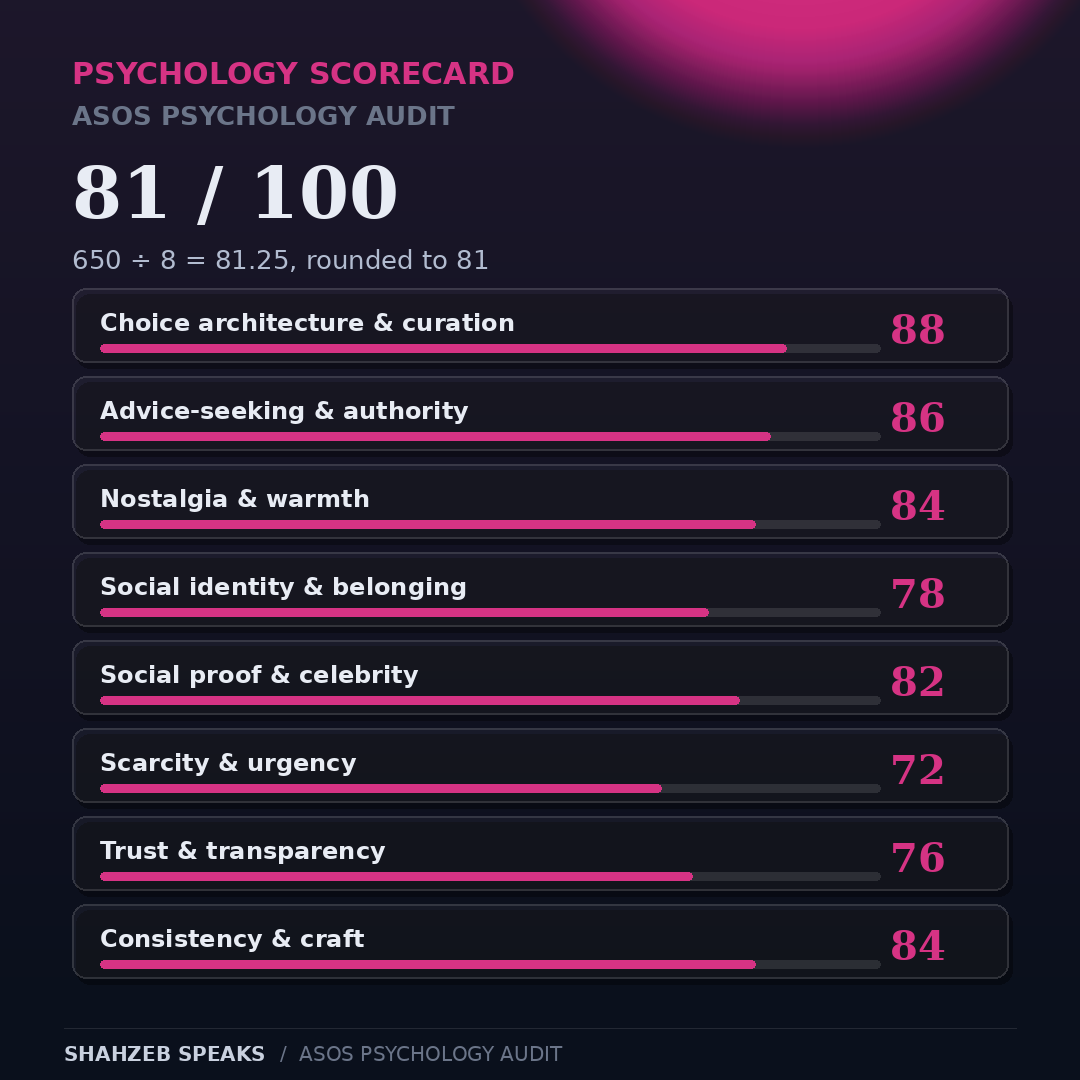
| Choice architecture & curation | 88 | One dilemma, one answer — curation as the product itself. |
| Advice-seeking & authority | 86 | Asking for help is shown as competent, with a real expert answering. |
| Nostalgia & warmth | 84 | The retro phone-in makes a modern problem feel safe and human. |
| Social identity & belonging | 78 | Callers feel like the audience, but the community around the campaign is thin. |
| Social proof & celebrity | 82 | A cast that mixes authority with people like the customer. |
| Scarcity & urgency | 72 | Seasonal urgency only — no verified reason to act now. |
| Trust & transparency | 76 | CMA case closed without a finding; the October cyber incident is still fresh. |
| Consistency & craft | 84 | Film, magazine and edit tell one story: ASOS as your stylist. |
| Overall | 81/100 | (88 + 86 + 84 + 78 + 82 + 72 + 76 + 84) ÷ 8 = 650 ÷ 8 = 81.25 → 81 |
✅ Balance sheet & prescription
What works. The Hotline answers the right problem — choice overload — with the right mechanism: curation presented as advice, from an expert, in a format that makes asking for help feel normal. The nostalgia is warm without being a gimmick, the cast balances authority with social proof, and the campaign matches a real product change: from single items to complete outfits, from generic to personal. The financial backdrop supports the timing: a brand returning to profit, with GMV growth back in the final quarter, spending its first dedicated Christmas campaign on a strategy rather than a discount.
What does not work yet. The campaign gives the customer no concrete reason to act now — no verified scarcity, no deadline, no limited offer. The trust story is unfinished: a cyber incident five weeks before launch, and a regulatory record that is clean of findings but not clean of history. And the campaign is four days old, so nothing about its effectiveness is known. An audit that scored outcome would be guessing. This one scores craft, and the craft is strong but incomplete.
Prescription. Three moves. First, give the Hotline a reason to act now that is honest — a genuine deadline for Christmas delivery, or a limited styling slot, stated plainly. Second, answer the trust question directly: a short, visible statement about what the October incident changed, before customers ask. Third, extend the advice beyond the film: a real styling service, in the app, where a customer can describe an occasion and receive three complete looks. The film promises a stylist. The app should deliver one.
📝 Final Verdict
ASOS has spent years selling access to more fashion. The Hotline sells the opposite: less choice, better chosen, with help. That is a genuine strategic shift, and the psychology behind it is sound — choice overload answered by curation, advice-seeking reframed as competence, nostalgia used to warm a transaction, authority and social proof carried by one cast. The campaign is well made, well timed, and honestly limited: it is four days old, its urgency is seasonal rather than specific, and it launched five weeks after a breach of customer data that it has not yet publicly turned into a trust story. For a brand that has just returned to profit, it is a confident first step — and the next step, a real styling service in the app, is the one that will decide whether “The Stylist” is a campaign or a company.
Psychology Score: 81/100 — ASOS has stopped selling endless choice and started selling help. The Hotline is warm, clever and strategically honest; it now needs urgency, and a trust story to match the advice it gives.
Want your brand audited the same way — on the psychology of what it actually does? I help organisations understand why customers choose, stay, or leave — get in touch here.
More brand psychology audits: Burberry — Wrapped in Burberry, Liverpool FC — Nice One, and Waitrose — The Perfect Gift 2. See all audits at Brand Psychology Audits.
📚 References & Sources
- ASOS plc (11 November 2026). ASOS brings together a star studded cast in the “ASOS Hotline”. https://www.asosplc.com/news-and-media/latest-news/asos-brings-together-a-star-studded-cast-in-the-asos-hotline/
- ASOS plc (5 November 2026). Final results for the 52 weeks to 30 August 2026 (FY26). https://www.asosplc.com/media/duwjosx5/fy26-results-rns-final.pdf
- ASOS plc (19 September 2026). ASOS names Law Roach Stylist in Residence in new creative partnership. https://www.asosplc.com/news-and-media/latest-news/asos-names-law-roach-stylist-in-residence-in-new-creative-partnership-1/
- Drapers (11 November 2026). Asos launches Christmas partywear and gifting campaign. https://www.drapersonline.com/news/asos-launches-christmas-partywear-and-gifting-campaign
- Retail Week (11 November 2026). Asos brings together star studded cast for first ever Christmas campaign. https://www.retail-week.com/fashion/asos-brings-together-star-studded-cast-for-first-ever-christmas-campaign/7052601.article
- 365 Retail (13 November 2026). ASOS Unveils Hotline Christmas Partywear and Gifting Campaign. https://365retail.co.uk/asos-hotline-christmas-partywear-campaign/
- Competition and Markets Authority (27 March 2024). Green claims: CMA secures landmark changes from ASOS, Boohoo and Asda. https://www.gov.uk/government/news/green-claims-cma-secures-landmark-changes-from-asos-boohoo-and-asda
- Advertising Standards Authority (2012). Asos.com Ltd, ruling A12-215014. https://www.asa.org.uk/rulings/asoscom-ltd-a12-215014.html
- Advertising Standards Authority (5 May 2021). Asos.com Ltd, ruling A20-1076557. https://www.asa.org.uk/rulings/asos-com-ltd-a20-1076557-asos-com-ltd.html
- Iyengar, S. S. & Lepper, M. R. (2000). When choice is demotivating: Can one desire too much of a good thing? Journal of Personality and Social Psychology, 79(6), 995–1006.
- Scheibehenne, B., Greifeneder, R. & Todd, P. M. (2010). Can there ever be too many options? A meta-analytic review of choice overload. Journal of Consumer Research, 37(3), 409–425.
- Chernev, A., Böckenholt, U. & Goodman, J. (2015). Choice overload: A conceptual review and meta-analysis. Journal of Consumer Psychology, 25(2), 333–358.
- Brooks, A. W., Gino, F. & Schweitzer, M. E. (2015). Smart People Ask for (My) Advice: Seeking Advice Boosts Perceptions of Competence. Management Science, 61(6), 1421–1435. DOI: 10.1287/mnsc.2014.2054. (PsycNet abstract, https://psycnet.apa.org/record/2015-26485-004)
- Wildschut, T., Sedikides, C., Arndt, J. & Routledge, C. (2006). Nostalgia: Content, triggers, functions. Journal of Personality and Social Psychology, 91(5), 975–993.
- Zhou, X., Sedikides, C., Wildschut, T. & Gao, D. (2008). Counteracting loneliness: On the restorative function of nostalgia. Psychological Science, 19(10), 1023–1029.
- Cialdini, R. B. (2001). Influence: Science and Practice (4th ed.). Boston: Allyn & Bacon. And Cialdini, R. B. (2001). Harnessing the Science of Persuasion. Harvard Business Review, 79(9), 72–79.
Key Findings
- Founded 2000 in London as AsSeenOnScreen; ASOS name adopted 2003; online-only retailer selling own labels (ASOS DESIGN, ARRANGE, Topshop, 4505) plus partner brands in over 100 markets; bought Topshop, Topman, Miss Selfridge and HIIT for £330m (£265m brands + £65m stock), announced 1 February 2021, completed 4 February 2021, 70 stores excluded.
- "ASOS Hotline" launched 11 November 2026, ASOS's first dedicated Christmas partywear and gifting campaign, across digital, social and editorial; 90-second retro-inspired hero film hosted by Ziwe and Farron Clark, with callers Harry Collett, Toni Brattin and Olivia Neill; created with Baron & Baron, photographed by Nicolas Kantor, film by Talia Collis and Peter Bishop; Law Roach appointed first-ever Stylist in Residence 19 September 2026.
- FY26 results (52 weeks to 30 August 2026, published 5 November 2026): GMV £2,349.0m (-5%), revenue £2,245.6m (-9%), active customers 16.4m (-4%), shipped orders 53.9m, average basket £43.59, adjusted EBITDA £170.3m (+29%), statutory operating profit £93.5m, profit before tax £24.4m against a £281.6m loss in FY25, net debt £109.3m; GMV returned to year-on-year growth in Q4 FY26, first time since FY22.
- Legal record: CMA green-claims investigation opened July 2022, concluded 27 March 2024 with voluntary undertakings and NO finding of infringement, no admission of wrongdoing or liability; ASA "20% off everything" email UPHELD 5 May 2021 (around 1,100 products excluded); ASA affiliate Instagram story (Zoe Sugg) UPHELD 22 April 2020, ASOS jointly responsible; ASA "killer Christmas" 2012 NOT UPHELD; no ASA ruling dated 2024-2026 found in the searches run on 15 November 2026; no fine, court case or settlement found in this pass.
- Cyber incident 6 October 2026: an unauthorised party accessed some basic customer data; the investigation found no payment information or account passwords were impacted; website and app remained operational; trading impact estimated at c.2-4% of group GMV (company-reported).
- Score 81/100: 88+86+84+78+82+72+76+84 = 650; 650/8 = 81.25, rounded to 81.
Overall Psychology Score
ASOS scores 81/100 in our comprehensive psychology audit covering consumer behavior strategies, UX design principles, and psychological marketing effectiveness.
The detailed dimension scores are in the audit's Psychology Scorecard chapter.
High impactMuhammad Shahzeb
MSc Industrial Psychologist, specializing in consumer behavior, UX psychology, and brand strategy analysis. Helping brands understand the psychology behind their success.
About Muhammad Shahzeb →