Liverpool FC Psychology Audit — Nice One: The Thank-You That Turned Fans Into the Campaign
Liverpool FC's Christmas campaign 'Nice One' thanks its fans instead of selling to them. A psychology audit of 'Dear Reds' — gratitude, belonging and fan identity — scores it 84/100.

84 / 100
Overall consumer behavior effectiveness
Brand Overview
- Brand nameLiverpool FC
- Founded1892
- HeadquartersAnfield, Liverpool, England
- IndustrySports & Fitness
- Websitewww.liverpoolfc.com ↗
Psychology Techniques Identified
- 01Social identity theory (Tajfel & Turner 1979; fans as "Reds", in-group belonging in 24 cities, 16 countries)
- 02Reciprocity (Cialdini 1984; the thank-you as a gift that invites loyalty back)
- 03Belonging & need to belong (Baumeister & Leary 1995; supporters' clubs on five continents)
- 04Parasocial relationships (Horton & Wohl 1956; Van Dijk, Mac Allister, Alisson, Wirtz and Fisk speaking direct to camera)
- 05Nostalgia & self-continuity (Sedikides et al. 2015, 2016, 2018; 134-year history, Anfield, anthem)
- 06Narrative transportation (Green & Brock 2000; 'Dear Reds' film absorbs the viewer)
- 07Mere exposure (Zajonc 1968; red shirt, anthem and rituals repeated for generations)
- 08User-generated content & co-creation (fan-captured images and video in the creative)
- 09Social proof (Cialdini 1984; club-claimed 450m+ supporters, 1.5bn+ engagements last season)
- 10Loss aversion & scarcity (Kahneman & Tversky 1979; PayPal offer until 19 Nov, museum tour free until 30 Nov)
- 11Peak-end rule (Kahneman et al. 1993; the closing line is both the peak and the end)
- 12Prosocial giving & warm-glow (LFC Foundation Christmas Magic supporting families in the Liverpool City Region)
Full Psychology Audit Report
In this audit
It is a cold night at Anfield, and the match is over. The players do not walk straight down the tunnel. They turn, together, towards the Kop, and they applaud the people who have sung for ninety minutes without stopping. Then the captain looks into the camera and says something no footballer is supposed to say in a Christmas advert: this club does not belong to us. This Liverpool FC psychology audit asks what happens when a football club stops selling shirts for a month and spends its Christmas campaign saying thank you instead — and whether gratitude, aimed at more than 450 million supporters the club itself claims, is a strategy or just good manners.
Liverpool Football Club was founded on 3 June 1892 and has played at Anfield ever since, which makes it one of England’s oldest clubs and one of the most decorated: twenty league titles, a joint record, eight FA Cups, a record ten League Cups and six European Cups. Its Christmas campaign for 2026, called “Nice One”, launched on 6 November 2026 with a hero film, “Dear Reds”, in 60- and 30-second versions. The club calls it the most extensive campaign in its 134-year history and “football’s biggest ever ‘thank you'” — its own description, not an independent measurement — and it is built around the supporters rather than the players. The film features Virgil van Dijk, Alexis Mac Allister, Alisson Becker and Florian Wirtz, with women’s captain Grace Fisk also appearing, and its outdoor advertising runs around Official Liverpool Supporters Club locations in 24 cities, 16 countries, across five continents. This audit asks what the film does to the mind of a supporter, why a thank-you can be more persuasive than a sales message, and where the campaign’s commercial machinery sits underneath its warmth. One honest limit up front: the campaign is seven days old and runs until the end of December 2026, with partner activations still to be announced, so there is no independent effectiveness score for it yet. This audit scores the psychology of the campaign and the club, not its outcome.
I am an Industrial and Organizational Psychologist in Karachi, and I audit brands by testing their claims against psychology research and their own public record. Where a figure is the club’s own claim rather than an independent measurement, I will say so in the same sentence, not in a footnote. Where a legal matter is only a filed complaint, I will keep it exactly that. And where the club’s own page gives a proud story about its supporters on one line and a routine trademark filing on another, I will show you both rather than pick the flattering one.
“Liverpool is not selling a shirt in this campaign. It is selling the idea that the people in the stands own the club more than the people on the pitch do — and that a thank-you, said properly, is the most persuasive sentence in football.”
— Brand Psychology Analysis, ShahzebSpeaks
📋 Brand Overview
| Field | Detail |
|---|---|
| Brand | Liverpool Football Club (Liverpool FC; “the Reds”) — professional football club, Premier League, England |
| Founded | 3 June 1892, after a dispute between the Everton committee and John Houlding, owner of the land at Anfield; played at Anfield since formation |
| Headquarters | Anfield, Liverpool, England |
| Owner | Fenway Sports Group (FSG) — took ownership in October 2010; principal owner John W. Henry; chairman Tom Werner |
| Honours | Twenty league titles (joint record), eight FA Cups, a record ten League Cups, six European Cups, three UEFA Cups; twentieth league title won in 2025 |
| Current campaign | “Nice One” — hero film “Dear Reds”, launched 6 November 2026; runs until the end of December 2026 |
| Website | https://www.liverpoolfc.com |
| Psychology score | 84/100 |
Sources: Liverpool FC official campaign page (6 November 2026); Wikipedia, “Liverpool F.C.” (founded 3 June 1892; FSG ownership October 2010; honours). All figures as of 13 November 2026.
📜 Chapter 1: History — born from a quarrel, built by the people in the stands
Liverpool FC was born from an argument about a football ground. In 1892, after eight years at Anfield, Everton relocated across Stanley Park to Goodison Park following a dispute between the Everton committee and John Houlding, the club president and owner of the land at Anfield. Houlding founded a new club to play at Anfield instead. Originally named “Everton F.C. and Athletic Grounds Ltd”, the club became Liverpool F.C. in March 1892 and gained official recognition three months later, on 3 June 1892 — the date the club counts as its founding. Anfield itself had been built in 1884 and was originally Everton’s home, which means Liverpool’s ground is older than the club that plays there, and the club’s first home was inherited from its rival. That is a fitting start for a club whose identity has always been bound up with the people who fill the ground rather than the people who own it.
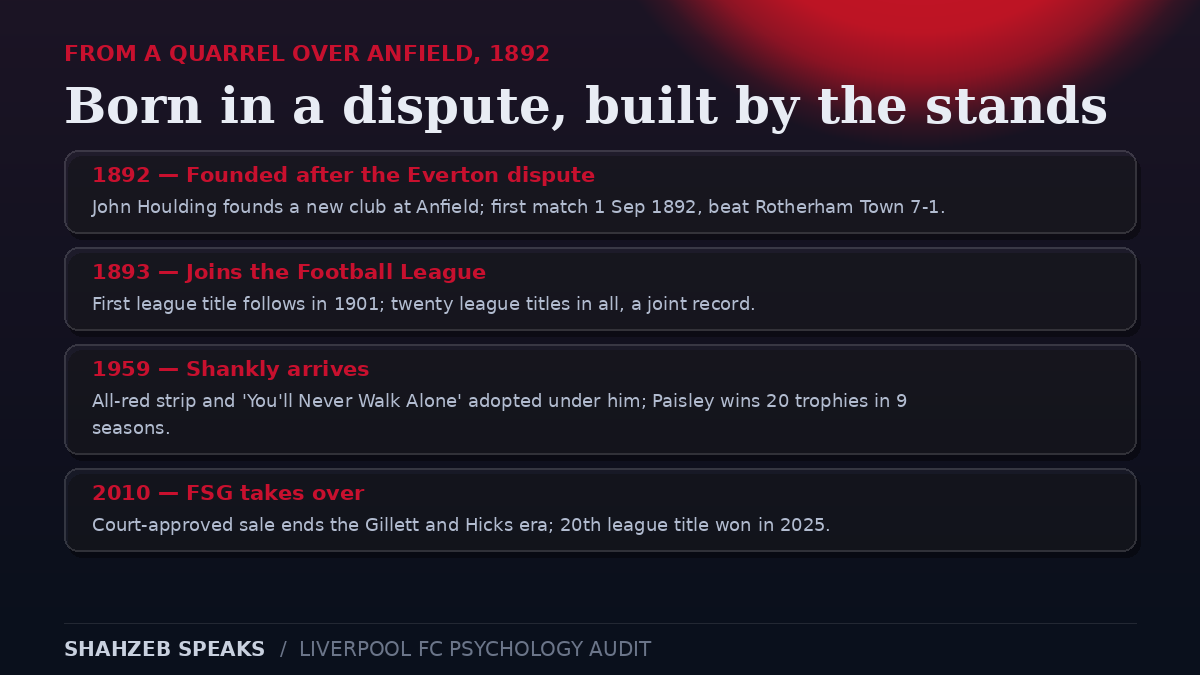
The new club wasted no time. Liverpool played its first match on 1 September 1892, a pre-season friendly against Rotherham Town, and won 7–1. It won the Lancashire League in its debut season, joined the Football League in 1893, and won its first league title in 1901. The modern club was made in the 1960s, when Bill Shankly was appointed manager in 1959 and turned a Second Division side into a force. Under Shankly the team first adopted the all-red home strip that has been used ever since, and under him the club also adopted its anthem, “You’ll Never Walk Alone”, the song that now defines the bond between the team and the stands. His successor Bob Paisley won twenty trophies in nine seasons, including three European Cups, six league titles and three consecutive League Cups, and remains the most successful manager in the club’s history. Kenny Dalglish, who followed, won three more league titles and two FA Cups as player-manager, and the club went on to win two further European Cups in 2005 and 2019, the second under Jürgen Klopp, who also led Liverpool to a nineteenth league title in 2020, the club’s first in the Premier League era. After Klopp’s departure in 2024, Arne Slot guided Liverpool to a twentieth league title in 2025 — a joint record.
Two tragedies sit inside that history and must be named, because they explain why a thank-you campaign from this club carries a weight it would not carry from another. At the 1985 European Cup final in Brussels, the Heysel Stadium disaster saw 39 fans — mainly Italian supporters of opponents Juventus — die after a crush against a concrete wall that collapsed. At an FA Cup semi-final on 15 April 1989, the Hillsborough disaster claimed the lives of 97 Liverpool supporters after grossly negligent policing led to a crowd crush. A decades-long campaign for justice saw further inquests, commissions and independent panels that ultimately exonerated the fans of all blame. The club’s supporters were not bystanders to those events; they were the people who carried the loss, and the people who fought for the truth about it. When Liverpool says its supporters are the club, that is not marketing copy invented for Christmas. It is a sentence the club’s history has already written, at a terrible price. The ownership chapter is quieter. American businessmen George Gillett and Tom Hicks became owners in the 2006–07 season; by the start of the 2010–11 season the club was on the verge of bankruptcy, and its creditors asked the High Court to allow a sale over the owners’ wishes. John W. Henry, owner of the Boston Red Sox and Fenway Sports Group, bid successfully and took ownership in October 2010. Fenway Sports Group still owns the club today, with Tom Werner as chairman.
🎬 Chapter 2: Nice One — the film that gives the campaign away
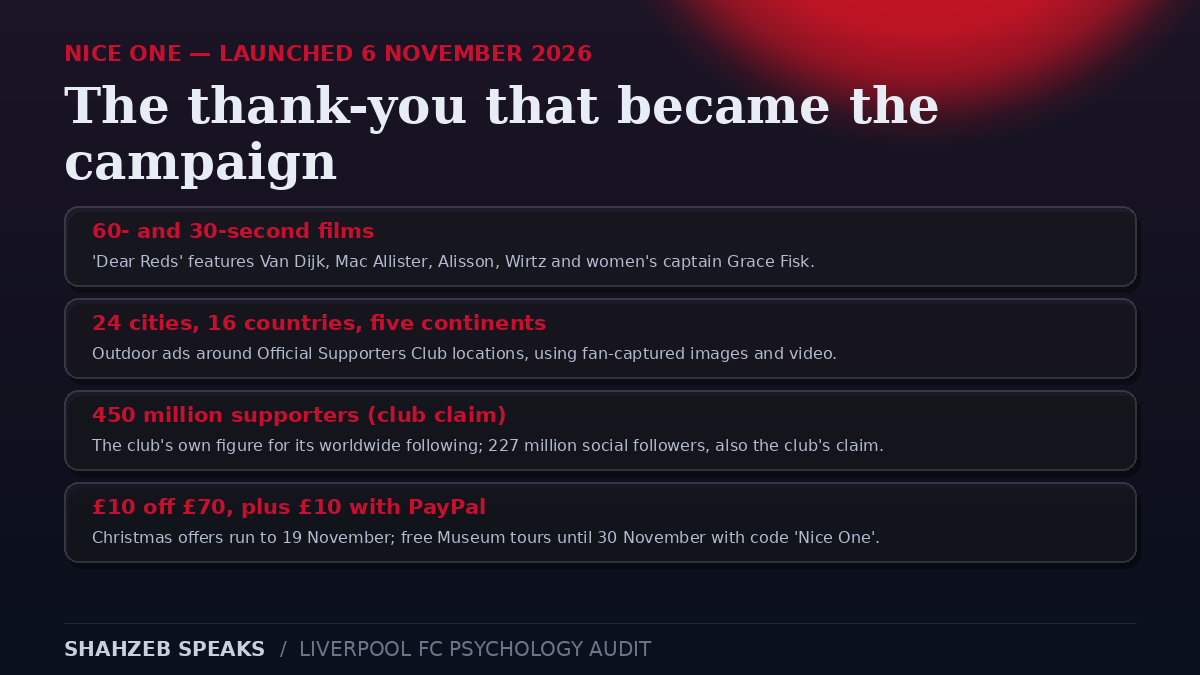
“Nice One” is a Christmas campaign with an unusual problem: it has almost nothing to sell. The message, in the club’s own words, is as simple as it is Scouse: “To the world’s greatest fans, nice one.” The hero film, “Dear Reds”, is spearheaded in 60- and 30-second versions, shown on liverpoolfc.com/Christmas and on the club’s social channels, and it features Liverpool stars including Virgil van Dijk, Alexis Mac Allister, Alisson Becker and Florian Wirtz, with women’s captain Grace Fisk also appearing. The players express their gratitude and conclude with a single line, quoted here in full because it is the whole campaign: “This club doesn’t belong to us. But we’re honoured to represent it. And it’s an honour to play for you. To the world’s greatest fans, nice one.” The club describes the campaign as the most extensive it has undertaken in its 134-year history and as “football’s biggest ever ‘thank you'” to fans. Both descriptions are the club’s own, not independent measurements, and this audit treats them as claims about ambition, not as facts about size. What can be verified is the shape of the campaign: a film, outdoor advertising around Official Liverpool Supporters Club locations in 24 cities, 16 countries, spanning five continents, creative built from images and video captured by fans themselves, and further fan-targeted activations and giveback gestures still to be unveiled across the Christmas period, including events delivered with club partners PayPal, Carlsberg and Expedia.
The film works through narrative transportation, the mechanism Green and Brock (2000) described in their work on the persuasiveness of public narratives: when people are absorbed into a story, they stop arguing with it, and the beliefs of the story travel with them into the world outside it. “Dear Reds” is built for absorption. It does not argue that Liverpool is a great club, and it does not list trophies. It shows players — the most famous employees a football club has — speaking directly to the people who pay to watch them, and saying the opposite of what famous people usually say. The usual script of a sports Christmas advert is the star as hero: the player does something extraordinary, and the viewer is invited to admire it. Here the player does something ordinary — he says thank you — and the viewer is invited to feel recognised. Van Dijk, the men’s captain, put it in his own words on the campaign page: “It’s an honour and a privilege to play for our fans, whether they’re in Anfield or watching from the other side of the world. Putting them front and centre of our Christmas campaign is a fantastic way to thank them for being there, through the good times and the challenges.” Fisk added: “It’s wonderful to be able to say thank you to our growing community of LFC Women supporters in this way. We’re excited to continue this journey together and create many more special moments along the way. Nice one for being there for us week in, week out.” Hannah Pym, the club’s senior vice-president for marketing and digital, framed the same idea from the brand side: “LFC has always been shaped by its supporters. Their passion, loyalty and connection to the club can be seen in every corner of the world, and that’s something we’re incredibly proud of. With ‘Nice One’, we’re putting the world’s greatest fans at the heart of our Christmas campaign and delivering football’s biggest ever thank you to the people who help make this club so special.”
There is a risk in this kind of film, and it is worth naming before the praise. A thank-you can be a performance, and supporters are good at telling the difference between gratitude and flattery. Sincerity is not a thing an audit can measure from a press release, but the structure of this campaign is the structure of a genuine thank-you: it names the people, it shows their work, and it gives something back. The creative uses images and video captured by fans themselves, which means the people being thanked are also the people making the campaign. The outdoor advertising is placed around Official Liverpool Supporters Club locations, which means the thank-you is delivered where supporters actually gather, not only where advertisers buy space. And the campaign’s giveback gestures — the museum tour, the discounts, the foundation work — are aimed at supporters rather than at the club’s own till. A flattering campaign would have stopped at the film.
🔴 Chapter 3: Social identity — being a Red is who you are, not what you buy
The strongest psychology in this campaign is also the oldest idea in the psychology of groups. Tajfel and Turner (1979), in their social identity theory of intergroup behaviour, showed that people draw a large part of who they are from the groups they belong to, and that they favour their own group — the in-group — over outsiders, not because of any reward, but because the group membership itself matters to their sense of self. Football fandom is the clearest everyday example of that theory in action. A Liverpool supporter does not merely like Liverpool; a supporter is a Red. The identity is worn on the body in the form of a red shirt, sung in the form of an anthem, and carried into conversations, workplaces and family arguments. “Nice One” is built on exactly that insight. Its hero film is called “Dear Reds”, not “Dear Customers”, and its closing line addresses “the world’s greatest fans”, not “our valued supporters”. The campaign does not try to persuade anyone to become a Liverpool fan. It speaks to people who already are, and it tells them that their membership is seen.
That distinction matters, because most Christmas advertising is acquisition advertising: it tries to win new customers. This campaign is retention advertising dressed as a thank-you, and social identity theory explains why it should work. When a brand affirms a person’s group identity, it strengthens the bond between the person and the brand, because the brand is no longer selling a product — it is confirming who the person is. The club’s own claimed numbers make the scale of that identity visible, and they must be attributed as the club’s claims: Liverpool says it has “more than 450 million” supporters locally and globally, and “more than 227 million followers on social media”. The club also claims it was the most-engaged club in the Premier League for the last three seasons in a row, with “more than 1.5 billion social media engagements last season alone, a third more than any other Premier League club”. None of those figures has been independently measured in this audit, and none should be read as a fact about the world. But their size tells you something true about the campaign’s design: it is aimed at an identity that already spans the world, and it is built to be recognised in 24 cities and 16 countries, not only in Liverpool. A thank-you that only worked at Anfield would be a local gesture. A thank-you that works in a supporters’ club in Kuala Lumpur or Lagos is a global identity being affirmed.
The honest limit is that identity can also become a trap: a supporter whose identity is bound up with a club will forgive a great deal — a bad season, a bad decision, a bad price — and a club that knows that can be tempted to trade on it.
🙏 Chapter 4: Reciprocity — the thank-you is a gift, and gifts create debts
Robert Cialdini (1984), in Influence: The Psychology of Persuasion, named reciprocity as one of the most powerful principles of human behaviour: when someone gives us something, we feel obliged to give something back, even when the gift was small, unexpected or unsolicited. The obligation is not a calculation. It is a reflex, built into the way human societies hold together, and it works even when the gift costs the giver almost nothing. “Nice One” is a campaign built entirely on that reflex. The club gives its supporters a film, a thank-you, a free museum tour and a set of discounts, and it asks for nothing in return — at least, not in the same sentence. The return is expected later, in the form of loyalty, attendance, shirt sales and the quiet decision, made thousands of times a day, to stay a Red rather than drift away.
What makes the campaign interesting from a reciprocity point of view is that the gift runs in both directions at once. The club is thanking the supporters, but the film’s closing line says the supporters are the ones who give: they give their time, their voice, their loyalty through good times and challenges. Van Dijk’s line about thanking fans “for being there, through the good times and the challenges” names that exchange directly. The supporters give the club its atmosphere, its identity and its revenue. The club gives back a public thank-you and a set of gestures. That two-way exchange is what makes reciprocity feel like gratitude rather than manipulation: both sides can see what the other has given, and neither side is pretending the exchange is one-way. A campaign that only took — a film that said “buy the new shirt” — would trigger no reciprocity at all, because there would be no gift to repay. A campaign that gives first, and gives publicly, creates the obligation that Cialdini described, and it does so without ever having to ask.
The gestures themselves are worth looking at closely, because reciprocity depends on the gift feeling real. The free Liverpool FC Museum tour, free until 30 November when pre-booked online with the code “Nice One”, is a genuine gift: it costs the club something, it costs the supporter nothing, and it gives the supporter an experience inside the club’s own history rather than a discount on a product. The discounts are more mixed. Saving £10 when you spend £70, with an extra £10 saving when paying with PayPal until 19 November, terms and conditions applying, and Red members receiving an additional 10 per cent saving, are real savings — but they are also sales mechanics, and supporters are good at telling the difference between a gift and a promotion. The honest reading is that the campaign mixes two kinds of giving: the museum tour and the foundation work are gifts, and the discounts are promotions dressed as gifts. Both kinds create reciprocity, but they create different kinds. A gift creates loyalty. A promotion creates a purchase. The campaign is at its strongest when it gives, and at its weakest when it sells — and the scorecard in the final chapters reflects exactly that split.
🌍 Chapter 5: Belonging — the campaign that shows up where supporters actually are
Baumeister and Leary (1995), in their review of the need to belong, argued that human beings have a fundamental drive to form and maintain lasting, positive and significant interpersonal relationships, and that a large part of human behaviour is best understood as an attempt to satisfy that need. Football fandom satisfies it in a particular way: it gives a person a community that meets regularly, sings together, suffers together and celebrates together, and it does so on a schedule that repeats every week. “Nice One” is a campaign about that community, and its most distinctive decision is a geographical one. The global outdoor campaign is scheduled to appear around all Official Liverpool Supporters Club outpost locations in 24 cities in 16 countries, spanning five continents. That is not a media buy. It is a map of belonging. The club is not advertising where the most people are; it is advertising where its people already gather.
The creative makes the same point in a different way. The campaign’s images and video were captured by fans themselves, which means the people in the advertising are the people the advertising is aimed at. That is user-generated content in the truest sense: not a competition with a hashtag, and not a testimonial filmed by a production company, but the supporters’ own record of what supporting Liverpool looks like from inside the stand. The psychology of that choice is straightforward. A supporter who sees their own photograph, or a photograph like their own, in a global campaign does not merely feel flattered. They feel recognised as a maker of the club’s identity rather than a consumer of it. The campaign’s message — “To the world’s greatest fans, nice one” — is addressed to people who can see themselves in the pictures that carry it. That is a stronger claim than any slogan, because it is a claim the audience can verify with their own eyes.
Social proof, another of Cialdini’s principles, runs through the same material. People look to what others do to decide what they should do, and a campaign that shows supporters in 24 cities is showing a new or wavering supporter that this is a very large crowd to join. The club’s claimed figures do the same work in words: more than 450 million supporters, more than 227 million social media followers, the most-engaged club in the Premier League for three seasons running, more than 1.5 billion social media engagements last season alone, a third more than any other Premier League club. Every one of those figures is the club’s own claim, and this audit repeats them only as claims. But the mechanism they serve is real even when the numbers are not independently verified: a person deciding whether to care about a club is influenced by how many other people already care, and by how loudly they care.
📺 Chapter 6: Parasocial relationships — when the captain talks to you, personally
Horton and Wohl (1956), who coined the term parasocial interaction, described the one-sided intimacy audiences form with media figures: viewers respond to a performer as if they knew them, and the relationship feels real even though it is not returned. Footballers are the most powerful parasocial figures in modern life. A supporter watches the same eleven men every week, learns their habits, their celebrations and their weaknesses, and comes to feel that they know them — even though the players have no idea the supporter exists. “Dear Reds” is built on that one-sided intimacy, and it uses it in the most direct way possible: the players look into the camera and speak to the viewer as if the viewer were in the room. Van Dijk, Mac Allister, Alisson and Wirtz do not perform a scene. They deliver a message. The camera does not cut away to a stadium or a trophy. It stays on the faces of men the audience already feels it knows, saying something those men have never said before in an advert: thank you, and this club is yours, not ours.
That direct address is the film’s most effective device, and it is also its most fragile one. Parasocial relationships work because the figure feels authentic, and they break when the figure feels scripted. A footballer reading a line written by a marketing department can sound like a footballer reading a line written by a marketing department, and supporters are quick to notice. “Dear Reds” protects itself against that in two ways. First, the line it gives the players is a humble one: “This club doesn’t belong to us. But we’re honoured to represent it. And it’s an honour to play for you.” Humility is hard to fake badly, because it runs against the usual script of the star, and a player saying he is honoured to represent a club sounds like a person, not a poster. Second, the film includes Grace Fisk, the women’s captain, speaking to the club’s growing community of LFC Women supporters. That inclusion does two things at once: it extends the parasocial bond to supporters who have historically been addressed less often, and it signals that the thank-you is aimed at the whole club rather than only at its most famous team. Fisk’s words — “Nice one for being there for us week in, week out” — are the most ordinary sentence in the campaign, and that ordinariness is the point. A thank-you that sounds like a press release would have failed. A thank-you that sounds like a person succeeds, because the parasocial bond is a bond with a person.
The risk is that parasocial intimacy can be used to sell things the audience would not otherwise buy, and this campaign does sell things, as Chapter 8 explains. But the film itself sells nothing, and that restraint is what makes the parasocial device work. A viewer who feels personally addressed by Van Dijk is more likely to forgive the discounts that follow, because the film has already given them something — recognition — that no discount can buy. The bond is one-sided, and the supporter knows it, even when they enjoy it. A club that mistakes the warmth of that bond for permission — permission to raise prices, to move a kick-off time, to treat supporters as customers — will find that the bond breaks faster than it was built.
🎵 Chapter 7: Nostalgia and mere exposure — 134 years in sixty seconds
Sedikides, Wildschut, Routledge, Arndt, Hepper and Zhou (2015), in “To nostalgize: Mixing memory with affect and desire”, published in Advances in Experimental Social Psychology, 51, described nostalgia as a self-conscious, bittersweet but predominantly positive and fundamentally social emotion. It serves a self-oriented function, raising self-positivity; an existential function, increasing perceptions of life as meaningful; and a sociality function, increasing social connectedness and promoting prosocial behaviour. Sedikides and Wildschut (2018), in “Finding meaning in nostalgia”, published in the Review of General Psychology, 22(1), 48–61, showed that nostalgia helps people find meaning in life primarily by increasing social connectedness, and secondarily by augmenting self-continuity, the connection between past and present selves. Sedikides, Wildschut, Cheung, Routledge, Hepper, Arndt and Vail (2016), in “Nostalgia fosters self-continuity”, published in Emotion, 16(4), 524–539, tested the mechanism across six experiments: nostalgia fosters self-continuity through social connectedness, and self-continuity in turn confers eudaimonic well-being. “Nice One” is a nostalgia campaign that never has to say the word. Its central claim — the most extensive campaign in the club’s 134-year history — is a number that only works because the history is long enough to feel. A club founded in 1892, playing in the same ground since its formation, singing the same anthem since the 1960s, wearing the same all-red strip since Shankly, is a machine for producing exactly the emotion Sedikides and his colleagues described: the feeling that who you were and who you are belong to the same story.
The film uses that history without showing it. There is no montage of trophies, no black-and-white footage, no voiceover listing the honours. The nostalgia is carried by the setting and the sentence. The players stand where players have stood for 134 years, and they thank the people who have stood in the same place, in the same colours, for just as long. That restraint is the film’s smartest choice. A trophy montage would have made the campaign about the club’s past. A thank-you makes it about the supporters’ past — the matches they attended with a parent, the shirt they were given as a child, the song they learned before they understood the words. The anthem is the clearest example. “You’ll Never Walk Alone” was adopted under Shankly in the 1960s, and it is sung before every home match, which means that for most supporters it is not a song they chose. It is a song they inherited, and singing it is an act of continuity with the people who sang it before them. A campaign that thanks the people who sing it is, in effect, thanking them for keeping the club’s memory alive — and that is a gift the club cannot buy back.
Zajonc (1968), in his work on the attitudinal effects of mere exposure, showed that people tend to develop a preference for things simply because they are familiar with them, and that repeated exposure, on its own, increases liking. Liverpool is a club that has been exposed to its supporters, week after week, for generations: the same ground, the same colours, the same song, the same rituals. Mere exposure is doing a great deal of the persuading in this campaign before the first frame plays, because the audience already likes the things the film shows them — the red shirt, the captain’s face, the sound of the crowd — simply because they have seen them so often. “Nice One” mostly escapes the trap of familiarity, because the message is new even when the setting is old. Nobody has thanked the supporters like this before, in a campaign of this size, with the players saying the club belongs to the fans. Familiarity gets the audience to watch. The sentence is what makes them stay.
🏷️ Chapter 8: The commercial machine behind the thank-you
Behind the thank-you sits a commercial machine, and this audit would be dishonest if it pretended otherwise. The campaign’s offers are real, and they are also sales mechanics. Save £10 when you spend £70. An extra £10 saving when you pay with PayPal, until 19 November, with terms and conditions applying. Red members receive an additional 10 per cent saving. Black Friday and Cyber Monday deals are available through the online store, the official store app and the official stores in the UK and Ireland. Partner activations with PayPal, Carlsberg and Expedia are still to be unveiled across the Christmas period. None of that is hidden. All of it is printed on the same campaign page as the thank-you, which is to the club’s credit. But it is also the reason the campaign must be scored as a piece of commerce as well as a piece of gratitude, and the psychology of the offers deserves the same attention as the psychology of the film.
Kahneman and Tversky (1979), in prospect theory, showed that losses loom larger than gains: people feel the pain of losing something more strongly than they feel the pleasure of gaining the same amount, which is why loss aversion shapes so much of what people buy and what they avoid. The campaign’s offers are built on that asymmetry. A discount that expires on 19 November is not only a saving; it is a saving that will be lost if the supporter waits. A free museum tour free only until 30 November, pre-booked online with the code “Nice One”, is not only a gift; it is a gift with a closing date. Scarcity, one of Cialdini’s principles, works the same way: a thing that is available for a limited time, or in a limited quantity, feels more valuable than the same thing available for ever. The PayPal deadline and the museum window are both scarcity devices, and both are honest ones — the dates are printed plainly — but they are devices all the same. A supporter who books the museum tour because it is free is behaving generously towards themselves. A supporter who books it because it ends on 30 November is behaving exactly as loss aversion predicts.
The peak-end rule, described by Kahneman, Fredrickson, Schreiber and Redelmeier (1993), says that people judge an experience largely by how it felt at its most intense moment and at its end, rather than by the sum of every moment in between. “Dear Reds” is built for that rule. Its peak is the players’ closing line — “This club doesn’t belong to us. But we’re honoured to represent it. And it’s an honour to play for you. To the world’s greatest fans, nice one.” — and its end is the same sentence, which means the peak and the end are the same moment. A supporter who remembers the film will remember that line, and a supporter who remembers that line will remember the film as a thank-you, whatever else was in it. That is a strong piece of design, and it is also a warning. The peak-end rule cuts both ways: if the supporter’s experience of the campaign ends not with the film but with a discount that did not work, a code that did not apply, or a tour that was already full, then the end of the experience is a frustration, and the frustration is what they will remember. The campaign’s weakest point is not its idea. It is the gap between a beautiful sentence and the mechanics that follow it, and the club’s score for commercial craft depends on whether those mechanics work as well as the film does.
The foundation work is the part of the machine that most deserves the name gift. The global campaign aligns with the LFC Foundation’s “Christmas Magic” campaign, which aims to ensure as many families as possible are supported at a time of year that can be difficult for some, with food support at the heart of its festive efforts across the Liverpool City Region. Last year, the club says, it “reached more families than ever before” — the club’s claim, with no number given, and this audit prints no number because none was provided. A charity claim without a figure is a claim the audience cannot check, and a campaign that is careful with its other numbers should be careful with this one too. That said, the alignment is real: a thank-you campaign that also feeds families in its own city is a thank-you that does something, not only says something. The warm-glow effect — the good feeling people get from giving, and from seeing others give — is the psychology at work here, and it is the one part of the campaign where the club’s interests and the supporters’ interests point in exactly the same direction. The film thanks the fans. The foundation feeds the city. Both are gifts, and both create the reciprocity that Chapter 4 described.
⚠️ Chapter 9: Dark side & regulatory record — exactly what is known
Every legal statement in this chapter is written at its exact status, as of 13 November 2026. A filed complaint is a filed complaint, not a judgment. A dismissed case is a dismissed case, not a win on the merits. A search that found nothing is a search that found nothing, not proof that nothing exists. I have scoped this chapter to the record actually checked: two United States federal court filings concerning counterfeit Liverpool FC merchandise, and searches for any current (2026) fine, sanction or investigation against Liverpool FC itself. What follows is what those searches found — and, at the end, what they did not cover.
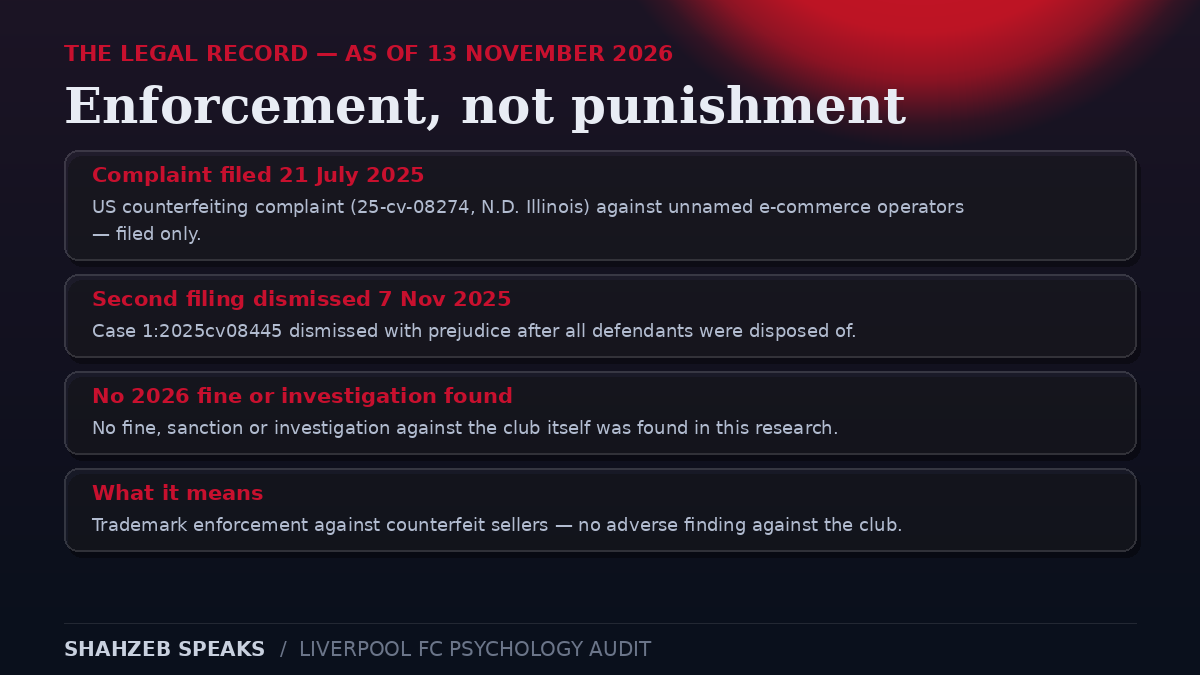
The first filing is a complaint, and it must be called nothing more. On 21 July 2025, Liverpool FC filed a trademark-counterfeiting complaint in the United States District Court for the Northern District of Illinois, Case No. 25-cv-08274, against unnamed e-commerce operators selling counterfeit Liverpool FC-branded goods. The complaint was filed. No outcome has been verified. There is no ruling, no fine, no settlement and no judgment to report, and this audit will not imply one. The second filing is a similar case, and its status is different. A second, similar filing, Case No. 1:2025cv08445, was filed on 23 July 2025 and was dismissed with prejudice on 7 November 2025, after all defendants were disposed of. A dismissal with prejudice means the case was closed and cannot be refiled on the same claims, but it is not a finding in Liverpool’s favour on the merits of the counterfeiting allegation, and this audit will not present it as one. Both cases are routine brand-protection enforcement — a club defending its name against sellers of fake shirts — not findings against Liverpool FC. The honest reading is that the club protects its trademark in court, as most clubs of its size do, and that one of its two recent cases was dismissed while the other has no verified outcome.
The rest of the record is an absence, and the absence must be stated with the same care as the filings. No current (2026) fine, sanction or investigation against Liverpool FC itself was found in this research. That sentence is not a claim that the club has a clean record in every jurisdiction and every register. It is a statement about what the searches for this audit found, and it should be read that way. Several stories that appear in search results about the club were deliberately left out of this chapter, because they could not be verified to the standard this audit requires. A story about Liverpool acting under Section W of the Premier League rulebook to preserve a right to claim compensation if Manchester City are later found to have broken financial rules is a procedural protection, not a claim: Liverpool are not accusing Manchester City of anything, and no verdict has been reached in the Manchester City case. This audit does not print it, because the reporting was secondary and the status is procedural rather than substantive. The 2019 dispute with New Balance over the kit deal is not printed as a live dispute, because it was resolved years ago and Nike has been the kit supplier since the 2020–21 season. Claims arising from the 2022 Champions League final are not printed, because the claim is against UEFA rather than Liverpool FC, and the dates in the republications were inconsistent. No club valuation and no ownership-split percentages are printed, because they rest on secondary aggregators rather than primary filings.
Two limits must be stated plainly, because they are the difference between an honest chapter and a misleading one. First, the searches for this chapter covered United States federal filings and general searches for 2026 enforcement against the club; they did not cover Companies House filings, and they did not search every regulator’s register directly, so this chapter does not print any unqualified statement that no case was found anywhere. Second, the two cases above concern counterfeit merchandise sold by third parties, not conduct by the club itself, and neither case suggests any wrongdoing by Liverpool FC. The honest reading of the record is that Liverpool FC’s legal history, as far as this audit could verify it, is short and unremarkable: two trademark-enforcement filings, one dismissed, one with no outcome verified, and no current fine, sanction or investigation against the club itself. None of that makes the Christmas film better. It makes the club behind it a real organisation, with a real record, telling a very good story — and a story that does not need a scandal to be interesting is a story worth trusting a little more.
🇵🇰 Chapter 10: What Pakistani brands should — and shouldn’t — copy
Pakistani brands should copy three things. First, the single emotional idea. Liverpool’s Christmas campaign is one film, one idea — thank the fans — and one sentence, expressed across film, outdoor advertising, the shop floor and the foundation. A Pakistani brand with a strong seasonal moment — Eid, Ramadan, a wedding season, a cricket series — should build one idea and run it everywhere, rather than running five ideas that cancel each other out. Second, the people, not the product. “Dear Reds” puts the supporters at the centre of the campaign and uses their own photographs and video to do it. A Pakistani brand has richer material than Liverpool does — a customer’s own photograph of a family meal, a fan’s video from a match, a shopkeeper’s story told in their own words — and it should let the audience see themselves in the campaign, rather than filming a generic happy family and hoping the audience recognises itself. Third, the gift that costs something. The free museum tour is a real gift: it costs the club something, it costs the supporter nothing, and it gives an experience inside the club’s own history. A Pakistani brand selling food, fabric or furniture should ask what experience it can give — a family meal, a room prepared for guests, a moment made for someone — rather than only showing the product on a shelf.
What they should not copy is the size of the claim, or the loose number. Liverpool’s campaign leans on figures — more than 450 million supporters, more than 227 million followers, more than 1.5 billion engagements — that are the club’s own claims, and a Pakistani brand that prints a number it cannot prove will be asked to prove it on the second day. A better rule is the one this audit follows: if the figure is yours, say so; if it is not verified, do not print it. Nor should they copy the discount trap. Liverpool’s offers are printed honestly, with dates and terms, but they are still promotions dressed as gifts, and a Pakistani brand that calls a discount a gift will teach its customers to wait for the discount rather than to love the brand. And they should not copy the premium-only trap. Liverpool is a global club with a worldwide audience, a 134-year history and a stadium that sells itself. A Pakistani brand that copies the film without copying the foundation — the community, the history, the people who actually gather — will have a beautiful advert and an empty room. Copy the thank-you, and then make sure there is something real behind it to thank people for.
📊 Psychology Scorecard — the Liverpool FC psychology audit in numbers
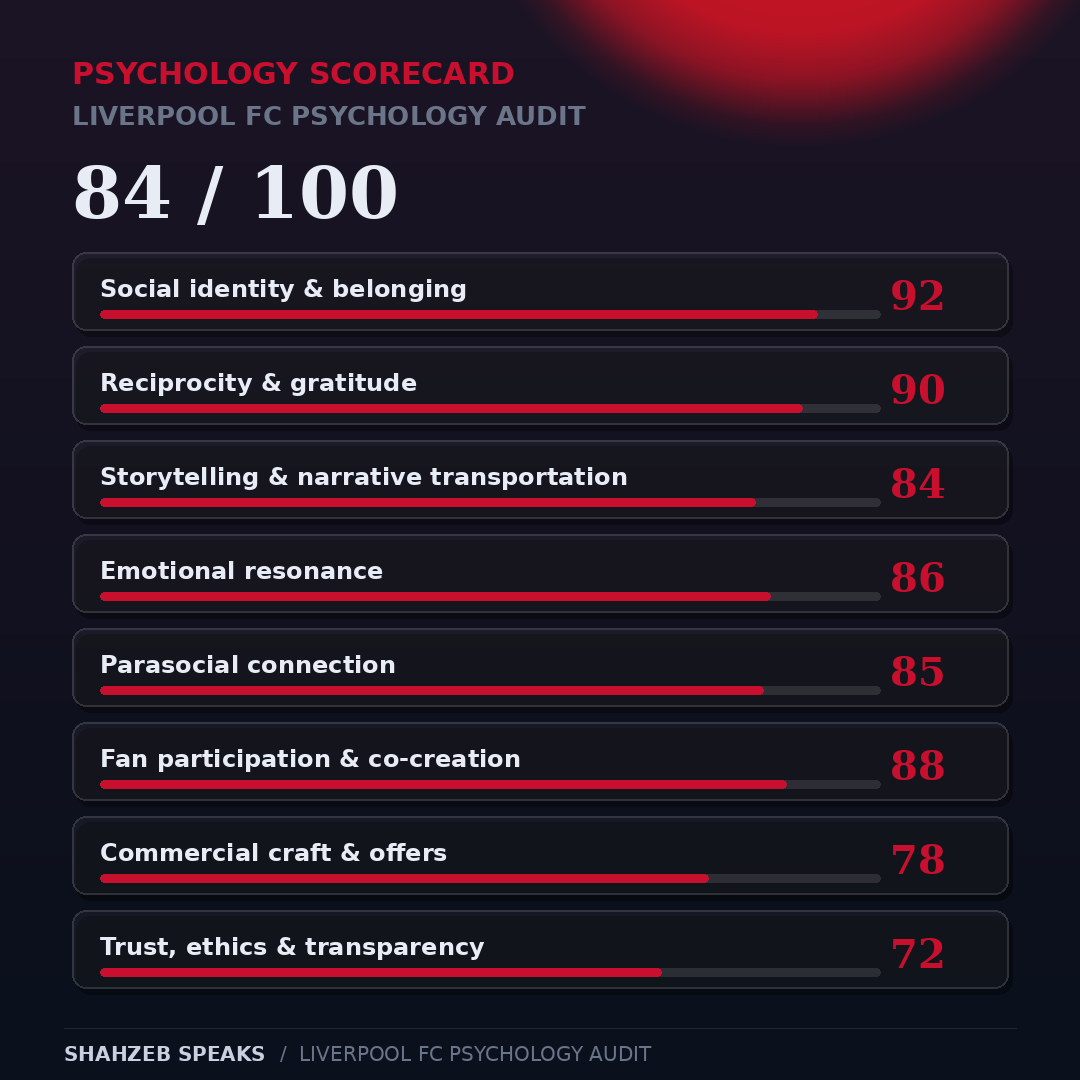
| Dimension | Score | Verdict |
|---|---|---|
| Social identity & belonging | 92 | “Dear Reds” speaks to people who already are Reds, in 24 cities and 16 countries, and tells them their membership is seen. |
| Reciprocity & gratitude | 90 | A public thank-you, a free museum tour and foundation giving create a genuine obligation to give back — without ever asking. |
| Storytelling & narrative transportation | 84 | A sixty-second film with one line at its centre absorbs the viewer, but the story is thin beyond that single sentence. |
| Emotional resonance | 86 | The closing line lands hard, and the 134-year history behind it gives the gratitude weight no new brand could buy. |
| Parasocial connection | 85 | Van Dijk, Mac Allister, Alisson, Wirtz and Fisk speak directly to camera, and the humility of the line makes it feel real. |
| Fan participation & co-creation | 88 | Fan-captured images and video, and outdoor advertising placed where supporters actually gather, make the thanked people the makers. |
| Commercial craft & offers | 78 | The discounts are printed honestly with dates and terms, but they are promotions dressed as gifts, and the charity claim carries no number. |
| Trust, ethics & transparency | 72 | No current fine, sanction or investigation against the club was found, but the big audience figures are the club’s own claims, not verified facts. |
Arithmetic: 92 + 90 + 84 + 86 + 85 + 88 + 78 + 72 = 675. 675 ÷ 8 = 84.375, rounded to 84/100.
✅ Balance sheet & prescription
What Liverpool does best is turn gratitude into identity. The social identity is exact — a campaign that speaks to people who already are Reds, in the places where they already gather, using their own photographs — the reciprocity is real, because the club gives first and asks for nothing in the same sentence, and the closing line is a piece of writing that will be remembered long after the discounts expire. What it does worst is the gap between the story and the proof. The big numbers are the club’s own claims rather than verified facts, the charity claim carries no figure, the offers are promotions dressed as gifts, and the film’s single sentence, however good, is carrying a campaign that has little else to say. The prescription follows that balance. First, let the campaign be measured: publish the independent effectiveness and supporter-response results when they arrive, so the next audit can score the outcome rather than the idea. Second, put a number on the giving: if the foundation reached more families than ever before, say how many, because a claim without a figure is a claim the audience cannot check. Third, keep the gratitude separate from the selling: a thank-you that ends in a discount code is a thank-you that has been priced, and the next campaign should let the gift stand on its own. Do those three things and the score rises on its own.
📝 Final Verdict
Liverpool FC has made a Christmas campaign about the idea that the people in the stands own the club more than the people on the pitch do, at the exact moment when its own history gives that idea more weight than any other club could claim. The story is generous: four stars and a captain looking into the camera, a women’s captain speaking to her own growing community, a thank-you delivered in 24 cities and 16 countries, and a single sentence — “This club doesn’t belong to us” — that turns the usual script of sports advertising upside down. The psychology is generous too — social identity, reciprocity, belonging, parasocial intimacy, nostalgia, narrative transportation and mere exposure, all working in the same direction. Its weakness is not warmth but proof: audience figures that are the club’s own claims, a charity claim without a number, offers that are promotions in gift wrapping, and a legal record that is short but real. None of that makes the film worse as a piece of gratitude. It makes the club behind it a real organisation, with a real record, telling a very good story. Until the results arrive, the campaign will be remembered for one thing: the sentence.
Psychology Score: 84/100 — A generous, well-judged Christmas thank-you whose social identity, reciprocity and fan co-creation get the psychology of belonging exactly right, held back by club-claimed figures printed without independent proof, a charity claim with no number, and offers that are promotions dressed as gifts.
If your brand has a community that gives it everything — its time, its voice, its loyalty — and you want to thank them in a way that actually lands, the psychology of the answer matters more than the polish of the film. I audit that decision journey — get in touch here.
Related audits: Nike — Just Do It: How a Slogan Became the World’s Most Powerful Psychological Trigger in Sports Marketing, Peloton — The Cult, the Crash, the Comeback, and Red Bull — The Psychology Audit. See also the full list at brand psychology audits and industrial psychology in Pakistan.
📚 References & Sources
- Liverpool FC (2026). “Nice one” — LFC uses annual Christmas campaign to deliver football’s biggest ever ‘thank you’ to fans (published 6 November 2026; read directly 13 November 2026). https://www.liverpoolfc.com/news/nice-one-lfc-uses-christmas-campaign-biggest-ever-thank-you-to-fans
- Marketing Interactive (2026). Liverpool FC sends a Christmas thank you to Reds worldwide (campaign runs until end of December 2026).
- This Is Anfield (2026). Liverpool FC Christmas campaign: free museum tour, shop discount (women’s captain Grace Fisk appears in the film).
- Wikipedia (2026). Liverpool F.C. (founded 3 June 1892; Anfield since formation; first match 1 September 1892, beat Rotherham Town 7–1; honours; Fenway Sports Group took ownership in October 2010; Heysel 39 deaths 1985; Hillsborough 97 deaths 1989; read directly 13 November 2026).
- Legal Radar / AMLaw (2025). Liverpool FC trademark-counterfeiting complaint, Case No. 25-cv-08274, N.D. Illinois, filed 21 July 2025.
- Justia Dockets (2025). Case No. 1:2025cv08445, filed 23 July 2025, dismissed with prejudice 7 November 2025.
- Tajfel, H. & Turner, J. C. (1979). An integrative theory of intergroup conflict. In W. G. Austin & S. Worchel (Eds.), The Social Psychology of Intergroup Relations (pp. 33–47). Brooks/Cole.
- Cialdini, R. B. (1984). Influence: The Psychology of Persuasion. William Morrow.
- Baumeister, R. F. & Leary, M. R. (1995). The need to belong: Desire for interpersonal attachments as a fundamental human motivation. Psychological Bulletin, 117(3), 497–529.
- Horton, D. & Wohl, R. R. (1956). Mass communication and para-social interaction: Observations on intimacy at a distance. Psychiatry, 19(3), 215–229.
- Green, M. C. & Brock, T. C. (2000). The role of transportation in the persuasiveness of public narratives. Journal of Personality and Social Psychology, 79(5), 701–721.
- Zajonc, R. B. (1968). Attitudinal effects of mere exposure. Journal of Personality and Social Psychology, 9(2, Pt. 2), 1–27.
- Sedikides, C., Wildschut, T., Routledge, C., Arndt, J., Hepper, E. G. & Zhou, X. (2015). To nostalgize: Mixing memory with affect and desire. Advances in Experimental Social Psychology, 51.
- Sedikides, C. & Wildschut, T. (2018). Finding meaning in nostalgia. Review of General Psychology, 22(1), 48–61.
- Sedikides, C., Wildschut, T., Cheung, W.-Y., Routledge, C., Hepper, E. G., Arndt, J. & Vail, K. E. (2016). Nostalgia fosters self-continuity. Emotion, 16(4), 524–539.
- Kahneman, D. & Tversky, A. (1979). Prospect theory: An analysis of decision under risk. Econometrica, 47(2), 263–291.
- Kahneman, D., Fredrickson, B. L., Schreiber, C. A. & Redelmeier, D. A. (1993). When more pain is preferred to less: Adding a better end. Psychological Science, 4(6), 401–405.
Key Findings
- Founded 3 June 1892 after a dispute between the Everton committee and John Houlding; played at Anfield since formation; first match 1 September 1892, beat Rotherham Town 7-1; twenty league titles (joint record), six European Cups; Fenway Sports Group took ownership in October 2010.
- "Nice One" — hero film "Dear Reds" launched 6 November 2026 in 60- and 30-second versions; players' closing line "This club doesn't belong to us. But we're honoured to represent it. And it's an honour to play for you. To the world's greatest fans, nice one."; club calls it the most extensive campaign in its 134-year history and "football's biggest ever 'thank you'".
- Global outdoor advertising around Official Liverpool Supporters Club locations in 24 cities, 16 countries, five continents; creative uses fan-captured images and video; partner activations with PayPal, Carlsberg and Expedia still to be unveiled; campaign runs until end of December 2026.
- Offers: save £10 when you spend £70, extra £10 saving paying with PayPal until 19 November (T&Cs apply), Red members extra 10%; free Museum tour until 30 November pre-booked online with code "Nice One"; LFC Foundation Christmas Magic supports families across the Liverpool City Region.
- Legal record: US trademark-counterfeiting complaint FILED 21 July 2025 (Case No. 25-cv-08274, N.D. Illinois) against unnamed e-commerce operators — FILED only, no outcome verified; second similar filing (1:2025cv08445, filed 23 July 2025) DISMISSED WITH PREJUDICE on 7 November 2025 after all defendants were disposed of; no current (2026) fine, sanction or investigation against Liverpool FC itself was found.
- Score 84/100: 92+90+84+86+85+88+78+72 = 675; 675/8 = 84.375, rounded to 84.
Overall Psychology Score
Liverpool FC scores 84/100 in our comprehensive psychology audit covering consumer behavior strategies, UX design principles, and psychological marketing effectiveness.
The detailed dimension scores are in the audit's Psychology Scorecard chapter.
High impactMuhammad Shahzeb
MSc Industrial Psychologist, specializing in consumer behavior, UX psychology, and brand strategy analysis. Helping brands understand the psychology behind their success.
About Muhammad Shahzeb →