Peloton Psychology Audit — The Cult, the Crash, the Comeback
Peloton audit: live classes, leaderboards and streaks built a fitness cult, the treadmill recall broke trust, and the 2026 treadmill launch is the comeback on trial. Score: 79/100. See scorecard.

79 / 100
Overall consumer behavior effectiveness
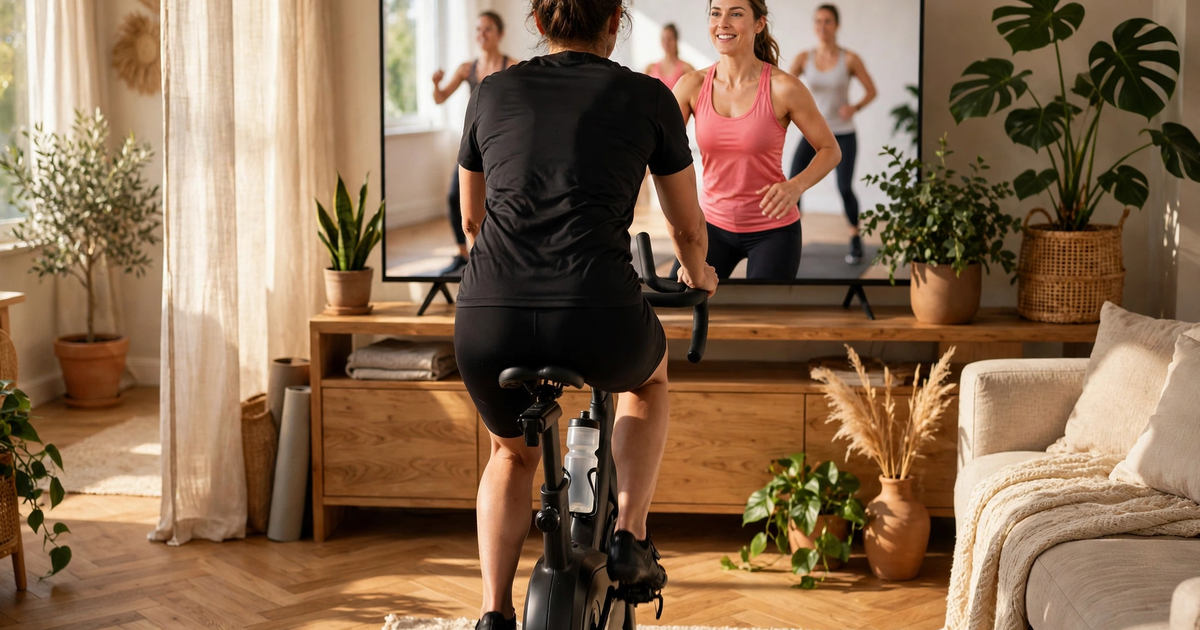
Brand Overview
- Brand namePeloton
- Founded2012
- HeadquartersNew York City, USA
- IndustrySports & Fitness
- Websitewww.onepeloton.com ↗
Psychology Techniques Identified
- 01Social Presence & In-Group Identity (Live Classes Together, Apart)
- 02Parasocial Instructor Bonds (Instructors Who Call Out Your Name)
- 03Habit Loops: Streaks, Badges and High-Fives
- 04Social Comparison via the Leaderboard
- 05Sunk Cost: Hardware Plus Monthly Subscription
- 06Anchoring via the Price Ladder ($2,195 to $6,695)
- 07Loss Aversion & Streak-Loss Fear
- 08Peak-End Rule (The Finish Matters More Than the Middle)
- 09Personalisation via Peloton IQ Coaching
- 10Self-Efficacy Through Coached Progress
- 11Autonomy & Self-Determination (Choice of Class, Instructor and Time)
- 12Mere Exposure & Familiarity Through Daily Classes
Full Psychology Audit Report
In this audit
On 1 October 2026, Peloton put a folding treadmill on sale for $2,195, a price far below anything it had charged for a treadmill before, and asked the world to believe that the company which once sold a bike as a status symbol had become a company selling fitness to everyone. Peloton did not build its empire on exercise equipment. It built it on belonging — on the feeling that thousands of strangers sweating at the same time, in separate rooms, were somehow in the same room, and that quitting would mean leaving them.
Peloton Interactive, Inc. is an American connected-fitness company founded in 2012 and headquartered in New York City, whose official website is www.onepeloton.com. It sells bikes, treadmills and a rower, and charges a monthly membership for live and on-demand classes led by instructors from studios in New York and London. In fiscal 2026, the year ended 30 June 2026, it reported revenue of $2.446 billion and GAAP net income of $63 million — its first full year of GAAP net income — while paid connected fitness subscriptions fell 8.8% year over year to 2.553 million. On 1 October 2026 it launched three new treadmills in the United States and Canada: the Tread Flex from $2,195, the Tread Vision at $3,495 and the Tread+ Vision at $6,695, with expanded Peloton IQ coaching software. Its first-quarter fiscal 2027 results are due before the market opens on 5 November 2026, a date announced on 22 October 2026. This audit asks how a company that turned a screen on a bike into a community also turned that community into a trap, and whether cheaper treadmills and smarter software can repair trust that a recall broke.
I am an Industrial and Organizational Psychologist based in Karachi. I audit brands by matching each persuasion technique to a documented feature or campaign, and by keeping legal claims at their exact status. Peloton is a useful test case because almost every technique it uses is visible on the screen: the leaderboard you can see, the streak you can lose, the instructor who says your name, the monthly fee that keeps running whether you ride or not. Nothing here depends on a hidden algorithm. The psychology is the product, and the product is on display.
“Peloton never sold you a bike. It sold you a room full of people who would notice if you did not show up — and then it charged you rent on the room.”
— Brand Psychology Analysis, ShahzebSpeaks
📋 Brand Overview: Peloton at a Glance
| Brand | Peloton Interactive, Inc. (Nasdaq: PTON); equipment, classes and membership |
| Founded | 2012, New York City; co-founded by John Foley; listed on Nasdaq in September 2019 |
| Headquarters | New York City, USA; official website www.onepeloton.com |
| What it sells | Bike, Bike+, treadmills and Row, plus All-Access Membership at $49.99 per month in the US for use on equipment |
| Fiscal 2026 results | Revenue $2.446 billion; GAAP net income $63 million, the first full profitable year; free cash flow $378 million |
| October 2026 news | Tread Flex from $2,195, Tread Vision $3,495, Tread+ Vision $6,695 on sale 1 October 2026 in the US and Canada; Peloton IQ expanded; Q1 fiscal 2027 results due 5 November 2026 |
| Signature moves | Live classes, leaderboard, instructor shout-outs, streaks, high-fives, Peloton IQ personalised coaching |
| Psychology score | 79/100 — High impact |
📜 Chapter 1: The History — From a Pitch Nobody Wanted to a Pandemic Boom to a Recall
Peloton began with a simple observation by John Foley, a former Barnes & Noble executive in New York: people who loved boutique studio cycling classes did not always have time to get to the studio. Founded in 2012, the company set out to put the studio in the home — a bike with a screen, a live instructor, and a leaderboard that showed everyone else riding at the same time. The first bike reached customers in 2014, and the company opened showrooms so sceptical buyers could try the experience before paying a four-figure price for it. The pitch was not “a better bike”. It was “the class you love, without leaving the house”, and the screen was the point: without it, Peloton was just an expensive stationary bike.

The company listed on Nasdaq in September 2019, months before the pandemic closed gyms around the world. Demand for at-home fitness surged, and Peloton became a cultural shorthand for lockdown life: the bike in the spare room, the instructor on the screen, the ride before the video call. But the boom carried the seeds of the bust. When gyms reopened, demand cooled, inventory piled up, and the company cut costs and changed leadership. Peter Stern is now chief executive, and the strategy has shifted from selling as many machines as possible to making the subscription business pay. Fiscal 2026 delivered the first full year of GAAP profit, but on a smaller subscription base — 2.553 million paid connected fitness subscriptions, down 8.8% year over year — and fiscal 2027 revenue guidance of $2.3 billion to $2.4 billion points to a further contraction. The October 2026 treadmill launch is best read against that background: cheaper hardware is not a victory lap. It is an attempt to widen the door through which new subscribers enter.
👥 Chapter 2: Live Together, Apart — Social Presence and the In-Group
The first principle is social presence: people behave differently when they feel others are present, even through a screen. Peloton’s live classes are built on it. You ride at a scheduled time, with a counter showing how many others are riding with you, and the instructor speaks to the class as a group, not to a recording. Social identity theory (Tajfel & Turner, 1979) explains why that matters: once you see yourself as part of a group — “Peloton people”, a hashtag group, a regular 6 a.m. class — the group’s habits become part of your identity, and skipping a ride feels like letting the group down rather than merely skipping exercise.
That is a powerful retention device, and it is also why Peloton’s community feels warmer than a gym’s. A gym is a place you go; a Peloton class is a group you belong to, with its own language, jokes and rituals. The risk is the mirror image: an in-group this strong can make outsiders feel judged and insiders feel watched. When the brand’s early advertising showed beautiful homes and beautiful people, the in-group looked like a club with an entry fee of thousands of dollars. The October 2026 launch, with a folding treadmill for smaller homes and a lower price, is in part an answer to that charge — an attempt to widen the group without diluting the feeling of belonging that makes it valuable.
🎤 Chapter 3: The Instructor in Your Living Room — Parasocial Bonds
The second principle is parasocial interaction (Horton & Wohl, 1956): the one-sided relationship audiences form with media figures, which feels personal even though the figure does not know the viewer exists. Peloton industrialised it. Instructors have distinct personas, catchphrases and fan followings; they call out usernames during live rides, and members plan their weeks around a favourite instructor’s schedule. For a member riding alone at home, that bond supplies what a gym supplies through other members: recognition, encouragement and a sense that someone expects you to turn up.
Used honestly, this is Peloton’s most humane technique. A good instructor can make a hard workout feel supported rather than lonely, and for members who cannot easily reach a gym — parents, shift workers, people in rural areas — that support is real. The ethical line is crossed when the bond is used to sell: when affection for an instructor is converted, without the member noticing, into tolerance for a price rise or a subscription that is never cancelled.
🔥 Chapter 4: Streaks, Badges and High-Fives — The Habit Machine
The third principle is operant conditioning: behaviour followed by a reward becomes more likely, especially when the reward is unpredictable (Skinner, 1938). Peloton’s version is the streak — consecutive weeks of workouts — plus badges, personal records and the “high-five”, a tap that sends encouragement to another rider. The cue–routine–reward loop that Duhigg popularised is visible in every ride: the scheduled class is the cue, the ride is the routine, and the shout-out, badge or personal record is the reward. Variable rewards are the strongest kind: you never know when an instructor will say your name, so you keep showing up for the chance that this ride is the one.
Streaks also exploit a second mechanism, loss aversion (Kahneman & Tversky, 1979): losing a 40-week streak hurts more than gaining a week feels good, so members ride when injured, tired or busy rather than break the chain. That is where a healthy habit becomes a compulsion, and it is a design choice, not an accident. Peloton could let members pause a streak for illness without penalty; the fact that the streak is the point is what makes it valuable to the company. For a related case of streak psychology taken to its extreme, see my audit of Duolingo, where the same mechanism is the whole business model.
📊 Chapter 5: The Leaderboard — Social Comparison as Fuel
The fourth principle is social comparison (Festinger, 1954): people judge their own performance by comparing themselves with others, and they work harder when the comparison is close. Peloton’s leaderboard ranks every rider in a class by output, and lets you filter it by age, gender or people you follow, so you are almost always near someone you can beat — or someone just ahead of you. That is deliberate. A leaderboard that ranked you 4,000th out of 5,000 would demotivate; a filtered leaderboard that puts a rival one place above you motivates, because the gap looks closable in the next ten minutes.

The leaderboard also creates a subtle status economy. Output is public, personal records are celebrated, and the top of the board is a visible hierarchy in a space where, in real life, fitness is private. For competitive members it is the reason to return; for beginners it can be humiliating, which is why the filters matter so much — they let Peloton sell competition to the competitive and community to everyone else, on the same screen, at the same time.
💰 Chapter 6: The Sunk Cost in the Spare Room — Hardware, Fees and the Subscription
The fifth principle is the sunk-cost effect (Arkes & Blumer, 1985): money already spent makes people persist, because quitting would mean admitting the spending was wasted. Peloton stacks sunk costs in layers. First the hardware — thousands of dollars for a bike or treadmill that dominates a room and cannot be ignored. Then the membership — $49.99 per month for All-Access in the US, charged whether you ride or not. Then the history — years of workouts, personal records and badges stored in your profile. Cancelling means abandoning all three at once: the machine becomes a clothes rack, the fee stops buying anything, and the record goes silent.
That stacking is why the subscription decline matters more than the profit headline. A company that reported its first full profitable year while losing 8.8% of its paid connected fitness subscribers is a company whose remaining members are paying more, not a company that is growing. The October 2026 price ladder is an attempt to change that arithmetic from the other end: a $2,195 folding treadmill lowers the first sunk cost, so that more people take the first step, even if the monthly fee afterwards is unchanged. Whether that works depends on whether the new buyers stay past the first year — and that is exactly what the 5 November 2026 results will begin to show. For the wider pattern of subscriptions that profit from inertia, see my article on the psychology of subscription traps.
🤖 Chapter 7: Peloton IQ — The Coach That Watches Back
The sixth principle is self-efficacy (Bandura, 1977): people persist when they believe they can succeed, and that belief grows from mastery experiences — small wins, clearly measured. Peloton IQ, launched on 1 October 2025 with the Cross Training Series, is the company’s attempt to manufacture those wins at scale. It builds personalised weekly plans from your history and goals, estimates how hard a class will feel for you (“Harder than your usual”), and, on the camera-equipped plus models, tracks your movement, counts your reps and corrects your form in real time. The October 2026 update extends the same idea to running: Run Analysis tracks cadence, stride length and vertical bounce, IQ Pace Targets suggest speed ranges for class intervals, and ReRuns replay outdoor routes as treadmill hills.
Self-determination theory (Deci & Ryan, 1985) gives the test for whether this helps or harms. Coaching supports autonomy when it gives you information you can use — your form, your pace, your plan — and it undermines autonomy when it decides for you, or when it watches you in a way that feels like surveillance. A camera in your living room that corrects your squat is both: genuinely useful feedback, and a device that records your body in your home. Peloton’s bet is that members will accept the second because they value the first. The folding Tread Flex, notably, has no camera — so the cheapest new treadmill also happens to be the least watched one, a fact worth noticing before calling the whole range “AI coaching”.
🏷️ Chapter 8: The Price Ladder — Anchoring, From $2,195 to $6,695
The seventh principle is anchoring (Tversky & Kahneman, 1974): the first number you see shapes what every later number feels like. Peloton’s October 2026 range is a textbook ladder. The Tread+ Vision at $6,695 makes the Tread Vision at $3,495 look moderate, and the Tread Vision makes the Tread Flex at $2,195 look like a bargain — even though $2,195 is still a large sum for a treadmill, and even though the previous Cross Training Tread cost $3,295, so the Flex is about a third cheaper than its predecessor rather than cheap in any absolute sense. The ladder also sorts buyers by identity: the Flex buyer is buying space and price, the Vision buyer is buying the camera and the coaching, and the Tread+ Vision buyer is buying the best machine in the range, with a slat belt and a Sled Mode for strength work.
Anchoring works best when the top of the ladder is visible but rarely bought, and Peloton’s top model, sold only in the US and Canada at launch, fits that role. The danger for Peloton is that the ladder also anchors expectations: a buyer who paid $2,195 and discovers that Run Analysis and live form tips need the camera models may feel that the “bargain” was a stripped-down version, not a cheaper version of the same thing. Price ladders only build trust when each rung is honestly described, and the camera distinction is the detail Peloton must keep in plain sight. For anchoring used across an entire catalogue, see my article on anchoring bias in marketing.
😨 Chapter 9: The Fear of Losing It — Loss Aversion and the Peak-End Rule
The eighth principle returns to loss aversion, now applied to identity rather than money. A member who has ridden for two years does not fear losing a subscription; they fear losing the version of themselves that rides — the streak, the records, the instructor who knows their name, the class friends who high-five them. Kahneman’s peak-end rule adds the finishing touch: people judge an experience by its most intense moment and its ending, not by the average. Peloton designs both. The peak is the personal record, the shout-out, the final sprint with the music up; the ending is the cool-down, the instructor’s closing words, and the summary screen showing what you achieved. A workout that ends well is remembered as a good workout, even if the middle was miserable, and a remembered good workout is a reason to return.
That is also why churn is so damaging to Peloton, and so hard to reverse. Once a member stops, the peak fades, the streak breaks, and the remembered experience is no longer “I am a rider” but “I used to ride”. Rejoining means rebuilding an identity from zero, which is psychologically far more expensive than the $49.99 fee.
⚠️ Chapter 10: The Dark Side — A Recall, a Penalty, and an Advertisement That Backfired
This chapter keeps every legal and regulatory matter at its exact status as of 25 October 2026. Nothing here is a finding against Peloton unless stated as one, and no current fine or damages figure is claimed beyond the settled penalty described below.
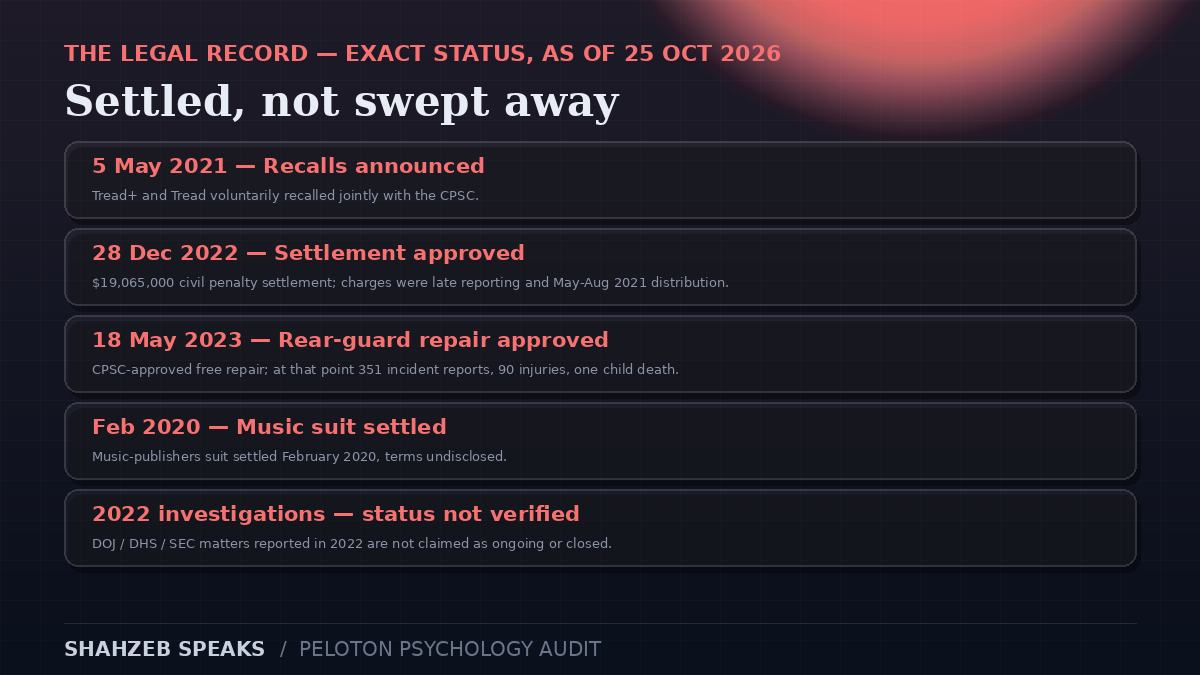
Tread+ and Tread recalls — jointly announced, 5 May 2021. In April 2021 the US Consumer Product Safety Commission (CPSC) issued an urgent warning about the Tread+, after reports of children, pets and objects being pulled under the rear of the treadmill. Peloton at first refused to recall the product, calling the warning inaccurate and misleading. On 5 May 2021, Peloton and the CPSC jointly announced voluntary recalls of both the Tread+ and the smaller Tread. The Tread+ recall concerned the risk of being pulled under the rear of the slat-belt machine; at announcement, Peloton had received 72 reports of adults, children, pets or objects being pulled under the rear, including 29 reports of injuries to children and one child death. The Tread recall concerned a separate defect: the touchscreen console could detach and fall. About 1,050 Tread units had been distributed in the US between November 2020 and March 2021, and a CPSC-approved repair for the touchscreen was available from August 2021. Then-chief executive John Foley apologised for the company’s initial response, saying Peloton should have engaged more productively with the CPSC from the outset.
Civil penalty — settlement approved 28 December 2022, announced 5 January 2023. The CPSC approved a civil penalty settlement under which Peloton agreed to pay $19,065,000. The settlement resolved charges that Peloton failed to report the Tread+ hazard immediately — the CPSC stated that by the time Peloton reported, there were more than 150 reports of persons, pets or objects being pulled under the rear of the treadmill, including the death of a six-year-old child — and that Peloton unlawfully distributed Tread+ treadmills from May to August 2021 after being informed of the CPSC’s approval of a voluntary corrective action plan. The settlement also required Peloton to maintain an enhanced compliance programme and to file annual reports on it for five years. This is a settlement of charges, not a court verdict after a trial, and it should not be reported as one. Reported breakdowns put $16.025 million of the penalty on late reporting and $3.04 million on the post-recall distribution of 38 recalled treadmills.
Rear guard repair — approved 18 May 2023. In May 2023 the CPSC approved a free rear guard repair for the Tread+, with a breakaway design that pivots away on contact, shuts off power and decelerates the belt, for Fall 2023 delivery. By that point the totals had risen to 351 incident reports and 90 injuries, with no additional deaths reported after the recall. The full-refund return window was extended to 6 November 2023. The repair closed the safety chapter for existing Tread+ owners, but it did not erase the sequence that matters for trust: warning refused, recall delayed, penalty paid. A company launching new treadmills in 2026 is still selling into homes that remember that order of events.
Music publishers suit — settled February 2020, terms undisclosed. Peloton was sued by music publishers in 2019 over the use of music in its classes without proper licences. The suit was settled in February 2020, with financial terms undisclosed. A settlement is not a court finding, and the pleaded figures are not claimed here.
Christmas advertisement — criticism, not a legal matter, December 2019. Peloton’s 2019 advertisement “The Gift That Gives Back”, in which a husband gives his wife a Peloton bike for Christmas and she films her workouts for a year, drew widespread criticism on social media, with critics calling it sexist and out of touch. Peloton stood by the advertisement, saying it was created to celebrate a fitness and wellness journey and that some had misinterpreted it. The share price fell more than 9% on 3 December 2019, reported as about $942 million of market value lost in a day; Peloton said the movement was not related to the advertisement. The episode is included here because it is the clearest early warning of Peloton’s recurring blind spot: a company that sells identity can misread how its own story lands, and the misreading itself becomes the story.
Beyond these matters, two things are deliberately not claimed. Investigations by US authorities reported in 2022 in connection with the Tread+ matter have no verified current outcome, so this audit does not describe them as ongoing or closed. And the $23.8 million nonrecurring legal contingency reported in the fourth quarter of fiscal 2026 is not named or described, because the underlying case could not be verified. An audit that invents precision about legal matters destroys the credibility of everything else it says.
🌍 Chapter 11: What Other Brands Should — and Shouldn’t — Copy
Copy the community mechanics, not the price tag. What transfers is the decision to make effort social: a scheduled live session, a visible leaderboard filtered so beginners compete with beginners, a shout-out that costs nothing and is remembered for weeks, and a summary screen that ends every session on a peak. Those mechanics work for a language app, a running club, a workplace wellness programme or a small gym, because they cost little and they respect a basic truth — people persist when other people notice. Copy the personalisation too, but honestly: tell members what the camera sees, what the software recommends and why, and let the cheapest product be a complete product, not a lure for the camera model.
Do not copy the sunk-cost stack without Peloton’s content. A hardware purchase plus a monthly fee plus a stored history only retains members if the content is worth returning to; without it, the stack is simply a trap, and traps produce the churn Peloton is now fighting. Do not copy the launch-then-apologise sequence either: when a safety warning arrives, engage with the regulator first and argue second, because the order of events is what the public remembers. And do not copy the streak without a pause: a habit system that punishes illness or bereavement with a broken chain teaches members that the system cares about the chain more than about them. The brands that last will be the ones whose psychology serves the member’s goals first, and whose revenue follows from that — not the other way round.
📊 Chapter 12: Psychology Scorecard
| Dimension | Score | Verdict |
|---|---|---|
| Identity & community | 88 | Live classes and hashtag groups make belonging the product. |
| Habit & streaks | 86 | Streaks, badges and variable shout-outs keep members returning. |
| Instructor bond | 90 | Parasocial bonds are Peloton’s strongest and most humane lever. |
| Personalisation (Peloton IQ) | 84 | Plans, pace targets and form feedback, but the camera question remains. |
| Social proof & leaderboard | 82 | Filtered comparison motivates without humiliating beginners. |
| Pricing & sunk cost | 74 | The $2,195 Flex widens the door, but the $49.99 fee still stacks. |
| Transparency & trust | 58 | Recall refused, then settled, still shadows every new launch. |
| Resilience & growth | 66 | First profitable year on a shrinking base; guidance points down. |
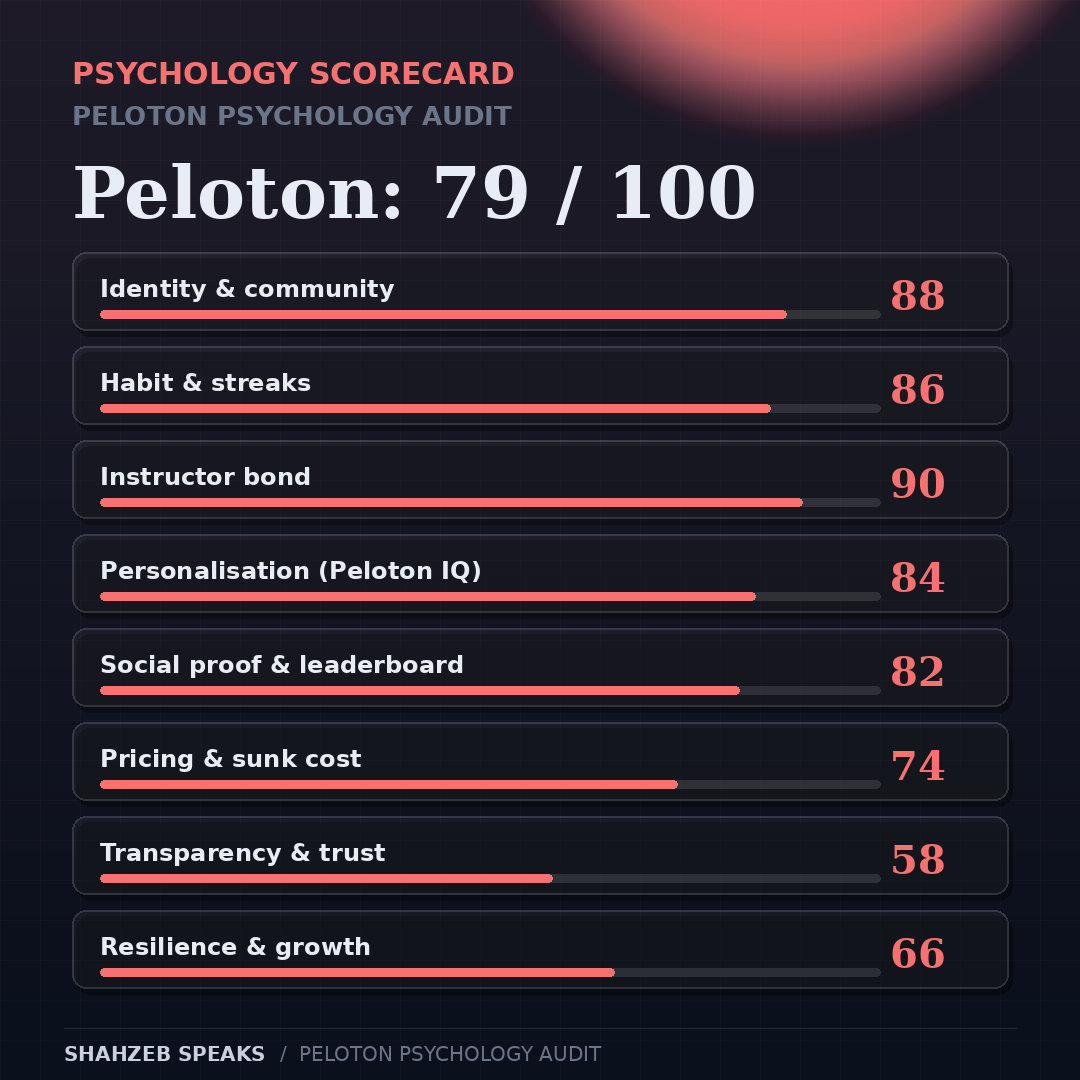
Overall: 88 + 86 + 90 + 84 + 82 + 74 + 58 + 66 = 628 ÷ 8 = 78.5 → 79/100.
✅ Chapter 13: Balance sheet & prescription
On the credit side: a community that genuinely supports isolated exercisers, instructors who turn a screen into a relationship, a habit system that works, a leaderboard that motivates without shaming, personalised coaching that is getting better, and a price ladder that finally offers a cheaper way in. On the debit side: a recall that was first refused and then settled for $19,065,000, a subscription base that shrank 8.8% in the year the company first turned a full-year profit, a camera in the living room that needs a clearer privacy story, and a streak system that punishes the very people — the ill, the busy, the bereaved — who most need a pause.
The prescription for Peloton is narrow: earn back trust in the open. Publish what the cameras record and keep, let streaks pause without penalty, describe each treadmill rung honestly — above all, which features need a camera — and treat the 5 November 2026 results as a report card, not a victory lap. If the cheaper treadmill brings in members who stay, the psychology will have proved itself again. If it brings in buyers who leave after a year, Peloton will have learned that a lower price can open a door but cannot make anyone stay in the room.
📝 Final Verdict
Peloton is the most psychologically sophisticated fitness company ever built for the home, and the most instructive warning in connected fitness. It proved that strangers on a screen can become a community, that an instructor can become a friend, and that a streak can become an identity. It also proved that the same machinery, mishandled, can delay a recall, sell a subscription on inertia, and turn a community into a room people pay to leave. The 2026 relaunch — a folding treadmill, smarter coaching, a lower price — is a genuine attempt to fix the second story without losing the first. Whether it succeeds will be decided not by the hardware, but by whether members who join this autumn are still riding next autumn, and whether they would still ride if the leaderboard disappeared.
Psychology Score: 79/100 — The room full of strangers who noticed when you showed up, and the company still learning that trust, once broken, is not repaired by a cheaper treadmill.
If your brand wants Peloton’s loyalty without its recall and churn costs, the lesson is not “add a leaderboard”. It is: make effort social, make feedback personal, and build a habit system that forgives a missed week instead of punishing it.
For more brand psychology, see my audits of Duolingo and Nike, and for the field behind this work, my writing on industrial psychology in Pakistan.
📚 References & Sources
- Arkes, H. R., & Blumer, C. (1985). The psychology of sunk cost. Organizational Behavior and Human Decision Processes, 35(1), 124–140.
- Bandura, A. (1977). Self-efficacy: Toward a unifying theory of behavioral change. Psychological Review, 84(2), 191–215.
- Deci, E. L., & Ryan, R. M. (1985). Intrinsic Motivation and Self-Determination in Human Behavior.
- Festinger, L. (1954). A theory of social comparison processes. Human Relations, 7(2), 117–140.
- Horton, D., & Wohl, R. R. (1956). Mass communication and para-social interaction. Psychiatry, 19(3), 215–229.
- Kahneman, D., Fredrickson, B. L., Schreiber, C. A., & Redelmeier, D. A. (1993). When more pain is preferred to less. Psychological Science, 4(6), 401–405.
- Kahneman, D., & Tversky, A. (1979). Prospect theory: An analysis of decision under risk. Econometrica, 47(2), 263–291.
- Peloton Interactive, Inc. (22 October 2026). Announcement of first-quarter fiscal 2027 earnings release and conference call, via GlobeNewswire: results before market open 5 November 2026; founded 2012; headquartered in New York City; www.onepeloton.com.
- Peloton Support. Membership fee changes: All-Access Membership $49.99 per month (US), effective October 2025.
- Skinner, B. F. (1938). The Behavior of Organisms.
- Tajfel, H., & Turner, J. C. (1979). An integrative theory of intergroup conflict. In W. G. Austin & S. Worchel (Eds.), The Social Psychology of Intergroup Relations.
- Tversky, A., & Kahneman, D. (1974). Judgment under uncertainty: Heuristics and biases. Science, 185(4157), 1124–1131.
- US Consumer Product Safety Commission. Statement of Chair Alexander Hoehn-Saric, 5 January 2023, on the vote to approve the $19,065,000 settlement agreement with Peloton Interactive, Inc. (approved 28 December 2022).
- Consumer Reports (5 May 2021, updated 2022). Peloton recalls its Tread+ and Tread treadmills; CPSC-approved Tread touchscreen repair from August 2021.
- TechCrunch (18 May 2023). Peloton and the CPSC agree on a rear guard fix for recalled treadmills (351 incident reports, 90 injuries, Fall 2023 delivery, free repair).
- StockTitan / Peloton Q4 & fiscal 2026 results reporting (August 2026): revenue $2.446 billion, GAAP net income $63 million, free cash flow $378 million, paid connected fitness subscriptions 2.553 million, down 8.8% year over year.
- Trade reporting on the October 2026 treadmill launch (September–October 2026): Tread Flex $2,195, Tread Vision $3,495, Tread+ Vision $6,695, on sale 1 October 2026 in the US and Canada; Peloton IQ Run Analysis, IQ Pace Targets and ReRuns.
Key Findings
- Founded 2012 in New York City by John Foley; listed on Nasdaq in September 2019; headquarters New York City, USA; official website www.onepeloton.com
- On 1 October 2026 Peloton launched Tread Flex from $2,195, Tread Vision at $3,495 and Tread+ Vision at $6,695 in the United States and Canada, with expanded Peloton IQ coaching software
- In fiscal 2026 Peloton reported revenue of $2.446 billion and GAAP net income of $63 million, its first full profitable year, while paid connected fitness subscriptions fell 8.8% year over year to 2.553 million
- Tread+ and Tread treadmills were voluntarily RECALLED jointly with the CPSC on 5 May 2021; Peloton had first refused the CPSC's April 2021 request, which is reported history, not a court finding
- A $19,065,000 civil penalty SETTLEMENT was approved 28 December 2022 (announced 5 January 2023), settling CHARGES of late reporting and distribution of recalled Tread+ units in May-August 2021; it is a settlement, not a court verdict after trial
- A CPSC-APPROVED free rear-guard repair was announced 18 May 2023, with 351 incident reports, 90 injuries and one child death reported at that point and no additional deaths reported after the recall; separately, the music-publishers suit was SETTLED in February 2020 with terms undisclosed
Overall Psychology Score
Peloton scores 79/100 in our comprehensive psychology audit covering consumer behavior strategies, UX design principles, and psychological marketing effectiveness.
The detailed dimension scores are in the audit's Psychology Scorecard chapter.
High impactMuhammad Shahzeb
MSc Industrial Psychologist, specializing in consumer behavior, UX psychology, and brand strategy analysis. Helping brands understand the psychology behind their success.
About Muhammad Shahzeb →