Duolingo Psychology Audit — The Owl, the Streak and the Price of Guilt
A psychology audit of Duolingo, the language app with 58.7 million daily users. How the streak turns loss aversion into a daily habit, how a peer-reviewed algorithm picks the owl's guilt-tripping reminders, why a dead mascot earned 1.7 billion impressions, how the company admitted its own friction slowed growth, what the learning evidence shows once you check who paid for it, and what Pakistani apps should copy.

77 / 100
Overall consumer behavior effectiveness
Brand Overview
- Brand nameDuolingo
- Founded2012
- HeadquartersPittsburgh, Pennsylvania, USA
- IndustryTechnology
- Websitewww.duolingo.com ↗
Psychology Techniques Identified
- 01Loss Aversion (The Streak)
- 02Endowment Effect & Streak Revival
- 03Goal-Gradient Effect
- 04Habit Formation (Tiny Daily Action)
- 05Forgiveness Design (Streak Freeze)
- 06Social Comparison & Leagues
- 07Social Commitment (Friend Streaks)
- 08Variable Reward & Novelty
- 09Guilt-Based Notifications
- 10Parasocial Mascot (Duo)
- 11Narrative Marketing (Death of Duo)
- 12Freemium Friction & Pain of Paying
Full Psychology Audit Report
In this audit
It is 11:40 at night. You are in bed, the phone is nearly asleep in your hand, and a green owl tells you that your 212-day streak is about to end. You do not particularly want to learn Spanish right now. You do not want to lose the 212 days either. So you open the app, finish a three-minute lesson, watch a small flame celebrate, and go to sleep feeling oddly relieved. You did not do that lesson for Spanish. You did it so that a number would not go back to zero.
That moment is the core of Duolingo, the Pittsburgh company that turned language learning into what its own annual report calls the top-grossing education app in the world. At the end of 2025, by its own count, about 43 million people who used it each day had a streak of at least seven days, and about 15 million had one of a year or longer. In 2025 it crossed a billion dollars in revenue. And in February 2026 it told its shareholders something unusual: that the small frictions it had added to make people pay were part of the reason its growth had slowed, and that it would give up more than $50 million of bookings to remove them.
I am an Industrial and Organizational Psychologist, and this audit looks at Duolingo the way a psychologist would: as one of the most carefully measured behaviour-change systems ever built — loss aversion, habit loops, social competition, an engineered mascot and a marketing voice nobody else dares to use — and at the costs that come with it. Duolingo is unusually open about its own experiments, so most of the numbers below come from the company itself.
“Duolingo does not sell lessons. It sells the feeling of not breaking a promise to yourself. The streak turns a vague intention into something you own and could lose, and the owl makes sure you remember that every evening. It is the best habit machine in consumer software — which is exactly why the question of what it is a habit of matters.”
— Brand Psychology Analysis, ShahzebSpeaks
📋 Brand Overview: Duolingo at a Glance
| Founders | Luis von Ahn and Severin Hacker, who met at Carnegie Mellon University, where von Ahn was a professor and Hacker his PhD student |
| Launched | Public launch 19 June 2012, after a private beta; headquartered in Pittsburgh, Pennsylvania |
| Listed | Nasdaq (DUOL) since 28 July 2021, IPO price $102 |
| Model | Freemium: free with ads and limits; paid tiers Super and Max (AI features); plus the Duolingo English Test |
| Scale (Q2 2026) | 58.7 million daily active users · 140.6 million monthly · 12.7 million paid subscribers |
| Revenue (FY2025) | $1,037.6 million, up 39%; bookings $1,158.4 million |
| Where the money comes through | 62% of FY2025 revenue via the Apple App Store, 20% via Google Play |
| Stated goal | 100 million daily active users in 2028 |
📜 Chapter 1: The History — From “Translate the Web” to a Billion-Dollar Habit
🎓 2012: A professor’s free idea
Duolingo launched publicly on 19 June 2012. Carnegie Mellon’s announcement that day said more than 100,000 people had used the beta and about 500,000 were on the waiting list. The original pitch was idealistic: learn a language free, and help translate the web while you do it. Von Ahn has said the company made no money for its first four or five years and only started monetising around 2017.
📈 2017–2021: The streak becomes the product
The company’s own blog documents years of experiments on one number: the streak, the count of consecutive days on which you complete a lesson. A 2017 test of a “Streak Wager” raised day-7 retention by 14%. By the time Duolingo went public in July 2021, the streak, the owl and the reminders were the brand.
💳 2022–2024: Monetisation
Super Duolingo arrived in 2022 and Max, with AI features, in 2023. Free users met more ads, limits and upsells. Revenue climbed fast.
🦉 2025: A dead owl and an angry internet
In February 2025 Duolingo “killed” its mascot and asked users to bring him back with lessons — a campaign it says generated 1.7 billion organic impressions. Two months later, a CEO memo declaring the company “AI-first” set off a backlash it is still discussing a year later.
🔄 2026: The pivot
In February 2026, after its share price fell 25% in a single day in November 2025, Duolingo told investors it would prioritise user growth over monetisation, aiming for 100 million daily users in 2028.
🔥 Chapter 2: The Streak — Loss Aversion You Can Hold in Your Hand
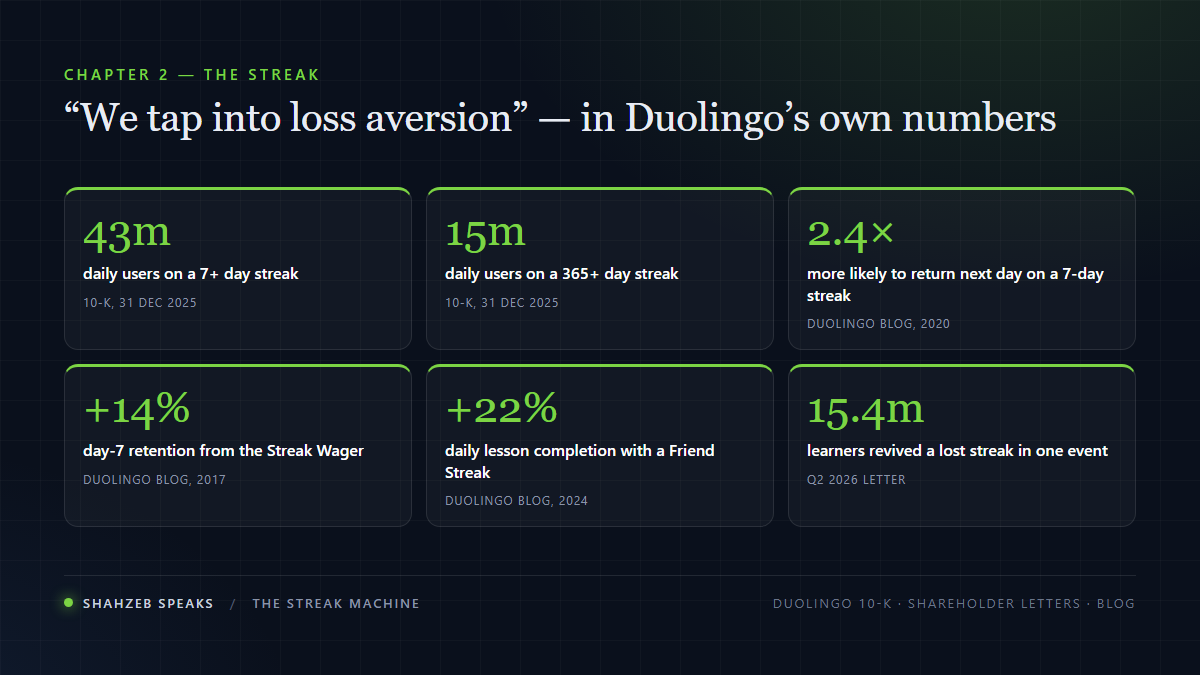
Most companies hide the psychology behind their features. Duolingo writes it down. Its 2022 blog post on streaks says plainly that as a streak grows, “we tap into ‘loss aversion’.”
Loss aversion is one of the best-established findings in behavioural science. In Kahneman and Tversky’s prospect theory (1979), losses loom larger than equivalent gains: losing something hurts more than gaining the same thing pleases. A streak converts a learning goal into a possession. On day one, missing a lesson costs nothing. On day 212, missing a lesson costs 212 days. The lesson has not become more valuable; the thing you would lose has.
The company’s own data shows how well this works:
- Learners on a 7-day streak were 2.4 times more likely to use Duolingo the next day (2020).
- Learners who reach a 7-day streak are 3.6 times more likely to complete their course (2022).
- The 2017 Streak Wager — stake gems on keeping a streak for a week — raised day-7 retention by 14%.
- At 31 December 2025, about 43 million daily users had a streak of 7 days or more, and about 15 million had one of 365 days or more (10-K).
🧊 The insurance policy: Streak Freeze and Repair
A pure loss-aversion device has a flaw: when the streak breaks, the motivation can collapse with it. Duolingo admits this, writing that breaking a streak can be demotivating and that fear of losing one can stop people starting. Its answer is insurance. A Streak Freeze, equipped in advance, covers a missed day; paid subscribers get a monthly Streak Repair.
The research backs the design. Silverman and Barasch (2023, Journal of Consumer Research) found across seven studies that highlighting an intact streak increases engagement, while a broken one reduces it — more so when people blame themselves, and less when the streak can be “repaired”. And in Lally and colleagues’ study of how habits form (2010), missing a single opportunity did not materially affect habit formation. A freeze protects the habit from the one day that would otherwise have ended it.
In June 2026 Duolingo went further with a one-time “Streak Revival”: restore your longest-ever streak by completing three lessons. According to its Q2 2026 letter, 15.4 million learners did, including nearly 8 million who had no active streak when it began. That is the endowment effect in reverse — people came back for something they had already lost.
🎯 The goal gradient
Kivetz, Urminsky and Zheng (2006) showed that people accelerate as they approach a goal — coffee-card customers bought faster as they neared a free drink. Duolingo’s progress bars, daily XP goals, streak milestones and quests all put the user permanently near the next finish line.
🦉 Chapter 3: The Owl That Guilt-Trips — Notification Engineering
Duo’s reminders became a meme around 2017; NPR described his tendency to guilt-trip, “at times in a vaguely threatening way”. What looks like a joke is one of the most rigorously tested notification systems anywhere.
In a peer-reviewed paper at KDD 2020, two Duolingo researchers, Kevin Yancey and Burr Settles, described the algorithm that chooses which reminder each user receives each day. It treats every message template as an option to learn about, rewards a template when the user completes a lesson within two hours, and penalises repeating the same template because novelty wears off — using the same forgetting curve Duolingo uses for vocabulary. Against what the authors call a strong, years-optimised baseline, it raised daily active users by 0.5% and new users’ 7-day retention by 2.0%. Duolingo says the system was trained on about 200 million reminders.
Half a percent sounds small. Applied to today’s base of nearly 59 million daily users, the same lift would be roughly 290,000 extra people opening the app every day.
Von Ahn has not pretended otherwise. Asked by TIME in 2026 about the reminders, he said: “Some of the reminders are guilt-tripping, and it just turns out this works.” His framing is that people say they want to learn but drift to other apps, and the reminder is a counterweight. That is a defensible view. It is also exactly the line a regulator may test: in September 2025 Hungary’s competition authority opened a case that includes, among other things, suspected unwanted marketing messages pushing more frequent use and the paid version (Chapter 9).
🏆 Chapter 4: Leagues, XP and Friends — Making Practice Social
Duolingo’s leaderboards, tested from 2018, put learners into weekly leagues of similar users — ten tiers, with Diamond at the top. XP earned in lessons decides who is promoted and who is relegated. This draws on social comparison and competition: you are no longer measured against a vague goal but against a group of similar learners, some of them a few points ahead of you.
In 2024 Duolingo added the Friend Streak, shared with up to five friends. The company reports that learners with at least one are 22% more likely to complete their daily lesson. A shared streak adds social commitment to loss aversion: now breaking it lets someone else down.
The risk is that the game replaces the goal. An independent study by Hadi Mogavi and colleagues (2022) analysed nine years of Duolingo forum posts and interviews and described “gamification misuse”: learners fixating on XP, leagues and streaks in ways that distracted from learning. Anyone who has done the easiest lesson of the day purely to keep a flame alive will recognise it.
📣 Chapter 5: The Unhinged Owl — A Brand Voice Nobody Else Would Risk
Most education brands sound like a careful teacher. Duolingo sounds like a chaotic friend. Its in-house social team grew its TikTok from about 50,000 followers to 16 million in just over four years, according to an interview with its social lead in The Drum (February 2025). Its 10-K describes the brand as part of pop culture and credits word of mouth as a main driver of growth.
💀 The death of Duo
On 11 February 2025 Duolingo announced that Duo had died — he “probably died waiting for you to do your lesson”. Avatars turned to a dead owl, a video showed a Cybertruck hitting him, and users were asked to bring him back by earning XP. NPR reported the collective total passed 50 billion XP before Duo “returned” two weeks later. The Q1 2025 shareholder letter says the “whodunit” generated 1.7 billion organic impressions and “drove a meaningful lift in new and resurrected users”, on practically no paid spend.
Psychologically the campaign was clever for a specific reason: the call to action was the product. The way to “save” Duo was to do lessons. The story, the mascot and the habit all pointed the same way.
🎚️ When the voice became a liability
The same voice turned against the brand in 2025 (Chapter 7). Duolingo’s Q3 2025 letter admitted that daily-user growth was slower than the previous quarter “in part because” it had posted less unhinged content on English-language social accounts, “as we listened to community feedback”. A brand built on a personality cannot easily switch it off.
⚖️ Chapter 6: The Friction Problem — When Monetisation Fights the Habit
A freemium habit app has a built-in tension. The habit is formed on the free tier; the money comes from making the free tier just uncomfortable enough to pay. Duolingo’s main lever for that discomfort was the Hearts system: every mistake cost a free user a heart, and running out stopped the lesson. The company’s own blog says beginners were twice as likely to run out mid-lesson.
In 2025 it began replacing Hearts with Energy, which its Q2 2025 letter describes as rewarding success — “a carrot, not a stick”. Each exercise uses energy whether right or wrong; correct answers and perfect lessons earn some back, and a rewarded ad or gems can refill it. The same letter says Energy raised daily users, time spent learning and subscriber conversion.
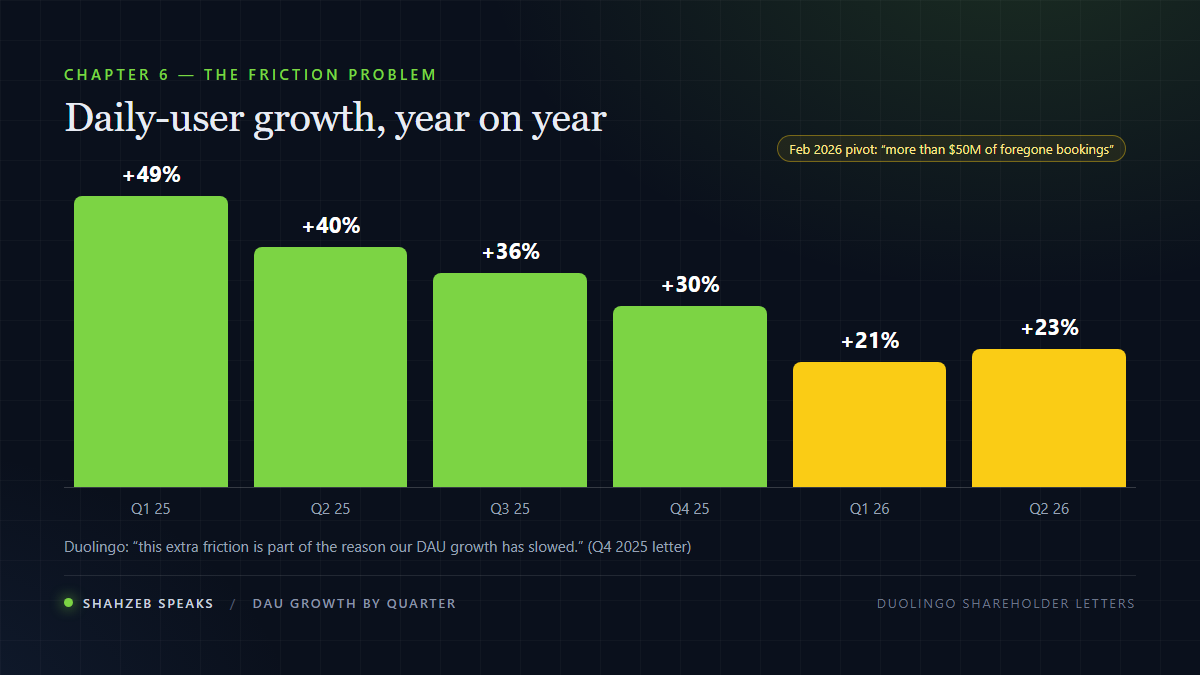
Then came the admission. In its Q4 2025 letter, published in February 2026, Duolingo wrote that “the main way we’ve increased bookings per user is by adding small amounts of friction to encourage more people to subscribe, for example by increasing ad load or subscription upsells” — and that it believes “this extra friction is part of the reason our DAU growth has slowed”. It estimated it would invest more than $50 million of foregone bookings into a better free experience.
The market’s reaction to this period was severe. CNBC reported a 25% fall on 6 November 2025, the stock’s worst session on record, after light guidance and the first signs of the pivot, and a further 14% fall on 27 February 2026 after the 2026 outlook.
From a psychologist’s chair, this is the most interesting chapter of the audit. Friction works on the person it converts. It also teaches everyone else that the app is slightly against them — and a habit app lives on the feeling that it is on your side. Duolingo has now put a price on that feeling: about five points of bookings growth.
🤖 Chapter 7: “AI-First” — How a Memo Dented a Lovable Brand
On 28 April 2025, von Ahn posted an all-hands email declaring Duolingo “AI-first”. As reported by Fortune, it said the company would gradually stop using contractors for work AI can handle, approve new headcount only where a team could not automate more, and factor AI use into hiring and performance reviews. It landed months after reports, in January 2024, that Duolingo had cut about 10% of its contractor workforce, partly attributed to AI; the company said no full-time staff were cut.
The backlash was immediate. Comments such as “AI first means people last” spread, and in mid-May the brand’s TikTok and Instagram posts were wiped for a period. Von Ahn later told the New York Times, as quoted by Fortune: “This was on me. I did not give enough context.” In April 2026 he said Duolingo had dropped AI use as a performance-review criterion, and told TIME of that clause: “we shouldn’t have done that.”
Why did a memo hurt this much? Because Duolingo’s brand is a person — a funny, slightly needy owl with a human team behind it. Parasocial warmth is a powerful asset and an easily betrayed one. A message that read, to outsiders, as “the humans are being replaced” contradicted the character the company had spent a decade building.
📚 Chapter 8: Does It Actually Teach? The Evidence, With Its Funding Labels
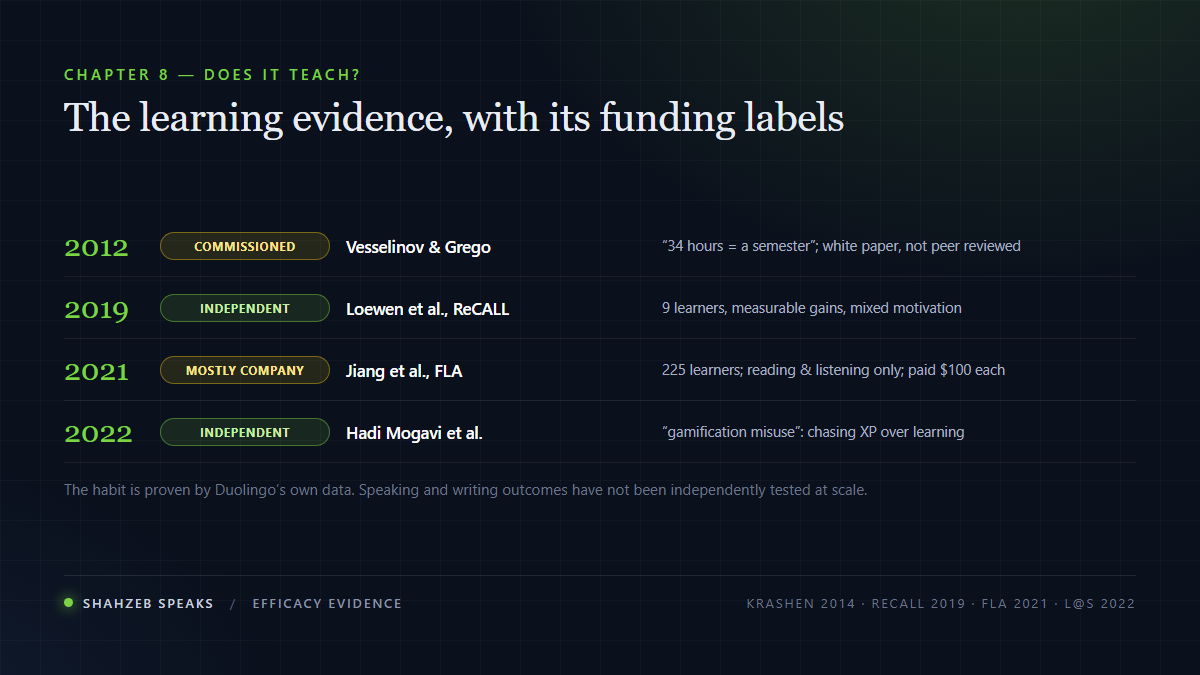
Duolingo’s habit engine is proven by its own data. Whether the habit produces fluency is a separate question, and the evidence needs reading with its labels on.
- 2012 — commissioned white paper (Vesselinov & Grego). The source of the famous claim that about 34 hours of Duolingo equals a university semester of Spanish. It was commissioned by Duolingo, not peer reviewed, and used volunteers recruited online, many of whom dropped out. Stephen Krashen (2014) argued the comparison was hard to support.
- 2019 — independent, peer-reviewed (Loewen et al., ReCALL). Nine participants learned Turkish for a semester. They showed measurable gains, linked to time spent, with mixed motivation and some frustration with the materials. Positive, but tiny.
- 2021 — peer-reviewed, mostly company-authored (Jiang et al., Foreign Language Annals). Four of the five authors worked at Duolingo, and each participant was paid $100. 225 US adults who completed the beginning sections of the Spanish or French course reached reading and listening levels comparable to US university students at the end of their fourth semester. The study tested only reading and listening, not speaking or writing, and hours on the app did not significantly predict scores.
- 2022 — independent (Hadi Mogavi et al.). Documented “gamification misuse”: users chasing XP and streaks instead of learning.
A fair summary: Duolingo appears to help beginners build reading and listening skills, the best evidence for that is partly the company’s own, and nothing here shows the app alone produces conversational fluency. Jiang and colleagues themselves noted that independent studies of commercial apps are few and small.
⚠️ Chapter 9: The Dark Side — Criticism and the One Open Case
The regulatory record (as of 6 October 2026)
The only regulatory action I found is in Hungary. On 17 September 2025, the Hungarian Competition Authority (GVH) opened a proceeding, case VJ/34/2025. According to its release, it suspects: terms and information not easily available or not in Hungarian; a probably unfounded claim to be “the best way to learn a language in the world”; probably misleading results claims such as nine out of ten learners speaking with confidence after a month; unclear information about the limits of the free tier; and unwanted direct-marketing messages pushing more frequent use and the paid version. The GVH itself states that opening a case is not a finding of infringement. Duolingo told the Hungarian press it was cooperating and believed the matter may stem from a misunderstanding. I found no decision.
Duolingo’s Q2 2026 10-Q also records about $5 million accrued for “certain proposed legal settlement charges” without saying what they relate to. I have not linked it to any case, because the filing does not.
The ethical critique
The stronger criticism is not legal. It is that an app can be very good at producing a daily behaviour without being equally good at producing the outcome that behaviour was supposed to serve. The streak research cuts both ways: the same loss aversion that keeps you practising can keep you doing the easiest possible lesson at 11:40 pm. And guilt is a motivator with side effects. TIME’s interviewer relayed friends’ complaints about “guilt-tripping constant reminders” and “the need to pay to progress” — the two tensions this audit keeps returning to.
🇵🇰 Chapter 10: What Pakistani Apps and Brands Should — and Shouldn’t — Copy
Duolingo’s public course list shows an English course for Urdu speakers, but no course that teaches Urdu, and its Punjabi offering is in the Gurmukhi script rather than Shahmukhi. Its playbook in India is more instructive. In 2020 the company reported that putting English for Hindi speakers at the top of the course list raised daily users by 2%, and that removing the paid tier entirely in India raised daily users by 6% — an early version of the lesson it relearned globally in 2026.
For Pakistani product teams — banking apps, edtech, telecom, e-commerce — the transferable lessons are these:
- Make the daily action tiny. Duolingo found that separating the streak from a bigger daily goal, so one lesson counts, increased the share of learners on a streak. Ask for less, every day.
- Insure the habit. A streak with no freeze punishes your most loyal users for one bad day. Build forgiveness in.
- Let the story point at the product. The death of Duo worked because saving the owl meant doing lessons. A campaign that does not lead to the core action is just noise.
- Test the copy, in each language. Duolingo found a notification reframe lifted opt-ins by 8% in German and did nothing in Spanish, and that its passive-aggressive tone does not always translate. Urdu and Roman Urdu need their own tests.
- Don’t copy the guilt by default. Guilt works for a brand people already love. For a bank or a telco, a guilt-tripping push notification is just harassment with a logo.
- Price your friction. Every upsell and ad on a free tier has a cost in trust. Duolingo eventually measured its at more than $50 million. Measure yours before it measures you.
⚔️ Chapter 11: Competitive Positioning
Duolingo’s moat is not content — language courses are widely available — but habit and brand. Its 10-K notes that people search Google for “Duolingo” more often than for “learn Spanish”, and that growth is driven primarily by word of mouth. Rivals that sell structured courses compete on depth; Duolingo competes on daily presence. Its vulnerabilities are equally clear: 82% of FY2025 revenue flowed through two app stores, AI tutors threaten to make “practise with something that talks back” cheap for everyone, and a habit built on a number can be abandoned the day the number breaks.
📊 Chapter 12: Psychology Scorecard — Detailed Ratings
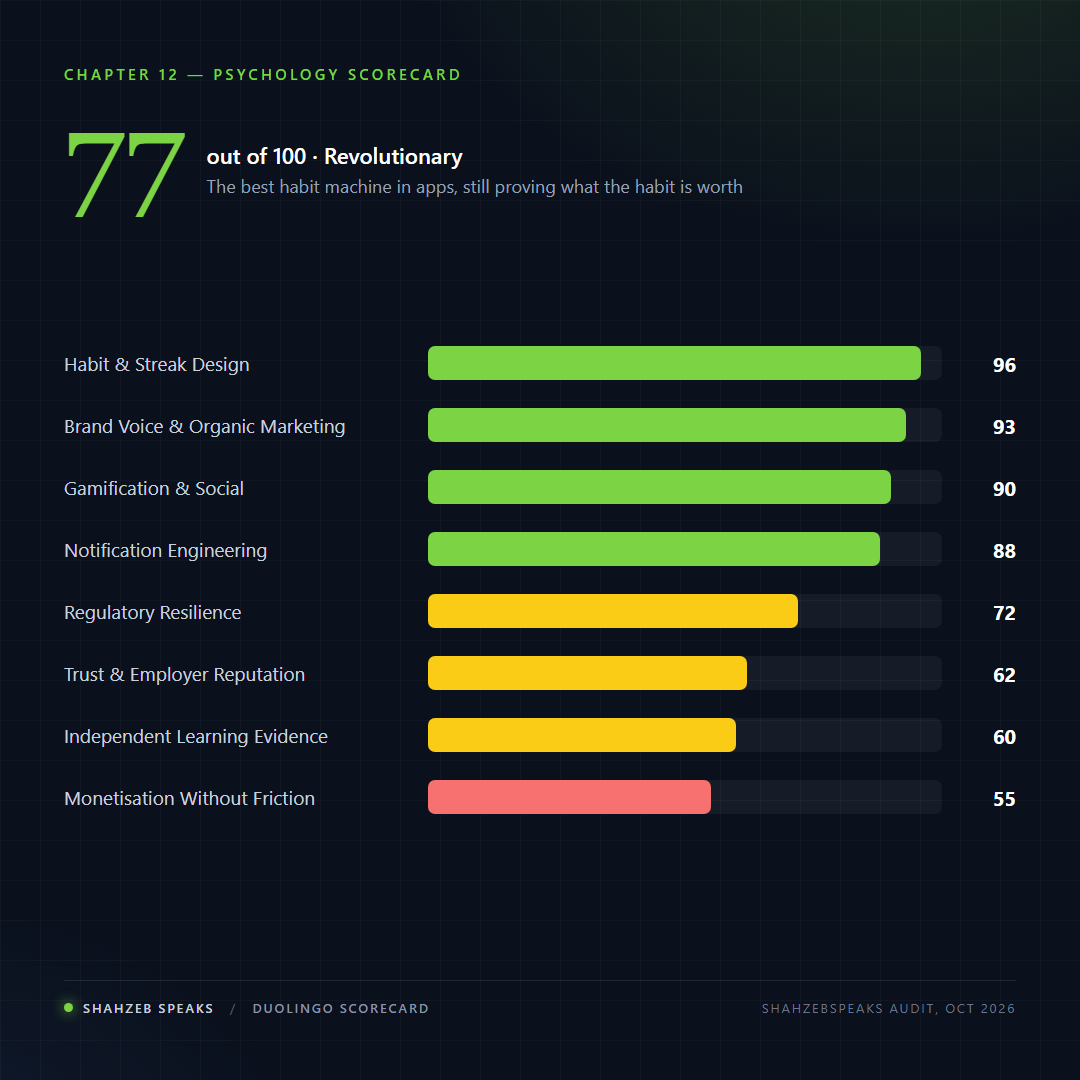
| Psychology Dimension | Score | Verdict |
| Habit & Streak Design | 96/100 | Loss aversion with insurance built in; measured to the decimal. |
| Brand Voice & Organic Marketing | 93/100 | 1.7 billion impressions for a dead owl; a voice nobody else would risk. |
| Gamification & Social Competition | 90/100 | Leagues and Friend Streaks drive practice; can crowd out learning. |
| Notification Engineering | 88/100 | Peer-reviewed, effective, and openly guilt-based. |
| Regulatory Resilience | 72/100 | One open case in Hungary, no findings; its claims and messages are what is being tested. |
| Trust & Employer Reputation | 62/100 | The AI-first memo hurt a brand built on warmth; partly repaired. |
| Independent Evidence of Learning | 60/100 | Promising for beginners; much of the evidence is the company’s own. |
| Monetisation Without Friction | 55/100 | The company itself says friction slowed growth; now paying to remove it. |
✅ Chapter 13: Balance Sheet & A Psychologist’s Prescription
What Duolingo gets right
- It measures behaviour change more rigorously than almost any consumer company, and publishes much of it.
- It designed forgiveness into a loss-aversion system, which most imitators forget.
- It aligned its marketing with its core action: the story always ends in a lesson.
- It admitted, in a filing, that its own monetisation was hurting the habit — and put a number on fixing it.
Where it is exposed
- Guilt as a growth tool, now part of a regulator’s case in Hungary.
- Claims about results (“best way to learn”, confidence after a month) that outrun the independent evidence.
- A habit metric that can drift away from learning — the easiest lesson at 11:40 pm still counts.
- A personality brand that can be wounded by one memo.
The prescription
- Measure learning as hard as you measure streaks. Publish independent, speaking-inclusive outcome studies. The habit is proven; the fluency claim is not.
- Give users a guilt dial. Let people choose encouraging, neutral or unhinged reminders. Respecting autonomy is the cheapest way to keep the joke funny.
- Retire the absolute claims. “Best way to learn a language in the world” is a slogan a regulator is now examining. Specific, sourced claims age better.
- Keep the humans visible. The owl is lovable because people believe there are people behind it. Show them.
📝 Final Verdict
Duolingo is the clearest demonstration in consumer software of how much daily behaviour can be shaped by a few well-understood principles — loss aversion, the goal gradient, social commitment, variable reward — applied with relentless testing. The streak is a small number that tens of millions of people now protect every day. As a habit engine, it is close to perfect.
Its weaknesses sit where the habit meets the business. Friction meant to convert users ended up, by the company’s own account, slowing the growth that feeds everything else. Guilt that makes a meme also makes a regulatory complaint. And the strongest evidence that the habit produces learning is still mostly the company’s own.
For brands in Pakistan and everywhere else, the lesson is not “add a streak.” It is that a habit is only as valuable as what it is a habit of — and users will forgive a lot of nagging from a brand they believe is on their side.
Psychology Score: 77/100 — Duolingo earns elite marks for habit and streak design (96), brand voice and organic marketing (93), gamification (90) and notification engineering (88), with good regulatory resilience (72), held back by trust and employer reputation (62), independent evidence of learning (60) and monetisation friction (55). The best habit machine in the business, still proving what the habit is worth.
🧠 Want Your App to Build Habits People Don’t Resent?
I’m Muhammad Shahzeb, an MSc Industrial Psychologist and web and app developer. I audit onboarding, streaks, notifications and paywalls through behavioural psychology — what builds a habit, what builds resentment, and where the line is.
More psychology behind the apps you use: the endowment effect, subscription traps and social media addiction.
📚 References & Sources
- Duolingo, Inc. Form 10-K for the fiscal year ended 31 December 2025, U.S. Securities and Exchange Commission.
- Duolingo shareholder letters: Q1 2025, Q2 2025, Q3 2025, Q4 and FY2025 (February 2026), Q1 2026 and Q2 2026 (August 2026); Form 10-Q for Q2 2026.
- Carnegie Mellon University News. Duolingo public launch, 19 June 2012.
- Duolingo Blog: “How Duolingo’s streak builds habit” (2022); “Improving the streak” (2020); “How streaks keep Duolingo learners committed” (2017); “Friend Streak” (2024); “Duolingo leagues and leaderboards” (2023); “Duolingo Energy” (2025); “Copy testing experiments” (2022); “Language learning for the next billion: Duolingo in India” (2020).
- Yancey, K. P., & Settles, B. (2020). A sleeping, recovering bandit algorithm for optimizing recurring notifications. Proceedings of KDD ’20, 3008–3016. doi:10.1145/3394486.3403351
- Kahneman, D., & Tversky, A. (1979). Prospect theory: An analysis of decision under risk. Econometrica, 47(2), 263–291.
- Kivetz, R., Urminsky, O., & Zheng, Y. (2006). The goal-gradient hypothesis resurrected. Journal of Marketing Research, 43(1), 39–58.
- Lally, P., van Jaarsveld, C. H. M., Potts, H. W. W., & Wardle, J. (2010). How are habits formed: Modelling habit formation in the real world. European Journal of Social Psychology, 40(6), 998–1009.
- Silverman, J., & Barasch, A. (2023). On or off track: How (broken) streaks affect consumer decisions. Journal of Consumer Research, 49(6), 1095–1117.
- Jiang, X., Rollinson, J., Plonsky, L., Gustafson, E., & Pajak, B. (2021). Evaluating the reading and listening outcomes of beginning-level Duolingo courses. Foreign Language Annals, 54(4), 974–1002.
- Loewen, S., et al. (2019). Mobile-assisted language learning: A Duolingo case study. ReCALL, 31(3), 293–311.
- Krashen, S. (2014). Does Duolingo “trump” university-level language learning? International Journal of Foreign Language Teaching, 9(1), 13–15.
- Hadi Mogavi, R., et al. (2022). When gamification spoils your learning. Proceedings of Learning @ Scale ’22, 175–188.
- Gazdasági Versenyhivatal (Hungarian Competition Authority). Press release on proceeding VJ/34/2025 against Duolingo, 17 September 2025.
- NPR, 13 and 26 February 2025 (the death and return of Duo); TIME, interview with Luis von Ahn, 26 July 2026; Fortune, 9 June 2025, 18 August 2025 and 13 April 2026; CNBC, 6 November 2025 and 26 February 2026; The Drum, 25 February 2025; TechCrunch, 9 January 2024.
Key Findings
- At 31 Dec 2025 about 43 million daily users had a 7+ day streak and 15 million a 365+ day streak, and Duolingo's own blog says the streak taps into loss aversion
- A peer-reviewed Duolingo algorithm (KDD 2020) chooses each user's reminder and raised daily users 0.5%; the CEO told TIME some reminders are guilt-tripping and that this works
- The February 2025 'death of Duo' campaign generated 1.7 billion organic impressions on practically no paid spend, because saving the owl meant doing lessons
- In its Q4 2025 letter Duolingo said the friction it added to drive subscriptions was part of why growth slowed, and it will forgo more than $50 million of bookings to remove it
- The best learning evidence is mixed: a 2021 peer-reviewed study mostly by Duolingo researchers found fourth-semester reading and listening levels, while independent studies are few and small
- Hungary's competition authority opened a case in September 2025 over claims, free-tier information and marketing messages; it is not a finding and no decision has been made
Overall Psychology Score
Duolingo scores 77/100 in our comprehensive psychology audit covering consumer behavior strategies, UX design principles, and psychological marketing effectiveness.
The detailed dimension scores are in the audit's Psychology Scorecard chapter.
RevolutionaryMuhammad Shahzeb
MSc Industrial Psychologist, specializing in consumer behavior, UX psychology, and brand strategy analysis. Helping brands understand the psychology behind their success.
About Muhammad Shahzeb →