Gusto Psychology Audit — Dream Small, Done Properly
Gusto's Dream Small campaign says small is the bigger dream — and the payroll machine behind it mostly earns that story. 500,000 businesses, cinematic storytelling, and a support gap. Score: 80/100. See scorecard.

80 / 100
Overall consumer behavior effectiveness

Brand Overview
- Brand nameGusto
- Founded2011
- HeadquartersSan Francisco, United States
- IndustryTechnology
- Websitegusto.com ↗
Psychology Techniques Identified
- 01Identity Reframing & the Small Dream (Reversal of the Growth Script)
- 02Self-Determination: Autonomy, Competence & Relatedness (Deci & Ryan)
- 03Narrative Transportation & Cinematic Storytelling (Green & Brock)
- 04Friction Removal & Cognitive-Load Relief (Payroll Dread)
- 05Social Proof at Two Scales (500,000 Businesses; SBA 99.9% / 43.5%)
- 06Trust Anchoring through Automation & Penalty Protection
- 07Loss Aversion & Penalty Fear (Payroll Errors, Tax Notices)
- 08Transparent Anchoring Pricing ($49 + $6, Month-to-Month)
- 09Extended Self & the Business as Identity (Name on the Door)
- 10Goal-Gradient & Platform Expansion (Task-by-Task Relief, Not Lock-In)
- 11Authority & Craft Signalling (Special US, Nick Ball, Hoyte van Hoytema)
- 12Reciprocity & Care Framing (Partner Built for Small Businesses)
Full Psychology Audit Report
In this audit
A man opens a single dry-cleaning shop against the advice of almost everyone he knows, including his father, who wanted him on the corporate ladder. It is not a film trailer. It is a payroll company’s new advertisement, shot by the cinematographer of Oppenheimer, and it is the most interesting brand statement of the week. Gusto’s “Dream Small” campaign works because it reverses the oldest promise in business culture — that success means getting bigger — and replaces it with a promise a payroll company can actually keep: that a small business, run properly, is already enough.
I am an Industrial and Organizational Psychologist in Karachi, and I audit brands by the psychology they use, not by the beauty of their advertising. Gusto is a useful test case because its product is the least glamorous thing in business — payroll, benefits, tax filings — and its new campaign is among the most cinematic. This audit follows that tension: how a company that handles other people’s paydays persuades owners to trust it, what “Dream Small” gets psychologically right, and where the machine behind the story strains, in support queues and in the small print of who is legally responsible when payroll goes wrong.
“Gusto does not sell software. It sells the feeling that the unglamorous part of your dream is handled — so you can get back to the part that made you start.” — Brand Psychology Analysis, ShahzebSpeaks
📋 Brand Overview: Gusto at a Glance
| Field | Verified detail (as of 31 October 2026) |
|---|---|
| Brand | Gusto, Inc. |
| Founded | 2011, as ZenPayroll; service launched December 2012 in California |
| Founders | Josh Reeves, Edward Kim and Tomer London |
| Headquarters | San Francisco, California, United States; offices also in New York and Denver |
| What it sells | Payroll, benefits, HR and money management for small businesses |
| Scale claimed | More than 500,000 small businesses supported (company release, October 2026) |
| Website | https://gusto.com |
| October 2026 moment | “Dream Small” campaign launched 29 October 2026; Fall Showcase product announcements 22 October 2026 |
📜 Chapter 1: The History — from ZenPayroll to a people platform
Gusto began in 2011 as ZenPayroll, founded by Josh Reeves, Edward Kim and Tomer London, and entered Y Combinator’s Winter 2012 batch. The service launched officially in December 2012 in California with a deliberately narrow promise: payroll, done online, without the spreadsheet dread that small employers knew well. The narrowness was the strategy. Payroll is a task every employer must do, most hate doing, and almost none can afford to get wrong. A company that does one dreaded task well earns something more valuable than a sale: it earns the right to be trusted with the next task, because it already holds the employee data, the pay data and the tax calendar on which the next task depends.
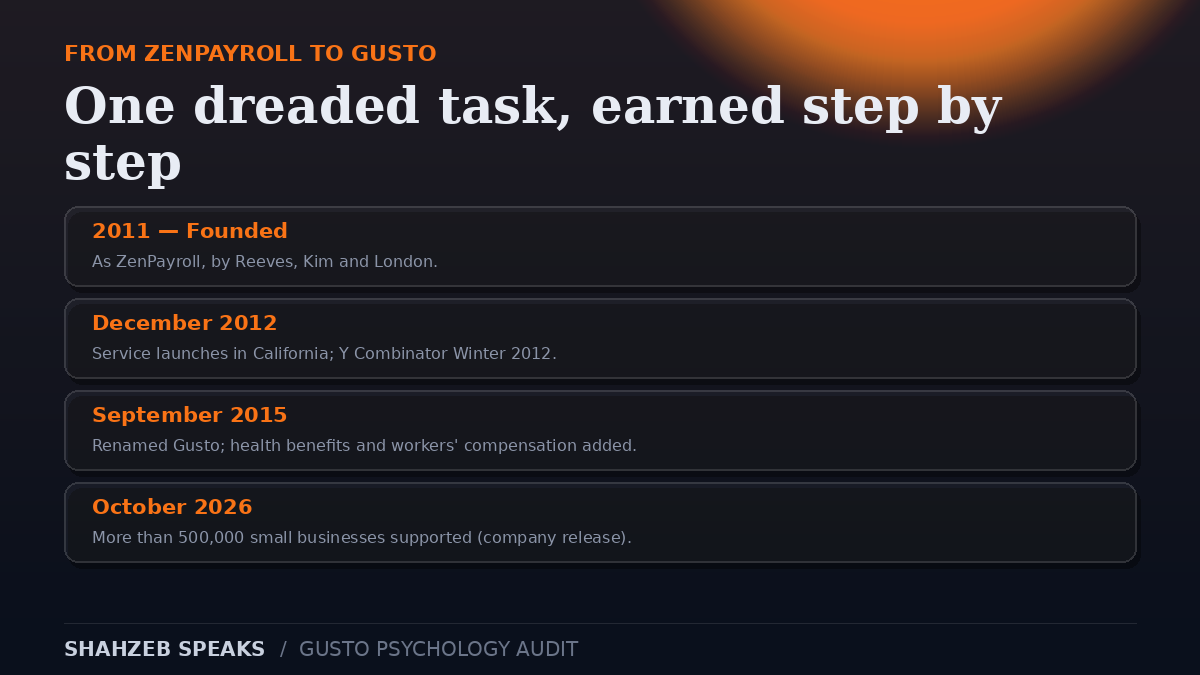
The rename in September 2015 marked the expansion. ZenPayroll became Gusto and added health benefits and workers’ compensation, with the company saying at the time that the new name was inspired by its customers and their teams, who showed courage and passion in their daily work. The psychology of the rename matters. “ZenPayroll” described a function. “Gusto” describes a feeling — energy, appetite, enthusiasm for the work itself. A payroll brand named after a feeling is making a claim about its customer’s inner life, not its feature list, and that claim has shaped everything since, up to and including “Dream Small”. By October 2026, the company says it supports more than 500,000 small businesses from offices in San Francisco, New York and Denver, and it describes itself as a partner built for small businesses rather than a vendor selling to them. The word “partner” is doing heavy work there, and Chapter 6 examines whether the support experience earns it.
🌱 Chapter 2: Dream Small — reversing the biggest promise in business
On 29 October 2026, Gusto announced “Dream Small”, which it calls its biggest creative campaign to date. Developed with Special US, directed by Nick Ball and shot by cinematographer Hoyte van Hoytema, the campaign runs across broadcast, online video, social, audio, influencer and digital out-of-home from 29 October 2026, with broadcast placements in live sports coverage on CBS, FOX, The CW, Netflix and Amazon Prime Video through Thanksgiving week, and outdoor advertising in New York and downtown Chicago. The hero film, “The New Big Dream”, follows Tony, a man who opens a single dry-cleaning store — his childhood dream — pursued against the advice of nearly everyone around him, including his father, who wanted him on the corporate ladder instead.
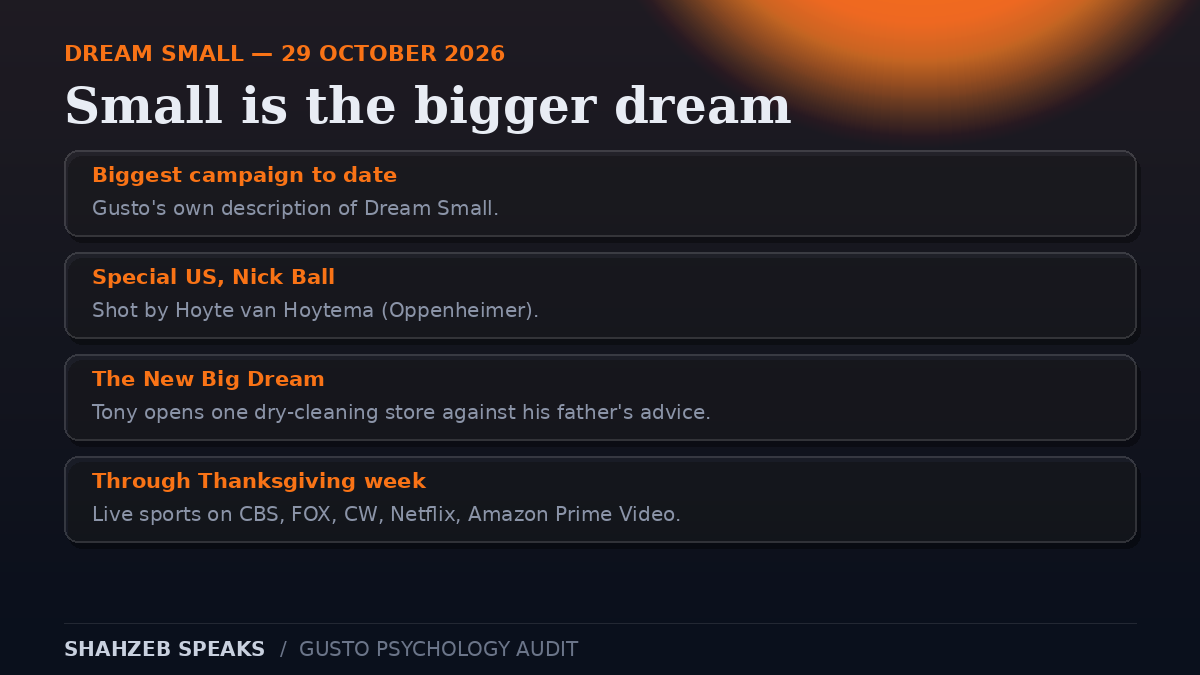
The reversal is the whole psychology. Business culture has one dominant story: dream big, climb the ladder, build something massive, or you have not really made it. Gusto’s chief creative officer, Ximena Keirouz, names that story directly in the launch release, calling it a version of success “repeated so often it’s treated as fact”. The campaign then offers a counter-story in which the measure of success is not scale but ownership: something completely your own, in your own way, with your name on the door and people you know by name on the payroll. In self-determination theory — Deci and Ryan’s account of human motivation — that counter-story maps neatly onto autonomy, competence and relatedness: the freedom to choose your path, the mastery of a craft, and the relationships with people you actually know. A campaign that speaks to all three needs at once will feel true to owners who live those needs daily, even if they have never heard of the theory.
The supporting films extend the same logic into the product without breaking the story. A massage therapist who never has to think about payday. A septic-service owner setting up health benefits mid-pump-out. A medical aesthetics practitioner announcing her own clinic. An office manager setting up retirement plans while a coworker microwaves a burrito in its plastic wrapper. Each film pairs a true-to-life small-business moment with the Gusto product behind it, and the pairing is the argument: the dream is the shop, the clinic, the route — not the software — and the software’s job is to disappear into the background of that dream. That is a disciplined creative choice. Most software advertising puts the product in the foreground and the customer in the background. Gusto puts the customer in the foreground and lets the product be the quiet reason the scene is possible.
🧠 Chapter 3: Removing dread — payroll as cognitive load, not paperwork
Payroll is not difficult in the way a puzzle is difficult. It is difficult in the way a deadline with legal consequences is difficult: the same task, repeated, with different rules in different states, with penalties for errors, and with employees who notice immediately if their pay is wrong and rarely notice at all if it is right. Psychologists would call this a high cognitive-load task with asymmetric feedback — invisible when done well, conspicuous when done badly — and tasks of that shape produce dread out of proportion to their size. Owners postpone them, worry about them between other jobs, and pay for help mainly to stop thinking about them. Gusto’s product psychology is built on that insight: automate the calculation, the withdrawal, the filing and the forms, and sell the customer back their attention.
The “never has to think about payday” film states the mechanism in plain language. Thinking about payday is not work; it is worry, and worry consumes the same attention the owner needs for customers, staff and the business itself. A product that removes a recurring worry is not competing on features. It is competing on mental bandwidth, and mental bandwidth is the scarcest resource in a small business. The same logic explains why Gusto expanded from payroll into benefits, HR and money management: each expansion removes another recurring worry from the same owner, using the same employee data, so the platform becomes harder to leave not because of a contract — comparison coverage notes Gusto is month-to-month with no long-term contracts — but because leaving means resuming all the worries at once. That is a switching cost built from relief, not from lock-in, and it is a more durable kind of loyalty than a discount.
👥 Chapter 4: Social proof — 500,000 businesses and the power of “people like you”
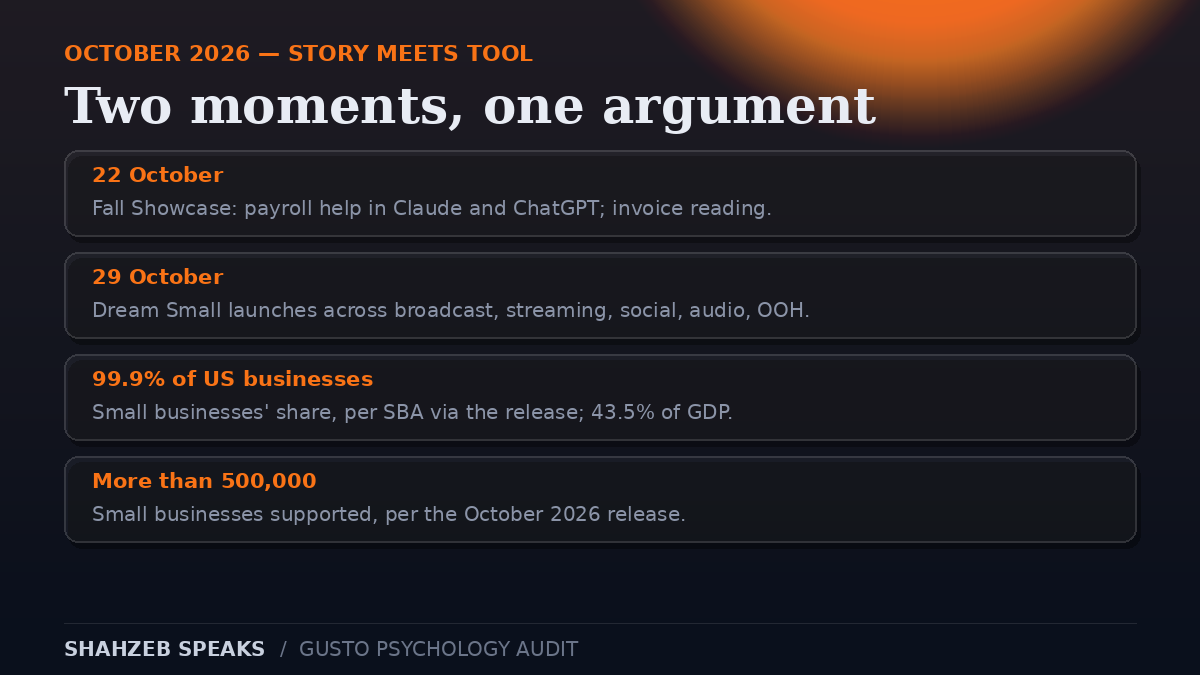
Gusto’s social proof works at two scales, and both are worth separating. The first is the big number: more than 500,000 small businesses supported, according to the company’s October 2026 release. The second is the national frame the release places around it: according to the United States Small Business Administration, small businesses make up 99.9% of all American businesses and account for 43.5% of gross domestic product. The first number says “many people trust us”. The second says “you are not marginal; you are the economy”. Together they answer the two doubts a small owner has about a software vendor: “will this work for someone like me?” and “does anyone take businesses like mine seriously?”
The earlier creator campaign shows the same mechanism at street level. Gusto recruited small-business creators to tell personal stories in their own feeds, and a vendor-reported case study (from impact.com, summarised by 5WPR) puts the result at 23.6 million impressions against a 3.5 million target, with 3.7 million influencer reach and 225,000 link clicks. Those figures are vendor-reported, and this audit labels them as such rather than treating them as independent measurement. Their psychological value does not depend on their precision: a creator who already uses the product, telling their own story, is a different kind of proof from a celebrity endorsement, because the audience can check the claim against their own experience of running a business. The release also cites a survey finding that 66% of Millennials and Gen Z who have not started businesses yet have seriously considered doing so. That figure is cited in the release, not independently verified for this audit, and it is used here only as the campaign’s own context: a generation considering the leap is an audience for a story that says the leap does not have to be huge to count.
🎬 Chapter 5: Cinematic craft — why a payroll ad looks like a film
Hiring a director and a cinematographer of this standing for a payroll campaign is itself a psychological statement. Narrative transportation — the effect studied by Green and Brock, in which a person absorbed in a story becomes more receptive to its message — depends on the story being good enough to absorb someone. A flat product demonstration does not transport anyone. A character-based film about a son defying his father’s idea of success does, because the viewer stops evaluating claims and starts following a person. By the time Tony opens his shop, the viewer has already accepted the campaign’s premise emotionally, and the product association arrives after the feeling, not before it. That ordering matters: a claim accepted through a story is held differently from a claim accepted through an argument, and it is defended differently when challenged.
The cinematic choice also performs status work for the customer. Small-business owners are used to advertising that treats them as a segment: cheerful, generic, slightly patronising. A film shot with the care of a feature tells the owner that their story is worth the same craft as any other story, which is exactly the campaign’s message in visual form. The risk of this strategy is proportion: a beautiful film about a dream can make the software behind it look small by comparison, and a customer who buys the feeling but finds the product ordinary will feel the gap sharply. Gusto’s defence against that risk is the supporting films, which tie each story to a specific product moment — payday, benefits, retirement — so the cinema never floats entirely free of the thing being sold. Whether that defence holds depends on the support experience in Chapter 6, because a customer who has cried at the film and then waited weeks for a tax answer will remember the wait longer than the film.
🛡️ Chapter 6: Trust — the hardest sale in payroll
Trust in payroll is not like trust in a watch or a trainer. A watch brand asks you to believe in its craft. A payroll brand asks you to hand over your bank account, your employees’ personal data, and the legal responsibility for paying people correctly and on time. That is a larger ask, and Gusto’s trust psychology has three layers. The first is automation as reassurance: calculations, withdrawals, filings and forms handled without the owner tracking deposit schedules. The second is the penalty-protection claim reported in coverage of Gusto’s tax filing: if the platform makes a calculation error or misses a deadline, and the owner provided accurate data and sufficient funds, Gusto generally covers the resulting penalties and interest. The third layer is the one the audit must state plainly, because it limits the first two: the employer’s ultimate legal responsibility for payroll taxes does not transfer to the payroll service. The tax authority’s position, as reported, is that using a service does not shift that responsibility, and the protection evaporates when the problem traces back to the owner — a wrong employer identification number, an outdated unemployment rate, a late approval, insufficient funds.
That structure is psychologically honest and commercially awkward at the same time. It is honest because it reflects how payroll law actually works. It is awkward because the campaign’s promise — stop thinking about payday — sits next to a legal reality in which the owner can never fully stop thinking about it. Gusto’s task is to make the gap as small as possible through accuracy and support, and the gap is where the brand is most vulnerable. Comparison coverage in October 2026 reports a mixed support story for Gusto: slow resolution times and repeated escalations flagged by users, against a generally praised interface and automation. The audit treats those reports as a pattern in user feedback, not as a measured service level, but the pattern is consistent enough to matter: in a product whose value is the removal of worry, slow support does not merely annoy. It returns the worry, with interest, at the worst moment — when a tax notice has arrived or a payday is wrong.
💰 Chapter 7: Pricing psychology — transparent, until it is not
Gusto’s pricing is reported in comparison coverage as starting from $49 per month plus $6 per person per month, month-to-month, with no long-term contracts. That structure is psychologically effective for three reasons. First, it anchors low: a single monthly figure plus a per-person figure is easy to compare with the cost of an accountant’s hour or of the owner’s own time. Second, it is published, unlike the quote-based pricing of larger rivals, which makes comparison feel fair even before any feature is compared. Third, it scales with the team, so the price grows only when the business grows — a framing that turns a cost into a shared success. A business that hires its tenth employee does not resent the tenth per-person fee in the way it would resent a price rise, because the fee arrives with the growth it measures.
The criticism, also from comparison coverage, is that some charges are reported as unexpected, notably for year-end tax filings, and that support for billing questions is part of the slow-resolution pattern in Chapter 6. This is the classic transparency trap: publishing a starting price earns trust, and any charge outside that price spends it faster than the price earned it, because the customer feels the surprise more than the amount. The amounts in individual complaints are often small — a fee, a filing charge — but the psychological mechanism is not about amounts. It is about the feeling that the price was not the whole price, which is exactly the feeling Gusto’s “transparent” positioning promises to remove. A brand that sells the removal of worry cannot afford surprise charges, because a surprise charge is a worry wearing a different name.
🌍 Chapter 8: Identity — the business as an extended self
The deepest mechanism in “Dream Small” is identity. Psychologists use the term extended self for the way possessions and projects become part of how we see ourselves, and a small business is an unusually complete example: the owner chose it, named it, staffs it with people they know, and is known in their community through it. The campaign’s language — “your name on the door”, “people they know by name on the payroll” — is not decoration. It is a precise description of that identity, and it explains why the father-son story in the hero film lands so hard. The father’s advice represents the conventional identity: success as a ladder, judged by others. Tony’s shop represents the chosen identity: success as a place, judged by the owner. When a brand aligns itself with the chosen identity against the conventional one, it is not selling a product. It is offering an ally in a family argument, and allies are remembered longer than vendors.
This mechanism also explains the campaign’s timing. Gusto says new small-business applications hit an all-time record this year, driven by a younger generation of founders who can launch faster and leaner than before and who want independence and control over their economic futures. That claim is the company’s own framing in its release, and this audit reports it as such. If the framing is broadly right, the audience for “Dream Small” is not only existing owners but people standing at the edge of starting — the 66% of younger non-founders the release cites as having seriously considered it. For that audience, the campaign is not a reminder. It is permission: permission to want something small, to want it on purpose, and to believe that a payroll company understands why that want matters. Permission is a powerful product, and it is also a responsibility, because a person who starts a business on the strength of a story deserves a product that does not let them down on payday.
📆 Chapter 9: The October 2026 moment — campaign and product in the same week
October 2026 gave Gusto two news moments in eight days, and their pairing is instructive. On 22 October 2026, at its Fall Showcase, Gusto announced integrations that let owners ask payroll questions from real team data in Claude and ChatGPT, and invoice reading for contractor payments — reported as no extra fee for the connection beyond a Gusto plan. On 29 October 2026 came “Dream Small”. The product news says: the boring work is getting easier and more conversational. The campaign news says: the boring work is not the point of your life. Together they form a complete argument that neither makes alone: use the tool, and get back to the dream. The sequencing also matters. A campaign about dreams, launched without a product story behind it, would be sentiment. A product announcement without a story would be a feature list. In the same month, each gives the other weight.
There is a second, quieter reading of the same week. A campaign that celebrates smallness, launched by a company serving more than half a million businesses, is a large company telling small ones that staying small is admirable. That message is welcome, and it is also convenient: Gusto’s business model depends on a large number of small customers, not on a small number of large ones. The campaign therefore aligns the company’s commercial interest with its customer’s identity, which is the best kind of alignment a brand can have — and the kind that deserves the most scrutiny, because it is easy to mistake alignment for altruism. The audit’s judgement is that the alignment here is genuine as far as it goes: Gusto does serve small businesses, its product does remove real work, and the campaign does say something true about what those businesses mean to their owners. Genuine alignment is not the same as selflessness, and a customer who understands the difference will trust the brand more, not less.
⚠️ Chapter 10: The dark side — support queues, surprise charges, and the limit of “partner”
The dark side of Gusto is not a scandal. This audit searched reputable sources for a court ruling, regulator fine or settlement involving Gusto and found none to report as of 31 October 2026, and it states that as a search finding, not as a claim that none could ever exist. The problems that do appear are structural, and they cluster around the gap between the campaign’s promise and the service’s hardest moments. The first is support. Better Business Bureau complaint summaries crawled for this audit showed 353 complaints in the last three years and 144 in the last twelve months on one page, and 356 and 146 on a second crawl. Those figures are self-selected complaints, not a complaint rate — with more than 500,000 businesses served, they cannot be converted into a percentage of unhappy customers — but the themes inside individual complaints recur: tax notices, deduction errors, corrections that take weeks, and support representatives who do not resolve the issue in one contact. For a product whose promise is the removal of worry, a slow resolution is not a minor defect. It is the product failing at its core job, in the exact situation where the customer is most anxious.
The second problem is scope. Gusto’s core payroll is built for the United States, while contractor payments are reported as supported in more than 120 countries. A business that hires internationally, or that operates in a specialised industry with niche labour rules, may find the general platform does not cover every requirement, and comparison coverage warns that complex garnishments, tip pools, piece rates and industry-specific rules may need manual oversight or specialist advice. The third problem is the pricing surprise in Chapter 7: charges reported as unexpected, notably around year-end filings, which spend the trust that published pricing earns. None of these problems is a legal finding, and none of them cancels the product’s genuine strengths. Together they define the limit of the word “partner” in Gusto’s positioning. A partner is judged not by its advertising but by what happens when something goes wrong, and on that test the public record shows a company that is excellent at removing routine worry and uneven at removing exceptional worry. That unevenness is the honest centre of this audit.
🌍 Chapter 11: What other brands should — and should not — copy
Copy the reversal. Most brand campaigns promise more: more growth, more scale, more everything. Gusto’s campaign succeeds by asking whether more is what the customer actually wants, and by giving the customer’s own answer — a shop, a clinic, a team known by name — the status of a dream. Any brand whose customers have been told their ambition is too small can use the same move, provided the brand genuinely serves that ambition rather than merely flattering it. Copy the product-story pairing. Every cinematic moment in “Dream Small” is tied to a product moment — payday, benefits, retirement — so the story never floats free of the thing being sold. Brands that copy the cinema without the pairing will produce beautiful films that sell nothing, or worse, films that sell a feeling their product cannot deliver.
Do not copy the support gap. This is the clearest prescription in the audit. A brand that sells the removal of worry must staff the moments when worry returns as if those moments were the product, because for the customer they are. Publish resolution times, give tax-notice cases a named owner, and make year-end charges visible before they arrive, not after. Do not copy the surprise charge. Transparency that stops at the starting price is not transparency; it is a headline. Every charge outside the headline price should be disclosed at signup, in the product, and in the invoice, in the same language. Finally, copy the alignment, honestly. Gusto’s campaign works because the company’s interest in many small customers matches the customer’s interest in staying small and well-run. Brands that find a genuine alignment of that kind should say so plainly, including where the alignment ends. Customers trust a brand more when it admits its interest, not less.
📊 Psychology Scorecard
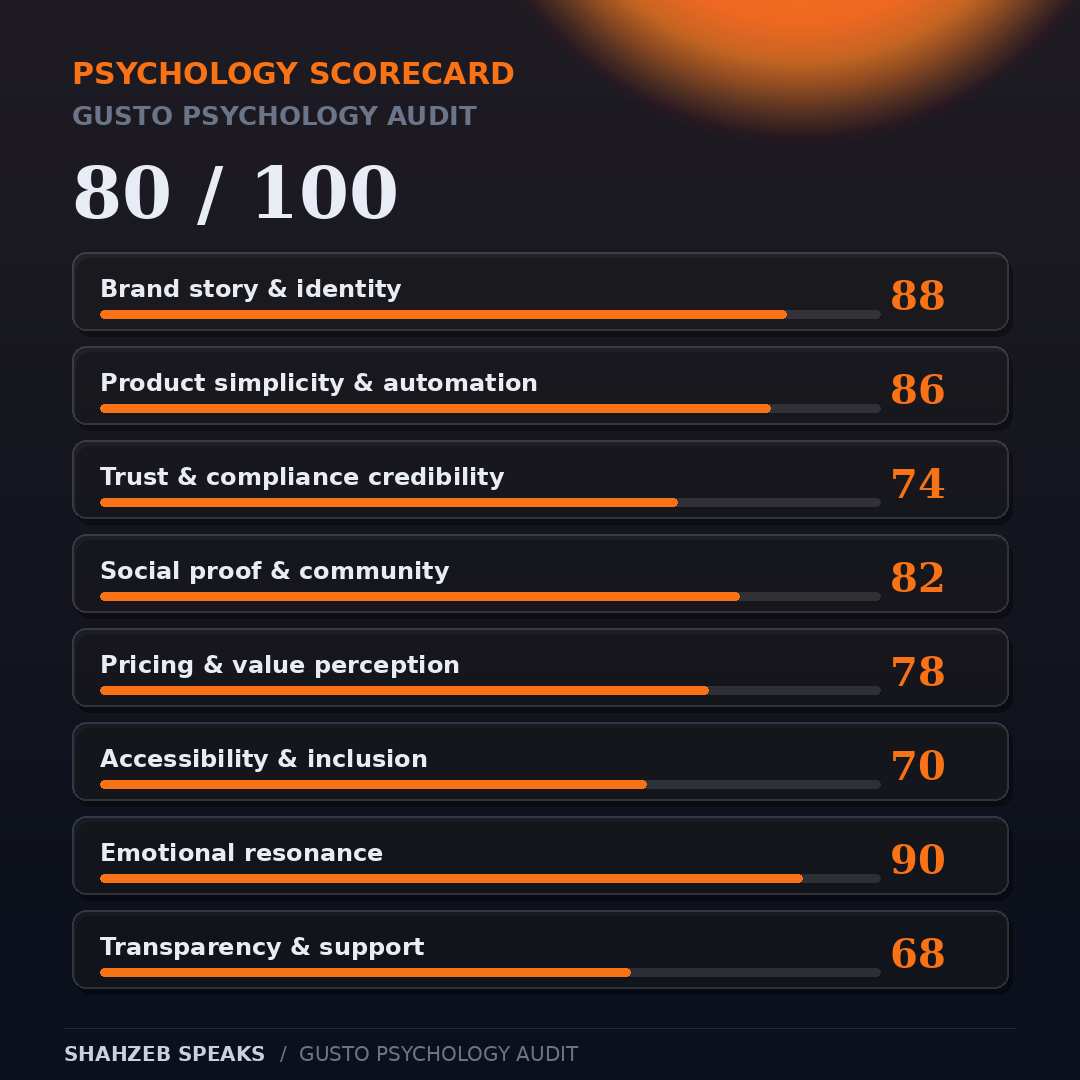
The overall score is the rounded average of eight dimensions. Arithmetic: 88 + 86 + 74 + 82 + 78 + 70 + 90 + 68 = 636; 636 ÷ 8 = 79.5, rounded to 80. The scorecard image matches these figures exactly.
| Dimension | Score | Verdict |
|---|---|---|
| Brand story & identity | 88 | Dream Small reverses the success script and means it. |
| Product simplicity & automation | 86 | Payroll dread removed; expansion earned task by task. |
| Trust & compliance credibility | 74 | Automation reassures; ultimate legal duty stays with the owner. |
| Social proof & community | 82 | 500,000 businesses plus a story owners recognise as their own. |
| Pricing & value perception | 78 | Published, scalable pricing, dented by reported surprise charges. |
| Accessibility & inclusion | 70 | Built for small American employers; complex and international cases strain it. |
| Emotional resonance | 90 | A film-quality story about a son, a father and one shop. |
| Transparency & support | 68 | Routine worry removed well; exceptional worry resolved unevenly. |
| Overall | 80 | A true story about small dreams, with a support gap to close. |
✅ Balance Sheet & Prescription
What works: a reversal of the growth script that matches how small owners actually see their businesses; cinematic storytelling tied to real product moments; automation that removes a recurring, dreaded task; published, scalable pricing; and a platform expansion earned task by task from a position of trust. What does not: support that resolves routine questions well and exceptional ones unevenly; surprise charges that spend pricing trust; a scope that strains on complex and international cases; and a “partner” promise that is tested, and sometimes found wanting, exactly when a tax notice arrives. Prescription: give tax-notice and correction cases a named owner and a published resolution time; disclose every charge outside the headline price at signup and in the invoice; publish, in plain language, the boundary of the penalty protection and the employer’s remaining legal duty; and keep the campaign’s promise measurable — report, each quarter, how many customers never had to think about payday, and how many had to think about it because something went wrong. A brand that measures the second number in public will be believed about the first.
📝 Final Verdict
Gusto’s “Dream Small” is the rare campaign that is both beautiful and true: true to the owners it portrays, true to the product that serves them, and true to a definition of success that business culture has neglected. The payroll machine behind it is genuinely good at its core job, and genuinely uneven at its hardest job, which is helping a worried owner when something has already gone wrong. Close that gap, and the campaign’s promise becomes a description rather than an aspiration. Until then, the verdict stands: a company that understands the small dream better than almost anyone, selling a product that mostly — but not always — lets its customers live it.
Psychology Score: 80/100 — The dream you can afford to keep small, from a company that still has to prove it on payday.
📬 Dreaming small, or dreaming big — which one is yours?
If you run a small business, or you are standing at the edge of starting one, tell me which dream you actually want: the shop with your name on the door, or the ladder someone else built. Contact me and describe the dream Gusto’s film got right — or got wrong.
For the broader field behind this audit, see my homepage on industrial psychology in Pakistan, and for another brand that sells identity before product, read the Supreme psychology audit and the Hermès psychology audit.
📚 References & Sources
- Gusto (2026). New Brand Campaign “Dream Small” From Gusto Proves There’s Nothing Small About Small Business. PR Newswire, 29 October 2026.
- CPA Practice Advisor (2015). ZenPayroll Changes Name to Gusto, Adds Workers Comp. 17 September 2015.
- Harvard Business School, Digital Innovation and Transformation (2017). Gusto: A Payroll Software Turned “People Platform”?
- SelectHub (2026). Gusto vs Patriot Payroll; Gusto vs PrimePay. October 2026. (User-reported support and pricing patterns.)
- Better Business Bureau (2026). Gusto — Customer Complaints Summary. Crawled October 2026. (Self-selected complaints; not a complaint rate.)
- LegalClarity (2026). Gusto Tax Filing: What It Covers and Your Responsibilities. (IRS position on employer responsibility; conditional penalty protection as reported.)
- Deci, E. L. & Ryan, R. M. (2000). The “what” and “why” of goal pursuits: Human needs and the self-determination of behavior. Psychological Inquiry, 11(4).
- Green, M. C. & Brock, T. C. (2000). The role of transportation in the persuasiveness of public narratives. Journal of Personality and Social Psychology, 79(5).
Key Findings
- Founded 2011 as ZenPayroll by Josh Reeves, Edward Kim and Tomer London; service launched December 2012 in California; Y Combinator Winter 2012; renamed Gusto September 2015 with health benefits and workers' compensation; headquarters San Francisco, United States; offices New York and Denver; official website gusto.com
- Dream Small announced 29 October 2026, Gusto's biggest creative campaign to date: Special US, director Nick Ball, cinematographer Hoyte van Hoytema; hero film The New Big Dream follows Tony opening one dry-cleaning store against his father's corporate-ladder advice; broadcast sports CBS, FOX, CW, Netflix, Amazon Prime Video through Thanksgiving week; outdoor in New York and downtown Chicago
- Gusto simplifies payroll, benefits, HR and money management and supports more than 500,000 small businesses (company release, October 2026); SBA figures cited in the release: small businesses are 99.9% of US businesses and 43.5% of GDP; Fall Showcase 22 October 2026 added payroll help in Claude and ChatGPT plus contractor-invoice reading
- Pricing reported from $49 per month plus $6 per person per month, month-to-month with no long-term contracts; comparison coverage reports some charges, notably year-end tax filings, as unexpected by users, and support resolution as slow with repeated escalations
- BBB complaint summaries crawled October 2026: 353 complaints in 3 years and 144 in 12 months (second crawl 356/146) — SELF-SELECTED complaints, NOT a complaint rate; NO court ruling, regulator fine or settlement involving Gusto was found in reputable sources searched for this audit as of 31 October 2026 (stated as a search finding); ultimate legal responsibility for payroll taxes stays with the employer even when using a payroll service
- Score 80/100: 88+86+74+82+78+70+90+68 = 636; 636/8 = 79.5, rounded to 80; NO current valuation figure is printed — Gusto is private and none was verified from a primary source for this run
Overall Psychology Score
Gusto scores 80/100 in our comprehensive psychology audit covering consumer behavior strategies, UX design principles, and psychological marketing effectiveness.
The detailed dimension scores are in the audit's Psychology Scorecard chapter.
High impactMuhammad Shahzeb
MSc Industrial Psychologist, specializing in consumer behavior, UX psychology, and brand strategy analysis. Helping brands understand the psychology behind their success.
About Muhammad Shahzeb →