Hermès Psychology Audit — The Bag You Have to Earn
Hermès sells a bag you cannot simply buy: 15 hours of craft, a reported $10,000–$20,000 pre-spend and a queue that survived a lawsuit. Score: 80/100. See scorecard.

80 / 100
Overall consumer behavior effectiveness
Brand Overview
- Brand nameHermès
- Founded1837
- HeadquartersParis, France
- IndustryFashion & Apparel
- Websitewww.hermes.com ↗
Psychology Techniques Identified
- 01Scarcity & Structural Supply Constraint (15 Hours of Craft, One Workshop a Year)
- 02Earned Access & Allocation (Relationship-Based Offers, Reported Pre-Spend)
- 03Effort Justification (One Artisan, Visible Handcraft)
- 04Goal-Gradient Behaviour (Spending Accelerates Near the Offer)
- 05Veblen Status & Conspicuous Consumption (Price as Proof of Standing)
- 06Endowment & Resale Premium (Ownership That Appreciates, 1.7x Retail)
- 07Social Proof & Identity Signalling (Kelly and Birkin Stories, Recognisable Without a Logo)
- 08Loss Aversion & Fear of Losing the Relationship (Kahneman & Tversky)
- 09Reactance (Restricted Access Increases Desire)
- 10Authority & Heritage Anchoring (1837, Faubourg Saint-Honoré)
- 11Extended Self & Belonging (The Bag as Membership)
- 12Investment Framing & Speculative Demand (Resale Market as Advertising)
Full Psychology Audit Report
In this audit
Walk into a Hermès boutique with money in your pocket and ask to buy the brand’s most famous product, and you may discover something strange: the money is not enough. The bag you want may not be offered to you at all, no matter what you are willing to pay, until you have spent months — sometimes years — buying other things first. Hermès has built a €15.2 billion business on a reversal of normal retail: the customer must earn the right to buy, and that earning is the product.
The numbers behind that reversal are striking. Hermès reported 2024 revenue of €15.2 billion, with recurring operating income of €6.2 billion — a 40.5% margin. Reuters reported in October 2026 that group sales had tripled between 2015 and 2025 to €16 billion, with a 41% operating margin last year. Yet in the same month, the machine showed strain: third-quarter 2026 sales of €4.1 billion grew about 4% at constant exchange rates, below the 5.2% analysts expected, while the resale premium on the Birkin — the market’s verdict on scarcity — fell from 2.6 times retail at its 2022 peak to 1.7 times. This audit examines how Hermès’ psychology works, and what happens when the world starts testing it.
I am an Industrial and Organizational Psychologist in Karachi, and I audit brands by matching their documented behaviour to established psychology — never by guessing at motives. Every figure here is sourced, every legal claim is stated at its exact status, and every tactic is described as consistent with a principle, not proven by it.
“Hermès does not sell you a bag. It sells you the right to be offered one — and the wait is what makes the offer feel like a prize.” — Brand Psychology Analysis, ShahzebSpeaks
📋 Brand Overview: Hermès at a Glance
| Field | Detail |
|---|---|
| Brand | Hermès (Hermès International) |
| Founded | 1837, Paris — harness workshop of Thierry Hermès |
| Headquarters | Paris, France |
| Website | https://www.hermes.com |
| 2024 revenue | €15.2 billion (+15% at constant exchange rates) |
| Q3 2026 sales | €4.1 billion (about 4% growth at constant exchange rates) |
| Employees | 27,107 at end of June 2026 |
| Known for | Birkin (1984) and Kelly bags, silk carrés, leather goods |
| Psychology score | 80/100 |
📜 Chapter 1: The History — from horse harnesses to the hardest bag to buy
Hermès began in 1837, when saddler- and harness-maker Thierry Hermès opened a workshop in the Grands Boulevards district of Paris. In 1880 his son Charles-Émile moved the workshops to 24, rue du Faubourg Saint-Honoré, the address that remains the house’s spiritual home. The company earned its reputation making harnesses and saddles for the carriage trade — work where a failure could injure a rider, so quality was not a marketing claim but a safety requirement. That origin still does psychological work today: when a brand’s story starts with life-or-death craftsmanship, “handmade” reads as a promise rather than a slogan.
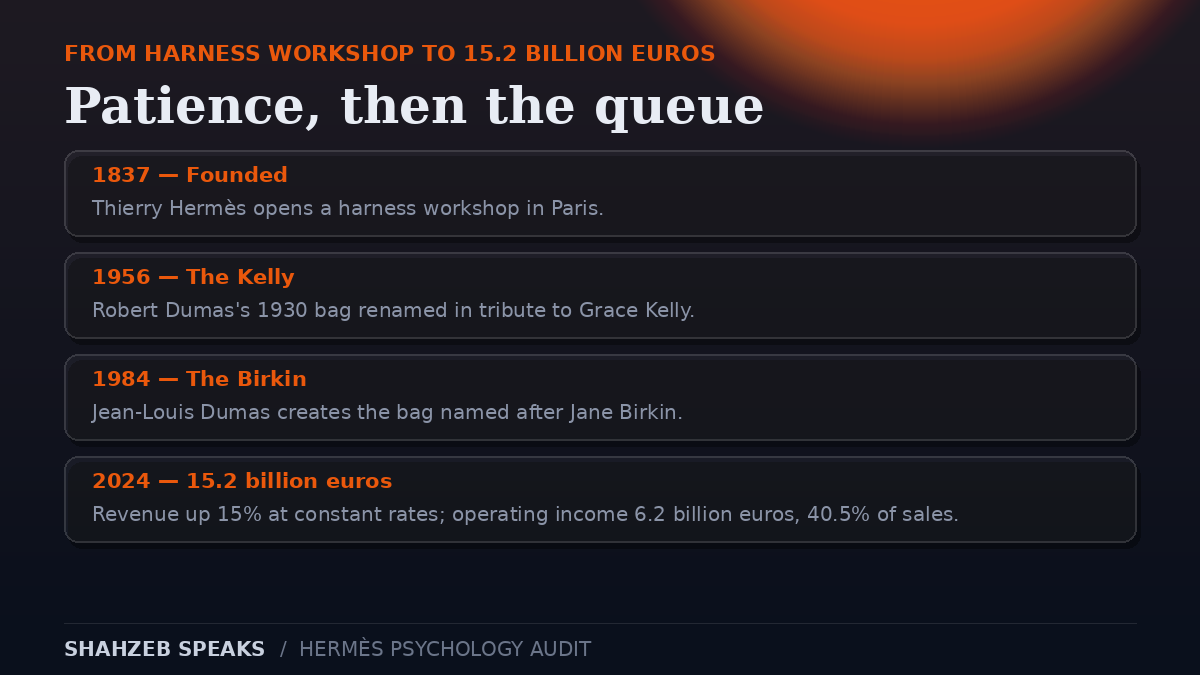
The two bags that define the brand both arrived by accident, and accidents make better stories than launches. The bag Robert Dumas created in 1930 became the Kelly in 1956, named in tribute to Grace Kelly after she was photographed with it. The Birkin was created in 1984 by Jean-Louis Dumas and named after the singer and actress Jane Birkin. Neither bag was introduced with a scarcity strategy presentation. Both became scarce later, through limited production, controlled distribution, and the stories customers told about them. That sequence matters for this audit: Hermès did not invent scarcity as a tactic and then build a brand around it. It built a craft brand over 150 years, and scarcity grew out of the craft constraint — one artisan, limited leather, limited workshops — before it became a strategy. The difference between earned scarcity and manufactured scarcity is the difference between this audit’s praise and its criticism, and later chapters keep them apart.
⏳ Chapter 2: Scarcity — the principle that runs the whole machine
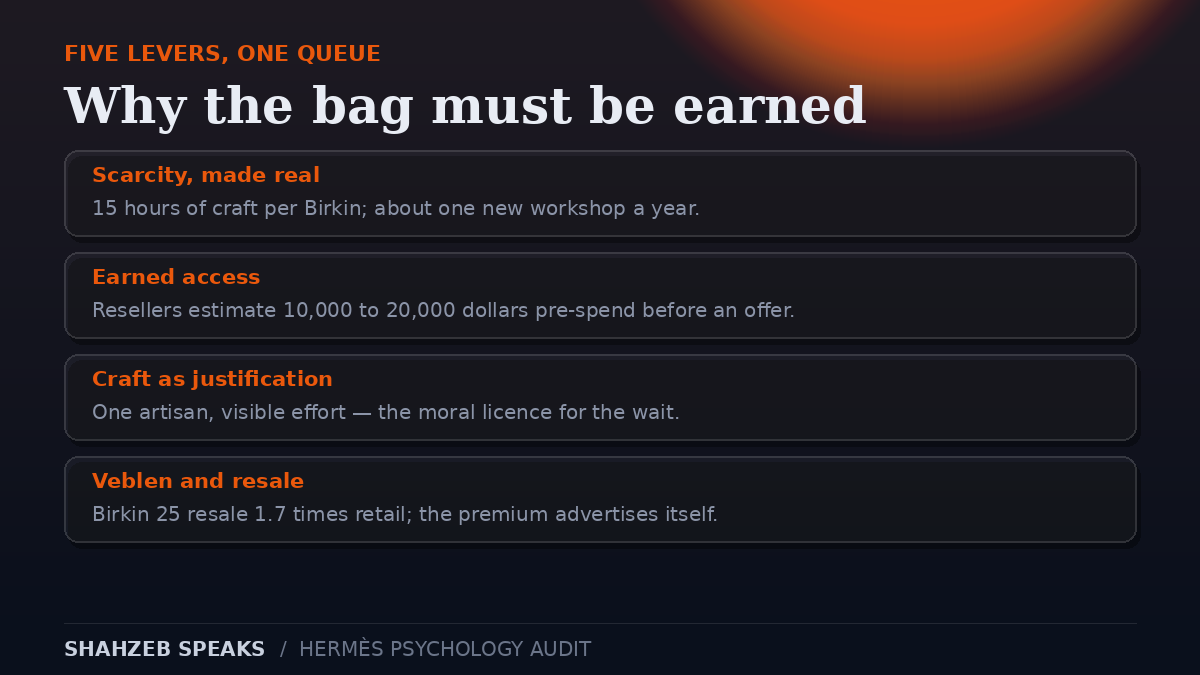
Scarcity is the oldest persuasion principle in the book: people want what they cannot easily have, and they want it more as it becomes harder to get. Robert Cialdini’s work on scarcity describes two drivers — the fear of losing the opportunity, and the inference that scarce things must be valuable. Hermès applies both at a scale no other luxury house matches, because its scarcity is structural rather than seasonal. A Birkin takes 15 hours to craft, according to Hermès itself, and the house expands production by roughly one workshop per year on average. Supply cannot surge to meet demand even if the company wanted it to, and Reuters reported that chief executive Axel Dumas said in July that output depended largely on the number of fully trained artisans and available high-quality leather. When scarcity is a real constraint, customers believe it. When it is a marketing choice, they eventually notice. Hermès’ first advantage is that its constraint is real.
The second advantage is opacity. Hermès does not disclose its selling policies or how many bags it makes. Customers cannot verify supply, cannot check a waiting list, and cannot compare their treatment with anyone else’s. Opacity turns a production constraint into a mystery, and mystery is more persuasive than a number: a customer who is told “we make 10,000 a year” can calculate their odds, while a customer told nothing can only hope. That hope is doing commercial work, and it is also the source of the trust problem scored later in this audit. Scarcity you can measure is a fact. Scarcity you cannot measure is a feeling — and feelings are easier to sell, and easier to resent.
🎟️ Chapter 3: Earned access — allocation as the world’s strictest loyalty programme
Here is where Hermès departs from every other luxury brand. Most brands ration by price: raise the price until demand matches supply. Hermès rations by relationship. Six resellers who source bags directly from Hermès shoppers told Reuters that access to a Birkin is generally linked to spending on Hermès scarves, clothes and shoes, although the exact policy differs between regions and stores. Two estimated that customers typically spend $10,000 to $20,000 before being offered a Birkin or the Kelly. Secondary summaries add that customers are reported to be limited to two quota bags per year across the Birkin, Kelly and Constance lines. None of this is a Hermès-stated policy — the house discloses nothing — but the pattern is consistent across reseller accounts, and it is the pattern that matters psychologically.
Read as psychology, earned access is a loyalty programme with the rewards inverted. Normal loyalty programmes give you something for spending. Hermès’ system gives you the right to spend more. That inversion works through three mechanisms. First, effort justification: the more a customer spends and waits, the more valuable the eventual bag must feel, because admitting otherwise would mean admitting the effort was wasted. Second, goal-gradient behaviour: as the customer gets closer to being offered a bag, each additional purchase feels more meaningful, so spending accelerates near the end. Third, identity: being “offered” a Birkin is a social signal in itself, a story the customer tells afterwards — not “I bought a bag” but “I was chosen for one.” The queue is not a flaw in the buying experience. It is the experience, and the bag is the souvenir.
🪡 Chapter 4: Craftsmanship — the 15 hours that justify everything else
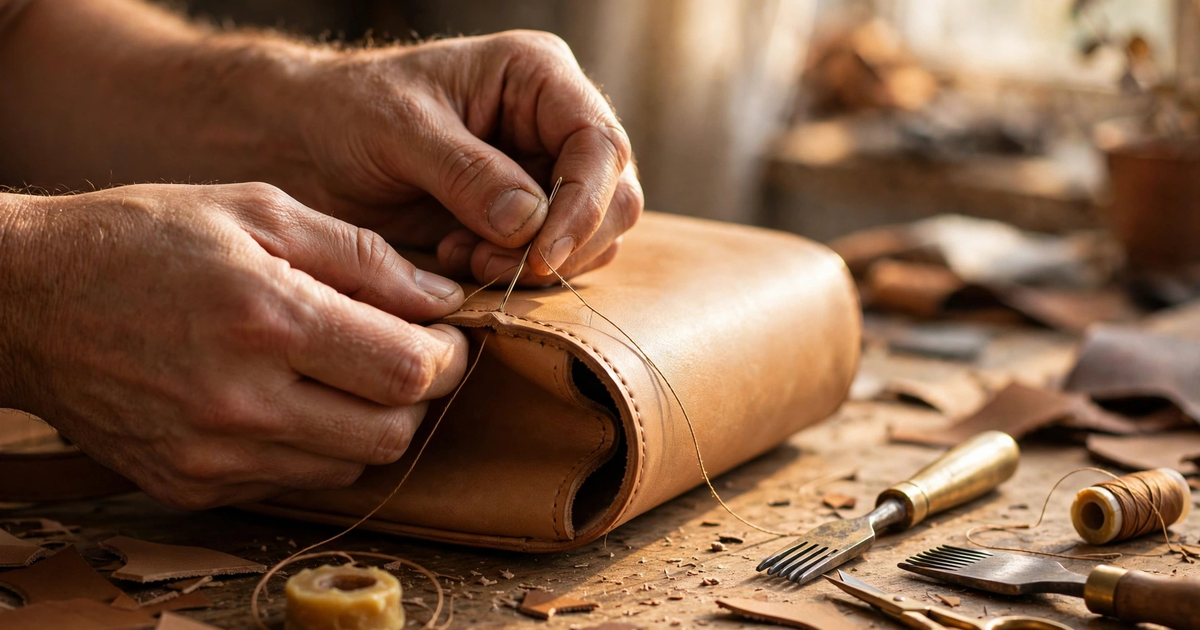
Every scarcity system needs a justification, and Hermès has the best one in luxury: the work itself. A Birkin takes 15 hours to craft, according to Hermès, and the house’s own account is that each bag is made by a single artisan. The atelier image — hands, thread, leather, time — is not decoration. It is the moral licence for the price, the wait and the allocation system. A customer who believes 15 hours of skilled labour went into the bag can accept a queue; a customer who believes the bag came off a line cannot. Craftsmanship converts scarcity from an insult (“why won’t you sell to me?”) into a virtue (“of course it takes time”).
The psychology here is effort heuristic: people judge quality by the effort they believe went into making something. Hermès makes the effort visible — workshops, artisans, the saddle-stitch story that traces back to the harness workshop — and the effort then does double duty. It justifies the price to the buyer, and it justifies the wait to everyone else. The risk, which October 2026 exposed, is that effort justification cuts both ways. If production expands — one workshop a year, every year — and resale supply grows anyway, customers start to ask whether the constraint is still craft or has become choice. That question is the theme of Chapter 10.
💎 Chapter 5: Veblen and status — when the price is the proof
Thorstein Veblen’s 1899 observation was that for some goods, a higher price increases desire rather than reducing it, because the price itself signals wealth and standing. The Birkin is the purest Veblen good in modern retail. Its UK retail price for an unworn black Birkin 25 was £9,390, according to a London sales assistant quoted by Reuters, while the same bag’s resale price had fallen to around £24,000 — still more than double retail, even after a fall of around £4,000 since 2022. The resale premium is the Veblen signal made measurable: the bag is desirable partly because it costs more than most people can justify, and the fact that strangers will pay more than retail for a used one proves the signal works.
That premium also creates a second, stranger incentive. For years, buying a Birkin at retail was not just consumption but a trade with a positive expected return: buy at £9,390, resell above £20,000, and the queue pays you. Reuters reported that one reseller, Cai Baochun, had stopped stockpiling Birkins as second-hand prices fell, saying “I don’t want to lose money.” When the premium shrinks, the investment story weakens, and the buyers who came for profit leave first. What remains is the question every Veblen good eventually faces: how much of the desire was status, and how much was speculation? The next chapter measures that split.
📈 Chapter 6: Endowment and the resale market — owning as investing
Once a customer owns a Birkin, two more principles take over. The endowment effect — people value something more once they own it — means the bag feels worth more the day after purchase than the day before, and the resale market confirms the feeling with cash. Bernstein, which tracks individual auction results, said in a September note that the resale price on Birkin 25 bags averaged about 1.7 times the retail tag in the third quarter, down from about 2.6 times at the 2022 peak. Even at 1.7 times, the owner holds an asset that appreciated on purchase. That is a remarkable psychological position: the act of buying creates wealth, which makes the next purchase easier to justify, which deepens the relationship with the brand. The queue, the craft and the resale market form a loop, and for a decade the loop ran in one direction.
The resale market also became the brand’s unofficial advertising. Fashionphile told Reuters its Birkin listings have grown 32-fold in 15 years, with 212 Birkins listed on its site at the time of reporting. UBS estimated in October 2026 that the number of handbags listed for sale worldwide is now six to seven times higher than before the pandemic. Every listing is a public price signal that says “this bag is worth more than the shop charges.” Hermès does not pay for that advertising, does not control it, and benefits from it enormously — until the signal turns. A market that advertises your scarcity will also advertise its decline, in the same public listings, at the same speed. That turn is visible in the data now, and it is the subject of Chapter 10.
👥 Chapter 7: Social proof and identity — the bag as a sentence
A Birkin is recognisable without a logo, and that recognisability is the point. Social proof works here not through advertising but through sightings: a bag carried by someone whose taste or wealth you admire tells you, without a word, that this is the bag to want. The Grace Kelly and Jane Birkin stories give those sightings a narrative frame — a princess, a singer, a chance encounter — that turns a leather object into a cultural reference. Later sightings keep refreshing the signal: Reuters noted renewed attention generated by Norwegian footballer Erling Haaland’s handbag collection, cited by Fashionphile as a reason its Birkin prices stayed firm even as others softened.
The identity mechanism is extended self: possessions become part of how people understand themselves and present themselves to others. A Birkin does not just signal wealth; it signals patience, access and membership in a group that does not need to explain itself. That is why the allocation system matters more than the price. Anyone with money can buy an expensive bag. Only someone with history at Hermès can be offered a Birkin, and that history is itself a story about taste, loyalty and standing. The bag says “I belong” in a language that people who cannot read it still understand as exclusion. That exclusion is the product’s power and its ethical problem, scored honestly below.
😨 Chapter 8: Loss aversion and reactance — the fear of never being offered
Two final principles lock the system shut. Loss aversion (Kahneman & Tversky, 1979) means the pain of losing an opportunity outweighs the pleasure of gaining an equivalent one — and in the Hermès system, the opportunity is not just a bag but the relationship itself. A customer who stops buying scarves and shoes risks losing their standing with their sales associate, and with it the offer that may be months away. Walking away does not just cost a bag. It costs the years already invested, which brings us back to sunk cost: the pre-spend is a sunk investment that makes exit feel wasteful, even when the customer suspects the game.
Reactance (Brehm, 1966) adds the other half: when a freedom is restricted, people want the restricted thing more. Being told you cannot simply buy a Birkin — that you must wait, spend, and hope — makes the bag more desirable than any advertisement could. Hermès does not need to create reactance deliberately; the allocation system creates it structurally. Every customer who is not offered a bag experiences a small restriction, and that restriction increases the value of the eventual offer. The system is elegant, and it is also the reason the brand’s critics sound angry rather than merely disappointed: reactance feels like manipulation even when it emerges from a production constraint.
🏛️ Chapter 9: Authority and heritage anchoring — 1837 does quiet work
Every Hermès boutique, every orange box, every reference to the Faubourg Saint-Honoré address is an authority cue: this house has done this since before your grandparents were born, and it will outlast any trend. Heritage anchoring works by borrowing credibility from time. A brand founded in 1837 does not need to argue that it is serious; the date argues for it. The harness-workshop origin adds a second anchor: this was once a trade of safety-critical craft, not fashion, so the house’s standards feel older and stricter than fashion’s seasonal churn.
The practical effect is price tolerance. Customers accept prices they would reject from a younger brand because the heritage story reframes the price as continuity rather than cost. The same mechanism protects the brand in a downturn: a house that survived two world wars, the end of the carriage trade, and the rise of fast fashion does not look fragile when a quarter disappoints. Heritage is Hermès’ shock absorber, and it is the reason the October 2026 numbers, examined next, should be read as a test rather than a verdict.
📉 Chapter 10: The October 2026 test — when the scarcity premium cools
On 21 October 2026, Reuters published an examination of the Birkin resale market under the headline question of whether the bag was losing its scarcity appeal. Its findings, from nine resellers across the US, Europe and Asia, were measured rather than dramatic: six said resale prices had fallen over the past year as more handbags became available, five reported softer demand, and the Birkin 25 premium had compressed from 2.6 times retail at the 2022 peak to 1.7 times in the third quarter. The next day, Hermès reported third-quarter sales of €4.1 billion, up about 4% at constant exchange rates — below the 5.2% analysts expected, and, by Reuters’ comparison, the weakest quarterly pace since early 2020. Leather goods still grew 10.8% to €1.91 billion, but ready-to-wear and accessories fell 2% to €1.14 billion, a sign, analysts told Reuters, that fewer customers were making the purchases traditionally required before being offered a Birkin.
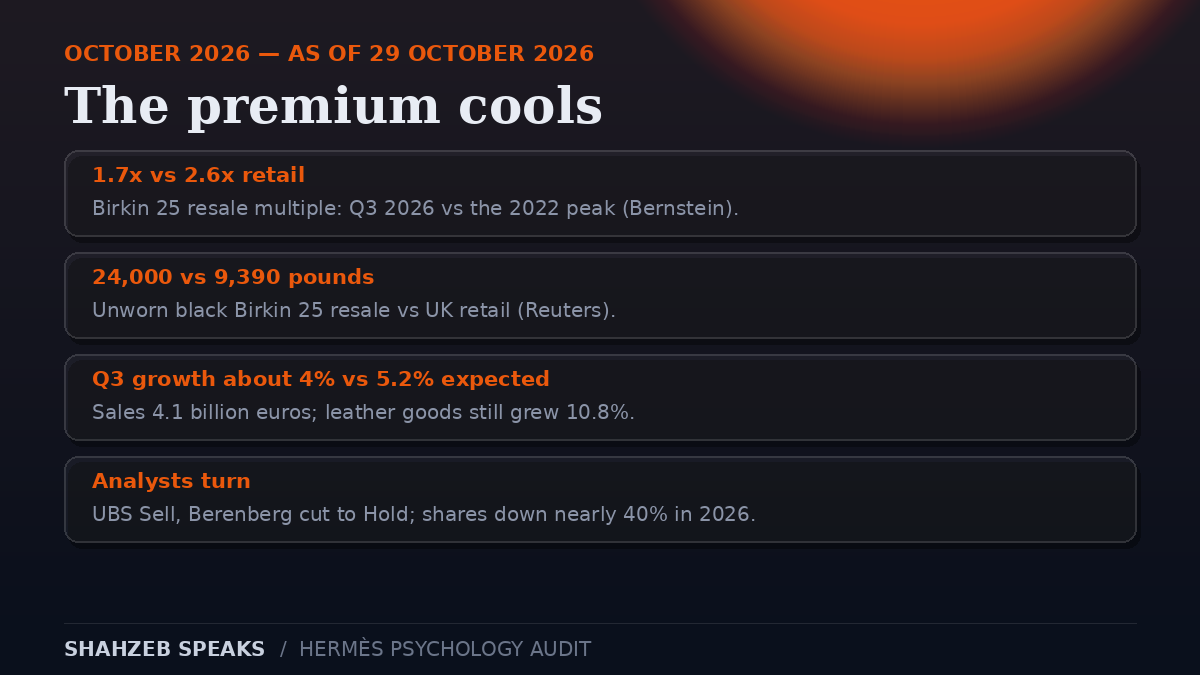
The analyst response was swift. UBS had already downgraded Hermès shares to “sell” in early October 2026, arguing that growing secondary-market supply could weaken the scarcity-driven business model. Berenberg cut its rating from Buy to Hold on 23 October 2026 and lowered its price target from €1,850 to €1,230, citing Hermès’ loss of its double-digit growth premium over LVMH in key regions. Goldman Sachs maintained a Sell rating with a €1,340 target. Reuters reported that Hermès shares had lost nearly 40% of their market value in 2026. None of this means the scarcity machine has broken: leather goods still grew at double digits, the premium is still 1.7 times retail, and the brand’s margins remain the envy of luxury. What it means is that the machine is no longer self-evidently strengthening. A premium that falls from 2.6 to 1.7 is still a premium, but it is a premium moving in the wrong direction, and markets price direction, not levels.
The honest reading is that Hermès faces a genuine dilemma, stated by its own chief executive. Asked in July whether the house should slow production to protect the brand, Axel Dumas said some people feared making too many bags would hurt exclusivity, while others questioned why it was not making more — and that output depended largely on trained artisans and leather. Make fewer bags and you protect the premium but frustrate customers and forgo revenue. Make more and you satisfy demand but feed the resale market that dilutes the premium. There is no version of this choice that keeps every number rising, and the psychology of the brand — which depends on the premium feeling permanent — is exposed to whichever choice disappoints.
⚠️ Chapter 11: The dark side — the lawsuit, stated exactly, and the opacity problem
On 19 March 2024, three customers — Tina Cavalleri, Mark Glinoga and Mengyao Yang — sued Hermès International and its US subsidiary in the US District Court for the Northern District of California, alleging an unlawful tying scheme: that Hermès limited access to Birkin bags to customers with a sufficient purchase history, and that the displayed retail price hid a lottery system pressuring buyers to purchase additional products. They brought claims under Sherman Act §1 and California’s Cartwright Act, among others. Hermès rejected the allegations, arguing that customers without prior purchases could still obtain a Birkin and that the plaintiffs had not shown antitrust harm beyond personal frustration.
On 17 September 2025, Judge James Donato granted Hermès’ motion to dismiss the second amended complaint with prejudice — meaning the plaintiffs cannot refile the same claims — finding that they had not plausibly defined a relevant product market, established Hermès’ market power, or demonstrated the type of injury antitrust law seeks to prevent. An earlier complaint had been dismissed with leave to amend, and the court found the amended version added no meaningful facts to fix those flaws. Secondary reporting as of mid-2026 said the plaintiffs had appealed and the case was being briefed before the Ninth Circuit; the outcome of any appeal was not verified as of 29 October 2026. To be precise: the dismissal is not a ruling that Hermès’ allocation system is fair, and the allegations were never a court finding. What the case did establish, in public, is the shape of the complaint customers make when a queue feels like a condition: that the price on the tag is not the price of admission.
Beyond the courtroom, the opacity problem remains the brand’s weakest point. A system that does not disclose its rules cannot be checked for fairness, and customers who spend thousands without an offer have no way to know whether they were unlucky, impatient, or misled. The dismissal with prejudice protects Hermès legally. It does not answer the customer who spent $15,000 on scarves and was never offered a bag, and that unanswered customer is the brand’s long-term risk: not a lawsuit, but a story, told often enough, that the queue is a game rather than a craft constraint.
🌍 Chapter 12: What other brands should — and should not — copy
Copy the craft justification. Scarcity that grows out of a real constraint — skilled labour, limited materials, genuine production limits — is believed, and belief is what makes scarcity persuasive. Manufactured scarcity, announced in a press release, is detected quickly and resented permanently.
Copy the long story, not the long wait. Hermès’ heritage works because it is true and specific: a workshop, an address, a saddle stitch. Brands that invent heritage, or rent it through a celebrity, get the costume without the credibility.
Do not copy the opacity. A queue with published rules — how it works, what counts, how long it usually takes — keeps the anticipation while removing the suspicion. Hermès can afford opacity because its premium is enormous. A smaller brand that copies the secrecy without the premium will simply look evasive.
Do not copy the pre-spend. Requiring customers to buy things they do not want before they may buy the thing they do want converts loyalty into resentment the moment the premium cools. When resale multiples fall, as they did from 2.6 to 1.7, the customers who came for profit leave, and the customers who remain are the ones who feel they were made to audition for the privilege of paying.
Copy the repair horizon. The strongest defence of a luxury price is a product that lasts and a house that stands behind it for decades. Hermès’ craft story implies a lifetime product; brands that copy the price without the lifetime will find the comparison unflattering.
📊 Psychology Scorecard
| Dimension | Score | Verdict |
|---|---|---|
| Brand story & heritage | 95 | 1837, Faubourg Saint-Honoré, two accidental icons — the deepest story in luxury. |
| Craftsmanship & product | 94 | 15 hours, one artisan, a real production constraint customers believe. |
| Scarcity & allocation | 88 | The strongest scarcity system in retail — now showing its first cracks. |
| Social proof & status signalling | 90 | Recognisable without a logo; the bag is a sentence about access. |
| Pricing & value perception | 78 | The resale premium still supports the price, but it is compressing. |
| Trust, safety & transparency | 64 | Undisclosed rules and a dismissed lawsuit leave the fairness question open. |
| Accessibility & inclusion credibility | 58 | A system designed to exclude cannot score highly here, by its own design. |
| Sustainability & repair credibility | 72 | Lifetime craft helps; the house says less, publicly, than its rivals. |
| Overall (rounded average) | 80 | 95 + 94 + 88 + 90 + 78 + 64 + 58 + 72 = 639; 639 ÷ 8 = 79.875 → 80/100. |
✅ Balance Sheet & Prescription
What works: a real craft constraint, a heritage story no rival can buy, a resale market that advertises the premium for free, and margins — 40.5% in 2024, 41% last year by Reuters’ account — that prove the machine pays.
What strains: a resale premium compressing from 2.6 to 1.7 times retail, quarterly growth missing expectations, a queue whose rules are undisclosed, and a customer story — the pre-spend audition — that turns hostile the moment the investment case weakens.
Prescription: publish the queue. Hermès does not need to abandon allocation, but it should state how it works in plain terms: what counts, what does not, and what a customer can reasonably expect. Transparency would cost the brand some mystery and buy it the one thing scarcity cannot manufacture — trust from the customers who are currently spending in the dark. Second, protect the premium by holding production growth below demand growth, even when the quarterly numbers tempt otherwise. The premium is the product; a quarter of extra volume is not worth a year of premium erosion.
📝 Final Verdict
Hermès is the most psychologically complete brand in luxury: scarcity that is real, craft that justifies it, a queue that turns buying into belonging, and a resale market that pays customers for waiting. October 2026 did not break that machine, but it showed the machine’s moving parts for the first time in years — a premium compressing, growth missing expectations, analysts turning sceptical, and a dismissed lawsuit that still left the fairness question standing. The brand’s next chapter depends on a choice its chief executive has already named: whether to protect exclusivity or satisfy demand, knowing it cannot fully do both.
Psychology Score: 80/100 — the finest scarcity machine in luxury, marked down for opacity and an accessibility model that is brilliant until the premium cools.
📬 Does your brand ration by price, by queue, or by accident?
If your scarcity is real, say so plainly — and if it is manufactured, expect customers to notice. Contact me and tell me which side of that line your brand sits on.
For more brand psychology, see the full audit collection, my Supreme audit on a different scarcity machine, and my guide to scarcity marketing examples. For the broader field, see my homepage on industrial psychology in Pakistan.
📚 References & Sources
- Hermès (2022). Universal Registration Document — key dates: 1837 workshop, 1880 Faubourg Saint-Honoré, 1930 bag named Kelly (1956), 1984 Birkin.
- Hermès (2025). 2024 Full-Year Results: revenue €15.2 billion, recurring operating income €6.2 billion (40.5% of sales), net income €4.6 billion, leather goods €6,457 million.
- Hermès (2026). Third Quarter 2026 Revenue (GlobeNewswire release, 22 October 2026): nine-month revenue €12.3 billion, Q3 sales €4.1 billion.
- Hummel, T., Reid, H. & Parodi, A. / Reuters (2026). End of an era? How the Hermes Birkin bag is losing its scarcity appeal. 21 October 2026.
- Reuters (2026). Hermès third-quarter growth of 4.3% at constant exchange rates, below the 5.2% analysts expected (Visible Alpha estimates); leather goods +10.8% to €1.91 billion; ready-to-wear −2% to €1.14 billion.
- UBS (2026). Downgrade of Hermès to Sell, 5 October 2026 (target €1,168, from €1,695).
- Berenberg (2026). Downgrade to Hold, 23 October 2026 (target €1,230, from €1,850).
- Goldman Sachs (2026). Sell rating maintained, €1,340 target, reported 23 October 2026.
- Cavalleri et al. v. Hermès International, Case No. 3:24-cv-01707-JD (N.D. Cal.): complaint filed 19 March 2024; second amended complaint dismissed with prejudice, 17 September 2025 (Judge James Donato).
- Cialdini, R. B. (2001). Influence: Science and Practice. Scarcity principle.
- Veblen, T. (1899). The Theory of the Leisure Class. Conspicuous consumption.
- Kahneman, D. & Tversky, A. (1979). Prospect Theory: An Analysis of Decision under Risk. Econometrica.
- Brehm, J. W. (1966). A Theory of Psychological Reactance.
Key Findings
- Founded 1837 by Thierry Hermès, Paris harness workshop; Kelly named 1956 in tribute to Grace Kelly; Birkin created 1984, named after Jane Birkin; headquarters Paris, France; official website hermes.com
- 2024 revenue €15.2 billion (+15% constant), recurring operating income €6.2 billion (40.5% of sales); Q3 2026 sales €4.1 billion, about 4% constant growth, below 5.2% expected; leather goods +10.8% to €1.91 billion; 27,107 employees end June 2026
- Hermès says a Birkin takes 15 hours to craft; resellers estimate customers typically spend $10,000–$20,000 before being offered a Birkin or Kelly — this is a RESELLER ESTIMATE, NOT a Hermès-stated policy; Hermès does not disclose selling policies or production numbers
- Birkin 25 resale averaged 1.7x retail in Q3, down from 2.6x at the 2022 peak (Bernstein); unworn black Birkin 25 resale around £24,000 vs £9,390 UK retail (Reuters); Fashionphile Birkin listings up 32-fold in 15 years; UBS estimated listings 6–7x pre-pandemic
- Tying lawsuit filed 19 March 2024 (Cavalleri et al., N.D. Cal.) ALLEGED unlawful tying; DISMISSED WITH PREJUDICE 17 September 2025 by Judge James Donato; appeal reported as being briefed before the Ninth Circuit as of mid-2026 — outcome NOT verified; allegations were never a court finding
- Analyst actions October 2026: UBS downgraded to Sell (target €1,168) 5 Oct 2026; Berenberg cut to Hold (target €1,230) 23 Oct 2026; Goldman maintained Sell (€1,340); shares down nearly 40% in 2026 (Reuters); no family ownership percentage or US/EUR Birkin list price verified and none printed
Overall Psychology Score
Hermès scores 80/100 in our comprehensive psychology audit covering consumer behavior strategies, UX design principles, and psychological marketing effectiveness.
The detailed dimension scores are in the audit's Psychology Scorecard chapter.
High impactMuhammad Shahzeb
MSc Industrial Psychologist, specializing in consumer behavior, UX psychology, and brand strategy analysis. Helping brands understand the psychology behind their success.
About Muhammad Shahzeb →