Patagonia Psychology Audit — The Brand That Told You Not to Buy It
Patagonia audit: how telling customers not to buy built trust, repair loyalty and a company owned by the planet, plus lawsuits testing the halo. Score: 82/100.

82 / 100
Overall consumer behavior effectiveness
Brand Overview
- Brand namePatagonia
- Founded1973
- HeadquartersVentura, California, United States
- IndustryFashion & Apparel
- Websitewww.patagonia.com ↗
Psychology Techniques Identified
- 01Values-Based Identity ("We're in business to save our home planet")
- 02Anti-Consumption Signalling ("Don't Buy This Jacket", 2011)
- 03Costly Signalling (2022 Ownership Transfer to Trust & Nonprofit)
- 04Endowment Effect (Worn Wear: Gear Kept, Repaired, Resold)
- 05Effort Justification (Repair Over Replace)
- 06Social Proof Through Activism (Bears Ears, Action Works)
- 07Transparency & Footprint Disclosure
- 08Reciprocity (Grants to Grassroots Groups, Free Repairs)
- 09Commitment & Consistency (1% of Sales Pledged Since 1985)
- 10Authority Through Activism (Lawsuits & Campaigns)
- 11Community & Belonging (Worn Wear Stories, Outdoor Community)
- 12Price as Quality & Values Signal (Premium Pricing)
Full Psychology Audit Report
In this audit
On Black Friday 2011, the biggest shopping day in America, Patagonia bought a full-page advertisement in the New York Times and printed, in enormous letters, “DON’T BUY THIS JACKET.” Underneath, it explained the environmental cost of making the jacket pictured. Patagonia is the rare brand whose most profitable marketing move was telling customers to consume less — and the rarer brand that then gave the whole company away to prove it meant it.
Patagonia is an outdoor apparel company founded by Yvon Chouinard in 1973 and based in Ventura, California. Its stated mission is: “We’re in business to save our home planet.” Since 1985 it has pledged 1% of sales to environmental causes; in 2011 it told customers not to buy its jacket; in 2016 it donated a reported $10 million in Black Friday sales; and in September 2022 the Chouinard family transferred 100% of the company’s ownership to a trust and a nonprofit, so that profits not reinvested in the business would fund the fight against the climate crisis. This audit asks whether that story is psychology, substance, or both — and where the halo cracks.
I am an Industrial and Organizational Psychologist based in Karachi. I audit brands by matching each persuasion technique to a documented feature or campaign, and by keeping legal claims at their exact status. Patagonia is a useful test case precisely because it is so admired: admiration is where psychology is easiest to miss, because we stop checking.
“Most brands sell you an identity you can wear. Patagonia sold you an identity you could refuse to buy — and customers bought it anyway, because the refusal was the proof.”
— Brand Psychology Analysis, ShahzebSpeaks
📋 Brand Overview: Patagonia at a Glance
| Brand | Patagonia |
| Founded | 1973, Ventura, California, by Yvon Chouinard |
| Headquarters | Ventura, California, United States |
| What it sells | Outdoor apparel and gear for climbing, surfing, skiing and trail use |
| Stated mission | “We’re in business to save our home planet” |
| Signature moves | 1% of sales pledged since 1985; “Don’t Buy This Jacket” (2011); $10 million Black Friday donation (2016); 100% ownership transfer (2022) |
| Ownership since Sep 2022 | Patagonia Purpose Trust (100% of voting stock); Holdfast Collective (100% of nonvoting stock) |
| Psychology score | 82/100 — Revolutionary impact |
📜 Chapter 1: The History — From a Blacksmith’s Shop to a Company Owned by the Planet
Patagonia did not start as a marketing idea. It started as a craftsman’s workaround. In 1957 Yvon Chouinard, a rock climber, began selling hand-forged climbing equipment he made himself, through Chouinard Equipment, because the pitons then in use damaged the rock. The logic that would define the brand was already there: make gear that works, and make it in a way that does less damage to the place you use it.
The clothing business grew almost by accident. On a 1970 trip to Scotland, Chouinard bought rugby shirts that he wore while climbing because the collar kept the climbing sling from hurting his neck; they sold well when he brought them home. The first Patagonia store, under the name Great Pacific Iron Works, opened in 1973 in a former meat-packing plant in Ventura, near Chouinard’s blacksmith shop. In the decades that followed came a series of firsts that built the credibility the later marketing would spend: in 1993, Patagonia became the first company to manufacture clothing using polyester sourced from recycled bottles, as reported in company histories; in 1996, Chouinard committed the company to using all organic cotton.
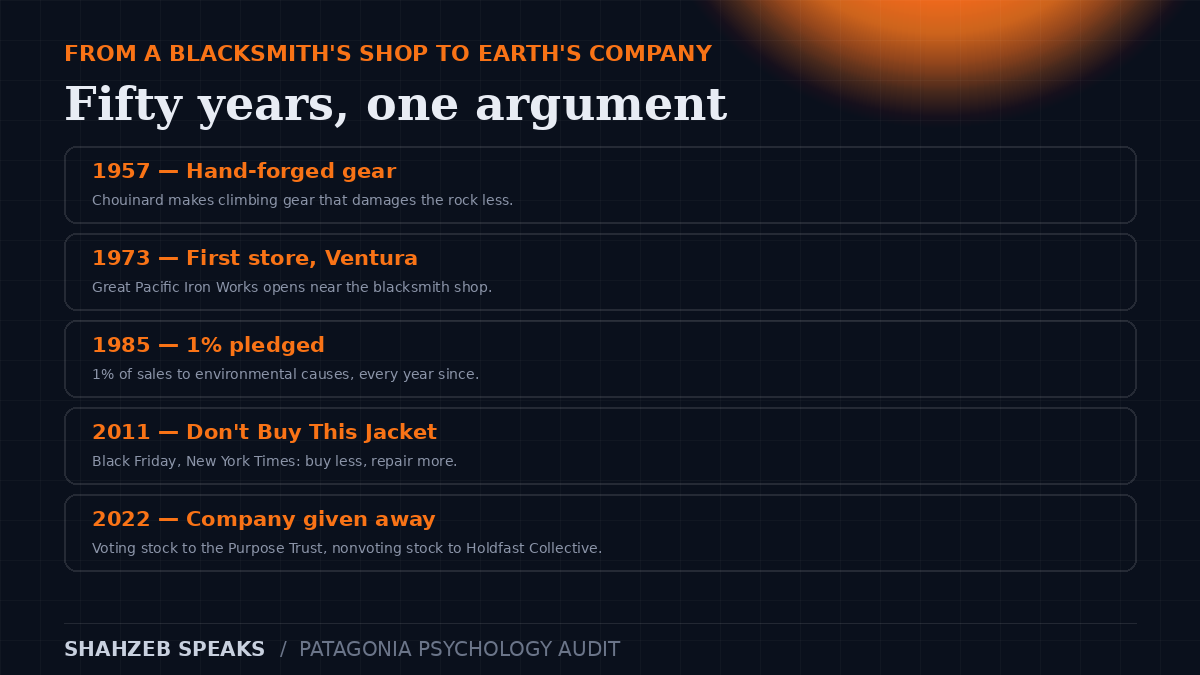
The timeline matters for the psychology, because Patagonia’s persuasion depends on a sequence. A brand that announced “Don’t Buy This Jacket” in its first year would look like a stunt. A brand that said it after decades of repair guarantees, organic cotton and 1% giving looked like a company acting consistently with its own history. Consistency is the currency here: every later claim draws on the earlier ones. When the Chouinard family gave the company away in 2022, it landed because the public had watched the same family make the same argument, at increasing cost to itself, for fifty years.
🪞 Chapter 2: Identity — Buy the Values, Get the Jacket Free
The core psychology principle is identity congruence, sometimes called values-based identity: people adopt products that signal who they are, or who they wish to be. Most outdoor brands sell performance: warmer, lighter, tougher. Patagonia sells membership in a moral story: a person who explores wild places and protects them. The jacket is the uniform of that story, which is why it is worn far from any mountain — including, famously, by finance workers whose outdoors is a commute.
The mechanism is social identity theory (Tajfel & Turner, 1979): we define ourselves partly by the groups we belong to, and we display that belonging with visible markers. A Patagonia fleece is a visible marker that says, without a word, that its wearer cares about the environment and can afford to care expensively. That is also the brand’s first vulnerability, and it is worth naming plainly: the same jacket can signal environmental virtue and wealth at the same time, and customers may be buying the second while believing they bought the first. Patagonia cannot fully control which signal its customers are sending. No brand can.
What Patagonia does unusually well is make the identity costly to fake — for itself. Identity claims are cheap when they cost the claimant nothing. Patagonia’s claims have repeatedly cost it money, attention or control, which is the next chapter’s subject.
🚫 Chapter 3: “Don’t Buy This Jacket” — Anti-Consumption as Costly Signalling
On Black Friday, 25 November 2011, Patagonia ran a full-page advertisement in the New York Times showing its R2 fleece jacket under the headline “DON’T BUY THIS JACKET.” The copy beneath explained the environmental cost of producing the jacket and urged readers to think before buying, and to repair, reuse and recycle what they already owned. On the busiest shopping weekend in America, the brand told people not to shop.
In signalling theory, a costly signal is one that is hard to fake precisely because it costs the sender something. A company that says “we care about the planet” in a sustainability report has signalled cheaply. A company that spends money on a national advertisement telling people not to buy its product has signalled at real cost — or at least at real apparent cost. Customers read that cost as evidence of sincerity, which is why the campaign is still discussed fifteen years later while thousands of green advertisements are forgotten.
And then came the irony that made the campaign legendary: sales reportedly grew by around a third in the year after the ad. Secondary reports put the figure at roughly 30% in the nine months following the ad, and other reports put 2012 revenue at $543 million. I report these as reported figures, not audited financials, but the direction is not in doubt: telling people not to buy did not hurt sales. It helped them. That is the paradox at the heart of anti-consumption marketing. Refusing to sell, performed credibly, can be the most effective way of selling — because it converts a purchase into a statement of restraint. The customer who buys the jacket after reading the ad is not just buying warmth. They are buying proof that they thought about it first.
There is a darker reading, and it should be stated. If anti-consumption marketing increases consumption, is it still anti-consumption? Patagonia’s honest answer, implied by its later actions, is that it cannot control what customers do with the message — it can only control what it does itself. That is why the later chapters, repair and ownership, matter more than the advertisement. An ad can be a stunt. A repair programme and a company giveaway are harder to fake.
🔧 Chapter 4: Worn Wear and Repair — The Endowment Effect, Extended
Worn Wear is Patagonia’s trade-in and resale programme: customers bring back used gear, receive store credit, and Patagonia repairs and resells the items. Its roots lie in the Common Threads Recycling Program launched in 2005, which encouraged repair and created a second-hand market for Patagonia garments; the Worn Wear trade-in and exchange programme was created in 2017. Alongside it sits the Ironclad Guarantee: Patagonia has offered free repairs on its products since the beginning, a company claim widely reported and central to its pitch.
The psychology here is the endowment effect (Thaler, 1980; Kahneman, Knetsch & Thaler, 1990): people value things more once they own them, and they dislike giving them up. Repair extends that effect across years. A jacket that has been repaired twice is not just a jacket; it is a jacket with a history, and its owner has invested effort and stories in it. Psychologists also call the effort side of this the IKEA effect — we value what we have worked on — and repair is effort made visible: patches, stitches, a garment that carries its own biography.
For the business, the effect is lock-in without a loyalty card. Trade-in credit can only be spent at Patagonia. A repaired garment stays in the wardrobe instead of being replaced by a competitor. And every repaired item resold is a new customer acquired at a lower price point, who may later buy new. It is also, genuinely, less wasteful than throwing the garment away. Both things can be true at once: a programme can reduce waste and increase loyalty. The test is whether the programme would survive if it stopped increasing loyalty. Patagonia’s repair offer has survived for decades, which is evidence — not proof, but evidence — that waste reduction is not only a cover story.
💰 Chapter 5: Giving as a Habit — 1% Since 1985, $10 Million in a Day
Commitment and consistency (Cialdini, 1984) is the principle that once people — or companies — take a public stand, they work to stay consistent with it. Patagonia’s stand is unusually old and unusually public. Since 1985, the company has pledged 1% of sales to the preservation and restoration of the natural environment. In 2002, Chouinard and Craig Mathews, owner of Blue Ribbon Flies, created 1% for the Planet, a nonprofit to encourage other businesses to do the same. On its own site, Patagonia states it has awarded over $140 million in cash and in-kind donations to grassroots environmental groups. I attribute that figure to the company: it is a company claim, from a page whose older version showed a lower figure, and it should be read as such.
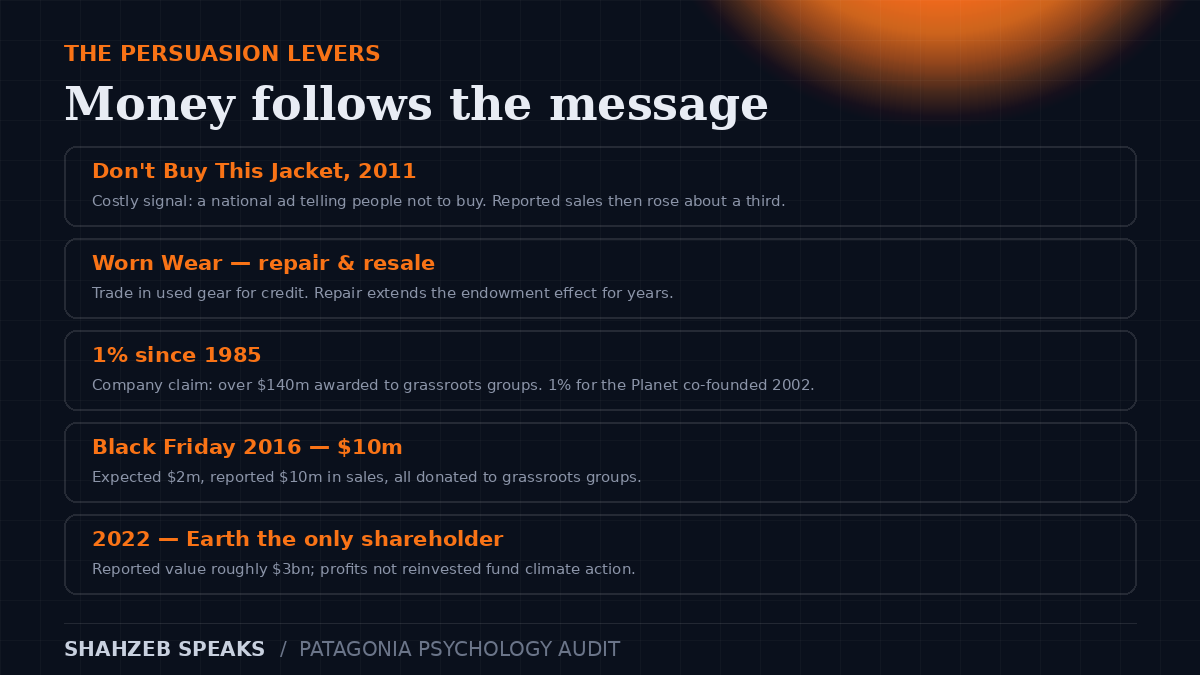
The habit produced its most dramatic moment on Black Friday 2016. Patagonia pledged to donate 100% of its global retail and online Black Friday sales to grassroots environmental nonprofits. It expected about $2 million. It reported a record $10 million in sales that day — five times the expectation — and donated it to hundreds of grassroots groups. The pattern is now familiar: a public commitment, a cost borne in public, and a customer response that rewards the cost. Each cycle makes the next commitment easier to believe and harder to break.
There is also a quieter mechanism at work: reciprocity. Patagonia gives first — grants to grassroots groups, an Action Works platform connecting customers with environmental nonprofits, free repairs — and customers repay with loyalty. Reciprocity works best when the gift feels genuine rather than transactional, and Patagonia’s gifts are unusual in that they are mostly given to third parties (grassroots groups, the planet) rather than to the customer directly. That indirection is part of the power: a gift to a cause feels less like a bribe than a discount does.
🌍 Chapter 6: Giving the Company Away — The Signal Nobody Can Copy Cheaply
In September 2022, the Chouinard family transferred 100% of Patagonia’s ownership: 100% of the voting stock went to the newly created Patagonia Purpose Trust, tasked with protecting the company’s mission and independence, and 100% of the nonvoting stock went to the Holdfast Collective, a nonprofit dedicated to fighting the climate crisis and protecting undeveloped land. Every dollar not reinvested in the business would be distributed as a dividend to protect the planet. Chouinard’s line for it was: “Earth is now our only shareholder.”
Contemporaneous reporting valued the company at roughly $3 billion and put annual profits at around $100 million per year. I report both as reported figures, not as audited values. What matters for the psychology is not the exact valuation but the structure: the family gave up the right to sell the company, take it public, or pass its wealth to heirs in the usual way. An IPO or a sale had been considered and rejected, Chouinard said, because a new owner could not be trusted to maintain the company’s values or keep its people employed. The transfer was described as irrevocable.
This is costly signalling at its maximum. A competitor can copy the advertisement. A competitor can copy the repair programme, given time and money. A competitor cannot cheaply copy giving away the company. That inimitability is what makes the 2022 transfer the strongest trust-building move in this audit — and also the one that raises the bar for everyone else. After 2022, every Patagonia sustainability claim is read against a background fact: this family gave the company away. Every competitor’s claim is read against the opposite background: they have not.
It also changed the customer’s relationship to the brand. Buying from Patagonia after 2022 is, in a small but real sense, donating through a purchase: profits flow to environmental causes rather than to private shareholders. That reframes the premium price. A $200 fleece is no longer only a fleece; it is a fleece plus a contribution. Whether that reframing is accurate in every accounting sense matters less, psychologically, than that it is structurally true: there are no private shareholders left to take the profit instead.
⚠️ Chapter 7: The Dark Side — Lawsuits, Trademarks and the Price of the Halo
A halo this bright attracts scrutiny, and Patagonia’s record is not unblemished. This chapter keeps every legal matter at its exact status as of 22 October 2026. Nothing here is a finding against Patagonia unless stated as one.
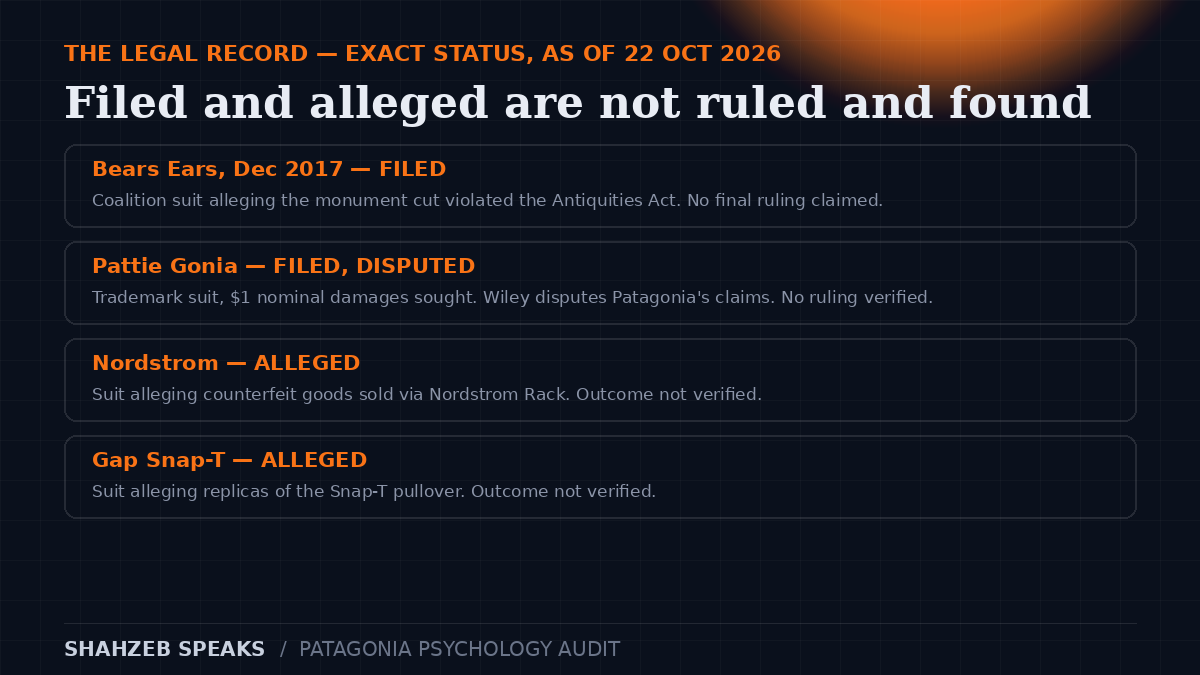
Bears Ears — lawsuit filed, December 2017. On 4 December 2017, President Trump proclaimed a reduction of Bears Ears National Monument by about 85%, from about 1.35 million acres to about 200,000 acres. Within days, Patagonia — through Patagonia Works — joined a coalition lawsuit filed in federal court in Washington, DC, alleging the reduction violated the Antiquities Act, and replaced its homepage with the message “The President Stole Your Land.” I state this as a lawsuit filed and an allegation made. I have not verified a final ruling, and this audit does not claim Patagonia won.
Pattie Gonia — lawsuit filed, allegations disputed. Patagonia filed a federal trademark lawsuit against performer Wyn Wiley, known as Pattie Gonia, alleging trademark infringement and breach of a prior agreement over use of the Patagonia name and logo on products, and seeking nominal damages of $1. Wiley disputes Patagonia’s claims. That is the exact status as reported in 2026 coverage: a lawsuit filed, allegations made, claims disputed, no final ruling verified by this audit. The case is awkward for the brand regardless of its legal merits: a company famous for activism suing a climate activist, even for $1, reads as a contradiction to many observers, and the reputational cost is real even if the legal position is sound.
Nordstrom and Gap — allegations, outcomes not verified. Patagonia alleged that Nordstrom Rack sold counterfeit Patagonia products, filing a lawsuit alleging trademark infringement, unfair competition and counterfeiting, after fake goods were said to have been found in 2023. Separately, Patagonia sued Gap Inc., alleging that Gap sold replicas of its Snap-T pullover. Both are allegations. I have not verified their outcomes, and this audit claims none.
Beyond the courtroom, the structural criticism is simpler and harder to answer: Patagonia still makes and sells new clothing, at premium prices, in a global industry with a large environmental footprint. Its own footprint is real, even if it is smaller per garment or more honestly reported than competitors’. Premium pricing also limits who can participate in the identity: a jacket that signals virtue at $200 excludes the customers who cannot pay $200, which means the brand’s community is, in part, a community of affluence. And the company’s own donation figures, as noted, vary across its own pages over time — a reminder to treat company claims as claims, even from a company with a strong record.
🇵🇰 Chapter 8: What Pakistani brands should — and shouldn’t — copy
Copy the structure, not the slogans. What transfers is the sequence: make a public commitment that costs something, keep it for years, then make a bigger one. A Pakistani apparel or food brand that donates 1% of sales quietly for five years, publishes the recipients, and repairs its own products will earn more trust than one that launches a “Don’t Buy This” campaign in its first year. The campaign only works as the visible tip of a history.
Do not copy the premium-price identity without the substance behind it. Patagonia’s price is defensible to its customers because the repair guarantee, the giving record and the ownership transfer give the price a story. A high price with only a green label is the definition of greenwashing, and customers in Pakistan — as everywhere — are learning to spot it.
Do copy Worn Wear’s logic in local form: trade-in, repair and resale are well suited to markets where durability and value-for-money already matter, and where a repair network can be a genuine service rather than a marketing line. Do not copy the trademark aggression: suing a small creator who admires your brand is a fast way to spend decades of goodwill in a week, as the Pattie Gonia coverage shows.
🛍️ Chapter 9: The Patagonia Shopper, Step by Step
Walk through the experience as a customer and the psychology stacks in order. First, identity: the customer arrives already half-sold by the brand’s reputation and by the people they have seen wearing it. Second, reassurance: the repair guarantee and the giving record lower the guilt of a premium purchase — the price is reframed as a contribution. Third, the anti-consumption test: the customer is invited, implicitly, to ask whether they need the item at all, which paradoxically makes buying feel considered rather than impulsive. Fourth, ownership: after purchase, Worn Wear and repair keep the garment — and the relationship — alive for years, and trade-in credit brings the customer back. Fifth, community: activism, grants and campaigns give the customer a story to tell about the purchase that is not about the purchase. Each step is documented above. None of them requires the customer to believe anything unverified.
📊 Chapter 10: Psychology Scorecard
| Dimension | Score | Verdict |
|---|---|---|
| Values & identity congruence | 95 | The mission is the product; the product is the uniform. |
| Anti-consumption credibility | 93 | “Don’t Buy This Jacket” still works because it cost something. |
| Repair & resale lock-in (Worn Wear) | 90 | Trade-in credit and repair keep customers for years. |
| Transparency & proof | 85 | Long giving record, but company figures vary across pages. |
| Activism & community mobilisation | 92 | Bears Ears, Action Works and grants turn buyers into participants. |
| Price & accessibility | 64 | Premium pricing excludes many who share the values. |
| Trademark & activist-image tension | 68 | The Pattie Gonia suit shows the halo’s legal cost. |
| Scrutiny resilience | 71 | Still sells new clothing; footprint claims invite fair challenge. |
Overall: 95 + 93 + 90 + 85 + 92 + 64 + 68 + 71 = 658 ÷ 8 = 82.25 → 82/100.
✅ Chapter 11: Balance sheet & prescription
On the credit side: a fifty-year consistent story, a repair and resale system that genuinely extends product life, a giving record that predates the marketing of giving by decades, and an ownership transfer that no competitor can copy cheaply. On the debit side: premium pricing that limits access, a footprint that still exists, company figures that should be checked rather than quoted, and trademark enforcement that sits uneasily with an activist image.
The prescription for Patagonia is narrow: publish one consistent, dated giving and footprint ledger and keep it updated, so that supporters do not have to reconcile conflicting pages; and be visibly more restrained in trademark disputes with small creators and activists, where the legal win is rarely worth the reputational loss. For other brands, the prescription is broader and is given in Chapter 8: earn the slogan with a history before you print it.
📝 Final Verdict
Patagonia is the strongest trust brand in this audit series precisely because its psychology is not a trick laid over a product. It is a structure: identity, costly signals, repair, giving, and finally ownership, each step making the previous one harder to dismiss. The halo is real, but it is not magic, and it is not free of tension — the price excludes, the footprint remains, and the lawyers sometimes contradict the activists. A customer who buys Patagonia is buying a good jacket and a story that has, unusually, been paid for by the storyteller.
Psychology Score: 82/100 — The brand that told you not to buy it, then gave itself away, and was believed because both acts cost it something real.
If your brand wants trust that survives scrutiny, the Patagonia lesson is not “say less” or “say more”. It is: make a commitment that costs you something, keep it in public for years, and let the record do the persuading.
For more brand psychology, see my audits of Zara and IKEA, and for the field behind this work, my writing on industrial psychology in Pakistan.
📚 References & Sources
- Associated Press (14 September 2022). Patagonia founder gives company away to environmental trusts (Purpose Trust / Holdfast Collective transfer).
- Cialdini, R. B. (1984). Influence: The Psychology of Persuasion. HarperCollins.
- IMD (2015). Patagonia’s sustainability strategy: Don’t buy our products (case study; Common Threads, 2011 advertisement, reported ~30% sales growth in the nine months after the ad).
- Kahneman, D., Knetsch, J. L., & Thaler, R. H. (1990). Experimental tests of the endowment effect and the Coase theorem. Journal of Political Economy, 98(6), 1325–1348.
- Patagonia. 1% for the Planet pages (company claim: 1% of sales pledged since 1985; over $140 million awarded in cash and in-kind donations).
- Patagonia Works press pages (2016). Black Friday sales report: $10 million, against a $2 million expectation, donated to grassroots environmental groups.
- Reports of Patagonia’s federal trademark lawsuit against Wyn Wiley (“Pattie Gonia”) (2026 coverage: lawsuit filed, $1 nominal damages sought, claims disputed).
- Reports of Patagonia’s coalition lawsuit over Bears Ears National Monument (filed December 2017, alleging violation of the Antiquities Act).
- Tajfel, H., & Turner, J. C. (1979). An integrative theory of intergroup conflict. In W. G. Austin & S. Worchel (Eds.), The Social Psychology of Intergroup Relations.
- Thaler, R. (1980). Toward a positive theory of consumer choice. Journal of Economic Behavior & Organization, 1(1), 39–60.
Key Findings
- Founded 1973 in Ventura, California; since 1985 Patagonia has pledged 1% of sales to environmental causes, and in 2002 co-founded 1% for the Planet
- On Black Friday 2011 Patagonia ran the "Don't Buy This Jacket" New York Times ad; reported sales then rose by around a third
- On Black Friday 2016 Patagonia reported $10 million in sales against a $2 million expectation, and donated it all to grassroots environmental groups
- In September 2022 the Chouinard family transferred 100% of ownership: voting stock to the Patagonia Purpose Trust and nonvoting stock to the Holdfast Collective
- In December 2017 Patagonia joined a coalition lawsuit FILED alleging President Trump's Bears Ears reduction violated the Antiquities Act — no final ruling verified
- Patagonia FILED a federal trademark lawsuit against Wyn Wiley ("Pattie Gonia") alleging infringement and breach of agreement, seeking $1 nominal damages; Wiley DISPUTES the claims and no final ruling is verified
Overall Psychology Score
Patagonia scores 82/100 in our comprehensive psychology audit covering consumer behavior strategies, UX design principles, and psychological marketing effectiveness.
The detailed dimension scores are in the audit's Psychology Scorecard chapter.
RevolutionaryMuhammad Shahzeb
MSc Industrial Psychologist, specializing in consumer behavior, UX psychology, and brand strategy analysis. Helping brands understand the psychology behind their success.
About Muhammad Shahzeb →