IKEA Psychology Audit — The Maze, the Meatballs and the Furniture You Love Because You Built It
A psychology audit of IKEA, the world's largest furniture brand. How the one-way store route shapes what you buy, why the IKEA effect makes self-assembled furniture feel more valuable, how a few visible prices create a low-price image for the whole store, why the meal at the exit matters, and where the model tips into frustration, overspending and disposable furniture. With lessons for Pakistani retailers.

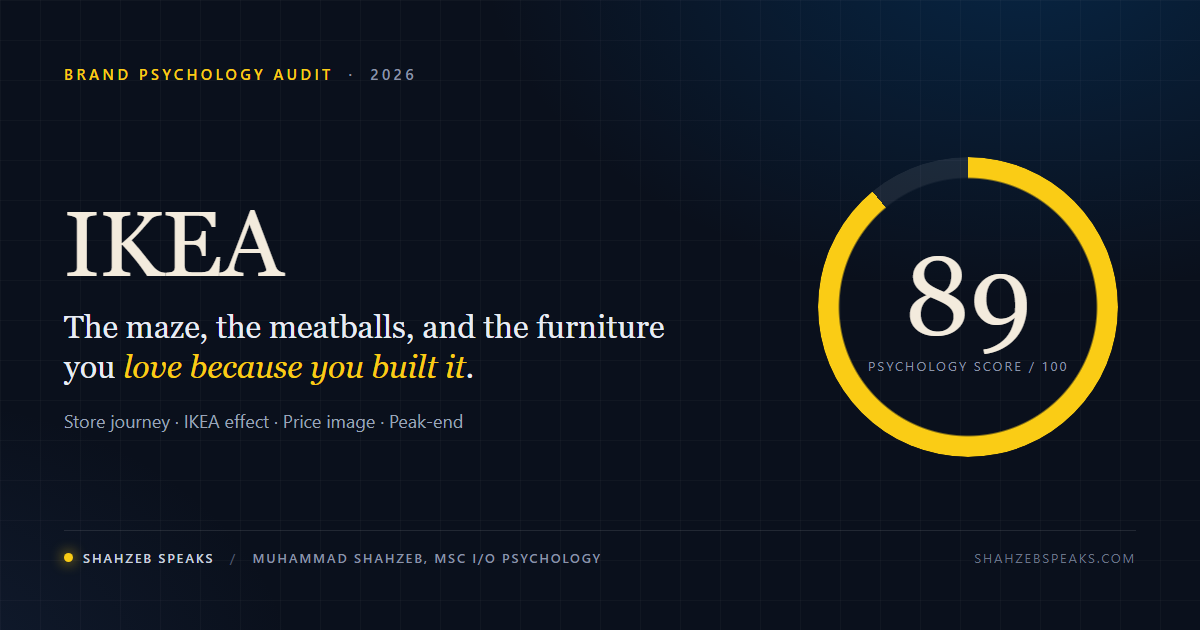
89 / 100
Overall consumer behavior effectiveness
Brand Overview
- Brand nameIKEA
- Founded1943
- HeadquartersDelft, Netherlands (Inter IKEA Group); founded in Sweden
- IndustryRetail
- Websitewww.ikea.com ↗
Psychology Techniques Identified
- 01The Gruen Transfer (Store Layout)
- 02Mental Simulation Through Room Settings
- 03The IKEA Effect
- 04Endowment Effect
- 05Price Image Management
- 06Price Anchoring
- 07Peak-End Rule
- 08Sunk Cost of Time
- 09Country-of-Origin Effect
- 10Distinctive Brand Assets
- 11Choice Architecture & Curated Sets
- 12Impulse Purchasing at Low-Risk Price Points
Full Psychology Audit Report
In this audit
You go to IKEA for a bookshelf. You follow the arrows through a living room, a kitchen, a child’s bedroom and a home office you did not ask to see. Somewhere around the bathrooms you realise you have no idea where the exit is. Two hours later you are at the tills with the bookshelf, six candles, a plant, a lamp, a set of frames and a bag of tea lights you will never use. On the way out you buy a hot dog and feel, somehow, that the day was a bargain. Then you spend Sunday building the shelf, and love it more because you did.
IKEA is the world’s largest furniture brand, with total retail sales of EUR 44.6 billion in its 2025 financial year and around 915 million store visits through its largest franchisee alone. Over two years it invested in cutting prices by around 10%, which it says lifted volumes and customer numbers. It sells furniture that customers must carry home and assemble themselves, and they thank it for the privilege.
I am an Industrial and Organizational Psychologist, and this audit looks at IKEA the way a psychologist would: the store as a designed journey, the price signals that make everything feel cheap, the effect that carries IKEA’s name, the meal that ends the visit, and the costs hidden inside all that efficiency. IKEA does not operate in Pakistan, which makes it a useful lesson for Pakistani retailers: these are the techniques you will increasingly see copied, and compete against.
“IKEA sells the one thing furniture shops never used to sell: a day out that ends with you doing the work. The maze decides what you see, the prices decide what you think it costs, and the assembly decides how much you love it.”
— Brand Psychology Analysis, ShahzebSpeaks
📋 Brand Overview: IKEA at a Glance
| Brand | IKEA (brand owner Inter IKEA Group; largest retailer and franchisee Ingka Group) |
| Founded | 1943, in Sweden, by Ingvar Kamprad, then aged 17 |
| Name | Ingvar Kamprad’s initials, plus Elmtaryd (the family farm) and Agunnaryd (his home village) |
| Total Retail Sales | EUR 44.6 billion in FY25 (down 1.0% from EUR 45.1 billion; 0.3% down in local currencies) |
| Visits | Around 915 million store visits in FY25 at Ingka Group, IKEA’s largest retailer |
| Price Strategy | About 10% lower prices over two years; the company reports a 3% rise in both volumes and customers in FY25 |
| Signature Assets | Blue and yellow, the flat pack, Swedish product names, the one-way store, the restaurant and meatballs, the BILLY bookcase |
| Psychological Code | You’ll love it more because you built it |
| Psychology Score | 89 / 100 — ⚡ High Impact |
📜 Chapter 1: The History — From a Teenager’s Mail-Order Business to 915 Million Visits (1943–2026)
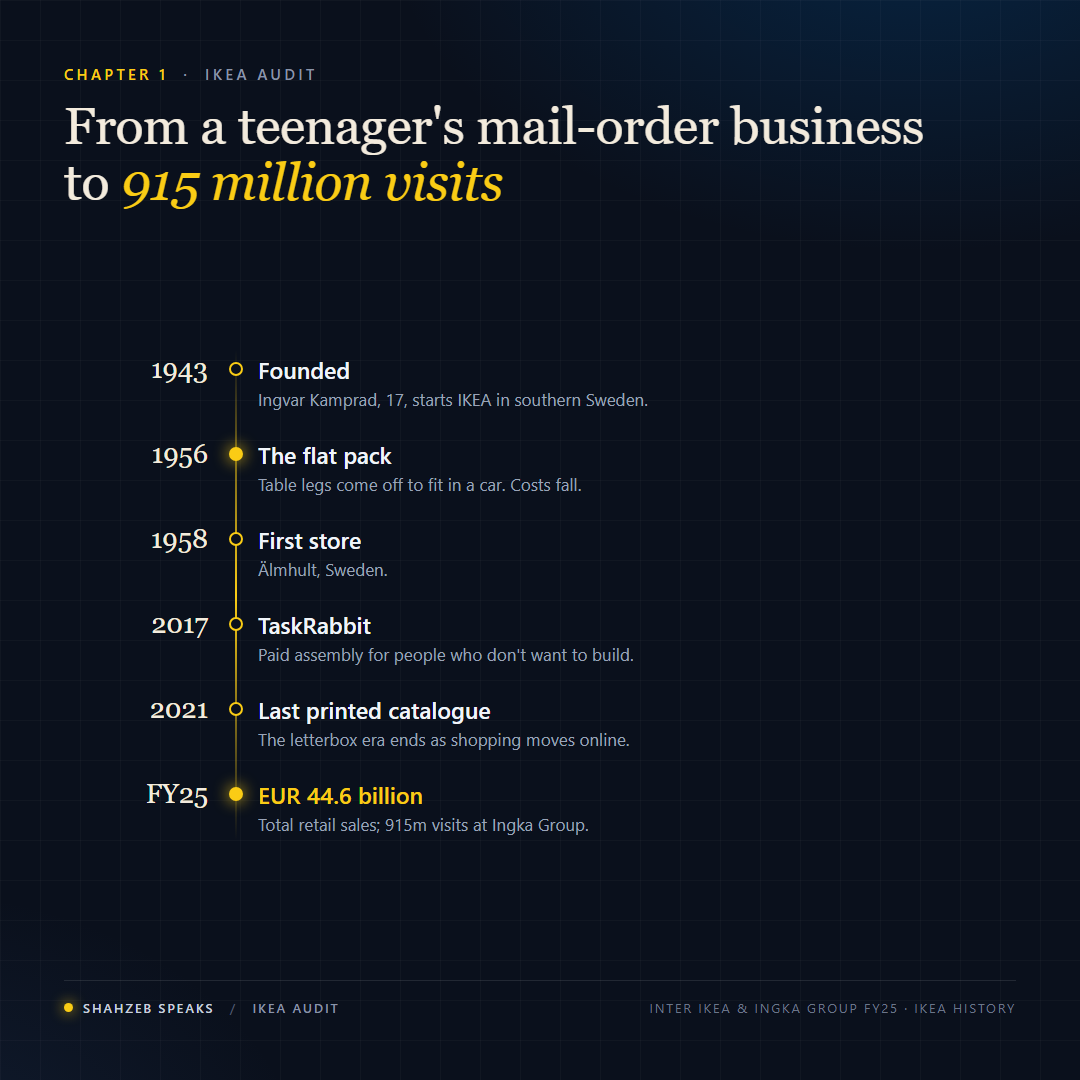
📮 1943: A 17-year-old and a mail-order business
Ingvar Kamprad founded IKEA in 1943 in southern Sweden, selling small goods by mail order. Furniture came a few years later. The low-cost, rural origin became part of the brand’s identity: thrift, practicality and the idea that good design should not be only for the rich.
📦 1956: The flat pack
According to IKEA’s own history, the flat pack idea emerged when an employee removed the legs of a table so it would fit in a car. Flat packs cut shipping and storage costs dramatically, and they shifted assembly, and much of the transport, to the customer. That single decision created both IKEA’s low prices and, as Chapter 3 explains, one of its most powerful psychological effects.
🏬 1958: The first store
The first IKEA store opened in Älmhult, Sweden, in 1958. Over the following decades the format grew into the large blue-and-yellow warehouse store with a fixed route, a restaurant and a self-serve warehouse that defined the brand globally.
📚 The catalogue era, and its end
For decades, the IKEA catalogue was one of the most widely distributed printed publications in the world. IKEA ended the printed catalogue in 2021 as shopping moved online, closing an era in which the brand’s biggest marketing tool arrived through the letterbox once a year.
💶 2024–2026: Cutting prices in a hard market
In a period of high living costs, IKEA chose to invest in lower prices rather than protect margins. In FY25 total retail sales were EUR 44.6 billion, slightly down, while the company reports rising volumes and customer numbers after lowering prices by about 10% over two years. Chapter 4 explains why price perception is so central to the brand.
🧭 Chapter 2: The Maze — A Store Designed as a Journey
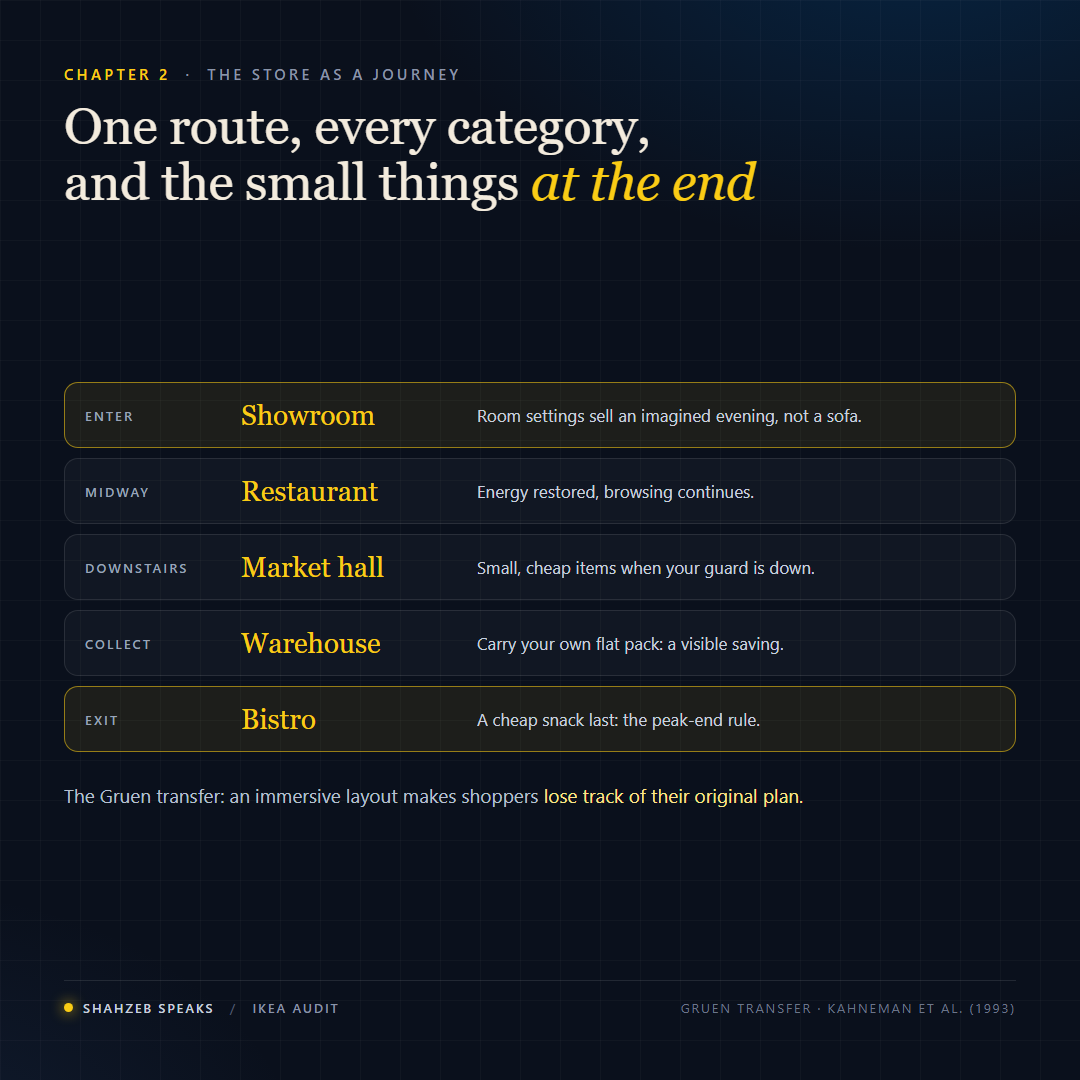
The classic IKEA store is built around a single guided route. You enter upstairs into the showroom, follow the path through room after room, pass the restaurant, go down into the market hall of small items, collect flat packs from the warehouse, pay, and leave past the bistro. Shortcuts exist, but they are not obvious.
The Gruen transfer
Retail designers talk about the Gruen transfer, named after the shopping-mall architect Victor Gruen: the moment when a shopper, surrounded by a deliberately immersive layout, loses track of their original plan and becomes more open to unplanned purchases. IKEA’s path is widely described as a textbook example. Alan Penn, a professor of architecture at University College London who has studied IKEA’s layout, has been widely quoted describing the maze as something that makes you give up control of your route, and with it some control of your spending.
Room settings sell the imagined life
The showroom does not display a sofa. It displays an evening in a flat. Complete room settings help people imagine the product in their own life, which is far more persuasive than a product on its own. This is a form of mental simulation: research on consumer imagery suggests that vividly imagining using a product increases the intention to buy it.
Everything you pass is a chance to add
Because the route passes every category, every customer sees everything. A shopper who came for a bookshelf is shown bedding, lighting, storage and kitchenware in the context of a home. The market hall, reached after the showroom, then offers small, cheap items: candles, frames, plants, glasses. These are low-risk decisions that feel like small treats, made at a point in the visit when shoppers are tired and have already decided the day was worth it.
Time spent becomes a reason to spend
A visit to IKEA commonly takes hours. After investing that much time, leaving with only the one item you came for can feel like a wasted trip. This is the same sunk cost logic I described in the Costco audit, applied to time rather than a membership fee.
🔨 Chapter 3: The IKEA Effect — You Love It Because You Built It
IKEA is one of very few companies to have a psychological effect named after it. In 2012, Michael Norton, Daniel Mochon and Dan Ariely published a study in the Journal of Consumer Psychology showing that people value products more when they have assembled them themselves. Participants who built IKEA storage boxes were willing to pay more for them than for identical, pre-assembled boxes, and valued their own creations close to those of experts.
The research also found an important condition: the effect depends on completion. People who started building but did not finish did not show the same increase in valuation. The love comes from the successful effort, not from effort alone.
This turns IKEA’s biggest cost-saving decision into a loyalty mechanism. Flat packs save IKEA shipping and assembly costs. Then the effort customers invest in building the furniture makes them value it more, and feel more attached to it and to the brand. I explained the mechanism in detail in my article on the IKEA effect with examples, and it connects closely to the endowment effect: we overvalue what is ours, and even more what we made.
The honest caveat is in the condition. Assembly that fails, frustrates or breaks does not create love; it creates resentment. Chapter 8 covers that side.
🏷️ Chapter 4: Price Signals — Why Everything Feels Cheap
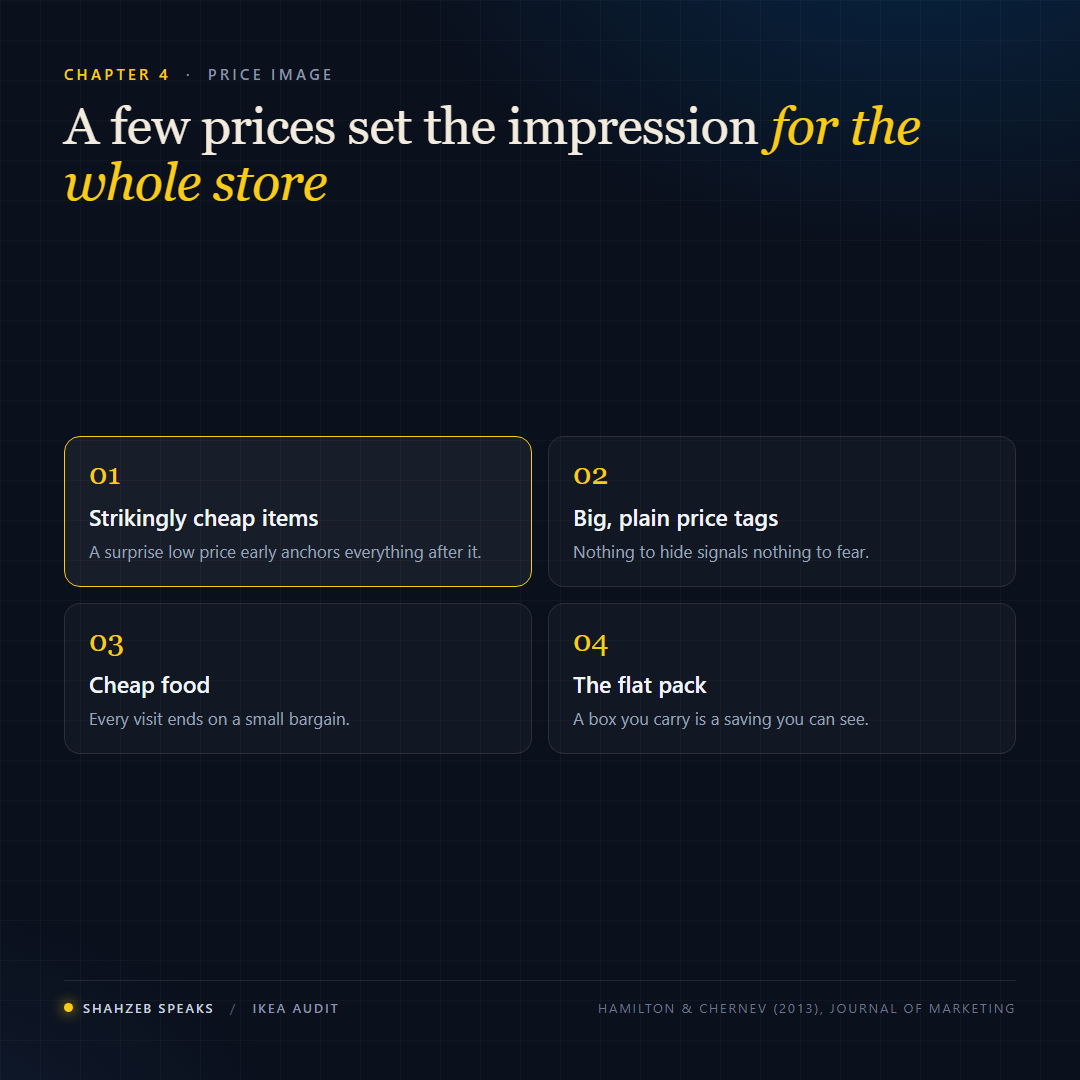
Shoppers do not know the price of most furniture, so they form an overall impression of how expensive a store is from a few highly visible signals. Research on price image, including Hamilton and Chernev’s 2013 review in the Journal of Marketing, shows that this overall impression shapes behaviour more than the actual prices of most items.
IKEA manages its price image carefully.
- Very low-priced signature items. Industry commentary describes IKEA placing a few strikingly cheap, well-known items prominently in stores. A surprisingly cheap product early in the visit works as an anchor for how cheap everything else is likely to be.
- Large, clear price tags. Prices are displayed prominently and simply, which signals that the store has nothing to hide about price.
- Cheap food. Low-priced meals and snacks reinforce the sense of value every visit.
- The flat pack itself. A box you carry out yourself is a visible sign that you are not paying for assembly or delivery.
- Public price cuts. The recent investment in lowering prices was announced loudly, strengthening the value message at a time when customers were most price-sensitive.
The result is that customers often leave feeling they spent wisely, even when the total bill is much higher than planned, because the price signals they remember were low.
🍽️ Chapter 5: The Restaurant and the Exit — Food as a Peak and an End
IKEA’s restaurant and exit bistro are often described as a way to keep hungry shoppers in the store longer. That is true, but the psychology goes further.
The peak-end rule. Daniel Kahneman and colleagues showed in a 1993 study that people judge an experience largely by its most intense moment and by how it ends, rather than by its average. A long, tiring shopping trip that ends with a cheap, pleasant snack is remembered more kindly than one that ends at a crowded till. IKEA places food exactly where the visit ends.
A recovery point. The restaurant sits partway along the route, where shoppers are tired. Eating restores energy and mood, so they continue browsing rather than leaving, which is valuable for a store whose layout depends on people walking through every section.
Identity and memory. Swedish meatballs have become part of the brand’s identity. The food turns a furniture shop into a family outing and gives people a reason to visit even when they are not buying anything large, which keeps IKEA in their habits.
🇸🇪 Chapter 6: Swedishness as a Brand Asset
IKEA’s identity is strongly tied to Sweden: the blue and yellow of the Swedish flag, Swedish product names, Swedish food and a design language built on simplicity and practicality.
Country-of-origin effect. Consumers use a product’s country of origin as a shortcut to judge quality and style. Scandinavian design is associated with clean lines, functionality and a relaxed, democratic idea of good living, which lends IKEA’s products a design credibility they might not earn on price alone.
Distinctive names. Product names such as BILLY, POÄNG and KALLAX are unusual, memorable and consistent across markets. They make products easier to remember and talk about, and give the catalogue a personality no numbered product code could have.
Distinctive assets. Blue and yellow, the flat pack and the store format are recognised instantly worldwide, which in Byron Sharp’s framework is one of the most valuable things a brand can own.
🧠 Chapter 7: Reduced Choice Anxiety — Help With Hard Decisions
Furniture is an expensive, long-term purchase with many options, the kind of decision where people often feel overwhelmed. I covered the research in detail in my article on choice overload: large choice sets are hardest when options are complex and people do not know what they want.
IKEA’s room settings are, in effect, a solution to that problem. They pre-select coordinated combinations, so a customer who does not know what they want can choose a whole look rather than assembling one from hundreds of separate decisions. Clear labels, measurements and consistent product families reduce the effort of comparison further. The store feels full of choice, but much of the choosing has been done for you.
⚠️ Chapter 8: The Dark Side — Frustration, Waste and Manipulation
🔧 When assembly goes wrong
The IKEA effect depends on successful completion. When instructions are unclear, parts are missing, or furniture wobbles, the effort that should create attachment creates frustration instead. IKEA’s acquisition of TaskRabbit in 2017, which lets customers pay someone else to assemble their furniture, is in part an acknowledgement that not everyone wants the effort.
🛒 Unplanned spending
A store designed to show every customer every category, with small cheap items placed where they are tired, is designed to increase unplanned purchases. For many shoppers the result is a pleasant day and useful items. For others it is overspending and clutter. The line between helpful display and manipulation is the point at which people buy things they did not want and do not use.
♻️ Disposable furniture
Low prices can encourage people to treat furniture as temporary, replacing rather than repairing. That creates environmental costs, including waste and the timber supply chain. IKEA has invested in sustainability programmes and buy-back schemes, but the underlying tension between very low prices and durable, sustainable goods remains.
🗺️ Feeling trapped
Some shoppers experience the one-way route as frustrating rather than pleasant, especially when they only want one item. The maze works on average; for a customer in a hurry it can feel like being held captive.
⚔️ Chapter 9: Competitive Positioning
| Competitor | Psychological Position | Where IKEA Wins or Loses |
| Online furniture sellers | Convenience, huge range, home delivery | IKEA wins on experience and trust in quality; loses on convenience for people who hate the store trip |
| Traditional furniture shops | Solid wood, craftsmanship, delivered assembled | IKEA wins on price and design; loses on perceived durability |
| Discount and fast-furniture brands | Lowest possible price | IKEA wins on design credibility and the store experience |
| Second-hand marketplaces | Cheaper, sustainable, often IKEA’s own products resold | A growing competitor, partly built on IKEA’s own brand recognition |
| Local retailers copying the model | Room settings, affordable design, flat packs | The model is widely imitated; IKEA’s scale and brand are harder to copy |
🇵🇰 Chapter 10: What Pakistani Retailers Can Learn
IKEA does not operate in Pakistan, but its principles apply to furniture and home retail here, whether in a showroom or on Instagram.
- Show rooms, not products. A photo of a complete, styled room sells a sofa better than a sofa on a white background. Shoppers need to imagine the life, not just the item.
- Anchor with a few visibly great prices. A handful of clearly excellent-value items shapes how customers see the whole range.
- Design the end of the experience. Delivery, installation and after-sales follow-up are where Pakistani furniture buying often goes wrong. A good ending, following the peak-end rule, changes how customers remember the whole purchase.
- Reduce choice anxiety. Offer coordinated sets and clear recommendations rather than asking customers to design everything themselves.
- Use the IKEA effect carefully. Letting customers customise fabrics, colours or configurations can create ownership, but only if the process is easy and the result succeeds.
I review how these principles apply to Pakistani online stores in my conversion work for Pakistani businesses.
📊 Chapter 11: Psychology Scorecard — Detailed Ratings
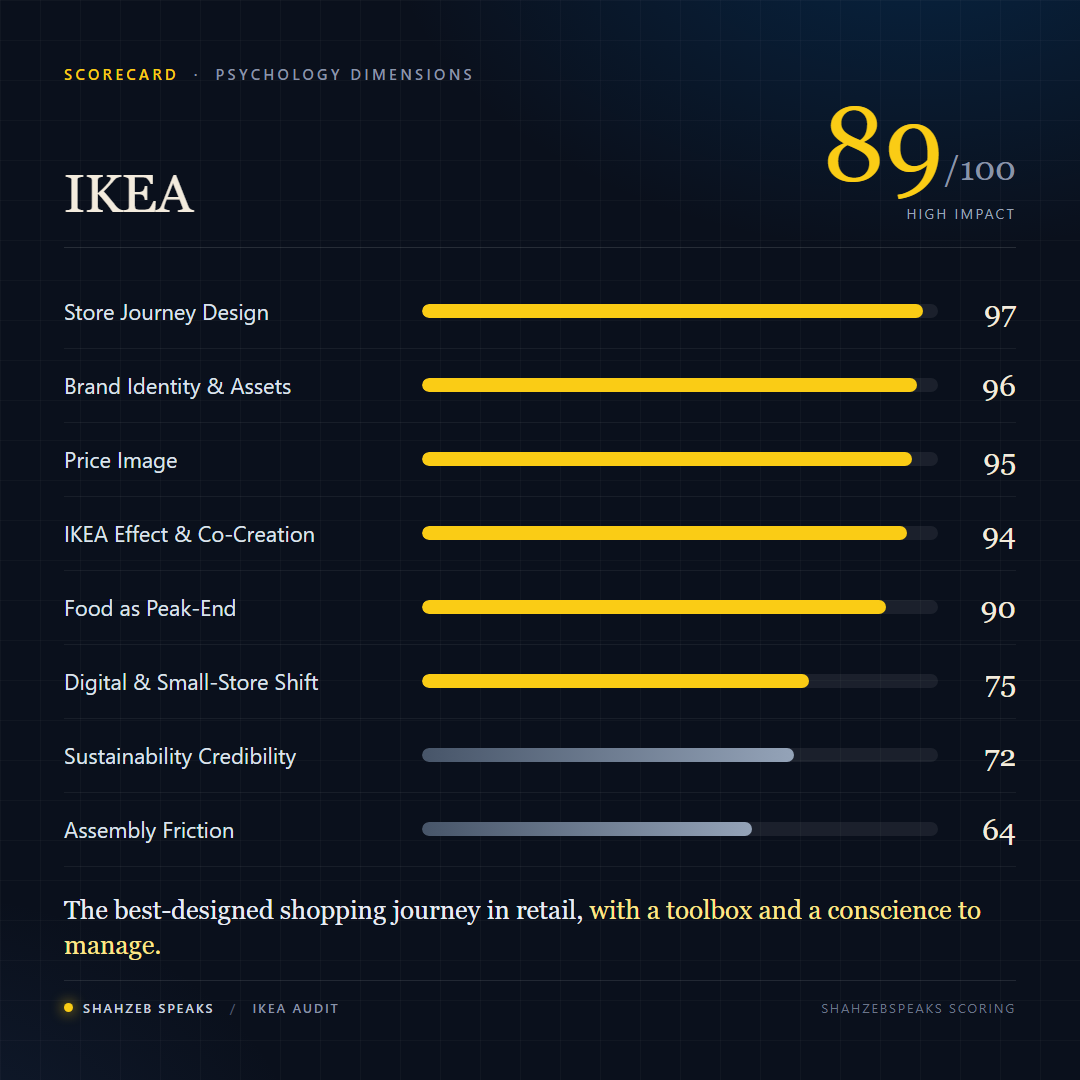
| Psychology Dimension | Score | Verdict |
| Store Journey Design | 97/100 | The most imitated shopping route in retail. |
| Brand Identity & Distinctive Assets | 96/100 | Blue and yellow, Swedish names and the flat pack, recognised everywhere. |
| Price Image | 95/100 | A few visible signals make the whole store feel affordable. |
| IKEA Effect & Co-Creation | 94/100 | Turns a cost saving into attachment, when assembly succeeds. |
| Food as Peak-End | 90/100 | A long, tiring trip that ends well is remembered well. |
| Digital & Small-Store Transition | 75/100 | The magic lives in the big store; online and city formats are still catching up. |
| Sustainability Credibility | 72/100 | Real investment, in tension with low prices and replaceable furniture. |
| Assembly Friction | 64/100 | Where the IKEA effect turns into frustration. |
| OVERALL PSYCHOLOGY SCORE | 89/100 | ⚡ High Impact — the brand that made customers do the work and love it more for it. |
✅ Chapter 12: Balance Sheet & A Psychologist’s Prescription
💪 Psychological Strengths
- The journey: a route that shows every customer every category
- Mental simulation: room settings that sell a way of living
- The IKEA effect: effort that turns into attachment
- Price image: a few visible prices that set the tone for the whole store
- Peak-end design: food where the visit ends
- Distinctive identity: Swedishness, colours, names and the flat pack
⚠️ Psychological Weaknesses
- Assembly failure: the IKEA effect reverses when building goes wrong
- Unplanned spending: a design that can tip from helpful to manipulative
- Disposable perception: low prices encourage replacement over repair
- Time cost: the maze frustrates shoppers who only want one item
- Channel shift: the psychology is strongest in the big store, which fewer people visit as shopping moves online
🔮 The Prescription
- Protect the completion moment. The IKEA effect depends on success. Clearer instructions, better video guides and easy help when something goes wrong turn more assembly attempts into attachment instead of resentment.
- Offer a respectful fast lane. A clearly signed shortcut for customers who know what they want would reduce frustration without undermining the browsing route for everyone else.
- Bring room settings online. Digital tools that let people see coordinated rooms in their own space are the online equivalent of the showroom, and matter more as physical visits decline.
- Make durability part of the value message. Repair parts, buy-back and resale reduce the “disposable furniture” perception and support the sustainability story.
- Keep the prices honest and visible. The price image is IKEA’s most valuable asset. It must match the checkout experience, or customers will start to feel managed rather than helped.
📝 Final Verdict
IKEA’s genius is not any single technique. It is that every part of the business supports the same psychology. The flat pack cuts costs and creates the IKEA effect. The maze shows every product and sells a way of living. A few visible prices make the whole store feel affordable. The food restores energy mid-route and ends the visit on a high. And Swedishness gives all of it a coherent identity recognised around the world.
Its weaknesses sit exactly where its strengths are. Assembly that fails reverses the IKEA effect. A route that increases unplanned spending can tip into manipulation. And low prices, the heart of the brand, sit uneasily with a world asking furniture to last longer.
For retailers in Pakistan and elsewhere, the lesson is not to copy the maze. It is to understand what IKEA understood: people do not buy furniture; they buy the home they imagine, at a price they believe is fair, and they value most what they helped to create.
Psychology Score: 89/100 — IKEA earns elite marks for store journey design (97), brand identity (96), price image (95), the IKEA effect (94) and food as peak-end (90), held back by digital and small-store transition (75), sustainability credibility (72) and assembly friction (64). The brand that made customers do the work, and love it more because they did.
🧠 Want a Psychology Audit for Your Store or Website?
I’m Muhammad Shahzeb, an MSc Industrial Psychologist and web developer. I audit store journeys, product pages and checkouts through consumer psychology, including the price signals and choice design that decide whether a visitor buys.
📚 References & Sources
- Inter IKEA Group. “IKEA retail sales figures for FY25” and “Inter IKEA Group reports resilient FY25 results.” October 2025.
- Ingka Group. “IKEA serves more customers and increases volumes in a challenging year.” FY25 results.
- Ingka Group. “IKEA makes a major investment in affordability, lowering prices on hundreds of products.”
- IKEA. “History of IKEA” and “The year in review FY25.” ikea.com
- Norton, M. I., Mochon, D., & Ariely, D. (2012). “The IKEA effect: When labor leads to love.” Journal of Consumer Psychology, 22(3), 453-460.
- Kahneman, D., Fredrickson, B. L., Schreiber, C. A., & Redelmeier, D. A. (1993). “When more pain is preferred to less: Adding a better end.” Psychological Science, 4(6), 401-405.
- Hamilton, R., & Chernev, A. (2013). “Low prices are just the beginning: Price image in retail management.” Journal of Marketing, 77(6), 1-20.
- Tversky, A., & Kahneman, D. (1974). “Judgment under uncertainty: Heuristics and biases.” Science, 185(4157), 1124-1131.
- Chernev, A., Böckenholt, U., & Goodman, J. (2015). “Choice overload: A conceptual review and meta-analysis.” Journal of Consumer Psychology, 25(2), 333-358.
- Sharp, B. (2010). How Brands Grow: What Marketers Don’t Know. Oxford University Press.
- The Hustle. “How Ikea tricks you into buying more stuff.” (Alan Penn, UCL, on the store layout.)
Audit conducted by Muhammad Shahzeb, MSc Industrial & Organizational Psychology | Brand Psychology Specialist | Full-Stack Web Developer
Learn more about my approach →
Key Findings
- IKEA reported total retail sales of EUR 44.6 billion in FY25 and around 915 million store visits at Ingka Group, after cutting prices by about 10% over two years
- The one-way store route shows every customer every category and places small, cheap items late in the visit, when shoppers are tired and more open to unplanned purchases
- The IKEA effect, demonstrated by Norton, Mochon and Ariely in 2012, turns the flat pack's cost saving into attachment, but only when assembly is completed successfully
- A few highly visible low prices, plain price tags and cheap food create a low-price image for the entire store
- Food placed at the end of the visit applies the peak-end rule, so a long, tiring trip is remembered more positively
- The weaknesses sit beside the strengths: failed assembly reverses the IKEA effect, the maze can feel manipulative, and very low prices sit uneasily with durable, sustainable furniture
Overall Psychology Score
IKEA scores 89/100 in our comprehensive psychology audit covering consumer behavior strategies, UX design principles, and psychological marketing effectiveness.
The detailed dimension scores are in the audit's Psychology Scorecard chapter.
High impactMuhammad Shahzeb
MSc Industrial Psychologist, specializing in consumer behavior, UX psychology, and brand strategy analysis. Helping brands understand the psychology behind their success.
About Muhammad Shahzeb →