KAY Psychology Audit — Love All In, Priced for the Moment
KAY swapped its kiss slogan for Love All In and a Colin Jost odyssey. A psychology audit of gift anxiety, scored 80/100, with a settled credit case on record.

80 / 100
Overall consumer behavior effectiveness

Brand Overview
- Brand nameKAY Jewelers
- Founded1916
- HeadquartersAkron, Ohio, United States
- IndustryRetail
- Websitewww.kay.com ↗
Psychology Techniques Identified
- 01Loss Aversion (Kahneman & Tversky 1979; Fear of the Wrong Gift)
- 02Gift Anxiety Relief Through Humour (Jost Odyssey Campaign)
- 03Vulnerability Framing (Love All In; Stop Holding Back)
- 04Choice Overload Reduction (Iyengar & Lepper 2000; One Journey, One Gift)
- 05Social Signalling & Identity (Gift as Relationship Proof)
- 06Reciprocity & Social Exchange (Mauss 1925; Gift Obligation)
- 07Peak-End Rule (Kahneman et al. 1993; Gift as Remembered Peak)
- 08Social Proof (Creator Content, Instagram & YouTube Distribution)
- 09Inclusivity & Breadth Framing (Everyday Love Beyond Milestones)
- 10Price Anchoring (Reference Prices in Jewellery Choice)
- 11Charitable Counterweight (St. Jude Support Since 1999)
- 12Brand Evolution & Nostalgia (From Every Kiss Begins with Kay to Love All In)
Full Psychology Audit Report
In this audit
Picture the shopper KAY is talking to this Christmas. They have a person they love, a budget they cannot quite admit, and a fear that is larger than both: that the gift they choose will say the wrong thing about how much they care. On 2 November 2026, KAY Jewelers answered that shopper with a comedian on an absurd quest, a silver necklace at the end of it, and a single instruction. Stop holding back. The biggest mistake, KAY says, is not choosing the wrong gift — it is not giving at all.
KAY is America’s leading jewellery retailer by its own description, part of Signet Jewelers, the world’s largest retailer of diamond jewellery. It has sold love, in one slogan or another, since its first storefront opened in Reading, Pennsylvania, in 1916. This audit asks whether its newest idea, “Love All In”, actually helps the anxious giver it claims to serve — and where the psychology underneath it starts to work against the customer.
I am an Industrial and Organizational Psychologist in Karachi, and I audit brands by testing their claims against psychology research and their own public record. Where a number comes from the company, I say so. Where a legal matter is settled without admission, I keep it settled without admission.
“The best expressions of love happen when you’re willing to go all in.”
— Brand Psychology Analysis, ShahzebSpeaks
📋 Brand Overview
| Field | Detail |
|---|---|
| Brand | KAY Jewelers (KAY) |
| Parent | Signet Jewelers Ltd., described as the world’s largest retailer of diamond jewellery |
| Founded | 1916, Reading, Pennsylvania, United States (company claim) |
| Headquarters | Akron, Ohio, United States |
| Scale | Kay accounted for 37% of Signet’s consolidated sales in Fiscal 2025; Signet operated 2,642 locations in total as of 1 February 2025 |
| Current platform | “Love All In”, launched 8 September 2026; holiday campaign with Colin Jost announced 2 November 2026 |
| Website | https://www.kay.com |
| Psychology score | 80/100 |
Sources: Signet Fiscal 2025 Form 10-K; KAY company pages; BusinessWire releases of 10 September and 2 November 2026. All figures as of 5 November 2026.
🏛️ Chapter 1: A century of selling love, not jewellery
KAY’s history is useful because it explains why “Love All In” is a bigger change than it looks. The company’s own story page traces the first storefront to Reading, Pennsylvania, in 1916, when the shop sold eyeglasses, music boxes and silverware alongside jewellery. Over a century it narrowed to one job: being the place Americans go when a feeling needs an object. Its long-running slogan, “Every Kiss Begins with Kay”, made that job explicit. The kiss was the product; the ring was the receipt.
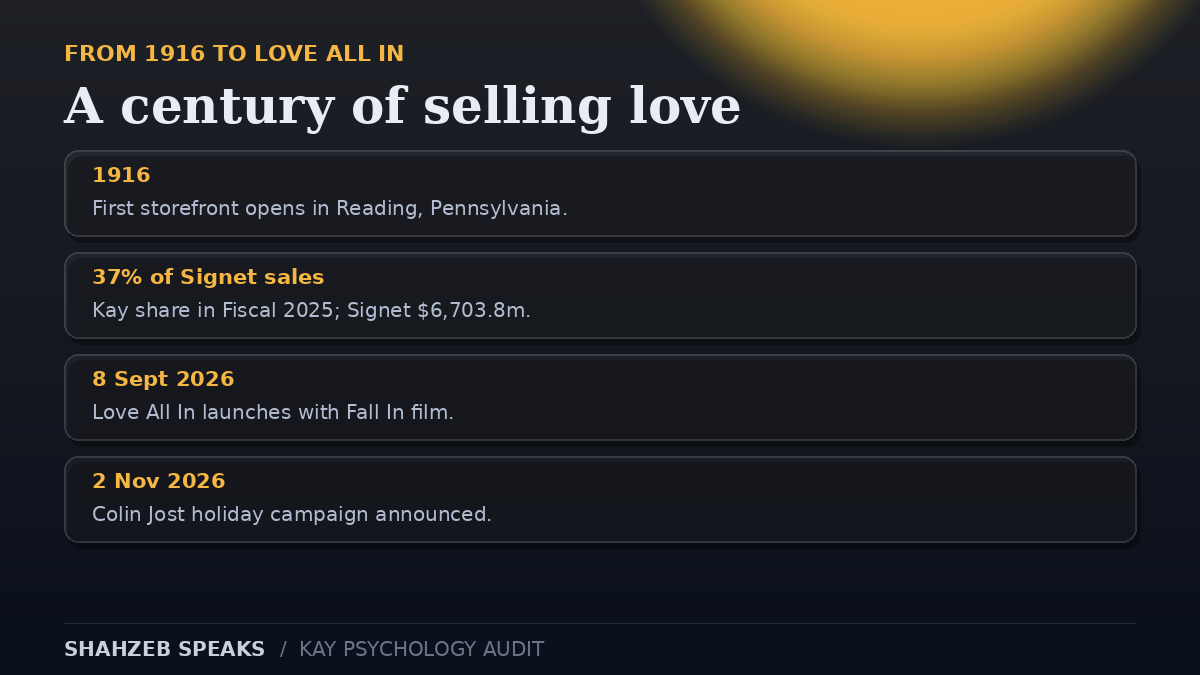
Scale matters to the psychology. In Fiscal 2025, Kay accounted for 37% of Signet’s consolidated sales, up from 36% the year before, and Signet reported total sales of $6,703.8 million across 2,642 locations. KAY is not a boutique selling romance to a few. It is the mass-market end of the jewellery trade, which means its messages land on ordinary budgets, not only on luxury ones. That is the context for everything that follows: when KAY talks about love, it is talking to people deciding between a necklace and a month of bills, and its psychology has to survive contact with that reality.
😰 Chapter 2: Gift anxiety — loss aversion with a bow on it
The first psychology principle is loss aversion (Kahneman and Tversky, 1979): losses feel larger than equivalent gains, so people work harder to avoid a bad outcome than to achieve a good one. Gift-giving is loss aversion in evening dress. The giver is not choosing between a good gift and a great gift. In their head, they are choosing between a gift that proves they care and a gift that proves they do not. The downside is social, not financial: embarrassment, disappointment, a relationship dented by a badly judged object.
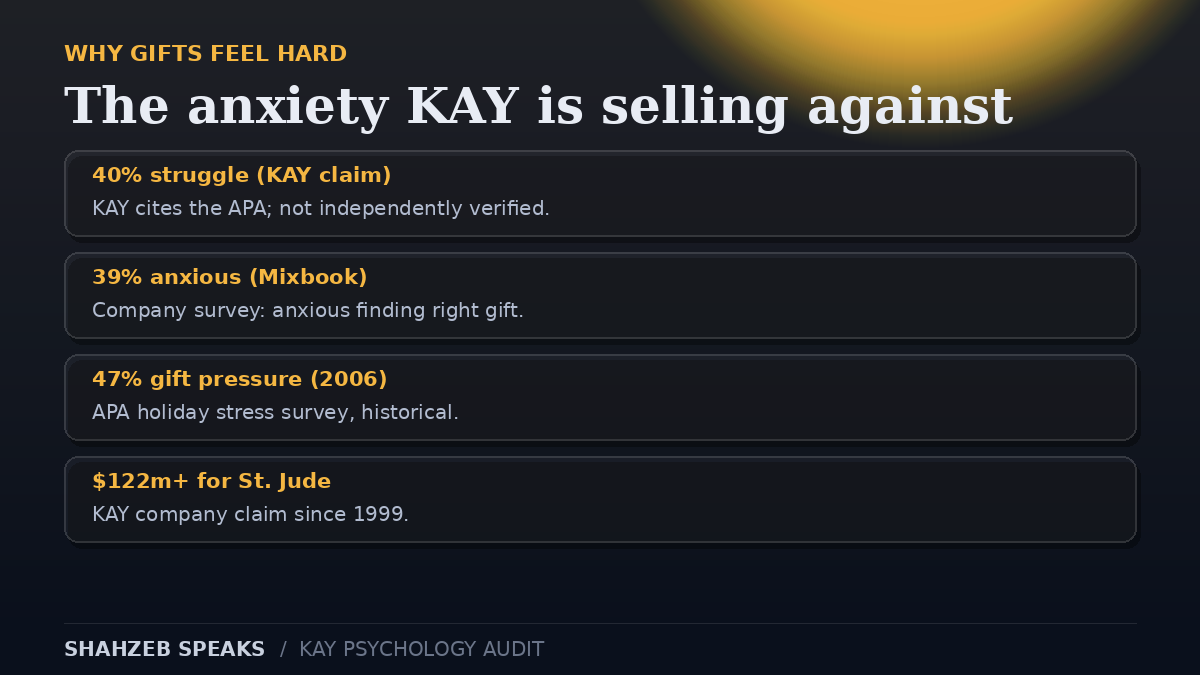
KAY’s holiday release leans directly on this fear. It states that 40% of people struggle to find the right gift, attributing the figure to the American Psychological Association. I could not verify that 40% figure in an APA primary source among the sources checked for this audit, so I print it here only as KAY’s claim, citing the APA — not as an APA finding I have independently confirmed. That distinction matters, and it is a mark against the campaign’s evidence discipline even though the underlying anxiety is well supported elsewhere. Mixbook’s 2025 holiday gifting anxiety report, a company survey, found 39% of United States adults anxious about finding the “right” gift, and 77% feeling at least one negative emotion while gift shopping. An older APA holiday stress survey, conducted by Greenberg, Quinlan and Rosner in 2006, found 47% feeling pressure in the giving and receiving of gifts. The direction is consistent across twenty years: a large minority dreads this decision. KAY’s insight is real. Its citation is not yet proven, and an audit should say both things.
💛 Chapter 3: Love All In — vulnerability as a brand position
“Love All In” launched on 8 September 2026 with “Fall In”, a 60-second film set to Charli XCX’s “Everything is Romantic” featuring Caroline Polachek, moving through relationships at different stages and in different forms. Signet’s own account roots the platform in a cultural tension, particularly among younger adults: a desire for meaningful connection alongside a growing reluctance to risk vulnerability. The first work of chief marketing officer Lisa Laich, with agency MARTIN, the platform deliberately moves beyond traditional milestones — engagements and anniversaries — towards everyday expressions of love and self-expression.
Psychologically, this is a shift from signalling to confession. The old slogan sold a moment: a kiss, a proposal, a milestone. The new platform sells an attitude: stop holding back. That reframes the purchase. Under the old logic, you bought jewellery because the occasion demanded it. Under the new logic, you buy it because holding back is the failure, and the object proves you did not. It is a clever inversion, and it is also a risk. A brand that tells people the worst mistake is restraint is, at the same time, telling them that spending is courage. The audit marks the creativity highly and the ethics of that equation more cautiously, because the same message that frees a shy giver also licenses an unaffordable one.
There is a second risk, subtler than overspending. Vulnerability is a real human value, but in advertising it is easily performed rather than practised. A sixty-second film can show a botched proposal and call it honesty, while the shop floor still rewards the flawless, expensive gesture over the modest, sincere one. The test of “Love All In” will not be whether its films feel authentic, but whether a customer who walks in with a small budget and a large feeling is treated as going all in too. If the platform only dignifies vulnerability when it arrives with a large stone, it will have changed the slogan without changing the judgement — and the anxious giver, who is the whole point, will notice the difference before any brand tracker does.
😂 Chapter 4: Colin Jost and the humour that lowers the stakes
The holiday campaign, announced 2 November 2026, puts Saturday Night Live’s Colin Jost on what Adweek describes as an Odyssey-inspired quest: a bearded Jost in a period robe, travelling through a blizzard and absurd obstacles, finally arriving at a silver KAY necklace. The campaign, created by The Martin Agency, runs across linear television, streaming, and KAY’s Instagram and YouTube channels at @kayjewelers. JCK reports it was created through Signet’s “Grow Brand Love” lens, with the stumped shopper in mind.
Humour does specific psychological work here. Anxiety narrows attention and pushes people towards avoidance or the safest choice; a joke widens it again, making the decision feel survivable. By making the quest ridiculous, the film tells the giver that their own agonising is normal, even comic, and that the destination was never in doubt. The departure from previous holiday work matters too: Adweek notes earlier campaigns focused on the person receiving the gift, while this one centres the giver’s struggle. That is a genuine insight. Most jewellery advertising flatters the recipient. This one comforts the buyer, which is the person actually standing in the shop, card in hand, afraid of getting it wrong.
🎁 Chapter 5: Choice, reciprocity and the gift as a signal
Three further principles run through KAY’s shop, not just its advertising. Choice overload (Iyengar and Lepper, 2000) is the enemy of the anxious giver: too many options do not liberate, they paralyse, and the paralysis ends in either delay or a safe, forgettable choice. KAY’s campaign answers overload with a story rather than a catalogue. It does not list fifty necklaces. It shows one journey ending at one necklace, which is a decision shortcut disguised as entertainment. In store and online, the same logic should apply — fewer, clearer paths to a decision — and that is where the brand’s execution, rather than its advertising, will be judged.
Reciprocity and social exchange complete the picture. Marcel Mauss argued a century ago that gifts are never just objects; they carry obligation, status and relationship. A gift that is too cheap can insult, one that is too expensive can burden, and the “right” gift is the one that matches the relationship’s unspoken terms. KAY’s “go all in” message simplifies that negotiation into a single direction — more is better — which is psychologically seductive and socially incomplete. The peak-end rule (Kahneman and colleagues, 1993) adds a final twist: people remember the peak and the ending of an experience, not its average. A well-chosen gift, given with confidence, becomes the remembered peak of a holiday. A gift given with visible anxiety becomes the remembered ending instead. KAY is selling confidence as much as jewellery, and confidence, unlike gold, cannot be hallmarked.
🌍 Chapter 6: Breadth — love in all its forms, or love in all its markets?
“Love All In” explicitly expands beyond traditional milestones to celebrate what Signet calls the full spectrum of love, connection and self-expression. The launch film shows diverse relationships and imperfect moments — botched proposals, wedding-cake disasters, poorly hidden rings — and the New York Fashion Week strand, a diamond jacket with more than 500 lab and natural KAY diamonds, pushed the platform into fashion culture. LBB reports the new platform replaces “Every Kiss Begins with Kay”, which it says was used since 1999, and notes the campaign’s break from category clichés.
The breadth is commercially sensible and psychologically sound. A brand that only speaks at engagements speaks a few times in a customer’s life. A brand that speaks at everyday moments speaks all year. But breadth has a test it must pass: does the everyday customer actually see themselves, or only a more fashionable version of themselves? The launch leans heavily on youth culture — Charli XCX, Fashion Week, creator content — while KAY’s core shopper is broader and older than that launch audience. The audit scores inclusivity well for intent, and reserves judgement on whether the in-store experience, pricing and service carry the same breadth as the film.
💎 Chapter 7: Price, access and the St. Jude counterweight
Jewellery psychology lives or dies on price fairness. KAY is a mid-market brand: its customer is not choosing between KAY and a private jeweller, but between KAY and no gift, or KAY and a cheaper gesture. The “Love All In” platform does not, in the material reviewed, rest on a price claim, and that restraint is wise. A brand that tells anxious givers to go all in while quietly raising prices would be selling courage at a markup. What KAY does offer as a counterweight is charitable: its own story page states that since 1999, KAY and its customers have supported St. Jude Children’s Research Hospital, raising more than $122 million. That is a company claim, but it is a specific and checkable one, and it gives the brand a second story about love — love as giving beyond the relationship — that softens the commercial edge of the first.
Anchoring shapes that choice more than any single price tag. The first price a shopper sees — in an advertisement, a window, or a friend’s story — becomes the reference point against which everything else feels cheap or extravagant, even when the shopper has no independent sense of what a necklace should cost. That is why a campaign built on “going all in” carries a pricing responsibility its films never mention. If the anchor is set by the most dramatic gift in the story, the ordinary budget starts to feel like holding back, which is exactly the failure the campaign warns against. A brand that wants its message to be about courage rather than expenditure should anchor deliberately at several levels, showing the small, sincere gift with the same warmth as the large one, so that the reference point is the feeling, not the figure.
📱 Chapter 8: Digital reach and the creator question
The campaign’s distribution is modern in the right way: Instagram and YouTube first, television and streaming alongside, creator content from launch. That matches how gift anxiety actually works today, which is to say it works on a phone at midnight, scrolling through options and other people’s celebrations. Social proof operates here in both directions. Seeing other people’s gifts can reassure, and it can also raise the bar until nothing feels enough. KAY’s humour helps on the first side. Its silence on the second — the comparison spiral its own channels feed — is the gap. A brand that profits from gift anxiety has a responsibility to say, at least once, that the gift is not the relationship. “Love All In” comes close to that line when it says the mistake is holding back rather than choosing wrongly. It never quite crosses it, because crossing it would mean admitting that sometimes the bravest gift is a small one, or none at all.
The creator strand deserves its own note. Creator content works for jewellery because it borrows trust: a familiar face wearing a piece does what a catalogue cannot, which is to show the object in a real life rather than a display case. But borrowed trust is fragile, and it cuts both ways for the giver. When every creator’s gift looks effortless, the ordinary giver’s effort starts to look inadequate by comparison, which is the opposite of what the campaign promises. KAY’s launch content, with its emphasis on imperfect moments, pushes against that effect rather than with it. Whether that push survives the holiday season, when the commercial pressure is to show the most impressive gift rather than the most honest moment, is an open question the brand should answer with its December content, not its September launch film.
⚠️ Chapter 9: What Pakistani brands should — and shouldn’t — copy
Pakistani brands should copy the giver-first insight: advertise to the person making the decision, not only to the person receiving the product, and name the anxiety honestly before offering the product as relief. They should copy the single-message discipline — one idea, “go all in”, carried across film, social and store — rather than a different slogan per channel. They should not copy the evidence shortcut: a statistic attributed to a respected body should be traceable to that body’s own publication, or it should not be printed. And they should not copy the equation of spending with courage without a counterweight. A campaign that tells people restraint is failure needs, at minimum, clear price ranges, honest financing terms and a visible cheaper path to the same feeling.
⚖️ Chapter 10: Dark side and regulatory record

Every audit must carry its brand’s record at its exact status, and KAY’s parent group has a serious one. In January 2019, the United States Consumer Financial Protection Bureau and the State of New York settled claims against Sterling Jewelers Inc., Signet’s subsidiary that operates KAY and Jared. The regulators’ parallel investigations found that Sterling had opened store credit-card accounts without customer consent, enrolled customers in payment-protection insurance without their consent, and misrepresented financing terms. Under the settlement, Sterling paid a $10 million civil money penalty to the Bureau and a $1 million civil money penalty to the State of New York, a total of $11 million, and agreed to injunctive relief.
The status words matter and I keep them exact: this was a settlement, not a final court ruling that the conduct occurred. Sterling neither admits nor denies the claims, according to court documents, and Signet said it disagrees with the allegations but chose to settle to avoid the time, expense and uncertainty of litigation. No admission of wrongdoing was made. That distinction does not erase the episode. A jeweller that sells on trust, and that finances purchases on credit, cannot treat a consent-based credit settlement as ancient history. It is directly relevant to the trust score below, and it is the reason this audit’s prescription starts with credit transparency rather than with advertising. As of 5 November 2026, no further regulator fine or final ruling against KAY itself was found in the sources checked for this audit, and none is claimed.
📊 Psychology Scorecard
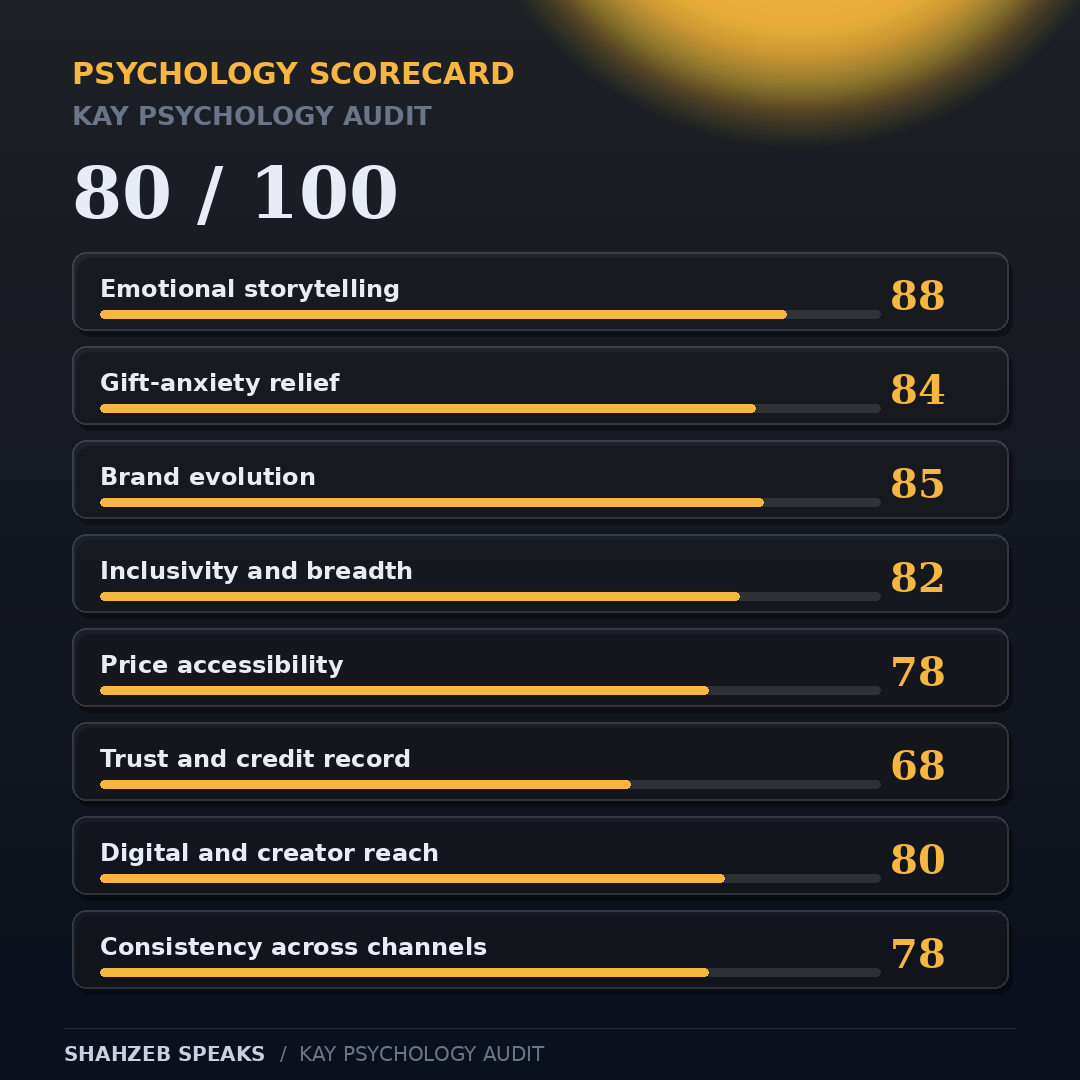
| Dimension | Score | Verdict |
|---|---|---|
| Emotional storytelling | 88 | Fall In and the Jost odyssey are genuinely moving and funny. |
| Gift-anxiety relief | 84 | Names the fear accurately; citation for 40% unverified. |
| Brand evolution | 85 | A real repositioning, not a new coat of paint. |
| Inclusivity and breadth | 82 | Everyday love is the right expansion; store proof pending. |
| Price accessibility | 78 | Mid-market position is honest; no price promise to test. |
| Trust and credit record | 68 | Settled $11m credit case, no admission, still counts. |
| Digital and creator reach | 80 | Right channels for midnight gift anxiety. |
| Consistency across channels | 78 | One idea everywhere; in-store carry-through unproven. |
Arithmetic: 88 + 84 + 85 + 82 + 78 + 68 + 80 + 78 = 643. 643 ÷ 8 = 80.375, rounded to 80/100.
✅ Balance sheet & prescription
What KAY does best is name a real feeling and lower its stakes with humour and story. What it does worst is evidence discipline around its headline statistic and the lingering trust cost of a credit settlement it settled without admitting. The prescription follows that balance. First, publish the APA source for the 40% figure or drop the attribution and use the verifiable Mixbook and historical APA figures instead. Second, put credit transparency at the front of the purchase journey — consent in plain language, financing terms before the card is offered — because that is where trust was lost. Third, carry “Love All In” into stores with the same breadth as the film: everyday price points, visible in plain language, so that going all in does not quietly mean spending beyond comfort. Do those three things and the platform earns its slogan. Without them, it remains a beautiful film over an unexamined bargain.
📝 Final Verdict
KAY has understood something most jewellers miss: the customer is not the person wearing the necklace, but the person afraid of choosing it. “Love All In” speaks to that person with warmth, humour and a genuinely modern idea of love. Its weakness is not creativity but credibility — a cited statistic it has not shown its working for, and a credit history it cannot advertise away. Fix the evidence, front-load the consent, and keep the everyday price honest, and this is a brand that will deserve the love it sells.
Psychology Score: 80/100 — A warm, funny, genuinely modern repositioning, held back by an unverified headline statistic and a settled credit record it must keep earning past.
If your brand sells to anxious buyers, the psychology of the decision matters more than the polish of the product. I audit that decision journey — get in touch here.
Related audits: e.l.f. — Made to Stand Out, Priced to Fit In, Rolex — The Watch You Have to Wait For, and Mondelēz — The Snack Drawer Empire. See also industrial psychology in Pakistan.
📚 References & Sources
- KAY Jewelers / BusinessWire (2026). KAY and Colin Jost holiday campaign release, 2 November 2026.
- Signet Jewelers (2026). KAY Unveils Bold Brand Evolution with “Love All In”, 10 September 2026.
- Signet Jewelers Ltd. Fiscal 2025 Form 10-K, year ended 1 February 2025.
- Consumer Financial Protection Bureau (2019). Settlement with Sterling Jewelers Inc., January 2019.
- Adweek (2026). Kay Sends Colin Jost on a Gift-Seeking Odyssey, 2 November 2026.
- Mixbook (2025). Holiday gifting anxiety report (company survey).
- Kahneman, D. and Tversky, A. (1979). Prospect theory. Econometrica, 47(2), 263–291.
- Iyengar, S. S. and Lepper, M. R. (2000). When choice is demotivating. Journal of Personality and Social Psychology, 79(6), 995–1006.
- Mauss, M. (1925). The Gift. Presses Universitaires de France.
- Kahneman, D., Fredrickson, B. L., Schreiber, C. A. and Redelmeier, D. A. (1993). When more pain is preferred to less. Psychological Science, 4(6), 401–405.
Key Findings
- KAY Jewelers was founded in 1916 in Reading, Pennsylvania; part of Signet Jewelers Ltd.; Kay accounted for 37% of Signet's consolidated sales in Fiscal 2025; Signet operated 2,642 locations in total as of 1 February 2025.
- Love All In launched 8 September 2026 with the 60-second Fall In film set to Charli XCX's "Everything is Romantic" featuring Caroline Polachek; a diamond jacket with more than 500 stones appeared at New York Fashion Week.
- Holiday campaign announced 2 November 2026 stars Colin Jost on an Odyssey-inspired quest ending at a silver KAY necklace; it runs on linear TV, streaming, Instagram and YouTube at @kayjewelers.
- Gift anxiety: KAY's release states 40% of people struggle to find the right gift, citing the American Psychological Association — this figure was NOT independently verified from an APA primary source in sources checked; Mixbook's 2025 company survey found 39% anxious about finding the right gift.
- Legal record: in January 2019 the CFPB and New York SETTLED claims against Sterling Jewelers Inc. (Signet's subsidiary operating KAY) over store credit-card accounts opened without consent and related allegations; $10 million to the CFPB plus $1 million to New York; Sterling neither admits nor denies the claims and Signet disagrees with the allegations; NO admission of wrongdoing and NO final court ruling was found.
- Score 80/100: 88+84+85+82+78+68+80+78 = 643; 643/8 = 80.375, rounded to 80.
Overall Psychology Score
KAY Jewelers scores 80/100 in our comprehensive psychology audit covering consumer behavior strategies, UX design principles, and psychological marketing effectiveness.
The detailed dimension scores are in the audit's Psychology Scorecard chapter.
High impactMuhammad Shahzeb
MSc Industrial Psychologist, specializing in consumer behavior, UX psychology, and brand strategy analysis. Helping brands understand the psychology behind their success.
About Muhammad Shahzeb →