e.l.f. Psychology Audit — Made to Stand Out, Priced to Fit In
e.l.f. turned $1 makeup into a $1.6bn beauty business, then launched its first holiday campaign on 2 Nov 2026. Scored 84/100, with a live legal caveat.

84 / 100
Overall consumer behavior effectiveness

Brand Overview
- Brand namee.l.f. Beauty
- Founded2004
- HeadquartersOakland, California, United States
- IndustryBeauty & Skincare
- Websitewww.elfcosmetics.com ↗
Psychology Techniques Identified
- 01Price Fairness & Anchoring (Low, Consistent Prices)
- 02Von Restorff Effect / Distinctiveness (Stand Out, Not Fit In)
- 03Mere Exposure & Familiarity (Zajonc 1968; Ubiquity)
- 04Social Proof & Belonging (Ubiquity as Endorsement)
- 05Nostalgia & Homecoming Framing (Holiday Campaign)
- 06Handmade / Craft Signalling (Stop-Motion Animation)
- 07Values Filtering (Vegan, Cruelty-Free, Fair Trade Claims)
- 08Product Naming as Instruction (Grip, Glow Reviver, Thirst Burst)
- 09Community Recognition (Kit, Echo, Cleo Character Types)
- 10Gifting Framing (Best Buy / Target TV-Section Takeover)
- 11Portfolio Ladder (Entry Price to rhode Prestige)
- 12Loss Aversion (Kahneman & Tversky 1979; Fairness Breach on Price Rises)
Full Psychology Audit Report
In this audit
Walk into a beauty aisle at Christmas and every brand is shouting luxury, in gold, in black, in a price that says you must earn it. Then a small, bright, handmade world appears, narrated by a Scottish actor, in which three friends discover that the things they once questioned about themselves are the things that make them extraordinary. e.l.f. Beauty has built a $1.6 billion business on the opposite of luxury pricing, and its first holiday campaign, launched on 2 November 2026, is the clearest statement yet of that psychology: stand out, without paying to fit in.
I am an Industrial and Organizational Psychologist in Karachi, and I audit brands by testing their psychology against their evidence: what the brand claims, what it actually does, and what the numbers support. e.l.f. is a useful test because its promise is unusually concrete. Founded in 2004 in Oakland, California, selling $1 makeup online, it now reports net sales of $1,636.5 million in the fiscal year to 31 March 2026, after $1,313.5 million in fiscal 2025. Its brands include e.l.f. Cosmetics, e.l.f. SKIN, and e.l.f. Hair, plus rhode, acquired in August 2025. This audit works through how a low price became an identity, how a holiday campaign about difference fits that identity, and where the psychology turns sharp: a tariff-driven price rise, a slowing unit story, and a live securities allegation that must be reported exactly as an allegation.
“e.l.f. does not sell you a better version of yourself. It sells you the version you already are, at a price that does not punish you for noticing.” — Brand Psychology Analysis, ShahzebSpeaks
📋 Brand Overview
| Field | Detail |
|---|---|
| Brand | e.l.f. Beauty, Inc. (NYSE: ELF); e.l.f. = eyes, lips, face |
| Founded | 2004, Oakland, California, United States |
| Headquarters | Oakland, California, United States |
| Website | elfcosmetics.com |
| Flagship brands | e.l.f. Cosmetics, e.l.f. SKIN, e.l.f. Hair, rhode, Naturium, Well People |
| Scale | Net sales $1,636.5 million in fiscal 2026; $1,313.5 million in fiscal 2025 |
| Psychology Score | 84/100 |
🏛️ Chapter 1: History — $1 makeup, sold online, before that was normal
e.l.f. Cosmetics was founded in 2004 by Joseph Shamah and Scott Vincent Borba, and its founding proposition was blunt: good makeup, sold online, for $1. At a time when beauty was sold through counters, consultants, and a price that signalled quality, e.l.f. removed the counter and the consultant and let the price do the talking. The name itself — eyes, lips, face — was a promise of completeness without mystique. You did not need to learn a system. You needed eyes, lips, and a face, which you already had.
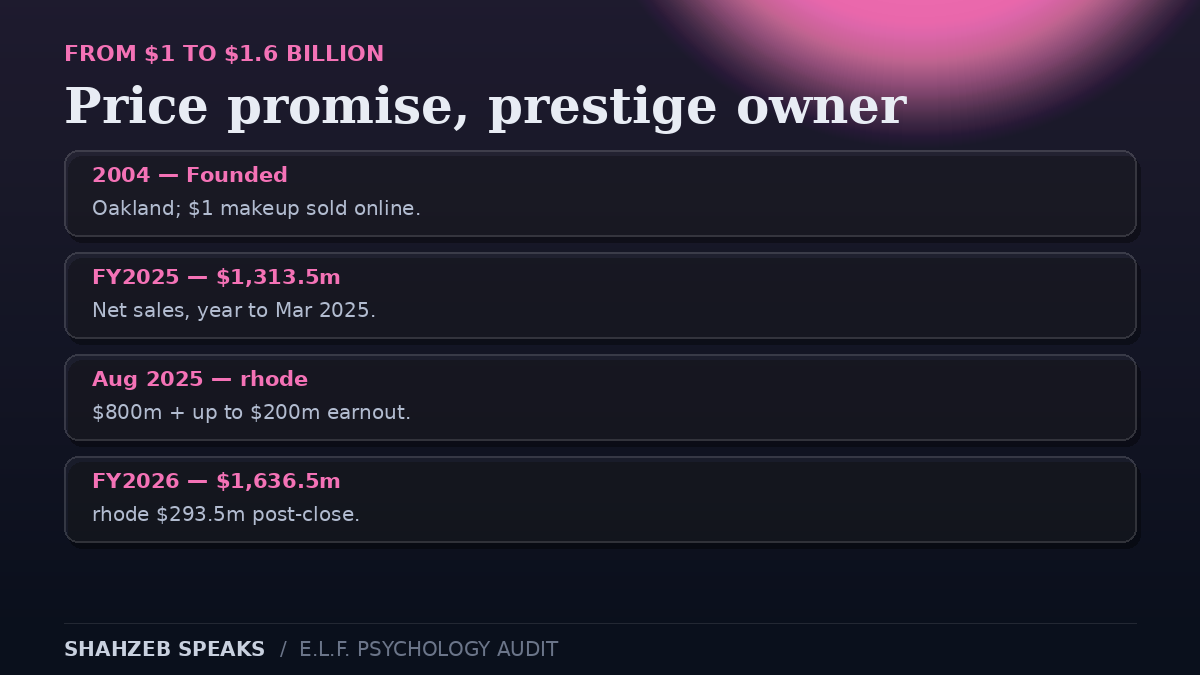
The company went public in 2016, and the years that followed turned a price point into a position. Reported figures describe e.l.f. as the number one cosmetics brand in the United States in units, and number two in dollar share, on Nielsen data as reported in 2025. That split — first in units, second in dollars — is the whole business in one line. e.l.f. sells more items than anyone, at lower prices than the prestige brands it sits beside. Growth, in that model, depends on volume, on new customers, and on keeping the price gap believable. When the price gap narrows, as it did in 2025, the model is tested in a way a prestige brand never experiences, because a prestige brand can raise prices and call it luxury. e.l.f. cannot, without breaking its own story.
The rhode acquisition, announced in May 2025 and closed in August 2025, changed the shape of that story. e.l.f. Beauty paid $800 million at closing — $600 million in cash and about $200 million in stock — plus up to $200 million more if rhode hits growth targets, for a total of up to $1 billion. rhode, Hailey Bieber’s skincare brand, had generated $212 million in net sales in the 12 months to March 2025, largely direct-to-consumer. In fiscal 2026, rhode contributed $293.5 million of e.l.f.’s sales after closing, out of a total increase of $323.0 million over fiscal 2025. That arithmetic deserves attention: most of the year’s growth came from the acquisition, not from the existing business. The audit does not present that as failure. Acquisitions are a legitimate way to grow. It does present it as a change in identity. e.l.f. is no longer only the $1 brand. It is now also the owner of a prestige brand, and it must hold both stories at once without letting either contradict the other.
💰 Chapter 2: Price as identity — the psychology of a low, honest number
The most powerful psychology in this audit is also the simplest: a low price, stated plainly, removes the fear of wasting money. In beauty, where a wrong shade or a bad texture can mean a product sits unused, that fear is real. A $9 lip oil or an $11 primer lowers the cost of trying, and trying is the first step to habit. The campaign prices in Chapter 3 are not accidents. Power Grip Primer at $11, Glow Reviver Lip Oil at $9, and Thirst Burst Drops at $13 are all in the range where a customer can try without a committee decision. That is anchoring in its most honest form: the anchor is not a crossed-out luxury price, but a real, repeatable price that the customer can check next week and find unchanged.
Low price also creates a different kind of loyalty. A prestige customer is loyal to a feeling of exclusivity. An e.l.f. customer is loyal to a feeling of fairness: the product works, the price is fair, and the company is not charging for a counter, a box, or a name. That loyalty is strong, but it is conditional in a specific way. If the price rises without a clear reason, or if the quality falls while the price holds, the fairness feeling breaks quickly, because fairness was the whole promise. A luxury brand can survive a price rise by calling it premium. A fairness brand must explain a price rise, or it loses the customer who trusted the number. That is the context for the tariff episode in Chapter 8, and it is why a $1 rise mattered far more than $1 suggests.
There is a second price psychology at work: the absence of shame. Beauty marketing has long sold correction — cover this, fix that, become this. e.l.f.’s language, from its founding to the 2026 campaign, sells access instead: premium quality, in the company’s words, at affordable prices, vegan and cruelty-free, without the gatekeeping. That framing matters psychologically because it changes who the customer is in the story. She is not a problem to be solved. She is a person with eyes, lips, and a face, who deserves products that work. When a brand consistently treats its customer as competent, the customer returns the favour with trust. When it treats her as a flaw to be fixed, it earns a purchase and loses a relationship.
🎄 Chapter 3: Made to Stand Out — a holiday campaign about not fitting in
On 2 November 2026, e.l.f. launched “e.l.f. Made to Stand Out”, its first-ever holiday campaign. The 60-second spot, narrated by Alan Cumming, follows three college-aged friends — Kit, Echo, and Cleo — reuniting in their hometown for the holidays and getting ready for what could be an awkward night out. Kit, the sentimental, nurturing presence holding the group together, preps with Power Grip Primer ($11). Echo, whose gift of gab knows no bounds, makes a statement with Glow Reviver Lip Oil ($9). Cleo, the bookish introvert with a talent all her own, gets her festive glow with Thirst Burst Drops ($13). The trio discover that the qualities they once questioned are the things that make them extraordinary. The company’s line for the campaign is that “your difference is lowkey your gift”.
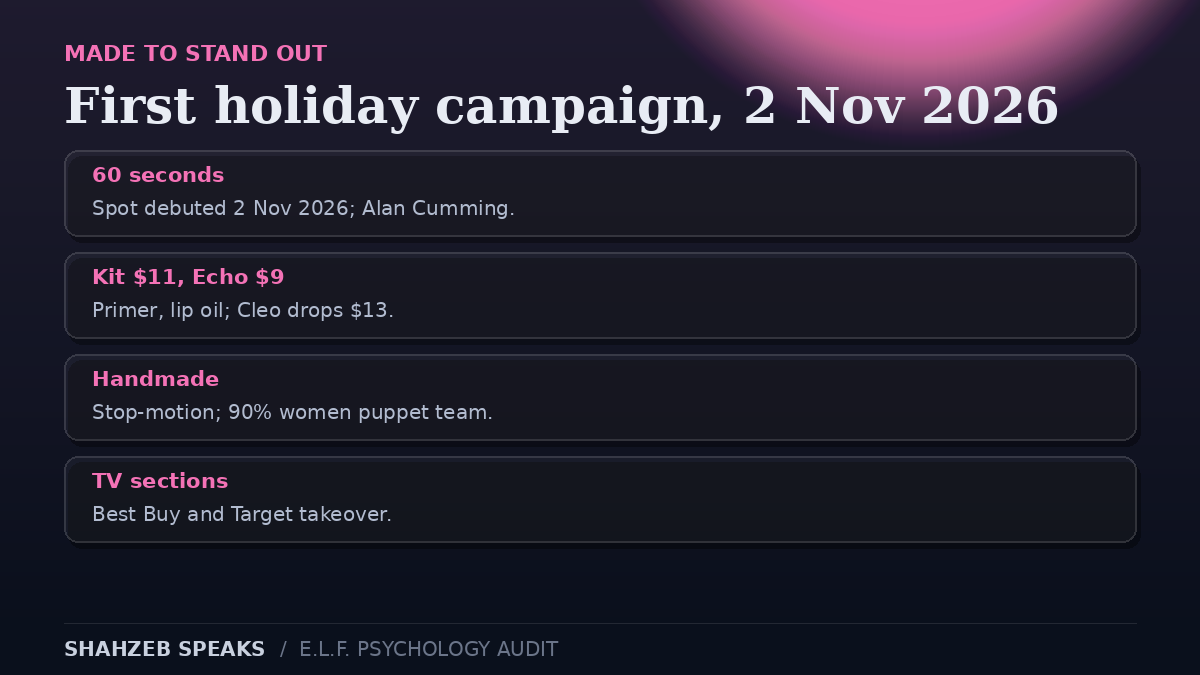
The campaign’s form is as deliberate as its message. It was created entirely through handmade stop-motion animation, directed by Cami Kwan, co-founder of Apartment D Films, with individually moulded characters and miniature sets built by hand, one frame at a time. The production included women comprising 90% of the puppet team and 100% of the animation team, in line, the company says, with its commitments to underrepresented artists and female empowerment. In a holiday season dominated by glossy, computer-generated spectacle, handmade work is a psychological signal: time, care, and a human hand. It also fits the campaign’s theme. A handmade character, like a person, is not identical to any other. Its small imperfections are the point.
The nostalgia framing is company-cited, and this audit reports it as such. The release cites Archbridge Institute research from November 2023, in which 72% of Americans said nostalgic memories inspire them when life feels complicated, and CivicScience data from 2026, in which 68% of United States adults said nostalgia influences the products they purchase. Those figures come from the company’s own release, not from an independent check in this audit, and they should be read that way. What can be judged independently is the choice itself: a holiday story about returning home, reuniting with friends, and preparing for a night out is a nostalgia structure, whether or not the percentages are exact. It works because it gives the viewer a memory to recognise, then attaches a product to that memory without interrupting it. The products are present — primer, lip oil, drops — but they are props in a friendship story, not lectures about skincare.
The retail extension completes the psychology. Beyond digital and social platforms, the campaign extends into a takeover of the TV sections of Best Buy and Target stores through the holiday gift-giving season. That is an unusual placement for a beauty brand, and it is psychologically shrewd. A television section is where people shop for others, in a state of decision fatigue, looking for a gift that signals care without requiring expertise. A beauty brand in that space is not competing with other lip oils. It is competing with the idea of a gift itself, and it wins by being affordable, recognisable, and easy to give. The scope note matters: the release describes a takeover of TV sections, not of whole stores, and this audit does not expand that claim.
🌱 Chapter 4: Values as a filter — vegan, cruelty-free, and Fair Trade
e.l.f. describes its products as vegan, “e.l.f. clean”, and double-certified by Leaping Bunny and PETA as cruelty-free, with products made in Fair Trade Certified facilities. Those are company claims, and this audit reports them as claims, not as independently audited facts. Their psychological function, however, is clear. They act as a filter: a customer who cares about animal testing, or about factory conditions, can choose e.l.f. without doing the research herself, because the certification does it for her. That is a trust shortcut, and trust shortcuts are valuable only as long as they are accurate. A brand that claims cruelty-free status and is then found to have breached it loses more trust than a brand that never claimed it, because the claim was the reason for the purchase.
The values framing also solves a problem that low price alone cannot solve: the suspicion that cheap means careless. A $9 product from a company that says nothing about its factories invites the question, “What was cut to get to $9?” A $9 product from a company that names its certifications, its Fair Trade facilities, and its female-led production team invites a different question: “How did they do this fairly?” The answer may still be incomplete — low price, high volume, and direct-to-consumer sales do much of the work — but the values language gives the customer a reason to believe the low price is a choice, not a corner cut. That belief is the difference between a bargain and a brand.
👥 Chapter 5: Community and the mirror — who sees themselves in e.l.f.
e.l.f.’s community psychology is built on recognition rather than aspiration. Its marketing repeatedly shows people who look, talk, and live like its customers, rather than a single idealised face. The Made to Stand Out trio — sentimental, talkative, bookish — are types, not models. Each has a flaw that becomes a strength, and each has a product that fits that strength rather than correcting the flaw. That is the von Restorff effect, the isolation effect, applied to people rather than products: the distinctive quality is what is remembered, and the brand’s job is to make distinctiveness feel safe rather than strange.
Social proof works differently for e.l.f. than for a prestige brand. A prestige brand uses scarcity: few people have it, so having it signals status. e.l.f. uses ubiquity: many people have it, so having it signals belonging. When a product is everywhere, in drugstores, in Target, in a friend’s bag, its presence reads as endorsement. The risk of ubiquity is that it can also read as ordinariness, and e.l.f. counters that risk with novelty: new shades, new formats, new collaborations, and now a handmade holiday world that feels anything but ordinary. The campaign’s stop-motion world is, in that sense, a corrective to ubiquity. It says: the product is for everyone, but the story is made by hand, for you.
There is a limit to this community story, and honesty requires stating it. A brand that celebrates difference must also be careful not to turn difference into a product category. “Stand out” is a message that can be sold to everyone, which means it can also be sold to no one in particular. The campaign avoids that trap, for now, by giving its characters specific traits — sentimentality, talkativeness, bookishness — rather than a generic celebration of uniqueness. Specificity is what makes a character recognisable, and recognisability is what makes a customer feel seen. Generic uniqueness is a slogan. Specific difference is a story.
🧪 Chapter 6: Innovation without intimidation — the product psychology
e.l.f.’s product psychology is to make innovation feel easy. Power Grip Primer, the campaign’s hero product for Kit, is a primer that grips makeup in place — a functional claim, in a name that describes what it does. Glow Reviver Lip Oil and Thirst Burst Drops do the same: the name is the benefit, the benefit is the instruction. That naming matters because it removes the learning barrier that prestige skincare often erects. A customer does not need a tutorial to understand “lip oil” or “drops”. She needs a mirror and a minute. That ease is itself a psychology: when a product is easy to understand, it is easy to try, and trying is the first step to habit.
The portfolio also uses a ladder. A customer can enter at $9, move to $11 or $13, and later, through rhode, move to a prestige price without leaving the company. That ladder is commercially smart and psychologically delicate. If the prestige rung makes the entry rung feel cheap, the ladder breaks. If the entry rung makes the prestige rung feel like a betrayal, the ladder also breaks. e.l.f.’s task, after the rhode acquisition, is to keep both rungs feeling like the same company: one that makes good products, at prices that are fair for what they are. The holiday campaign helps, because it puts the $9, $11, and $13 products at the centre of a story about worth, not price. Worth, in that story, is not measured in dollars.
🇵🇰 Chapter 7: What brands elsewhere should — and should not — copy
Copy this: a price that is a promise, not a promotion. e.l.f.’s low price works because it is consistent, explainable, and tied to a value — access — rather than to a sale. A brand that discounts constantly teaches customers to wait. A brand that prices fairly constantly teaches customers to trust. Copy the naming too: a product name that tells the customer what it does is worth more than a name that tells her how luxurious she will feel. Copy the handmade, specific story: three characters with traits, not a generic celebration of uniqueness, is what makes a campaign memorable.
Do not copy the assumption that low price alone protects you. When costs rise, a fairness brand must explain, not just announce. Do not copy the temptation to acquire prestige and then hide the entry-level brand that built you. And do not copy the habit of citing survey percentages in a campaign release without making clear who measured them and when. e.l.f.’s nostalgia figures are company-cited; a brand that wants trust should label them as such, in the release itself, not leave the labelling to an audit.
⚠️ Chapter 8: The dark side — a price rise, a unit story, and a live allegation
Every audit in this series has a chapter where the psychology meets the law, and for e.l.f. that chapter has three parts, each with a different status, which must not be confused. The first part is a business decision, reported in secondary coverage. In May 2025, e.l.f. announced a $1 price increase across all its products, effective 1 August 2025, citing tariffs and inflationary pressures, with about 75% of its supply chain reported to be in China. Reporting in 2026 described a more pronounced decline in units on the May 2026 earnings call, including a 5-point unit-volume decline in the fourth quarter of fiscal 2026. This audit does not claim the price rise caused the unit decline. Tariffs, the rhode mix, and other factors were also in play, and the reported figures describe association, not a proven causal chain. What can be said is that the episode tested the fairness promise in Chapter 2, and that a fairness brand feels a unit decline more sharply than a prestige brand, because volume is its model.
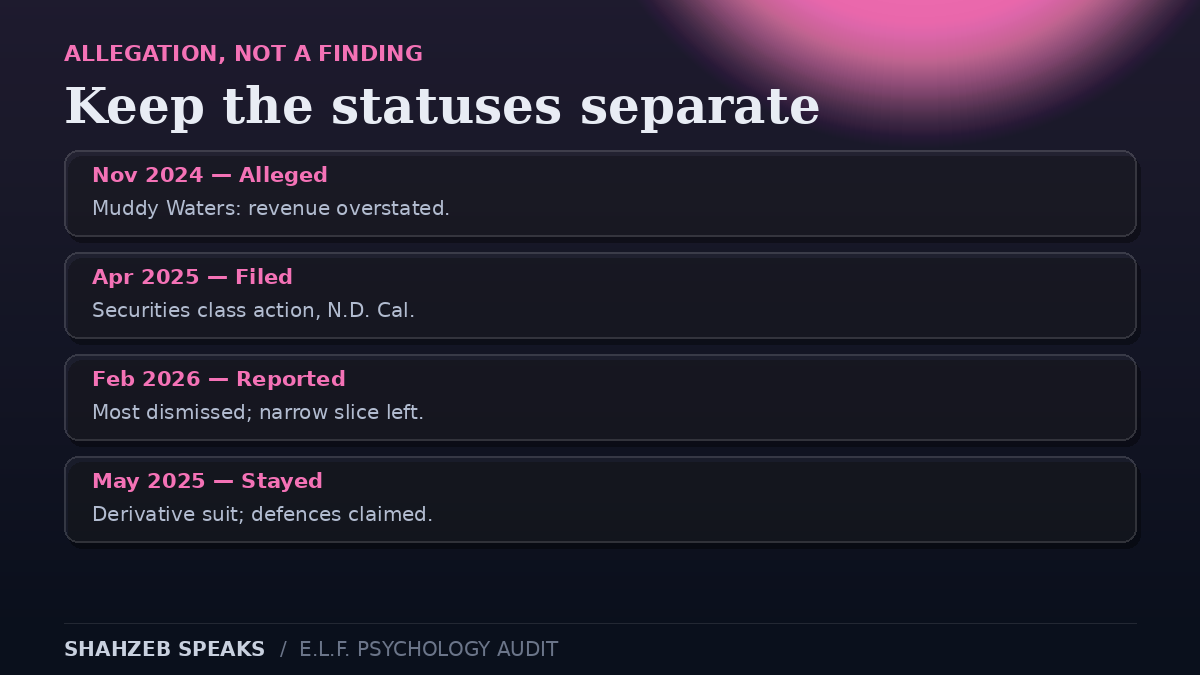
The second part is a live legal allegation, and its status must be exact. On 20 November 2024, Muddy Waters Research published a report ALLEGING that e.l.f. had materially overstated revenue, by $135 million to $190 million over the class period in the complaint’s account. On 8 April 2025, the Boston Retirement System filed a securities class action in the Northern District of California, alleging violations of sections 10(b) and 20(a) of the Securities Exchange Act and Rule 10b-5. Those are allegations in pleadings, not findings by a court or a regulator. Secondary reporting in 2026 described a February 2026 ruling that dismissed most of the case, calling the growth talk “puffery”, and leaving alive only a narrow slice tied to statements made in November 2024. That reported ruling, if accurately described, is a procedural narrowing, not a final judgement on the merits of the remaining claim, and this audit does not present it as a vindication or a condemnation.
The third part is a derivative suit, also a pleading. A shareholder derivative lawsuit filed in May 2025 in Delaware, on behalf of the company against certain current and former officers and directors, asserts claims including breach of fiduciary duty and unjust enrichment, and is stayed pending resolution of the securities class action, according to the company’s quarterly filing. The company says it has substantial defences and intends to defend vigorously. As of 4 November 2026, no final court ruling, and no regulator fine or SEC enforcement finding, was found in the sources checked for this audit. That absence is itself a fact worth stating plainly: shoppers and investors should not read a filed complaint as a verdict, and they should not read a partial dismissal as an acquittal. The honest position is to report the allegation, report the denial and the reported narrowing, and withhold judgement until a court rules.
The psychological question inside that legal record is about trust. A brand whose promise is fairness will be judged, by its customers, on whether its numbers are fair as well as its prices. An allegation about revenue, even unproven, touches the same trust as a price rise: both ask whether the number the customer was given was honest. e.l.f.’s response, in its filings, is to defend vigorously. Its response in its marketing, in the same period, is to tell a handmade story about difference. Both responses can be true at once. Whether customers believe both depends on whether the next set of numbers — prices, volumes, and filings — are explained as plainly as the campaign’s story.
📊 Psychology Scorecard
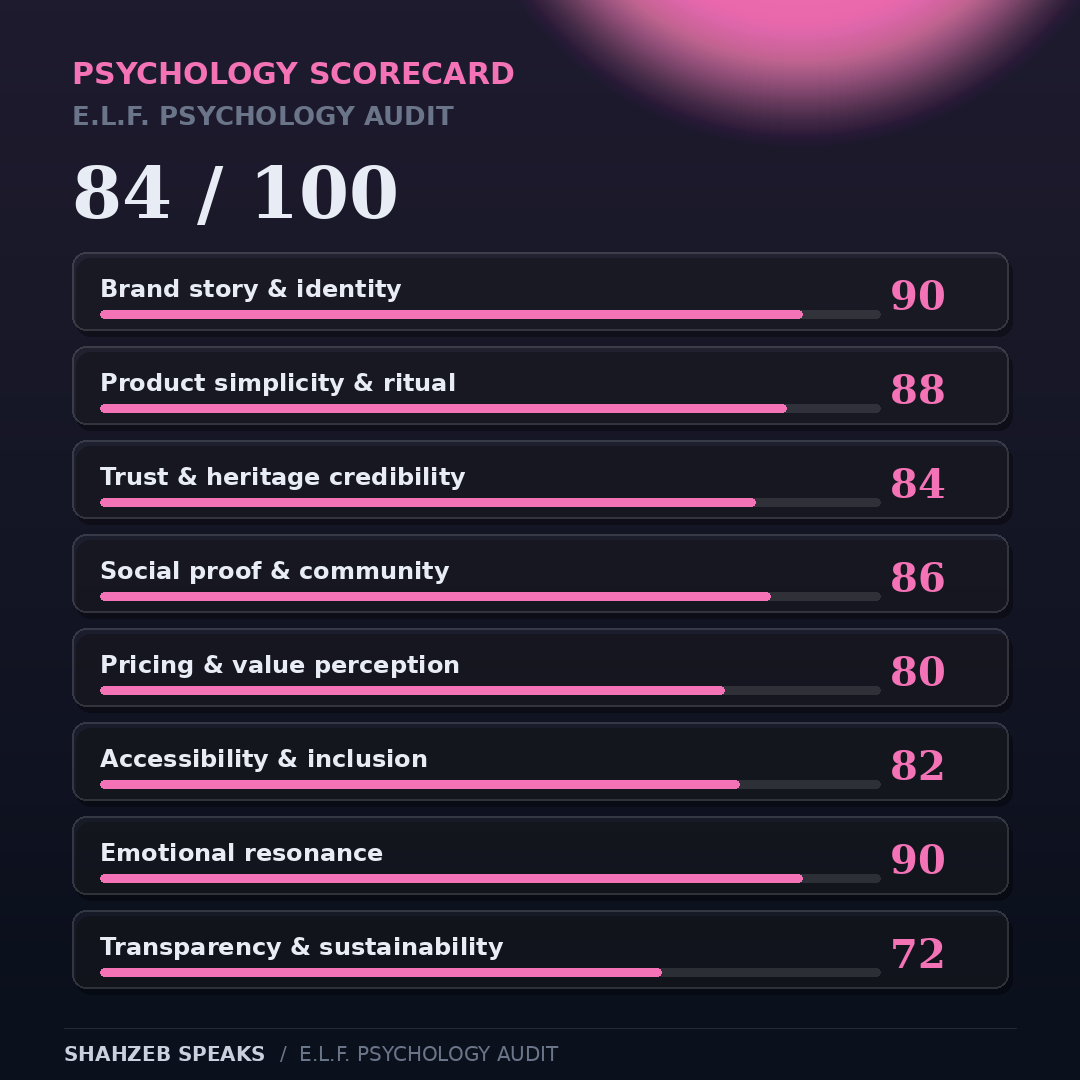
The scorecard below rates e.l.f. on eight dimensions, each from 0 to 100. The overall score is the rounded average of the eight.
| Dimension | Score | Verdict |
|---|---|---|
| Brand story & identity | 90 | Access, not luxury, told consistently since 2004. |
| Product simplicity & ritual | 88 | Names that teach, prices that invite a first try. |
| Trust & heritage credibility | 84 | Two decades of fair pricing, tested by tariffs. |
| Social proof & community | 86 | Ubiquity as belonging, refreshed by handmade stories. |
| Pricing & value perception | 80 | The $1 rise was small; the fairness test was large. |
| Accessibility & inclusion | 82 | Vegan and cruelty-free claims, with a prestige ladder to hold. |
| Emotional resonance | 90 | Made to Stand Out turns difference into the hero. |
| Transparency & sustainability | 72 | Live allegations and company-cited figures need clearer labelling. |
Arithmetic: 90 + 88 + 84 + 86 + 80 + 82 + 90 + 72 = 672; 672 / 8 = 84.
✅ Balance sheet & prescription
On the credit side, e.l.f. owns the clearest fairness story in beauty: a low, consistent price, products whose names teach their use, a community built on recognition rather than aspiration, and now a holiday campaign that makes difference feel handmade and heroic. On the debit side, it faces a tariff-tested price promise, a unit story that needs explaining, and a live securities allegation that, whatever its merits, touches the same trust as its prices. The prescription is therefore simple: explain every number as plainly as the campaign explains its characters. Announce price changes with their reasons, in advance, on the pack. Report unit trends alongside dollar growth, so customers can see volume, not just revenue. Label company-cited survey figures as company-cited, in the release itself. And keep the $9, $11, and $13 products at the centre of the story, even as rhode grows, because those products are the proof that “made to stand out” is not a slogan for the few, but a price for the many.
📝 Final Verdict
e.l.f. is a fairness brand that has learned to tell a prestige story without raising its price to prestige levels, and a prestige owner that must now prove it has not forgotten the fairness story that built it. Its holiday campaign is its best argument: handmade, specific, and warm, it makes standing out feel like belonging. Whether that argument holds depends on a narrower question than any campaign can answer: will the next price, the next volume figure, and the next filing be explained as honestly as the story of Kit, Echo, and Cleo? Answer that question well, and the score rises. Answer it badly, and no amount of stop-motion charm will restore the feeling that the price was fair.
“Psychology Score: 84/100 — A fairness brand, told by hand, and tested by whether its numbers are as honest as its prices.”
📬 Which e.l.f. product did you try first — and why?
Was it the price, a friend, or a story? Contact me and tell me which cue brought you in, and whether a price rise ever changed how fair the brand felt.
For the broader field behind this audit, see my homepage on industrial psychology in Pakistan, and for related audits, see the PG Tips audit and the Mondelēz audit.
📚 References & Sources
- e.l.f. Beauty (2026). “e.l.f. Made to Stand Out”: e.l.f. Creates Handcrafted Holiday Campaign. Business Wire, 2 November 2026.
- e.l.f. Beauty, Inc. (2026). Form 10-K, fiscal year ended 31 March 2026 (via 10-K summary: net sales $1,636.5 million fiscal 2026, $1,313.5 million fiscal 2025).
- Boston Retirement System v. e.l.f. Beauty, Inc. (2025). Class Action Complaint, Case 3:25-cv-03167, N.D. Cal., filed 8 April 2025 (allegations only).
- Muddy Waters Research (2024). e.l.f. Beauty, Inc.: A Revenue and Inventory Mystery. 20 November 2024 (allegations only).
- Nielsen, via company and press reporting (2025). e.l.f. number one in US cosmetics units, number two in dollar share.
- von Restorff, H. (1933). Über die Wirkung von Bereichsbildungen im Spurenfeld. Psychologische Forschung, 18, 299-342.
- Kahneman, D., & Tversky, A. (1979). Prospect theory: An analysis of decision under risk. Econometrica.
- Zajonc, R. B. (1968). Attitudinal effects of mere exposure. Journal of Personality and Social Psychology, 9(2), 1-27.
Key Findings
- e.l.f. Beauty was founded in 2004 in Oakland, California; e.l.f. = eyes, lips, face; started selling $1 makeup online; NYSE: ELF.
- Scale: net sales $1,313.5 million in fiscal 2025 and $1,636.5 million in fiscal 2026 (year to 31 March 2026); rhode contributed $293.5 million after its August 2025 closing.
- rhode acquisition: $800 million at closing ($600 million cash + about $200 million stock) plus up to $200 million earnout, up to $1 billion total; rhode had $212 million net sales in the 12 months to March 2025.
- First holiday campaign 'e.l.f. Made to Stand Out': 60-second spot debuted 2 November 2026, narrated by Alan Cumming, following Kit, Echo and Cleo; handmade stop-motion; women 90% of puppet team and 100% of animation team; campaign products $11, $9 and $13; Best Buy and Target TV-section takeover.
- Legal record: Muddy Waters ALLEGED in November 2024 that revenue was overstated; a securities class action was FILED 8 April 2025 (allegations only); a February 2026 ruling was REPORTED to have dismissed most of the case, leaving a narrow slice; a Delaware derivative suit filed May 2025 is STAYED pending the class action and the company says it has substantial defences; NO final ruling and NO regulator fine was found in sources checked as of 4 November 2026.
- Score 84/100: 90+88+84+86+80+82+90+72 = 672; 672/8 = 84.
Overall Psychology Score
e.l.f. Beauty scores 84/100 in our comprehensive psychology audit covering consumer behavior strategies, UX design principles, and psychological marketing effectiveness.
The detailed dimension scores are in the audit's Psychology Scorecard chapter.
High impactMuhammad Shahzeb
MSc Industrial Psychologist, specializing in consumer behavior, UX psychology, and brand strategy analysis. Helping brands understand the psychology behind their success.
About Muhammad Shahzeb →