Apple Psychology Audit — The $416 Billion Machine of Desire
Apple psychology audit: $416.2B FY2025 sales, 2.35B devices, Interbrand #1. A psychologist audits fluency, lock-in, secrecy, scarcity and status — plus the exact legal record: two EU fines under appeal, a pending DOJ suit, and the final €13B Irish judgment.

86 / 100
Overall consumer behavior effectiveness
Brand Overview
- Brand nameApple
- Founded1976
- HeadquartersCupertino, California, USA
- IndustryTechnology
- Websitewww.apple.com ↗
Psychology Techniques Identified
- 01Processing Fluency (Minimalist Design)
- 02Ecosystem Lock-In (Switching Costs)
- 03Loss Aversion (The Walled Garden)
- 04Endowment Effect (Your Apple Life)
- 05Curiosity Gap (Secrecy & "One More Thing")
- 06Scarcity Theatre (Launch-Day Queues)
- 07Conspicuous Consumption (Premium Pricing)
- 08Social Proof at Scale (Shot on iPhone)
- 09Choice Simplification (Good-Better-Best)
- 10Sunk Cost (App & Subscription Investments)
- 11Ritual & Keynote Drama (Product Events)
- 12Nostalgia & Founder Myth (Think Different)
Full Psychology Audit Report
In this audit
On 23 October 2001, Steve Jobs reached into his jeans pocket and pulled out a small white rectangle: “1,000 songs in your pocket,” at $399 — a brave price in 2001. That moment contains the entire Apple psychology audit in one sentence: the product was not the cheapest available, it was the easiest to understand; the price was not the lowest, it was the most reassuring. Apple is the most profitable application of psychology in business history: a $416.2 billion machine built on fluency, lock-in, secrecy, scarcity and status — engineered so precisely that leaving it feels like losing something you own.
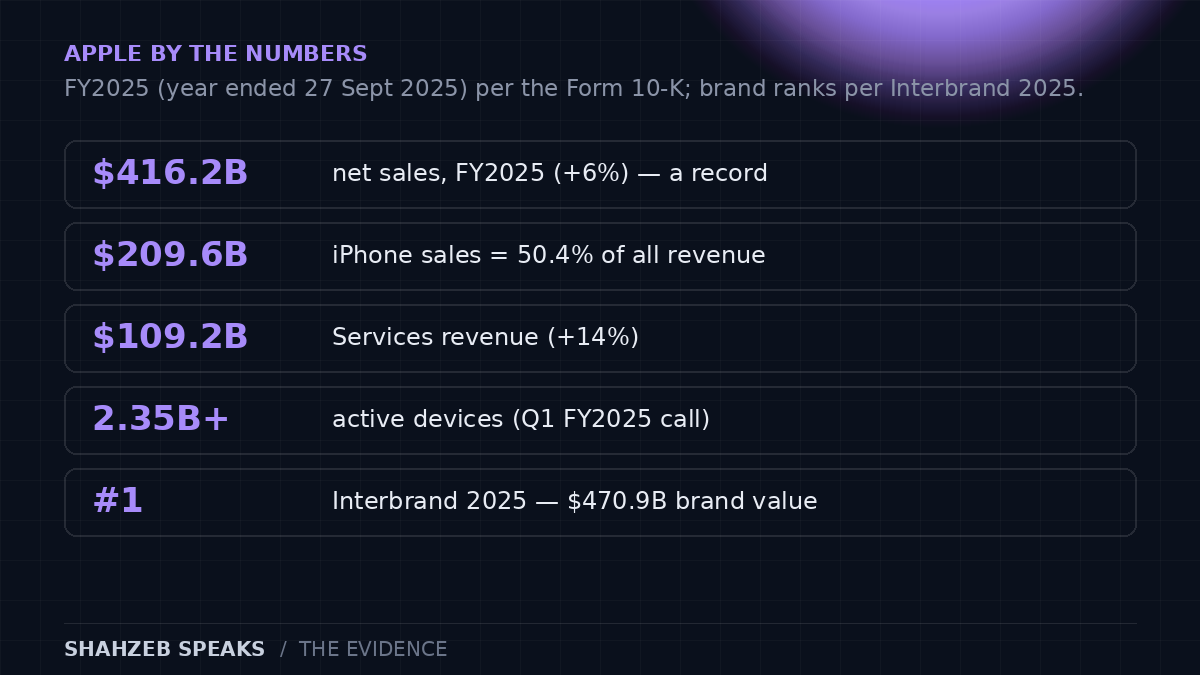
The numbers need their labels. Apple’s Form 10-K for fiscal 2025 — read directly from the SEC, year ended 27 September 2025 — reports $416,161 million in total net sales, up 6%, a record. The iPhone alone generated $209.6 billion — 50.4% of all sales; Services reached $109.2 billion, up 14%. On the Q1 FY2025 call (30 January 2025), the company announced over 2.35 billion active devices, also a record. Interbrand’s 2025 ranking keeps Apple #1 in the world at $470.9 billion (−4% YoY); Kantar’s BrandZ 2025 also ranks it #1, at roughly $1.3 trillion (+28%). Everything below comes with its source and its date.
I am an Industrial and Organizational Psychologist in Karachi, and this audit treats Apple as psychology’s most expensive field experiment: minimalism as processing fluency, the ecosystem as a switching-costs machine, secrecy as a permanent curiosity gap, premium pricing as conspicuous consumption — and an antitrust file with two pending European appeals, a pending DOJ lawsuit and a contempt finding, each at its exact legal status as of 12 October 2026.
“Apple never sold technology. It sold the feeling that technology was finally on your side — and then priced the feeling so high that the price itself became the proof. Fluency made it lovable, the ecosystem made it inescapable, secrecy made it mythic, and the bill, itemised below, is still being paid in courtrooms across three continents.”
— Brand Psychology Analysis, ShahzebSpeaks
📋 Brand Overview: Apple at a Glance
| Brand | Apple Inc. (apple.com) |
| Founded | 1976 — Apple Computer Co., 1 April 1976: Steve Jobs, Steve Wozniak, Ronald Wayne (Associated Press, 1 Apr 2026) |
| Headquarters | One Apple Park Way, Cupertino, California (per the FY2025 Form 10-K) |
| CEO | John Ternus (since 1 September 2026; announced 20 April 2026); Tim Cook was CEO 24 Aug 2011 – 31 Aug 2026, now Executive Chairman |
| Scale | $416.2 billion net sales, FY2025 (+6%, SEC Form 10-K); iPhone $209.6B (50.4% of sales); Services $109.2B (+14%) |
| Brand rank | #1 globally, brand value $470.9B (−4% YoY, Interbrand 2025); #1 at ~$1.3T (+28%, Kantar BrandZ 2025) |
| Installed base | Over 2.35 billion active devices (Q1 FY2025 call, 30 Jan 2025); more than 1 billion paid subscriptions (Q1 FY2024 call, 1 Feb 2024) |
| Model | Premium hardware priced as signal, funded by a growing services flywheel |
📜 Chapter 1: The History — From a Garage Partnership to $416.2 Billion
🍎 1976: Three names on a partnership agreement
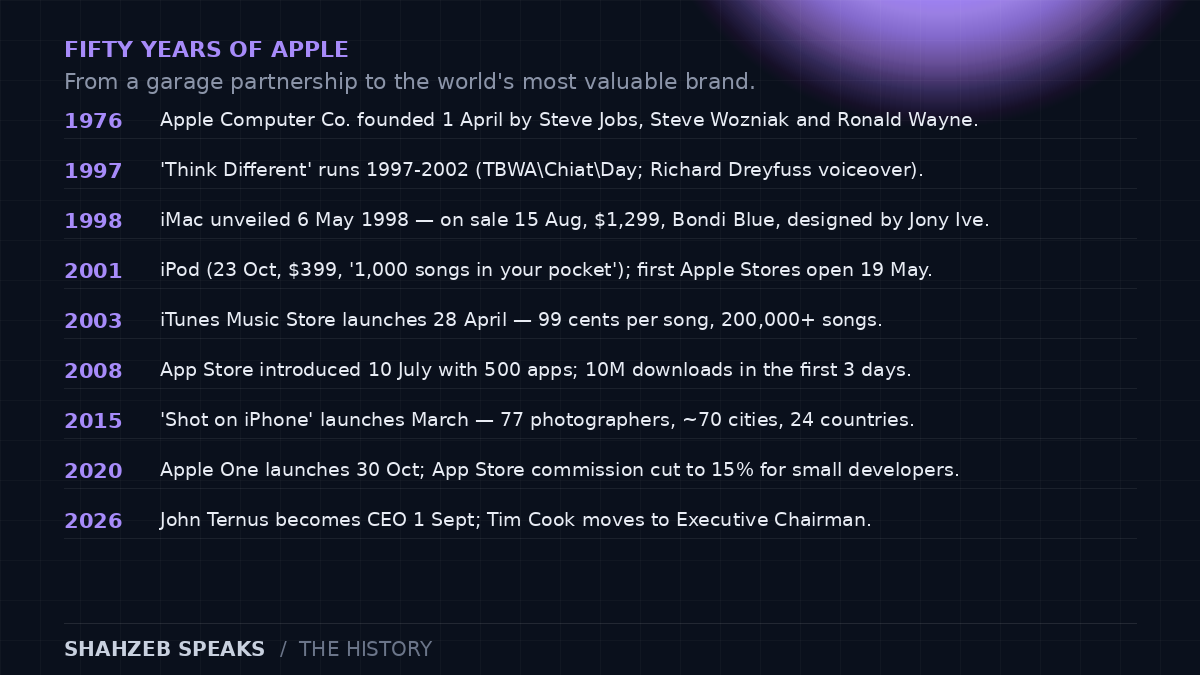
Apple Computer Co. was founded on 1 April 1976 by Steve Jobs, Steve Wozniak and Ronald Wayne. The founding partnership agreement — dated 1 April 1976, Mountain View — still exists as the birth certificate.
💭 1997: Think Different
“Think Different” — created by TBWAChiatDay — ran from 1997 to 2002. The words were written by art director Craig Tanimoto; the “Here’s to the crazy ones” copy by Rob Siltanen and Ken Segall; the television voiceover by Richard Dreyfuss (a Jobs-voiced version was recorded but never aired). Jobs introduced it at Macworld Expo on 8 August 1997; the “Crazy Ones” spot debuted 28 September 1997.
🖥️ 1998: The iMac — design as fluency
On 6 May 1998, Jobs unveiled the iMac: $1,299, on sale 15 August 1998, translucent Bondi Blue, designed by Jony Ive. The name came from Ken Segall at TBWAChiatDay — Jobs had wanted “MacMan” — and Jobs explained the “i”: “The ‘i’ stands for ‘Internet,’ but it also means ‘individual,’ ‘instruct,’ ‘inform,’ and ‘inspire.'”
🎧 2001: The iPod — and the first Apple Stores
On 23 October 2001, Jobs introduced the first iPod — 5GB, $399: “1,000 songs in your pocket.” Five months earlier, on 19 May 2001, Apple had opened its first two retail stores — Tysons Corner Center in Virginia and Glendale Galleria in California — after Ron Johnson joined as SVP of retail in January 2000. The opening weekend drew 7,700+ visitors and $599,000 in combined sales. The concept was experience, not inventory: a Genius Bar modelled on the Ritz-Carlton service experience and a demo Theater. Jobs’ line from the 2001 press release is the thesis of Apple retail: “Rather than just hear about megahertz and megabytes, customers can now learn and experience the things they can actually do with a computer.”
🎵 2003–2008: The iTunes Music Store and the App Store
The iTunes Music Store launched on 28 April 2003 — 99 cents per song, over 200,000 songs at launch, no subscription fees. On 10 July 2008, Apple introduced the App Store with 500 apps — the day before the iPhone 3G — and 10 million apps were downloaded in the first three days. Apple said in January 2026 that developers have earned a cumulative $550 billion from the App Store since its 2008 launch, with a record 2025 averaging 850 million weekly App Store users.
💳 2014–2020: Pay, Card, One
Apple Pay was announced on 9 September 2014 — an “easy, secure and private way to pay” — launched in the US on 20 October 2014, with Apple’s promise that “cashiers will no longer see your name, credit card number or security code.” Apple Card launched for all US customers on 20 August 2019: no annual, late, international or over-limit fees; Daily Cash of 3% on Apple purchases, 2% via Apple Pay, 1% on the titanium card; no number, CVV or expiration printed on the card; Goldman Sachs as issuer, Mastercard as network. (Reuters reported in January 2026 that JPMorgan Chase will become the new issuer — roughly $20 billion in balances, a roughly two-year transition — but completion is not verified.) Apple One was announced 15 September 2020 and launched 30 October 2020, bundling Music, TV+, Arcade, News+, Fitness+ and iCloud at $14.95, $19.95 and $29.95 a month.
📸 2015: Shot on iPhone
In March 2015, Apple launched “Shot on iPhone” for the iPhone 6 camera: real user photographs on billboards and bus stops, each credited with the photographer’s name. The debut wave featured 77 photographers across about 70 cities and 24 countries — and the campaign won the Grand Prix for Creative Effectiveness at the 2025 Cannes Lions.
👔 2026: The CEO transition
On 20 April 2026, Apple announced that John Ternus became CEO on 1 September 2026, with Tim Cook — CEO from 24 August 2011 to 31 August 2026 — moving to Executive Chairman; the board vote was unanimous. Ternus joined Apple in 2001 and served as SVP Hardware Engineering from 2021 to 2026. In an 8 October 2026 interview, Cook described the planned handover: “I wanted John to have some wind at his back” before the iPhone cycle.
✨ Chapter 2: Simplicity as Fluency — The Ive Doctrine
Jony Ive was Chief Design Officer from 26 May 2015 until his 27 June 2019 departure to found LoveFrom — but his doctrine never left. The iMac’s translucence, the iPod’s click wheel, the iPhone’s single button: each generation removed something the customer had to learn. Reber, Schwarz and Winkielman (2004) showed that aesthetic pleasure is a function of processing dynamics — the more fluently a stimulus is processed, the more positive the aesthetic response (Personality and Social Psychology Review). Apple intuited fluency before the paper existed: every bezel removed, every port retired, every button flattened is one less thing to process, and fluency feels like beauty. Competitors sell specifications; Apple sells the absence of friction.
🔒 Chapter 3: The Ecosystem — Lock-In as Loss Aversion
Apple’s most valuable psychology is not in any single product. It is in the cost of leaving. Your photos live in iCloud, your music in Apple Music, your subscriptions renew on Apple’s rails — and Apple Trade In offers credit toward a new device or a gift card, with free recycling otherwise — while Apple One bundles the whole stack into one monthly bill. On the Q1 FY2024 earnings call (1 February 2024), Apple announced more than 1 billion paid subscriptions, “more than double the number of four years ago.”
Two findings make this a machine. First, prospect theory — Kahneman and Tversky (1979): losses loom larger than equivalent gains, so the pain of abandoning a paid-for ecosystem outweighs the pleasure of a cheaper rival, as I wrote in my loss aversion in marketing piece. Second, the endowment effect — Kahneman, Knetsch and Thaler (1990): people value what they own far above its market price — in the original mug experiments, sellers demanded roughly double what buyers would pay. Your Apple library, as I wrote in my endowment effect piece, is a mug you bought ten years of apps into. Switching feels like giving things away.
The inflow numbers confirm the gravity. CIRP (US, 12 months to December 2023) found roughly 10–15% of iPhone buyers in a given quarter were former Android users — inflow, not a retention rate. I found no reputable dated survey supporting an exact iPhone loyalty figure, so none is printed here.
🤫 Chapter 4: The Curiosity Gap — Secrecy as Marketing
Jobs first used “one more thing” at Macworld San Francisco in January 1998 — reportedly announcing that Apple was profitable again — and first attached it to a product in July 1999. The phrase became a trigger: when you hear it, the room stands. Loewenstein (1994) named the mechanism: curiosity is a “cognitively induced deprivation” arising from the gap between what you know and what you want to know (Psychological Bulletin). Apple’s keynotes are engineered gaps: you know something is coming, roughly when, and nothing else. The gap is the marketing.
The secrecy extends to the supply chain. Unsealed court filings showed Apple’s confidentiality regime: secret project code names (one was “Project Onyx”), 24/7 security, destruction of scrap materials, and “SecureShip” prototype transport.
⏳ Chapter 5: Scarcity Theatre — The Launch-Day Ritual
Verhallen and Robben (1994) showed that product unavailability shifts preference and product evaluation (Journal of Economic Psychology). Apple turned this into theatre: controlled supply at release, lines outside stores, sold-out shipping windows — each launch reads as a verdict on desirability.
👑 Chapter 6: Status — Veblen in Your Pocket
In 1899, Thorstein Veblen named conspicuous consumption: the public display of goods to signal social status (The Theory of the Leisure Class). The $399 iPod did not compete on price; the price was the signal — visible where the product is: the café table, the meeting, the hand. Paying more certifies you could afford to, and the minimalist logo does the rest.
“Shot on iPhone” closed the status loop with social proof. Goldstein, Cialdini and Griskevicius (2008) showed descriptive norms — “the majority of guests reuse their towels” — beat environmental appeals, lifting reuse from 35.1% to 44.1% (Journal of Consumer Research). Apple’s version: 77 photographers, 70 cities, 24 countries of real customers’ work on billboards, winning the 2025 Cannes Lions Grand Prix.
🧭 Chapter 7: Choice Architecture — The Jam Study, Inverted
Iyengar and Lepper (2000) gave marketers the jam result: shoppers offered 6 flavours were about ten times more likely to buy (30% vs 3%) than those offered 24 — and reported higher satisfaction (Journal of Personality and Social Psychology). Apple is the jam study as a business model: a small handful of models in good, better and best tiers. You do not configure; you ascend. The limited range constrains your decision fatigue — fewer decisions, fewer abandoned carts, as I wrote in my choice overload piece.
The stores complete the architecture. The Genius Bar — modelled on the Ritz-Carlton — replaces the salesperson with the expert, on your side. Ron Johnson’s design idea (2004): the stores should “create an ownership experience for the customer” — a “public place… more like a great library.” The store is not where you buy the product. It is where you stop considering the alternatives.
⚓ Chapter 8: Sunk Cost — The Toll Road Grows Wider
Arkes and Blumer (1985) documented the psychology of sunk cost: once you have invested money, effort or time, you continue to avoid appearing wasteful — even when continuing is irrational (Organizational Behavior and Human Decision Processes). Apple customers carry a decade of sunk cost: purchased apps, iCloud libraries, subscriptions, accessories that only fit Apple’s ports. Each investment is small; the total is a life.
The developer side tells the same story. Apple said developers have earned $550 billion from the App Store since its 2008 launch (disclosed 12 January 2026), and the Small Business Program — announced 18 November 2020, effective 1 January 2021 — cut the commission from 30% to 15% for developers earning up to $1 million a year. From 1 October 2026, Apple’s new EU terms set a 26% standard commission on in-app purchases (down from 30%), 15% on linked-out purchases, 20% for alternative payment processing, and a 5% Core Technology Commission.
⚠️ Chapter 9: The Dark Side — The Real Legal Record
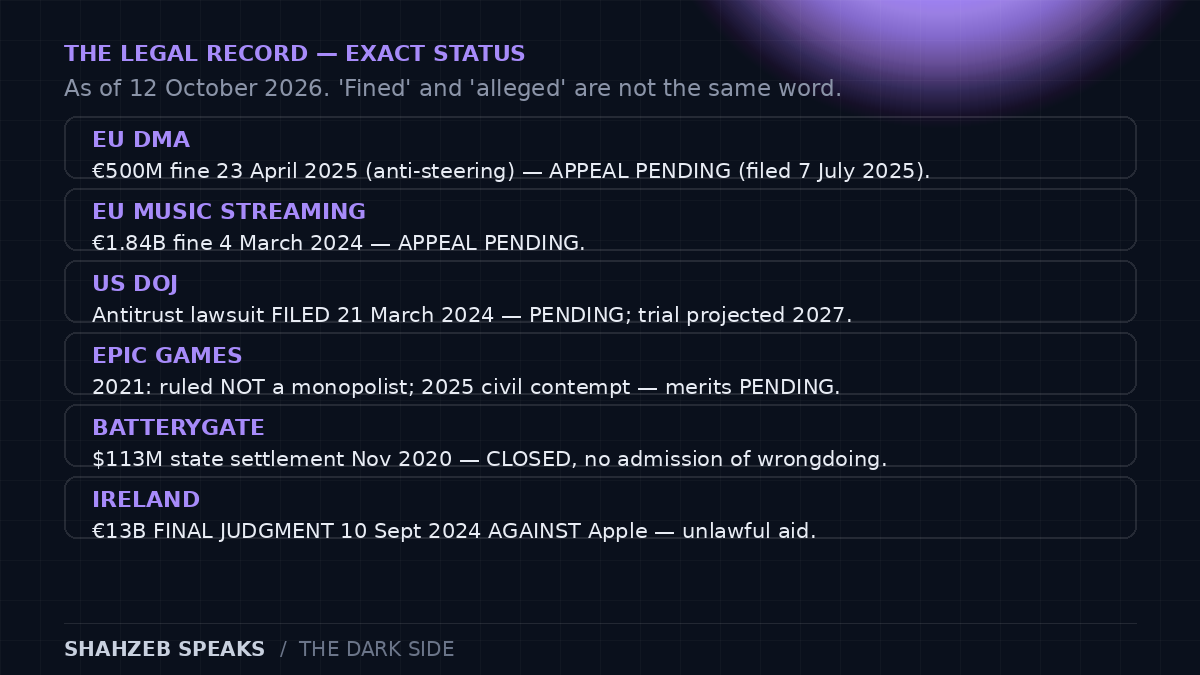
A fifty-year-old company with 2.35 billion devices collects regulators the way others collect awards. Here is the record at its exact legal status, as of 12 October 2026 — read the verbs: “fined” and “alleged” are not the same word, and Apple coverage routinely confuses them.
🇪🇺 The DMA fine: €500 million — fined, appeal pending
On 23 April 2025, the European Commission fined Apple €500 million for non-compliance with the Digital Markets Act’s anti-steering obligation (Article 5(4)) — the first major non-compliance decision under the DMA — ordering Apple to remove the restrictions on steering within a 60-day grace period and warning of periodic penalties of up to 5% of average daily worldwide turnover. Apple appealed to the EU General Court on 7 July 2025 — pending; no judgment reported. From 1 October 2026, Apple applied new unified EU terms — 26% standard commission on in-app purchases (down from 30%), 15% on linked-out purchases, 20% for alternative payment processing, 5% Core Technology Commission — with the Commission monitoring implementation “to ensure full and effective steering for developers.” Two cautions: no confirmed report that the €500 million has been paid, and no new formal 2026 investigation verified.
🇪🇺 The music-streaming fine: €1.84 billion — fined, appeal pending
On 4 March 2024, the Commission fined Apple €1.84 billion for prohibiting iOS music-streaming developers from informing users of cheaper options outside the App Store — triggered by Spotify’s 2019 complaint. The fine: a €40 million base plus a €1.8 billion deterrence uplift (0.5% of global turnover); Apple was ordered to stop. Apple appealed to the EU General Court in 2024 — pending.
🇺🇸 Epic Games: not a monopolist — but contempt, referral outcome unknown
On 10 September 2021, Judge Yvonne Gonzalez Rogers ruled Apple is not a monopolist under federal or state antitrust law, but that its anti-steering provisions are anticompetitive under California’s Unfair Competition Law — imposing a nationwide permanent injunction. On 30 April 2025, she found Apple in civil contempt — willful violation of the 2021 injunction via a 27% commission on external-link purchases and “scare screens” — barred any commission on external-link purchases in the US App Store, and referred Apple and VP of Finance Alex Roman to federal prosecutors for possible criminal contempt. The referral outcome is not verified. The Ninth Circuit upheld the contempt finding on 11 December 2025 but vacated the commission ban and remanded; en banc denied 30 March 2026; the Supreme Court declined Apple’s stay on 6 May 2026 and granted certiorari on 30 June 2026 — Epic’s response due 13 November 2026. Merits: pending.
🇺🇸 The DOJ lawsuit: filed 21 March 2024 — pending
On 21 March 2024, the US Department of Justice — with 16 state attorneys general and DC, later expanded — sued Apple in the District of New Jersey, alleging illegal monopolisation of the smartphone market through the “walled garden” (blocking super apps, suppressing cloud-streaming and messaging apps, limiting rival smartwatches and digital wallets). Judge Julien Xavier Neals denied Apple’s motion to dismiss on 30 June 2025 in a 33-page opinion. The lawsuit is pending, discovery underway, no trial date set (trial projected 2027); Bloomberg reported early settlement talks in mid-2026 — no agreement confirmed.
🔋 Batterygate: settled, no admission — closed
On 18 November 2020, Apple settled with more than 30 US state attorneys general for $113 million over allegations it secretly slowed older iPhones — without admission of wrongdoing. The class action (a minimum-$310M/maximum-$500M fund) won final approval in December 2020, was vacated by the Ninth Circuit in September 2022 and re-approved in February 2023; payments went out from January 2024 at $92.17 per claim (about 3.3 million claims of 90 million+ eligible devices), and Apple denied all allegations. Status: settled and paid out; closed.
📚 E-books: final ruling against Apple — closed
On 7 March 2016, the US Supreme Court declined Apple’s appeal of the ruling that Apple conspired with five publishers to fix e-book prices — a final ruling against Apple — triggering Apple’s $450 million settlement (~$400M to consumers as credits, ~$50M to 33 states and legal fees; publishers paid $166M combined). Status: settled; closed.
🇮🇪 Ireland state aid: final judgment against Apple — closed
On 10 September 2024, the European Court of Justice set aside the General Court’s 2020 annulment and confirmed the Commission’s 2016 decision: “Ireland granted Apple unlawful aid which Ireland is required to recover” — €13 billion over 1991–2014 tax rulings. Status: final judgment against Apple.
🇵🇰 Chapter 10: What Pakistani Brands Should — and Shouldn’t — Copy
Copy this
- Apple removed buttons; Pakistani brands add them. The Reber, Schwarz and Winkielman finding is free: everything you remove from the customer’s path is something they do not process — and fluency reads as quality.
- Build the ecosystem before you discount the product. Subscriptions, trade-ins, bundles — each is a reason not to leave. Competing on price alone leaves nothing to stay in.
- Constrain choice deliberately. Good, better, best: the Iyengar and Lepper jam study applies at every price point — a short, tiered range converts better than a catalogue.
- Turn customers into the media. “Shot on iPhone” was 77 photographers and a printing budget. Pakistani brands with proud customers have the same raw material; the missing piece is the invitation.
Do not copy this
- Apple’s curiosity gap works because the reveal is a global event. A startup’s secret launch is just silence.
- Do not copy the walled garden without the legal department. Apple’s toll road is now an antitrust file on three continents — marketplaces building closed ecosystems should study Chapter 9 before Chapter 3.
- Do not price premium without delivering fluency. Veblen’s signal only works when the product confirms the price. A premium price on a friction-filled product reads as arrogance.
📊 Chapter 11: Apple Psychology Audit Scorecard — Detailed Ratings
| Psychology Dimension | Score | Verdict |
| Simplicity & Design Fluency | 91/100 | Ive-era minimalism made ease feel premium; fluency research says ease reads as beauty. |
| Ecosystem Lock-In & Retention | 93/100 | Trade In, Apple One, 1B+ subscriptions: leaving feels like a loss; CIRP 10–15% is inflow, not retention. |
| Launch Theatre & Scarcity | 89/100 | Keynotes and “one more thing” turn releases into events; supply stays visibly finite. |
| Secrecy & Curiosity Management | 87/100 | Loewenstein’s gap: you know something is coming, never what — secrecy is the marketing. |
| Status & Identity Signalling | 92/100 | Veblen’s conspicuous consumption: premium price is the signal; Shot on iPhone won the 2025 Cannes Grand Prix. |
| Choice Architecture & Retail | 88/100 | Good-better-best, few SKUs, Genius Bar as Ritz-Carlton — the jam study inverted. |
| Scale & Financial Gravity | 91/100 | $416.2B sales, 2.35B devices, Interbrand #1 — scale as availability, globally. |
| Regulatory Resilience | 57/100 | €500M + €1.84B fines under appeal, DOJ suit pending, contempt with referral outcome unverified, €13B final judgment against. |
Score arithmetic: 91 + 93 + 89 + 87 + 92 + 88 + 91 + 57 = 688; 688 ÷ 8 = 86. Overall Psychology Score: 86/100.
✅ Chapter 12: Balance Sheet & A Psychologist’s Prescription
What Apple gets right
- It built fluency into the object — every removed button a removed decision — before processing-fluency research explained why it felt like beauty.
- It made leaving feel like losing: subscriptions, trade-in credit and bundles turn prospect theory into a balance-sheet asset.
- It weaponised the curiosity gap: competitors announce products; Apple stages events.
- It lets the price advertise: premium pricing is the signal, and Shot on iPhone turned customers into the media department.
- It constrains choice on purpose: good, better, best — the jam study as corporate strategy.
Where it is exposed
- The walled garden is a legal strategy now: two European fines under appeal, a pending DOJ suit, a contempt finding with an unverified referral outcome, and a final €13B Irish judgment.
- Concentration: the iPhone is still 50.4% of sales. The ecosystem protects the phone, but the phone carries the ecosystem.
- Leaks industrialise: every accurate rumour narrows Loewenstein’s gap before the keynote opens it.
- The CEO transition is a psychology event: Ternus inherits the machine, but the founder myth belongs to Jobs, not to him.
The prescription
- Defend the fluency premium. Every new fee structure and regulatory compromise taxes the asset no competitor can copy. Simplicity is the moat; protect it like one.
- Settle the toll-road fights before courts do. 30% to 15% to 26% shows negotiated retreat works; imposed retreat costs more.
- Give Ternus his own psychology. Cook professionalised the machine; Ternus can re-mythologise it — but only with a new signature move, not inherited rituals.
- Turn compliance into design. The EU’s steering rules are a design brief in disguise: the company that made leaving feel impossible can make fair competition feel effortless.
📝 Final Verdict
Apple is the most expensive psychology case I have audited: not the most loved, the most engineered. Fluency made the products feel inevitable; loss aversion and the endowment effect made the ecosystem feel owned; the curiosity gap made the secrecy feel generous; scarcity made the launches feel like verdicts; Veblen made the price feel like proof. Seven principles, one walled garden, fifty years.
Its weakness is the price of its strength: the toll road that funded the machine is now the evidence in the file. Two European fines are under appeal and the DOJ case is pending; the €13B Irish judgment is final, the e-books ruling was final, batterygate is closed. No honest audit has one column.
For brands everywhere — Pakistan included — the lesson is not “be premium.” It is that fluency is a decision, leaving should feel like losing, and the most profitable toll road in business history was built one removed button at a time.
Psychology Score: 86/100 — Apple earns elite marks for simplicity and design fluency (91), ecosystem lock-in (93), status and identity signalling (92), scale and financial gravity (91), launch theatre (89), choice architecture (88) and secrecy management (87), dragged down hard by regulatory resilience (57): €500M and €1.84B in European fines under appeal, a pending DOJ lawsuit, a contempt finding with an unverified referral outcome, and a final €13B Irish judgment. The best-engineered desire machine on earth, paying its tolls in court.
🧠 Building a Brand People Can’t Ignore?
I’m Muhammad Shahzeb, an MSc Industrial Psychologist and web and app developer. I audit brands through behavioural psychology — what makes people care, share and stay loyal, and where the line is.
More psychology behind the brands you buy: loss aversion in marketing, the endowment effect and choice overload and the paradox of choice. And my field is industrial psychology in Pakistan — the homepage is where that work lives.
📚 References & Sources
- Apple Inc. — Form 10-K, FY ended 27 September 2025 (SEC EDGAR; read directly): HQ One Apple Park Way, Cupertino; net sales $416,161M (+6%); iPhone $209,586M; Mac $33,708M (+12%); iPad $28,023M (+5%); Wearables $35,686M (−4%); Services $109,158M (+14%). [A]
- Apple Inc. — Exhibit 99.1: Services revenue FY2024 $96,169M; FY2025 $109,158M. [A]
- Associated Press, 1 Apr 2026: founded 1 April 1976 by Steve Jobs, Steve Wozniak and Ronald Wayne. [B]
- MacObserver: John Ternus became CEO 1 September 2026 (announced 20 April 2026); Cook CEO 24 Aug 2011 – 31 Aug 2026, now Executive Chairman. [B]
- Beebom: Ternus previously SVP Hardware Engineering 2021–2026, led iPhone/iPad/Mac development, joined Apple 2001. [B]
- MacRumors, 8 Oct 2026: Tim Cook interview on the Ternus transition — “I wanted John to have some wind at his back.” [B]
- MacRumors, 30 Jan 2025: over 2.35 billion active devices announced on the Q1 FY2025 earnings call. [B]
- Nasdaq earnings coverage, 1 Feb 2024: more than 1 billion paid subscriptions announced on the Q1 FY2024 call — “more than double the number of four years ago.” [B]
- MacRumors, 16 Oct 2025: Interbrand Best Global Brands 2025 — Apple #1, $470.9B, −4% YoY. [B]
- Kantar BrandZ 2025 (announced May 2025): Apple #1, ~$1.3 trillion (+28% YoY), the only trillion-dollar brand. [A]
- TechCrunch, 12 Jan 2026: Apple said developers earned a cumulative $550B from the App Store since 2008 (avg 850M weekly users in record 2025). [B]
- Apple newsroom, 18 Nov 2020: App Store Small Business Program — commission 30% to 15% for developers earning up to $1M (from 1 Jan 2021). [A]
- CultOfMac / Macworld: “Think Different” ran 1997–2002 (TBWAChiatDay); slogan introduced 8 Aug 1997; “Crazy Ones” spot debuted 28 Sept 1997; words by Craig Tanimoto; copy by Rob Siltanen and Ken Segall; voiceover Richard Dreyfuss. [B]
- Macworld: “one more thing” first used by Jobs at Macworld San Francisco, January 1998; first product use July 1999 (AirPort). [B]
- AppleInsider, 7 Nov 2014: Apple’s supplier secrecy per unsealed court filings — code names (“Project Onyx”), 24/7 security, scrap destruction, SecureShip. [B]
- Macworld / CultOfMac: iMac unveiled 6 May 1998; on sale 15 Aug 1998, $1,299, Bondi Blue, Jony Ive; “i” = Internet, individual, instruct, inform, inspire; name by Ken Segall. [B]
- CultOfMac / MacRumors: first iPod 23 Oct 2001, 5GB, $399 — “1,000 songs in your pocket.” [B]
- MacRumors / 9to5Mac / CultOfMac: first Apple Stores 19 May 2001 (Tysons Corner, Glendale Galleria); opening weekend 7,700+ visitors, $599,000; Ron Johnson joined Jan 2000; Genius Bar and Theater; Jobs “megahertz and megabytes” quote. [B]
- Apple newsroom, 28 Apr 2003: iTunes Music Store — 99 cents per song, 200,000+ songs at launch, no subscription fees. [A]
- Apple newsroom, 10 Jul 2018 (App Store at 10): App Store introduced 10 July 2008 with 500 apps; 10 million downloads in first three days. [A/B]
- Apple newsroom, 9 Sep 2014 / 16 Oct 2014: Apple Pay announced — “easy, secure and private way to pay”; US launch 20 Oct 2014 — “cashiers will no longer see your name, credit card number or security code.” [A]
- Apple newsroom, 20 Aug 2019: Apple Card launched for all US customers — no annual, late, international or over-limit fees; Daily Cash 3%/2%/1%; no number/CVV/expiration printed; Goldman Sachs issuer, Mastercard network. [A]
- Reuters, 7 Jan 2026: JPMorgan Chase reported to become the new Apple Card issuer (~$20B balances, ~2-year transition). [B]
- MacRumors, 19 Jun 2025: “Shot on iPhone” launched March 2015 (77 photographers, ~70 cities, 24 countries); Grand Prix for Creative Effectiveness, 2025 Cannes Lions. [B]
- TechCrunch, 29 Oct 2020: Apple One announced 15 Sep 2020, launched 30 Oct 2020 — $14.95 / $19.95 / $29.95 per month. [B]
- 9to5Mac, 17 Apr 2023: Apple Trade In — credit toward a new device or gift card; free recycling otherwise. [B]
- Computer Weekly: Jony Ive Chief Design Officer 26 May 2015 – 27 June 2019 (departed to found LoveFrom). [B]
- AppleInsider, 29 Feb 2024: CIRP — 10–15% of iPhone buyers per quarter were former Android users (US, 12 months to Dec 2023). [B]
- Mondaq: European Commission fined Apple €500M on 23 April 2025 for DMA anti-steering non-compliance (Art 5(4)); 60-day grace period; periodic penalties up to 5% of average daily worldwide turnover warned. [B]
- Verdict, 7 Jul 2025: Apple appealed the €500M fine to the EU General Court; appeal pending. [B]
- Dow Jones Newswires, 1 Oct 2026 / Ashurst: Apple’s new EU terms from 1 Oct 2026 — 26% standard commission (from 30%), 15% linked-out, 20% alternative payment, 5% Core Technology Commission; Commission monitoring. [B]
- Hausfeld: Commission fined Apple €1.84B on 4 March 2024 over music-streaming anti-steering (Spotify 2019 complaint; €40M + €1.8B uplift). [B]
- PYMNTS: Apple appealed the €1.84B fine at the EU General Court in 2024; pending. [B]
- Public Radio East, 18 Nov 2020: Apple settled with 30+ state AGs for $113M without admission of wrongdoing (batterygate). [B]
- MacRumors, 6 Jan 2024: batterygate class action — payouts from Jan 2024 at $92.17/claim; approved Dec 2020, vacated Sept 2022, re-approved Feb 2023. [B]
- MacRumors, 10 Sep 2021: Epic Games v. Apple — Apple ruled not a monopolist; anti-steering anticompetitive; injunction issued. [B]
- Reuters, 30 Apr 2025: civil contempt finding — willful violation; commission on external-link purchases barred in US App Store; Apple and Alex Roman referred to federal prosecutors. [B]
- IPWatchdog, 30 Jun 2026: Ninth Circuit upheld contempt 11 Dec 2025, vacated commission ban, remanded; en banc denied 30 Mar 2026; SCOTUS declined stay 6 May 2026, granted cert 30 Jun 2026; Epic response due 13 Nov 2026. [B]
- iClarified: DOJ sued Apple 21 March 2024 in D. New Jersey with 16 state AGs + DC (later expanded). [B]
- Dig.watch: Judge Julien Xavier Neals denied Apple’s motion to dismiss 30 June 2025; lawsuit pending; trial projected 2027; early settlement talks reported, no agreement confirmed. [B]
- Public Radio East, 7 Mar 2016: SCOTUS declined Apple’s e-books appeal — final ruling against Apple; $450M settlement triggered. [B]
- Harneys: ECJ final judgment 10 Sept 2024 — “Ireland granted Apple unlawful aid which Ireland is required to recover” (€13B, 1991–2014 rulings). [B]
- Kahneman, D., & Tversky, A. (1979). Prospect theory: An analysis of decision under risk. Econometrica, 47(2), 263–291.
- Kahneman, D., Knetsch, J. L., & Thaler, R. H. (1990). Experimental tests of the endowment effect and the Coase theorem. Journal of Political Economy, 98(6), 1325–1348.
- Iyengar, S. S., & Lepper, M. R. (2000). When choice is demotivating: Can one desire too much of a good thing? Journal of Personality and Social Psychology, 79(6), 995–1006.
- Goldstein, N. J., Cialdini, R. B., & Griskevicius, V. (2008). A room with a viewpoint: Using social norms to motivate environmental conservation in hotels. Journal of Consumer Research, 35(3), 472–482.
- Loewenstein, G. (1994). The psychology of curiosity: A review and reinterpretation. Psychological Bulletin, 116(1), 75–98.
- Verhallen, T. M. M., & Robben, H. S. J. (1994). Scarcity and preference: An experiment on unavailability and product evaluation. Journal of Economic Psychology, 15(2), 315–331.
- Reber, R., Schwarz, N., & Winkielman, P. (2004). Processing fluency and aesthetic pleasure: Is beauty in the perceiver’s processing experience? Personality and Social Psychology Review, 8(4), 364–382.
- Arkes, H. R., & Blumer, C. (1985). The psychology of sunk cost. Organizational Behavior and Human Decision Processes, 35(1), 124–140.
- Veblen, T. (1899). The Theory of the Leisure Class.
Key Findings
- $416.2B net sales FY2025 (+6%, year ended 27 Sept 2025, SEC Form 10-K); iPhone 50.4% of sales ($209.6B), Services $109.2B (+14%)
- Over 2.35B active devices (Q1 FY2025 call, 30 Jan 2025); Interbrand 2025 ranks Apple #1 with a $470.9B brand value (−4% YoY)
- CEO John Ternus since 1 September 2026; Tim Cook (CEO 24 Aug 2011–31 Aug 2026) now Executive Chairman — announced 20 April 2026
- EU DMA: €500M fine 23 April 2025 (anti-steering non-compliance, Art 5(4)); Apple appealed 7 July 2025 — APPEAL PENDING; Oct 2026 new EU terms (26% standard commission), Commission monitoring
- EU music-streaming: €1.84B fine 4 March 2024 — appeal PENDING. US DOJ antitrust lawsuit filed 21 March 2024 — motion to dismiss DENIED 30 June 2025, lawsuit PENDING, trial projected 2027. Epic: 2021 ruled not a monopolist; 30 Apr 2025 civil contempt, criminal referral outcome NOT verified — merits PENDING
- Batterygate: $113M state settlement Nov 2020 WITHOUT admission of wrongdoing; class payouts from Jan 2024 at $92.17/claim — CLOSED. Ireland state aid: FINAL JUDGMENT 10 Sept 2024 against Apple (unlawful aid, Ireland required to recover €13B)
Overall Psychology Score
Apple scores 86/100 in our comprehensive psychology audit covering consumer behavior strategies, UX design principles, and psychological marketing effectiveness.
The detailed dimension scores are in the audit's Psychology Scorecard chapter.
RevolutionaryMuhammad Shahzeb
MSc Industrial Psychologist, specializing in consumer behavior, UX psychology, and brand strategy analysis. Helping brands understand the psychology behind their success.
About Muhammad Shahzeb →