Dyson Psychology Audit — The Engineering of Desire, Tested by a £419.99 Toothbrush
Dyson built desire on engineering, visible proof and premium prices. Then a £419.99 toothbrush tested that trust. Score: 80/100. See scorecard.

80 / 100
Overall consumer behavior effectiveness
Brand Overview
- Brand nameDyson
- Founded1991
- HeadquartersSingapore
- IndustryTechnology
- Websitewww.dyson.com ↗
Psychology Techniques Identified
- 01Inventor Authority & Founder Effect (James Dyson, 5,127 Prototypes)
- 02Visible Proof & Vivid Evidence (Transparent Bin, Camera Feed)
- 03Price-Quality Signal (Premium Pricing as Quality Cue)
- 04Distinctiveness & Von Restorff Effect (Design Unlike Any Rival)
- 05Social Identity & In-Group Signalling (Buy Engineering, Not Marketing)
- 06Ecosystem Familiarity & Endowment Effect (Range, App, Repeat Purchase)
- 07Sunk Cost & Investment (Premium Hardware, Ongoing Ownership)
- 08Anchoring via the Price Ladder (DC01 About £200 to CameraJet £419.99)
- 09Loss Aversion (Premium Investment at Risk When a Product Fails)
- 10Social Proof via Market Scale (85 Markets, Over 20 Million Products in 2024)
- 11Innovation Halo & Category Transfer (Trust That Travels to New Categories)
- 12Transparency & Trust Repair (30 September 2026 Statement and Apology)
Full Psychology Audit Report
In this audit
A toothbrush that costs £419.99 should be a joke. Dyson made it a test. When the CameraJet launched globally on 1 September 2026, it carried everything Dyson has ever sold: six years of development, a camera that scans 28 images a second, and a price that says, in numbers, “this is not like other toothbrushes”. Weeks later, the same brand had to explain a production issue, isolate products, and watch retailers pull the listing from their websites. Dyson’s psychology is not that people love vacuum cleaners. It is that people will pay a premium for visible engineering — until the engineering stops being visible, and starts being a problem.
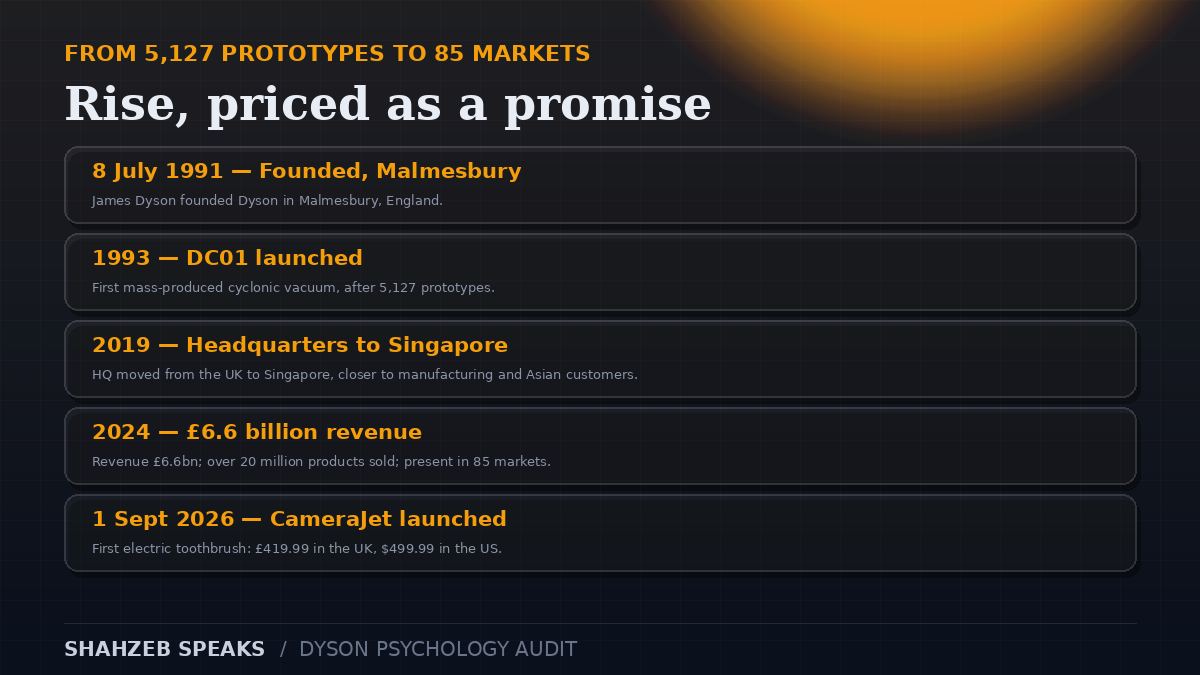
Dyson’s most striking verified facts set the scale. Founded on 8 July 1991 in Malmesbury, England, by James Dyson, the company is now present in 85 markets, with its headquarters in Singapore since 2019. In 2024 it reported revenue of £6.6 billion, down from £7.1 billion in 2023, profit before tax of £561 million, and more than 20 million products sold — a record volume. Around half of its global team are engineers and scientists, and it spent, by its own account, £8 million a week on research and development, filing 238 patents in 2024. That is the machine behind the brand. This audit asks what that machine does to a buyer’s mind — and what happens when it stumbles in public.
I am an Industrial and Organizational Psychologist in Karachi. I audit brands by their documented features, campaigns and legal record, not by their slogans. Every psychology principle below is tied to a verifiable Dyson feature, and every legal action is stated at its exact status, as of 26 October 2026.
“Dyson does not sell suction. It sells the sight of suction working — and the story of the man who refused to stop prototyping.” — Brand Psychology Analysis, ShahzebSpeaks
📋 Brand Overview: Dyson at a Glance
| Brand | Dyson |
| Founded | 8 July 1991, Malmesbury, England, by James Dyson |
| Headquarters | St James Power Station, HarbourFront, Singapore (moved from the UK in 2019) |
| Leadership | Founder: Sir James Dyson; CEO: Hanno Kirner |
| First product | DC01 cyclonic vacuum, launched 1993, after 5,127 prototypes |
| Product lines | Vacuum cleaners, hair care, air treatment, headphones, lighting, business hand dryers |
| Scale (2024) | Revenue £6.6 billion; over 20 million products sold; present in 85 markets |
| Psychology Score | 80 / 100 |
📜 Chapter 1: The History — 5,127 Prototypes and a Transparent Bin
James Dyson’s first cyclonic vacuum took four years and, by Dyson’s own account, 5,127 prototypes before the DC01 launched in 1993. The detail matters because it is not a footnote in Dyson’s marketing. It is the marketing. The prototype count turns effort into evidence: this was not styled, it was solved. The transparent bin did the same work visually. Market research, as secondary histories report, suggested people would not like seeing the dust they had collected. Dyson made the bin transparent anyway, and the bin became a popular, heavily copied feature. The DC01 became the biggest-selling vacuum in the United Kingdom within 18 months, according to the same histories.
The company then repeated the pattern across categories: a bladeless fan, a hair dryer that looked unlike any hair dryer, a cordless vacuum that removed the cord rather than improving it. Some bets failed — a washing machine discontinued in 2005, an electric car project halted in 2019 as not commercially viable after more than £500 million invested, and Zone headphones withdrawn in mid-2025, as secondary reporting records. The failures are useful for this audit because they show the limit of the Dyson formula. Engineering story alone does not guarantee a category. It guarantees attention. What happens after attention is where the psychology gets tested.
👤 Chapter 2: The Inventor as the Brand — Authority and the Founder Effect
Psychology principle: authority — people follow a credible expert, especially one who appears to have paid a personal cost for the expertise (Cialdini). Dyson’s authority is not a celebrity endorsement. It is the founder, on camera, in a workshop, holding a prototype. James Dyson is still presented as Founder, and the company’s own biography centres on the man, the prototypes and the problem. That is a strong authority signal because it is costly to fake: a founder who spent four years on one vacuum has skin in the story in a way a hired spokesperson does not.
The risk of founder authority is the same as its strength. When the founder is the proof, a product failure is not just a product failure. It reads as a crack in the authority itself. The CameraJet episode, examined in Chapter 7, is therefore more damaging for Dyson than it would be for a brand whose authority rests on price or distribution. Dyson trained its customers to judge it by engineering. They did.
👁️ Chapter 3: Visible Proof — Why You Can See Dyson Working
Psychology principle: the availability and vividness of evidence — concrete, visible proof is more persuasive than an abstract claim (Tversky and Kahneman). Dyson’s clearest trick is to make performance visible. The transparent bin lets you see the dust. The bladeless fan lets you see the absence of blades. The CameraJet goes further: a camera feed and a coverage map in the app let you see where you brushed and where you missed. Each feature turns a claim (“more powerful”, “more thorough”) into something the buyer can watch.
Visible proof also explains Dyson’s premium pricing. A buyer cannot easily verify motor speed or airflow, but can verify a clear bin filling up, a dryer that looks different, or a toothbrush that shows its own work. The visible feature carries the invisible claim. When the visible feature fails — water where it should not be, a device that stops — the same mechanism reverses. The failure is also visible, and therefore also persuasive, in the opposite direction.
💰 Chapter 4: The Price as a Signal — Premium Pricing and the Quality Heuristic
Psychology principle: price-quality inference — when quality is hard to judge, a high price is read as a signal of high quality. Dyson has used this from the start. The DC01 launched at about £200, a premium price for a vacuum at the time. The CameraJet, at £419.99 in the United Kingdom and $499.99 in the United States, is the same logic taken to an extreme: a toothbrush priced like a small appliance, because Dyson is not selling a toothbrush. It is selling a Dyson.
The signal works only while the rest of the brand supports it. Premium price plus visible engineering plus a founder story equals “expensive because it is better”. Premium price plus a product that stops working equals “expensive and broken”. The second equation is harsher than the first is kind, because the price raised the expectation. That asymmetry is the central tension of the Dyson audit: the pricing that builds desire also raises the cost of a mistake.
🧲 Chapter 5: Distinctive Form, Ecosystem and the Habit of Upgrading
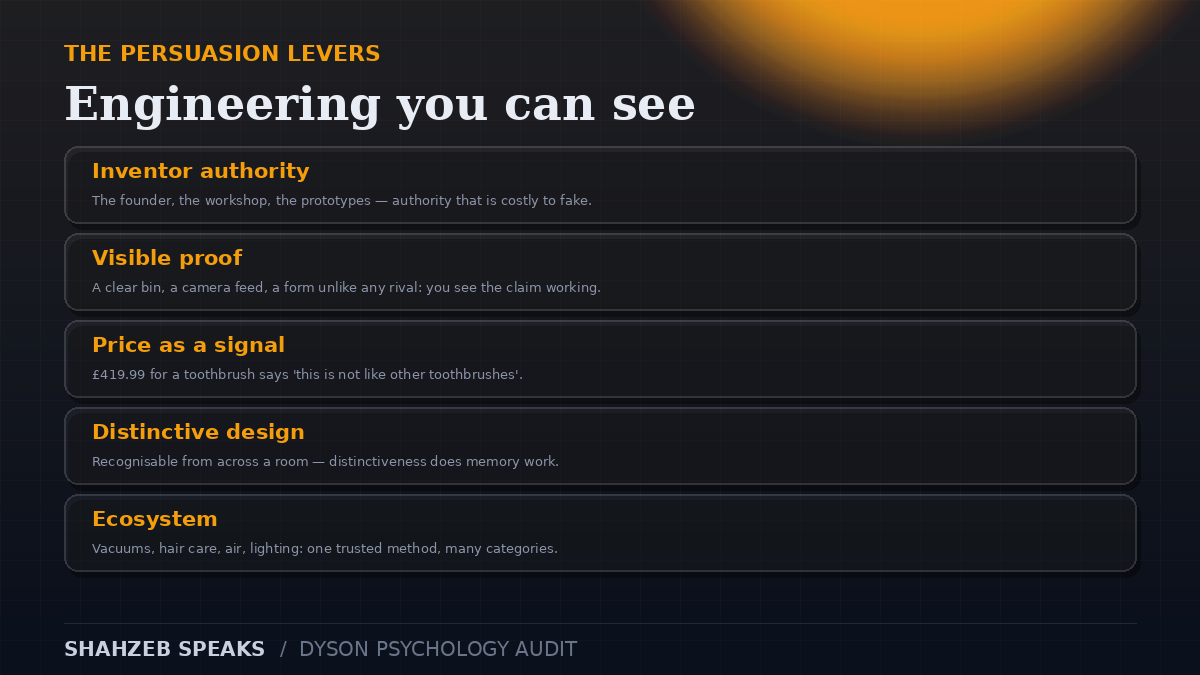
Psychology principles: distinctiveness (the Von Restorff effect — the distinctive item is remembered) and the endowment and ecosystem effects (once you own part of a system, leaving feels like a loss). Dyson products look unlike their competitors, on purpose. A Supersonic dryer, a bladeless fan, a cordless stick vacuum: each one is recognisable from across a room. That distinctiveness does memory work that advertising cannot buy. It also does identity work. Owning a Dyson signals a certain kind of buyer — design-aware, engineering-trusting, willing to pay — and that signal is part of what the buyer purchases.
The ecosystem completes the loop. Dyson’s range now spans vacuums, hair care, air treatment, headphones and lighting, with the MyDyson app tying devices together. A buyer who owns one Dyson has a reason to consider the next Dyson first: familiar controls, familiar service, familiar design language. That is not a lock-in in the contractual sense. It is a psychological one, built from familiarity and sunk investment, and it is why a single-category failure rarely ends a Dyson relationship — but can still dent the next purchase.
🤖 Chapter 6: Engineering as Identity — “Around Half the Team Are Engineers”
Psychology principle: social identity and in-group signalling — people buy products that say who they are (Tajfel and Turner). Dyson’s claim that around half of its global team are engineers and scientists, backed by £8 million a week in research spending and 238 patents filed in 2024, is not a specification sheet. It is an identity offer: buy from the engineers, not the marketers. For a buyer who distrusts advertising, that is a powerful pitch, because it appears to be the opposite of advertising.
The claim is also checkable in a way most brand claims are not, and that checkability is part of its power. Patents can be counted. Research spending can be reported. Products can be taken apart. Dyson invites that scrutiny, and usually survives it. The CameraJet is the exception that tests the rule, because its scrutiny came from users and reviewers, not from Dyson’s own demonstrations.
There is a second, quieter identity signal at work here. Dyson rarely asks buyers to join a community, wear a logo, or signal membership in the way fashion or fitness brands do. The signal is competence: the buyer who chooses Dyson is the buyer who did the research, read the specifications, and was not fooled by a cheaper lookalike. That self-image is flattering, and it is sticky. Once a buyer has told themselves they are the kind of person who buys engineering rather than marketing, switching to a cheaper rival feels like a small betrayal of that self-image, not just a different purchase. This is why Dyson’s customers defend the brand in reviews and forums with an intensity that vacuum cleaners do not normally inspire. They are not only defending a product. They are defending a judgement about themselves.
The same identity mechanism explains why Dyson can charge a premium in categories where it has no history. A buyer who trusts Dyson’s engineering in vacuums does not need a separate reason to trust its hair dryer, its fan, or its toothbrush. The trust transfers, because it was never really about the vacuum. It was about the method: find a category where the existing products look compromised, engineer a visible improvement, and price it as the honest cost of doing the job properly. That transfer is powerful, and it is also the reason a failure in a new category travels back so quickly to the core brand. The method is the brand, so a failure of method is a failure of brand.
It is worth pausing on the scale behind that method, because scale changes what a failure costs. In 2024, Dyson reported revenue of £6.6 billion and more than 20 million products sold, across 85 markets. A company of that size cannot treat a launch problem as a workshop anecdote. Every production batch, every retailer listing, every support response is multiplied across markets, languages and time zones. The CameraJet’s temporary unavailability in some markets while it remained on sale in others is, in that light, not a minor inconsistency. It is what scale does to a story: the same product, the same week, available in one country and absent in another, with buyers comparing notes online in real time. Scale does not create the problem, but it does make the problem impossible to contain with a single statement.
⚠️ Chapter 7: The CameraJet Test — When Visible Engineering Becomes Visible Failure
The CameraJet launched globally on 1 September 2026 as Dyson’s first electric toothbrush, with a 100,000-pixel macro camera, a targeted liquid jet, six years of development, 661 engineers, 16 million lines of code and training on more than 470,000 dental images, as reported from Dyson. The price — £419.99 in the United Kingdom, $499.99 in the United States — set the expectation. What followed set the test.
Secondary reporting described consumer complaints including water in battery compartments, charging failures and devices stopping seconds after first use, and a review unit that stopped working less than 24 hours after unboxing. Those are reported complaints, not Dyson admissions, and this audit treats them as such. What Dyson itself said, in a statement dated 30 September 2026, is on the record: “The new Dyson CameraJet technology launched globally on September 1st. We are now in full production and shipping product. Unfortunately, one production batch of jet tubes had experienced a process issue, creating the potential for water seepage which affected the performance of a small number of products early on. We took what we believe to be the right decision to isolate impacted products, which resulted in a temporary out-of-stock position. We are sorry that we have let down our loyal customers and we will do all we can to support them.”
Two points matter for the psychology score. First, Dyson did not call this a recall, and no formal recall is verified in this audit — the company’s wording is “isolate impacted products” and “temporary out-of-stock position”, and that wording should not be upgraded. Second, secondary reporting, citing Bloomberg, said major retailers including Best Buy removed the toothbrush from their websites soon after launch, and a check on 6 October found it absent from Best Buy Canada’s website while Dyson’s United Kingdom site displayed a buy option. A permanent Best Buy exit is not verified and is not claimed here. What is verified is narrower, and still damaging: a premium product, launched on engineering authority, became temporarily unavailable while its maker explained a production issue. For a brand built on visible proof, an invisible production batch and a missing listing are the worst kind of visibility.
⚖️ Chapter 8: The Dark Side — Patents, the European Union and a Settled Workers’ Case
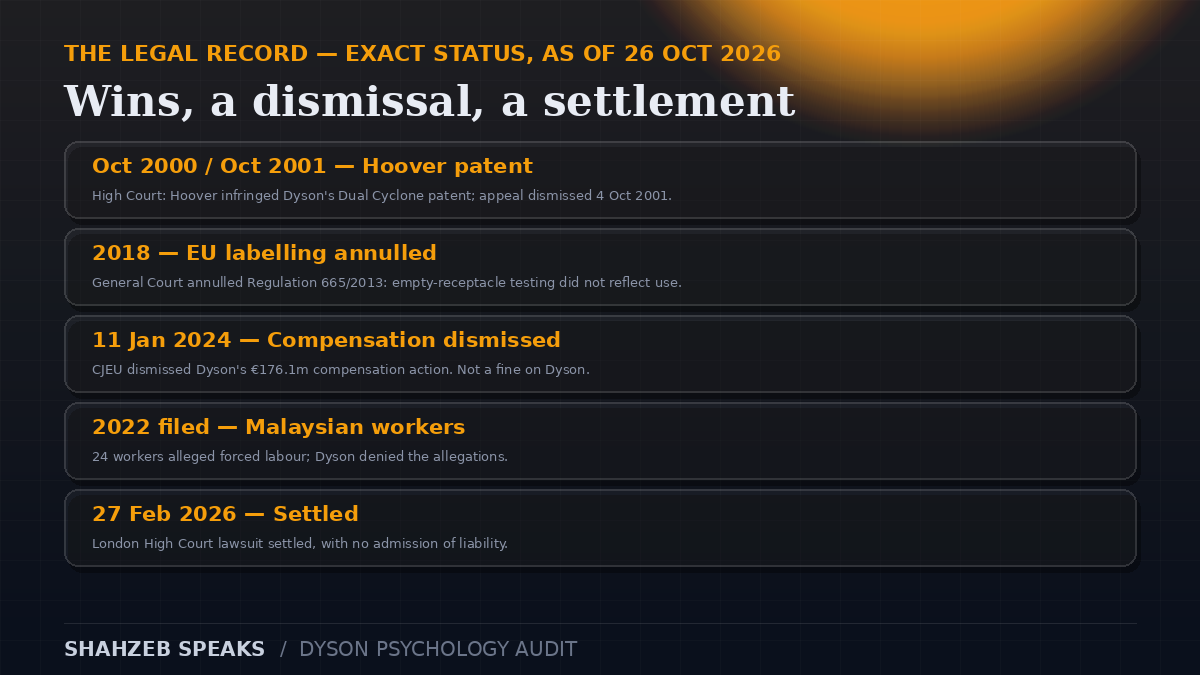
Dyson’s legal history is, unusually for this audit series, a story of Dyson as claimant as often as defendant. In October 2000, the High Court ruled that Hoover had infringed Dyson’s Dual Cyclone patent with its Triple Vortex cleaner, and on 4 October 2001 the Court of Appeal dismissed Hoover’s appeal, upholding patent validity and the infringement finding. That is a final ruling in Dyson’s favour, and it reinforced the inventor-authority story: the courts agreed the invention was Dyson’s.
The European Union energy-labelling case runs the other way. The General Court annulled Commission Delegated Regulation 665/2013 in 2018 because empty-receptacle testing did not reflect actual conditions of use. Dyson then sought €176.1 million in compensation. On 11 January 2024, the Court of Justice of the European Union dismissed Dyson’s compensation action. That is a loss for Dyson’s compensation claim. It is not a fine imposed on Dyson, and this audit does not describe it as one. No fine against Dyson was found in the legal history checked for this audit.
The most sensitive chapter concerns workers in Malaysia. In 2022, 24 workers from Nepal and Bangladesh sued Dyson Technology Ltd, Dyson Ltd and a Malaysian subsidiary, alleging forced labour at a Malaysian factory making Dyson parts. Those are allegations, which Dyson denied. On 27 February 2026, the London High Court lawsuit was settled, with no admission of liability; the defendants, as reported, “deny and have always denied all liability”. This audit reports the settlement exactly at that status: settled, with no admission of liability, and the underlying claims remaining allegations, not findings. For a brand whose identity rests on engineering integrity, even a settled allegation of this kind is a trust cost, because it sits uneasily beside the founder’s problem-solving story.
🌍 Chapter 9: What Other Brands Should — and Shouldn’t — Copy
Copy the visible proof. If your product works better, find the one feature that lets a buyer see it working, and make that feature the advertisement. Copy the founder’s cost: a story about effort is persuasive only if the effort is real and checkable — prototype counts, patents, research spending, not adjectives. Copy the price discipline: a premium price is a promise, and it must be supported by the rest of the brand, or it becomes the evidence against you.
Do not copy the CameraJet launch pattern: a premium price, a complex new category, and a production issue that becomes public before the maker has a clear, specific account of what went wrong and who is affected. Dyson’s 30 September statement was honest about the batch and the seepage risk, but it arrived after weeks of reported failures and retailer removals, and it left the scale — “a small number of products” — unquantified. For any brand, the lesson is timing: in a visible-proof brand, the explanation must arrive at the speed of the failure, not after it.
Do not copy the idea that a settled case ends a story. The Malaysian workers’ settlement, with no admission of liability, closes a lawsuit. It does not close the question buyers will ask about supply chains, and brands that treat a settlement as a full stop will find the question asked again at the next launch.
Finally, copy Dyson’s patience with categories, but not its impatience with explanations. Dyson spent four years and thousands of prototypes on its first vacuum, and six years on the CameraJet. That patience is admirable, and it is part of why buyers trust the brand. The same patience should apply to the explanation when something goes wrong: a specific account, with numbers, dates and remedies, given at the speed of the reports, not after the listings have already disappeared. Engineering patience and communication patience are the same virtue, applied to different moments. A brand that has one and not the other will keep inventing well and explaining badly — and in a market where buyers compare notes instantly, explaining badly is now the more expensive failure.
📊 Psychology Scorecard
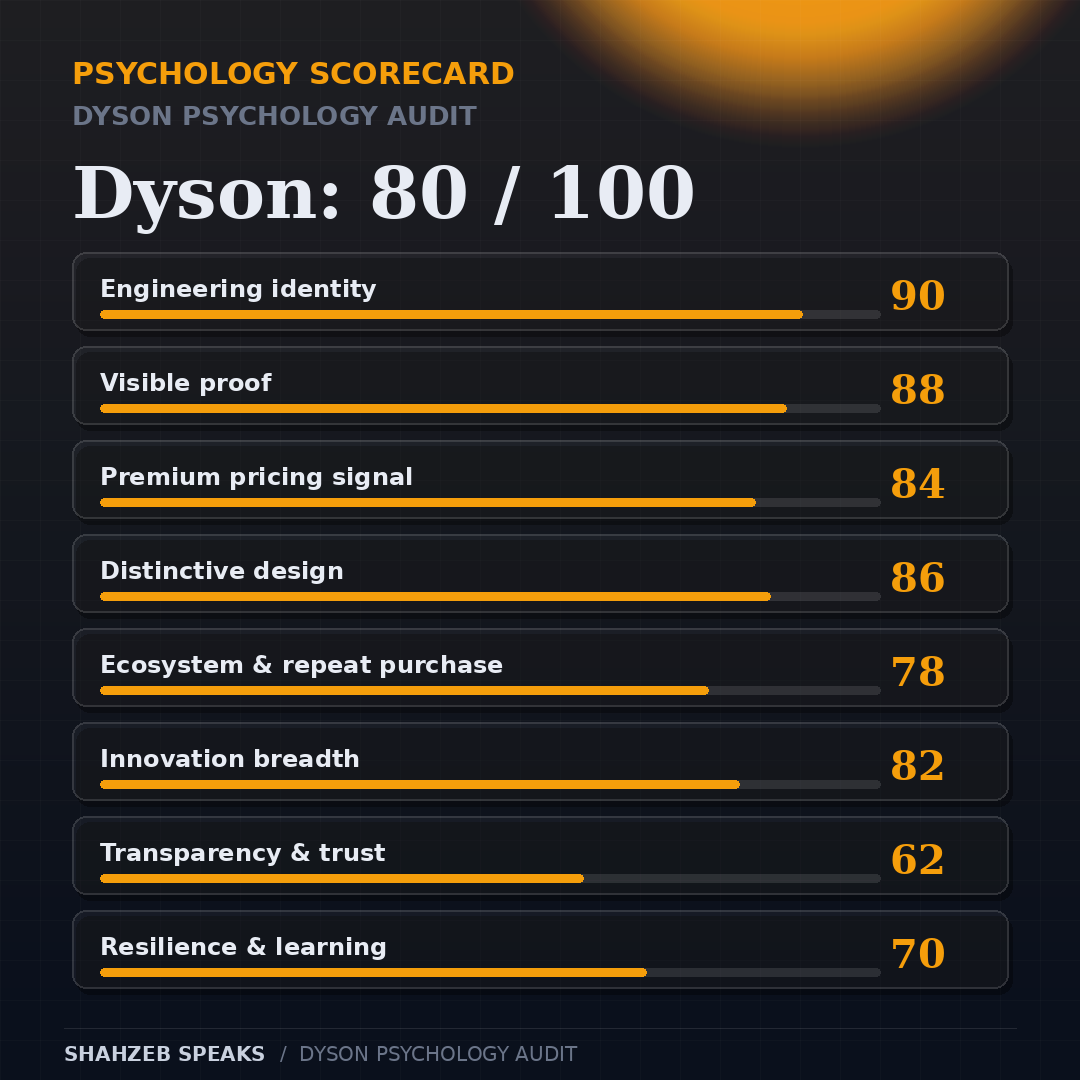
| Dimension | Score | Verdict |
|---|---|---|
| Engineering identity & inventor authority | 90 | The founder-prototype story is real, costly and checkable. |
| Visible proof & demonstration | 88 | Clear bins, camera feeds and distinctive forms let buyers see the claim. |
| Premium pricing as quality signal | 84 | Price consistently signals quality — and raises the cost of failure. |
| Distinctive design identity | 86 | Recognisable from across a room; distinctiveness does memory work. |
| Ecosystem & repeat purchase | 78 | Range and app give a reason to stay, without contractual lock-in. |
| Innovation breadth | 82 | Repeated category entry, with honest failures alongside the wins. |
| Transparency & trust (CameraJet) | 62 | Statement was honest on the batch, late and unquantified on scale. |
| Resilience & learning from failure | 70 | Failed categories were exited; the CameraJet lesson is still being written. |
| Overall (rounded average) | 80 | 90+88+84+86+78+82+62+70 = 640; 640 ÷ 8 = 80. |
✅ Balance Sheet & Prescription
Assets: a founder story that is true and checkable; visible proof in every category; a price that signals quality; a design language that is instantly recognisable; a range that rewards staying.
Liabilities: a premium price that magnifies every failure; a CameraJet launch whose explanation lagged its failures; a settled workers’ case that leaves supply-chain questions open; an innovation record that includes expensive exits.
Prescription: publish, for the CameraJet, the number of affected units and the exact remedy for each market, in the same plain language as the 30 September statement. Make the next launch’s first communication a production and support plan, not a specification list. And treat supply-chain transparency as part of the engineering story, not as a separate legal matter — because buyers now judge Dyson by the same standard it taught them: show the work.
📝 Final Verdict
Dyson is one of the strongest psychology brands in this audit series, because its persuasion is built on something real: engineering you can see, a founder who paid for the story, and a price that dares you to doubt it. The CameraJet did not destroy that structure. It revealed its condition: when a premium, visible-proof brand stumbles, the stumble is also visible, and the explanation must be as specific as the product. Dyson’s next chapter will be decided not by its next invention, but by how completely it explains its last one.
Psychology Score: 80/100 — Engineering you can see, priced like a promise, tested by a toothbrush.
📬 Want a brand audit like this for your company?
If you want to know what your brand is really teaching buyers — and what it will cost you when it fails — contact me.
Related audits: Apple, Samsung, Crocs. For the field behind this audit, see industrial psychology in Pakistan.
📚 References & Sources
- Dyson (2026). Dyson CameraJet update — statement dated 30 September 2026. Dyson UK.
- Dyson (2026). James Dyson — founder biography. Dyson UK.
- Dyson (2025). Dyson financial results 2024. Dyson UK press release.
- Oral Health Group (2026). Dyson’s US$499 AI toothbrush faces water seepage fault weeks after launch.
- DentistryIQ (2026). Dyson halts sales of CameraJet after reports of product failures.
- Gadget Review (2026). Dyson CameraJet — consumer failure reporting summary.
- Swarb.co.uk (2001). Dyson Appliances Ltd v Hoover Ltd, Court of Appeal, 4 October 2001.
- EU Law Live (2024). General Court dismisses Dyson compensation action (CJEU, 11 January 2024).
- Global Banking & Finance (2026). Dyson settles Malaysian workers’ UK lawsuit, 27 February 2026.
- Dezeen (2026). Dyson products roundup, 12 September 2026.
Key Findings
- Founded 8 July 1991 in Malmesbury, England, by James Dyson; headquarters in Singapore since 2019; official website www.dyson.com; present in 85 markets
- In 2024 Dyson reported revenue of £6.6 billion, over 20 million products sold, R&D spend of £8 million a week and 238 patents filed globally
- CameraJet launched globally 1 September 2026 at £419.99 in the UK and $499.99 in the US; Dyson's 30 September 2026 statement said one production batch of jet tubes had a process issue creating potential water seepage affecting a small number of products, and that impacted products were isolated, resulting in a temporary out-of-stock position — NOT described as a formal recall
- Secondary reporting, citing Bloomberg, said major retailers including Best Buy removed CameraJet from their websites soon after launch, and a 6 October check found it absent from Best Buy Canada's website; a permanent Best Buy exit is NOT verified and is NOT claimed
- High Court ruled October 2000 that Hoover had INFRINGED Dyson's Dual Cyclone patent; Court of Appeal dismissed Hoover's appeal 4 October 2001, UPHOLDING patent validity and infringement; separately, on 11 January 2024 the CJEU DISMISSED Dyson's €176.1 million compensation action over EU energy labelling — a loss for Dyson's claim, NOT a fine imposed on Dyson
- In 2022, 24 workers from Nepal and Bangladesh SUED Dyson entities ALLEGING forced labour at a Malaysian factory making Dyson parts; the London High Court lawsuit was SETTLED 27 February 2026 with NO ADMISSION OF LIABILITY, defendants denying all liability
Overall Psychology Score
Dyson scores 80/100 in our comprehensive psychology audit covering consumer behavior strategies, UX design principles, and psychological marketing effectiveness.
The detailed dimension scores are in the audit's Psychology Scorecard chapter.
High impactMuhammad Shahzeb
MSc Industrial Psychologist, specializing in consumer behavior, UX psychology, and brand strategy analysis. Helping brands understand the psychology behind their success.
About Muhammad Shahzeb →