Samsung Psychology Audit — The Three-Star Empire of Reinvention
Samsung turned a 1938 grocery store into the world's #2 smartphone maker: the first major foldable in 2019, a $5.3 billion Note 7 recall, and a $1.05 billion Apple verdict. This audit examines the twelve documented psychological mechanisms — and carries the full legal record at its exact status, from a final €35.1M EU fine to a KFTC penalty still under appeal.

83 / 100
Overall consumer behavior effectiveness
Brand Overview
- Brand nameSamsung
- Founded1938
- HeadquartersSuwon, South Korea
- IndustryTechnology
- Websitewww.samsung.com ↗
Psychology Techniques Identified
- 01Ecosystem Lock-In (Galaxy Devices, Wearables, SmartThings)
- 02Status Signalling (Ultra Tiering, the $1,980 Fold)
- 03First-Mover Theatre (Galaxy Fold — the 'First Major' Foldable)
- 04AI Priming (Galaxy AI, 'A New Era of Mobile AI')
- 05Comparative Advertising (the Anti-Apple Tradition)
- 06Price Anchoring ($1,980 Launch Reference Price)
- 07Authority by Association (Tesla $16.5B AI6 Chip Deal)
- 08Heritage Narrative ('Three Stars' Since 1938)
- 09Crisis Ritual (Note 7: Halt, Recall, Kill)
- 10Social Proof at Scale (World #2 Smartphone Maker)
- 11Ritual Cadence (Annual Unpacked Events)
- 12National-Champion Halo (South Korea's Flagship Company)
Full Psychology Audit Report
In this audit
You have been thinking about switching to another phone. Then you remember: your watch is a Galaxy Watch, your earbuds are Galaxy Buds, your home lights answer to SmartThings, and twelve years of photos live in Samsung’s cloud. The competitor’s phone is cheaper and, honestly, you prefer its camera. You stay anyway. Samsung is a three-star empire built on reinvention: it sells you one device, then makes the second one feel inevitable — and the Samsung psychology behind that lock-in is as engineered as the silicon.
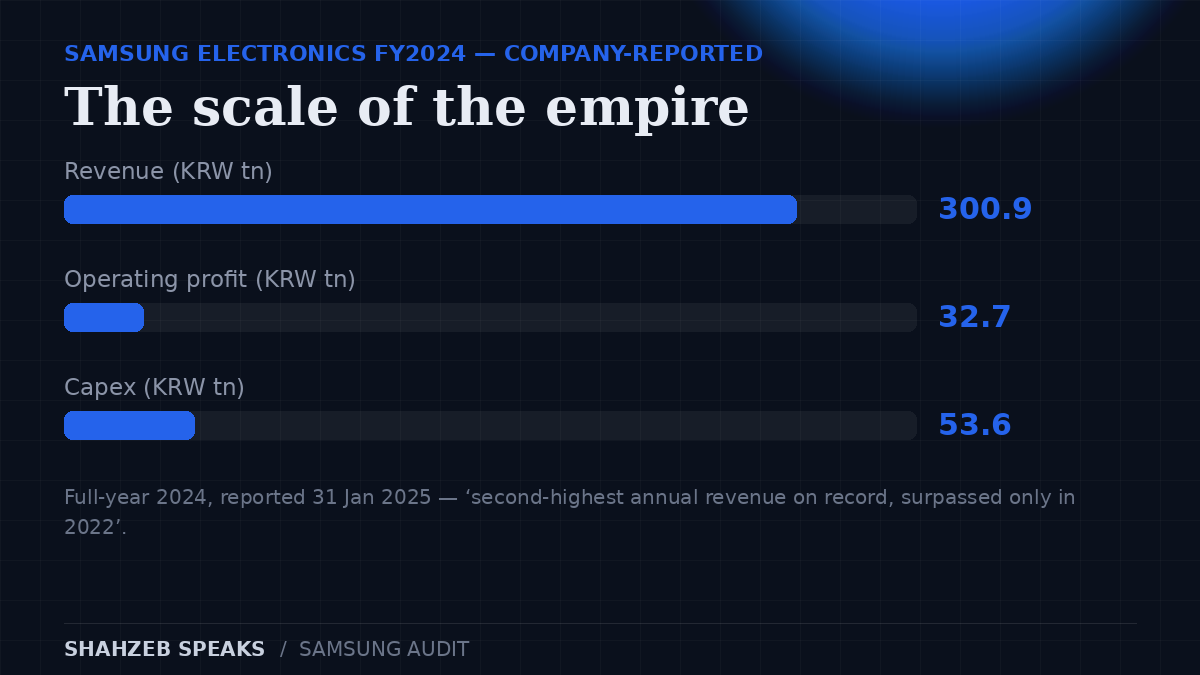
The numbers behind the empire, all company-reported: full-year 2024 consolidated revenue of KRW 300.9 trillion — the second-highest annual revenue in Samsung’s history, surpassed only in 2022 — with operating profit of KRW 32.7 trillion and capital expenditure of KRW 53.6 trillion (Samsung’s earnings release, 31 January 2025). The brand story begins far from technology: a grocery trading store founded on 1 March 1938 in Taegu, Korea. And the legal ledger is real: a $1.05 billion Apple verdict, a €35.1 million EU cartel fine, a Korean antitrust fine that a court overturned in April 2026, and the most expensive product recall in consumer-electronics memory.
I am an Industrial and Organizational Psychologist in Karachi. I audit brands the way I study workplaces: by tracing behaviour back to the systems that produce it, and by refusing to confuse a company’s story about itself with the evidence. Samsung’s story is reinvention — from noodles to semiconductors, from a burning phone to the world’s thinnest foldable. The evidence is twelve documented psychological mechanisms — and a court docket. Both are in this audit.
“Samsung does not sell phones. It sells the feeling that leaving is more expensive than staying — and prices the door accordingly.”
— Brand Psychology Analysis, ShahzebSpeaks
📋 Brand Overview: Samsung at a Glance
| Attribute | Detail (verified) |
| Founded | 1 March 1938, Taegu (Daegu), Korea, by Lee Byung-chul — a grocery trading store; “Samsung” means “three stars” (Britannica) |
| Headquarters | 129 Samsung-ro, Yeongtong-gu, Suwon-si, Gyeonggi-do, South Korea (Samsung Digital City) |
| FY2024 revenue | KRW 300.9 trillion consolidated (company-reported 31 Jan 2025) — second-highest annual revenue on record, after 2022 |
| FY2024 operating profit | KRW 32.7 trillion (Q4 2024: KRW 75.8T revenue, KRW 6.5T operating profit) |
| FY2024 capital expenditure | KRW 53.6 trillion — including KRW 46.3T in the DS (semiconductor) Division and KRW 4.8T in SDC |
| Smartphones | World #2 — Counterpoint Q4 2025: Apple 25% (#1), Samsung 18% (#2), Xiaomi 11% (#3) |
| Chips & TVs | World’s top memory chipmaker (Reuters’ standard descriptor); top-selling global TV manufacturer since 2006 (Britannica) |
| Website | https://www.samsung.com |
📜 Chapter 1: The History — From Noodles to Nanometres
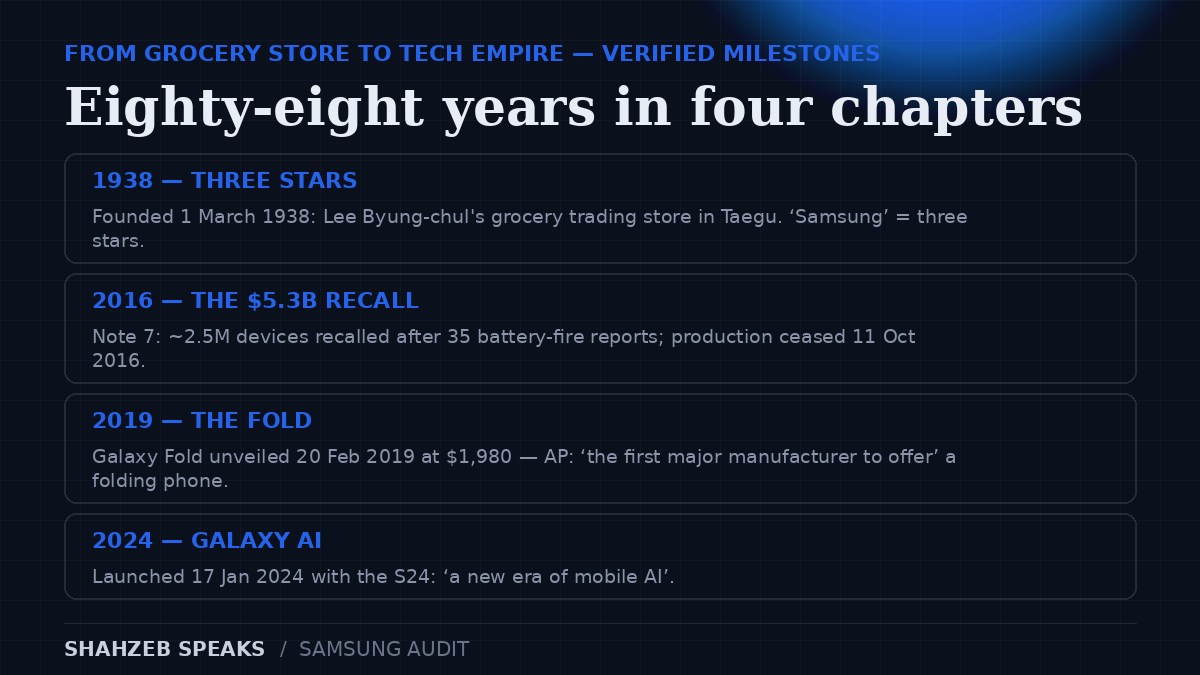
On 1 March 1938, Lee Byung-chul (Britannica spells it “Lee Byung-Chull”) opened a grocery trading store in Taegu, Korea — trading noodles and locally produced goods, exporting them to China. The name “Samsung” comes from the Korean for “three stars”: three being a number of power and endurance in Korean culture, stars standing for something bright, high, and eternal. That is the origin story Samsung still tells about itself — and it is the raw material of Chapter 8’s heritage narrative.
The decades that followed were diversification on a national scale, until Samsung Electronics became the conglomerate’s flagship: the world’s top memory chipmaker (Reuters’ standard descriptor), the top-selling global television manufacturer since 2006 (Britannica), and, in smartphones, the company that spent the 2010s trading the global #1 spot with Apple. Three moments define the modern brand. In September 2016, the Galaxy Note 7 began catching fire — the recall of ~2.5 million devices and the production halt of 11 October 2016 (Chapter 10). On 20 February 2019, at Galaxy Unpacked in San Francisco, Samsung unveiled the Galaxy Fold — the AP described it as “the first major manufacturer to offer” a folding phone — at a starting price of $1,980. And on 17 January 2024, at Galaxy Unpacked in San Jose, Samsung launched “Galaxy AI”, calling it “a new era of mobile AI” with the Galaxy S24 series — which Samsung claimed, via Reuters, was the first smartphone to offer two-way, real-time voice translation on a live phone call, across 13 languages, processed on-device.
The reinvention continues: on 9 July 2025 Samsung unveiled the Galaxy Z Fold7 — 4.2 mm thick unfolded, 215 g, the thinnest and lightest in the series’ history — and on 25 February 2026 it launched the Galaxy S26 series, which Samsung’s newsroom described as “marking the third generation of Samsung’s Galaxy AI phones.” From noodles to nanometres in 88 years. The audit that follows asks: what did the psychology look like along the way?
🌐 Chapter 2: Technique 1 — Ecosystem Lock-In (The Hotel You Never Leave)
The founding psychological mechanism of Samsung’s consumer business is also its most complete: the ecosystem. Buy the Galaxy phone and the watch pairs in seconds; add the Galaxy Buds and the pairing is automatic; add SmartThings and your lights, locks, and television join the same account; add the cloud and twelve years of photos make switching feel like arson. Each device is sold as a product. Together they function as a commitment and consistency trap (Cialdini, 2006): every new Samsung device is a small public declaration — to yourself, in your own home — that you are a Samsung person, and each declaration makes the next consistent choice easier.
The lock-in is psychological before it is technical. Nothing physically prevents you from pairing a Galaxy Watch with a competitor’s phone; what prevents you is the accumulated weight of setup time, learned interfaces, stored data, and paired accessories. Psychologists call this switching costs, and Samsung manufactures them with unusual care: the watch works best with the phone, the phone works best with the buds, and everything works best inside Samsung’s account. Note the discipline — Samsung does not need to persuade you each upgrade cycle. It needs you to have bought the watch last cycle. The past purchase does the persuading.
👑 Chapter 3: Technique 2 — Status Signalling (The Ultra Tier)
Samsung’s product ladder — the base Galaxy S, the Plus, and at the top the Ultra — is conspicuous consumption (Veblen, 1899) engineered into a spec sheet. The Ultra tier exists to be the expensive one: the biggest screen, the most cameras, the embedded stylus, the titanium frame. Its job is not to be bought by everyone. Its job is to make the tier below it feel like the sensible choice — and to give the buyers at the top a visible signal of exactly how much phone they could afford.
The purest expression of the signalling strategy was the original Galaxy Fold at $1,980 (Chapter 4). A phone that unfolds into a tablet, priced at nearly two thousand dollars, was never a volume play; it was a statement piece — a device whose price was part of its function, the way a luxury watch’s price is part of its function. The $1,980 figure did double duty as status anchor (Chapter 6): once Samsung had established that a Samsung phone could cost $1,980, every subsequent flagship price felt, by comparison, almost reasonable.
📱 Chapter 4: Technique 3 — First-Mover Theatre (The Fold Unveiling)
On 20 February 2019, Samsung unveiled the Galaxy Fold in San Francisco: a 4.6-inch outer display that unfolded into a 7.3-inch tablet, starting at $1,980, on sale 26 April 2019. The AP’s verdict — “the first major manufacturer to offer” a folding phone — is the sentence Samsung bought with years of display R&D. This is first-mover theatre: the product does not have to work perfectly (review units broke within days, and Samsung delayed the launch) — it has to establish, in the public record, that Samsung defined the category.
The psychology is the primacy effect applied to corporate identity. The first company associated with a category owns the mental prototype — the Fold is what people picture when they hear “foldable phone,” regardless of who shipped what, when, at what volume. The mechanism is honest here: Samsung really was first among the majors, and the theatre was earned. But notice the risk the theatre carried — the same spotlight that anointed Samsung first also broadcast the broken review units worldwide. First-mover theatre is a bet that the headline outlives the footnote. In 2019, it did.
🤖 Chapter 5: Technique 4 — AI Priming (“A New Era of Mobile AI”)
On 17 January 2024, Samsung unveiled the Galaxy S24 series and launched “Galaxy AI”, announcing “a new era of mobile AI.” The launch’s centrepiece was a claim with psychological precision: the S24 was, Samsung said, the first smartphone to offer two-way, real-time voice translation on a live phone call, across 13 languages, processed on-device (Samsung’s claim, reported by Reuters). Live translation on a phone call is not a spec — it is a scene, and scenes are what the mind stores.
The mechanism is priming: by saturating the launch — and every advertisement after it — with the words “Galaxy AI,” Samsung trained a simple association before competitors could train their own. When shoppers now hear “AI phone,” the first association available is Samsung’s. The substance underneath is real features (translation, summarisation, photo editing), but the psychology does not depend on any single feature working well. It depends on Samsung owning the category label in the consumer’s mind — the same first-mover logic as Chapter 4, applied to language instead of hardware. Two years later, the S26 launch was framed as “the third generation of Samsung’s Galaxy AI phones” — the priming had become the product line’s identity.
🥊 Chapter 6: Techniques 5 & 6 — Comparative Advertising and Price Anchoring
Comparative advertising is the oldest move in Samsung’s playbook and one of its most psychologically aggressive: for the better part of a decade, Samsung’s advertising has directly named, mocked, and measured itself against Apple — the notch, the missing charger, the camera, the foldable Apple does not sell. The mechanism is social comparison (Festinger, 1954): people evaluate what they cannot judge absolutely by comparing — and Samsung’s ads do the comparing for you, pre-loading the reference frame so that every iPhone feature is read against a Samsung feature that came first or costs less.
The honesty check: comparative advertising only works while the comparisons are credible. When Samsung mocked Apple for removing the charger and then removed its own chargers, the internet kept the receipts — and the mockery became the meme. Comparison is a weapon that points both ways; Samsung’s long campaign is a case study in both its power and its fragility.
Price anchoring (Tversky & Kahneman, 1974) is the quieter sibling, and Samsung’s masterstroke was the $1,980 Galaxy Fold launch price. Anchoring works on the first number seen: once $1,980 existed as a Samsung price, the $999 or $1,199 of subsequent flagships read as restraint. Samsung deploys the same logic in retail — launch prices set high, then “discounted” aggressively within months — so the shopper evaluates the deal, not the price. The Fold’s $1,980 was therefore never really about the Fold. It was a reference point installed at the top of Samsung’s entire price architecture, where it still quietly sits.
⚡ Chapter 7: Techniques 7 & 12 — Authority by Association and the National-Champion Halo
On 28 July 2025, Samsung disclosed a $16.5 billion chip-supply contract running through 31 December 2033 — initially without naming the client. Elon Musk then confirmed the client is Tesla, and that Samsung’s Taylor, Texas fab would manufacture Tesla’s next-generation AI6 chip. Samsung shares closed up 6.8% on the news. The mechanism is the authority principle (Cialdini, 2006): the most exciting company in the world just chose Samsung’s factories for the most important chip in its future. Every Galaxy buyer who hears this borrows a little of Tesla’s aura — Samsung’s silicon is, by association, the silicon that matters.
The authority rests on a documented foundation, not a press release: Reuters’ standard descriptor for Samsung is “the world’s top memory chipmaker,” and Britannica records Samsung as the top-selling global television manufacturer since 2006. These are not marketing claims; they are the reason the Musk announcement was credible. Samsung sells the authority it has genuinely earned — then lets the earned authority halo the products that have not earned it yet.
The halo extends one step further, into national identity: Samsung is South Korea’s flagship company, the enterprise most associated worldwide with the country’s rise. The mechanism is the halo effect (Thorndike, 1920): a positive impression in one domain — national pride, industrial might — colours perception of everything the company touches. A Samsung phone does not just carry Samsung’s reputation; it carries, faintly, the reputation of the country that built it. No competitor from a smaller industrial base gets that association for free.
🏛️ Chapter 8: Techniques 8 & 11 — Heritage Narrative and Ritual Cadence
“Three stars.” Samsung’s name — from the Korean for three stars, founded as a grocery trading store on 1 March 1938 — is the heritage narrative: a founding story that converts 88 years of survival into psychological capital. The mechanism is narrative identity: organisations that can tell a coherent story about who they have always been give customers a reason to trust who they will be next. “From noodles to nanometres” is not a tagline; it is proof-of-character — this company has reinvented itself before, so the next reinvention is safe to buy into. The Note 7 crisis (Chapter 10) is the narrative’s hardest test and its strongest evidence: the company that survived 1938, the Korean War, and the Asian financial crisis framing can absorb a burning phone.
The narrative is performed, twice a year, as ritual. Samsung’s Galaxy Unpacked events — San Francisco (February 2019), San Jose (January 2024), Brooklyn (July 2025), San Francisco again (February 2026) — are product launches staged as ceremonies: the keynote, the countdown, the reveal. The psychology is ritual’s well-documented power to create commitment: regular, shared, emotionally charged events bind a community. Apple’s keynotes invented the form; Samsung’s Unpacked is the proof that the ritual works for the challenger too. Each Unpacked does not just launch phones — it re-consecrates the heritage narrative for another year.
📈 Chapter 9: Technique 10 — Social Proof at Scale (World #2)
Counterpoint Research’s Q4 2025 figures put it plainly: Apple 25% (#1), Samsung 18% (#2), Xiaomi 11% (#3). For the full year 2025, Counterpoint had Apple at 20% and Samsung at 19% — a genuine two-horse race (IDC’s preliminary data tells the same story: Q4 2025 Apple 24.2%, Samsung 18.2%; full-year Apple 19.7%, Samsung 19.1%, on a 1.26-billion-unit market). And Reuters reported that Apple had topped Samsung in 2023 shipments per IDC, “dethroning Samsung for the first time since 2010” — which tells you how long Samsung had held the crown.
The psychology is social proof (Cialdini, 2006), and Samsung wields it with unusual honesty: it does not claim #1. It claims one of two — and in a market of 1.26 billion annual units, being one of the two names everyone knows is the proof that matters. “Everyone else bought Samsung” is the implicit argument of every carrier store display, every “best Android phone” listicle, every queue outside an Unpacked. The mechanism needs no exaggeration: 18% of the planet’s smartphone buyers, every quarter, is a consensus no advertisement can fake.
The honest footnote is the 2023 dethroning. Samsung lost the annual crown for the first time since 2010 — and its response was not denial but Galaxy AI (Chapter 5), launched weeks later. Social proof is a lagging indicator; Samsung’s psychology machine treats it as a dashboard, not a trophy.
🔥 Chapter 10: Technique 9 — Crisis Ritual (The Note 7 Playbook)
On 2 September 2016, Samsung published a statement titled “[Statement] Samsung Will Replace Current Note7 with New One”: 35 battery-fire cases reported as of 1 September, a battery cell issue identified, sales halted, a voluntary replacement programme for an estimated 2.5 million devices. When replacement devices also caught fire, Samsung went further: on 11 October 2016 it announced it would “cease production of the Note 7 device in the interests of consumer safety” — killing its flagship phone outright, two months after launch.
This is crisis ritual: decisive, public, costly action that functions as trust repair. The psychology is procedural — research on trust recovery consistently finds that the speed and costliness of the response matter more than the apology’s wording. Samsung’s response was fast (recall within weeks of the first fires) and costly: on 12 October 2016 Samsung cut its Q3 earnings guidance by roughly 2.6 trillion won, and on 14 October it estimated a further “negative impact of approximately mid-3 trillion won in operating profit” from Q4 2016 through Q1 2017. The AP summed Samsung’s own disclosures as a cost of “at least $5.3 billion” — note carefully, that is the AP’s arithmetic on Samsung’s figures, not a Samsung quote.
The ritual worked. Samsung’s brand survived a crisis that destroyed products and companies before it — because the company performed the one act that proves a safety claim: it sacrificed the product. The 2017 Galaxy S8 launch carried an eight-point battery safety check Samsung advertised explicitly, turning the ritual’s aftermath into a feature. Crisis ritual does not erase the fire. It converts the fire into evidence of the response — and Samsung’s response is now the industry’s reference case.
⚠️ Chapter 11: The Dark Side — The Real Legal and Regulatory Record
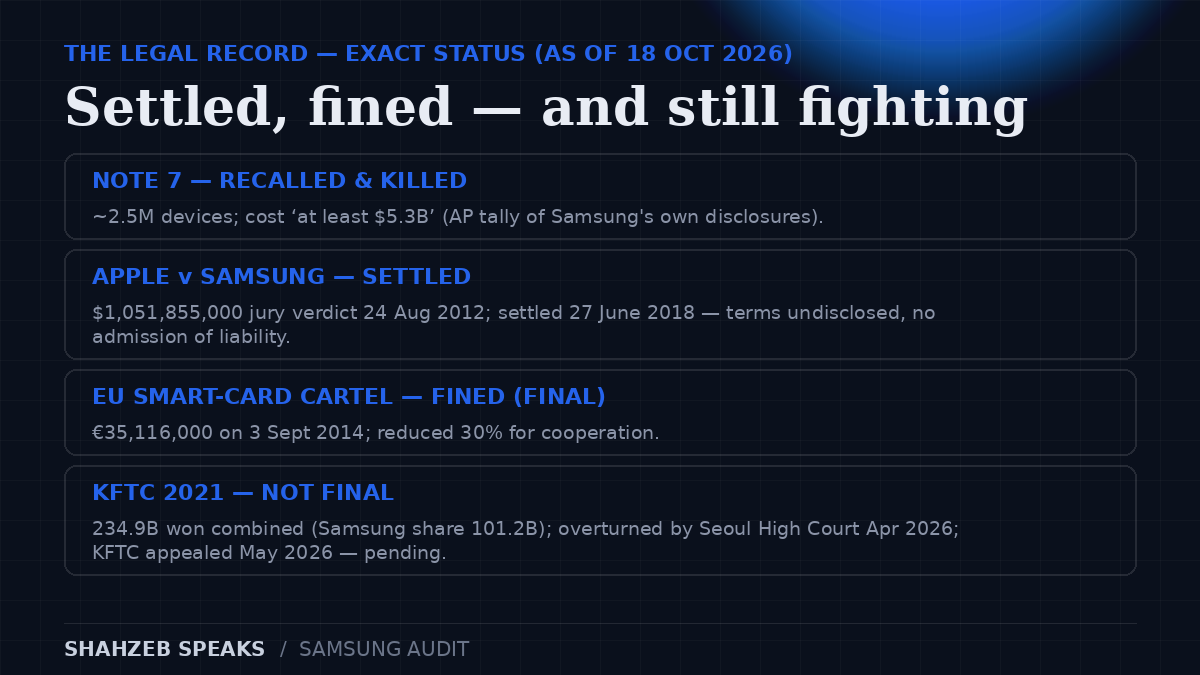
Samsung’s psychology operates inside a substantial legal record. Every item below is at its exact status as of 18 October 2026. Nothing here is proven except where a final decision says so.
United States — Apple v. Samsung: jury verdict, then SETTLED
On 24 August 2012, a nine-person jury in San Jose found Samsung had wilfully infringed Apple’s design and utility patents and awarded Apple $1,051,855,000 (~$1.05 billion) in damages; none of Samsung’s counterclaims were upheld — $0 to Samsung. Apple had sought up to ~$2.5–2.75 billion. On 1 March 2013, Judge Lucy Koh vacated $450.5 million of the award over a jury damages-calculation error and ordered a retrial; the retrial jury on 21 November 2013 awarded Apple $290 million, leaving a total of roughly $890 million. The war ended on 27 June 2018, when Apple and Samsung filed a stipulation agreeing to drop and settle all remaining claims and counterclaims, dismissed with prejudice, each side bearing its own costs. The terms were not disclosed; neither company admitted liability. Status: settled, terms undisclosed, no admission.
European Union — smart-card cartel: FINED (2014)
On 3 September 2014, the European Commission fined Samsung €35,116,000 for participating in a smart card chips cartel (bilateral contacts between September 2003 and September 2005); the fine was reduced by 30% for cooperating with the investigation (Renesas received full immunity as whistleblower; Infineon €82.78M; Philips €20.15M). Status: fined (EC decision). I did not verify whether Samsung appealed or has paid — so I state neither.
South Korea — KFTC fine: fined, then OVERTURNED — NOT final
On 24 June 2021, the Korea Fair Trade Commission fined five Samsung affiliates a combined 234.9 billion won (~$206M) for alleged unfair intra-group support of Samsung Welstory’s in-house cafeteria business; Samsung Electronics’ share was 101.2 billion won — reported as the largest-ever single-company fine in a South Korean unfair-internal-trading case. The KFTC also filed prosecution complaints against Samsung Electronics and a former executive; I did not verify any outcome of those complaints. In April 2026, the Seoul High Court overturned the penalty; the KFTC appealed to the Supreme Court in May 2026. Status: NOT final — overturned at High Court, appeal pending as of 18 October 2026.
Labour — the first strike in Samsung’s history
On 7 June 2024, the National Samsung Electronics Union staged its first-ever industrial action (a one-day walkout using coordinated annual leave), followed by a three-day strike beginning 8 July 2024 over pay, annual leave, and bonus-system changes (~30,000 members, ~24% of Samsung Electronics’ South Korean workforce). On 10 July 2024 the union declared an “indefinite general strike”; talks broke down in July and the union called off the indefinite strike in early August, shifting to intermittent actions. Samsung said there was no production disruption. The 2024 wage round ended without agreement; a tentative 2025 deal (average 5.1% raise) was reached in February 2025. Then, on 20 May 2026, Samsung and the union reached a last-minute tentative wage deal — ratified by 73.7% of voting members — averting a planned 18-day general strike. Status: resolved through negotiation; no adjudicated findings against the company.
📝 Chapter 12: What Brands Should — and Shouldn’t — Copy
Copy the ecosystem thinking, not the ecosystem trap. Samsung’s real insight is that the second purchase should be easier than the first: devices that pair instantly, accounts that carry data across hardware, accessories that complete each other. Any brand with more than one product can design for the second purchase. What you should not copy is the asymmetry — when leaving costs more than staying because of engineered friction rather than genuine value, regulators and customers both eventually notice. (Samsung’s lock-in is mostly genuine value; the line is worth watching.)
Copy the crisis ritual. The Note 7 playbook — fast acknowledgment, public cost, sacrifice the product — is the gold standard of trust repair, and it transfers to any company in any country. Speed and costliness beat eloquence. When your product is on fire, literally or figuratively, the market does not want your statement. It wants your sacrifice.
Copy the anchor discipline. The $1,980 Fold shows how a flagship price can be a strategic asset rather than a sales target: set the reference point at the top, and every price below it becomes a decision, not a shock. But the anchor must be attached to something real — Samsung could charge $1,980 because the Fold was genuinely first. An anchor with no substance behind it is just an expensive mistake.
Don’t copy the comparative mockery. Samsung’s anti-Apple advertising won attention and lost the receipts: every mocked feature Apple kept, Samsung eventually adopted, and the internet archives everything. Comparative advertising is powerful while the comparison holds — the moment it doesn’t, your own ads become the prosecution’s exhibits. Compare on substance, or don’t compare.
Don’t copy the narrative without the substance. “Three stars” works because the reinvention is real — the company genuinely went from groceries to the world’s top memory chipmaker. A heritage story with nothing behind it is costume. Earn the narrative first; then tell it.
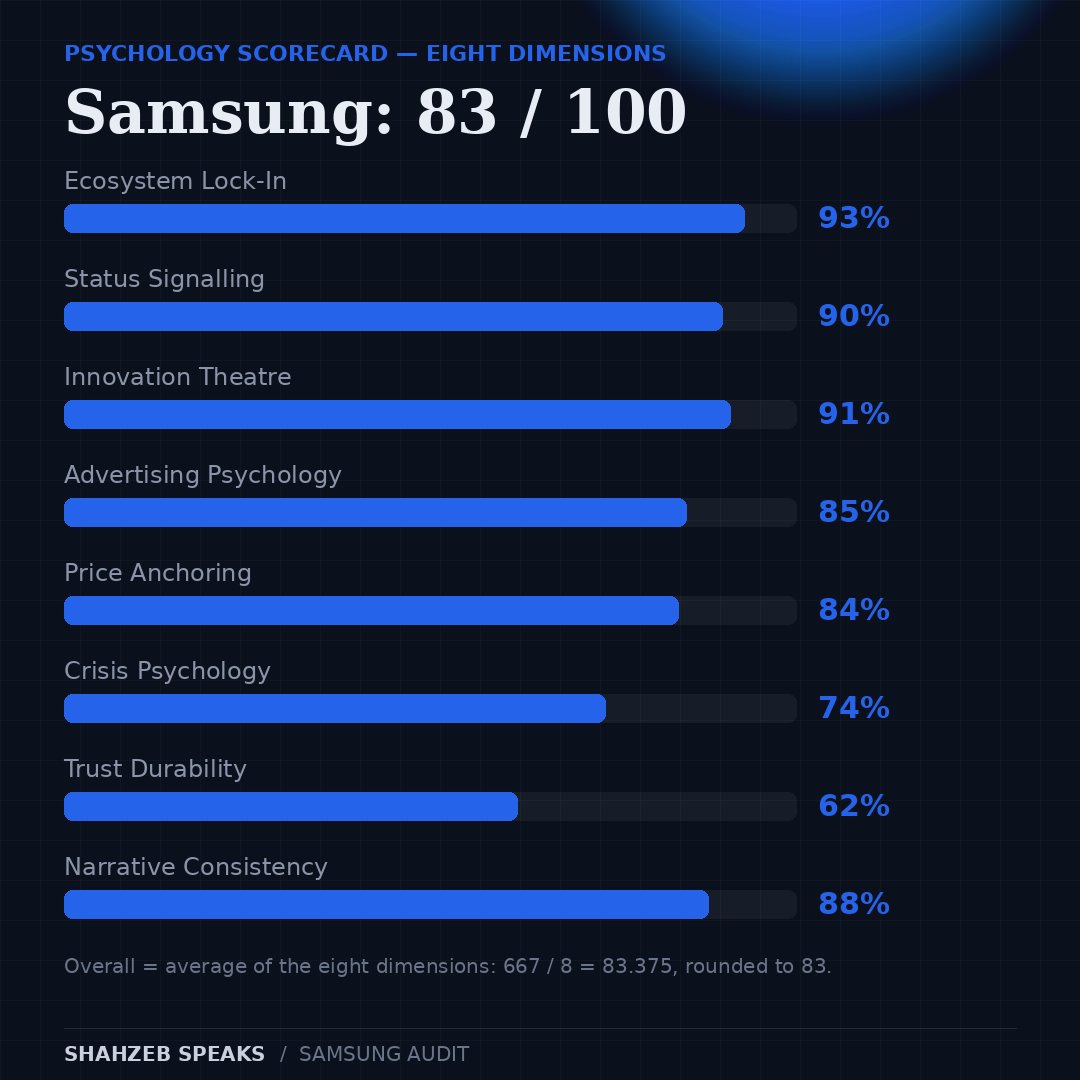
📊 Chapter 13: Samsung Psychology Audit Scorecard — Detailed Ratings
| Psychology Dimension | Score | Verdict |
| Ecosystem Lock-In | 93/100 | The watch, the buds, the cloud: every device makes the next one inevitable. |
| Status Signalling | 90/100 | Ultra tiering and the $1,980 Fold turned price into a signal. |
| Innovation Theatre | 91/100 | First foldable, first AI phone: Samsung defines categories, then owns them. |
| Advertising Psychology | 85/100 | Comparative ads that won attention — and left receipts when the jokes backfired. |
| Price Anchoring | 84/100 | $1,980 installed a reference point at the top of the whole price architecture. |
| Crisis Psychology | 74/100 | The Note 7 ritual was textbook — but the fire happened in the first place. |
| Trust Durability | 62/100 | A $1.05B verdict, a €35.1M fine, and an overturned-but-pending KFTC case cap this pillar. |
| Narrative Consistency | 88/100 | Three stars, 88 years, one story: reinvention as identity. |
Score arithmetic: 93 + 90 + 91 + 85 + 84 + 74 + 62 + 88 = 667; 667 ÷ 8 = 83.375 → Overall Psychology Score: 83/100.
✅ Chapter 14: Balance Sheet & A Psychologist’s Prescription
Assets: the most complete consumer-electronics ecosystem outside Apple — phones, watches, buds, and SmartThings bound by commitment and consistency; a first-mover record (foldables, on-device AI translation) that owns two category prototypes; a $1,980 anchor quietly organising the price architecture; the world’s top memory chipmaker lending authority to everything else; and a heritage narrative — three stars since 1938 — that makes reinvention feel like character rather than panic.
Liabilities: the Note 7 will always be one search away, whatever the textbook crisis response; the Apple verdict — wilful infringement, $1,051,855,000 — sits in the permanent record even settled; the EU’s €35.1 million cartel fine is final; the KFTC case is overturned but pending, which is the worst of both worlds for trust; and the first strike in company history (2024) plus the near-miss 18-day strike of 2026 show that the empire’s workforce no longer accepts the old bargain silently.
Prescription: Samsung’s persuasion engineering is mature; its next gains come from trust, not theatre. Resolve the KFTC matter definitively rather than letting a pending appeal trail the brand for years. Keep the comparative advertising honest — or retire it; the receipts era punishes mockery that ages badly. And protect the ecosystem’s real advantage: as long as staying is genuinely easier than leaving, Samsung does not need lock-in to be a trap. The moment the ecosystem feels like a trap instead of a home, the three stars start to dim.
📝 Final Verdict
Samsung is the purest corporate expression of reinvention as strategy: a grocery store that became the world’s top memory chipmaker, a company that survived the most expensive phone recall in history and answered with the first foldable, then the first AI phone. The twelve mechanisms in this audit — from ecosystem lock-in to crisis ritual — form one coherent machine, and the machine works: KRW 300.9 trillion in 2024 revenue is the validity of its psychology written in the revenue line.
But an empire built on reinvention accumulates a shadow. The $1,051,855,000 Apple verdict (settled, undisclosed, no admission), the €35,116,000 EU cartel fine (final), the KFTC penalty overturned in April 2026 with the appeal still pending as of 18 October 2026, and the first strikes in company history describe what happens when scale meets scrutiny. Samsung’s score reflects both halves: near-perfect ecosystem and innovation psychology, capped by a trust pillar the courts are still writing.
Psychology Score: 83/100 — The Three-Star Empire of Reinvention: ecosystem lock-in, first-mover theatre, and a heritage narrative 88 years deep — capped by a $1.05B verdict, a €35.1M fine, and a legal docket that is still being written.
Want your brand audited the way Samsung was?
I audit the psychology of brands — the mechanisms, the evidence, and the legal record at its exact status. Contact me here.
More brand psychology: see the Apple machine-of-desire audit and the Tesla audit. For the psychology behind the mechanisms, see anchoring bias in marketing and when social proof works — and backfires. I write as an industrial psychology in Pakistan practitioner.
📚 References & Sources
- Samsung Electronics. Q4 and FY2024 earnings release (31 January 2025): KRW 300.9T revenue, KRW 32.7T operating profit, KRW 53.6T capex. (Newsroom read via search snippet.)
- Britannica. “Samsung Electronics.” (Founded 1 March 1938, Taegu, Lee Byung-Chull; “three stars”; top TV manufacturer since 2006.) https://www.britannica.com/money/Samsung-Electronics
- Phys.org / Associated Press (20 February 2019). Galaxy Fold unveiled at Galaxy Unpacked; “the first major manufacturer to offer” a folding phone; $1,980 starting price. https://phys.org/news/2019-02-samsung-smartphone.html
- Samsung Newsroom. Galaxy Unpacked 2024 (17 January 2024): Galaxy S24, “Galaxy AI,” “a new era of mobile AI.” (Read via snippet.)
- Reuters via 4imag (January 2024). S24 first with two-way real-time voice translation on a live call, 13 languages, on-device (Samsung’s claim); Apple topped Samsung in 2023 shipments per IDC, first time since 2010. https://4imag.com/samsung-packs-newest-galaxy-s24-smartphones-with-ai-functions-to-beat-apple/
- Samsung Newsroom (UK). Galaxy Unpacked 2026 (25 February 2026): Galaxy S26 series, “third generation of Samsung’s Galaxy AI phones.” (Read via snippet.)
- TechXplore / Associated Press (9 July 2025). Galaxy Z Fold7 unveiled in Brooklyn: thinnest and lightest in series history (4.2 mm unfolded, 215 g). https://techxplore.com/news/2025-07-samsung-unveils-line-foldable-devices.html
- Samsung Newsroom. “[Statement] Samsung Will Replace Current Note7 with New One” (2 September 2016): 35 cases, battery cell issue, sales halted, voluntary replacement. (Read via snippet.)
- Business Insider (27 October 2016). Samsung ceased Note 7 production on 11 October 2016. https://www.insider.co.uk/news/samsungs-q3-profits-down-30-9866475
- VentureBeat / AP via Phys.org (October 2016). Samsung’s stated Note 7 costs: ~2.6T won Q3 guidance cut; ~mid-3T won Q4 2016–Q1 2017 impact; AP tally “at least $5.3 billion.” https://phys.org/news/2016-10-samsung-recall-billion.html
- MacRumors / EE Times (24 August 2012). Apple v. Samsung jury verdict: $1,051,855,000, wilful infringement, $0 on counterclaims. https://www.macrumors.com/2012/08/24/jury-reaches-verdict-in-apple-vs-samsung-trial/
- AFP via Phys.org / MacRumors (2013). $450.5M vacated 1 March 2013; retrial awarded $290M (21 November 2013). https://www.macrumors.com/2013/11/21/jury-rules-samsung-must-pay-apple-290-million-in-damages-retrial/
- MacRumors / Law360 (27 June 2018). Apple–Samsung patent dispute settled; claims dismissed with prejudice; terms undisclosed; no admission. https://www.macrumors.com/2018/06/27/apple-samsung-patent-dispute-settled/
- LexGo / Phys.org (3 September 2014). European Commission fined Samsung €35,116,000 in the smart card chips cartel (30% reduction for cooperation). https://phys.org/news/2014-09-eu-fines-samsung-philips-smartcard.html
- Korea Bizwire / PYMNTS (24 June 2021). KFTC fined five Samsung affiliates a combined 234.9B won; Samsung Electronics’ share 101.2B won. http://koreabizwire.com/samsung-affiliates-fined-235-bln-won-for-unfair-biz-practice
- MLex (19 May 2026). Seoul High Court overturned the KFTC penalty (April 2026); KFTC appealed to the Supreme Court (May 2026) — pending. https://www.mlex.com/mlex/articles/2479189/
- Reuters via SRN News (28 July 2025). Samsung’s $16.5B chip-supply contract; Musk confirmed Tesla client; Taylor, Texas fab to make Tesla AI6 chip. https://srnnews.com/samsung-elec-signs-16-5-billion-contract-to-supply-semiconductors/
- Reuters via SRN News / AFP via EconomyLens / SDxCentral (2024). NSEU first strike 7 June 2024; three-day strike from 8 July 2024; indefinite strike declared 10 July 2024; called off early August. https://srnnews.com/samsung-workers-union-in-south-korea-kicks-off-three-day-strike/
- AP via The Chief Leader / DCD (May 2026). Tentative wage deal 20 May 2026 averting 18-day strike; ratified 73.7%. https://thechiefleader.com/stories/samsungs-union-puts-off-strike-after-reaching-last-minute-wage-deal-with-management,56717
- Counterpoint Research. Global smartphone share, Q4 2025: Apple 25%, Samsung 18%, Xiaomi 11%. https://counterpointresearch.com/en/insights/global-smartphone-share
- Cialdini, R. B. (2006). Influence: The Psychology of Persuasion (rev. ed.). Harper Business. (Commitment & consistency, authority, social proof.)
- Festinger, L. (1954). A theory of social comparison processes. Human Relations, 7(2), 117–140.
- Tversky, A., & Kahneman, D. (1974). Judgment under uncertainty: Heuristics and biases. Science, 185(4157), 1124–1131. (Anchoring.)
- Thorndike, E. L. (1920). A constant error in psychological ratings. Journal of Applied Psychology, 4(1), 25–29. (Halo effect.)
- Veblen, T. (1899). The Theory of the Leisure Class. Macmillan. (Conspicuous consumption.)
Key Findings
- FY2024: KRW 300.9T revenue, KRW 32.7T operating profit, KRW 53.6T capex (company-reported, 31 Jan 2025) — 'second-highest annual revenue on record, surpassed only in 2022'
- Founded 1 March 1938: Lee Byung-chul's grocery trading store in Taegu; HQ Suwon, South Korea; 'Samsung' = Korean for 'three stars'
- Note 7: ~2.5M devices recalled after 35 battery-fire cases (1 Sept 2016); production permanently ceased 11 Oct 2016; cost 'at least $5.3B' (AP tally of Samsung's own disclosures)
- Apple v. Samsung: $1,051,855,000 jury verdict 24 Aug 2012 (wilful infringement); $450.5M vacated 1 Mar 2013; SETTLED 27 June 2018 — terms undisclosed, no admission of liability
- EU smart-card cartel: FINED €35,116,000 (3 Sept 2014, FINAL, 30% cooperation reduction); KFTC 234.9B won (Samsung share 101.2B) — OVERTURNED by Seoul High Court Apr 2026, KFTC appealed May 2026 — NOT FINAL
- Labour: NSEU first-ever strike 7 June 2024; indefinite strike declared 10 July 2024, called off early August; tentative deal 20 May 2026 (ratified 73.7%) averting an 18-day strike
Overall Psychology Score
Samsung scores 83/100 in our comprehensive psychology audit covering consumer behavior strategies, UX design principles, and psychological marketing effectiveness.
The detailed dimension scores are in the audit's Psychology Scorecard chapter.
RevolutionaryMuhammad Shahzeb
MSc Industrial Psychologist, specializing in consumer behavior, UX psychology, and brand strategy analysis. Helping brands understand the psychology behind their success.
About Muhammad Shahzeb →