Tesla Psychology Audit — How One Man’s Personality Became a $800 Billion Brand (And Why That’s Now the Biggest Risk in Business)
The deepest psychology audit of Tesla ever written. How Elon Musk fused his personal identity with a car company so completely that the stock moves on his tweets, the brand's reputation rises and falls with his controversies, and millions of owners find themselves defending not a vehicle but a man. From first principles positioning to tribal identity to the 2024-2026 reckoning where the founder's politics began costing the company billions.

88 / 100
Overall consumer behavior effectiveness
Brand Overview
- Brand nameTesla
- Founded2003
- HeadquartersAustin, Texas, USA
- IndustryAutomotive & Electric Vehicles
- Websitewww.tesla.com ↗
Psychology Techniques Identified
- 01Founder-Brand Fusion (Identity Merger)
- 02First Principles Positioning (Category Reframing)
- 03Aspirational Identity Signaling (Status Through Values)
- 04Tribal Identity & In-Group Psychology
- 05Mission Framing (Saving the Planet Narrative)
- 06Visionary Halo Effect
- 07Scarcity & Waitlist Psychology
- 08Polarization as Engagement Strategy
- 09Direct-to-Consumer Ownership Experience
- 10Meme Culture & Internet-Native Branding
- 11Stock-as-Identity (Shareholder Tribalism)
- 12Cognitive Dissonance in Brand Loyalty
Full Psychology Audit Report
In this audit
Name a car company, any car company, and then tell me the name of its CEO. For nearly every brand on earth, including brands you drive and admire, you cannot do it. Now try Tesla. You did not think of a CEO. You thought of Elon Musk, and in that fraction of a second, you demonstrated the phenomenon this entire audit is about.
Tesla is the most extreme case of founder-brand fusion in the history of business. Not founder-led, not founder-inspired, but fused — the man and the company sharing a single identity in the public mind so completely that his tweets move the stock price, his political statements cost billions in sales, his personal reputation is the brand’s reputation, and millions of owners around the world find themselves in the psychologically extraordinary position of defending not a vehicle but a person. This audit, written by an Industrial and Organizational Psychologist, takes that fusion apart layer by layer: how it was built, why it worked spectacularly, why it is now the most expensive single-point-of-failure in corporate history, and what the psychology says about whether it can ever be unwound.
Because here is the finding this audit delivers at the end: the fusion was not an accident or an ego project. It was the strategy. Tesla had no advertising budget, no dealer network, no legacy credibility, and no product for years. What it had was a founder whose personal mythology — PayPal, SpaceX, the Tony Stark comparison — was so compelling that people pre-ordered a car from a company that had never mass-produced one. The personality was the go-to-market strategy. And now that the personality has become politically polarising, Tesla is discovering what no business school case study prepared anyone for: you cannot fire your brand.
“Every car company sells a vehicle. Tesla sells a position in a story — a story about the future, about intelligence, about refusing to accept the way things are. The problem is that the story has a single author, and the author has started writing chapters that half the audience did not sign up for.”
— Brand Psychology Analysis, ShahzebSpeaks
📋 Brand Overview: Tesla at a Glance
| Brand Name | Tesla, Inc. |
| Founded | 2003 by Martin Eberhard & Marc Tarpenning; Elon Musk joined as chairman and lead investor in 2004, became CEO in 2008 |
| Headquarters | Austin, Texas, USA (moved from Palo Alto in 2021) |
| Market Cap | ~$800 billion+ (mid-2026), making it the most valuable automaker on earth by a factor of several |
| Vehicles Delivered | ~1.79 million (2024); first annual decline in company history amid rising competition and brand headwinds |
| Core Products | Model S, 3, X, Y, Cybertruck, Semi; Powerwall, Megapack, Solar Roof; Full Self-Driving (FSD) software |
| The Fusion | Elon Musk’s personal brand and Tesla’s corporate brand are functionally indistinguishable in public perception |
| 2024-2026 Crisis | Political polarisation, European sales collapse, US boycott movement, brand favorability among Democrats fell ~50% |
| Psychology Score | 88 / 100 — ⚡ Extreme Impact |
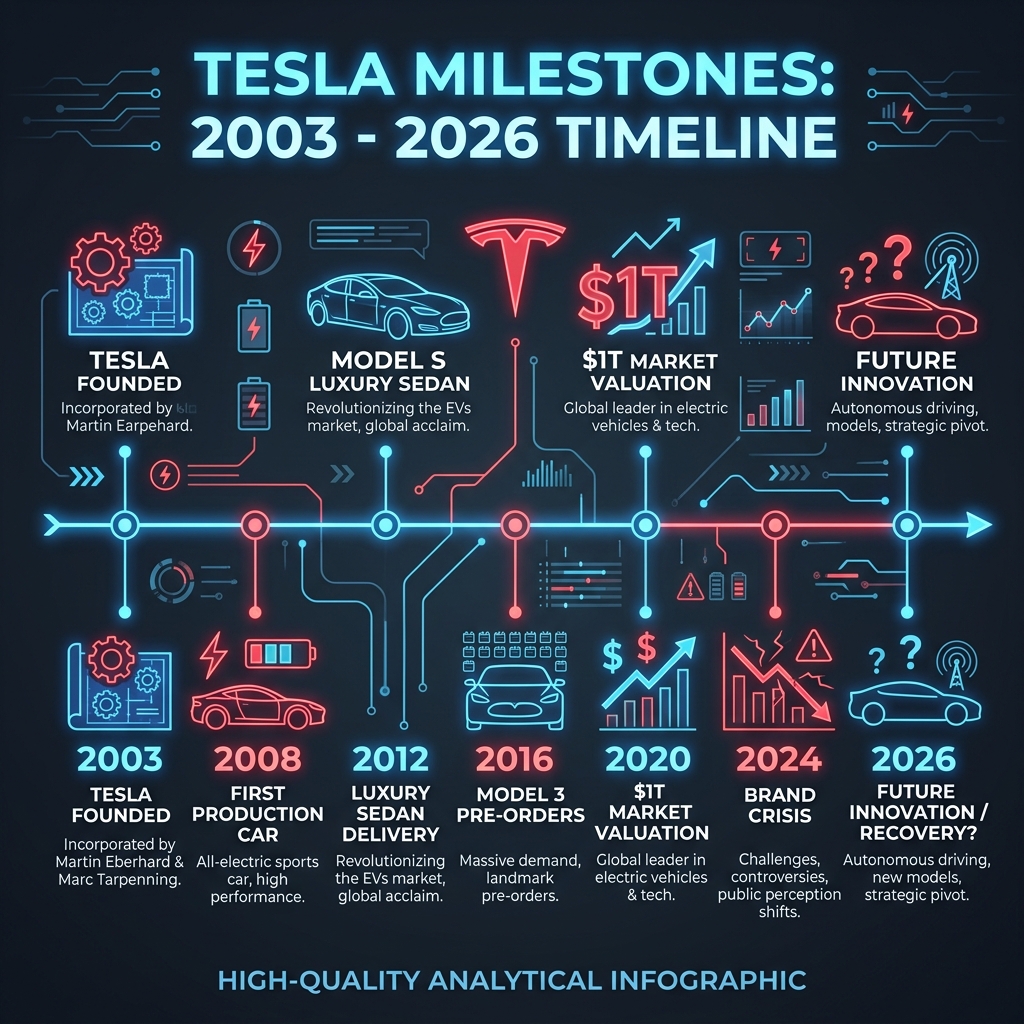
📜 Chapter 1: The Complete History — From a Garage Bet to the World’s Most Valuable Car Company (2003–2026)
⚡ 2003-2008: The Roadster Thesis
The founding mythology matters because it established the psychological template. Martin Eberhard and Marc Tarpenning incorporated Tesla Motors in 2003, named after Nikola Tesla, and Elon Musk led the Series A funding round in 2004, investing $6.5 million of his own money and becoming chairman. By 2008, after brutal internal conflicts that saw Eberhard removed as CEO, Musk took the CEO role himself, and the Tesla Roadster shipped.
The Roadster was not the first electric car. It was the first electric car that made people want an electric car. Built on a Lotus chassis, it was fast, beautiful and expensive, and that was the strategic genius: by entering at the top of the market, Tesla positioned electric vehicles as aspirational rather than sacrificial. Every previous EV had asked customers to give something up — range, performance, style — in exchange for environmental virtue. Tesla asked them to give up nothing except a combustion engine they were invited to view as primitive. This is first principles positioning, and it is the most consequential marketing decision in automotive history since Ford chose the assembly line.
🏆 2012-2015: Model S and the Credibility Inflection
The Model S did not just win awards; it redefined the category mental prototype. When Motor Trend named it Car of the Year unanimously in 2013, the first unanimous winner in the magazine’s history, the message received by the market was not “this electric car is good.” It was “electric cars can be the best cars, period.” Consumer Reports gave it a score so high they had to adjust their rating system. The psychology here is prototype displacement: Tesla moved the exemplar of “great car” from combustion to electric in the minds of opinion leaders, and opinion leaders set the frame for everyone else.
The over-the-air software updates established another psychological first: the car that gets better after purchase. In a category where every other product depreciates in capability from the moment you drive it off the lot, Tesla reversed the hedonic treadmill. Owners woke up to new features, and each update reinforced the narrative that this was a technology company that happened to make cars, not a car company pretending to be tech.
🚀 2016-2020: Model 3 and Mass-Market Identity
The Model 3 unveiling in March 2016 produced 325,000 pre-orders in the first week, with $1,000 deposits, for a car nobody had driven, from a company that had never mass-produced anything. That number is not a sales figure. It is a measure of identity investment. Those 325,000 people were not buying a car; they were buying membership in a story, placing a deposit on a version of themselves that drove the future. The production hell that followed, with Musk sleeping on the factory floor and the company nearly going bankrupt multiple times, only deepened the mythology: the founder suffering for the mission made the mission feel more real, and the customers who waited through delays felt like co-survivors rather than inconvenienced buyers.
📈 2020-2021: The Valuation Supernova
Tesla’s stock rose roughly 740% in 2020, and by late 2021 the company briefly crossed a $1 trillion market capitalisation, worth more than the next dozen automakers combined. The valuation was, by any conventional metric, disconnected from the cars sold. But conventional metrics misunderstand what was being valued. The market was pricing the narrative: autonomy, energy, AI, robotics, Mars. Musk’s ability to make investors believe Tesla was not a car company but a civilisation-scale technology platform was, itself, the product being traded. The stock became a tribal identity token, and owning it was a declaration of faith in a future only one man seemed to be building.
💥 2022-2026: The Personality Becomes the Problem
Then Musk bought Twitter, renamed it X, and the fusion that had built the brand began working in reverse. His increasingly visible political positioning — public alignment with right-wing politics in the US and Europe, the DOGE government role, confrontations with progressive causes his own customer base championed — created a situation unprecedented in corporate history: the brand’s greatest asset actively repelling its core demographic. By 2025, brand favorability among US Democrats had fallen by roughly 47-55 percentage points from its peak. European markets that had been Tesla strongholds saw sales collapse: Germany down 59%, France down over 60%, Scandinavia cratering. A global #BoycottTesla movement reached critical mass. Tesla’s global deliveries fell for the first time ever in 2024, then fell further in Q1 2025.
The most psychologically interesting detail: when Musk briefly stepped back from the DOGE role in early 2025, the stock rallied 17% in a single day. The market was not pricing cars. It was pricing personality distance. That is the founder-brand fusion working as a financial instrument, in both directions.
🧬 Chapter 2: Founder-Brand Fusion — The Most Dangerous Asset in Business
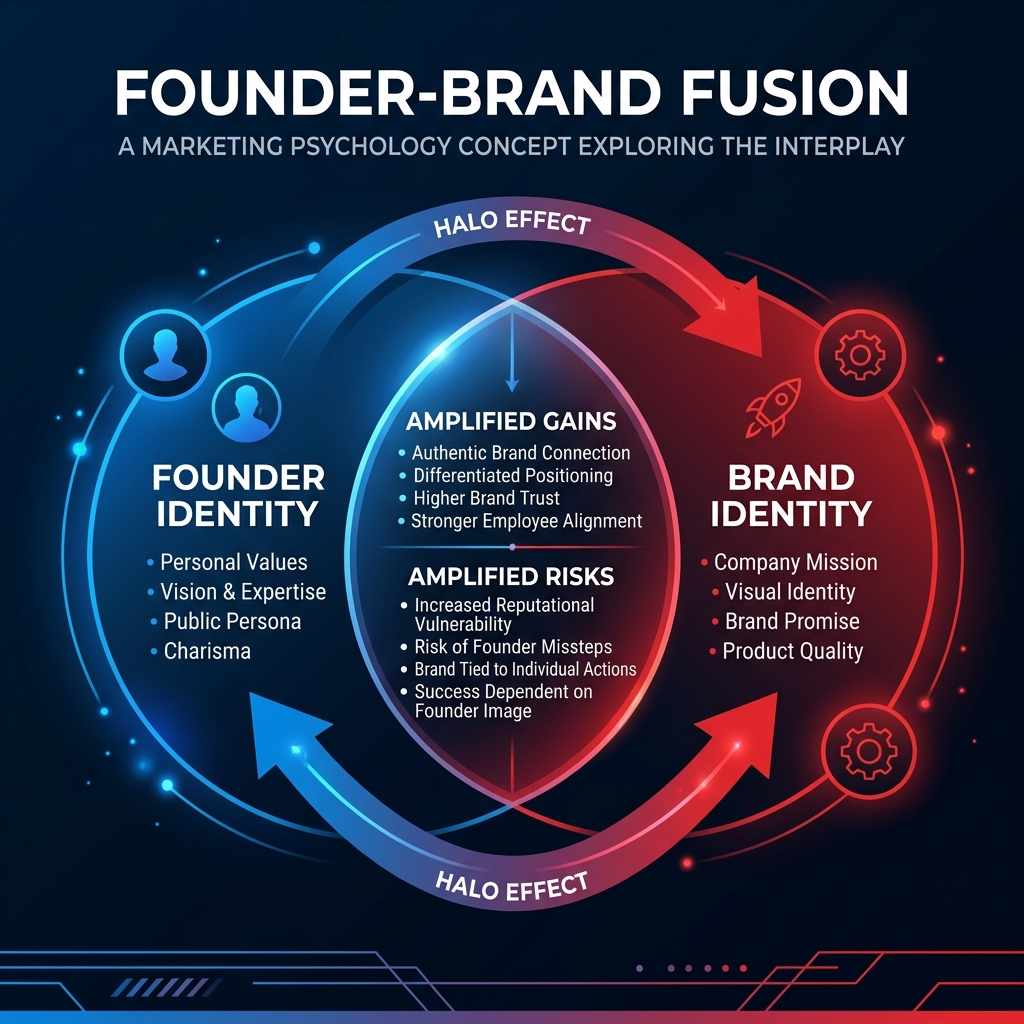
Let me define what I mean by founder-brand fusion, because it is different from founder-led or even founder-famous. Apple under Steve Jobs was founder-led: Jobs shaped everything, but Apple had its own identity that survived his death. Virgin is founder-famous: Branson’s personality promotes the brand but the brand has substance independent of him. Tesla under Musk is something more extreme: in public perception, the brand and the man are the same thing. There is no Tesla without Musk in the way there is an Apple without Jobs. The identities merged, and that merger was the strategy.
🎭 How the Fusion Was Built
The fusion was not inevitable; it was engineered by circumstance and amplified by personality. Tesla had zero advertising budget for most of its existence. No dealer network to build local brand equity. No heritage, no racing pedigree, no family story. What it had was a founder who was simultaneously building SpaceX, promising to colonise Mars, proposing the Hyperloop, and posting memes on Twitter to an audience that eventually exceeded 100 million followers. Musk’s personal mythology — the immigrant genius, the man who bets his last dollar, the real-life Iron Man — became Tesla’s advertising. Every SpaceX launch was a Tesla ad. Every viral tweet was a Tesla impression. The halo effect ran in one direction: Musk’s perceived genius made Tesla seem revolutionary, and Tesla’s real products made Musk’s other promises seem achievable.
The psychological mechanism is the halo effect as described by Thorndike and extensively documented by Nisbett and Wilson: a single strong positive trait (visionary genius) colours the perception of everything associated with it (the cars must be brilliant, the company must be well-run, the stock must be undervalued). The halo was so powerful that for years, production delays, quality complaints, missed deadlines and erratic public behaviour were all filtered through the “genius at work” frame and forgiven.
⚠️ The Reversal Mechanism
But halos are not one-way streets. When the perception of the person shifts, the halo becomes a horns effect, and every associated entity inherits the new negative evaluation. Musk’s political turn did not just make people dislike Musk; it made them dislike Teslas, dislike seeing Teslas, dislike people who drive Teslas. Vandalism of Tesla vehicles spiked. Owners reported social friction. Trade-in values fell. The brand had no independent reservoir of goodwill to draw on because the brand had never built one. It had Musk’s goodwill, and Musk spent it on something else.
I have audited dozens of brands, and I have never encountered a case where a founder’s personal political choices so directly and measurably destroyed brand equity. Not damaged — destroyed, in specific demographics and geographies, with the receipts visible in registration data. The 2024-2026 Tesla story is the most expensive founder-brand fusion failure ever recorded, and it happened not because the fusion broke but because it worked perfectly: the brand did exactly what the man did, which was polarise.
🧠 Chapter 3: First Principles Positioning — How Tesla Made Electric Cars Aspirational
Before Musk, electric cars were coded as sacrifice. The Toyota Prius, the Nissan Leaf, the GM EV1 — each communicated that choosing electric meant accepting something worse (less range, less power, less style) in exchange for something virtuous (environmental responsibility). The purchase was a trade: performance for morality. And trade-offs limit markets to people willing to make them, which is always a niche.
Tesla’s foundational positioning move was to refuse the trade-off entirely. The Roadster was faster than most sports cars. The Model S was more luxurious than most sedans. The positioning was not “this is a good electric car.” It was “this is a great car that happens to be electric.” That reframe changed everything, because it converted the target customer from “person willing to sacrifice for the environment” to “person who wants the best car,” which is a massively larger market.
The psychology underneath is category reframing through first principles. Instead of accepting the existing frame (electric = compromise) and competing within it, Tesla rebuilt the frame from scratch: what would a car designed today, with no legacy constraints, actually look like? The answer was electric, software-defined, direct-sold, and designed to make combustion look like a technology from the past rather than a competitor in the present. Every Tesla customer who explains their purchase by saying “it’s just the better car” is repeating the reframe, and the fact that they feel compelled to say “just” reveals they know the frame exists and they are choosing to transcend it.
This positioning attracted a very specific psychological profile in the early years: the rational progressive, someone who wanted to signal both intelligence (I chose the technologically superior option) and values (I chose the sustainable option) without appearing to sacrifice (I did not buy a boring car). That profile, concentrated among educated, affluent, politically liberal consumers in California and Northern Europe, was Tesla’s foundation market. Remember that profile for Chapter 7, because it is the exact profile most alienated by Musk’s later political positioning.
⚡ Chapter 4: The Tesla Tribe — Identity, Ownership and Cognitive Dissonance
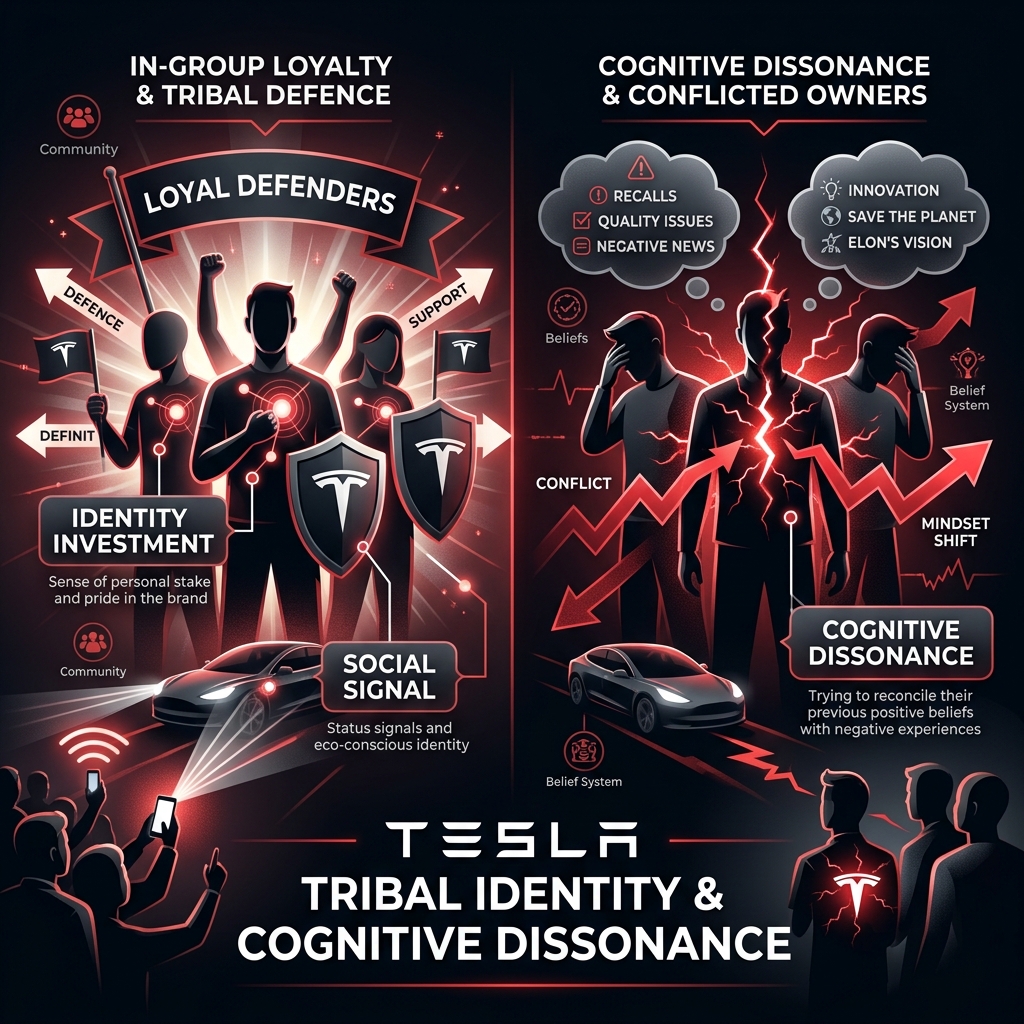
Tesla owners are, on average, the most emotionally invested car owners in the world, and the reason is structural rather than accidental.
🏷️ The Identity Purchase
Buying a Tesla in the 2012-2020 era was not a transportation decision. It was a public declaration: I believe in the future, I am technologically sophisticated, I care about the planet, I am not bound by convention. The car in the driveway was a billboard for the buyer’s self-concept, and that self-concept was validated by the tribal community of other owners, by Musk’s visionary narrative, and by the cultural cachet of being an early adopter of something that felt inevitable.
Social identity theory (Tajfel & Turner) explains what happens next: once group membership becomes part of self-concept, threats to the group become threats to the self. Criticising Tesla does not feel like criticising a car to a tribal member; it feels like criticising them. This is why Tesla discourse is so unusually heated compared to other automotive brands. Nobody fights on the internet about Toyota reliability ratings. Tesla threads become identity conflicts because the stakes are personal.
🔄 The Cognitive Dissonance Trap
The 2024-2026 period created an extraordinary cognitive dissonance problem for the original Tesla demographic. People who bought Teslas to signal progressive, environmentally conscious values suddenly found the face of their purchase publicly aligned with political positions they opposed. The car in the driveway was no longer saying what they wanted it to say. Festinger’s cognitive dissonance theory predicts the available responses: change the belief (“Musk isn’t that bad”), change the behavior (sell the car), add consonant cognitions (“the car is still the best EV regardless of the CEO”), or minimise the importance (“I don’t care about politics in my car choice”). All four responses are visible in Tesla owner communities right now, playing out in real time with real trade-in transactions.
The owners who stayed often deployed compartmentalisation: separating the product from the person, insisting the car’s merits stand independent of the CEO’s politics. The owners who left often described a contamination effect: the car felt different, the brand felt different, the social signal had changed meaning without their consent. Both responses are psychologically rational, which is what makes the situation so analytically interesting: the same fusion that created loyalty is now creating its opposite, using exactly the same mechanism.
📈 Shareholder Tribalism
A dimension unique to Tesla: the stock itself became a tribal identity. Tesla retail investors on social media defended the stock with the same intensity that owners defended the car, because the investment was also an identity investment. Shorting Tesla was treated not as a financial position but as a moral betrayal. The stock’s cult status created a feedback loop: belief drove buying, buying drove price, price validated belief, and anyone who questioned the price was questioning the tribe’s intelligence. This is textbook confirmation bias operating at market scale, and it contributed to a valuation disconnected from automotive fundamentals but perfectly connected to narrative fundamentals.
🛻 Chapter 5: The Cybertruck — Polarisation as a Product
The Cybertruck deserves its own section because it is the purest expression of a psychological strategy Tesla had been approaching for years: designing for maximum polarisation.
When the Cybertruck was unveiled in November 2019, the reaction was not mixed — it was split, violently, into love and hate, with almost nothing in between. The angular, stainless-steel, dystopian design violated every convention of automotive aesthetics, and the window-breaking incident during the live demo added chaos to division. The internet exploded, and Musk announced over 250,000 pre-orders within a week.
This is not accidental design. It is applied distinctiveness at maximum intensity. The Cybertruck cannot be confused with any other vehicle on earth. It cannot be ignored on any road. And it sorts people into two groups on sight: those who love it (and who now have a tribal marker more visible than any bumper sticker) and those who hate it (whose hatred generates free media coverage that keeps the product in public consciousness). Polarisation, in attention economics, is engagement, and engagement is the resource Tesla converts into sales, conversation and cultural relevance.
The delayed delivery (announced 2019, first deliveries late 2023, volume production still ramping in 2025-2026) created an extended anticipation period that served the same psychological function as a luxury waitlist: the longer you wait, the more you want, because the commitment bias deepens with time. Every month of waiting was a month of identity investment in an object that had not arrived, and the arrival had to validate the wait or force an uncomfortable reassessment.
The Cybertruck also represents Musk’s personal aesthetic preferences made physical, which reinforces the founder-brand fusion thesis: the product looks the way the founder thinks, and buying it is, more than any other Tesla, buying into the founder’s worldview. That is both its appeal and, for those who have cooled on the founder, its liability.
💰 Chapter 6: Pricing Psychology — From Aspirational Scarcity to Aggressive Discounting
Tesla’s pricing journey is a psychology case study in itself, because each phase served a different emotional function.
💎 Phase 1: Aspirational Scarcity (2008-2017)
The Roadster at $109,000, the Model S starting near $70,000, the Model X similarly positioned — these were luxury prices that said “this is not for everyone,” which is precisely what made early buyers feel special. Veblen goods theory applies: the high price was part of the value, signaling both wealth and values simultaneously. The waitlists compounded the scarcity signal. You did not just buy a Tesla; you were accepted into Tesla ownership.
📉 Phase 2: Mass-Market Democratisation (2017-2022)
The Model 3 at $35,000 (eventually) and the Model Y opened the brand to a mass market, and this transition carried psychological risk: would the brand lose its aspirational signal when everyone could buy one? Tesla managed this partly through trim levels (the Performance and Long Range variants maintained a premium tier) and partly through the sheer volume of cultural capital the brand had accumulated. By the time the $35,000 car arrived, Tesla’s brand meaning was secure enough to survive democratisation, a trick that luxury brands from Coach to Mercedes have repeatedly failed.
⬇️ Phase 3: The Discounting Era (2023-2026)
Facing rising competition from BYD, legacy automakers and new Chinese entrants, Tesla began aggressive price cuts in early 2023, slashing prices multiple times across the lineup. The psychology reversed: each cut signaled urgency rather than confidence, and existing owners watched their vehicles lose resale value overnight, which attacked the endowment effect and created genuine anger among the loyal base. A buyer who paid $60,000 for a Model Y and then watched Tesla sell the same car for $44,000 six months later did not feel like a valued early adopter; they felt like someone who overpaid, and that feeling erodes tribal loyalty faster than any external criticism.
🎯 Chapter 7: The Great Brand Split — When Your Core Customer Becomes Your Critic (2024-2026)
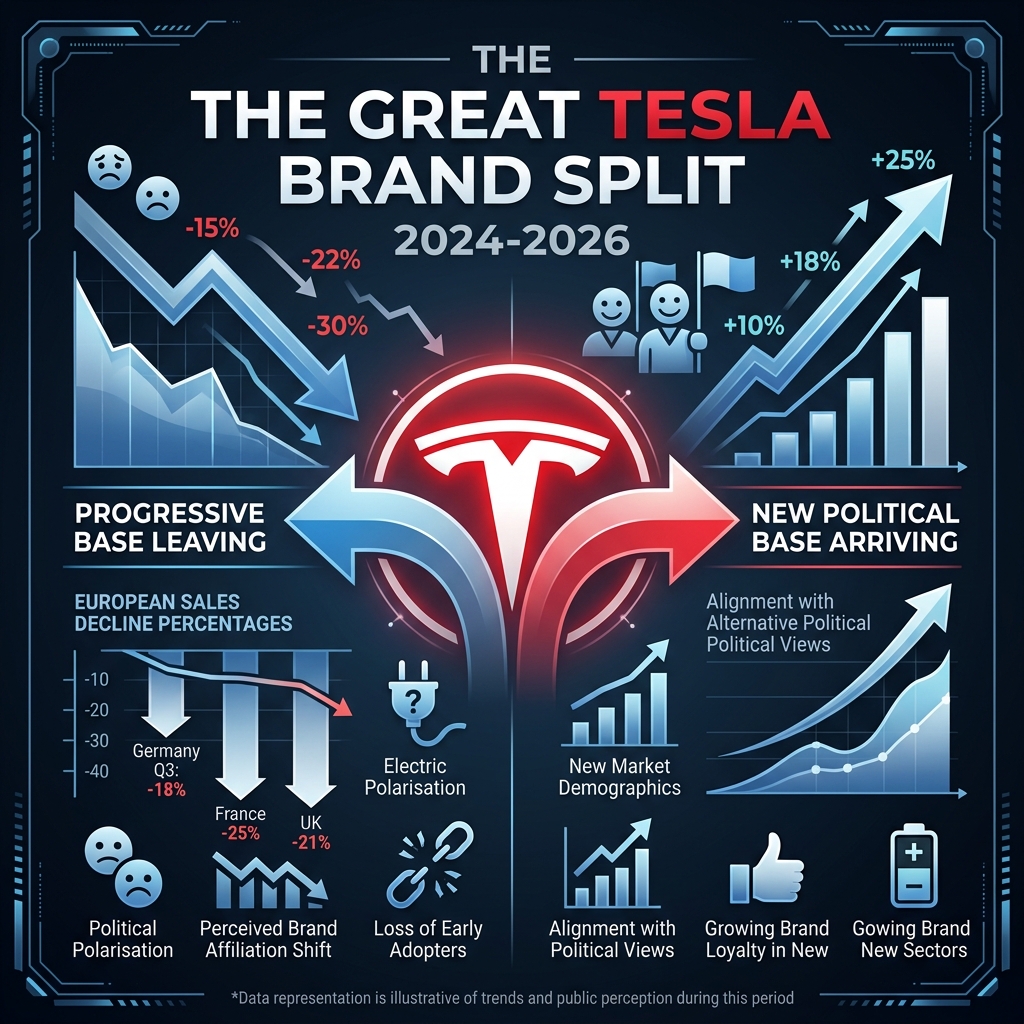
The data from 2024-2026 is the most extraordinary brand-damage dataset I have ever analyzed, and I want to present it clearly because the numbers tell the story more honestly than any interpretation.
📊 The Numbers
- Brand favourability among US Democrats: fell approximately 47-55 percentage points from peak, per multiple tracking surveys
- European registration data: Germany Tesla registrations down roughly 59% YoY at their worst in early 2025; France down over 60%; Scandinavian markets (early Tesla strongholds) showing similar patterns
- Global deliveries: first-ever annual decline in 2024 (~1.79 million, down from ~1.81 million in 2023); Q1 2025 deliveries down 13% YoY
- #BoycottTesla: moved from social media hashtag to measurable purchase behavior, with cross-shopping data showing former Tesla intenders shifting to Hyundai, BMW, and BYD
- Trade-in behavior: some owners reported actively removing Tesla badges, others traded to different brands citing the “Musk factor”
- Vandalism: reports of Tesla vehicle vandalism increased in multiple markets, driven by anti-Musk sentiment
🧠 The Psychology of the Split
What happened is a case study in brand meaning contamination. Tesla’s original brand meaning — progressive, sustainable, innovative, intelligent — attracted a customer base concentrated among educated, liberal, urban, environmentally conscious consumers. When Musk visibly and vocally aligned with political positions that this base opposed, the brand meaning did not simply weaken; it inverted for a significant portion of the original audience. The car that once said “I care about the future” now said, to its former tribe, “I fund the politics I oppose.”
The contamination is especially severe because cars are public possessions. You can quietly hold a stock. You cannot quietly drive a car. Every Tesla in a parking lot is a visible signal, and the signal’s meaning has changed without the owner’s consent. This is the cruelest consequence of founder-brand fusion: the brand’s meaning became someone else’s decision, and the someone else made a decision the core customer would not have made.
Meanwhile, a new audience is appearing: buyers attracted to Tesla specifically because of Musk’s political positioning, treating the purchase as a statement of political allegiance. The brand is not dying; it is splitting, and the two halves may not be compatible in the same showroom.
🤖 Chapter 8: The $0 Advertising Machine — How Tesla Marketed Without Marketing
Tesla spent $0 on traditional advertising for most of its history, a fact so unusual that it became its own marketing message. The implicit claim: “our product is so good it sells itself,” which is both a statement about the car and a flattering mirror for the buyer (“I am sophisticated enough to find the best product without being told”).
The actual advertising was Musk’s social media presence, which functioned as the most effective owned-media channel in corporate history. Over 100 million followers. Memes, product announcements, philosophical musings, and provocations, all blended into a feed that felt personal rather than corporate. When Musk tweeted about Tesla, it was not a press release; it was a conversation with a person, and conversations drive engagement at rates corporate accounts cannot approach.
The referral program converted owners into salespeople, offering free Supercharging or accessories for bringing in new buyers. This is network-effect marketing: each owner becomes a node that generates new owners, who become new nodes. The word-of-mouth advantage was enormous in the early years because each Tesla on the road was a novel sight that generated conversations, and each conversation was a sales opportunity conducted by someone with the most credible position in marketing: an actual satisfied customer.
Tesla did eventually begin some advertising in 2023, a tacit acknowledgment that the organic machine was no longer sufficient against competitors who were advertising heavily. But the legacy of the $0 era remains in brand perception: Tesla still feels more like a movement than a product, and that feeling — of joining something rather than buying something — is the deepest competitive advantage a brand can have. The question is whether a movement can survive its leader becoming controversial.
⚔️ Chapter 9: Competitive Positioning — The Lead Shrinks
| Competitor | Their Psychological Play | Tesla’s Vulnerability |
| BYD | Price leadership, vertical integration, aggressive global expansion | Already outselling Tesla globally; offers the value proposition Tesla used to own before price hikes |
| BMW / Mercedes EQ / Audi | Legacy luxury credibility, dealer networks, brand heritage | Captures Tesla defectors who want an EV without the Musk association; familiar luxury signals |
| Hyundai / Kia (Ioniq, EV6) | Design-forward, value pricing, no polarising CEO | Cross-shopping data shows Ioniq 5 as the top destination for ex-Tesla intenders |
| Rivian | Adventure identity, community focus, anti-Musk positioning by default | Captures the outdoor-progressive demographic Tesla is losing |
| Chinese newcomers (Nio, Xpeng, Xiaomi) | Tech integration, competitive pricing, rapid iteration | Winning in China where Tesla’s brand story matters less than features and price |
Tesla’s competitive position in 2026 is a study in what happens when a technology moat narrows while a brand moat collapses. The Supercharger network remains a genuine infrastructure advantage, and the NACS charging standard becoming the US default is a strategic victory. Full Self-Driving remains ahead of competitors in accumulated driving data. But the brand advantage — the feeling that buying Tesla meant buying the future — has been severely diluted by competition catching up on product and Musk pulling ahead on controversy. The competitors do not need to beat Tesla’s technology; they only need to offer a comparable EV without the baggage, and several now do.
📊 Chapter 10: Psychology Scorecard — Detailed Ratings
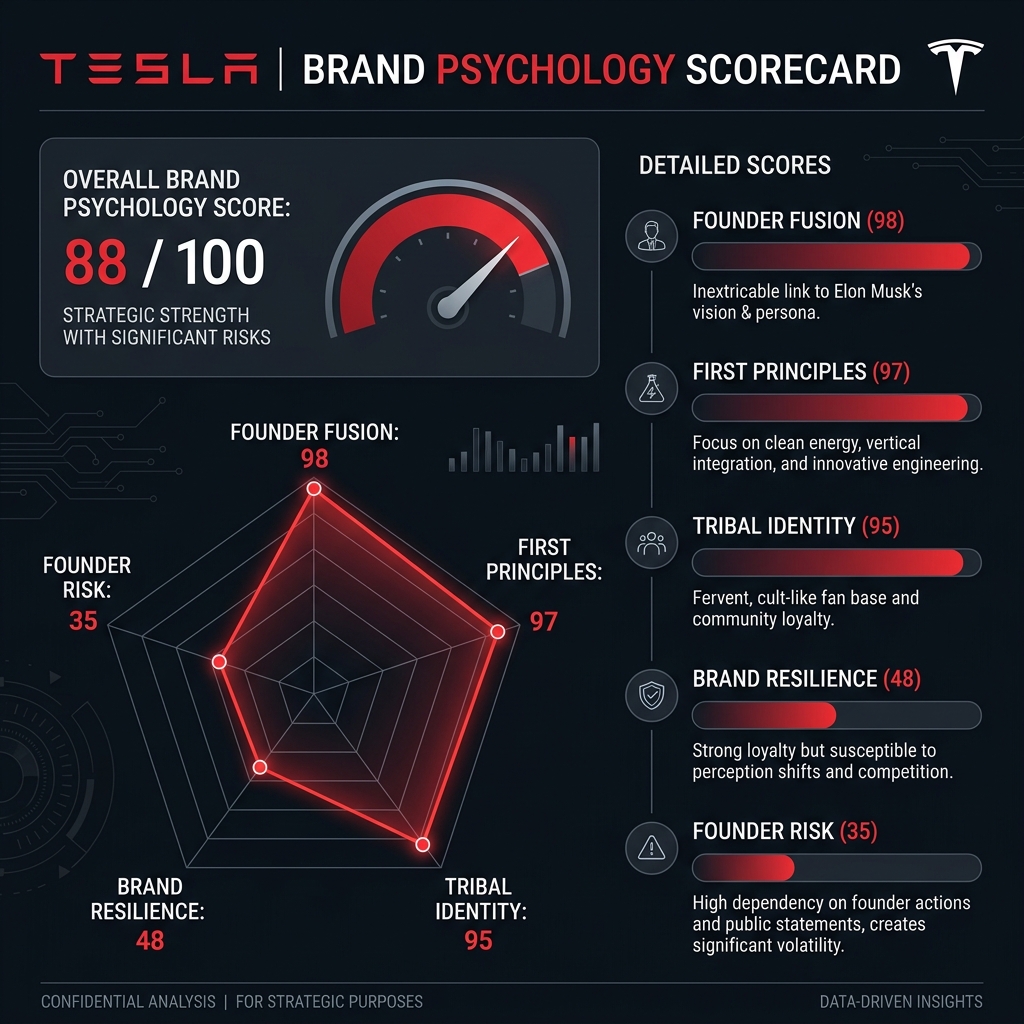
| Psychology Dimension | Score | Verdict |
| Founder-Brand Fusion Power | 98/100 | The most complete personality-brand merger in commercial history. |
| First Principles Positioning | 97/100 | Rewrote the EV category from sacrifice to aspiration — a generational positioning move. |
| Tribal Identity & Community | 95/100 | Ownership as identity investment: the most passionate (and most conflicted) automotive tribe. |
| Mission Narrative & Visionary Halo | 93/100 | “Accelerate the transition to sustainable energy” — a mission frame strong enough to sell pre-orders on faith. |
| $0 Marketing & Word-of-Mouth Engine | 91/100 | Built a global brand without a marketing budget, using the founder as the channel. |
| Product Innovation Perception | 89/100 | OTA updates, Autopilot, Supercharger network: the car-as-platform repositioned automotive expectations. |
| Brand Resilience & Diversification | 48/100 | Single-personality dependency with no independent brand equity to fall back on. |
| Founder-Brand Fusion Risk | 35/100 | The most expensive single point of failure in the history of brand management. |
| OVERALL PSYCHOLOGY SCORE | 88/100 | ⚡ Extreme Impact — a masterclass in personality-driven brand building, carrying the risk that only a personality-driven brand can. |
✅ Chapter 11: Balance Sheet & A Psychologist’s Prescription
💪 Psychological Strengths
- Category creation, not competition: Tesla did not enter the EV market; it created the EV market as we understand it, and category creators hold mental real estate that competitors must work around
- First principles positioning remains durable: even amid the brand crisis, the core product proposition — best-in-class technology, Supercharger network, OTA updates — retains genuine substance
- The mission narrative: “accelerate the transition to sustainable energy” is a purpose frame strong enough to survive founder controversy for a portion of the audience, because the mission is bigger than any person
- Infrastructure moat: the Supercharger network and the NACS standard becoming the US default create switching costs that exist independent of brand sentiment
- Shareholder commitment: the retail investor base remains intensely loyal, providing stock support that insulates the company from short-term brand damage
⚠️ Psychological Weaknesses
- Single-personality dependency: the brand has no identity independent of Musk, which means every personal controversy is automatically a corporate crisis
- Core demographic alienation: the original customer base — progressive, educated, urban — is the demographic most repelled by Musk’s political positioning, and they are not being fully replaced
- Brand meaning contamination: the car’s social signal has changed from “I care about the future” to “I support Musk” in a significant share of the public, which is a meaning the company did not choose and cannot easily correct
- Competitive moat narrowing: product differentiation is shrinking as legacy and Chinese automakers close the technology gap, leaving brand as the primary differentiator at the exact moment the brand is weakening
- Quality reputation erosion: panel gaps, build quality complaints, and the Cybertruck’s recall history undermine the “technologically superior” narrative that justifies premium pricing
- Price-cut damage: aggressive discounting destroyed resale values and punished loyal early buyers, eroding the community trust the tribe model depends on
🔮 The Prescription
- Build a brand identity that can survive its founder — and do it now. This is the single most important strategic imperative for Tesla. The company needs values, aesthetic identity, customer stories and brand meaning that exist independent of any individual. Apple did this before Jobs died; Tesla must do it before the fusion causes more damage. This does not require removing Musk; it requires building something beside him.
- Invest in the mission, visibly and expensively. “Accelerate sustainable energy” is the one brand narrative that transcends political lines. Every dollar spent making that mission tangible — grid storage, solar deployment, carbon impact reporting — is a dollar spent rebuilding the brand on a foundation that does not depend on one man’s Twitter feed.
- Stop punishing early adopters with price cuts. Implement price-protection policies or loyalty credits that prevent loyal buyers from feeling that their trust was a financial mistake. The tribe cannot survive if membership feels like a penalty.
- Separate the Cybertruck’s meaning from Musk’s meaning. The Cybertruck has the raw distinctiveness to be an iconic product, but right now it reads as “Musk’s truck” rather than “Tesla’s truck.” Give it its own identity, its own community, its own narrative arc.
- Let the product speak again. Tesla’s strongest periods were when the product was the story. The Model S review, the Ludicrous Mode video, the OTA update that added features overnight — these moments built the brand without politics. The product is still capable of generating those moments; the founder’s social media presence is drowning them out.
📝 Final Verdict
Tesla is the most extraordinary and the most cautionary brand story of this century, and it is both of those things for exactly the same reason: founder-brand fusion. The fusion built a car company from nothing into the most valuable automaker on earth, with zero advertising, by making one man’s personal mythology so compelling that hundreds of thousands of people pre-ordered a product they had never seen. It made the stock a tribal token, the car a political statement, and the ownership experience a declaration of identity. As a piece of brand psychology, the power rating is 98 out of 100, because no brand in history has achieved this depth of personal identification between a founder and a customer base.
And the fusion is now demonstrating, with billions of dollars of measurable damage, why personality dependency is not an asset but a structural vulnerability. The same mechanism that converted Musk’s genius into Tesla’s brand equity is now converting Musk’s politics into Tesla’s brand liability, and the company has no circuit breaker because the circuit is the founder. European sales collapsed not because the cars got worse but because the man got controversial. American brand favorability split not along product lines but along political lines. Vandalism increased not because of quality complaints but because of who the owner was perceived to be funding.
My honest assessment as a psychologist: Tesla’s product is still remarkable. Its infrastructure is still leading. Its technology is still competitive. And its brand is in the most dangerous position of any major company on earth, because the danger is not external — it is not regulation, not competition, not technology — it is one man’s public behavior, and no board resolution, no PR campaign, and no product launch can manage that risk as long as the fusion holds. The brand that was built by a personality can only be saved by something bigger than one.
Psychology Score: 88/100 — Tesla scores at elite levels for founder-brand fusion power (98), first principles positioning (97), and tribal identity (95), but posts the lowest brand-resilience score ever recorded on ShahzebSpeaks (48) and a founder-risk score of 35. A brand built by a personality now running the world’s most expensive experiment in what happens when the personality changes. The car is still remarkable. The question is whether anyone can still see it.
🧠 Want a Psychology Audit for Your Brand?
I’m Muhammad Shahzeb, an MSc Industrial Psychologist and Full-Stack Developer. I apply behavioral science to branding, positioning and founder-brand dynamics — including telling you when your greatest asset is also your greatest risk. Let’s audit yours.
📚 References & Sources
- Vance, A. (2015). Elon Musk: Tesla, SpaceX, and the Quest for a Fantastic Future. Ecco/HarperCollins.
- Isaacson, W. (2023). Elon Musk. Simon & Schuster.
- Tesla, Inc. Annual Reports, Form 10-K filings, and quarterly delivery reports. ir.tesla.com, sec.gov
- Morning Consult brand tracking data on Tesla favorability by political affiliation, 2022-2026.
- European Automobile Manufacturers’ Association (ACEA) and national registration statistics for EV market share, 2024-2025.
- Reuters, Bloomberg and Financial Times reporting on Tesla delivery declines, European sales data, and boycott impact, 2024-2026.
- Tajfel, H., & Turner, J. C. (1979). “An integrative theory of intergroup conflict.” In W. G. Austin & S. Worchel (Eds.), The Social Psychology of Intergroup Relations. (Social identity theory.)
- Festinger, L. (1957). A Theory of Cognitive Dissonance. Stanford University Press.
- Thorndike, E. L. (1920). “A constant error in psychological ratings.” Journal of Applied Psychology, 4(1), 25-29. (Halo effect.)
- Nisbett, R. E., & Wilson, T. D. (1977). “The halo effect: Evidence for unconscious alteration of judgments.” Journal of Personality and Social Psychology, 35(4), 250-256.
- Sharp, B. (2010). How Brands Grow. Oxford University Press. (Distinctive brand assets, mental availability.)
- Cialdini, R. B. (2006). Influence: The Psychology of Persuasion. Revised edition. Harper Business. (Commitment & consistency, social proof.)
- Kahneman, D. (2011). Thinking, Fast and Slow. Farrar, Straus and Giroux. (System 1 vs System 2, heuristics.)
- Aaker, D. A. (1996). Building Strong Brands. Free Press.
- Fournier, S. (1998). “Consumers and their brands: Developing relationship theory in consumer research.” Journal of Consumer Research, 24(4), 343-373.
- Motor Trend. “2013 Car of the Year: Tesla Model S.” motortrend.com
- Consumer Reports scoring of Model S, 2013-2015; subsequent quality reporting.
Audit conducted by Muhammad Shahzeb, MSc Industrial & Organizational Psychology | Brand Psychology Specialist | Full-Stack Web Developer
Learn more about my approach →
Key Findings
- Tesla is the most extreme case of founder-brand fusion in business history — Elon Musk IS the brand to a degree that no CEO since Steve Jobs has approached, and the fusion now works in both directions
- The brand was built on first principles positioning: Tesla did not sell electric cars, it sold the idea that electric cars could be the BEST cars, reframing the category from sacrifice to aspiration
- Tesla owners exhibit tribal psychology at clinical intensity — defending the brand against criticism functions as self-defence because the purchase is an identity investment
- The 2024-2026 political period represents the most expensive founder-brand fusion failure ever recorded: Musk's political alignment cost Tesla ~50% brand favorability decline among US Democrats and 40-60% European sales drops
- Tesla proved a car company can be built like a tech startup but also proved a brand built on one personality inherits that personality's entire risk profile
- The Cybertruck is the purest expression of polarization marketing in automotive history — designed to be impossible to ignore and impossible to feel neutral about
Overall Psychology Score
Tesla scores 88/100 in our comprehensive psychology audit covering consumer behavior strategies, UX design principles, and psychological marketing effectiveness.
The detailed dimension scores are in the audit's Psychology Scorecard chapter.
High impactMuhammad Shahzeb
MSc Industrial Psychologist, specializing in consumer behavior, UX psychology, and brand strategy analysis. Helping brands understand the psychology behind their success.
About Muhammad Shahzeb →