Barbour Psychology Audit — Warm Wishes: Wallace, Gromit and the Walk-o-matic
Barbour's "Warm Wishes" brings Wallace & Gromit back for a second Christmas, with a Walk-o-matic, a dog coat and tartan everywhere. Our psychology audit of the borrowed affection, the hand-made craft and the two gifts — and the Levi's lawsuit with no verified ending — scores Barbour 84/100.

84 / 100
Overall consumer behavior effectiveness
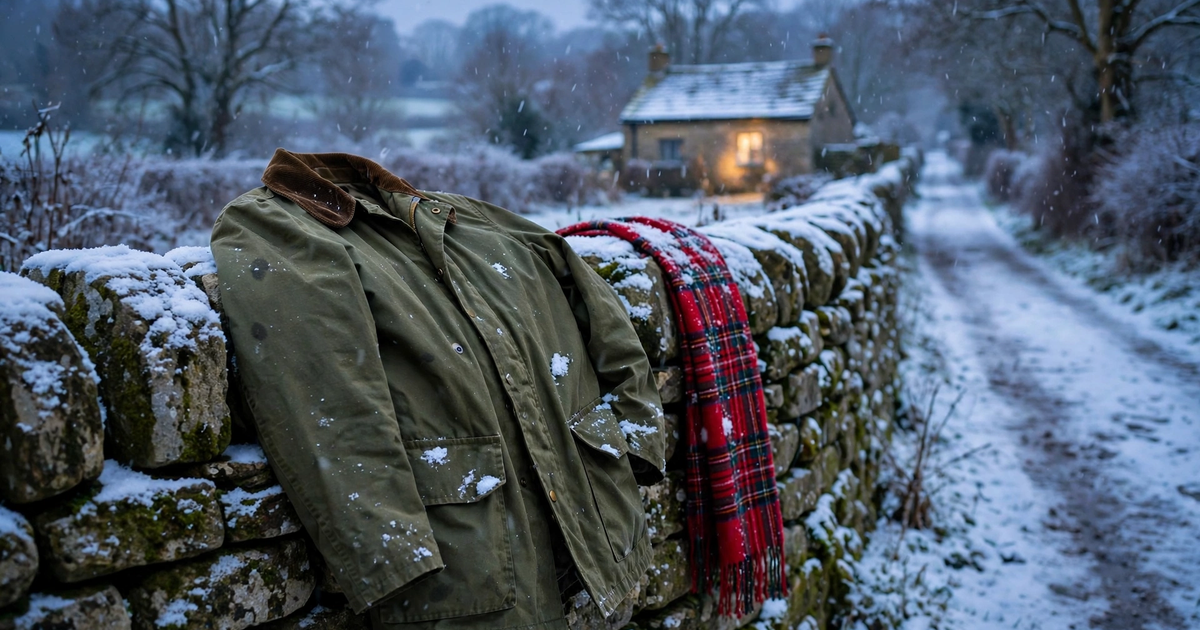
Brand Overview
- Brand nameBarbour
- Founded1894
- HeadquartersSimonside, South Shields, England
- IndustryFashion & Apparel
- Websitewww.barbour.com ↗
Psychology Techniques Identified
- 01Borrowed equity / parasocial recognition (Horton & Wohl 1956; Wallace & Gromit arrive with thirty-seven years of audience affection already attached)
- 02Nostalgia (Wildschut et al. 2006; the characters and the tartan run two nostalgia channels at once — both bolster social bonds and positive affect)
- 03Mere exposure (Zajonc 1968; the fourth consecutive Aardman Christmas, the second with Wallace & Gromit — familiarity that deepens liking)
- 04Identity signalling / the extended self (Belk 1988; the wax jacket and the characters share the same values — practical, British, unshowy)
- 05Effort heuristic / craft premium (Kruger et al. 2004; stop-motion made frame by frame, and jackets made by hand at Simonside — visible effort raises perceived quality)
- 06Gift giving as agapic love (Belk & Coon 1993; the coat and the jumper are given from knowledge of the recipient, not as transactions)
- 07Reciprocity (Gouldner 1960; Cialdini 2001; Gromit's gift answers Wallace's — the exchange is balanced, not a debt)
- 08Benign violation humour (McGraw & Warren 2010; the Walk-o-matic is wrong and harmless at the same time — a chair that should not be a vehicle)
- 09Peak-end rule (Kahneman et al. 1993; the film ends on the rescue and a second small joke, so the last feeling is warmth)
- 10Anthropomorphism (Epley, Waytz & Cacioppo 2007; Gromit never speaks, and the audience reads patience, exasperation and affection into his silence)
- 11Scarcity (Cialdini 2001; the December-only capsule and the limited Re-loved run — genuinely limited supply, not staged urgency)
- 12Loss aversion (Kahneman & Tversky 1979; the limited pieces are framed by what the buyer might miss, and the loss weighs more than the gain)
Full Psychology Audit Report
In this audit
Gromit is hanging tartan around the house. The turkey is in the oven. The presents are wrapped. Then Wallace appears with a gift for his dog — a wax coat, “for walkies!” — and with an invention that will ruin the walk entirely: an armchair on giant wheels made from wellington boots. Barbour’s “Warm Wishes” is a Christmas film about a gift, a gadget and a rescue. This Barbour Warm Wishes audit explains why that small story works so well, and what it costs a brand to borrow someone else’s childhood.
I am an Industrial and Organizational Psychologist in Karachi, and I audit brands on the psychology of what they actually do — not on how much I like their products. This audit is of Barbour’s “Warm Wishes”, released on 5 November 2026. It is fourteen days old. No effectiveness score exists yet for this film, no viewer or sales figure has been published, and this audit will not invent one. What it scores is the campaign’s psychology and craft: the borrowed affection of Wallace & Gromit, the nostalgia of stop-motion, the gift at the centre of the story, and the legal record that sits behind a brand most people think of as simply respectable.
Barbour’s “Warm Wishes” works because it borrows two things at once: the most loved animated duo in Britain, and the feeling of a Christmas that already happened. The film gives Wallace a gadget that fails, Gromit a coat that fits, and the viewer a rescue that lands exactly where it should. Our audit scores it 84/100 — very strong on nostalgia, craft and gifting, weaker on trust, where an unresolved American trademark lawsuit still counts against it.
“Like Wallace and Gromit, we can’t help getting totally wrapped up in Christmas, and we’re so excited to present the duo again, this time wrapped up in Barbour for their winter walkies. We hope it warms the cockles and brings a giant Wallace smile.”
— Nick Park, creator of Wallace & Gromit, 2026
📋 Brand Overview
| Field | Detail |
|---|---|
| Brand | Barbour (J. Barbour & Sons Ltd) — British heritage outerwear, fifth-generation family-owned |
| Founded | 1894, Market Place, South Shields, North East England, by John Barbour |
| Headquarters | Simonside, South Shields, England — where the Bedale wax jacket is still made by hand |
| Scale (year to 30 April 2025) | Turnover £350.8 million, up 9%; operating profit £49.5 million; more than 1,100 employees |
| Current campaign | “Warm Wishes”, released 5 November 2026; 1 minute 28 seconds, stop-motion, made by Aardman |
| Royal Warrants | King’s Warrant granted May 2024; earlier warrants 1974, 1982, 1987 |
| Website | https://www.barbour.com |
| Psychology score | 84/100 |
📜 Chapter 1: History — oilskins, wax and a family that never left South Shields
Barbour began with bad weather and a Scotsman who had crossed the border. In 1894, John Barbour set up in the Market Place in South Shields, in the North East of England, supplying oilskins and other hard-wearing garments to the sailors, fishermen and mariners who worked the North Sea coast. The need was practical: clothes that kept the wet out. The solution was a cloth coated in wax, and Barbour’s version used paraffin wax rather than the linseed oil its rivals relied on — a difference that mattered, because paraffin wax cracked less and breathed better. A jacket that does not crack in the cold is a small thing. It is also the whole of Barbour’s first hundred years: make the practical thing slightly better, and keep making it in the same town.
The company stayed in the family, and the family stayed in South Shields. Barbour is now a fifth-generation family business, and its headquarters at Simonside, in the town where it began, is still a working factory: the Bedale wax jacket is made there by hand, and the same building houses the customer service teams who re-wax, repair and re-work jackets so their owners can keep wearing them. That continuity is rare in fashion, where brands change hands, move production and re-invent themselves every decade. Barbour has done the opposite. It has kept the address, the family and the product, and let the world come to it.
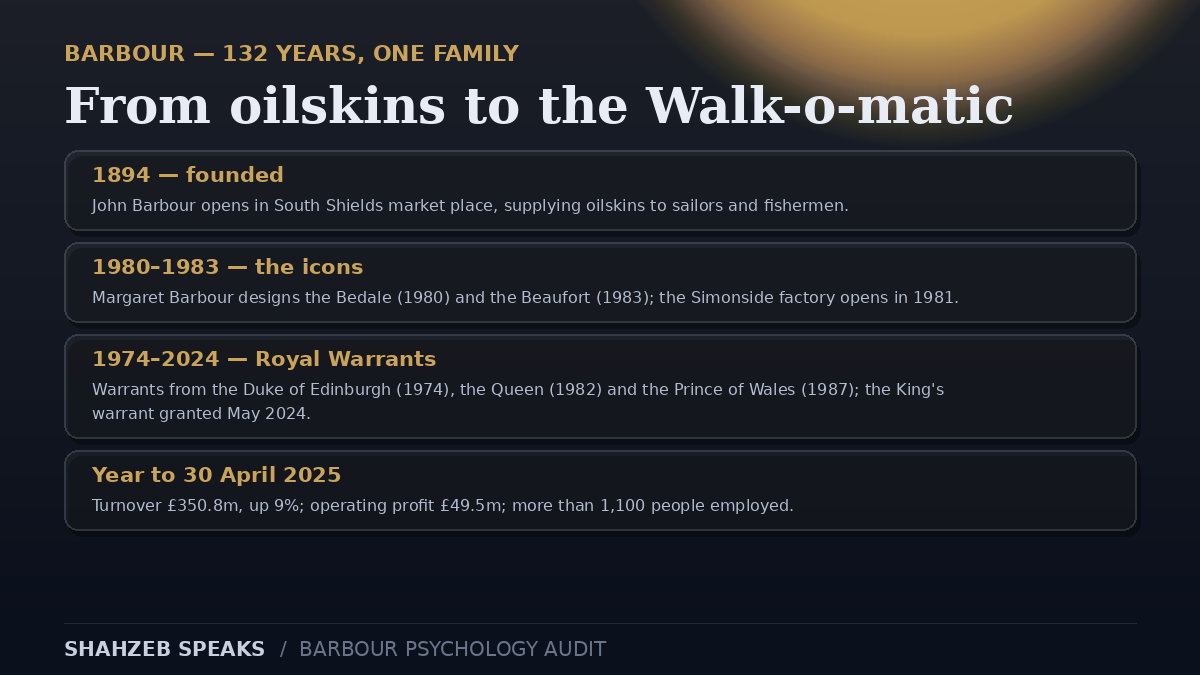
The jackets that made the brand a household name arrived in the early 1980s, and they arrived because of one person. Margaret Barbour joined the board in 1968 and became chairman in 1973, after her husband John Barbour — the founder’s grandson, who had re-introduced the company to countrywear in 1964 — died in 1968. She designed the Bedale in 1980, a lightweight, thornproof short jacket made for riding, and the Beaufort in 1983, a longer jacket for country pursuits with a full-length rear pocket, inspired by French shooting jackets. The Border followed in the same years. In 1981 the company moved into a new factory at Simonside, where it remains. Margaret Barbour was made a Dame in 2001. The three jackets of the early 1980s are still the template for what people picture when they hear the name Barbour, and the Bedale and the Beaufort are still made by hand in the town where they were designed.
The Royal Warrants tell the same story of slow accumulation, and they need stating carefully, because they are often misreported. Barbour received its first Royal Warrant in 1974, from the Duke of Edinburgh; a second in 1982, from the Queen; and a third in 1987, from the Prince of Wales. A warrant belongs to the person who grants it, not to the title, so the Duke of Edinburgh’s warrant ended when he died in 2021, and the Queen’s when she died in 2022. The Prince of Wales warrant carried on when he became King, and in May 2024 Barbour was granted a Royal Warrant of Appointment to His Majesty the King, as manufacturers of outerwear, clothing, footwear and accessories. That is the current position: one live warrant, from the King, granted in 2024 — not three, and not a warrant that has simply rolled on unchanged since 1974.
The numbers behind the brand are strong, and they are worth recording because they frame the campaign’s timing. In the year to 30 April 2025, J. Barbour & Sons reported turnover of £350.8 million, up 9% from £321.8 million the year before, and operating profit of £49.5 million, up from £39.5 million. Pre-tax profit was £45.8 million, up 21%. The company attributed the growth to a recovery in wholesale and stronger direct-to-consumer sales through stores and online, with what it called “unprecedented growth” in womenswear, and clothing and accessories now accounting for almost half of group sales. The company employs more than 1,100 people, and it recommended a £30 million final dividend to the founding family. The chair, Dame Margaret Barbour, noted in the accounts that revenue had risen by £29.1 million after a planned £21.3 million sales reduction in the prior year to set up future growth, and that gross margin had improved by 1.6%. The year before, turnover had dipped 6% to £321.79 million while operating profit still rose 15% — a company that chose profitable sales over volume, and was rewarded for it.
There is one more recent fact that belongs in this chapter, because it shows the brand’s standing in its own industry. On 12 November 2025, Barbour was the big winner of the Drapers Awards, taking Menswear Brand of the Year, Womenswear Brand of the Year and Best Marketing Campaign for “Icons in Quilting”. A heritage brand winning both the menswear and womenswear prizes in the same year is unusual, and it is the context for this Christmas campaign: Barbour is not a fading country label trading on old glories. It is a growing, profitable, award-winning business, and it is spending its Christmas budget from a position of strength.
🎬 Chapter 2: “Warm Wishes” — a dog coat, a chair on wellies, and a rescue
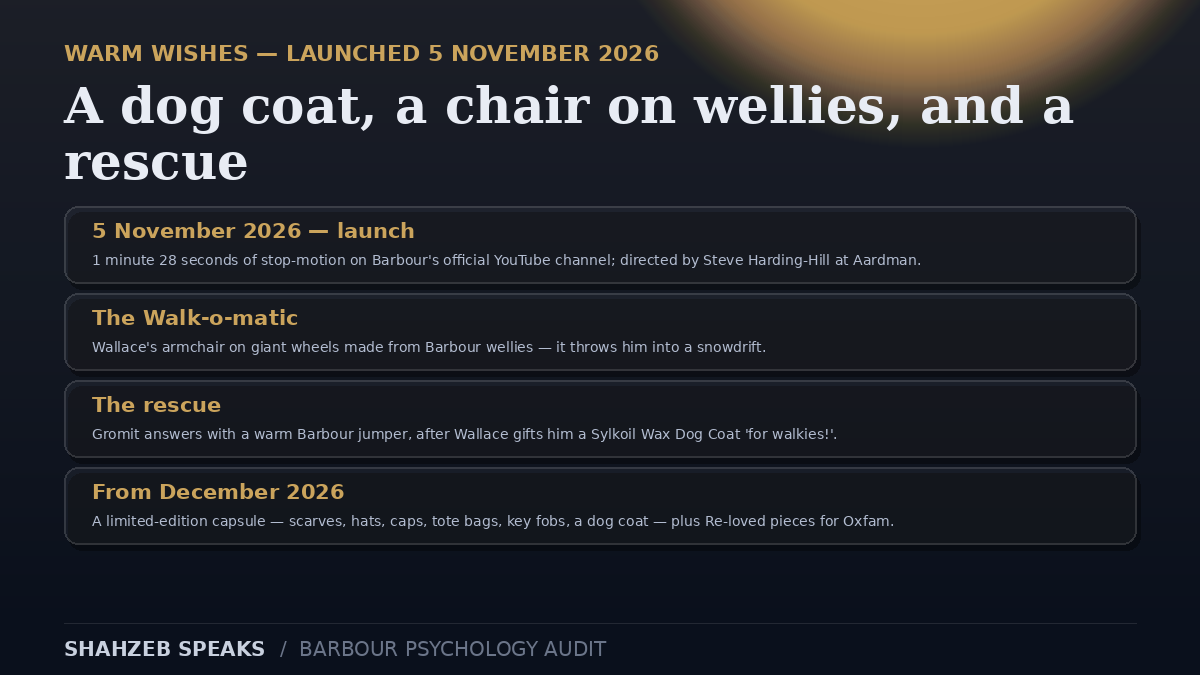
The film is a minute and twenty-eight seconds long, and it does not waste a frame. “Warm Wishes” was released on 5 November 2026 on Barbour’s official YouTube channel, directed by Steve Harding-Hill, Aardman’s Creative Director of Short Form and Commercials, and made in Aardman’s stop-motion style. The client was Barbour, led by Global Marketing Director Jamie McCall. Wallace & Gromit were created by Nick Park. That is the whole credits list that matters, and it is worth recording because it is short: this is not a film with a dozen agencies and a committee. It is a brand, a studio and a director.
The story runs in three beats. First, the gift. Gromit is at home, decorating the house with tartan, the turkey in the oven, the presents wrapped. Wallace arrives with a present for his dog: a Barbour Sylkoil Wax Dog Coat, presented with the words “for walkies!”. Second, the gadget. Wallace has built the Walk-o-matic, his latest invention — his favourite armchair mounted on giant wheels made from Barbour wellies — so that he can enjoy a Christmas Day stroll without taking a single step. The contraption breaks down and throws him into a snowdrift. Third, the rescue. Gromit, the sensible one, comes to the rescue with a warm Barbour jumper — the gift he had ready for Wallace all along, which Wallace had headed out before he could hand over. Shaun the Sheep and his flock make a cameo at the end, wearing the Walk-o-matic’s welly boots on their heads. The film closes with the message “Warm Wishes from Barbour”.
The film is the fourth consecutive Christmas collaboration between Barbour and Aardman, and the second with Wallace & Gromit as the leads. Shaun the Sheep starred in the Christmas films of 2023 and 2024, and the 2025 film — “Barbour and Wallace & Gromit have Christmas covered” — introduced the duo with a different Wallace invention, the Gift-o-matic, a tartan-covered robot built to make present-giving easy. In earlier years the Christmas films featured Raymond Briggs’s Snowman and Father Christmas. The pattern is deliberate and it is the point of the next chapter: Barbour does not invent a new Christmas world each year. It returns to the same one, with the same characters, and lets the audience’s familiarity do the work.
Aardman has described the film as a celebration of “the simple joy of giving and receiving a thoughtful gift at Christmas”, and the people behind it have said the same thing in their own words. Jamie McCall, Barbour’s Global Marketing Director, said: “We’re delighted to be continuing our creative partnership with Aardman. Barbour and Aardman share a distinctly British heritage, a passion for craftsmanship and an appreciation for the attention to detail that make something truly special.” Nick Park added that he hoped the film “warms the cockles and brings a giant Wallace smile”. Harding-Hill called the collaboration “an absolute joy” and said it was “a pleasure to work with such an iconic British brand”. Those are company and creative claims, not independent findings — but they state the test the film sets itself. If it works, it works because the gift feels thoughtful, the gadget feels like Wallace, and the rescue feels like Gromit. The next chapters test each of those in turn.
There is a shopping extension, and it is doing more work than a normal merchandise tie-in. Alongside the film, Barbour has produced a limited-edition capsule collection of accessories — knitted scarves, hats, caps, tote bags, key fobs and a dog coat — available from December 2026 on Barbour.com and through selected retail stores. It has also brought back a limited-edition run of Re-loved Wallace & Gromit-inspired wax jackets, after last year’s run, and for the first time it has added Re-loved scarves and Re-loved dog coats, with all proceeds going to Oxfam. The capsule sells the film’s world. The Re-loved pieces sell the brand’s values. Chapter 8 takes up the first, and Chapter 6 the second. For now, the fact to hold is simple: the film is not only an advert. It is the front of a shop, and the shop opens in December.
One more fact about the film belongs here, because it protects the reader from a mistake. Some listings describe the film as 90 seconds long. The precise running time, as reported by the coverage that credits Aardman directly, is 1 minute 28 seconds. This audit prints 1 minute 28 seconds, and notes the rounding, because a small error in a running time is a small thing — and because getting small things right is what makes the big claims believable.
🎭 Chapter 3: Borrowed equity — Wallace & Gromit are the brand’s best asset, and Barbour does not own them
The strongest psychology in this audit is also the most obvious fact about the film: the two characters on screen are not Barbour’s. Wallace & Gromit belong to Aardman, created by Nick Park, first seen in A Grand Day Out in 1989 — thirty-seven years before this film. Barbour is borrowing them. That is not a criticism. It is the strategy, and it is a strategy with a name: borrowed equity, the practice of renting the affection an audience already feels for one thing and attaching it to another.
The principle underneath it is parasocial interaction. Horton and Wohl described it in 1956: audiences form one-sided relationships with media figures, and those relationships feel real even though the figure does not know the viewer exists. Wallace and Gromit are unusually strong parasocial figures, because the relationship has had decades to form. A viewer who watched The Wrong Trousers in 1993 was a child; that viewer is now in their forties, with children of their own, and the same dog is still silent, still patient, still saving the day. The feeling that arrives when Gromit appears on screen is not the feeling of meeting a new character. It is the feeling of meeting an old friend. Barbour did not earn that feeling. It rented it, and the rent is the partnership with Aardman.
There is a second principle at work beside it, and it explains why the borrowing fits Barbour so neatly. Belk argued in 1988, in the Journal of Consumer Research, that possessions are part of identity — that the things we own, wear and choose are extensions of the self. A wax jacket is not only a jacket. It is a statement about the wearer: practical, British, unshowy, built to last. Wallace & Gromit make the same statement in a different register. Wallace is an eccentric inventor from Wigan who loves cheese and builds machines that fail. Gromit is the silent, competent dog who keeps the household running. Neither of them is fashionable, and that is the point: the characters and the coats share the same values — modest, practical, slightly old-fashioned, and proud of it. The borrowing works because the two brands already agree about what matters.
The evidence that the borrowing pays is unusually strong, and it comes from last year’s film. System1, the advertising effectiveness firm, named the 2025 Wallace & Gromit film its Ad of the Week, gave it 5.8 stars on its Test Your Ad platform, placed it 11th on the 2025 Christmas leaderboard, and recorded an uplift of 3.2 stars against the fashion category average. On System1’s 1.0 to 5.9 star scale, where only about 1% of ads reach five stars, 5.8 is an exceptional result. That score belongs to the 2025 film, and this audit prints it only as such — never as a score for “Warm Wishes”, which has no verified score yet. But the 2025 result is the reason Barbour came back with the same characters and the same studio: the borrowing worked, measurably, and the brand is repeating what worked.
There is a risk in borrowed equity, and this audit counts it honestly. Barbour does not own Wallace & Gromit. If Aardman ends the partnership, or if the characters lose their lustre, Barbour’s Christmas has no centre. The brand has also now spent four consecutive Christmases inside Aardman’s world — Shaun the Sheep, then Wallace & Gromit — and the audience’s affection is attached to the characters first and the coats second. A viewer who loves the film may remember Gromit and forget Barbour. That is the permanent risk of borrowing: the lender keeps the asset, and the borrower keeps the receipt. The audit scores the borrowing as the campaign’s strongest dimension, because the fit is genuine and the 2025 result is real. It also notes the dependence, because a strategy that works is not the same as a strategy that is safe.
🎵 Chapter 4: Nostalgia — the tartan, the dog and thirty-seven years of Christmas
The second psychology in the film is nostalgia, and it runs on the same characters that carry the borrowed equity. The direct answer is that “Warm Wishes” is not selling a coat. It is selling a memory of Christmas that the viewer has already lived, and it is using Wallace & Gromit as the way back to it.

The research behind this is precise. Wildschut, Sedikides, Arndt and Routledge, writing in 2006 in the Journal of Personality and Social Psychology, ran seven studies on nostalgia and found that nostalgic narratives typically feature the self with close others — family and friends — or in momentous events; that nostalgia is triggered by negative mood and loneliness; and that it bolsters social bonds, increases positive self-regard and generates positive affect. Nostalgia, in other words, is not only a warm feeling. It is a social feeling. It makes people feel closer to the people they love, and better about themselves.
That is exactly what the film is selling, and it is worth stating carefully. Wallace & Gromit are not only characters. They are a shared memory. A Grand Day Out arrived in 1989; The Wrong Trousers and A Close Shave won Academy Awards in 1993 and 1995; Vengeance Most Fowl reached British audiences on BBC One on Christmas Day 2024, before arriving on Netflix. For many viewers, these films are the texture of Christmas itself — watched with parents, then with children, then with grandchildren. The tartan in the film does the same work in a second channel: it is Barbour’s own memory, the pattern of its Scottish roots, woven through the animation. The film is running two nostalgia channels at once, the characters and the cloth, in the same minute and a half. That doubling is deliberate, and it is the reason the campaign scores so highly on this dimension.
There is a third channel, and it is the one the film does not have to explain. Aardman itself is a nostalgia object. The studio was founded in 1972 by Peter Lord and David Sproxton, in Bristol, and 2026 is its fiftieth anniversary year. Stop-motion — plasticine figures moved a frame at a time by human hands — is a technique that belongs to a slower, more patient kind of filmmaking, and its very slowness is part of the feeling. Chapter 5 takes up the craft in full. Here, the point is simpler: the film feels old in the best sense, because it is made the old way, by a studio that has been making things the old way for fifty years, about characters who have been loved for thirty-seven.
There is a limit to claim here, and it matters. Nostalgia works when the memory is shared, and it fails when it is not. A viewer who has never seen Wallace & Gromit will not feel anything from a silent dog in a wax coat. A viewer outside Britain may not know the characters at all. Barbour is betting that enough of its audience shares these memories for the film to work, and the bet is probably sound in Britain, where Wallace & Gromit are close to common property. But the bet is narrower than it looks: the film’s nostalgia is a British nostalgia, and Barbour sells in Germany, the United States and Singapore as well as in Britain. The audit counts the nostalgia as the campaign’s strongest dimension, and the reach of it as limited. Both are true.
🔨 Chapter 5: Craft — the effort you can see, in the film and in the coat
The third psychology in the film is the one that separates it from most of this year’s Christmas advertising. “Warm Wishes” is made by hand. Stop-motion animation means moving a plasticine figure a fraction of an inch, taking a photograph, moving it again, and repeating that thousands of times until a minute and twenty-eight seconds of film exists. The viewer can feel that labour in every frame, even without knowing how it is done. The direct answer is that visible effort makes people value a thing more — and this film is built, frame by frame, out of visible effort.
The principle has a name: the effort heuristic. Kruger, Wirtz, Van Boven and Altermatt showed in 2004, in the Journal of Experimental Social Psychology, that people judge a thing’s quality by how much effort they believe went into making it. A poem believed to have taken eighteen hours was rated better than the same poem believed to have taken four. A painting believed to have taken longer was judged more valuable. The effect holds even when the work itself is identical. Effort is a signal, and audiences read it without being told to. Stop-motion is the most legible form of that signal in advertising: the fingerprints are almost visible, the patience is the point, and the viewer knows, without being told, that a machine did not make this.
That is the same signal Barbour’s coats carry, and the film and the product are telling the same story. The Bedale wax jacket is still made by hand at Simonside, in the town where the company began, and the same building houses the teams who re-wax, repair and re-work jackets so their owners can keep wearing them. A waxed cotton jacket is not a fast product. It needs re-waxing. It ages. It is repaired rather than replaced. The brand’s own history page describes the work as done “lovingly” and “by hand” — the company’s words, and this audit prints them only as such. But the claim is visible in the product: a coat that is made slowly, in one place, by people whose names the customer will never know, is a coat that carries the effort heuristic in its seams.
The contrast with the rest of the Christmas season is the reason this chapter matters. Other brands this year have used AI-assisted animation, and some have disclosed it and some have not. Sky’s Christmas film, for example, used AI tools for pre-visualisation and character removal, and disclosed it openly. Barbour’s film uses no such shortcut. It is stop-motion, made the way Aardman has made films for fifty years, and the studio’s fiftieth anniversary year makes the choice feel deliberate rather than accidental. In a year when audiences are learning to distrust images they cannot verify, a film that is plainly made by human hands is itself a trust signal. The audit counts it as a genuine strength, and it is one of the reasons the craft score is 89 — the second-highest dimension in this audit.
There is a limit, and it is a real one. Craft is expensive, and it is slow. A stop-motion film cannot be re-cut in a week, and a hand-made jacket cannot be made in a day. The effort heuristic works because effort is scarce, and scarcity is a cost as well as a benefit. Barbour’s turnover of £350.8 million is large for a family business, but it is small beside the fashion groups it competes with, and a hand-made product has a ceiling that a factory-made product does not. The audit does not punish the brand for that ceiling. But it notes it, because a strategy built on slowness must be honest about what slowness costs.
🎁 Chapter 6: Gifting — two gifts, and the one that is given twice
The fourth psychology in the film is the one Aardman named itself. The studio said the film was made to celebrate “the simple joy of giving and receiving a thoughtful gift at Christmas”. The direct answer is that the film is not built around one gift. It is built around two, and the second one is the one that makes the story work.
The first gift is the one the audience sees: Wallace gives Gromit a Barbour Sylkoil Wax Dog Coat, “for walkies!”. It is a good gift in the plain sense — it fits the recipient, it suits the season, and it will be used on the walk that follows. But the second gift is the one that carries the film. Gromit has a gift ready for Wallace — a warm Barbour jumper — and Wallace heads out before he can hand it over. The jumper is given after the rescue, when Wallace is cold and wet from the snowdrift, and it is given at the moment it is needed most. The film’s structure is a gift delayed, then a gift delivered exactly on time.
The research behind this is Belk and Coon’s work on gift giving as agapic love, published in 1993 in the Journal of Consumer Research. They argued that the best gifts are not exchanges — not a transaction, not a trade, not a debt to be repaid — but expressions of care that ignore the accounting. A gift given in the spirit of agapic love is given because the giver knows the recipient, not because the giver expects something back. The two gifts in “Warm Wishes” are agapic in exactly that sense. Wallace gives Gromit a coat because he knows his dog loves a walk. Gromit gives Wallace a jumper because he knows his friend will end up cold. Neither gift is a purchase. Both are knowledge, wrapped.
There is a second principle beside it, and it is the older one. Gouldner described the norm of reciprocity in 1960: people feel obliged to return a kindness, and the obligation is one of the strongest social rules there is. Cialdini, in Influence (2001), made the same point for persuasion: a gift creates a debt, and the debt is usually repaid. The film uses reciprocity gently — Gromit’s gift answers Wallace’s, and the exchange is balanced — but it does not use it cynically. The gifts are not bribes. They are the plot, and the plot is a friendship. That restraint matters, because a film about giving that felt like a sales pitch would fail at the thing it was selling.
The Re-loved pieces are the same idea at a larger scale, and they belong in this chapter rather than in the legal one, because they are a gift with a different recipient. Barbour’s Re-loved initiative, launched in 2019, takes jackets back from customers in exchange for a voucher, then repairs and re-waxes them so they can be worn again. For Christmas 2026, the company has made a limited-edition run of Re-loved Wallace & Gromit-inspired wax jackets, scarves and dog coats, with all proceeds going to Oxfam. The buyer of a Re-loved piece is giving twice: once to the person who receives the item, and once to the charity that receives the money. Andreoni called that second feeling warm-glow giving, in 1990 in The Economic Journal — the satisfaction of giving, separate from the good the gift does. The Re-loved pieces are priced for that feeling. The audit counts them as a genuine strength, and they are the reason the generosity score is 80 rather than lower.
There is a limit here too, and it is worth naming. A gift in a film is free. A gift in a shop is not. The Sylkoil Wax Dog Coat is a real product with a real price, and the capsule collection is a real range with real prices, and the film does not mention any of them. That is the right choice for a film — a price tag would break the spell — but it means the audit cannot say whether the gifting in the film translates into gifting in the shops. The film shows the joy of giving. Whether the shop captures it is a question for the December sales figures, which do not exist yet.
😂 Chapter 7: Humour — the invention that fails, and the dog who does not laugh
The fifth psychology in the film is humour, and it is the one that makes the film watchable a second time. The direct answer is that the joke is not the Walk-o-matic. The joke is that the Walk-o-matic was always going to fail, and that everyone except Wallace knew it.
The principle is the benign violation theory of humour. McGraw and Warren argued in 2010, in Psychological Science, that humour arises when something is both wrong and harmless at the same time — a violation of what should happen, that is benign enough to laugh at. Wallace’s invention is a perfect benign violation. An armchair on giant wheels made from wellington boots is wrong: chairs are not vehicles, and wellies are not wheels. It is also harmless: nobody is hurt, the worst outcome is a snowdrift, and the dog is there to fix it. The film lets the violation run its course — the chair tips, Wallace flies, the snowdrift catches him — and then it resolves it with the rescue. The audience laughs at the failure, and then feels warm about the rescue. The two feelings arrive in order, and the order is the joke.
There is a second principle at work in the same scene, and it is the one that explains why the ending matters more than the gag. Kahneman, Fredrickson, Schreiber and Redelmeier described the peak-end rule in 1993: people judge an experience by how it felt at its most intense moment and at its end, not by the sum of its parts. A film that ends on a rescue will be remembered as warm, even if most of it was a farce. A film that ends on the failure would be remembered as cruel. “Warm Wishes” ends on Gromit handing Wallace a jumper, and on Shaun the Sheep wearing wellies on his head — a second, smaller joke, placed after the rescue, so the last feeling is laughter rather than pity. That is a careful piece of construction, and it is the reason the film’s humour score is 86 rather than lower.
There is a third principle, and it is the one that makes Gromit funny without a single line of dialogue. Epley, Waytz and Cacioppo described anthropomorphism in 2007: people attribute human minds to non-human things, and they do it most readily when the thing behaves in a way that invites it. Gromit is a dog who never speaks, never smiles, and never fails to understand exactly what is happening. The audience reads a mind into him — patience, exasperation, affection, judgement — because his face and his timing invite it. The comedy of Wallace & Gromit has always depended on that reading: the dog is the adult, the man is the child, and the audience knows it before either of them does. The film does not need to explain the joke. Gromit’s expression explains it.
The limit of the humour is the same as the limit of the nostalgia: it depends on knowing the characters. A viewer who has never seen Wallace build a machine that fails will see a man fall into snow and wonder why it is funny. A viewer who knows the pattern — the invention, the confidence, the collapse, the rescue — will laugh before the chair tips. The film is the second Wallace & Gromit Christmas in a row, and the fourth Aardman Christmas in a row, and the humour is now part of a formula the audience recognises. That recognition is a strength, and it is also a risk: a formula that works twice can work a third time, but the third time the audience will expect the failure, and the joke will need to be better than the last one. This year’s joke is good. Next year’s will need to be different.
⏳ Chapter 8: Scarcity and the capsule — December only, and the find you miss
The sixth psychology in the film is the one that turns a story into a sale. The capsule collection is limited, and it arrives in December, and the Re-loved pieces are a limited run. The direct answer is that Barbour is selling the film’s world in a form that will run out, and that the running out is part of the offer.
The principle is scarcity. Cialdini, in Influence (2001), described scarcity as one of the most reliable persuasion tools there is: people want what is rare, what is limited, and what they might lose. A limited-edition capsule — knitted scarves, hats, caps, tote bags, key fobs and a dog coat, available from December on Barbour.com and through selected retail stores — is scarcity in its plainest form. It is not available now. It will be available for a season. It will not be re-made. The Re-loved pieces sharpen the point: they are one-off jackets, repaired and re-waxed by hand, and when a size is gone, it is gone. The scarcity is real, because the supply is genuinely limited, and the audit counts that honesty in the brand’s favour.
There is a second principle beside it, and it is the one that explains why the scarcity stings. Kahneman and Tversky’s prospect theory, published in 1979, showed that losses weigh more heavily than gains: losing something hurts roughly twice as much as gaining the same thing pleases. A limited-edition scarf is not only a scarf. It is a scarf you might miss, and the thought of missing it is what moves the buyer. The December timing sharpens the effect further: the collection arrives when Christmas shopping is already a deadline, and the deadline does the persuading that the advert does not have to.
There is a third principle, and it is the one that explains why the campaign can afford to be scarce. Zajonc’s mere exposure effect, from 1968, showed that repeated exposure to a stimulus increases liking, even without conscious recognition. Barbour and Aardman are now in their fourth consecutive Christmas together, and their second with Wallace & Gromit. The audience has seen this world before. It liked it last year — the 2025 film’s 5.8 stars on System1’s Test Your Ad platform are the evidence — and it likes it more for having seen it again. Scarcity works best when the thing that is scarce is already wanted, and the four-year run has made the thing wanted. The capsule does not have to create demand. It has to ration it.
The limit is the one that applies to every limited edition. Scarcity is a promise, and it is only as good as the brand’s willingness to keep it. If the capsule is re-issued, or if the “limited” pieces appear again next year, the promise is broken and the next scarcity claim will not be believed. Barbour has a good record here — the Re-loved runs are genuinely limited, and the Glastonbury rental jackets of 2024 were one-offs — but the audit notes the risk, because a brand that trades on scarcity must protect the scarcity as carefully as it protects the product.
⚠️ Chapter 9: The dark side — the Levi’s lawsuit, the counterfeit sites, and the dependence on borrowed characters
Every audit on this site carries a dark-side chapter, and this one is about a lawsuit that has no verified ending. The direct answer is that Barbour’s legal record is not clean, and it is not dirty either. It is unfinished, and the audit must say so plainly rather than smoothing it into a verdict it has not earned.
The first item is the Levi Strauss case, and it needs telling in full because the details matter. On 22 May 2018, Levi Strauss & Co. sent J. Barbour & Sons a cease-and-desist letter alleging that Barbour’s “flag” — a small piece of fabric bearing the Barbour name, sewn into the seam of a pocket — infringed Levi’s Tab trademark, the little label Levi’s has sewn into its jeans since 1936. Levi’s demanded that Barbour immediately cease, on a worldwide basis, from all use of the flag, and gave the company ten days to comply. Barbour’s response was to sue first. On 9 June 2018, J. Barbour & Sons and its American subsidiary, Barbour Inc., filed for a declaratory judgment in the Southern District of New York, asking the court to declare that the flag did not infringe Levi’s trademark, and calling Levi’s letter “a classic example of severe overreaching” by a company with “the dubious distinction of being one of the world’s biggest trademark ‘bullies'”. Four days later, on 13 June 2018, Levi’s filed its own suit, for trademark infringement, dilution and unfair competition, in the Northern District of California.
The procedural history after that is verified, and it is worth recording exactly. On 30 January 2019, Judge Loretta A. Preska dismissed Barbour’s New York action in favour of the California action, holding that the California case should decide the dispute. On 11 March 2019, Judge William H. Orrick denied Barbour’s motion to dismiss the California case for lack of personal jurisdiction, finding that Barbour designed the allegedly infringing articles, ran worldwide marketing for them, owned the American trademarks and maintained the American-facing website through which customers could find stores. That is the last verified step. No settlement, no ruling on the merits, and no dismissal of the California case was found in the searches run for this audit, and this audit does not print one. The case was filed. It was fought over jurisdiction. Its outcome is not verified, and the audit says so rather than guessing. The trust score of 72 reflects that uncertainty, and the fact that the dispute was about the brand’s own label — the flag that marks its products — rather than about a distant subsidiary.
The second item is a decision in Barbour’s favour, and it should be recorded as one. In 2013, a WIPO arbitration panel decided case D2013-1301, J. Barbour & Sons Ltd v Chen Guangbiao, over the domain name <cheapbarbourjacketswomen.org>. The panel found the domain confusingly similar to the BARBOUR trademark, found the registrant had no legitimate interest in it, and found bad faith: the site used Barbour’s own images and purported to sell Barbour products, but either delivered nothing or delivered counterfeits. The panel ordered the domain transferred to Barbour. That is a UDRP administrative decision, not a court judgment, and the audit writes it that way. But it is evidence of a real problem the brand faces: counterfeit Barbour jackets are sold online, and the company spends money and time taking the sellers down, one domain at a time.
The third item is an absence, and the audit must state it honestly. No ASA ruling against Barbour was found in the searches run for this audit, and no fine or criminal investigation against the company was found either. That is absence of evidence, not proof of a clean record, and the audit does not claim more than it found. It is also worth recording, for the same reason, that Levi’s reported a $33 million “legal settlement gain” in its half-year accounts for 2026, from a trademark settlement — and that the company it came from was not identified in the reporting seen. This audit does not attribute that gain to Barbour, because the evidence does not support it.
Finally, the dependence that the legal chapter must name, because it is the campaign’s largest structural risk. Barbour’s Christmas now runs on characters it does not own, made by a studio it does not control, in a partnership that has lasted four years and could end in a fifth. The 2025 film’s 5.8 stars belong to a film that Aardman made. The 2026 film’s quality belongs to Aardman too. If the partnership ends, Barbour’s Christmas has no centre, and the brand would have to build one from nothing. The audit does not call that a failure. It calls it a fact, and it is the reason the trust score is 72 rather than higher: a brand that borrows its best asset should be judged on what it owns as well as on what it rents.
🇵🇰 Chapter 10: What Pakistani brands should — and shouldn’t — copy
Pakistani brands should copy the borrowing — but they should borrow from their own culture, not from someone else’s. Barbour’s best decision was to rent characters its audience already loved, and the device works because the affection was already there. A Pakistani brand with a recognisable world — a drama, a cricket team, a street, a family ritual, a truck-art tradition — should do the same. Find the character, the place or the ritual your audience already loves, and put your product inside that world rather than building a new world from nothing. The device is cheap to shoot and hard to forget, and it works best where the audience already knows the reference. Pakistani television and street culture have no shortage of references that a whole country recognises. Use them, and leave the explaining out.
Pakistani brands should copy the gift. The best thing in “Warm Wishes” is not the gadget or the coat. It is the structure: two people, each giving the other something the other needs, at the moment it is needed. A Pakistani brand that sells at Eid, at a wedding, or at a family gathering should build its advertising the same way — around the giving, not the product. Show the thought behind the gift, not the price of it. Show the person who receives it, and the moment it lands. The product will be remembered because the feeling is remembered, and the feeling is what the customer buys.
Pakistani brands should copy the craft, and the honesty about it. Barbour’s film is made by hand, and its jackets are made by hand, and the two facts support each other. A Pakistani brand that makes things by hand — textiles, embroidery, leather, food — should show the hands. Show the work, show the time, show the person doing it. The effort heuristic is not a trick. It is a fact about how people judge quality, and a brand that hides its craft is hiding its best evidence. Show it, and let the audience do the judging.
Pakistani brands should not copy the dependence. Barbour’s Christmas now depends on a studio it does not own and characters it does not control. A Pakistani brand that builds its whole festive season around a licensed character, a celebrity, or a borrowed world should ask what happens when the licence ends, the celebrity leaves, or the price goes up. Borrow for a season. Build your own world for the long term. The brands that last are the ones whose audience loves them, not only the characters they rent.
And Pakistani brands should not copy the price of the lesson Barbour is still learning. The Levi’s case in Chapter 9 began with a small label — a piece of fabric sewn into a pocket seam — and it became a federal lawsuit in two American courts that was still unresolved years later. A Pakistani brand that uses a label, a tag, a pattern or a name that resembles a bigger brand’s mark should check it before the product ships, not after the letter arrives. The cost of a trademark search is small. The cost of a lawsuit is not. Barbour’s flag was its own design, used for years, and it still ended up in court. A brand that has not checked is in a worse position than Barbour was.
📊 Psychology Scorecard — the Barbour Warm Wishes audit verdict
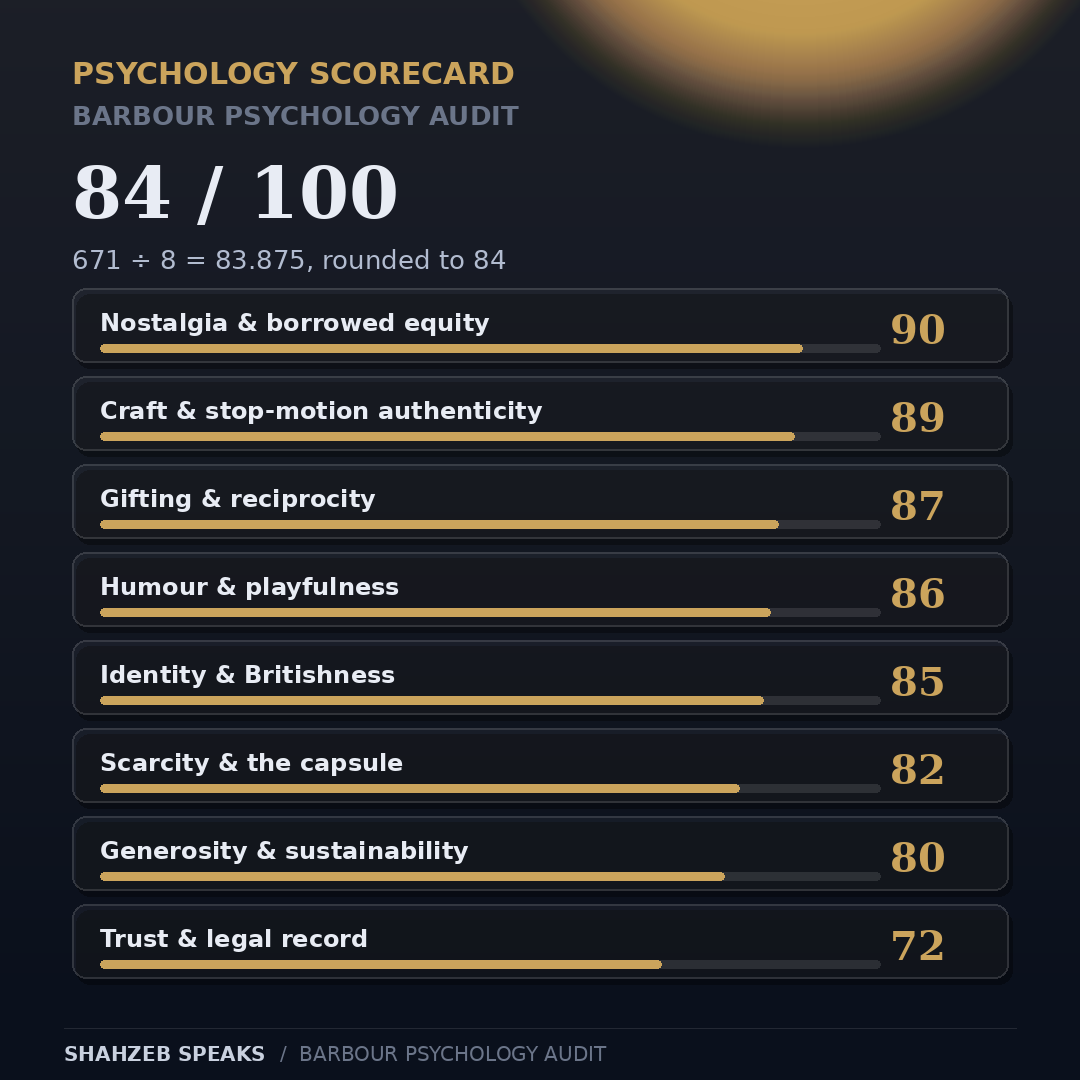
The scorecard below scores the campaign’s psychology and craft, not its outcome. No effectiveness data exists yet for the 2026 film, and none is claimed. The eight dimensions are scored out of 100, and the overall score is their rounded average.
| Dimension | Score | Verdict |
|---|---|---|
| Nostalgia & borrowed equity | 90 | Thirty-seven years of Wallace & Gromit, plus tartan — and a 5.8-star 2025 film to prove it worked |
| Craft & stop-motion authenticity | 89 | Hand-made film, hand-made coats, fifty years of Aardman — the effort is visible in every frame |
| Gifting & reciprocity | 87 | Two gifts, each given at the moment it is needed — the film’s structure is the gift |
| Humour & playfulness | 86 | The Walk-o-matic fails exactly as it should, and Gromit’s silence is the punchline |
| Identity & Britishness | 85 | Wax, tartan and a Wigan inventor — the characters and the coats share the same values |
| Scarcity & the capsule | 82 | December-only, limited-run, and genuinely limited — the scarcity is real, not staged |
| Generosity & sustainability | 80 | Re-loved for Oxfam gives twice, and the warm glow is earned rather than claimed |
| Trust & legal record | 72 | No ASA ruling found, but the Levi’s lawsuit has no verified outcome and the brand rents its best asset |
| Overall | 84/100 | 90 + 89 + 87 + 86 + 85 + 82 + 80 + 72 = 671; 671 ÷ 8 = 83.875, rounded to 84 |
🧠 Psychology Techniques Identified
- Borrowed equity / parasocial recognition (Horton & Wohl 1956; Wallace & Gromit arrive with thirty-seven years of audience affection already attached)
- Nostalgia (Wildschut et al. 2006; the characters and the tartan run two nostalgia channels at once — both bolster social bonds and positive affect)
- Mere exposure (Zajonc 1968; the fourth consecutive Aardman Christmas, the second with Wallace & Gromit — familiarity that deepens liking)
- Identity signalling / the extended self (Belk 1988; the wax jacket and the characters share the same values — practical, British, unshowy)
- Effort heuristic / craft premium (Kruger et al. 2004; stop-motion made frame by frame, and jackets made by hand at Simonside — visible effort raises perceived quality)
- Gift giving as agapic love (Belk & Coon 1993; the coat and the jumper are given from knowledge of the recipient, not as transactions)
- Reciprocity (Gouldner 1960; Cialdini 2001; Gromit’s gift answers Wallace’s — the exchange is balanced, not a debt)
- Benign violation humour (McGraw & Warren 2010; the Walk-o-matic is wrong and harmless at the same time — a chair that should not be a vehicle)
- Peak-end rule (Kahneman et al. 1993; the film ends on the rescue and a second small joke, so the last feeling is warmth)
- Anthropomorphism (Epley, Waytz & Cacioppo 2007; Gromit never speaks, and the audience reads patience, exasperation and affection into his silence)
- Scarcity (Cialdini 2001; the December-only capsule and the limited Re-loved run — genuinely limited supply, not staged urgency)
- Loss aversion (Kahneman & Tversky 1979; the limited pieces are framed by what the buyer might miss, and the loss weighs more than the gain)
✅ Balance sheet & prescription
What works: the borrowing, which is the best fit of any licensed-character Christmas campaign this year — the characters and the coats share the same values, and the 2025 film’s 5.8 stars on System1 prove the fit pays; the double nostalgia of Wallace & Gromit and the tartan; the craft, from Aardman’s fiftieth year of stop-motion to the hand-made Bedale; the two-gift structure, which makes the film about giving rather than about shopping; the humour, which fails exactly as it should and ends on a rescue; and the Re-loved pieces for Oxfam, which give the generosity a real recipient.
What does not: the trust record, where the Levi’s lawsuit has no verified outcome and the brand’s Christmas depends on characters it does not own; the reach of the nostalgia, which is British in a way that leaves part of Barbour’s own international audience behind; the humour’s dependence on a formula the audience now expects, which will need to be different next year; and the absence of any effectiveness data for the 2026 film, which means this score is a judgement of psychology and craft, not of outcome.
The prescription: keep the partnership, and keep returning to it — it is the brand’s best asset, and it has a fourth year of familiarity in the bank already. Resolve the Levi’s question in public, or at least stop leaving it unresolved: a brand that asks customers to trust a label should be able to say, plainly, what happened to the lawsuit about its label. Build one Christmas asset that Barbour owns outright — a character, a place, a ritual of its own — so that the festive season does not depend entirely on a studio it does not control. And keep the scarcity honest: re-issue nothing that was sold as limited, so that the next December’s claim is believed as readily as this one’s.
📝 Final Verdict
“Warm Wishes” is a small film built on a large affection. Barbour understood that the most valuable thing it owned this Christmas was not a new concept but an old one — two characters its audience has loved for thirty-seven years, a technique its studio has practised for fifty, and a coat its family has made for a hundred and thirty-two — and it spent its budget on bringing those three things together rather than inventing a replacement. The borrowing is genuine, the nostalgia is earned, the craft is visible, and the gift at the centre of the story is the kind of gift people actually give. The film’s weakness is that it asks for trust — in a borrowed world, from a brand whose own label was the subject of a lawsuit with no verified ending — and the audit’s score reflects both halves of that judgement. It is a very good Christmas film. It is not a perfect one — and the difference between the two is a lawsuit with an ending, and a Christmas world that Barbour owns.
Psychology Score: 84/100 — a borrowed childhood, a hand-made film, and a gift given twice. The affection is real; the ownership is not.
— Brand Psychology Analysis, ShahzebSpeaks
🔑 Key Findings
- The borrowed equity is the campaign’s strongest psychology: Wallace & Gromit arrive with thirty-seven years of audience affection, and the 2025 film’s 5.8 stars on System1’s Test Your Ad platform — Ad of the Week, 11th on the 2025 Christmas leaderboard — prove the borrowing pays. Nostalgia and borrowed equity score 90/100.
- Craft is the second-strongest dimension at 89/100: stop-motion made frame by frame in Aardman’s fiftieth anniversary year, and wax jackets still made by hand at Simonside — the effort heuristic working in the film and in the product at the same time.
- The film is built around two gifts, not one: Wallace’s dog coat for Gromit, and Gromit’s jumper for Wallace, delivered after the rescue at the moment it is needed most — gift giving as agapic love, with reciprocity kept gentle rather than transactional.
- Scarcity is real, not staged: the limited-edition capsule arrives in December only, and the Re-loved Wallace & Gromit pieces — jackets, scarves and dog coats — are a limited run with all proceeds going to Oxfam.
- Legal record: Levi Strauss sued Barbour in June 2018 over the “flag” label, alleging infringement of Levi’s Tab trademark; Barbour’s New York declaratory action was dismissed on 30 January 2019 in favour of the California case, and Barbour’s motion to dismiss was denied on 11 March 2019 — NO settlement or ruling on the merits was verified, and none is printed. A 2013 WIPO panel ordered a counterfeit-selling domain transferred to Barbour. No ASA ruling against Barbour was found in this session’s searches.
- No effectiveness data exists for the 2026 film: no System1 score, no viewer count and no sales figure has been verified as of 19 November 2026, so 84/100 is a judgement of psychology and craft, not of outcome. One critic, Daily Commercials, scored the film 3.5 out of 5.
❓ Questions I am asked most often
What is Barbour’s “Warm Wishes” about?
It is Barbour’s Christmas 2026 film, released 5 November 2026. Wallace gives Gromit a Barbour Sylkoil Wax Dog Coat “for walkies!”, then tests his new invention, the Walk-o-matic — an armchair on giant wheels made from Barbour wellies — which throws him into a snowdrift. Gromit rescues him with a Barbour jumper, and Shaun the Sheep makes a cameo.
How good is the campaign, psychologically?
Our audit scores it 84/100. It is strongest on nostalgia and borrowed equity (90) and craft and stop-motion authenticity (89), and weakest on trust and the legal record (72), where the unresolved Levi’s trademark lawsuit still counts against it.
Did last year’s Barbour film win anything?
Yes. System1 named the 2025 Wallace & Gromit film its Ad of the Week and gave it 5.8 stars on its Test Your Ad platform, placing it 11th on the 2025 Christmas leaderboard with an uplift of 3.2 stars against the fashion category average. That score belongs to the 2025 film only — the 2026 film has no verified score yet.
Has the 2026 film been scored by System1?
Not as far as this audit could verify. No System1 score, viewer count, reach or sales figure for “Warm Wishes” has been published as of 19 November 2026. A “5.6 stars” figure circulating in Christmas-advert round-ups refers to John Lewis’s Gloria and Pickles, not to Barbour.
What is the Levi’s lawsuit about?
Levi Strauss alleged in 2018 that Barbour’s “flag” label — a small fabric label sewn into a pocket seam — infringed its Tab trademark. Barbour sued first in New York for a declaration of non-infringement; that action was dismissed in January 2019 in favour of Levi’s California suit, and Barbour’s motion to dismiss the California case was denied in March 2019. No settlement or ruling on the merits has been verified.
Where can I buy the Wallace & Gromit collection?
The limited-edition capsule — knitted scarves, hats, caps, tote bags, key fobs and a dog coat — is available from December 2026 on Barbour.com and through selected retail stores. The limited-edition Re-loved Wallace & Gromit-inspired jackets, scarves and dog coats are also available, with all proceeds going to Oxfam.
If your brand is renting its best asset — a character, a celebrity, a borrowed world — while its own label sits in an unresolved lawsuit, you are spending your Christmas budget on affection you do not own. I help organisations build evidence-based brand strategy — get in touch here.
If this audit helped, you may also like Burberry — Wrapped in Burberry, TK Maxx — Festive Crossing, and ASOS — The Hotline. For the wider field, the homepage of this site covers industrial psychology in Pakistan and beyond.
📚 References & Sources
- Barbour / Aardman, “Warm Wishes” (2026). Film released 5 November 2026; 1 minute 28 seconds; directed by Steve Harding-Hill; Wallace & Gromit created by Nick Park. Covered in Animation Magazine, 5 November 2026: https://www.animationmagazine.net/2026/11/wallace-gromit-share-warm-wishes-in-aardmans-latest-barbour-holiday-film/
- Little Black Book, “Wallace & Gromit Go for Christmas Walkies in Barbour’s Festive Film”, 5 November 2026: https://lbbonline.com/news/barbour-wallace-gromit-christmas-2026
- 365 Retail, “Barbour Christmas Ad 2026: Wallace & Gromit and Aardman”, 5 November 2026: https://365retail.co.uk/barbour-christmas-advert-2026-wallace-gromit/
- TheIndustry.fashion, “Barbour reunites with Wallace & Gromit for latest Christmas ad and limited-edition collection”, 5 November 2026: https://www.theindustry.fashion/barbour-reunites-with-wallace-gromit-for-latest-christmas-ad-and-limited-edition-collection/
- Daily Commercials, “Barbour ‘Warm Wishes’ Christmas Ad Review”, 12 November 2026 (3.5 out of 5): https://dailycommercials.com/barbour-warm-wishes-christmas-ad-review/
- System1 Group, “Wallace and Gromit Bring Barbour Christmas Cheer — and Consistency”, 11 December 2025 (2025 film: 5.8 stars, Ad of the Week): https://system1group.com/ad-of-the-week/wallace-and-gromit-bring-barbour-christmas-cheer-and-consistency
- Barbour, “A History of J Barbour and Sons” (founded 1894; Royal Warrants 1974, 1982, 1987; King’s Warrant May 2024): https://www.barbour.com/gb/our-history.html
- Drapers, “Barbour sales and profits up”, 26 January 2026 (year to 30 April 2025: turnover £350.8m; operating profit £49.5m): https://www.drapersonline.com/news/barbour-sales-and-profits-up
- Retail Week, “Barbour profits and sales surge as wholesale arm recovers”, 26 January 2026 (pre-tax profit £45.8m): https://www.retail-week.com/fashion/barbour-profits-and-sales-surge-as-wholesale-arm-recovers/7050423.article
- Business Live, “Profit and revenue up at outdoor clothing specialist Barbour”, 26 January 2026 (more than 1,100 employees; £30m dividend): https://www.business-live.co.uk/enterprise/profit-revenue-up-outdoor-clothing-33306166
- Levi Strauss & Co. v J. Barbour & Sons Ltd, Case No. 3:18-cv-03540-WHO (N.D. Cal.), Order on Motion to Dismiss, 11 March 2019: https://jnswire.s3.amazonaws.com/jns-media/86/9e/1151362/035117747673.pdf
- J. Barbour & Sons Ltd v Levi Strauss & Co., Case No. 1:18-cv-05195-LAP (S.D.N.Y.), decision dismissing the declaratory action, 30 January 2019: https://dn710302.ca.archive.org/0/items/gov.uscourts.nysd.495345/gov.uscourts.nysd.495345.36.0.pdf
- WIPO Arbitration and Mediation Center, Case No. D2013-1301, J. Barbour & Sons Ltd v Chen Guangbiao (domain transferred to Barbour): https://www.wipo.int/amc/en/domains/decisions/text/2013/d2013-1301.html
- AdRanking, “Christmas adverts 2026: all 34 UK ads so far”, updated 18 November 2026 (5.6 stars refers to John Lewis, not Barbour): https://adranking.co.uk/rankings/christmas-adverts-2026/
- Zajonc, R. B. (1968). Attitudinal effects of mere exposure. Journal of Personality and Social Psychology, 9(2), 1–27.
- Wildschut, T., Sedikides, C., Arndt, J. & Routledge, C. (2006). Nostalgia: Content, triggers, functions. Journal of Personality and Social Psychology, 91(5), 975–993.
- Horton, D. & Wohl, R. R. (1956). Mass communication and para-social interaction. Psychiatry, 19(3), 215–229.
- Belk, R. W. (1988). Possessions and the extended self. Journal of Consumer Research, 15(2), 139–168.
- Belk, R. W. & Coon, G. S. (1993). Gift giving as agapic love: An alternative to the exchange paradigm based on dating experiences. Journal of Consumer Research, 20(3), 393–417.
- Gouldner, A. W. (1960). The norm of reciprocity: A preliminary statement. American Sociological Review, 25(2), 161–178.
- Kahneman, D. & Tversky, A. (1979). Prospect theory: An analysis of decision under risk. Econometrica, 47(2), 263–291.
- Kahneman, D., Fredrickson, B. L., Schreiber, C. A. & Redelmeier, D. A. (1993). When more pain is preferred to less: Adding a better end. Psychological Science, 4(6), 401–405.
- Cialdini, R. B. (2001). Influence: Science and Practice. Scarcity, reciprocity, social proof and consistency.
- Kruger, J., Wirtz, D., Van Boven, L. & Altermatt, T. W. (2004). The effort heuristic. Journal of Experimental Social Psychology, 40(1), 91–98.
- McGraw, A. P. & Warren, C. (2010). Benign violations: Making immoral behavior funny. Psychological Science, 21(8), 1141–1149.
- Epley, N., Waytz, A. & Cacioppo, J. T. (2007). On seeing human: A three-factor theory of anthropomorphism. Psychological Review, 114(4), 864–886.
- Andreoni, J. (1990). Impure altruism and donations to public goods: A theory of warm-glow giving. The Economic Journal, 100(401), 464–477.
- Thaler, R. H. & Sunstein, C. R. (2008). Nudge: Improving Decisions About Health, Wealth, and Happiness. Yale University Press.
- Iyengar, S. S. & Lepper, M. R. (2000). When choice is demotivating: Can one desire too much of a good thing? Journal of Personality and Social Psychology, 79(6), 995–1006.
- Samuelson, W. & Zeckhauser, R. (1988). Status quo bias in decision making. Journal of Risk and Uncertainty, 1(1), 7–59.
- Green, M. C. & Brock, T. C. (2000). The role of transportation in the persuasiveness of public narratives. Journal of Personality and Social Psychology, 79(5), 701–721.
- Tajfel, H. & Turner, J. C. (1979). An integrative theory of intergroup conflict. In W. G. Austin & S. Worchel (Eds.), The Social Psychology of Intergroup Relations.
Key Findings
- The borrowed equity is the campaign's strongest psychology: Wallace & Gromit arrive with thirty-seven years of audience affection, and the 2025 film's 5.8 stars on System1's Test Your Ad platform — Ad of the Week, 11th on the 2025 Christmas leaderboard — prove the borrowing pays. Nostalgia and borrowed equity score 90/100.
- Craft is the second-strongest dimension at 89/100: stop-motion made frame by frame in Aardman's fiftieth anniversary year, and wax jackets still made by hand at Simonside — the effort heuristic working in the film and in the product at the same time.
- The film is built around two gifts, not one: Wallace's dog coat for Gromit, and Gromit's jumper for Wallace, delivered after the rescue at the moment it is needed most — gift giving as agapic love, with reciprocity kept gentle rather than transactional.
- Scarcity is real, not staged: the limited-edition capsule arrives in December only, and the Re-loved Wallace & Gromit pieces — jackets, scarves and dog coats — are a limited run with all proceeds going to Oxfam.
- Legal record: Levi Strauss sued Barbour in June 2018 over the "flag" label, alleging infringement of Levi's Tab trademark; Barbour's New York declaratory action was dismissed on 30 January 2019 in favour of the California case, and Barbour's motion to dismiss was denied on 11 March 2019 — NO settlement or ruling on the merits was verified, and none is printed. A 2013 WIPO panel ordered a counterfeit-selling domain transferred to Barbour. No ASA ruling against Barbour was found in this session's searches.
- No effectiveness data exists for the 2026 film: no System1 score, no viewer count and no sales figure has been verified as of 19 November 2026, so 84/100 is a judgement of psychology and craft, not of outcome. One critic, Daily Commercials, scored the film 3.5 out of 5.
Overall Psychology Score
Barbour scores 84/100 in our comprehensive psychology audit covering consumer behavior strategies, UX design principles, and psychological marketing effectiveness.
The detailed dimension scores are in the audit's Psychology Scorecard chapter.
High impactMuhammad Shahzeb
MSc Industrial Psychologist, specializing in consumer behavior, UX psychology, and brand strategy analysis. Helping brands understand the psychology behind their success.
About Muhammad Shahzeb →