Burberry Psychology Audit — Wrapped in Burberry: 170 Years of Heritage, One Party, and a Turnaround
Burberry's 'Wrapped in Burberry' turns 170 years of heritage into a Christmas party at Longleat House. Our psychology audit of the campaign and the turnaround scores it 84/100.

84 / 100
Overall consumer behavior effectiveness
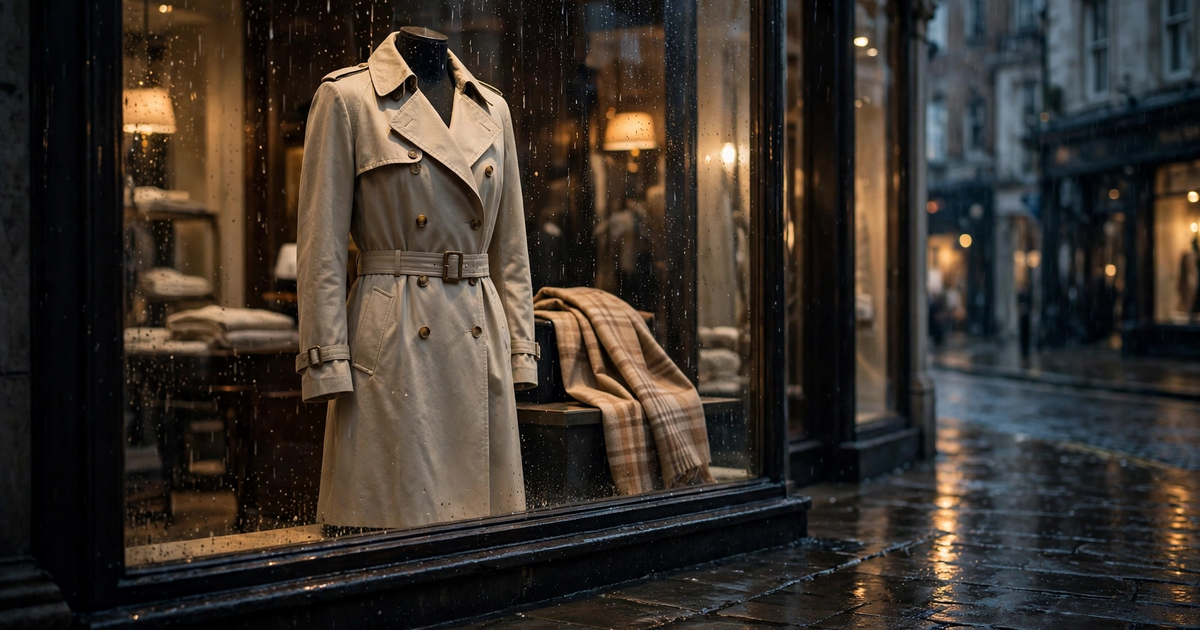
Brand Overview
- Brand nameBurberry
- Founded1856
- HeadquartersLondon, England
- IndustryFashion & Apparel
- Websitewww.burberry.com ↗
Psychology Techniques Identified
- 01Heritage & nostalgia (Sedikides et al. 2015, 2016, 2018; 170 years of continuity, gabardine 1879, trench worn by officers and by 23 stars in 2026)
- 02Social identity theory (Tajfel & Turner 1979; the Burberry Check as a visible group badge, reclaimed after the "chav" years)
- 03Narrative transportation (Green & Brock 2000; the Longleat House party film absorbs the viewer instead of arguing with them)
- 04Peak-end rule (Kahneman et al. 1993; the disco-ball finale is both the peak and the end of the film)
- 05Mere exposure (Zajonc 1968; the trench silhouette, belt and epaulettes repeated for more than a century)
- 06Scarcity (Cialdini 1984; the check rationed after overexposure, embroidery making each coat one of a kind)
- 07Loss aversion & price integrity (Kahneman & Tversky 1979; full-price discipline, gross margin 68.3%, no discounting)
- 08Authority (Cialdini 1984; Milgram 1963; Royal Warrant 1955, War Office commission, V&A exhibition, Royal Collection Trust capsule)
- 09Parasocial relationships (Horton & Wohl 1956; Pierce Brosnan and Fiona Shaw as hosts welcoming the viewer in)
- 10Social proof (Cialdini 1984; 23 global stars photographed by Tim Walker in the trench, all wearing the same garment)
- 11Goal-gradient effect (Kivetz et al. 2006; five consecutive quarters of growth as visible progress toward the turnaround goal)
- 12Reciprocity & gifting (Cialdini 1984; complimentary embroidery for up to five initials or icons, free gift wrapping)
Full Psychology Audit Report
In this audit
It is Christmas at Longleat House, and the party has already started. Pierce Brosnan is pouring the drinks, Fiona Shaw is holding court, and somewhere near the back a disco ball is turning over a room full of film stars, footballers and fashion royalty. The soundtrack is Sylvester’s “Do You Wanna Funk?”, the house is 170 years old, and the host is a brand that spent the last few years learning how not to be loved. This Burberry psychology audit asks what happens when a luxury house stops apologising for its past and throws a party instead — and whether a disco ball, a trench coat and five consecutive quarters of growth are enough to make the world want Burberry again.
Burberry Group plc was founded in 1856, when Thomas Burberry, a 21-year-old former draper’s apprentice, opened an outfitting shop in Basingstoke, Hampshire, with one founding principle: clothing designed to protect people from the British weather. One hundred and seventy years later, the house it became is listed on the London Stock Exchange, a constituent of the FTSE 100, headquartered at Horseferry House on Horseferry Road in London, with 412 directly operated stores and a chief executive, Joshua Schulman, who took over on 15 July 2024 with a plan called Burberry Forward. Its 2026 festive campaign, “Wrapped in Burberry: Celebrating 170 Years”, was announced on 3 November 2026, and nine days later the company published interim results that gave the party something to celebrate: revenue of £1,098 million, up 6 per cent, adjusted operating profit of £62 million against £19 million a year earlier, and shares that closed up 8.01 per cent at 1,180.50p. The same day, William Jackson succeeded Gerry Murphy as chair. This audit asks what the campaign does to the mind of a shopper, why a 170-year-old trench coat still works as a psychological object, and where the brand’s troubled history — the check that went wrong, the stock that was burned, the ambassadors who walked away — sits underneath the celebration. One honest limit up front: the campaign is eleven days old, so there is no independent effectiveness score for it yet. This audit scores the psychology of the campaign and the turnaround, not their outcome.
I am an Industrial and Organizational Psychologist in Karachi, and I audit brands by testing their claims against psychology research and their own public record. Where a figure is the company’s own claim rather than an independent measurement, I will say so in the same sentence, not in a footnote. Where a legal matter is only a filed claim or a preliminary injunction, I will keep it exactly that. And where the company’s own history gives a proud story about a trench coat on one page and a bonfire of unsold stock on another, I will show you both rather than pick the flattering one.
“Burberry is not selling a coat in this campaign. It is selling an invitation — to a party at a country house, hosted by people you already like, in honour of a garment that has kept people dry for 170 years — and the invitation only works because the brand finally stopped pretending its past never happened.”
— Brand Psychology Analysis, ShahzebSpeaks
📋 Brand Overview
| Field | Detail |
|---|---|
| Brand | Burberry Group plc — British luxury fashion house |
| Founded | 1856, by Thomas Burberry, aged 21, a former draper’s apprentice, who opened an outfitting shop in Basingstoke, Hampshire |
| Headquarters | Horseferry House, Horseferry Road, London SW1P 2AW, England |
| Leadership | Chief Executive Officer Joshua Schulman (from 15 July 2024); Chief Creative Officer Daniel Lee (from October 2022); Chair William Jackson (succeeded Gerry Murphy with effect from 12 November 2026) |
| Listed | London Stock Exchange (BRBY), FTSE 100 constituent; 412 directly operated stores at 26 September 2026 |
| Current campaign | “Wrapped in Burberry: Celebrating 170 Years”, announced 3 November 2026; film 1 minute 31 seconds, directed by Harmony Korine |
| Website | https://www.burberry.com |
| Psychology score | 84/100 |
Sources: Burberry Group plc FY27 interim results announcement (12 November 2026); Burberry plc festive-campaign press release (3 November 2026); Encyclopaedia Britannica, “Burberry” (updated 8 October 2026). All figures as of 14 November 2026.
📜 Chapter 1: History — from a Basingstoke outfitter to the trench that dressed officers
Burberry began with weather. In 1856, Thomas Burberry, a 21-year-old former draper’s apprentice, opened an outfitting shop in Basingstoke, Hampshire, built on a single idea: clothing designed to protect people from the British weather. That idea turned out to be a durable one, because British weather has never improved, and because protection is a need that never goes out of fashion. Twenty-three years later, in 1879, Burberry invented gabardine, a tightly woven fabric that was water-resistant yet breathable, and patented it in 1888. Gabardine was the material breakthrough behind everything that followed: a coat that kept rain out and let sweat escape was not a fashion statement, it was a piece of equipment, and equipment earns trust in a way that fashion rarely does.
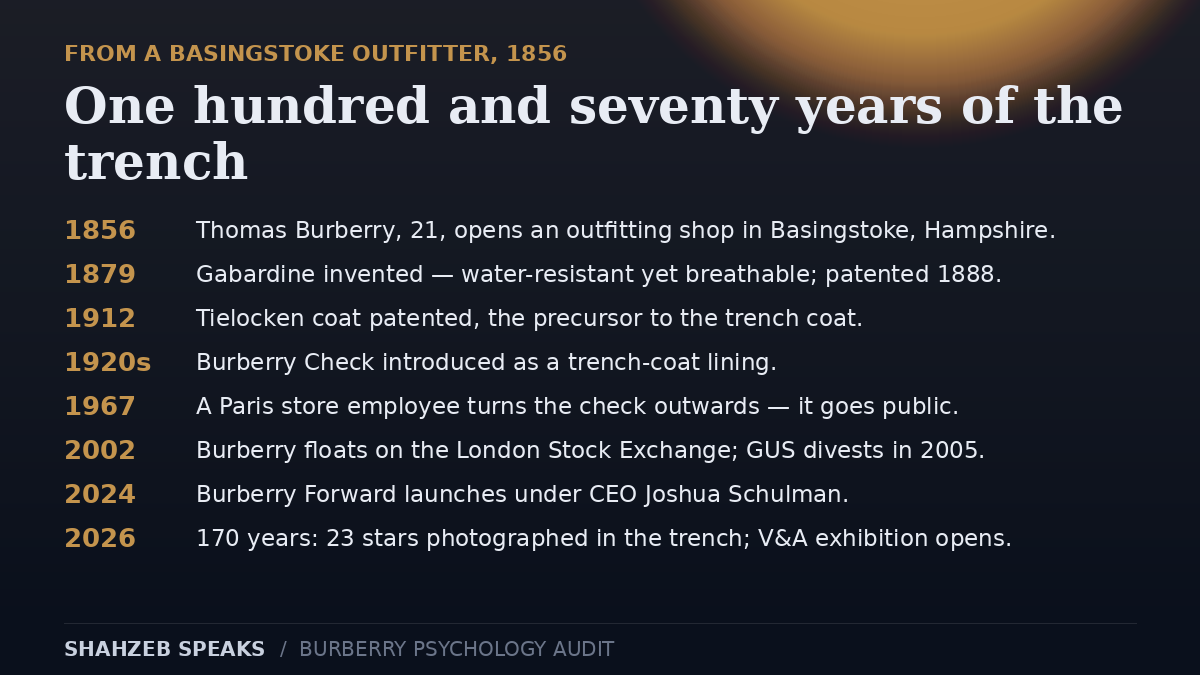
The trench coat itself arrived through war. The Tielocken coat, patented in 1912 and fastened with a strap and buckle and a button collar, was the precursor, and during the First World War the British War Office commissioned Burberry to adapt its officer’s coat for trench warfare. The result carried the features that are still on the garment today: epaulettes, D-rings, a storm shield, a gun flap and a belt. Only officers were allowed to wear it, and they had to buy it themselves — which meant the trench coat was, from the start, a garment that people chose and paid for, not one that was issued to them. That distinction matters, because a coat that officers chose to buy became, after the war, a coat that civilians chose to buy for the same reason: it had been tested in the worst conditions anyone could imagine, and it had worked. The Burberry Check, the pattern of black, white and red lines on a tan ground, was introduced in the 1920s as a lining for trench coats. In 1967, an employee at the Paris store turned check linings outwards for a display, and the pattern moved onto umbrellas, cashmere scarves and accessories — the moment a hidden lining became a public signature. The Equestrian Knight logo dates to 1901, according to Burberry’s own averment in court pleadings, and the house was awarded a Royal Warrant in 1955, in the reign of Queen Elizabeth II.
The corporate history is quieter. Great Universal Stores acquired Burberry in 1955 and owned it for fifty years, until 2005. Burberry was floated on the London Stock Exchange in July 2002, and GUS divested its remaining interest in December 2005. The house that emerged from that half-century of conglomerate ownership was a global luxury brand with a very old product at its centre, and the tension between those two facts — a 170-year-old coat and a modern luxury business — is the tension this whole audit is about. A brand that old has something no new brand can buy: continuity. It also has something no new brand has to carry: a history that includes the years when it went badly wrong.
🎬 Chapter 2: Wrapped in Burberry — the party at Longleat House
“Wrapped in Burberry: Celebrating 170 Years” was announced on 3 November 2026, and it is, on its face, a Christmas party. The film runs for 1 minute 31 seconds, directed by Harmony Korine with creative direction by Daniel Lee, and it is set at Longleat House in Wiltshire, the historic seat of the Marquess of Bath — a playful take on a traditional British Christmas gathering at a country house. The hosts are Pierce Brosnan and Fiona Shaw. The guests, drawn from film, fashion and sport, are Cara Delevingne, Dylan Brosnan, Dwyane Wade, Gabrielle Union, Kim Min-ha, Nico Parker and Wu Lei, and Emma Thynn, Marchioness of Bath, makes a cameo — which means the actual chatelaine of the house appears in the film of a party set in her own home. The soundtrack is “Do You Wanna Funk?” by Sylvester and Patrick Cowley, a 1980s hi-NRG track, and the film ends in a disco-ball finale. Daniel Lee, the chief creative officer, put the idea in one sentence: “We wanted to celebrate 170 years of Burberry with a proper party.”

The product story underneath the party is cashmere: cashmere trench coats, House Check scarves and heart-patterned argyle knits. The campaign also carries Burberry’s first-ever collaboration with Smythson — leather notebooks and folding chess and backgammon sets designed for travel, handcrafted in England and launched in October 2026 — and the gifting extras are deliberately personal: a complimentary embroidery service for up to five initials or icons, and free gift wrapping in store. A party is not a shop. At a party you are welcomed, fed, given something to hold, and sent home with a small gift. Burberry’s campaign borrows that structure exactly: the hosts welcome you in, the music sets the mood, the products are presented as things you might give to someone you love, and the embroidery service turns a bought object into a personal one. The film works through narrative transportation, the mechanism Green and Brock (2000) described in their work on the persuasiveness of public narratives: when people are absorbed into a story, they stop arguing with it, and the beliefs of the story travel with them into the world outside it. A viewer absorbed into a Christmas party at Longleat House is not arguing about prices. They are deciding whether they would like to be at that party — and the answer, for most people, is yes.
The peak-end rule, described by Kahneman, Fredrickson, Schreiber and Redelmeier (1993), says that people judge an experience largely by how it felt at its most intense moment and at its end, rather than by the sum of every moment in between. “Wrapped in Burberry” is built for that rule. Its peak is the disco-ball finale — a room full of famous people dancing to a song about wanting to funk — and its end is the same moment, which means the peak and the end are the same memory. A viewer who remembers the film will remember the disco ball, and a viewer who remembers the disco ball will remember the film as a party, whatever else was in it. That is strong design, and it is also a risk: if the shopper’s experience ends not with a party but with a price they cannot reach or a store that feels cold after the warmth of the film, then the disappointment is what they will remember. The campaign’s weakest point is not its idea. It is the gap between a beautiful invitation and the reality of buying a luxury coat.
🕰️ Chapter 3: Heritage and nostalgia — 170 years, worn by 23 stars
The party is only the last act of a year-long anniversary. On 2 March 2026 Burberry launched “The Trench, Portraits of an Icon”: 23 global stars from film, music, sport and fashion, photographed by Tim Walker in black-and-white portraits, each wearing a Burberry trench. The cast runs from Kate Moss and Kendall Jenner to Jonathan Bailey, Daisy Edgar-Jones, Matthew Macfadyen, Kristin Scott Thomas, Little Simz, Kid Cudi, Teyana Taylor, Wu Lei, Jack Draper, Eberechi Eze, Hikaru Utada, J.Y. Park and Rosie Huntington-Whiteley, with a documentary film set to Blur’s “Sing”. Pop-ups for the campaign opened on Regent Street in London, at Isetan Shinjuku in Tokyo, at Lotte Main in Seoul and on 57th Street in New York. The Victoria and Albert Museum’s free display “The Burberry Trench: Crafting an Icon” runs at V&A South Kensington from 21 September 2026 to 3 January 2027, tracing the trench from military origins to modern luxury. And on 12 March 2026 Burberry launched a capsule collection with Royal Collection Trust, a department of the Royal Household, to mark the centenary of Queen Elizabeth II’s birth: four designs, including a belted car coat in holly-green gabardine made at Castleford in Yorkshire, and a new House Check colourway created for the capsule.
Sedikides, Wildschut, Routledge, Arndt, Hepper and Zhou (2015), in “To nostalgize: Mixing memory with affect and desire”, published in Advances in Experimental Social Psychology, 51, described nostalgia as a self-conscious, bittersweet but predominantly positive and fundamentally social emotion. It serves a self-oriented function, raising self-positivity; an existential function, increasing perceptions of life as meaningful; and a sociality function, increasing social connectedness and promoting prosocial behaviour. Sedikides and Wildschut (2018), in “Finding meaning in nostalgia”, published in the Review of General Psychology, 22(1), 48–61, showed that nostalgia helps people find meaning in life primarily by increasing social connectedness, and secondarily by augmenting self-continuity, the connection between past and present selves. Sedikides, Wildschut, Cheung, Routledge, Hepper, Arndt and Vail (2016), in “Nostalgia fosters self-continuity”, published in Emotion, 16(4), 524–539, tested the mechanism across six experiments: nostalgia fosters self-continuity through social connectedness, and self-continuity in turn confers eudaimonic well-being. Burberry’s anniversary year is a machine for producing exactly that emotion. A coat invented in 1879, worn by officers in the First World War, lined with a check from the 1920s and photographed on 23 stars in 2026, is a single object that connects the person wearing it to every person who wore it before. The trench does not need to be new. Its power is that it is not new.
Two other mechanisms are doing quiet work in the same material. The first is mere exposure. Zajonc (1968), in his work on the attitudinal effects of mere exposure, showed that people tend to develop a preference for things simply because they are familiar with them, and that repeated exposure, on its own, increases liking. The trench coat has been exposed to the public, year after year, for more than a century: the same silhouette, the same belt, the same epaulettes, the same check. A shopper who has seen a trench coat a thousand times already likes it before they try it on, simply because they have seen it so often. The second is social proof. Twenty-three admired people, photographed by Tim Walker in black and white, all wearing the same garment, is a statement that the garment is worth wearing — not because any one of them says so, but because all of them are wearing it at once. The number is 23 — specific and verified, not a rounder figure invented for effect, because a heritage campaign built on an invented number would be built on sand.
🏷️ Chapter 4: Social identity — the check as a badge, and the years it went wrong
The strongest psychology in this audit is also the oldest idea in the psychology of groups. Tajfel and Turner (1979), in their social identity theory of intergroup behaviour, showed that people draw a large part of who they are from the groups they belong to, and that they favour their own group — the in-group — over outsiders, not because of any reward, but because the group membership itself matters to their sense of self. The Burberry Check is a visible group badge in the purest sense: a pattern you can recognise across a street, on a scarf, a bag, an umbrella, a coat. After the 1967 Paris-store moment, when the check moved from hidden lining to public surface, it became a status symbol among the British upper class — a quiet signal that the wearer belonged to a particular world. A badge that says “I belong” is the most powerful thing a luxury brand can sell, because it is not selling a product at all. It is selling membership.
But a badge that anyone can wear stops saying what it used to say, and Burberry learned that the hard way. Under chief executive Rose Marie Bravo, who led the company from 1997 to 2006, the check was put on everything, from bikinis to baseball caps. The pattern became associated first with football casuals and then with the “chav” subculture, and in 2003 a number of British bars and clubs banned customers wearing Burberry. The checked baseball caps were withdrawn, the check was removed from many products, and, according to the BBC, the pattern featured on 20 per cent of products in 2002 and under 5 per cent by 2004. A brand that deliberately shrank its most famous asset by three quarters in two years, because the asset had become a liability. The psychology is straightforward. A status signal only works while the group it signals is a group people want to join. When the check started signalling a group that the brand’s core customers did not want to be associated with, the check stopped being a badge of belonging and became a badge of exclusion — and Burberry, to its credit, pulled it back rather than defending it.
The recovery is the reason this chapter scores as well as it does. Burberry did not abandon the check; it rationed it. The pattern is now one of the world’s most widely copied trademarks, which is why Burberry polices it so aggressively in court — Chapter 9 gives the full record — and its reappearance on scarves, coats and bags in the anniversary campaign is a controlled reappearance, not a return to the days when it was on everything. A badge withdrawn and then returned carries a different meaning from one never taken away: it says the brand knows what its symbols are worth, and will protect them by using them less. That is scarcity applied to identity, and it is why the check, in 2026, reads as luxury again.
💰 Chapter 5: Scarcity and price integrity — full price, and the fire Burberry lit
Robert Cialdini (1984), in Influence: The Psychology of Persuasion, named scarcity as one of the most powerful principles of human behaviour: a thing that is available in limited quantity, or for a limited time, feels more valuable than the same thing available for ever. Burberry’s recent history contains the most extreme version of that principle a luxury brand has ever practised — and the reason the principle has a limit. Burberry’s annual report for the year to March 2018 disclosed that £28.6 million of finished goods had been physically destroyed in the year, including £10.4 million of beauty inventory. The disclosure was spotted by The Times in July 2018, and the backlash followed under the hashtag #burnberry. On 6 September 2018 Burberry announced it would stop destroying unsaleable products with immediate effect, and would reuse, repair, donate or recycle them instead; it also banned real fur — rabbit, fox, mink, Asiatic raccoon and angora — from runway collections. The then chief executive, Marco Gobbetti, said: “Modern luxury means being socially and environmentally responsible.”
The fire was scarcity taken to its logical end. A luxury brand destroys unsold stock for one reason: to protect the price of what it does sell. If a coat can be found cheaply, the coat stops being worth its price, and a brand whose value is its price has a real problem. Destroying the coat solves the problem by removing the cheap version from the world — but it creates a worse one, because a company that burns its own products in a world that knows how much waste costs is telling its customers something about its values that no advertising can undo. Burberry’s instinct was commercially rational and morally indefensible, and the company itself reached the same conclusion: it stopped, it said so publicly, and it has not gone back. The turnaround that followed rebuilt price integrity the honest way instead. Gross margin in the first half of the 2027 financial year was 68.3 per cent, and the company attributes that to strong full-price performance — the same outcome the fire was meant to protect, achieved by selling the product at its price rather than by destroying it. Loss aversion, described by Kahneman and Tversky (1979) in prospect theory, explains why the full-price discipline matters: people feel the pain of losing something more strongly than the pleasure of gaining the same amount, and a brand that discounts trains its customers to wait for the discount, which is a loss the brand feels every season. Burberry’s answer, since 2018, has been to hold the price and let the product do the work.
The embroidery service is the same idea at a smaller scale. A coat with your initials on it cannot be resold, cannot be discounted, and cannot be mistaken for anyone else’s. Complimentary embroidery for up to five initials or icons, and free gift wrapping, are not discounts: they make the product personal, a form of scarcity that costs the brand almost nothing and gives the customer something no sale could give. That is the difference between the Burberry of 2018 and the Burberry of 2026. One destroyed value to protect price. The other creates value to justify it.
👑 Chapter 6: Authority — warrants, museums and the Royal Collection
Authority is the quietest principle in this audit, and it may be the most effective. Cialdini (1984) listed authority among his principles of influence: people defer to credible experts and institutions, and a credible endorsement transfers legitimacy from the endorser to the endorsed. Milgram (1963), in his obedience studies, showed how far that deference can go when the authority is perceived as legitimate. Burberry has spent 170 years collecting the kind of authority that cannot be bought in a single campaign. The house was awarded a Royal Warrant in 1955, in the reign of Queen Elizabeth II, who wore Burberry throughout her reign. The trench coat was commissioned by the British War Office. The Victoria and Albert Museum is staging a free display on the trench, and its Fashion Gallery at South Kensington will be renamed the Burberry Gallery after a major two-year refurbishment, announced on 31 March 2025 and due to open in autumn 2028. And the capsule collection with Royal Collection Trust, launched on 12 March 2026 to mark the centenary of Queen Elizabeth II’s birth, was created with a department of the Royal Household itself.
Each of those endorsements does a different job. The Royal Warrant says the brand was good enough for the monarch. The War Office commission says the product was good enough for the army. The V&A display says the garment is good enough for a museum — which is a particular kind of authority, because a museum does not sell things, it preserves them, and a brand that a museum chooses to preserve has been judged by a standard that has nothing to do with sales. The Royal Collection Trust capsule says the brand is still trusted by the institution of the monarchy, in a year when the monarchy is marking the centenary of the late Queen’s birth. None of these is a claim Burberry makes about itself. All of them are things other institutions have done, and that is what makes them persuasive: a brand telling you it is excellent is advertising, and a museum telling you it is worth preserving is evidence. The exhibition “Queen Elizabeth II: Her Life in Style”, which opened on 10 April 2026 at The King’s Gallery in Buckingham Palace and is described as the largest-ever exhibition of the late Queen’s fashion, features Burberry designs worn by her — the same logic, applied to a person rather than a garment.
Authority transfers legitimacy, but it also transfers responsibility. A brand that borrows the authority of the Crown, the army and the museum is a brand that will be judged by the standards of those institutions, and the standard those institutions set is a high one. The burning of unsold stock in 2018 was judged, in part, against exactly that standard — a house with a Royal Warrant does not burn its own coats — and the backlash was sharper because of it. Authority is a loan, not a gift, and Burberry’s anniversary year is a reminder that the loan is still being repaid.
🌟 Chapter 7: Celebrity and parasocial warmth — when the hosts welcome you in
Horton and Wohl (1956), who coined the term parasocial interaction, described the one-sided intimacy audiences form with media figures: viewers respond to a performer as if they knew them, and the relationship feels real even though it is not returned. Burberry’s Christmas film is built on that one-sided intimacy, and it uses it in the most direct way possible: it does not show celebrities modelling coats. It shows them hosting a party. Pierce Brosnan and Fiona Shaw are not presented as stars. They are presented as the people whose house you have come to, and the guests — Cara Delevingne, Dylan Brosnan, Dwyane Wade, Gabrielle Union, Kim Min-ha, Nico Parker and Wu Lei — are presented as the other people at the party. The viewer is not watching an advert. The viewer is the guest who has just arrived.
That framing changes what the celebrity is doing. In a conventional luxury campaign, a famous face says “this product is desirable because I wear it”, and the viewer is invited to admire the face. Here the famous faces say “come in, the party has started”, and the viewer is invited to feel welcomed. The parasocial bond is the same — the viewer feels they know Brosnan, because they have watched him for decades — but the emotion is different. Admiration makes a person want to be like the celebrity. Warmth makes a person want to be near them, and warmth is the more useful emotion for Christmas, a season of belonging rather than admiration. The cameo by Emma Thynn, Marchioness of Bath, does quiet work in the same direction: she is not a celebrity in the usual sense, she is the person who actually lives in the house where the party is set, and her presence tells the viewer that the party is, in some small way, real.
Parasocial warmth is borrowed warmth. The viewer feels close to Brosnan, but Brosnan does not know the viewer, and a campaign that leans too hard on that feeling can start to feel like a trick — a famous person pretending to be your host so that you will buy a coat. “Wrapped in Burberry” protects itself against that in two ways. First, the party format is honest about what it is: nobody believes Brosnan is actually hosting them, and the film does not ask them to. Second, the product story is present but not aggressive: the cashmere coats, the check scarves, the heart-patterned argyle knits and the Smythson collaboration are shown as things at a party, not as things being sold. A viewer who enjoys the party and then finds a coat they like has been persuaded. A viewer who is told to buy a coat by a man pretending to be their host has been cornered. The difference is the whole campaign.
📈 Chapter 8: The turnaround machine — Burberry Forward, in numbers
Behind the party sits a turnaround, and the numbers are the reason the party is happening at all. Burberry Forward, the strategic plan to reignite brand desire, improve performance and drive long-term value creation, was launched in November 2024. The financial year to 28 March 2026 — the first full year of the plan — produced revenue of £2,420 million and adjusted operating profit of £160 million, against £26 million the year before, an adjusted operating margin of 6.6 per cent against 1.0 per cent, reported operating profit of £115 million against a £3 million loss, and profit for the year of £21 million against a £75 million loss. The cost programme delivered £80 million of annualised savings in that year, on track for £100 million in the 2027 financial year. Those are real numbers, and they are the foundation the anniversary campaign is standing on.
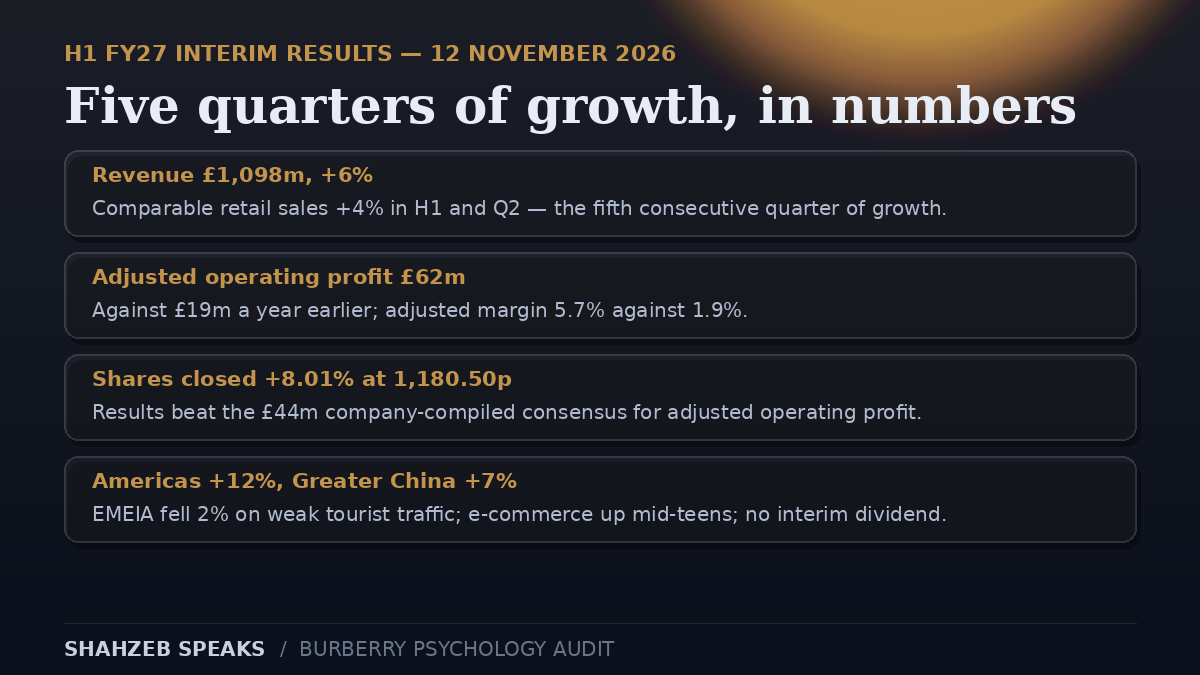
The interim results published on 12 November 2026, for the 26 weeks to 26 September 2026, are stronger still. Revenue was £1,098 million, up 6 per cent at reported and constant exchange rates, against £1,032 million a year earlier. Comparable retail sales rose 4 per cent in the half and in the second quarter — the fifth consecutive quarter of growth, after 5 per cent in the first quarter. Adjusted operating profit was £62 million against £19 million, up 225 per cent reported and 228 per cent at constant exchange rates, with an adjusted margin of 5.7 per cent against 1.9 per cent. Reported operating profit was £54 million against an £18 million loss. Profit before tax was £19 million against a £48 million loss, attributable profit £6 million against a £26 million loss, and adjusted diluted earnings per share were 3.4p against 0.6p. Gross margin was 68.3 per cent. By channel, retail was £896 million, wholesale £174 million — up 17 per cent at constant exchange rates, which the company said was ahead of guidance and reflected the confidence of its strategic partners — and licensing £28 million. By region, comparable retail sales rose 12 per cent in the Americas, 7 per cent in Greater China and 3 per cent in Asia Pacific, and fell 2 per cent in EMEIA, on reduced tourist activity and weak traffic, particularly in the Outlet channel. Outerwear grew double-digit, e-commerce grew mid-teens, and the directors elected not to declare an interim dividend. Free cash flow was a £147 million outflow, on plan, with a normalised inventory profile ahead of peak trading. The outlook for the full year is further revenue growth and margin expansion, with wholesale revenue expected to grow 10 to 12 per cent. The next update is the third-quarter trading update on 21 January 2027, and a Capital Markets Day will be held in London in March 2027.
Joshua Schulman, the chief executive, put the story in one sentence: “Two years ago, we launched Burberry Forward. Today, our brand and our business are stronger. Five consecutive quarters of growth and improved quality of sales demonstrate that our strategy is working.” The market agreed, at least for a day: the shares rose about 7.2 per cent in morning trading, to 1,171.50p, after the results beat the £44 million company-compiled consensus for adjusted operating profit and the £1.08 billion revenue consensus, and closed at 1,180.50p, up 8.01 per cent on the previous close of 1,093p. Frasers Group, the retail group controlled by Michael Ashley, raised its position to 7.420529 per cent of voting rights — 27,000,000 votes — held entirely through sold put options, with no direct share ownership, the threshold crossed on 8 October 2026 and disclosed on 12 October 2026. The goal-gradient hypothesis, described by Kivetz, Urminsky and Zheng (2006), says that people accelerate their effort as they approach a goal, and that visible progress towards the goal is itself motivating. Five consecutive quarters of growth is visible progress, published in numbers — it does for investors and staff what the party does for shoppers: it makes the goal feel close enough to reach. The honest counterweight is that the turnaround has a human cost that the numbers do not show. On 14 May 2025 Burberry announced about 1,700 job cuts — around a fifth of a global workforce of about 9,300 people — mostly office roles, with the night shift at the Castleford trench-coat factory to be cancelled, as part of the plan to save £100 million a year. A turnaround that is celebrated in the same year that a fifth of the workforce is cut is a turnaround that has to be scored with both numbers in view. Loss aversion, again, is the psychology at work: the people who lost their jobs feel the loss more sharply than the shareholders feel the gain, and a brand that forgets that will find its party remembered for the wrong reason.
⚠️ Chapter 9: Dark side & regulatory record — exactly what is known
Every legal statement in this chapter is written at its exact status, as of 14 November 2026. A filed claim is a filed claim, not a judgment. A preliminary injunction is interim relief, not a final ruling on the merits. A case that was reversed and remanded is a case that has not been finally decided. A search that found nothing is a search that found nothing, not proof that nothing exists. This chapter covers the record actually checked: court dockets in the United States, India, China and Taiwan, trademark coverage, and searches of the UK Advertising Standards Authority and Competition and Markets Authority and of EU enforcement.
The first thing to say is that every case found has Burberry as the claimant, enforcing its trademarks against counterfeiters or lookalikes. No case was found in which Burberry is a defendant in a material suit, and no regulator fine, settlement or investigation against Burberry was found. That is a statement about what the searches found, and it must be read that way — cases do exist, and they are all cases Burberry brought. In Taiwan, Burberry sued in 2021 over counterfeit goods sold on the ETMall platform, seeking a permanent injunction and damages. The lower courts found the defendants had infringed but dismissed Burberry’s claim for non-pecuniary damages. In October 2025 the Taiwan Supreme Court reversed and remanded, holding that a corporation can claim non-pecuniary damages for injury to business goodwill — the first time the Supreme Court affirmed this in an intellectual property case. The case is reversed and remanded, not finally decided, and this audit will not call it a win. In the United States, Burberry filed a trademark-counterfeiting claim on 4 December 2025 in the Southern District of New York, Case No. 25-CV-10068, together with Cartier, Chanel, Hermès, Louis Vuitton, Richemont and Van Cleef & Arpels, against sellers on Canal Street in New York. A preliminary injunction was granted. The case is pending, not a final ruling. A second American case, filed on 16 April 2025 in the Southern District of Florida, Case No. 0:25-cv-60732, also ended in a preliminary injunction being granted. It is also pending, not a final ruling.
The Indian record is mixed, and the mixed part must be printed. In Delhi, on 29 May 2026, a district court dismissed Burberry’s claims against three traders — Krishan Kumar, Yogesh Kumar and Daljeet Singh — on procedural and evidential grounds, while granting a permanent injunction and ₹3 lakh in compensatory and punitive damages against a fourth defendant, Md. Shible Raza, after a Local Commissioner’s report recorded infringing goods at his premises. Burberry largely lost that case, and this audit says so plainly. In a separate Delhi case, decided on 28 March 2025, Burberry’s suit against Sunil B. Sharma over the defendant’s “RF BROWNBERRY” mark for perfumes and fragrances was decreed in Burberry’s favour: a permanent injunction restraining use of RF BROWNBERRY or any deceptively similar mark, ₹2,00,000 in damages, and costs awarded to Burberry. That is a final judgment at first instance. In a third Indian case, the Delhi High Court allowed Burberry’s appeal against Aditya Verma, set aside a 2019 trial judgment that had gone against Burberry, and decreed the suit, with a permanent injunction against use of Burberry’s registered trademark and logo. The exact date of that appeal judgment was not established, and this audit prints no date for it. In China, the Jiangsu Provincial High People’s Court decided in October 2023 — first reported publicly in May 2024 — that Xinboli Trading Shanghai had infringed Burberry’s check graphic trademarks and used the “BANEBERRY” mark and a logo resembling the Equestrian Knight, and awarded RMB 6 million in damages for trademark infringement and unfair competition. In the United Kingdom, Burberry launched a trademark infringement and passing-off action against discount retailer B&M in December 2024, alleging B&M falsely represented goods sold under its “furberry” branding. As of the 27 October 2026 update, that action was filed and pending, with no outcome reported, and this audit prints no outcome.
The regulator record is an absence, and the absence must be stated with the same care as the filings. No Advertising Standards Authority ruling against Burberry was found in a search of the ASA’s rulings and general web search on 14 November 2026. No Competition and Markets Authority investigation, undertaking or fine against Burberry was found; the March 2024 fashion greenwashing undertakings named ASOS, Boohoo and Asda only. No European Union fine or investigation against Burberry was found in the searches run. Each of those sentences is a statement about what the searches found, not proof that nothing exists. One controversy does belong in this chapter because it shows what happens when a brand’s supply chain becomes a political question. In March 2021, Burberry, a member of the Better Cotton Initiative, was caught in the Chinese backlash against Western brands over Xinjiang cotton. Its ambassador, Zhou Dongyu, terminated her contract because Burberry had not clearly and publicly stated its stance on cotton from Xinjiang, and Burberry’s check design was removed from Tencent’s Honor of Kings video game. Burberry had told British lawmakers in November 2020 that it had no operations in Xinjiang and no suppliers based there, and that it did not condone any form of modern slavery. No fine or regulator action resulted. The honest reading of the record is that Burberry is an aggressive enforcer of its own trademarks — it has won damages and injunctions against counterfeiters in China, India and the United States, and its Taiwan case set a precedent on corporate damages for reputational harm — and that its record is not unbroken, because a Delhi court dismissed most of its claims in one case in May 2026, and because its supply chain became a political controversy in China in 2021. None of that makes the Christmas film worse. It makes the brand behind it a real organisation, with a real record, telling a very good story — and a story that does not need a scandal to be interesting is a story worth trusting a little more.
🇵🇰 Chapter 10: What Pakistani brands should — and shouldn’t — copy
Pakistani brands should copy three things. First, the single emotional idea. Burberry’s Christmas campaign is one party, one house, one sentence — “We wanted to celebrate 170 years of Burberry with a proper party” — expressed across film, gifting, embroidery and the shop floor. A Pakistani brand with a strong seasonal moment — Eid, Ramadan, a wedding season, a cricket series — should build one idea and run it everywhere, rather than running five ideas that cancel each other out. Second, the hosts, not the product. “Wrapped in Burberry” puts welcoming people at the centre of the campaign and lets the products sit quietly inside the party. A Pakistani brand has richer material than Burberry does — a customer’s own photograph of a family meal, a shopkeeper’s story told in their own words, a tailor’s hands at work — and it should let the audience see themselves in the campaign, rather than filming a generic happy family and hoping the audience recognises itself. Third, the discipline of the price. Burberry rebuilt its margin by holding its price and letting the product justify it, and it personalised the product with embroidery instead of discounting it. A Pakistani brand that calls a discount a gift will teach its customers to wait for the discount rather than to love the brand. A monogram, a handwritten note, a small service that costs the brand almost nothing and makes the product the customer’s own — that is the lesson worth copying.
What they should not copy is the fire, or the check, or the loose number. Burberry burned £28.6 million of its own stock in a single year and spent years living with the consequences; a Pakistani brand that destroys value to protect a price will be judged more harshly than a global house, because it has less goodwill to spend. Nor should they copy the overexposure: Burberry put its check on everything until it meant nothing, then spent two years taking it off four fifths of its products. A Pakistani brand with a signature pattern, colour or phrase should ration it from the start, because a badge that is everywhere is a badge that says nothing. And they should not copy the size of the claim: Burberry’s anniversary is built on numbers that can be checked — 23 stars, 170 years, £62 million against £19 million — and a Pakistani brand that prints a number it cannot prove will be asked to prove it on the second day. If the figure is yours, say so; if it is not verified, do not print it. And they should not copy the turnaround without counting its cost. Burberry’s recovery involved cutting about a fifth of its workforce, and a Pakistani brand that treats people as a line item in a cost programme will find that its customers notice, because in a market as small and as connected as Pakistan’s, the people you cut are the people your customers know. Copy the party, copy the hosts, copy the price discipline — and then make sure there is something real behind it to celebrate.
📊 Psychology Scorecard — the Burberry psychology audit in numbers
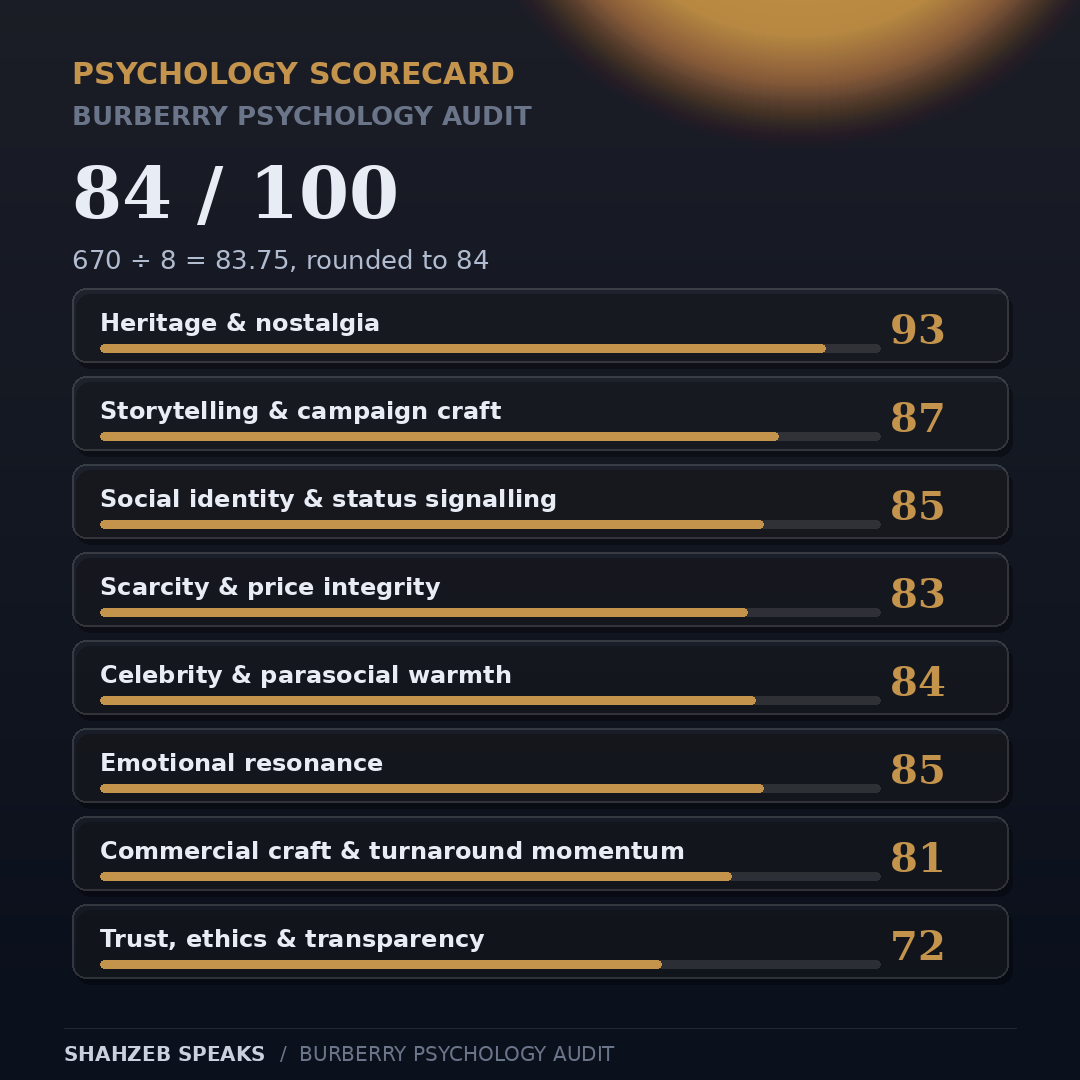
| Dimension | Score | Verdict |
|---|---|---|
| Heritage & nostalgia | 93 | One hundred and seventy years, a trench coat invented for war and worn by 23 stars in 2026: nostalgia with a real object at its centre. |
| Storytelling & campaign craft | 87 | A ninety-one-second party at Longleat House, a disco-ball peak and end, and one clear sentence from Daniel Lee. |
| Social identity & status signalling | 85 | The check is a badge again after the brand rationed it — but the “chav” years are still inside living memory. |
| Scarcity & price integrity | 83 | Full-price discipline rebuilt the margin to 68.3 per cent, but the 2018 bonfire is the cautionary tale this score cannot forget. |
| Celebrity & parasocial warmth | 84 | Brosnan and Shaw host rather than model, and the warmth is real — but borrowed warmth is still borrowed. |
| Emotional resonance | 85 | A party, a disco ball and a 170-year-old coat land together; the film is felt before it is understood. |
| Commercial craft & turnaround momentum | 81 | Five consecutive quarters of growth and a market that noticed, held back by a fifth of the workforce cut and EMEIA down 2 per cent. |
| Trust, ethics & transparency | 72 | No regulator fine was found in the searches run, but the burning, the Xinjiang backlash and a lost Delhi case keep the score honest. |
Arithmetic: 93 + 87 + 85 + 83 + 84 + 85 + 81 + 72 = 670. 670 ÷ 8 = 83.75, rounded to 84/100.
✅ Balance sheet & prescription
What Burberry does best is turn continuity into an invitation. The heritage is exact — a coat invented in 1879, a check from the 1920s, 23 stars photographed in the same garment in 2026 — the nostalgia is real, because the object at its centre is real, and the party format turns that heritage into warmth rather than into a museum lecture. The turnaround is real too: five consecutive quarters of growth, a profit that more than tripled, and a market that closed the day up 8.01 per cent. What it does worst is the gap between the invitation and the reality. The coat is expensive, the check still carries the memory of the years it went wrong, the 2018 bonfire is still the first thing many people remember when they hear the name, and the recovery was paid for, in part, by cutting about a fifth of the workforce. The prescription follows that balance. First, let the campaign be measured: publish the independent effectiveness and shopper-response results when they arrive, so the next audit can score the outcome rather than the idea. Second, keep the check rationed: the pattern is a luxury signal again only because the brand stopped putting it on everything, and the temptation to put it back on everything will return with the recovery. Third, tell the Castleford story properly: the night shift was cancelled, the factory still makes the trench, and the people who make it are the most credible witnesses the brand has — put them in the next campaign, not only the stars. Do those three things and the score rises on its own.
📝 Final Verdict
Burberry has made a Christmas campaign about the idea that a 170-year-old house can throw a party rather than deliver a lecture, at the exact moment when its own numbers give that idea more weight than any other luxury brand could claim. The story is generous: two hosts welcoming you into a country house, seven guests from film, fashion and sport, a disco ball turning over a room full of famous people, and a single sentence about a proper party that turns the usual script of luxury advertising upside down. The psychology is generous too — nostalgia, social identity, scarcity, authority, parasocial warmth, narrative transportation, mere exposure and the peak-end rule, all working in the same direction. Its weakness is not warmth but history: a check that once meant the wrong thing, a bonfire of unsold stock, a lost case in Delhi, an ambassador who walked away, and a turnaround that cut a fifth of the workforce. None of that makes the film worse as a piece of celebration. It makes the brand behind it a real organisation, with a real record, telling a very good story. Until the results arrive, the campaign will be remembered for one thing: the party.
Psychology Score: 84/100 — A warm, well-judged 170th-birthday party whose heritage, nostalgia and social identity get the psychology of belonging exactly right, held back by a check that still carries the memory of its wrong years, a 2018 bonfire that no party can erase, and a turnaround whose human cost and regional weakness keep the score honest.
If your brand has a history worth celebrating — and a past worth being honest about — and you want to turn both into a campaign that actually lands, the psychology of the answer matters more than the polish of the film. I audit that decision journey — get in touch here.
Related audits: Louis Vuitton — The Journey Is the Destination, Dior — The Night in Color: Hand-Drawn Craft, AI Questions and the Price of Belief, and Marks & Spencer — The Home of Christmas: Santa Shops at M&S. See also the full list at brand psychology audits and industrial psychology in Pakistan.
📚 References & Sources
- Burberry Group plc (2026). Burberry celebrates the festive season — ‘Wrapped in Burberry: Celebrating 170 Years’ (press release, 3 November 2026; read directly 14 November 2026). https://www.burberryplc.com/news/brand/2026/burberry-celebrates-the-festive-season
- Burberry Group plc (2026). Interim Results for 26 Weeks Ended 26 September 2026 (12 November 2026; read directly 14 November 2026). https://www.burberryplc.com/content/dam/burberryplc/corporate/documents/investors/results-reports/2026/interims/Burberry%20FY27%20Interim%20Results%20Announcement.pdf.downloadasset.pdf
- Burberry Group plc (2026). Preliminary Results for 52 Weeks Ended 28 March 2026 (14 May 2026; FCA/RNS copy). https://data.fca.org.uk/artefacts/NSM/DirectUpload/NI-000144933/NI-000144933.pdf
- Burberry Group plc (2026). Annual Report 25/26. https://www.burberryplc.com/investors/annual-report-25-26
- Encyclopaedia Britannica (2026). Burberry (updated 8 October 2026; founded 1856; gabardine 1879, patented 1888; Tielocken 1912; War Office commission; check 1920s and 1967; GUS 1955–2005; floated July 2002). https://www.britannica.com/money/Burberry
- Drapers (2026). Burberry unveils star-studded Christmas advert (4 November 2026; Daniel Lee quote). https://www.drapersonline.com/news/burberry-unveils-star-studded-christmas-advert
- LBB (2026). Burberry Christmas ad news — 170 years (3 November 2026). https://lbbonline.com/news/Burberry-christmas-ad-news-170-years?edition=latam
- The Impression (2026). Burberry festive 2026 campaign — Pierce Brosnan (3 November 2026). https://theimpression.com/burberry-festive-2026-campaign-pierce-brosnan/
- Daily Commercials (2026). Burberry — Wrapped in Burberry: 170 Years ad review (4 November 2026; film 1 minute 31 seconds; soundtrack). https://dailycommercials.com/burberry-wrapped-in-burberry-170-years-ad-review/
- FashionUnited (2026). Burberry unveils ‘The Trench, Portraits of an Icon’ (2 March 2026; 23 stars photographed by Tim Walker; pop-ups). https://fashionunited.uk/press/fashion/burberry-unveils-the-trench-portraits-of-an-icon-a-global-campaign-featuring-leading-figures-from-film-music-sport-and-fashion/2026030286586
- Webwire (2026). Burberry / Royal Collection Trust capsule (12 March 2026; four designs; holly-green gabardine car coat made at Castleford; Royal Warrant 1955). https://www.webwire.com/ViewPressRel.asp?aId=351930
- Country & Town House (2026). Burberry Gallery at the V&A (updated 28 July 2026; announced 31 March 2025; opens autumn 2028). https://www.countryandtownhouse.com/culture/burberry-gallery-v-and-a/
- TheIndustry.fashion (2026). Burberry celebrates 170th anniversary with festive campaign (4 November 2026; Smythson collaboration). https://www.theindustry.fashion/burberry-celebrates-170th-anniversary-with-festive-campaign-starring-pierce-brosnan-and-fiona-shaw/
- Vinepair. British bars, Burberry ban (check overexposure; 2003 bans; caps withdrawn; 20% of products in 2002, under 5% by 2004, per the BBC). https://vinepair.com/cocktail-chatter/british-bars-burberry-ban/?recirc=true
- European Business Magazine (2026). Why Burberry burned £28 million of its own stock on purpose (2 May 2026; FY2017/18 disclosure £28.6m, incl. £10.4m beauty). https://europeanbusinessmagazine.com/why-burberry-burned-28-million-of-its-own-stock-on-purpose/
- Retail Gazette (2018). Burberry backflips destroying unsaleable products, bans fur (6 September 2018). https://www.retailgazette.co.uk/blog/2018/09/burberry-backflips-destroying-unsaleable-products-bans-fur/
- Reuters via Inside Retail (2021). Burberry the first luxury brand to suffer Chinese backlash over Xinjiang (26 March 2021; Zhou Dongyu; Honor of Kings; no fine or regulator action resulted). https://insideretail.us/burberry-the-first-luxury-brand-to-suffer-chinese-backlash-over-xinjiang/
- Lexology (2026). Taiwan Supreme Court, October 2025 — Burberry v ETMall (5 January 2026; reversed and remanded; corporate non-pecuniary damages for goodwill). https://www.lexology.com/library/detail.aspx?g=230a7810-ebe4-476c-9800-0642a3b9fc68
- Justia (2025). Burberry Ltd et al v Various John Does, 25-CV-10068, S.D.N.Y. (filed 4 December 2025; preliminary injunction granted; pending). https://cases.justia.com/federal/district-courts/new-york/nysdce/1:2025cv10068/654146/24/0.pdf
- Justia (2025). Burberry Ltd v Schedule “A” defendants, 0:25-cv-60732, S.D. Fla. (filed 16 April 2025; preliminary injunction granted; pending). https://law.justia.com/cases/federal/district-courts/florida/flsdce/0:2025cv60732/687861/24/
- Live Law (2026). Delhi court dismisses Burberry trademark infringement suit against Karol Bagh traders (6 June 2026; judgment 29 May 2026; claims dismissed against three defendants; injunction and ₹3 lakh damages against Md. Shible Raza). https://www.livelawbiz.com/trademark/delhi-court-dismisses-burberry-trademark-infringement-suit-against-karol-bagh-traders-over-procedural-failures-537049
- Indian Kanoon (2025). Burberry Ltd v Sunil B. Sharma, CS (COMM) 949/2022 (judgment 28 March 2025; suit decreed in Burberry’s favour; permanent injunction; ₹2,00,000 damages; Equestrian Knight logo 1901 per Burberry’s own averment). https://indiankanoon.org/doc/124209346/
- Legal500 (2023). Analysing the landmark judgment of Burberry v Aditya Verma (31 October 2023; appeal allowed, 2019 trial judgment set aside, suit decreed). https://www.legal500.com/intelligence/india/intellectual-property/analysing-the-landmark-judgment-of-burberry
- Global Legal Post (2024). Burberry celebrates trademark infringement win in key market (8 May 2024; Jiangsu High People’s Court, October 2023; RMB 6m damages). https://www.globallegalpost.com/news/an-important-moment-in-chinese-ip-litigation-burberry-celebrates-trademark-infringement-win-in-key-market-1386955387
- Legal500 (2024, updated 27 October 2026). Burberry launches trade mark action against B&M over use of “furberry” (filed December 2024; pending, no outcome reported). https://www.legal500.com/intelligence/united-kingdom/intellectual-property/burberry-launches-trade-mark-action-against-b%26m-over-use-of-furberry
- Morningstar / Alliance News (2026). Burberry shares rise 7% as interim profit and sales beat expectations (12 November 2026; morning move 7.2% to 1,171.50p). https://www.morningstar.com/news/alliance-news/1794476632940532500/burberry-shares-rise-7-as-interim-profit-and-sales-beat-expectations
- StockAnalysis. Burberry (BRBY) price history (shares closed at 1,180.50p, up 8.01%, 12 November 2026). https://stockanalysis.com/quote/lon/BRBY/history/
- Kalkine Media (2026). Frasers Group boosts Burberry Group (BRBY) stake to 7.42% via sold put options (7.420529% of voting rights, 27,000,000; threshold crossed 8 October 2026; disclosed 12 October 2026). https://kalkinemedia.com/uk/news/announcements/frasers-group-boosts-burberry-group-brby-stake-to-742-via-sold-put-options
- Tajfel, H. & Turner, J. C. (1979). An integrative theory of intergroup conflict. In W. G. Austin & S. Worchel (Eds.), The Social Psychology of Intergroup Relations (pp. 33–47). Brooks/Cole.
- Cialdini, R. B. (1984). Influence: The Psychology of Persuasion. William Morrow.
- Milgram, S. (1963). Behavioral study of obedience. Journal of Abnormal and Social Psychology, 67(4), 371–378.
- Horton, D. & Wohl, R. R. (1956). Mass communication and para-social interaction: Observations on intimacy at a distance. Psychiatry, 19(3), 215–229.
- Green, M. C. & Brock, T. C. (2000). The role of transportation in the persuasiveness of public narratives. Journal of Personality and Social Psychology, 79(5), 701–721.
- Zajonc, R. B. (1968). Attitudinal effects of mere exposure. Journal of Personality and Social Psychology, 9(2, Pt. 2), 1–27.
- Sedikides, C., Wildschut, T., Routledge, C., Arndt, J., Hepper, E. G. & Zhou, X. (2015). To nostalgize: Mixing memory with affect and desire. Advances in Experimental Social Psychology, 51.
- Sedikides, C. & Wildschut, T. (2018). Finding meaning in nostalgia. Review of General Psychology, 22(1), 48–61.
- Sedikides, C., Wildschut, T., Cheung, W.-Y., Routledge, C., Hepper, E. G., Arndt, J. & Vail, K. E. (2016). Nostalgia fosters self-continuity. Emotion, 16(4), 524–539.
- Kahneman, D. & Tversky, A. (1979). Prospect theory: An analysis of decision under risk. Econometrica, 47(2), 263–291.
- Kahneman, D., Fredrickson, B. L., Schreiber, C. A. & Redelmeier, D. A. (1993). When more pain is preferred to less: Adding a better end. Psychological Science, 4(6), 401–405.
- Kivetz, R., Urminsky, O. & Zheng, Y. (2006). The goal-gradient hypothesis resurrected: Purchase acceleration, illusionary goal progress, and customer retention. Journal of Marketing Research, 43(1), 39–58.
Key Findings
- Founded 1856 by Thomas Burberry, aged 21, a former draper's apprentice, who opened an outfitting shop in Basingstoke, Hampshire; gabardine invented 1879 and patented 1888; Tielocken coat patented 1912; British War Office commissioned the trench for the First World War and officers bought their own; Burberry Check introduced in the 1920s as a trench lining and turned outwards in a Paris store in 1967; Royal Warrant awarded 1955; floated on the London Stock Exchange July 2002; 412 directly operated stores at 26 September 2026.
- "Wrapped in Burberry: Celebrating 170 Years" announced 3 November 2026; film 1 minute 31 seconds directed by Harmony Korine with creative direction by Daniel Lee, set at Longleat House, Wiltshire; hosts Pierce Brosnan and Fiona Shaw; guests Cara Delevingne, Dylan Brosnan, Dwyane Wade, Gabrielle Union, Kim Min-ha, Nico Parker and Wu Lei; cameo Emma Thynn, Marchioness of Bath; soundtrack "Do You Wanna Funk?" by Sylvester and Patrick Cowley; disco-ball finale; Daniel Lee: "We wanted to celebrate 170 years of Burberry with a proper party." Product story is cashmere; first-ever Smythson collaboration (leather notebooks, folding chess and backgammon sets, launched October 2026); complimentary embroidery and free gift wrapping.
- H1 FY27 interim results, 12 November 2026: revenue £1,098m (+6%); comparable retail sales +4% in H1 and Q2, the fifth consecutive quarter of growth; adjusted operating profit £62m against £19m; adjusted margin 5.7% against 1.9%; reported operating profit £54m against an £18m loss; profit before tax £19m against a £48m loss; gross margin 68.3%; Americas +12%, Greater China +7%, Asia Pacific +3%, EMEIA -2%; outerwear up double-digit; e-commerce up mid-teens; no interim dividend; shares closed at 1,180.50p, up 8.01% (morning move 7.2% to 1,171.50p); next update Q3 Trading Update 21 January 2027.
- Check overexposure: under CEO Rose Marie Bravo (1997-2006) the check went on everything; associated with football casuals and the "chav" subculture; in 2003 a number of British bars and clubs banned Burberry-wearing customers; checked baseball caps withdrawn; check on 20% of products in 2002, under 5% by 2004 (BBC via Vinepair). Burning unsold stock: FY2017/18 annual report disclosed £28.6m of finished goods physically destroyed (incl. £10.4m beauty inventory); practice ended 6 September 2018, with real fur banned; Xinjiang cotton backlash March 2021 (ambassador Zhou Dongyu terminated her contract; check removed from Tencent's Honor of Kings) — no fine or regulator action resulted.
- Legal record: every case found has Burberry as CLAIMANT enforcing its trademarks. Taiwan Supreme Court, October 2025: REVERSED AND REMANDED the ETMall counterfeiting case (corporate non-pecuniary damages for goodwill — first time affirmed in an IP case) — NOT finally decided. US SDNY 25-CV-10068 FILED 4 December 2025 (with Cartier, Chanel, Hermes, Louis Vuitton, Richemont, Van Cleef & Arpels vs Canal Street sellers): PRELIMINARY INJUNCTION GRANTED; case PENDING, not a final ruling. US S.D. Fla. 0:25-cv-60732 FILED 16 April 2025: PRELIMINARY INJUNCTION GRANTED; not a final ruling. India Delhi 29 May 2026: claims DISMISSED against Krishan Kumar, Yogesh Kumar and Daljeet Singh (procedural/evidential grounds); permanent injunction and Rs 3 lakh damages against Md. Shible Raza. India Delhi 28 March 2025, Burberry v Sunil B. Sharma ("RF BROWNBERRY"): suit DECREED in Burberry's favour, permanent injunction, Rs 2,00,000 damages. India Delhi High Court, Burberry v Aditya Verma: appeal ALLOWED, 2019 trial judgment set aside, suit decreed (no appeal date established). China Jiangsu High People's Court, October 2023: Burberry v Xinboli Trading ("BANEBERRY"), RMB 6m damages for trademark infringement and unfair competition. UK High Court, Burberry v B&M ("furberry"), FILED December 2024, PENDING as of the 27 October 2026 update — no outcome reported. Regulators: NO ASA ruling found in the searches run on 14 November 2026; NO CMA investigation, undertaking or fine found (March 2024 greenwashing undertakings named ASOS, Boohoo and Asda only); NO EU fine or investigation found in the searches run.
- Score 84/100: 93+87+85+83+84+85+81+72 = 670; 670/8 = 83.75, rounded to 84.
Overall Psychology Score
Burberry scores 84/100 in our comprehensive psychology audit covering consumer behavior strategies, UX design principles, and psychological marketing effectiveness.
The detailed dimension scores are in the audit's Psychology Scorecard chapter.
High impactMuhammad Shahzeb
MSc Industrial Psychologist, specializing in consumer behavior, UX psychology, and brand strategy analysis. Helping brands understand the psychology behind their success.
About Muhammad Shahzeb →