Levi’s Psychology Audit — The Yeti, the 501 and the Feeling of Belonging
Levi's turned a handmade yeti into a lesson in belonging. A psychology audit of Let's Get Fuzzy, the 501, and a 173-year-old brand, scored 83/100, with a mixed legal record.

83 / 100
Overall consumer behavior effectiveness
Brand Overview
- Brand nameLevi's
- Founded1853
- HeadquartersSan Francisco, California, United States
- IndustryFashion & Apparel
- Websitewww.levi.com ↗
Psychology Techniques Identified
- 01Belonging & Social Identity (Tajfel & Turner 1979; The 501 as Uniform)
- 02Need to Belong (Baumeister & Leary 1995; Gus the Outsider)
- 03Nostalgia & Archive Re-animation (Launderette to REIIMAGINE)
- 04Craft & Effort Signalling (Handmade Claymation; No AI Used)
- 05IKEA Effect (Norton, Mochon & Ariely 2012; Tailor Shops & Repair)
- 06Scarcity & Staged Release (REIIMAGINE Chapters; Limited-Edition Drop)
- 07Self-Expression & Customisation (Tailor Shops; Personalisation)
- 08Endowment & Ownership (SecondHand Trade-In; Resale Value)
- 09Social Proof & Cultural Endorsement (Beyoncé; Brando & Dean)
- 10Sustainability Signalling (Company Claims; Water & Cotton Goals)
- 11Price Anchoring & Premium Positioning (Women's Growth; $10bn Ambition)
- 12Trademark Salience (Red Tab; Arcuate Stitch; Two Horse Patch)
Full Psychology Audit Report
In this audit
Picture a yeti at the door of a snow-covered cabin, too big for the doorway and too strange for the party inside. The friends gathered there could have left him out in the cold. Instead, one of them hands him a red sweater, and he is welcomed in. That is the whole of Levi’s Holiday 2026 campaign, “Let’s Get Fuzzy”, launched globally on 2 November 2026 — and it is also the whole of Levi’s psychology in one scene. For 173 years, this brand has sold the same thing: the feeling of belonging, stitched into a pair of jeans.
Levi Strauss & Co. was founded in San Francisco in 1853, and its most famous product, the 501, traces to a patent granted on 20 May 1873 for riveting pocket corners. The company reported $6,355.3 million of revenue in fiscal 2024, and its Levi’s brand accounted for 89% of that. In the third quarter of fiscal 2026, ended 30 August 2026, revenue was $1,610 million, up 4% on a reported basis. This audit asks how a workwear patent from 1873 still sells belonging in 2026 — and where the psychology underneath it starts to wear thin.
I am an Industrial and Organizational Psychologist in Karachi, and I audit brands by testing their claims against psychology research and their own public record. Where a number comes from the company, I say so. Where a legal matter is only a filed complaint, I keep it a filed complaint.
“Everyone wants to feel like they belong.”
— Brand Psychology Analysis, ShahzebSpeaks
📋 Brand Overview
| Field | Detail |
|---|---|
| Brand | Levi’s® (Levi Strauss & Co.) |
| Founded | 1853, San Francisco, California, United States |
| Headquarters | Levi’s Plaza, 1155 Battery Street, San Francisco, California |
| Scale | FY2024 revenue $6,355.3 million; Levi’s brand 89% of revenue; sold in approximately 120 countries; 1,276 company-operated stores at 1 December 2024 |
| Current platform | “Let’s Get Fuzzy” Holiday 2026 campaign, launched globally 2 November 2026 |
| Website | https://www.levi.com |
| Psychology score | 83/100 |
Sources: Levi Strauss & Co. Form 10-K for fiscal year ended 1 December 2024; Q3 FY2026 press release, 7 October 2026; company Holiday 2026 page, 2 November 2026. All figures as of 6 November 2026.
🏛️ Chapter 1: A rivet that became an identity
The story starts with a problem of durability, not fashion. In 1872, Jacob Davis, a tailor in Reno, Nevada, wrote to Levi Strauss about his process for riveting the pocket corners of men’s work trousers. He could not afford the patent filing fee and asked Strauss to fund it. On 20 May 1873, the two men were granted US Patent No. 139,121 for the process of riveting trousers. The company calls this the invention of the blue jean. The trousers were then called “waist overalls”, with one back pocket, Arcuate stitching, a watch pocket, a cinch and suspender buttons.
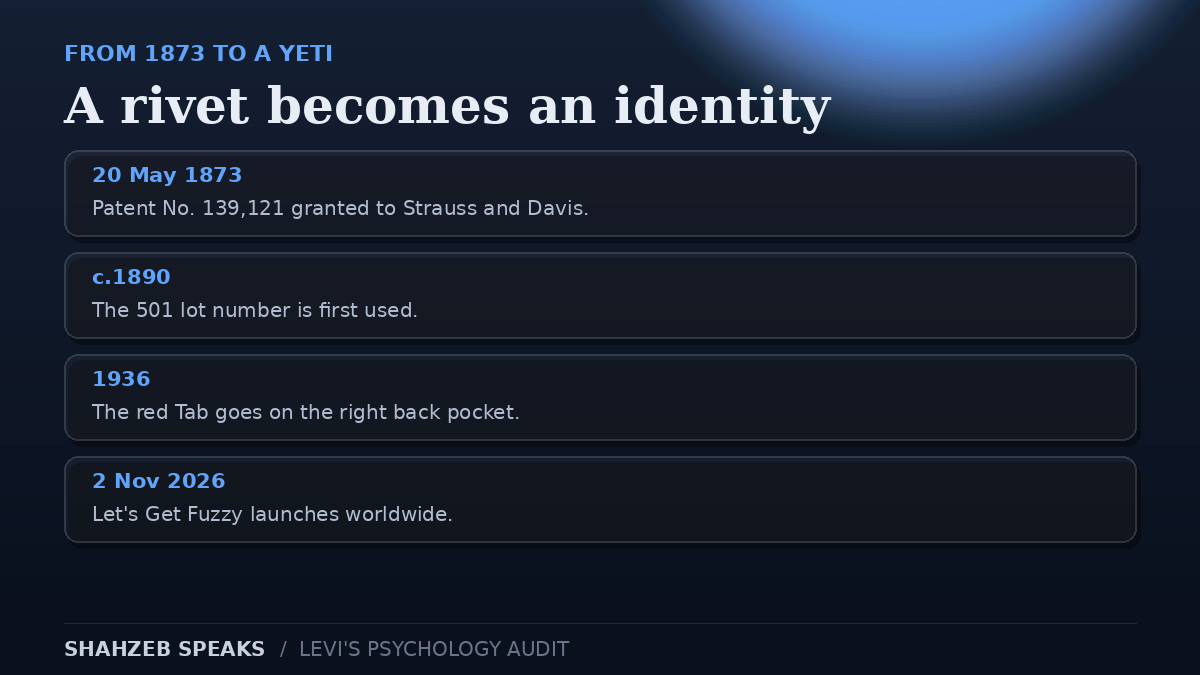
What followed was a century of small marks that became large signals. The Two Horse Brand leather patch arrived in 1886, showing two horses trying and failing to pull a pair of jeans apart — a durability demonstration you could read without words. The lot number 501 was first used around 1890, once the rivet patent entered the public domain. The red Tab was placed on the right back pocket in 1936, with “LEVI’S” stitched in white capitals on one side only, to separate Levi’s overalls from competitors copying the dark denim and the Arcuate stitch; the Tab was registered as a trademark in 1938. The Arcuate stitching design itself was registered in 1943. By 1947, the 501 had been refined into essentially its modern form, with suspender buttons and the back cinch removed.
The lesson for a psychologist is that none of these marks was designed as a logo. Each one solved a practical problem — durability, identification, imitation — and then became a signal. The red Tab is a few millimetres of cloth, yet it carries the whole brand. That is how identity works in clothing: the smallest visible difference becomes the way a wearer says who they are, and the way others read it.
👖 Chapter 2: The 501 as a uniform — social identity in denim
Social identity theory (Tajfel & Turner, 1979) says that part of how we see ourselves comes from the groups we belong to, and that we signal that membership through visible markers. The 501 is one of the most durable markers ever made. The company’s own blog frames it as “the chosen uniform of those looking to express themselves and let their originality shine”, and describes it as “right there during every important era of history, worn by everyone from civil rights activists to musical icons”. In the 1950s it became a uniform for the teenage rebel, popularised on screen by Marlon Brando in The Wild One (1953) and James Dean in Rebel Without a Cause (1955), to the point that jeans were banned in some schools. In the 1960s the 501 was embraced by counterculture figures; in the 1980s it was coveted behind the Iron Curtain.
That is the paradox at the heart of the brand: the same garment signals rebellion and conformity, depending on who wears it and where. A uniform works precisely because it is shared, yet the wearer experiences it as self-expression. Levi’s has kept that tension alive for decades by never quite resolving it. The 501 is at once the most common item of clothing in the world and a personal statement. A brand that can hold both meanings at once does not need to choose between mass appeal and identity — it sells the same product as both.
The commercial shape of that identity is visible in the numbers. The Levi’s brand accounted for 89% of the company’s net revenues in fiscal 2024. The company’s ambition, stated by chief executive Michelle Gass — the first woman to lead the company, in the role since January 2024 — is to build Levi’s into a $10 billion company and the world’s leading denim lifestyle brand, with the women’s business growing from about 38–40% of sales towards 50%. Identity, in other words, is not a side project. It is the growth plan.
🧌 Chapter 3: “Let’s Get Fuzzy” — belonging, told by a yeti
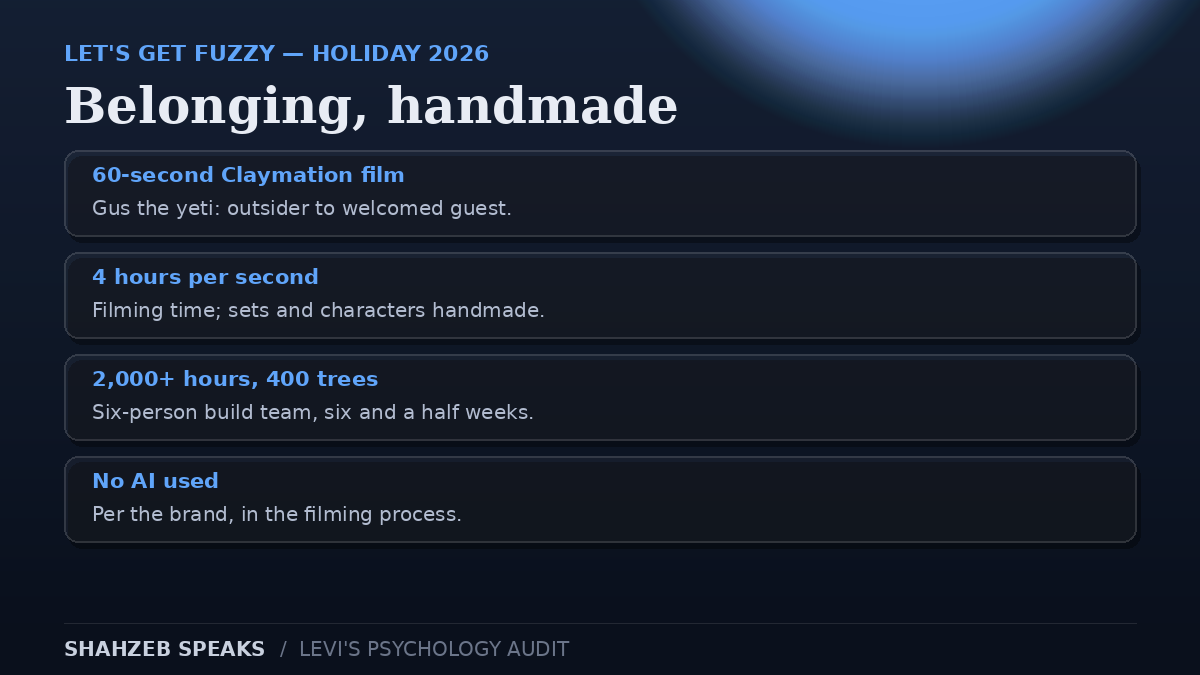
The Holiday 2026 campaign is the clearest expression of that plan. “Let’s Get Fuzzy” launched globally on 2 November 2026, across retail, digital and social channels, with sweaters at the centre of a holiday wardrobe the company describes as “built for both self-expression and togetherness”. The centrepiece is a 60-second stop-motion film featuring “Fuzzyeti” — affectionately known as Gus — a larger-than-life yeti whose journey “from feared outsider to welcomed guest captures something universal about the season: everyone wants to feel like they belong”. In the film, Gus approaches a remote snow-covered cabin where friends are gathered, breaks in, is offered a red sweater, and is welcomed into the celebration.
The psychology underneath is Baumeister and Leary’s need to belong (1995). In their review in Psychological Bulletin, they argued that the desire for interpersonal attachment is a fundamental human motivation, closer to hunger than to taste: people need frequent, pleasant interaction inside stable relationships marked by mutual concern, and the lack of it produces real harm. Levi’s has built its holiday film on exactly that need. Gus is not a mascot. He is the viewer: the person who arrives at the gathering unsure whether there is a place for them. The red sweater is the mechanism of acceptance — a garment offered, not sold — and the film’s resolution is not a purchase but an invitation.
Notice what the campaign does not do. It does not show a price, a discount or a reason to buy now. It shows a social fear and its resolution, and it trusts the viewer to connect the sweater in the film with the sweaters in the store — women’s Charlotte Crewneck Cardigan and Ava Quarter-Zip Sweater, men’s Presidio Crew Sweater and Miles V-Neck Sweater, layered with denim including the 501 Loose, 578 Baggy, Ribcage and Loose Taper. That restraint is a strength. A campaign that names a universal feeling and then steps back is more persuasive than one that shouts a price, because the feeling is the product and the product is only the proof.
🎬 Chapter 4: Handmade in an AI age — the craft signal
The film was made entirely with stop-motion Claymation. Sets and characters were fully crafted by hand, each character outfit meticulously reproduced by artisans, and it required four hours of filming for each second of animation. No AI was used in the filming process, according to the brand. A six-person build team spent more than 2,000 hours across six and a half weeks building and painting the sets, including 400 miniature trees and three cabins at different scales. Production was by Blink / Blinkink, directed by Stevie Gee and Essy May.
The handmade choice is doing real psychological work. When a tool can generate a polished film in minutes, visible human effort becomes a signal of care — the effort heuristic, the tendency to value something more when we can see the work that went into it. Levi’s is also making a deliberate callback: “Clayman” (1995) was, in the company’s words, the first full-length commercial shot entirely in Claymation, and Levi’s first global commercial. The 2026 film re-animates that archive, just as the Beyoncé REIIMAGINE campaign re-animated the 1985 “Launderette” advertisement. The brand keeps returning to its own past, and each return reminds the audience that the brand was there before the present moment — which is the definition of heritage, and the reason heritage sells.
There is a risk in the handmade claim, and it is worth naming. “No AI was used” is a brand statement reported by trade press, not an independently audited fact, and the line between handmade and machine-assisted is getting harder to draw. Levi’s is wise to make the claim about the filming process specifically, and to let the visible craft — the fingerprints in the clay, the miniature trees — carry the evidence. A claim that can be seen is stronger than a claim that must be believed.
🎤 Chapter 5: Nostalgia as a strategy — REIIMAGINE and the archive
REIIMAGINE, launched on 30 September 2024 after the release of “LEVII’S JEANS”, a track from Beyoncé’s album COWBOY CARTER, is the same strategy in a different register. Beyoncé is the campaign’s protagonist, and it reinterprets several of Levi’s most recognisable advertisements through filmmaker Melina Matsoukas. Chapter 1, “Launderette”, reworked the 1985 advertisement in which Nick Kamen stripped to wash his 501s. Chapter 2, “Pool Hall”, followed in February 2025. Chapter 3, “Refrigerator”, arrived in April 2025, reinterpreting the 1988 advertisement in a sun-drenched roadside diner. The final chapter, “The Denim Cowboy”, closed the campaign in August 2025. A limited-edition BEYONCÉ x LEVI’S tees drop followed in May 2025, reimagining the Levi’s logo with a double “ii” — a nod to “LEVII’S JEANS”.
Nostalgia works because it is not really about the past. It is about the self in the past: who you were when you first heard the song, wore the jeans, saw the advertisement. By re-staging its own archive with the world’s most famous living pop star, Levi’s lets a 20-year-old discover the 1985 advertisement and a 60-year-old relive it, in the same frame. The staged release — chapters over eleven months, a limited-edition drop in the middle — adds scarcity to the nostalgia: each chapter is an event, not a rerun.
What Levi’s does not do is publish a sales figure for REIIMAGINE, and I will not invent one. No verified sales, revenue-attribution or brand-lift figure for the campaign was found in a primary source. One low-authority blog claims “over $2 billion in global sales” for the collaboration; that figure is unverified and I am leaving it out. The honest assessment is that the campaign’s value is visible in the company’s direction — women’s growth, premium positioning, cultural relevance — rather than in a single number. A brand that needs a made-up number to prove a campaign worked has already admitted the campaign did not work.
✂️ Chapter 6: Customisation, repair and the IKEA effect
Levi’s Tailor Shops, at flagship stores around the globe, offer repair and repurposing of denim, extending the useful life of the company’s garments. For Holiday 2026, select Tailor Shops are introducing a dedicated customisation offering worldwide, with personalised touches and fuzzy embellishments. In July 2026 the company held a clothing-repair workshop in San Francisco, teaching customers to sew on buttons, hem garments, patch holes and repair tears.
The psychology here is the IKEA effect (Norton, Mochon & Ariely, 2012). In their experiments, published in the Journal of Consumer Psychology, participants who assembled an IKEA storage box themselves were willing to pay 63% more for it than participants who evaluated an identical pre-assembled box — $0.78 against $0.48 — and participants who folded their own origami valued it at about five times more than other people’s. Labour leads to love, but only when the labour results in successful completion. A repaired, customised pair of jeans is not just a product. It is a product the customer helped finish, and the effort makes it harder to throw away.
The same logic drives Levi’s SecondHand programme, which buys back and resells used Levi’s jeans, denim shorts and Trucker Jackets. Trade-in is by appointment at participating US stores: up to five items per trade-in, one trade-in per month per person, earning a digital gift card of $5 to $30 based on age, condition and original retail price. Traded-in items are professionally cleaned before being listed. The timing is good. ThredUp’s 2026 Resale Report, based on research by GlobalData and a survey of 3,268 US adults in January and February 2026, found that 59% of consumers shopped secondhand apparel in 2025, the US secondhand apparel market grew 19% in 2025, and the global secondhand apparel market is projected to reach $393 billion by 2030. Among Gen Z, 62% shopped secondhand in 2025. Levi’s is not inventing a market here. It is building a door into one that is already open — and keeping its own jeans in circulation, which is the cheapest advertising a denim brand can buy.
💰 Chapter 7: The premium push — women’s growth and the $10 billion ambition
Strip away the campaigns and the commercial question is simple: can a 173-year-old workwear brand become a premium lifestyle brand without losing the people who made it famous? The company’s answer is visible in its results. In the third quarter of fiscal 2026, the quarter ended 30 August 2026 and announced on 7 October 2026, net revenues were $1,610 million, up 4% reported and 5% organic against the same quarter a year earlier. Direct-to-consumer sales were 45% of total revenue, e-commerce grew 10%, and wholesale grew 6%. Operating margin was 13.8%, against 10.8% a year earlier, though that figure was helped by $79 million of tariff refunds, which contributed $0.11 of net earnings-per-share benefit after the company redeployed part of the refund into the business. The company raised its full-year guidance to adjusted diluted earnings per share of $1.54 to $1.56.
Two structural moves sit behind those numbers. First, the Dockers sale, completed on 27 February 2026 to Authentic Brands Group for $311 million initially, with the potential to reach $391 million through an earnout, sharpens the focus on the Levi’s brand and Beyond Yoga. Second, the women’s business — “nearing 40% of total company organic net revenue” in fiscal 2025, up 11% in the year — is the growth engine, with the stated aim of reaching 50%. The REIIMAGINE campaign and the sweater-led Holiday 2026 campaign are both aimed squarely at that goal. The risk is the same as the opportunity: premium positioning raises prices, and a brand whose founding story is workwear for labourers must be careful not to price out the people who gave it its meaning. The scorecard marks this tension, and the prescription returns to it.
🌍 Chapter 8: Sustainability — claims, targets and one honest miss
Levi’s publishes ambitious sustainability goals, and every one of them must be read as a company claim. Net-zero greenhouse-gas emissions by 2050; a 42% absolute reduction in scope 1 and 2 emissions by 2030, and the same cut in supply-chain emissions, against a 2022 base year; 100% of cotton from “more sustainable origins”, which the company reports as achieved in its 2024 sustainability report summary. Its 2030 Water Strategy, released in October 2025, aims to reduce absolute freshwater use by 15% across apparel and textile manufacturing suppliers by 2030 and to recycle or reuse 40% of water used in manufacturing. Its regenerative-cotton initiative launched in January 2026 in Jalalpur Pirwala, Punjab, Pakistan, aiming to cover 10,000 hectares and plant 100,000 trees by December 2028.
Two details deserve credit, because they show the difference between a claim and a record. First, the company admits it missed its earlier goal to halve freshwater use in high-water-stressed manufacturing areas by 2025. A brand that reports its own miss is more credible than one that quietly moves the target. Second, the company’s estimate that selling a previously used pair of 501s through Authorized Vintage “uses 98 percent less water than making a new pair and cuts out more than half of the carbon footprint” is labelled here as a company estimate, not an independent finding. That is the standard I apply throughout this audit: a company’s own numbers are evidence of what the company says, not of what is true. The sustainability story is real, but it is a story the company is telling about itself, and the reader should know whose voice that is.
🇵🇰 Chapter 9: What Pakistani brands should — and shouldn’t — copy
Pakistani brands should copy three things. First, the archive discipline: Levi’s returns to its own history and re-stages it, rather than inventing a new story every season. A Pakistani brand with fifty years of history has an archive too, and it is usually sitting in a cupboard. Second, the belonging frame: “Let’s Get Fuzzy” sells a feeling first and a product second, and the product is the proof of the feeling. Third, the repair and resale infrastructure — Tailor Shops and SecondHand — which turns a sustainability claim into a service a customer can actually use. A Pakistani denim or lawn brand that offered real repair and genuine trade-in would stand out immediately, because almost nobody does it.
What they should not copy is the trademark aggression described in the next chapter, or the premium drift. A Pakistani brand that raises prices towards a premium while its core customer is still price-sensitive will learn the same lesson Levi’s is learning: the workwear story and the luxury price cannot both be true for the same customer. Copy the belonging, the craft and the repair. Do not copy the courtroom, and do not copy the price ladder without the income ladder to match it.
⚠️ Chapter 10: Dark side and regulatory record
Levi Strauss & Co. is a frequent claimant in trademark enforcement, not a frequent defendant in the cases found. Every case below is reported with its procedural status as sourced. A complaint being filed is an allegation, not a finding, and I do not write that any defendant “infringed” a mark unless a court so ruled. All legal statuses are as of 6 November 2026.
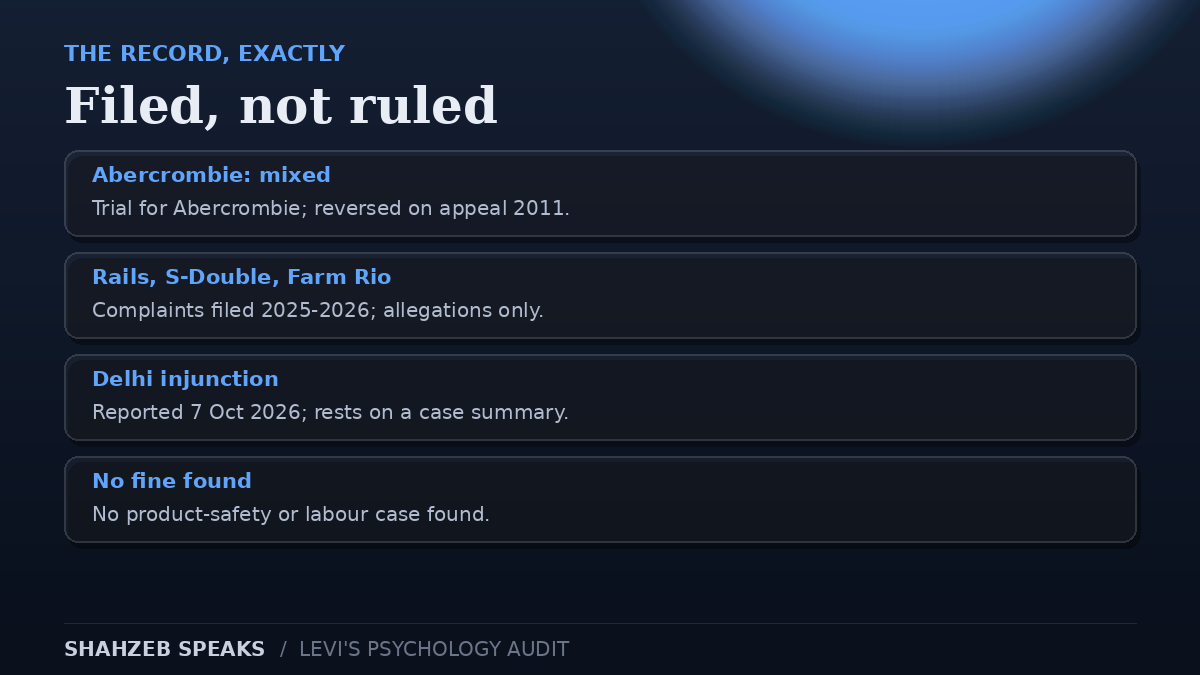
The landmark case is Levi Strauss & Co. v. Abercrombie & Fitch, over the Arcuate back-pocket stitch. Levi’s sued in 2007, alleging Abercrombie’s “Ruehl” back-pocket stitching diluted the famous Arcuate mark. On 22 December 2008 a jury returned a verdict in Abercrombie’s favour on the infringement and unfair-competition claims, and on 22 April 2009 the district court entered findings for Abercrombie on the dilution claim, holding the Ruehl design was not “identical or nearly identical” to the Arcuate mark. On 8 February 2011 the US Court of Appeals for the Ninth Circuit reversed and remanded, holding the district court had applied the wrong legal standard — the Trademark Dilution Revision Act does not require the junior mark to be identical or nearly identical to the famous mark. On 18 June 2013 the US Court of Appeals for the Federal Circuit reversed the Trademark Trial and Appeal Board’s dismissal of Levi’s opposition proceedings against Abercrombie’s mirror-image stitching registrations. The final outcome of the dispute after the 2011 remand was not verified in this research, so I do not print that Levi’s “won” or “lost” the case overall. What is verified is a mixed record: a loss at trial, a reversal on appeal, and a second reversal in the trademark office proceedings.
Three newer complaints are all at the allegation stage. On 24 October 2025 Levi’s filed a complaint against Rails International, alleging Rails misappropriated the Tab trademark and was planning to use a pocket-stitching design that would infringe the Arcuate trademark; no ruling was found. On 5 June 2026 Levi’s filed a complaint against S-Double Corporation and Globe International, alleging S-Double resumed selling apparel bearing tabs nearly identical to those at issue in a 2010 lawsuit and a 2011 settlement agreement, and that Levi’s had notified the defendants of its claims in March 2026; no ruling was found. On 11 June 2026 Levi’s filed a complaint against Farm Rio, alleging Farm Rio misappropriated the Tab trademark; no ruling was found. In January 2026 Levi’s also filed actions in Illinois against unnamed e-commerce operators, alleging they sold counterfeit Levi’s products through online stores targeting US consumers; those are allegations only. Separately, a case summary reports that a Delhi court granted a permanent injunction on 7 October 2026 in a counterfeiting case against defendants who allegedly manufactured and sold counterfeit garments bearing the LEVI’S, Two Horse and Arcuate marks — but that report rests on a secondary case summary, not the court order itself, so I phrase it as reported, not as a verified final fact.
No product-safety case, labour-standards case, regulatory fine or settlement against Levi Strauss & Co. was found in this research, and I do not invent one. The honest reading of the record is that Levi’s defends its marks aggressively, that its most famous case produced a mixed result rather than a clean win, and that its recent enforcement is a pattern of filings whose outcomes are still unknown. A brand that has spent 150 years building small marks — a red Tab, a stitch, a patch — will spend a great deal defending them. That is rational. It is also a cost, in goodwill as well as legal fees, and it is the reason the scorecard marks the legal record below the brand’s creative scores.
📊 Psychology Scorecard
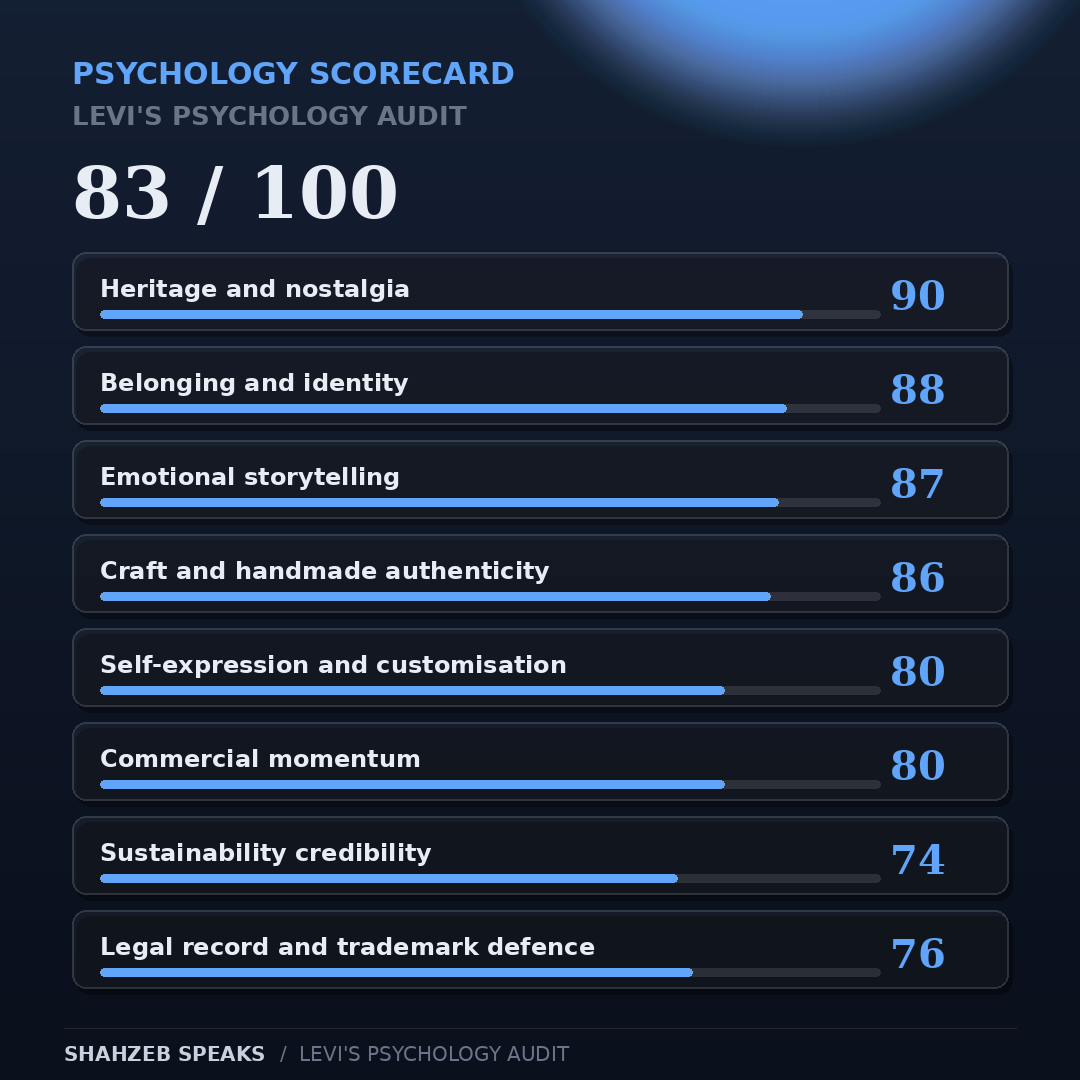
| Dimension | Score | Verdict |
|---|---|---|
| Heritage and nostalgia | 90 | A 173-year archive, re-staged rather than retired. |
| Belonging and identity | 88 | The 501 is a uniform and a statement at once. |
| Emotional storytelling | 87 | Gus the yeti names a universal fear and resolves it. |
| Craft and handmade authenticity | 86 | Four hours per second, visible in every frame. |
| Self-expression and customisation | 80 | Tailor Shops and SecondHand make effort part of the product. |
| Commercial momentum | 80 | Q3 growth is real; tariff refunds flatter the margin. |
| Sustainability credibility | 74 | Real targets and one honest miss; still mostly company claims. |
| Legal record and trademark defence | 76 | Defends its marks hard; the landmark case was mixed. |
Arithmetic: 90 + 88 + 87 + 86 + 80 + 80 + 74 + 76 = 661. 661 ÷ 8 = 82.625, rounded to 83/100.
✅ Balance sheet & prescription
What Levi’s does best is turn a feeling into a product without ever saying the feeling out loud as a sales pitch. Belonging is the platform, heritage is the proof, craft is the evidence, and the 501 is the uniform that lets a customer wear all three at once. What it does worst is the same thing every heritage brand risks: confusing the archive with the future, and confusing a filed complaint with a victory. The prescription follows that balance. First, publish a real effectiveness measure for “Let’s Get Fuzzy” — reach, recall or sales attribution — rather than letting trade press fill the gap with adjectives. Second, settle the premium question openly: say who the $10 billion brand is for, and what happens to the customer who cannot follow the price up. Third, keep the sustainability reporting as honest as the missed water target was — a missed goal reported plainly is worth more than a new target announced loudly. Do those three things and the yeti earns his sweater. Without them, the brand remains a beautiful archive with a price ladder it has not fully explained.
📝 Final Verdict
Levi’s has understood something most fashion brands forget: people do not buy jeans, they buy membership. The 501 has been a uniform for rebels, activists, pop stars and office workers, and “Let’s Get Fuzzy” is the same idea in a new costume — an outsider handed a sweater and welcomed in. Its weakness is not creativity but candour: a premium ambition that has not yet said who it leaves behind, sustainability claims that still rest on the company’s own word, and a legal record that is more mixed than the brand’s confidence suggests. Fix the candour, keep the craft, and this is a brand that will deserve the belonging it sells.
Psychology Score: 83/100 — A 173-year-old belonging machine, told with rare warmth and craft, held back by a premium ambition it has not fully explained and a legal record more mixed than its confidence suggests.
If your brand sells belonging, the psychology of the decision matters more than the polish of the product. I audit that decision journey — get in touch here.
Related audits: IKEA — The Maze, the Meatballs and the Furniture You Love Because You Built It, Zara — The Scarcity Machine of Fast Fashion, and Rolex — The Watch You Have to Wait For. See also industrial psychology in Pakistan.
📚 References & Sources
- Levi Strauss & Co. (2026). “Let’s Get Fuzzy” Holiday 2026 campaign page, 2 November 2026.
- Levi Strauss & Co. (2026). Third quarter fiscal 2026 results press release, 7 October 2026.
- Levi Strauss & Co. (2026). Fourth quarter fiscal 2025 results press release, 28 January 2026.
- Levi Strauss & Co. (2025). Form 10-K for the fiscal year ended 1 December 2024.
- Levi Strauss & Co. (2024). REIIMAGINE campaign page, 29 September 2024.
- Levi Strauss & Co. (2026). Levi’s Regenerative and Resilient Landscape Initiative, Pakistan, 16 April 2026.
- Levi Strauss & Co. (2025). 2030 Water Strategy press release, 23 October 2025.
- Levi Strauss & Co. (2026). Completion of the sale of Dockers to Authentic Brands Group, 27 February 2026.
- Marketing Dive (2026). “Levi’s Claymation holiday campaign celebrates handmade craft amid AI bloat”, November 2026.
- ThredUp (2026). 14th Annual Resale Report, research by GlobalData, released 2 April 2026.
- Baumeister, R. F. & Leary, M. R. (1995). The need to belong: Desire for interpersonal attachments as a fundamental human motivation. Psychological Bulletin, 117(3), 497–529.
- Norton, M. I., Mochon, D. & Ariely, D. (2012). The IKEA effect: When labor leads to love. Journal of Consumer Psychology, 22(3), 453–460.
- Tajfel, H. & Turner, J. C. (1979). An integrative theory of intergroup conflict. In W. G. Austin & S. Worchel (Eds.), The Social Psychology of Intergroup Relations. Brooks/Cole.
- Levi Strauss & Co. v. Abercrombie & Fitch Co., 633 F.3d 1158 (9th Cir. 2011); Levi Strauss & Co. v. Abercrombie & Fitch Trading Co., No. 12-1495 (Fed. Cir. 18 June 2013).
- Levi Strauss & Co. v. Rails International LLC, No. 25-cv-09175 (N.D. Cal., filed 24 October 2025); Levi Strauss & Co. v. S-Double Corp., No. 26-cv-05462 (N.D. Cal., filed 5 June 2026); Levi Strauss & Co. v. Farm Rio, No. 26-cv-05661 (N.D. Cal., filed 11 June 2026).
Key Findings
- Founded 1853 in San Francisco; patent No. 139,121 granted 20 May 1873 (Strauss & Davis); 501 lot first used c.1890; red Tab 1936, registered 1938; sold in approximately 120 countries; 1,276 company-operated stores at 1 December 2024.
- FY2024 revenue $6,355.3 million; Levi's brand 89% of revenue. Q3 FY2026 revenue $1,610 million, up 4% reported / 5% organic (quarter ended 30 August 2026); DTC 45% of total revenue; e-commerce up 10%.
- "Let's Get Fuzzy" launched globally 2 November 2026: 60-second Claymation film starring Fuzzyeti "Gus"; 4 hours of filming per second; no AI used in the filming process (per the brand); a callback to "Clayman" (1995).
- REIIMAGINE launched 30 September 2024 with Beyoncé; four chapters to August 2025; limited-edition tees drop May 2025. No verified sales figure exists in a primary source.
- Legal record: Abercrombie — district court ruled FOR Abercrombie (2008-2009); Ninth Circuit REVERSED and remanded 8 February 2011; Federal Circuit reversed the TTAB dismissal 18 June 2013; final outcome after remand NOT verified. Rails (filed 24 October 2025), S-Double (filed 5 June 2026) and Farm Rio (filed 11 June 2026) complaints are ALLEGED / FILED ONLY; no ruling was found. A Delhi permanent injunction reported 7 October 2026 rests on a secondary case summary, not the court order.
- Score 83/100: 90+88+87+86+80+80+74+76 = 661; 661/8 = 82.625, rounded to 83.
Overall Psychology Score
Levi's scores 83/100 in our comprehensive psychology audit covering consumer behavior strategies, UX design principles, and psychological marketing effectiveness.
The detailed dimension scores are in the audit's Psychology Scorecard chapter.
High impactMuhammad Shahzeb
MSc Industrial Psychologist, specializing in consumer behavior, UX psychology, and brand strategy analysis. Helping brands understand the psychology behind their success.
About Muhammad Shahzeb →