Rolex Psychology Audit — The Watch You Have to Wait For
Rolex sells no new watch online, publishes no waiting list, and discloses no sales figures — yet demand never cools. Allocation, craft and resale explain the wait. Score: 82/100. See scorecard.

82 / 100
Overall consumer behavior effectiveness

Brand Overview
- Brand nameRolex
- Founded1905
- HeadquartersGeneva, Switzerland
- IndustryFashion & Apparel
- Websitewww.rolex.com ↗
Psychology Techniques Identified
- 01Scarcity & Structural Supply Constraint (One Million Estimated a Year, Steel Sports Shortfall)
- 02Earned Access & Allocation (Retailer-Managed Lists, No Published Queue)
- 03Effort Justification (Years of Waiting as Investment)
- 04Goal-Gradient Behaviour (Investment Accelerates Near the Offer)
- 05Veblen Status & Conspicuous Consumption (Price as Proof, Recognised Without a Logo)
- 06Endowment & Resale Premium (Ownership That Holds Value Above Retail)
- 07Social Proof & Identity Signalling (Explorers, Pilots, Drivers — the Professional Lineage)
- 08Loss Aversion & Fear of Losing the Relationship (Kahneman & Tversky)
- 09Reactance (Restricted Access Increases Desire)
- 10Authority & Heritage Anchoring (1905, Geneva, Chronometer Certificates)
- 11Extended Self & Belonging (The Watch as Biography Object)
- 12Investment Framing & Speculative Demand (Secondary Market as Advertising)
Full Psychology Audit Report
In this audit
Walk into a Rolex shop with money in your pocket and you may still leave empty-handed — not because the shop is closed, but because the watch you want is not for sale to you, today, at any price the shop will name. Rolex is the purest scarcity machine in luxury: a company that sells no new watch online, publishes no waiting list, discloses no sales figures, and still has customers begging to be allowed to buy. This audit scores that machine 82/100 — brilliant at desire, weaker at openness, and tested in October 2026 by two stories it did not choose.
I am an Industrial and Organizational Psychologist in Karachi, and I audit brands by the psychology they actually use, not the advertising they prefer you to notice. Rolex is a useful case because its psychology is almost entirely structural: there is no celebrity endorsement at the centre of the story, no viral campaign to point to, no discount to decode. The desire is built into how the product is made, how it is certified, how it is allocated, and how it is resold. That makes it easier to see — and easier for other brands to misunderstand when they try to copy it.
“Rolex does not sell you a watch. It sells you the right to wait for one — and the wait is the product.” — Brand Psychology Analysis, ShahzebSpeaks
📋 Brand Overview: Rolex at a Glance
| Field | Detail |
|---|---|
| Brand | Rolex |
| Founded | 1905, London, as Wilsdorf & Davis; Rolex name registered 1908 |
| Headquarters | Geneva, Switzerland (moved from London in 1919) |
| Owner | Hans Wilsdorf Foundation, a private Swiss charitable foundation, since 1960 |
| Website | https://www.rolex.com |
| Signature products | Oyster Perpetual, Datejust, Submariner, GMT-Master II, Daytona, Day-Date |
| Sales model | New watches exclusively through Official Rolex Retailers; no direct online sale of new watches |
| Certification | Superlative Chronometer: -2/+2 seconds per day after casing; five-year international guarantee |
| Psychology score | 82/100 |
📜 Chapter 1: The History — a wristwatch nobody wanted, made unavoidable
Hans Wilsdorf was 24 when he founded Wilsdorf & Davis in London in 1905, distributing timepieces at a moment when respectable men wore pocket watches and wristwatches were considered feminine. His bet was unfashionable and precise: the wristwatch would win if it could be made accurate and reliable enough to trust. The company registered the name Rolex in 1908 — short, pronounceable in any language, and small enough to fit on a dial — and moved to Geneva in 1919, into the heart of Swiss watchmaking. The foundation of the modern brand was laid in two inventions. The Oyster case of 1926 was the first waterproof watch case, and the Perpetual rotor of 1931 was the first reliable self-winding mechanism for wristwatches. Together they removed the two objections that had kept wristwatches a novelty: water and winding.
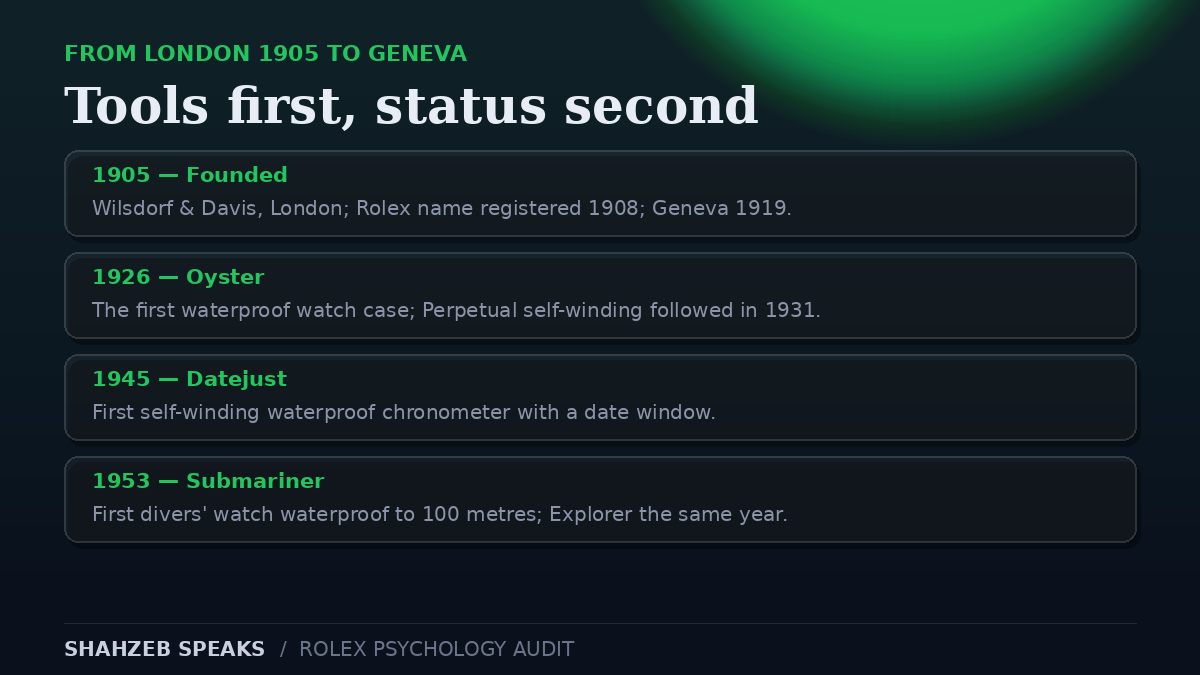
Wilsdorf understood something his competitors did not: proof beats promise. In 1910, a Rolex wristwatch became the first wristwatch to receive the Swiss Certificate of Chronometric Precision from the Official Watch Rating Centre in Bienne. In 1927, swimmer Mercedes Gleitze wore an Oyster across the English Channel, and Wilsdorf bought a full-page newspaper advertisement for the result the next day. The 1950s then produced the professional catalogue that still defines the brand: the Explorer and Submariner in 1953 — the Submariner the first divers’ watch waterproof to 100 metres, with a rotating bezel for immersion time — the GMT-Master in 1954 for Pan Am pilots crossing time zones, and the Day-Date in 1956, the first watch to show the day of the week spelt out in full. Each was a tool first and a status object second, and that order matters: the status Rolex sells today is still borrowed from the tool’s credibility. When Wilsdorf died in 1960, he left the company to the Hans Wilsdorf Foundation, a private charitable foundation. Rolex has therefore never had to answer to public shareholders, report quarterly earnings, or explain a bad year to a market. That privacy is not a footnote. It is the structural condition that lets the rest of the machine run without disclosure.
⏳ Chapter 2: Scarcity — real, structural, and impossible to fake convincingly
Scarcity is the most copied and most misunderstood principle in marketing, because most brands fake it: a countdown timer, a “limited edition” of 50,000, a sale that never ends. Rolex scarcity is different in kind, because it is structural rather than theatrical. The company produces roughly one million watches a year, according to widely repeated secondary estimates — a figure Rolex itself does not disclose, and this audit treats as an estimate, not a company fact. Even at that scale, demand for certain steel models has outstripped supply for the better part of a decade, and the shortfall is concentrated exactly where desire is highest: steel sports models such as the Submariner, the GMT-Master II and the Daytona. The scarcity is therefore not a single lever the company pulls. It is the gap between a production system that cannot be scaled overnight — every movement tested, every finished watch certified — and a demand system that grows every time a watch is seen on a wrist that matters.
That gap creates the psychology that follows. When a product cannot be bought on demand, it stops being a purchase and becomes a pursuit, and pursuits change how people value things. The effort spent waiting, visiting, and building a relationship with a retailer is not wasted time from the customer’s point of view; it is investment, and investment creates attachment. Psychologists call this effort justification: the more we work for something, the more we value it, because devaluing it would mean admitting the effort was wasted. Rolex never has to manufacture this effect with a marketing campaign. The allocation system manufactures it for free, every day, in every shop. The risk for imitators is obvious: artificial scarcity without a real production constraint or a real demand surplus reads as manipulation, and customers can tell the difference. Rolex scarcity works because it is, at least in part, genuinely hard to make the thing and genuinely easy to want it.
🎟️ Chapter 3: Earned access — allocation as the world’s quietest loyalty programme
Here is the strangest fact about buying a Rolex, and the one most coverage gets wrong. There is no central Rolex waiting list. Rolex’s own position, as reported by its retailers, is that Official Rolex Retailers receive regular deliveries and independently manage the allocation and sale of watches to customers. In practice, the “waitlist” is a dealer-level record of interest: you tell a shop which exact reference and configuration you want, the shop records your interest, and when a watch arrives, the shop decides who is offered it. There is no published queue position, no universal waiting-time table, and no guarantee of an eventual allocation. Dealer guidance for sought-after steel models runs from months to several years, or no guaranteed allocation at all.
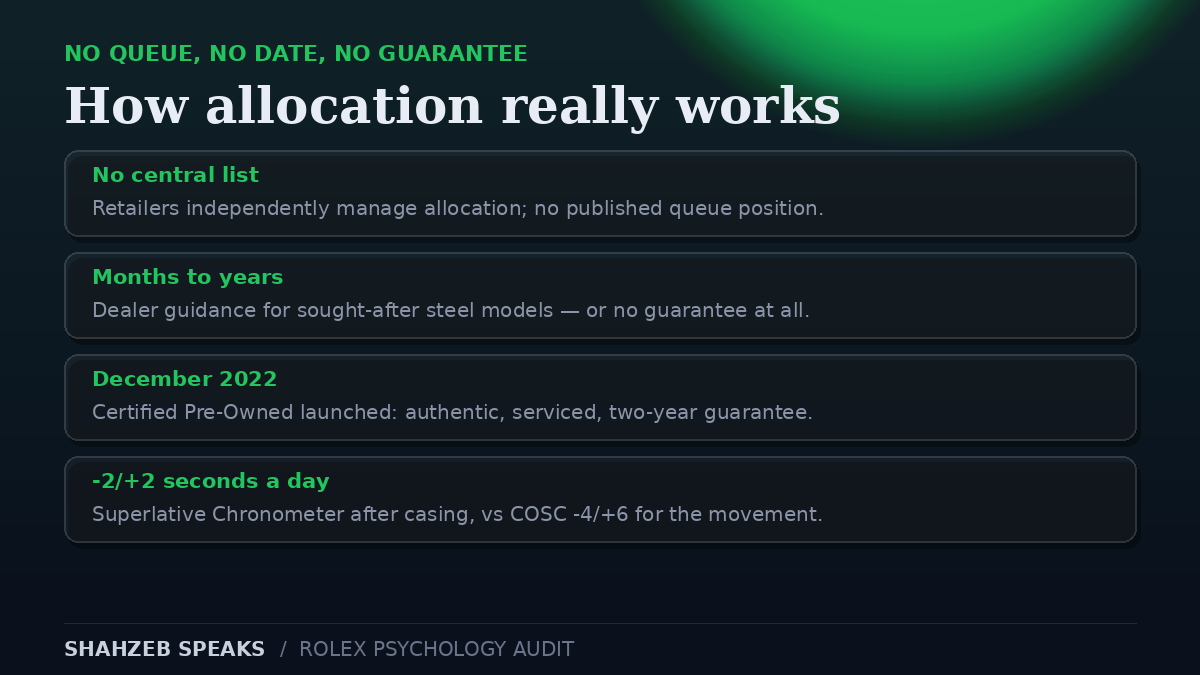
Read as psychology, this is a loyalty programme with no card, no points and no published rules — and that opacity is doing real work. First, it creates a goal-gradient effect: the closer a customer feels to an allocation, the more they invest in the relationship, visiting, buying other pieces, and signalling that they will wear rather than flip the watch. Second, it creates loss aversion around the relationship itself: once you have spent a year building standing with a retailer, walking away means losing that standing, so you stay. Third, it creates reactance: being told, in effect, that you cannot have the thing yet increases desire for it, especially when the barrier feels personal rather than commercial. The system is also, frankly, unfair in ways a published queue would not be: allocation depends on the individual shop, the individual salesperson, and the customer’s history with that shop, so two equally keen buyers can have entirely different experiences. Rolex does not publish rules that would let anyone check whether the system is fair. That is a deliberate choice, and it costs the brand in the scorecard below.
The official escape valve arrived in December 2022 with Rolex Certified Pre-Owned. Official retailers can now sell previously worn Rolex watches that Rolex has certified as authentic and fully serviced, with a two-year Rolex guarantee from the date of resale. It is the only way to buy a used Rolex with Rolex itself standing behind it, and it solves the timing problem without solving the allocation problem: a certified pre-owned watch is a different product path from a new-watch allocation, it does not guarantee your configuration, and it typically costs more than retail for the sought-after references. For Rolex, the programme is elegant: it captures part of the secondary market it used to watch from outside, it puts authentication under its own roof, and it does so without loosening the new-watch queue at all.
🪡 Chapter 4: Craftsmanship and certification — the -2/+2 seconds that justify everything
Every Rolex is a Superlative Chronometer, and the numbers behind that phrase are doing heavy psychological work. The movement is first sent for official COSC certification, which requires -4/+6 seconds per day for the uncased movement. After casing, Rolex tests the finished watch to its own tighter standard of -2/+2 seconds per day, and couples the green seal that denotes the status with a five-year international guarantee. The certification also covers waterproofness, self-winding and power reserve, tested by methods Rolex says simulate real wear. Two honest caveats belong here, and the audit keeps them in the open. First, the post-COSC testing is Rolex’s own, conducted with its own equipment and methods, and is not validated by an external authority; the individual results for a given watch are not published. Second, the -2/+2 figure describes the watch as it leaves the factory; shock, magnetism, wear and ageing lubricants can change performance afterwards. Neither caveat destroys the claim. Together they define it accurately: a demanding factory standard, self-certified, that is roughly twice as tight as the industry chronometer norm.
Why does a number as small as two seconds matter? Because it is the moral licence for everything else in this audit. A customer who waits two years, pays a premium, and defends the purchase to sceptical friends needs a reason that is not only “everyone wants one”. The certification gives them one: this object was tested, twice, to a standard most watches never meet, and the company guarantees it for five years. That is effort justification in its most respectable form — visible, measurable craft that makes the wait feel rational rather than vain. It is also authority anchoring: a century of chronometer certificates, an Everest expedition equipped with Oyster Perpetuals in 1953, and a green seal together tell the customer that the status is earned by the object, not merely conferred by the crowd. Brands that copy Rolex scarcity without copying Rolex testing end up with the queue and none of the justification, and customers notice the difference within a generation.
💎 Chapter 5: Veblen and status — when being recognised without a logo is the point
Thorstein Veblen’s 1899 argument was that some goods are valued partly because they are expensive: price itself signals standing. Rolex is the textbook case, with a twist that makes it stronger than most Veblen goods. A Rolex is recognisable without a logo. The fluted bezel, the Cyclops date lens, the Oyster bracelet, the Mercedes hands on a Submariner — these are signals readable by people who know watches, and nearly invisible to people who do not. That two-level signalling is psychologically ideal: the wearer gets recognition from the group whose opinion matters, without the vulgarity of a visible brand name that would embarrass them in front of everyone else. It is status for insiders, discretion for outsiders, and it is why Rolex survives fashion cycles that kill louder luxury brands.
The extended self completes the mechanism. Psychologists use that term for the way possessions become part of how we see ourselves, and a watch is an unusually intimate example: worn daily, on the wrist, against the skin, for decades, often inherited. A Rolex bought at a milestone — a promotion, a wedding, a retirement — stops being a timekeeper and becomes a biography object, and biography objects are almost never resold lightly. That is why the resale market, covered next, does not undermine the brand the way discounting would: owners who sell are usually selling a different watch from the one they wear, and the watch they wear has become part of who they are. The brand’s refusal to discount, advertise price, or sell online protects this mechanism. A discounted Rolex would be a cheaper signal; a Rolex bought in a click would be a less storied one. The friction is the feature.
📈 Chapter 6: Endowment and the resale market — owning as investing
Rolex is one of the few consumer products where ownership can feel like an investment, and that feeling reshapes behaviour at every stage. The endowment effect — people value something more once they own it — is amplified here because the secondary market gives the feeling a price. A steel Daytona or GMT-Master II that cannot be bought at retail can often be bought immediately from a specialist dealer at a premium over list, and dealer commentary in October 2026 illustrated the scale with indicative figures — about 27% over list for an Explorer II and about double for a steel Daytona at two large US pre-owned dealers. Those are dealer-blog figures, not a market index, and this audit does not present them as one; but the direction they illustrate is real and widely reported: for the hardest references, the secondary price sits above retail, so buying at retail feels like gaining money, and owning feels like holding an asset.
That feeling has a dark twin, and the audit does not hide it. When a product trades above retail, flippers enter: buyers whose aim is not to wear the watch but to resell it, which is exactly why retailers probe whether a customer intends to wear the piece. The allocation system is partly a defence against flipping, and it is an imperfect one, because any system that rewards relationship and history also rewards those best at performing relationship and history. The grey market — independent dealers selling new, unworn watches sourced from authorised retailers — exists because the allocation gap exists, and it charges for immediacy what the retailer will not charge for the watch itself. Rolex Certified Pre-Owned is the brand’s answer to the grey market’s authentication problem, but it cannot answer the price problem, because the price problem is the scarcity problem, and the scarcity problem is the brand. A brand that solved it would destroy the desire that built it. That paradox is the whole audit in one sentence.
👥 Chapter 7: Social proof and identity — the wrist that everyone photographs
Social proof for Rolex works differently from social proof for most brands, because the brand barely advertises in the conventional sense and yet is everywhere. It is on the wrists of explorers, racing drivers, tennis players, film characters and heads of state — not because Rolex bought those wrists, but because a century of tool-watch credibility made the watch the default choice for people whose work is photographed. Each sighting is a testimonial the brand did not have to script, and each one reinforces the same message: serious people, doing serious things, wear this. The mechanism is identity signalling at scale. Wearing a Submariner does not say “I am rich” as crudely as a logo bag does; it says “I belong to the group that knows what this is”, and that group includes everyone from divers to dealmakers, which is a remarkably broad church for a single object.
The risk of this mechanism is that it depends on the group staying admirable. When a status object becomes associated mainly with speculation, or with a narrow social set, the signal curdles: it starts to say “I bought the hype” rather than “I earned the tool”. Rolex has so far avoided that fate, largely because the professional watches still have a genuine professional lineage and because the brand refuses to chase trends — no smartwatch, no fashion collaboration of the month, no rebrand. Conservatism is a psychology strategy here, not a lack of imagination. A brand whose models change slowly tells customers that today’s purchase will still be recognisable in twenty years, which is exactly what a biography object needs to be. The same conservatism, though, makes the brand slow to answer the criticisms in the next chapters, because answering would mean changing a formula that has worked for decades.
😨 Chapter 8: Loss aversion and reactance — the fear of never being offered
Loss aversion, from Kahneman and Tversky’s prospect theory (1979), is the finding that losses weigh more heavily than equivalent gains, and it operates in the Rolex queue in a form most customers do not notice. The loss is not the watch. The loss is the relationship, the standing, the years of visits that would be wasted if you walked away, and the possibility that the offer, if it ever comes, will go to someone else. Once a customer has waited a year, the wait itself becomes a reason to keep waiting, because quitting would convert a long investment into a certain loss. Reactance adds the second force: restricted access increases desire, especially when the restriction feels like a judgement about you rather than a fact about supply. A customer told “not yet” by a specific salesperson in a specific shop hears something more personal than “out of stock”, and the desire sharpens accordingly.
None of this is a criticism of the customer. It is the normal machinery of human motivation, operating in a system designed — whether by intention or by accumulation — to trigger it at every step. The audit’s judgement is narrower: a system that relies this heavily on loss aversion and reactance owes its customers transparency about the rules, because opacity turns a fair queue into a relationship contest. Rolex publishes no allocation rules, no queue positions and no waiting-time tables, so a customer cannot tell whether their wait is normal, whether the shop is treating them fairly, or whether a different shop would treat them better. The brand’s answer, in effect, is trust us. For a company that certifies its watches to two seconds a day, that is a strikingly unmeasured promise about its own sales process.
🏛️ Chapter 9: Authority and heritage anchoring — 1905 does quiet work
Heritage is the quietest lever in this audit and one of the strongest. The date 1905, the Geneva address, the foundation ownership, the century of chronometer certificates — none of these is advertised loudly, and all of them do work every time a customer justifies the price to themselves or to someone else. Authority anchoring works because it transfers trust: a company that has survived two world wars, the quartz crisis that destroyed most of Swiss watchmaking in the 1970s, and the smartwatch wave without abandoning mechanical watches has earned a presumption of permanence that a new brand cannot buy. The foundation ownership reinforces it. A company owned by a charitable foundation cannot be bought, cannot be taken over, and does not have to maximise next quarter’s sales, so its promise to still be servicing your watch in thirty years is structurally credible in a way a listed company’s promise is not.
The same heritage, however, creates a blind spot. A brand anchored in 1905 can struggle to answer questions that did not exist in 1905: about supply-chain transparency, about who gets allocated watches and why, about the environmental cost of luxury production, and about whether a waitlist that rewards existing customers systematically excludes new ones. Rolex publishes little on these questions, and its privacy — the same privacy that protects it from shareholders — also protects it from scrutiny. Heritage is therefore both the brand’s deepest asset and its most convenient shield, and the scorecard marks it accordingly: near-perfect for story, much weaker for openness.
📉 Chapter 10: The October 2026 test — two stories Rolex did not choose
October 2026 gave Rolex two news moments it did not seek, and both are useful tests of the machine because neither was a product launch. On 14 October 2026, the Business of Fashion reported that Switzerland’s trade chief, Helene Budliger Artieda, had described a Rolex table clock and an engraved gold bar presented to President Trump by a Swiss business delegation as “a gift to the American people”, after the gifts became a matter of national controversy in Switzerland over relief from US tariffs. No allegation of wrongdoing by Rolex is contained in that reporting, and this audit makes none: the story matters here because it shows how a Rolex object functions as diplomatic currency — a gift whose value is instantly understood, in any capital, without explanation. That is status signalling at the level of states, and it is free advertising no campaign could buy.
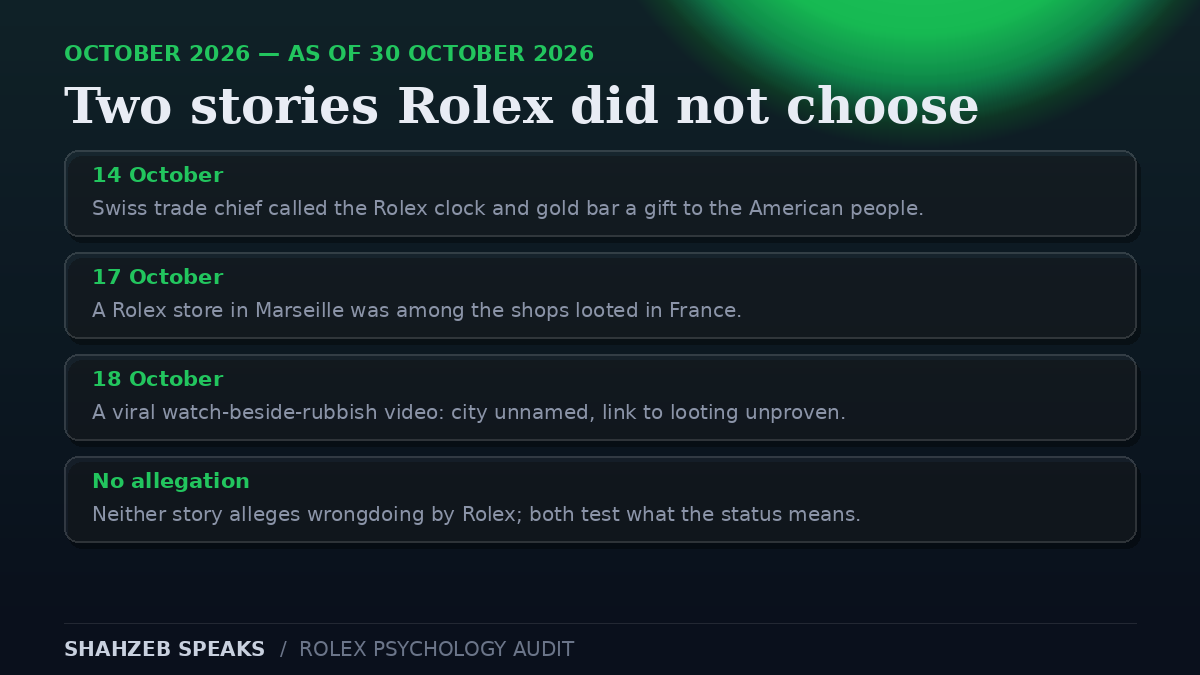
Three days later, on 17 October 2026, nationwide protests in France over living costs and school conditions turned violent, and a Rolex store in Marseille was among the shops looted, alongside Hermès and other luxury outlets in Paris and Bordeaux. A viral video shared on 18 October 2026 appeared to show a passer-by picking up a brand-new watch from beside a pile of rubbish; the video does not name the French city where it was filmed, nothing in it ties the watch to a looted shop, and viewers disputed whether it was staged. This audit reports the video as reported and unresolved, not as fact. What the episode reveals, regardless of the video’s authenticity, is the other side of Veblen status: a luxury object in a moment of social anger becomes a symbol of inequality, and a shop window becomes a target. A brand that sells status cannot be surprised when status is contested, and the Marseille looting is a reminder that the same visibility that makes Rolex desirable also makes it visible in the worst moments. Neither October story damages the allocation machine directly. Together they show its exposure: the brand’s value depends on a social consensus that a Rolex means achievement, and that consensus is not entirely in the brand’s control.
⚠️ Chapter 11: The dark side — counterfeits, the grey market, and the opacity problem
The dark side of Rolex is not a single scandal. It is a set of structural problems the brand’s own success creates, and the audit states each at its exact status as of 30 October 2026. Counterfeits are the oldest problem: Rolex is among the most copied brands in the world, and high-quality copies now reproduce weight, movement architecture and finishing closely enough to fool casual buyers. No verified seizure or volume figure is printed here, because none was verified for this audit; the point does not need a number. The counterfeit problem is the shadow of the status mechanism: the more a watch signals, the more incentive there is to fake the signal, and every fake that circulates dilutes the signal for genuine owners. Rolex Certified Pre-Owned is a genuine answer to authentication for used watches, but it does not help a buyer who meets a convincing fake outside the official network.
The grey market is the second problem, and it is a problem Rolex creates by its own allocation policy. When authorised retailers cannot supply demand, independent dealers fill the gap at a premium, and the brand loses control of price, presentation and customer experience at exactly the moment of highest desire. Opacity is the third problem, and it is the one Rolex could fix most easily and chooses not to: no published allocation rules, no queue transparency, no sales disclosure, no explanation of how a customer earns an offer. No court has ruled that this opacity is unlawful, and no regulator is reported to have ordered Rolex to change it as of 30 October 2026; the audit alleges no legal violation. The criticism is commercial and ethical, not legal: a system that asks customers to invest years of loyalty should tell them the rules of the game. Finally, exclusion: a system that rewards existing relationships systematically advantages people who already own luxury watches, live near authorised retailers, and can afford to buy other pieces while waiting. That is not a legal finding either. It is a fairness question, and it is the weakest point in an otherwise formidable machine.
🌍 Chapter 12: What other brands should — and should not — copy
Copy the craft before the queue. Rolex scarcity is credible because the testing is real, the history is real, and the product survives decades of use. A brand that creates a waitlist for a product with no comparable justification will be read, correctly, as manufacturing desire rather than rationing something scarce. If your product cannot justify a wait, do not create one. Copy the conservatism. Slow model changes, no discounting, no chasing trends: these protect the resale value and the identity signal that make a premium product worth its price over time. A brand that discounts to hit a quarterly target teaches its customers to wait for the discount, and that lesson is almost impossible to unteach.
Do not copy the opacity. This is the clearest prescription in the audit. A published queue, a stated allocation principle, or even a rough waiting-time range would cost Rolex little desire and buy it much trust, because the underlying demand is real. Brands copying Rolex should publish the rules of their own scarcity from the start: who gets what, in what order, and why. Transparency does not kill desire when the product is genuinely wanted; it kills resentment, and resentment is what turns a waitlist into a backlash. Do not copy the exclusion. If your allocation system rewards only existing customers, you are building a club, not a market, and clubs shrink. Reserve a visible share of allocation for new customers, or say plainly that you do not, and accept the consequence. Finally, copy the service promise, not just the sale. A five-year guarantee, a certified pre-owned programme with the brand’s own name behind it, and a service network that outlives trends are what turn a purchase into a biography object. Any brand can announce a guarantee. Few can honour it for thirty years. That gap is where Rolex actually lives.
📊 Psychology Scorecard
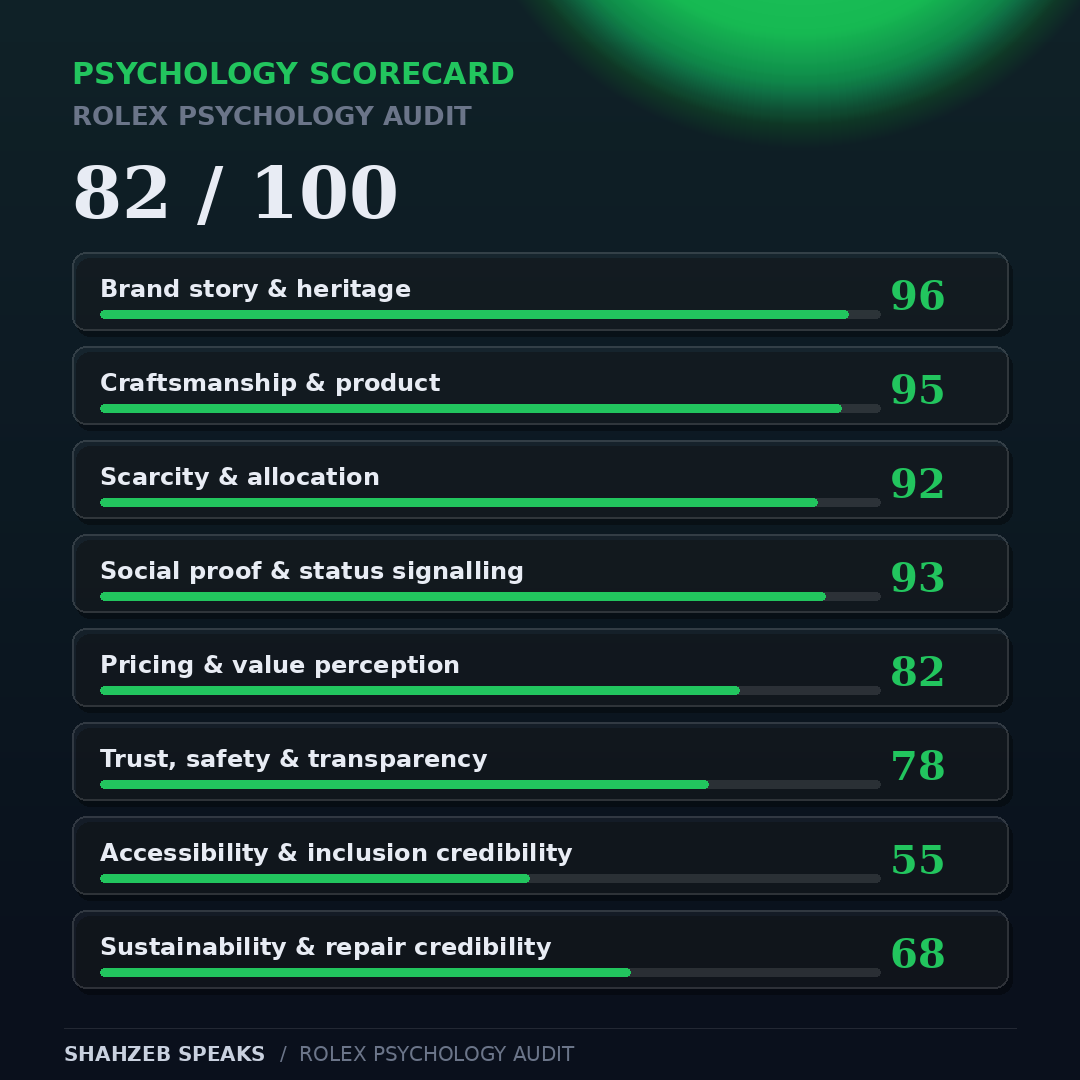
The overall score is the rounded average of eight dimensions. Arithmetic: 96 + 95 + 92 + 93 + 82 + 78 + 55 + 68 = 659; 659 ÷ 8 = 82.375, rounded to 82. The scorecard image matches these figures exactly.
| Dimension | Score | Verdict |
|---|---|---|
| Brand story & heritage | 96 | 1905 to Everest to the foundation: a story no competitor can buy. |
| Craftsmanship & product | 95 | -2/+2 seconds, five-year guarantee, tools that became icons. |
| Scarcity & allocation | 92 | Structural, credible, and ruthlessly effective — and opaque. |
| Social proof & status signalling | 93 | Recognised without a logo; status for insiders, discretion for outsiders. |
| Pricing & value perception | 82 | Resale above retail for hard references; no discounting to dilute it. |
| Trust, safety & transparency | 78 | Certified Pre-Owned helps authentication; allocation rules stay unpublished. |
| Accessibility & inclusion credibility | 55 | A relationship contest that advantages existing owners and nearby buyers. |
| Sustainability & repair credibility | 68 | Longevity and servicing are real; public disclosure on impact is thin. |
| Overall | 82 | A formidable desire machine, marked down for opacity and exclusion. |
✅ Balance Sheet & Prescription
What works: a century of credible craft; certification numbers that justify the price; scarcity that is structural rather than theatrical; status signalling that works without a logo; a resale market that rewards ownership; a service and certified pre-owned network that protects the object for decades. What does not: allocation opacity that turns a queue into a relationship contest; systematic advantage for existing customers; thin public disclosure on sales, supply and impact; exposure to counterfeiting and grey-market distortion that the brand’s own success creates. Prescription: publish allocation principles and rough waiting-time ranges; reserve a stated share of sought-after references for first-time buyers; extend Certified Pre-Owned authentication education to every buyer, not only to buyers inside the official network; and report, even in broad terms, on production and servicing capacity, so that scarcity can be judged as a fact rather than suspected as a strategy. None of these steps would end the wait. All of them would make the wait fairer, and fairness is the one thing a desire machine cannot afford to lose.
📝 Final Verdict
Rolex does not need to persuade you to want a Rolex. It needs only to make you wait, and to make the wait feel like proof that the object is worth it. For a century it has done that better than any brand alive, by building the desire into the product, the certification, the allocation and the resale market, rather than into a campaign. The machine’s weakness is the same as its strength: it trusts no one outside its own walls, and it tells its customers almost nothing about how it chooses them. A brand that certifies its watches to two seconds a day should be able to certify its queue to a standard its customers can check. Until it does, the verdict stands.
Psychology Score: 82/100 — The watch you have to wait for, from a brand that has never had to explain the wait.
📬 Waiting for a Rolex, or watching the waitlist from outside?
If you have been through an allocation queue — for a watch or anything else — tell me what the wait did to the value of the thing. Contact me and describe the queue that changed how you wanted something.
For the broader field behind this audit, see my homepage on industrial psychology in Pakistan, and for another luxury scarcity machine, read the Hermès psychology audit and the Supreme psychology audit.
📚 References & Sources
- Rolex history, 1905–1956: founding, Oyster, Perpetual, Datejust, Explorer, Submariner, GMT-Master, Day-Date. Secondary histories summarising Rolex’s own historical accounts.
- Superlative Chronometer certification: COSC -4/+6 seconds per day (movement); Rolex -2/+2 seconds per day after casing; five-year international guarantee.
- Rolex allocation: Official Rolex Retailers independently manage allocation; no central numbered waiting list; no published universal waiting-time table.
- Rolex Certified Pre-Owned: launched December 2022; certified authentic, fully serviced; two-year Rolex guarantee from resale.
- Business of Fashion (14 October 2026). Rolex and Gold Were for US and Not Trump, Swiss Trade Chief Says.
- France unrest reporting (17–18 October 2026): Marseille Rolex store among shops looted; viral video authenticity unresolved.
- Kahneman, D. & Tversky, A. (1979). Prospect Theory: An Analysis of Decision under Risk. Econometrica.
- Veblen, T. (1899). The Theory of the Leisure Class.
- Figures as of 30 October 2026. Rolex discloses no revenue, profit or production figures; none are printed in this audit.
Key Findings
- Founded 1905 in London as Wilsdorf & Davis; Rolex name registered 1908; moved to Geneva 1919; owned by the Hans Wilsdorf Foundation since 1960; headquarters Geneva, Switzerland; official website rolex.com
- Oyster case 1926; Perpetual self-winding 1931; Datejust 1945; Explorer and Submariner 1953 (Submariner waterproof to 100 metres); GMT-Master 1954; Day-Date 1956; Superlative Chronometer -2/+2 seconds per day after casing with a five-year international guarantee
- New genuine watches sold exclusively through Official Rolex Retailers; retailers independently manage allocation; NO central numbered waiting list and NO published universal waiting-time table; dealer guidance from months to several years or no guaranteed allocation for sought-after steel models
- Rolex Certified Pre-Owned launched December 2022: previously worn watches certified authentic and fully serviced by Rolex, with a two-year Rolex guarantee from resale; about one million watches per year is a SECONDARY ESTIMATE, NOT a Rolex disclosure
- October 2026: Business of Fashion 14 Oct 2026 reported the Swiss trade chief described a Rolex table clock and engraved gold bar as a gift to the American people amid a tariff-gift controversy — NO allegation of wrongdoing by Rolex; a Rolex store in Marseille was among shops looted 17 Oct 2026; a viral watch-beside-rubbish video (18 Oct 2026) names no city and nothing in it ties the watch to a looted shop — authenticity UNRESOLVED
- Score 82/100: 96+95+92+93+82+78+55+68 = 659; 659/8 = 82.375, rounded to 82; NO revenue, profit, market-share or current retail-price figure is printed — Rolex is private and discloses none of these
Overall Psychology Score
Rolex scores 82/100 in our comprehensive psychology audit covering consumer behavior strategies, UX design principles, and psychological marketing effectiveness.
The detailed dimension scores are in the audit's Psychology Scorecard chapter.
RevolutionaryMuhammad Shahzeb
MSc Industrial Psychologist, specializing in consumer behavior, UX psychology, and brand strategy analysis. Helping brands understand the psychology behind their success.
About Muhammad Shahzeb →