Supreme Psychology Audit — The Drop That Became a Religion
Supreme turned a $30 brick into a $1,000 resale item and Thursdays into a ritual. Score: 82/100. See scorecard.

82 / 100
Overall consumer behavior effectiveness
Brand Overview
- Brand nameSupreme
- Founded1994
- HeadquartersNew York, USA
- IndustryFashion & Apparel
- Websitewww.supreme.com ↗
Psychology Techniques Identified
- 01Scarcity Drops (Weekly Thursday 11 AM ET Drops, Limited Quantities, No Restock Promise)
- 02Variable Reward & Anticipation (Fixed Day and Hour, Unpredictable Contents)
- 03Social Proof at Scale (Queues, Pop-Up Crowds, Sold-Out Pages)
- 04Identity & Logo Signalling (Box Logo as Extended Self, Shared Code)
- 05Veblen Status & Conspicuous Consumption (Resale Price as Proof of Standing)
- 06Reactance (Removed Freedom to Buy Later, No-Restock Pressure)
- 07Endowment & Collecting (Ownership Premium, Goal-Gradient Set Completion)
- 08Community & Belonging (Skate-Shop Origin, Shared Weekly Ritual, Social Identity)
- 09Authority & Collaboration Halo (Louis Vuitton, Nike, The North Face Standing Transfer)
- 10Loss Aversion & FOMO (Prospect Theory, Fear of Missing the Drop and the Conversation)
- 11Heritage & Origin Anchoring (1994 Lafayette Street Skate Shop Story)
- 12Everyday-Object Reframing (Brick, Oreo and Household Objects as Collectibles)
Full Psychology Audit Report
In this audit
On a Thursday at 11 a.m. Eastern, thousands of people refresh the same page at the same second. Some will get what they wanted. Most will not. By 11:05 the argument has already moved to resale sites, where the price of a T-shirt is being set by people who never intended to wear it. Supreme did not invent desire. It organised it into a weekly appointment, and then it sold the appointment itself — until, in October 2026, a hoodie that never reached the shelves showed what happens when the ritual meets a contract dispute.
I am an Industrial and Organizational Psychologist in Karachi, and I audit brands by the psychology they actually use, not the story they tell about themselves. This audit traces Supreme from a skate shop on Lafayette Street to a brand sold twice for billions, scores the eight dimensions of its psychology, and keeps the October 2026 Tyson dispute at its exact legal status — because the difference between a reported claim and a court finding is the whole story in that chapter.
“Supreme proved that scarcity works best when it is boringly reliable — same day, same hour, same uncertainty — and that a brand built on control of the drop loses control the moment someone else’s name is on the artwork.” — Brand Psychology Analysis, ShahzebSpeaks
📋 Brand Overview: Supreme at a Glance
| Field | Detail |
|---|---|
| Brand | Supreme |
| Founded | April 1994, by James Jebbia |
| Founder | James Jebbia, American-British businessman and fashion designer |
| Current owner | EssilorLuxottica (bought from VF Corporation in 2024) |
| Headquarters | New York, USA |
| Drop model | Weekly Thursday drops at 11 AM ET, in store and online, in limited quantities |
| Revenue | Current standalone revenue is not separately disclosed in sources found; under VF, Supreme contributed $538.9 million in revenue in VF fiscal 2024 (ended 30 March 2024), per VF filing summaries |
| Website | https://www.supreme.com |
One point of method before the history. Supreme rarely explains itself. It gives no detailed sales breakdown, no production numbers and no interviews that settle its strategy. Much of what follows therefore rests on secondary reporting, trade summaries and filing figures, and this audit labels that material as such. Where a number comes from a resale listing or a bid, it is printed as a listing or a bid. Where a legal claim comes from one side’s lawyers, it is printed as that side’s claim. That discipline is not a footnote to this audit. It is the reason the audit can be trusted on the chapters where the evidence is strong.
📜 Chapter 1: The History — a skate shop that learned to sell time
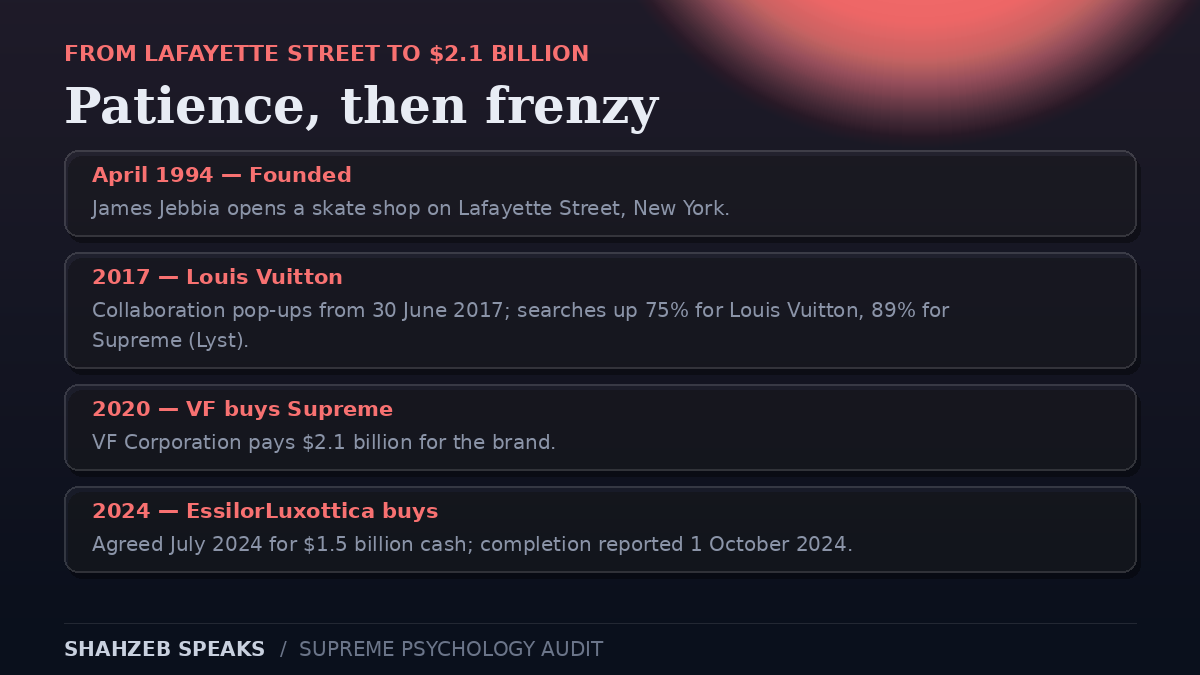
Supreme opened in April 1994 on Lafayette Street in Lower Manhattan. James Jebbia had worked with Shawn Stüssy, and he saw a gap that larger skate brands had missed: in New York, skaters were older than the teenage image in the catalogues, and they wanted clothes that fitted well and looked good. The first store was a former office space with an open floor in the middle so skaters could ride inside, and clothes arranged around the perimeter. The staff included skaters. The shop was a place to be before it was a place to buy, and that order matters for everything that follows.
The red box logo came from an unlikely source. Secondary sources report that Jebbia was inspired by a book on the artwork of Barbara Kruger, whose white text on red blocks became the template for the white Futura Heavy Oblique word on a red box. This audit attributes that link carefully. It is a reported inspiration, not a claim that Kruger designed the logo or endorsed the brand. The irony is real even at that modest level: an artist known for work that questions consumer culture supplied the visual language for one of the most effective consumer brands of the next thirty years.
Growth was slow by modern standards, then sudden. A second store opened in Los Angeles in 2004. London followed in September 2011 and Paris in 2016, with further stores across Asia and Europe in the years after. In 2017 two events changed the brand’s scale at once. The Louis Vuitton collaboration put Supreme on luxury runways and in pop-up queues around the world, and the Carlyle Group was reported to have bought about half the company for about $500 million, in a deal that reports valued at about $1 billion, with one report putting the figure at $1.1 billion including debt. The Carlyle terms were never officially confirmed in the sources found, so this audit prints them as reported. Even as a reported figure, the valuation tells a story: a skate shop was being priced like a luxury house.
VF Corporation bought Supreme in late 2020, closing the deal in December 2020 for $2.1 billion. In July 2024 VF agreed to sell Supreme to EssilorLuxottica, the eyewear group behind Ray-Ban and Oakley, for $1.5 billion in cash, with completion reported on 1 October 2024. VF’s chief executive at the time cited limited synergies with the rest of the group. The price drop from $2.1 billion to $1.5 billion is often read as a verdict on Supreme. It is better read as a verdict on fit. VF’s filing summaries show Supreme contributing $538.9 million in revenue in VF fiscal 2024, which ended on 30 March 2024. A brand generating that level of revenue is not a fading novelty. It is a brand whose owner decided it belonged somewhere else.
⏰ Chapter 2: Scarcity — the principle that runs the whole machine
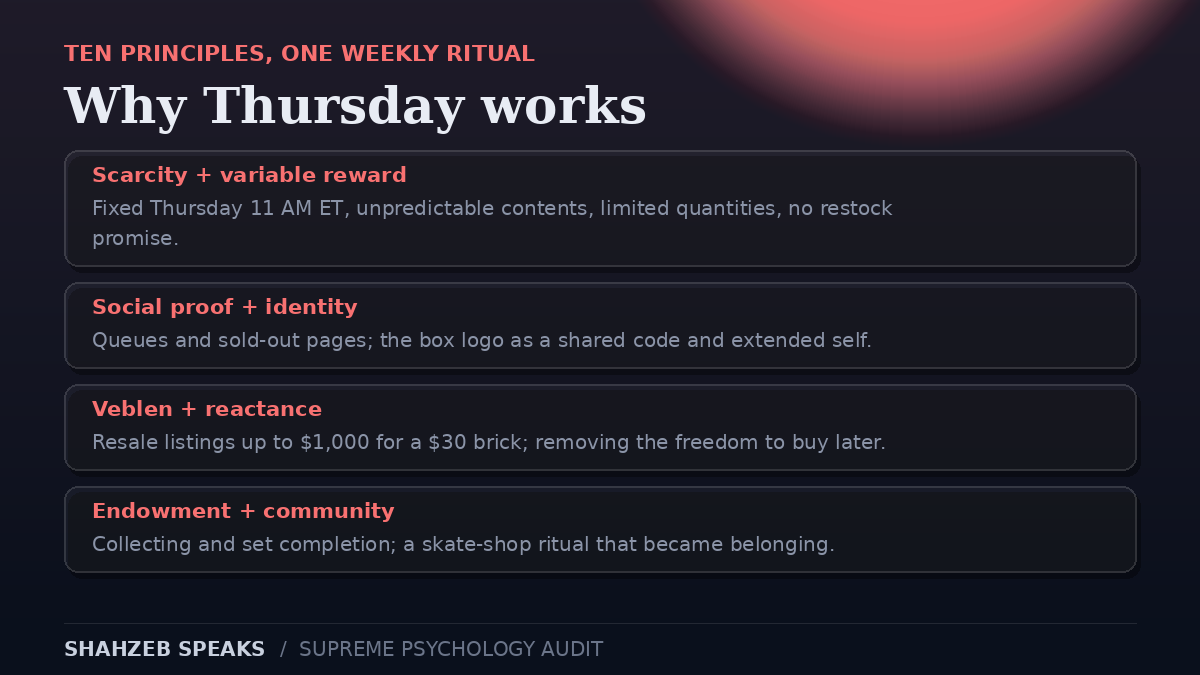
Cialdini’s scarcity principle holds that people value things more when they believe those things are limited or hard to obtain. Supreme is that principle turned into a calendar. Every Thursday at 11 a.m. Eastern, new product appears in limited quantities, in store and online. There is no restock promise to soften the moment. If you miss it, your next chance is the resale market, at a price set by strangers.
The discipline is what separates Supreme from brands that run occasional sales. A sale creates urgency once. A weekly drop creates a habit of urgency. Customers learn the day and the hour the way they learn a television schedule, and they organise their week around it. That regularity is also what makes the scarcity credible. A brand that claims scarcity once a year can be doubted. A brand that sells out most weeks has the evidence on its side, and the customer supplies the rest of the argument.
The brick is the cleanest test of the principle. In autumn 2016 Supreme sold a clay brick, printed with its logo, for $30. It sold out within minutes. Resale listings on the day were reported at up to $1,000. A brick has no function that a cheaper brick lacks. Its value came entirely from the logo and the fact that it was gone. If scarcity alone can sell a brick at thirty-three times its retail price in listings, then scarcity is not a feature of Supreme’s marketing. It is the product, and the clothing is the excuse.
🎲 Chapter 3: Variable reward — why Thursday never gets boring
A fixed reward gets dull. A variable reward does not. In the schedules of reinforcement described by Ferster and Skinner in 1957, behaviour persists longest when the reward arrives unpredictably — sometimes after a short effort, sometimes after a long one, sometimes not at all. Supreme’s drop follows that shape. The day and hour are fixed. The contents are not. A customer may open the page to find a box-logo hoodie, a collaboration, a household object, or nothing they want at all.
That mix is why the weekly check survives weeks when a customer buys nothing. The customer is not only shopping. The customer is checking whether this is the week. Anticipation does work that advertising cannot buy, because it is generated by the customer, on the customer’s own time, for free. Each Thursday that ends in disappointment still teaches the customer to return next Thursday, because the next drop might be the one.
There is a cost to this design. Variable reward keeps people checking, and checking costs attention. It trains a customer to treat a purchase as a win rather than a decision. Supreme gives customers little way to opt out of the game: no waiting list guarantees a fair turn, and no published production number lets a customer judge their real odds.
👥 Chapter 4: Social proof — the queue is the advertisement
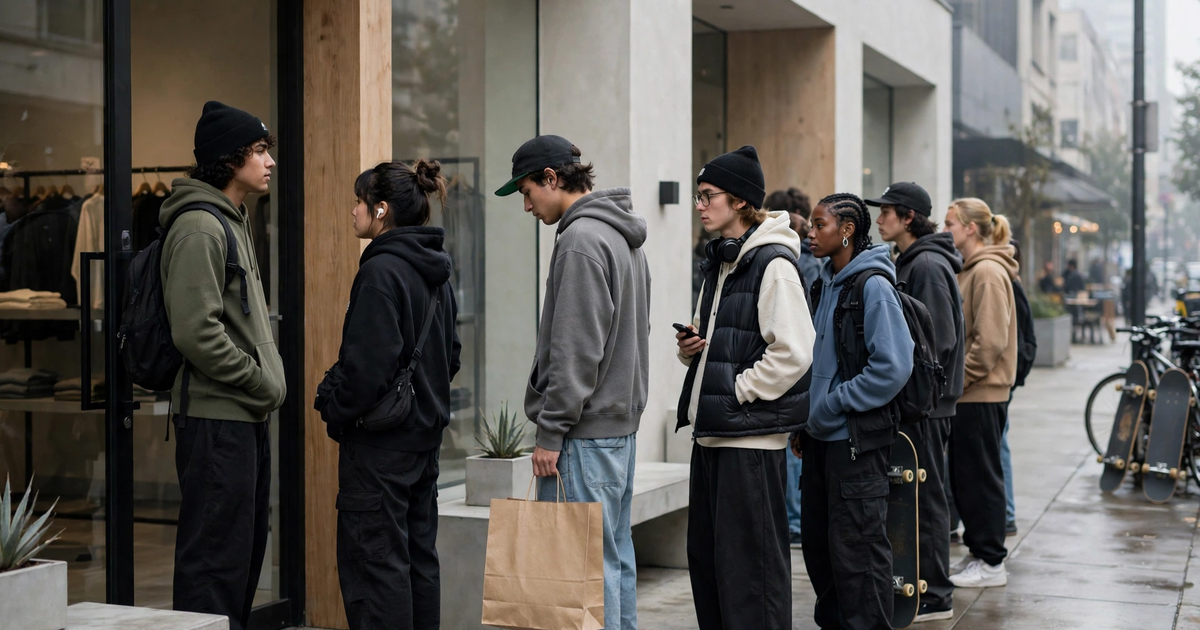
Cialdini’s social proof principle holds that people decide what is correct by watching what others do, above all when they are uncertain. Supreme has never needed to explain why its products matter, because the queue explains it for them. Photographs of lines outside stores, of crowds at pop-ups, of sold-out pages, all do the same work: they tell a new customer that other people have already decided, and that the new customer is late.
The Louis Vuitton collaboration in 2017 is the largest example. The collection was unveiled at the Paris men’s show in January 2017 and sold through pop-ups from 30 June 2017 in London, Paris, Tokyo, Beijing, Sydney, Los Angeles, Miami and Seoul. Thousands queued for hours. In New York, the city denied the proposed pop-up, with reporting that officials could not see how the launch would benefit the community. That refusal became part of the story rather than an end to it, because it proved the demand was real enough to worry a city. In the month after launch, searches rose by 75% for Louis Vuitton and 89% for Supreme, according to Lyst data reported by Jing Daily. Those are search figures, not sales figures, and this audit prints them as such. They still show what a queue does: it makes strangers curious, and curiosity is the first step toward a purchase.
Social proof also works inside the community. A customer who sees friends, musicians and skaters wearing the same box logo learns that the logo is a shared language, spoken by people the customer already trusts. The risk is the same mechanism in reverse: the customer who cannot join the queue learns that they are outside the group.
🪪 Chapter 5: Identity signalling — wearing a logo that says where you stand
Belk’s 1988 extended self thesis holds that possessions help form and reflect identity. Supreme is that thesis in its simplest form. The box logo is small, plain and instantly readable. It carries no slogan and no explanation. A person wearing it is telling strangers that they know what it means, that they were there on a Thursday, or that they paid what it took to get it afterwards. The message is not about the garment. It is about the wearer.
That is why Supreme can put its logo on almost anything and still sell it. The object changes. The signal stays the same. A brick, a cookie, a fire extinguisher or a hoodie all say the same thing to the right audience: I understand this code. For a young customer with little money and much to prove, that signal is worth more than the fabric. For an older customer who grew up with skate culture, it says something else: I was part of this before it was expensive. The same logo carries two different identities at once, and both groups pay for the privilege of sending theirs.
The audit’s claim here is modest, and it should be. Belk’s work was not a study of Supreme buyers, and this audit does not pretend otherwise. The claim is that Supreme’s design is consistent with extended-self dynamics: a minimal, widely recognised mark that functions as an identity badge rather than as decoration. A brand that understands that distinction will protect the badge at all costs. A brand that dilutes it will discover that the badge was the business.
💎 Chapter 6: Veblen and status — when the price is the proof
Thorstein Veblen argued in 1899 that some goods are desired because they are expensive, not in spite of it. The high price is the signal. It shows that the buyer can afford waste, and it separates the buyer from people who cannot. Supreme fits that pattern in a modern form. Its retail prices are not extreme by luxury standards. Its resale prices often are, and the resale price is the one that gets photographed, reported and envied.
The Oreo collaboration from spring 2020 shows the mechanism at its most absurd and therefore its clearest. A three-pack of red Supreme Oreos retailed at $8 in Supreme stores only. Within hours, eBay listings and bids were reported in the thousands of dollars, with one auction reported above $92,000 in bids before it was removed. Those were bids, not a completed sale, and this audit never prints them as a sale price. Even as bids, they did psychological work: they told every later reader that an $8 cookie could be treated as an asset. Once a cookie is treated as an asset, the customer is no longer buying food. The customer is buying a story about value, and the story is priced by strangers.
Veblen status also explains why Supreme’s luxury collaborations matter more than its ordinary drops. A Louis Vuitton trunk or a Supreme box logo over a monogram canvas is not a better bag than a plain one. It is a more legible one. It tells two audiences at once — the luxury audience and the streetwear audience — that the buyer belongs to both. That double legibility is rare, and rarity is what status markets pay for. The danger is that status built on price can be destroyed by price. If resale values fall, the signal weakens, and the customer who bought for status is left holding an ordinary hoodie at an extraordinary price.
🚧 Chapter 7: Reactance — the ban that makes people want it more
Brehm’s reactance theory, published in 1966, holds that when people feel a freedom is threatened or removed, they value that freedom more and work harder to restore it. Supreme’s model creates reactance by design. A drop that sells out removes the freedom to buy later. A “no restock” expectation removes the freedom to wait. A queue that ends in a sold-out page removes the freedom to decide calmly. Each removal makes the next drop feel more urgent, because the customer has learned that waiting is punished.
The New York pop-up refusal in 2017 is a useful illustration, not a proof. When a city declines a pop-up, the product becomes harder to obtain in that city, and the customers who wanted it must travel, queue elsewhere, or pay resale prices. The restriction was not created by Supreme, and this audit does not claim it was. The point is narrower: restrictions on access, whatever their source, feed the same psychology that Supreme’s own limits feed. A brand that benefits from scarcity will also benefit from other people’s restrictions, and it should be honest about that windfall.
Reactance also explains the bot economy around Supreme. When buying fairly becomes hard, some customers stop trying to buy fairly. Automated purchasing tools, resale networks and queue services all grow in the gap between demand and supply. Supreme limits quantities per buyer to slow that trade, but the trade persists because the incentive persists. A customer who loses three drops in a row does not conclude that the product is unpopular. The customer concludes that the system is rigged, and then looks for a way to rig it back. That cycle is not a failure of the drop model. It is the drop model working as designed, with its costs paid by the customers who follow the rules.
🧱 Chapter 8: Endowment and collecting — why one box logo is never enough
Kahneman, Knetsch and Thaler showed in 1990 that people who own an object value it above the price a buyer will pay for the identical object. Ownership itself adds value. That endowment effect is the quiet engine of Supreme collecting. Once a customer owns a box-logo hoodie, that hoodie is no longer a hoodie on a rack. It is their hoodie, with their drop-day story attached, and its value in their mind rises above the price they paid.
Collecting adds a second mechanism. The goal-gradient hypothesis, from Hull in 1932 and revived by Kivetz, Urminsky and Zheng in 2006, holds that effort rises as people get closer to a goal. A collection works the same way in reverse: each new item moves the collector closer to completeness, and each new season reopens the set so completeness is never reached. Supreme’s seasonal model does that work automatically. A customer who owns ten box-logo pieces is not finished. The customer is invested, and the next drop is the next step toward a goal that moves every season.
The household objects are the proof that collecting, not clothing, is the real product. A brick, a cookie pack and a fire extinguisher all become collectibles once they carry the logo, because the collection is organised by the mark rather than by use. That is also the sustainability problem. Supreme sells the absurdity as a joke that customers are in on, and the joke is part of the appeal.
🤝 Chapter 9: Community and belonging — the skate shop that never closed
Social identity theory, from Tajfel and Turner in 1979, holds that people draw part of their identity from the groups they belong to, and that they favour their own group over others. Supreme’s original store was a group before it was a brand. Skaters rode inside it, staff were skaters, and the shop gave a scattered subculture a fixed address. That address mattered. It turned a style into a place, and a place into a membership.
The membership survived the move from skate shop to global brand, but it changed form. In the early years, belonging meant being in the store. Later it meant being in the queue, online at 11 a.m., or in the resale conversation afterwards. The group is now too large to meet in one room, so it meets in a shared ritual instead. That ritual is weaker than a real room, and stronger than a mailing list. It gives customers a weekly reason to recognise each other, and a shared vocabulary of drops, seasons and collaborations that outsiders cannot follow.
There is a limit to this belonging, and it should be named. A community built on limited supply cannot welcome everyone who wants to join. Each drop that sells out creates a new group of people who wanted to belong and were told, by a sold-out page, that they do not. Supreme’s community is therefore real for insiders and exclusionary by design for everyone else. A brand that calls itself a community while rationing membership should expect its members to notice the contradiction. Many do, and they stay anyway, because the belonging they have is worth more to them than the fairness they lack.
⭐ Chapter 10: Authority and the collaboration halo — borrowing someone else’s standing
Cialdini’s authority principle holds that people defer to credible sources, and that credibility can be transferred. Supreme’s collaboration strategy is a transfer machine. Each partner lends Supreme a different kind of standing: Louis Vuitton lends luxury, Nike lends sport, The North Face lends outdoor credibility, and artists lend cultural credibility. In return, Supreme lends each partner youth, urgency and a queue. The exchange is mutual, and that mutuality is why it lasts.
The Louis Vuitton case shows the transfer in both directions. Before 2017, luxury houses rarely shared a logo with a skate brand. After the pop-ups sold out and searches for both brands rose sharply, the idea of a luxury-streetwear collaboration became normal. Supreme gained the right to be priced and discussed as luxury. Louis Vuitton gained access to customers who had never queued for a luxury product. Neither brand could have bought that exchange with advertising. It had to be performed in public, in queues, in photographs, and in resale prices, to be believed.
The halo has a limit that the Tyson chapter makes concrete. Borrowed authority works only while the lender is willing to lend it. A collaboration puts two names on one product, and either name can withdraw its standing. When a partner disputes the artwork, the halo does not fade gradually. It stops. That fragility is the price of a strategy built on other people’s names, and it is a price Supreme pays in full in October 2026.
😨 Chapter 11: Loss aversion and FOMO — the fear that does the selling
Prospect theory, from Kahneman and Tversky in 1979, holds that losses weigh more heavily than equivalent gains. Losing $50 hurts more than gaining $50 pleases. Supreme’s drop turns that asymmetry into a weekly event. The customer is not choosing between buying a hoodie and keeping the money. The customer is choosing between buying now and losing the chance forever. The loss is vivid, immediate and social: other people will have it, and you will not. The gain is abstract: a hoodie you do not yet own. Loss wins that contest most weeks.
FOMO is loss aversion with an audience. It is not only the fear of missing the product. It is the fear of missing the conversation, the photograph, the reference that everyone else will understand next week. Supreme’s weekly rhythm feeds that fear by giving it a deadline. A product that is available forever can be considered at leisure. A product that is available for minutes must be decided on instinct, and instinct favours buying. That is why the drop works even for customers who know the psychology. Knowing the trick does not remove the deadline.
For the companion question of how another global brand built desire on identity rather than scarcity, read my audit of Nike, and for scarcity as a system in a different industry, my audit of Zara.
⚠️ Chapter 12: The dark side — the Tyson dispute, stated exactly
This chapter keeps every legal claim at its exact status, as of 28 October 2026, because this audit’s credibility depends on it. The facts, as reported, are as follows. Supreme and designer Martine Rose announced a Fall 2026 collection on 12 October 2026. The wider collection was released on 15 October 2026, with an Asia release on 17 October 2026, according to House of Heat. The collection included a Nike Dunk Low with Mike Tyson graphics, and a zip-up hoodie reworking Tyson’s Jeff Hamilton championship jacket graphic, showing Tyson surrounded by national flags.
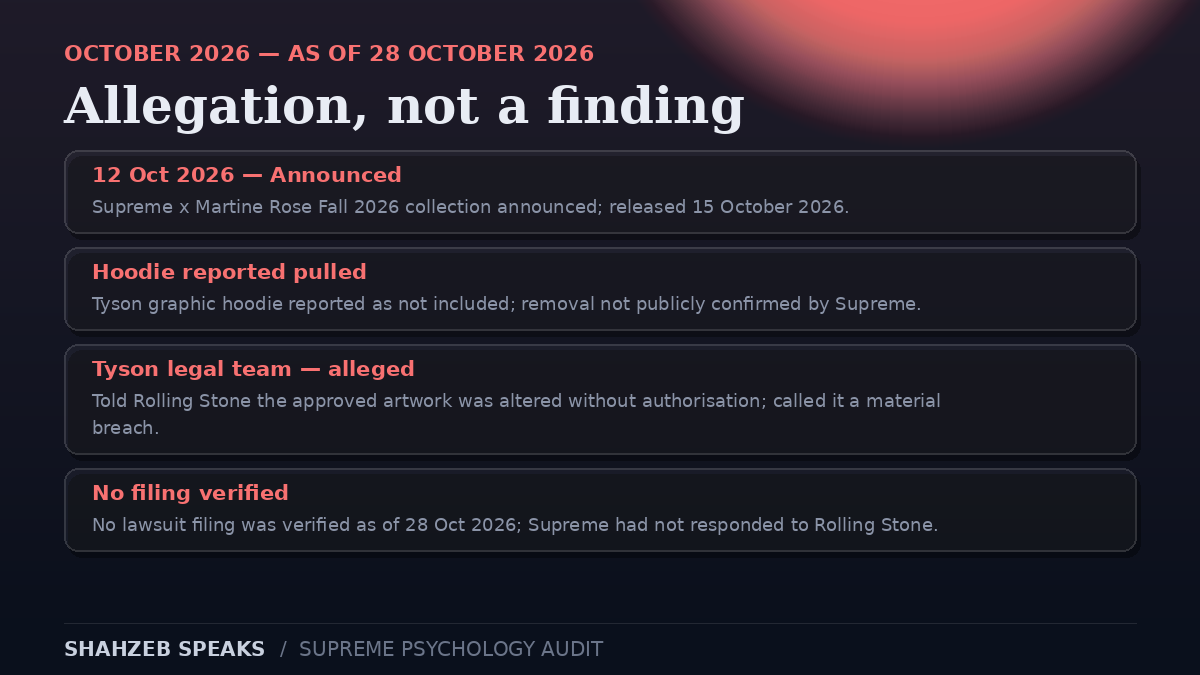
After the announcement, attention online focused on the flags in the hoodie artwork. Reports state that the updated version showed the Palestinian flag where the original jacket graphic showed the Israeli flag. Images of the hoodie were then removed from Supreme’s promotional materials, and the hoodie was not included in the release, according to reports. Supreme has not publicly confirmed the reason for the removal in the sources found, and this audit does not supply a reason on its behalf. The removal is printed as reported, not as confirmed by Supreme.
Tyson’s legal team then gave its account to Rolling Stone, as reported by secondary outlets. Attorney Mitchell Schuster of Meister Seelig & Schuster said Tyson’s team had approved artwork based on the Jeff Hamilton jacket solely to celebrate boxing history. The statement said, in the legal team’s words, that “without authorization, Supreme altered the approved design, embroiling Mr. Tyson in an unrelated political crisis”, that the change constituted “a material breach of contract”, and that with Supreme ignoring repeated demands, Tyson’s legal counsel would take “all necessary action” to protect his name, likeness and legacy. Those are the legal team’s claims, reported by Rolling Stone and relayed by secondary outlets. They are not findings of a court, and this audit does not treat them as such.
Two further points must be stated plainly. First, Supreme had not responded to Rolling Stone’s request for comment at the time of reporting, according to the secondary reports. That silence is not an admission, and it is not a denial. It is the absence of a response at a stated time. Second, no lawsuit filing by Tyson against Supreme was verified in this research. Some secondary headlines speak of legal action in general terms, and the legal team’s statement speaks of action it will take. Neither is a filed case. The correct sentence is: Tyson’s legal team has alleged a material breach of contract and said it will take all necessary action, Supreme had not responded to Rolling Stone at time of reporting, and no lawsuit filing was verified as of 28 October 2026. Do not write that Tyson sued Supreme, and do not write that a court found Supreme in breach.
This audit takes no position on the political question behind the flag change, and it does not need to. The psychology question is separate from it: a brand that builds its value on control of the drop and control of the logo loses both when a collaborator’s name is on the artwork and that collaborator disputes the artwork. The dispute also shows the limit of Supreme’s usual silence. Silence works when the product speaks for itself. It does not work when the question is whether the product was authorised, because silence leaves only one side’s account in public. That is a trust cost, and it is scored below.
The wider dark side is quieter and older. The resale economy that proves Supreme’s desirability also prices out the young skaters the brand was built for. Bots and resellers take stock that fans wanted to wear. Counterfeiting follows the same logic: a logo simple enough to read at a glance is simple enough to copy. Neither problem is a legal finding against Supreme. Both are costs of the model.
🌍 Chapter 13: What other brands should — and should not — copy
Copy the reliable rhythm, not the random chaos. Supreme’s weekly drop works because the day and hour never change, even when the contents do. Brands that copy only the scarcity, without the reliability, get the anxiety without the habit. A customer should be able to plan around your release. If they cannot, they will not return for it.
Copy the community address, not the community slogan. Supreme began as a place where a real group met, and the ritual still carries some of that feeling. Brands that want that effect should build something a specific group can actually use and gather around, before they spend money telling the world about it. A slogan about community is cheap. A room, a ritual or a service that a group values is not.
Copy the collaboration discipline, not the collaboration count. Supreme’s best partnerships work because each partner brings a standing the other lacks, and because the product could only come from that pairing. A long list of partners with no clear reason for each one dilutes the halo instead of strengthening it. One partnership that fits is worth ten that merely fill a calendar.
Do not copy the silence around authorisation. When two names are on a product, the paperwork matters as much as the design. Get the artwork approval in writing, keep the approved version on record, and agree in advance what happens if either side objects. A dispute that could have been settled by a shared file should never become a public claim of breach.
Do not copy the exclusion as a business model. Scarcity that rewards loyal customers is a strategy. Scarcity that systematically rewards resellers and bots over fans is a tax on loyalty. If your drop sells out to automated buyers while your real customers lose out, your psychology is working against your community, and the community will eventually notice.
📊 Psychology Scorecard
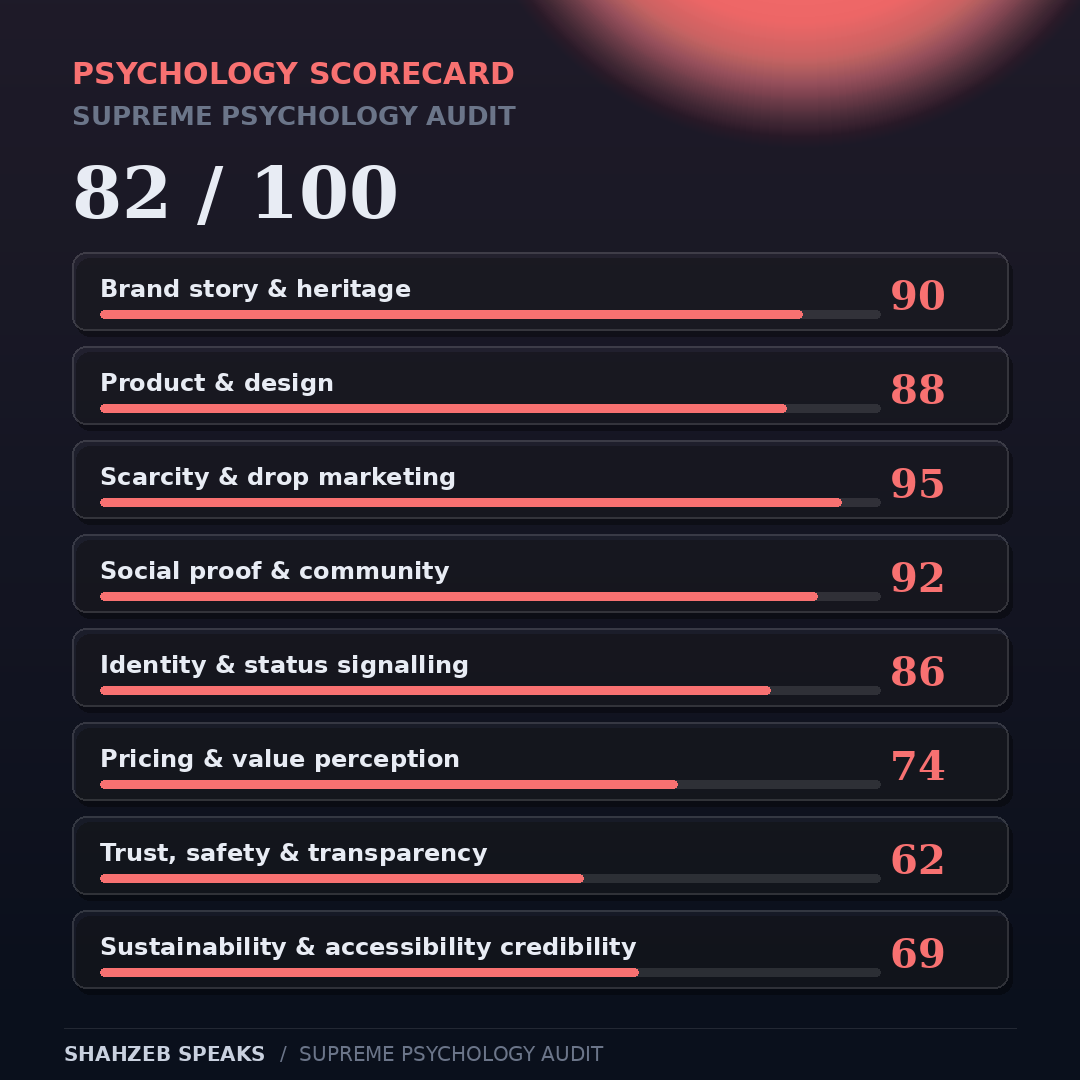
| Dimension | Score | Verdict |
|---|---|---|
| Brand story & heritage | 90 | A real skate-shop origin, kept alive in the store design and the drop ritual rather than invented in a campaign. |
| Product & design | 88 | A minimal, instantly readable mark applied with discipline across clothing, collaborations and objects. |
| Scarcity & drop marketing | 95 | The defining strength: a weekly, reliable, limited drop that the whole streetwear industry copied. |
| Social proof & community | 92 | Queues, pop-ups and resale prices that advertise the brand better than any campaign could. |
| Identity & status signalling | 86 | A badge that tells two audiences at once that the wearer understands the code. |
| Pricing & value perception | 74 | Retail prices are restrained, but resale inflation makes the value story fragile for ordinary buyers. |
| Trust, safety & transparency | 62 | An unresolved, publicly one-sided authorisation dispute, plus no published production numbers or fair-access system. |
| Sustainability & accessibility credibility | 69 | Collecting multiplies ownership, and resale pricing excludes the young fans the brand was built for. |
| Overall (rounded average) | 82 | 656 / 8 = 82 / 100. |
✅ Balance Sheet & Prescription
What Supreme does brilliantly: it turned a weekly appointment into a global ritual, using scarcity, variable reward and social proof in a combination no competitor has matched for thirty years. Its logo is a masterclass in restraint, and its collaborations show how borrowed authority can be exchanged fairly when both sides bring real standing.
What holds it back: trust and accessibility are the two dimensions where the psychology breaks. The October 2026 dispute is unresolved and publicly one-sided, the drop system rewards resellers over fans, and the collecting model multiplies consumption while pricing out newcomers. Those are not footnotes. They are the reason a brand with 95-point scarcity scores 82 overall rather than 90.
The prescription: three moves. First, publish the authorisation process: approved artwork on record, a named contact for collaborators, and a public response within days when a dispute emerges, not silence. Second, fix fair access: a verified-fan queue, purchase limits that are enforced, and published odds or production ranges so customers can judge their real chances. Third, protect the original community: reserve a share of each drop for in-store skaters and young fans at retail price, so the people who built the brand are not priced out of it by the market they created.
📝 Final Verdict
Supreme is the rare brand whose psychology deserves both admiration and warning in the same paragraph. It proved that a small mark, sold at a fixed hour in limited numbers, could become a shared language for a generation — and it proved, in October 2026, that a shared language breaks down when the people whose names are on it disagree about what was agreed. The Tyson dispute may end quietly, with a statement and a settlement, or it may become a filed case. As of 28 October 2026, neither outcome has happened in any verified record, and this audit will not guess which one will. Until Supreme answers the authorisation question on its own timetable, its score will carry an asterisk — and Supreme’s does.
Psychology Score: 82/100 — a masterclass in scarcity, variable reward and identity, held back by trust and accessibility scores that its own drop system and an unresolved dispute earned.
📬 Want a psychology audit of your brand?
If your product has a community you have not found yet, or a trust question you have not answered yet, the psychology is already at work — with or without you. Contact me and tell me which one you are facing.
Related audits: Nike, Crocs, Zara.
📚 References & Sources
- Supreme (brand) — history summary, including April 1994 founding by James Jebbia, Lafayette Street first store, and Barbara Kruger artwork inspiration for the box logo (secondary summary; see research file).
- JustFreshKicks — Supreme quick facts: founded April 1994, headquarters New York, weekly Thursday drops at 11 AM ET, Vans collaboration since 1996 (secondary summary).
- FashionUnited (2017) — Supreme sells stake to Carlyle Group: reported about $500 million for about 50%, valuation reported at about $1.1 billion.
- SGB Media Online (2017) — Supreme sells equity stake to Carlyle Group: about 50% for about $500 million, first reported by Women’s Wear Daily.
- SGB Media Online / VF Corporation SEC filing summaries — VF closed its Supreme acquisition in December 2020 for $2.1 billion; Supreme contributed $538.9 million revenue in VF fiscal 2024 (ended 30 March 2024).
- Chain Store Age / Glossy / Modern Notoriety (2024) — EssilorLuxottica agreed to acquire Supreme from VF for $1.5 billion in cash.
- Retail Insider (2017) — Louis Vuitton x Supreme pop-ups in London, Beijing, Tokyo, Paris, Sydney, Los Angeles and Seoul; resale at multiples of retail.
- Jing Daily — Louis Vuitton x Supreme retrospective: pop-up dates, New York proposal denial, Lyst search increases of 75% (Louis Vuitton) and 89% (Supreme) in the month after launch.
- BuzzFeed / Retail Dive / IB Times UK (2016), summarised in Brandvelle — Supreme brick, retail $30, sold out within minutes, resale listings up to $1,000 reported.
- Mashed / PYMNTS (2020) — Supreme x Oreo, 3-pack retail $8, eBay bids reported in the thousands, one auction reported above $92,000 before removal (bids, not a sale).
- House of Heat (October 2026) — Supreme x Martine Rose Fall 2026: announced 12 October 2026, released 15 October 2026, Asia 17 October 2026; Tyson hoodie reportedly pulled, images removed.
- Style Rave (October 2026) — Supreme x Martine Rose Fall 2026 collection, Tyson zip-up hoodie flag detail.
- Rolling Stone reporting via ShreddER / Reality Tea (October 2026) — Tyson legal team statement: Mitchell Schuster, Meister Seelig & Schuster, alleging unauthorised alteration and material breach of contract; Supreme had not responded at time of reporting.
- Supreme audit industry taxonomy — slug “fashion” (Fashion & Apparel, id 46), verified live 28 October 2026 via the site’s wp-json audit_industry endpoint.
- Cialdini, R. B. (1984/2001). Influence: Science and Practice. Scarcity, social proof, authority.
- Kahneman, D., & Tversky, A. (1979). Prospect theory: An analysis of decision under risk. Econometrica, 47(2), 263–291.
- Kahneman, D., Knetsch, J. L., & Thaler, R. H. (1990). Experimental tests of the endowment effect and the Coase theorem. Journal of Political Economy, 98(6), 1325–1348.
- Belk, R. W. (1988). Possessions and the extended self. Journal of Consumer Research, 15(2), 139–168.
- Veblen, T. (1899). The Theory of the Leisure Class.
- Brehm, J. W. (1966). A Theory of Psychological Reactance.
- Ferster, C. B., & Skinner, B. F. (1957). Schedules of Reinforcement.
- Tajfel, H., & Turner, J. C. (1979). An integrative theory of intergroup conflict. In W. G. Austin & S. Worchel (Eds.), The Social Psychology of Intergroup Relations.
- Hull, C. L. (1932). The goal-gradient hypothesis and maze learning. Psychological Review, 39(1), 25–43.
- Kivetz, R., Urminsky, O., & Zheng, Y. (2006). The goal-gradient hypothesis resurrected. Journal of Marketing Research, 43(1), 39–58.
Key Findings
- Founded April 1994 by James Jebbia; first store on Lafayette Street, Lower Manhattan, as a skate shop; red box logo reported as inspired by Barbara Kruger artwork (secondary sources, not an endorsement claim); headquarters New York, USA; official website supreme.com
- Weekly Thursday drops at 11 AM ET in limited quantities; Louis Vuitton collaboration pop-ups from 30 June 2017; searches up 75% for Louis Vuitton and 89% for Supreme in the month after launch (Lyst data via Jing Daily); brick retail $30 with resale listings reported up to $1,000; Oreo 3-pack retail $8 with eBay bids reported in the thousands
- Carlyle 2017 deal REPORTED about $500 million for about 50%, valuation reported at about $1 billion (one report $1.1 billion including debt) — NOT officially confirmed; VF Corporation bought Supreme late 2020 for $2.1 billion; EssilorLuxottica agreed July 2024 to buy Supreme for $1.5 billion cash, completion reported 1 October 2024; VF fiscal 2024 Supreme revenue $538.9 million per VF filing summaries; current standalone revenue NOT separately disclosed
- Martine Rose Fall 2026 collection announced 12 October 2026, released 15 October 2026, Asia 17 October 2026 per House of Heat; Tyson zip-up hoodie reworking the Jeff Hamilton championship jacket graphic was REPORTED as not included in the release, with images removed from promotional materials — removal NOT publicly confirmed by Supreme in sources found
- Tyson legal team TOLD Rolling Stone that Supreme ALLEGEDLY altered approved artwork without authorisation, calling it a material breach of contract and saying it would take all necessary action — this is an ALLEGATION, NOT a court finding; Supreme had NOT responded to Rolling Stone's request for comment at time of reporting; NO lawsuit filing was verified as of 28 October 2026 — do NOT print that Tyson sued Supreme or that a court found a breach
- No FTC enforcement action against Supreme was identified in this research; no 2023 standalone revenue figure was verified and none is printed; resale and bid figures are reported listings/bids, NOT verified completed sale prices; psychology studies cited were NOT run on Supreme buyers — tactics are consistent with principles, never proven by them
Overall Psychology Score
Supreme scores 82/100 in our comprehensive psychology audit covering consumer behavior strategies, UX design principles, and psychological marketing effectiveness.
The detailed dimension scores are in the audit's Psychology Scorecard chapter.
High impactMuhammad Shahzeb
MSc Industrial Psychologist, specializing in consumer behavior, UX psychology, and brand strategy analysis. Helping brands understand the psychology behind their success.
About Muhammad Shahzeb →