Nike Brand Psychology Audit — How “Just Do It” Became the World’s Most Powerful Psychological Trigger in Sports Marketing
A comprehensive psychology audit of Nike — the world's most valuable sportswear brand. We analyze how Nike leverages hero archetype marketing, aspirational identity psychology, scarcity-driven pricing, the "Just Do It" self-efficacy trigger, controversy marketing, and digital ecosystem gamification to maintain global cultural dominance from 1964 to 2026.

89 / 100
Overall consumer behavior effectiveness

Brand Overview
- Brand nameNike
- Founded1964
- HeadquartersBeaverton, Oregon, USA
- IndustrySports & Fitness
- Websitewww.nike.com ↗
Psychology Techniques Identified
- 01Hero Archetype & Aspirational Identity
- 02Self-Efficacy Trigger ("Just Do It")
- 03Scarcity & FOMO Marketing (SNKRS Drops)
- 04Controversy & Polarization Marketing
- 05Veblen Effect & Premium Pricing Psychology
- 06Social Proof & Celebrity Endorsement
- 07Gamification & Habit Loop Design
- 08Loss Aversion & Membership Lock-In
- 09Nostalgia & Retro Revival Psychology
- 10Tribal Identity & In-Group Signaling
- 11Emotional Storytelling & Narrative Transportation
- 12Anchoring & Decoy Pricing
Full Psychology Audit Report
In this audit
In the annals of global branding, no company has achieved what Nike has achieved. This isn’t merely a sportswear company — it’s a psychological empire that has fundamentally rewired how billions of humans think about athletics, aspiration, identity, and human potential itself.
From a $1,000 handshake deal in 1964 to a $51.2 billion revenue machine in 2026, Nike’s ascent isn’t just a business success story — it’s the most sophisticated case study in applied consumer psychology the world has ever seen. Every swoosh, every “Just Do It,” every limited-edition drop is backed by decades of behavioral science, neuroscience, and social psychology research — whether the architects of these strategies knew the academic terms or not.
In this exhaustive brand psychology audit, I will dissect every psychological mechanism Nike employs — from Phil Knight’s first sales pitch in 1964 to the AI-powered personalization engines of 2026 — and reveal the behavioral architecture behind the most powerful brand on Planet Earth.
“Nike doesn’t sell shoes. It sells the belief that you can become someone greater than you are right now. And that belief is worth more than any sneaker ever made.”
— Brand Psychology Analysis, ShahzebSpeaks
📋 Brand Overview: Nike at a Glance
| Official Name | Nike, Inc. |
| Founded | January 25, 1964 (as Blue Ribbon Sports) |
| Renamed to Nike | 1978 (brand name used since 1971) |
| Founders | Phil Knight & Bill Bowerman |
| Headquarters | Beaverton, Oregon, United States |
| CEO (2026) | Elliott Hill (since October 2024) |
| Annual Revenue (FY2025) | ~$46.4 Billion USD |
| Brand Value (2026) | ~$53+ Billion — #1 Most Valuable Apparel Brand Globally |
| Employees | ~79,000+ worldwide |
| Market Position | #1 Global Sportswear Brand (by revenue & brand value) |
| Subsidiaries | Jordan Brand, Converse, Nike Direct |
| Brand Colors | Nike Black (#111111), Volt (#CDFC01), Sport Red (#C41230), White |
| Iconic Tagline | “Just Do It” (since 1988) |
| Nike Members | 300+ Million globally (Nike App ecosystem) |
| Website | www.nike.com |
📜 Chapter 1: The Complete History of Nike (1964–2026) — From Waffle Irons to World Domination
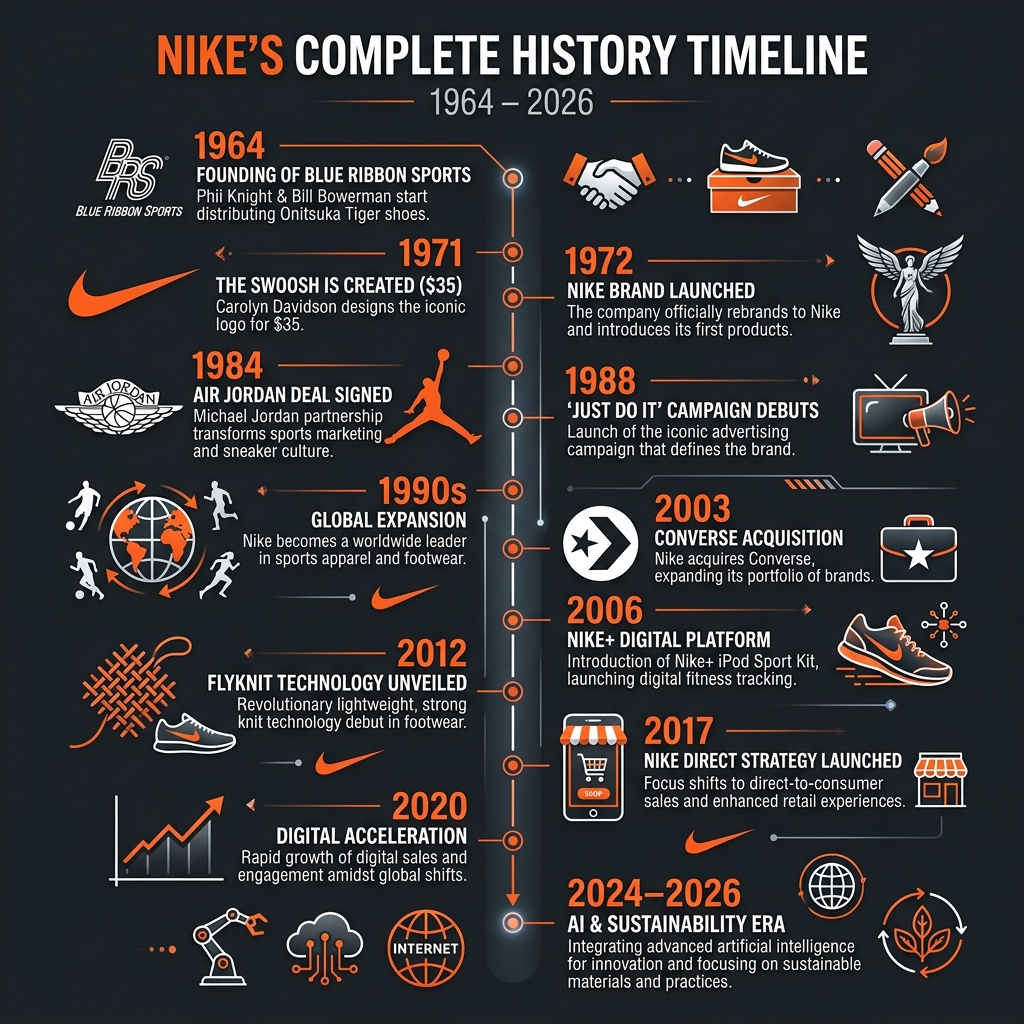
👟 1964–1970 — Blue Ribbon Sports: The Origin Story
On January 25, 1964, University of Oregon track athlete Phil Knight and his legendary coach Bill Bowerman founded Blue Ribbon Sports (BRS) with a handshake and $500 each — totaling a $1,000 investment that would eventually become the most valuable sportswear empire in human history.
The psychological foundation was laid from day one. Knight’s Stanford MBA thesis had proposed that Japanese running shoes could displace German dominance (Adidas and Puma) — a classic underdog narrative that would define Nike’s brand DNA for decades. He secured a distribution deal with Japan’s Onitsuka Tiger (now ASICS) and began selling shoes out of the trunk of his car at track meets.
From a social identity theory perspective, this origin story is psychologically perfect:
- Humble beginnings: Triggers empathy and relatability — “They started with nothing, just like me”
- Expert credibility: A world-class coach (Bowerman) and a business-trained athlete (Knight) — dual authority
- David vs. Goliath: An American startup challenging the mighty German sports establishment — activates the underdog effect, where consumers root for and support perceived underdogs (Paharia et al., 2011)
Bowerman, ever the innovator, famously ruined his wife’s waffle iron in 1971 by pouring rubber into it — creating the prototype for the Nike Waffle Trainer sole. This story became brand mythology: the genius inventor driven by obsession to find a better way. It’s the kind of founder myth that Apple has with Steve Jobs and his garage.
✓ 1971–1972 — The Birth of Nike: Name, Swoosh, and Identity
In 1971, three transformative events occurred:
- The Name “Nike”: Employee Jeff Johnson suggested “Nike” — the Greek goddess of victory. From a linguistic psychology perspective, this is masterful:
- Short (4 letters) — high memorability (Miller’s Law: 7±2 chunks)
- Strong consonant sounds (/n/ and /k/) — perceived as powerful and decisive
- Mythological resonance — unconscious associations with triumph and divinity
- Globally pronounceable — works across virtually every language
- The Swoosh: Portland State University graphic design student Carolyn Davidson created the iconic Swoosh logo for $35. Phil Knight famously said, “I don’t love it, but it will grow on me.” The Swoosh is now valued at over $26 billion as a brand asset — perhaps the greatest ROI on a design investment in history.
- First Nike-branded shoes debuted at the 1972 U.S. Olympic Track & Field Trials in Eugene, Oregon.
🚀 1973–1983 — Rapid Growth & The Running Boom
Nike’s early growth coincided with the 1970s American running boom — a cultural shift driven by Jim Fixx’s bestseller “The Complete Book of Running” (1977) and growing health consciousness. Nike was perfectly positioned to ride this wave.
Key milestones:
- 1974: The Waffle Trainer becomes the best-selling training shoe in America
- 1978: Blue Ribbon Sports officially becomes Nike, Inc.
- 1979: Nike Air technology introduced — air cushioning that would revolutionize footwear
- 1980: Nike IPO — goes public on the NYSE. 50% U.S. market share in athletic shoes
- 1982: First nationally broadcast Nike TV commercials air
Psychologically, Nike during this era built its brand on authentic performance credibility. Real athletes wore Nikes. Real coaches endorsed them. This established the foundation of expert social proof that would later scale to celebrity endorsements.
🏀 1984–1987 — The Air Jordan Revolution: When a Shoe Became a Religion
In 1984, Nike made the most consequential endorsement deal in the history of marketing: signing Michael Jordan, a rookie from the University of North Carolina, to a $2.5 million, 5-year contract — an unprecedented sum for an unproven NBA player.
The Air Jordan I launched in 1985 with a now-legendary backstory: the NBA banned the shoe for violating uniform color rules, fining Jordan $5,000 per game. Nike paid every single fine — and turned the ban into the most brilliant reactance marketing campaign ever executed.
Psychologically, this activated multiple mechanisms simultaneously:
- Reactance Theory (Brehm, 1966): When an authority tells people they can’t have something, desire for that thing increases dramatically. The NBA ban made Air Jordans the most desired shoes in America overnight
- Forbidden Fruit Effect: The “banned” narrative made every pair feel transgressive and rebellious
- Hero Worship: Jordan’s otherworldly athletic ability made him a modern deity — and buying his shoes was an act of devotion
- Aspirational Identity Transfer: Consumers believed (unconsciously) that wearing Jordans would transfer some of Michael’s greatness to them — a textbook example of sympathetic magic in consumer behavior
By 1986, Air Jordans were generating $130 million annually. By 2025, Jordan Brand alone generates over $6.6 billion per year — larger than most sportswear companies’ entire revenue.
🔥 1988 — “Just Do It”: The Three Words That Changed Everything
On July 1, 1988, advertising agency Wieden+Kennedy launched the “Just Do It” campaign. The first commercial featured 80-year-old marathon runner Walt Stack jogging across the Golden Gate Bridge. The tagline was reportedly inspired by the last words of convicted murderer Gary Gilmore before his execution: “Let’s do it.” Dan Wieden modified it to “Just Do It.”
From a psychology perspective, “Just Do It” is the most effective brand slogan in history because it functions as a self-efficacy trigger:
- Bandura’s Self-Efficacy Theory (1977): People’s belief in their ability to accomplish tasks is the strongest predictor of whether they’ll actually attempt those tasks. “Just Do It” directly addresses the internal voice of doubt and says: stop overthinking, start acting
- Imperative Mood: The command form (“Do it”) bypasses rational deliberation and speaks directly to the action-oriented limbic system
- Universal Application: Unlike “Impossible is Nothing” (Adidas), which is abstract, “Just Do It” applies to literally anything — running, working out, starting a business, asking someone out. This universality made it a life philosophy, not just a shoe tagline
- Cognitive Shortcut: In moments of hesitation, “Just Do It” serves as a mental heuristic — a pre-packaged decision that eliminates the need for complex cost-benefit analysis
Within a decade, Nike’s share of the North American sport-shoe business jumped from 18% to 43%. Revenue surged from $877 million to $9.2 billion.
🌍 1990–1999 — Global Expansion & Cultural Domination
The 1990s were Nike’s golden age of global expansion:
- 1990: Nike Town retail flagship stores open — creating experiential retail before the term existed
- 1993: Revenue crosses $4 billion
- 1994: Nike signs the Brazilian National Football Team — entering global soccer market
- 1995: Nike signs Tiger Woods for $40 million — the golf world gasps
- 1996: Nike achieves $9.2 billion in revenue — the first sportswear company to cross this threshold
- 1998: The sweatshop controversy erupts — Nike faces intense criticism for labor conditions in Asian factories
- 1999: Revenue reaches $8.8 billion (post-controversy dip) but brand awareness is at all-time high
The 1990s also saw Nike master cultural infiltration psychology. Nike wasn’t just sponsoring sports — it was sponsoring street culture, hip-hop, skateboarding, and urban youth identity. Air Jordans, Air Force 1s, and Air Max became cultural symbols that transcended athletics entirely.
⚠️ 1997–2001 — The Sweatshop Crisis: Brand Psychology Under Fire
The late 1990s sweatshop controversy is a critical chapter in Nike’s psychology story. Investigations revealed that Nike’s contracted factories in Vietnam, Indonesia, and China had:
- Workers as young as 14
- Wages below $2 per day
- Excessive overtime and unsafe conditions
- Verbal and physical abuse by supervisors
From a cognitive dissonance perspective, this created a massive psychological crisis for Nike’s consumers. The brand that told you to “Just Do It” — to be your best self — was exploiting some of the world’s most vulnerable workers. Consumers experienced what psychologists call moral disengagement conflict: “I love this brand, but its practices conflict with my values.”
Nike’s response, initially defensive, eventually became a masterclass in crisis psychology:
- Acknowledgment: Phil Knight publicly admitted the problems (authenticity psychology)
- Transparent Action: Nike published its entire supplier list — a radical move in the industry (transparency builds trust)
- Overcompensation: Nike invested hundreds of millions in worker welfare programs — going beyond what was required (the transgression-compliance effect: people/companies that have violated norms often overcorrect)
- Narrative Reframe: Over time, Nike repositioned as an industry leader in ethical manufacturing — turning a weakness into a strength
💡 2002–2011 — Innovation Era: Nike+ and Digital Pioneering
- 2003: Nike acquires Converse for $309 million — gaining the iconic Chuck Taylor brand
- 2006: Nike+iPod launches in partnership with Apple — one of the first consumer fitness technology integrations. This was revolutionary: a shoe that talks to your music player and tracks your runs
- 2008: Revenue crosses $18 billion
- 2010: Nike launches Nike+ Running app — the precursor to the digital ecosystem
- 2011: Nike introduces the FuelBand wearable fitness tracker
The Nike+ platform was psychologically groundbreaking because it introduced gamification to fitness:
- Variable Ratio Reinforcement: Random milestones and achievements (like “Fastest mile this month!”) created unpredictable rewards — the same mechanism that makes slot machines addictive
- Social Comparison: Leaderboards and friend challenges activated competitive drive
- Streak Psychology: Running streaks created commitment devices — “I can’t break my 30-day streak”
- Goal Gradient Effect: Progress bars showing proximity to goals increased motivation as users got closer
🧬 2012–2016 — The Flyknit Revolution & Performance Innovation
- 2012: Nike Flyknit technology launches — a single-thread construction that reduces waste by 60% and creates a second-skin fit
- 2013: Revenue hits $25.3 billion
- 2015: Nike Self-Lacing Shoes (HyperAdapt 1.0) announced — fulfilling a “Back to the Future” prophecy
- 2016: Nike launches SNKRS app — the limited-edition sneaker drop platform that would redefine retail psychology
🔄 2017–2020 — Nike Direct: The DTC Revolution
In 2017, Nike announced its “Consumer Direct Offense” strategy — a radical pivot to direct-to-consumer (DTC) sales, reducing dependence on wholesale partners like Foot Locker and Dick’s Sporting Goods.
This wasn’t just a business strategy — it was a psychological control strategy:
- Owning the Customer Relationship: When Nike sells through retailers, the retailer owns the customer data, the store experience, and the brand presentation. Direct-to-consumer puts Nike in complete psychological control
- First-Party Data: Nike’s apps collect behavioral data that enables unprecedented personalization — the foundation of persuasion profiling
- Price Perception Control: Nike can control when and how discounts are presented, preventing the “always on sale” perception that erodes premium positioning
🦠 2020–2023 — Pandemic Pivot & Digital Acceleration
COVID-19 accelerated Nike’s digital transformation by 3-5 years:
- 2020: Nike digital sales surge 82% in Q1 during lockdowns. Nike Training Club and Nike Run Club see record downloads
- 2021: Nike acquires RTFKT Studios — entering the NFT and virtual sneaker space
- 2022: .SWOOSH platform launches — Nike’s Web3 and digital collectibles marketplace
- 2023: Revenue reaches $51.2 billion — an all-time high. Nike Membership surpasses 300 million members
⚡ 2024–2026 — Recalibration & The Elliott Hill Era
After unprecedented growth, Nike entered a period of strategic recalibration in 2024-2026:
- October 2024: Elliott Hill returns as CEO (replacing John Donahoe), signaling a return to Nike’s sport-first DNA. Hill is a 32-year Nike veteran who understands the culture
- 2024-2025: Nike acknowledges over-rotation to digital/DTC and begins re-engaging wholesale partners — a course correction
- 2025: Revenue adjustment to ~$46.4 billion as Nike focuses on innovation pipeline reset — new Air Max, new running technology, new basketball silhouettes
- 2026: Focus on AI-powered personalization, sustainability commitments (Move to Zero), and reclaiming the “innovation brand” narrative
- 2026: Nike returns focus to sport performance credibility — re-establishing relationships with elite athletes and grassroots sport communities
From a brand psychology perspective, the Elliott Hill era represents a “return to authenticity” movement — reconnecting with what made Nike psychologically powerful in the first place: sport, athletes, and the relentless pursuit of human potential.
🧠 Chapter 2: Brand Identity Psychology — Why the Swoosh is the Most Powerful Symbol in Commercial History
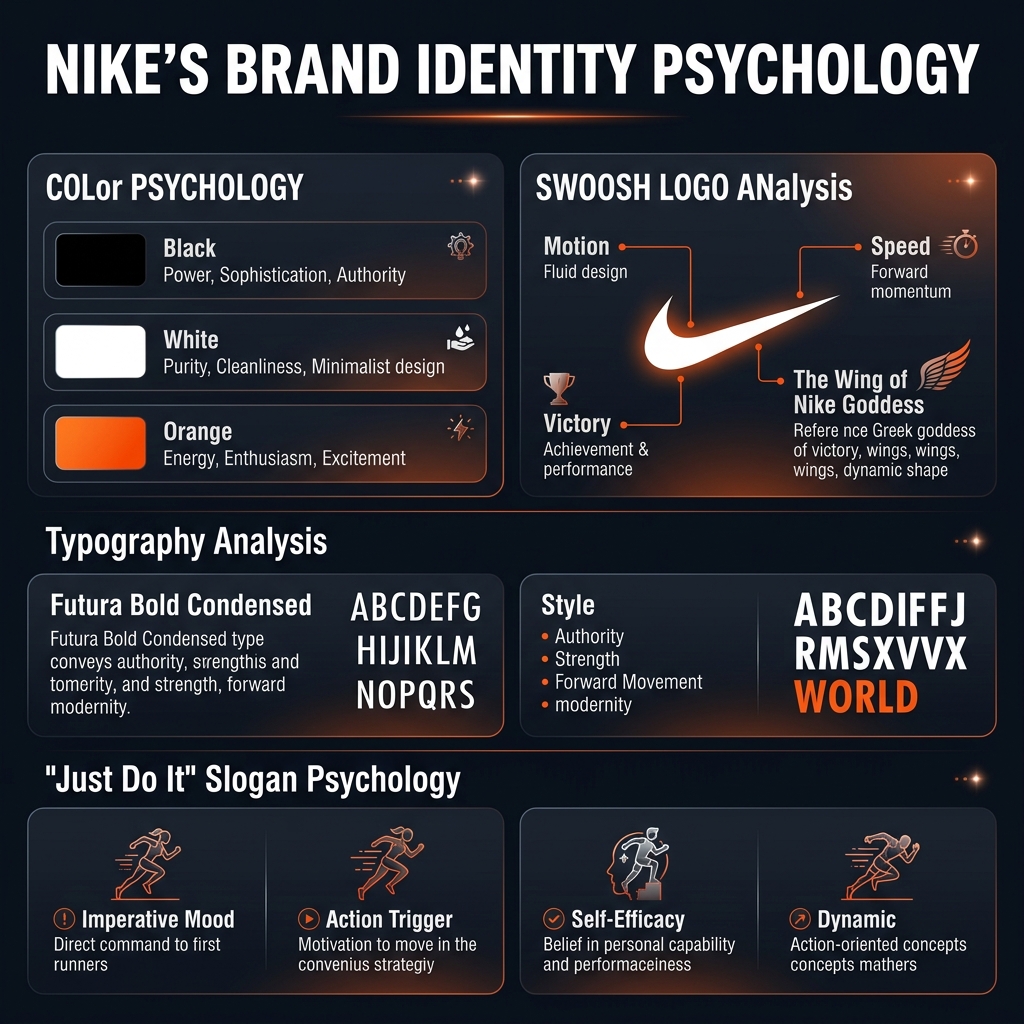
✓ The Swoosh: Motion, Victory, and Subconscious Activation
The Nike Swoosh is recognized by 97% of Americans and over 85% of global consumers — making it arguably the most recognized commercial symbol in human history, rivaling only the cross and the crescent moon.
The Swoosh’s psychological power comes from multiple layers:
- Implied Motion (Gestalt Psychology): The Swoosh’s curve implies forward movement — our visual system perceives it as something in motion, activating associations with speed, progress, and dynamism
- Wing Symbolism: Carolyn Davidson designed it to represent the wing of Nike, the Greek goddess of victory. Wings subconsciously evoke flight, transcendence, and freedom from limitation
- Checkmark Association: The Swoosh resembles a checkmark — the universal symbol for “correct,” “approved,” “done.” This creates a subtle confirmation bias toward the brand: Nike = the right choice
- Minimal Complexity: With only two curves, the Swoosh is cognitively effortless to process. According to the Processing Fluency Theory, stimuli that are easier to process are perceived as more truthful, beautiful, and valuable
- Lone Symbol Power: Nike is one of very few brands that can use its logo without any text and achieve instant recognition. This is the ultimate expression of brand equity — the symbol has become self-sufficient
🎨 Color Psychology: The Power of Black
Unlike most sportswear brands that use vibrant primary colors (Adidas’s blue, Puma’s red, Under Armour’s grey-red), Nike’s core identity revolves around black and white — with strategic use of accent colors.
- Black signals: Power, sophistication, authority, premium quality, mystery, and exclusivity. Black is the color of luxury fashion houses (Chanel, Prada, Gucci) — by adopting black as its primary color, Nike positions itself above “mere sportswear” into the realm of cultural fashion authority
- White signals: Purity, simplicity, clean performance, technical precision
- Volt (#CDFC01) accent: The electric yellow-green used selectively signals cutting-edge technology, speed, and visibility. It’s deliberately uncomfortable — designed to grab attention and signal innovation
- Sport Red (#C41230): Used strategically for energy, urgency, and competitive fire
The genius of Nike’s color strategy is its adaptability. While the Swoosh remains constant, Nike can shift its color palette for different sub-brands, cultures, and product lines — Jordan Brand uses black/red/white, Nike SB uses counter-cultural tones, ACG uses earth tones for outdoor, etc.
✍️ Typography: Futura Bold Condensed — Authority in Letterform
Nike’s iconic typeface is based on Futura Bold Condensed — a geometric sans-serif designed by Paul Renner in 1927. This choice is psychologically calculated:
- Geometric forms: Signal precision, modernity, and engineering
- Bold weight: Communicates strength and confidence
- Condensed width: Creates a sense of compression and energy — like a coiled spring about to release
- All-caps usage: In many Nike applications, text appears in all capitals — the typographic equivalent of a confident, commanding voice
🔤 “Just Do It” — The Neurolinguistic Architecture
I’ve already discussed the slogan’s self-efficacy function, but let’s go deeper into its neurolinguistic programming (NLP) architecture:
- “Just”: This word is a minimizer — it makes the action feel small, simple, manageable. It reduces the perceived effort of starting
- “Do”: An action verb in the imperative mood — the most direct command form in English. It bypasses deliberation and speaks to the motor cortex
- “It”: Deliberately vague — “it” can be anything. This open-ended pronoun allows every consumer to project their own challenges, dreams, and aspirations onto the slogan
Together, the three words form a cognitive override command — they acknowledge that you’re hesitating (“just” implies you’ve been overthinking) and give you permission to act anyway. This is essentially therapeutic intervention disguised as a marketing slogan.
🏟️ Chapter 3: The Psychology of Nike’s Athlete Endorsement Empire
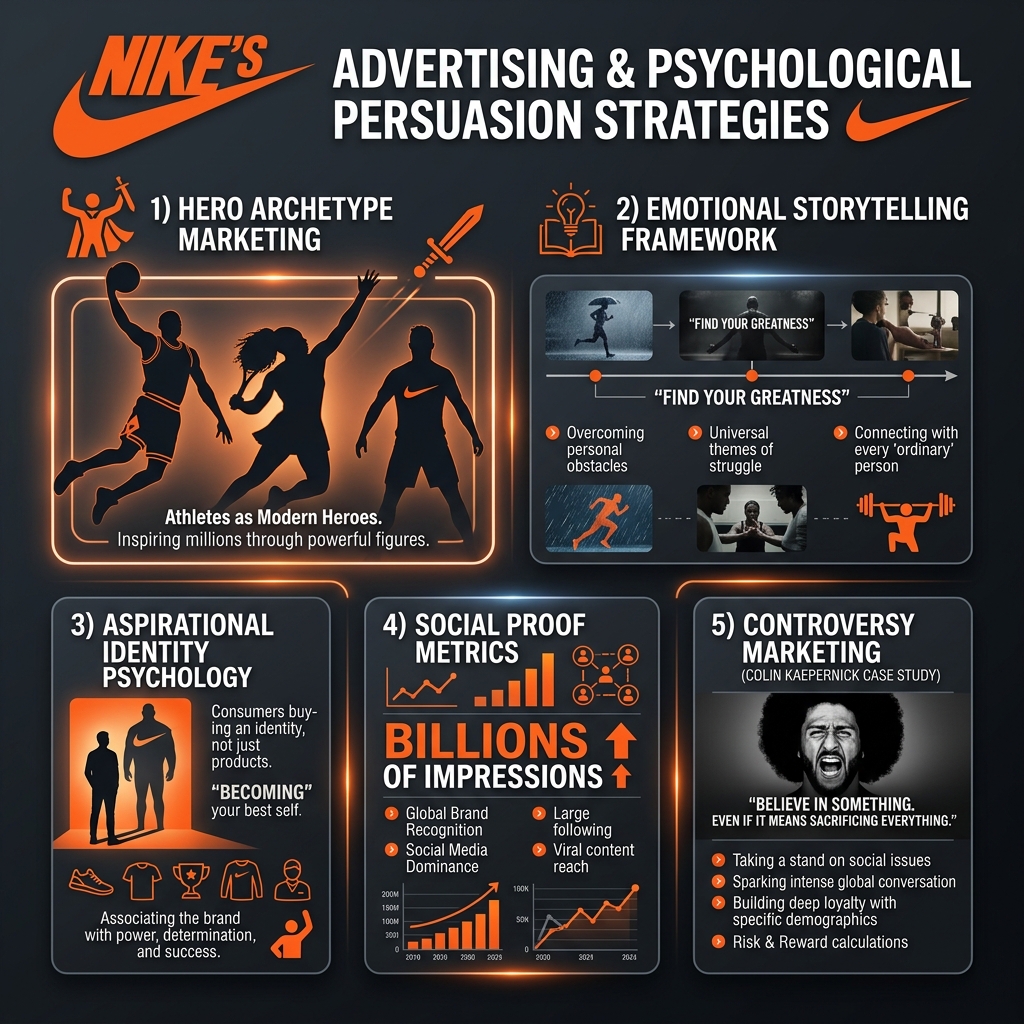
Nike spends approximately $4+ billion per year on “demand creation expense” — the industry euphemism for marketing, endorsements, and advertising. This makes Nike one of the top 20 advertisers on Earth. But Nike’s spending isn’t just large — it’s psychologically precise.
🦸 The Hero Archetype Framework
In Carl Jung’s archetypal psychology, the Hero is one of the 12 primary archetypes — representing courage, mastery, and the transformative journey from weakness to strength. Nike has built its entire brand around this archetype, and it executes it with unparalleled consistency.
Nike’s athlete roster reads like a pantheon of modern gods:
- Michael Jordan — The deity of basketball. His story (cut from high school team → greatest ever) is the ultimate hero’s journey
- LeBron James — The chosen one. Kid from Akron who became the most complete basketball player ever
- Serena Williams — Dominance against systemic bias. The hero who battles both opponents and institutions
- Cristiano Ronaldo — The self-made perfectionist. Obsessive work ethic personified
- Kobe Bryant — The “Mamba Mentality.” Relentless pursuit of greatness at any cost
- Tiger Woods — Fall and redemption. The hero’s journey extended to include a fall from grace and a comeback
- Rafael Nadal — The warrior. Physical intensity and never-quit spirit
- Naomi Osaka — Mental health and authenticity. The hero who is brave enough to show vulnerability
Each of these athletes is not merely a spokesperson — they’re a character in Nike’s ongoing mythological narrative. When consumers buy Nike products endorsed by these athletes, they’re engaging in what anthropologists call sympathetic magic — the belief that contact with a powerful object (the athlete’s shoe) transfers some of that power to the wearer.
📺 Emotional Storytelling: Narrative Transportation
Nike’s most effective advertisements don’t sell shoes — they tell stories. And the psychological mechanism at work is called Narrative Transportation Theory (Green & Brock, 2000).
When viewers become “transported” into a story, they:
- Experience reduced counter-arguing — they stop evaluating the ad critically
- Form stronger emotional connections to the brand
- Are more likely to change attitudes and behaviors in line with the story’s message
- Report higher purchase intent than viewers of informational ads
Classic examples of Nike’s narrative transportation:
- “Find Your Greatness” (2012): Ordinary people doing extraordinary things — a chubby kid running alone on a country road. This ad was devastating in its simplicity, directly challenging the notion that “greatness” belongs only to elite athletes
- “Dream Crazy” (2018) with Colin Kaepernick: “Believe in something. Even if it means sacrificing everything.” This transcended advertising — it was a cultural statement
- “You Can’t Stop Us” (2020): Split-screen video showing athletes in parallel motion — a technical and emotional masterpiece with over 100 million views
- “Winning Isn’t for Everyone” (2024): A provocative exploration of the psychology of winning, featuring Kobe Bryant’s voice narrating the dark side of competitive drive
🔥 The Kaepernick Effect: Controversy as Psychology
Nike’s decision to feature Colin Kaepernick — the NFL quarterback who knelt during the national anthem to protest racial injustice — in the 2018 “Dream Crazy” campaign was perhaps the most calculated psychological gamble in advertising history.
The results were stunning:
- Initial backlash: Stock dipped 3%, “#BoycottNike” trended, people burned shoes on social media
- Long-term result: Nike gained $6 billion in brand value, stock hit all-time highs, and online sales surged 31%
The psychology behind this success:
- Moral Identity Signaling: By taking a clear moral stance, Nike attracted consumers who wanted to signal their own values through brand choices. In an era of identity politics, buying Nike became a political statement
- Ingroup Intensification: While some consumers left, the remaining consumers became more loyal and more engaged — the controversy strengthened the tribe
- Asymmetric Demographics: Nike’s core customer base (18-34, urban, diverse) overwhelmingly supported Kaepernick. The boycotters were largely not Nike’s target market anyway
- Mere-Exposure Amplification: The controversy generated billions in free media coverage — even negative attention kept Nike in the cultural conversation
💰 Chapter 4: Pricing Psychology — The Art of Making $170 Shoes Feel Like a Bargain
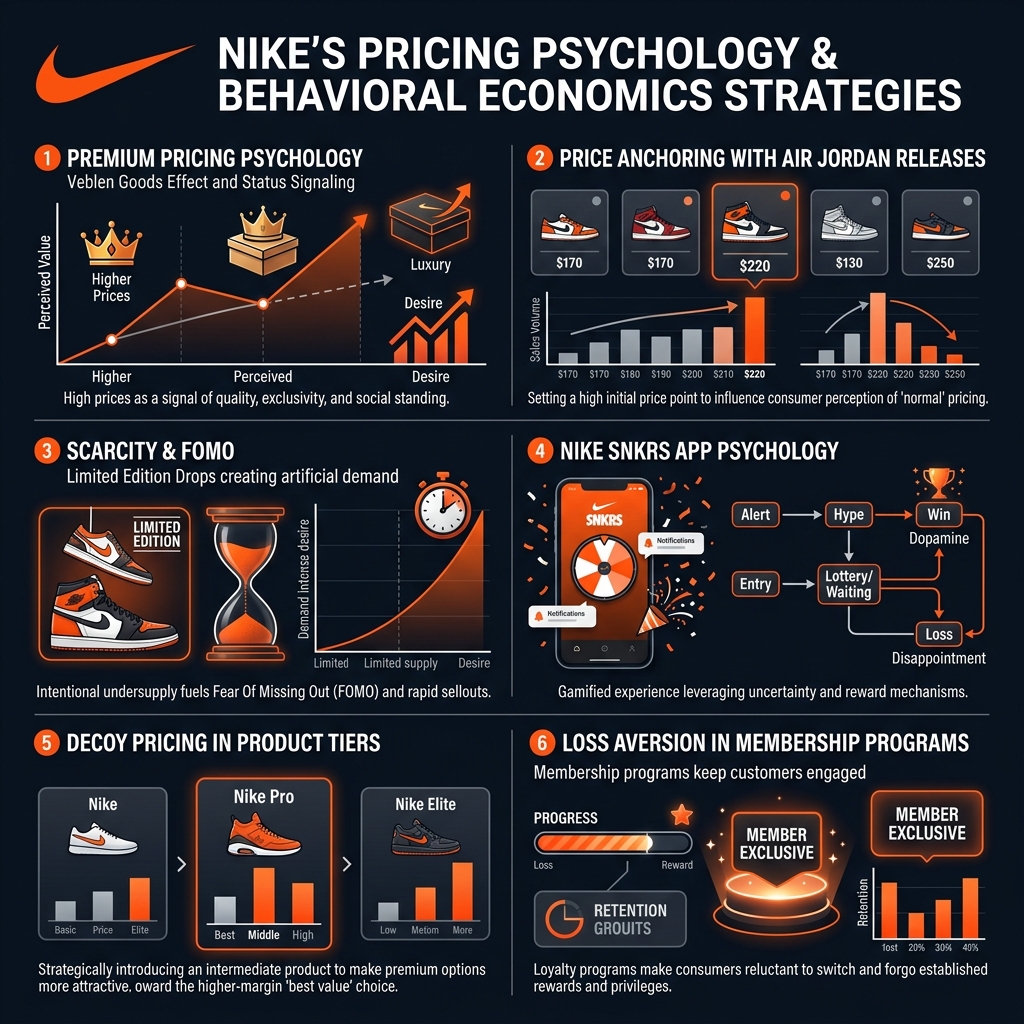
💎 The Veblen Goods Effect: When Higher Prices Increase Demand
Standard economic theory says that as price increases, demand decreases. But Nike has mastered the creation of Veblen goods — products where higher prices actually increase perceived desirability.
Consider the pricing trajectory of Air Jordan 1s:
- 1985 original retail: $65
- 2015 retro retail: $160
- 2026 retail: $180
- Limited colorway resale: $500–$5,000+
The psychology at work:
- Price-Quality Heuristic: Consumers use price as a mental shortcut for quality. A $180 shoe “must” be better than a $60 shoe — even if the production costs are similar
- Status Signaling (Conspicuous Consumption): Thorstein Veblen identified in 1899 that luxury goods serve as social signals — wearing expensive Nike shoes tells others “I can afford premium goods”
- Exclusivity Bias: Higher prices restrict access, making ownership more exclusive, which in turn makes the product more psychologically valuable
🎰 SNKRS App: The Slot Machine in Your Pocket
Nike’s SNKRS app is perhaps the most psychologically sophisticated retail platform ever designed. It uses variable-ratio reinforcement schedules — the same mechanism that makes gambling addictive — to create compulsive engagement.
How the SNKRS psychology works:
- Anticipation Building: Nike announces upcoming drops days or weeks in advance, showing images and stories. This creates anticipatory dopamine — the brain releases more dopamine in anticipation of a reward than when actually receiving it
- The Draw (Lottery System): Many releases use a random draw system where users enter for a chance to purchase. This is literally a lottery — and lotteries exploit the optimism bias (people overestimate their probability of winning)
- The Notification: When the draw opens, users frantically check their phones. The uncertainty creates a variable ratio schedule — sometimes you win, sometimes you don’t, and the unpredictability is what makes it addictive
- The “L” (Loss): Most users don’t “hit” (win the draw). This loss creates frustration-driven motivation — they become more determined to win next time, entering more draws and checking the app more frequently
- The “W” (Win): The rare wins feel euphoric precisely because of all the previous losses. This is classic intermittent reinforcement — the most powerful conditioning schedule known to behavioral science
📊 Price Anchoring & Tier Psychology
Nike’s product lineup uses sophisticated price anchoring to make mid-range products feel like good value:
| Product Tier | Price Range | Psychological Function |
| Nike Entry (Tanjun, Revolution) | $60–$85 | Entry point — “I own Nike” status at lowest cost |
| Nike Core (Air Max, Pegasus) | $100–$160 | The target tier — feels like “real Nike” without extreme cost |
| Nike Premium (Vaporfly, Air Jordan) | $170–$250 | Aspirational anchor — makes Core tier feel like a deal |
| Nike Ultra-Premium (Limited, Collab) | $250–$500+ | Price ceiling anchor — makes Premium tier feel reasonable |
This structure exploits the Goldilocks Effect (also known as extremeness aversion) — most consumers avoid the cheapest and most expensive options, gravitating toward the middle-upper range. The existence of $400 collaborations makes $180 Air Jordans feel like a moderate, sensible purchase.
⏳ Artificial Scarcity: The Economics of “Sold Out”
Nike has elevated artificial scarcity to an art form:
- Limited edition drops: Producing fewer units than demand guarantees sellouts — creating a permanent perception of exclusivity
- Collaboration scarcity: Nike x Off-White, Nike x Travis Scott, Nike x Sacai — these collaborations produce tiny quantities, creating astronomical resale premiums
- Regional exclusives: Some colorways are available only in specific countries or cities — adding geographic scarcity
- Time-limited access: SNKRS drops are often available for minutes, not hours — temporal scarcity at its extreme
The Commodity Theory (Brock, 1968) states that any commodity that is unavailable, hard to obtain, or restricted in availability will be perceived as more valuable. Nike doesn’t just understand this theory — it has built an entire business model on it.
📱 Chapter 5: Digital Ecosystem & UX Psychology — Nike’s App Empire
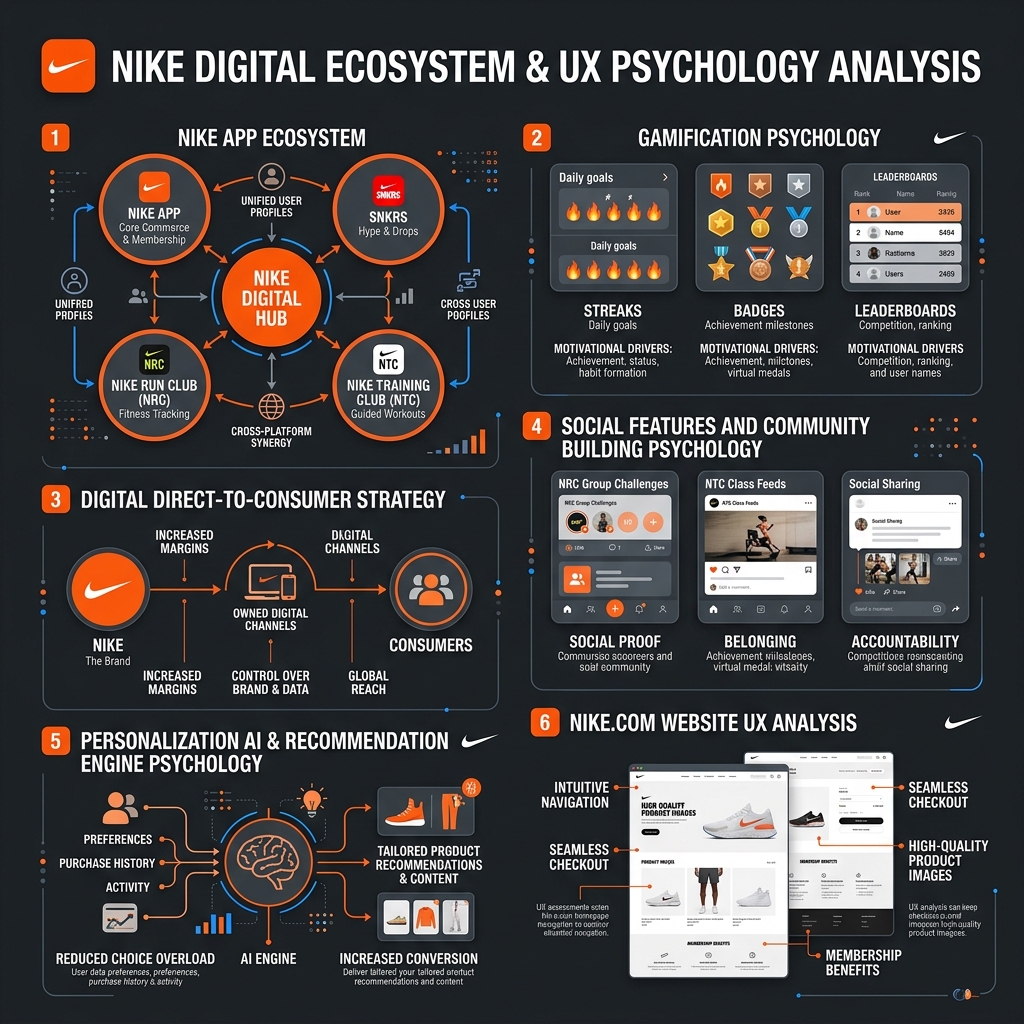
📲 The Nike App Ecosystem: Four Apps, One Psychological Loop
Nike operates four primary consumer apps, each targeting a different psychological need — but all feeding into a unified membership ecosystem:
- Nike App: The flagship shopping and brand experience — e-commerce, product discovery, member exclusives, style inspiration
- SNKRS: The limited-edition drop platform — anticipation, scarcity, collector culture
- Nike Run Club (NRC): GPS-tracked running with coaching, streaks, and community — fitness habit formation
- Nike Training Club (NTC): Workout programs, training plans, video guidance — structured fitness engagement
The psychological architecture is a habit loop system (Duhigg, 2012):
- Cue: Daily run reminder, new drop notification, training plan alert
- Routine: Open the app, engage with Nike content, complete a workout, enter a draw
- Reward: Personal best notification, badge earned, shoe won, membership points accrued
- Investment: Activity history, streaks, shoe collection, community connections — all create switching costs
🎮 Gamification Psychology in Nike Run Club
Nike Run Club is a masterclass in gamification psychology:
- Achievement Badges: Earning badges for milestones (first 5K, 100 miles, fastest kilometer) activates the completion drive — humans are hardwired to collect and complete sets
- Running Streaks: Consecutive day streaks create powerful loss aversion — the pain of losing a 30-day streak is psychologically more intense than the pleasure of starting one
- Leaderboards: Friends and global leaderboards activate social comparison theory (Festinger, 1954) — we evaluate ourselves relative to others
- Guided Runs with Athletes: Audio-guided runs narrated by Nike athletes and coaches use parasocial relationships — the feeling of personal connection to a famous person you’ve never met
- Post-Run Celebrations: Animated celebrations after completing runs create positive reinforcement — associating the Nike brand with the runner’s high
🛒 Nike.com UX Psychology
Strengths:
- Minimal Cognitive Load: Clean, image-forward design with generous whitespace reduces decision fatigue
- Social Proof Integration: Star ratings, “Bestseller” badges, and “Trending” labels guide purchase decisions
- Personalization Engine: AI-powered recommendations based on browsing history, purchase patterns, and stated preferences
- Nike By You (Customization): Allowing consumers to customize shoes activates the IKEA Effect — people value things more when they’ve contributed to creating them
- Visual Storytelling: Product pages feature lifestyle imagery and athlete stories, not just product specs — selling identity, not just features
Weaknesses:
- Choice Overload: With thousands of products, Nike.com can trigger Paradox of Choice (Schwartz, 2004) — too many options lead to decision paralysis
- Checkout Friction: Some users report multi-step checkout processes that increase abandonment rates
- Inventory Frustration: Popular sizes/colors frequently sold out — creating frustration (though also scarcity psychology)
- App Fragmentation: Four separate apps can create confusion — “Which Nike app do I need?”
📊 Nike Membership: 300 Million in the Ecosystem
Nike’s membership program has over 300 million members globally — making it one of the largest consumer loyalty programs on Earth. The psychology behind its effectiveness:
- Endowment Effect: Once you’re a “Nike Member,” you feel ownership over the status — and loss aversion prevents you from leaving
- Sunk Cost Fallacy: Accumulated points, purchase history, and workout data create perceived investment — “I’ve been tracking my runs here for 3 years, I can’t switch now”
- Exclusive Access: Member-only products and early access to drops create an in-group/out-group dynamic — members are privileged, non-members are missing out
- First-Party Data: Nike uses member data to create hyper-personalized marketing — showing you the exact shoes, in the exact colorway, at the exact time you’re most likely to purchase
🤝 Chapter 6: Customer Loyalty & Community Psychology
🔄 The Nike Loyalty Engine: Identity → Community → Habit → Advocacy
Nike’s customer loyalty model operates on four psychological layers:
- Identity Adoption: The consumer adopts Nike as part of their self-concept: “I’m a Nike person.” This is brand-self connection — the degree to which a brand is incorporated into a consumer’s identity
- Community Belonging: Through Nike Run Club groups, local running clubs, and social features, consumers form brand communities — social groups centered around shared brand affiliation
- Habitual Engagement: Daily running streaks, weekly training plans, and seasonal shoe releases create behavioral automaticity — engagement becomes effortless and unconscious
- Active Advocacy: The most loyal consumers become brand evangelists — recommending Nike to friends, defending the brand online, and creating user-generated content
👟 Sneaker Culture: When Brand Loyalty Becomes Identity
Nike has created something unprecedented in consumer behavior: sneaker culture — a global subculture where shoes are art, collectibles, investments, and identity markers simultaneously.
The psychology of sneakerheads reveals several powerful mechanisms:
- Collector Psychology: The drive to collect complete sets (every colorway of Air Jordan 1, every Air Max 90 variant) activates completion anxiety — the discomfort of having an incomplete collection
- Investment Rationalization: Framing sneakers as “investments” (some pairs appreciate 500-1000% in value) provides cognitive permission to spend excessively — “I’m not wasting money, I’m investing”
- Tribal Signaling: Wearing specific Nike models signals membership in specific subcultures — Jordan 1s signal streetwear knowledge, Vaporflys signal serious running, ACG signals outdoor culture
- Nostalgia Monetization: Retro releases (bringing back shoes from the 1980s and 1990s) monetize consumers’ nostalgic associations — they’re buying back their youth
🏃 Nike Run Club Communities: Social Glue
Nike sponsors and facilitates thousands of local running clubs worldwide. These serve a dual psychological function:
- Social Identity: “I’m not just a runner — I’m a Nike Runner.” The club membership strengthens brand-self connection
- Switching Costs: If all your running friends are in the Nike ecosystem (using NRC, sharing runs), switching to another brand means losing your social running network — this is network effect lock-in
⚔️ Chapter 7: Competitive Positioning — The Global Sportswear Battlefield
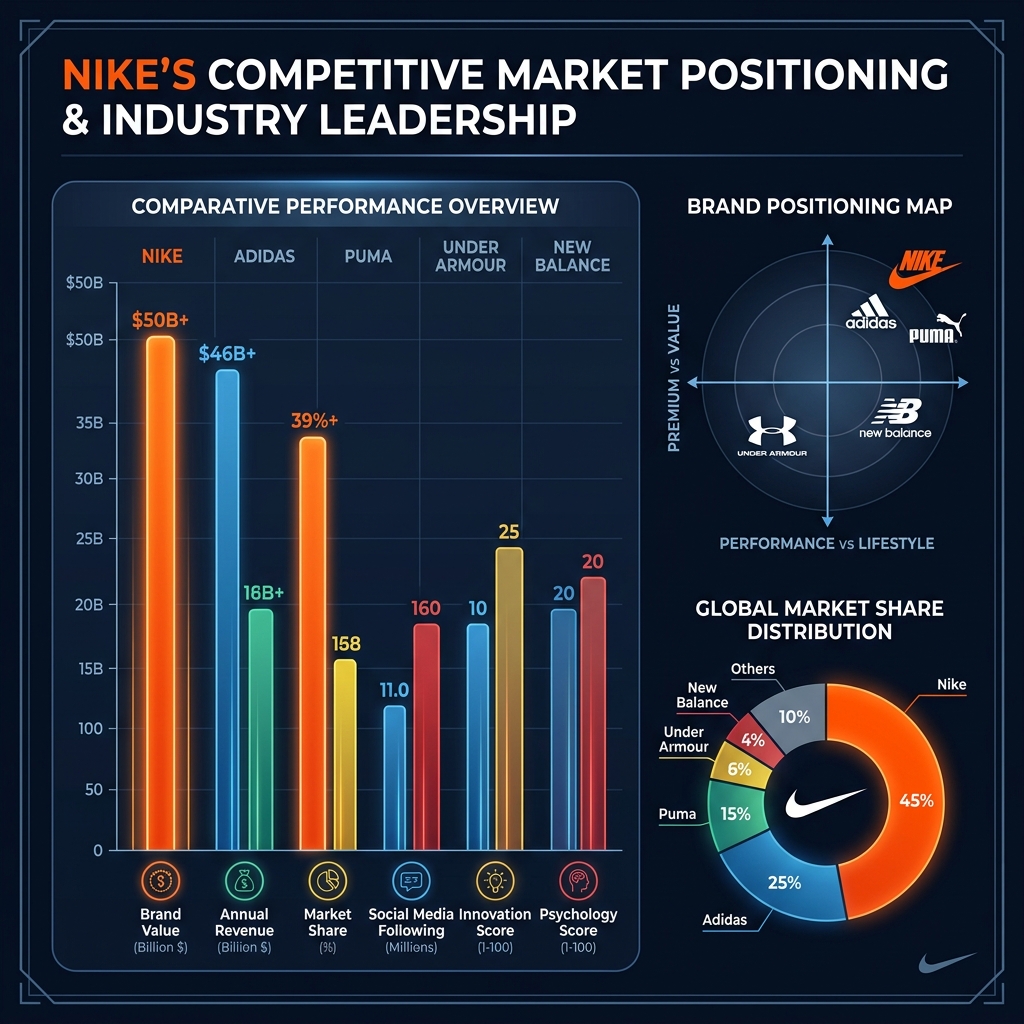
🏆 Global Sportswear Market Share (2025–2026 Estimates)
| Brand | Revenue (FY2025) | Global Market Share |
| ✓ Nike | ~$46.4B | ~27% |
| ⬡ Adidas | ~$25.5B | ~15% |
| 🐆 Puma | ~$9.5B | ~5.5% |
| 🛡️ Under Armour | ~$5.7B | ~3.3% |
| 🏃 New Balance | ~$6.5B | ~3.8% |
| 🏔️ On Running | ~$2.5B | ~1.5% |
🧠 Psychological Competitive Analysis
Nike positions as the “Hero Brand” — the brand of champions, peak performance, and aspirational identity. Its psychological message: “If the greatest athletes in the world choose Nike, you should too.”
Adidas positions as the “Creator Brand” — emphasizing creativity, collaboration (Yeezy, Pharrell), and cultural fusion. Its psychological message: “We’re at the intersection of sport and street culture.”
Puma positions as the “Lifestyle-Sport Hybrid” — emphasizing style over pure performance. Its psychological message: “You don’t need to be an athlete to look like one.”
Under Armour positions as the “Underdog Warrior” — emphasizing grit, training, and the unglamorous work of preparation. Its psychological message: “While they’re showing off, we’re putting in the work.”
New Balance positions as the “Authentic Craft Brand” — emphasizing Made in USA manufacturing, dad-shoe heritage, and anti-hype authenticity. Its psychological message: “We’re for people who don’t need flashy logos to feel confident.”
On Running positions as the “Performance Innovation Disruptor” — Swiss engineering, CloudTec technology, and premium-minimal aesthetics. Its psychological message: “Smart people choose better technology.”
What makes Nike’s position most defensible is that it owns the Hero archetype — and heroes are universal. Every culture, every generation, every demographic understands and aspires to heroism. Adidas’s “creator” positioning is culturally specific and trend-dependent. Under Armour’s “warrior” positioning is narrowly masculine. New Balance’s “authentic” positioning limits growth. Nike’s hero positioning is infinitely scalable.
🌍 Chapter 8: Cultural Impact & Social Psychology
✊ Nike and Social Justice: Brand as Moral Actor
Since the Kaepernick campaign, Nike has positioned itself as a brand that takes moral stands. This is a high-risk, high-reward psychological strategy:
- Black Lives Matter support (2020): “For Once, Don’t Do It” campaign — a striking inversion of the iconic slogan
- Gender equality campaigns: “Dream Crazier” featuring Serena Williams — challenging how female athletes are labeled “crazy” for showing emotion
- LGBTQ+ BeTrue collection: Annual pride-themed products and campaigns
- Disability inclusion: Nike FlyEase adaptive footwear for people with disabilities — hands-free shoes
- Hijab Pro: Performance hijab for Muslim female athletes — acknowledging previously invisible consumers
The psychology behind brand activism:
- Moral Identity Theory: Consumers increasingly choose brands that align with their moral self-image. Buying Nike signals moral alignment
- Parasocial Morality: Consumers feel that by supporting Nike, they are themselves participating in social justice — vicarious moral action
- Tribe Strengthening: Shared moral values create stronger in-group bonds than shared product preferences
🌱 Sustainability Psychology: Move to Zero
Nike’s “Move to Zero” sustainability initiative is a psychological response to growing eco-anxiety among younger consumers:
- Nike Refurbished: Refurbishing and reselling returned shoes — circular economy messaging
- Space Hippie collection: Shoes made from factory scraps and recycled materials — “trash transformed”
- Flyknit waste reduction: 60% less waste than traditional cut-and-sew — performance and sustainability aligned
- 2025 Target: 100% renewable energy in owned and operated facilities
However, critics point out the psychological gap between Nike’s sustainability messaging and its fast-fashion-like release cadence — hundreds of new colorways per year encourages overconsumption. This creates what psychologists call the licensing effect: “I’m buying a ‘sustainable’ shoe, so it’s okay to buy one more pair.”
🧪 Chapter 9: Consumer Psychology Deep Dive — The Neuroscience of Wearing Nike
🧬 Identity-Based Consumption: “I Am What I Wear”
Research in consumer neuroscience reveals that wearing Nike activates distinct brain regions:
- Medial Prefrontal Cortex (mPFC): This brain region, associated with self-reflection and identity, shows increased activation when consumers evaluate brands they strongly identify with. Nike’s brand identity is so deeply embedded that wearing Nike literally activates the brain’s self-concept
- Ventral Striatum: The brain’s reward center activates when consumers acquire desired Nike products — the same region that responds to food, sex, and drugs. Limited-edition acquisitions create dopamine spikes comparable to other reward experiences
- Mirror Neurons: When consumers see elite athletes performing in Nike, mirror neurons fire — creating a neurological simulation of the athlete’s performance. The consumer feels the athlete’s speed, power, and triumph vicariously
🏋️ The “Enclothed Cognition” Effect
Research by Adam & Galinsky (2012) demonstrated “enclothed cognition” — the systematic influence that clothes have on the wearer’s psychological processes. Applied to Nike:
- People wearing Nike athletic wear report feeling more athletic, confident, and motivated — even before exercising
- The Swoosh on your chest serves as a self-fulfilling prophecy: “I’m wearing Nike, therefore I’m an athlete, therefore I should perform like one”
- This effect is strongest when the clothing is associated with specific abilities (athletic performance) and when the wearer actively wears the garment (vs. just seeing it)
📐 The Psychology of “Drops” Culture
Nike’s “drop” culture (limited releases at specific times) exploits several powerful psychological mechanisms simultaneously:
- Anticipatory Pleasure (Dopamine): The period before a drop generates more neurological excitement than the purchase itself — the “wanting” system is more powerful than the “having” system
- Competition & Social Comparison: Knowing others are competing for the same limited product intensifies desire — it’s not just about wanting the shoe, it’s about winning the shoe
- Post-Purchase Rationalization: After securing a limited pair, consumers construct elaborate justifications (“It’s an investment,” “It’s art”) to reduce cognitive dissonance about the price
- Social Currency: Successfully copping a limited drop becomes social capital — shareable on Instagram, enviable by friends, documented on YouTube
📊 Chapter 10: Psychology Scorecard — Detailed Ratings
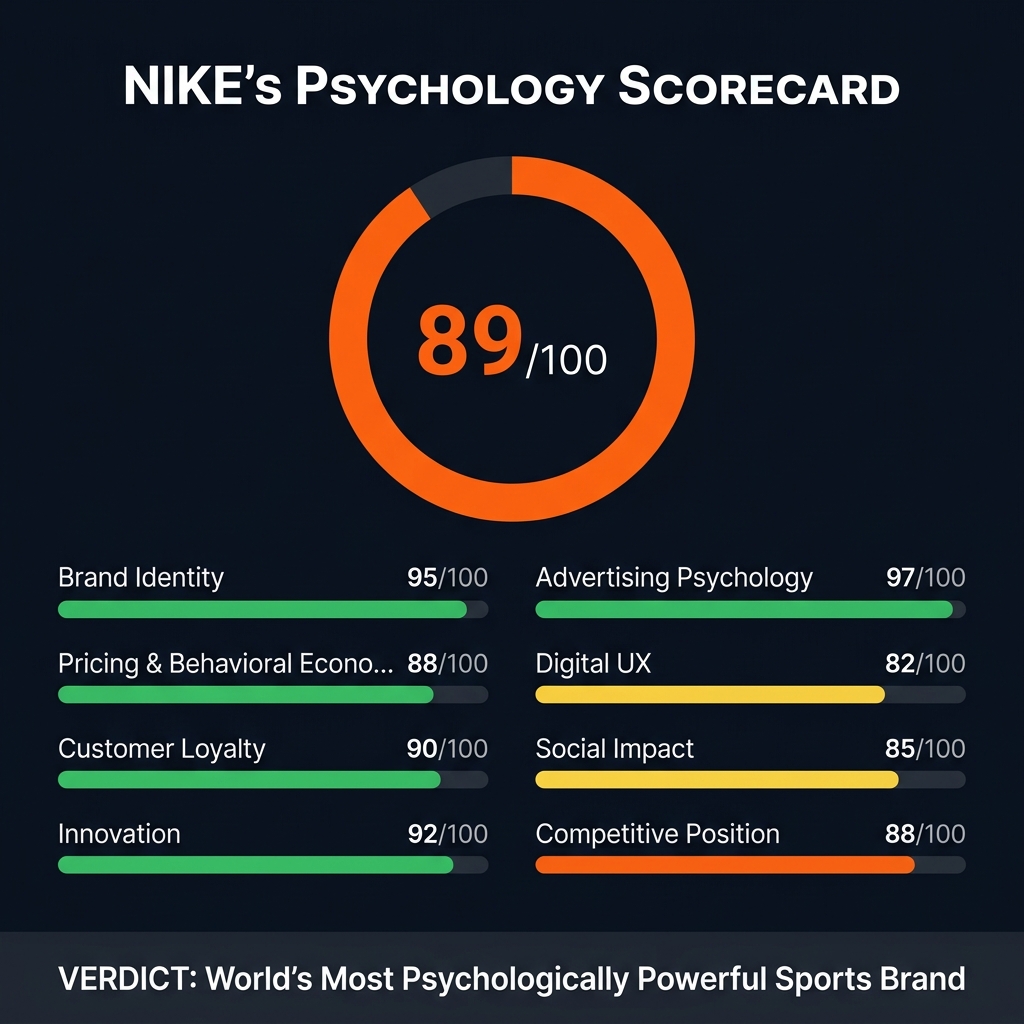
🧠 Overall Psychology Score: 89/100
| Brand Identity & Visual Psychology | 95/100 ⭐⭐ |
| Advertising & Persuasion Psychology | 97/100 ⭐⭐⭐ |
| Pricing & Behavioral Economics | 88/100 ⭐ |
| Digital UX & Interface Psychology | 82/100 ⭐ |
| Customer Loyalty & Retention | 90/100 ⭐⭐ |
| Social & Cultural Impact | 85/100 ⭐ |
| Innovation & Future-Readiness | 92/100 ⭐⭐ |
| Competitive Positioning | 88/100 ⭐ |
✅ Chapter 11: Strengths & Weaknesses — The Psychological Balance Sheet
💪 Psychological Strengths
- Unmatched Aspirational Identity Capital: No brand in any industry has built a stronger aspirational identity than Nike. Wearing Nike makes people feel like athletes, achievers, and members of an elite tribe. This identity bond is Nike’s most valuable psychological asset — worth more than its factories, stores, and inventory combined.
- “Just Do It” as Cultural Operating System: The slogan has transcended advertising to become a universal motivational framework. It’s used by people who have never bought a Nike product. This is the ultimate measure of brand penetration — when your message becomes part of the cultural lexicon.
- Athlete Endorsement Mythology: Nike’s athlete roster functions as a modern pantheon of heroes. Michael Jordan, LeBron, Serena, CR7 — these aren’t endorsers, they’re brand deities whose stories create emotional infrastructure for the brand.
- Scarcity Mastery: Nike has perfected the art of making demand consistently exceed supply. The SNKRS ecosystem is the most psychologically sophisticated retail platform ever designed, creating engagement patterns identical to behavioral addiction mechanisms.
- Digital Ecosystem Depth: With 300M+ members across four apps, Nike has built a data-powered psychological profiling engine that personalizes every touchpoint — from what products you see to what notifications you receive.
- Cultural Elasticity: Nike can credibly participate in basketball, running, soccer, skateboarding, yoga, streetwear, luxury fashion, social justice, and sustainability — this category breadth is psychologically unprecedented.
- Controversy Resilience: From sweatshops to Kaepernick, Nike has demonstrated remarkable ability to survive and even strengthen through controversy — a testament to the depth of its emotional equity.
- Founder Mythology: Phil Knight’s origin story (selling shoes from a car trunk, the waffle iron, being the underdog against Adidas) provides an authentic narrative foundation that can never be replicated by competitors.
⚠️ Psychological Weaknesses
- Innovation Narrative Fatigue: After decades of positioning as an innovator, Nike’s 2023-2025 period saw critics argue the brand was recycling retro designs rather than creating genuinely new ones. The “innovation” messaging risks becoming hollow if product development doesn’t match the marketing claims.
- DTC Over-Rotation Backlash: Nike’s aggressive pivot to direct-to-consumer (cutting wholesale partners like Foot Locker) created consumer access problems — people who wanted to try shoes in-store couldn’t find them. The 2024-2026 course correction acknowledges this error.
- Sustainability Authenticity Gap: Nike releases hundreds of new product colorways annually while simultaneously promoting “Move to Zero” sustainability. Environmentally conscious consumers may see this as greenwashing — creating cognitive dissonance that could erode trust.
- Sneaker Market Saturation: The resale sneaker market that Nike helped create has become flooded. When Jordan Brand releases too many retro colorways, individual releases feel less special — diluting the scarcity psychology that built sneaker culture.
- Price Sensitivity Growing: As Nike pushes retail prices higher ($180+ for many models), and global cost-of-living increases, there’s growing resistance — especially from younger consumers who may shift to more affordable competitors like New Balance or On Running.
- App Fragmentation: Four separate apps (Nike App, SNKRS, NRC, NTC) create UX confusion. Some users report notification fatigue and unclear differentiation between apps — violating the Simplicity Principle in UX psychology.
- Gen Z Authenticity Skepticism: While Millennials embraced Nike’s aspirational marketing, Gen Z consumers are more skeptical of corporate brand narratives. They may view Nike’s polished hero marketing as “too corporate” — preferring the more authentic, imperfect positioning of brands like New Balance or Salomon.
🔮 Chapter 12: Strategic Recommendations — A Psychologist’s Prescription for 2026 and Beyond
Based on this comprehensive psychological analysis, here are my evidence-based recommendations for Nike’s brand strategy:
1. Reclaim the Innovation Narrative with Demonstrable Breakthroughs (Highest Priority)
Nike’s psychological power has always rested on being the brand that pushes boundaries. The 2024-2026 innovation reset under Elliott Hill must deliver genuinely new technology — not just retro rereleases. Specifically:
- A successor to Vaporfly/Alphafly that creates another “revolution moment” in running
- New sustainable materials that don’t compromise performance — proving “green” can be “elite”
- AI-powered personalized fitting technology that makes buying Nike online as reliable as in-store
2. Consolidate the App Ecosystem
Merge Nike Run Club and Nike Training Club into a unified “Nike Fitness” platform, and integrate SNKRS into the main Nike App as a dedicated tab. This would:
- Reduce cognitive fragmentation — one app, one experience, one relationship
- Cross-pollinate engagement — runners see sneaker drops, sneakerheads discover fitness features
- Strengthen the unified membership identity — “I’m a Nike Member” across all activities
3. Embrace “Imperfect Hero” Marketing for Gen Z
While Nike’s polished hero narratives work brilliantly for Millennials and Gen X, Gen Z responds more strongly to authentic imperfection. Nike should:
- Feature athletes’ failures and vulnerabilities as prominently as their victories
- Create raw, unfiltered content for TikTok and social platforms — behind-the-scenes, bloopers, real moments
- Amplify grassroots athletes alongside global superstars — showing that Nike is for everyone, not just the elite
4. Solve the Sustainability-Consumption Paradox
Nike needs to address the cognitive dissonance between its sustainability messaging and its release volume. Potential approaches:
- Launch a “Nike Forever” product line — shoes explicitly designed for longevity (5+ years) with repair programs
- Implement a trade-in program where old Nikes are recycled into new products — closing the consumption loop visibly
- Reduce the total number of releases while increasing the significance of each one — quality over quantity
5. Deepen the Data-Driven Personalization Engine
With 300M+ members, Nike sits on one of the world’s largest consumer behavior datasets. The next step is:
- Predictive personalization: Show consumers products they’ll want before they know they want them
- Lifestyle integration: Use workout data to recommend appropriate shoes (e.g., “You’ve run 500 miles in your Pegasus — it’s time for a new pair”)
- Emotional targeting: Time marketing messages based on psychological state indicators — send motivational content when running streaks are at risk, send celebration content after achievements
6. Re-engage Wholesale Partners Strategically
Nike’s DTC over-rotation removed the brand from many physical retail locations. The course correction should:
- Curate a premium wholesale network — fewer, better retail partners
- Create Nike shop-in-shops within partner stores — maintaining brand control within third-party environments
- Use wholesale partnerships for try-on and discovery, then drive conversion through Nike direct channels — a hybrid model
📝 Final Verdict
Nike is, without question, the most psychologically sophisticated brand in the history of consumer marketing. Over 62 years, from a car trunk in Oregon to a global empire touching 190 countries, Nike has demonstrated an unparalleled understanding of human psychology — often operating at the cutting edge of behavioral science before the academic research even caught up.
The “Just Do It” slogan alone would be enough to secure Nike’s place in the marketing hall of fame. But Nike’s psychological arsenal goes far deeper: the Hero archetype framework, the aspirational identity machine, the scarcity-driven sneaker culture, the gamified digital ecosystem, the courage to take moral stands, and the relentless ability to make a pair of shoes feel like a transformative life decision.
As Nike enters 2026 under Elliott Hill’s leadership, the brand faces real challenges — innovation fatigue, Gen Z skepticism, sustainability paradoxes, and rising competition from agile newcomers like On Running and Hoka. But Nike’s psychological infrastructure — built over six decades of consistent investment in emotional equity — provides a competitive moat that no competitor can replicate in a few years.
Nike doesn’t just sell shoes. It sells the most powerful story in commercial history: that ordinary people can do extraordinary things. And as long as humans need to believe that, Nike will remain unstoppable.
Psychology Score: 89/100 — Nike earns the highest psychology score ever awarded on ShahzebSpeaks. With near-perfect scores in advertising psychology (97) and brand identity (95), Nike’s only significant gaps are in digital UX consolidation and sustainability authenticity. This is a brand that doesn’t just understand psychology — it advances the field of behavioral science through its marketing practices.
🧠 Want a Psychology Audit for Your Brand?
I’m Muhammad Shahzeb — an MSc Industrial Psychologist & Full-Stack Developer. I apply behavioral science to branding, web design, and conversion optimization. Let’s analyze your brand’s psychological impact.
📚 References & Sources
- Nike, Inc. “Annual Reports & SEC Filings 2020–2025.” investors.nike.com
- Knight, P. (2016). Shoe Dog: A Memoir by the Creator of Nike. Scribner.
- Katz, D. (2020). Just Do It: The Nike Spirit in the Corporate World. Adams Media.
- Bandura, A. (1977). “Self-efficacy: Toward a unifying theory of behavioral change.” Psychological Review, 84(2), 191-215.
- Cialdini, R. B. (2006). Influence: The Psychology of Persuasion. Harper Business.
- Kahneman, D. (2011). Thinking, Fast and Slow. Farrar, Straus and Giroux.
- Green, M. C., & Brock, T. C. (2000). “The role of transportation in the persuasiveness of public narratives.” Journal of Personality and Social Psychology, 79(5), 701-721.
- Adam, H., & Galinsky, A. D. (2012). “Enclothed cognition.” Journal of Experimental Social Psychology, 48(4), 918-925.
- Paharia, N., Keinan, A., Avery, J., & Schor, J. B. (2011). “The Underdog Effect: The Marketing of Disadvantage and Determination through Brand Biography.” Journal of Consumer Research, 37(5), 775-790.
- Brehm, J. W. (1966). A Theory of Psychological Reactance. Academic Press.
- Brock, T. C. (1968). “Implications of commodity theory for value change.” In A. G. Greenwald et al. (Eds.), Psychological Foundations of Attitudes. Academic Press.
- Festinger, L. (1954). “A theory of social comparison processes.” Human Relations, 7(2), 117-140.
- Schwartz, B. (2004). The Paradox of Choice: Why More is Less. Ecco.
- Duhigg, C. (2012). The Power of Habit: Why We Do What We Do in Life and Business. Random House.
- Morgan, A. (2009). Eating the Big Fish: How Challenger Brands Can Compete Against Brand Leaders. Wiley.
- Veblen, T. (1899). The Theory of the Leisure Class. Macmillan.
- Forbes. “World’s Most Valuable Brands 2025.” forbes.com
- Statista. “Nike Revenue & Market Share Reports 2020–2026.” statista.com
- Business of Fashion. “Nike’s DTC Strategy Analysis.” businessoffashion.com
Audit conducted by Muhammad Shahzeb — MSc Industrial & Organizational Psychology | Brand Psychology Specialist | Full-Stack Web Developer
Learn more about my approach →
Key Findings
- Nike's "Just Do It" slogan functions as a self-efficacy trigger backed by Bandura's social cognitive theory, producing measurable increases in consumer motivation
- The Air Jordan brand created the first athlete-as-deity marketing model, generating $6.6B+ annually through aspirational identity transfer
- Nike SNKRS app uses variable-ratio reinforcement schedules identical to slot machines, creating compulsive engagement loops
- Colin Kaepernick "Believe in Something" campaign generated $6B in brand value by leveraging controversy and moral identity signaling
- Nike's direct-to-consumer pivot reduced wholesale dependency from 68% to under 50%, fundamentally reshaping retail psychology
- The Nike membership ecosystem (300M+ members) creates switching costs through endowment effect and sunk cost psychology
Overall Psychology Score
Nike scores 89/100 in our comprehensive psychology audit covering consumer behavior strategies, UX design principles, and psychological marketing effectiveness.
The detailed dimension scores are in the audit's Psychology Scorecard chapter.
High impactMuhammad Shahzeb
MSc Industrial Psychologist, specializing in consumer behavior, UX psychology, and brand strategy analysis. Helping brands understand the psychology behind their success.
About Muhammad Shahzeb →