Meezan Bank Psychology Audit — How Faith, Not Marketing, Made Pakistan’s Most Profitable Bank
The deepest psychology audit of Meezan Bank ever written. How Pakistan's first and largest Islamic bank turned religious identity into the strongest customer loyalty asset in the country's financial sector, crossed Rs 1 trillion in market capitalisation, and posted Rs 89 billion profit in 2025 without ever competing on interest rates. Includes the moral licensing engine, the Shariah board as an authority device, and the two risks that could unravel it.

89 / 100
Overall consumer behavior effectiveness

Brand Overview
- Brand nameMeezan Bank
- Founded1997
- HeadquartersKarachi, Pakistan
- IndustryGeneral
- Websitewww.meezanbank.com ↗
Psychology Techniques Identified
- 01Identity-Based Loyalty (Religious Self-Concept)
- 02Moral Licensing & Guilt Removal
- 03Authority Bias (The Shariah Supervisory Board)
- 04Category Creation as Positioning
- 05First-Mover Prototype Advantage
- 06Terminology as Psychological Distancing
- 07Trust Transfer Through Scholarly Endorsement
- 08In-Group Belonging & Social Signalling
- 09Loss Aversion Applied to the Afterlife
- 10Sensory Brand Coding (Green, Calligraphy, Calm)
- 11Word-of-Mouth via Community Networks
- 12Switching Cost Through Moral Commitment
Full Psychology Audit Report
In this audit
Ask a Meezan Bank customer why they bank there and you will rarely hear an answer about profit rates, app features or branch convenience. You will usually hear a version of the same sentence: “Kam az kam sukoon to hai.” At least there is peace of mind. That sentence is not a financial statement. It is a statement about identity, conscience and sleep, and it is the reason a bank that refuses to compete on interest rates became Pakistan’s most profitable bank.
The numbers are difficult to argue with. Meezan posted a profit after tax of roughly Rs 89 billion for 2025, followed by Rs 23.4 billion in the first quarter of 2026. It became the first Islamic bank in Pakistan to cross Rs 1 trillion in market capitalisation. It runs over 1,115 branches across 365 cities, holds deposits of around Rs 3.6 trillion, commands roughly a third of the country’s Islamic banking market and over 27% of Roshan Digital Accounts. Meanwhile Islamic banking’s share of total banking assets in Pakistan is projected to climb toward 25-27% by the end of 2026.
I am an Industrial and Organizational Psychologist, and I want to be precise about what this audit is and is not. It is not a religious ruling; I am not a scholar and I will not adjudicate what is or is not permissible. It is an examination of the psychological architecture of a brand that solved the hardest problem in financial services, trust, by attaching itself to something customers already trusted more than any bank. That mechanism is fascinating, commercially formidable, and carries risks that most analyses of this brand never mention.
“Every other bank in Pakistan asks you to compare a number. Meezan asks you a different question entirely: what kind of person do you want to be about your money? A bank that competes on rates can be outbid tomorrow. A bank that competes on conscience cannot.”
— Brand Psychology Analysis, ShahzebSpeaks
📋 Brand Overview: Meezan Bank at a Glance
| Bank Name | Meezan Bank Limited (PSX: MEBL) |
| Founded | 1997 as Al-Meezan Investment Bank; first Islamic commercial banking licence in Pakistan, 2002 |
| Headquarters | Meezan House, Karachi, Pakistan |
| Profitability | Rs 89 billion profit after tax (FY2025); Rs 23.4 billion in Q1 2026; Pakistan’s most profitable bank |
| Market Milestone | First Islamic bank in Pakistan to cross Rs 1 trillion market capitalisation |
| Network & Deposits | 1,115+ branches in 365 cities; deposits around Rs 3.6 trillion (as of early 2026) |
| Market Share | Roughly one third of Pakistan’s Islamic banking market; 27%+ of Roshan Digital Accounts |
| Brand Slogan | “The Premier Islamic Bank” |
| Psychological Code | Conscience, peace of mind, religious identity, moral safety |
| Psychology Score | 89 / 100 — ⚡ Extreme Impact |
📜 Chapter 1: The Complete History — From a Sceptical Market to Rs 1 Trillion (1997–2026)
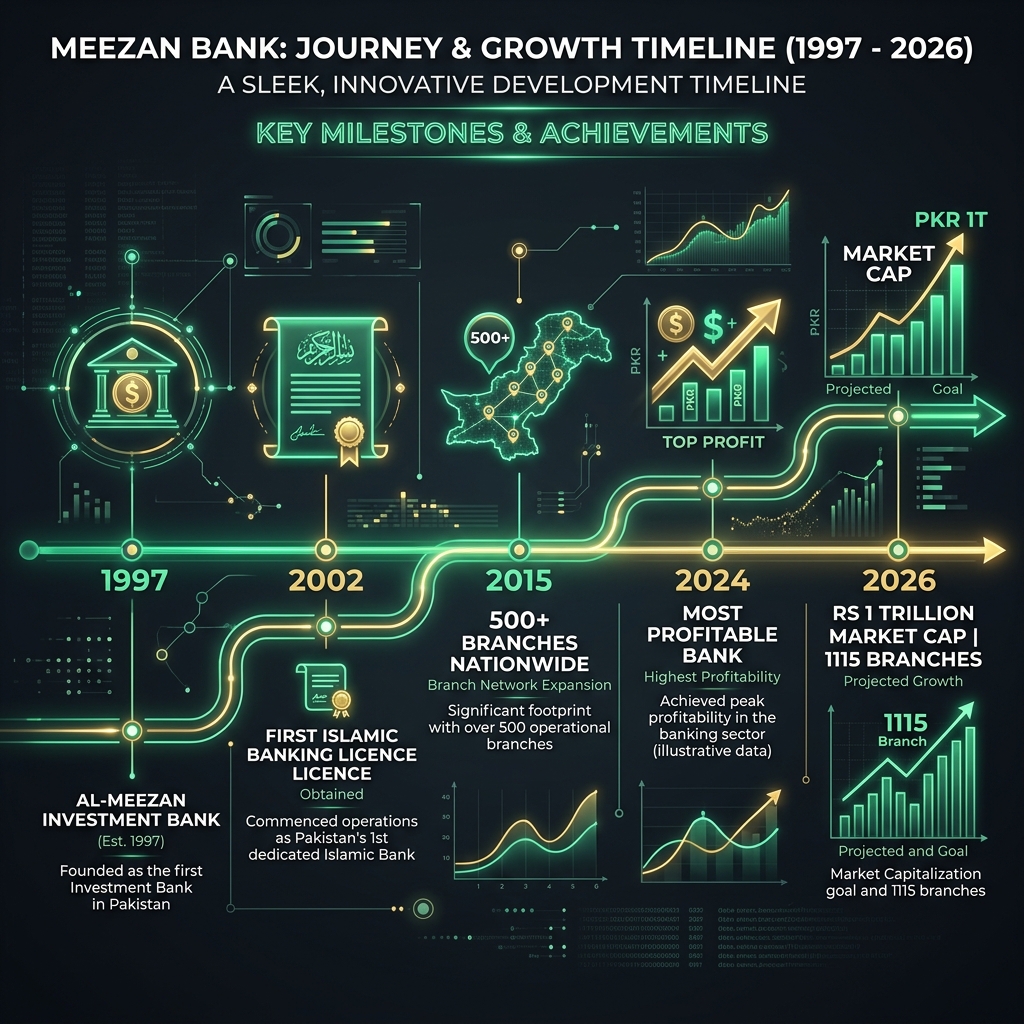
🏦 1997-2001: A Category That Did Not Exist Commercially
Meezan began life as Al-Meezan Investment Bank in 1997, in a market where “Islamic banking” existed mostly as an academic debate and a source of public scepticism. The prevailing assumption among ordinary Pakistanis, and frankly among many bankers, was that an interest-free bank was either impossible or a marketing costume. Building a business in that environment required solving a psychological problem before a financial one: convince people a category can exist at all.
📜 2002: The First Licence
In 2002 Meezan received Pakistan’s first Islamic commercial banking licence from the State Bank of Pakistan. This is the single most important strategic event in the brand’s history, and Chapter 4 explains why in psychological terms. Being first in a new category does not just give you a head start; it lets you become the mental prototype of the category itself, so that later entrants are permanently measured against you.
🌱 2003-2015: The Slow Trust Build
The next decade was branch expansion, product development and, most importantly, patient credibility work: a visible Shariah Supervisory Board, published fatwas, scholarly seminars, and a deliberate refusal to look like a conventional bank wearing green. This period generated no dramatic growth story, and that is precisely the point. Trust brands cannot sprint. Meezan spent a decade making a claim believable before spending a decade monetising it.
🚀 2016-2023: The Inflection
As Islamic banking gained regulatory support and public familiarity, Meezan’s earlier investment converted. Branch count climbed past a thousand, deposits grew steeply, and the bank moved from being “the Islamic option” to being a mainstream financial institution that happened to be Islamic. Roshan Digital Accounts, launched to serve overseas Pakistanis, gave the brand a new growth channel where Meezan captured over a quarter of the market.
👑 2024-2026: The Crown
Meezan became Pakistan’s most profitable bank, posting roughly Rs 89 billion profit after tax for 2025 and Rs 23.4 billion in Q1 2026 with a Rs 7.5 per share dividend. It crossed Rs 1 trillion in market capitalisation, a first for an Islamic bank in the country. Meanwhile the category it created kept expanding, with Islamic banking assets projected to reach around Rs 19 trillion and 25-27% of total banking assets by end-2026.
Read that trajectory as a psychologist and the story is unusually clean: a brand spent roughly fifteen years building an identity asset, then roughly ten years collecting on it.
🕌 Chapter 2: Identity-Based Loyalty — The Strongest Retention Mechanism in Finance
Banking is, on paper, the most commoditised consumer category there is. The money is identical. The account is identical. Switching costs are modest. In a rational market, customers should chase the best rate and banks should compete themselves into thin margins.
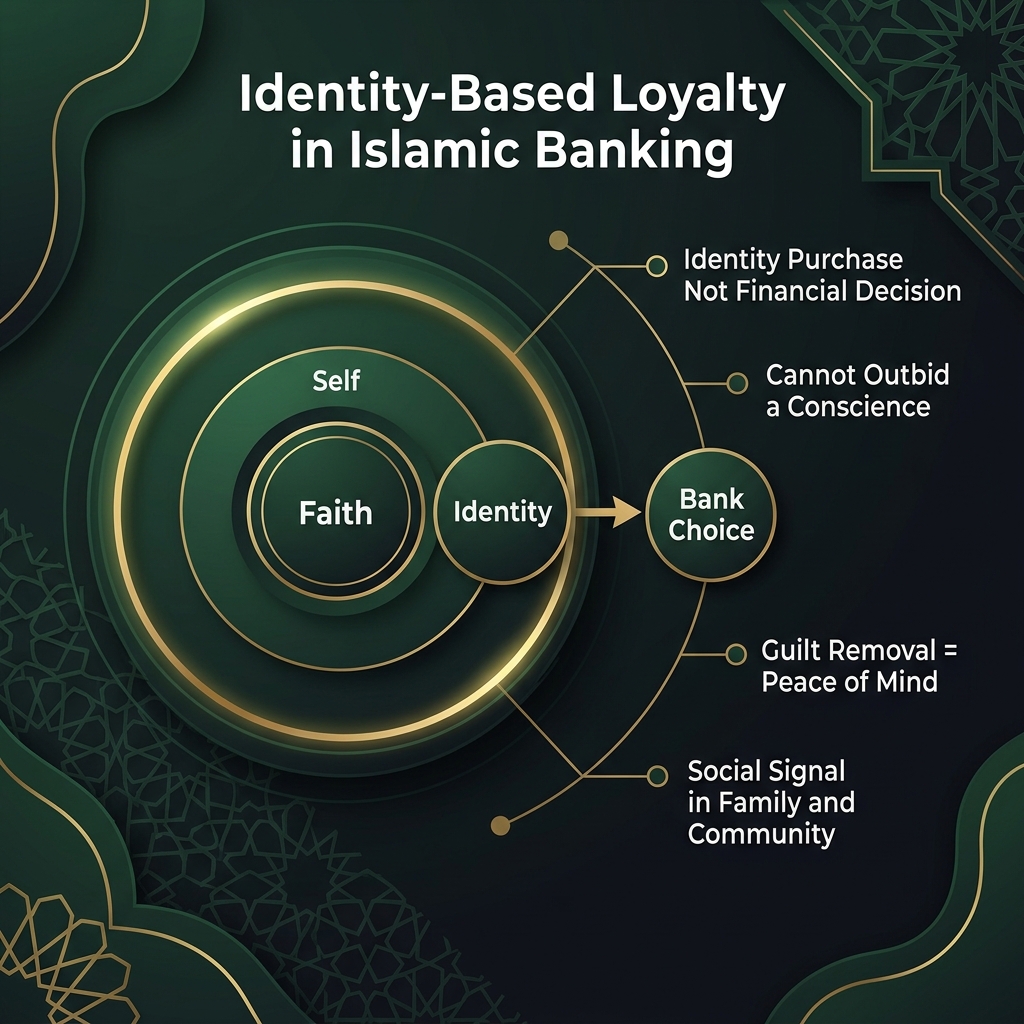
Meezan escaped that trap by moving the decision to a different level of the mind. Social identity theory, developed by Tajfel and Turner, describes how a significant part of our self-concept comes from the groups we belong to, and how strongly we act to maintain consistency with those group identities. For a religiously observant customer, choosing an Islamic bank is not a product comparison; it is an expression of religious identity, and identity-consistent behaviour is among the most stable behaviour psychology has ever measured.
The commercial consequence is enormous and worth stating plainly: a competitor cannot outbid an identity. If a conventional bank offers a better return, the observant Meezan customer does not experience that as a tempting offer. They experience it as a proposal to be a different kind of person, which is not a trade most people will make for a percentage point. This is why Meezan can maintain pricing power in a category where pricing power is supposed to be impossible.
There is a second layer. Identity choices are socially visible. Telling family that you bank with Meezan communicates something about you, and receiving approval for it reinforces the behaviour. The bank is not only a service, it is a small, repeatable signal of belonging, and signals that earn social approval are exceptionally durable.
😌 Chapter 3: The Real Product Is Guilt Removal
Here is the mechanism I would put at the centre of this entire audit, and it is the one conventional marketing analysis consistently misses.
For a religiously observant Muslim in Pakistan, keeping money in a conventional interest-bearing account produces a persistent, low-grade moral discomfort. Not usually a crisis. A background hum: the mild unease of a person whose stated values and daily practice are not fully aligned. Festinger’s cognitive dissonance theory tells us this state is genuinely aversive and that the mind works continuously to resolve it, usually by rationalising (“everyone does it,” “there is no alternative”) because the alternative, changing behaviour, feels harder.
Meezan’s actual product is the elimination of that dissonance. What the customer buys is not a superior return or a slicker app. It is the ability to stop rationalising. That is why “sukoon” appears so often in how customers describe the brand, and why the emotional register of Meezan’s communication is calm rather than exciting. The bank is not selling gain; it is selling relief.
Relief products behave differently from performance products in three ways that every marketer should note. They are price-insensitive, because you do not shop around for peace of mind. They produce gratitude rather than satisfaction, which is a much stronger loyalty emotion. And they generate evangelism, because a person who has resolved a moral discomfort naturally wants others they care about to resolve it too, which converts customers into an unpaid, highly credible sales force operating inside families and mosques.
Add one more layer that makes this uniquely powerful in a faith context: the stakes are framed not as financial loss but as spiritual accountability. Loss aversion research shows losses weigh roughly twice as heavily as equivalent gains, and here the imagined loss is not money. It is standing in the hereafter. No conventional bank can construct an incentive of comparable weight, and Meezan does not need to state it explicitly, because the customer supplies it themselves.
👳 Chapter 4: The Shariah Board — Authority Bias as Infrastructure
Ask an ordinary customer to personally verify whether a Diminishing Musharakah house financing structure is genuinely free of riba, and the request is absurd. The evaluation requires expertise in Islamic jurisprudence and financial structuring that almost nobody possesses. Under that kind of irreducible uncertainty, the brain does what it always does: it outsources the judgment to an authority.
Meezan’s Shariah Supervisory Board, historically associated with prominent scholars including Justice (Retd) Muhammad Taqi Usmani, is therefore not a compliance department. It is the single most important brand asset the bank owns. Cialdini’s work on authority explains the mechanism: we defer to credible experts, particularly in domains where our own competence is low, and the deference is largely automatic rather than deliberate.
What makes this an unusually strong version of authority bias is whose authority is being borrowed. The bank is not citing a rating agency or a consultancy; it is citing scholars whom the customer’s family, community and mosque already regard as trustworthy on the most important questions in their life. That is a pre-existing trust relationship, and Meezan is effectively renting it. Trust transferred from a religious authority carries emotional weight that no financial regulator’s approval could match.
The strategic vulnerability is the mirror image, and Chapter 9 develops it: rented trust can be recalled. A brand whose credibility rests on scholarly endorsement is exposed to scholarly disagreement, and that disagreement exists, publicly, in exactly the discourse the bank’s customers read.
🗣️ Chapter 5: The Language Layer — Why Terminology Is Not Decoration
Murabaha, Ijarah, Musharakah, Mudarabah, Sukuk, Takaful. Critics dismiss this vocabulary as Arabic labels on conventional products, and I will address that criticism honestly in Chapter 9. But as a matter of psychology, the terminology is doing real and measurable work regardless of the jurisprudential debate.
Framing changes perception even when substance is unchanged. Kahneman and Tversky demonstrated this repeatedly: the same outcome described as “90% survival” versus “10% mortality” produces different decisions. When a transaction is described as Ijarah (a lease) rather than a loan, the customer’s mental model of the relationship genuinely changes, and their emotional response follows the model rather than the cash flows.
Unfamiliar precise terminology signals expertise. Specialist vocabulary functions as a credibility cue. A bank that uses jurisprudential terms correctly appears to be a bank that has done the jurisprudential work, and that inference happens automatically.
The words carry sacred association. These are not neutral technical terms; they come from religious and classical legal discourse, and they arrive pre-loaded with reverence. Every use quietly reinforces that this is a religious institution operating in finance rather than a financial institution using religion.
The visual and sensory codes reinforce it: green, calligraphic elements, calm typography, restrained advertising, and a deliberate absence of the aggressive aspiration that conventional bank marketing uses. As I argued in my von Restorff article, distinctiveness comes from breaking your category’s visual uniform, and Meezan’s uniform break is calm dignity in a category that shouts.
🥇 Chapter 6: First-Mover Prototype Advantage
Meezan holds a position that money cannot buy: it is the mental prototype of Islamic banking in Pakistan. Ask most Pakistanis to name an Islamic bank and one name arrives first, unprompted.
Eleanor Rosch’s research on categorisation showed that we store categories around a central example, and the prototype enjoys advantages that are close to structural. It is recalled first, treated as the standard against which alternatives are judged, and benefits from every conversation about the category, including conversations started by competitors. I documented the commercial power of this position in my McDonald’s audit, and the dynamic is identical here in a completely different industry.
The advantage compounds in a specific way for Meezan. When a conventional bank opens an Islamic window, its marketing has to first educate the customer that Islamic banking is legitimate, and that education reinforces the prototype rather than the advertiser. Competitors are effectively paying to grow a category in which Meezan is the default answer, which is one of the pleasanter positions in commerce.
There is also a credibility asymmetry that competitors cannot close with spending. A bank that was Islamic from birth carries a different psychological status than a bank that added an Islamic division after decades of conventional operation. The first reads as conviction; the second reads as strategy. Customers detect the difference intuitively, and in a trust category the difference is decisive.
🌍 Chapter 7: The Overseas Channel and the Diaspora Psychology
Meezan’s capture of over 27% of Roshan Digital Accounts deserves its own analysis, because the diaspora customer is psychologically distinct from the domestic one.
Overseas Pakistanis frequently live in countries where genuinely Islamic financial products are unavailable or awkward, which means the moral dissonance described in Chapter 3 is a daily, unresolved condition rather than an occasional thought. A Pakistani account that is both home and halal resolves two separate discomforts simultaneously: distance from country and distance from practice.
Diaspora identity research consistently finds that religious and national identification often intensifies among migrants rather than fading, because identity becomes more salient when it is a minority position. A bank that lets an overseas Pakistani express both identities in one account is not selling a remittance product. It is selling a small, recurring act of belonging, performed from six thousand kilometres away.
This also explains why the channel is so profitable relative to its acquisition cost. The customer arrives pre-motivated, requires little persuasion on the value proposition, and tends to bring family into the same institution, since financial decisions in Pakistani households are frequently collective rather than individual.
👨👩👧 Chapter 8: Family Systems, Word of Mouth and the Community Multiplier
Western banking marketing assumes an individual chooser. Pakistani financial behaviour frequently does not work that way, and Meezan’s growth pattern reflects this.
Bank choice here is often a household decision, made with elders, influenced by extended family, and reinforced in community settings. That produces a growth mechanic that no advertising budget can replicate: when one respected family member switches on religious grounds, the switch travels through the family network carrying moral endorsement rather than commercial recommendation. “Abbu ne Meezan mein account khulwa liya hai” is a far stronger persuasion event than any campaign, because it combines social proof with authority and family loyalty in a single sentence.
Mosque networks, religious study circles and community organisations amplify this further. These are pre-existing high-trust networks, and information travelling through a high-trust network is accepted with far less scrutiny than the same information from a paid channel. Meezan effectively acquired distribution inside the country’s densest social infrastructure without owning it, which is why its marketing spend has historically looked modest relative to its growth.
One consequence worth noting for competitors: this network cuts both ways. The same channels that spread endorsement would spread a credibility failure at identical speed, which raises the stakes on the risks in the next chapter.
⚠️ Chapter 9: The Dark Side — Scepticism, Commoditisation and the Rented-Trust Problem
🤨 The “Same Thing With Arabic Names” Critique
The most persistent public criticism of Islamic banking, in Pakistan and globally, is that the products are conventional instruments restructured to satisfy form while producing economically similar outcomes, and that profit rates track interest rates closely enough to make the distinction feel cosmetic. This critique is made by ordinary customers in comment sections and by some scholars and academics in serious terms.
My audit’s position has to be careful here, because I am a psychologist and not a jurist. I cannot rule on the substance, and I will not pretend to. What I can say is the psychologically relevant part: the critique exists inside the community whose trust the bank depends on, it circulates in exactly the WhatsApp groups and religious discussion spaces where the brand’s word-of-mouth engine operates, and a trust brand cannot answer that kind of doubt with advertising. It can only answer it with transparency, which is the recommendation in Chapter 12.
🏪 Commoditisation of the Category
Meezan created a category and is now watching every conventional bank enter it. Islamic windows, Islamic subsidiaries and fully converted institutions are multiplying as the sector heads toward 25-27% of banking assets. The strategic problem is straightforward: if every bank is Islamic, being Islamic stops being a differentiator. The identity-based loyalty that made Meezan immune to rate competition weakens the moment a customer can satisfy their religious requirement at any branch on any street, at which point the competition reverts to service, digital experience and rates, which are precisely the dimensions where Meezan’s advantage is smallest.
🔗 Rented Trust Is Recallable
As Chapter 4 noted, the Shariah board is the load-bearing wall. Any significant scholarly dispute, board departure, or high-profile disagreement about a product structure transmits directly into customer confidence, because the customer never verified the claim independently and cannot defend it independently either. Borrowed credibility is powerful and fragile in equal measure, a dynamic I documented from the other direction in my Qatar Airways audit, where awards played the same borrowed-authority role.
⚖️ The Moral Licensing Risk
Here is a subtler psychological hazard that nobody discusses. Moral licensing research shows that when people make one virtuous choice, they sometimes feel licensed to be less scrupulous elsewhere. A customer who has satisfied their conscience through their choice of bank may feel less need to scrutinise the ethics of what they finance, how they treat debtors, or how they earn. That is not the bank’s fault, but it is a real effect of the product it sells, and an institution built on conscience arguably has some responsibility to notice it.
⚔️ Chapter 10: Competitive Positioning — Who Can Actually Take This
| Competitor | Their Position | Psychological Gap vs Meezan |
| Conventional banks’ Islamic windows | Islamic products inside a conventional institution | Read as strategy rather than conviction; the origin story cannot be bought |
| Other full-fledged Islamic banks | Same category, same principles, smaller scale | Compete on the same axis but against the prototype; must out-serve rather than out-position |
| Large conventional banks (HBL, UBL, MCB) | Scale, network, corporate relationships, digital investment | Win convenience and rates; cannot enter the conscience dimension at all |
| Fintechs and digital wallets | Speed, UX, low friction, young user base | The real long-term threat: they compete for the generation that grew up expecting an app, not a branch |
The honest competitive read is that Meezan’s position is close to unassailable on the dimension it chose, and increasingly exposed on the dimensions it did not. No conventional bank can credibly claim founding conviction. But a generation of younger customers whose default expectation is a fast, elegant app may weigh convenience more heavily than their parents did, and if a fintech ever pairs genuine Shariah credibility with excellent digital experience, that is the competitor that matters. Meezan’s moat is made of belief; belief protects against rate wars, not against a better interface.
📊 Chapter 11: Psychology Scorecard — Detailed Ratings
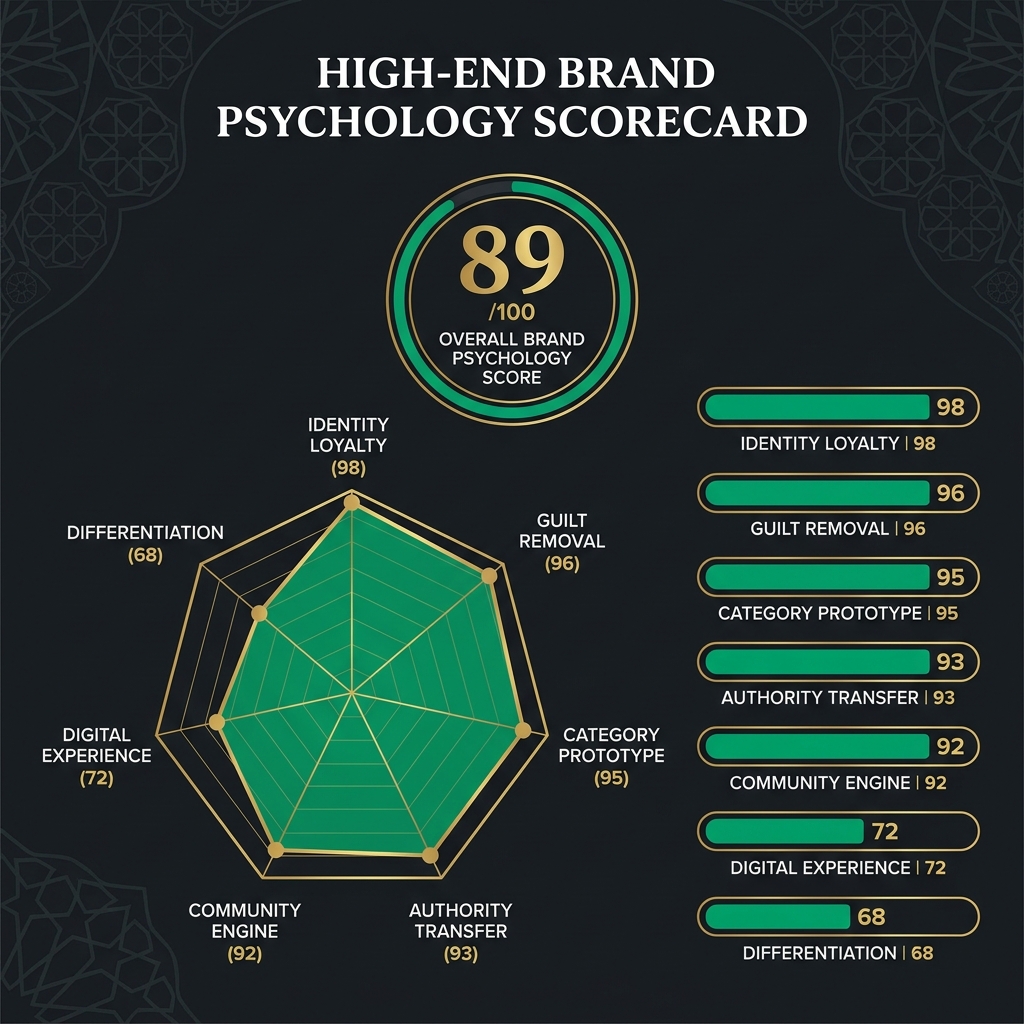
| Psychology Dimension | Score | Verdict |
| Identity-Based Loyalty | 98/100 | The strongest retention mechanism available in any consumer category. |
| Guilt Removal & Relief Positioning | 96/100 | Sells peace of mind, which is price-insensitive and produces gratitude. |
| Category Prototype Position | 95/100 | First mover owns the default answer; rivals grow the category for it. |
| Authority Transfer (Shariah Board) | 93/100 | Borrows the most trusted authority in the customer’s life. |
| Community & Word-of-Mouth Engine | 92/100 | Distribution inside family and mosque networks, acquired without owning them. |
| Digital Experience & Youth Appeal | 72/100 | Adequate rather than category-leading; the generational exposure. |
| Differentiation Durability | 68/100 | Every bank going Islamic erodes the thing that made it distinct. |
| Credibility Robustness (Rented Trust) | 70/100 | Powerful but recallable; scepticism lives inside the customer base. |
| OVERALL PSYCHOLOGY SCORE | 89/100 | ⚡ Extreme Impact — conviction converted into compounding advantage. |
✅ Chapter 12: Balance Sheet & A Psychologist’s Prescription
💪 Psychological Strengths
- Identity loyalty that cannot be outbid: a better rate elsewhere is not a temptation, it is a proposal to be a different person
- Relief as a product: peace of mind is price-insensitive, produces gratitude rather than satisfaction, and generates evangelism
- Prototype ownership: the default answer in its category, growing every time a competitor advertises the category
- Borrowed sacred authority: scholarly endorsement carries weight no regulator or rating agency can match
- Community distribution: family and mosque networks carry endorsement with moral force and zero media cost
- Founding-conviction advantage: a bank that was Islamic from birth cannot be imitated by one that converted later
⚠️ Psychological Weaknesses
- Category commoditisation: as Islamic banking approaches a quarter of all assets, the differentiator dilutes into a norm
- Rented credibility: the trust sits with scholars, so scholarly dispute transmits directly into customer doubt
- Living scepticism: the “Arabic names on conventional products” critique circulates inside the very networks that drive growth
- Digital gap: conviction protects against rate competition, not against a materially better app for a younger cohort
- Moral licensing side effect: a conscience product can inadvertently reduce scrutiny elsewhere in a customer’s financial conduct
🔮 The Prescription
- Answer the scepticism with radical transparency, not reassurance. The single highest-value move available is publishing, in plain Urdu and English, exactly how a Murabaha or Ijarah transaction differs structurally from a conventional loan, including where the bank bears risk and what happens if it does not. Customers cannot verify jurisprudence, but they can recognise an institution willing to be examined, and willingness to be examined is the only credible answer to “is this real?”
- Build the second moat now, while the first still holds. When every bank is Islamic, the winner will be the one with the best service and digital experience. That investment must be made during the period of advantage, not after it evaporates, because the identity moat is quietly buying time that is finite.
- Own the education layer of the category. The brand that teaches Pakistan how Islamic finance works becomes the authority on it, and authority is harder to commoditise than a product. Free courses, plain-language explainers and school-level financial literacy would deepen the prototype position rather than merely defending it.
- Reduce single-point dependence on the board. Diversified scholarly representation, published methodology and documented decision processes make the credibility structural rather than personal, which protects against the day any individual endorsement changes.
- Take the ethical mandate further than compliance. A bank that positions on conscience has an opening no competitor can follow: genuinely humane debt recovery, transparent fee structures, and visible refusal of harmful financing would convert a religious claim into an observable ethical record, which is far harder to dismiss as cosmetic.
- Win the young without diluting the code. The generation entering banking now expects app-first everything. Meezan’s calm dignity is a real asset and does not have to be traded for a modern interface, but the interface has to arrive before a fintech pairs excellent design with credible Shariah governance.
📝 Final Verdict
Meezan Bank is the most psychologically interesting company in Pakistani commerce, and the reason is that it solved banking’s hardest problem by refusing to play banking’s game. Every competitor asked customers to compare a number. Meezan asked them a question about themselves, and questions about the self produce answers that do not change when a rival improves an offer. That single strategic decision, made in a market that did not believe the category could exist, produced Rs 89 billion in annual profit, Rs 1 trillion in market capitalisation, and a customer base that recommends the institution as a moral act rather than a financial one.
The honest closing note is that the brand’s greatest achievement now contains its greatest risk. Meezan won by creating a category. That category is now succeeding so thoroughly that it is becoming the norm, and a differentiator that becomes a norm stops differentiating. The bank has perhaps a decade in which its founding conviction still reads as distinct, and the question for that decade is whether it spends the advantage on transparency, service and education, or simply enjoys it. Trust brands rarely fall because someone beat them. They fall because the thing they stood for became ordinary, and they did not notice in time.
Psychology Score: 89/100 — Meezan Bank earns elite marks for identity-based loyalty (98), guilt-removal positioning (96), and category prototype ownership (95), held back by differentiation durability (68), credibility robustness (70), and a digital experience (72) that will matter more with every passing year. The strongest identity asset in Pakistani business, on a clock it did not set.
🧠 Want a Psychology Audit for Your Brand?
I’m Muhammad Shahzeb, an MSc Industrial Psychologist and Full-Stack Developer based in Pakistan. I audit brand trust, positioning and customer psychology using behavioral science, with particular focus on how identity, culture and faith shape financial and consumer decisions in our market. Let’s look at your brand.
📚 References & Sources
- Meezan Bank Limited. Corporate profile, annual reports and investor disclosures. meezanbank.com/about-us
- Bloom Pakistan. “Meezan Bank Net Profit Surges to Record in 2025.” bloompakistan.com
- Bloom Pakistan. “Meezan Bank Becomes Pakistan’s First Islamic Bank to Hit Rs 1 Trillion Valuation.” bloompakistan.com
- Profit by Pakistan Today. “Pakistan’s Islamic banking assets may reach Rs19 trillion by end-2026.” May 2026.
- Business Recorder. Meezan Bank coverage and quarterly results reporting. brecorder.com
- State Bank of Pakistan. Islamic Banking Bulletin, quarterly editions.
- Tajfel, H., & Turner, J. C. (1979). “An integrative theory of intergroup conflict.” (Social identity theory.)
- Festinger, L. (1957). A Theory of Cognitive Dissonance. Stanford University Press.
- Cialdini, R. B. (2006). Influence: The Psychology of Persuasion. Harper Business. (Authority and social proof.)
- Rosch, E. (1975). “Cognitive representations of semantic categories.” Journal of Experimental Psychology: General, 104(3), 192-233.
- Kahneman, D., & Tversky, A. (1981). “The framing of decisions and the psychology of choice.” Science, 211(4481), 453-458.
- Kahneman, D., & Tversky, A. (1979). “Prospect theory: An analysis of decision under risk.” Econometrica, 47(2), 263-291. (Loss aversion.)
- Monin, B., & Miller, D. T. (2001). “Moral credentials and the expression of prejudice.” Journal of Personality and Social Psychology, 81(1), 33-43. (Moral licensing.)
- ICMA International. “Islamic Banking Sector in Pakistan” research paper.
Audit conducted by Muhammad Shahzeb, MSc Industrial & Organizational Psychology | Brand Psychology Specialist | Full-Stack Web Developer
Learn more about my approach →
Key Findings
- Meezan Bank posted Rs 89 billion profit for 2025 and became the first Islamic bank in Pakistan to cross Rs 1 trillion in market capitalisation, without ever competing primarily on rates
- The bank operates over 1,115 branches across 365 cities with deposits of around Rs 3.6 trillion and holds roughly one third of Pakistan's Islamic banking market
- Meezan's central psychological asset is identity-based loyalty: for a religiously observant customer, choosing this bank is an expression of who they are, making it immune to rate competition
- The Shariah Supervisory Board functions as one of the most powerful authority devices in Pakistani commerce
- The brand's deepest mechanism is guilt removal: conventional banking creates moral discomfort for observant Muslims, and Meezan sells the resolution of that discomfort
- The two structural risks are commoditisation as every bank opens an Islamic window, and the persistent public scepticism that Islamic products are conventional products with Arabic names
Overall Psychology Score
Meezan Bank scores 89/100 in our comprehensive psychology audit covering consumer behavior strategies, UX design principles, and psychological marketing effectiveness.
The detailed dimension scores are in the audit's Psychology Scorecard chapter.
High impactMuhammad Shahzeb
MSc Industrial Psychologist, specializing in consumer behavior, UX psychology, and brand strategy analysis. Helping brands understand the psychology behind their success.
About Muhammad Shahzeb →