Ryanair Psychology Audit — The Fare That Costs More
Ryanair audit: how a headline fare, unbundling and blunt brand voice built Europe's biggest airline — and where trust breaks down. Score: 77/100. See scorecard.

77 / 100
Overall consumer behavior effectiveness
Brand Overview
- Brand nameRyanair
- Founded1984
- HeadquartersSwords, County Dublin, Ireland
- IndustryTravel & Hospitality
- Websitewww.ryanair.com ↗
Psychology Techniques Identified
- 01Anchoring (Headline Low Fare as the First Number)
- 02Unbundling & Choice Architecture (Paid Extras as Choices)
- 03Loss Aversion (Avoiding Loss of Seat, Bag Space, Priority)
- 04Default Effect (Pre-selected / 'Most Popular' Extras Presentation)
- 05Scarcity & Urgency (Fare Buckets and Fare Calendar)
- 06Social Identity Through Opposition (Smart Traveller vs Legacy Airlines)
- 07Costly Signalling Through Public Rows (Tax and Regulator Fights)
- 08Habit Formation (App, Stored Details, Learned Rules)
- 09Expectation Management (Low Promise: A Seat, On Time)
- 10Reciprocity Reversal (Customer 'Chooses' Each Extra, Shares Blame)
- 11Authority Through Scale (208.4 Million Passengers as Proof)
- 12Price as Identity Signal (Cheap Seat as Smart Choice)
Full Psychology Audit Report
In this audit
On 20 October 2026, in Brussels, Ryanair’s chief executive Michael O’Leary warned Europe to prepare for the biggest airfare increase in its history — fares rising by 10, 15, maybe 20% over the next year — and announced that his airline was cutting 20 routes and 1.1 million seats from Belgium this winter. Ryanair is the airline that taught Europe to fly for the price of a pizza, and then taught it that the pizza price was never the whole bill. Its psychology is not charm. It is arithmetic, made visible, then made unavoidable.
Ryanair is an Irish ultra-low-cost airline group headquartered in Swords, County Dublin, founded in 1984 and operating since 1985, when it flew a 15-seat turboprop between Waterford and London Gatwick. In the financial year ended March 2026, the group reported profit after tax of €2.26 billion before exceptional items, on revenue of €15.54 billion, carrying 208.4 million passengers at a 94% load factor. This audit asks how a brand built on being disliked — by rivals, regulators, and sometimes its own customers — became Europe’s largest airline by passengers, and where the same psychology that built it now limits it.
I am an Industrial and Organizational Psychologist based in Karachi. I audit brands by matching each persuasion technique to a documented feature or campaign, and by keeping legal claims at their exact status. Ryanair is a useful test case because its techniques are unusually transparent: there is almost no attempt to hide the mechanism. The headline fare, the extras menu, the public row with a government — all of it is the mechanism, performed in public.
“Most airlines sell you a journey and hide the price. Ryanair sells you a price and hides the journey — until you have already chosen it, and the extras start to feel like choices you made yourself.”
— Brand Psychology Analysis, ShahzebSpeaks
📋 Brand Overview: Ryanair at a Glance
| Brand | Ryanair (Ryanair Holdings plc; subsidiaries include Ryanair DAC, Malta Air, Buzz, Lauda Europe and Ryanair UK) |
| Founded | 1984; operations began 1985, Waterford to London Gatwick, 15-seat Embraer Bandeirante |
| Headquarters | Swords, County Dublin, Ireland |
| What it sells | Short-haul point-to-point flights, plus paid extras: bags, seats, priority boarding, food, car hire and insurance |
| FY26 (year ended March 2026) | 208.4 million passengers; revenue €15.54 billion; profit after tax €2.26 billion before exceptional items; load factor 94% |
| October 2026 news | 20 routes and 1.1 million seats cut from Belgium winter schedule; 6 aircraft withdrawn; O’Leary forecasts European fares up 10–20% |
| Signature moves | Headline low fare; unbundled extras; single aircraft family (Boeing 737); secondary airports; public fights with governments and regulators |
| Psychology score | 77/100 — High impact |
📜 Chapter 1: The History — From a 15-Seat Turboprop to 208 Million Passengers
Ryanair began in 1984 as Danren Enterprises, founded by Christopher Ryan, Tony Ryan and Liam Lonergan, and was soon renamed Ryanair. It began operations in 1985 flying a 15-seat Embraer Bandeirante turboprop between Waterford and London Gatwick. The early airline lost money. The transformation came in the 1990s, when Ryanair copied the Southwest Airlines low-cost model for Europe: one aircraft type, fast turnarounds, point-to-point routes with no connections to protect, and secondary airports that charged less and moved faster.
European aviation deregulation in 1997 removed the old barriers to that model, and Ryanair expanded at a speed legacy carriers found hard to match. The formula was ruthless in its simplicity. Fly one type of aircraft — almost all Boeing 737s — so that pilots, engineers and spares are interchangeable. Turn the aircraft in under half an hour where possible, so the same plane flies more sectors a day. Sell direct, online, so no travel-agent commission is paid. And charge separately for everything that is not the seat itself. Each element is a cost saving on its own. Together, they are a different business: not a full-service airline with cheap tickets, but a transport platform whose ticket is the entry fee.
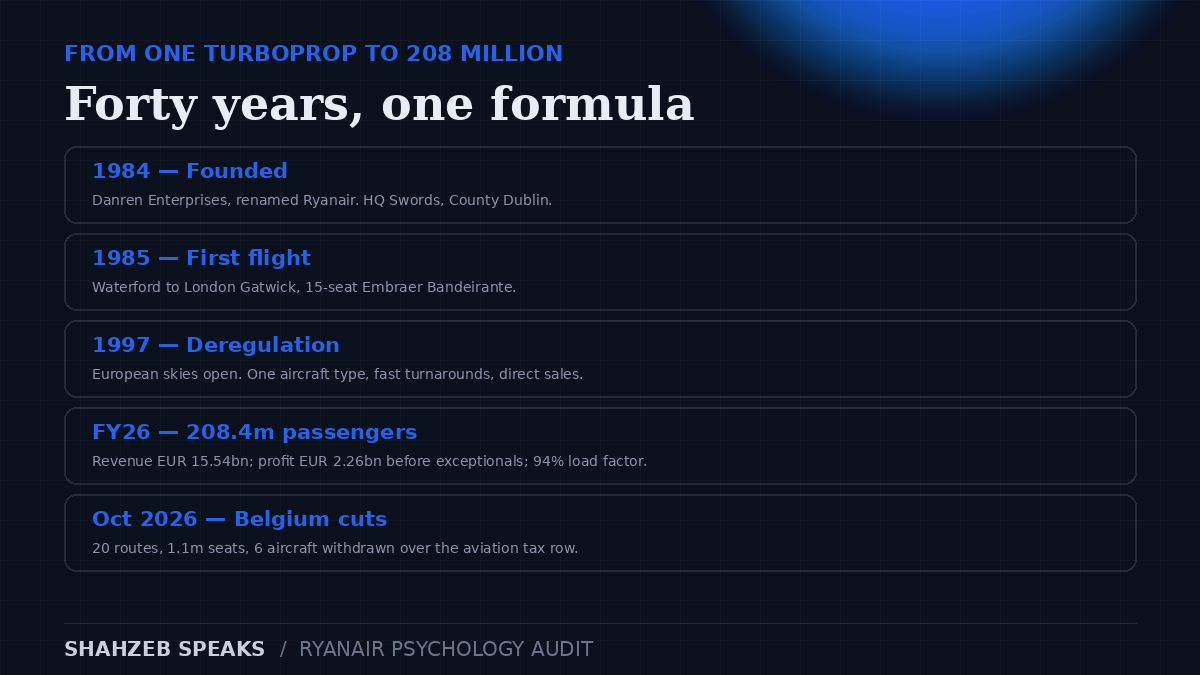
The scale that followed is the context for everything else in this audit. In the year ended March 2025, Ryanair carried 200.2 million passengers on revenue of €13.95 billion, with profit after tax of €1.61 billion and average fares down 7%. A year later, in the year ended March 2026, traffic rose 4% to 208.4 million, revenue rose 11% to €15.54 billion, and profit after tax before exceptional items rose 40% to €2.26 billion. Those are company-reported figures, and they matter psychologically: Ryanair does not need customers to love it. It needs them to book it, repeatedly, because the alternative on a given route is dearer, slower, or absent. Scale is the proof the marketing never has to make.
💰 Chapter 2: Anchoring — The Headline Fare Does the Selling
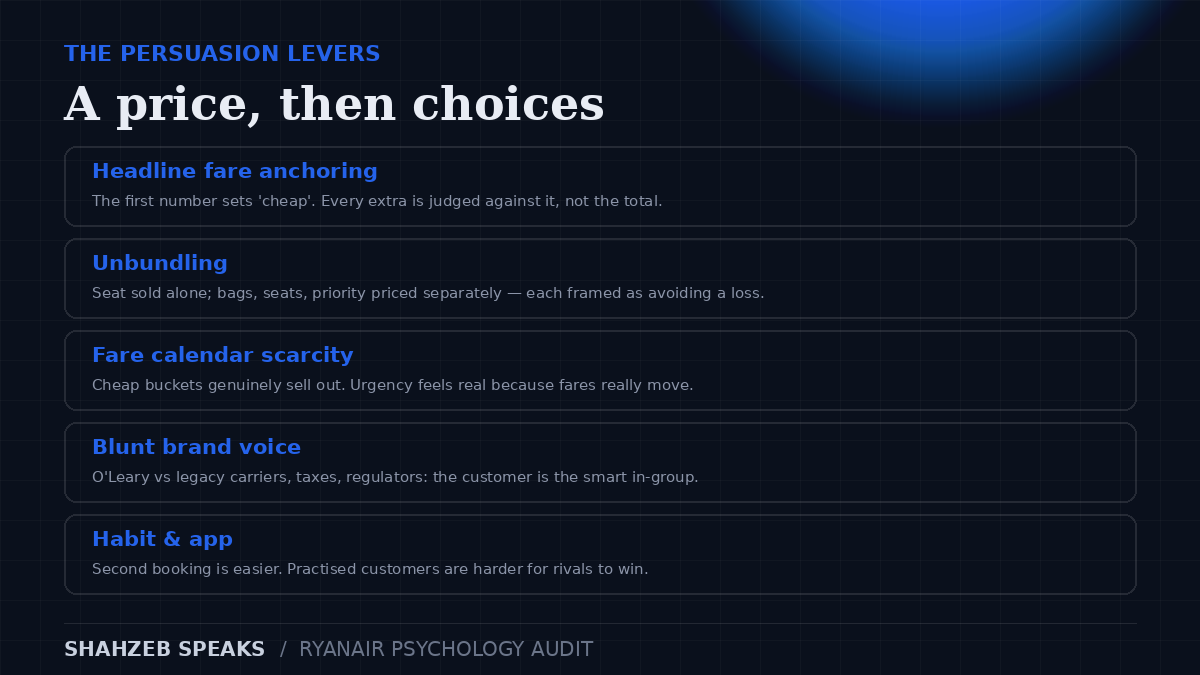
The core principle is anchoring (Tversky & Kahneman, 1974): the first number a person sees shapes every number that follows. Ryanair’s first number is the headline fare, and it is designed to be startlingly low. A customer who sees a fare in single or low double figures anchors on “cheap”. Every later figure — a bag fee, a seat fee, priority boarding — is then judged against that anchor, not against the total cost of a legacy ticket. A €25 bag fee feels large on its own; it feels smaller when the brain has already filed the trip under “cheap flight”.
Anchoring also explains why Ryanair can be simultaneously famous for low fares and for expensive extras without customers feeling cheated in the same way they would by a hidden charge. The extras are not hidden in the small print in the psychological sense: they are presented as choices, one by one, after the anchor is set. The customer clicks “yes” or “no” at each step, and each click creates a small sense of ownership over the final price. By the end, the total may be far above the headline fare, but it is a total the customer assembled. That is the difference between a price imposed and a price participated in, and it is worth more to Ryanair than any single fee.
The risk of anchoring is that it trains customers to compare only the anchor. When Ryanair’s total, with bags and seats, approaches a legacy carrier’s total, the customer who anchored on the headline may still book Ryanair — and then feel the gap at the airport. That gap is where Ryanair’s reputation damage lives, and it is a structural feature of the model, not an accident. An anchor that is too good creates expectations the rest of the journey must then manage.
🧩 Chapter 3: Unbundling — Pay Only for What You Use, and Notice Every Choice
Unbundling is the second principle, and it is where Ryanair’s psychology becomes a choice architecture. The classic economic idea is simple: instead of one bundled price that includes bags, food, seat selection and flexibility, sell the seat and price each extra separately. Customers who travel light pay less. Customers who want more, pay more. That is genuinely fairer for the light traveller, and Ryanair is right to say so.
The psychology is more complicated. Each extra is a separate decision, and each decision is framed as an upgrade to comfort or certainty: a bag you can rely on, a seat you can choose, boarding before the queue. Loss aversion (Kahneman & Tversky, 1979) does quiet work here: the customer is not buying a luxury, they are avoiding a loss — the loss of a preferred seat, of overhead space, of a smooth boarding experience. The default matters too. A pre-selected option, or an option presented as “most popular”, carries the default effect: people tend to stay with what is presented as normal. Ryanair’s booking flow has been criticised over the years for the friction of declining extras, and the fair way to read that criticism is that friction is not neutral: making “no” harder to click than “yes” changes how many people say yes, even when they would prefer no.
There is a second, less discussed effect of unbundling: it makes the customer complicit. A bundled airline can be blamed for its price. An unbundled airline can say, truthfully, that the customer chose each extra. That shifts blame in a way that protects the brand’s self-image as the customer’s ally against expensive legacy carriers, even when the customer’s final bill is high. It is a powerful frame, and it only breaks when the customer feels the choices were not real choices — when a fee feels unavoidable rather than optional.
🔥 Chapter 4: Scarcity, Urgency and the Fare Calendar
Ryanair’s pricing is dynamic: fares rise as departure approaches and as cheaper fare buckets sell out. The psychology here is scarcity and urgency, familiar from every booking site, but Ryanair adds a twist. Because its headline fares are so low, the gap between the cheapest fare and the fare available tomorrow can be dramatic, which makes the urgency feel real rather than theatrical. A customer who has seen a route at a very low fare and then sees it higher does not need a countdown timer to feel they have missed something. The fare calendar does the work: it shows, in a grid, what was possible and what is possible now.
This is also where Ryanair’s scale becomes a psychological asset. With hundreds of routes and millions of passengers, the claim that cheap seats are limited is credible in a way it is not for a small seller. Credible scarcity persuades; theatrical scarcity irritates. Ryanair mostly stays on the credible side, because its fares genuinely move — but the line is thin, and customers who feel rushed into a booking they later regret remember the rush, not the saving. For the related evidence on how urgency and scarcity are used across brands, see my audit of Booking.com, which runs the same machinery in hotels, and my guide to scarcity marketing examples.
🗣️ Chapter 5: The Blunt Brand Voice — Identity Through Opposition
No audit of Ryanair is complete without Michael O’Leary. His public voice — blunt, combative, funny, often insulting to regulators, rivals and occasionally customers — is not a lapse in brand management. It is the brand management. In social identity terms (Tajfel & Turner, 1979), Ryanair defines its in-group by opposition: the no-nonsense traveller who wants a cheap seat, against the bloated legacy airline, the tax-hungry government, and the regulator who wants to add cost. O’Leary is the spokesperson for that in-group, and his rows are its rituals.
The October 2026 Brussels appearance is a textbook example. O’Leary announced the Belgium cuts and the fare forecast in the same breath, blamed the Belgian aviation tax — described by Ryanair as rising from €2 in January 2025 to €7 in January 2027, a 250% increase — and positioned Ryanair as the victim of policy and the customer’s ally against it. Whether the tax is the main driver of fares is a separate question: O’Leary himself tied the fare forecast mainly to fuel hedging, saying Ryanair was 80% hedged at $67 per barrel to March 2027 when the conflict began at the end of February, but only 15% hedged at $85 per barrel from April 2027, against spot prices around double that level. The audit keeps those drivers separate, because Ryanair’s own account does: fuel for the forecast, tax for the Belgium cuts, capacity for both. A brand that merges them into one slogan is simplifying; a customer who separates them understands the price better.
The blunt voice also earns free media. A press conference that insults a prime minister is reported everywhere, at no advertising cost, and it reinforces the identity: this is the airline that says what others will not. The cost is that the same voice makes regulatory relationships harder, and makes apology — when service fails — sound unlike the brand. A brand built on never backing down finds it difficult to say sorry convincingly, and customers notice.
📱 Chapter 6: Habit, App and the Airport Experience
Once a customer has booked Ryanair once, the second booking is easier than the first. The app stores details, the boarding pass is digital, the rules — bag sizes, check-in windows, priority queues — are learned, even if they were resented the first time. That is habit formation through repetition, reinforced by the fare calendar: the customer who checks Ryanair first for a European route is not necessarily loyal in the emotional sense. They are practised. Practised customers are cheaper to serve and harder for rivals to win, because switching means learning a new set of rules.
The airport experience itself is part of the psychology. Secondary airports, fast turnarounds and strict bag checks are cost decisions, but they also teach a lesson: this is not a luxury experience, and you should not expect one. Expectation management is a powerful, underrated technique. A legacy carrier that promises comfort and delivers a delay disappoints more than a low-cost carrier that promises a seat and delivers a seat on time. Ryanair’s low promise is, paradoxically, a form of honesty — provided the seat, the time and the price are as stated. When any of those three fails, the honesty frame collapses, because the customer was told there was nothing else to go wrong.
⚠️ Chapter 7: The Dark Side — Taxes, State Aid and the Price of Bluntness
This chapter keeps every legal and regulatory matter at its exact status as of 23 October 2026. Nothing here is a finding against Ryanair unless stated as one, and no specific current fee, fine or compensation outcome is claimed, because none was verified to a citable source in this run.
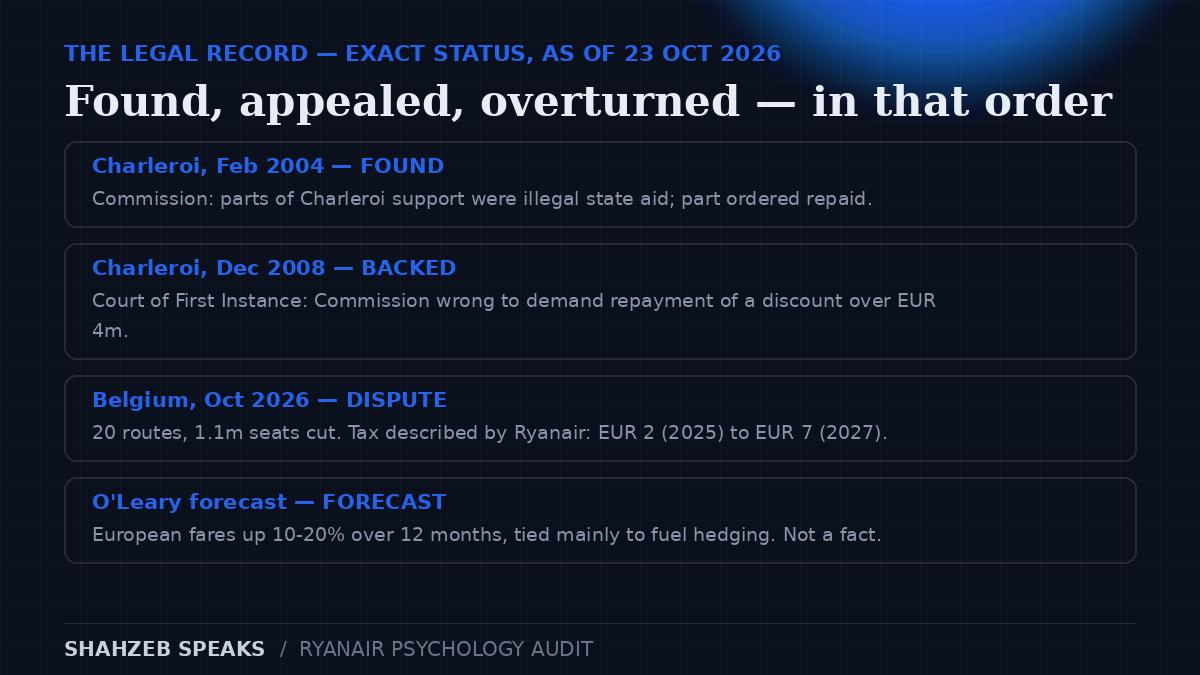
Charleroi — Commission decision, 2004; court backing, 2008. In February 2004, the European Commission ruled that parts of the support given to Ryanair by the publicly owned airport at Charleroi, south of Brussels, constituted illegal state aid, and ordered repayment of part of it — reported at the time as a sum in the range of €3 million to €5.5 million from the Walloon regional government, including a 50% cut in landing fees. Ryanair appealed, calling the decision anti-competitive. In December 2008, the EU Court of First Instance backed Ryanair, holding that the Commission was wrong to demand repayment of a discount of more than €4 million, because it had failed to check whether a private investor would also have offered low fees to attract the airline. That sequence — found, appealed, overturned on that point — is the correct status, and it matters: the Charleroi model that Ryanair then repeated across Europe was, on that ruling, a commercial negotiation, not a subsidy, in the court’s view.
Belgium, October 2026 — a dispute, not a ruling. On 20 October 2026, Ryanair announced it would remove 20 routes and about 1.1 million seats from its Belgian winter 2026–27 schedule, withdraw six aircraft, and redeploy them to other European markets, linking the cuts to the planned rise in Belgium’s aviation tax. Ryanair described the tax as rising from €2 in January 2025 to €7 in January 2027. Reported route lists name, at Zaventem, Barcelona, Madrid, Málaga, Marrakech, Porto, Rome Fiumicino and Valencia, with Dublin reported as the remaining Zaventem route, and 13 routes at Charleroi including Amman, Dubrovnik, Katowice and Warsaw Modlin; reports differ on the exact split between the two airports, and about 200 jobs were reported as affected (Belga, via Travel Tomorrow). Ryanair’s claims about the tax’s effects — that it makes Belgium uncompetitive, damages tourism and jobs — are Ryanair’s claims, not independent findings, and no government response is presented as verified in this audit. The same pattern appeared in France, where, after the solidarity tax on domestic and intra-European flights rose from €2.63 to €7.40 in March 2025, Ryanair was reported to have cut regional capacity by 13%, withdrawing 25 routes and about 750,000 seats. The pattern is consistent, and it is a business strategy: capacity follows cost, loudly, in public.
Beyond the courtroom and the tax row, the structural criticism is simpler: a model built on unbundling and strict rules generates a steady stream of customer-service friction — bag-size disputes, check-in penalties, and the feeling that the airline profits from mistakes. Ryanair would reply that the rules are stated in advance and that customers who read them pay less. Both things can be true. The psychological cost is that a brand which trains customers to expect a fight at every step will be believed, even when it is right, less readily than a brand that has not trained them that way.
🇵🇰 Chapter 8: What Pakistani brands should — and shouldn’t — copy
Copy the discipline, not the tone. What transfers is the cost structure: one product family, fast turnaround, direct sales, and a price that is honest about what it includes. A Pakistani travel, food-delivery or e-commerce brand that unbundles genuinely optional extras — and makes “no” as easy to click as “yes” — will earn more trust than one that copies Ryanair’s headline trick without its scale. The headline fare works for Ryanair because the scale behind it is real. A small brand with a startling headline and a painful checkout will be read as a trap, not as a bargain.
Do not copy the public-row strategy without Ryanair’s leverage. O’Leary can threaten to move aircraft because he has aircraft to move, and because other countries compete for them. A smaller brand that picks a public fight with a regulator it cannot afford to lose will lose the fight and the relationship. Do copy the expectation management: promise a seat, deliver a seat, on time, at the stated price — and say plainly what is not included. In markets where customers are used to bundled, negotiated prices, that clarity is itself a competitive advantage, provided the final bill matches the first number more closely than Ryanair’s sometimes does.
🛫 Chapter 9: The Ryanair Customer, Step by Step
Walk through the experience and the psychology stacks in order. First, anchoring: the headline fare sets “cheap” in the mind. Second, choice: the extras menu turns a price into a series of small decisions, each framed as avoiding a loss. Third, urgency: the fare calendar shows what the same route cost yesterday, and the customer books before it rises again. Fourth, identity: the blunt brand voice tells the customer they were smart to choose this, and that anyone who charges more is the problem. Fifth, habit: the second booking is easier, the rules are learned, and the app remembers the details. Sixth, the airport test: a strict bag check or a delay either confirms the bargain — a seat, on time, at a low price — or breaks it, and the break is remembered more vividly than the saving, because the saving was expected and the break was not. Each step is documented above. None of them requires the customer to believe anything unverified.
📊 Chapter 10: Psychology Scorecard
| Dimension | Score | Verdict |
|---|---|---|
| Price anchoring (headline fare) | 95 | The first number does the selling, on every route. |
| Unbundling & choice architecture | 92 | Extras as choices, framed as avoiding loss. Powerful, and friction-sensitive. |
| Scarcity & urgency (fare calendar) | 88 | Credible because fares genuinely move — but urgency creates regret when it misfires. |
| Identity & blunt brand voice | 85 | Opposition defines the in-group — and earns free media. |
| Habit & app lock-in | 78 | Practised customers are cheaper to serve and harder to win away. |
| Transparency & trust | 58 | Rules are stated, but the gap between headline and final bill is the trust cost. |
| Service recovery & customer care | 55 | A brand built on never backing down struggles to apologise convincingly. |
| Regulatory & reputation resilience | 66 | Charleroi was won on appeal; tax rows are a strategy, not a settlement. |
Overall: 95 + 92 + 88 + 85 + 78 + 58 + 55 + 66 = 617 ÷ 8 = 77.125 → 77/100.
✅ Chapter 11: Balance sheet & prescription
On the credit side: a cost discipline that turned a 15-seat turboprop into 208 million passengers, a headline fare that genuinely changed who could fly in Europe, unbundling that is fairer for light travellers, and a brand voice that earns attention without an advertising budget. On the debit side: a headline-to-final-bill gap that breeds resentment, a booking flow where declining extras must be as easy as accepting them, a service-recovery voice that sounds unlike the brand when it needs to sound human, and a public-row strategy that wins headlines while hardening regulatory relationships.
The prescription for Ryanair is narrow: show the honest total earlier — a “typical total with one bag and a chosen seat” beside the headline fare — and make “no” one click, not a hunt. That would cost some ancillary conversion in the short term and buy the trust that the next tax row or fuel shock will need. For other brands, the prescription is in Chapter 8: copy the discipline and the clarity, not the fight.
📝 Final Verdict
Ryanair is the most effective, and the least loved, persuasion machine in European travel. It does not persuade by making customers feel special. It persuades by making the first number small, the choices feel personal, the urgency feel real, and the opposition feel like the enemy. That machine carried 208 million people in a year. It also guarantees that every customer who feels trapped by an extra, or stranded by a tax row, will remember the trap more than the fare. Ryanair’s psychology works best when the seat is cheap, on time, and exactly as described — and that, in the end, is a promise about operations, not about marketing.
Psychology Score: 77/100 — The airline that sold Europe a price, then charged it for everything around the price, and was believed because the first number was true.
If your brand wants Ryanair’s discipline without its resentment, the lesson is not “charge less” or “charge more”. It is: make the first number honest, make “no” easy, and let the total match the promise.
For more brand psychology, see my audits of Booking.com and Uber, and for the field behind this work, my writing on industrial psychology in Pakistan.
📚 References & Sources
- Kahneman, D., & Tversky, A. (1979). Prospect theory: An analysis of decision under risk. Econometrica, 47(2), 263–291.
- Reuters (Blenkinsop, P.), 20 October 2026. Ryanair CEO warns of biggest European airfare increase in history; Belgium cuts and fuel hedging (reported via LA Post / SRN News).
- Ryanair Holdings plc. Full-year FY25 results announcement, 19 May 2025 (200.2m passengers; revenue €13.95bn; PAT €1.61bn).
- Ryanair Holdings plc. Full-year FY26 results announcement, 18 May 2026 (208.4m passengers; revenue €15.54bn; PAT €2.26bn pre-exceptional; load factor 94%).
- Ryanair corporate news release, 20 October 2026. Ryanair cuts 20 routes and over 1 million seats from Belgium winter schedule due to aviation tax increase (company claims).
- Tajfel, H., & Turner, J. C. (1979). An integrative theory of intergroup conflict. In W. G. Austin & S. Worchel (Eds.), The Social Psychology of Intergroup Relations.
- Tversky, A., & Kahneman, D. (1974). Judgment under uncertainty: Heuristics and biases. Science, 185(4157), 1124–1131.
- Reports of the European Commission Charleroi state-aid decision (February 2004) and the EU Court of First Instance ruling backing Ryanair (17 December 2008, AP).
- Reports of the Belgium winter 2026–27 route cuts (Travel Tomorrow, 21–22 October 2026; Brussels Signal, October 2026), including reported route lists and the Belga jobs figure.
Key Findings
- Founded 1984 in Ireland, operations began 1985 Waterford to London Gatwick with a 15-seat Embraer Bandeirante; headquarters Swords, County Dublin, Ireland
- In FY26 (year ended March 2026) Ryanair reported 208.4 million passengers, revenue EUR 15.54 billion and profit after tax EUR 2.26 billion before exceptional items at a 94% load factor
- On 20 Oct 2026 Ryanair announced it would cut 20 routes and 1.1 million seats from its Belgium winter 2026-27 schedule and withdraw 6 aircraft, linking the cuts to the planned aviation tax rise
- On 20 Oct 2026 CEO Michael O'Leary FORECAST European airfares rising by 10, 15, maybe 20% over the next 12 months, tied mainly to fuel hedging — a forecast, not a fact about future fares
- In February 2004 the European Commission FOUND parts of the Charleroi airport support constituted illegal state aid and ordered repayment of part of it; Ryanair APPEALED
- In December 2008 the EU Court of First Instance BACKED Ryanair, holding the Commission was wrong to demand repayment of a discount of more than EUR 4 million at Charleroi
Overall Psychology Score
Ryanair scores 77/100 in our comprehensive psychology audit covering consumer behavior strategies, UX design principles, and psychological marketing effectiveness.
The detailed dimension scores are in the audit's Psychology Scorecard chapter.
High impactMuhammad Shahzeb
MSc Industrial Psychologist, specializing in consumer behavior, UX psychology, and brand strategy analysis. Helping brands understand the psychology behind their success.
About Muhammad Shahzeb →