Booking.com Psychology Audit — The Urgency Machine Behind 1.1 Billion Room Nights
Booking.com audit: how scarcity, Genius loyalty and verified reviews drive 1.1 billion room nights, plus the Spain fine and DMA gatekeeper rules. Score: 82/100.

82 / 100
Overall consumer behavior effectiveness
Brand Overview
- Brand nameBooking.com
- Founded1996
- HeadquartersAmsterdam, Netherlands
- IndustryTravel & Hospitality
- Websitewww.booking.com ↗
Psychology Techniques Identified
- 01Scarcity & Urgency ("Only 2 Left" labels)
- 02Social Proof (370M+ Verified Reviews)
- 03Anchoring & Struck-Through Prices
- 04Loss Aversion (Fear of Losing the Room)
- 05Goal-Gradient Effect (Genius Level Progress)
- 06Status-Quo & Endowment (Genius Levels Never Taken Away)
- 07Defaults & Choice Architecture (Default Sort)
- 08Certainty Effect (Free Cancellation)
- 09Commitment & Investment (Search as Commitment)
- 10Friction Removal (One-Tap Booking)
- 11Connected Trip Lock-In (Flights, Cars, Attractions)
- 12Ranking as Persuasion (Position Rewards Platform Loyalty)
Full Psychology Audit Report
In this audit
It is 11:40 at night. You have told yourself you will “just look” at hotels for a trip in March. Twenty minutes later you are staring at a room that says only two are left at this price, a banner says 14 other people are looking at it, and a Genius discount will vanish if you log out. You book. You did not choose that hotel in twenty minutes. Booking.com chose the frame, and you chose inside it.
This audit examines how Booking.com, the Amsterdam-born platform at the centre of Booking Holdings, turned hotel search into one of the most effective persuasion machines in consumer software. In 2024 the parent company reported 1.1 billion room nights, $165.6 billion in gross travel bookings and $23.7 billion in revenue. The question is not whether the machine works — the numbers answer that — but how it works, what it costs hotels and travellers, and where regulators have drawn lines.
I am an Industrial and Organizational Psychologist in Karachi, and I audit brands the way a psychologist studies a workplace: through the decisions people make under pressure, the incentives they are shown, and the ones they are not. Booking.com interests me because almost every lever is visible on the screen — scarcity, social proof, anchoring, loyalty ladders — yet travellers still describe their booking as a free choice. That gap, between visible lever and felt freedom, is the whole audit.
“Booking.com does not sell rooms. It sells certainty about a decision that is inherently uncertain — and it charges for that certainty in attention, in urgency, and in the hotels’ margins. The genius is not the discount. It is making the traveller feel that waiting is the risky choice.”
— Brand Psychology Analysis, ShahzebSpeaks
📋 Brand Overview: Booking.com at a Glance
| Founded | 1996 in Amsterdam, Netherlands, by Geert-Jan Bruinsma |
| Parent | Booking Holdings (formerly Priceline Group; renamed February 2018); acquired Booking.com in 2005 |
| Headquarters | Amsterdam, Netherlands (Booking.com); parent in Norwalk, Connecticut, USA |
| Scale (2024) | 1.1 billion room nights · $165.6 billion gross travel bookings |
| Money (2024) | $23.7 billion revenue · $5.9 billion GAAP net income · $8.3 billion adjusted EBITDA |
| Listings | Over 31 million total reported listings as of early 2025, including 8.1 million alternative accommodation listings, across 220+ countries and territories |
| Reviews | Over 370 million verified reviews — submitted only by guests who actually booked and stayed |
| Model | Agency and merchant booking; commission from properties; Genius loyalty; “Connected Trip” (flights, cars, taxis, attractions) |
📜 Chapter 1: The History — From a Dutch Startup to the World’s Hotel Lobby
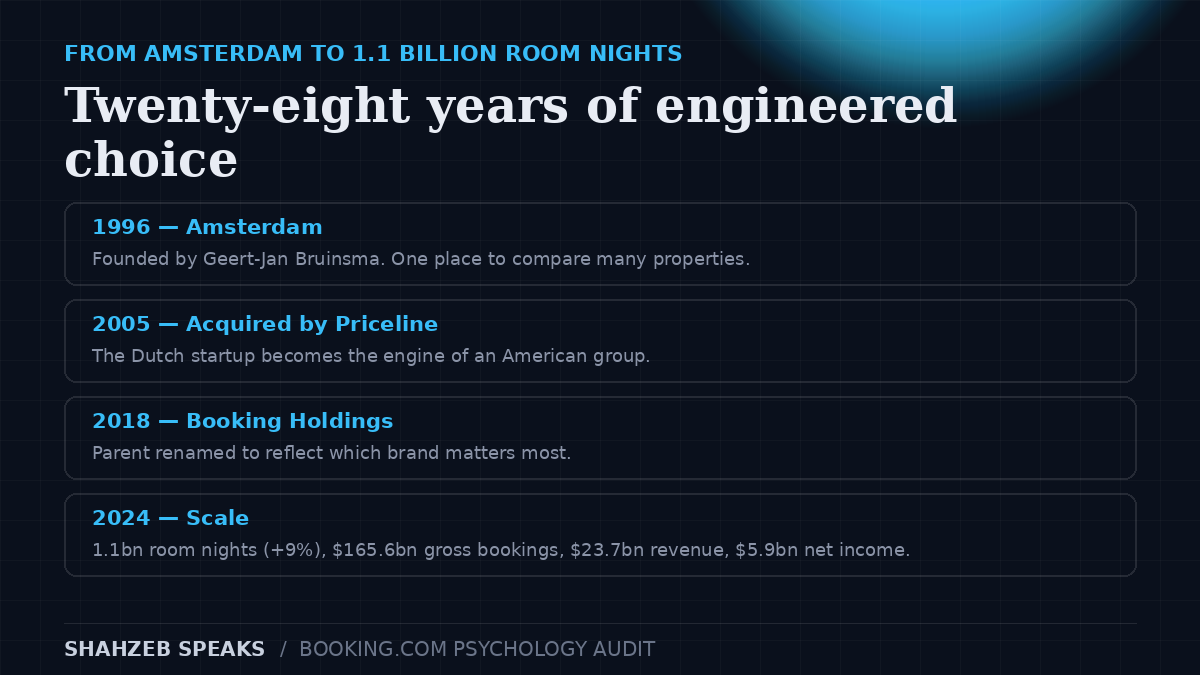
Booking.com began in 1996 in Amsterdam, founded by Geert-Jan Bruinsma, at a time when booking a hotel still meant phone calls and fax machines. Its early advantage was not glamour. It was completeness: one place to compare many properties, with prices and availability in one view. In 2005 Priceline.com acquired the company, and the Dutch startup became the engine of an American group. In February 2018 that group renamed itself Booking Holdings, an acknowledgement of which brand now mattered most.
The next decade was about scope. The platform added homes and apartments alongside hotels, then flights, rental cars, airport taxis and attractions under the “Connected Trip” ambition: one trip, booked in one place, with each added component making the next booking more likely to stay inside Booking.com. By 2024 that scope produced 1.1 billion room nights, up 9% on the year, and $165.6 billion in gross travel bookings. The psychology of the audit starts here: scale is not just a result of good persuasion. Scale is itself a persuasion tool. When a platform lists over 31 million properties, the traveller reasonably assumes it must have the best choice — and stops looking elsewhere. That assumption is the first lever, and it costs nothing to run.
⏰ Chapter 2: Scarcity — “Only 2 Left” and the Manufactured Deadline
The most famous Booking.com screen element is also its most argued-over: the scarcity label. “Only 2 rooms left at this price”, “Booked 14 times today”, “14 people are looking at this property right now”. These labels are not decoration. They are scarcity and urgency, applied at the exact moment of hesitation.
Robert Cialdini’s work on influence treats scarcity as a core principle: opportunities seem more valuable when they are less available. Booking.com applies it twice over. First, quantity scarcity: a small number of rooms at a price. Second, time scarcity: free-cancellation deadlines, “price may rise” framings, and Genius or deal banners that imply the advantage is temporary. The traveller is not deciding between hotels any more. They are deciding between booking now and losing the room — and loss aversion, from Kahneman and Tversky’s prospect theory (1979), says losses loom larger than equivalent gains. Losing a room you never owned feels worse than saving money you never spent.
Is the scarcity real? Sometimes, plainly, yes: a small guesthouse really does have two rooms. Sometimes the label describes rooms at one price for one room type, not the property as a whole — a distinction a tired traveller at midnight is unlikely to parse. The audit’s judgement is therefore narrow: scarcity is a legitimate signal when it is specific and verifiable, and a manipulation when it is vague enough to mean anything. Booking.com’s labels sit on both sides of that line, and the traveller cannot tell which side any given label is on. That ambiguity is the problem, not the existence of scarcity itself.
👥 Chapter 3: Social Proof — 370 Million Reviews and the Tyranny of 9.0
Booking.com’s second lever is its review system, and here the platform deserves genuine credit before the criticism. Reviews can only be submitted by guests who booked through the platform and stayed — over 370 million of them as of early 2025. That verification rule solves the oldest problem in online reviews: fake praise and fake sabotage. A traveller reading a Booking.com score is reading, in the main, real guests.
The psychology is social proof: when uncertain, people copy what others did. A property scored 9.2 from thousands of guests feels safe in a way that a beautiful hotel website never can. But the score also creates a second effect. Properties cluster around high scores, small differences (9.1 versus 9.3) are treated as meaningful when they may reflect a handful of reviews, and hotels learn to optimise for the score — breakfast quality, check-in speed, the review prompt at checkout — rather than for the stay itself. The score becomes the product. That is not Booking.com’s invention; it is what happens whenever a single number becomes a market’s currency. But Booking.com minted the currency, and it profits from every transaction the currency enables.
For a fuller account of how social proof works and backfires, see my guide to social proof — and for the price-framing tricks that sit alongside it, anchoring in marketing.
⚓ Chapter 4: Anchoring, Defaults and the Price You See First
Search results on Booking.com are a masterclass in anchoring (Tversky & Kahneman, 1974): the first number you see becomes the reference point, and every later number is judged against it. A struck-through “original” price, a Genius discount in blue, a “cheapest room” default sort — each sets an anchor before the traveller has thought about what the room is worth. The discount feels like a gain even when the underlying price is the market price. The default sort, by “top picks” or price, quietly decides which properties most travellers ever see. Defaults are choices made on the traveller’s behalf, and the platform that sets the default wins most of the time.
Free cancellation is the platform’s most elegant lever, and its most honest one. It removes the risk of booking now: book the room, keep looking, cancel if something better appears. Psychologically it reverses the scarcity pressure of Chapter 2 — urgency to book, safety after booking — and the combination is powerful. The traveller books early (good for Booking.com’s conversion), feels safe (good for the traveller), and often never cancels (good for the hotel, and for Booking.com’s commission). Where free cancellation is genuinely free and the deadline is clear, this is a fair trade. Where the deadline is buried or the “free” rate is priced higher than the non-refundable rate, the traveller should compare the final payable amount, not the headline. The audit’s rule for travellers is simple: compare identical room conditions and the final amount payable, on Booking.com and on the hotel’s own site, before treating any discount as a saving.
🏆 Chapter 5: Genius — A Loyalty Ladder With No Points to Count
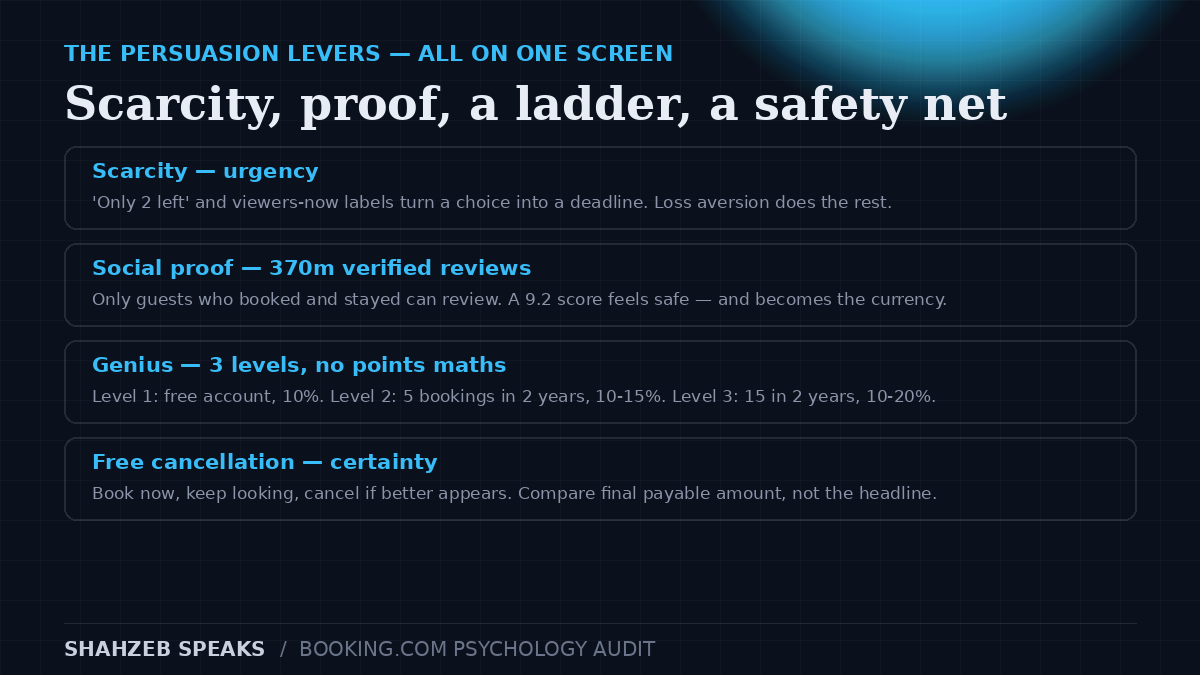
Genius is Booking.com’s loyalty programme, and its design is smarter than most airline schemes because it removes the arithmetic. There are three levels. Level 1 arrives on creating a free account, with 10% discounts at participating properties. Level 2 requires 5 bookings in two years, with 10–15% discounts plus breakfast and upgrades on select stays. Level 3 requires 15 bookings in two years, with 10–20% on stays, 10–15% on rental cars, and priority support. Discounts apply before taxes and charges, at participating properties only — the blue Genius label marks them — and a level, once reached, is not taken away.
Two psychological mechanisms do the work. The first is the goal-gradient effect: as people get closer to a reward, they accelerate toward it. A traveller on four bookings in two years does not need much persuasion to make the fifth on Booking.com rather than elsewhere. The second is status-quo and endowment: once you hold a level, switching platforms feels like giving something up, even though the level cost you nothing and the discount applies only at participating properties. Genius is free, which makes it feel generous; it is also a switching cost, which makes it effective. Both things are true at once, and the audit credits the programme for the first while naming the second.
🔗 Chapter 6: The Connected Trip — Lock-In by Convenience
The Connected Trip is Booking.com’s answer to a strategic problem: a hotel booking is a rare, high-consideration purchase, and a customer who books once a year is easy to lose. The solution is to surround the hotel with flights, cars, taxis and attractions, so that the platform becomes the trip rather than one part of it. Each added component increases the cost of leaving: your bookings, your Genius progress, your review history and your saved properties all live in one place. In 2024 the platform reported roughly 49 million airline tickets booked through it, up 36% on the year, and a record 83 million rental car bookings in secondary summaries of its results. Those numbers are the lock-in working, one component at a time.
For travellers, convenience is real value, and the audit does not pretend otherwise. For hotels, the same convenience is dependence: the more of the trip Booking.com owns, the harder it is for a hotel to win the guest directly, and the more the hotel’s margin funds the platform that intermediates its own customers. That tension — genuine traveller convenience, genuine hotel dependence — is the central fact of the Booking.com business model.
⚠️ Chapter 7: The Dark Side — Regulators, Rank and the Spain Fine
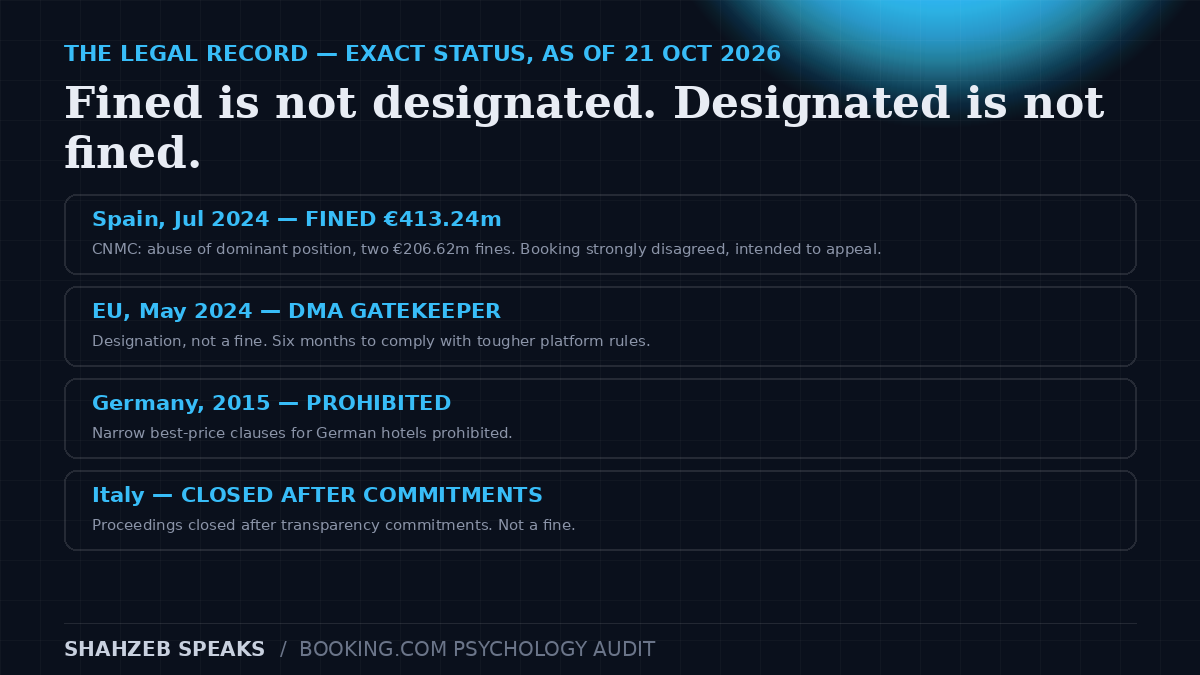
Regulators in Europe have spent a decade testing whether Booking.com’s levers cross from persuasion into abuse of dominance. The record, in exact status, is as follows as of 21 October 2026.
Spain — FINED. On 30 July 2024 Spain’s competition authority, the CNMC, fined Booking.com €413.24 million — two fines of €206.62 million each — for abuse of its dominant position over the previous five years. The CNMC found two abuses: unfair commercial conditions imposed on hotels located in Spain, including a pricing clause preventing hotels from offering lower prices on their own websites, and restriction of competition from other online travel agencies, by giving better positioning to hotels that brought Booking.com more bookings. Booking.com said it strongly disagreed with the findings and intended to appeal. The outcome of that appeal is not stated here because it was not verified as final as of 21 October 2026.
European Union — GATEKEEPER DESIGNATION. In May 2024 the European Union designated Booking.com as a gatekeeper under the Digital Markets Act, giving it six months to comply with the Act’s obligations. Designation is not a fine. It is a regulatory status that brings tougher rules, including on how the platform treats business users and competing services.
Germany — NARROW PRICE CLAUSES PROHIBITED (2015). Germany prohibited Booking.com’s narrow best-price clauses affecting German hotels in 2015 — clauses that stopped hotels undercutting Booking.com on their own sites. The direction of travel since has been consistent: hotels should retain meaningful freedom to price across channels.
Italy — PROCEEDINGS CLOSED AFTER COMMITMENTS. Italy’s competition authority examined Booking.com programmes including Preferred Partner, Preferred Plus and Sponsored Benefit, and closed proceedings after accepting commitments intended to strengthen transparency and accommodation businesses’ commercial independence. That is a settlement by commitments, not a fine and not a finding of abuse in the Spain sense.
The pattern matters for the psychology audit. The features travellers love — ranking, badges, Genius, “top picks” — are the same features regulators scrutinise when they shape which hotels travellers see. A ranking is never neutral. When better positioning follows the volume of bookings a hotel brings the platform, the ranking rewards loyalty to the platform, not quality for the traveller. That is the CNMC’s case in one sentence, and it is the reason the audit scores regulatory resilience as Booking.com’s weakest dimension.
🇵🇰 Chapter 8: What Pakistani brands should — and shouldn’t — copy
Copy the verification rule: only guests who stayed can review. Copy the clarity of Genius: three levels, no points arithmetic, a benefit that is visible before booking. Copy free cancellation as a risk-reversal, with the deadline in plain language. Do not copy vague scarcity labels. A small hotel or travel brand that writes “only 2 left” when the property has ten rooms will be found out in one review — and the review will outlive the booking. Do not copy ranking that rewards platform loyalty over guest quality. And do not copy the habit of burying the final payable amount behind a headline discount. Travellers forgive a high price faster than they forgive a surprise charge at checkout.
🖥️ Chapter 9: The Booking Screen, Step by Step
Walk through a Booking.com search as a psychologist, and the sequence reveals itself. First, the search box asks for destination, dates and guests — a commitment device disguised as a form. Once you have typed your trip, you have invested in it, and investment makes abandonment feel like waste. Second, the results page sorts by a default the platform chose, and most travellers never change the sort. The properties at the top are not necessarily the best; they are the best according to a ranking that weighs conversion, commission and programme participation alongside quality. Third, each listing shows a score, a review count, a price with a struck-through anchor, and a Genius badge in blue. Four signals, one glance, and the glance does the deciding before the traveller reads a single review.
Fourth, the property page adds the urgency layer: rooms left, people viewing, bookings today, a free-cancellation deadline. Fifth, the booking form removes friction at exactly the point where doubt would normally appear: saved details, one tap to confirm, a confirmation email within seconds. Each step is individually reasonable. Together they form a funnel in which the easiest action is always to continue, and the hardest action is to stop, compare elsewhere, and come back. That is choice architecture at its most polished: not a trick at any single step, but a slope that runs downhill toward “confirm”.
The defence is also step by step, and it is worth stating plainly. Open the hotel’s own website in a second tab. Compare the identical room type, the identical dates, the identical cancellation terms, and the final amount payable including taxes and charges. Read three recent reviews that are neither five-star nor one-star — the middle reviews describe the stay most honestly. Check whether the Genius discount applies to the room you actually want, or only to a room type you would not choose. If Booking.com is still cheaper on identical terms, book there with confidence. If it is not, you have just proved that the frame, not the price, was doing the persuading.
📊 Chapter 10: Psychology Scorecard
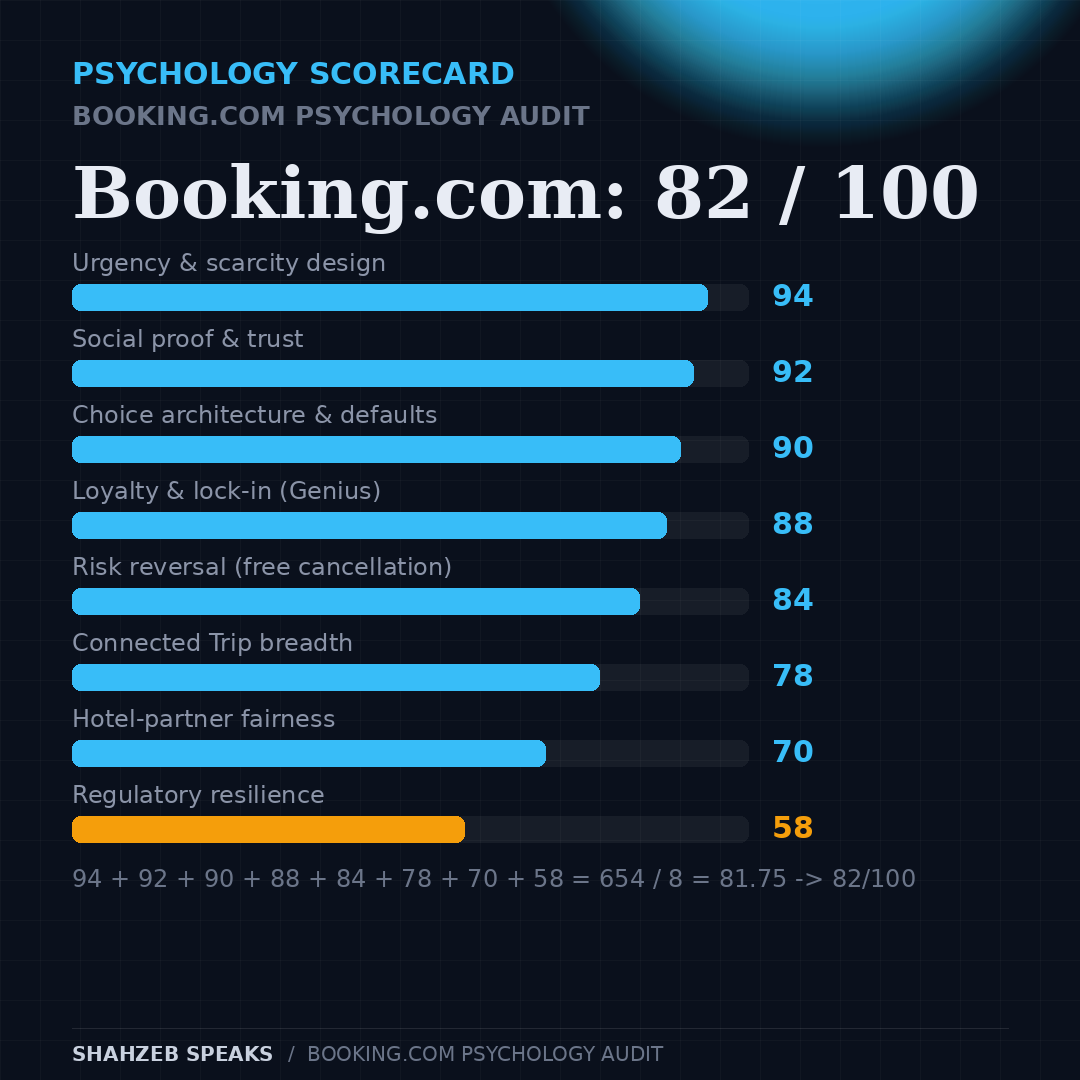
| Urgency & scarcity design | 94 — The most refined urgency screen in travel; vague labels cost it the last points. |
| Social proof & trust | 92 — Verified-only reviews are the industry’s best trust asset. |
| Choice architecture & defaults | 90 — Sorting, anchoring and Genius labels steer without feeling like steering. |
| Loyalty & lock-in (Genius) | 88 — A ladder with no arithmetic; switching feels like a loss. |
| Risk reversal (free cancellation) | 84 — Genuinely useful, genuinely converting; deadlines must be clearer. |
| Connected Trip breadth | 78 — Flights, cars and attractions extend the trip; hotel still dominates. |
| Hotel-partner fairness | 70 — Scale helps hotels reach guests; ranking and parity history hurt trust. |
| Regulatory resilience | 58 — A €413.24m Spain fine and DMA gatekeeper status are structural, not reputational, risks. |
Overall: 94 + 92 + 90 + 88 + 84 + 78 + 70 + 58 = 654 ÷ 8 = 81.75, rounded to 82/100.
✅ Chapter 11: Balance sheet & prescription
What Booking.com does brilliantly: it removes uncertainty at every step — verified reviews, a clear price, a cancellable booking, a loyalty level that feels free. What it does dangerously: it replaces the traveller’s uncertainty with its own urgency, and replaces the hotel’s independence with dependence on its ranking. The prescription for Booking.com is therefore specific, not moral. Make every scarcity label specific (rooms of this type, at this price, on these dates). Show the final payable amount as prominently as the discount. Publish, in plain language, how ranking works and what Genius and Preferred programmes change in it. Those three fixes would cost little conversion and would answer most of what regulators have actually asked for.
For travellers, the prescription is simpler: use Booking.com for comparison and verified reviews, then check the hotel’s own site for the identical room and final amount before you book. Book the cancellable rate only if you might genuinely need to cancel — the non-refundable rate is often cheaper for a trip you will certainly take. And treat “only 2 left” as a prompt to decide, not as evidence that the room is good.
📝 Final Verdict
Booking.com is the most effective persuasion machine in travel because it is also, in large part, a genuinely useful one. Verified reviews, huge choice, cancellable bookings and a simple loyalty ladder are real traveller benefits. The problem is not that the machine persuades. It is that its most powerful levers — scarcity, ranking and the loyalty ladder — also serve the platform’s dominance over the hotels it lists, and regulators in Spain, Germany, Italy and Brussels have now said so in formal terms. A traveller who understands the frame can use the machine well. A hotel that understands it can negotiate with it honestly. Neither should mistake the frame for freedom.
Psychology Score: 82/100 — A brilliant urgency machine, weakened by the dominance its own levers created.
If your brand uses urgency, scarcity or loyalty ladders — or if your customers book through a platform that does — I can audit how those levers actually land, and where they cross into risk.
For related audits, see the Uber psychology audit and the Amazon psychology audit. For context on the field behind this work, my writing on industrial psychology in Pakistan explains what an I/O psychologist actually does.
📚 References & Sources
- Booking Holdings. Q4 and Full Year 2024 results; Investor Presentation, October 2025 (1.1 billion room nights, $165.6 billion gross bookings, $23.7 billion revenue).
- Booking.com. Genius programme pages (levels, discounts, participating properties) as checked October 2026 via secondary summaries.
- Cialdini, R. B. (2001). Influence: Science and Practice.
- CNMC (Spain). Fine of €413.24 million against Booking.com, 30 July 2024 (via AFP reporting).
- European Commission. Digital Markets Act gatekeeper designation of Booking.com, May 2024.
- Iyengar, S. S., & Lepper, M. R. (2000). When choice is demotivating. Journal of Personality and Social Psychology, 79(6), 995–1006.
- Kahneman, D., & Tversky, A. (1979). Prospect theory. Econometrica, 47(2), 263–291.
- Kivetz, R., Urminsky, O., & Zheng, Y. (2006). The goal-gradient hypothesis resurrected. Journal of Marketing Research, 43(1), 39–58.
- Tversky, A., & Kahneman, D. (1974). Judgment under uncertainty: Heuristics and biases. Science, 185, 1124–1131.
Key Findings
- In 2024 Booking Holdings reported 1.1 billion room nights, $165.6 billion in gross travel bookings and $23.7 billion in revenue
- Genius Level 1 arrives on a free account with 10% at participating properties; Level 2 needs 5 bookings in 2 years (10-15%); Level 3 needs 15 bookings in 2 years (10-20% on stays)
- Over 370 million reviews are verified — only guests who booked and stayed can submit them
- On 30 July 2024 Spain's CNMC FINED Booking.com €413.24 million for abuse of dominant position; Booking said it strongly disagreed and intended to appeal, outcome not verified as final
- In May 2024 the EU designated Booking.com a DMA gatekeeper — a designation, not a fine — with six months to comply
- Germany prohibited narrow best-price clauses in 2015 and Italy closed proceedings after accepting commitments — neither is a Spain-style fine
Overall Psychology Score
Booking.com scores 82/100 in our comprehensive psychology audit covering consumer behavior strategies, UX design principles, and psychological marketing effectiveness.
The detailed dimension scores are in the audit's Psychology Scorecard chapter.
High impactMuhammad Shahzeb
MSc Industrial Psychologist, specializing in consumer behavior, UX psychology, and brand strategy analysis. Helping brands understand the psychology behind their success.
About Muhammad Shahzeb →