Uber Psychology Audit — The Surge, the Rating and the Machine That Manages Millions
A psychology audit of Uber, the ride-hailing platform with 208 million monthly users and 3.87 billion trips a quarter. How surge pricing manufactures urgency, how upfront fares sell certainty, how two-way ratings discipline drivers and riders alike, how Quest streaks and goal-gradients keep drivers online, why Uber One is being sued by the FTC, and where the UK, California and EU courts drew the legal lines.

78 / 100
Overall consumer behavior effectiveness
Brand Overview
- Brand nameUber
- Founded2009
- HeadquartersSan Francisco, California, USA
- IndustryTravel & Hospitality
- Websitewww.uber.com ↗
Psychology Techniques Identified
- 01Loss Aversion & Urgency (Surge Pricing)
- 02Certainty Effect (Upfront Fares)
- 03Anchoring & the Compromise Effect (UberX / Comfort / Black)
- 04Goal-Gradient Effect ("Make It to $330" Nudges)
- 05Streak Mechanics (Quest Trip Streaks)
- 06Stopping-Cue Removal (Forward Dispatch)
- 07Algorithmic Management (Two-Way Star Ratings)
- 08Reputation as Discipline (Rating-Based Deactivation)
- 09Defaults & Anchored Presets ($1 / $2 / $5 Tipping)
- 10Subscription Lock-In & Benefit Loss Aversion (Uber One)
- 11Variable Reward (Surge Zones & Quest Bonuses)
- 12Consent Friction (Free-Trial Auto-Conversion)
Full Psychology Audit Report
In this audit
It is 8:47 in the evening and it is raining. You open the app and the fare to your office, which was nineteen dollars in the morning, is now thirty-eight — with a small line beneath it: “Fares are higher due to increased demand.” You could wait. The rain will not. You tap confirm. You did not pay double for the ride. You paid double for not waiting.
This Uber psychology audit looks at how the company engineered that decision — and millions like it, every hour, in cities all over the world. In the second quarter of 2026, by Uber’s own count, 208 million monthly active platform consumers completed 3.867 billion trips, moving $58.022 billion in gross bookings through the platform. For the full year 2025, the numbers were 13.567 billion trips and $193.454 billion in gross bookings. What is less often examined is the machinery underneath: dynamic prices that manufacture urgency, a rating system that disciplines both sides of every trip, and an app for drivers that researchers describe as an employer without a human resources department.
I am an Industrial and Organizational Psychologist in Karachi, and I audit brands the way a psychologist studies a workplace: through the decisions people make under pressure, the incentives they are shown, and the ones they are not. Uber interests me because it runs one of the largest behavioural experiments on earth — on riders and on drivers — and documents most of it in filings, help pages and court records. This audit uses those sources.
“Uber sells certainty on one side and manufactured urgency on the other. The rider pays for a price known in advance; the driver is paid by a system that knows almost everything about him and tells him almost nothing. It is the most sophisticated two-sided nudge machine in business — and the legal system on three continents is now deciding what that costs.”
— Brand Psychology Analysis, ShahzebSpeaks
📋 Brand Overview: Uber at a Glance
| Founded | March 2009 as UberCab, a black-car service in San Francisco; renamed Uber in October 2010 |
| Founders | Garrett Camp and Travis Kalanick |
| Listed | NYSE (UBER) since 10 May 2019; IPO priced at $45 per share, raising $8.1 billion |
| Headquarters | San Francisco, California |
| Scale (Q2 2026) | 208 million monthly active platform consumers · 3.867 billion trips |
| Money | $58.022 billion gross bookings in Q2 2026; $193.454 billion in FY2025; FY2025 revenue $52.017 billion |
| Model | Mobility (rides) · Delivery (Uber Eats) · Freight; plus the Uber One subscription |
| Leadership | CEO Dara Khosrowshahi, hired in 2017 |
📜 Chapter 1: The History — From a Black-Car Hack to the World’s Biggest Taxi Company That Owns No Cars
🚕 2009–2011: A luxury hack
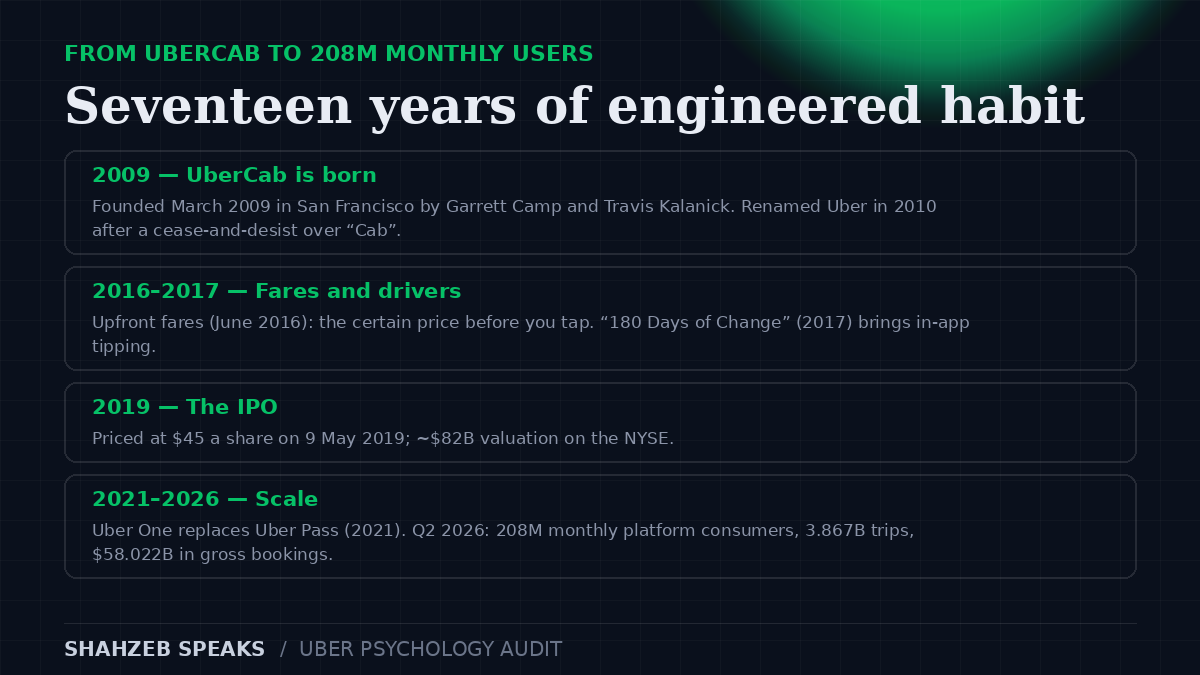
The idea, as research summaries of the company record it, was born in Paris in 2008, when Camp and Kalanick struggled to find a taxi in the snow. The company was established in March 2009 as UberCab: a premium black-car service hailed from an iPhone, running in San Francisco. It lasted about a year. In October 2010 the San Francisco Municipal Transportation Agency issued a cease-and-desist over the word “Cab” — the company was not a licensed taxi service — and UberCab became Uber.
🍔 2014–2016: Delivery and the price you see
In 2014 Uber piloted UberFRESH, a lunchtime food-delivery experiment in California; in December 2015 it launched as a standalone app, Uber Eats, starting in Toronto. In June 2016, after years of outrage over the surge multiplier, Uber announced upfront fares: riders would see the actual fare before requesting, with the surge folded invisibly into the number. Both moves shifted the psychology of the product from estimation to certainty.
🧨 2017: The reckoning year
In April 2017 the New York Times published Noam Scheiber’s investigation into how Uber used behavioural science to keep drivers on the road, and in March the same paper had revealed “Greyball”, the software that showed regulators a different version of the app. In June 2017 Uber launched in-app tipping as part of a “180 Days of Change” driver initiative, and the company’s leadership changed, with Dara Khosrowshahi hired as CEO. The reporting from that year is the foundation of almost everything researchers and regulators now say about the platform.
💰 2019–2021: Going public, then locking in
Uber priced its IPO at $45 a share on 9 May 2019 and began trading on the New York Stock Exchange the next day, raising $8.1 billion at a valuation of about $82 billion — the stock closed its first day lower, at $41.57. In November 2021 the company replaced its Uber Pass with Uber One, a $9.99-a-month subscription spanning rides and delivery: the beginning of a deliberate lock-in strategy that is still being litigated (Chapter 10).
📊 2022–2026: Scale, scrutiny, and the earnings machine
The Guardian and the ICIJ published the Uber Files in July 2022. Courts settled the biggest fights: Prop 22 upheld in California in July 2024, the Australian class action settled in March 2024, the FTC sued over Uber One in April 2025. Through all of it, the numbers kept climbing: FY2025 brought 13.567 billion trips and $52.017 billion in revenue, and Q2 2026 pushed gross bookings past $58 billion in a single quarter.
⚡ Chapter 2: Surge Pricing — Urgency Priced to the Minute
Surge pricing is the most psychologically potent price mechanism in consumer software, and Uber describes it plainly on its own site: when demand outpaces the supply of cars, “rates will automatically increase, sometimes as high as 3x the normal rates.” The rider is told the fare is higher before requesting — today the small text says “Fares are higher due to increased demand” — and drivers are told to head toward the surge zone. This is Uber’s company account, and it tells you exactly the psychology at work.
The first mechanism is loss aversion. In Kahneman and Tversky’s prospect theory (1979), losses loom larger than equivalent gains. A surge fare does not feel like paying more; it feels like a loss against the price you remember from this morning. Research on flash sales and countdown timers shows the same pattern: when the disadvantage is time-limited, deliberation collapses and the default answer is yes. You do not evaluate the fare. You evaluate the rain.
The second mechanism is that the surge price is never shown as a negotiation. There is no multiplier to argue with in most markets anymore — the upfront fare absorbed it (Chapter 3) — so the rider faces a binary: pay or wait. Binary choices under urgency are where loss aversion bites hardest, because the alternative (“stand in the rain and hope”) is framed as the loss of the ride itself.
Uber’s account is that surge brings more drivers to busy areas and that riders who wait restore balance. Both are true, and together they are why the feature survived a decade of criticism. Surge pricing is simultaneously an allocation mechanism and a behavioural lever: it rations supply with economics and rations patience with psychology.
💰 Chapter 3: Upfront Fares — Certainty as a Product Feature
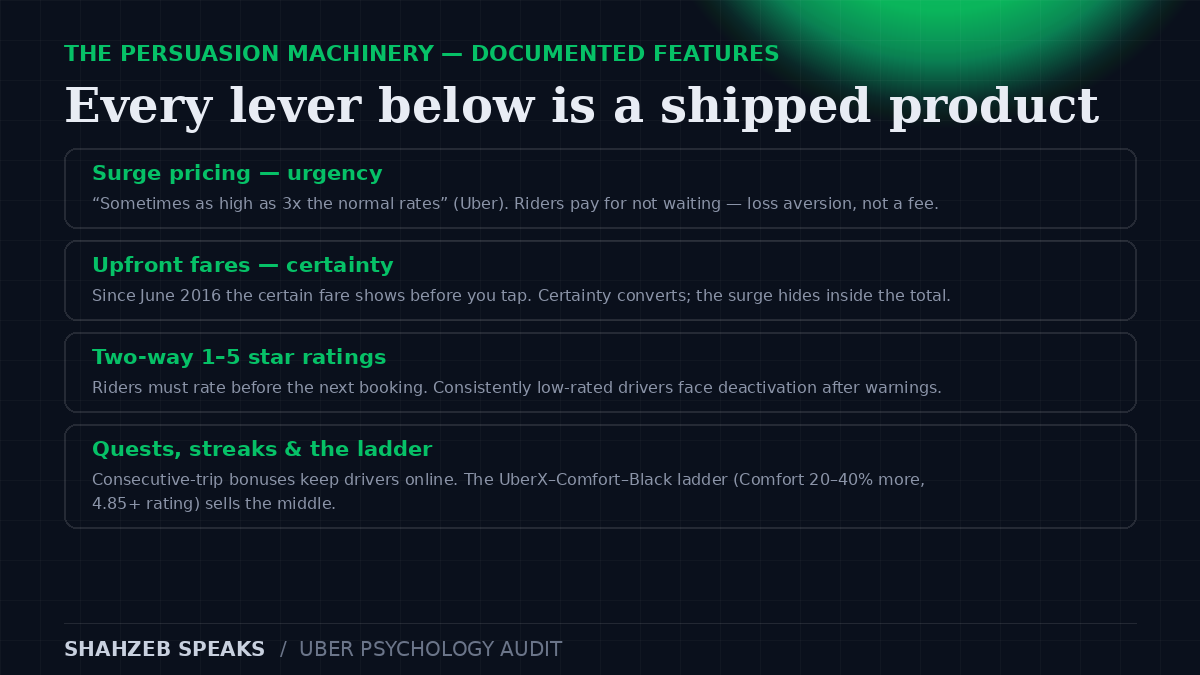
In June 2016 Uber announced upfront fares, first for UberX in parts of the US and India: riders would be “given the actual fare before they request their ride.” The blog’s own words: “There’s no complicated math and no surprises: passengers can just sit back and enjoy the ride.” The lightning bolt and the pop-up surge screen disappeared; a line of small text — “fares are higher due to increased demand” — took their place, without saying how much higher.
Psychologically, this trades one bias for another. People dislike ambiguity about prices at least as much as they dislike high prices: knowing the number in advance removes the anxiety of an open meter. That is the certainty effect from the same 1979 prospect-theory paper — we overweight outcomes that are certain relative to merely probable ones. But removing the visible multiplier also removed the one piece of information that let riders judge whether the price was fair. Outrage about “2.0x” vanished; acceptance of whatever the fare was became the norm. Press coverage at the time called it exactly that: the surge was still there, just out of sight.
For brands, the lesson is double-edged. Certainty pricing converts — people buy what they can see. But when the certainty is engineered to hide the very information that made people angry, it is transparency as theatre.
🎚️ Chapter 4: UberX, Comfort, Black — Anchoring in Three Tiers
Open the app and you choose a tier: UberX (the standard), Comfort (launched July 2019 in 43 US cities and Ottawa; 20–40% more than UberX, newer cars, minimum legroom, drivers rated 4.85 or higher, “quiet preferred” or “happy to chat”), and Uber Black (professional drivers, premium support, help with luggage). The spread is deliberate, and it is a textbook anchoring arrangement.
Tversky and Kahneman (1974) showed that people anchor on the first number they see and adjust insufficiently. Uber Black anchors the top: a fare that looks expensive makes Comfort look reasonable, and Comfort’s modest premium makes UberX look like the smart default. The compromise effect (Simonson, 1989) does the rest — given three options, many people pick the middle one. Uber does not need everyone to buy Black; it needs Black to exist so that Comfort sells and UberX feels like the baseline everyone compares downward from.
Comfort also shows how a rating becomes a product feature. The 4.85 driver threshold turns the rating system (Chapter 5) into a sorting machine: good ratings buy drivers access to higher-paying trips. The anchor is not just a number — it comes with a story about quality attached.
⭐ Chapter 5: Two-Way Ratings — Surveillance That Feels Like Politeness
After every trip, drivers and riders rate each other from one to five stars. Uber’s help page states the rules plainly: riders are prompted to rate each trip before booking another; consistently low-rated drivers “may face deactivation after several warnings”; new drivers start at five stars and the rating is an average of recent trips. Riders, for their part, find that low ratings mean longer waits and declined requests. It is a reputation market — and it is also a management system.
This is the chapter where the academic literature is bluntest. Alex Rosenblat and Luke Stark (2016), in a nine-month study of Uber drivers published in the International Journal of Communication, concluded that Uber exercises “significant indirect control” over drivers through information asymmetries: the platform controls pricing, dispatch and ratings data while drivers see almost none of it. Lee, Kusbit, Metsky and Dabbish (2015) gave the practice its name — algorithmic management — and studied Uber and Lyft as its founding examples: software that allocates, optimises and evaluates work without a human manager in the loop.
The psychological trick is that a star rating feels like feedback from a person. In practice it functions as a performance metric with employment consequences, except the manager is an average. Drivers cannot see which trip produced a low rating or why. When the UK Supreme Court ruled in 2021 (Chapter 10), the justices specifically cited the ratings system as evidence of control — the feature Uber designed for trust became evidence it was an employer in all but name.
🎯 Chapter 6: “Make It to $330” — The Goal Gradient on Wheels
The New York Times investigation of April 2017 remains the single best-documented account of Uber’s driver psychology. When a driver tried to log off, the app would tell him he was close to an arbitrary target: “Make it to $330.” Then: “You’re $10 away from making $330 in net earnings. Are you sure you want to go offline?” Two buttons followed — “Go offline” and “Keep driving” — with “Keep driving” pre-highlighted. The messages exploited, in the Times’ words, “some people’s tendency to set earnings goals,” and drivers reported receiving dozens of them.
Kivetz, Urminsky and Zheng (2006) demonstrated the goal-gradient effect: people accelerate as they approach a finish line. Being $10 from $330 is not meaningfully different from being $10 from nothing — but it feels like leaving a race one lap from the end. Combine that with loss aversion (the $330 you “almost” earned is now something you could lose), and the highlighted button is doing an enormous amount of work. The Times also reported a subtler experiment: drivers approaching the 25 rides needed for a signing bonus received “warm and innocuous” encouragement — “You’re almost halfway there, congratulations!” — calibrated on the finding that attrition fell sharply once drivers crossed the 25-ride mark.
Uber’s own promotions run on the same gradient today. Quest, described on Uber’s site, is “a promotion that offers you the opportunity to earn extra when you complete a trip streak” — the driver opts into a tier before the period starts and watches progress in the app’s Opportunities tab. Consecutive Trips pays extra for completing trips “in a row… without canceling, rejecting, or going offline,” with a black progress tracker at the top of the screen. The design never says “keep driving.” It shows you how close you are, which says it louder.
🔄 Chapter 7: Auto-Queue — The Stopping Cue That Never Comes
The Times investigation also described Uber’s “forward dispatch”: the next fare is sent to the driver before the current ride is over — “an algorithm similar to a Netflix feature that automatically loads the next program,” as the paper put it. Drivers can pause it temporarily but cannot permanently disable it. One Uber official told the paper that drivers were saying: “I can never go offline. I’m on just continuous trips. This is a problem.”
This is a stopping-cue problem. Humans regulate effort with natural breaks — the end of a ride, the end of a shift. Forward dispatch removes the break between the end of one unit of work and the decision to start the next, so each decision to stop requires an active, separate act of will against a system that has already queued the future. The driver’s shift becomes one continuous session, punctuated by progress bars: the binge-watching architecture applied to labour.
Nothing here is hidden in the fine print. What is hidden is the asymmetry: the rider sees a car arriving; the driver sees a session he did not choose to continue. Rosenblat and Stark’s framing fits again — the platform manages the flow of work, and the worker experiences it as his own momentum.
💵 Chapter 8: The $1, $2, $5 Tip Screen — Defaults at the Moment of Gratitude
In June 2017, as part of its “180 Days of Change” driver initiative, Uber finally added in-app tipping — first in Seattle, Minneapolis and Houston, then across the US by the end of July. Riders tip after rating the driver, choosing from preset amounts of $1, $2 or $5, or a custom amount. Uber stated that service fees are never deducted from tips. Tipping, the feature drivers had requested most, became part of the product.
The timing matters: the screen appears right after the rating, at the moment the rider is evaluating the driver’s performance — gratitude and evaluation arrive in the same interaction, and the preset converts the feeling into a number before it fades.
🔒 Chapter 9: Uber One — Subscription as Lock-In
Uber One, launched in November 2021 to replace Uber Pass, costs $9.99 a month ($99.99 a year) and bundles $0 delivery fees on eligible food orders over $15 and grocery orders over $30, 5% off eligible rides, and priority matching with top-rated drivers. Uber’s marketing claims members save “an average of $27 per month.” The structure is a classic subscription play: a free trial converts automatically, the benefits accumulate with use, and cancelling means losing things you have come to treat as yours.
The psychology is loss aversion applied to membership. Once $0 delivery fees are part of your routine, every non-member order shows you a fee you “would not have paid” — the subscription converts a gain (savings) into a possession (membership) that cancelling would forfeit. Usage also concentrates: if you pay $9.99 monthly, every order outside Uber feels like paying twice, so you route more spending through the platform. The subscription is not just revenue; it is a gravity well for the customer’s whole transport and food budget.
It is also the chapter of Uber’s psychology now under the most legal pressure. The FTC filed suit in April 2025 alleging that Uber enrolled consumers in Uber One without clear consent, charged users before free trials ended, and made cancellation unreasonably difficult — allegations Uber denies, saying consent is obtained and cancellation takes seconds. An amended complaint in December 2025 added 21 states and the District of Columbia as co-plaintiffs. As of 20 October 2026, none of the allegations has been ruled on. The pattern is one I have written about before — subscription mechanics that depend on the customer not quite noticing are the subject of my article on the psychology of subscription traps, and Uber One is now the highest-profile test case of where the line sits.
⚠️ Chapter 10: The Dark Side — A Decade of Fights, Each at Its Exact Status
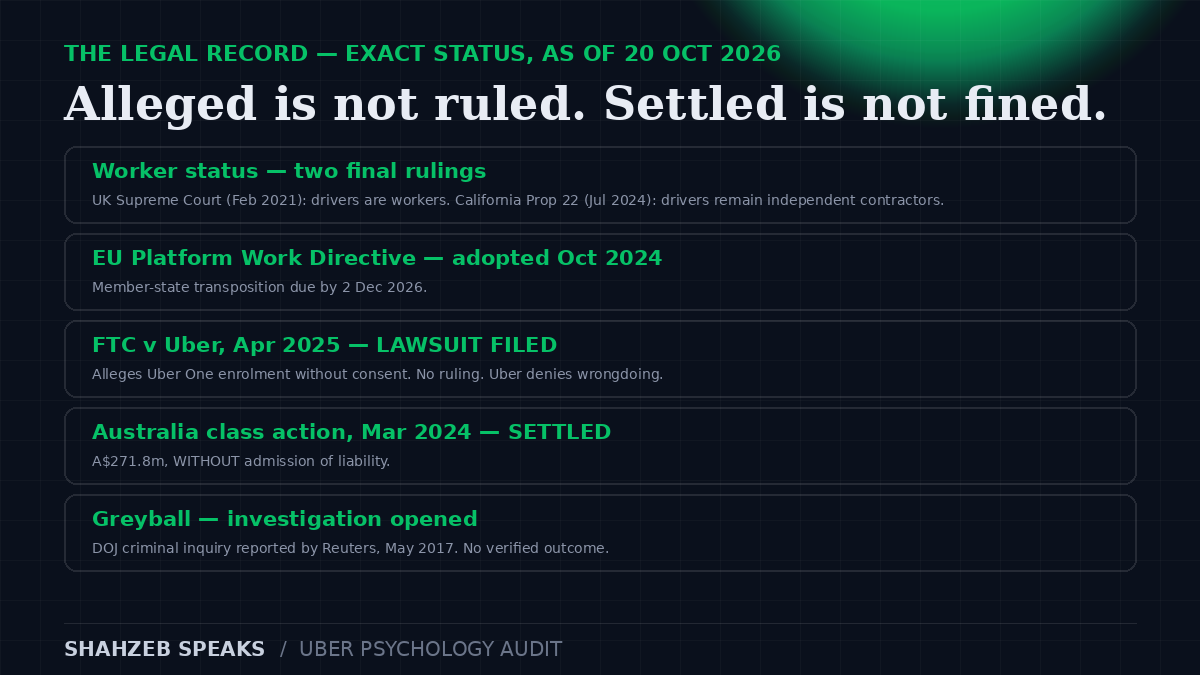
No audit of Uber is honest without the fights. Each is stated below at its exact legal status, as of 20 October 2026. Nothing is upgraded: alleged stays alleged, opened stays opened, and settled means settled.
🇬🇧 The UK: drivers are workers — final ruling, 19 February 2021
In Uber BV v Aslam [2021] UKSC 5, the UK Supreme Court unanimously dismissed Uber’s appeal and held that Uber’s UK drivers are “workers” — a middle category between employee and self-employed — entitling them to the national minimum wage, holiday pay and rest breaks. The court emphasised the reality of the relationship: Uber sets the fares, dictates the contractual terms, and exercises “significant control” through the ratings system. After the ruling, Uber announced UK drivers would receive holiday pay of just over 12% of earnings and automatic pension enrolment — but minimum wage only for trip time, from acceptance to completion, not for all logged-in time.
🇺🇸 California: Proposition 22 survives — final ruling, 25 July 2024
In Castellanos v. State of California, the California Supreme Court ruled 7–0 that Proposition 22 — the 2020 ballot measure, backed by Uber and other platforms, that classifies app-based drivers as independent contractors with a package of alternative benefits — is constitutional. This is a final ruling: in California, Uber drivers remain independent contractors.
🇪🇺 The EU: the Platform Work Directive — adopted, transposition pending
Directive (EU) 2024/2831 was adopted on 23 October 2024 and entered into force in December 2024. Member states must transpose it by 2 December 2026. The directive creates a rebuttable presumption of employment where platforms exercise direction and control, and imposes transparency and human-oversight rules on algorithmic management — the automated monitoring, task allocation and account decisions that Chapters 5–7 describe. As of October 2026, no member state has completed national enforcement.
🇺🇸 The FTC v Uber (Uber One) — lawsuit filed, allegations only
On 21 April 2025 the US Federal Trade Commission sued Uber in the Northern District of California under the FTC Act and the Restore Online Shoppers’ Confidence Act, alleging deceptive Uber One billing and cancellation practices: enrolment without clear consent, charges before free trials ended, and cancellation flows designed to be difficult. On 15 December 2025 the FTC filed an amended complaint joined by 21 states and the District of Columbia. Uber denies the allegations. As of 20 October 2026, the case is pending: no finding has been made and no ruling issued.
🇦🇺 Australia: A$271.8 million — settled March 2024, no admission of liability
In Andrianakis v Uber, a class action filed in 2019 by Maurice Blackburn on behalf of more than 8,000 taxi and hire-car owners and drivers, Uber agreed on the eve of trial to pay A$271.8 million (about US$178 million) without admission of liability; the court approved the settlement as fair and reasonable. It is the fifth-largest class action settlement in Australian history.
🕵️ Greyball and the “kill switch” — reported, not ruled on
In March 2017 the New York Times revealed Greyball, software that identified officials in areas where Uber was not approved and showed them a different app view, blocking bookings. Uber then prohibited the practice. In May 2017 Reuters reported that the US Department of Justice had opened a criminal investigation into Greyball. No public outcome of that investigation has been verified — it remains a reported investigation, not a finding. The July 2022 Uber Files — 124,000 leaked documents published by the Guardian and the ICIJ from former lobbyist Mark MacGann — documented Greyball’s use and a “kill switch” deployed during police raids. That is journalism, not a legal action, and I state it as such.
🇵🇰 Chapter 11: What Pakistani Brands Should — and Shouldn’t — Copy
✅ Copy this
Certainty pricing. Upfront fares removed the most hated part of buying a ride — the unknown. Any service that quotes estimates and then charges something else (home services, logistics, clinics) can copy the mechanism: show the number, honour it, and let the customer decide. Tiered choice with a real top anchor. The UberX–Comfort–Black ladder makes the middle option sell itself — but only if the top tier genuinely delivers what the anchor promises, or the whole ladder collapses into cynicism. Progress-bar incentives for gig workers. Quest-style trip streaks work in any market — the Careem audit shows how the regional playbook developed. The mechanism is sound; the ethics depend on the terms.
🚫 Don’t copy this
Consent that isn’t. The FTC’s Uber One allegations are a warning to every app running free trials that auto-convert: if cancellation takes a dozen screens and disclosures sit in grey small print, you are building your own regulator’s case file. Punishment by rating. Two-way ratings work for Uber because the market is deep enough that a deactivated driver can be replaced; in a smaller market, a rating system that functions as a firing mechanism will eat your supply side. Worker-status ambiguity. The UK and California took opposite paths and both cost Uber years and hundreds of millions. Platforms growing on gig labour should decide what their riders and drivers are — and document it — before a court decides for them.
📊 Chapter 12: Psychology Scorecard — Detailed Ratings
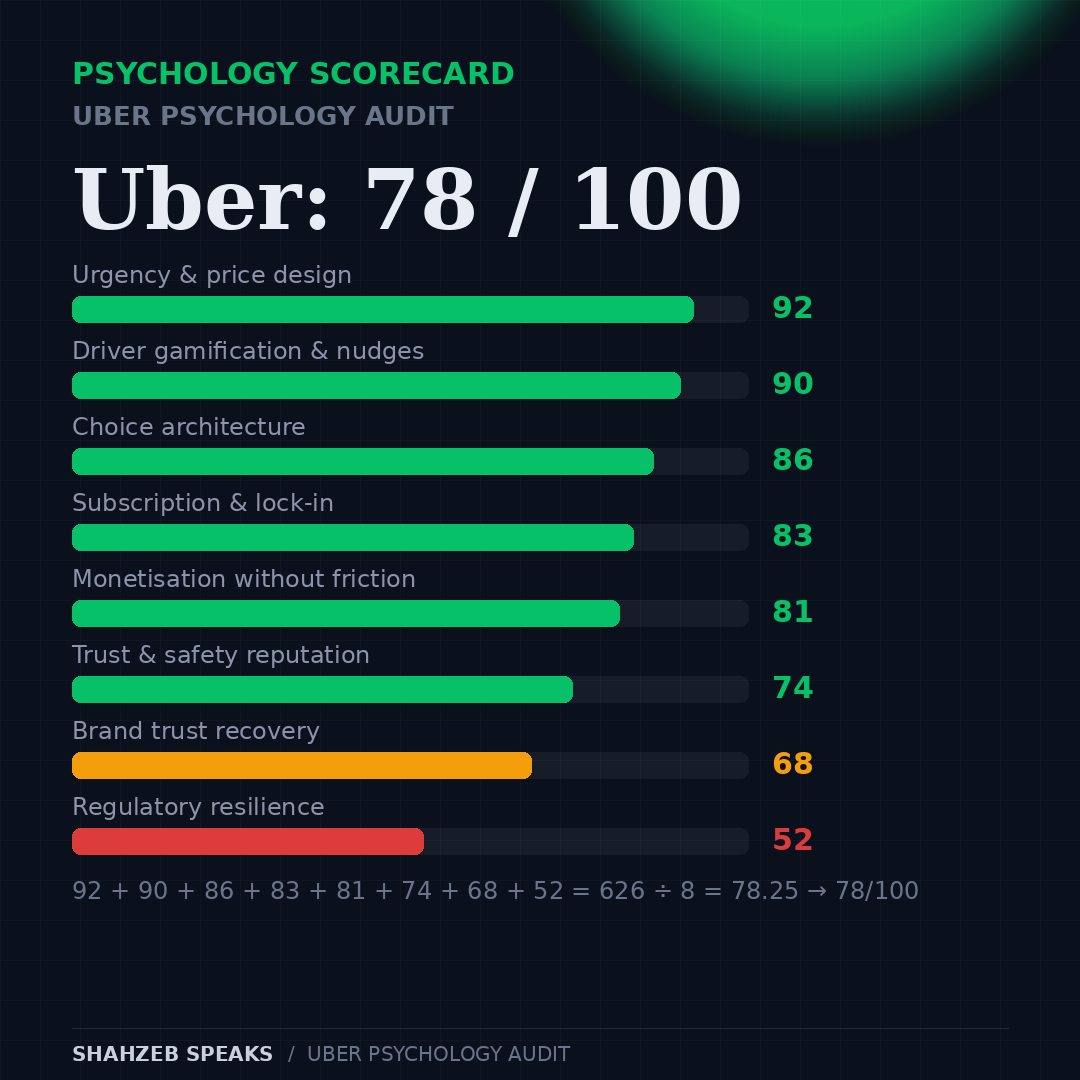
The arithmetic: 92 + 86 + 90 + 83 + 81 + 74 + 68 + 52 = 626. Divided by 8 dimensions = 78.25, rounded to 78/100.
| Psychology Dimension | Score | Verdict |
| Urgency & Price Design | 92/100 | Surge plus upfront certainty is the best pricing psychology in the industry. |
| Driver Gamification & Nudges | 90/100 | Quests, streaks and goal-gradients manage millions without a single manager. |
| Choice Architecture | 86/100 | The UberX–Comfort–Black ladder anchors and sells the middle tier. |
| Subscription & Lock-In | 83/100 | Uber One turns savings into a possession users will not surrender. |
| Monetisation Without Friction | 81/100 | Frictionless payment is superb; the subscription consent questions drag it down. |
| Trust & Safety Reputation | 74/100 | Two-way ratings and verification built trust; the Files era still stains it. |
| Brand Trust Recovery | 68/100 | The 2017 reset worked commercially; the brand never fully explained itself. |
| Regulatory Resilience | 52/100 | An FTC lawsuit, an EU deadline and two final rulings — the heaviest load of any audited brand. |
✅ Chapter 13: Balance Sheet & A Psychologist’s Prescription
What Uber gets right
- It priced urgency and certainty better than any consumer company in history — surge for allocation, upfront fares for trust.
- It built a tiered choice architecture where the top tier sells the middle tier and the middle tier makes the default feel smart.
- It documented its driver promotions in public help pages, so its nudge system can be studied instead of merely suspected.
- It turned a 2017 existential crisis into a profitable, diversified platform — rides, delivery, freight, subscriptions.
Where it is exposed
- The FTC’s Uber One case tests whether its subscription growth was built on consent or on friction — alleged, not ruled on.
- The EU Platform Work Directive’s December 2026 deadline directly targets the algorithmic management this audit describes.
- Two final court rulings (UK 2021, California 2024) went in opposite directions, leaving its labour model permanently contested.
- The Greyball history and the Uber Files mean every new algorithmic feature is read by regulators as a chapter in an old story.
The prescription
- Make cancellation as easy as enrolment. One-tap, same-screen, no 48-hour windows. If the FTC case is about friction, remove the friction before the ruling does.
- Show drivers the data they are managed by. Publish acceptance-rate thresholds, surge-zone logic and the deactivation line. Information asymmetry is the exact charge Rosenblat and Stark documented a decade ago.
- Put a stopping cue back in the driver app. End-of-shift summaries and opt-in forward dispatch would cost little and would answer the “I can never go offline” complaint from the company’s own drivers.
- Decide what a driver is, in public. The UK says worker, California says contractor, the EU is about to say more. A company this large should stop letting courts write its employment contract.
📝 Final Verdict
Uber is the most complete behavioural machine I have audited. The rider side is a pricing laboratory — surge for urgency, upfront fares for certainty, tiers for anchoring, presets for tipping — executed at 3.867 billion trips a quarter. The driver side is rarer: a workforce of millions managed almost entirely by software, through goal gradients, streaks, ratings and dispatch.
Its weaknesses are the mirror of its strengths. The same opacity that makes the pricing feel seamless is what the FTC is now suing over. The same ratings system that built trust became the evidence for worker status. Uber’s psychology is world-class; its accountability is still catching up.
For every brand watching: the lesson is not to copy the nudges — it is that a nudge you cannot explain in a courtroom is a liability you are still carrying.
Psychology Score: 78/100 — Uber earns elite marks for urgency and price design (92), driver gamification and nudges (90), choice architecture (86), subscription lock-in (83) and monetisation without friction (81), with solid trust and safety (74) and trust recovery (68), held back by regulatory resilience (52) — the heaviest legal load of any brand yet audited. The most complete behavioural machine in business, still negotiating the price of its own design.
🧠 Want Your Platform to Nudge Without Crossing the Line?
I’m Muhammad Shahzeb, an MSc Industrial Psychologist and web and app developer. I audit pricing, onboarding, ratings and subscription flows through behavioural psychology — what converts, what coerces, and where the legal line is.
More psychology behind the platforms you use: all brand psychology audits, the Careem audit, the Duolingo audit, loss aversion in marketing and the psychology of subscription traps.
📚 References & Sources
- Uber Technologies, Inc. Q2 2026 results press release (Exhibit 99.1), August 2026 — MAPCs 208m, trips 3.867bn, gross bookings $58.022bn, revenue $14.191bn.
- Uber Technologies, Inc. Q4 and FY2025 results press release (Exhibit 99.1), February 2026 — trips 13.567bn, gross bookings $193.454bn, revenue $52.017bn.
- Associated Press via Phys.org, 10 May 2019 — Uber IPO priced at $45/share, began trading on NYSE; $8.1bn raised.
- EBSCO Research Starters — Uber (company): founded March 2009 as UberCab by Garrett Camp and Travis Kalanick; renamed Uber October 2010 after SF cease-and-desist; Uber fully launched in San Francisco 2011; HQ San Francisco.
- Uber Newsroom (driver-facing page) — surge pricing: rates “sometimes as high as 3x the normal rates”; riders notified before requesting; company claim.
- The Hindu BusinessLine, 24 June 2016 — Uber’s upfront-fares blog: fares calculated from expected time/distance, traffic and rider/driver volumes; “the actual fare before they request their ride.”
- Macworld, 24 June 2016 — upfront fare rollout for UberX; surge folded into the fare; “fares are higher due to increased demand” text.
- PYMNTS, 9 July 2019 — Uber Comfort launch in 43 US cities and Ottawa; 20–40% premium over UberX; 4.85+ driver rating requirement.
- VentureBeat, 9 July 2019 — Uber Comfort details; Uber Black features (professional drivers, premium support).
- Digital Trends, July 2019 — quoting Uber’s Comfort blog on Black-tier professional drivers.
- Uber Help, “Understanding ratings” — drivers and riders rate each other 1–5 after each trip; consistently low-rated drivers “may face deactivation after several warnings.”
- Uber, “How Quest works” — Quest is a promotion to “earn extra when you complete a trip streak”; opt-in tiers; progress in the Opportunities tab.
- Uber Help, “Consecutive Trips” — complete trips in a row “without canceling, rejecting, or going offline”; progress tracker in the app.
- GeekWire, 20 June 2017 — in-app tipping launched in Seattle, Minneapolis, Houston; US-wide by end of July 2017; part of “180 Days of Change”; presets $1/$2/$5; “Uber service fees are never deducted from your tips.”
- Ridester — Uber One launched November 2021, replacing Uber Pass; $9.99/month or $99.99/year; $0 delivery fees on eligible orders; 5% off rides; “members save an average of $27 per month” (Uber marketing claim).
- Noam Scheiber, The New York Times, 2 April 2017 — “How Uber Uses Psychological Tricks to Push Its Drivers’ Buttons”: “Make it to $330” log-off messages, highlighted “Keep driving” option, auto-queuing of the next fare, 25-ride signing-bonus encouragement.
- Rosenblat, A. & Stark, L. (2016). Algorithmic Labor and Information Asymmetries: A Case Study of Uber’s Drivers. International Journal of Communication, 10, 3758–3784.
- Lee, M. K., Kusbit, D., Metsky, E. & Dabbish, L. (2015). Working with Machines: The Impact of Algorithmic and Data-Driven Management on Human Workers. Proceedings of CHI ’15.
- Kahneman, D. & Tversky, A. (1979). Prospect theory: An analysis of decision under risk. Econometrica, 47(2), 263–291.
- Tversky, A. & Kahneman, D. (1974). Judgment under uncertainty: Heuristics and biases. Science, 185, 1124–1131.
- Kivetz, R., Urminsky, O. & Zheng, Y. (2006). The goal-gradient hypothesis resurrected: The role of goal proximity, goal specificity, and monetary reward for goal gradients. Journal of Marketing Research, 43(1), 39–58.
- Johnson, E. J. & Goldstein, D. (2003). Do defaults save lives? Science, 302, 1338–1339.
- Simonson, I. (1989). Choice based on reasons: The case of attraction and compromise effects. Journal of Consumer Research, 16(2), 158–174.
- Computer Weekly, 19 February 2021 and 17 March 2021 — UK Supreme Court Uber BV v Aslam [2021] UKSC 5: unanimous final ruling, drivers are “workers”; Uber’s response (12%+ holiday pay, pension enrolment, minimum wage for trip time only).
- Reed Smith, 2024 — California Supreme Court, 25 July 2024, Castellanos v. State of California: Proposition 22 upheld 7–0 as constitutional; final ruling.
- CXC Global / EUR-Lex — Directive (EU) 2024/2831 adopted 23 October 2024, in force December 2024; member-state transposition by 2 December 2026.
- Republican View / InfoLaw Group, 2025–2026 — FTC sued Uber 21 April 2025 (FTC Act + ROSCA) over alleged Uber One practices; amended complaint 15 December 2025 with 21 states + DC; Uber denies; pending, no ruling.
- Supreme Court of Victoria / Maurice Blackburn, 2024–2025 — Andrianakis v Uber: class action filed 2019; settled March 2024 for A$271.8m without admission of liability; court-approved.
- MotorTrend / SC Media, May 2017 (citing Reuters) — DOJ criminal investigation into Greyball reported opened May 2017; no verified outcome.
- ICIJ, July 2022 — the Uber Files: 124,000 leaked documents (2013–2017), source Mark MacGann; lobbying, “kill switch” during raids, Greyball use documented; journalism, not a legal action.
- Android Authority, 2017 — Uber Eats began 2014 as UberFRESH pilot; standalone app launched Toronto, December 2015.
- ICIJ / AP reporting, 2022 — CEO Dara Khosrowshahi, hired 2017.
Key Findings
- In Q2 2026 Uber reported 208 million monthly active platform consumers, 3.867 billion trips and $58.022 billion in gross bookings; for FY2025, 13.567 billion trips and $193.454 billion in gross bookings
- Surge pricing can run "sometimes as high as 3x the normal rates" per Uber's own page, while June 2016 upfront fares folded the surge multiplier invisibly into the price riders see
- The UK Supreme Court's 19 February 2021 FINAL RULING held Uber drivers are "workers", and on 25 July 2024 the California Supreme Court's FINAL RULING upheld Proposition 22, keeping drivers independent contractors there
- The EU Platform Work Directive was adopted in October 2024 with member-state transposition due by 2 December 2026, directly targeting algorithmic management of the kind Uber uses
- The FTC filed suit against Uber in April 2025 over alleged deceptive Uber One billing and cancellation, joined by 21 states in an amended complaint in December 2025; no finding has been made and no ruling issued
- Uber's Australian class action settled in March 2024 for A$271.8 million WITHOUT admission of liability; Greyball's 2017 DOJ inquiry has no verified outcome and the 2022 Uber Files are journalism, not a legal action
Overall Psychology Score
Uber scores 78/100 in our comprehensive psychology audit covering consumer behavior strategies, UX design principles, and psychological marketing effectiveness.
The detailed dimension scores are in the audit's Psychology Scorecard chapter.
High impactMuhammad Shahzeb
MSc Industrial Psychologist, specializing in consumer behavior, UX psychology, and brand strategy analysis. Helping brands understand the psychology behind their success.
About Muhammad Shahzeb →