easypaisa Psychology Audit — The Wallet That Became Pakistan’s First Digital Bank
A psychology audit of easypaisa, Pakistan's first digital retail bank (SBP commercial approval 28 January 2025). How 50M+ users were won with visible security, daily rewards, saving pockets and green-sticker ubiquity; why the licence converted borrowed trust into institutional trust; and the shadows — an opened NCCIA investigation, fraud magnetism and a reported stake sale.

80 / 100
Overall consumer behavior effectiveness
Brand Overview
- Brand nameeasypaisa
- Founded2009
- HeadquartersKarachi, Pakistan
- IndustryFinance & Banking
- Websiteeasypaisa.com.pk ↗
Psychology Techniques Identified
- 01Loss Aversion (Daily Rewards)
- 02Variable Rewards (Daily Prizes)
- 03Habit Formation (Daily Check-in)
- 04Goal-Gradient Effect (Saving Pockets)
- 05Mental Accounting (Pockets & Term Deposits)
- 06Social Proof (Ubiquity & Agent Network)
- 07Authority (SBP Digital Bank Licence)
- 08Reciprocity (Cashback Campaigns)
- 09Framing (Roman-Urdu Loss Copy)
- 10Friction Reduction (QR & One-Tap Bills)
- 11Pain-of-Paying Reduction (easycash & BNPL)
- 12Trust Architecture (Cooling-off & Biometrics)
Full Psychology Audit Report
In this audit
Picture a small shop in a town you have never heard of, somewhere between Multan and nowhere. The sign outside is hand-painted, but the sticker on the door is printed in a bright, confident green: easypaisa. Inside, a woman who has never set foot in a bank branch sends money to her son in Karachi, pays the electricity bill, and puts a little aside in a “saving pocket” — all from a phone that cost less than the shoes she is wearing. Sixteen years ago this was a telecom experiment. In January 2025 it became a bank. easypaisa did not win by being a better bank. It won by being there first, being everywhere, and making money feel safe in the hands of people the banking system had ignored.
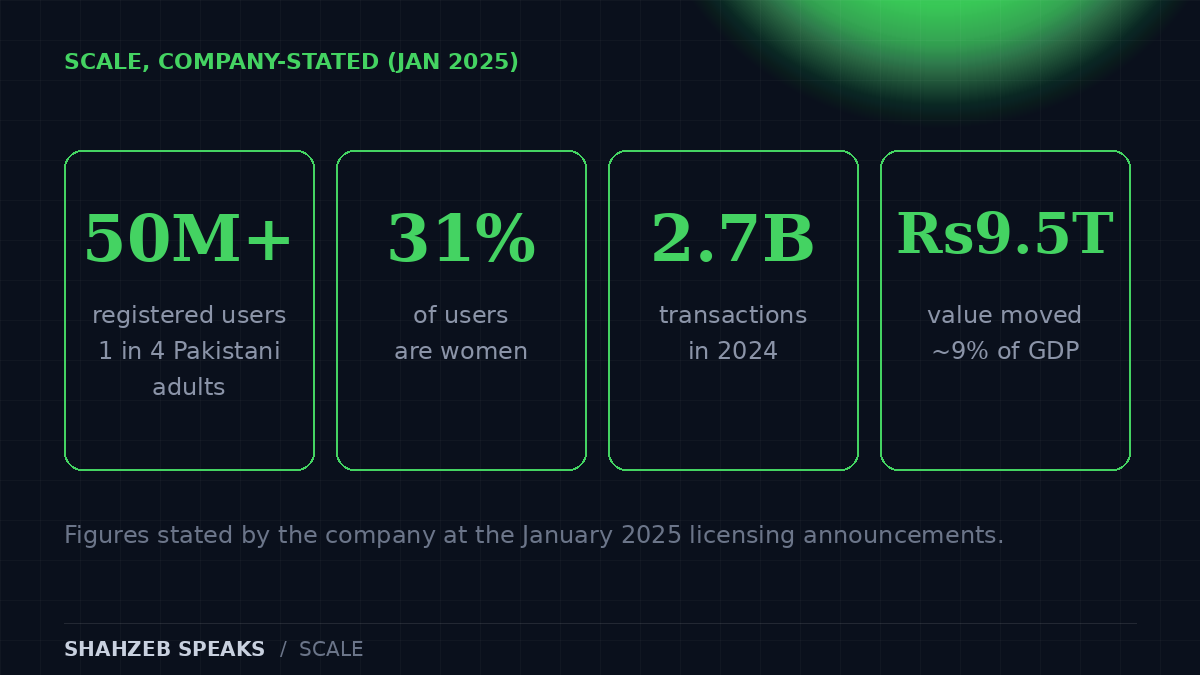
At the January 2025 licensing announcements, the company stated it had more than 50 million registered users — roughly one in four Pakistani adults — with women making up 31% of the base, and that it processed 2.7 billion transactions in 2024 worth Rs9.5 trillion, about 9% of Pakistan’s GDP. On 28 January 2025, the State Bank of Pakistan gave it commercial approval to operate as a Digital Retail Bank, the first in the country to launch regular operations. The registered name is easypaisa Bank Limited; it was converted from Telenor Microfinance Bank.
I am an Industrial and Organizational Psychologist, and this audit examines easypaisa the way a psychologist would: as a sixteen-year experiment in trust. How do you get a population with low banking penetration to hand its money to a phone screen? The answer turns out to be a careful stack of psychology — security theatre that is not theatre, daily rituals, mental accounting, ubiquity as social proof, and a licence that converted borrowed trust into institutional trust — with a few shadows I will not gloss over.
“easypaisa understood something most banks still do not: in Pakistan, the scarcest currency is not money, it is trust. So it spent sixteen years manufacturing trust — one agent sticker, one biometric login, one daily reward at a time — and then the State Bank stamped it. The licence did not create the trust. The trust earned the licence.”
— Brand Psychology Analysis, ShahzebSpeaks
📋 Brand Overview: easypaisa at a Glance
| Launched | 2009, jointly by Tameer Microfinance Bank and Telenor Pakistan — Pakistan’s first branchless banking service |
| Registered name | easypaisa Bank Limited (converted from Telenor Microfinance Bank in January 2025) |
| Licence | Pakistan’s first Digital Retail Bank to receive SBP commercial approval for regular operations, 28 January 2025 |
| Scale (company-stated, Jan 2025) | 50+ million registered users · 31% women · roughly one in four Pakistani adults |
| Throughput (2024) | 2.7 billion transactions worth Rs9.5 trillion — about 9% of Pakistan’s GDP |
| Leadership | Chair: Irfan Wahab Khan · CEO at launch: Jahanzeb Khan |
| Shareholders | Telenor B.V. and Ant Group (per the company’s December 2023 statement) |
| Model | Branchless-first digital bank: app + agent network; payments, transfers, bills, savings, term deposits, nano-loans, BNPL, insurance, QR |
📜 Chapter 1: The History — Sixteen Years to an Overnight Licence
📱 2009: A telecom company sells banking
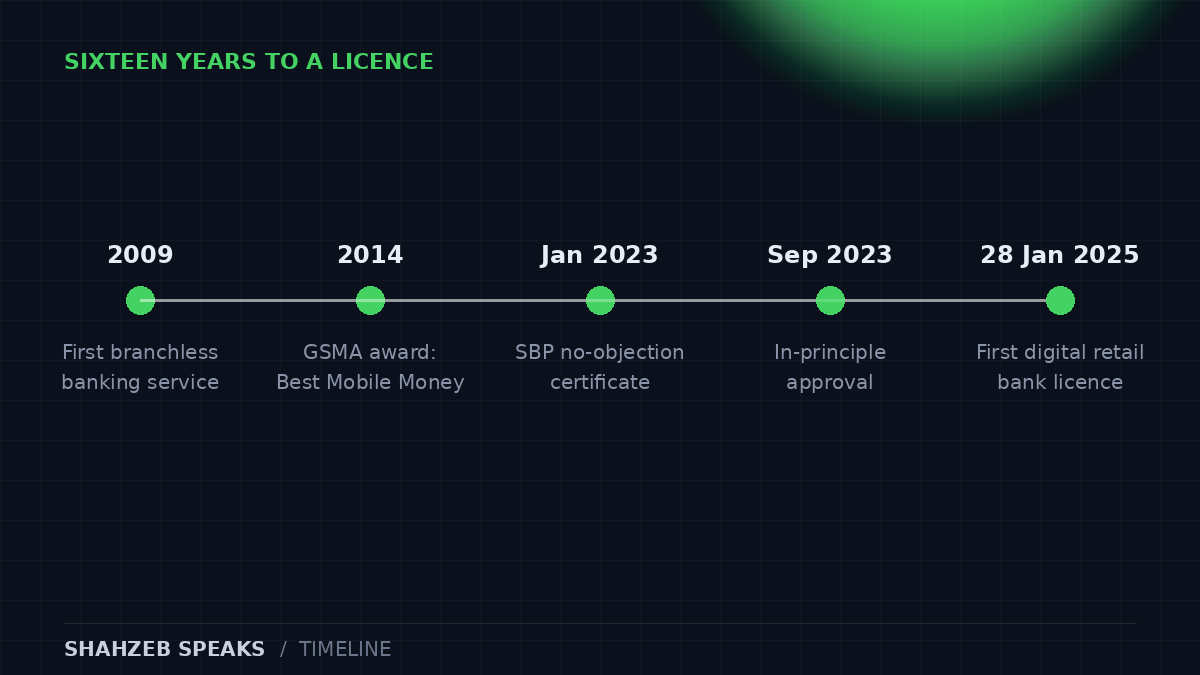
easypaisa was launched in 2009 as a joint venture between Tameer Microfinance Bank and Telenor Pakistan. The State Bank had issued branchless banking guidelines in 2008, and easypaisa was the first service to walk through the door they opened. The insight was demographic, not technological: mobile penetration in Pakistan far exceeded bank-account penetration, so the phone became the branch. By 2010 the service was already running at more than 11,000 agents.
🏆 2014: The world notices
In February 2014, at the Mobile World Congress in Barcelona, easypaisa won two GSMA awards including “Best Mobile Money Service in the World,” chosen from more than 250 mobile money services. For a Pakistani service barely five years old, this was external validation it could spend for a decade — awards are social proof with a long half-life.
🔄 2016–2023: Consolidation and the digital-bank race
Telenor Group completed its acquisition of Tameer Bank in 2016 and moved easypaisa’s management under the bank. The bank’s own quarterly financial statements for March 2023 disclose the resulting ownership: Telenor Pakistan B.V. holding 55% and Alipay (Hong Kong) Holding Limited — an Ant Group company — holding 45%. That put one of the world’s largest fintech operators on the cap table, and the app’s subsequent evolution toward a fuller financial-services shelf is consistent with that influence. When the State Bank published its digital-bank licensing framework in January 2022, Telenor Microfinance Bank was among the five applicants awarded a No-Objection Certificate in January 2023, and received in-principle approval in September 2023.
🏦 28 January 2025: The licence
At an official ceremony at the State Bank, easypaisa received commercial approval to commence regular digital banking operations — the first Digital Retail Bank in Pakistan to do so. Telenor Microfinance Bank was converted from a microfinance bank into a digital retail bank, operating as “easypaisa digital bank.” Board Chair Irfan Wahab Khan and CEO Jahanzeb Khan framed it as a financial-inclusion milestone, and on the numbers they had a case: one in four Pakistani adults registered, nearly a tenth of GDP flowing through the platform.
🛡️ Chapter 2: Trust Architecture — Security You Can See
Ask why people trust a bank and they will mention the building. Branches are trust architecture made of marble: they say “we are permanent, we are supervised, your money is inside something solid.” easypaisa had no marble. So it built the digital equivalent, and — crucially — it made the security visible.
Reading the official site today, the security list reads like a checklist written by someone who has watched fraud happen: a 2-hour cooling-off period that freezes suspicious changes, location-based login, device binding with biometric verification and OTP auto-fetch, a 5-digit PIN on every login, biometric checks when you switch numbers, fraud monitoring, facial recognition for large transactions, encrypted storage. Each feature is a small promise: even if someone steals your phone, your money has layers between it and them.
The psychology here is risk reversal plus authority. A first-time user in 2012 was not comparing easypaisa to a bank; she was comparing it to cash under a mattress and to a stranger at a shop counter. Every visible lock tipped that comparison. And in 2025 the ultimate authority signal arrived: a State Bank licence. Regulation is the one trust signal a startup cannot manufacture — it has to be granted. easypaisa spent sixteen years behaving like it was already regulated, then got the paper to prove it.
🎰 Chapter 3: Daily Rewards — The Habit Machine
The app’s homepage currently advertises “daily rewards — win rewards, every day!” That exclamation mark is doing psychological work. A daily reward is a variable-reward habit loop: show up, get something, come back tomorrow. The variability matters — a fixed daily prize becomes salary and gets mentally spent; an uncertain one stays interesting, the same mechanism that keeps people pulling slot-machine levers.
But there is a second mechanism underneath, and it is the subject of my companion article this week on loss aversion in marketing: miss a day and you have not merely failed to gain — you have lost today’s reward. The streak logic I documented in my Duolingo audit applies here in miniature. Duolingo defends a 212-day streak; easypaisa defends today’s small win. Both convert a vague intention (“I should save”) into something you own and could lose.
Is this manipulative? A daily nudge to open your banking app is milder than most of what the attention economy does, and the reward is real money, not confetti. The line worth watching is whether the rewards train saving or merely opening. A habit of opening the app is valuable to the bank either way; only one of those habits is valuable to the user.
🎯 Chapter 4: Saving Pockets — Mental Accounting, Productised
Richard Thaler’s mental accounting research showed that people do not treat money as fungible — we keep mental ledgers, “rent money” and “holiday money,” even though a rupee is a rupee. easypaisa’s “saving pockets” turn that quirk into a feature: labelled sub-accounts inside the wallet where you park money for a purpose.
This works through two channels. First, labelling creates a soft commitment — money in the “school fees” pocket feels costlier to raid than money in the main balance, even though the app would let you move it in seconds. Second, pockets create visible progress, which triggers the goal-gradient effect: we accelerate effort as we approach a goal, the reason loyalty cards with two stamps pre-filled get completed faster. A pocket that is 80% full pulls the last 20% out of you.
Term deposits add the harder version of the same idea: money locked for a fixed period at a stated rate. The lock is the point. A behavioural economist would call it a commitment device — your present self tying the hands of your future self, voluntarily, for interest.
👥 Chapter 5: Ubiquity — The Green Sticker as Social Proof
There is a reason the green easypaisa sticker is on what feels like every third shop shutter in Pakistan. In 2015-era company material the network ran to tens of thousands of shops across 800+ cities; whatever the current count, the perception of ubiquity is the product. Psychologists call the underlying mechanism the mere exposure effect: we prefer things we have seen often, and familiarity reads as safety.
Ubiquity is also social proof at national scale. “One in four Pakistani adults” is not just a statistic — it is an argument. If your neighbour, your shopkeeper and your cousin all use it, the question stops being “is this safe?” and becomes “why am I the one still standing in a bank queue?” easypaisa’s early marketing leaned into exactly this, positioning the service as the people’s alternative to distant, paperwork-heavy branches.
The colour choice deserves a note. Green is the colour of Pakistani currency, of “go,” of Islam, of growth. On a dusty street, a green sticker is legible at fifty metres. Brand psychologists debate how much colour truly drives behaviour, but legibility is not debatable — and easypaisa is the most legible financial brand in the country.
🤝 Chapter 6: Cashback — Reciprocity With an Expiry Date
In 2018, easypaisa ran a campaign offering 50% cashback on mobile top-ups made through the app, for users maintaining a balance of Rs1,000 or more, with instant posting capped at Rs200. The mechanics are worth studying because they stack three principles:
Reciprocity: the company gives first, and the customer feels the quiet pull to give back — with loyalty, with balances, with habit. Loss framing: the balance requirement and the cap turn the cashback into something you can fail to qualify for, which stings more than never being offered it. Urgency: campaigns expire, and expiring rewards convert browsers into actors.
Cashback is also honest in a way discount theatre is not. The money is real, the posting is instant, and the conditions are stated. Compare that with the “original price” games on sale pages, and you see why easypaisa’s incentives built trust instead of spending it: the reward was verifiable in the user’s own balance, seconds later.
⚡ Chapter 7: Friction Killing — “Scan Karo, Done Karo”
The site’s current taglines are written in Roman Urdu and they all promise the same thing: less effort. “Bill due toh wait kyun?” (why wait if the bill is due?). “Scan karo, done karo” (scan it, done). Pay the bill, top up the phone, send money, buy insurance, take a nano-loan — each action compressed toward a single gesture.
This is the least glamorous and most important chapter. Every extra step in a financial task is a moment where a nervous first-time user can abandon it; every removed step is conversion. QR payments replace account numbers with a camera point. Saved billers replace monthly data entry. The friction-reduction principle is simple: motivation is fragile, so make the desired action the easiest action.
Two products deserve a careful look here. easycash (nano-loans) and buy-now-pay-later reduce the pain of paying — the psychological sting that normally restrains spending. That is good design for inclusion (credit for people banks ignore) and a genuine risk category for over-indebtedness everywhere in the world. easypaisa publishes no default figures I could verify, so I will not claim a problem exists; I will say the product category demands the same care as the security chapter shows, because the easier borrowing gets, the more the design — not just the user — owns the outcome.
🏦 Chapter 8: The Licence — Borrowed Trust Becomes Institutional Trust
The January 2025 conversion matters more psychologically than financially. For sixteen years, easypaisa asked users to trust a telecom-adjacent brand with their money. It worked, but it was borrowed trust — trust in Telenor’s network, in the agent’s familiar face, in the sticker. A Digital Retail Bank licence converts that into institutional trust: deposits under a State Bank-regulated entity, with the obligations and protections that status carries.
Watch what this unlocks in the product: term deposits, digital lending, current and savings accounts, wealth-management tools, international remittances, cards — the full banking shelf, delivered through the same app. The psychology of the brand can now run on two tracks at once: the friendly green wallet for daily life, and the regulated bank for serious money. Most fintechs have to choose one personality. easypaisa gets both, because it earned them in sequence.
⚠️ Chapter 9: The Dark Side — Misinformation, Fraud Magnetism, and a Reported Sale
No honest audit skips this chapter. Three things belong in it, each with its exact status.
First, the NCCIA investigation — opened, not decided. In June 2026, Pakistan’s National Cyber Crime Investigation Agency opened an investigation into a social-media campaign that allegedly spread false claims about easypaisa Bank’s financial stability. The complaint was filed by the bank’s own Head of Country Litigation under the Prevention of Electronic Crimes Act (PECA) 2016. The bank denied any financial difficulty and confirmed full operations. To be precise: an investigation was opened. No finding has been announced, no charge against the bank exists, and the allegation under investigation is against the campaign’s creators, not the bank. A bank popular enough to be worth lying about is a backhanded compliment; a bank that has to keep denying rumours is spending trust it would rather save.
Second, the fraud magnet problem. In December 2025, a fake easypaisa “Birthday Fund” scam circulated and was debunked by fact-checkers — one more entry in a recurring pattern of false narratives around the brand. This is the structural shadow of ubiquity: when one in four adults uses your service, scammers impersonate you the way they impersonate tax authorities. easypaisa’s visible security stack — the cooling-off period, the biometric binding — reads differently in this light: not marketing, but armour. The question for the next audit is whether armour is keeping pace with the attacks.
Third, the reported stake sale. In mid-2026, Bloomberg-reported via the tech press, Telenor was seeking a buyer for its easypaisa Bank holding, with the same reports citing full-year 2025 profit after tax of Rs17.04 billion and first-quarter 2026 profit before tax of Rs3.66 billion. Status: reported, not confirmed by the company. If a sale happens, the psychology chapter to watch is continuity of trust — easypaisa’s brand equity is inseparable from sixteen years of consistent identity, and new ownership will be judged on whether that identity survives.
One clarification, because conflation here would be unfair: in September 2026 the PTA fined Telenor Pakistan — the telecom operator — Rs68.05 million over network quality standards. That is a different company from easypaisa Bank Limited, which stated in December 2023 that it operates independently under the State Bank. Fining the telco is not fining the bank.
🇵🇰 Chapter 10: What Pakistani Brands Should — and Shouldn’t — Copy
Copy the visible security. Most Pakistani apps hide their protections in settings menus. easypaisa puts them on the homepage. When your users are first-generation digital, security you can see beats security you can only read about in a privacy policy.
Copy the Roman-Urdu voice. “Scan karo, done karo” is not a translation of an English tagline — it is the product thinking in the user’s language. Pakistani brands that write English-first copy and translate downward sound like announcements. easypaisa sounds like a shopkeeper.
Copy the real rewards. Instant, verifiable, balance-visible incentives. The 2018 cashback landed in the account in seconds. Compare that with points that take six weeks to “process” and you understand why one builds habit and the other builds resentment.
Don’t copy the daily-reward treadmill without asking what it trains. If your product’s core value is saving, make sure the ritual trains saving — not just opening. Engagement metrics and user outcomes are not the same number.
Copy the earned-licence sequence. easypaisa behaved like a regulated bank for years before it became one — visible compliance, published financials, a real head office in Karachi. When the licence came, nobody was surprised. Pakistani fintechs that treat regulation as paperwork to be gamed get the opposite: a licence that surprises nobody either, but for the wrong reason.
Don’t copy ubiquity without the armour. The bigger your brand gets, the more scammers will wear your face. Budget for fraud communication the way you budget for marketing — easypaisa’s recurring misinformation episodes show the cost of learning this late.
📊 Chapter 11: Psychology Scorecard
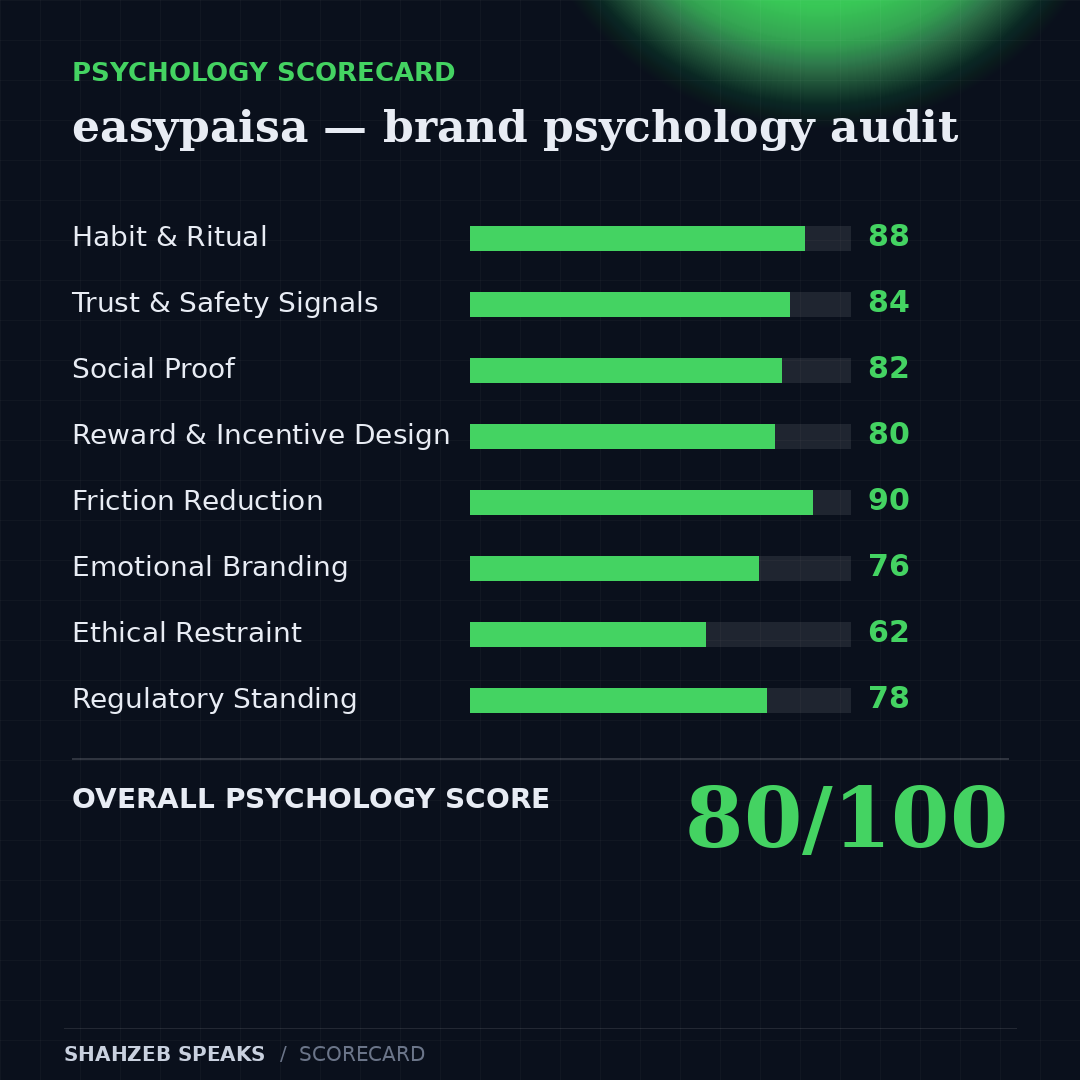
| Dimension | Score | One-line verdict |
|---|---|---|
| Habit & Ritual | 88 | Daily rewards and bill cycles turn banking into routine. |
| Trust & Safety Signals | 84 | Visible, layered security plus a State Bank licence. |
| Social Proof | 82 | One in four adults and a sticker on every street. |
| Reward & Incentive Design | 80 | Real, instant, verifiable — cashback that lands in seconds. |
| Friction Reduction | 90 | QR, saved billers, one-gesture payments in Roman Urdu. |
| Emotional Branding | 76 | Warm and legible, but functional rather than beloved. |
| Ethical Restraint | 62 | Daily-reward treadmills and easy credit need watching. |
| Regulatory Standing | 78 | First digital-bank licence; misinformation episodes cost points. |
✅ Chapter 12: Balance Sheet & Prescription
Assets: sixteen years of trust compounding; genuine ubiquity; security users can see; instant, honest rewards; a regulator’s stamp; a voice that speaks the user’s language.
Liabilities: a brand big enough to be impersonated; daily mechanics that optimise for opens as much as outcomes; credit products whose psychology (reduced pain of paying) needs the same rigour as the security chapter; a reported ownership change that will test continuity.
Prescription: publish a public fraud-transparency report — attacks seen, blocked, and user losses compensated would turn the armour into a marketing asset. Tie daily rewards to savings outcomes, not just app opens, so the habit serves the user. And through any ownership change, keep the green sticker, the Roman-Urdu voice and the instant cashback: that is the identity sixteen years built.
📝 Chapter 13: Final Verdict
easypaisa is the rare fintech whose psychology serves its mission more than its metrics. It took the hardest trust problem in Pakistani consumer life — handing money to a screen — and solved it with patience: visible locks, familiar faces, small daily wins, and finally a licence that made the trust official. The shadows are real but manageable: misinformation, fraud magnetism, and the eternal question of whether easy credit stays easy.
Psychology Score: 80/100 — The most trusted financial habit in Pakistan, built one visible lock and one daily reward at a time. The licence was earned long before it was granted.
Want this lens on your brand?
I audit brands the way a psychologist would — what the design is doing to your customer’s brain, and what to change. Contact me here for a brand psychology audit.
More from this site: my homepage on industrial psychology in Pakistan, the companion article on loss aversion in marketing (the principle behind easypaisa’s daily rewards), and the Meezan Bank psychology audit — the other Pakistani bank that won on trust, for completely different reasons.
📚 References & Sources
- Ericsson press release via Telecom Ramblings (2016) — easypaisa launch history and 2014 GSMA awards (Telenor-stated).
- FactFile / Green Post / The AZB / Trade Chronicle (January 2025) — SBP commercial approval ceremony, 28 January 2025; company-stated scale figures.
- TechX (2026) — Pakistan digital-bank race explainer; Telenor stake-sale reporting (via Bloomberg).
- MeaTechWatch (January 2025) — licensing milestone, leadership quotes.
- easypaisa official website (easypaisa.com.pk) — product and security features, accessed 7 October 2026.
- EveryThing.PK (2018) — 50% cashback campaign details.
- FactFile (24 June 2026) — NCCIA investigation opened under PECA 2016.
- Kahneman, D. & Tversky, A. (1979). Prospect Theory. Econometrica, 47(2) — loss-aversion framing in Chapter 3.
- Thaler, R. — mental accounting (saving pockets, Chapter 4).
Key Findings
- On 28 January 2025 easypaisa received SBP commercial approval to commence regular digital banking operations — Pakistan's first Digital Retail Bank to do so; registered name easypaisa Bank Limited, converted from Telenor Microfinance Bank
- Company-stated scale as of January 2025: 50M+ registered users (about one in four Pakistani adults), 31% women, 2.7 billion transactions in 2024 worth Rs9.5 trillion — about 9% of GDP
- The official site (read 7 October 2026) documents the trust-and-habit stack: daily rewards, saving pockets, term deposits, a 2-hour cooling-off period, biometric device binding, 5-digit PIN and facial recognition for large transactions
- A documented 2018 campaign offered 50% cashback on easyload via the app (Rs1,000+ balance, instant posting, Rs200 cap) — reciprocity with an expiry date
- The NCCIA opened an investigation (reported June 2026) under PECA 2016 into an alleged false social-media campaign about the bank's financial stability — investigation opened, not a finding; the bank denied any difficulty
- Bloomberg-reported (via tech press, mid-2026) Telenor stake-sale process, with FY2025 profit after tax of Rs17.04 billion cited in the same reports — reported, not company-confirmed
Overall Psychology Score
easypaisa scores 80/100 in our comprehensive psychology audit covering consumer behavior strategies, UX design principles, and psychological marketing effectiveness.
The detailed dimension scores are in the audit's Psychology Scorecard chapter.
High impactMuhammad Shahzeb
MSc Industrial Psychologist, specializing in consumer behavior, UX psychology, and brand strategy analysis. Helping brands understand the psychology behind their success.
About Muhammad Shahzeb →