
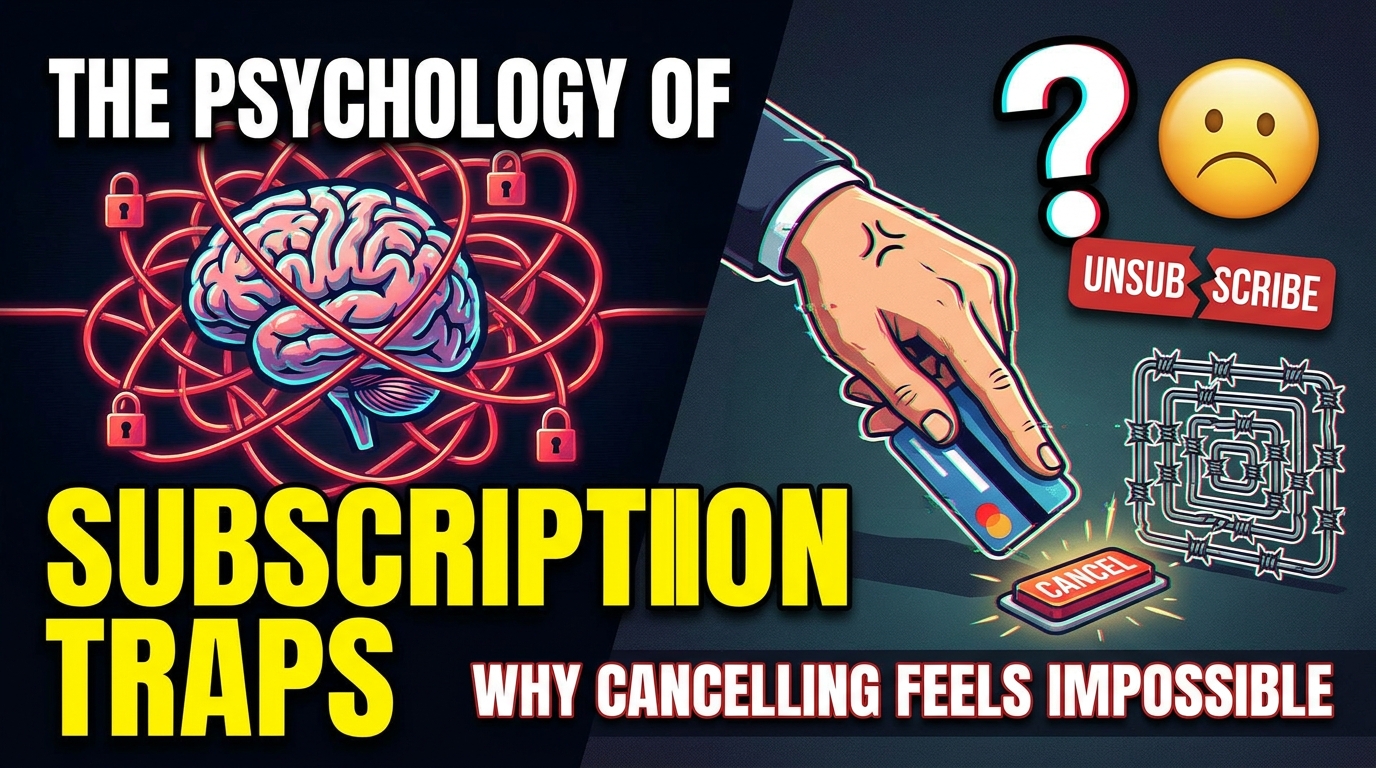
Signing up took you eleven seconds and one thumb. Cancelling took a phone call during business hours, a “please hold,” a retention offer for 40% off, two screens asking if you were sure, one screen reminding you of everything you would “lose,” and a small, quiet dose of guilt. You probably gave up at least once. Millions of people give up every day, and their monthly payments keep leaving their accounts for a service they stopped using in March.
That asymmetry, effortless in, exhausting out, is not a technical accident or a customer-service failure. It is engineered, deliberately, using well-documented principles of behavioral science, and there is a precise word for it that I will use throughout this article: sludge. I am an Industrial and Organizational Psychologist, and this piece takes apart exactly how subscription traps work on your brain, the specific dark patterns companies deploy, the reason the guilt screen makes you feel bad, the 2024-2025 wave of laws trying to outlaw the whole thing, and a step-by-step escape plan you can use the moment you finish reading.
“A company that makes signing up delightful and cancelling miserable is telling you the truth about its product. If they had to keep you honestly, they would not need to trap you dishonestly.”
— Consumer Psychology Analysis, ShahzebSpeaks

🧠 Sludge: the concept that explains everything
Richard Thaler, who won the Nobel Prize for behavioral economics, coined the term nudge for small design choices that steer people toward good decisions. He later named the evil twin: sludge, friction deliberately added to make good decisions harder. Every subscription trap is sludge, and once you have the word, you cannot unsee it.
The core mechanism relies on a boring but powerful truth: humans are governed by friction far more than we admit. Behavioral economists call it the status quo bias, our strong tendency to stick with the current state simply because changing it requires effort. Add even a small barrier to an action and a large share of people will not take it, not because they decided against it, but because they never quite got around to it. Companies discovered that they do not need to convince you to stay subscribed. They only need to make leaving slightly annoying, and inertia does the rest.
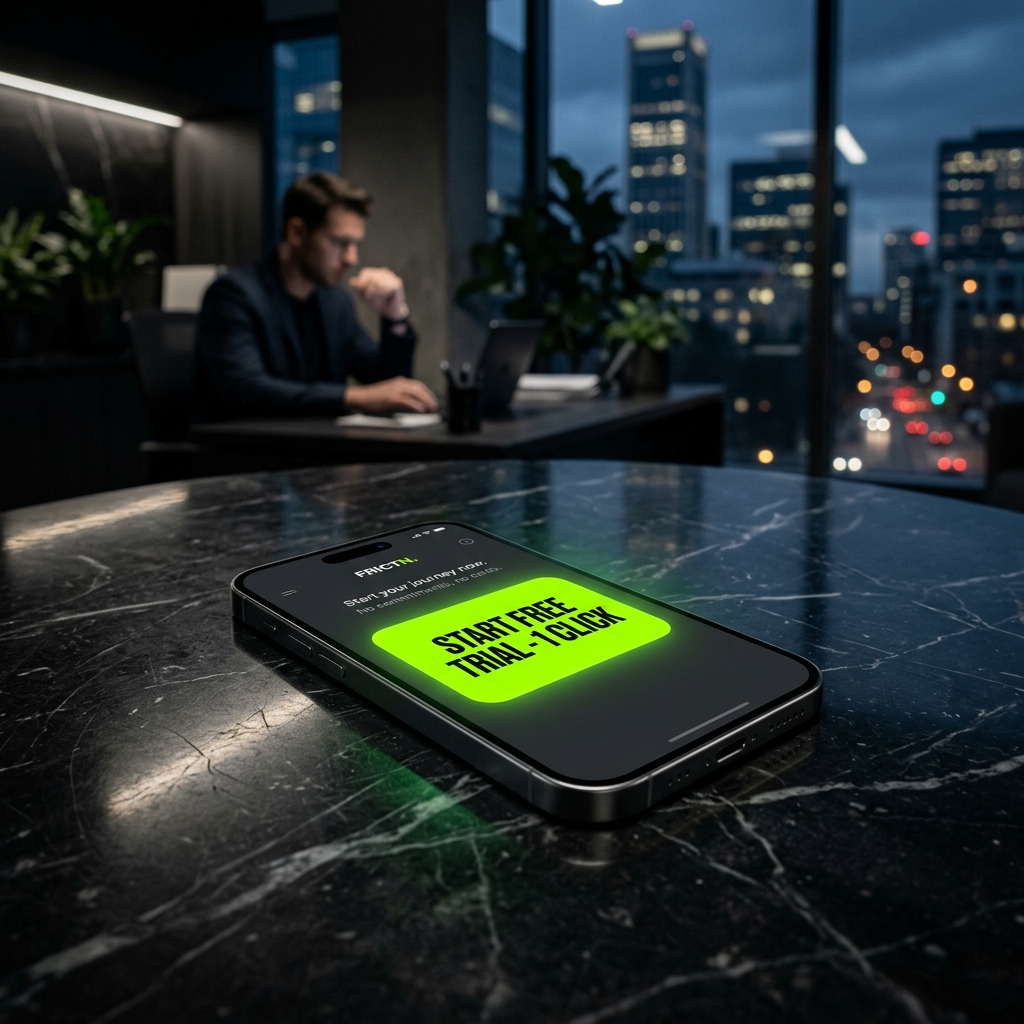
The genius, and the cynicism, of the model is the deliberate imbalance. The sign-up flow is optimised to remove every possible barrier: one click, saved card, no confirmation. The cancel flow is optimised to add them: hidden menus, required phone calls, multiple confirmations, retention offers. Same company, opposite design philosophies, aimed at the same person. That contradiction is the confession.
🎣 Trap 1: The free trial and the forgetting
The free trial is the most elegant trap because it weaponises your own optimism against you. When you sign up, you genuinely intend to cancel before the charge. Behavioral research on the intention-action gap shows that intending to do a small future task is a poor predictor of actually doing it, especially when the task has no deadline reminder and a tiny immediate cost of forgetting.
Companies know this precisely. That is why the trial length is often set to a period long enough for you to forget (a month, not three days), why the reminder email is frequently absent or buried, and why the card is required up front so the charge is automatic rather than a decision. You are not charged because you chose to continue. You are charged because you failed to remember to stop, and the entire flow is engineered around that specific human failure. There is even a name for the business metric: passive churn avoided, which is the polite term for revenue from people who did not mean to pay.
💔 Trap 2: Loss aversion and the “you will lose” screen
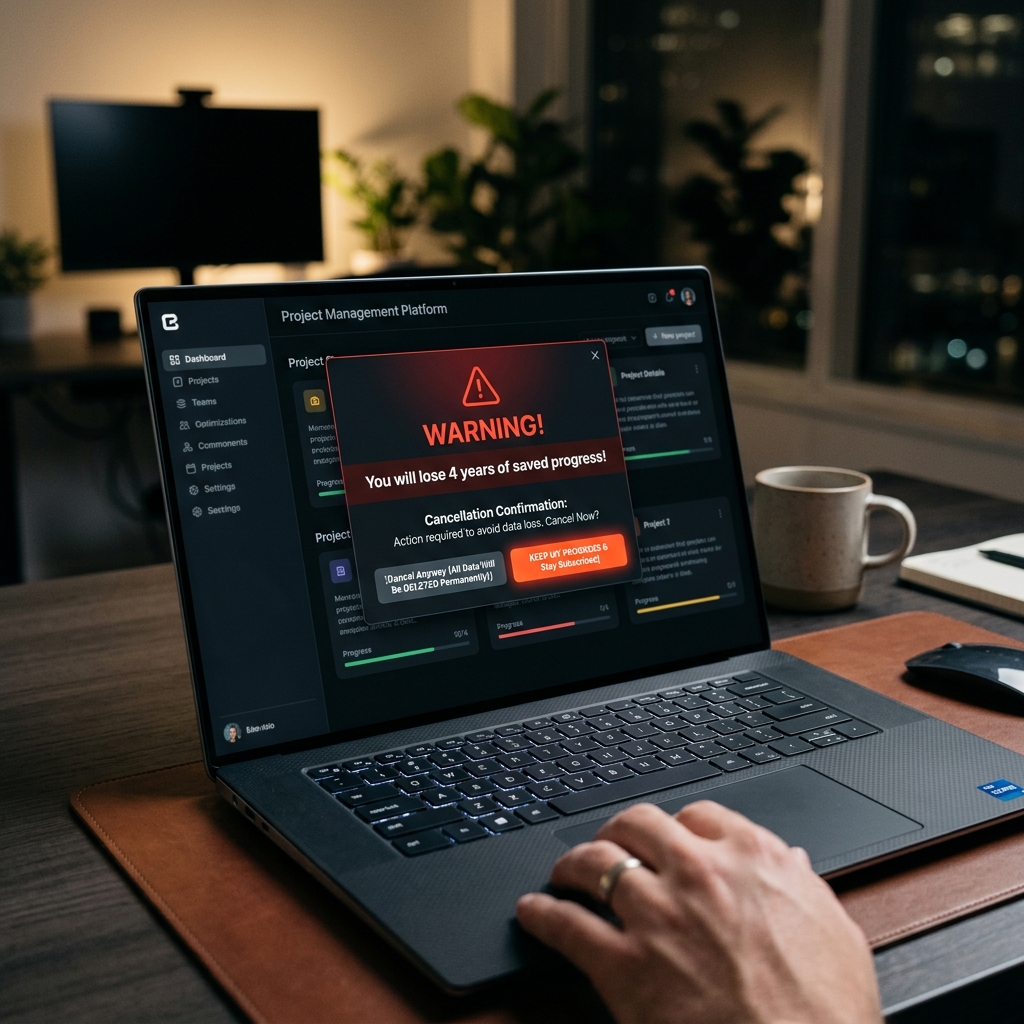
When you finally reach the cancel button, watch what the screen says. It rarely lists what you are saving. It lists what you are losing: your saved playlists, your progress, your history, your discount, your data, your streak. This is a direct exploitation of loss aversion, Kahneman and Tversky’s finding that losses feel roughly twice as painful as equivalent gains feel good.
The screen is not informing you. It is inflating the pain of leaving by framing the entire decision as a loss rather than a saving. “Cancel and lose access to 4 years of notes” hits harder than “Save 900 rupees a month,” even when the money is the more rational consideration, because loss aversion is asymmetric and the design knows it. Streak-based products (language apps, fitness apps) are the most aggressive here, because they spent months building a number you now feel you would be “throwing away,” which is the sunk cost fallacy standing right next to loss aversion, both pushing the same direction.
🪤 Trap 3: The roach motel and the vanishing cancel button
User-experience researchers Harry Brignull (who coined “dark patterns”) named this one the roach motel: easy to get into, hard to get out of. The cancel option is technically present, because it usually has to be legally, but it is buried where friction is maximised.
The standard techniques are worth naming so you recognise them: the cancel link is not on the account page but three sub-menus deep; cancellation requires a phone call while sign-up needed only a tap; the phone line has limited hours and long holds; the “manage subscription” button is grey and small while “keep my plan” is bright and huge (a visual dark pattern called confirmshaming‘s cousin, misdirection); and the flow inserts survey after survey, each one a small energy tax hoping you abandon the attempt. None of these individually is illegal in most places. Stacked together, they form a maze designed so that a measurable percentage of people give up, and that percentage is a line item in someone’s revenue model.
😔 Trap 4: Confirmshaming and manufactured guilt
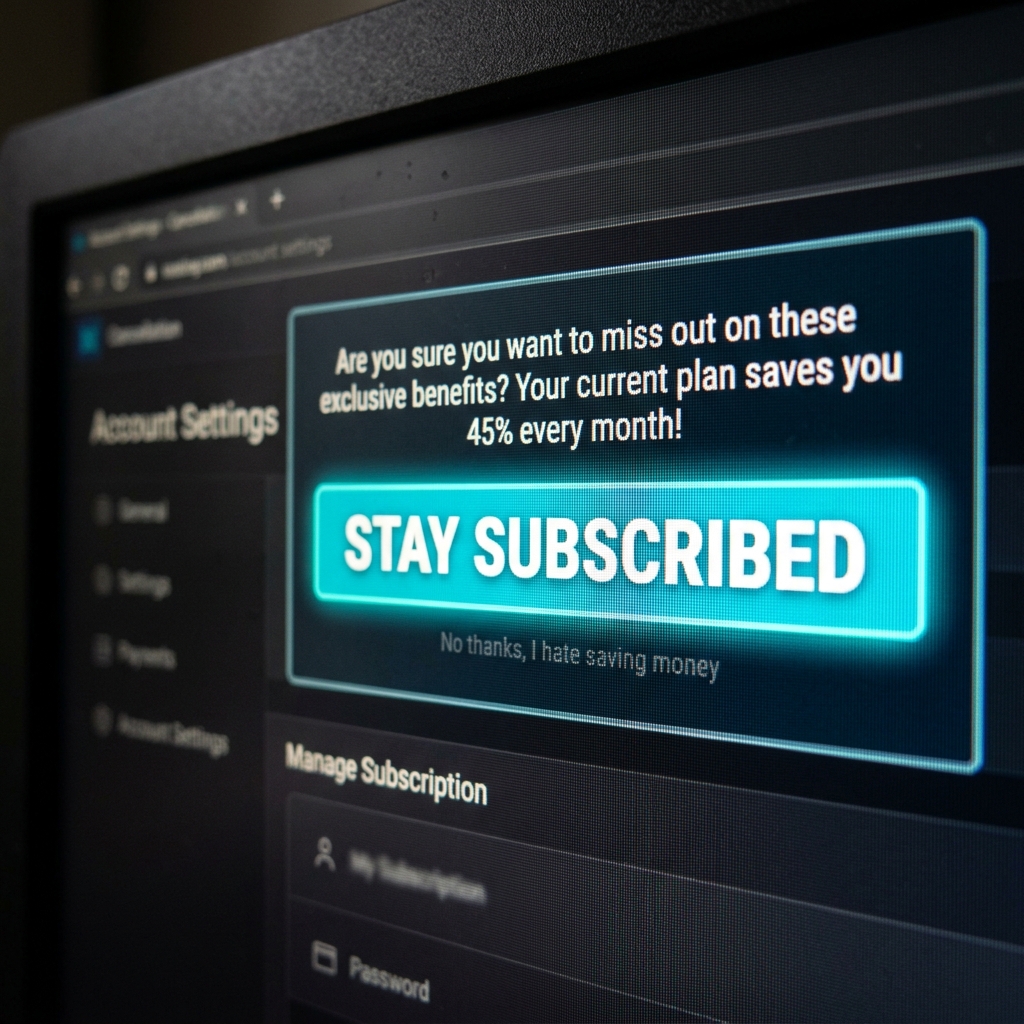
You click cancel, and a message appears: “No thanks, I don’t want to save money” as the opt-out, or “Are you sure? We’ll miss you” with a sad mascot. This is confirmshaming, and it is one of the most psychologically manipulative patterns in the toolkit.
It works on two levers. First, it manufactures a small social transaction where none exists, triggering the mild guilt we feel when we imagine disappointing someone, even a cartoon. Second, it forces you to actively affirm a negative self-statement (“I don’t want to save money,” “I don’t care about my health”) to proceed, which creates cognitive dissonance uncomfortable enough that some people click the other button just to avoid the feeling. It is a tiny act of emotional coercion, repeated at scale, and the fact that it works on people who intellectually know it is a trick tells you how far below conscious reasoning these levers operate.
💸 Trap 5: Price creep and the boiling frog
The subscription you signed up for at 500 rupees is now 750, and you may not have noticed the moment it changed. Companies raise subscription prices in small increments precisely because a gradual change stays below the threshold that would trigger you to re-evaluate. Psychologists call the underlying insensitivity to slow change by the folk name of the boiling frog, and while the literal frog story is a myth, the human version is real: we anchor on the original price and adjust insufficiently for creep, a cousin of the anchoring bias I covered in my anchoring article.
Combine price creep with declining usage and you get the true cost of subscription traps: people paying rising prices for falling value, held in place not by satisfaction but by the friction of leaving. Surveys repeatedly find that a large share of people are paying for at least one subscription they have entirely forgotten they have, and the forgetting is not stupidity. It is the designed outcome of small recurring charges that sit below the attention threshold, which is exactly why the $3-per-charge psychology I described in the Shein audit also protects subscriptions from scrutiny.
🧩 Why it works even when you know: the deeper layer
Here is the part that unsettles people, and it should. Everything above works even on those who understand it completely. I study this for a living and I have still paid for subscriptions I meant to cancel. Awareness is a weak defence against friction, for three structural reasons worth understanding.
First, these mechanisms operate on the fast, automatic system of thinking, not the slow, deliberate one, so knowing about them intellectually does not switch them off in the moment. Second, the cost of each individual trap is small enough that fighting it feels not worth the effort in any single instance, which is precisely the calculation the design relies on, a hundred small “not worth it right now” decisions adding up to years of payment. Third, the effort of cancelling is concentrated and immediate (a painful thirty minutes now) while the saving is diffuse and delayed (a little money each month later), and humans systematically underweight diffuse future benefits against concentrated present costs. The trap is not built on your ignorance. It is built on your entirely normal cognitive architecture, which is what makes it both effective and, in my professional view, genuinely unethical.
⚖️ The law is finally catching up (2024-2026)
For most of the subscription economy’s history, sludge was legal and lucrative. That is changing, and anyone writing about this in 2026 should say so clearly.
In the United States, the Federal Trade Commission finalised a “click to cancel” rule requiring that cancelling be at least as easy as signing up, the single most important principle in the entire debate, though its rollout has faced legal challenges and its final status has been contested in court. The European Union’s consumer protection framework and its rules against dark patterns in the Digital Services Act and related directives push in the same direction, targeting confirmshaming, misdirection and hidden cancellation. California and other US states passed their own automatic-renewal laws requiring clear disclosure and easy cancellation. The direction of travel is unambiguous even where the specifics are still being fought over: the core legal idea now emerging worldwide is symmetry, if sign-up is one click, cancellation must be too.
For readers in Pakistan and much of South Asia, formal regulation lags, which means the defence is still mostly personal rather than legal. That makes the escape plan below more important here, not less.
🛡️ The escape plan: how to actually cancel
Since the traps exploit friction and forgetting, the defences are systems, not willpower. Here is what actually works, in order.
Do a subscription audit today. Open your bank and card statements and read every recurring charge for the last three months. Most people find at least one they forgot. The forgetting is the trap’s main weapon, so a scheduled review, once a quarter, in your calendar, disarms it. This single habit is worth more than everything else on this list.
Cancel the moment you subscribe, not before the deadline. For any free trial, cancel immediately after signing up. Almost all services let you keep access until the paid period would have started, which means you get the full trial and remove the forgetting risk entirely. This one reframe defeats the free-trial trap completely.
Use a virtual or single-use card for trials. Where available, a card number that you can freeze or that expires stops passive charges at the source, turning “I forgot to cancel” into “the charge simply failed.” You move the friction onto the company instead of yourself.
Pre-commit to ignoring retention offers. Decide before you open the cancel flow that you will not accept the 40%-off save offer. Those offers prove the company was overcharging you the entire time, and accepting one keeps you inside a trap you had already decided to leave. Name the manipulation out loud as it happens; naming it restores the deliberate system’s control.
Refuse the guilt. When the confirmshaming screen tells you that you don’t care about your health or your savings, recognise it as a designed emotional lever and click through it anyway. A cartoon is not disappointed in you. A company that built a maze to keep your money has not earned your guilt.
💼 For the business owners: the honest way to run subscriptions
I advise businesses on this, so here is the line I hold. Subscriptions are a legitimate and often excellent model, and retention is a fair goal. The ethical test is simple: make cancelling exactly as easy as subscribing. If your product is good, symmetry costs you almost nothing, because satisfied customers stay. If your revenue depends on people who cannot find the exit, your product has a problem that sludge is hiding rather than solving, and hidden problems compound.
The business case for honesty is stronger than it looks. Sludge generates short-term revenue and long-term reputational debt, and the debt is coming due as regulation tightens and as public tolerance for dark patterns collapses. Brands increasingly win by being the transparent one in a category full of traps, easy cancellation as a marketing message actually converts, because it signals confidence. I designed exactly this kind of trust-first flow for clients, and the counterintuitive result is that making cancellation easy often reduces churn, because customers who feel free to leave feel safe to stay.
❓ Frequently asked questions
Why do companies make cancelling so hard?
Because friction plus forgetting equals retained revenue. It is called sludge, deliberately added difficulty, and it exploits status quo bias: a measurable share of people who want to cancel will not complete the process if it is annoying enough, and those people keep paying.
Why do I feel guilty cancelling a subscription?
The guilt is manufactured through a dark pattern called confirmshaming, screens that make you affirm a negative statement (“No, I don’t want to save money”) or that use sad mascots to trigger a social-disappointment response. It is designed emotional coercion, and recognising it removes most of its power.
Is it legal for companies to make cancellation difficult?
Increasingly not. The US FTC’s “click to cancel” rule and EU dark-pattern regulations require cancellation to be as easy as sign-up, though enforcement and final legal status vary by region and are still being contested. In many countries, including much of South Asia, formal rules lag, so personal defences matter more.
How do I stop forgetting to cancel free trials?
Cancel immediately after signing up, since most services let you keep access until the paid period would begin. Use a virtual or single-use card where possible, and put a quarterly subscription-audit reminder in your calendar to catch anything that slips through.
What is sludge in behavioral economics?
Sludge is the opposite of a nudge: friction deliberately added to a process to make a beneficial decision harder, coined by Nobel laureate Richard Thaler. Subscription cancellation flows are the most common everyday example.
🧠 Is your product using sludge without knowing it?
I’m Muhammad Shahzeb, an MSc Industrial and Organizational Psychologist and Full-Stack Developer. I audit sign-up and cancellation flows for dark patterns, the ones that quietly build reputational debt, and redesign them into trust-first experiences that keep customers because they choose to stay, not because they can’t leave.
📚 References and further reading
- Thaler, R. H. (2018). “Nudge, not sludge.” Science, 361(6401), 431.
- Thaler, R. H., & Sunstein, C. R. (2008). Nudge: Improving Decisions About Health, Wealth, and Happiness. Yale University Press.
- Kahneman, D., & Tversky, A. (1979). “Prospect theory: An analysis of decision under risk.” Econometrica, 47(2), 263-291. (Loss aversion.)
- Samuelson, W., & Zeckhauser, R. (1988). “Status quo bias in decision making.” Journal of Risk and Uncertainty, 1(1), 7-59.
- Brignull, H. (2010-present). “Deceptive Patterns” (formerly darkpatterns.org). Documentation of roach motel, confirmshaming, and misdirection.
- Mathur, A., et al. (2019). “Dark Patterns at Scale: Findings from a Crawl of 11K Shopping Websites.” Proceedings of the ACM on Human-Computer Interaction, 3(CSCW).
- US Federal Trade Commission. “Negative Option Rule / Click to Cancel.” 2024-2025 rulemaking and subsequent litigation.
- European Commission. Digital Services Act and Unfair Commercial Practices Directive guidance on dark patterns, 2023-2025.
- Kahneman, D. (2011). Thinking, Fast and Slow. Farrar, Straus and Giroux. (System 1 vs System 2.)
- Sunstein, C. R. (2019). “Sludge and ordeals.” Duke Law Journal, 68, 1843.
Written by Muhammad Shahzeb, MSc Industrial & Organizational Psychology | Consumer Psychology Specialist | Full-Stack Web Developer
Learn more about my approach →