
You check into a hotel and find a small card by the bathroom sink. One version reads: “Help save the environment — reuse your towels.” Another reads: “Join your fellow guests: almost 75% of guests in this hotel reuse their towels.” Same request, same towels, same planet. But the second card moved the needle by nine percentage points in a real experiment — because it did not ask you to be good. It told you what everyone else was already doing. That is social proof: the quiet assumption that other people’s behaviour is the correct behaviour — and it is one of the most powerful and most abused tools in marketing, because it works beautifully until the day it backfires.
This guide covers what social proof actually is, the three conditions that make it strongest, the experiments that proved it (and the ones that showed its limits), what online reviews really do to revenue, when the crowd’s wisdom becomes the crowd’s folly, and how to use social proof honestly. Every number below is traceable to its source, and where I could only verify a finding through reputable summaries — for example, some details of the older field studies — I say so.
I am an Industrial and Organizational Psychologist in Karachi. I study how people decide — at work and in the marketplace — and social proof is one of those principles that sounds like common sense right up until the evidence shows you the traps. I read the studies so you do not have to.
“Social proof is the principle that people assume the actions of others reflect the correct behaviour. The uncomfortable corollary: tell people that ‘everyone’ does the wrong thing, and more of them will do it too.”
— Consumer Psychology Analysis, ShahzebSpeaks
⚡ Chapter 1: The short answer
Social proof works when it is true, specific and similar to the reader: “almost 75% of guests reuse their towels” lifted reuse from 35.1% to 44.1% in a hotel experiment; a one-star Yelp improvement lifts independent restaurants’ revenue by 5–9%. It backfires when it broadcasts a bad norm (“many past visitors steal from this park” increased theft), when praise lands on people already doing well (below-average energy users who learned they were frugal became more wasteful), and when it is perfect — purchase likelihood peaks around 4.2–4.7 stars and falls toward a perfect 5.0, because shoppers smell fakery. The short answer: show the crowd’s good behaviour, never its bad behaviour, and never fabricate the crowd.
🧭 Chapter 2: What social proof is — and when it bites hardest
Robert Cialdini, the Arizona State University psychologist, named social proof one of the six principles of persuasion in Influence — later seven, when Unity was added in the expanded 2021 edition. The principle is simple: we determine what is correct by finding out what other people think is correct. It is the mental shortcut behind queues outside restaurants, “bestseller” badges, and your aunt forwarding a WhatsApp remedy because “everyone is trying it.”
Cialdini’s research identifies three conditions under which social proof bites hardest. Uncertainty: when we are unsure, we look sideways. In the classic ambiguous-judgement studies, people converged on group norms only when the judgement was unclear — the fuzzier the situation, the heavier the reliance on the crowd. Similarity: the proof “operates most powerfully when we observe the behaviour of people similar to us.” Guests in your room reuse towels at 49.3%; generic citizens at 42.8% — same message, but “people like me” won. Numbers: the more people modelling the behaviour, the stronger the pull — “almost 75%” beats “a few guests do it,” and Asch’s conformity rose with the size of the unanimous majority.
That triple filter is also a diagnostic tool. If a marketer shows you vague praise (“everyone loves it!”) with no numbers, no similarity and no real uncertainty to resolve — that is not social proof. That is decoration.
🏨 Chapter 3: The hotel towels — social proof that worked
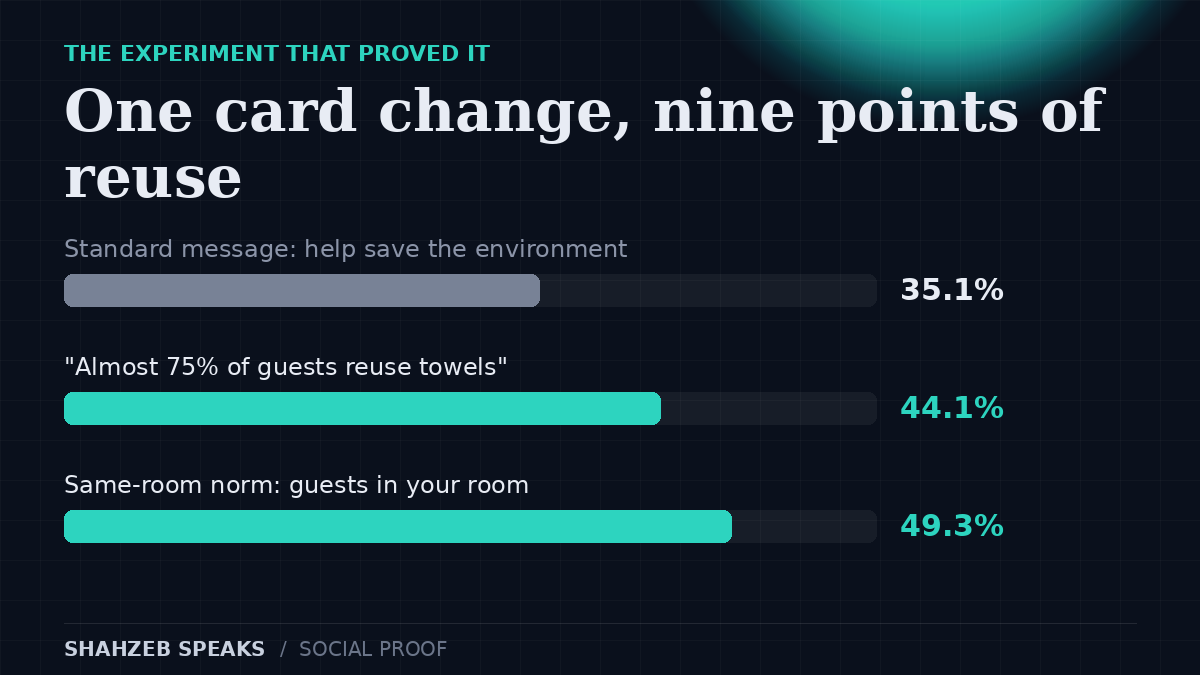
The most famous social-proof experiment in marketing ran not in a lab but in a mid-range hotel. Goldstein, Cialdini and Griskevicius (2008) spent 80 days testing door-hanger cards with guests staying at least two nights. The standard card pleaded: “HELP SAVE THE ENVIRONMENT. You can show your respect for nature … by reusing your towels during your stay.” The social-proof card recruited the crowd: “JOIN YOUR FELLOW GUESTS IN HELPING TO SAVE THE ENVIRONMENT. Almost 75% of guests who are asked to participate in our new resource savings program do help by using their towels more than once …”
The crowd won. Towel reuse ran at 44.1% with the descriptive-norm card versus 35.1% with the standard plea — a nine-point lift from changing nothing but the sentence. Then came the similarity test. A second experiment varied whose norm was quoted: guests who stayed in the same room (49.3% reuse), other hotel guests, fellow citizens, or men/women in general (42.8% combined) — all against the standard message (37.2%). The closer the reference group to “me,” the stronger the pull.
One honest caveat, because this blog does not cherry-pick: a 2014 German replication found descriptive-norm cards no better than the standard environmental message there. The effect is real but not universal — culture, hotel norms and how the message lands all matter. That is why the rest of this article exists: social proof is a tool with edge cases, not a magic spell.
🪃 Chapter 4: The boomerang — when “everyone does it” backfires
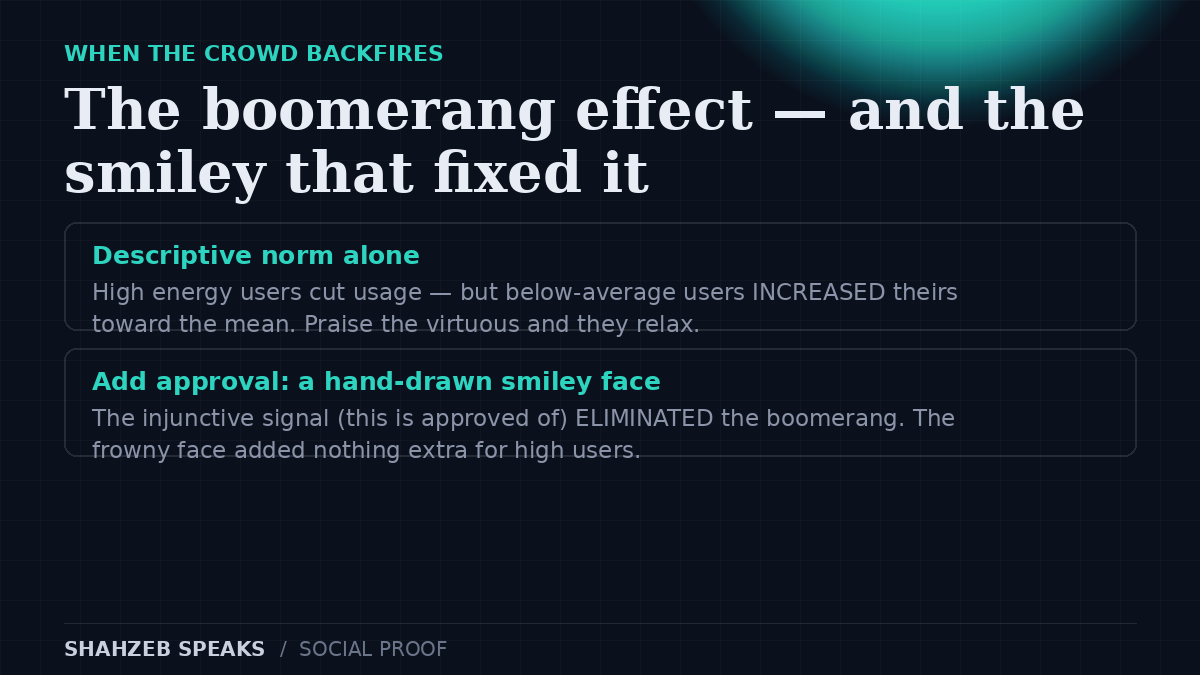
Now the dark mirror. Schultz, Nolan, Cialdini, Goldstein and Griskevicius (2007) ran a field experiment with about 290 residents of San Marcos, California, whose home energy use was monitored. Households received feedback comparing their actual usage with their neighbourhood’s average — a pure descriptive norm. The result: high consumers cut usage, exactly as hoped. But below-average consumers, on learning they were thriftier than their neighbours, increased their usage toward the mean. The researchers called it the boomerang effect: telling virtuous people they are better than average can license them to get worse.
The fix was elegant. Some households received the same feedback with a hand-drawn emoticon added: a smiley face for below-average users, a frowning face for above-average ones. That tiny injunctive signal — this behaviour is approved of — eliminated the boomerang: praised low users stayed low. And note the asymmetry: the frowning face produced no extra reduction among high users beyond what plain feedback achieved. Carrots beat sticks here; the smiley did the real work.
The boomerang has a cruder cousin: negative social proof. At Arizona’s Petrified Forest National Park, researchers placed secretly marked pieces of petrified wood along paths over five weekends and varied the entrance sign. The sign reading “Many past visitors have removed the petrified wood from the park” — an honest, true, social-proof statement — produced more theft than the simple plea “Please don’t remove the petrified wood.” Broadcasting how common a bad behaviour is normalises it. The same mechanism shows up in littering research (Cialdini, Reno & Kallgren, 1990): a dirty garage made people litter more, and anti-littering PSAs that show people littering can promote littering “by convincing viewers that everybody does it.”
And in the original conformity lab, Solomon Asch (1951) seated a naive participant among seven confederates for a simple line-judgement task. On the 12 critical trials where the group gave a unanimously wrong answer, participants conformed on about 32% of trials — and roughly 75% conformed at least once (control error rate: under 1%). The crowd does not just inform us; it recruits us.
⭐ Chapter 5: Stars, reviews and the “too good to be true” peak
Online, social proof is the economy. Harvard Business School’s Michael Luca combined Yelp reviews with Washington State restaurant revenue data in a regression-discontinuity design — exploiting the rounding thresholds where, say, 3.25 stars displays as 3.5. Headline finding: a one-star increase in Yelp rating leads to a 5–9% increase in revenue. But two details matter. First, the effect is driven by independent restaurants; chains were unaffected, and chains actually lost market share as Yelp penetration grew — reviews substitute for brand reputation. Second, consumers respond more when ratings carry more information: more reviews, more elite reviewers.
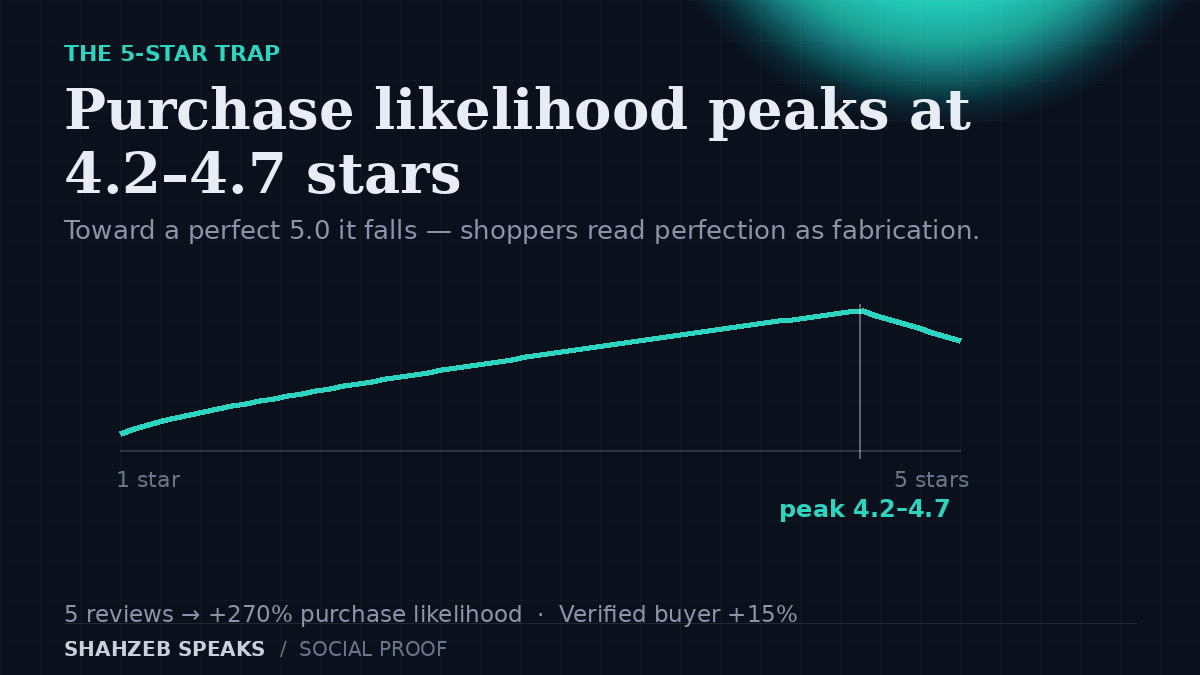
Here is where perfection becomes the enemy. Northwestern University’s Spiegel Research Center found that purchase likelihood for a product with five reviews is 270% greater than for a product with no reviews — nearly all of the gain arriving within the first ten reviews. But across categories, purchase likelihood peaks at ratings around 4.2–4.7 and then decreases as ratings approach a perfect 5.0. Shoppers see perfect scores as too good to be true — and they are often right. (Peer-reviewed anchor: Maslowska, Malthouse & Bernritter, 2017.) Displayed reviews raise conversion 190% for lower-priced products and 380% for higher-priced ones; “verified buyer” badges improve purchase odds by 15% over anonymous reviews.
The diffusion-of-responsibility side of the crowd deserves a mention too. In Darley and Latané’s (1968) smoke-filled-room study, 75% of participants alone reported the smoke within six minutes — but only 10% did so with two calm, passive confederates, and 38% in groups of naive strangers. Others’ inaction is social proof too, and it teaches the worst lesson: nothing needs doing. The related mechanism, pluralistic ignorance, is when everyone mistakes everyone else’s calm for evidence that nothing is wrong.
🚨 Chapter 6: Fake it till they fine you — the fake-review economy
Because social proof moves money, the market for fabricated proof exploded — and regulators finally responded. On 14 August 2024, the US Federal Trade Commission announced a final rule (16 CFR Part 465) on the use of consumer reviews and testimonials, which took effect on 21 October 2024. Passed on a 5–0 vote, it bans buying, selling or disseminating fake reviews and testimonials — including AI-generated ones — bans insider reviews without disclosure of the relationship, bans incentivising reviews conditional on a particular sentiment, bans suppressing honest negative reviews, and bans fake indicators of social-media influence. Note the nuance: paying for reviews is not itself banned — incentives are allowed as long as there is no express or implied requirement of a particular sentiment. At issuance, the FTC could seek civil penalties of up to $51,744 per violation. As Chair Lina Khan put it: “Fake reviews not only waste people’s time and money, but also pollute the marketplace and divert business away from honest competitors.”
The cautionary tale is Sunday Riley. Between November 2015 and August 2017, the skincare brand’s managers — including its CEO — posted fake reviews of its products on Sephora.com using accounts designed to hide their identities, and allegedly obtained an Express VPN account to cover their tracks after Sephora removed the employee-written reviews. The story broke via an anonymous Reddit post in October 2018; the FTC filed its complaint on 21 October 2019 and approved a final consent agreement in November 2020. The case settled: the order prohibits misrepresenting reviewer status and requires clear disclosure of material connections. Two commissioners dissented, arguing the settlement would not deter others — and they had a point, because faking continued at industrial scale.
Amazon filed its first fake-review lawsuit in 2015, and on 19 July 2022 it took legal action against the administrators of more than 10,000 Facebook groups orchestrating fake reviews across Amazon stores in seven countries — one group, “Amazon Product Review,” had over 43,000 members before Meta took it down. Amazon reports blocking more than 250 million suspected fake reviews in 2023 (a company figure) and has jointly sued a review broker, ReviewServiceUSA.com, with the Better Business Bureau (lawsuit filed in US District Court, Seattle).
The UK’s Competition and Markets Authority took a different angle: pressure tactics dressed as social proof. After a 2018 investigation into hotel booking sites, six major sites — Expedia, Booking.com, Agoda, Hotels.com, ebookers and trivago — gave formal undertakings in February 2019 to stop practices like giving a false impression of a room’s popularity, with changes required by 1 September 2019. CMA chairman Andrew Tyrie called the tactics “wholly unacceptable.” A later Which? spot-check still found 5 of 10 Booking.com “only 1 room left” claims failed to give an accurate picture of availability. These were voluntary undertakings — not findings of infringement — but the message landed: manufactured urgency is social proof’s shadiest costume.
🧰 Chapter 7: The honest playbook — using social proof without lying
Everything above compresses into six rules. First, be specific, not loud. “Almost 75% of guests in this hotel reuse their towels” beat “help save the environment” because it was a number about a place. Second, match the audience. The same-room norm outperformed the generic norm — “people like your customers” beats “people.” Third, seed the first reviews. Five reviews deliver most of the 270% lift that reviews provide; the first ten matter more than the next hundred. Fourth, approve, don’t just inform. Descriptive norms (“72% pay on time”) can boomerang among the virtuous; add the injunctive signal — the smiley face, the “thank you for being above average” — and the boomerang disappears. Fifth, never broadcast bad norms. “Only 3% of our customers miss payments” outperforms “many customers default” — and if your numbers are bad, fix the behaviour before you advertise the norm. Sixth, never fabricate. The FTC’s rule is now in force, fake-review brokers are being sued, and a perfect 5.0 makes shoppers suspicious anyway. Honesty is not just ethics here; it converts better.
One more from the nudge literature, because it ties the whole principle together: social proof is a nudge — it changes the choice architecture without removing options. I have collected twelve real-world nudges that changed behaviour, from pension enrolment to organ donation, in my guide to nudge theory examples. And if the “almost 75%” mechanism reminded you of pricing tricks, read how loss aversion sells more than the promise of winning — the two principles are siblings.
Social proof at a glance — what the evidence says
| Finding | Result |
| Hotel towel norm (“almost 75% of guests”) | 44.1% reuse vs 35.1% standard message |
| Same-room norm vs generic norm | 49.3% vs 42.8% — similarity wins |
| Descriptive norm + smiley face | Boomerang effect eliminated |
| 1-star Yelp improvement (independents) | 5–9% revenue increase |
| First five reviews | 270% lift in purchase likelihood vs none |
| Optimal star rating | ~4.2–4.7 — falls toward 5.0 |
| “Verified buyer” badge | +15% purchase odds vs anonymous |
❓ Questions I am asked most often
What is social proof in marketing?
Social proof is the principle that people judge what is correct by watching what others do. In marketing it means reviews, ratings, testimonials, user counts, “bestseller” labels and queues — any signal that others have chosen, used or endorsed something. Cialdini named it one of the core principles of persuasion; it works strongest under uncertainty, among similar people, and in large numbers.
Does social proof actually increase sales?
Yes, measurably. A Harvard Business School study found a one-star Yelp increase lifts independent restaurants’ revenue 5–9%. Northwestern’s Spiegel Research Center found five reviews raise purchase likelihood 270% versus no reviews, and displayed reviews lift conversion 190% for cheaper products and 380% for expensive ones. The effect is strongest where buyers are uncertain — which is why it dominates travel, restaurants and unfamiliar brands.
When does social proof backfire?
Three classic ways. The boomerang effect: telling below-average energy users they beat the average made them use more — fixed by adding an approving smiley face. Negative norms: a park sign saying “many visitors steal wood” increased theft versus a simple “please don’t.” And perfection: ratings approaching 5.0 sell worse than 4.2–4.7, because shoppers read perfection as fabrication.
Are fake reviews illegal?
In the United States, yes — since 21 October 2024, when the FTC’s final rule (16 CFR Part 465) took effect. It bans buying or selling fake reviews (including AI-generated ones), undisclosed insider reviews, sentiment-conditional incentives and suppressing honest negative reviews, with civil penalties of up to $51,744 per violation at issuance. Amazon and the FTC have both sued fake-review operators; the Sunday Riley case settled in November 2020 with a consent order.
Why do perfect 5-star ratings look suspicious?
Because shoppers have learned that real products have mixed experiences. Northwestern’s Spiegel Research Center found purchase likelihood peaks around 4.2–4.7 stars and declines toward 5.0 — a pattern confirmed in peer-reviewed research (Maslowska, Malthouse & Bernritter, 2017) on reviews being “too good to be true.” A few critical reviews make the praise believable; a wall of perfection makes it look bought.
How can a small business use social proof honestly?
Start with specificity: collect the first five to ten real reviews, because they deliver most of the lift. Quote numbers (“4.6 from 212 verified buyers”) instead of adjectives. Show similarity — testimonials from customers like your target buyer. Pair descriptive norms with approval (“thank you for being above average”). And never buy reviews: it is illegal in the US, increasingly enforced everywhere, and a perfect 5.0 converts worse than an honest 4.5 anyway.
Want your marketing audited by a psychologist?
I audit how brands use (and abuse) persuasion principles — with the receipts. Contact me here.
If this is your first time on the site: I write about the psychology of work and the marketplace as an industrial psychology in Pakistan practitioner. For the persuasion principle most abused in pricing, see loss aversion in marketing; for the flip side of giving first, see reciprocity in marketing.
Sources
- Goldstein, N. J., Cialdini, R. B., & Griskevicius, V. (2008). A room with a viewpoint: Using social norms to motivate environmental conservation in hotels. Journal of Consumer Psychology, 18(3), 472–482.
- Schultz, P. W., Nolan, J. M., Cialdini, R. B., Goldstein, N. J., & Griskevicius, V. (2007). The constructive, destructive, and reconstructive power of social norms. Psychological Science, 18(5), 429–434.
- Cialdini, R. B., et al. (2006). Managing social norms for persuasive impact. Social Influence, 1(1), 3–15.
- Cialdini, R. B. (2006). Influence: Science and Practice (revised ed.). HarperBusiness. (New and expanded ed., Harper Business, 2021.)
- Asch, S. E. (1951). Effects of group pressure upon the modification and distortion of judgments. In H. Guetzkow (Ed.), Groups, Leadership and Men (pp. 177–190). Carnegie Press.
- Luca, M. (2016). Reviews, reputation, and revenue: The case of Yelp.com. Harvard Business School Working Paper 12-016.
- Maslowska, E., Malthouse, E. C., & Bernritter, S. F. (2017). Too good to be true: The role of online reviews’ features in probability to buy. International Journal of Advertising, 36(1), 142–163.
- Latané, B., & Darley, J. M. (1968). Group inhibition of bystander intervention in emergencies. Journal of Personality and Social Psychology, 10(3), 215–221.
- Cialdini, R. B., Reno, R. R., & Kallgren, C. A. (1990). A focus theory of normative conduct. Journal of Personality and Social Psychology, 58(6), 1015–1026.
- Medill Spiegel Research Center, Northwestern University. How online reviews influence sales (accessed 13 Oct 2026).
- Bohner, G., & Schlüter, L. E. (2014). A room with a viewpoint revisited. PLoS ONE, 9(8), e104086.
- US Federal Trade Commission. Trade Regulation Rule on the Use of Consumer Reviews and Testimonials, 16 CFR Part 465 (final rule announced 14 Aug 2024; effective 21 Oct 2024).
- US Federal Trade Commission. FTC approves final consent agreement with Sunday Riley Modern Skincare, LLC (press release, Nov 2020).
- Amazon. Amazon targets fake review fraudsters on social media (press release, 19 Jul 2022).
- Smithsonian Magazine. On the Petrified Forest signage study (reporting Cialdini et al., 2006).