
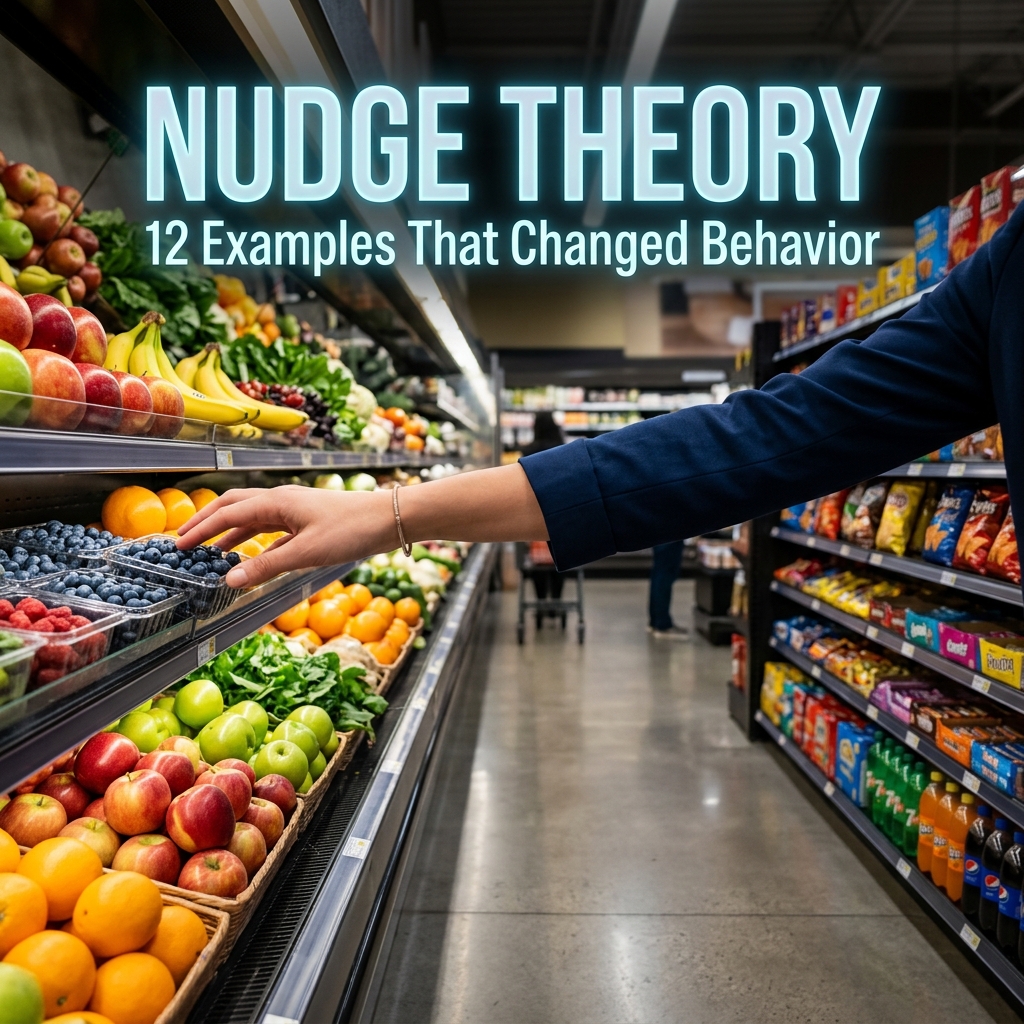
In 2012 the United Kingdom decided it wanted more people saving for retirement. It did not raise taxes, run an advertising campaign, or make pensions compulsory. It changed one thing: instead of employees signing up for a workplace pension, they were now signed up automatically and could opt out whenever they liked. Nobody lost a single option. Within a decade, more than ten million additional people were saving for retirement, and opt-out rates stayed under ten percent.
That is nudge theory in its purest form, and it is also the reason the idea is often oversold. Because for every auto-enrolment there are a dozen small interventions that produced almost nothing, and a few that turned out to be built on research that later fell apart. I am an Industrial and Organizational Psychologist, and I think nudging is one of the most useful ideas in applied behavioural science and one of the most consistently exaggerated. This article covers twelve documented examples, what each one actually achieved, and the honest evidence on how big these effects really are once you stop cherry-picking the famous ones.
“A nudge does not change what you want. It changes what is easy. And most of the time, what is easy is what you end up doing, which means whoever arranged the easy option has already made your decision for you.”
— Behavioral Science Analysis, ShahzebSpeaks

🧭 What nudge theory actually says
The term comes from Nudge, the 2008 book by economist Richard Thaler and legal scholar Cass Sunstein. Thaler later won the 2017 Nobel Prize in Economics, partly for the behavioural work underneath it. Their definition is narrower than most people who use the word realise.
A nudge is any aspect of how a choice is presented that predictably changes behaviour without forbidding any option and without significantly changing financial incentives. Putting fruit at eye level is a nudge. Banning junk food is not. A tax on sugar is not. An outright default that you cannot escape is not. The whole point is that the person keeps every option they had before, and can still walk away at no cost.
The concept underneath it is choice architecture: the observation that there is no neutral way to present a choice. Someone has to decide what appears first, what is pre-selected, what the form looks like, which item sits at eye level. That arrangement always influences the outcome, so the only real question is whether it was designed deliberately or by accident. Thaler and Sunstein’s argument, which they called libertarian paternalism, is that since you cannot avoid influencing people, you may as well arrange things in a direction that helps them.
Two psychological mechanisms do most of the heavy lifting. The first is default bias: whatever is pre-selected tends to stay selected, because changing it costs attention, effort and a moment of deciding. The second is social proof: telling people what most others in their situation do shifts behaviour more reliably than telling them what they should do. Almost every example below runs on one of these two, or both.
💰 1. UK pension auto-enrolment (the largest nudge ever run)

This is the strongest example in the entire field, and it is the one that should be quoted instead of the fly in the urinal.
Before 2012, joining a workplace pension in the UK required an active decision. Participation among eligible private-sector workers sat around 40 percent. The reform flipped the default: employers had to enrol staff automatically, and employees could opt out any time with no penalty. That is a genuine nudge by the strict definition, since not one option was removed.
Participation rose above 85 percent and stayed there. Opt-out rates have consistently run below ten percent, which is far lower than almost anyone predicted. The research foundation for this was Madrian and Shea’s 2001 study of a single US company that switched to automatic enrolment for its 401(k) plan and saw participation jump from roughly 49 percent to 86 percent, with new hires overwhelmingly sticking with both the default contribution rate and the default fund.
Here is the detail I find most revealing, and it complicates the happy story. People did not just accept enrolment. They accepted the default contribution rate too, which was often set low, around three percent. Many ended up saving less than they would have chosen if they had actively thought about it. The default is powerful in both directions, and a badly chosen default anchors people to a bad outcome just as efficiently as a good one anchors them to a good outcome.
🫀 2. Organ donation defaults (the most famous, and the most misunderstood)
Johnson and Goldstein’s 2003 paper in Science is the image everyone remembers: two neighbouring European countries, similar cultures, wildly different organ donation consent rates. Austria at over 99 percent, Germany at around 12 percent. Denmark at 4 percent, Sweden at 86 percent. The difference was not values. It was the form. Opt-in countries clustered at the bottom, opt-out countries at the top.
It is a beautiful demonstration of default power. It is also routinely misreported, and the honest version matters.
Consent registration is not the same as transplants performed. Countries with presumed consent do tend to have somewhat higher donation rates, but the gap in actual organs transplanted is far smaller than the gap in registration figures, because what really determines whether a donation happens is the transplant infrastructure, the intensive care pathway, and above all the conversation with the family, who in most systems can still decline. Spain has long led the world in actual donation rates, and specialists generally credit its hospital coordination system rather than its legal default.
So the correct lesson is not “change the default and organs appear.” It is that the default sets the starting point of a conversation, and starting from “your relative was a registered donor” is a different conversation than starting from “we do not know what they wanted.” That is still enormously valuable. It is just not magic.
🪰 3. The fly in the urinal at Schiphol Airport
The story every nudge presentation opens with. Amsterdam’s Schiphol Airport etched a small image of a housefly into the urinals, near the drain. Men aimed at it. Spillage reportedly fell dramatically, cutting cleaning costs.
I include it because it is a genuinely elegant piece of design, and because it illustrates the cheapest and most reliable nudge available: give attention a target. It costs nothing, forbids nothing, and works on an automatic behaviour that no amount of signage would fix.
The honest footnote is that the famous “80 percent reduction in spillage” figure has never been traced to a published study. It appears to originate in an account from the manager involved, and has been repeated ever since without verification. Later controlled tests of target-based urinal designs have found real effects, but smaller and messier. I would still call the fly a legitimate nudge. I would stop calling it an 80 percent one.
📮 4. HMRC tax letters and the power of “most people already paid”
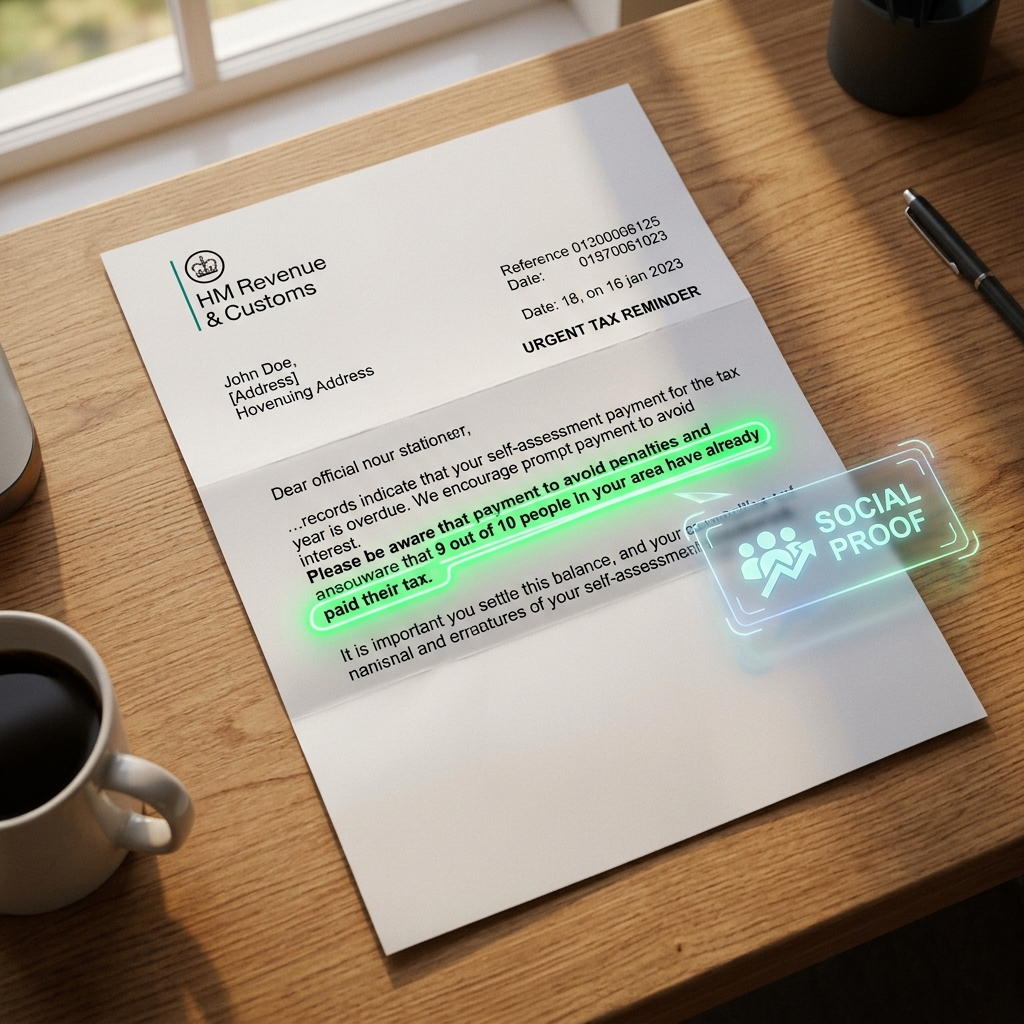
This is one of the best-documented nudges in government, run by the UK’s Behavioural Insights Team, informally called the Nudge Unit, set up in 2010.
Late taxpayers received reminder letters. The team ran randomised trials on the wording. The standard letter explained the obligation and the penalty. The test letters added a single sentence of social norm information, along the lines of: “Nine out of ten people in the UK pay their tax on time. You are currently in the very small minority who have not.” A further version localised it to the recipient’s own town.
Payment rates rose by roughly five percentage points, and the more local the comparison group, the stronger the effect. Because the intervention was one sentence on a letter that was being sent anyway, the cost was effectively zero and the returns were measured in tens of millions of pounds.
The psychology is descriptive social norms, work associated with Robert Cialdini. People are far more moved by what others actually do than by what authorities say they should do. Note the direction carefully, because this is where organisations get it wrong constantly: telling people “too many customers fail to pay on time” advertises non-payment as normal and makes it worse. The norm you describe is the norm you spread.
📈 5. Save More Tomorrow
Thaler and Shlomo Benartzi designed this one specifically to defeat a psychological obstacle rather than a practical one. People know they should save more, and saving more hurts immediately, so it never happens.
Save More Tomorrow asks employees to commit now to increasing their pension contribution later, automatically, timed to coincide with future pay rises. Because the increase is in the future, present-bias does not fight it. Because it is tied to a raise, take-home pay never falls, so loss aversion is never triggered.
In the original implementation, participants who joined the plan raised their savings rate from roughly 3.5 percent to around 13.6 percent over several pay cycles, and most stayed in it. This is my favourite example in the whole list because it does not just exploit a bias; it routes around three of them at once, and the person keeps full control the entire time.
⚡ 6. Green energy tariffs by default
German field research by Ebeling and Lotz, published in Nature Climate Change in 2015, tested this directly. Customers choosing an electricity contract online were shown either a conventional tariff as the pre-selected option, or a slightly more expensive green tariff as the pre-selected option, with both choices freely available either way.
Setting green as the default roughly doubled uptake. Customers were paying more, voluntarily, largely because the box was already ticked. Several European utilities and municipalities have since applied the same logic, and it remains one of the more replicable default effects because the decision is low-involvement and people have no strong prior preference to defend.
This example is also the sharpest illustration of why nudging makes people uneasy. The customer paid more money because of how a form was arranged. If you approve of that, it is because you approve of the goal, not the mechanism, and that is worth being honest about.
📱 7. Text message reminders that people actually act on
Unglamorous and one of the most consistently effective nudges anywhere.
Missed court appearances, missed medical appointments, missed vaccinations and unpaid fines all share a structure: the person is not refusing, they simply forgot or never got around to it. Reminders convert intention into action, and the wording changes how well they work.
UK trials found that court fine reminders mentioning bailiff action substantially raised payment rates. NHS appointment reminders that stated the specific cost to the health service of a missed appointment reduced no-shows more than generic reminders. Vaccination letters that used ownership language, telling patients a dose had been reserved for you, outperformed neutral invitations, an effect documented in large US trials during and after the pandemic.
Three mechanisms are stacked here: salience, since a forgotten task becomes visible again; implementation intentions, since naming a specific time and place makes follow-through far more likely, as Peter Gollwitzer’s research shows; and psychological ownership, since “reserved for you” creates something you can lose.
🥗 8. Cafeteria placement, and the example I have to walk back
Every nudge article lists cafeteria interventions: fruit at eye level, salad first in the line, smaller plates, water bottles at the front. The original Nudge book opens with a cafeteria story. I am including it, but with a warning that most articles on this topic will not give you.
A large share of the popular evidence on food placement and portion cues came from Brian Wansink’s Food and Brand Lab at Cornell. Beginning in 2016, his work faced serious scrutiny over statistical errors and data practices. Multiple papers were retracted, a university investigation found problems with his research methods, and he resigned in 2018. Some of the most repeated claims in this area, including several specific numbers about plate size and cafeteria layout, rest on that damaged foundation.
What survives is more modest and better established. Placement and convenience genuinely affect food choice: items that are easier to reach get chosen more, and this has been replicated by independent groups. But the effect sizes in reliable studies are smaller than the famous claims, and they mostly shift which item people take rather than how much they eat overall. I flag this at length because a psychologist who quotes retracted research to prove a point about evidence is not much use to you.
🍔 9. Calorie labels on menus
Menu calorie labelling has been mandatory for large US chains since 2018 and for large UK food businesses since 2022. It is a textbook nudge: no ban, no tax, just information at the moment of choosing.
The results are real and small. Reviews generally find modest reductions in calories purchased, often in the range of a few percent, and effects on what restaurants themselves offer, since some chains reformulated items once the numbers were printed publicly. The supply-side change may end up mattering more than the consumer-side change.
There is also a documented downside worth stating. Some evidence suggests calorie labelling can be distressing for people with eating disorders, and clinicians have raised this seriously. A nudge that produces a small average benefit across a population can still produce a concentrated harm in a minority, and averages hide that.
👣 10. Copenhagen’s green footprints
A small and often-cited street experiment: green footprints were painted on pavements leading toward public bins in a Copenhagen district, alongside a distribution of sweets whose wrappers created litter. Reported litter dropped substantially in the treated area.
Two things are happening at once. The footprints reduce search cost, since you no longer have to look for a bin, and they act as a visible norm cue, quietly signalling that this is a place where people bin things. Environments communicate expectations constantly, which is the same mechanism, in reverse, behind the observation that litter attracts more litter and a clean space stays cleaner.
The caveat, which applies to most one-off street experiments, is that this was not a tightly controlled multi-site trial, and novelty effects fade. Painted footprints are interesting for a month. What happens in year three is a different question.
🚗 11. Speed feedback signs
The roadside sign that flashes your speed back at you, sometimes with a smiling or frowning face, is a nudge and a good one. It does not fine you, it does not stop you, and it is not connected to enforcement.
Evaluations across multiple countries find real reductions in average speed near the signs, typically a few kilometres per hour, with the effect strongest close to the sign and decaying with distance. Dynamic feedback with an emotional cue, the smiley face, tends to outperform a bare number.
The psychology is immediate feedback on an otherwise invisible behaviour. Most drivers are not deliberately speeding; they are unaware of their speed because there is no natural feedback loop. Add the loop and behaviour self-corrects. Any behaviour that lacks feedback is a candidate for this, which is why energy usage displays and step counters work on the same principle.
🎓 12. Nudges in education and benefit take-up
A large body of work targets a specific problem: people who qualify for something valuable and never complete the paperwork.
The best-known study is Bettinger, Long, Oreopoulos and Sanbonmatsu (2012), in which low-income US families having their taxes prepared were offered help completing the federal student aid form, with data pre-populated from their tax return. College enrolment among high-school seniors in the treated group rose by around eight percentage points. Notably, families who received only information about aid eligibility, without the form-filling help, showed no meaningful effect.
That contrast is the single most useful finding in this entire article. Information alone did almost nothing. Removing the friction did a lot. Most failures to act are not knowledge failures. They are hassle failures, and the intervention has to attack the hassle.
⚠️ The honest part: nudges are much weaker than you have been told
If I stopped here you would leave with a distorted picture, so this section matters more than any single example above.
In 2022, a meta-analysis by Mertens and colleagues in PNAS reported a moderate average nudge effect, around a standardised mean difference of 0.43. A reanalysis by Maier and colleagues, published in the same journal, applied publication-bias corrections and found that once you account for the fact that studies finding nothing tend not to get published, the average effect shrank to somewhere near zero for several categories. The exchange became one of the more heated methodological arguments in the field, and it is not fully settled.
Separately, DellaVigna and Linos (2022) did something clever. Instead of surveying published academic papers, they analysed 126 randomised trials run by two large government nudge units in the US, covering over 23 million people, including the ones that were never written up as papers. Academic publications reported an average effect of roughly 8.7 percentage points. The government trials averaged about 1.4 percentage points.
The gap is not fraud. It is selection. Academics publish what works, on smaller and more favourable samples, while a nudge unit runs everything and reports everything. A 1.4 percentage point improvement on a national programme can still be excellent value, since the cost is often a rewritten letter. But it is a completely different claim from the impression left by the popular books, and anyone selling you nudges as a transformative tool is quoting the wrong number.
What actually predicts whether a nudge works
Across the reliable evidence, the pattern is consistent. Nudges work best when the person already wants the outcome and something small is in the way. They work worst when the behaviour is driven by cost, addiction, deep preference or structural constraint. A default beats a reminder, a reminder beats information, and information on its own barely registers. Anyone who tells you a leaflet changed behaviour is describing a coincidence.
🕳️ The dark twin: sludge
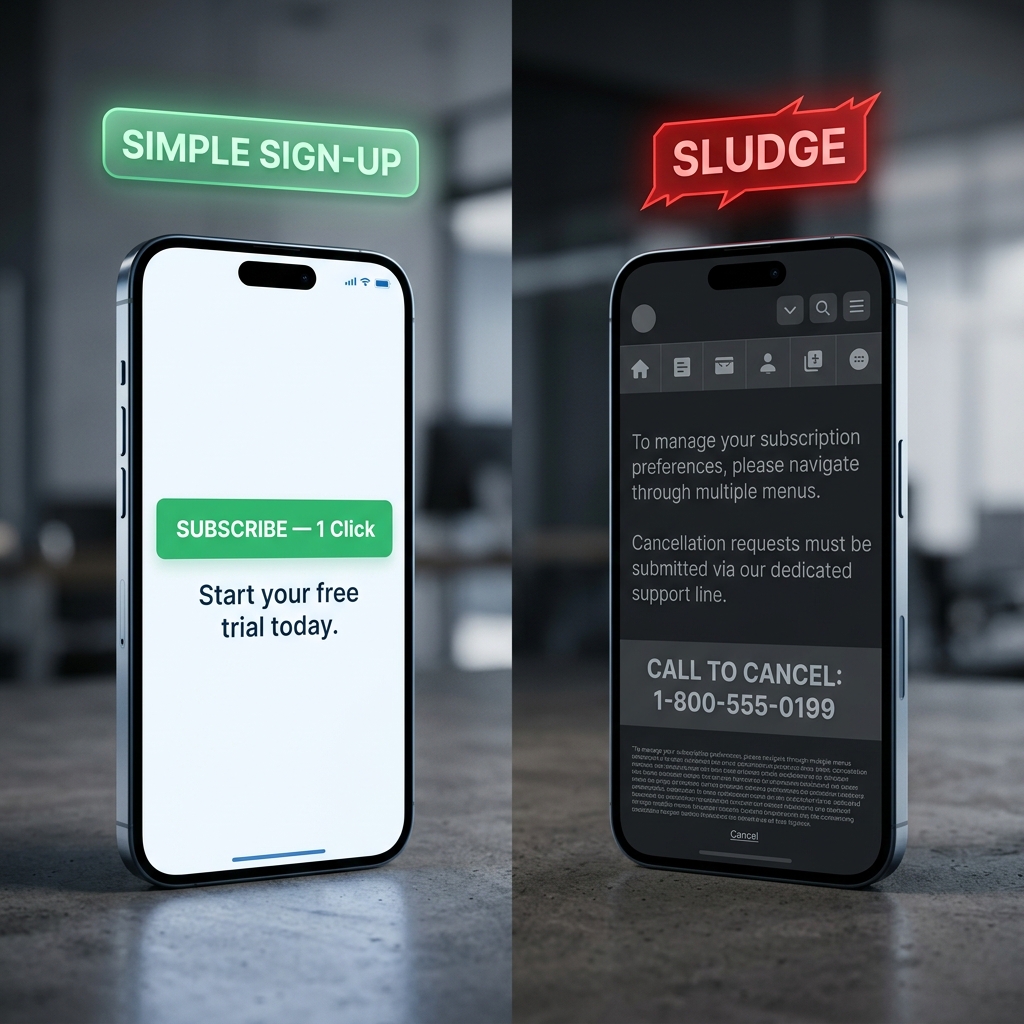
Every mechanism in this article works just as well pointed the other way, and Thaler himself named the abuse. In 2018 he introduced sludge: friction deliberately inserted to stop people doing something that would be good for them and bad for the company.
You have met it. Subscriptions that take two clicks to start and a phone call to cancel. Cookie banners where “accept all” is one button and refusing means unticking forty toggles. Rebates that require posting a receipt within a narrow window. Pre-ticked insurance add-ons. Autoplay that removes the moment where you would have chosen to stop watching.
The design principle is identical to a good nudge, only inverted: make the profitable path effortless and the other path exhausting. I wrote about this at length in my article on why cancelling a subscription feels impossible, which breaks down the specific patterns companies use. Regulators have started to catch up, with the FTC’s click-to-cancel rulemaking in the US and consumer-protection action against dark patterns in the UK and EU.
The reason I raise it here is that you cannot evaluate nudging honestly without it. The techniques are neutral. The direction is a choice someone made, and most of the choice architecture you actually encounter in daily life was designed to benefit the architect.
🧭 The ethical objection, taken seriously
Critics of nudge theory make three arguments, and I think two of them are strong.
The first is manipulation. A nudge works precisely because you are not fully attending to it; if you noticed the default being set and consciously evaluated it, it would lose much of its power. That is uncomfortably close to a definition of influence that bypasses reason. Sunstein’s counterargument is transparency: a nudge is legitimate if it would survive being announced publicly, and the evidence suggests most defaults keep working even when disclosed. That is a decent test, and I use it, but it does not fully dissolve the problem.
The second is who decides. Libertarian paternalism assumes the architect knows what is good for you. For pensions and vaccination that is defensible. For a private company deciding which choice is in your interest, it is obviously not, and the same government units that nudge you toward saving have also been used to nudge in politically contested directions.
The third objection I find weaker but worth noting: that nudging lets institutions avoid structural fixes. If a rewritten letter improves benefit take-up by two percentage points, that can become a reason not to simplify the benefit system. Critics call this a substitution for real reform. My view is that this is an argument about political priorities rather than about nudging itself, but it lands often enough that I would not dismiss it.
🛠️ How to apply this without pretending it is magic
- Find the friction before you write the message. The Bettinger study is the template. If people are failing to act, ask what step is annoying, not what fact they are missing. Information is the weakest tool in the box.
- Set the default deliberately, and set it well. Whatever is pre-selected will be what most people end up with. The auto-enrolment lesson cuts both ways: a lazy default rate traps people at a bad number just as effectively as a good one lifts them.
- Describe the norm you want, never the one you fear. “Most customers pay within seven days” works. “Many customers fail to pay on time” makes the problem worse by advertising it.
- Give feedback where there is none. Speed signs, energy meters and progress bars all work for the same reason. If a behaviour is invisible to the person doing it, making it visible is often enough.
- Test it, and expect a small number. If your intervention shows a huge effect in a small sample, the most likely explanation is noise. A one or two point improvement on a letter you were sending anyway is a genuine win, and it is roughly what the honest evidence predicts.
- Apply the publicity test. If you would be uncomfortable explaining your choice architecture to the person it is aimed at, you have built sludge and given it a nicer name.
📝 The takeaway
Nudge theory earns its place because it takes seriously something economics ignored for a century: people do not choose in a vacuum, they choose inside an arrangement, and the arrangement is never neutral. The twelve examples above are real, and the best of them, auto-enrolment above all, moved millions of people toward outcomes they said they wanted and could not organise themselves into.
What it does not deserve is the mythology. Most nudges produce effects measured in single percentage points. Several of the most quoted studies have not held up. The most reliable of them all, the default, works because it removes a decision rather than improving one, which means it succeeds by using exactly the inattention that critics complain about.
The useful version of this idea is unglamorous. Find the small thing that is in people’s way and remove it. Put the good option where the hand already reaches. Then measure honestly and accept a modest number. That is not as exciting as the fly in the urinal, but it is the part that actually works.
❓ Frequently asked questions
What is nudge theory in simple terms?
Nudge theory says you can change what people do by changing how a choice is presented, without banning any option or changing the cost. Pre-ticking a box, putting fruit at eye level or telling people what most others do are all nudges, because you keep every option you had before.
Who created nudge theory?
Richard Thaler and Cass Sunstein introduced it in their 2008 book Nudge. Thaler received the Nobel Prize in Economics in 2017 for his contributions to behavioural economics.
What is the most successful nudge ever?
Pension auto-enrolment. The UK’s 2012 reform, which enrolled workers automatically while letting them opt out freely, raised workplace pension participation from around 40 percent to over 85 percent and added more than ten million savers.
Does nudge theory actually work?
Sometimes, and usually less than advertised. Analysis of 126 government trials covering over 23 million people found an average effect of about 1.4 percentage points, compared with 8.7 points in published academic studies. Defaults are the strongest tool; information campaigns are the weakest.
What is the difference between a nudge and sludge?
A nudge makes a beneficial action easier. Sludge, a term Thaler coined in 2018, adds friction to stop people doing something in their own interest, like making a subscription hard to cancel. Same mechanism, opposite direction.
Is nudge theory ethical?
It is contested. The strongest defence is the transparency test: a nudge is acceptable if it still works when openly disclosed, and most defaults do. The strongest objection is that nudges work partly because people are not attending to them, and that whoever designs the architecture has decided what is good for you.
🧠 Want your choice architecture designed on purpose?
I’m Muhammad Shahzeb, an MSc Industrial and Organizational Psychologist and Full-Stack Developer. I audit signup flows, forms, pricing pages and internal processes to find the friction that is quietly costing you conversions, and I will tell you honestly when the expected gain is one percent rather than twenty.
📚 References and further reading
- Thaler, R. H., & Sunstein, C. R. (2008). Nudge: Improving Decisions About Health, Wealth, and Happiness. Yale University Press. (Final edition, 2021.)
- Madrian, B. C., & Shea, D. F. (2001). “The power of suggestion: Inertia in 401(k) participation and savings behavior.” Quarterly Journal of Economics, 116(4), 1149-1187.
- Johnson, E. J., & Goldstein, D. (2003). “Do defaults save lives?” Science, 302(5649), 1338-1339.
- Thaler, R. H., & Benartzi, S. (2004). “Save More Tomorrow: Using behavioral economics to increase employee saving.” Journal of Political Economy, 112(S1), S164-S187.
- Ebeling, F., & Lotz, S. (2015). “Domestic uptake of green energy promoted by opt-out tariffs.” Nature Climate Change, 5, 868-871.
- Bettinger, E. P., Long, B. T., Oreopoulos, P., & Sanbonmatsu, L. (2012). “The role of application assistance and information in college decisions.” Quarterly Journal of Economics, 127(3), 1205-1242.
- DellaVigna, S., & Linos, E. (2022). “RCTs to scale: Comprehensive evidence from two nudge units.” Econometrica, 90(1), 81-116.
- Mertens, S., Herberz, M., Hahnel, U. J. J., & Brosch, T. (2022). “The effectiveness of nudging: A meta-analysis of choice architecture interventions.” PNAS, 119(1).
- Maier, M., Bartoš, F., Stanley, T. D., Shanks, D. R., Harris, A. J. L., & Wagenmakers, E.-J. (2022). “No evidence for nudging after adjusting for publication bias.” PNAS, 119(31).
- Thaler, R. H. (2018). “Nudge, not sludge.” Science, 361(6401), 431.
- Cialdini, R. B. (2007). Influence: The Psychology of Persuasion. Harper Business. (Descriptive social norms.)
- Gollwitzer, P. M. (1999). “Implementation intentions: Strong effects of simple plans.” American Psychologist, 54(7), 493-503.
- UK Behavioural Insights Team. Annual reports and published trial results. bi.team
- Cornell University statements and journal retraction notices regarding the Food and Brand Lab, 2017-2018.
Written by Muhammad Shahzeb, MSc Industrial & Organizational Psychology | Behavioral Science Specialist | Full-Stack Web Developer
Learn more about my approach →