
A man in an orange robe presses a flower into your hand at the airport. “It is our gift to you,” he says, and refuses to take it back. Thirty seconds later he asks for a donation — and you reach for your wallet, even though you did not want the flower and did not plan to give anything. You have just met reciprocity in marketing: the most reliable lever in consumer psychology. The rule is simple and almost frighteningly strong: when someone gives us something, we feel compelled to give something back — even when we never asked for the gift in the first place.
This guide explains the psychology of reciprocity in marketing: the experiments that proved it, the field studies that measured it in restaurants and bake sales, why it still powers free samples and free trials, and — because the evidence deserves honesty — the research on when it stops working. Every number below is traceable to its source, and where the evidence is second-hand, I say so.
I am an Industrial and Organizational Psychologist in Karachi. I study how people actually behave, not how marketers wish they behaved — and reciprocity is one of the rare principles where the lab findings and the field findings agree.
“Reciprocity is marketing’s oldest trick and its most honest one. A free sample is a gift and a debt in the same package. The brands that win with it are the ones that give something genuinely worth repaying — and the ones that lose are the ones who treat the gift as a trap.”
— Consumer Psychology Analysis, ShahzebSpeaks
⚡ Chapter 1: The short answer
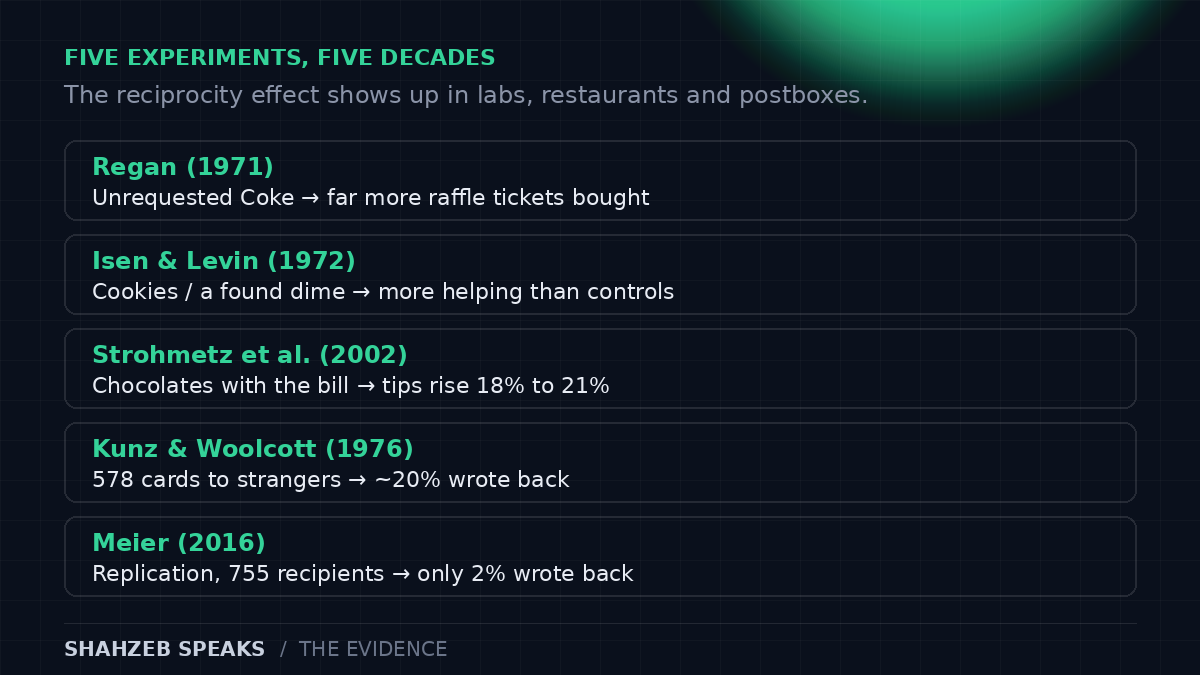
Reciprocity in marketing is the use of unsolicited gifts, favours and concessions to trigger the customer’s deeply felt obligation to give something back — usually a purchase. In the classic experiment (Regan, 1971), a stranger who gave participants an unrequested soft drink sold far more raffle tickets than the same stranger without the gift. In a restaurant field study (Strohmetz, Rind, Fisher & Lynn, 2002), a few chocolates with the bill lifted tips by 18%, and a “spontaneous” second chocolate by 21%.
It works because the norm of reciprocity is one of the most widely shared moral rules humans have — sociologist Alvin Gouldner (1960) proposed it as a near-universal component of moral codes. But it has limits: the obligation decays with time and suspicion (a famous 1976 Christmas-card experiment got ~20% responses; its 2016 replication got 2%), and gifts that threaten the recipient’s status can backfire outright. Give genuinely, give visibly, and never make the customer feel trapped.
🥤 Chapter 2: The Coke that bought raffle tickets
In 1971, psychologist Dennis Regan ran an experiment that every marketing textbook still cites. Participants were asked to rate paintings alongside a confederate they believed was another participant — a man called “Joe.” During a break, Joe left the room. In the favour condition he returned carrying two soft drinks: one for himself, one for the participant. In the control condition he returned empty-handed. A few minutes later, Joe made a request: would the participant buy raffle tickets for a high-school project? (Regan, 1971, Journal of Experimental Social Psychology; procedure details from secondary summaries.)
The result: participants who had received the unrequested drink bought substantially more tickets than those who had not — and, remarkably, the favour mattered more than liking. Even participants who found Joe unpleasant bought more tickets after receiving his drink than participants who liked him but received nothing. As Robert Cialdini later retold it in Influence (1984), the favour group bought roughly twice as many tickets and spent more on tickets than the drink had cost — the reciprocity response overshot the gift.
Three features of this experiment matter for marketers:
The gift was unrequested
Nobody asked Joe for a drink. That is the whole point of the principle: the obligation does not require a contract, a purchase, or even a desire for the gift. Cialdini’s summary of the reciprocity chapter is blunt — the rule obligates us to repay gifts and favours even when we did not ask for them, it can trigger unequal exchanges (a small gift repaid with a much larger favour), and the obligation to accept the initial gift is what makes the rule so exploitable. If you have ever wondered why free samples arrive whether you want them or not, this is why.
Liking did not drive it
The uncomfortable finding is that reciprocity works on people who do not like the giver. That separates it from charm or persuasion: it is a social debt, not affection. For brands, this is the good news and the warning. The good news: you do not need customers to love you before a gift works. The warning: a gift used manipulatively creates obligation without goodwill, which is exactly the feeling customers remember when they feel tricked.
The norm is assumed to be universal
Gouldner (1960) proposed the norm of reciprocity as one of the “principal components” of moral codes — a hypothesis, not a proven fact, and he framed it that way himself. Cialdini likewise treats the rule as near-universal. I have found no peer-reviewed study testing whether the rule is genuinely weaker in collectivist cultures, so any claim to that effect in marketing blogs is speculation. What the research does support: the obligation fires across the societies studied, including in anonymous, one-off encounters with strangers.
🍬 Chapter 3: Two mints, 21% more tips
The cleanest field measurement of reciprocity in a commercial setting comes from restaurants. Strohmetz, Rind, Fisher and Lynn (2002) read the full primary paper for this claim, so the numbers below are from the researchers themselves, not a retelling.
Study 1 (92 dining parties, fall 1992, a casual restaurant in downtown Ithaca, New York): servers gave some tables foil-wrapped chocolates with the bill and others nothing. Mean tip with candy: 17.8% of the bill. Without: 15.1%. The authors calculated that if every customer had received candy, the server’s total tips would have risen from $424.84 to $500.80 — an 18% increase, from a gift worth pennies.
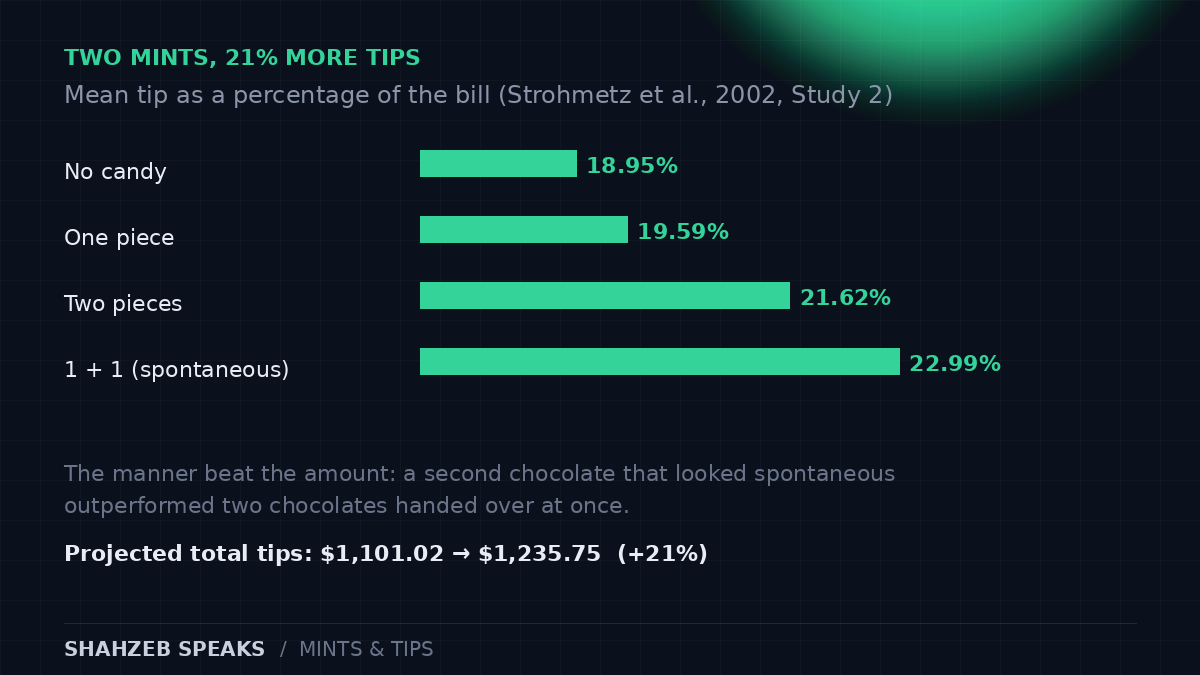
Study 2 (80 dining parties, 293 customers, spring 1998, an upscale Italian-American restaurant in central New Jersey) added a twist. Four conditions: no candy (mean tip 18.95%), one chocolate per person (19.59%), two chocolates per person (21.62%), and one chocolate followed by a seemingly spontaneous offer of a second (“for the rest of the table too” — 22.99%). Two pieces beat one — and the manner of giving beat the amount. A second chocolate that looked spontaneous and personal outperformed two chocolates handed over at once. Total projected tips in the “1+1” condition: $1,101.02 to $1,235.75 — a 21% increase.
| What the diners got | Mean tip (Study 2) | Lift vs no candy |
| No candy | 18.95% | — |
| One chocolate each | 19.59% | ≈ +3.4% |
| Two chocolates each | 21.62% | ≈ +14% |
| One, then a “spontaneous” second | 22.99% | ≈ +21% |
Crucially, the authors argued the mechanism was reciprocity, not good mood. They tested this: the effect was larger when the server appeared more generous and for larger parties — patterns that fit an obligation explanation better than a mood one. Impression-management was also ruled out as the main driver. The candy was an unexpected gift delivered with the check; diners had no prior obligation, and still repaid it.
Cialdini summarised the same research in a radio interview with almost identical arithmetic: a mint on the check tray lifts tips by about 3.3%; a second mint, given with a pause, eye contact and a personal remark, lifts them by about 20%. These match the paper’s own numbers — one piece versus no candy is roughly +3.4%, and the 1+1 condition versus no candy is roughly +21%.
What restaurants — and brands — should take from this
The lesson is not “buy cheaper mints.” It is threefold: the gift should be unexpected (planned freebies feel like entitlements), personal (the server’s pause and eye contact did half the work), and perceived as generous (the effect scaled with apparent generosity). A loyalty points email lacks all three. A hand-written note in the parcel has all three.
🌼 Chapter 4: The flower you couldn’t give back
Cialdini did not discover reciprocity in a laboratory. He discovered it at Los Angeles International Airport, watching Hare Krishna solicitors work the terminal. The technique, as he described it in Influence (first published 1984, with the seventh principle “unity” added in Pre-Suasion, 2016): a solicitor pressed a flower into a passer-by’s hand and refused to take it back — “It is our gift to you.” Then came the request for a donation. The gift was unwanted, the flower often thrown away moments later, and yet people paid. (This is Cialdini’s own field observation, reported in the book and interviews — not a peer-reviewed study.)
Two things about this story are worth separating from legend. First, the solicitation really did happen: Hare Krishna members solicited donations at LAX from 1974, the city council passed an ordinance in 1997 banning the receipt of donations at the airport, the group sued, and the California Supreme Court upheld the ban (reported 2010). But that ban was on solicitation generally — not on the flower technique specifically. Second, the power of the technique was never in the flower. It was in the refusal to take it back: the obligation to accept the gift is what traps the target. As Cialdini put it in an NPR interview about a similar charity tactic, “I can’t send it back to them because it’s got my name on it… as soon as I’ve decided to keep that packet of labels, I’m in the jaws of the rule.”
That packet of labels is the other famous case. The Disabled American Veterans charity has used personalised address labels as front-end premiums in its direct mail since the 1950s — unsolicited labels bearing the recipient’s name, arriving in an envelope you did not ask for. In a radio interview, Cialdini claimed the charity’s own tests showed the packet costs about 9 cents and the mail response “hit rate” went from about 18% to about 35% — nearly doubling when the gift was included. Be careful with this figure: it is Cialdini’s claim about the charity’s internal testing, not an independent peer-reviewed result. What is independently documented is that DAV tested premiums against alternatives for decades and built a large share of its revenue on the tactic (a 2009 trade-press account put DAV’s appeal-driven income at roughly 85% of about $107 million yearly revenue).
The uncomfortable question: is this manipulation? Cialdini’s own answer is that the rule can be used fairly or unfairly, and that the defence is awareness — knowing the rule exists lets you distinguish a genuine gift from an obligation trap. (My own view: when the gift is real value with no strings, reciprocity is service; when the gift exists only to create the debt, it is manipulation. The customer can tell the difference faster than the marketer thinks.)
🛒 Chapter 5: Free samples — and the 475% lift
If the airport flower is reciprocity at its most predatory, the supermarket free sample is reciprocity at its most productive. The evidence is unusually practical, though it comes with a funding caveat you should know.
The peer-reviewed side: researchers at BYU, the University of Wisconsin–Madison and Singapore Management University studied in-store sampling and reported in the Journal of Retailing that sampling has both immediate and sustained sales effects — it beats end-of-aisle displays, whose lift fades after about two weeks; it benefits smaller stores more; and it expands the category rather than merely stealing sales from rivals. They also found a profitability boundary: sampling stops paying when the event’s incremental cost exceeds about 15 times the unit price. (Findings via a BYU news summary; exact figures beyond this were not independently verified.)
The industry side is more dramatic and less independent. A Knowledge Networks–PDI study for PromoWorks, reported by Progressive Grocer, found sampled households showed a 475% day-of-event sales lift versus non-sampled households, were 11% more likely to repurchase within 20 weeks, and 6% more likely to buy another item in the brand’s franchise. Treat this as industry-commissioned research, not independent science — the direction is consistent with the peer-reviewed work, but the numbers are the industry’s own.
And the company side: Giovanni DeMeo, who ran Costco’s sampling programme, said that of all in-store media, “in-store product demonstration has the highest [sales] lift.” That is a company claim, but it is a revealing one — the retailer that built its brand on bulk value still puts free samples at the top of its conversion tools.
Why do samples work beyond simple reciprocity? A 2009 study by Wadhwa, Shiv and Nowlis (reported via Arizona State University) found that food, beverage and even good-smelling samples made people consume more — and not only the sampled product. Participants given fruit punch rated a wide range of unrelated rewarding items (steak, vitamins, a holiday in Bora Bora) more desirable and drank more soda. As Professor Stephen Nowlis put it: “when you give someone a little bit of something rewarding, they actually want more of other rewarding things.” (Journal details were not verified; findings via the ASU summary.)
The online caveat
One study suggests the obligation does not always convert to a sale. Shi, Cai and Luo (2023), in the Journal of Electronic Commerce Research, studied online free-product sampling and found that perceived reciprocity had a positive, significant effect on product ratings — but not on purchase intention. People felt obliged to rate generously; they did not feel obliged to buy. The lesson for e-commerce: free trials and samples buy goodwill and reviews, not necessarily carts. If your funnel needs purchases, reciprocity is a supporting actor, not the lead.
The charity twist: pay-what-you-want
Ayelet Gneezy and colleagues (2010) ran a large field experiment at a US amusement park selling roller-coaster souvenir photos — published in Science, and it won the 2011 Robert B. Cialdini Award from the Society for Personality and Social Psychology. Under plain pay-what-you-want pricing, more people bought the photo but most paid little. When pay-what-you-want was coupled with a charity cause (half the payment supporting patients), customers paid far more — according to UC San Diego’s reporting of the findings, payments were five times higher than in the other conditions. The reciprocity was aimed not at the seller but at the cause: given a reason to be generous that felt good, people out-gave the price tag.
🎟️ Chapter 6: The two-door trick — concessions as gifts
Reciprocity does not only run on objects. It also runs on concessions — and this is where the principle gets genuinely sneaky.
In 1975, Cialdini and colleagues published the “door-in-the-face” technique (Journal of Personality and Social Psychology, 31(2), 206–215; abstract read directly). Students were asked to escort juvenile offenders from a detention centre on a two-hour zoo visit. Half were first hit with a much larger request — two hours a week of volunteering for two years. When they refused, the requester “conceded” down to the zoo visit. Those who refused the big request first complied with the small one at about three times the rate of the control group, who were only asked for the small favour. The concession felt like a gift — the requester had “given up” something — and the participant repaid it with compliance.
Burger (1986) found the mirror image in a campus bake sale. Control: a cupcake offered at 75 cents. “That’s-not-all” condition: the cupcake offered at 75 cents, and before the person could answer, the seller added “that includes the cupcake and two chocolate chip cookies” — sweetening the deal mid-pitch. According to secondary summaries of the study, buying rose from around two-fifths to around three-quarters. (The exact percentages — 40% vs 73% or 75% depending on the summary — come from secondary sources, not the paper’s own tables, so treat the precise figures with care; the direction is consistent.)
Both techniques are reciprocity wearing a negotiation costume. The concession is the gift; compliance is the repayment. This is also why “was £99, now £59” framing works beyond simple anchoring: the markdown reads as the seller giving something up for you. (For more on price framing, see my decoy effect examples and loss aversion in marketing.)
🎄 Chapter 7: The Christmas cards that stopped working
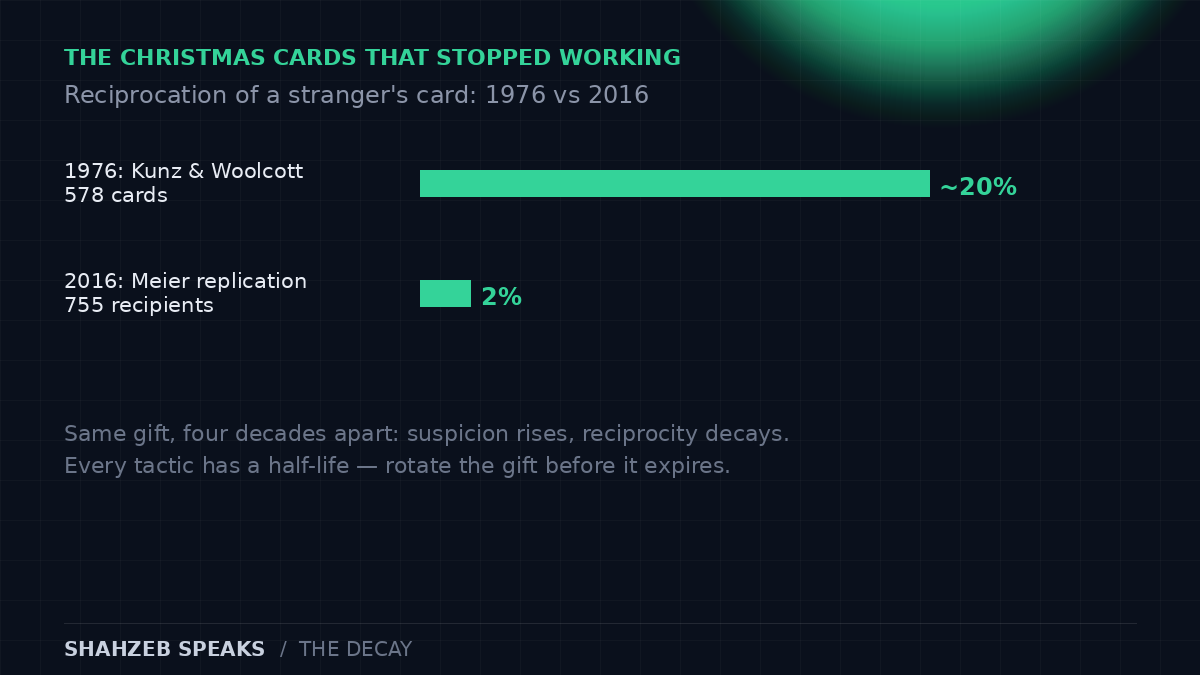
Here is the finding marketers least want to hear. In 1976, Kunz and Woolcott sent 578 Christmas cards to complete strangers — and received responses from about 20% of them. A handwritten card from nobody you know, and one in five people wrote back. Pure reciprocity, on paper, at scale. (Social Science Research, 5(3), 269–278; citation verified, numbers from secondary reporting.)
Four decades later, Brian Meier (2016) ran a conceptual replication with 755 recipients. The reciprocation rate was 2%. The norm had not vanished — but suspicion had arrived. Meier found that perceived suspicion and threat correlated negatively with reciprocating, and that the shift toward email had cheapened the gesture. When everyone knows the card is a tactic, the gift stops reading as a gift. (Journal of Social Psychology; full record read directly.)
This is the decay curve of every reciprocity tactic: novelty makes it generous; familiarity makes it suspicious. The 20%-to-2% collapse is the single most important number in this article for anyone running a loyalty programme, because it says the tactic has a half-life. What felt like generosity in 1976 reads as database marketing in 2026. The defence is the one the mints study already showed: make the gift genuinely personal, genuinely unexpected, and genuinely costly to you — the three things automation destroys.
⚠️ Chapter 8: When free gifts backfire
Reciprocity fails — and not only through decay. It fails when the gift misreads the recipient.
Some people are allergic to gifts
Researchers developing a “reciprocity anxiety” scale found that roughly 18% of the hundreds tested scored highly: these people said they would refuse a 20% discount voucher and reported lower satisfaction and return intentions after being given free drinks and snacks. (Reported by the British Psychological Society’s Research Digest.) But read the caveat the researchers themselves would insist on: the studies used hypothetical scenarios — the scale has not yet been shown to predict real behaviour. It is a real measured trait with an unverified behavioural footprint. Still, every marketer knows the customer who finds the free pen insulting; this research says that customer is real, just rarer than the complainers suggest.
Gifts that threaten status
Donnelly and colleagues (published in the Journal of the Association for Consumer Research, reported by ScienceDaily in 2020) found that gifts framed as intended to save the recipient money made people feel embarrassed, ashamed and inferior — recipients inferred the giver saw them as needy. The same gifts framed as saving time were welcomed. A discount reads as “you look poor”; a convenience reads as “your time matters.” For brands: never frame the freebie as charity toward a customer you also want to flatter.
Timing matters
Reciprocity effects decay faster for strangers — waiting too long between the favour and the request erodes the obligation (summarised from Burger and colleagues, 1997, via a research summary; the original paper was not read directly). Ask while the gift is still warm. The Hare Krishna solicitors knew this; they asked within seconds.
🧰 Chapter 9: Using reciprocity in marketing honestly
If you are going to use reciprocity — and every business does, whether it knows it or not — here is what the evidence actually supports:
- Give before you ask, and mean it. The Regan experiment’s power came from the drink arriving with no visible agenda attached. Lead with genuine value — a useful guide, a real sample, a working free tier — and let the request come later.
- Make it personal and unexpected. The mints study’s biggest lift came from the “spontaneous” second chocolate with a personal remark. Templates kill this; the handwritten note, the unprompted upgrade, the founder’s reply do not scale — and that is exactly why they work.
- Let the gift be generous relative to its cost. The obligation tracks perceived generosity, not your wholesale cost. An 18% tip lift from foil-wrapped chocolates is the benchmark: tiny cost, visible generosity.
- Frame it as time and care, never as charity. Donnelly’s research is the warning: the moment the gift implies the customer is needy, it reverses. “On us” beats “for people like you.”
- Ask soon, but ask once. The obligation fades; the Hare Krishnas asked within seconds, the 1+1 mints arrived with the bill. But repeated asks convert the gift into a subscription the customer never signed up for — and that is when reciprocity becomes the dark psychology I have written about elsewhere.
- Expect decay and rotate. Kunz & Woolcott to Meier is your timeline: every tactic has a half-life. When the free trial becomes the industry standard, it is no longer a gift — it is table stakes. Invent the next genuine gift before this one expires.
❓ Questions I am asked most often
What is reciprocity in marketing?
It is the use of unsolicited gifts, favours or concessions to trigger the customer’s felt obligation to repay — usually by buying. The norm is one of the most widely shared moral rules humans have (Gouldner, 1960), and it fires even when the gift was never requested, as Regan’s 1971 experiment showed.
Why do free samples make people buy more?
Two mechanisms. First, reciprocity: the sample is an unrequested gift, and customers repay gifts with purchases — the mint study measured an 18–21% lift in tips from chocolates worth pennies. Second, samples activate reward-seeking: research found samples of fruit punch made people rate unrelated rewards (steak, a holiday) as more desirable too.
Does reciprocity work in online marketing?
Partially. A 2023 study of online free-product sampling found perceived reciprocity lifted product ratings but not purchase intention — people felt obliged to rate generously, not to buy. Free trials, samples and useful content buy goodwill and reviews online; converting that into sales still needs a separate mechanism.
Why did the Hare Krishna flower technique work?
Because the solicitor refused to take the flower back. The obligation to accept the gift is what makes the reciprocity rule exploitable — once you hold the flower, refusing the donation feels like breaking a social contract. Cialdini documented this as field observation in Influence (1984); it was never a peer-reviewed study.
When does reciprocity backfire?
Three documented ways: the tactic decays as people grow suspicious (the Christmas-card response rate fell from ~20% in 1976 to 2% in 2016); gifts framed as saving the recipient money trigger embarrassment and status threat; and about 18% of people score high on “reciprocity anxiety” and actively dislike unsolicited gifts — though that figure comes from hypothetical scenarios, not observed behaviour.
Is using reciprocity in marketing manipulation?
It depends on the gift. When the freebie is genuine value with no strings — a real sample, useful content, an unprompted upgrade — reciprocity is service, and customers repay it gladly. When the gift exists only to manufacture obligation, customers detect it and remember the trick longer than the product. The research supports both outcomes.
🧠 Want Psychology That Actually Sells?
I’m Muhammad Shahzeb, an MSc Industrial Psychologist and web and app developer. I write evidence-based guides on the psychology behind buying, hiring and building — no invented stats, no hype.
More consumer psychology, all evidence-based: loss aversion in marketing, nudge theory examples, the decoy effect, and scarcity marketing. And if you work in hiring, my field is industrial psychology in Pakistan — the evidence on structured interviews is on this site too.
Sources
- Regan, D. T. (1971). Effects of a favor and liking on compliance. Journal of Experimental Social Psychology, 7(6), 627–639. doi:10.1016/0022-1031(71)90025-4
- Gouldner, A. W. (1960). The norm of reciprocity: A preliminary statement. American Sociological Review, 25(2), 161–178. doi:10.2307/2092623
- Cialdini, R. B., Vincent, J. E., Lewis, S. K., Catalan, J., Wheeler, D., & Darby, B. L. (1975). Reciprocal concessions procedure for inducing compliance: The door-in-the-face technique. Journal of Personality and Social Psychology, 31(2), 206–215.
- Burger, J. M. (1986). Increasing compliance by improving the deal: The that’s-not-all technique. Journal of Personality and Social Psychology, 51, 277–283.
- Isen, A. M., & Levin, P. F. (1972). Effect of feeling good on helping: Cookies and kindness. Journal of Personality and Social Psychology, 21, 384–388.
- Strohmetz, D. B., Rind, B., Fisher, R., & Lynn, M. (2002). Sweetening the till: The use of candy to increase restaurant tipping. Journal of Applied Social Psychology, 32, 300–309. doi:10.1111/j.1559-1816.2002.tb00216.x
- Kunz, P. R., & Woolcott, M. (1976). Season’s greetings: From my status to yours. Social Science Research, 5(3), 269–278. doi:10.1016/0049-089X(76)90003-X
- Meier, B. P. (2016). Bah humbug: Unexpected Christmas cards and the reciprocity norm. Journal of Social Psychology. doi:10.1080/00224545.2015.1129306
- Chandakula, S., Dotson, J., & Liu, Q. (via BYU news summary). In-store sampling: immediate and sustained sales effects; beats end-of-aisle displays; expands the category. Journal of Retailing.
- Shi, H., Cai, S., & Luo, X. (2023). Online free product sampling: The reciprocity and diagnosticity effects. Journal of Electronic Commerce Research, 24(3).
- Gneezy, A., Gneezy, U., Nelson, L. D., & Brown, A. (2010). Shared social responsibility: A field experiment in pay-what-you-want pricing and charitable giving. Science, 329(5989), 325–327. doi:10.1126/science.1186744
- Donnelly, G., et al. (reported 2020 via ScienceDaily). Gifts framed as money-saving trigger embarrassment and status threat; time-saving gifts welcomed. Journal of the Association for Consumer Research.
- Wadhwa, M., Shiv, B., & Nowlis, S. (reported 2009 via Arizona State University news). Rewarding samples increase consumption of unrelated rewarding products.
- Cialdini, R. B. (1984). Influence: The psychology of persuasion. HarperCollins. (1984 first edition; rev. ed. 2006; “unity” added in Pre-Suasion, 2016.)
- British Psychological Society Research Digest. Reciprocity anxiety: ~18% of respondents uncomfortable receiving favours; studies used hypothetical scenarios.
- Knowledge Networks–PDI for PromoWorks (via Progressive Grocer). Industry study: 475% day-of-event lift from in-store sampling; industry-commissioned, not peer-reviewed.
- Costco sampling programme (company claim via trade press): in-store product demonstration has the highest sales lift of any in-store medium.
- Disabled American Veterans address-label premiums (Cialdini’s account of the charity’s internal tests, via NPR/WCBE interview); DAV premium history via the Chronicle of Philanthropy.
- Hare Krishna airport solicitation history (LAX, 1974; 1997 ordinance; California Supreme Court ruling, reported 2010) — via religion-news trade reporting.