
Picture a hiring panel in Karachi. Three managers, one candidate, forty-five minutes, no fixed questions. Afterwards each panellist has a different favourite, the discussion runs on anecdotes — “he seemed confident”, “she reminded me of myself at her age” — and the decision comes down to whoever argued longest. Multiply that by every hire, every year. The research verdict on this ritual is blunt: the unstructured interview predicts job performance at barely half the strength of structured interviews, and the gap has survived every serious re-examination for over three decades.
This guide sets out what the evidence actually says about structured interviews: the headline numbers from the big meta-analyses, what “structure” concretely means, the two classic question types researchers keep returning to, why the unstructured interview fails, what a major 2022 revision changed (and did not change), what we know about hiring in Pakistan, and a practical checklist for running a structured interview yourself.
I am an Industrial and Organizational Psychologist in Karachi. Every number below comes from a published meta-analysis or review, and where the evidence is thin — Pakistan included — I say so instead of filling the gap.
“An unstructured interview is a conversation that feels like assessment. A structured interview is assessment that happens to be a conversation. The difference sounds small. In three decades of data, it roughly doubles how well you predict who will do the job.”
— Workplace Psychology Analysis, ShahzebSpeaks
⚡ Chapter 1: The short answer
Yes. Across 85 years of research, structured interviews predict job performance at .51, against .38 for unstructured interviews (Schmidt & Hunter, 1998) — and a 2022 re-analysis kept the gap at roughly two-to-one (.42 versus .19). Structure means asking every candidate the same job-related questions and scoring the answers against anchored scales, instead of chatting and going with your gut. It works because it replaces impression with evidence, and the best available evidence says the advantage survives every re-examination.
If you hire people and you only change one thing this year, change this: write the questions down before the first candidate walks in, ask everyone the same ones, and score each answer before you discuss anyone. That single discipline is most of what the word “structured” means.
📊 Chapter 2: The headline numbers — structured interviews at .51, unstructured at .38
The most quoted figures in personnel psychology come from Frank Schmidt and John Hunter’s 1998 synthesis in Psychological Bulletin, which pulled together 85 years of selection research. Their corrected validity coefficients for predicting job performance put structured employment interviews at .51 and unstructured interviews at .38.
For context, here is what else sat in that table: work sample tests .54, general mental ability tests .51, job knowledge tests .48, integrity tests .41, reference checks .26, years of education .10 — and graphology, handwriting analysis, at .02. The unstructured interview sits closer to reference checks than to the structured interview. Schmidt and Hunter’s own recommendation was a general mental ability test plus a structured interview, a combination they regarded as the practical sweet spot. (If you want to know how those ability tests are used — and misused — in hiring, see how companies use psychometric tests to reject you.)
Other meta-analyses tell the same story with different numbers:
- McDaniel, Whetzel, Schmidt & Maurer (1994) — 245 validity coefficients from 86,311 people: structured interviews .44, unstructured .33, and situational interviews (a structured type) .50. They also reported that 99% of the 852 organisations surveyed by Ulrich and Trumbo back in 1965 already used interviews — the tool is everywhere, the structure is not.
- Wiesner & Cronshaw (1988) — structured interviews at ρ = .62, “twice that of the unstructured interview” at ρ = .31.
- Huffcutt & Arthur (1994) — 114 coefficients coded into four levels of structure: validity rose from ρ = .20 with no structure to ρ = .57 with the greatest structure. More structure, better prediction, step by step.
- Conway, Jako & Goodman (1995) — high, moderate and low structure at r = .67, .56 and .34. Again, each added degree of structure added utility.
| Meta-analysis | Structured | Unstructured | The gap |
| Schmidt & Hunter (1998) | .51 | .38 | about one-third higher |
| McDaniel et al. (1994), n = 86,311 | .44 | .33 | about one-third higher |
| Wiesner & Cronshaw (1988) | .62 | .31 | twice as high |
| Huffcutt & Arthur (1994) | .57 (most structure) | .20 (no structure) | nearly three times |
| Conway et al. (1995) | .67 (high structure) | .34 (low structure) | nearly twice |
| Sackett et al. (2022), revised | .42 | .19 | more than twice |
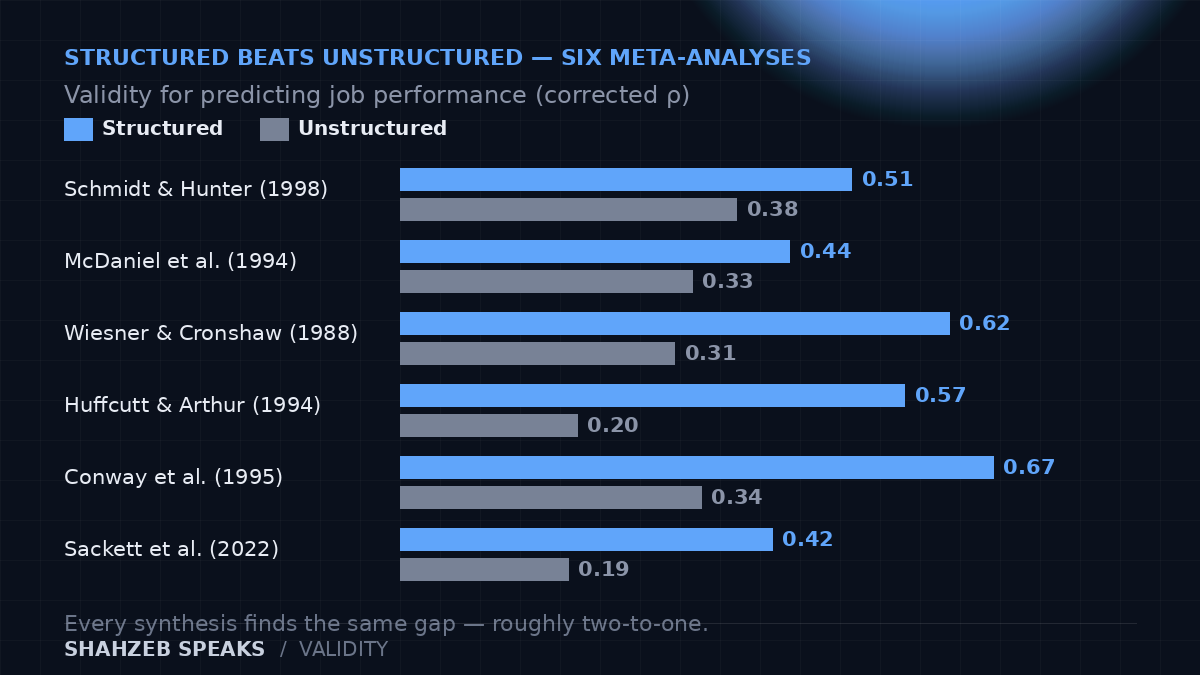
Two things are worth noticing. First, the numbers differ because the methods differ — corrected versus uncorrected coefficients, different samples, different eras — but the direction never changes. Second, these are correlations with job performance, not guarantees about any single hire. A validity of .51 does not mean you will pick the right person 51% of the time; it means the interview score tracks later performance far more closely than chance, and far more closely than an unstructured chat does.
🧩 Chapter 3: What “structure” actually means
“Structured” does not mean stiff, hostile or robotic. In the definition researchers use — Campion, Palmer and Campion (1997) — structure is “any enhancement of the interview that is intended to increase psychometric properties by increasing standardization or otherwise assisting the interviewer in determining what questions to ask or how to evaluate responses.” In plain language: anything that makes the interview more standardised, and helps the interviewer ask better questions and score answers more fairly.
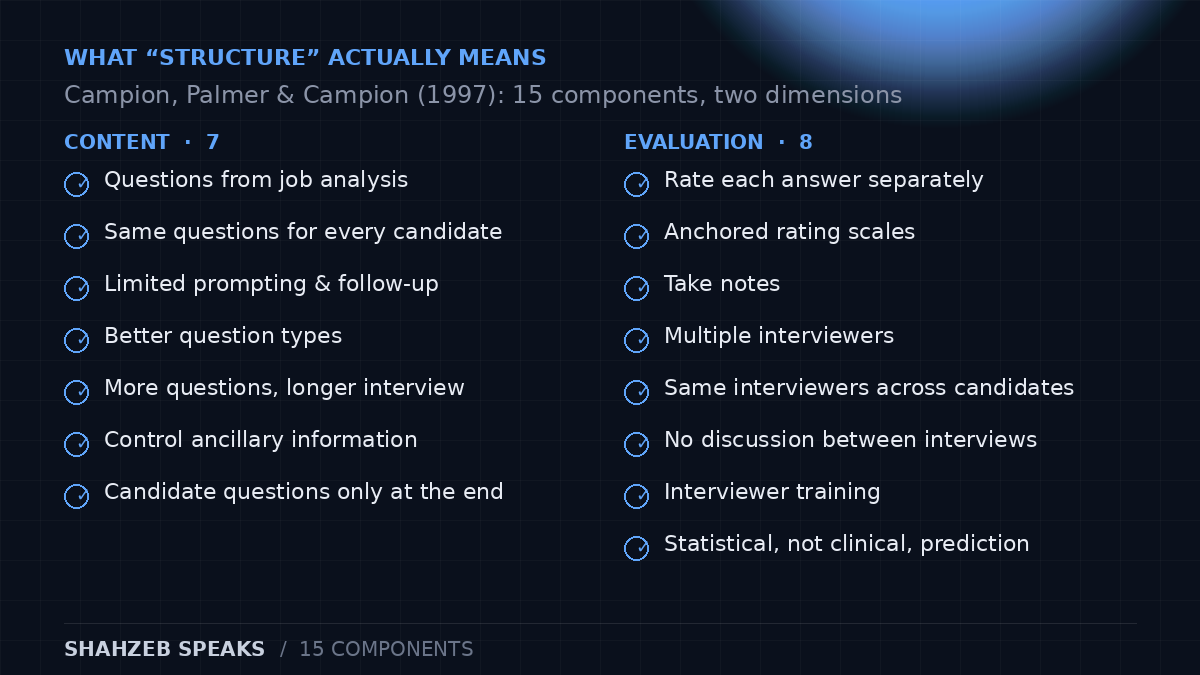
That 1997 review broke structure into 15 components across two dimensions:
The content dimension (7 components)
- Base the questions on a job analysis — know what the job actually requires first.
- Ask the same questions of each applicant.
- Limit prompting, follow-up questions and elaboration.
- Use better types of questions (Chapter 4 covers the two classics).
- Use longer interviews with more questions.
- Control ancillary information — decide what else the interviewer gets to see, and when.
- Do not allow questions from the applicant until after the interview is over.
The evaluation dimension (8 components)
- Rate each answer separately, or use multiple scales.
- Use anchored rating scales — written descriptions of what a weak, average and strong answer look like.
- Take notes during the interview.
- Use multiple interviewers.
- Use the same interviewer or panel for all applicants.
- Do not discuss applicants or answers between interviews.
- Provide interviewer training.
- Combine the scores statistically rather than by clinical judgement — let the numbers decide, not the loudest panellist.
A shorter version of the same idea comes from Huffcutt and Arthur (1994): standardise the questions, and standardise the scoring. That is the whole game. A modern narrative and quantitative review by Levashina, Hartwell, Morgeson and Campion (2014) confirmed the link again: more of these components, better prediction.
The practical point is that structure is a dial, not a switch. You do not need all fifteen components to beat an unstructured interview. The meta-analyses show each added degree of structure adds utility — so even three or four components put you meaningfully ahead of a free-form chat.
❓ Chapter 4: The two classic question types
Two question formats dominate the structured-interview literature. They sound similar, they rest on different psychological logic, and the best interviews use both.
Behaviour-description questions — “tell me about a time when…”
Introduced by Tom Janz, first presented at a conference in 1977 and published in the Journal of Applied Psychology in 1982, the behaviour-description interview asks candidates to describe what they actually did in a real past job situation. The logic is the sentence every hiring manager has heard: past behaviour predicts future behaviour.
A good one is specific and job-related: “Tell me about the last time you had to deliver bad news to a client. What was the situation, what got in the way, what did you do, and what happened?” Janz’s 1986 book added the SHARE model for scoring such answers — Situation, Hindrances, Action, Results, Evaluate — the direct ancestor of the STAR format (Situation, Task, Action, Result) that interview guides teach today.
Situational questions — “what would you do if…”
Developed by Gary Latham, Saari, Pursell and Campion (1980), the situational interview presents a hypothetical scenario drawn from a systematic analysis of the job and asks how the candidate would handle it. The underlying theory is that intentions predict behaviour (Locke, 1968). A review in the Journal of Business and Psychology called situational interviews “one of the most criterion-valid interview techniques”, and meta-analytic estimates put their validity between 0.41 and 0.47.
Example: “Your two best technicians both request the same week off during our busiest month, and only one can go. Walk me through exactly what you would do.” There is no single right answer — there are anchored examples of better and worse responses, written before the interview, against which the answer is scored.
Which one to use?
McDaniel’s 1994 meta-analysis found situational interviews at .50 validity, ahead of the structured average. Behaviour-description questions have the deeper track record in practice. My reading of the evidence: use behaviour-description questions for jobs where past experience transfers directly, and situational questions where the job throws novel problems at people — which, honestly, is most jobs. Write both types from the job analysis, score both against anchors, and you have covered the two best-validated formats in the literature.
🛡️ Chapter 5: Why the unstructured interview fails
The unstructured interview does not fail for lack of effort. It fails because the human brain is a poor measuring instrument when it is allowed to improvise, and an unstructured interview is improvisation with consequences.
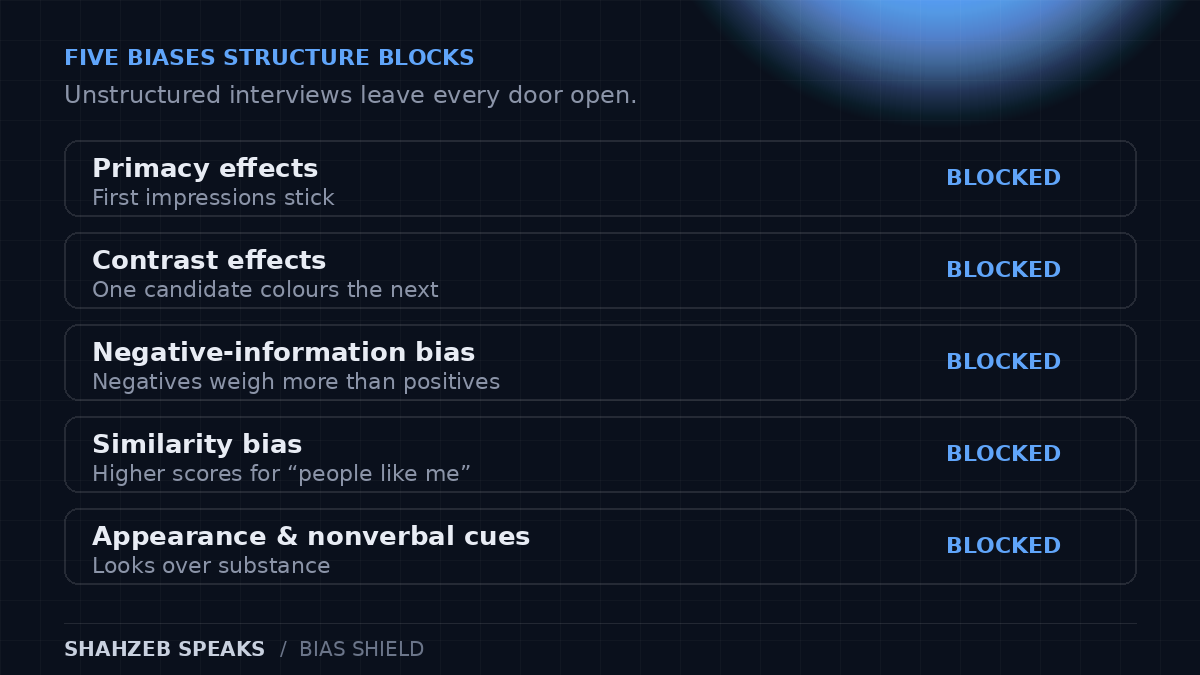
The five bias mechanisms
I/O psychology textbooks catalogue the same culprits:
- Primacy effects. First impressions form fast and colour everything after. In an unstructured interview there is nothing to pull the interviewer back to the evidence.
- Contrast effects. A mediocre candidate looks brilliant right after a weak one, and weak right after a strong one. The rating measures the queue, not the person.
- Negative-information bias. One negative detail outweighs several positives. A single awkward answer can sink an hour of solid ones.
- Similarity effects. Interviewers score candidates more highly when they share personality, attitudes, gender or race. This is the mechanism behind “cultural fit” hiring that reproduces the existing team.
- Appearance and nonverbal cues. Looks, dress, handshake, eye contact — all real signals of something, none of them job performance.
There is also the candidate’s side of the table. Levashina and Campion’s (2006) model of applicant faking found that structured interviews “do not allow for intentional influencing of results as much when compared with unstructured interviews.” A skilled talker can steer a free conversation; it is much harder to steer twelve anchored questions.
The strongest single test: 20,000 applicants
The cleanest evidence that structure resists bias comes from McCarthy, Van Iddekinge and Campion (2017). They examined nearly 20,000 applicants for a managerial position in a large organisation, all assessed with a highly structured interview. Their words: “Findings were unequivocal: main effects of applicant gender and race were not associated with interviewers’ ratings of applicant performance nor was applicant–interviewer similarity with regard to gender and race.”
Read that carefully. It does not say structured interviews end discrimination in hiring — the applicant pool, the job ad, the shortlisting all happen before the interview. It says that within the interview, structure stopped demographic similarity from moving the scores. If you care about fair hiring — and about psychological safety at work, which starts with being judged on your work — that is a large claim, tested at scale.
🔄 Chapter 6: The 2022 revision — lower numbers, same verdict
Here is where I have to be honest about my own field’s numbers, because they moved.
In 2022, Paul Sackett, Charlene Zhang, Christopher Berry and Filip Lievens revisited the classic meta-analytic estimates in the Journal of Applied Psychology. Their argument was technical but important: earlier syntheses had overcorrected for range restriction in concurrent validation studies — studies run on current employees (incumbents) rather than real applicant pools, where the range of ability is already narrowed because the worst performers were never hired. Correcting as if you had the full applicant range, they argued, inflated the numbers.
Their revised estimates, without that correction:
- Structured interviews: .42 (was .51)
- Unstructured interviews: .19 (was .38)
- General mental ability tests: .31 (was .51)
So yes — the famous .51 came down to .42. But notice what else happened: the unstructured interview fell further, from .38 to .19, and the GMA test fell hardest of all. Under both the 1998 and the 2022 numbers, the structured interview predicts roughly twice as well as the unstructured one. The gap survived the revision that shrank everything.
Two honest caveats. First, this is an active debate, not a settled correction: Oh, Le and Roth (2023) argued the conditions do not justify dropping the correction, and Sackett, Berry, Lievens and Zhang (2023) replied, endorsing the correction whenever applicant-pool data exist. Second, whichever side of that debate you find convincing, the ranking of methods barely moves — structured interviews stay near the top either way.
This is how science is supposed to work, and it is why I trust this literature more, not less, after 2022. A field that revises its own headline numbers downward is a field you can believe when it says the remaining gap is real.
🇵🇰 Chapter 7: Hiring in Pakistan — what we actually know
Now the uncomfortable part. Everything above comes from American and European samples. What do we actually know about how Pakistan hires?
Less than you would hope. I could find no nationwide survey — not from P@SHA, OICCI, PSX or any business body — breaking down Pakistani employers’ use of structured versus unstructured interviews. Anyone who quotes you a percentage is inventing it. What exists is qualitative, and it is blunt.
Gul and Ghazal, writing in the Pakistani peer-reviewed Journal of Professional & Applied Psychology, interviewed HR professionals about selection practices. One manager said simply: “Only interview method is used.” Another went further: “interview method is cheapest and worst method, specifically panel interviews are also very worst” — and added that “people are more biased with referral hiring. Subjectivity gets involved here.” Referrals, a third noted, get used “when limited resources are available.”
A separate account in the Strategic Leadership and Business Management Journal describes the traditional Pakistani hiring process as “manual screening of resumes, personal recommendations, and a long process of interviews” — “manpower intensive and subject to biases” — with hiring dragging on for 45 to 60 days for technical posts.
Put those two pictures together and the implication is stark. Pakistan’s default is the unstructured panel interview — the exact format the meta-analyses rank lowest — combined with referral hiring, the exact channel HR professionals themselves call the most subjective. Organisations are spending up to two months running the method the evidence trusts least.
The opportunity is correspondingly large. Nothing about structured interviewing requires Western budgets. Asking every candidate the same job-related questions and scoring the answers costs nothing — and in a market where the starting point is “cheapest and worst”, even basic structure is a competitive advantage most competitors have not tried. (For the broader picture of where this discipline fits, see the scope of industrial psychology in Pakistan.)
One more honest note: van der Zee, Bakker and Bakker asked back in 2002 “why are structured interviews so rarely used in personnel selection?” — documenting the research–practice gap in the West. If even well-resourced Western firms underuse them, Pakistan’s gap is no embarrassment. It is an opening.
🧰 Chapter 8: How to run a structured interview
Here is the checklist, drawn directly from Campion’s components. No special software, no consultants required.
- Start with a job analysis. Before writing a single question, list what the job actually requires — the five or six competencies that separate good performers from weak ones. Every question must trace back to this list.
- Write the questions in advance. The same questions for every candidate, in the same order. Mix behaviour-description questions (“tell me about a time when…”) for experience that transfers, with situational questions (“what would you do if…”) for novel problems.
- Build anchored rating scales. For each question, write down what a 1, a 3 and a 5 answer look like — in concrete terms, using real examples of good and poor responses. This is the single highest-value step.
- Take notes, score later. Write down what the candidate said during the interview. Score each answer against the anchors after they leave the room, not while they are talking.
- Use the same panel for every candidate. Multiple interviewers, same people each time. Do not let panellists discuss a candidate until everyone has scored independently.
- Limit follow-ups. Clarifying a vague answer is fine; conducting a second, secret interview inside the first one defeats the purpose. No candidate questions until the structured portion is done.
- Train your interviewers. One session: how the scales work, what the biases look like, and practice scoring sample answers. Untrained interviewers with good forms still drift.
- Let the scores decide. Add the ratings up and rank by total. The panel discussion should explain the scores, not override them — statistical combination beats the loudest voice in the room.
You will not get all eight right the first time. Do four of them consistently and you are already running a more valid selection process than most organisations in either hemisphere. That is what the .20-to-.57 gradient in Huffcutt and Arthur means: every step toward structure pays.
If you are rethinking how your organisation evaluates people more broadly, the same measurement discipline applies after hiring — see why performance reviews fail.
❓ Questions I am asked most often
What is a structured interview?
A structured interview standardises what is asked and how answers are scored. Campion, Palmer and Campion (1997) defined structure as anything that increases standardisation: the same job-related questions for every candidate, anchored rating scales, notes taken during the interview, trained interviewers, and scores combined by rule rather than gut feeling. If two interviewers could swap candidates and reach the same result, it is structured.
How much better are structured interviews than unstructured ones?
Schmidt and Hunter’s 1998 synthesis put structured interviews at .51 validity for predicting job performance, against .38 for unstructured ones. Sackett and colleagues’ 2022 re-analysis revised both figures down — .42 versus .19 — but the gap survived at roughly two-to-one. Whichever set of numbers you trust, adding structure roughly doubles the interview’s predictive power.
What is the difference between behavioural and situational interview questions?
Behaviour-description questions (Janz, 1982) ask candidates what they did in a real past situation — the logic being that past behaviour predicts future behaviour. Situational questions (Latham and colleagues, 1980) describe a hypothetical job scenario and ask what the candidate would do — the logic being that intentions predict behaviour. Meta-analytic validities for situational interviews run between 0.41 and 0.47. The best interviews use both.
Do structured interviews eliminate bias?
No method eliminates bias entirely, but structure sharply reduces it where it matters most. McCarthy, Van Iddekinge and Campion (2017) studied nearly 20,000 applicants and found no effect of applicant gender or race — nor of interviewer–applicant similarity — on ratings in highly structured interviews. Unstructured interviews, by contrast, leave the door open to first impressions, contrast effects and similarity bias.
Can a small company run structured interviews without a big budget?
Yes. The expensive components are optional. Take the free ones: base your questions on a short job analysis, ask every candidate the same questions, write down what good, average and poor answers look like before you start, take notes, and score each answer separately before any discussion. That alone removes most of the noise. Interviewer training helps, but consistency matters more.
Are structured interviews common in Pakistan?
Honestly, nobody knows — I could find no nationwide survey of Pakistani employers on this, and I will not invent a percentage. What exists is qualitative: HR professionals interviewed by Gul and Ghazal called the standard panel interview the “cheapest and worst method” and admitted referral hiring brings subjectivity. Given that starting point, even basic structure is an upgrade most organisations have not tried.
Hiring for a role that actually matters?
I help organisations build structured interview processes — job analysis, question banks, anchored rating scales — grounded in the research above, not in HR fashion. If you want hiring you can defend, let us talk.
More on my field and why it matters in Pakistani workplaces: industrial psychology in Pakistan. If you are weighing a career in this area, see I/O psychology vs HRM.
This article summarises published research as of 10 October 2026. It is not legal advice.
Sources
- Schmidt, F. L., & Hunter, J. E. (1998). The validity and utility of selection methods in personnel psychology: Practical and theoretical implications of 85 years of research findings. Psychological Bulletin, 124(2), 262–274. doi:10.1037/0033-2909.124.2.262
- McDaniel, M. A., Whetzel, D. L., Schmidt, F. L., & Maurer, S. D. (1994). The validity of employment interviews: A comprehensive review and meta-analysis. Journal of Applied Psychology, 79(4), 599–616. doi:10.1037/0021-9010.79.4.599
- Wiesner, W. H., & Cronshaw, S. F. (1988). A meta-analytic investigation of the impact of interview format and degree of structure on the validity of the employment interview. Journal of Occupational Psychology, 61(4), 275–290. doi:10.1111/j.2044-8325.1988.tb00467.x
- Huffcutt, A. I., & Arthur, W., Jr. (1994). Hunter and Hunter (1984) revisited: Interview validity for entry-level jobs. Journal of Applied Psychology, 79(2), 184–190.
- Conway, J. M., Jako, R. A., & Goodman, D. F. (1995). Meta-analysis of interview structure levels: mean validities .67, .56 and .34 for high, moderate and low structure (journal not confirmed in available sources).
- Sackett, P. R., Zhang, C., Berry, C. M., & Lievens, F. (2022). Revisiting meta-analytic estimates of validity in personnel selection: Addressing systematic overcorrection for restriction of range. Journal of Applied Psychology, 107(11), 2040–2068. doi:10.1037/apl0000994
- Oh, I.-S., Le, H., & Roth, P. L. (2023). [Rebuttal on range-restriction correction conditions.]
- Sackett, P. R., Berry, C. M., Lievens, F., & Zhang, C. (2023). [Reply endorsing correction where applicant-pool information is available.]
- Campion, M. A., Palmer, D. K., & Campion, J. E. (1997). A review of structure in the selection interview. Personnel Psychology, 50(3), 655–702.
- Levashina, J., Hartwell, C. J., Morgeson, F. P., & Campion, M. A. (2014). The structured employment interview: Narrative and quantitative review of the research literature. Personnel Psychology, 67(1), 241–293. doi:10.1111/peps.12052
- Janz, T. (1982). Initial comparisons of patterned behavior description interviews versus unstructured interviews. Journal of Applied Psychology, 67(5), 577–580. doi:10.1037/0021-9010.67.5.577
- Latham, G. P., Saari, L. M., Pursell, E. D., & Campion, M. A. (1980). The situational interview. Journal of Applied Psychology, 65(4), 422–427. doi:10.1037/0021-9010.65.4.422
- McCarthy, J. M., Van Iddekinge, C. H., & Campion, M. C. (2017). Are highly structured job interviews resistant to demographic similarity effects? A meta-analytic investigation. Personnel Psychology, 70(2), 241–282. doi:10.1111/peps.12144
- van der Zee, K. I., Bakker, A. B., & Bakker, P. (2002). Why are structured interviews so rarely used in personnel selection? Journal of Applied Psychology, 87(1), 176–184. doi:10.1037/0021-9010.87.1.176
- Gul & Ghazal. Qualitative study of HR professionals’ selection practices in Pakistan. Journal of Professional & Applied Psychology. doi:10.52053/jpap.v3i1.96
- Strategic Leadership and Business Management Journal. [Traditional Pakistani hiring practices: manual screening, personal recommendations, 45–60 day hiring processes for technical posts.]
- SHRM Talent Access Report (benchmarking survey, West-region cut): structured vs unstructured interview usage by management level.
- CIPD Resourcing and Talent Planning 2024 (UK, 1,016 HR professionals, via YouGov, April 2024).
- Dipboye, R. L., et al. (2012). [The employment interview as the most frequently used predictor in personnel selection.]