
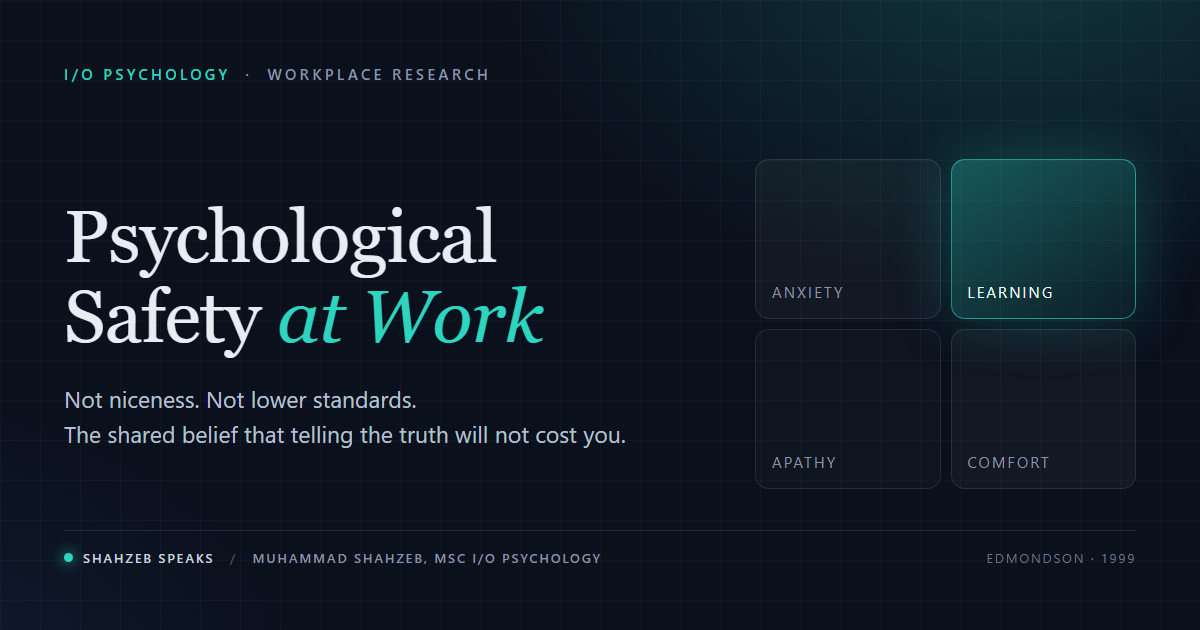
In the early 1990s a young Harvard researcher set out to prove something obvious. Hospital teams with better leadership and better working relationships, she assumed, would make fewer medication errors. She collected the data, ran the numbers, and found the opposite. The best teams appeared to be making the most mistakes.
They were not. When Amy Edmondson went back to find out why, the explanation turned out to be far more important than the hypothesis she had started with. The better teams were not making more errors. They were the only teams where people felt safe enough to report them. In the weaker teams, errors happened, got hidden, and never reached the spreadsheet.
That accident became one of the most cited ideas in organisational psychology: psychological safety. It is also one of the most misused. It gets confused with niceness, with comfort, with never hearing criticism, and with lowering the bar. I am an Industrial and Organizational Psychologist, and this article covers what the research actually says, what psychological safety is not, the four zones every team sits in, why people stay silent even in “open door” cultures, the findings the popular version leaves out, and six specific moves that build it.
“Psychological safety is not the absence of pressure. It is the absence of punishment for telling the truth. A team can have both brutal standards and complete safety, and the teams that do are the only ones that learn fast enough to meet the standards.”
— Workplace Psychology Analysis, ShahzebSpeaks
🔍 Chapter 1: What psychological safety actually is
Edmondson’s definition, from her 1999 paper in Administrative Science Quarterly, is precise and worth quoting in spirit: psychological safety is a shared belief within a team that it is safe to take interpersonal risks.
Three words in that definition do most of the work.
- Shared. It is a property of the team, not a personality trait. The same confident person can be outspoken in one meeting and silent in the next, because the room changed, not the person.
- Belief. It lives in people’s expectations about what will happen next, not in the company values poster. A policy that says “we welcome challenge” is irrelevant if the last person who challenged got quietly sidelined.
- Interpersonal risks. Not physical danger. The specific risks of looking ignorant, incompetent, negative or disruptive. Asking a basic question. Admitting a mistake. Disagreeing with the most senior person present. Saying “I think this plan will fail.”
The earlier root is William Kahn’s 1990 research on engagement, which described psychological safety as being able to show and employ yourself “without fear of negative consequences to self-image, status, or career.” Kahn’s point was that people only bring their full effort to work when they believe that doing so will not cost them. Edmondson’s contribution was to show that this belief operates at team level and predicts whether a team learns.
In everyday terms, a psychologically safe team is one where these sentences are said out loud, regularly, without drama:
- “I don’t understand. Can you explain that again?”
- “I got that wrong.”
- “I think we are missing something.”
- “I disagree, and here is why.”
- “This is going to be late.”
If those sentences are rare on your team, the problems they would have surfaced have not disappeared. They are simply being discovered later, when they cost more.
🏥 Chapter 2: The error paradox that started it all
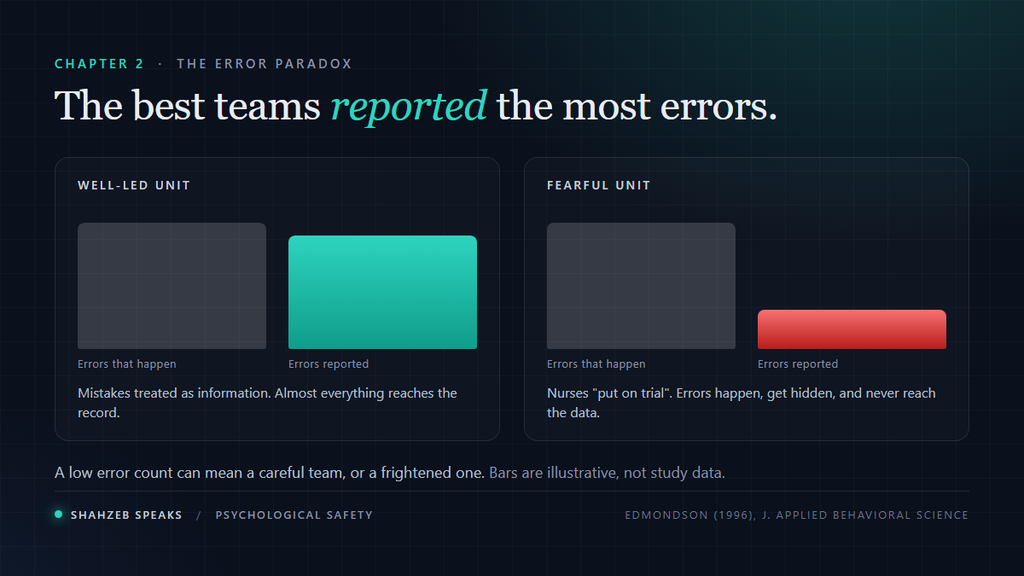
Edmondson published the hospital findings in 1996 in the Journal of Applied Behavioral Science under a title that says it all: “Learning from mistakes is easier said than done.” The study followed nursing units in two hospitals, measuring detected medication errors alongside leadership and team relationships.
The unit-level pattern ran against expectation. Units with stronger leadership and relationships had higher detected error rates. Follow-up observation, carried out by a research assistant who did not know the survey results, found a clear difference in climate. In some units nurses talked openly about mistakes and the manager treated them as information. In others, nurses described being “put on trial” for errors and made to feel guilty, so reporting was the last thing anyone would do.
The lesson travels far beyond hospitals, and it is the single most practical idea in this article:
A team’s reported problems are a measurement of two things at once: how many problems exist, and how safe it is to report them. You cannot read one without the other.
This is why the manager celebrating “zero incidents this quarter” should be slightly nervous. Zero can mean excellence. It can also mean silence. The same reading bias that fools people about engagement scores applies here; I built a free survivorship bias calculator for exactly that trap, where a number improves because of who stopped reporting rather than because anything got better.
🔬 Chapter 3: What the research shows (and what Google found)
The 1999 team study
Edmondson’s foundational paper studied 51 work teams in a manufacturing company. Teams with higher psychological safety showed more learning behaviour: asking for feedback, discussing errors, seeking information from outside the team, and experimenting. That learning behaviour, in turn, was associated with better team performance. Safety did not produce performance directly. It produced learning, and learning produced performance.
That distinction matters for anyone trying to sell the idea internally. Psychological safety is not a feel-good perk that somehow raises output. It is the precondition for a team to notice and fix what is going wrong. In stable, simple, repetitive work that effect is modest. In complex, uncertain, fast-changing work, where nobody can know everything, it becomes decisive.
The meta-analysis
By 2017 there was enough research to pool. Frazier and colleagues published a meta-analysis in Personnel Psychology drawing on 136 independent samples covering more than 22,000 individuals and nearly 5,000 groups. Psychological safety was consistently related to information sharing, learning behaviour, engagement and performance, and it was predicted by supportive leadership, clear roles and positive relationships with colleagues. Across very different settings, the core pattern held.
Project Aristotle
The study that made the idea famous outside academia was Google’s internal research on team effectiveness, known as Project Aristotle and reported in The New York Times Magazine in 2016. Google studied more than 180 teams, looking for the ingredients of a great team. Team composition, meaning who was on the team, mattered far less than expected. What mattered was how the team worked together, and Google named five dynamics:
- Psychological safety, which Google described as by far the most important
- Dependability: people do what they say, on time and to standard
- Structure and clarity: clear roles, plans and goals
- Meaning: the work matters personally to the people doing it
- Impact: people believe the work makes a difference
A caution I will return to in Chapter 7: Project Aristotle was an internal company study published as guidance, not a peer-reviewed paper. It is consistent with the academic research, which is why it is credible, but it should not be quoted as if it were the evidence on its own.
Notice what sits second and third on Google’s list, because it answers the most common objection. Dependability and clarity are standards. The best teams did not choose between safety and accountability. They had both.
🧭 Chapter 4: The four zones, and the trap called “high performance”
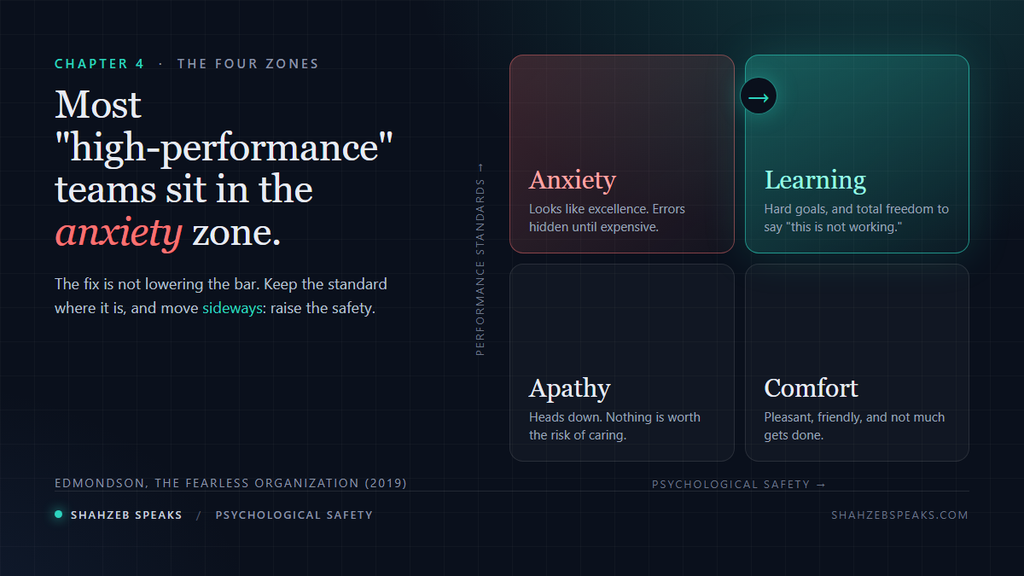
In her book The Fearless Organization, Edmondson draws the idea as a simple grid. One axis is psychological safety. The other is performance standards, meaning how much is expected. Four zones result.
Apathy zone: low safety, low standards. People turn up, do the minimum and keep their heads down. Nothing here is worth the risk of caring. Energy goes into protecting yourself, not into the work.
Comfort zone: high safety, low standards. Everyone is pleasant, meetings are friendly, and not much gets done. People feel free to speak but have little reason to stretch. This is what critics picture when they say psychological safety makes teams soft, and it is a real failure mode. It is just not what psychological safety means.
Anxiety zone: low safety, high standards. This is the dangerous one, because from outside it looks like excellence. Long hours, polished presentations, confident updates, very few visible mistakes. Inside, people hide errors until they are expensive, over-prepare for everything, agree in the meeting and object in the corridor. The effort that should go into the work goes into looking safe.
Learning zone: high safety, high standards. Hard goals, and total freedom to say “this is not working.” Problems are raised while they are small. Disagreement is about the work, not about who is to blame. It is the only zone where genuinely difficult things are done well repeatedly.
The practical point is directional. When a leader tries to fix the anxiety zone, the instinct is to lower the pressure, which moves the team down into comfort. The right move is sideways: keep the standard exactly where it is and raise the safety. The bar was never the problem. The fear was.
🤐 Chapter 5: Why people stay silent, even when the door is “open”
Most leaders sincerely believe their door is open. Most employees can name something important they have never said. Both are telling the truth, and the research explains how.
The calculation is rigged toward silence
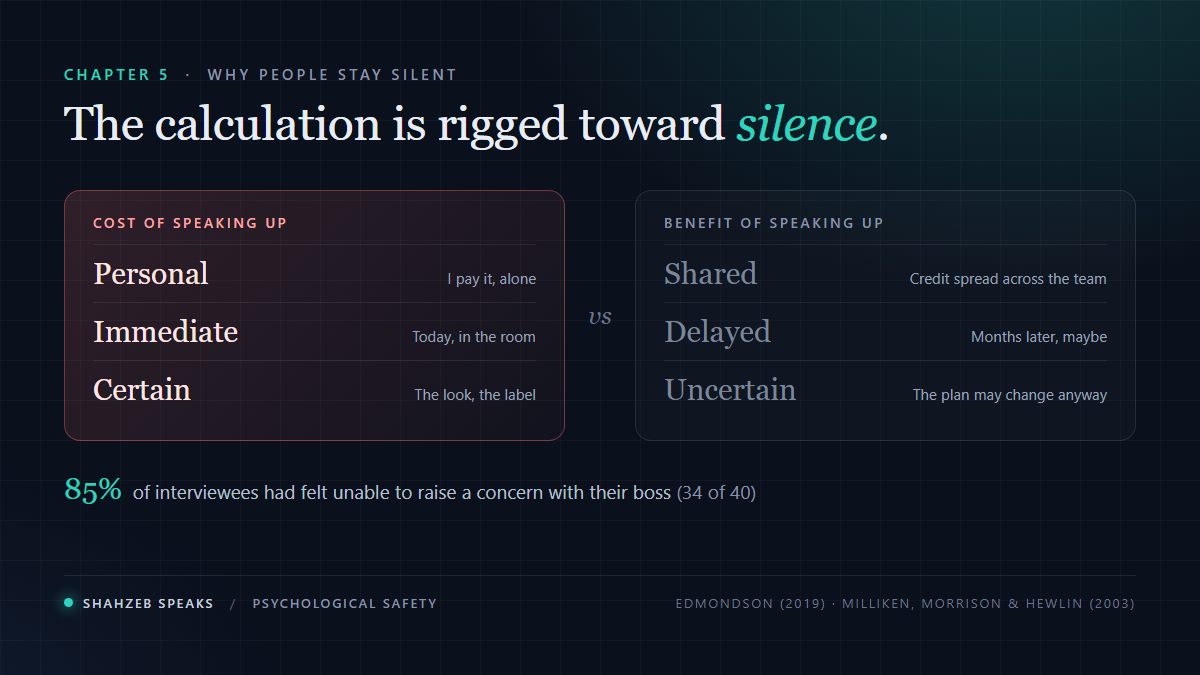
Every time someone considers speaking up, they are running a quick, mostly unconscious calculation. Edmondson describes the asymmetry clearly: the costs of speaking up are personal, immediate and certain, while the benefits are shared, delayed and uncertain. If I point out the flaw in the director’s plan, I definitely pay the social cost today. The benefit, a better plan, may or may not arrive months from now, and credit for it will be spread across the team. No wonder silence wins.
Most people have held something back
In an interview study published in 2003, Frances Milliken, Elizabeth Morrison and Patricia Hewlin asked employees whether they had ever felt unable to raise an issue or concern with their bosses. Thirty-four of the forty people they interviewed, 85%, said yes. The most common reason was fear of being seen negatively, as a troublemaker or a complainer, and fear of damaging relationships. It was a small, qualitative sample, but it matched a wider body of research on what Morrison and Milliken had earlier called organisational silence.
People follow unwritten rules of self-censorship
James Detert and Amy Edmondson published a study in 2011 in the Academy of Management Journal on what they called implicit voice theories: taken-for-granted beliefs about when speaking up is dangerous. Examples include “don’t criticise an idea in front of the person who owns it,” “don’t go over your boss’s head,” and “you need solid data before you say anything.” These rules are rarely taught. They are absorbed, and they keep people quiet even under leaders who have never punished anyone.
The leader is usually the signal
Detert and Burris found in 2007 that leader openness was related to whether employees spoke up, and that the relationship ran through psychological safety. People do not read the policy. They read the boss. Specifically, they watch what happened to the last person who delivered bad news.
🇵🇰 Chapter 6: Power distance, and why this is harder in some cultures
This chapter matters for readers in Pakistan, South Asia and the Gulf, and it is usually missing from the Western versions of this topic.
Geert Hofstede’s cultural research uses a dimension called power distance: how much people expect and accept that power is distributed unequally. On Hofstede’s published country scores, Pakistan sits at 55, higher than the United States (40) and the United Kingdom (35). Country scores are broad averages and every organisation differs, but the direction is meaningful.
In higher power-distance settings, several things make psychological safety harder to build:
- Disagreeing with a senior person can read as disrespect, not as useful input. The junior person who challenges the plan is not seen as helpful; they are seen as forgetting their place.
- “Sir, it will be done” becomes the safe answer to every deadline, whether or not it is true, so leaders learn about slippage at the last moment.
- Family and seniority dynamics in owner-run businesses can make a founder’s idea effectively unchallengeable.
- Silence is often read as agreement, when in the room it frequently means the opposite.
None of this means psychological safety is a Western luxury. It means the leader’s role is even larger. Where hierarchy is respected, the most senior person has an unusually strong ability to create safety by explicitly giving permission, because people take their cues from the top. A Karachi or Lahore manager who says “I want you to tell me where this plan is weak, and I will thank you for it” and then actually thanks the person does more than a Western manager saying the same words, because the signal is rarer and carries more authority. I work with organisations on exactly this in my organisational psychology work, and the pattern is consistent: the cultural barrier is real, and it moves faster than people expect once the top of the room changes its behaviour.
⚠️ Chapter 7: The honest part — what psychological safety is not, and where it goes wrong
Popular writing on this topic is almost entirely positive. The research is more interesting than that, and a psychologist who only gives you the flattering half is selling, not advising.
It is not niceness
Edmondson has said repeatedly that psychological safety is not about being nice. Teams where everyone is polite and nobody disagrees are often the least safe, because politeness is being used to avoid risk. Candour is the product of safety, not its enemy. A safe team argues more, not less.
It is not lower standards or no consequences
Safety means you will not be humiliated or punished for raising a problem, admitting an error or asking a question. It does not mean repeated careless work carries no consequence, or that a missed commitment is not discussed. The four zones make this explicit: comfort without standards is a failure, not a goal.
It is not a guarantee that people agree with you
A common misuse runs: “I don’t feel psychologically safe because my manager rejected my idea.” Being disagreed with, even firmly, is not a safety violation. Being mocked, ignored or penalised for having raised the idea is.
It can make bad teams more efficient at bad things
This is the finding that rarely appears in articles about the topic. Pearsall and Ellis published a study in 2011 in the Journal of Applied Psychology titled, memorably, “Thick as thieves.” They found that psychological safety could amplify unethical team behaviour when the team’s ethical orientation leaned toward “the ends justify the means.” Safety helps a team coordinate and speak freely, and a team that is comfortable cutting corners becomes more comfortable cutting them together. Safety is a multiplier. It multiplies whatever the team is already pointed at.
The evidence is mostly correlational
Most studies measure psychological safety and outcomes at the same time using surveys, often from the same people. That makes it hard to prove direction. Do safe teams perform better, or do teams that are performing well feel safer? Probably both. The field is strong on association and growing on causation, and anyone who tells you psychological safety “increases performance by X%” as a fixed law is claiming more than the research supports.
The famous statistics are often invented
Search this topic and you will find confident figures about how much safer teams outperform, with no study attached. I have deliberately used only findings I can trace to a named paper in this article. If a number about psychological safety comes without a source, treat it as marketing.
🛠️ Chapter 8: Six moves that build psychological safety
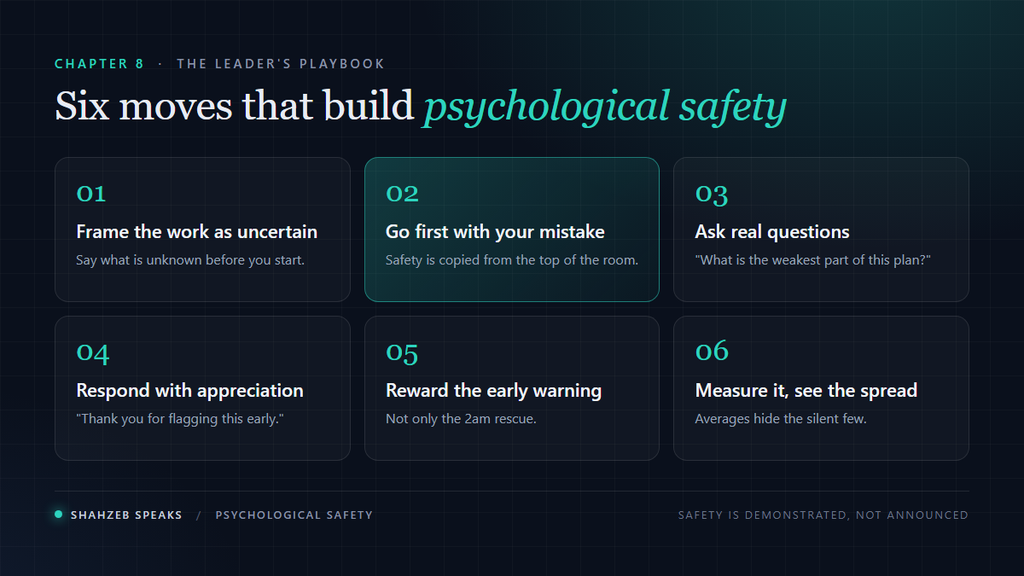
Edmondson’s own framework groups the leader’s job into setting the stage, inviting participation and responding productively. The six moves below follow that logic and translate it into behaviour you can do this week.
- Frame the work as uncertain. Before a project starts, say out loud what is unknown: “We have not done this before, and some of our assumptions will be wrong. I need you to tell me which ones.” Framing a task as a learning problem rather than an execution problem makes raising concerns part of the job instead of a deviation from it.
- Go first with your own mistake. Safety is copied from the most senior person in the room. A leader who says “I got that call wrong last month, and here is what I learned” makes the sentence available to everyone else. This is the fastest single move available, and the one most leaders avoid.
- Ask real questions, and make the silence comfortable. “Any questions?” gets silence. “What is the weakest part of this plan?” or “What would have to be true for this to fail?” gets answers. Then wait. The first few seconds of silence are when people decide whether you meant it.
- Respond to bad news with appreciation, not a verdict. The moment someone raises a problem is the moment the whole team is watching. “Thank you for flagging this early” before any discussion of what went wrong teaches everyone that raising issues is valued. A sigh, a sharp question about who is responsible, or a visible flash of irritation teaches the opposite, permanently.
- Reward the early warning, not only the late rescue. If the person who stayed until 2am to fix the crisis gets public praise, and the person who flagged the risk three months earlier was ignored, you have told everyone exactly how to behave. Name and credit the early signal.
- Measure it, and look at the distribution, not only the average. Edmondson’s seven-item scale is widely used, with statements such as “If you make a mistake on this team, it is often held against you” (reverse-scored) and “Members of this team are able to bring up problems and tough issues.” Run it anonymously, at team level, and look at the spread. A team average of “fairly safe” can hide one or two people who feel entirely unable to speak.
If you want a structured version of this, including the scale, scoring and a facilitation guide for discussing results with a team, I built The Psychological Safety Audit as a ready-to-run kit.
👤 Chapter 9: If you are not the leader
Most advice on this topic is written for managers. But many readers are the person in the meeting deciding whether to speak. A few approaches work better than simply summoning courage.
Frame concerns as questions about the goal. “I want to make sure we hit the launch date. What happens if the vendor is late?” lands very differently from “this timeline is unrealistic.” You are raising the same risk, aligned with the leader’s interest rather than against it.
Bring it early and small. A concern raised at 10% of the way through a project is a planning input. The same concern at 90% is a crisis, and whoever raises it inherits some of the blame for the timing.
Use private channels first with high power-distance leaders. In cultures and companies where public disagreement is costly, a short one-to-one conversation before the meeting often achieves what the meeting never would, and lets the leader adopt the idea as their own.
Notice the pattern, not the incident. One sharp reaction may be a bad day. A consistent pattern where bad news is punished is information about the environment, and it is worth taking seriously for your own wellbeing. Prolonged silence at work is closely linked to the disengagement I described in my article on what the research shows about quiet quitting.
📝 The takeaway
Psychological safety began as a mistake in a hospital study, and it remains the most useful correction in organisational psychology: the teams that look like they have the fewest problems are sometimes the teams that are hiding the most.
It is not comfort, and it is not lower standards. It is the shared belief that telling the truth at work will not cost you. Where that belief exists, problems surface while they are cheap, people learn from errors instead of concealing them, and hard goals become reachable. Where it does not, even very talented people spend their energy managing how they look.
The part I would leave any leader with is the error paradox from Chapter 2. Your team’s silence is data, and so is its volume of bad news. If you rarely hear about problems, do not assume there are none. Assume you have not yet made it safe to tell you, and start with your own mistake.
❓ Frequently asked questions
What is psychological safety in simple words?
Psychological safety is a shared belief in a team that you will not be embarrassed, punished or rejected for speaking up with a question, a concern, a mistake or a disagreement. The term was defined in team research by Harvard professor Amy Edmondson in 1999.
What is an example of psychological safety at work?
A junior analyst tells the director in a meeting that the forecast is built on a figure she thinks is wrong, and the director thanks her and checks it rather than dismissing her. Another example is a team reviewing a failed project without looking for someone to blame, and focusing on what they would do differently.
Is psychological safety the same as being nice?
No. Psychologically safe teams often disagree more openly than other teams. Politeness that avoids hard conversations can be a sign of low safety. Safety means candour is possible without punishment, not that everyone agrees or avoids criticism.
Does psychological safety mean no accountability?
No. Edmondson’s model separates safety from standards. High safety with low standards produces a comfort zone. High safety combined with high standards produces the learning zone, where the best performance happens. Google’s Project Aristotle also listed dependability and clarity alongside psychological safety.
How do you measure psychological safety?
The most widely used measure is Edmondson’s seven-item survey scale, answered anonymously by team members and analysed at team level. Items cover whether mistakes are held against people, whether people can raise tough issues, and whether it is safe to take a risk on the team. Look at the spread of answers as well as the average.
What is Project Aristotle?
Project Aristotle was Google’s internal study of more than 180 teams, reported in 2016. It found that how team members worked together mattered more than who was on the team, and identified psychological safety as the most important of five dynamics, along with dependability, structure and clarity, meaning, and impact.
Can psychological safety be built in a hierarchical culture like Pakistan?
Yes, though it takes more deliberate leadership. In higher power-distance cultures, people take strong cues from senior leaders, so a senior person who explicitly invites challenge, admits their own mistakes and responds with appreciation to bad news can shift a team’s behaviour noticeably.
🧠 Is your team in the learning zone, or only looking like it?
I’m Muhammad Shahzeb, an MSc Industrial and Organizational Psychologist. I measure psychological safety, voice and engagement in teams using validated methods, and I tell you honestly where silence is costing you, including when the answer is the leadership behaviour at the top of the room.
📚 References and further reading
- Edmondson, A. C. (1996). “Learning from mistakes is easier said than done: Group and organizational influences on the detection and correction of human error.” Journal of Applied Behavioral Science, 32(1), 5-28.
- Edmondson, A. C. (1999). “Psychological safety and learning behavior in work teams.” Administrative Science Quarterly, 44(2), 350-383.
- Edmondson, A. C. (2019). The Fearless Organization: Creating Psychological Safety in the Workplace for Learning, Innovation, and Growth. Wiley.
- Edmondson, A. C., & Lei, Z. (2014). “Psychological safety: The history, renaissance, and future of an interpersonal construct.” Annual Review of Organizational Psychology and Organizational Behavior, 1, 23-43.
- Kahn, W. A. (1990). “Psychological conditions of personal engagement and disengagement at work.” Academy of Management Journal, 33(4), 692-724.
- Frazier, M. L., Fainshmidt, S., Klinger, R. L., Pezeshkan, A., & Vracheva, V. (2017). “Psychological safety: A meta-analytic review and extension.” Personnel Psychology, 70(1), 113-165.
- Duhigg, C. (2016, February 25). “What Google learned from its quest to build the perfect team.” The New York Times Magazine. See also Google re:Work, “Guide: Understand team effectiveness.”
- Milliken, F. J., Morrison, E. W., & Hewlin, P. F. (2003). “An exploratory study of employee silence: Issues that employees don’t communicate upward and why.” Journal of Management Studies, 40(6), 1453-1476.
- Morrison, E. W., & Milliken, F. J. (2000). “Organizational silence: A barrier to change and development in a pluralistic world.” Academy of Management Review, 25(4), 706-725.
- Detert, J. R., & Burris, E. R. (2007). “Leadership behavior and employee voice: Is the door really open?” Academy of Management Journal, 50(4), 869-884.
- Detert, J. R., & Edmondson, A. C. (2011). “Implicit voice theories: Taken-for-granted rules of self-censorship at work.” Academy of Management Journal, 54(3), 461-488.
- Pearsall, M. J., & Ellis, A. P. J. (2011). “Thick as thieves: The effects of ethical orientation and psychological safety on unethical team behavior.” Journal of Applied Psychology, 96(2), 401-411.
- Hofstede, G., Hofstede, G. J., & Minkov, M. (2010). Cultures and Organizations: Software of the Mind (3rd ed.). McGraw-Hill. (Power distance country scores.)
Written by Muhammad Shahzeb, MSc Industrial & Organizational Psychology | Workplace Psychology Specialist | Full-Stack Web Developer
Learn more about my approach →