
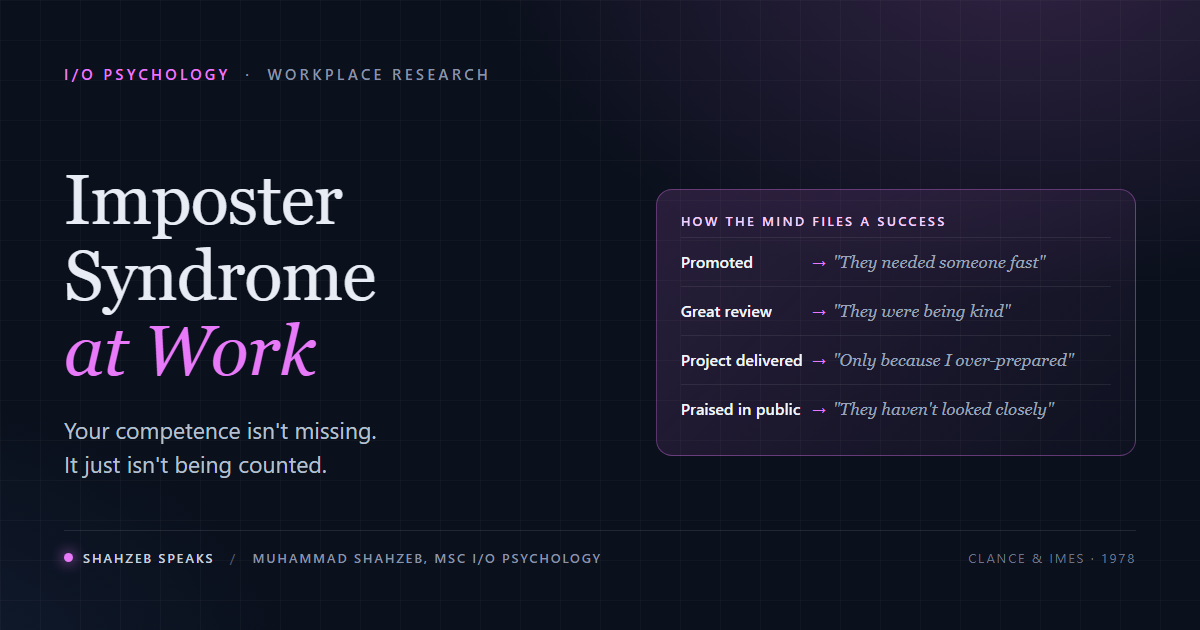
You got the job. You got the promotion. You presented to the board and it went well. And somewhere underneath the relief there is a small, persistent voice saying: they have not realised yet. They think you are more capable than you are. It was luck, or timing, or the fact that nobody looked closely. Sooner or later someone will.
If that voice sounds familiar, you have almost certainly been told it has a name: imposter syndrome. You have probably also been told that 70% of people experience it, that it mainly affects high-achieving women, and that the cure is to believe in yourself more.
Almost all of that is shakier than it sounds. The psychologists who first described it never called it a syndrome. The 70% figure has no study behind it. It affects men as well as women. And one of the most interesting recent workplace studies found that people with imposter thoughts were rated by colleagues as more interpersonally effective, not less. I am an Industrial and Organizational Psychologist, and this article covers what the research actually shows, the cycle that keeps the feeling alive, the uncomfortable question of when the workplace is causing it, and what genuinely helps.
“Imposter syndrome is not the belief that you are incompetent. It is the belief that your competence does not count as evidence. Success arrives, and the mind files it under luck. That is why more success does not cure it, and why telling people to feel more confident misses the mechanism entirely.”
— Workplace Psychology Analysis, ShahzebSpeaks
🔍 Chapter 1: What imposter syndrome actually is
The idea comes from a 1978 paper by psychologists Pauline Rose Clance and Suzanne Imes, published in Psychotherapy: Theory, Research & Practice. Working with high-achieving women in clinical and academic settings, they described a pattern they called the impostor phenomenon: a persistent internal experience of intellectual fraudulence, despite clear external evidence of success.
Notice the word they chose. Phenomenon, not syndrome. It is not a mental disorder. It does not appear in the DSM-5 or ICD-11, and there is no clinical diagnosis of “imposter syndrome.” It is an experience, and a very common one, which is part of why the popular label misleads people: calling it a syndrome makes an ordinary pattern of self-doubt sound like a condition you either have or do not.
The pattern has a recognisable shape. People who experience it tend to:
- Attribute success to external causes: luck, timing, help from others, a lenient evaluator, “they needed someone quickly.”
- Attribute failure to internal causes: “this proves I am not good enough.”
- Fear being found out, often very specifically, as if exposure is a matter of time.
- Struggle to accept praise, deflecting it or privately dismissing it.
- Set extremely high standards and experience anything below them as evidence of fraud.
The crucial feature, and the one popular advice overlooks, is the first. The issue is not a lack of evidence of competence. It is the refusal to count that evidence. That is why accumulating more achievements rarely helps. Each new success simply gets explained away, and the explanation leaves the underlying belief untouched.
🧪 Chapter 2: What it is not
Several things get mixed up with imposter feelings, and separating them matters because they call for different responses.
It is not ordinary nerves in a new role
Feeling uncertain in your first months in a new job is not imposter syndrome. It is an accurate reading of the situation: you are new, you do not yet know everything, and some doubt is appropriate. Imposter feelings are distinguished by persistence despite evidence. The feeling is still there after three years of good performance reviews.
It is not the Dunning-Kruger effect in reverse
People often cite the Dunning-Kruger effect, from Kruger and Dunning’s 1999 paper, as though it proved that competent people doubt themselves. The original finding was mainly about low performers overestimating themselves. It did find that top performers somewhat underestimated how they compared with others, but that is a much narrower point than “experts always feel like frauds,” and the effect itself has faced serious statistical criticism since. It is not a scientific explanation of imposter feelings.
It is not low self-esteem, exactly
The two are related, and imposter feelings correlate with lower self-esteem in research. But many people with imposter feelings have quite a stable sense of their worth outside work. The doubt is specific to competence and achievement, not a general sense of being unworthy.
It is not always a problem inside the person
This is the most important distinction, and Chapter 6 is devoted to it. Sometimes a person feels like they do not belong because the environment is telling them, repeatedly and in small ways, that they do not. Calling that “imposter syndrome” relocates a problem in the organisation into the head of the person experiencing it.
🔁 Chapter 3: The imposter cycle — why success does not fix it
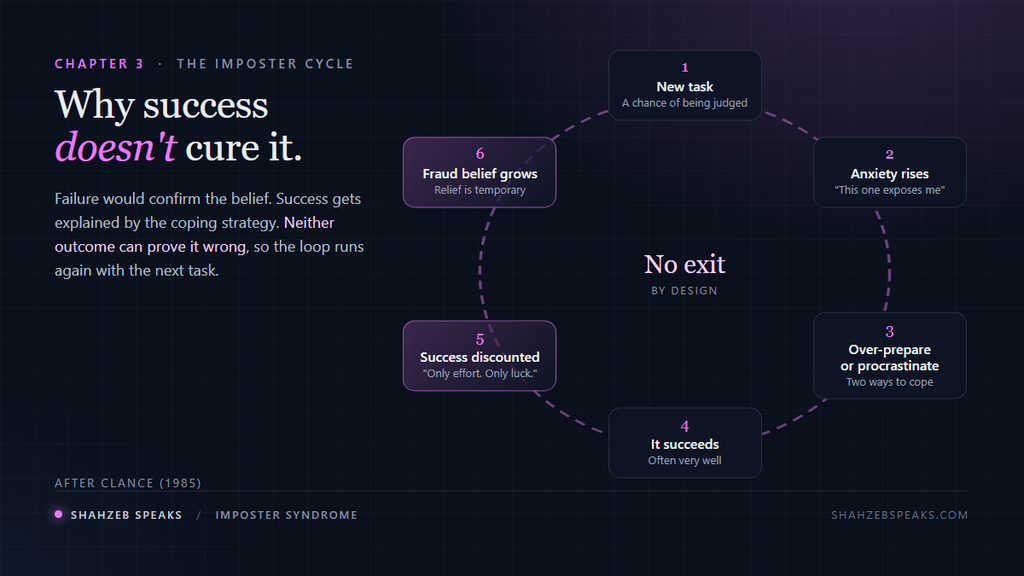
Clance later described what she called the imposter cycle, and it explains the most frustrating feature of imposter feelings: they survive success. The cycle runs in six steps.
- A new task arrives with any real chance of evaluation: a presentation, a report, a promotion case.
- Anxiety and self-doubt rise. “This is the one that exposes me.”
- One of two coping strategies kicks in. Some people over-prepare heavily, working far beyond what the task needs. Others procrastinate, then work frantically at the last moment.
- The task succeeds, often well.
- The success is discounted. The over-preparer concludes: “It only worked because I worked three times harder than a real expert would need to.” The procrastinator concludes: “I got lucky; it came together at the last minute.”
- The fraud belief is reinforced, and the relief is temporary. The next task starts the loop again.
Psychologically this is a closed system. Neither outcome can disconfirm the belief. Failure would confirm it directly. Success gets explained by the coping strategy itself. The person never runs the one experiment that would test the belief: doing a normal amount of preparation and seeing whether a normal amount of success follows.
There is a second cost. Over-preparation is expensive. It consumes hours, crowds out rest and other work, and is a direct route to exhaustion. Research reviewed by Bravata and colleagues in 2020 found imposter feelings associated with burnout, lower job satisfaction and poorer job performance across a range of professions. I covered the wider burnout mechanism in my article on the psychology of workplace burnout, and chronic over-preparation driven by fear is one of its quieter fuels.
📊 Chapter 4: How common is it? The 70% myth
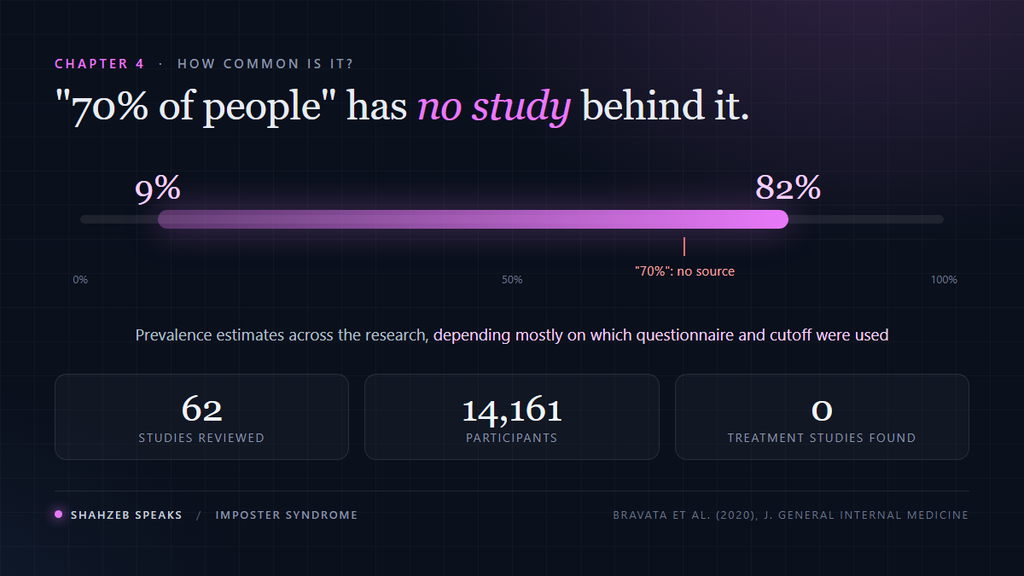
You will see the claim everywhere: “70% of people experience imposter syndrome at some point in their lives.” It appears in articles, corporate training slides and TED-style talks. I have looked for the study it comes from. There is not one. It is repeated from source to source without a traceable origin in a representative sample.
The best evidence we actually have is a 2020 systematic review by Dena Bravata and colleagues in the Journal of General Internal Medicine. They screened the research published between 1966 and 2018 and included 62 studies covering 14,161 participants. What they found is more useful than any single number:
- Prevalence estimates ranged from 9% to 82%, “largely depending on the screening tool and cutoff used.” In other words, the answer to “how common is it?” depends mostly on how you ask.
- Rates were particularly high among ethnic minority groups.
- It was common among both men and women, and across ages from adolescents to late-career professionals.
- It was often found alongside depression and anxiety, and linked to impaired job performance, job satisfaction and burnout.
- No published study had evaluated a treatment for it.
That last point deserves attention. Coaching programmes, workshops and apps promising to cure imposter syndrome are selling an intervention that, as of that review, nobody had rigorously tested. Some of the techniques in Chapter 8 have good evidence behind them for related problems, which is why I include them, but the honest statement is that the treatment research for imposter feelings specifically is still thin.
I apply the same caution to statistics in my own work: a number with no study behind it is marketing, not research. I built a free rating confidence calculator on the same principle, because a figure that sounds precise can rest on almost nothing.
👥 Chapter 5: Who feels it, and the gender question
Because Clance and Imes studied high-achieving women, imposter syndrome became culturally coded as a women’s issue. The original sample explains the framing, but the research since has not supported the idea that it is mainly female.
Bravata’s review found it common across genders. Findings on whether women report it more often are mixed and depend on the sample and measure. But a 2018 study by Rebecca Badawy and colleagues in Personality and Individual Differences found something more interesting than a difference in frequency: a difference in reaction. Men who scored high on imposter measures reported more anxiety during a task than women who scored similarly. When they were held accountable, they reduced their effort and performed worse. And when given negative feedback, women with strong imposter feelings increased their effort and outperformed the men. The feeling may be shared, while the way it plays out under pressure differs.
The groups where imposter feelings show up most strongly are telling, and they point toward the next chapter:
- People who are the first in their family to reach a university, profession or social class.
- Ethnic and racial minorities in environments where they are underrepresented.
- Early-career professionals in high-status, high-evaluation fields such as medicine, law, academia and technology.
- People recently promoted into a role with visibly different expectations, which I discussed in my article on why new managers micromanage.
What these groups share is not a personality type. It is a situation: being in a place where you have fewer signals that people like you belong there.
🏢 Chapter 6: Is it the person, or the room?
This is the chapter most articles skip, and as an organisational psychologist I think it is the most important.
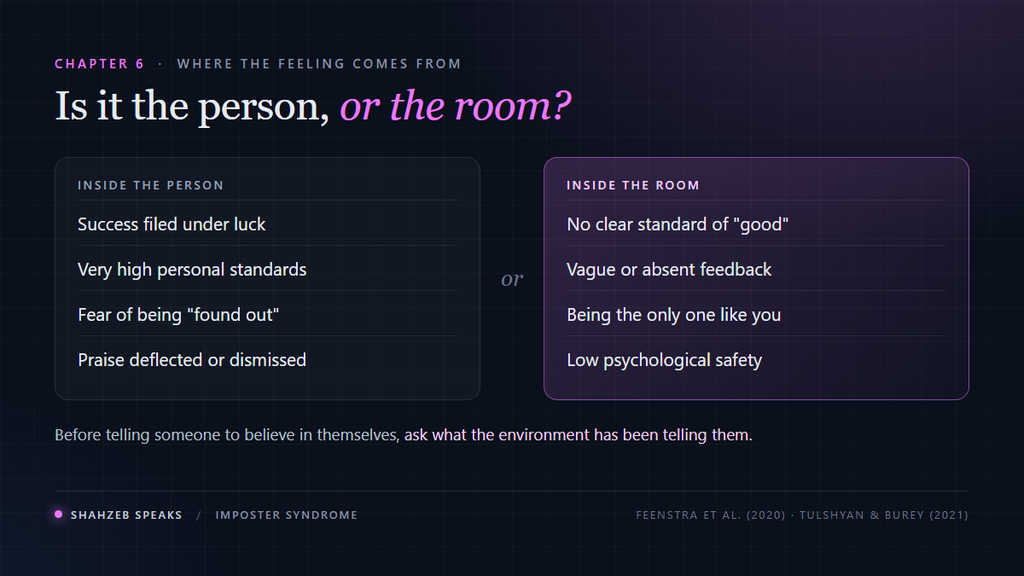
In 2020, Jolien Feenstra and colleagues published a paper in Frontiers in Psychology titled “Contextualizing the Impostor ‘Syndrome’.” Their argument was that research had focused almost entirely on the individual, and had neglected how the social environment produces impostor feelings. If you are repeatedly the only person like you in the room, if you are mistaken for a junior colleague, if your contributions are attributed to others, then feeling that you do not belong is not a distortion. It is a reasonable inference from the evidence you are receiving.
The following year, Ruchika Tulshyan and Jodi-Ann Burey made the same point in a widely read Harvard Business Review article, “Stop Telling Women They Have Imposter Syndrome.” Their argument was that the label puts the burden of fixing exclusion on the people being excluded.
From an I/O psychology standpoint, there are four organisational conditions that reliably produce imposter feelings in people who would not otherwise have them:
- Unclear standards. If nobody can tell you what “good” looks like, you cannot know whether you are meeting it, and uncertainty fills with doubt.
- Absent or vague feedback. People with no clear performance signal default to their most anxious interpretation.
- Visible underrepresentation. Being the only woman, the only person from a particular background, or the only non-native speaker makes you feel observed and evaluated as a representative.
- Low psychological safety. In a team where mistakes are punished and questions look weak, everyone hides uncertainty, so each person concludes they are the only one who feels it. I covered this in detail in my article on psychological safety at work.
That last point creates a trap worth naming. Imposter feelings spread in silence. When nobody admits doubt, everyone privately believes they are the fraud among real experts. The moment one respected person says “I felt completely out of my depth in my first year,” others recognise the feeling as normal rather than as evidence of personal inadequacy.
⚠️ Chapter 7: The honest part — when imposter thoughts might help
Almost everything written about imposter feelings treats them as purely harmful. The evidence is more interesting.
Imposter thoughts and being good with people
In 2022, Basima Tewfik published a study in the Academy of Management Journal that examined what she called workplace impostor thoughts. Across several studies, including investment professionals and physicians in training, employees who had more frequent impostor thoughts were rated by others as more interpersonally effective, not less. Tewfik’s explanation was that people who worry about falling short become more other-oriented: they listen more, ask more, and pay more attention to the people they work with.
This is a single research programme and should not be overstated. It does not mean imposter feelings are good, or that anyone should want them. But it does challenge the assumption that the feeling only damages performance.
Doubt is not always wrong
Some people who feel out of their depth are, in fact, out of their depth, at least for now. A new manager who has never managed, or a specialist moved into an unfamiliar field, may be accurately detecting a skills gap. Treating every doubt as a distortion to be argued away can prevent someone from getting training they genuinely need.
The label can become an identity
Once someone decides they “have imposter syndrome,” the label can explain away every uncomfortable feeling in advance, and sometimes discourage the ordinary work of seeking feedback. A useful label describes a pattern; a harmful one becomes a permanent self-description.
Confidence is not the goal
The popular fix is more confidence. But confidence and competence are only loosely related, and plenty of workplace damage is done by people with high confidence and low accuracy. The goal is not to feel certain. It is to evaluate your own performance accurately, count the evidence fairly, and act despite reasonable doubt.
🛠️ Chapter 8: What actually helps
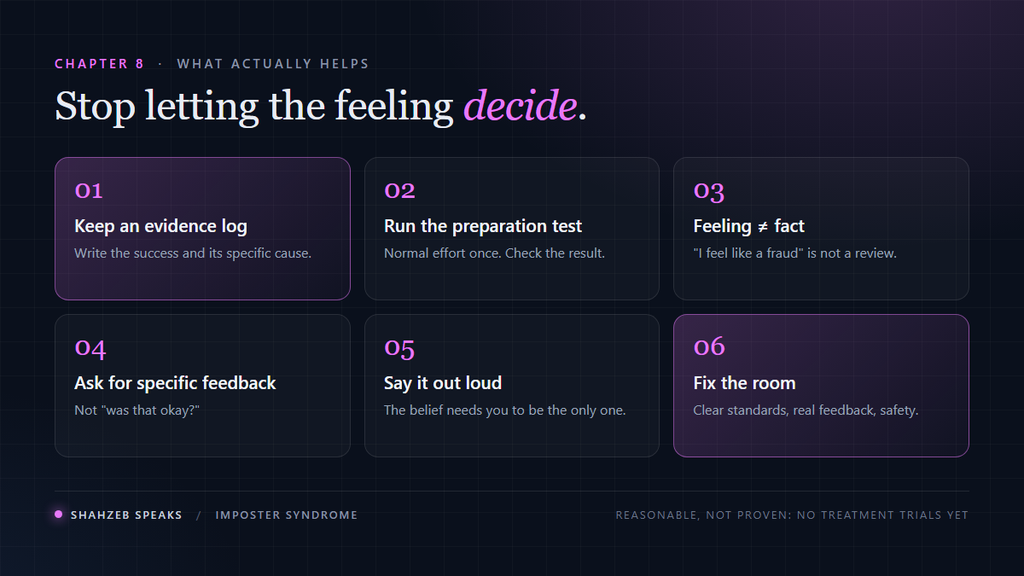
Given that no treatment for imposter feelings has been rigorously tested, I want to be clear about the basis for these suggestions. They draw on well-established methods for related patterns, such as anxiety, perfectionism and attribution, and on organisational research. They are reasonable, not proven cures.
If you are the one feeling it
- Keep an evidence log, and write down the cause. For every success, record what happened and why it went well. The discipline is in the second part: before writing “luck,” name the specific skill or decision that contributed. You are training yourself to count evidence you normally discard.
- Run the preparation experiment. Pick one lower-stakes task and prepare a normal amount, deliberately. Note the result. This directly tests the belief that only extraordinary effort keeps you from being exposed, and it is the one test the imposter cycle is designed to avoid.
- Separate the feeling from the fact. “I feel like a fraud” is a report about an emotional state, not a performance assessment. Cognitive behavioural approaches teach this distinction well: notice the thought, then look at the evidence as if it concerned a colleague.
- Ask for specific feedback, not reassurance. “Was that okay?” invites a reassuring answer you will dismiss. “What is one thing I did well in that presentation, and one thing to improve?” produces concrete information that is much harder to explain away.
- Say it out loud to someone you trust. Imposter feelings rely on the belief that you are the only one. A conversation with a mentor or peer often reveals that they have felt exactly the same, which removes the most important support for the belief.
- Know when to get professional support. Because imposter feelings frequently occur alongside anxiety and depression, persistent distress that affects your sleep, health or ability to work is worth discussing with a qualified mental health professional, not just a career coach.
If you manage people who feel it
- Define what good looks like. Clear, written standards remove the uncertainty that doubt feeds on.
- Give specific, regular feedback. Vague praise (“great job”) is easy to dismiss. Specific feedback (“your analysis of the churn data changed the director’s decision”) is evidence. My Performance Review Rewrite Kit is built around exactly this kind of specific, behaviour-based feedback.
- Normalise doubt from the top. Senior people describing their own early uncertainty does more than any workshop.
- Look at the room. If imposter feelings cluster among underrepresented groups on your team, examine attribution of credit, who gets interrupted, and who gets stretch assignments before recommending confidence training.
🇵🇰 Chapter 9: A note for readers in Pakistan and South Asia
Several features common in South Asian workplaces can intensify imposter feelings, and they are rarely discussed.
Degree and institution hierarchies. In many organisations the university you attended, or whether you studied abroad, carries lasting weight. Someone who reached a role from a less prestigious institution can feel permanently on probation, however well they perform.
Family expectations as the measuring stick. When career success is tied closely to family honour or comparison with relatives, the stakes of being “found out” can feel far larger than the job itself.
Low feedback cultures. Where direct praise from seniors is rare and criticism is common, employees receive little evidence that they are doing well, and silence gets read as disapproval.
First-generation professionals. Many young professionals in Pakistan are the first in their families to work in corporate, technology or professional roles, which is exactly the group where imposter feelings appear most strongly in research elsewhere.
None of this is a clinical claim about a population. It is a practical observation about conditions. And it means that for many organisations in the region, the most effective response is organisational: clearer standards, more specific feedback, and seniors willing to talk openly about their own doubts. I work with organisations on exactly these questions through my organisational psychology work.
📝 The takeaway
Imposter syndrome is one of the most popular ideas in workplace psychology and one of the least carefully described. It is not a diagnosis. The famous statistic has no source. It is not mainly a women’s issue. And it is not always a distortion inside the person.
What is real is the pattern Clance and Imes described: success that does not count as evidence, sustained by a cycle of over-preparation or procrastination that makes every good outcome explainable by something other than ability. That pattern is common, it is linked to burnout and anxiety, and it responds better to changing how evidence is counted than to being told to feel more confident.
The question I would leave with both individuals and organisations is the one from Chapter 6. Before deciding someone needs to believe in themselves more, ask what the environment has been telling them. Sometimes the fix is in the person’s head. Often it is in the room.
❓ Frequently asked questions
What is imposter syndrome in simple words?
Imposter syndrome, properly called the impostor phenomenon, is a persistent feeling that you are not as competent as others believe and that you will eventually be exposed as a fraud, even when there is clear evidence of your success. It was first described by psychologists Pauline Clance and Suzanne Imes in 1978.
Is imposter syndrome a mental illness?
No. It is not a recognised diagnosis in the DSM-5 or ICD-11. It is a common pattern of thinking and feeling. However, it often occurs alongside anxiety and depression, which are clinical conditions and may need professional support.
Do 70% of people have imposter syndrome?
There is no reliable study behind that figure. A 2020 systematic review of 62 studies with 14,161 participants found prevalence estimates ranging from 9% to 82%, depending mostly on the questionnaire and cutoff used.
What are the signs of imposter syndrome at work?
Common signs include attributing your successes to luck or timing, fearing that colleagues will discover you are not capable, difficulty accepting praise, extreme over-preparation or last-minute procrastination, and feeling that each success was a narrow escape rather than evidence of skill.
Does imposter syndrome affect men?
Yes. Although it was first described in a study of women, later research has found it common across genders. Some research suggests men with strong imposter feelings may react worse to negative feedback and high accountability.
How do you overcome imposter syndrome?
Helpful approaches include keeping a record of successes along with their specific causes, deliberately testing whether normal preparation produces good results, separating feelings from evidence, asking for specific feedback rather than reassurance, and talking openly with trusted peers. Persistent distress should be discussed with a mental health professional.
Can the workplace cause imposter syndrome?
Researchers increasingly argue that it can. Unclear standards, vague feedback, underrepresentation and low psychological safety can all produce feelings of not belonging in people who would not otherwise experience them.
🧠 Are your best people doubting themselves, or is your system making them?
I’m Muhammad Shahzeb, an MSc Industrial and Organizational Psychologist. I help organisations fix the conditions behind self-doubt and disengagement, including unclear standards, weak feedback and low psychological safety, so talented people can stop spending their energy proving they belong.
📚 References and further reading
- Clance, P. R., & Imes, S. A. (1978). “The imposter phenomenon in high achieving women: Dynamics and therapeutic intervention.” Psychotherapy: Theory, Research & Practice, 15(3), 241-247.
- Clance, P. R. (1985). The Impostor Phenomenon: Overcoming the Fear That Haunts Your Success. Peachtree. (The imposter cycle and the Clance IP Scale.)
- Bravata, D. M., Watts, S. A., Keefer, A. L., Madhusudhan, D. K., Taylor, K. T., Clark, D. M., Nelson, R. S., Cokley, K. O., & Hagg, H. K. (2020). “Prevalence, predictors, and treatment of impostor syndrome: A systematic review.” Journal of General Internal Medicine, 35(4), 1252-1275.
- Tewfik, B. A. (2022). “The impostor phenomenon revisited: Examining the relationship between workplace impostor thoughts and interpersonal effectiveness at work.” Academy of Management Journal, 65(3), 988-1018.
- Feenstra, S., Begeny, C. T., Ryan, M. K., Rink, F. A., Stoker, J. I., & Jordan, J. (2020). “Contextualizing the impostor ‘syndrome’.” Frontiers in Psychology, 11, 575024.
- Tulshyan, R., & Burey, J.-A. (2021, February 11). “Stop telling women they have imposter syndrome.” Harvard Business Review.
- Badawy, R. L., Gazdag, B. A., Bentley, J. R., & Brouer, R. L. (2018). “Are all impostors created equal? Exploring gender differences in the impostor phenomenon-performance link.” Personality and Individual Differences, 131, 156-163.
- Vergauwe, J., Wille, B., Feys, M., De Fruyt, F., & Anseel, F. (2015). “Fear of being exposed: The trait-relatedness of the impostor phenomenon and its relevance in the work context.” Journal of Business and Psychology, 30(3), 565-581.
- Kruger, J., & Dunning, D. (1999). “Unskilled and unaware of it: How difficulties in recognizing one’s own incompetence lead to inflated self-assessments.” Journal of Personality and Social Psychology, 77(6), 1121-1134.
- Leary, M. R., Patton, K. M., Orlando, A. E., & Funk, W. W. (2000). “The impostor phenomenon: Self-perceptions, reflected appraisals, and interpersonal strategies.” Journal of Personality, 68(4), 725-756.
Written by Muhammad Shahzeb, MSc Industrial & Organizational Psychology | Workplace Psychology Specialist | Full-Stack Web Developer
Learn more about my approach →