
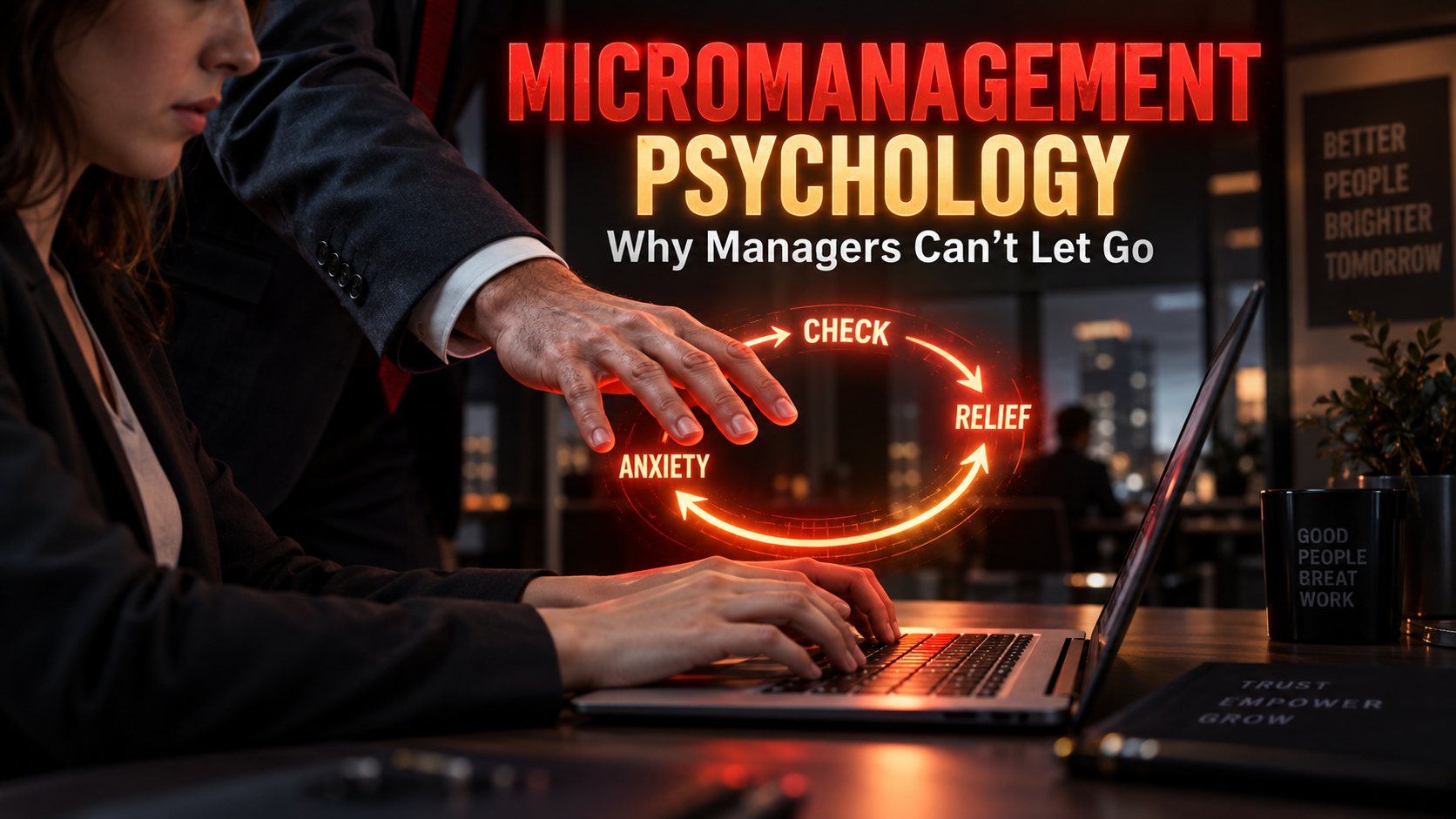
Ask anyone about micromanagement and you get the same picture: a manager who enjoys control, who does not trust anyone, who needs to feel important. It is a satisfying explanation because it makes the problem simple and gives you someone to blame.
It is also, in my experience of actually sitting with these managers, mostly wrong. Almost nobody enjoys micromanaging. The person checking the same document for the fourth time is not savouring their power. They are exhausted, working longer hours than anyone on their team, and privately aware that they are the bottleneck. If control felt good, they would not look like that.
That gap between how micromanagement looks from below and how it feels from inside is the most useful thing in this whole topic, and it is where the actual explanation lives. I am an Industrial and Organizational Psychologist, and this article covers what is genuinely happening inside a manager who cannot let go, the structural trap that produces most cases, the loop that makes it worse over time, the honest question of when close supervision is simply correct management, and what actually works on both sides.
“Micromanagement is not a personality trait dressed up as a management style. It is an anxiety behaviour that happens to be socially permitted at work. The manager is not trying to control the work. They are trying to stop feeling the fear, and checking is the only lever they have.”
— Workplace Psychology Analysis, ShahzebSpeaks

🔍 Chapter 1: What micromanagement actually is
Before the psychology, a definition, because the word gets used for two completely different things and the confusion causes real damage.
Close supervision is high direction matched to a situation that needs it. A new hire in week two. A junior on their first client deliverable. A regulated process where errors are expensive. Detailed oversight here is not a failure of management, it is management.
Micromanagement is high direction that is not matched to the situation. Specifically it has three markers worth memorising:
- It does not decrease as competence increases. The same person, doing the same task correctly for eight months, is still being checked the same way. This is the single clearest diagnostic.
- It targets method rather than outcome. Not “this needs to be accurate by Thursday” but “use this template, in this order, and copy me on each step.”
- It removes decisions the person is capable of making. The employee is not being supported, they are being operated.
That first marker matters most. Good supervision is a curve that bends downward. Micromanagement is a flat line. If a manager’s involvement never decreases regardless of what the person demonstrates, something other than the work is driving it, and the rest of this article is about what.
⚖️ Chapter 2: The accountability trap (this explains most cases)

Here is the structural fact that produces more micromanagement than every personality flaw combined, and almost nobody names it.
A manager is held accountable for work they cannot personally do. If the project fails, their name is on it. If the numbers miss, they answer for it. But the actual production happens through other people’s hands, on other people’s timelines, using other people’s judgement.
That is a genuinely uncomfortable position, and psychology has a well-established name for what it does to people. The demand-control model, developed by Robert Karasek, finds that the most damaging work situation is not high demand on its own. It is high demand combined with low control. That combination produces strain, and strain produces attempts to restore control wherever control is still available.
For a manager, the only place control is still available is the process. They cannot make the work good by doing it. They can require updates, approve steps, sit in on calls and check drafts. So they do, not because they think it helps, but because it is the only lever within reach and the fear is real.
Read that structure honestly and something uncomfortable follows. In a large share of cases, the organisation manufactured the micromanagement and then blamed the manager for it. Any system that gives someone full accountability and partial authority is going to produce this behaviour reliably, in normal people, regardless of their character. Fixing that requires changing the design, not sending the manager on a delegation course.
📈 Chapter 3: The promotion problem

Almost every manager was promoted for one reason: they were excellent at doing the work. They were the best engineer, the sharpest analyst, the strongest designer. That competence was visible, measurable and rewarded.
Then the job changed completely, and this is where it gets psychologically interesting. Their new job is to stop doing the thing they were rewarded for, and instead produce results through people who will do it differently and, at first, worse.
Three things happen at once.
Identity threat. Their professional self-concept was built on personal excellence. Delegation feels like giving up the evidence of their own competence. Watching someone do it clumsily is not just inefficient to them, it is uncomfortable, because the standard is part of who they are.
The curse of knowledge. Once you are expert at something, you genuinely cannot remember what it felt like not to know it. So the manager’s instructions feel obvious and complete to them, and vague to the person receiving them, and the resulting confusion gets read as inability rather than as bad briefing.
No training for the new job. Organisations promote for technical excellence and then provide almost no development in the completely different skill of getting work done through others. The manager is asked to perform a job nobody taught them, while being judged on it. Falling back on the thing they know how to do is not a character weakness. It is the predictable response to being out of your depth.
This is adjacent to the Peter Principle, though I would put it more precisely: people are not promoted to their level of incompetence so much as promoted out of the competence that defined them, and left there without a map.
🔁 Chapter 4: The checking loop, and why it gets worse

This chapter explains why micromanagement intensifies over time rather than settling down, and the mechanism is the same one that drives all checking behaviour.
The sequence runs like this. Anxiety rises about whether something is on track. The manager checks. The anxiety drops immediately, because uncertainty was the source of it. That drop is negative reinforcement: a behaviour that removes discomfort gets strengthened, reliably and without any conscious decision.
Three consequences follow, and each makes the next one worse.
The relief is temporary and the interval shortens. Checking answers “is it fine right now,” which stops being true almost immediately. So the next check comes sooner. This is the same escalation pattern I described in my piece on why we go back to check the lock, running on a project instead of a door.
Checking never builds confidence, only reassurance. The manager is not accumulating evidence that the person is reliable, because each check is about the task rather than about the person’s judgement. Which is why eight months of correct work changes nothing.
Every check produces small corrections, which feel like proof it was needed. If you inspect any work in progress closely enough you will find something to adjust. The manager experiences this as vindication. The employee experiences it as never being good enough. Both are responding honestly to the same event.
There is also a documented cognitive error stacked on top. The illusion of control, which Ellen Langer demonstrated in 1975, is the tendency to believe our involvement influences outcomes more than it actually does. Langer showed people valued lottery tickets they had chosen themselves over identical randomly assigned ones. Applied here: a manager who was involved in a successful project attributes part of that success to their involvement, which strengthens the belief that involvement is what produces success.
👁️ Chapter 5: The manager’s blind spot
Two related biases explain why micromanagers rarely recognise themselves in the description.
The fundamental attribution error. When someone else makes a mistake, we explain it with their character. When we make the same mistake, we explain it with circumstances. So an employee’s error becomes evidence of carelessness, while the manager’s own errors were caused by pressure and bad information. This asymmetry means that every mistake the team makes strengthens the case for closer oversight, in a way the manager’s own mistakes never do.
The self-fulfilling loop. This is the expensive one. In my article on the halo effect I covered the Pygmalion effect, where a leader’s high expectations produce better performance. The reverse also exists and is called the golem effect: low expectations produce lower performance.
Applied to micromanagement, the sequence is grim and completely invisible from inside it. The manager expects errors, so they remove decisions. The employee stops exercising judgement, because judgement is not wanted and gets overruled. Judgement, being a skill, decays without use. The employee becomes more dependent and less capable of independent decisions. The manager observes this and concludes they were right to check.
So the behaviour generates the evidence that justifies it. This is why arguing with a micromanager about whether the team is trustworthy never works: their evidence is real, and they built it.
💸 Chapter 6: The cost, on both sides
What it does to the employee
Self-determination theory, from Edward Deci and Richard Ryan, identifies autonomy, competence and relatedness as the basis of intrinsic motivation. Micromanagement attacks all three simultaneously: autonomy directly, competence by implying you lack it, relatedness by signalling you are not trusted.
The first thing to disappear is not output. It is discretionary effort, the unrewarded extras that make a team function. I covered exactly this mechanism in my article on what the research actually shows about quiet quitting, and it is worth noting that micromanagement is one of the most reliable ways to produce that outcome deliberately.
What follows is learned helplessness in a mild but real form: people stop initiating, stop flagging problems early, and start asking permission for things they could decide. The manager reads this as passivity and increases oversight, which is the loop again.
What it does to the manager
This gets ignored and it should not. The micromanager is usually the most overloaded person in the team, working longer hours, carrying tasks they should have delegated, and unable to do the strategic part of their job because they are inside the operational part.
They also become the single point of failure. Nothing moves without them. Holidays are stressful. Their absence stalls the team, which they may quietly read as proof of their importance, when it is actually a description of a design flaw they created.
And it is a direct route to burnout, which matters more than usual right now. Gallup’s 2026 data, which I covered in the quiet quitting piece, shows manager engagement falling faster than any other group. A manager trapped in this loop is carrying two jobs and succeeding at neither.
⚠️ Chapter 7: The honest part — when it is not micromanagement
Most articles on this topic are written for the person being micromanaged and treat close supervision as always wrong. That is neither accurate nor useful, and the correction matters.
Sometimes high direction is simply correct
New hires, junior staff, unfamiliar tasks, genuine performance issues, safety-critical work, regulated processes, and crises all warrant detailed oversight. A manager who backs off in these situations is not empowering anyone, they are abandoning them. The variable is not how much involvement, it is whether the involvement is matched to competence and stakes.
“Micromanagement” is also a convenient accusation
Worth saying plainly, because I have seen it repeatedly. The word is sometimes used by people who are being managed appropriately and do not enjoy it. An employee who is missing deadlines and receiving closer scrutiny as a result is experiencing consequences, not oppression. Any concept that only ever indicts the manager is not analysis, it is a script.
The research base is thinner than the advice suggests
The mechanisms in this article, demand-control, illusion of control, self-determination theory, the golem effect, attribution error, are all well established in their own right. But research on “micromanagement” as a named construct is comparatively sparse, and a great deal of what circulates is consultancy survey material and anecdote presented with more confidence than it has earned. I am applying solid psychology to the phenomenon rather than citing a large literature on the phenomenon itself, and that distinction is worth being honest about.
Situational leadership is popular and empirically shaky
The obvious framework here, Hersey and Blanchard’s situational leadership model, says to match your directiveness to the follower’s readiness. The advice is sensible and matches what experienced managers do. Its empirical support, however, has been repeatedly criticised as weak. I use the underlying idea because it is reasonable, not because the model is validated, and anyone quoting it as science should know that.
Remote work made it visible, not new
Monitoring software and activity trackers created a wave of commentary about a new surveillance culture. Managers who could previously reassure themselves by glancing across a room lost that channel and reached for a worse one. The underlying anxiety is unchanged. What changed is that the checking became legible, and therefore documentable and objectionable.
🛠️ Chapter 8: If you are the manager

Telling an anxious person to relax has never worked. Every item below changes the structure rather than asking for a personality adjustment.
- Schedule the checking instead of resisting it. Agree fixed checkpoints in advance, in writing, with the person. This satisfies your need for visibility without the randomness that makes it feel like surveillance. It also converts an anxious impulse into a predictable process, which is the only reliable way to interrupt a reinforcement loop.
- Specify the outcome and the constraints. Leave the method alone. “Accurate, client-ready, by Thursday, using our existing data” is direction. “Open the template, do the summary first, cc me on each draft” is operation. The first can be delegated. The second cannot, by definition.
- Write down what would let you check less. Be explicit: “after three deliverables at this standard, we move to weekly.” This is the fix for the flat line from Chapter 1. It gives the employee a route out and gives you a pre-committed decision made while calm.
- Allow reversible mistakes on purpose. Judgement is a skill and it develops only through use. Decide in advance which errors are affordable, and let those happen. A team that has never been permitted to decide anything will never develop the capability you are waiting for.
- Notice what your checking actually finds. Keep a rough count for a month: how many checks produced a genuinely important catch, versus a cosmetic tweak. Most managers are startled by this number, and it is more persuasive than any advice because it is their own data.
- If your authority does not match your accountability, escalate that. Chapter 2 was serious. If you are answerable for outcomes you cannot influence except through inspection, that is a design problem, and no amount of self-management will fix it. Naming it upward is the actual solution.
👤 Chapter 9: If you are being micromanaged
The advice normally given here is to have an honest conversation about trust. That conversation goes badly almost every time, because it asks an anxious person to admit an insecurity while being criticised. Here is what works better.
Get ahead of the check. This is counterintuitive and it is the single most effective thing available. Send the update before they ask for it. Micromanagement is driven by uncertainty, and you can remove the uncertainty at its source. A short, unprompted, predictable status note frequently reduces checking within weeks, because the anxiety it feeds on never builds up.
Make your reasoning visible, not just your output. A manager checks because they cannot see your judgement. So show it: “I chose this approach because of X, the alternative was Y, here is the risk I am watching.” You are giving them the thing they are actually looking for, which is not the work but evidence that it is being thought about.
Negotiate the checkpoint, not the principle. “Do you trust me?” is unanswerable. “Can we do one review at the halfway point instead of daily, and if that goes well, move to weekly?” is a proposal with a built-in trial. Small, specific and time-bound proposals succeed where trust conversations fail.
Understand what you are looking at. If your manager is drowning, overloaded and answerable for things they cannot control, they are not attacking you. That does not make it pleasant, and it does not oblige you to stay. But it changes what you try first, and it usually changes the tone of the conversation in your favour.
Know when it is not fixable. If oversight never decreases despite consistently good work, if it is targeted at you specifically, or if it comes with hostility rather than anxiety, you are looking at something other than an overwhelmed manager. That is worth acting on rather than solving.
📝 The takeaway
Micromanagement looks like a manager who wants control. It is almost always a manager who has lost it, or never had enough of it to match what they are answerable for.
That reframing matters practically, not just charitably. If the cause is a controlling personality, the fix is removing the person. If the cause is accountability without authority, a promotion into an untaught job, and an anxiety loop that rewards itself, then the fix is structural, and the same manager in a better-designed role usually stops doing it.
The part I would leave a manager with is the loop from Chapter 5, because it is the one that traps good people. Removing someone’s judgement makes their judgement worse, and the deterioration then looks like proof you were right. The evidence is genuine. The manager built it themselves. And there is no way to see that from the inside, which is exactly why the fix has to be a structure agreed in advance rather than a decision made in the moment when the anxiety arrives.
❓ Frequently asked questions
Why do managers micromanage?
Usually because they are accountable for outcomes they cannot personally produce, which creates high demand with low control. Checking is the only lever available, it relieves anxiety immediately, and that relief reinforces the behaviour. Personality plays a part but structure explains more cases.
What is the difference between micromanagement and close supervision?
Close supervision is matched to the situation and decreases as competence increases. Micromanagement stays flat regardless of demonstrated performance, targets method rather than outcome, and removes decisions the person is capable of making.
Do micromanagers know they are micromanaging?
Usually not. The fundamental attribution error means employee mistakes read as carelessness while their own read as circumstance, so every error strengthens the case for oversight. And because reduced autonomy genuinely degrades judgement over time, the manager accumulates real evidence that appears to justify them.
How do I get my manager to stop micromanaging me?
Send updates before they are requested, since the behaviour feeds on uncertainty. Make your reasoning visible rather than only your output. Then propose a specific, time-bound reduction in checkpoints with a trial period, rather than raising trust as a topic.
How do I stop micromanaging my team?
Schedule fixed checkpoints instead of checking impulsively, specify outcomes and constraints while leaving methods alone, write down in advance what would let you check less, permit reversible mistakes deliberately, and track for a month how many of your checks actually caught something important.
Is micromanagement always bad?
No. New hires, unfamiliar tasks, safety-critical work, regulated processes and genuine performance problems all warrant close direction. It becomes micromanagement when the level of involvement stops matching competence and stakes, and never comes down.
🧠 Is it the manager, or the way the role was designed?
I’m Muhammad Shahzeb, an MSc Industrial and Organizational Psychologist. I diagnose management and delegation problems using organizational psychology, including the uncomfortable part where the answer turns out to be your reporting structure rather than your people.
📚 References and further reading
- Karasek, R. A. (1979). “Job demands, job decision latitude, and mental strain: Implications for job redesign.” Administrative Science Quarterly, 24(2), 285-308.
- Langer, E. J. (1975). “The illusion of control.” Journal of Personality and Social Psychology, 32(2), 311-328.
- Deci, E. L., & Ryan, R. M. (2000). “The ‘what’ and ‘why’ of goal pursuits: Human needs and the self-determination of behavior.” Psychological Inquiry, 11(4), 227-268.
- Ross, L. (1977). “The intuitive psychologist and his shortcomings: Distortions in the attribution process.” Advances in Experimental Social Psychology, 10, 173-220.
- Rosenthal, R., & Jacobson, L. (1968). Pygmalion in the Classroom. Holt, Rinehart & Winston. (And the golem effect as its inverse.)
- Babad, E. Y., Inbar, J., & Rosenthal, R. (1982). “Pygmalion, Galatea, and the Golem: Investigations of biased and unbiased teachers.” Journal of Educational Psychology, 74(4), 459-474.
- Seligman, M. E. P. (1975). Helplessness: On Depression, Development, and Death. Freeman. (Learned helplessness.)
- Camerer, C., Loewenstein, G., & Weber, M. (1989). “The curse of knowledge in economic settings.” Journal of Political Economy, 97(5), 1232-1254.
- Peter, L. J., & Hull, R. (1969). The Peter Principle. William Morrow.
- Hersey, P., & Blanchard, K. H. (1969). Situational leadership model. See also Thompson, G., & Vecchio, R. P. (2009), “Situational leadership theory: A test of three versions,” The Leadership Quarterly, 20(5), 837-848, for the empirical criticism.
- Gallup. State of the Global Workplace: 2026 Report. (Manager engagement decline.)
- Maslach, C., & Leiter, M. P. (2016). “Understanding the burnout experience.” World Psychiatry, 15(2), 103-111.
Written by Muhammad Shahzeb, MSc Industrial & Organizational Psychology | Workplace Psychology Specialist | Full-Stack Web Developer
Learn more about my approach →